It is perhaps superfluous, but I have to get it off my chest: there is no such thing as objective music criticism. Of course there are criteria, but it is not science: after all, you listen to music not only with your ears, but also with your soul and your heart, and you cannot switch them off. Therefore, do not consider my mini discography as an absolute truth and, as far as possible, listen and judge for yourself.
JOAN SUTHERLAND
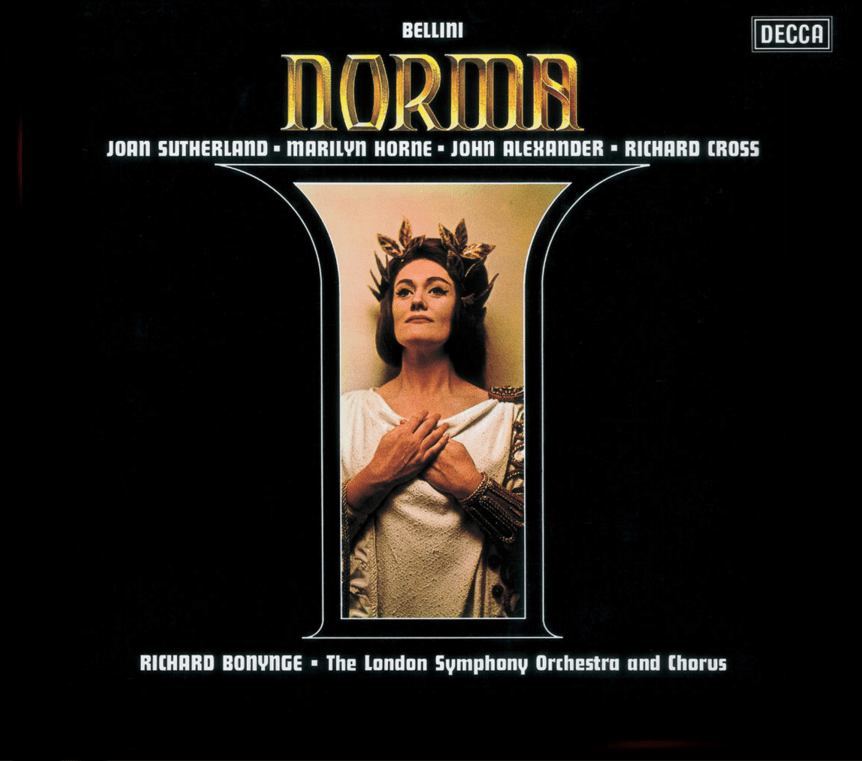
Joan Sutherland, like Callas recorded Norma twice (officially). Her first recording from 1965 (Decca 4704132) caused a real sensation. It was the very first recording of Bellini’s complete music, without any cut. Moreover, it was the first recording in the original key (Bellini composed his opera in G, but before the premiere he changed it to F).
In those days, Sutherland was considered the belcanto specialist par excellence. Her voice knew no limits and seemed to be made of elastic. High, higher, highest, and with coloraturas that sound almost inhumanly perfect.
Adalgisa was sung by Marilyn Horne, Sutherland’s alter ego in the mezzo voice. The result is dazzling, but it lacks the necessary drama, all the more so because John Alexander (Pollione) has a beautiful but insipid voice.
The orchestral playing is excellent, however, and if you like pure singing, high notes and and if you like pure singing, high notes and coloratura, this recording is the best choice.
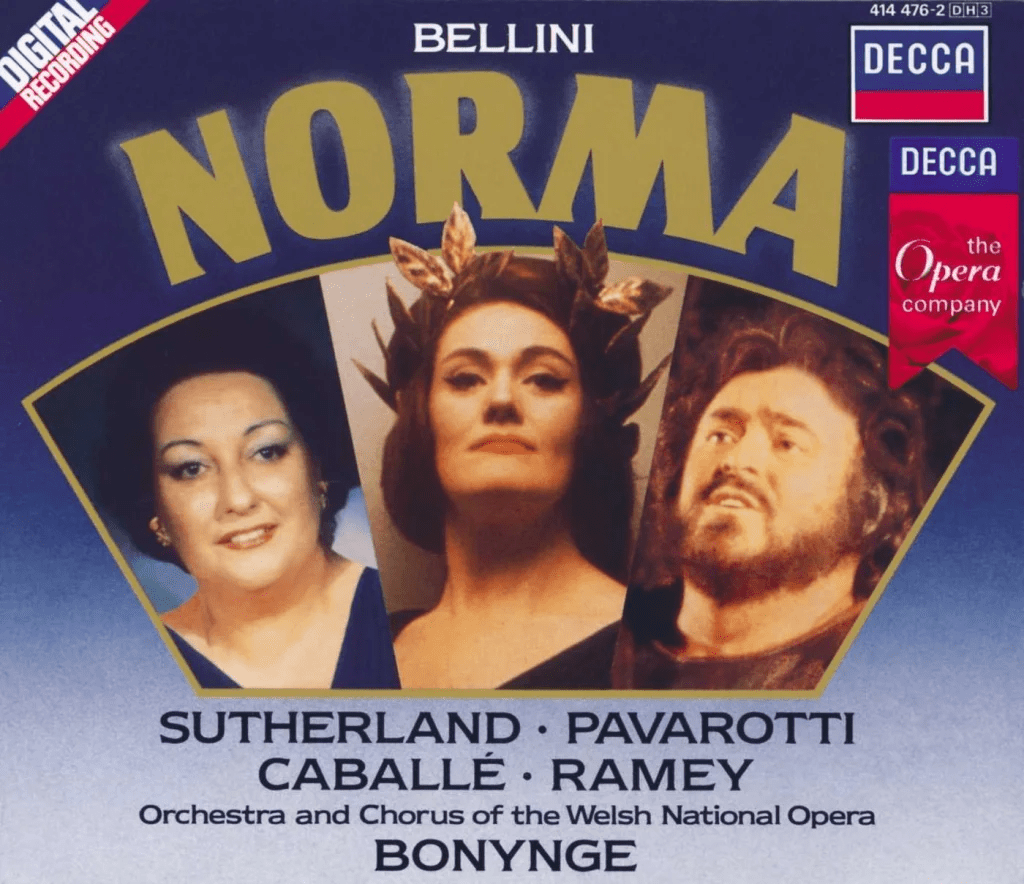
Twenty years later, Sutherland recorded the role again, this time with Montserrat Caballé (Adalgisa) and Luciano Pavarotti (Pollione). Let’s call it a mistake, although Caballé’s Adalgisa is at least interesting. It’s a pity it wasn’t thought of sooner.
MONTSERRAT CABALLÉ
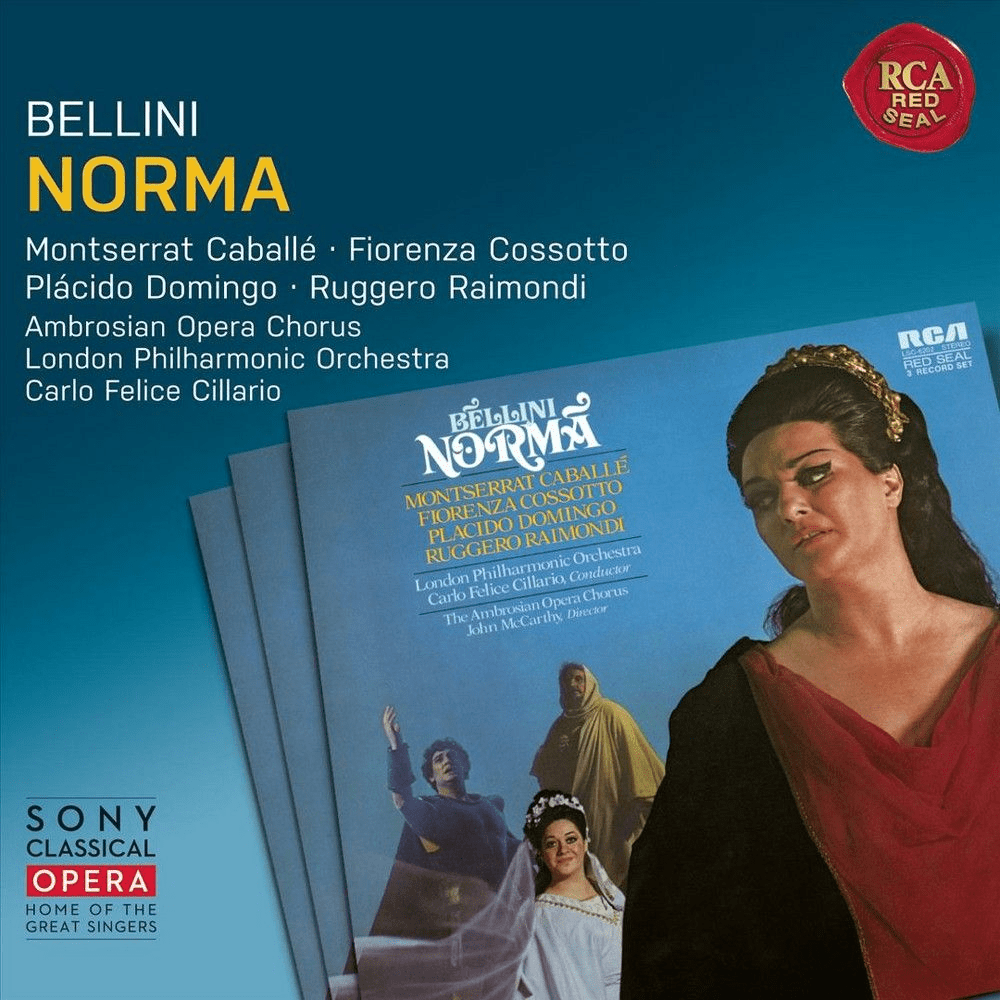
Caballé is a kind of cross between Callas and Sutherland: wonderful top notes, incredibly beautiful legato arches, perfect trills, and moreover a pianissimo that none of her colleagues could match. She was a much better actress than Sutherland, moreover she had great charisma. She never went to extremes like Callas or (later) Scotto, but her performances were always very convincing. In 1973 she recorded the role for RCA and the result was very decent (GD 86502). Her Pollione, a very young Plácido Domingo, was vocally crystal clear and sounded like a bell. However, he lacked dominance, making him sound far too young for the role.
Fiorenza Cossotto in her role of Adalgisa looked more like Azucena than a young girl, but her singing as such was flawless. Unfortunately, the orchestra sounds uninspired and hurried, which must surely be blamed on the conductor, Carlo Felice Cillario.
In 1974 she sang Norma in the Roman amphitheatre in Orange (Provence). It was a very windy evening, and everything blew and moved: her hair, veils and dresses. A fantastic sensation, which added an extra dimension to the already great performance. It was filmed by French television (what luck!), and has now appeared on DVD (VAIV 4229).
Caballé sings ‘Casta Diva’:
Caballé was in superb voice, very lyrical in ‘Casta Diva’, dramatic in ‘Dormono etrambi’ and moving in ‘Deh! Non volerli vittime’. Together with Josephine Veasey, she sang perhaps the most convincing ‘Mira , o Norma’ – of all, at least in a complete recording of the opera. As two feminists avant la lettre, they renounce men and transform from rivals into bosom buddies.
Jon Vickers (Pollione) was never my cup of tea, but Veasey is a fantastic (also optically) Adalgisa and Patané conducts with passion. Of all the recordings on DVD (and there are not many), this is definitely the best.
RENATA SCOTTO
Scotto sang her first Norma in 1974, in Turin. To my knowledge, there is no recording of it, at least not of the complete opera.
Casta Diva’ from Turin:
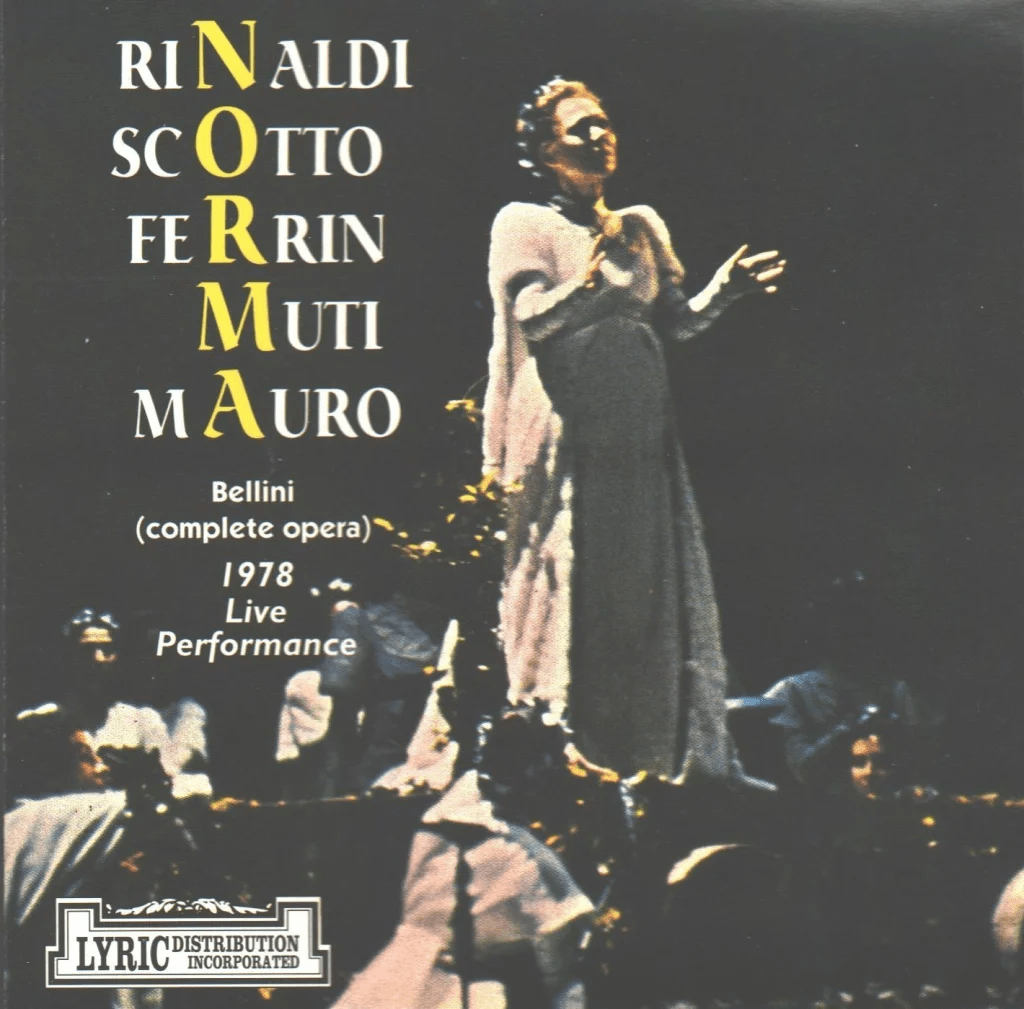
A pirate did record the 1978 performance in Florence (Legato LCD 203-2). It should have been an ideal Norma, but unfortunately the performance was marred by a no more than adequate Ermanne Mauro as Pollione.
Margherita Rinaldi (finally a soprano again) sounds young as Adalgisa and Scotto is, according to many critics, the first Norma, after Callas, who seems to know what it’s all about. Orchestrally, this recording belongs to my top three, but the sound is unfortunately not really great.
Scotto in ‘Dormono entrambi’ in 1978:
In 1980 Scotto recorded the opera in the studio (Sony SM2K 35902), conducted by James Levine. I cannot find much negative to say about her performance, although the ‘steel’ in her voice is sometimes particularly painful. The Adalgisa (incredibly beautiful Tatiana Troyanos) is also absolutely top-notch. But Giuseppe Giacomini (Pollione) is not great at all and Levine conducts far too heavily and overdramatically.
It is perhaps superfluous, but I have to get it off my chest: there is no such thing as objective music criticism. Of course there are criteria, but it is not science: after all, you listen to music not only with your ears, but also with your soul and your heart, and you cannot switch them off. Therefore, do not consider my mini discography as an absolute truth and, as far as possible, listen and judge for yourself.
Norma is considered the pinnacle of bel canto, but at the same time, this is a tremendous musical drama that leaves Verdi’s early works quite behind and carries with it the promise of a ‘Tristan’. And although it is a love story and both protagonists die a kind of ‘Liebestod’ at the end, love is not the heroine’s only motivation. She is also a mother, a priestess, a patriot, a daughter and a friend, and to be able to express all these aspects of human feelings, you need to be more than a ‘singer’.
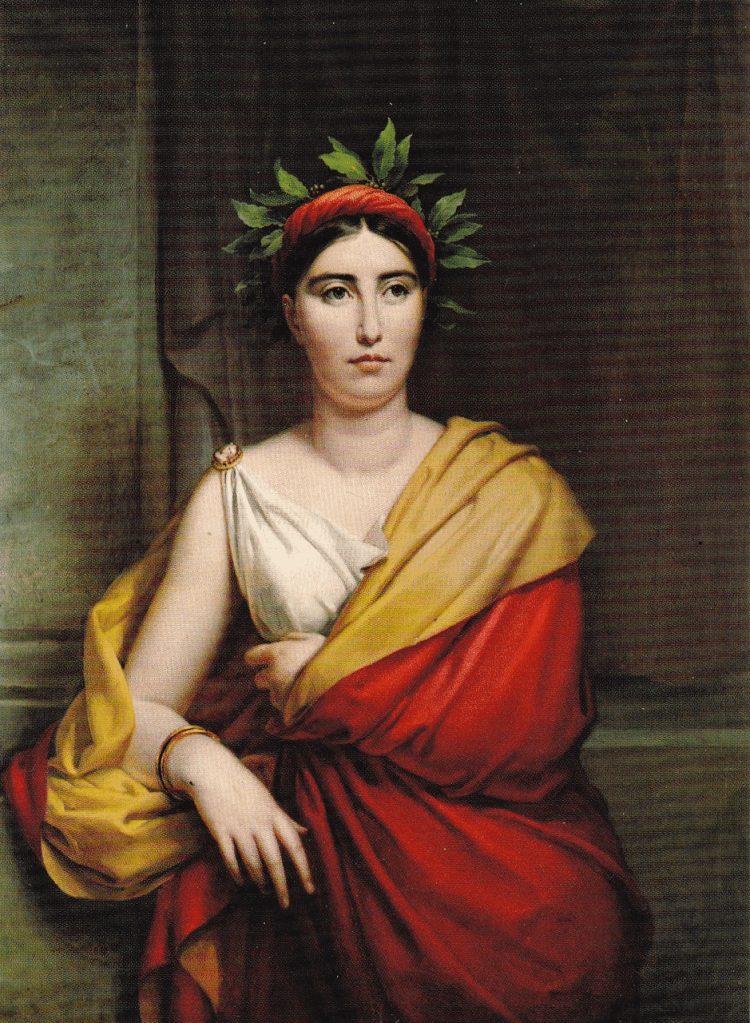
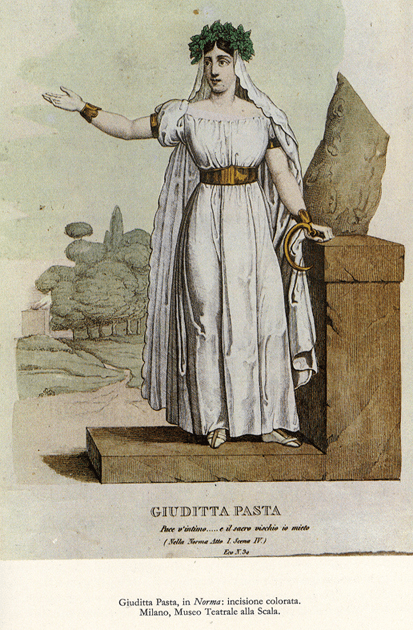
The role of Norma was created by Giuditta Pasta, originally a mezzo, who had trained her voice upwards. Pasta was an exceptionally intelligent singer with a great stage personality and a great voice range but her technique was not optimal, which caused her voice to deteriorate very early in her career. Pauline Viardot (one of the most famous mezzos of her time) once said about Pasta: “She looks like ‘The Last Supper’ by Leonardo da Vinci – a ruin of a painting, but it is still the greatest painting in the world”.
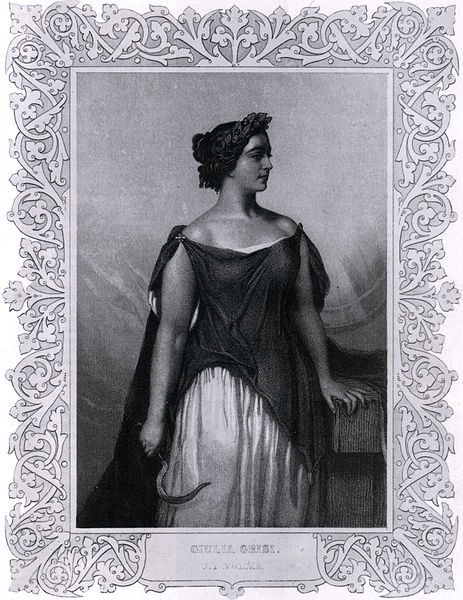
Giulia Grisi as Norma
The first Adalgisa was sung by Giulia Grisi, a soprano who also created the roles of Elvira (I Puritani) and Giulia (I Capuletti e i Montecchi), and who would later become a great Norma herself.
Gina Cigna
In the first fifty years of the twentieth century, Norma was only rarely performed. Opera history mentions only two memorable performances: in 1926 at the Metropolitan Opera (with Rosa Ponselle and Lauri-Volpi) and in 1936 at La Scala, with Gina Cigna.
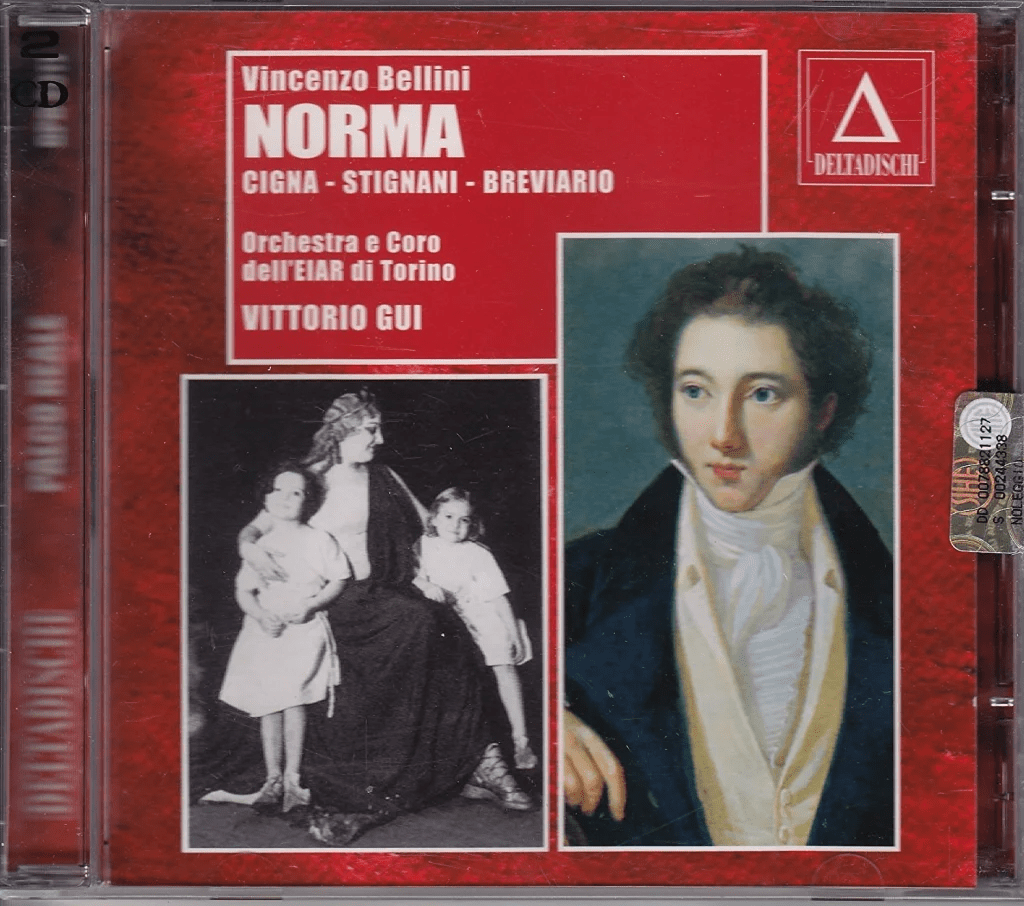
In 1937, the very first (almost) complete recording of “Norma” was made: with Gina Cigna, Ebe Stignani and Giovanni Brevario, conducted by Vittorio Gui (various labels). the sound is still quite good, although obviously not optimal.
In the opera world there is a general opinion that most (Bel canto) singers before Callas were light, like canaries. This is not true. Just listen to Cigna’s full, dark timbre and to her sense of drama.
Cigna approaches the role from the verist tradition and plays it heavily. There are no coloraturas, but her technique is phenomenal and her top notes firm and pure. However, she is not a real actress, thus her interpretation is far behind that of Callas (among others).
Adalgisa is sung here by the young Ebe Stignani: a beautiful, warm mezzo, much more convincing here than in all her later recordings. Giovanni Breviario is an inferior Pollione, but orchestrally this recording is, together with those of Serafin (Rome 1955) and Muti (Turin 1974), one of the three finest Normas. Partly because of this (and the particularly moving sung ‘Deh! Non volerli vittime’) it is well worth listening to.
Gina Cigna and Giovanni Breviario in ‘Deh! non volerli vittime’:
MARIA CALLAS
One thinks Norma, one says Callas. Rightly so, because like no other La Divina has left her mark on this role. Between 1950 and 1964, she was undeniably the best Norma. Perhaps she was the best Norma ever. She sang the role more than 90 times and recorded it twice in the studio, both times under Tulio Serafin.
The first dates from 1954 (Warner Classics 0825646341115). Callas was then at her best vocally, yet this recording does not really captivate me. I find Serafin’s accompaniment downright boring, Filippeschi, despite his beautiful voice, is no Pollione of weight, and Stignani simply sounds (too) old. I also have some comments on Callas’ acting. Her ‘Casta Diva’ seems much more a love aria than an ode to the moon goddess, which it actually should be. But her singing is phenomenally beautiful, with wonderful heights and good trills.
In the autumn of 1960, Callas insisted on recording the opera again. It is claimed that she wanted to make her comeback with it (due to all sorts of scandals, Callas had not sung for nine months). This is possibly true, but it is also very likely that her views on the role had changed so much that she wanted to record it again.
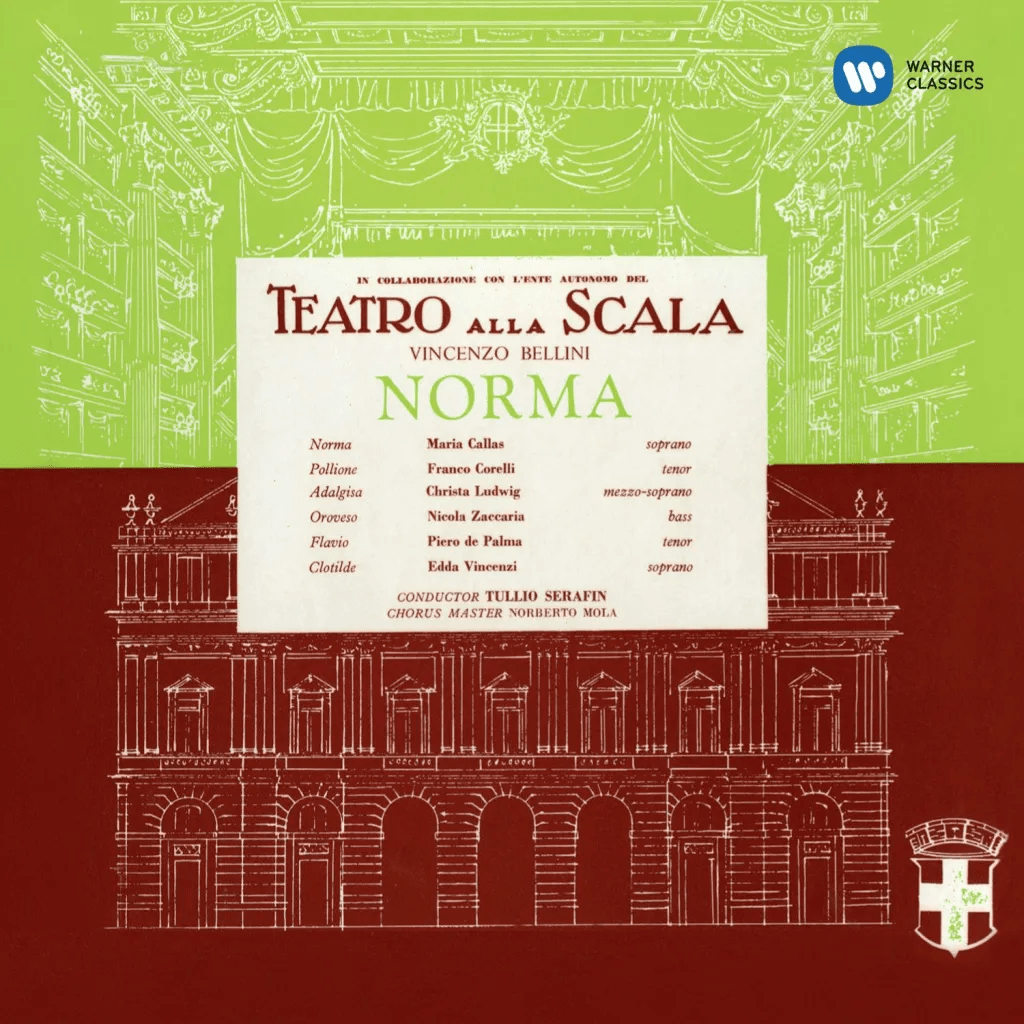
Anyway it is fortunate that she did, because her second ‘official’ Norma (Warner Classics 0825646340842) is in all respects superior to the first. Franco Corelli is probably the best Pollione ever: a real warlord with a very masculine voice. Certain of himself and his appearance, resolute, macho, but also loving and very, very sensual and sexy. No wonder, then, that a young priestess would fall for him. And no wonder that a woman like Norma – strong, beautiful and powerful – continues to love him, despite his betrayal.
Adalgisa is sung by a young Christa Ludwig. Not really Italian, also (for me) a bit too dark in timbre, but with so much empathy that it doesn’t really matter. Callas herself is past her vocal peak and here and there she lets out a painful note, but as an actress she is absolutely unequalled. Here, too, she occasionally wants to “make believe” (the scene with her children, for example), but her intense involvement, her complete understanding and surrender – it is unique. Serafin, too, is clearly much more inspired, although I occasionally have trouble with his tempi.
Next to these two studio- recordings there are half a dozen radio- and pirate-recordings made from her live- performances. They are from London, Milan and Rome. One of them I will discuss here, because for me, this is the greatest Norma of them all! It is a registration of a performance on 29 june 1955 in Rome (amongst others on Opera d’Oro 7003).
Callas, in wonderful voice, never misses a (top) note, nor a gasp or a nuance. From pianissisimo to forte and back again, from dark to light and open, from glissando to portamento she goes on and on and all this with a great feeling for style and a deep understanding of the text. This is dramatic Belcanto singing pur sang; this is what Bellini must have had in mind.
Mario del Monaco sings a dream of a Pollione. sometimes a bit loud, but he is allowed, because he is a warrior after all. In ‘Qual cor tradisti, qual cor perdisti’ he is audibly moved and falling in love again. Their voices melt together in the ultimate love duet which can only lead unto death.
Maria Callas and Mario del Monaco in ‘Qual cor tradisti’:
Serafin conducts it all with feeling for both drama and lyricism and if Stignani still does not convince me, it is only because I want to hear a soprano in that role.
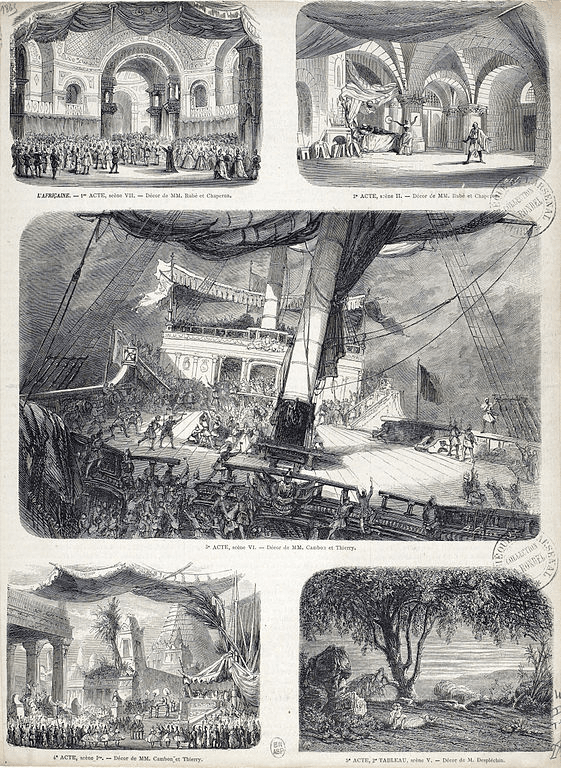
Settings for the 1865 premiere of a L’Africaine (press illustrations). The stage designs for Act I (Council Scene) and Act II (Dungeon Scene) were created by Auguste-Alfred Rubé and Philippe Chaperon; for Act III (Sea Scene and Shipwreck) and Act IV (Hindu Temple), by Charles-Antoine Cambon and Joseph-François-Désiré Thierry; for Scene 1 of Act V (Queen’s Garden, not shown), by Jean Baptiste Lavastre; and for Scene 2 of Act V (The Machineel Tree), by Edouard-Désiré-Joseph
SHIRLEY VERRETT
Shrirley Verrett (Selika)and Plácido Domingo (Vasco da Gama) in San Francisco
Vasco da Gama (yes, the Vasco da Gama) loves Inès, but when his own life is in danger, he takes refuge with the African queen, Sélika. Poor Sélika! She loves him wholeheartedly, but as soon as Inès reappears on the scene, she has to step asie. She does so literally; by smelling a poisonous flower.
Of course, much more happens in the opera, especially in the music. I wonder why it is that the opera is performed so little. Is it due to the weak male lead, who mainly pursues fame? In any case, Meyerbeer gave him a magnificent aria, probably one of the most beautiful ever: ‘Pays merveilleux/Oh paradis’:
Domingo has always had faith in the opera and he has sung da Gama several times. It is also thanks to him that the opera experienced a minor revival in the 1970s.
There is a pirate recording on CD (Legato Classics LCD-116-3), starring Shirley Verrett and a truly brilliant Norman Mittlemann as Nélusco. It is from 1972, but there is no mention of where it was recorded. But since Verrett sang a series of performances that year, in San Francisco, it is actually quite clear.
The sound quality is poor, but not to worry: the opera was later also recorded for television, so that we can now enjoy it to the full on DVD (Arthaus Music 100217).
The truly wonderful production was created by Lotfi Mansouri (direction) and Wolfram and Amrei Skalicki (stage and costumes). Inès is sung by a (literally) beautiful, light coloratura soprano Ruth Ann Swenson and Justino Díaz does his best to convince us that he is scary. You should really watch it!
MONTSERRAT CABBALÉ
In 1977, the opera was recorded at the Teatre Liceu in Barcelona, again with Plácido Domingo as da Gama. But should I really recommend this recording? Probably not. Montserrat Caballé is a fine but unconvincing Sélika, Juan Pons has seen better days and Christine Weidinger is a merely decent Inez (Legato Classics LCD 208-2).
MARTINA ARROYO
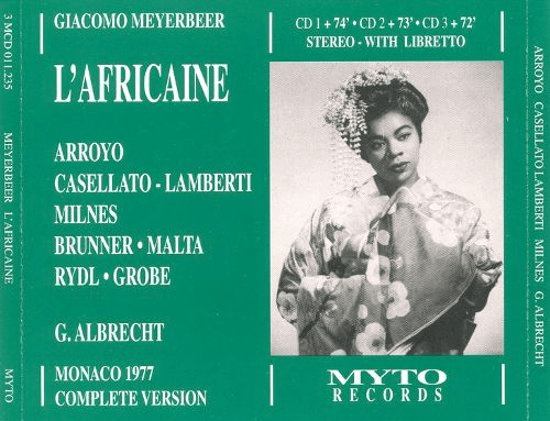
In November 1977, L’Africaine was recorded live in Monaco with a fine Martina Arroyo in the leading role. The textbook says it is probably the most complete performance of the score ever recorded. Unfortunately, Giorgio Casellato-Lamberti is a weak Vasco da Gama, but Sherrill Milnes’ superb Nélusco makes up for a lot (Myto 3MCD 011.235).
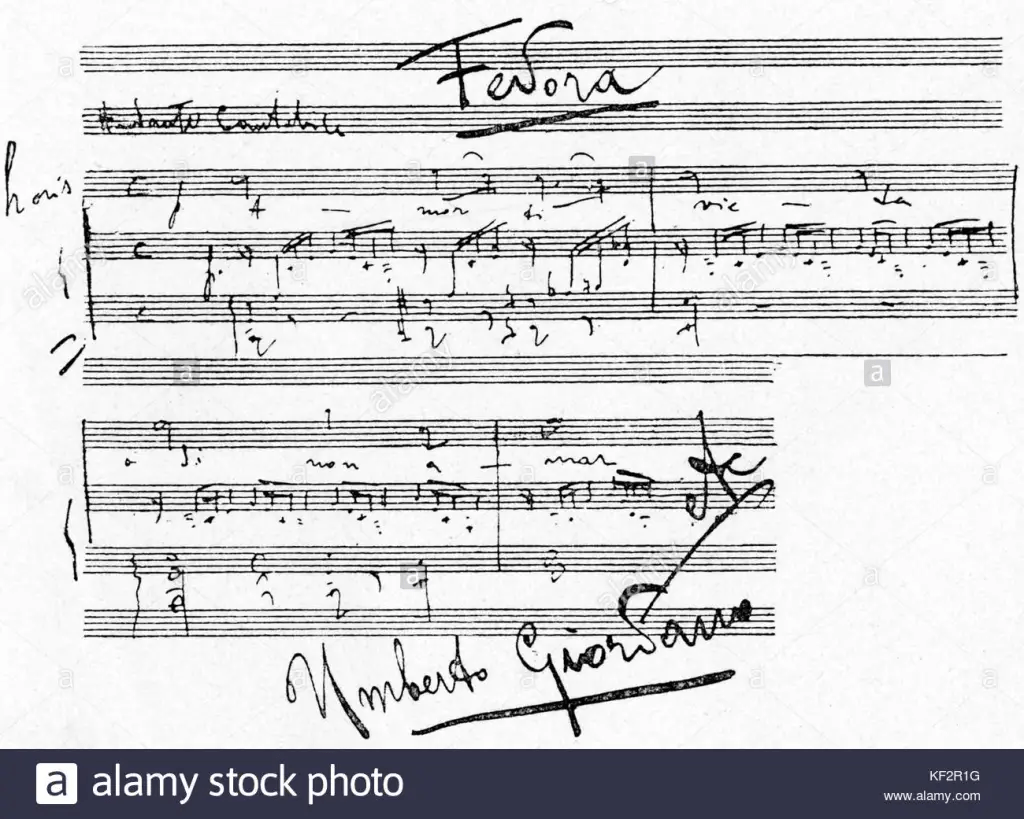
How many opera lovers know Umberto Giordano and his operas? Many know Andrea Chénier (for me one of the best and most beautiful operas ever), but that’s it. Unless you are a fan of verism, in which case there is a good chance that you have heard of Fedora. And if you do go to opera houses in countries other than the Netherlands, you may even have seen the opera. Otherwise, you are left with nothing but the CD and DVD recordings.
Admittedly, Fedora does not reach the level of Andrea Chénier, which is mainly due to the libretto. The first act has a hard time getting started and the third is a bit drab. But the music! It is so incredibly beautiful!
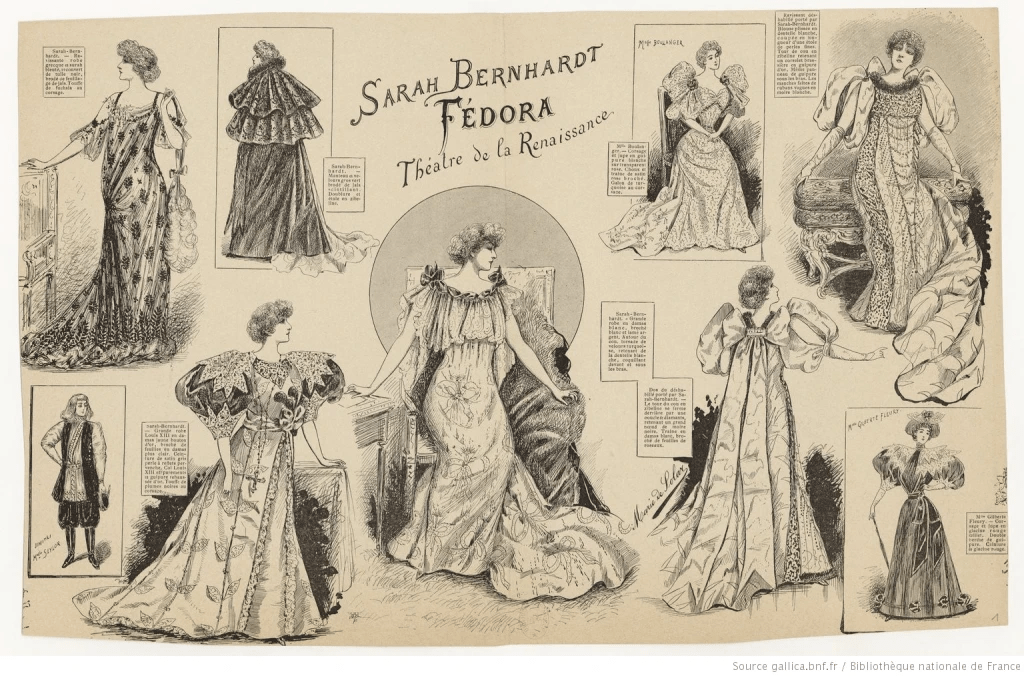
The play on which Arturo Colautti’s libretto is based comes from the pen of Victorien Sardou and, just like Tosca, it was written for the greatest tragédienne of the time, Sarah Bernardt. The opera therefore offers an amazing opportunity for the best singing actresses. Magda Olivero, for instance, is without doubt one of the greatest performers of the role.
Below Magda Olivero, Doro Antonioli and Aldo Protti in the third act of Fedora, recorded in the Concertgebouw in Amsterdam 1967:
And with Mario del Monaco in Monte Carlo 1969:
No wonder then that in 1970, when there was serious talk of a comeback for Maria Callas, she was proposed to sing Fedora with Domingo as Loris. Unfortunately, nothing came of it: Callas did want to return, but only as a Norma or a Violetta.
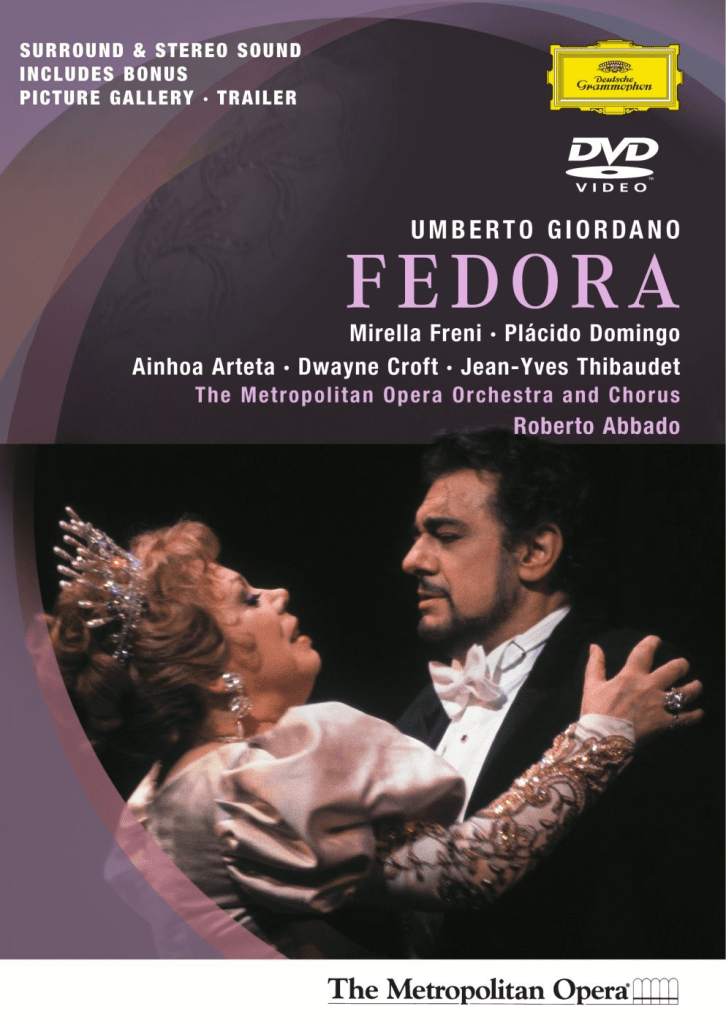
When she was sixty, Mirella Freni included Fedora in her repertoire and she gave a series of performances in Italy and Spain, finally coming to the Met in 1996. It became an enormous success. No wonder, because La Freni’s voice was extraordinary. I have never before seen her act with such intensity; it is a performance of the highest level.
Domingo also portrays a perfect Loris: tormented and oh so charming!
Ainhoa Arteta is truly delightful as the flirtatious, spirited Olga; her performance provides the necessary comic note. As the Polish pianist, Boleslao Lazinski, the real piano virtuoso appears: Jean-Yves Thibaudet. Not only can he play the piano very well, but throughout his performance he convinces as a real primadonna, it is very entertaining to watch.
The staging is conventional, with lavish, larger-than-life sets and real snow behind the stage-sized windows. It is just beautiful (DG 0732329).
In 2008, DG (4778367) recorded the opera on CD. Alberto Veronesi is a fine, lyrical conductor. He is less dramatic than his colleagues, so that the opera loses something of its ‘verism’.
Domingo is now an aging Loris, but he still sings with passion and in the third act he is simply irresistible. Angela Gheorghiu is a fine, slightly understated, Fedora and Nino Machaidze is a truly fantastic Olga.
Les vêpres siciliennes was Verdi’s first French ‘grande opéra’, which, after much insistence by the Paris Opera, he composed on a libretto by Eugene Scribe and Charles Duyverier. It is one of his longest operas, thanks in part to the lengthy ballet in the third act, which was compulsory for the Paris of the time (no less than half an hour!).
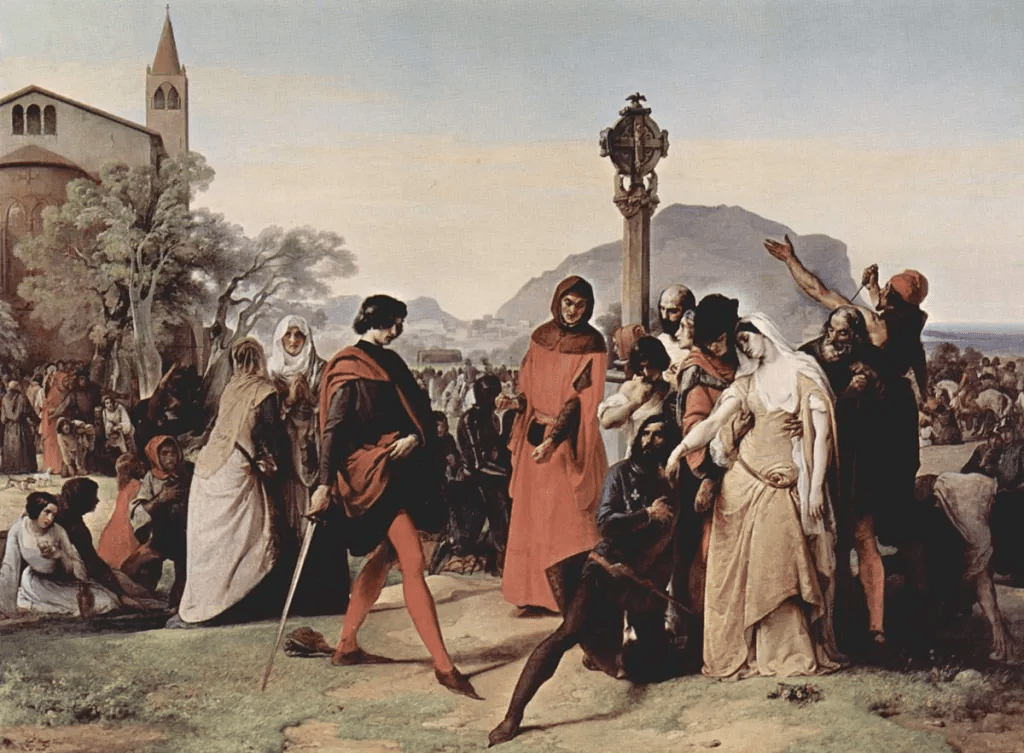
The story is set in Palermo in 1282, during the French occupation of Sicily. The young Sicilian Henri is in love with Hélène, a young Austrian duchess, who is being held prisoner by Guy de Montfort, the French governor of Sicily. When de Montfort turns out to be Henri’s father, the complications are incalculable, and by the end just about everybody is dead. The premiere in 1855 was a fiasco and a few years later, Verdi adapted the work into the Italian I vespri Siciliani, which was much more successful. However, the opera never became a real box-office hit.
IN FRENCH
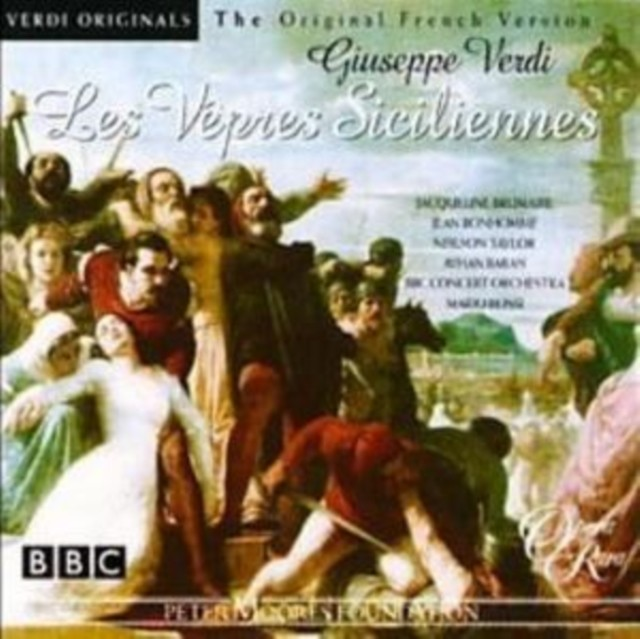
Les vêpres siciliennes was the third release in Opera Rara’s series of ‘original versions’, following earlier releases of Macbeth and Simon Boccanegra. It had already been recorded live at The Camden Theatre in London in May 1969 and broadcast by the BBC in February 1970, but the CD was not released until 2004.
The performance, starring Jacqueline Brumaire, Jean Bonhomme and Neilson Taylor, is fair to good, but as a document it is of extraordinary importance (ORCV303).
In June 2002, our unsurpassed Saturday Matinee staged Les vêpres siciliennes concertante. It is a great pity that the recording has never been released on CD, because the performance (with, among others, Nelly Miricioiu, Francisco Casanova and Zeljko Lucic) was really good.
IN ITALIAN
If you want the Italian version of the opera, the choice is a bit greater, but to say the market is flooded with them?
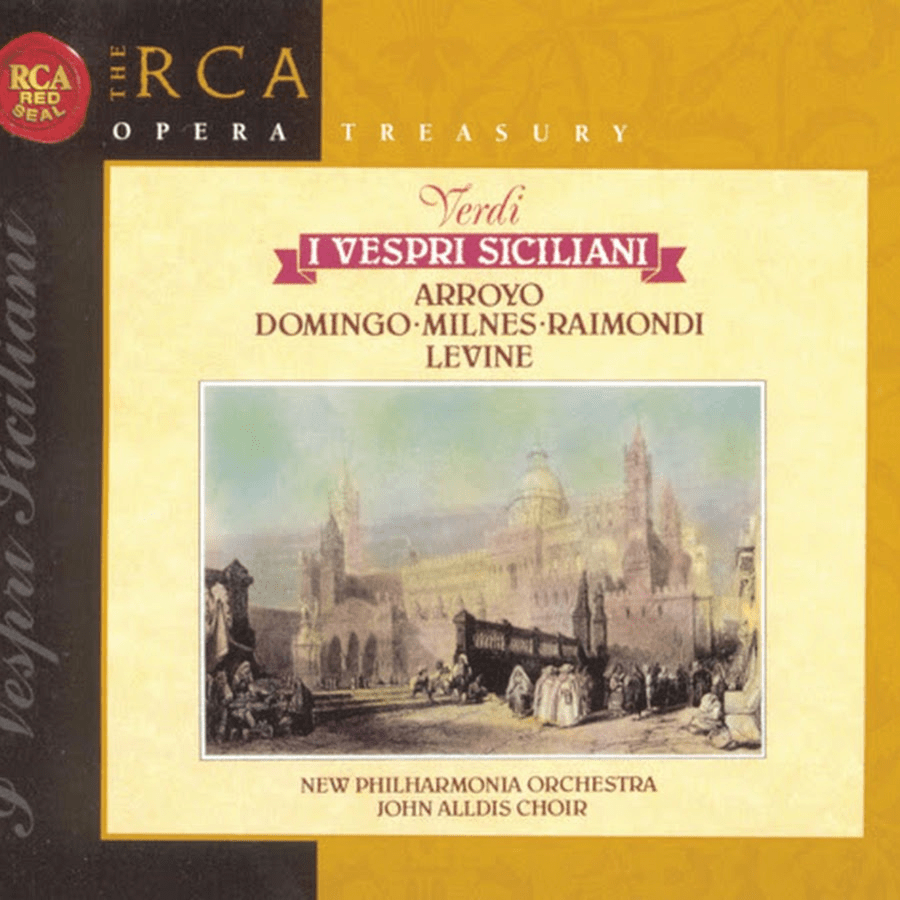
To be honest, I only know of one studio recording of the work (once RCA RD 80370). The cast includes Martina Arroyo, Plácido Domingo, Sherill Milnes and Ruggiero Raimondi. It is well worth seeing, especially as the music is virtually complete.
For the rest, we have to depend on (admittedly, in most cases very interesting) pirate recordings. Highly recommended is a recording with Montserrat Caballé and Plácido Domingo from Barcelona 1974 (SRO 837-2).
The same recording on another label (SRO is no longer available):
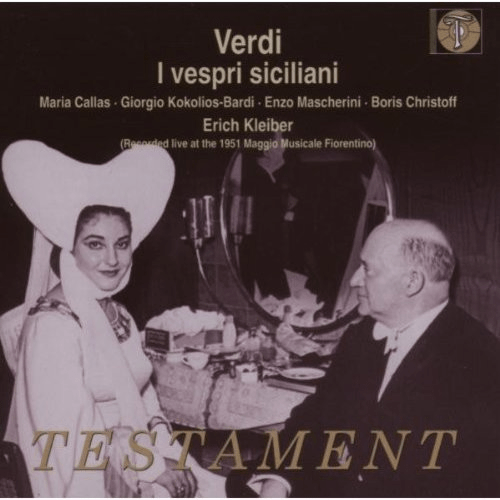
Don’t forget La Divina (with Boris Christoff and others), recorded in 1951 during the Maggio Musicale Fiorentino (Testament SBT 21416).
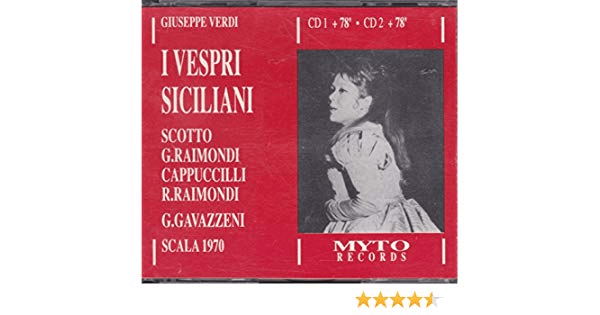
Fantastic is also the version with Renata Scotto, Gianni and Ruggiero Raimondi from La Scala 1970 The entire opera:
And then there are a few recordings with Cristina Deutekom This one is from Paris 1974:
And Leyla Gencer. Recording from 1970:
Please note: most recordings have been (greatly) shortened. Check the internet just to be sure, because these pirate labels come and go and the difference in price can be enormous.
AND ON DVD
In the 1980s, the American Susan Dunn was immensely popular. She was seen as the ultimate Verdi soprano. In her ‘Bologna years’ she became the favourite singer and protégé of Riccardo Chailly, the chief conductor there at the time. She made many CD recordings with him. Apart from Verdi also Mahler, Schoenberg and Beethoven, and they also recorded opera performances for video.
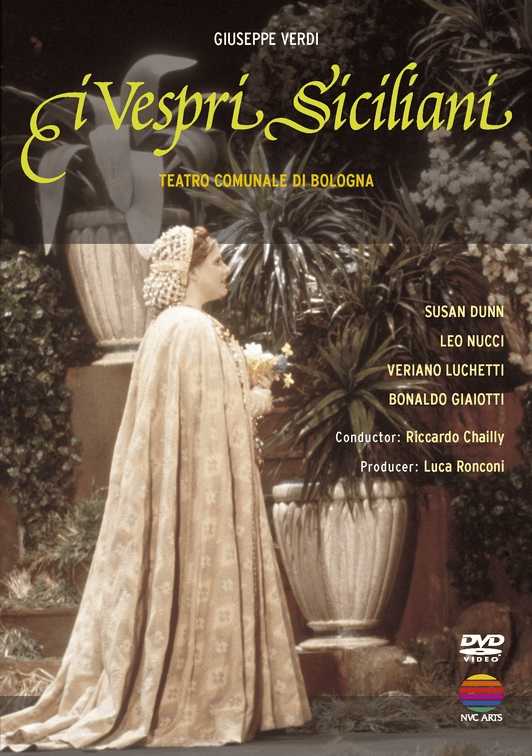
Elena in I vespri Siciliani was one of her star parts. She sang it, with enormous success, for the first time in 1986 (Warner Music Vision 504678029-2). Luca Ronconi’s production is quite traditional and the decors are true to nature. It feels like being among the cacti on a very sultry Sicily. The costumes also leave nothing to be desired, but the whole performance is rather static.
The audience clearly loves it. One open curtain follows another and the singers gratefully accept all the applause. Even though none of the protagonists are great actors – which may also be due to the director – their singing is of a very high level. And there is a surprise too: Anna Caterina Antonacci in the small role of Ninetta.
Below, Susan Dunn sings “Arrigo! Ah, parli a un core”:
Della Casa is één van mijn geliefde zangeressen, zeker in het Duitse ‘fach’. Haar mooie, romige stem met een vloeiende hoogte en een zeer sensuele ondertoon maakt haar tot één van de beste vertolksters van de muziek van Strauss. Haar ‘Vier Letzte Lieder” vind ik zelf het allermooist van allemaal.
Zo ook haar Marschallin. Voor mij heeft ze alles, wat de wat ouder (nou ja, ouder, zij is pas 34!) wordende vrouw ook voor een jonge jongen aantrekkelijk maakt. Zelfbewust en toch enigszins kwetsbaar. Koninklijk en speels. Vrolijk en melancholisch.
Della Casa was een zeer mooie vrouw, zeer elegant ook. Het is daarom echt jammer dat haar Feldmarschallin voor zover ik weet niet is vastgelegd op dvd. Er zijn diverse cd-opnamen met haar verkrijgbaar, allemaal live en in de meeste gevallen niet in een optimale geluidskwaliteit.
Ik wil even stilstaan bij de productie die op 18 januari 1956 werd opgenomen in de Metropolitan Opera (Walhall WLCD0313). De geluidskwaliteit is zeer pover en scherp, wat niet wegneemt dat er zo ongelofelijk veel valt te genieten!
Het Met-orkest onder leiding van Rudolf Kempe klinkt ouderwets mooi: zoetig en weemoedig. Wenen ten top. Af en toe moest ik ook aan oude films denken – toch geen straf.
Della Casa is onweerstaanbaar en zo is ook haar Octavian, Risë Stevens. Tel daar de onnavolgbare Hilde Güden als Sophie bij op en dan weet je wat voor hemel je in de ‘Hab’mir’s gelobt’ kunt verwachten.
Elisabeth Schwarzkopf
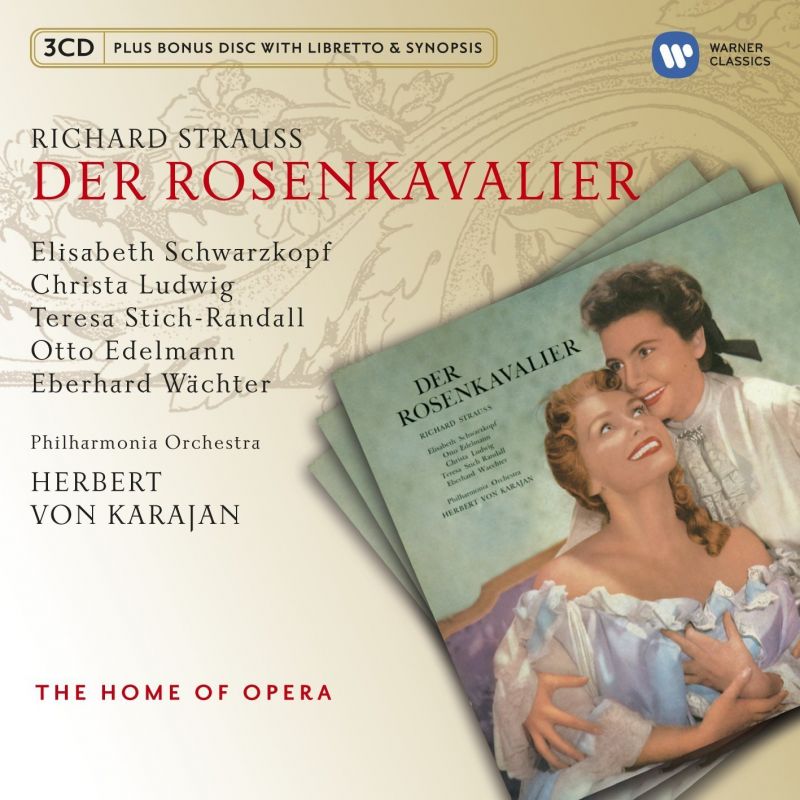
Nu ga ik mij op glad ijs begeven. De Karajan-opname uit 1956 ((Warner Classics 5099996682425) heet legendarisch te zijn. Maar ik houd niet van Elisabeth Schwarzkopf: ik vind haar zingen vaak gemaniëreerd en haar nadrukkelijke dictie maakt dat ik mij vaak ongemakkelijk voel. Ook haar glansrol, de Marschallin, vind ik te geaffecteerd en bovendien zeer onderkoeld.
Von Karajan kan mij hier ook moeilijk bekoren. O ja, het orkest onder zijn leiding speelt werkelijk fenomenaal, maar ik vind er te weinig ‘Weense bonbons’ en te veel ‘Pruisische dril’ in. Maar wellicht ligt het aan mij?
Christa Ludwig is echter een wonderschone Octavian en Teresa Stich-Rendall een Sophie in de beste Mozartiaanse traditie. Otto Edelmann is een heerlijke baron Ochs.
Montserrat Caballé
Onlangs bereikte mij een cd-opname uit Glyndebourne 1965. Het is een in alle opzichten merkwaardige voorstelling geweest: de rol van de Marschallin werd toen gezongen door niemand minder dan Montserrat Caballé.
Wij kunnen het ons nu niet meer voorstellen, maar toen was het volstrekt voor de hand liggend. Caballé is haar carrière in Duitsland begonnen en heeft zelfs een prachtige Salome op haar repertoire staan. Er is ook helemaal niets op haar Duits aan te merken. Ze is een mooie, jonge en kruidige Marschallin, die de rol ‘op z’n Caballés’ verrijkt, met de mooiste pianissimo’s en legato’s.
Teresa Zylis-Gara is een verrukkelijk licht klinkende Octavian en Edith Mathis een als een vijftienjarig meisje klinkende Sophie. Otto Edelmann (Ochs) completeert de fantastische opname (GFOCD 010-65).
Trailer:
Claire Watson
Net als voor zijn vader Erich, was ‘Der Rosenkavalier’ een paradepaardje van Carlos Kleiber, een van de meest charismatische dirigenten van de laatste 50 jaar. In 1973 werd de opera live geregistreerd tijdens het Münchner Festival en een jaar of twee geleden op Orfeo (C 581 083 D) uitgebracht.
Bij de enthousiast ontvangen première een jaar eerder werd de Marschallin gezongen door Gwyneth Jones (er bestaat een DVD-opname van), nu werd ze vervangen door Claire Watson, jarenlang het boegbeeld van het Münchense ensemble. Watson is een wat rijpere Marschallin, weemoedig, bitterzoet en niet gespeend van humor. Ik vind het mooi.
Karl Ridderbush is werkelijk kostelijk als Ochs: lomp en over alles heen walsend, maar in zijn walsjes klinkt hij toch oprecht ouderwets melancholisch. De Sophie van Lucia Popp is onnavolgbaar: kwikzilverig, flirterig en kwetsbaar. Haar pure meisjesachtige sopraan smelt in perfecte harmonie met de donkere mezzo van Brigitte Fassbaender, twee stemmen die daadwerkelijk verliefd op elkaar zijn geworden.
Maar het mooiste is het orkest. Kleiber ontlokt de beoogde ‘zilverklank’ en vervlecht het natuurlijke sentiment met ironie en een zekere hang naar vroeger.
De opname werd al eerder op verscheidene piraten-labels te koop aangeboden, maar nu kunnen we hem eindelijk in een goede geluidskwaliteit beluisteren.
Anna Tomowa-Sintow
Tomowa-Sintow behoorde tot de lievelingszangeressen van Herbert von Karajan. Begin jaren zeventig haalde hij haar naar Salzburg, waardoor ze internationaal kon doorbreken. Zij heeft ook veel opnamen onder de maestro gemaakt, voornamelijk Mozart en Strauss. De Marschallin had ze onder zijn leiding al in 1984 voor Deutsche Grammophon opgenomen, maar ik ken die opname niet.
Wel een andere, op 3 maart 1995 live opgenomen in Covent Garden (Opus Arte OA CD9006). In 1995 was ze al een rijpe vrouw en zo klinkt ze ook. Maar haar vertolking is meer dan roldekkend: ze zingt niet alleen doorleefd maar heeft ook allure.
Ann Murray (ach! Wat een zangeres!) is een verrukkelijke Octavian en Barbara Bonney een wellicht niet voor de hand liggende, maar wel een heerlijke Sophie.
De walsjes zijn onder handen van Andrew Davis heel erg luchtig, wat ook de hele opname een opvallend milde toon geeft.
For most Russians, the Volga, the longest river in Europe, is the symbol for everything, including life itself. It is celebrated in many songs, and in many stories and poems it plays the leading part.
In Ostrovsky’s Storm, on which Janaček’s opera is based, and also in the opera itself, the river mirrors the soul of the unhappy Kát’a , whose life ends in the Volga. You can hear the river in the music also.
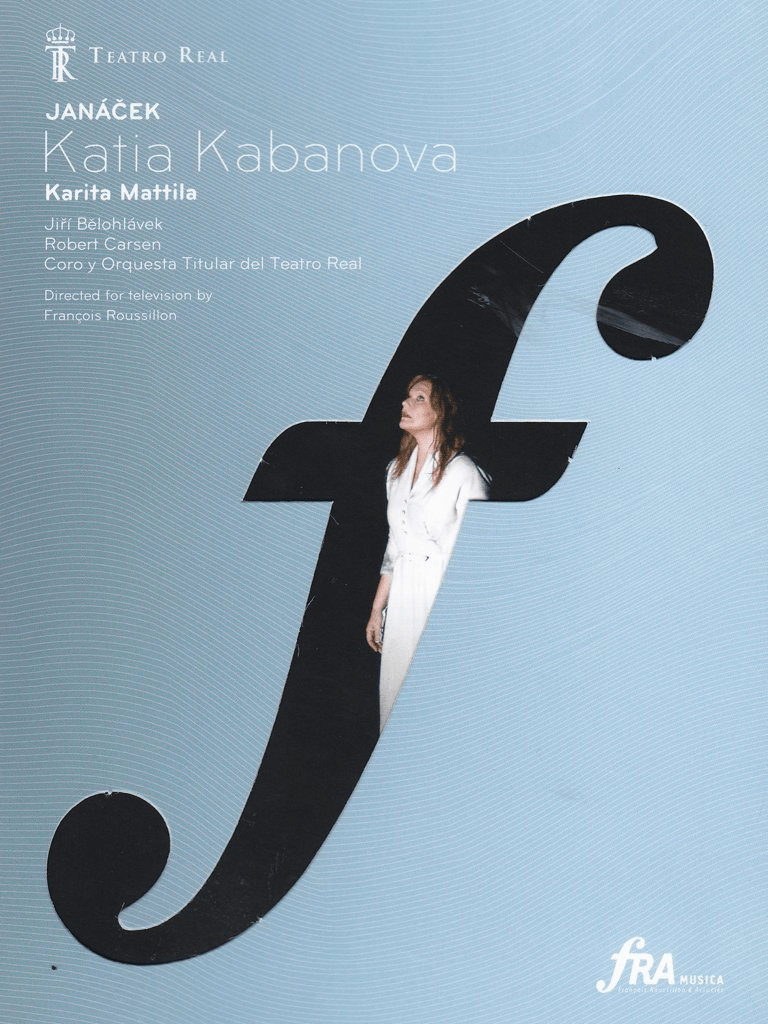
Robert Carsen understood this very well; in his 2004 Antwerp production he had the entire stage covered with water and the story played out on platforms. I thought it was the most beautiful production of the work ever. It was taken over by the Teatro Real in Madrid in 2008 and released on DVD not long ago (Fra Musica 003).
I must honestly confess that I was really scared to see it again. Would I still find it so very beautiful? The answer is a resounding yes! It is even more beautiful than I remembered it.
Karita Mattila is a Kát’a to fall in love with and Jiří Bělohlávek is, next to Mackerras, the best advocate for the opera. Do you want my honest opinion? Buy it, because it is as beautiful as it gets!
Act Three: The Storm
Christopher Marthaler
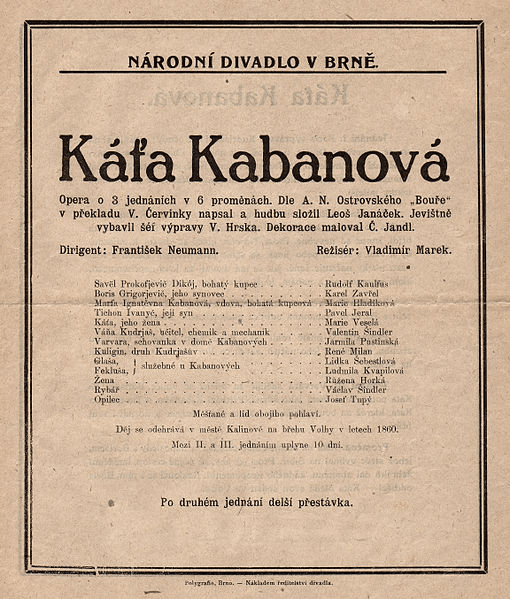
Believe it or not, to most opera lovers Kát’a Kabanova belongs to the standard repertoire, but in Salzburg it was not performed until 1998. The fact that the production was received with mixed feelings at the time, was not due to the music or the singers, or the orchestra or the conductor.
Sylvain Cambreling took care of Janaček’s masterpiece with the necessary love and understanding. The overture already made my throat close and my eyes fill with tears.
But alas, there was also a director. Marthaler set the action somewhere in the Eastern Bloc of the 1960s, clearly drawing his inspiration from the Czech film hits of the time. Those who have ever seen Miloš Forman’s Love of a Blonde know what I mean.
There is no river anywhere (a picture on the wall does not really count) and that is something I find absolutely unacceptable, because Kát’a Kabanova without the Volga is to me like Die Zauberflöte without the flute.
A lover of modern, conceptual directing theatre might enjoy it though, because musically it is really well put together. It is clear that he had a particularly long rehearsal time at his disposal: the singers were moulded into a formidable ensemble.
The singing was also superb. Angela Denoke portrayed a vulnerable Kát’a and Dagmar Pecková shone as the rebellious Varvara. David Kuebler and Rainer Trost were perfectly cast as Boris and Kudrjas respectively, and they all deserved their bravos. For us Dutch, it is also nice to see our own national pride, Henk Smit, in action. In the struggle between direction and music, the latter won.
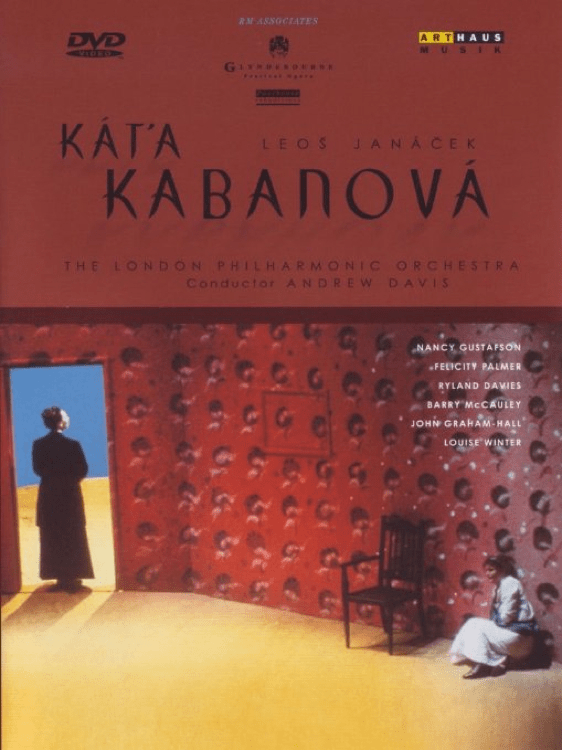
Lehnhoff belongs to those directors who like to give their own twist to a performance, but in Glyndebourne he delivered a rather traditional production (Arthaus 100158). Very austere, but with great attention to detail and to the psychological development of the characters.
He emphasises all aspects of Kát’a’s character, including her piety, penetrates deeply into her tormented soul and makes her misery palpable. There is a feeling of complete abandonment, which is reinforced by the beautiful, bright colours that are sometimes strongly reminiscent of paintings by Münch.
Musically, too, there is no reason to complain: Nancy Gustafson is a wonderful Kát’a and Barry McCauley an excellent Boris.
Trailer:
CD
Both CD recordings conducted by Charles Mackerras starring respectively Elisabeth Söderström on Decca (4218522) and Gabriela Beňačková on Supraphon (SU3291-2 632) are very good and I would not like to miss either of them, although I have a slight preference for Beňačková .
Peter Straka is as credible as Petr Dvorsky as Boris and Nadĕžda Kniplova and Eva Randová (Kabanicha) are a match for each other.
I love Khovanschina very much. The music is a combination of Russian folk songs, religious chorales, moving arias and glowing orchestral splendour and presents us with a masterpiece of an altogether unprecedented beauty. The libretto, based on historical facts, tells of religious strife, struggles for power, political manipulations, sectarianism and a collective suicide. The chorus plays a fundamental role, but the six leading roles are also particularly well developed as to their individual psychological developments.
The opera had its premiere in 1886, in Rimsky-Korsakov’s abridged version: Mussorgsky had left the score unfinished. In 1959, Shostakovich orchestrated the original piano arrangement. That version, with the ending recomposed by Stravinsky, is almost always used nowadays.
Boris Khaikin
The conductor Boris Khaikin, who was very popular in the post-war Soviet Union, is mainly known for his recordings of Russian operas, including Khovanshchina.
He already recorded the opera in 1946, with the unsurpassed Mark Reizen as Dosifej.
Mark Reizen as Dosifey
For the curious: you can find the complete recording on YouTube.
In 1974, Khaikin recorded the opera again, this time with Alexander Ognivtsev as Dossifej, Aleksey Krivchenya as Chovansky and Vladislav Piavko as his son. Golitsin was beautifully performed by Aleksey Maslennikov. Anyone still looking for an example of a tenor from the ‘old Russian school’? Listen to Maslennikov!
The real star of the recording, however, is Irina Arkhipova. As Marfa, she is absolutely unequalled in my opinion:
If you are used to Shostakovich’s instrumentation, Rimsky-Korsakov’s version feels a bit strange. More melodious, almost fairy-tale like. The overture could just as well have been an introduction to Shéhérazade. Rimsky-Korsakov has taken the sting out of it. Unintentionally, it makes you think of old films in which even the greatest misery has been put through the technicolour filter. In this version, Marfa’s prophecy also sounds rather bland. Mild and not very threatening, which makes it difficult to understand Golitsin’s terrified reaction.
The recording is very clear, making every word easy to understand. (Melodia MEL CD 1001867)
Boris Leskovich
A year earlier, in 1973, Boris Leskovich conducted the opera in Rome. In Italian. Despite the fact that he used Shostakovich’s version, the result is rather light and it does not “smolder”anywhere. It also lacks the “width” in the overture, but that may also be due to the poor sound quality.
The soloists are fingerlickingly good: Cesare Siepi (Dosifej), Fiorenza Cossotto (Marfa), Elena Souliotis, Veriano Luchetti, Siegmund Nimsgern and the greatest Chovanski in history: Nicolai Ghiaurov.
As a bonus, you get the complete fifth act with Boris Christoff as Dosifej in a recording from 1958 conducted by Artur Rodziński. Also in Italian (Irene Companez’ Marfa sounds just like Azucena here), but with a significantly better sound quality. (BellaVoce BLV 107.402) Different label, same recording:
Emil Tchakarov
The much-lamented Bulgarian conductor Emil Tchakarov (he died of AIDS at the age of 42) recorded Chovanshchina in 1990, with the best Bulgarian voices available at the time, including – how could it be otherwise – Ghiaurov in the title role.
Nicola Ghiuselev is an excellent Dosifej, Alexandrina Milcheva a very charismatic Marfa and Kaludi Kaludov a very lyrical Golitsyn. He stands with both feet firm in the Russian tradition, but at the same time sings with a large dose of Italianitá. Tchakarov keeps the orchestra very transparent. (Sony S3K 45831)
The recording can also be found on You Tube. Below act 1:
Claudio Abbado
In 1989, Abbado conducted the opera at the Vienna State Opera. Alfred Kirschner’s direction and Erich Wonder’s staging are real masterpieces. Anchored in tradition, with a great eye for detail, strong direction of the characters and a well-developed mise-en-scène. The final scene is a dramatic climax, leaving you riveted to your seat, gasping for breath.
Paata Burchuladze sings an excellent Dosifej and Ludmila Semtchuk is a very erotic Marfa. Ghiaurov once again manages to impress as Chovansky. (Arthaus Musik 100 310)
Michael Boder
In Barcelona (May 2007), the opera was presented in yet another version. Although the orchestration used was that of Shostakovich, the ending was recomposed by Guerassim Voronkov.
Norwegian director Stein Winge says the story is set in the 1950s, but it could just as well be 300 years ago. Or the here and now. His images are timeless and very evocative.
Vladimir Ognovenko is an excellent Chovansky and Vladimir Vaneev a ditto Dosifej. Vladimir Galouzine is without doubt one of the best Andrews I know, if not the best. With Robert Brubaker, Golitsyn sounds less lyrical than usual, but the character does gain character. Graham Clarke provides the comic note as the writer (Opus Arte OA0989 D)
Excerpt from the production:
Kent Nagano
Kent Nagano’s well-conducted and Dmitri Tcherniakov’s extraordinarily excitingly directed Munich production of Chovanshchina unfortunately has two misfits. Paata Burchuladze (Chovansky) whose career by then has lasted for too long and Doris Soffel (Marfa), whom I love very much, has ended up in the wrong opera. Not for a second can she convince me that she is a young, sexy woman. A real pity, because otherwise the production is strongly recommended.
Anatoli Kocherga is a magnificent Dosifej and Klaus Florian Vogt a ‘creepy’ Andrej. John Daszak, like Brubaker, is a ‘character Golitsyn’ and Camilla Nylund a dreamy Emma.
Tcherniakov portrays the three clashing currents – the conservative, the power-hungry and the progress-seeking – very well. The confrontation between the three rulers is chillingly exciting. Unfortunately, the tension weakens towards the end, so that the last scene feels like an anticlimax. (EuroArts 2072424)
Why do we love Manon so very much? She is not really virtuous. She leaves the love of her life for an old rich man, but as soon as she gets bored, she allows her young lover to come back to her. She is willing to run away with him, but not without her jewels. A child can see that it cannot end well.
Once caught, Manon is taken prisoner and exiled to America, where she dies in the arms of her lover. The poor soul refused to leave her. Talk about real love!
It is thanks to Puccini, who captured her character in the most beautiful notes, that she never becomes one-dimensional and you must be made of stone if you do not love her.
The role of Manon was created in 1893 at the Teatro Reggio in Turin by Cesira Ferrari, an Italian soprano who made her debut as Micaëla in Carmen and three years later sang the first Mimì in La bohème. Perhaps here is an indication of the type of voice that Puccini had in mind for his Manon?
How many good Manons are there nowadays? Not many, I think. The role makes very high demands on the performer. It requires a voice that can combine the childishly naive sex appeal of the silly girl in the first three acts with the real tragédienne in act four.
But Des Grieux, too, is a role that is not easy to fill. The man himself may be a sissy, but Puccini has written such violent notes for him, challenging him with such utterly emotional outbursts, that the singer must be a would-be Calaf to survive the opera with his voice intact.
MAGDA OLIVERO
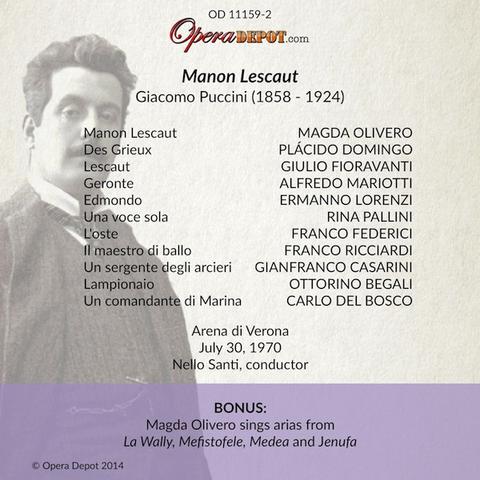
There is no doubt about it: Magda Olivero was the very best Manon Lescaut of the second half of the twentieth century. In 1970, when she was 60 (!) years old, she sang the role in Verona with the not yet 30-year-old Domingo at her side. Quite bizarre when you consider that Olivero made her professional debut eight years before Domingo was born. And yet her portrayal of the young heroine was utterly convincing. Most of her colleagues could not (and cannot) match her performance!
The role of Des Grieux was a role that could have been written for Domingo. As Renato, he was able to combine all his charm, his sehnsucht and his boyishness (something he has managed to retain to an advanced age) with a cannon-like voice. My copy was released on Foyer (2-CF 2033), but nowadays there are more releases in better sound quality and the recording can also be found on You Tube.
Two years later, Olivero sang the role in Caracas. The performance of 2 June 1972 was recorded by Legato Classics (LCD-113-2). The sound quality is reasonably good, but what makes the recording really desirable is Des Grieux by the then 60-year-old Richard Tucker. So yearning, so in love, so beautiful…. Sigh. Yes, folks: once upon a time, opera was made by voices, not by beautiful bodies!
Duet from the fourth act:
RAINA KABAIVANSKA
\
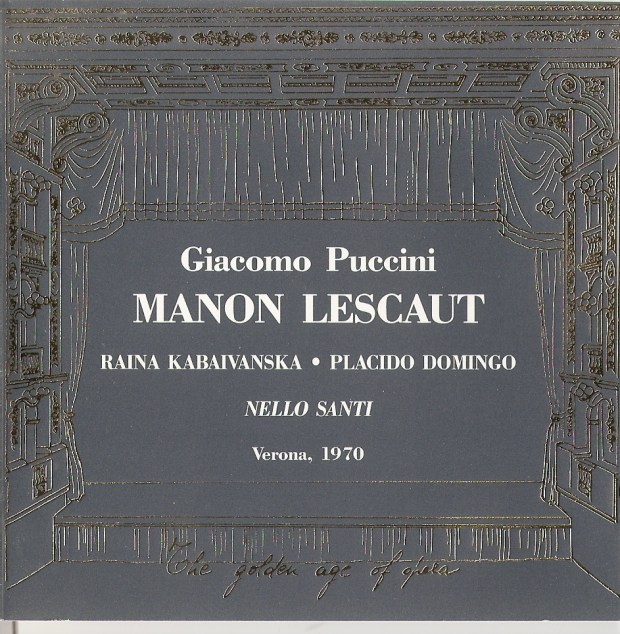
Manon was sung in Verona in 1970 not by Magda Olivero alone, but also by Raina Kabaivanska, with the same cast and the same conductor. The recording is very poor and therefore only for the diehards among us, but if you have a chance to listen to it: please do! Between Kabaivanska, who is still extremely underrated, and the young Domingo, a chemistry can be heard that, despite the poor sound quality, comes across really well.
The duet from II Tu, tu, Amore? tu?
As a bonus, you get fragments from 1953 of the live performance in Mexico, with Mario del Monaco and Clara Petrella. Not bad at all! (GAO 162/63)
MIRIAM GAUCI
In 1991, the Maltese Gauci was not exactly an unknown, but her great career only took off with her role as Manon Lescaut at the Vlaamse Opera in Antwerp. The opera was the first in the Puccini cycle, created by the then fledgling Canadian director Robert Carsen. Those who were present will never forget it. Because of the magnificent production, of course, but also because of Gauci’s scorching performance.
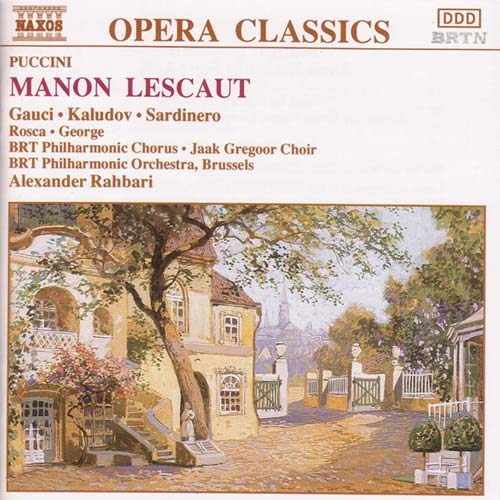
In 1992, Gauci recorded the role for Naxos (8660019-20), with Bulgarian tenor Kaludi Kaludov at her side as a very lyrical sounding Des Grieux. His “Donna non vidi mai” is very passionate, but at the same time kept within the boundaries of lyricism. To fall in love with, so beautiful. Alexander Rahbari’s direction is very intense, but also lacks many nuances. A real must because of Gauci and Kaludov.
Highlights are on Spotify:
RENATA SCOTTO
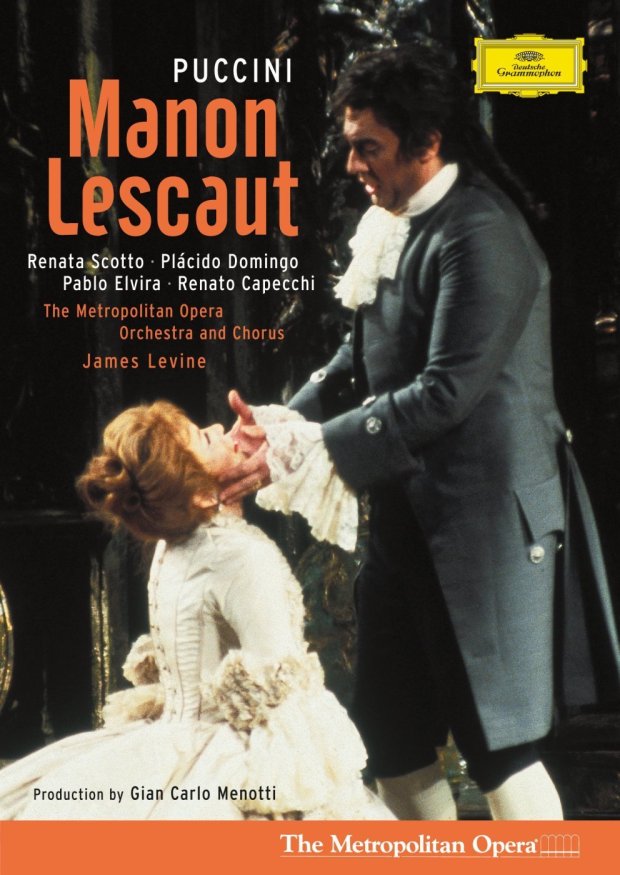
I can be very brief about the offers on DVD: buy the Menotti production with Renata Scotto and Plácido Domingo from the Metropolitan Opera (1980) and you are set for life. There is no other production that comes even close to it and I do not expect that event to happen any time soon. The compulsiveness with which many contemporary directors want to update everything can only kill the opera. Such was the case with Mariusz Trelinski’s production in Brussels a few years ago, with Eva-Maria Westbroek and Brandon Jovanovich. And this was also the case with the latest production from the MET, directed by Richard Eyre, with Kristine Opolais and Roberto Alagna in the leading roles.
Scotto sings and acts Manon like no one else has done before, and together with Domingo she provides us with a lovely evening filled with a whole lot of old-fashioned crying. Menotti’s very realistic, true-to-nature and oh-so-exciting production could not be any better. It is quite unique (DG 0734241).
THE VERY FIRST MANON
Back to the very first Manon. What did she sound like? There is a recording by Cesira Ferrari of “In quelle trine morbide”, made in 1905. It is on a double CD by Standing Room Only (SRO-818-2) with the title “Creators Records”. What you hear is a light, almost soubrette-like voice, but with dark undertones. And with a lot of body. You could say it’s a bit of a big-boned Lolita.
It is said of I Puritani that it is a true soprano opera, but that is not really quite the case. Elvira may be the pivot around which everything revolves, she is also one of the most passive opera heroines I know. Everything that happens around her and to her, happens in spite of her; because apart from loving and going mad, she doesn’t seem to be able to do much of anything at all.
It is the bass (her uncle Giorgio) who devises all sorts of plans to steer the action in the desired direction, and for this he is rewarded by Bellini with a most beautiful aria (‘Cinta di fiori’).
Nicolai Ghiaurov:
In order to save the mad soprano from certain death, he asks the baritone to spare the tenor’s life, which ends in a gorgeous duet (‘Suoni la tromba’), a real show-stopper.
Samuel Ramey and Sherrill Milnes:
The tenor also, who in a fit of patriotinic frenzy seems to send the whole thing into disarray, gets to sing a lot of beautiful (and high!) notes.
John Osborn with Mariola Cantarero from Amsterdam 2009:
All these roles require an excellent bel canto technique, with good coloratura, leggiero and legato. And don’t forget a sense of pure drama, because Bellini (and his librettist!) have created a lot of havoc for the poor soprano: first she becomes delirious with joy, then she loses her mind. She then regains it, only to lose it again immediately. Are you still there? Because it’s not over yet: her mind comes back once more and immediately she’s delirious with joy again. Ouch… Fortunately, the opera stops here, because poor Elvira apparently has to repeat such tricks a few times a day
CD’S
JOAN SUTHERLAND
Elvira, like Lucia, was a showpiece for Maria Callas and Joan Sutherland, both of whom recorded it several times. In 1974, Richard Bonynge (Decca 4175882) made a peerless recording of the opera, besides Sutherland, there was the sublime male trio: Luciano Pavarotti, Nicolai Ghiaurov and Piero Cappuccilli. Sutherland sounds like a little heap of misery, and her virtuosity knows no limits. Pavarotti still possessed all his glorious long high notes in those days and he pops them out with no effort at all.
MARIA CALLAS
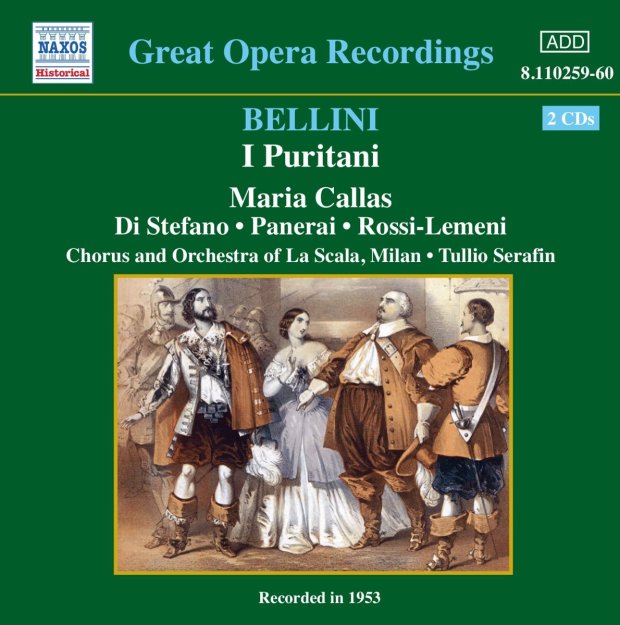
The recording with Callas from 1953 (Naxos 8110259-60) is weighed down by the fact that Giuseppe di Stefano is totally unfit to sing Arturo. But Nicola Rossi-Lemeni (Giorgio) and Rolando Panerai (Riccardo) are excellent, and Tulio Serafin conducts with verve and theatricality. Unfortunately, the score is not complete.
BEVERLY SILLS
A good (and complete!) alternative is the 1973 recording under Julius Rudel (Westminster 4712072), with a very virtuoso Beverly Sills. Arturo is sung in an extraordinarily beautiful and elegant way by Nicolai Gedda. His approach to the high notes is delightful, and personally I find it very pleasant to listen to him.
Conclusion; you are best off with the Decca and Westminster recordings. You get all the music, all the high notes and the best male voices. But since Naxos’ recording with Callas is in the budget class, why not buy it! Because of the conductor, because of the bass, but mainly because of La Divina. Because let’s be honest – nobody else can go so deliciously mad.
DVD’S
ANNA NETREBKO
It gets more difficult if you want to buy the work on DVD, because I cannot recommend either of the performances I watched without any reservations.
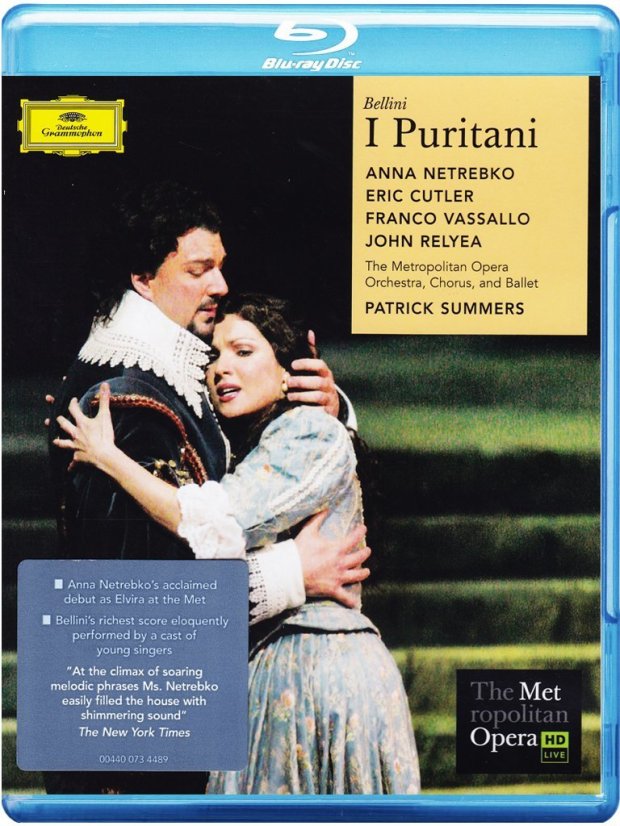
The Metropolitan Opera production, filmed in January 2007 (DG 0734421), is over 30 years old and was originally made for the Sutherland/Pavarotti duo. Perhaps this explains its total lack of personal direction?
There are these monumental tableaux-vivants , in which nobody seems to be allowed to move. The sets are ‘larger than life’ and all the costumes ‘historically accurate’. Anna Netrebko is a very imaginative Elvira. And although she lacks trills, her top notes are there and her presentation (charisma?) is more than convincing.
Both the bass (John Relyea) and the baritone (Franco Vassallo) are reasonable, but no more than that. Eric Cutler (Arturo) has a pleasant timbre and he reaches (albeit with difficulty) the high notes, but it is not really spectacular.
Netrebko sings ‘Deh Vieni al Tempio’ from the first act:
EDITA GRUBEROVA
But Cutler is much better than the totally miscast José Bros in the fifteen-year-old production from Barcelona (ArthouseMusik 107267). His voice is at least a size too small for Arturo. Edita Gruberova is a matter of taste. I do not like her ‘pussy-mouthed ways’ and I do not really want to watch her, but with my eyes closed there is little to complain about, because yes, she can sing bel canto.
Carlos Álvarez is a first-class Riccardo, but the rest of the cast …. Ah, let’s not talk about it. Andrei Serban’s direction, on the other hand, is truly sublime and exciting, I enjoyed it a lot. A friend I was watching with summed it up like this: Netrebko is for straight men and Gruberova (because of Álvarez) for gays and women, but of course it is not that simple. If only we could cut and paste!
BELLINI-BOX
A 25-cd Bellini box set is an absolute must. For 90 euros only, you get all of Bellini’s operas, two of which (La Sonnambula, Norma) are also available in two different versions. Many well known names too: Callas, Caballé, Scotto, Ciofi, Bernstein…
Most recordings are live and the sound and performance quality vary, but who cares? Among them, of course, is I Puritani, recorded in Catania in 1989, with Mariella Devia as Elvira. In the beginning, she is a bit of a disappointment, but gradually she gets better. Not only does she have all the top notes at the ready, she also brings in a lot of (her own) embellishments, and if that is not part of the art of bel canto, then I don’t know what is.
Mariella Devia:
Unfortunately, the men are not of the same level, although Paulo Washington is a moving and very imaginative Giorgio. A special CD-ROM contains all the libretti. A MUST! (Dynamic CDS 52/1-25)





















 Basia con fuoco