Emmanuel Chabrier’s L’Étoile is a delightful operetta in the style of Offenbach, with catchy melodies and a satirical libretto. Even the can-can is not missing. And yet…
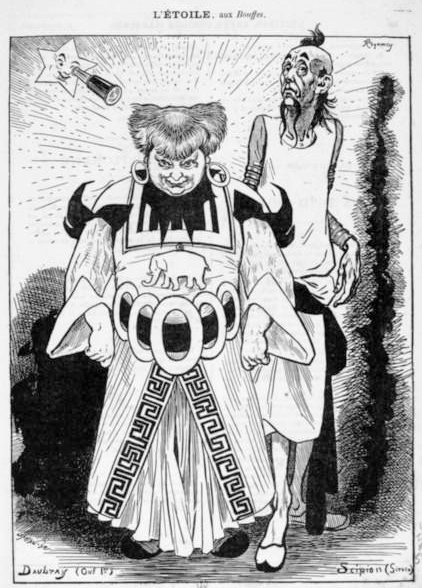
Press cartoon for the premiere by Félix Régamey
Few people, including great operetta lovers really know L’Étoile well. Why is that? The quality of the work, which premiered in Offenbach’s Théâtre des Bouffes Parisiens in 1877, is not to be blamed. There is nothing wrong with it at all. But it is a fact that the only complete recording of the work has been taken off the market.
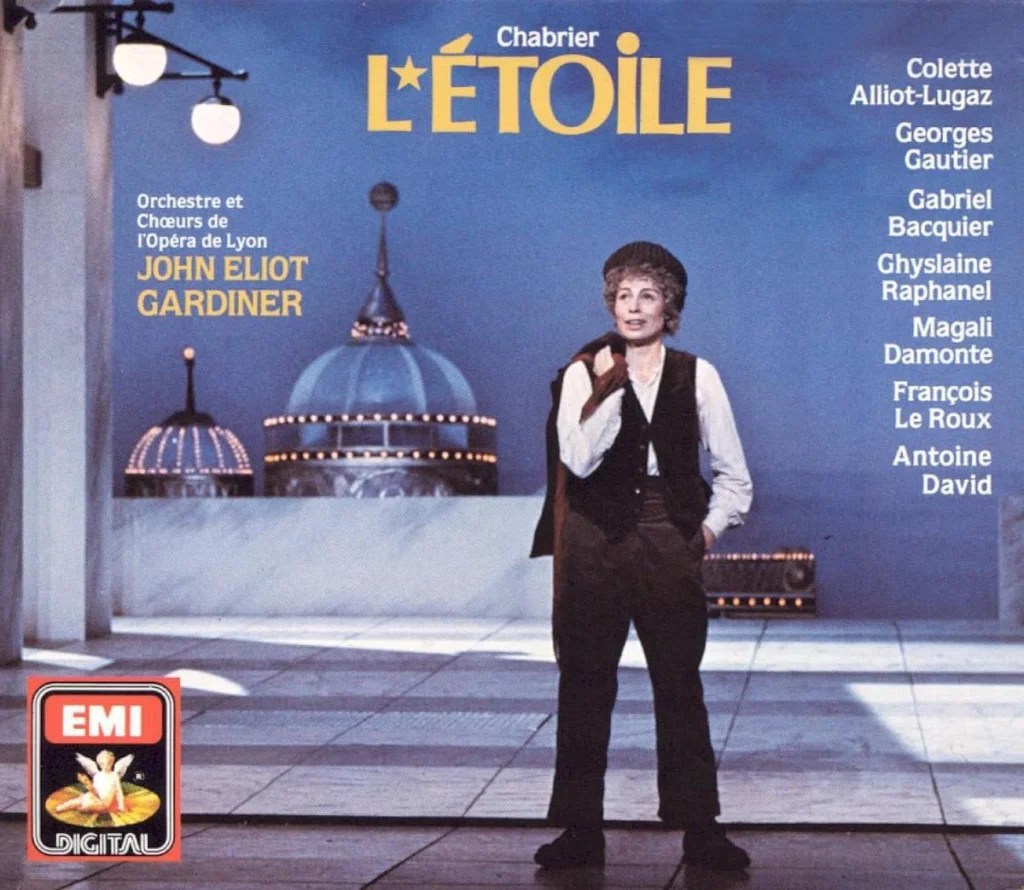
In 2016 John Eliot Gardiner led a truly fantastic performance in Lyon, with Colette Alliot-Lugaz, François Le Roux and Gabriel Bacqier, among others. French TV filmed it and released it on DVD, and EMI made a studio recording of it. Both the production and the performance were praised to the skies, but… gone they are! The internet does offer some solace, but for a used copy they charge something like a fortune.
A small clip on YouTube:
The complete EMI recording can still be found on Spotify
L’Etoile was played in Amsterdam in October 2014. It was fun, but really ooed?
There are also clips from Berlin (delicious!), Frankfurt, Geneva and Montpellier, among others, definitely worth watching!
If you don’t know that much about Chabrier and his music is still a bit of a tabula rasa for you, I can recommend the CD of his orchestral works. Conducted by Neeme Järvi, the Orchestre de la Suisse Romande recorded all his most important works for orchestra in 2013, including his greatest hit España and three excerpts from L’Étoile (Chandos CHSA 5122). Highly recommended!
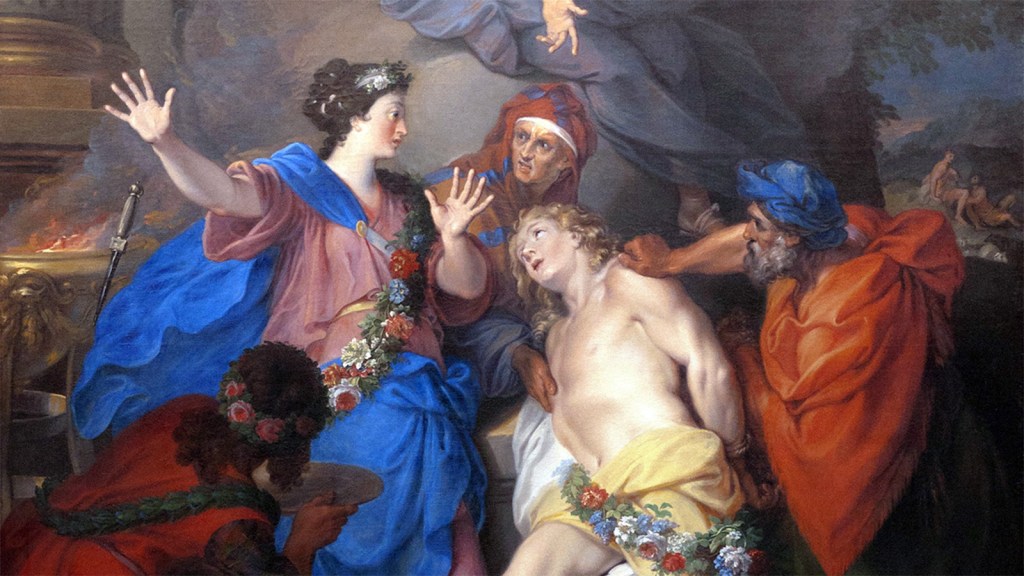
Pylades and Orestes Brought as Victims before Iphigenia (1766) by Benjamin West
Ik ben geen echte Gluck-fan – zijn opera’s zijn me vaak te statisch en te ‘klassiek’ van vorm. Maar ik kan niet ontkennen dat hij een meester was in het scheppen van sfeer – meestal verstild, dat wel – die tot de diepste roerselen van je ziel kon reiken. Zijn grootste verdienste was echter het wakker schudden van de ingeslapen Franse opera. Men kwam toen niet verder dan Lully en Rameau; voor de Fransen betekenden de opera’s van Gluck hun eerste revolutie.
Het ging natuurlijk niet van harte, maar ja, zo gaat dat met revoluties. Zelfs (of misschien juist?) de culturele. En de Fransen waren strijdvaardig en fel: was de oorlog tussen de Lully- en Rameau-aanhangers eindelijk geluwd, nu kwam het tot de uitbarsting tussen de aanhangers van Gluck en Niccola Piccinni.
Beide componisten hadden net een opera over Iphigeneia gecomponeerd en dat heeft de massa’s de straat op laten gaan (hier een zucht: ik zou er heel wat voor over hebben om dat soort straatrellen en demonstraties nog mee te kunnen maken, maar dit terzijde).
Anonymous, Iphigénie en Tauride, 17th century. Oil on canvas. Musée des beaux-arts de Brest
Iphigeneia en haar lotgevallen zijn de hoofdthema’s van twee opera’s van Gluck. Ik weet eigenlijk niet of ze inderdaad bedoeld waren als een tweeluik, maar logisch is het wel. Het ‘Aulide’-deel vertelt hoe ze bijna geofferd wordt aan Diana in de aanloop naar de Trojaanse oorlog. In deel twee leren we hoe het haar verder verging in het barbaarse Tauris.
De oorlog is inmiddels lang voorbij, haar vader en moeder zijn vermoord en ook haar zus Elektra is dood. Hier beleeft zij het weerzien met haar dood gewaande broer Orestes en wordt zij weer eens verliefd. Dat alles natuurlijk niet zonder allerlei verwikkelingen en al helemaal niet zonder goddelijk ingrijpen.
In tegenstelling tot Aulide ben ik werkelijk gek op Tauride. En ik ben niet de enige, niemand minder dan Schubert ging mij voor. Volgens één van zijn vrienden heeft hij ooit gezegd dat hij ‘totaal buiten zichzelf was door de impact die deze prachtige muziek op hem heeft gehad en verklaarde dat er niets mooiers in de wereld bestaat’.
Iphigenia’s escape from Tauris. Ancient Roman relief, end of a marble sarchophagus. Middle of the 2nd century A.D.
Waarom de ene Iphigénie wel en de andere niet? Zelf vind ik Tauride veel spannender dan de nogal statische Aulide. Er zit veel meer drama in en de muziek is zonder meer innovatief – je herkent meteen de weg naar Berlioz. Hiermee was Gluck een echte precursor.
Ook de karakters zijn beter uitgewerkt en de rol van Iphigénie was dramatisch genoeg om zulke uiteenlopende zangeressen als Maria Callas, Montserrat Caballé, Shirley Verett en Sena Jurinac, om een paar grootheden te noemen, aan te spreken. Allemaal hebben ze haar op de lessenaar gehad ….
Maria Callas:
Montserrat Caballé (in het Duits):
JOHN ELLIOT GARDINER
Gardiner is zonder meer betrouwbaar (Philips 478 1705), maar echt spannend? Thomas Allen is een mannelijke, maar zeer beheerste Oreste en John Aler is een zoetgevooisde Pylade. Mooi, maar zonder – hmmmm, hoe zal ik het netjes uitdrukken? – het mannelijke testosteron… Diana Montague, een mezzo (!), heeft een pracht van een lyrische stem, licht en wendbaar. En René Massis is een voortreffelijke Thoas.
De opname is me zeer dierbaar, maar als ik eerlijk mag zijn: ik mis drama.
RICCARDO MUTI
Muti is, zoals altijd, bijzonder trouw aan de partituur en wat is het levendig! Zijn storm is inderdaad stormachtig, daar word je bijna duizelig van.
Carol Vaness is een Iphigénie naar zijn hand. Al meteen bij haar eerste aria gaat zij zo hysterisch te keer dat je meteen recht op je stoel gaat zitten. Je voelt op je klompen aan: het wordt een drama van jewelste. En je wordt niet teleurgesteld, want de spanning is om te snijden.
Carol Vaness sings ‘Ô malheureuse Iphigénie!’
Ook Thomas Allen haalt hier echt uit. Bij Muti is hij veel minder beschaafd dan bij Gardiner, je kan zelfs angst in zijn stem horen. Ik mag het. De opname heeft ook een extra troef – de rol van Pylade wordt gezongen door de veel te jong gestorven Gösta Winbergh (hij stierf in 2002 aan een hartaanval, nog geen 50 jaar oud). Een zanger die, zoals zijn landgenoot Gedda, werkelijk alles in zijn stem verenigde: de lyriek van Tagliavini, de elegantie van Kraus en de mannelijkheid van zijn andere landgenoot, Jussi Björling. Nog net met een been in Mozart, maar met het ander al voorzichtig Wagner aftastend. Daar wordt een mens droevig van.
De opname (Sony 52492) is live, wat behalve applaus en toneelgeluiden ook het gevoel ‘ik ben erbij’ meegeeft. Ik vind het prachtig, maar ik kan me voostellen dat de meeste mensen voor de veilige en betrouwbare Gardiner kiezen.
JOSEPH KEILBERTH
Over Nicolai Gedda gesproken: in de opname onder Joseph Keilberth uit 1956 (Capriccio 5005) zingt hij de rol van Pylades. De opvatting van de dirigent is zeer vooruitstrevend, zeker voor de tijd – het lijkt meer op Gardiner dan op Muti, al heeft hij ook wat van het hysterische van de laatste.
Hermann Prey doet mij een beetje aan Thomas Allen denken, zeker vanwege de lyriek, de lichte smacht en het onnadrukkelijk zingen. Echt woedend wordt hij niet, hij is meer van het treurende type.
Maar dan Gedda! Daar smelt niet alleen het hart van Iphigénie (een zeer elegante maar wel met schmalz zingende Hilde Zadek) van, daar gaat ook Diana humaan van worden. Geen wonder dat uw discografe een traantje moest wegpinken. Het geluid is een beetje dof, maar het went snel. En ja, het is in het Duits.
Bonus:
Opname onder Prétre met Rita Gorr, Nicolai Gedda en Luis Quilico:
It has been said that ‘The Woman Without a Shadow’ is a kind of remake of The Magic Flute. There is something in that, because in this, very moralistic, fairy tale, too, the main characters are subjected to the most terrible ordeals, which, if endured well, will make them better persons. You can also detect a ˜Pelleas-like” symbolism, and Das Rheingold and Siegfried are nowhere far away either. But, simply put, this opera is mainly a kind of glorification of married life enriched with many children
˜FROSCH”, as the opera is called in the corridors, is considered Strauss’ most difficult opera to cast – one of the reasons why it is almost always cut. I think this is a pity, all the more so since the ˜melodrama” (the Empress’ outburst when she realises that the Emperor is already almost completely turned into stone), among other things, is also cut, and I think that (along with the beginning of the third act) it is one of the opera’s most exciting and dramatic moments.
DVD’S
GEORG SOLTI, 1992
In 1992, Solti conducted a totally complete performance of the work in Salzburg. Götz Friedrich’s direction was considered particularly strong at the time, but I do not find it entirely satisfactory. The mise-en-scène is undoubtedly excellent, but he falls short in the direction of the characters, leaving the singers a bit awkwardly bouncing around on the stage..
The beautifully designed stage setting is lovely with very minimalist but realistic scenery, but the costumes are a bit bizarre at times. There is a lot of use of strobe lighting, which combined with violent musical passages can come across as rather too much.
Cheryl Studer is a dream of an Empress. Her voice, with its very recognisable timbre and beautiful pitch, is soaring, transparent almost, innocent and erotic at the same time. Thomas Moser is an attractive Emperor, perhaps a touch too light for this role, which occasionally causes him breathlessness and forced notes, but his singing is fine.
Robert Hale (Barak) was already far past his prime here, at less than 50 years old. A pity, because his portrayal is very charismatic. Eva Marton hurts the ears, but is so committed that you forgive her. Her aria of despair at the beginning of the third act is touching and gives you goosebumps.
The palm of honour, however, goes to Marjana Lipovšek, who portrays a truly phenomenal Amme. What this woman has at her disposal in terms of colour nuances and how she handles her (very warm) mezzo borders on the impossible. On top of that, she is also a gifted actress; I could not take my eyes off her. (Decca 0714259
WOLFGANG SAWALLISCH, 1992
Six months later, FROSCH was presented in Japan. It was the very first time the opera was performed there, so expectations were high. The production was in the hands of an all-Japanese team led by Ennosuke Ichikawa, a famous director and stage actor of the Kabuki theatre. What he and his colleagues have achieved is simply mesmerising. FROSCH translates wonderfully to the rules of Kabuki, it gets even more convincing – it gains credibility and tension because of these rules. Lipovšek is even meaner here, even more evil than with Solti. Her movements are now smaller and more subdued which, curiously, makes them more expressive, and she can do even more with her voice.
Peter Seiffert is an excellent Emperor, his voice is rich, elegant, warm, sensitive and pliable, and all his high notes sound like a bell. Unfortunately, the Empress is not of the same level. Luana DeVol intones very broadly, her soprano sounds shrill and is totally bereft of lyricism (why didn’t they include Studer?), but she is a very convincing actress.
Alan Titus and Janis Martin may be a touch less intense than Hale and Marton with Solti, but their voices sound much more pleasant. They can also act, and how! Moreover, Martin looks very attractive, which is not unimportant for the role. I find the orchestra led by Sawallisch even more beautiful than Solti’s, more fairy-like, more transparent too, and more sultry… A truly phenomenal production. (Arthaus Musik 107245)
CD’S
KARL BÖHM 1955
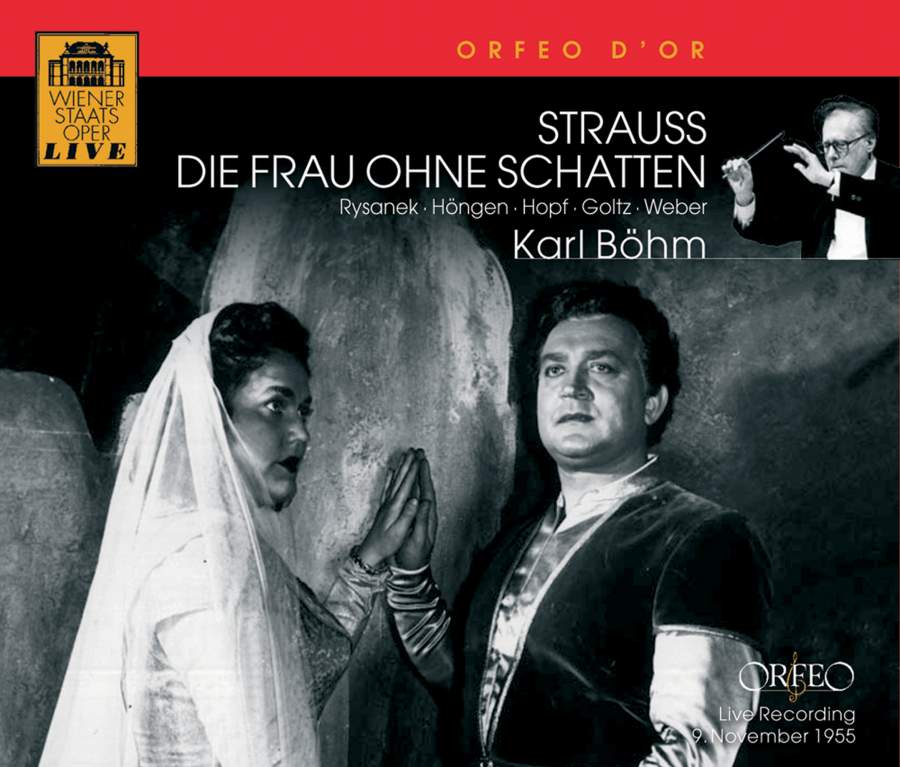
The very first recording of the opera dates from 1955. It was recorded live in Vienna, and has been amazingly polished by the Orfeo team.
Leonie Rysanek is the very best Empress I have ever heard. She dares to take risks, taking her beautiful, lyrical soprano to the limits of the impossible. With this role, she set a standard that is not easy to match. Hans Hopf (Emperor) has a kind of ˜heroic” way of singing that I don’t really like, but I imagine he is considered as ideally cast by many fans. It is a matter of taste, I would say.
Elisabeth Höngen is a vile Amme, and Christel Glotz an impressive, if not always cleanly intoned Färberin Böhm conducts very lovingly (Orfeo D’Or 668053)
HERBERT VON KARAJAN, 1964
In 1964, on the occasion of Strauss’ 100th birthday, von Karajan conducted a very inspired FROSCH at the Wiener Staatsoper. Christa Ludwig’s scoring of the Färberin is not exactly idiomatic, but her high notes and her reading of the role are very impressive to say the least.
In terms of vocal beauty, Walter Berry (then also in real life her husband) is probably the finest Barak, unfortunately is Jess Thomas (Emperor) a bit disappointing. Leonie Rysanek repeats her magnificent reading of the Empress, even more intense, and even more fused with the role.
The luxurious scoring of the minor roles by Fritz Wunderlich (the Jüngeling ) and Lucia Popp (a.o. Falke), makes the recording even more appealing. Von Karajan conducts as we have come to expect from him – narcissistic but oh so impressive and with a great sense of nuance. (DG 4576782)
GEORG SOLTI 1987-1990
You cannot avoid Solti’s studio recording (it took him three years, between 1987-1990), if only because he recorded every note as it had been written by Strauss.
The scoring of the Emperor by Plácido Domingo was considered an attack on the work by many ˜purists” at the time. Unjustly so. His voice is in every way ideal for the role, and with his musicality, the colours in his voice and his more than ordinary vocal acting skills, he portrays a very humane and vulnerable Emperor.
Julia Varady is, as far as I am concerned, along with Studer, the best Empress after Rysanek, what a voice, and what a performance! Hildegard Behrens is a torn Färberin , her complete identification with the role is limitless. (Decca 4362432)
There is no shortage of recordings of the complete Ring – let alone the individual parts- but apparently the need (among consumers or conductors?) is inexhaustible. Because: you haven’t had time to properly listen to one version or a new one is already being presented.
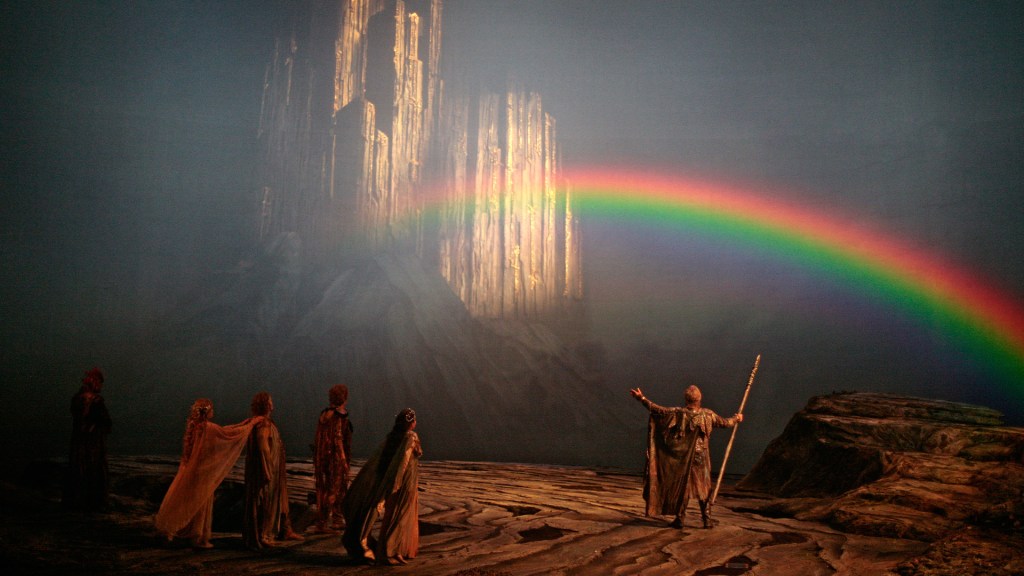
Simon Rattle is no novice when it comes to Wagner. Between 2006 and 2010, he conducted the complete Ring cycle in both Aix-en-Provence and Bayreuth. But ˜everything the conductor Sir Simon Rattle touches turns to gold”, and thus Das Rheingold was put back on the music stands, this time with the Symphonieorchester des Bayerischen Rundfunks. There, Rattle conducted a concert performance of the first Ring part in April 2015, and it has been released on the orchestra’s own label.
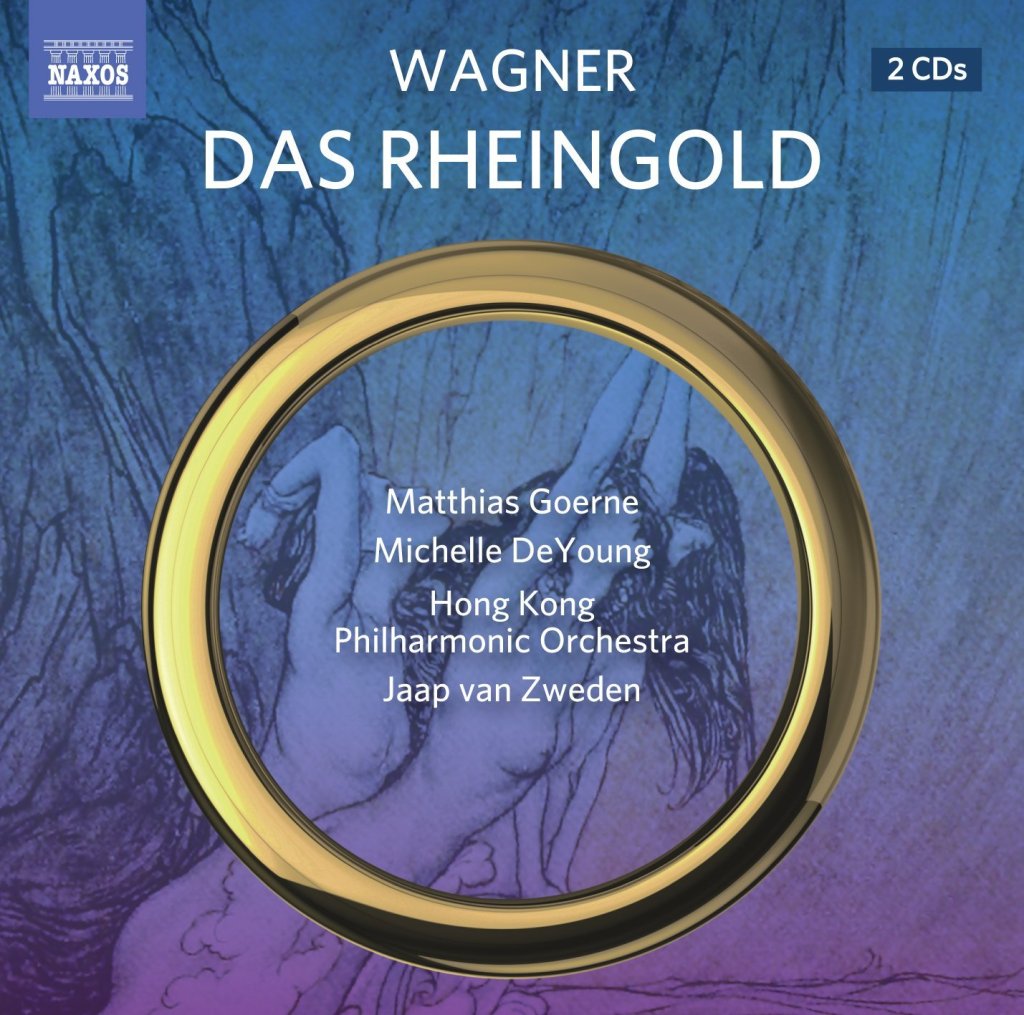
Like Rattle, Jaap van Zweden is a master as to conducting Wagner. His interpretations of his operas with the Radio Philharmonic Orchestra were very well received by critics and audiences alike. The Ring was the logical next step. The choice of orchestra – Van Zweden brought the music to his own Hong Kong Philharmonic – was also obvious. Now that his Das Rheingold is out: shall we compare it with Rattle?
The performance under Rattle is carried by the two bass-baritones: Michael Volle (Wotan) and Tomasz Konieczny (Alberich). The latter in particular manages to impress me. His voice is so big that I am almost blown away by it, and the way he manages to put a sly deviousness in his voice is more than sublime. Compared to him, Van Sweden’s Peter Sidhom is nothing more than a ˜character”. Exquisite singing, yes, but he lacks finesse.
Bildquelle: picture alliance / Geisler-Fotopress | Thomas Bartilla/Geisler-Fotopres
Michael Volle’s voice, despite a good dose of pleasant lyricism, also has something compelling about it. Truly a supreme being who has to be obeyed. Matthias Goerne cannot match that. Although I really like his voice, he sounds like he is singing oratorio.
The giants with Rattle – Peter Rose (Fasolt) and Eric Halfvarson (Fafner) – are so insanely good that the basses with Van Zweden – the surely not insignificant Kwangchul Youn and Stephen Milling – have trouble competing with them.
I don’t like Annette Dasch (Freia). There is something in her timbre that I do not like, but that is a personal and subjective opinion. I do like Anna Samuil’s voice on the Van Zweden recording more, but neither of these ladies is a my dream Freia.
Photo:Metropolitan Opera / Marty Sohl
The only one much better cast in the van Zweden recording is Loge. Whereas Burkhard Ulrich does not sound very pleasant to me on the Rattle production- a bit shrill, although that may suit the character of Loge – Kim Begley shows that a devious character and good singing, can and do, really go together.
Rattle makes the orchestra play lightly and sparklingly. Moreover, he keeps the momentum going. Van Zweden is much more slow and more ˜long- winded”, so the performance lacks drama. In addition, the recording is far too soft. So even though I also have some reservations about Rattle: I still opt for his version.
Impression of the rehearsal by Rattle:
Trailer of van Zweden’s recording:
Michael Volle, Christian Van Horn, Benjamin Bruns, Burkhard Ulrich, Elisabeth Kulman, Annette Dasch, Janina Baechle, Tomasz Konieczny, Peter Rose, Eric Halfvarson e.a. Symphonieorchester des Bayerichen Rundfuks olv Simon Rattle BR Klassik 900133 • 143’
Matthias Goerne, Michelle de Young, Kim Begley, Peter Sidhom, Anna Samuil, Deborah Humble, Kwangchul Youn, Stepen Milling e.a. Hong Kong Philharmonic Orchestra olv Jaap van Zweden Naxos 8660374-75 • 153’
Benvenuto Cellini was a 16th-century Italian artist considered the representative of Mannerism. He was a sculptor, silversmith, writer and musician, clearly an example of the ˜uomo universale.”
We know from his memoirs that he was no sweetheart: he is portrayed as a self-assured, egotistical man who was not averse to sexual excesses and who had lots of affairs, both with women and with men. That he also did not treat his fellow man with the utmost decency was forgiven from higher up: after all, he was a gifted artist.
Why exactly did Berlioz choose Cellini for his first opera? Perhaps he thought he had found a new Don Giovanni and thus created a new masterpiece?
The premiere of the opera in Paris in September 1838 was a flop. For the revival a year later, Berlioz made some changes, but to no avail. Later, for a performance in Weimar in 1852, he made another shorter version of his work, on the advice and in collaboration with Liszt and Von Bülow.
CD’S
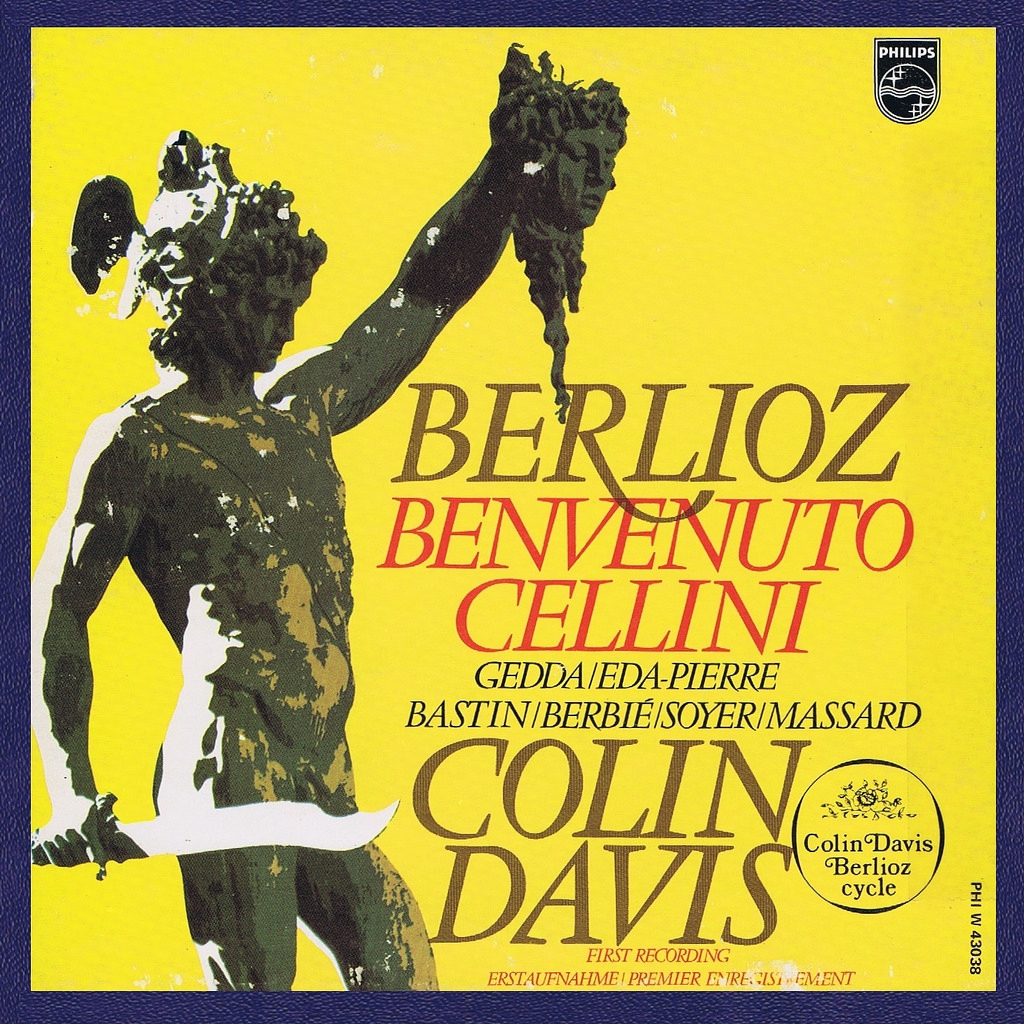
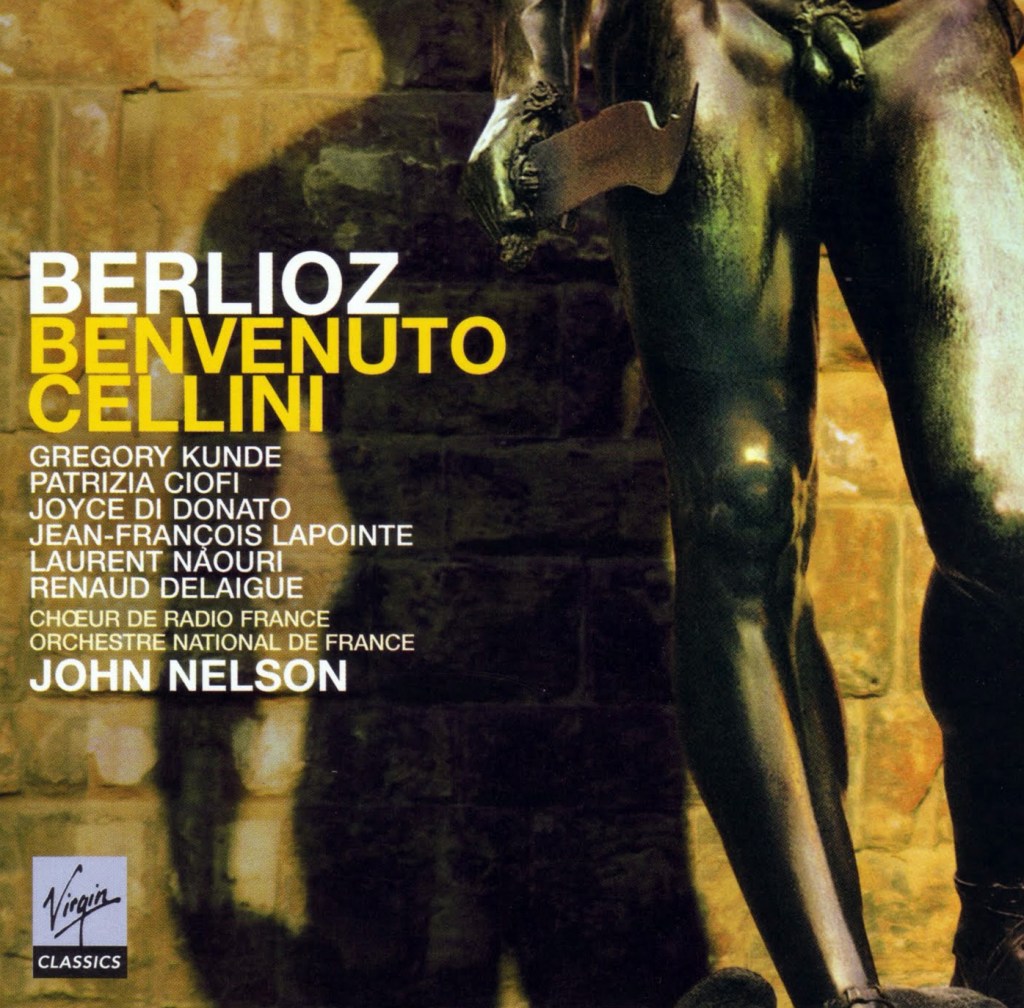
Colin Davis, one of the greatest advocates of Berlioz’s music, recorded the opera in 1972. For years, the recording (Philips 4169552) was regarded as the example of how it should be done. It took more than 30 years before it met a formidable opponent in John Nelson’s registration (once Virgin Classics 54570629).
Whichever of the two you choose: the orchestra is fine and both conductors are a match for each other. Nelson is perhaps a bit brighter while Davis is more into lyricism.
Can you imagine a better Cellini than Nicolai Gedda (Davis)? One would say not. I thought so too. Until recently, at least, because Gregory Kunde comes pretty close.
I love Kunde’s slim, agile yet firm tenor. His high notes are produced so easily that you’d almost think he was rehearsing a shopping list. And then his power… What a voice, what a singer! Incredible that the record companies ignored him for so long. He almost didn’t participate in this recording either: he replaced Roberto Alagna.
Jules Bastin (Balducci with Davis) was matched by Laurent Naouri. I personally prefer the second, but that’s personal.
The choice for my favourite Ascanio is quickly made: even Jane Berbié (Davis) has to concede superiority to Joyce DiDonato (Nelson). Just listen to her ˜Mais quai-je donc”. No, not everything was always better in the olden days!
But Nelson has more to offer, should you feel the need: the score is more than complete, as he combines both Paris versions and adds another appendix with a whopping 15 minutes of additional music.
Below is the trio ‘Ô Teresa’, sung by Gedda, Eda-Pierre and Massard under Colin Davis:
And by Kunde, Ciofi and Lapointe under John Nelson:
Nelson’s recording is officially off the market, but you can find it on Spotify:
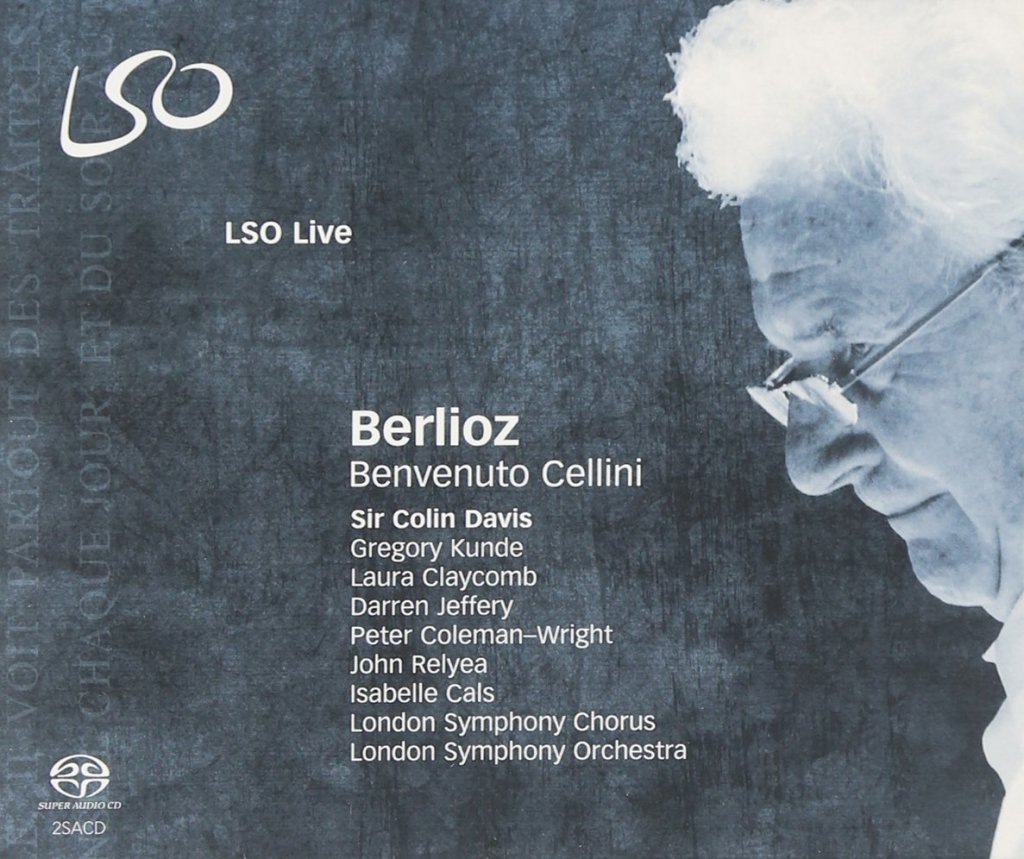
And then there is Colin Davis II. In 2007, he once again ˜dusted off” the opera, resulting in several cuts in the dialogues. Cellini and Teresa’s duet from the second act also had to go. The live performance from Barbican Hall was released on two SACDs on London Symphony Orchestra’s own label (LSO Live 0623).
I find the result satisfactory, but a little too polished for me. Gregory Kunde once again shows what a great singer he is: for him alone, the recording is more than worthwhile. I am less pleased with Laura Claycomb (Teresa) and the other singers do not really appeal to me either.
DVD’S
Salzburg 2007
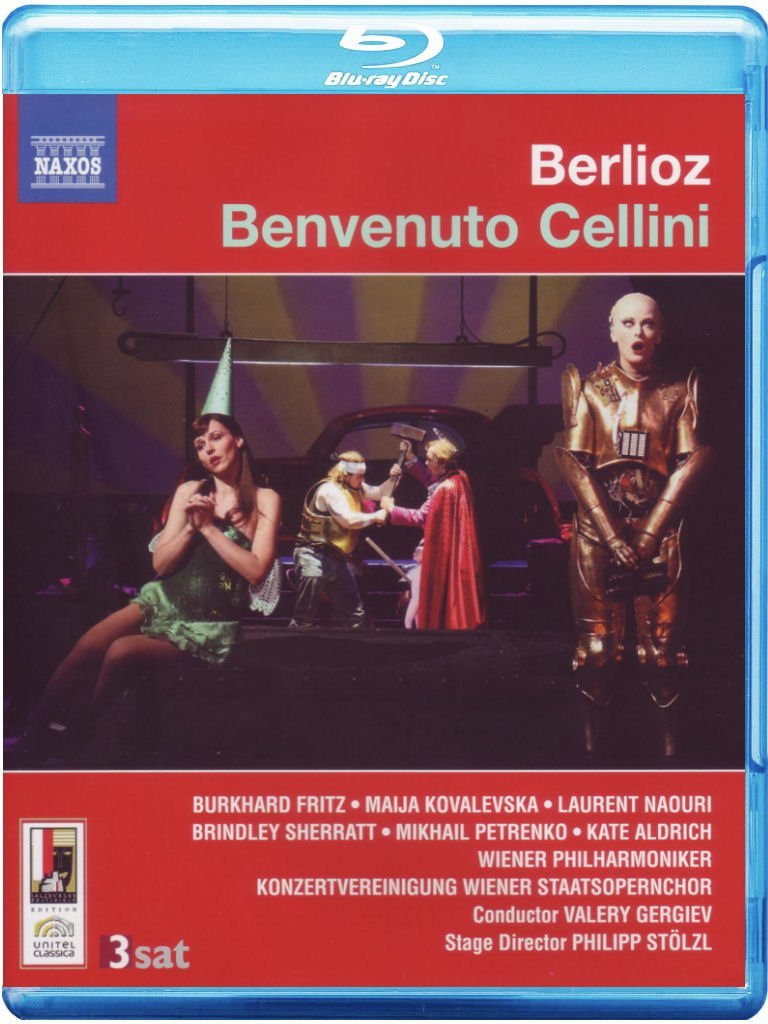
Presented in Salzburg in 2007, Benvenuto Cellini was subsequently recorded for DVD (Naxos 2110271). The production is great fun. It contains all sorts of things that makes one laugh: commedia dell’arte, comedy theatre, a pope accompanied by dancing blonde drag queens, a helicopter, robots as house servants, a madonna as a naked angel with wings… You name it and it’s there. It starts off in quite a nice way: Rome, carnival, fireworks… Almost Fellini-like. The whole thing is set in a ˜world of once upon a time”. The Wizard of Oz is not far away. Yes, director Philipp Stölzl knows his film classics! Beautiful, yes. Funny? Yes. Logical? No. The audience is overenthusiastic, I am not.
There is good singing without any question, though I don’t really get excited. Burkhard Fritz (also a substitute, this time for Shicoff) at the time still had both feet firmly in the heavier belcanto repertoire, but he lacks charisma.
You can leave the latter to Maija Kovalevska. She is beautiful and slender (an indispensable requirement these days, it seems) and has a ditto voice. She is a good actress too. What she lacks is the ˜typical characterization” needed for this role. Without it she sounds like just one of many beautiful slender sopranos from Eastern Europe. Terr Whether Valery Gergiev is the appropriate conductor for this work I doubt. He makes a lot of noise, like heavy fireworks. At the start of the overture, I thought for a moment I was in the middle of one of the Bruckners.
Below is the trailer of the Salzburg production:
Amsterdam 2015
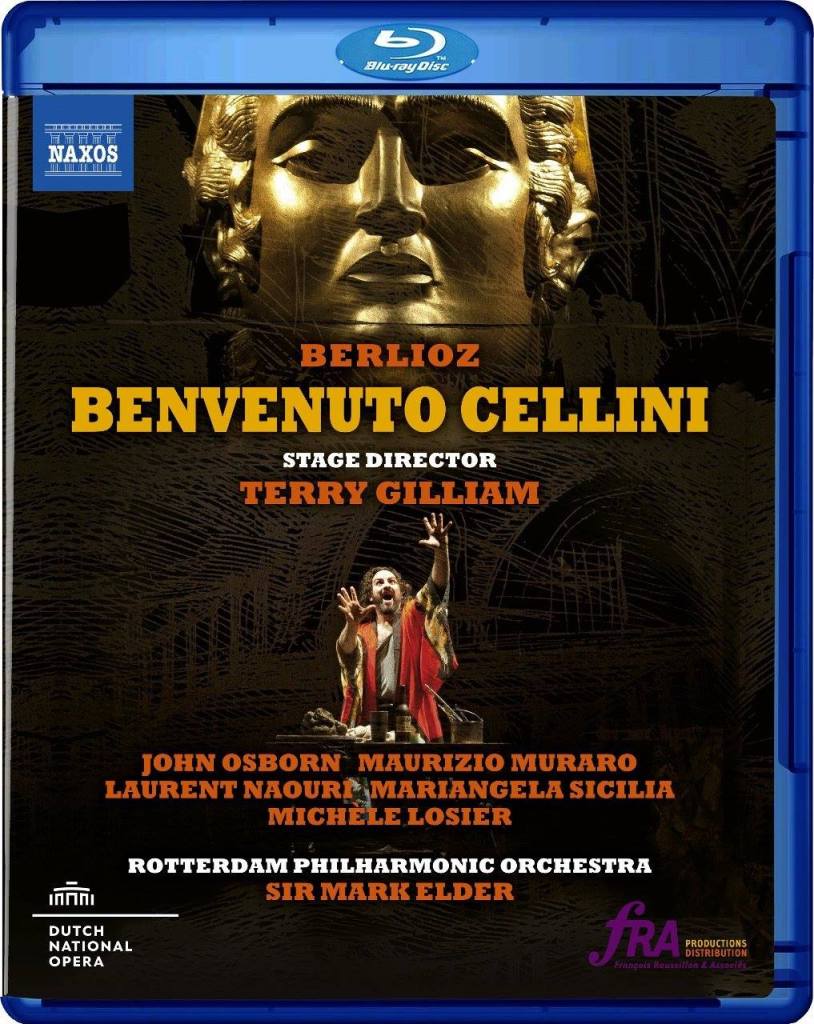
It’s still not really my kind of opera but I enjoyed Terry Gilliams’ 2015 Amsterdam production so immensely that I visited the show several times.
I can sum up the lavish, rich production in one word: whirlwind. Cellini is one hell of a role, but leave it to John Osborn! Just listen to his ˜La gloire était ma seule idole”, wow!
Mariangela Sicilia is a fantastic Teresa. Her light soprano seems created for the role but it is mainly thanks to the fantastic persona direction and the unimaginably good orchestral accompaniment by Sir Mark Elder that she is able to make the role her very own.
Laurent Naouri (Fieramosca) is a delicious schemer. What a voice and what an actor! Michèle Losier is a superb Ascanio, Maurizio Muraro an excellent Balducci and Orlin Anastasov a fine Pope.
In the innkeeper scene, it is Marcel Beekman who steals the show with his irresistible performance as Le Cabaretier, but the smaller roles of Bernardino (Scott Conner), Francesco (Nicky Spence) and Pompeo (André Morsch) are also more than excellently cast.
François Roussillon’s video direction is excellent. He highlights all the important details without losing sight of the whole. As a result, you can perfectly see what really good direction does for an opera. Also note the more than excellent chorus: each chorus member is an individual character.
Those who were not there can now catch up on a missed opportunity. For those who did attend: this DVD is a lasting memory of one of the finest DNO productions ever.
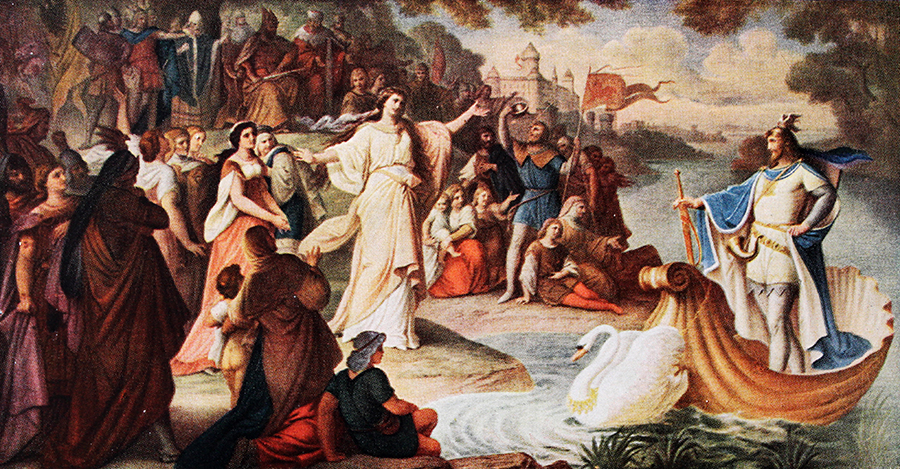
Lohengrin arrives in Antwerp, painting from the Lohengrin mural cycle, by August von Heckel , Neuschwanstein Castle
For me (definitely not a Wagnerian!), Richard Wagner’s Lohengrin ranks as high as his Tannhäuser : I can never get too much of it. No wonder my Lohengrin shelf is well-stocked. A selection of recommendations and turn-offs.
CD’S
GEORG SOLTI
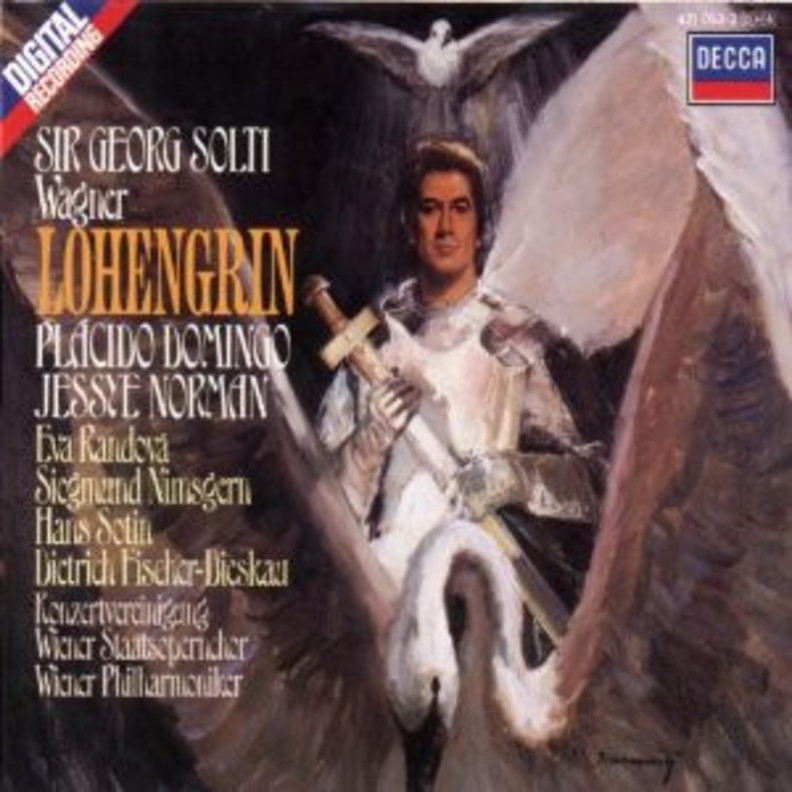
My favourite CD recording is the one conducted by Georg Solti (Decca 4210532), mainly because of the conductor. It starts already with the overture: very mysterious yet with both feet on the ground. Very sensitive, but also emphatically real without any sectarianism; no Hare Krishna here, but no Halleluja either.
Despite all the swans, Lohengrins do not usually fall out of the sky. Before officially recording the role Domingo had been preparing for it for almost twenty years. His Lohengrin is loving and warmblooded.
Jessye Norman was the perfect Elsa in those days; young and innocent with a voice that completely blows you away. Fischer-Dieskau’s Heerrufer is a matter of taste, but Siegmund Nimsgern and Eva Randová are a perfectly vicious pair!
Domingo’s baptism of fire in the role of Lohengrin was in Hamburg in 1968. He was then 27 (!) years old. It was not only his first Wagner, it was also the very first time he sang an opera in German, a language he did not yet master.
Fragments of the performance have been preserved (e.g. Melodram MEL 26510). His voice sounds like a bell, with a lot of bronze and a golden shine. The high notes are high and sung in full. Where can you still experience a Lohengrin like this? So beautiful that it makes you want to cry.
His Elsa was Arlene Saunders, at that time a much-loved prima donna in Hamburg, today she is totally forgotten. How unjust! Saunders was not only an amazingly good singer, she was also a beautiful woman and an exemplary actress.
MAREK JANOWSKI
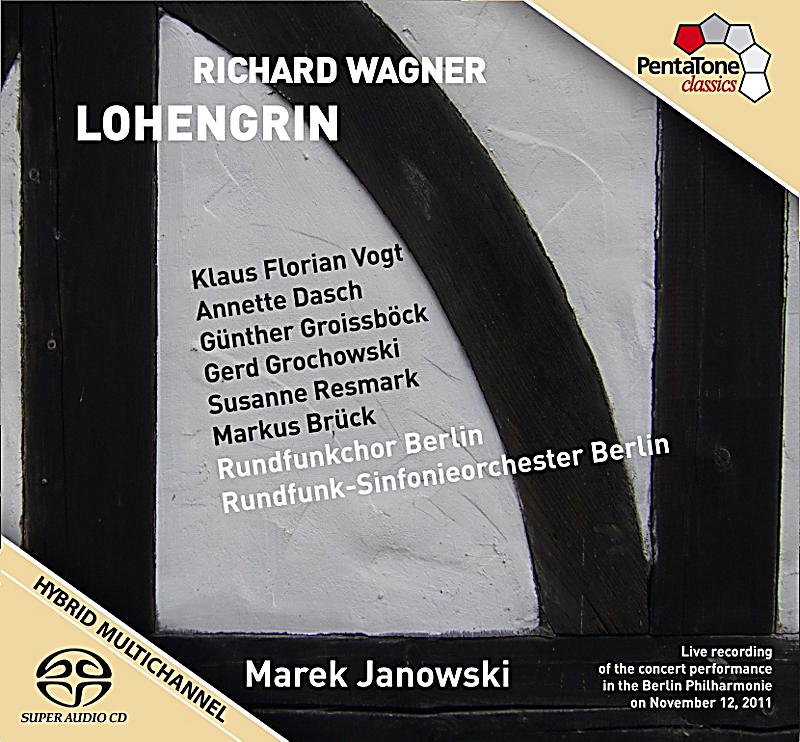
Marek Janowski is considered one of the best Wagner conductors of our time, but his Lohengrin, recorded live in Berlin in November 2011 (PentaToneClassics PTC 5186403) is a little disapppointing to me.
Janowski conducts very carefully, too carefully for me, making the overture most like an overly- stretched mush. Fortunately, he soon recovers and in the second act he makes the menace palpable. In the Wedding March, he makes the notes flow nicely into each other and he succeeds very well with his choice of tempi, all the while neatly restraining the orchestra. Yet I cannot escape the impression that he loses himself into the details.
I am not a fan of Annette Dasch, I find her voice a bit ‘ordinary’, but perhaps it does suit the character of Elsa? Susanne Resmark is a decent Ortrud, with a big voice and a nice dark timbre. But her ample vibrato is sometimes annoying.
The rest of the singers are certainly superb, but there is one problem: they do not blend. Klaus Florian Vogt’s sound is very ‘white’, his timbre quite sweet and his approach very lyrical. Beautiful, yes, but frankly I’ve had it by now with the same thing over and over again: he doesn’t develop. Moreover, he cannot compete with the deep low sound of Günther Groisböck (Heinrich) and the truly phenomenal volume of Gerd Grochowski (Telramund). In the ensembles, he simply shrinks away to nothing.
Below Günther Groisböck sings the ‘Gebet des König Heinrich’
BERTRAND DE BILLY
One of the newer Lohengrins, at least on CD, was conducted by Bertrand de Billy and recorded live at the Frankfurter Opern in March 2013 (OEHMS classics OC946). Judging by pictures in the textbook, we are to be happy that the production was not released on DVD but on CD!
Camilla Nylund is a wonderful Elsa, for me perhaps the best Elsa of recent years. Michaela Schuster, meanwhile, has made Ortrud into one of her showpieces, although there is something in her interpretation that displeases me a little. For Falk Struckman (King Heinrich) I am willing to commit murder, so I will forgive him for his voice becoming a bit unstable. The German-Canadian tenor Michael König (Lohengrin) is new to me. His voice and interpretation really make me quiet, so beautiful and so moving! Just because of him and Nylund, I am going to cherish this recording!
ERICH LEINSDORF
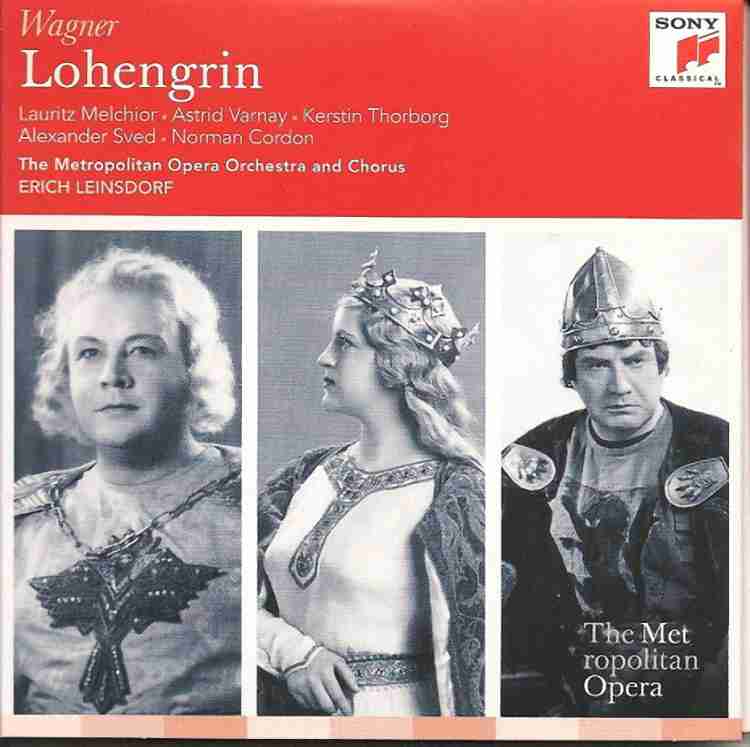
Back in time for a moment. In 1943, Erich Leinsdorf conducted a wonderful Lohengrin at the Metropolitan Opera in New York (Sony 88765 42717 2). The overture is to die for, just like a fairytale. I can’t get enough of it.
Lauritz Melchior is of course the Lohengrin of the era and Astrid Varnay sounds surprisingly lyrical. It’s a pity that she pronounces the consonants so very emphatically, something I don’t like. Alexander Sved is a very authoritative Telramund and Kerstin Thorborg a good Ortrud.
FRITZ STIEDRY
Opposite Leinsdorf’s recording is a 1950 recording under Fritz Stiedry (Walhall WLCD 0146). His approach is very down-to-earth, straightforward, which is also amplified by the poor sound quality. But it is undeniably beautiful and very surprising.
The singers also: Helen Traubel is a delightful Elsa and Astrid Varnay has been promoted from Elsa to a very impressive Ortrud after those seven years. And then Herbert Janssen’s Telramund: what a voice and what an impressive interpretation.
DVDS
AUGUST EVERDING
Even on DVD there is no shortage of good, not so good or even ridiculous performances (long live the director!). I start with an undoubtedly fine performance from the Metropolitan Opera, recorded in 1986 (DG 0734176) .
August Everding’s production is very traditional, with ditto costumes and sets. It is very beautiful, but for me there is something missing, as if the soul has been taken out of the performance.
But then there is Leonie Rysanek (Ortrud) and you have to keep looking at her with fascination. Just watch her glance at Elsa’s accusation. Delightful! James Levine conducts with verve and gives all the shine to the score, truly magnificent. Watching his face while he conducts is also fascinating; it shows complete commitment to the music.
Below, Leonie Rysanek as Ortrud:
GÖTZ FRIEDERICH
It was August Everding who first recognised Götz Friedrich’s enormous qualities. It was also he who ensured that Friedrich was appointed chief producer in Hamburg after his escape from the GDR.
Contrary to what is written about him, Friedrich never saw himself as a representative of ‘Regietheater’. On the contrary, his productions are very faithful to the libretto and the music. Do not expect strange concepts from him.
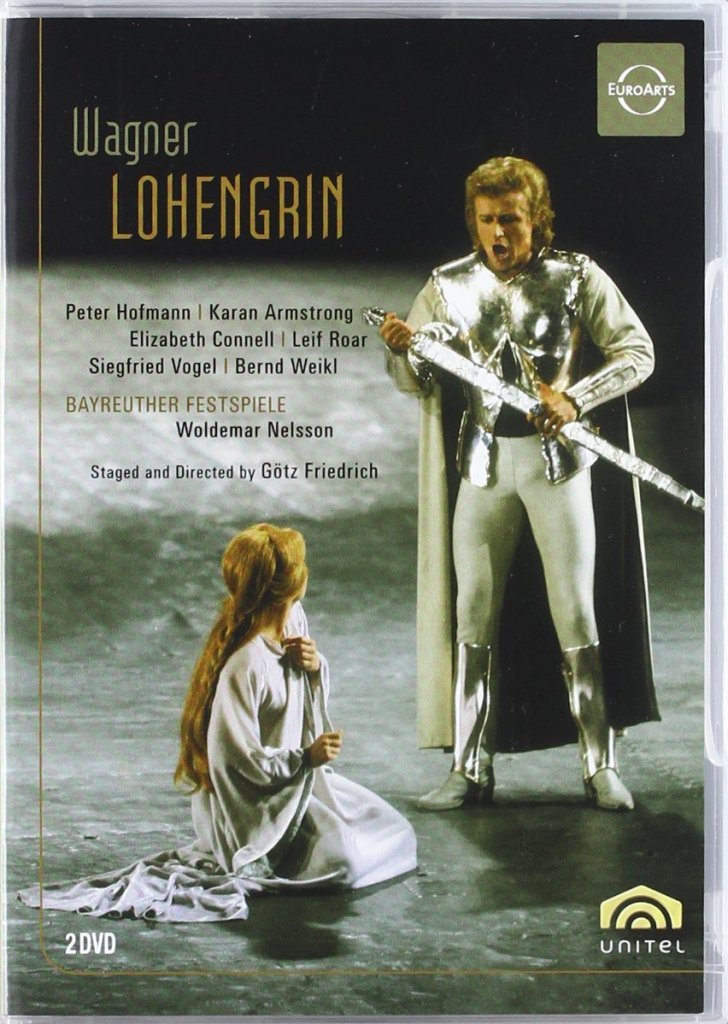
The Lohengrin he made in Bayreuth in 1982 (Euroarts 2072028) is, for me, among the opera’s finest productions. It moves between harsh reality and the utopian dream world of an adolescent girl. Karan Armstrong is a beautiful woman and a great actress, but her tremolo is very annoying at times. Peter Hofmann is in every way a dream Lohengrin: with his handsome looks, clad in white and silver, he seems to have literally stepped out of a girl’s reveries. Elisabeth Connell is an impressive Ortrud and Bernd Weikl a terrific Heerrufer.
Below is a short excerpt from the production:
NIKOLAUS LEHNHOFF
That Nikolaus Lehnhoff was very familiar with Friedrich’s production is obvious. Like Friedrich, he omits the swan. Lohengrin (Klaus Florian Vogt in one of his best roles) is preceded by a ray of light, giving him the allure of a 1950s pop star. Talk about girlish dreams!
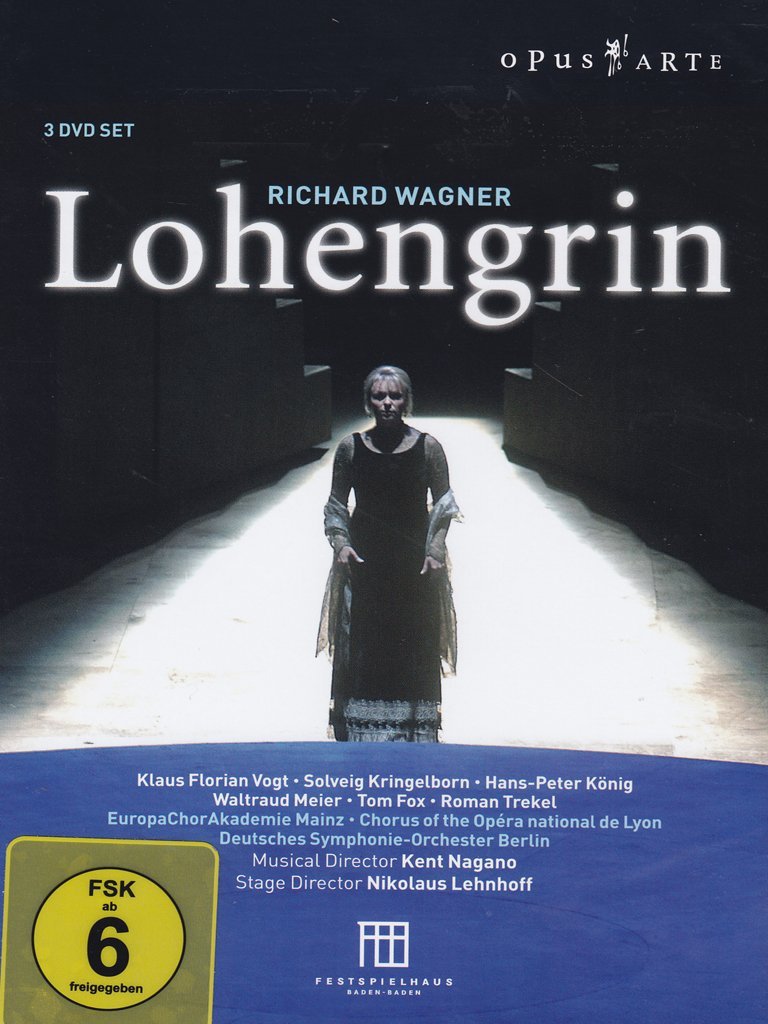
Light and soft, like the first rays of the rising sun, this is how the first bars of the overture sound. In the middle of the stage, shrouded in shades of dark blue and black, Elsa ( a very poignant Solveig Kringelborn) comes up, her hands on a chair. This chair will remain the centre of her universe, and her only foothold, from now until the end of the opera. The feeling of loneliness takes hold of you, and you realise that things will never work out, all the knights and swans notwithstanding. The most striking thing about this brilliant Baden-Baden production is its matchless lyricism. The singers seem to have walked straight out of Bellini operas and even Ortrud, in the interpretation of the phenomenal Waltraud Meier, is like a Lady Macbeth with human traits. After Götz Friedrich, this is for me the best Lohengrin on DVD (Opus Arte OA 0964D)
Below is a scene between Elsa and Ortrud:
RICHARD JONES
Does the libretto speak of a regime? Dictatorship? Persecution and/or lack of democracy? Yes? Hup, then we simply move the action to the 1930s. So banal, and so clearly a lack of inspiration! I blame Richard Jones especially for the latter. His Lohengrin, in its banality, is not only weird, but also predictable and uninspired. At least for me.
Right at the start the beautiful overture, sublimely and sensitively played by the Bayerischer Staatsorchester under Kent Nagano, is totally destroyed by the picture. We see a girl with dark braids, dressed in green dungarees, sitting at a drawing table, drawing a house.
Lohengrin (Jonas Kaufmann) is a hippy dressed in jeans. He emerges, with under his arm, a big, white plastic swan, which is also mechanically controlled: it pecks around and into its feathers. I find it tacky.
The Munich production, July 2009 (Decca 0743387), marked Kaufmann’s debut in the role of Lohengrin. Did he succeed? Yes and no. His voice is naturally powerful and lyrical at the same time and with a big volume. He does not have to force anything and his highs and lows are beautifully balanced. Yet I miss something in his performance, that little ‘etwas’… Maybe it’s because it’s his debut, but on me he makes a not too happy impression.
Anja Harteros is a heartbreaking Elsa. She plays the role very impressively and manages to combine girlishness with a budding femininity.
Michaela Schuster did not know how to be portray Ortrud at the time, but Wolfgang Koch (Telramund) makes up for a lot. Such a beautiful voice! Deep, grand, supple, lithe, majestic and authoritative. He also manages to impress particularly as an actor. Evgeny Nikitin is a convincing Heerrufer.
Below is the trailer of the production:
HANS NEUNFELS
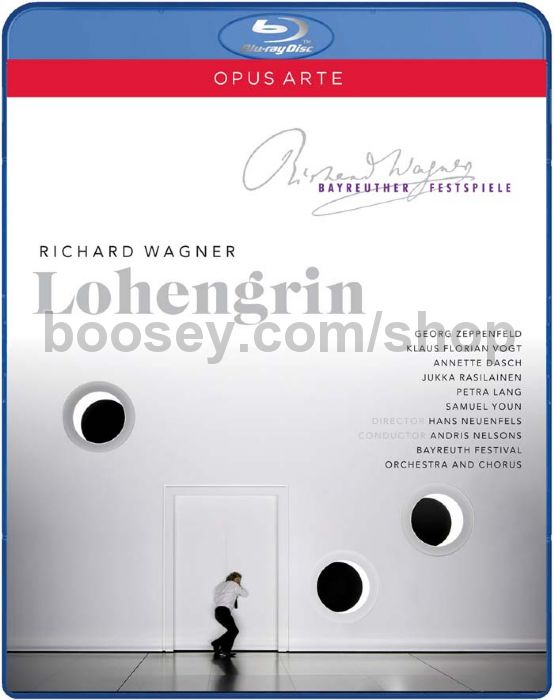
Recorded in Bayreuth in 2011, Hans Neuenfels’ production (Opus Arte OA 1071 D) is a bit obscure. Because, what are rats doing in Lohengrin? Now… here’s the thing: the Brabanders have been turned into rats by failed experiments and Lohengrin comes to help them, like someone from the animal liberation front. Something like that. Sort of. No, I didn’t think it up and I wouldn’t have been able to understand it if I hadn’t read the reviews. But apparently the enthusiastic (yes, the production was enthusiastically received!) fellow reviewers are either clairvoyant, or they had a special sit-down with the director. Even the overture is teeming with (animated) rats in pink, white and grey. And that’s just the beginning. And to also give away the ending: Elsa’s little brother is a just-born fat baby with the umbilical cord still on…. Annette Dasch looks beautiful and innocent and acts well and Klaus Florian Vogt sings beautifully and lyrically. Once and never again.
Onegin, unlike don Giovanni, is not a colourful character. He is a rather dull, bored brat, for whom even hitting on a woman is too much trouble. Through an inheritance he has become a rich man and as such has access to the”high society”, but everything bores him and in fact he does not know himself what it is he really wants.
He dresses according to the latest fashion, the only question is whether he does it because he likes nice clothes, or because that’s the way things are supposed to be. Because he does know how things should be done.
He also shows hardly any character development over the whole course of the opera. He kills his best friend after flirting with his lover – not because he really wants to, but to teach him (and the, in his eyes horrid, countrybumpkins) a lesson – and even that leaves him unmoved. Only at the end does he “wake up” and something of a feeling enters his mind. But is it real?
Not really someone you can dedicate an entire opera to, which is why for many people the real protagonist is not Onjegin but Tatyana. If Tchaikovsky had really wanted it that way he might have named the opera “Tatyana”, but that she is a much more captivating character than the man of her dreams, is beyond any doubt.
CDs
SERGEY LEMESHEV:
One says Tatyana, one thinks Galina Vishnevskaya. The Russian soprano has created a benchmark for the role that few singers can yet match. In 1955, she recorded the role, along with all the Bolshoi greats of the time.
Her “letter scene” is perhaps the most beautiful ever, but the recording has even more to offer: how about Sergei Lemeshev as Lensky? Fingerlicking good!
Sergey Lemeshev as Lensky (his great aria & duel scene)
Valentina Petrova is a peerless Larina, unfortunately the title hero himself (Evgeny Belov) is a bit colourless. (Melodiya 1170902)
FRITZ WUNDERLICH:
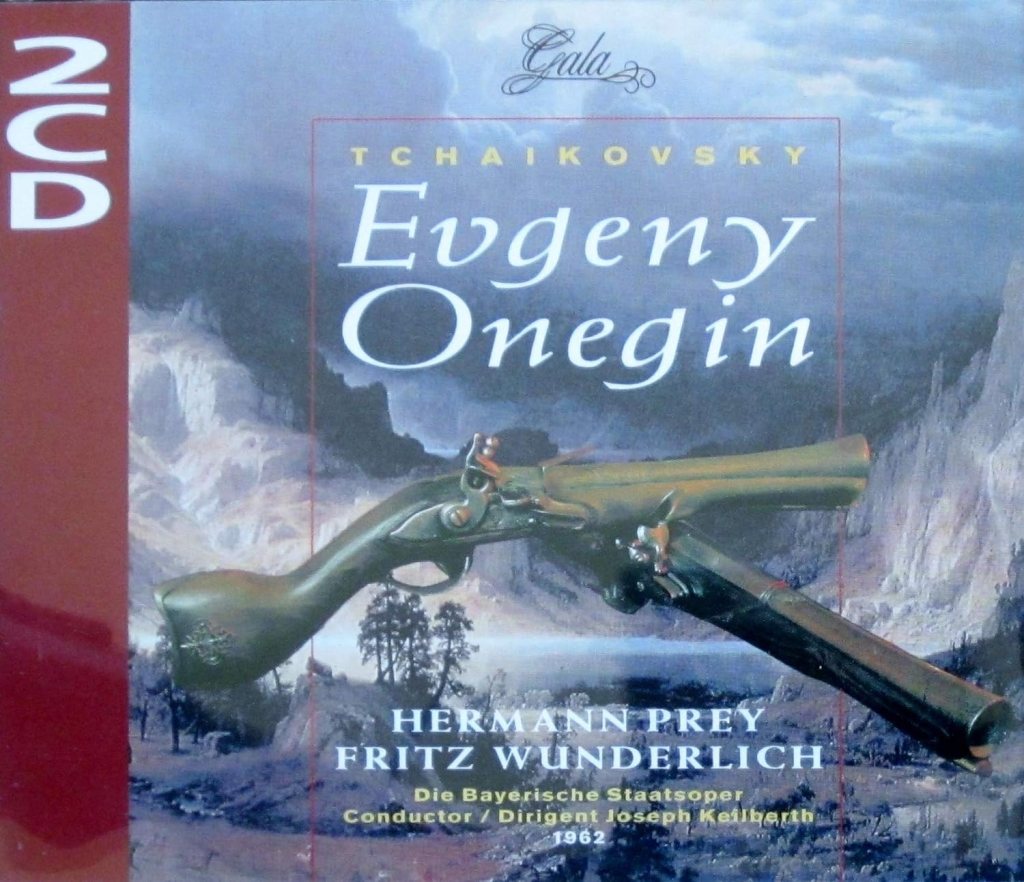
In 1962, the opera was recorded live in Munich (Gala GL 100.520).
Ingebort Bremmert is too light for Tatyana, she also sounds rather sharp, but Brigitte Fassbaender makes up for a lot as Olga. But for a change, the ladies do not make the greatest impact, you buy it, of course, for the men: Hermann Prey and Fritz Wunderlich.
Prey is a very charming, gallant Onjegin, actually more like a brother than a lover, but the voice is so divinely beautiful! And about Wunderlich’s Lensky I can be very brief: ‘wunderbar’! By the way, it strikes me once again how similar Piotr Beczala sounds to him!
There is a lot of stage noise and the sound is dull with far too many bass sounds. And of course it is in German, but yes, that’s how it was done in those days. But it is a matchless document and, especially because of both singers, actually a must-see.
Duel scene from the recording (with picture!):
BERND WEIKL:
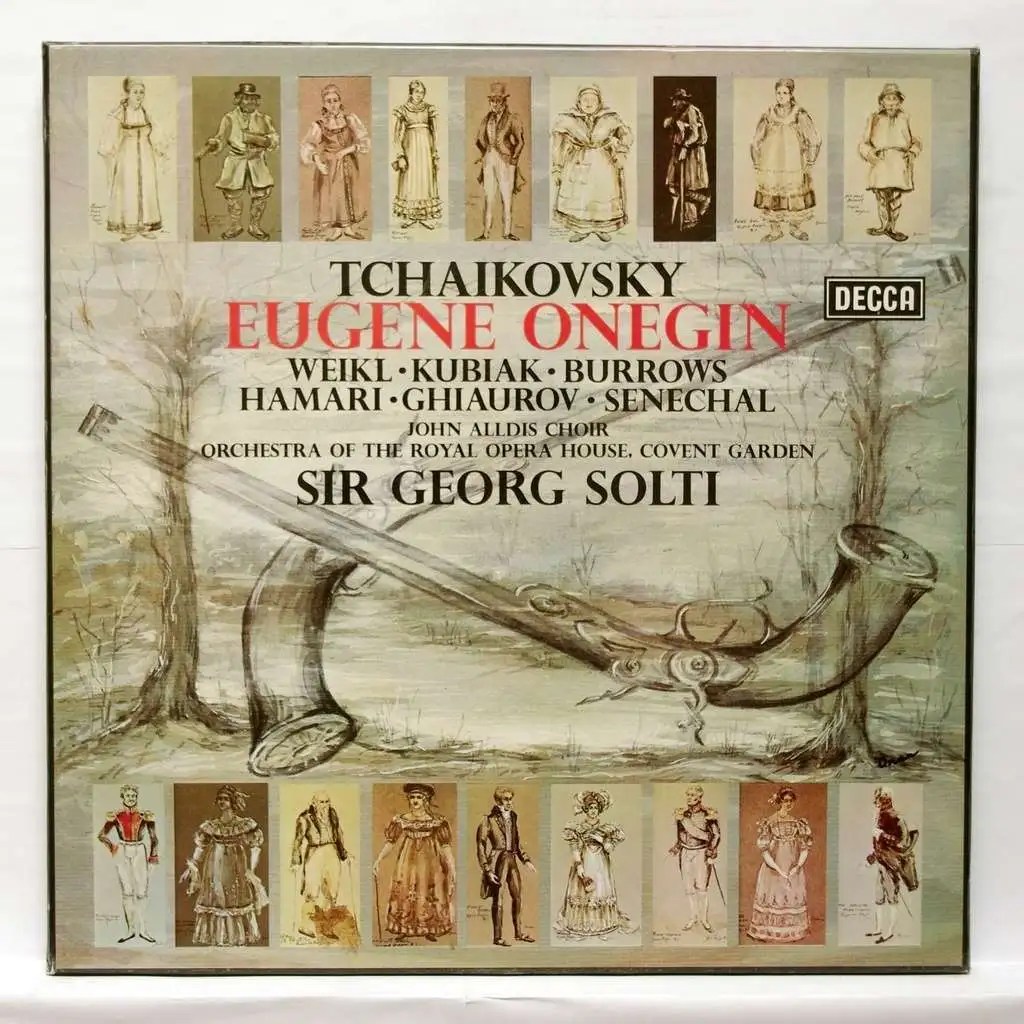
In 1974, Georg Solti recorded the opera for Decca(4174132) and that reading is still considered one of the best. In Stuart Burrows he had at his disposal the best Lensky after Wunderlich and before Beczala, and Teresa Kubiak was the very personification of Tatyana. Young, innocent, with a touch of elation at the beginning of the opera, but resigned at the end.
Under his direction, the orchestra (Orchestra of the Royal Opera House) flourished like the cornflowers in the Russian fields, making it clear why the composer considered his opus magnus to be “lyrical scenes” and not opera.
Bernd Weikl is a very seductive Onjegin, his very spicy baritone particularly sexy. Nicolai Ghiaurov is of course legendary in his role of Gremin and for me Michel Sénéchal is perhaps the best Triquet ever. Enid Hartle deserves to be especially mentioned as Filipyevna.
THOMAS ALLEN:
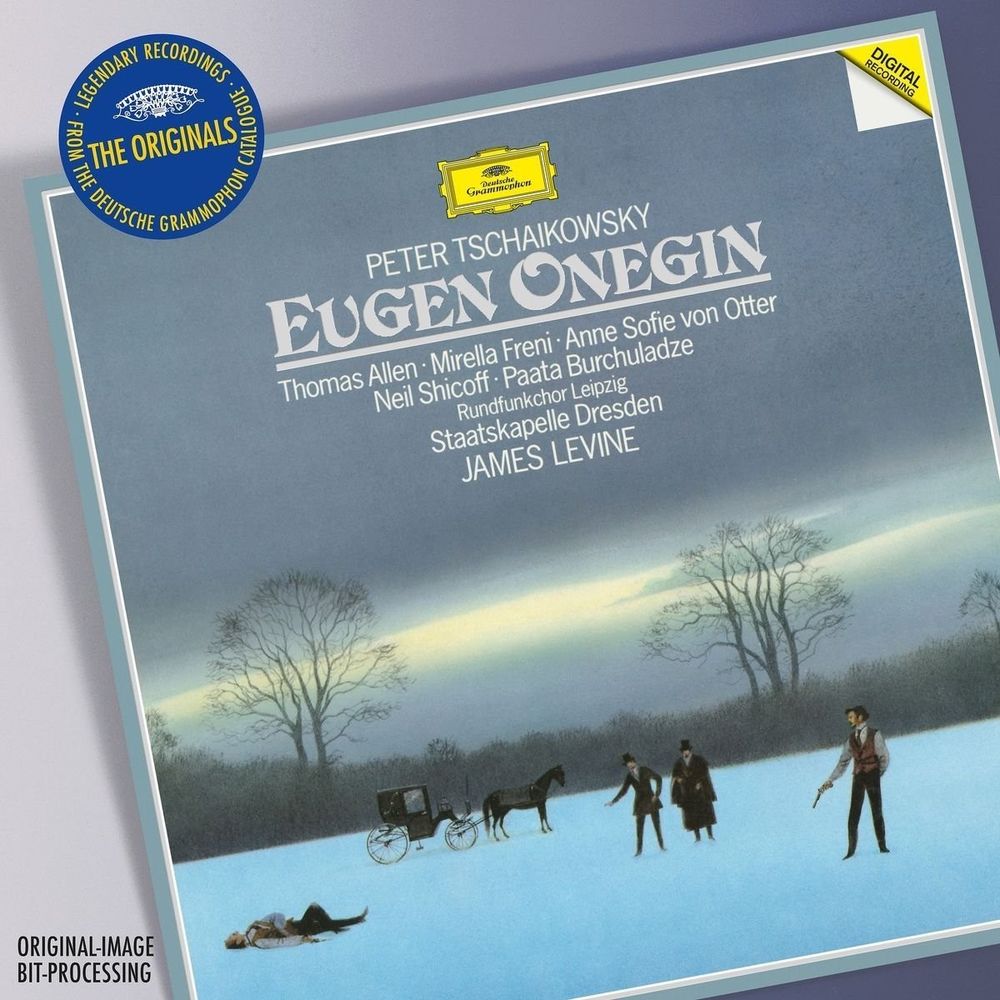
I want to dwell for a moment on Onjegin by Sir Thomas Allen. He has sung the role several times: both in Russian and in English. In 1988, he recorded it for DG (423 95923). Tatyana was sung by Mirella Freni – in the autumn of her career it became one of her showpieces. She is therefore more convincing as the older Tatyana than as the young girl, but there is nothing to criticise about her interpretation.
Neil Shicoff, then a splendid lyricist, was a very idiomatic Lensky, but Anne Sophie von Otter was only moderately convincing as Olga. Under James Levine, the Staatskapelle Dresden produced an unexpectedly lyrical sound, with lovely long arcs, but not devoid of a healthy sense of drama.
Anyway: it’s mainly about Thomas Allen. His reading of the title hero is particularly exciting and dramatically well grounded; it is truly fascinating to hear how Onjegin’s condescension in I turns into a shimmering passion in III. A vocal artist, no less.
It is also very interesting to see how he coaches young people at an ‘Onjegin master class’ (among his “students” is James Rutherford, among others)
DVDs
VLADIMIR REDKIN
Boris Pokrovsky is a living legend. For decades, from 1943 to 1982, he was opera director of the Bolshoi Theatre in Moscow. Even in the Netherlands, he is not unknown: in 1996, he was ‘visiting’ us with his new company, the Moscow Chamber Opera, with “Life with an Idiot” by Alfred Schnittke.
His production of Onjegin, recorded for TV at the Bolshoi in Moscow in 2000(Arthaus Musik 107 213) originally dates from 1944. It is, of course, a classic, complete with all the trimmings. Sumptuous costumes, true-to-life sets, everything as it ‘should’ be.
As soon as the stage curtain opens, the first ‘open curtain’ is a fact. People love it. And they are right: it is indeed so very beautiful! Of course, you don’t get to see it like that anymore. Think Zeffirelli, but really authentic, without a single liberty being taken. You have to have seen it at least once, just to know how it was originally intended.
The unknown singers are all just fine, but the close-ups are a bit laughable. Of course, it is not a production to be shown on TV, you have to actually see it in the opera house. There is no chance of that, though: Boris Pokrovsky’s production has been replaced by a new production by Dmitri Tcherniakov after more than 60 years of faithful service. Buy the DVD and muse on the ‘good old days’, because they really aren’t coming back.
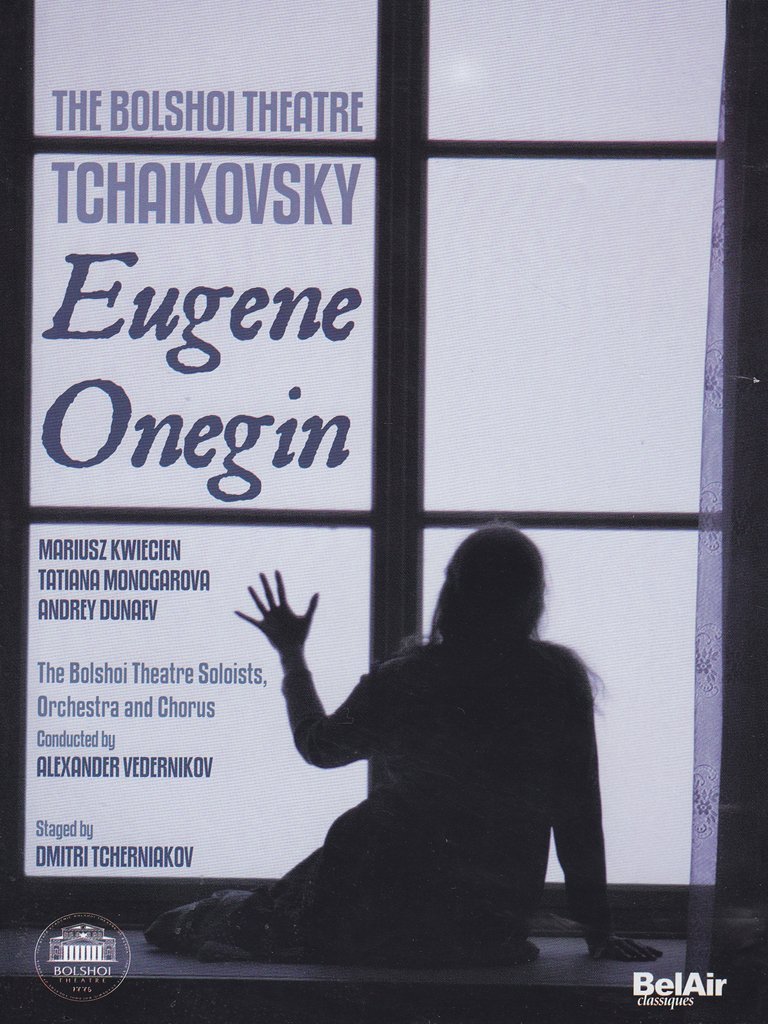
I started on Dmitri Tcherniakov’s production(Bel Air BAC046) with a huge dose of scepticism. His decision to replace Boris Pokrovsky’s old legendary production was very brave, because Muscovites (and not only Muscovites) were so very attached to it. Besides: you have to be really sure of yourself to dare to replace a LEGEND. On top of that, from the entire cast – apart from Kocherga and Kwiecien – I did not know any of the performers.
I quickly changed my mind, because from the start I was on the edge of my seat. The staging, costumes, stage design, sets and props – everything is right, even if it is not as it is in a typical ‘Onegin’. The entire first and second acts take place in the same space: the dining room in Larina’s house, with a long table and chairs prominently displayed. The same table and chairs also recur in III, but in a much richer ambience.
It is incredibly difficult to explain the whole directorial concept in a few words, you have to believe me that it is extremely fascinating and extremely exciting. Very intelligent too.
Tatyana is portrayed by Tatiana Monogarova in a very convincing way. She is pale, thin and slightly autistic, locked in her own mind. The outside world scares her as she tries to hide from it.
Olga(Margerita Mamsirova) is just a flirt and from the start she challenged Onegin. She is more than a little tired of her poet- boyfriend’s sighs. and she is not wrong!
Lensky is sung by a good, though not exeptional, Andrey Dunaev. He is a bit stupid, pushy and jealous and thus the real instigator of all evil happenings.
Larina (an insanely good singing and acting Makvala Kasrashvili) also gets more attention than usual. The moment when, thinking back to her childhood, she downs a drink and has a little cry is very touching. But she soon recovers and everything stays the same.
Mariusz Kwiecien (Onegin) is indeed irresistible. Or let me rephrase it: he portrays such a very bored and self-important arsehole (sorry for the word!). And he actually stays that way until the end. Utterly convincing!
Frantically he tries to belong to the ‘high society’, where he is not really accepted. Even his sudden passionate love for Tatyana feels unreal. On his knees, he offers her a bunch of red roses and when she refuses to run away with him, he tries to rape her.
Dignified, Tatyana walks off the stage on her husband’s arm on which Onjegin pulls out a pistol, but we are spared the suicide, because, of course!, without witnesses by his standards there is no use for it..
Trailer:
DMITRY HVOROSTOVSKY
And then there is Robert Carsen’s production for the Metropolitan Opera, recorded in February 2007(Decca 0743298). I am a huge Carsen-adept and love almost everything he does. So too this Onjegin
His staging is very realistic and he follows the libretto accurately. In the first act, the stage is strewn with autumn leaves, but everything else is basically bare and there is almost no scenery. A bed for the ‘letter scene’, otherwise some chairs in the second and third acts. At the duel, the stage is completely empty.
It is not distracting. On the contrary. The costumes are really beautiful, but especially in the first act they remind me more of English Jane Austen film adaptations than of the Russian countryside. It is not really disturbing, the eye wants something too, but Renée Fleming is too glamorous for a peasant trio, making her switch to a proud princess less impressive.
Onjegin (Dmitri Hvorostovsky) is mainly a dandy here, very concerned with his, good, looks. Well, Dima is an extremely attractive singer in all aspects, but in his confrontation scene with Tatyana, he is more reminiscent of daddy Germont than of Onjegin.
Ramón Vargas is one of the best lyric tenors in 2007, but Lensky he is not! He really does his best, he also looks like a real poet, but this role needs to be a bit more languorous.
As usual, Carsen’s character direction is truly unsurpassed and even Fleming seems to thaw out at times. Unfortunately, her Russian is totally unintelligible.
Fleming and Hvorostovsky in the final scene of the opera:
Who does not know ‘Méditation’, the sentimentally sweet but oh-so-beautiful piece of violin music? Most often it will make you cry.
Méditation in Josef Hassid’s performance:
However, not many people have ever heard, let alone seen, the opera in which this piece acts as a kind of interlude in the second act.
Recordings of the complete work are still scarce, I only know of three myself (with Anna Moffo, Beverly Sills and Renée Fleming), of which the one with Sills, Sherrill Milnes and Nicolai Gedda (Warner 0190295869069) is dearest to me.
Below Beverly Sills and Sherrill Milnes in the final scene of the opera:
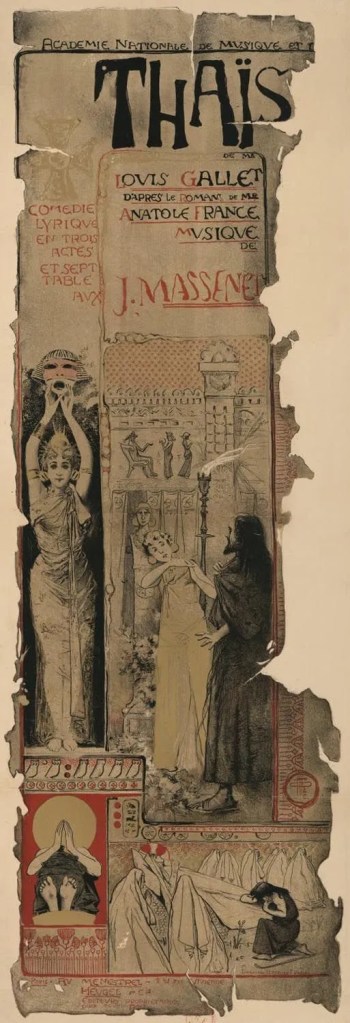
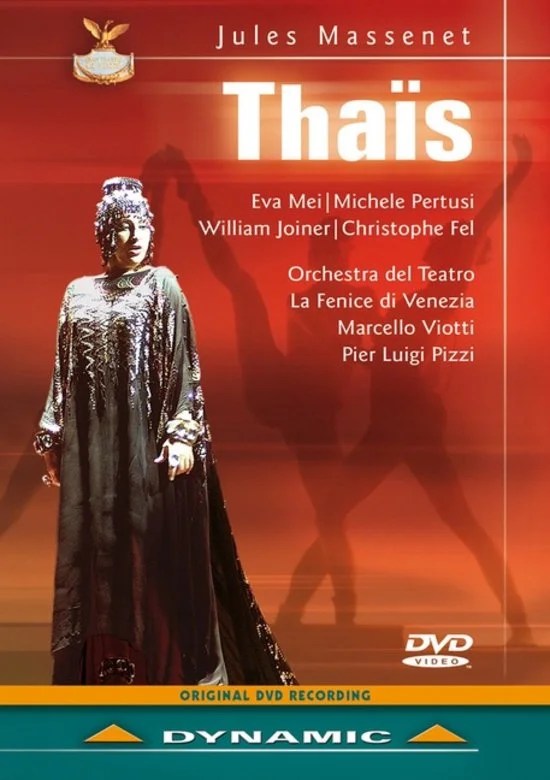
Pier Luigi Pizzi’s production from La Fenice had previously been released on CD and I found it particularly strong musically and mainly vocally. I was therefore particularly curious as to whether the visuals added anything to it on Dynamic’s DVD. To which I can now say a resounding “yes”.
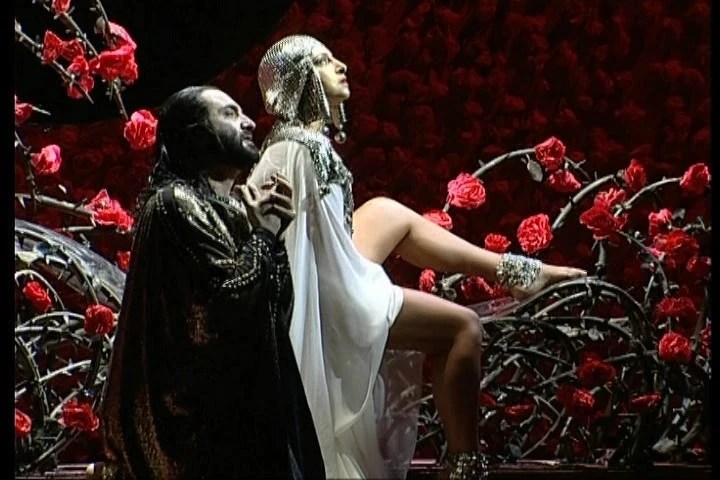
The sets are sparse, yet the stage seems to be completely full of them. Because of the colours (with very predominant red) perhaps, but also because of the dominant place they occupy on stage. For instance, Thaïs’ rose-covered bed, on which she – as if she were the Venus of Urbino or one of the versions of Danaë, also by Titian – lies very voluptuously. This bed is very prominently in the centre of the stage.
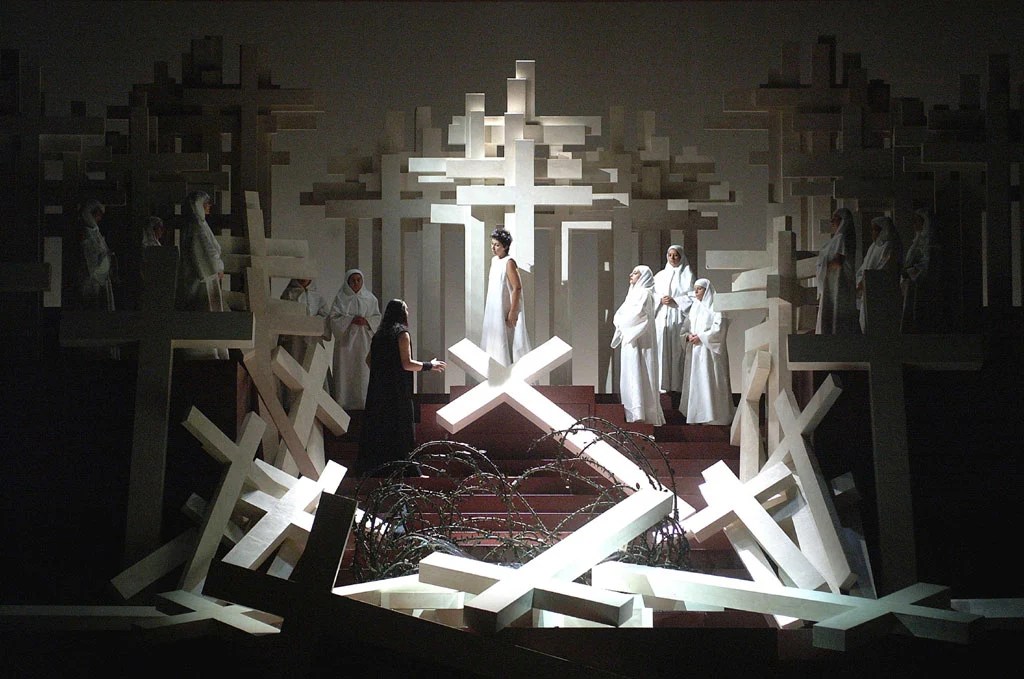
In the third act, when the fun life has ended and the penance begins, the roses are nowhere to be seen (a bed of thorns?) and her posture is as chaste as her white robe.
The costumes are a story apart: very opulent, oriental and barely concealing. Eva Mei doesn’t go as far as her colleague Carol Neblett, who went completely out of her clothes in New Orleans in 1973, but her see-through little nothing of a dress, from which her breasts keep escaping almost unnoticed, leaves nothing to the imagination.
Perhaps she was inspired by the very first Thaïs, Sybil Sanderson, whose breasts were also ‘accidentally’ visible during the premiere performance in 1894? Then again, it is all about the greatest (and most beautiful) courtesan in Alexandria!
Eva Mei is very virtuoso and very convincing as Thaïs . So is Michele Pertusi as Athanael. There is a lot of ballet, though. Also where it really shouldn’t be, which is very distracting at times.
Thaïs from Toronto: unearthly beautiful orchestral playing
Recordings of Thaïs are still scarce so any new releases are more than welcome. Especially if the performance is good, and this new recording on Chandos most certainly is. At least: to some extent.
The Toronto orchestra sounds so incredibly beautiful that you cannot help falling in love with it. Sir Andrew Davis truly extracts the impossible from his musicians: I have not heard the score performed so beautifully before. The pianissimi, the way they manage the quiet passages to perfection, the subcutaneous tension. Hats off! Hats off also to the violinist who manages to add new layers to the ‘Meditation’. So beautiful!
Unfortunately, the singers lag a bit behind. Erin Wall is a beautiful soprano with a crystal-clear voice, but a ‘Whore of Babylon’? More like a rather childishly naive girl.
Joshua Hopkins has the right voice for Athanael but he goes the wrong way when it comes to ‘earthly desires’. Andrew Staples is a good Nicias but he too fails to fully convince me.
“This is my best opera,” Giuseppe Verdi said after the premiere. And added that he “could probably never write anything so beautiful again”. That the “never” wasn’t completely correct, we know now, but at the time, some kind of electric shock must really have gone through the audience. Even now, more than 170 years after its premiere, Rigoletto continues to top the opera charts, as ever. I therefore sincerely wonder if there are any opera lovers left who do not have at least one recording of the ‘Verdi cracker’ on their shelves.
Design by Giuseppe Bertoja for the world premiere of Rigoletto (second scene of the first act)
Ettore Bastianini
My all-time favourite is a 1960 Ricordi recording (now Sony 74321 68779 2), starring an absolutely unmatchable Ettore Bastianini. His Rigoletto is so warm and human, and so full of pent-up frustrations, that his call for “vendetta” is only natural.
Renata Scotto sings a girlishly naïve Gilda, who is transformed into a mature woman by her love for the wrong man. She understands like no other, that the whole business of revenge can lead nowhere and sacrifices herself, to stop all this bloodshed and hatred.
Alfredo Kraus is a Duca in a thousand: elegant and aloof, courteous, yet cold as ice. Not so much mean, but totally disinterested and therefore all the more dangerous.
A sonorous Yvo Vinco (Sparafucile) and deliciously vulgar seductive Fiorenza Cossotto (Maddalena) are not to be sneezed at either, and the whole thing is under the inspired direction of Gianandrea Gavazzeni. Unfortunately, the sound is not too good, but a true fan will take it for granted.
Bastianini and Scotto in the finale:
Piero Cappuccilli
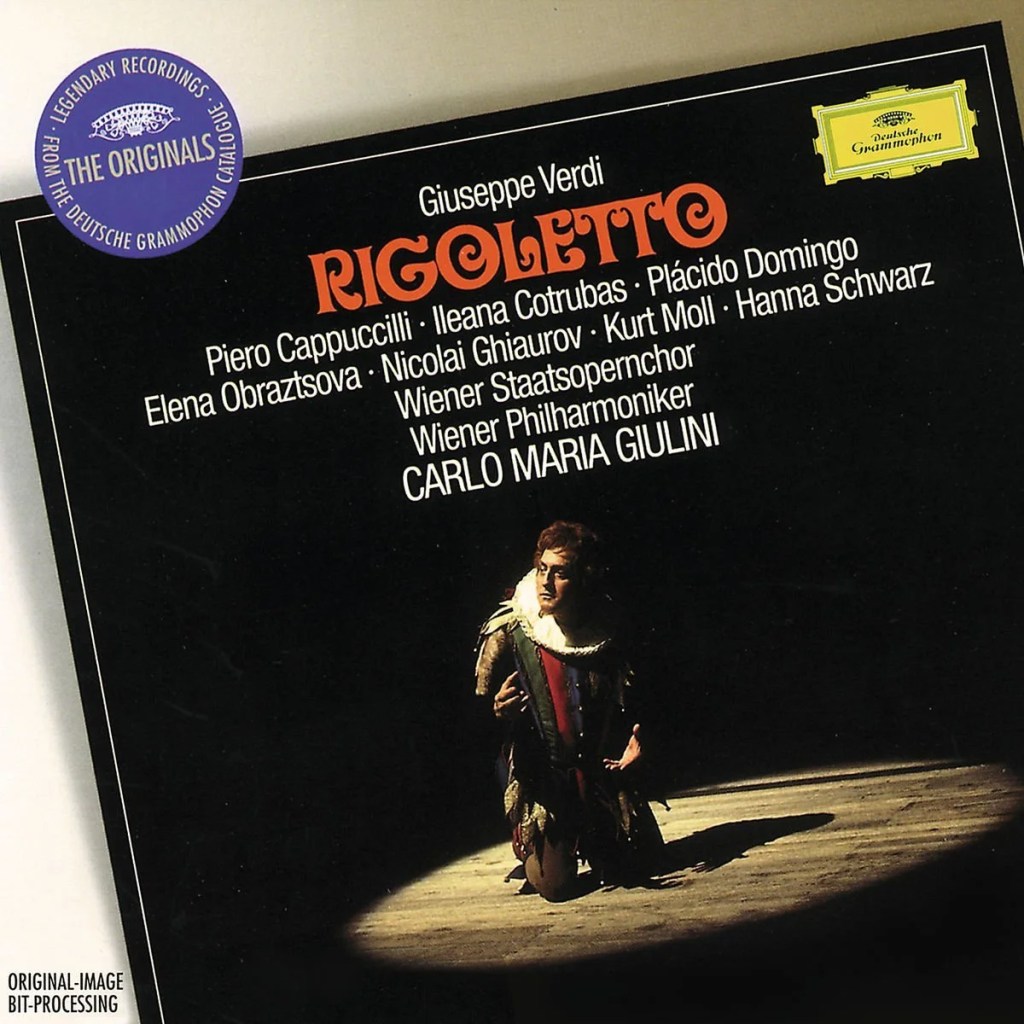
My other great favourite is the performance recorded in 1980 under Carlo Maria Giulini (DG 457 7532). Ileana Cotrubas is Gilda incarnate. She is not quite a vocal acrobat à la Gruberova, nor a wagging ‘canary’ like Lina Palliughi, decidedly less dramatic than Callas (rightly so, a Gilda is not a Leonora) and perhaps not as brilliant as Sutherland, but what empathy! What commitment! What an understanding of the text! Her Gilda, unlike Scotto’s, never grows old, and her sacrifice is a teenage girls’ own: senseless and pointless and so all the more moving.
The Duca is sung by Plácido Domingo, not really my favourite for the role, though there is nothing at all wrong with his singing. Piero Cappuccilli is a truly phenomenal Rigoletto, they don’t make ‘em like that anymore.
But we shouldn’t forget Giulini, because so lovingly as he handles the score that it couldn’t be more beautiful.
Tito Gobbi
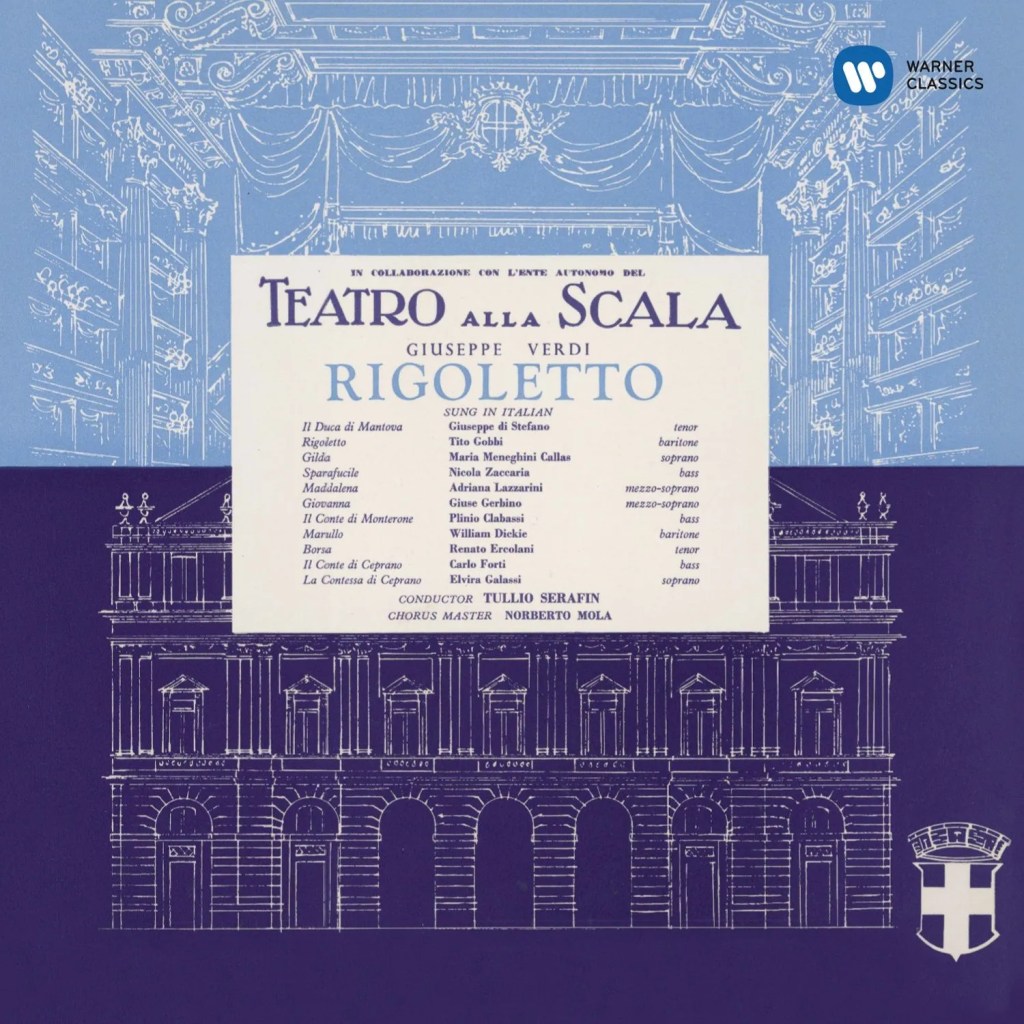
The 1955 recording with Maria Callas (Warner Classics 0825646340958) conducted by Tulio Serafin sounds pretty dull. Giuseppe Di Stefano is a pretty much perfect Duca: seductive macho, suave and totally unreliable. That his high notes in ‘Questa o Quella’ come out a bit squeezed, well… for this, he is forgiven.
Tito Gobbi is simply inimitable. Where else can you find a baritone with so many expressions at his disposal? This is no longer singing this is a lesson in acting with your voice! What you should also have the recording for is Nicola Zaccaria as Sparafucile. Unforgettable.
And Callas? Hmm. Too mature, too dramatic, too present.
Gobbi and Callas sing ‘Si, vendetta! Tremenda vendetta’
Sherrill Milnes
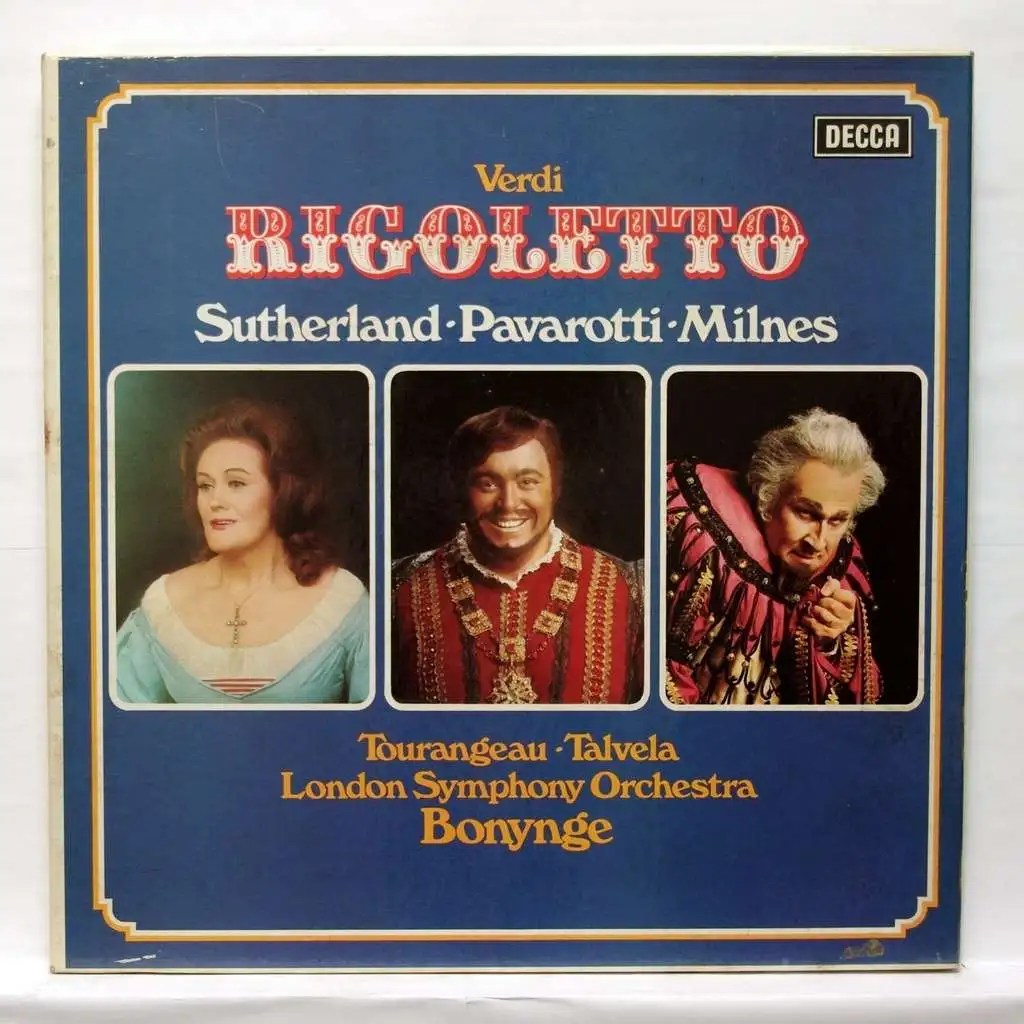
Joan Sutherland is a different story. Light voice, sparkling and indescribably virtuosic but a silly teenager? No.
Luciano Pavarotti is, I think, one of the best and most ideal Ducas in history. There is something appealingly vulgar in his voice that makes him sexually desirable which easily explains his several conquests.
Sherrill Milnes is a touching jester, who never wants to become a real jester: no matter how well he tries, he remains a loving father.
Matteo Manuguerra
Nowadays, hardly anyone knows him, but in the 1970s, Tunisian-born Manuguerra was considered one of the greatest interpreters of both bel canto and verismo.. And Verdi, of course, because his beautiful, warm, smooth-lined voice enabled him to switch genres easily.
Anyway, of course, you listen to this pirate recording (it is also for sale as a CD) mainly because of Cristina Deutekom. Just listen how, in the quartet ‘Bella figlia dell’amore’, she goes with a breathtaking portamento to the high D from the chest register. No one imitates her in that. For that, you take Giuliano Ciannella’s screaming and understated Duca at face value. The sound is abominably bad, but then again: are you a fan or not?
DVD’S
John Dexter
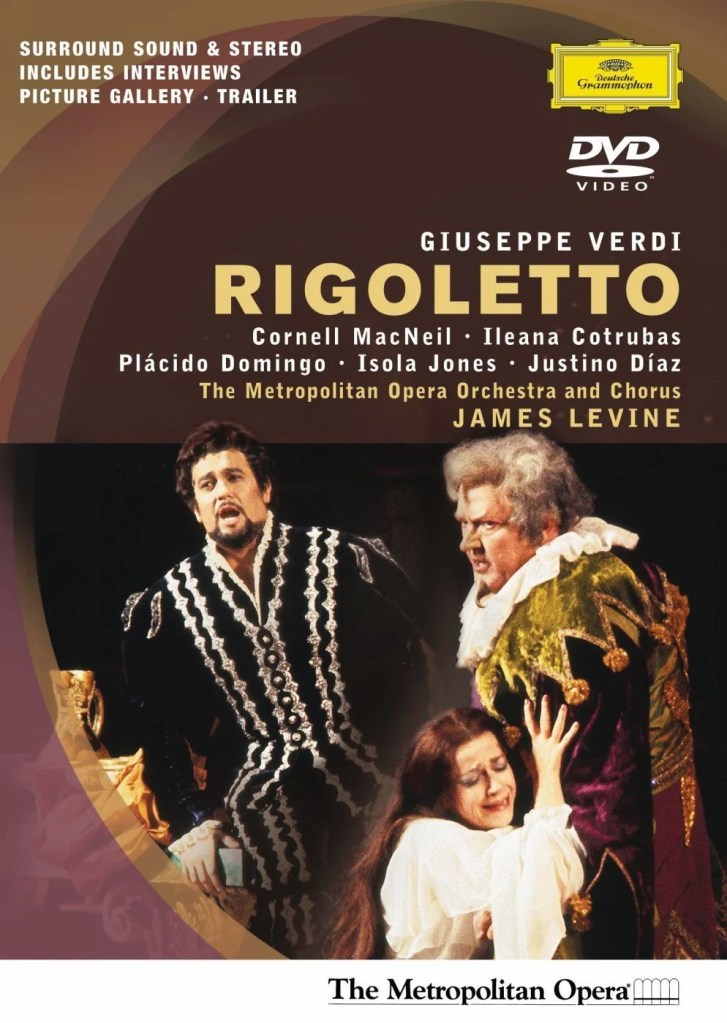
The 1977 production from the Metropolitan Opera (DG 0730939) is – of course – traditional. At first I had trouble with the close ups, which made all those stuck-up noses and thickly painted faces far too visible. But gradually I gave in to the beautiful direction and scenography which, together with the genuine 16th-century costumes, soon reminded me of Giorgione’s paintings. That this was indeed the intention was evident at the end, modelled on his ‘La Tempesta’, including the landscape and the sky drawn by lightning. But before it came to that, Rigoletto knelt with the dead Gilda (in blue, yes!) in his arms like Michelangelo’s “Pieta”, and I searched for a handkerchief because by now I had burst into tears.
Cornell MacNeil had his better days and started off rather false, but halfway through the first act, there was nothing wrong with his singing. And in the second act he sang just about the most impressive ‘Cortigiani’ I have ever heard, helped wonderfully by Levine’s very exciting accompaniment. Just watch how he pronounces the word ‘dannati’. Goosebumps.
It is an enormous pleasure to see and hear a young Domingo: tall, slim and handsome, and with a voice that audibly has no limitations, but…. As a Duca he goes nowhere. No matter how he tries his best – his eyes look cheerful and kind, and his lips constantly curl into a friendly smile. A “lover boy”, sure, but with no ill intentions. And he knows it himself, because he has sung that role very little. Actually, he hates Duca, at least so he says in an interview in a “bonus” to the Fragment from the second act:
Charles Roubaud
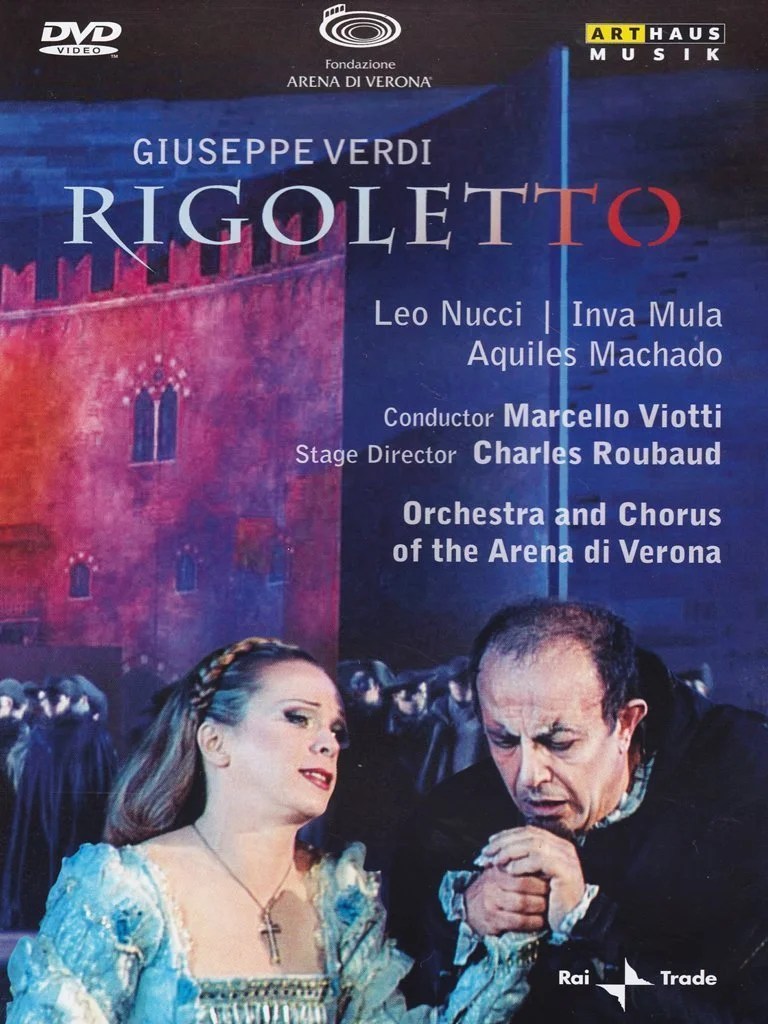
I heard a lot of good things about the performance at the arena in Verona in 2001. Reviews of the performances were rave, and people were also generally very positive about the DVD (Arthaus Musik 107096). So this will be just me, but I don’t like it.
The scenery is very sparse and looks very minimal on the large stage. It is still most reminiscent of cube boxes, but when the camera comes closer (and sometimes it comes too close!) they turn out to be walls, which close at the end in a very ingenious way – like a stage cloth, a nice invention though. The costumes are more or less okay, but I can’t find them brilliant either. And Rigoletto’s hunched back is downright ridiculous.
Leo Nucci is among the great Verdi baritones of our time but on the DVD his voice sounds anything but beautiful and in his first scenes he seems to be doing sprechgeang. Sure, his portrayal is certainly impressive, but I have seen him do better. The audience does enthuse, forcing him to encore ‘La Vendetta’ at the end of the second act.
It is not the last encore this evening: Aquiles Machado (Duca) also repeats with visible pleasure his, to my ears, roared-out ‘La donna e mobile’. It seems to be a tradition.
That he doesn’t look the part… well, he can’t help that. What is worse is that his Duca is nothing more than a silly macho man (what’s in a name?) and that his loud, in itself fine lyrical voice with solid pitch has only one colour.
Albanian Inva Mula really does her best to sing and look as beautiful as possible, and she succeeds wonderfully. All the coloraturas are there, as well as all those high notes. Her pianissimo is breathtaking, so there is nothing to criticise about that. But – it leaves me cold, because of how studied it sounds.
Marcello Viotti does not sound particularly inspired and his hasty tempi lead to an ugly ‘Cortigiani, vil razza dannata’, normally one of the opera’s most moving moments.
Leo Nucci and Inva Mula in ‘Si Vendetta’:
Gilbert Deflo
Sometimes I think that some opera directors have grown tired of all this updating and conceptualism and go back to what it’s all about: the music and the libretto. Such is the case with the Belgian Gilbert Deflo, who in 2006 in Zurich realised a Rigoletto that, were the story not too sad for that, would make you want to cry out for pure viewing pleasure (Arthaus Musik 101 283). He (and his team) created an old-fashioned beautiful, intelligent staging, with many surprising details and sparse but effective sets. The beautiful costumes may be of all times, but the main characters do not deviate from the libretto: the jester has a hunchback and the associated complexes, the girl is naive and self-sacrificing, and the seducer particularly attractive and charming.
Piotr Beczała, with his appearance of a pre-war film giant evokes (also in voice) reminiscences of Jan Kiepura. Elena Moşuc is a very virtuoso, girlish Gilda, and Leo Nucci outdoes himself as an embittered and tormented Rigoletto – for his heartbreakingly sung ‘Cortiggiani’ he is rightly rewarded with a curtain call.
Nello Santi embodies the old bel canto school, which one rarely hears these days.
Beczala, Nucci, Mosuc and Katharina Peets in ‘Bella Figlia del’amore’:
Michael Mayer
Times are changing and ‘director’s theatre’ has now also reached the New-York Metropolitan. They do not yet go as far as their European counterparts, but updating or moulding the libretto to a concept is now allowed.
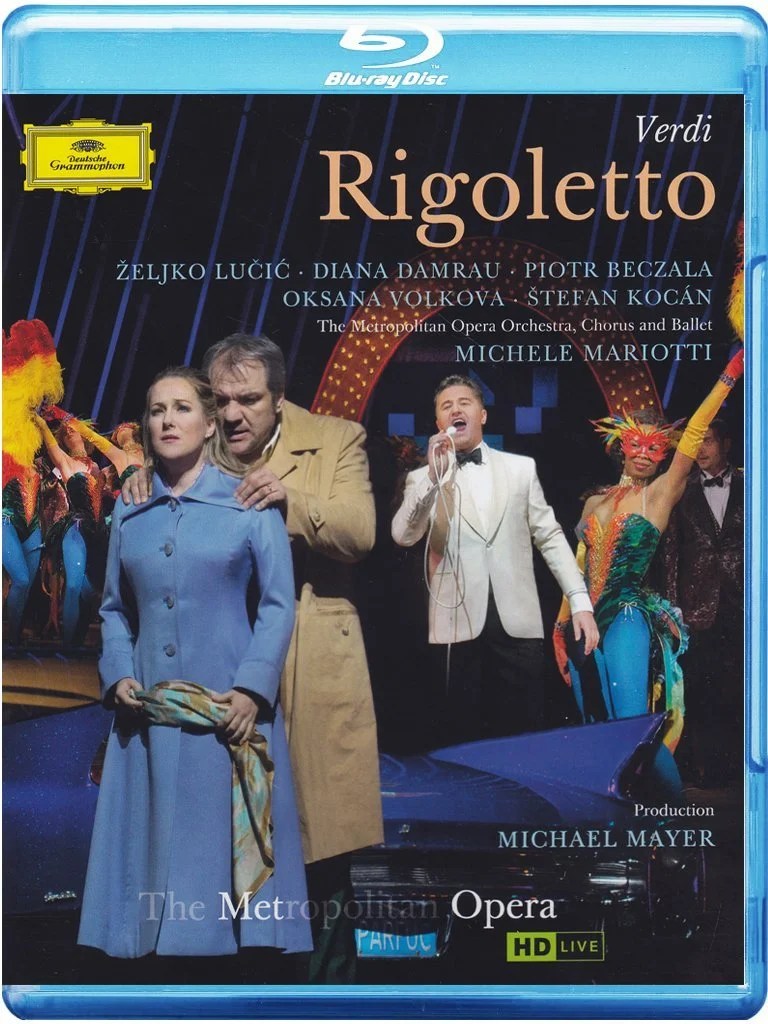
In 2013, Michael Mayer made it a “Rat Pack ‘Rigoletto'” set in 1950s Las Vegas in which Piotr Beczała (Duca), armed with a white dinner jacket and a microphone, is modelled on Frank Sinatra (or is it Dean Martin?). Beczała plays his role of the seductive entertainer for whom ‘questa o quella’ are more than excellent.
Piotr Beczała sings ‘Questa o quella’:
Diana Damrau remains a matter of taste: virtuoso but terribly exaggerated.
Zjeljko Lučić does not let me forget his predecessors, but these days he is undoubtedly one of Rigoletto’s best interpreters. The young bass Štefan Kocán is a real discovery. What a voice! And what a presence! The production is fun and engaging, but you cannot deny that you often have to look far for the logic.
‘La Donna e mobile’ in a minute and a half, sung by five tenors:
Victor Borge gives special treatment to ‘Caro Nome’:
For me an absolute ‘numero uno’ is the 1966 recording by EMI (now Warner 0190295735913) under Sir John Barbirolli. One might imagine a more lyrical or alternatively a more dramatic Cio Cio San; one with less metal in her voice or maybe one with a more childlike voice. But no other singer was able to grasp the complex nature of the girl so well and to characterise her change from a naive child into an adult woman, broken by immense grief, so impressively
CLARA PETRELLA
At number two on my list is a 1953 Italian Rai recording (Urania URN22.311) starring Clara Petrella. This terribly underrated soprano is a very dramatic Butterfly, with an intensity that just makes you ache on listening. Feruccio Tagliavini’s sweet, lyrica
l voice evokes an atmosphere of songs by Tosti: this is a Pinkerton to fall in love with.
VICTORIA DE LOS ANGELES
At number three, another oldie: a recording recorded by EMI in 1954 and now reissued on Regis (RRC 2070) featuring Victoria de los Angeles and Giuseppe di Stefano. De los Angeles is a Butterfly with a childlike warmth, brittle, fragile. Hurting her feels like hurting the Madonna herself. This is where Giuseppe di Stefano with his very macho tenor fits wonderfully.



























 Basia con fuoco