English

Musings on Tosca

Tosca partituurI am a great Puccini admirer. His music goes straight to my heart to never leave it again. I love all his operas and all his heroines are equally dear to me. I love Angelica and Cio-Cio-San very much and after they die I keep crying for hours. But none of them compare to Tosca. The story is so incredibly complex and so ingeniously constructed that I – even if I can really dream the opera! – discover something new in it everytime I listen to it.

Have you noticed that Puccini has no (big) roles for  mezzos? For the sake of convenience, I do not count Edgar. After all, that was not yet a ‘real Puccini’. I think the reason is his women are anything but one-dimensional. They are strong and vulnerable at the same time, neither good nor bad. Cio-Cio-San was a geisha, Suor Angelica had an illegitimate child, Mimi had loose relationships. And yet we love them, all of them, even the fickle Manon Lescaut and their death makes us grab our handkerchiefs.

The ‘Puccini baritones’ are friendliness itself: the sweet and helpful Marcello, the compassionate consul Sharpless. Even the sheriff Jack Rance plays fair and after a lost game of poker he lets his rival go.
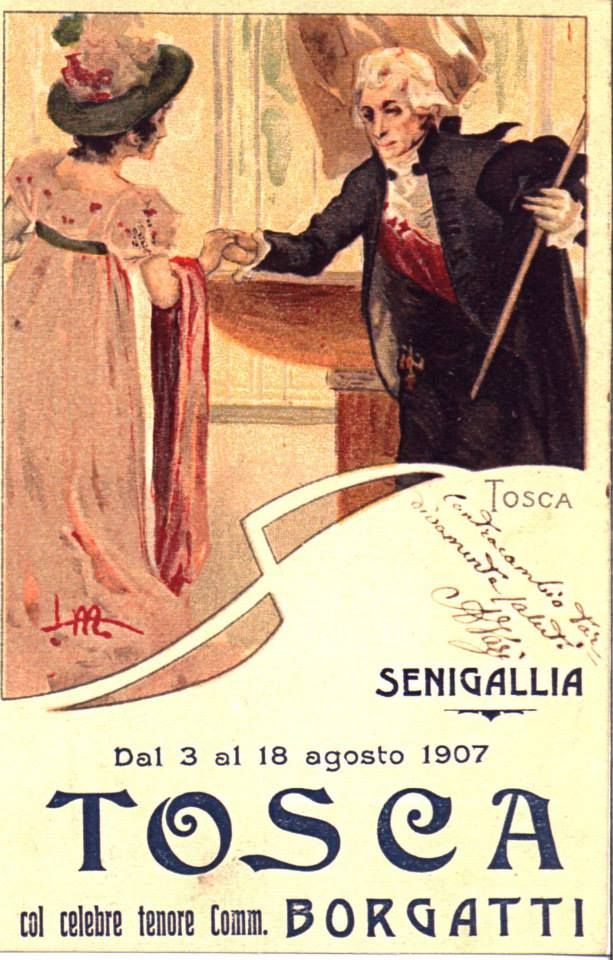
Tosca 1907

There is one exception: Baron Scarpia. From the beginning he dominates the stage in the literal and figurative sense. He is the one who has worked out the whole scenario and worked it out down to the smallest details. He is the hunter, who will not shy away from any means to catch his prey. He is the devil, afraid of nothing and no one; and in order to get what he wants he is prepared to cheat. But beware: he is totally repulsive, but also an attractive, charming, erudite and intelligent man and therefore an extremely dangerous opponent.

Tosca Giraldoni+as+Scarpia

First Scarpia: Eugenio Giraldoni


Floria Tosca is a celebrated singer, a diva. Beautiful, seductive, feminine and famous; coveted by many men. She is in a relationship with a young painter, Mario Cavaradossi.

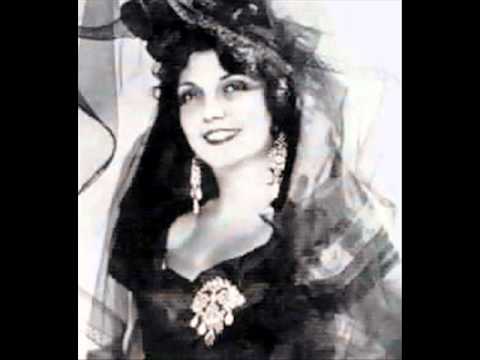
Tosca hericlee-darclee-din-arhiva-teatrului-solis

The first Tosca: Hariclée Darclée

Their relationship is passionate, but do they really love each other? Tosca is at the height of her career, so not so young anymore. She has already had many lovers and realizes that Mario might be the last one. That makes her extremely jealous.
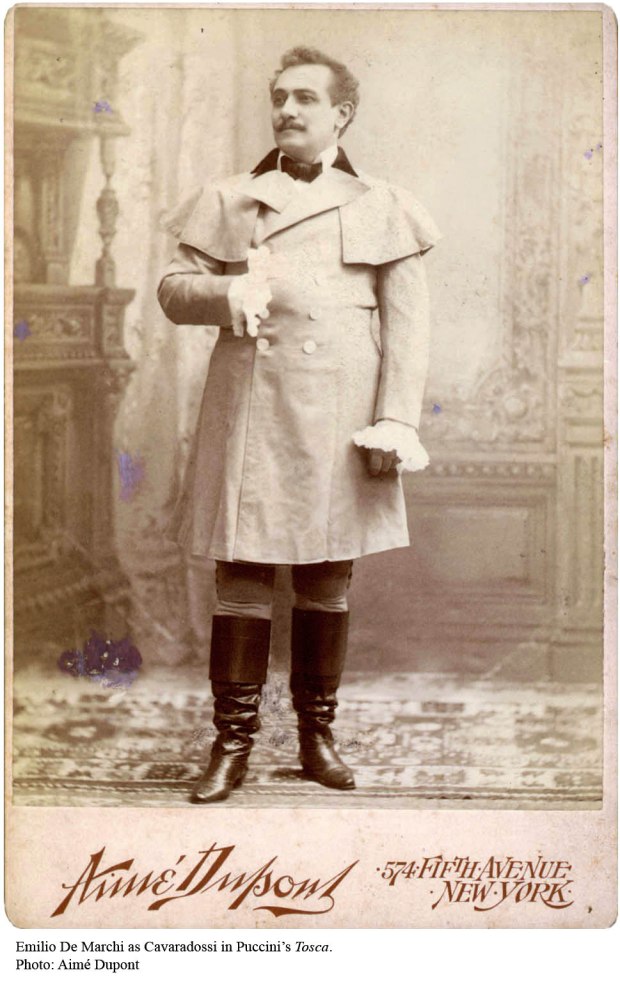
Tosca DeMarchiTosca

For Cavaradossi, a relationship with a famous diva is something to be proud of. He is, which doesn’t stop him from looking at other ladies and admiring their beauty. He flirts a bit with the revolution, trying to make himself important by offering a hiding place to a real revolutionary. What an easy prey for our hunter!
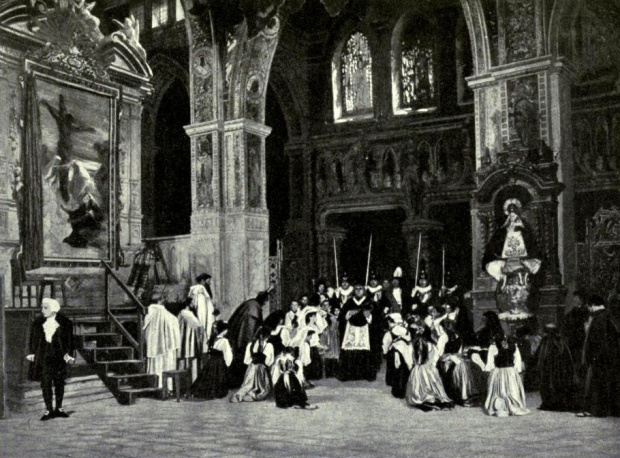
Tosca_Te_Deum_Act_1-1

The Te Deum scene which concludes act 1; Scarpia stands at left. Photograph of a pre-1914 production at the old Metropolitan Opera House

Scarpia is responsible for the detection of republicans. Angelotti, ex consul of the Roman Republic nevertheless manages to escape and all traces lead to a church, where our painter is at work. However, neither Angelotti nor Cavaradossi is present: an empty bread bin and doors which are open. Scarpia gratefully uses Tosca’s jealousy in the (justified) assumption that she could lead him to Angelotti’s hiding place. Moreover, he has been following the diva for some time now: he would love to spend a night with her. He has Cavaradossi tortured and in the meantime he is busy seducing Tosca.
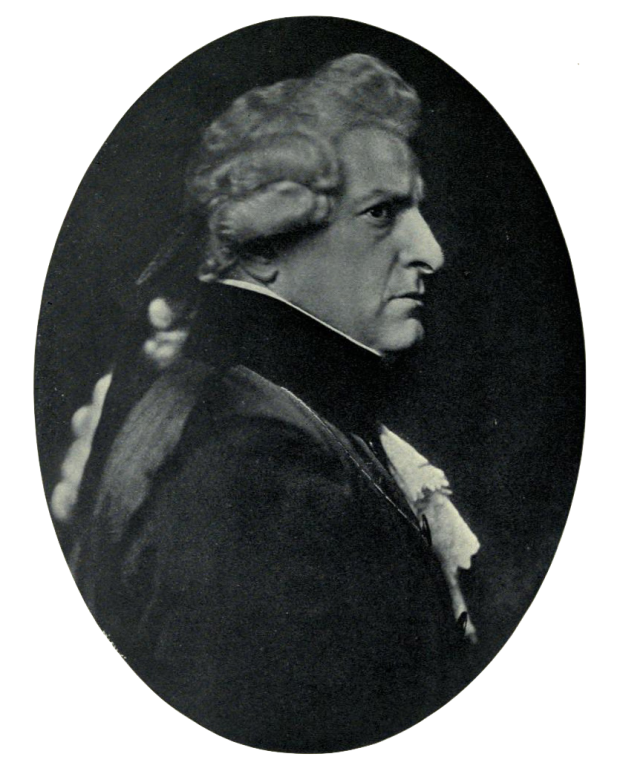
Scotti_as_Scarpia_Kobbe

Antonio Scotti as Scarpia

The exchange he offers her (Mario’s life for sexual favors) doesn’t surprise us. We have experienced this before in opera. But the finale, it’s so different! Most sopranos in the same situation commit suicide (Gioconda, Leonora ‘Trovatore’), or give in (Maddalena). Not our diva! She fights, prays, begs and behaves like a locked up tiger, to finally kill Scarpia with his own bread knife. What does she think she can achieve with this? The murder of the important man is soon discovered and then neither she nor her boyfriend (whom she still thinks she can set free) is safe anymore. Even a not very intelligent diva can think of that. What drives her? Well: Tosca is afraid of her own emotions!
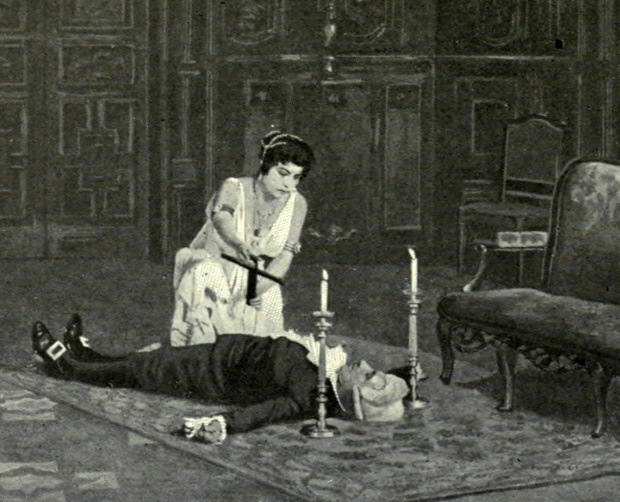
Tosca_Act_2_Victrola_Book_of_Opera

Tosca reverently lays a crucifix on Scarpia’s body. Photograph of a pre-1914 production at the old Metropolitan Opera House, New York

Remember how attractive Scarpia is? Even Tosca is not insensitive to him and that frightens her to a great extent. To escape Scarpia’s erotic appeal, she must kill him. Only then can she be truly free. She rushes to the Castle of the Holy Angel where her lover is imprisoned, tells him what she had done and that they are free. There remains one little thing: a ‘mock execution’.
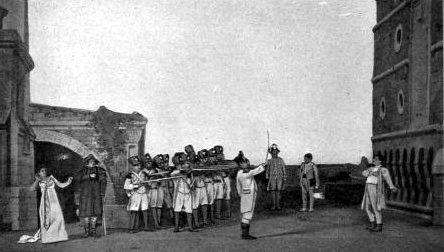
Puccini_-_Tosca_-_The_execution_of_Cavaradossi_-_The_Victrola_book_of_the_opera

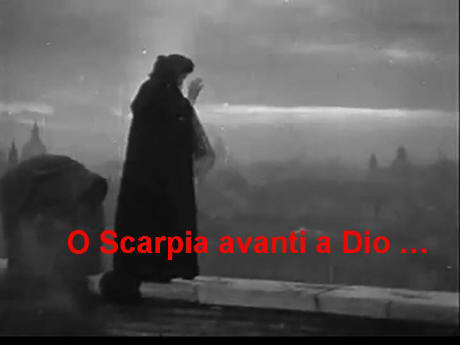
Unfortunately, Scarpia had never intended to pay Tosca for the night and Mario is actually killed. Only then does Tosca realize that Scarpia had surpassed herself in acting. And she can’t forgive him: “O Scarpia, avanti a Dio! (“O Scarpia, to God!”) are her last words.
110924-diapo315

There are thousands of ‘Toscas’ on the market. I will certainly not discuss them, too much, too many really good ones. Go and listen to Rosa Ponselle, Rosa Raisa, Mafalda Favero, Maria Caniglia, Magda Olivero, Renata Tebaldi, Maria Callas, Zinka Milanov, Eleanor Steber, Leyla Gencer, Leontyne Price, Montserrat Cabbalè, Renata Scotto, Raina Kabaivanska, Régine Crespin … They are all excellent, each in their own way, as it should be with a real diva. But – for me – no one beats Sara Scuderi:

In Dutch:
Mijmeringen over Tosca

Translated with http://www.DeepL.com/Translator

HIS SONG WILL NOT BE SILENCED *

kol-david

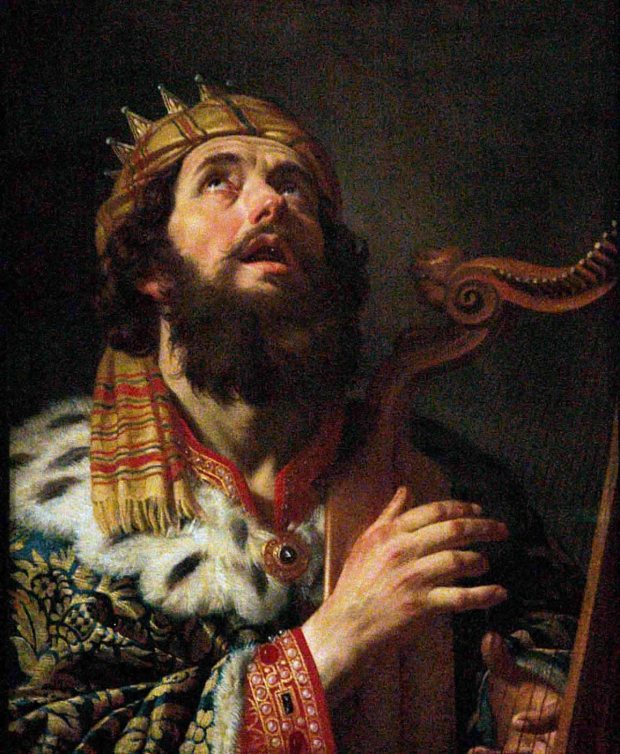
Gerrit van Honthorst (1590-1656), King David Playing the Harp (1611), Centraal Museum, Utrecht, Holland

A question of conscience: is there such a thing as Jewish music? If so, what is it? Is it klezmer?  The Chassidic Nigunim? The Spanish romanceros, the Yiddish songs, the synagogal chants, the psalms? And: can classical music be Jewish? Is it up to the composer? Is the music Jewish if the composer is Jewish? Or is it due to the themes used by him/her? A small quest.

Music played an important role in the lives of the ancient Hebrews. Just like most peoples of the East they were very musical and music, dance and singing were of great importance to them: both in daily life and in the synagogal services. They also played different instruments: for example, one of the women of Solomon brought more than a thousand different musical instruments from Egypt.

After the destruction of The Temple all instruments disappeared from the synagogues- except for the sjofar – and only in the 19th century did they return there. Unfortunately there is little written music from before the year 1700. However, in 1917 the oldest known music manuscript to date was found – it dates from around ±  1100.

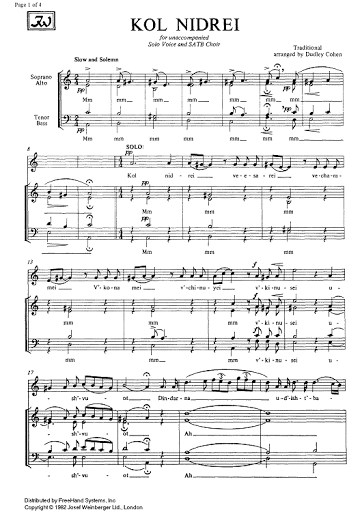
KOL NIDRE

ZIJN LIED ZAL NIET VERSTOMMEN *

The best-known prayer from the Jewish liturgy is undoubtedly Kol Nidre: a request for forgiveness and for the annulment of all vows made to God and to oneself during the past year. The prayer was said to have originated before the destruction of the Temple, but there are also legends that put the origin of the prayer in the hands of the Marranos (Spanish Jews, who converted to the Catholic faith under the pressure of the Inquisition, but remained Jewish at heart).

It is certain that Rabbi Jehuda Gaon already introduced Kol Nidre in his synagogue in Sura in 720. It is also a fact that the melody, as we know it, has some affinity with a well-known Catalan song. Over the years it has been arranged by several cantors, the most famous version dates from 1871 and was made by Abraham Baer.

The melody became a source of inspiration for many composers: the best known of them is the work for cello and orchestra by Max Bruch.

The motifs of Kol Nidre can also be found in Paul Dessau’s symphony and in the fifth movement of the String Quartet Op. 131 by Ludwig van Beethoven. And then we should not forget Arnold Schönberg’s “Kol Nidre” for speaking voice, choir and orchestra. He composed it in 1939, commissioned by one of the Jewish organizations.

http://www.schoenberg.at/index.php/de/joomla-license-sp-1943310035/kol-nidre-op-39-193

INFLUENCES

Jewish folk music cannot be grouped together under one denominator and has many traditions: after their dispersion Jews ended up in different parts of Europe, Asia and Africa. The greatest development of their own culture manifested itself strangely enough in places where Jews had the least freedom. Jewish folk music was actually music from the ghetto. Where Jews lived in reasonable freedom, their own “self” faded away.

In the countries around the Mediterranean Sea lived the so-called Sephardim (from Sfarad, Hebrew for Spain). They sang their romanceros in Ladino, a kind of corrupted Spanish. After their expulsion from Spain and later Portugal, they were influenced by the music of their new host country.

Below: ‘Por Que Llorax Blanca Nina’, a Sephardic song from Sarajevo.

In countries such as Poland and Russia, Jews lived in a constant fear of persecution that often degenerated into pogroms. Chassidism emerged as a kind of “counter-reaction”, a movement based on mysticism, spiritualism and magical doctrines. It proclaimed the joy of life, a kind of bliss, which could be achieved through music, dance and singing. Only in this way could direct contact with God be achieved. Hasidic music was strongly influenced by Polish, Russian and Ukrainian folklore. With later also the music of vaudevilles and the waltzes of Strauss. However, the character of the works remained Jewish.

Bratslav nigun – Jewish tune of Bratslav (by Vinnytsia), Ukraine:

In turn, the Chassidic melodies have had an enormous influence on classical composers: just think of Baal Shem by Ernest Bloch or Trois chansons hebraïques by Ravel.

Below: Isaac Stern plays ‘Baal Shem’ by Bloch:

JOSEPH ACHRON

ZIJN LIED ZAL NIET VERSTOMMEN *

Courtesy of the Department of Music, Jewish National & University Library, Jerusalem, Achron Collection.

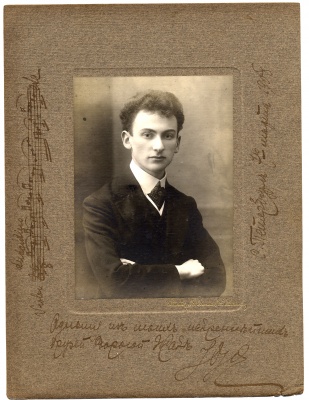
Arnold Schoenberg firmly believed that Joseph Achron was the most underrated composer of his generation. Schoenberg praised his originality and claimed Achron’s music was destined for eternity. Yet, despite his enthusiastic praise, Joseph Achron never became a household name. Violin buffs no doubt know his Hebrew Melody, a much loved encore of many violinists, starting with Heifetz.

Hebrew Melody is inspired by a theme Achron heard as a young boy in a synagogue in Warsaw. It is one of his earliest compositions,  dating from 1911, and his first ‘Jewish’ work.  In the year he composed it Achron joined the Society for Jewish Folk Music. His career as a composer properly started in the twenties of the last century.  In Saint Petersburg, Achron joined the composers of the New Jewish School. Several years later he moved to Berlin, where he got acquainted with the works of the French impressionists, and the Second Viennese School.

In 1924 he made a trip of several months to Palestine. He not only performed there, but also collected a huge variety of folk music. The notes he took during this trip were later used for several of his compositions. In his Violin Concerto No. 1,  Op. 60 (1925) several Yemenite themes can be heard. In the 1930s he fled, like Schoenberg, Korngold and many other Jewish composers from Europe, to Hollywood, where he died in 1943.

Jossif Hassid plays Jewish Melody by Achron:

OWN JEWISH SOUND

As early as the end of the nineteenth century a ‘Jewish national school of music’ was established in Petersburg (and later in Moscow). The composers united in it tried to compose music that would be faithful to their Jewish roots. Their music was anchored in the Jewish traditions of a mainly Hasidic nigun (melody).

The movement was not limited to Russia, think of the Swiss Ernest Bloch and the Italian Mario Castelnuovo-Tedesco who, in search of their roots, developed a completely individual, ‘Jewish style of composing’.

joods-cast

Mario Castelnuovo-Tedesco

Synagogal songs were a source of inspiration for Sacred Service by Bloch, Sacred Service for the Sabbath Eve by Castelnuovo-Tedesco, Service Sacré pour le samedi matin by Darius Milhaud and The Song of Songs by Lucas Foss.

joods-milhaud

Darius Milhaud

Below Darius Milhaud: Service Sacré pour le Samedi Matin:


Castelnuovo-Tedesco also used the old Hebrew poetry of the poet Moses-Ibn-Ezra, which he used for his song cycle The Divan of Moses Ibn Ezra:


In the USA it was (among others) Leonard Bernstein, who very deliberately used Jewish themes in his music (Third symphony, Dybbuk Suite, A Jewish Legacy).

Less well known are Paul Schoenfield and his beautiful viola concerto King David Dancing Before the Ark:

And Marvin David Levy who used Sephardic motifs in his cantata Canto de los Marranos:

The Argentinean Osvaldo Golijov (1960, La Plata) combines Jewish liturgical music and klezmer with the tangos of Astor Piazzolla in his compositions, both classical and film music. He often works with the clarinettist David Krakauer and for the Kronos Quartet he has composed a very intriguing work The Dreams and Prayers of Isaac the Blind:


DMITRI SHOSTAKOVICH

shosty

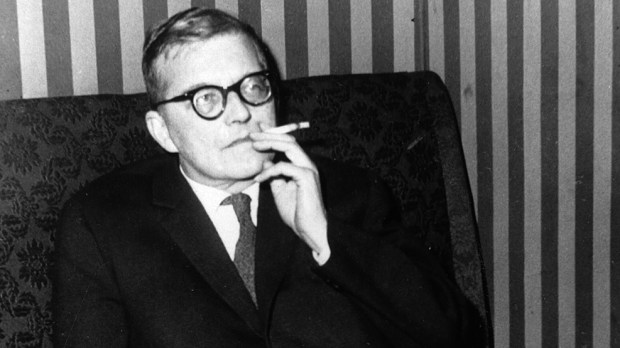
Soviet composer Dmitri Shostakovich’s once brilliant career took a dive after the official party paper criticized one of his operas in 1936. Shostakovich responded with his powerful Fifth Symphony.

The reason why the non-Jewish Shostakovich used Jewish elements in his music is not entirely clear, but at least it produced beautiful music. He wrote his piano trio op.67 as early as 1944. At the first performance, the last movement, the ‘Jewish part’, had to be repeated. It was also the last time it was played during Stalinism.

Piano trio op.67, Recorded in Prag 1946, with David Oistrakh, violine, Milos Sadlo, violoncello and Dmitri Shostakovich, piano

In 1948 he composed a song cycle for soprano, mezzo-soprano and tenor From Jewish Folk Poetry – recorded many times and (rightly!) very popular.

Old Melodia recording of the cycle:

In 1962 he composed the 13th symphony Babi Yar, after a poem by Yevgeny Yevtuchenko. Babi Yar is the name of a ravine in Kiev, where in 1941 more than 100,000 Jews were murdered by the Nazis.


In 1990, the Milken Archive of American Jewish Music Foundation was established to record all the treasures of Jewish music composed in the course of American history. The archive now consists of more than 700 recorded musical works, divided into 20 themes.

The CDs are distributed worldwide by the budget label Naxos. No one interested in the (history of) Jewish music should ignore them.

* This sentence is mentioned on the memorial stone, placed at the Muiderberg cemetery, in memory of the conductor Sam Englander, murdered by the Nazis, and his Amsterdam Jewish Choir of the Great Synagogue.

Translated with http://www.DeepL.com/Translator

in German: SEIN LIED WIRD NICHT VERSTUMMEN *|

in Dutch: ZIJN LIED ZAL NIET VERSTOMMEN *

Entartete Musik, Teresienstadt and Channel Classics

entartAt the end of the 1980s the music-loving world (and here I mean not only listeners, but also publicists, reviewers and music experts) found out that there was more between heaven and earth, or, since we are talking about music: between Strauss and Stockhausen. People began to realise that an entire generation of composers had been deleted from the history books and concert halls. Just like that. And it was not _only_ the fault of the Nazis.

entart-du

In 1988, the exhibition ‘Entartete Musik’ was put on in Düsseldorf, exactly 50 years after the original event held by the Nazis. The exhibition also traveled to other cities, including Amsterdam, and became the occasion of much discussion.

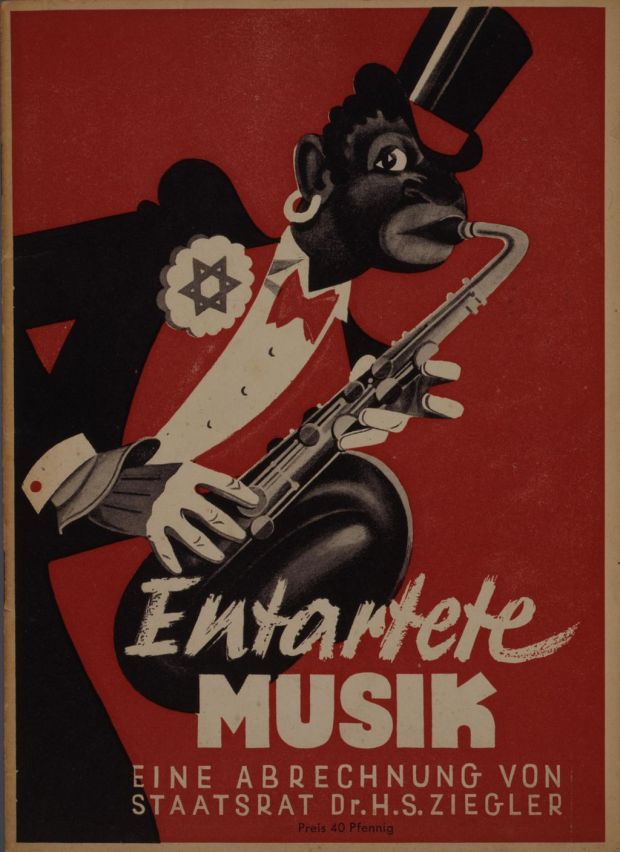
entartete affiche


The term ‘entartet’ (degenerate) was not invented by the Nazis. Already in the nineteenth century it was used in criminology, meaning something like ‘biologically degenerated’. The term was eagerly borrowed by the rulers of the Third Reich to prohibit the expressions of art that they considered ‘non-Aryan’. Modernism, expressionism, jazz … And everything that had to do with Jews, because they were already seen as a degenerate race.

entertet zwe vielschreiber


What had begun as a ban soon developed into exclusion and resulted in murder. Those who had managed to flee to America or England have survived the war. Those who stayed in Europe were doomed.

Many, mainly Czech composers were deported via Terezín to the extermination camps, many ended up there directly. After the war they were totally forgotten, and thus murdered for the second time. Those who survived were found hopelessly old-fashioned and no longer played.

It was only at the end of the 1980s that it became clear that Korngold was more than a composer of Hollywod scores; that without Schreker and Zemlinski there would probably have been no Strauss either and that Boulez and Stockhausen were not the first to experiment with serialism. The turnaround came too late for most of the survivors …

 In Germany the foundation Musica Reanimata was established, but the Netherlands did not stay behind either. Under the name Musica Ritrovata a few enthusiasts have tried to bring the music back to the concert halls.

That this succeeded was partly thanks to Channel Classics. The Dutch CD label, founded by Jared Sachs was the very first to record the music of forgotten composers.

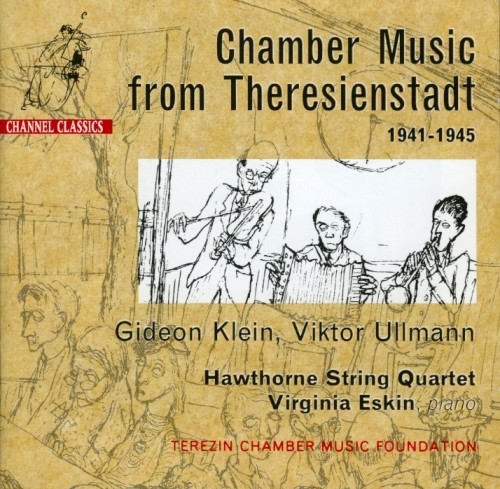
Already in 1991 and 1992 they released four CD’s with music of the ‘Theresienstadt – Composer’ of whom one had almost never heard before: Gideon Klein, Hans Krása, Pavel Haas, Viktor Ullman… Even though the last three were really household names before the war. Gideon Klein had not had the chance – he was murdered in the gas chambers at the age of 24.

HANS KRÁSA

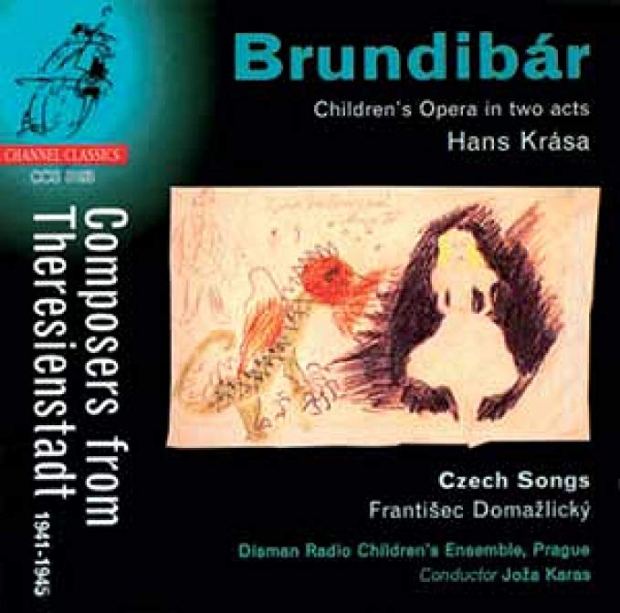
entartete brundibar

The first four Channel Classics CDs were truly pioneering. Hans Krása’s child opera Brundibar was recorded in Prague. Brundibar was actually composed before the war, but its premiere took place in Terezín, in 1943.

The CD (CCS 5198) was combined with songs by Domažlicky. Not a high-flyer, but certainly interesting.


krasa

On the other hand, the recording of Krása’s chamber music by the La Roche Quartet (CCS 3792) is great, probably the best performance of it.

PAVEL HAAS

haas

Of all Janácek’s students, Pavel Haas succeeded best in combining the influences of his teacher with his own musical language. At the request of the bass Karel Berman, he wrote Four Songs on Chinese Poetry in 1944. Berman, who survived the war, recorded them together with his own songs (CCS 3191).

Karel Berman sings  ‘Far Away Is The Moon Of Home’:

GIDEON KLEIN

entartete klein

But the best thing, in my opinion, is the recording with four works by 24-year-old Gideon Klein and Victor Ulmann’s third string quartet,. Listen to Klein’s Trio and shiver (CCS 1691)

SCHULHOFF, WOLPE AND KOFFLER. AND MORE

entartete griebel schulhoff

Channel Classics continues, now in collaboration with the acclaimed Werner Herbers and his Ebony Band. Thanks to Herbers many composers have become more than just a Wikipedia entry. Think of Schulhoff: you do know his CD with Dada-inspired works, with Otto Griebel’s drawings, don’t you?

The Ebony Band plays H.M.S.Royal Oak, Schulhoff’s jazz oratorio:


entartet dancing

Think of Stefan Wolpe, of whom Herbers performed the opera Zeus und Elida during the Holland Festival in 1997 and whose music he still records: the latest CD is called Dancing.

Ebony Band plays ‘Tanz (Charleston)’ by Wolpe:

Besides compositions by Wolpe, Milhaud and Martinů it inlcudes works by Emil František Burian and Mátyás Seiber.

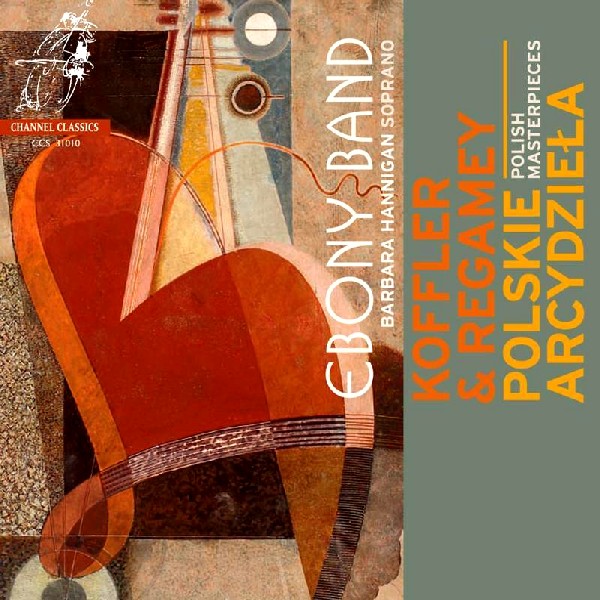
entartkof

And think of the Polish composer Józef Koffler, the first Polish composer who used the dodecaphony. Koffler, together with his family, was murdered by the Nazis, probably in the city of Krosno. His String Trio and the beautiful cantata Die Liebe (sung by Barbara Hannigan) are combined with the Quintet of the other unknown Pole, Konstanty Regamey (CCS 31010).

Koeffler’s ‘Die Liebe’ (Miłość):

Translated with http://www.DeepL.com/Translator

In Dutch:
Entartete Musik, Teresienstadt en Channel Classics

Auf Deutsch:
Entartete Musik, Theresienstadt und Channel Classics. Deutsche Übersetzung

For more ‘Theresienstadt-composers’
“Ich möcht so gern nach Haus!”: Anne Sofie von Otter zingt liederen van ‘Theresienstadt componisten’

DROMEN ZIJN BEDROG

Das Lied von Terezín & Requiem Ebraico

Rudolf Karel, een ‘Theresienstadt componist’ die vrijwel niemand kent

PAVEL HAAS door het Kocian Quartet


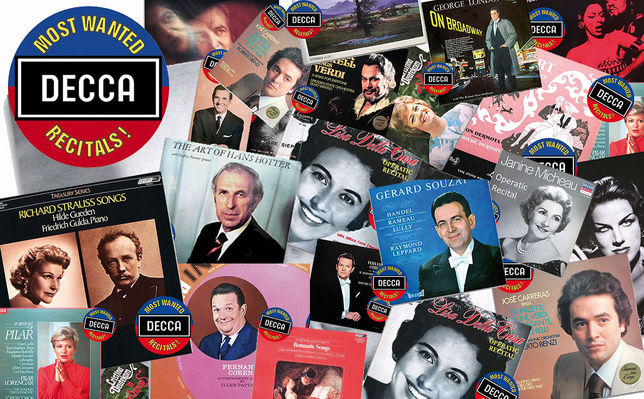
Decca’s Most Wanted Recitals. Part 2

Decca-s-Most-Wanted-Recitals 2

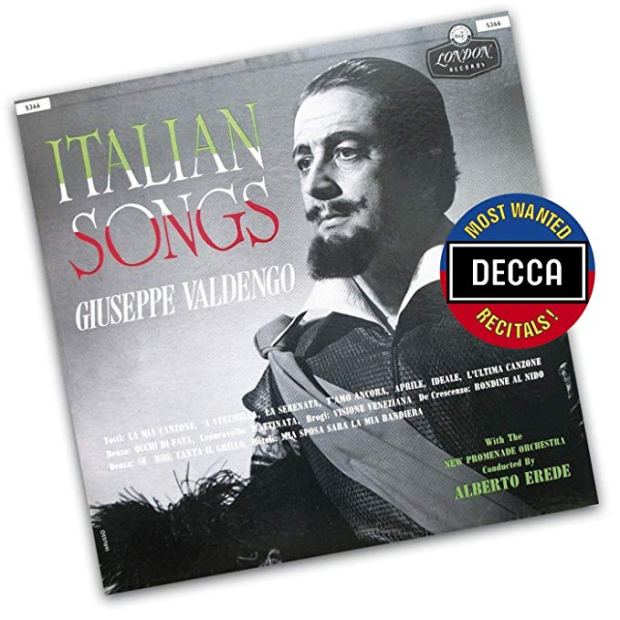
GIUSEPPE VALDENGO

Decca Valdengo

In May 2014 Giuseppe Valdengo would have turned 100 years old. A fact that has escaped everyone, because the baritone born in Turin is now almost completely forgotten. How sad! And then to think that he was one of the beloved singers of Arturo Toscanini! He can still be admired on live radio recordings of Aida, Otello and Falstaff, led by the great maestro.

Opera News wrote about Valdengo: “Although his timbre lacked the innate beauty of some of his baritone contemporaries, Valdengo’s performances were invariably satisfying – bold and assured in attack but scrupulously musical. How true!

Below is a tribute to the baritone, made on the occasion of his hundredth birthday:

I knew him from his performance in the film Great Caruso with Mario Lanza, but he really impressed  me with his role of Alfio in the RAI filmed Cavalleria rusticana, with the inimitable Carla Gavazzi as Santuzza.

Alfio is missing on the 1949 CD recorded for London, but his Tonio from Pagliacci, a role with which he celebrated unprecedented triumphs, is included. Furthermore, two very moving arias from Rigoletto, plus the Italian sung Hamlet and Valentin (Faust), sound very touching.

Most of his recital, however, is taken up by Italian songs by Tosti, Brogi, Denza and Leoncavallo. Repertoire that fits him like a glove.


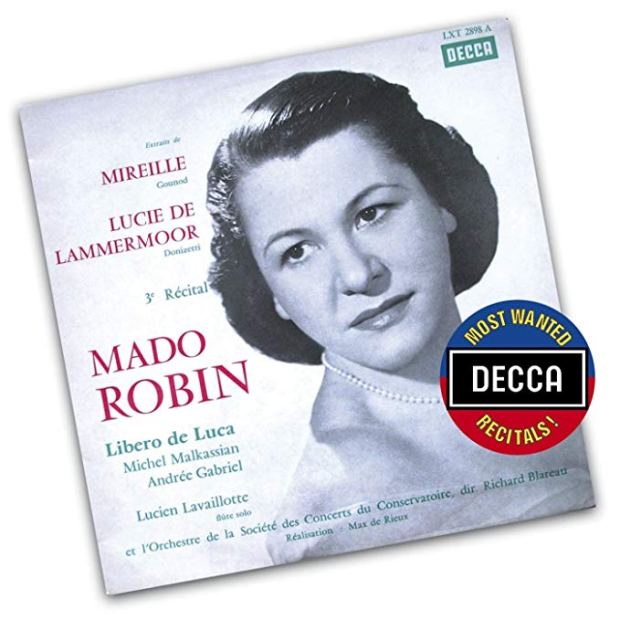
MADO ROBIN

Decca Robin

The French coloratura soprano could actually be considered the eighth world wonder Her voice was of the soubrette type with a very pleasant girlish timbre and her coloratura technique more than sublime, but there was more: her high notes were extremely high. With her voice she not only reached the F4, but even had the C4 within her reach without any problems, one of the highest notes ever sung by a human voice.

All her high notes in a row, with the description:

In the fifties she was a very celebrated radio and TV star in France, but her fame reached far beyond her national borders. She celebrated her greatest triumphs as Lakmé and Leïla (Pearl Fishers), but her Lucia and Olympia were also proverbial.

Gounod’s Mireille is not really a role we would expect from her, but it fits wonderfully well with her childishly naive timbre. I enjoyed these fragments the most, much more than her Lucia and Bellinis.


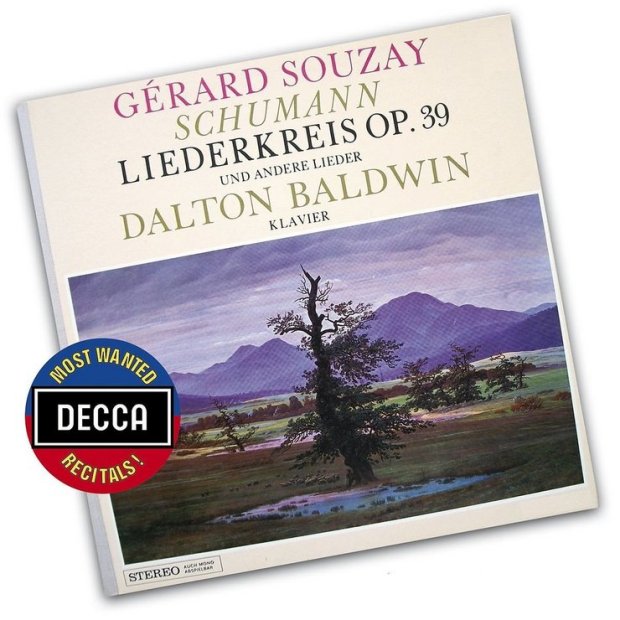
GERARD SOUZAY

Decca-Souzay-Liederkreis-op.-39

The in all respects beautiful baritone Gérard Souzay has made the big mistake to sing on for far too long. His last Philips recordings are unlistenable and with his hair dyed pitch black he looked rather pathetic. A great pity, because if you listen to his earlier recordings, you can only fall in love with him and his voice.

Souzay was without a doubt one of the greatest performers of French song and his Faurés and Ravels are a delight. But don’t underestimate his German lieder either! Listening to his recording of Schumann’s Liederkreis from 1965, one cannot escape the thought that this music should go like this, and not otherwise. Just listen to his ‘In der Fremde’; I want to bet you cannot escape the feeling of being displaced yourself.

Below Liederkreis:

His Dichterliebe is just as beautiful: with his light baritone and his sweet, sweet sound he makes you actually fall in love. The recording dates from 1953 and in addition to the cycle we get three separate Schumann songs, including an interpretation of ‘Nussbaum’, which moves me to tears.

In these recordings Souzay’s then regular accompanist Jacqueline Bonneau accompanies him. After 1954 she gave way to Dalton Baldwin (Bonneau did not like travelling). Souzay had a kind of musical marriage with Baldwin. Their collaboration guarantees ultimate beauty.

Below is Dichterliebe:

VIRGINIA ZEANI

decca zeani

Born in 1925, Zeani made her debut at age 23 as Violetta in Bologna, a role that would become her trademark. She had no less than 69 roles on her repertoire, many of which were premieres – she created the role of Blanche in 1957 in Dialogues des Carmélites by Poulenc. Her repertoire ranged from Haendel, Bellini, Donizetti, Massenet and Gounod to Wagner. And of course the necessary Verdis and Puccinis.

Her Puccini arias, recorded in 1958 under the direction of Giuseppe Patané, have – together with a recital by Graziella Sciutti – been released earlier by Decca; but her Donizettis, Bellinis and Verdis from 1956 (conductor: Gianandrea Gavazzeni) have their CD premiere.


INGVAR WIXELL

Decca Wixell

The Swede Ingvar Wixell was and remains a more than phenomenal Verdi baritone, and his Rigoletto ranks among the best creations of the role.

Below Ingvar Wixell sings ‘Cortigiani, vil razza dannata’ in Jean-Pierre Ponnelle’s 1982 Rigoletto film:

He had a sonorous sound most reminiscent of a firm oak, at first sight unshakable and yet sensitive to wind and rain. You can hear it best in ‘Tregua è cogi’ from Attila:


HILDE GUEDEN

Decca Gueden

Together with Lisa Della Casa, Hilde Gueden was one of the best performers of Richard Strauss songs. On this CD, flanked by none other than pianist Friedrich Gulda, she makes my heart sing with pleasure. The mono recording was made in 1956 in the famous Sofiensaal in Vienna, under the supervision of the legendary John Culshaw.


As a bonus we hear Gueden’s delicious Zdenka, in duet with Lisa Della Casa as Arabella, from a less known recording of highlights from the Strauss opera under Rudolf Moralt (1953). There are also two scenes from one of the most beautiful Rosenkavalier recordings I know, the one under Silvio Varviso from 1964.

Below the final scene from that recording. Besides Gueden, we hear Régine Crespin and Elisabeth Söderström:

Decca’s Most Wanted. Part one

THE STEPSISTERS OF MARIA CALLAS

Decca’s Most Wanted. Part one

Decca-s-Most-Wanted-Recitals

In April 2014 the series ‘Decca’s Most Wanted Recitals’ was launched: fifty albums by legendary singers, often never released on CD before. It’s a true treasure chest and it’s to be hoped that it is still available.

It was all the ‘fault’ of Victor Suzan. This employee of Universal Mexico went through the old Decca archives and lovingly restored no less than fifty albums never released on CD before.He digitized and remastered them, adding bonuses where possible and utilising the artwork from the original LP issues. Nostalgia at its bests, and moreover of the highest quality…

Fortunately, all Universal branches responded more than enthusiastically to her initiative. EDC/Hannover picked it up and so the series ‘Decca’s Most Wanted Recitals’ was born. The first batch consisting of twenty titles appeared on the market in early April 2014. Fifteen more titles followed in June and the last fifteen in September of that year.

These are treasures. Real treasures. For many, certainly younger voice lovers there is plenty to (re)discover. Enough also to shake up their world view, because in the fifties and sixties the word “crossover” did not yet exist and musicals were just as much appreciated as Wagner and Verdi.

I have selected ten titles from the collection and divided them into two parts in random order.

GEORGE LONDON (4808163)

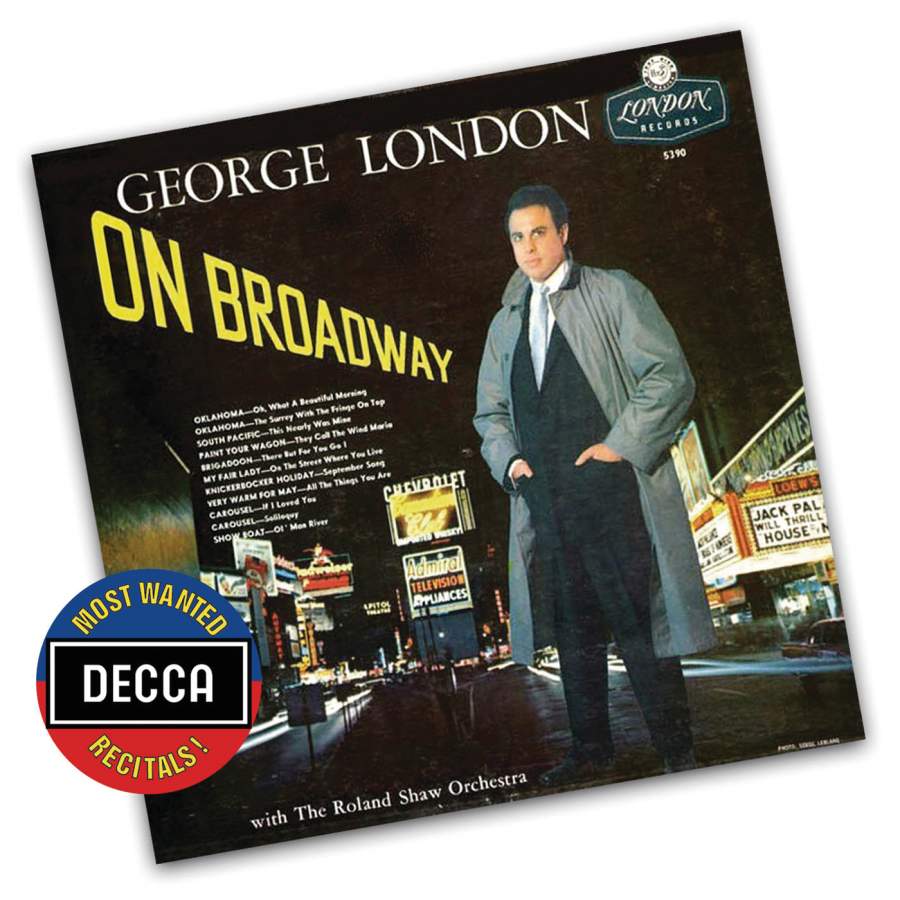
Decca London

Let’s start with George London. He was the very first American who sang Boris Godunov (in Russian!) at the Bolshoi in Moscow and was considered one of the best Wotans/Wanderers of his time. His Scarpia was also legendary during his lifetime.

Below is George London (in a perfect Russian!) as Boris, recording from a concert from 1962


He started his career in the early forties as a member of the ‘Bel-Canto Trio’, with soprano Frances Yeend and … Mario Lanza as the other two members.

On the CD On Broadway he gives a masterclass how to sing the music of musical composers Rogers, Kern and Loewe.

Below London sings ‘f I loved you’ by Rogers and Hammerstein.


You get Wagner as a bonus.


CESARE SIEPI: Easy to love (4808177)

Decca Siepi broadway


Not only Americans considered Broadway as something to take seriously. The Don Giovanni and one of the biggest Verdi-basses of the second half of the last century, Cesare Siepi, didn’t look down on the musical theatre either.

His CD on which he gives his vision on the songs of Cole Porter is called Easy to Love. It sounds ‘easy’ indeed, but it is not at all. Porter’s music benefits from simplicity, coupled with the best vocal chords in the world, and Siepi has it all.

His interpretation of ‘Night and Day’ is one of the most beautiful ones I’ve heard in my life. Not to mention ‘So in love’ or the delicious ‘Blow, Gabriel blow’ from Anything Goes.


As a bonus we get to hear some of his best Verdis: Nabucco, Philip II and a Boccanegra like you don’t hear anymore.


CESARE SIEPI: The romantic voice of Cesare Siepi (4808178)

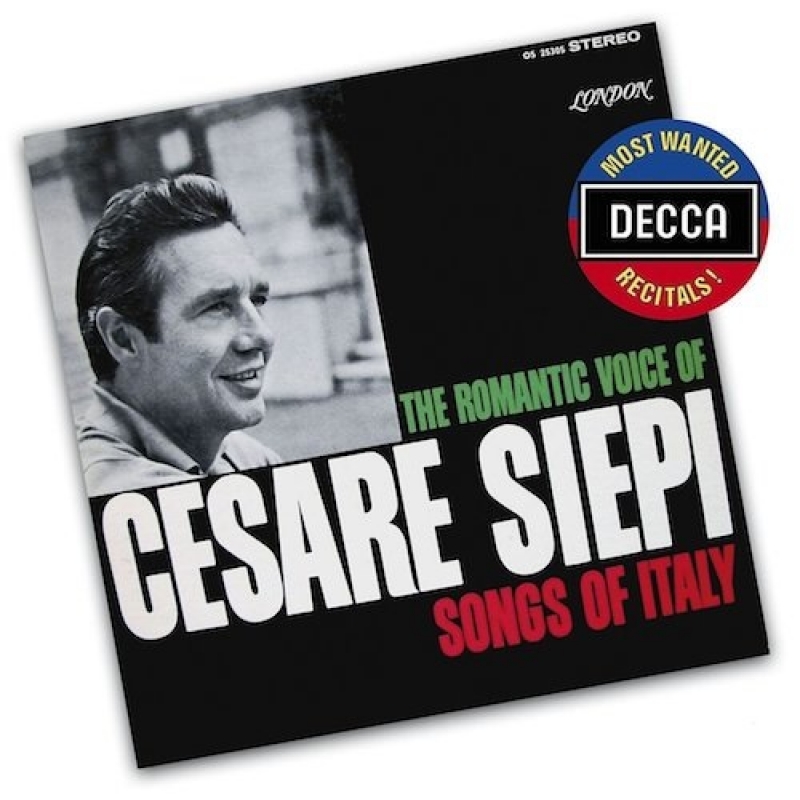
Decca Siepi italiaans


This CD is entitled The romantic voice of Cesare Siepi and that is exactly what you get: a beauty of a voice that awakens all the romantic feelings in you!

No Broadway here anymore, but popular Italian songs that fit Siepi  like a glove: just delicious.

What really makes the CD special are the bonus tracks, with arias from Meyerbeers Robert le Diable and Les Huguenots, La Juive by Halévy and – for most people a real rarity – an aria from Salvator Rosa by Antônio Carlos Gomes. My goodness, what beautiful music! I ask (again): when do we get to see another opera by Gomes? After the performances of his Il Guarany in 1994 in Bonn it has remained silent for much too long around this Brazilian Verdi.

Below ‘Di Sposo Di Padre Le Gioie Serene’ from Salvator Rosa van Gomes, 1954:


The album was recorded in 1961 (songs) and in 1954 (arias) and the sound is excellent. In the arias Siepi is accompanied phenomenally well by the Orchestra dell’Accademia di Santa Cecilia and Alberto Erede. At that time Erede was considered a ‘decent’ conductor, but now he would be considered one of the greatest opera conductors of all. He gives his soloist all the space he needs and allows the orchestra to breathe with him.


ARNOLD VAN MILL (4808167)

Decca van Mill

The Dutch bass Arnold van Mill is almost completely forgotten nowadays. How unfair! His voice is a bit reminiscent of the young Kurt Moll, which of course is also due to the repertoire. Beautiful!

Below is the duet from Der Fliegende Holländer. Arnold Van Mill sings Daland and George London Der Holländer:


Van Mill was mainly famous for his Wagner roles. Unfortunately they are not on this CD. But his smooth bass was also very suitable for Singspiel and operetta. His Lortzing, Cornelius, Nicolai and Weber (all present on this CD) are a pure delight for the ear. All real collector items. Thank you, Decca!


The CD is complemented by Russian songs, sung by the Bulgarian bass Raphael Arié. (not available on YT anymore). The combination isnot really a happy one: not only does the repertoire differ like day and night, the voices are incomparable as well; which does not prevent me from enjoying him enormously! Hopefully Decca will have more of Arié on the shelf, because my wish list with his recordings is quite long!

Below Arié sings ‘Ella giammai m’amo’ from Don Carlo

and the death scene from Boris Godunov:

Decca’s Most Wanted Recitals. Part 2

It all started with Paganini: DYNAMIC celebrates its fortieth birthday

DynamicThe genesis of Dynamic can be read as a real fairy tale. The label was founded  forty years ago by Pietro Mosetti Casaretto (1925-2012), a violin-playing surgeon with an enormous passion for classical music. Initially, only chamber music works were recorded, all performed by the many friends (including Salvatore Accardo and Bruno Cannino) of the founder.

Mosetti Casaretto, a sincere admirer of violin music in general and of Paganini in particular, set himself the goal of recording Paganini’s complete oeuvre, which he more or less succeeded in doing. The catalogue mentions 35 Paganini titles, many of them performed on the famous violin of the composer/virtuoso.

In 1996, however, there was a turnaround: Dynamic signed a cooperation contract with the opera festival in Martina Franca. With live recordings of weird and unknown operas and of lesser known versions of Macbeth and Lucia di Lammermoor, for example, Dynamic quickly became popular among opera lovers.

Nowadays they also work with other (small) Italian opera houses, such as Teatro La Fenice (Venice), Teatro Lirico di Cagliari and Teatro Regio di Parma. The company initially focused mainly on DVDs, nowadays all titles are offered on both DVD and CD.

With a few different titles, chosen by myself mainly for their high rarity, I settled down on the couch: the party could begin. What struck me immediately was that most of the operas were directed by Pier Luigi Pizzi. Coincidence?

Dynamic Pizzi

Pier Luigi Pizzi © Studio Amati Bacciardi

According to Stefano Olcese (production supervisor), it had indeed been pure coincidence at first. “But”, he adds, “Pizzi was so enthusiastic about what we were doing that he wanted us to join him when he directed another opera”. And so it happened.

I’ll start right away with two Pizzi operas – productions for which he also designed the costumes and sets.


Les Pêcheurs de Perles (Bizet)

Dynamic parelvissers

A production with a lot of ballet, and that bothers me a lot. When yet another dancer floats through the famous duet and thus hides the singing gentlemen from my eyes, I want to give up and read a book.

Yet it won’t let me go, so I watch again. I don’t regret it, although it is still hard for me to persevere. The blame lies mainly (except for the ballet) with the tenor: Yasu Nakajima is mainly meaningless and superficial. Too bad.

But Annick Massis is a truly enchanting Léïla. Only in her place I had chosen the baritone (good Luca Grassi). All in all: provided you do not hate ballet, it is a reasonable recording of that opera on DVD.

Below Annick Massis and Yasu Nakajima in ‘O Dieu Brama!


Hans Heiling (Marschner)

Dynamic Hans Heiling

Somewhat hesitantly I started Hans Heiling. Never before did I hear it, let alone see it. From Marschner I only knew Les Vampyrs. Besides: after all the hassle with the ballet in Les Pêcheurs de Perles I fear the worst. Well, that was a surprise! I immediately recognized Pizzi: his predilection for colour (mainly red in all its shades), excesses and physicality is evident here too, but it really works here.

Hans Heiling (Jan Svatos in Czech) was a legendary king of spirits, his name is often found in Czech and German legends. He falls in love with an earthly girl and swears off his magic power to marry her.

However, she is in love with an ordinary boy and rejects him. Disillusioned (only a man can try his luck on earth) Heiling returns to his underground kingdom. A male equivalent of Rusalka, but without the tragic end.

There is insanely good singing and acting, there is not a single weak role. I already knew how formidable Anna Caterina Antonacci can be, but the (also to the eye) very attractive Markus Werba is a true discovery. Very exciting and dazzling. Recommended.

Below a fragment of the production:


Alfonso und Estrella (Schubert)

Dynamic Schubert

Another surprise! I love it: a romantic fairy tale about an old king, who is thrown off the throne by his rival, and about his son who falls in love with the daughter of his father’s rival.

After some complications (there is also a real bad guy) everything goes well: Alfonso and Estrella get married and the old king gets his throne back, which he then promptly hands over in favour of the young couple. And there is also a moral: a really big man forgives his enemies.

The music is very beautiful. No, it’s not a masterpiece, but still … it’s unmistakably Schubert. There are a few incredibly beautiful ballads: a song by Froila about the cloud girl, for example. Or a touching ‘Wo ist sie’ by Mauregato, who thinks he has lost his daughter.

Eva Mei, Rainer Trost, Alfred Muff, Markus Werba and Jochen Schmeckenbacher play and sing exceptionally well, and I also think the staging (directed by Luca Ronconi) is a great success. In a setting of string instruments only, the opera is played out two-dimensionally: on stage and on the platform behind it, where puppets play the scenes.

In the first act the singers are dressed in evening dress (suggesting a song recital?), in the second and third act they wear period costumes from the region  (Spain in the eighteenth century).

Like Hans Heiling, the piece was performed in 2004 in Cagliari, an opera house that is not afraid of unknown repertoire.

More Dynamic (a selection):
Il Matrimonio segreto, a somewhat forgotten niemendalletje
LALO: LE ROIS D’YS
GIOVANNI BOTTESINI: Requiem

In Dutch:
Het begon met Paganini… Dynamic viert zijn veertigste verjaardag

Translated with http://www.DeepL.com/Translator

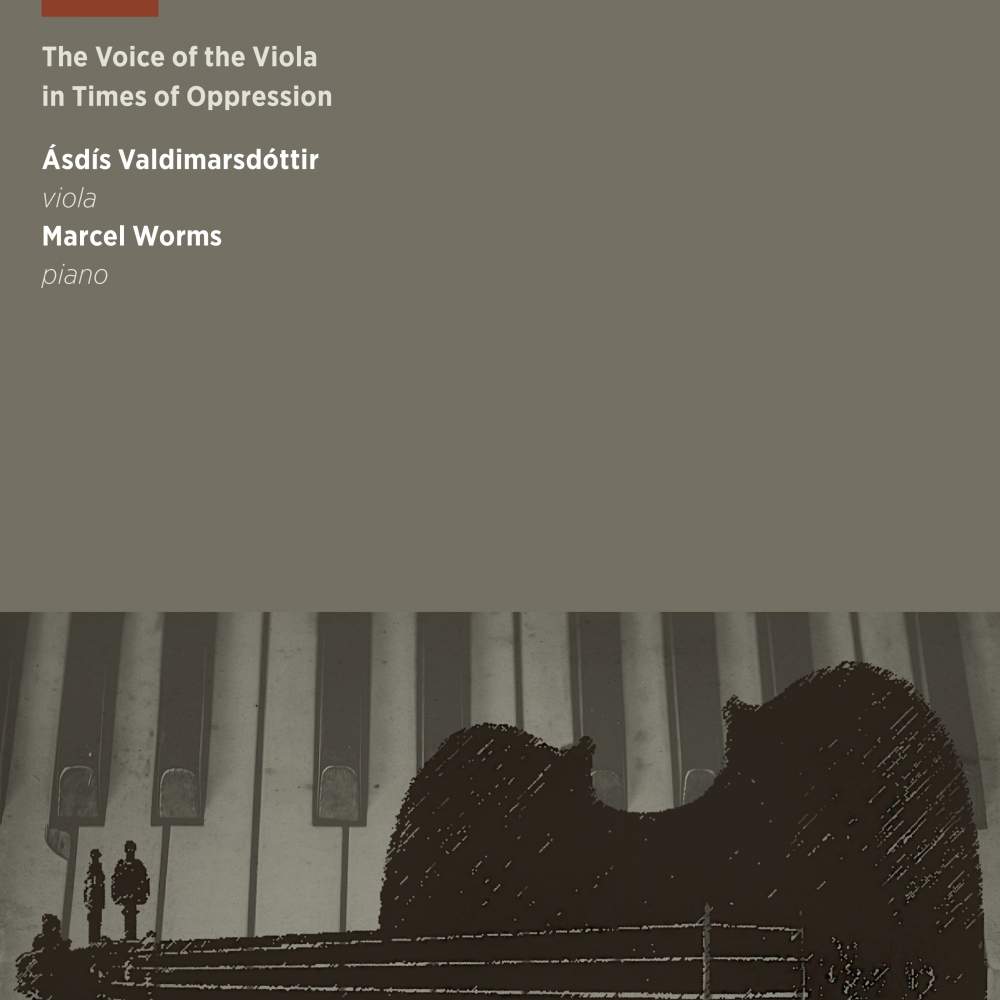
The voice of the Viola in Times of Opression: viola as a voice for the persecuted

altviool voice of the viola

The viola sonata by Dick Kattenburg (1919-1944) consists of only one movement, allegro moderato. The reason is simple: before Kattenburg could complete the work, he was arrested during a raid in a cinema and sent to Westerbork on 5 May 1944. Two weeks later, on 19 May 1944, he was deported to Auschwitz, where he was murdered. Kattenburg was only 24 years old.

Max Vredenburg (1904 -1976) is now mainly known as co-founder of the National Youth Orchestra. In the 1920s he left for Paris where he studied with Paul Dukas and Albert Roussel, composers who influenced him greatly. In 1941 he fled to Batavia and in 1942 he ended up in a Japanese camp. He survived the war but a large part of his family was murdered in Sobibor and Auschwitz. He composed the Lamento in 1953 in memory of his sister Elsa.

altvioool VredenburgMax1

Max Vredenburg © Maria Austria MAI

The sonata by Mieczysław Weinberg, originally composed for clarinet and piano, is perhaps the most complex of all the other works on this CD. It is also the only composition that is not only sad: you can also recognize fragments of klezmer and Jewish folklore in it.

And if you think you recognize the opening measures of Beethoven’s Mondscheinsonate in ‘Adagio’, you are right. Those notes are indeed in it. Just as in the adagio, the final movement of Dmitri Shostakovich’s sonata. The work, dating from 1975, was his last composition, and shortly after the completion of the sonata he died of lung cancer.

I can only be brief about the performance: the absolute TOP! The sound that Ásdís Valdimarsdóttir elicits from her viola is of a rare beauty. It is so beautiful that it hurts. Listen to the Adagio of Weinberg’s sonata. Terrifying.

Marcel Worms, surely one of the greatest pianists/accompanists of our time, keeps himself a bit in the background, giving his Icelandic colleague all the honour of wearing glasses. But just listen carefully and experience how compassionate his contribution is. That’s what I think is called ‘partners in crime’. I can’t describe it any better.

Mieczysław Weinberg, Dick Kattenburg, Max Vredenburg, Dmitri Shostakovich
The voice of the Viola in Times of Opression
Ásdís Valdimarsdóttir (viola), Marcel Worms (piano)
Zefir Records ZEF 9657

Translated with www.DeepL.com/Translator

Article in Dutch: The voice of the Viola in Times of Opression: de altviool als stem voor de vervolgden

Forbidden Music in World WAR II: PAUL HERMANN

Worshipped, ignored, forgotten: about Erich Wolfgang Korngold and ‘Die Tote Stadt’.

kORNGOLD kindHe was a child prodigy. At the age of twenty he was already world-famous and established as a composer. He wrote several operas, songs, concertos, symphonies, quartets, quintets and some more. His compositions were performed by prominent musicians such as Arthur Schnabel, Carl Fleisch, Bruno Walter, Rose and his quartet, Böhm, Tauber, Lotte Lehmann, Strauss…
He was the inventor of the famous Hollywood sound, which in reality was nothing more than a combination of the Viennese schmalz (including the waltz) and a healthy dose of tension and a sense of drama. Worshipped before the war, totally ignored afterwards.

Korngold, the son of a leading Austrian music critic, was destined to to become a musician – a genius! His father had not called him Wolfgang for nothing.

On the recommendation of Mahler, who became quite impressed by the boy’s talent, he was taught composition by Zemlinsky. After eighteen months (Korngold was then 12 years old) his teacher thought it was pointless to teach him anything.

An amusing anecdote also dates from that time. Zemlinsky was appointed chief conductor in Prague. When he heard that Korngold studied counterpoint with Hermann Grädener (then a famous music teacher), he sent him a telegram: “Dear Erich, I heard that you are studying with Grädaner. And, is he already making progress?”

Below: Korngold plays Korngold:

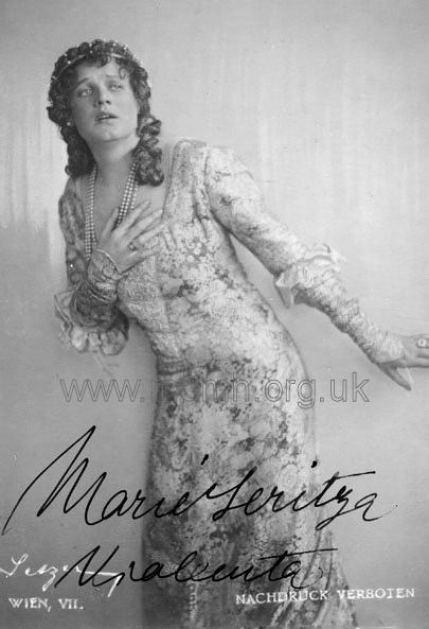
Korngold was eleven years old when his ballet pantomime Der Schneeman premiered at the Vienna State Opera and at the age of eighteen he presented two operas: Ring des Polykrates and Violanta. The last one starring Maria Jeritza. Both achieved enormous success. “Meister von Himmel gefallen”, headlined one of the newspapers.

Korngold Jerirza Violanta

Maria Jeritza as Violanta

In 1934 Korngold left for Hollywood. His friend Max Reinhardt, a world-famous stage director, asked him to write music for A Midsummer Night’s Dream, a film he worked on at the time. Thanks partly to the beautiful music it became a great success and the directors of Warner Bros. offered Korngold a fantastic contract.

Traailer of A Midsummer Night’s Dream:

]

Korngold lived between two worlds. Literally and figuratively. In the years 1934-1938 he commuted between Hollywood and Vienna. In the winter he worked on film music, the summers he spent on his more ‘serious’ works.

At that time his last opera, Die Kathrin, was created. The premiere (originally planned for January 1938) had to be postponed several times. Richard Tauber, who had taken over the leading role from Jan Kiepura, was working on a film in England and was only available in March.

On 22 January a telegram arrived: whether Korngold could be back in Hollywood within ten days, to start the score for The Adventures of Robin Hood as soon as possible. Korngold considered it an omen and with the last ship he left Europe on 29 January 1938. On 3 February he arrived in New York, together with his wife and one of his two children (the rest of the family followed a month later).

Below is a trailer of Robin Hood:

He was doing well in America and was very successful (two of his films won an Oscar), but still he didn’t feel at home there. His heart and soul had stayed behind in Vienna. In 1949 he travelled back to Vienna, but nobody knew him anymore. In Salzkammergut he visited his villa, where he had once been so happy. What a pleasure that you have returned”, was said to him. And when will you leave again? Disillusioned he returned to Hollywood, where seven years later he literally died of a broken heart.

Below: Konrad Jarnot sings Korngold’s ‘Sonnett fur Wien’:

DIE TOTE STADT

KOrngold TS poster

“This cover illustration of the Schott publication of excerpts from Die tote Stadt, arranged for piano duet, depicts very well the sort of atmosphere which Korngold sought to portray. The medieval city of Bruges with its dark streets, canals, processing nuns and tolling church bells.

“Any act requires oblivion,” Nietsche wrote in one of his pamphlets. “To survive one sometimes has to destroy one’s past.” Korngold must have known, because it is precisely with these words that you can summarize the real themes of his best-known opera, Die Tote Stadt.

After the death of his wife, Paul, a widower, locked himself up in his house in a deserted Bruges, where he lives among the relics. One day he meets a young woman who reminds him of his deceased wife, and in whom he sees her reincarnation. What follows is a ‘Vertigo’-like, hallucinatory search through the mystical and misty city, balancing between dream and reality. Only when Paul lets go of the past, he can leave the ‘dead city’ and start a new future.

The Tote Stadt had its world premiere in Cologne (under the direction of Otto Klemperer) and Hamburg on 4 December 1920, followed by the rest of the world. Before the war it was the most played of all contemporary operas. And because Maria Jeritza had chosen the work for her American debut, Die Tote Stadt became the first opera to be performed in the Metropolitan Opera in New York after the First World War. In German.

Below: Maria Jeritza sings ‘Glück das mir verblieb’ in a 1926:

KORNGOLD IN THE NETHERLANDS

Korngold den haag

taken from “A boy of cheeky sway” by Caspar Wintermans

After the very successful premieres in Cologne and Hamburg, Die Tote Stadt travelled around the world. A year later there were also enthusiastically received performances in Vienna and New York, but the Netherlands had to wait until 1929. The opera was performed on 26 January in The Hague, in the Building of Arts and Sciences. It was a one-off performance in the series of so-called ‘Extraordinary Opera Evenings’, produced by Jacob Meihuizen, then director and intendant of the Building of Arts and Sciences.

Korngold 1929 den Haag

taken from “A boy of cheeky sway” by Caspar Wintermans

Korngold himself conducted the Residentie Orkest, and the leading roles were sung by the then stars from Hamburg: Gertrude Geyersbach, Fritz Scherer and Josef Degler. It was an overwhelming success, even though the hall was not fully occupied. After the second act the applause was so great that the composer had to appear on stage.

Yet the review in the NRC was only moderate. The reviewer found the music old-fashioned, weak and sentimental, and the story (of which I don’t think he had understood much) too ridiculous for words. How different in Het Volk! A.d.W. had already studied the score long before the performance, and considered it a “work of inwardness, of lautrer Innenklang”. He also added: “After a year of dealing with work, I dared to express my understanding of its inner value in written and spoken words.”

In his extensive article he concludes that he loves the music: “There is something very attractive and youthful in it, the heart is always strongly involved, and nowhere the technical skills dominate. An important thing in this music, filled with and drenched in moods, is that it moves from peak to peak, always with tension and with core themes full of invention”. And he ends with: “A work like this needs to be given again later. I believe that the public will certainly appreciate it, now that the ice of acquaintance has broken”.

A work like this needs to be given again later….. A.d.W. wrote it 90 years ago, on 28 January 1929. After 1938 ‘Die Tote Stadt’ was no longer played. Only at the end of 1970s it started a cautious comeback.

Korngold boek

If you would like to read more about Korngold in the Netherlands, I warmly recommend “Een jongen van brutale zwier” (“A boy of cheeky sway”)  by Caspar Wintermans.

Wintermans in the introduction to his book: “In a life that was overshadowed by jalousie de métier and racism, this pet child of muses has created an oeuvre that shimmers and glows with joy and beauty, that gives lustre and colour to the existence of lovers of late-Romanticism, who know that it is never too late for romance. “

Translated with www.DeepL.com/Translator

BETWEEN TWO WORLDS

http://Korngold and time

Die Kathrin, Korngold’s last opera, still awaiting rediscovery

Das Wunder der Annemarie Kremers ‘Heliane’

Discovering Jerzy Fitelberg

Fitelberg-Arc-Esnsemble1

Is the music world finally waking up? Not if it’s up to the big record companies. With them we are still condemned to Bachs, Beethovens and Wagners. Fortunately, smaller labels like Chandos still exist. A while ago they surprised us with a CD with chamber works by Paul Ben-Haim, now they know how to make me overjoyed with Jerzy Fitelberg.

While Ben-Haim’s name was still a little known here and there, Fitelberg’s name was not. At least not Jerzy’s,  because there are still enough old recordings of his father Grzegorz, who was a famous conductor.

FitelbergJerzy1expanded

Jerzy Fitelberg (1903 – 1951) was born in Warsaw and first studied with his father who had him play as a percussionist in the orchestra of the National Theatre in order to gain experience. From 1922 he studied composition with Franz Schreker in Berlin, among others. In 1927 he made a name for himself by re-orchestrating Sullivan’s Mikado for Erik Charell’s operetta-revue in the Grosses Schauspielhaus in Berlin. In 1933 he fled first to Paris and from there to New York.

Fitelberg was one of the favourite composers of Copland and Artur Rubinstein, among others. He himself described his compositional style as “full of the energy and high tension of Stravinski combined with the harmonic complexity of Hindemith and the colours of Milhaud’s French music. Plus the much-needed satire”.

Below an arrangement, made by Stefan Frenkel, of a Tango from Fitelberg’s opera ‘Der schlechgefesselte Prometheus’,played by Marleen Asberg (violophone) and Gerard Bouwhuis (piano) at a concert given by the Ebony Band, April 25, 2013 in Amsterdam,


His works were often performed until his death, after which they disappeared from the stage. Until more than sixty years later the ARC Ensemble (yes, the same ensemble that recorded the Ben-Haim CD) picked up the thread.

The first string quartet from 1926 starts with a resolute Presto, which reminds me a lot of Mendelssohn, but not for long. Soon Slavic themes pass by to make way for the melancholic Meno mosso. Beautiful.

The second string quartet , overloaded with prizes in 1928, sounds a bit like Janaček, but with Polish instead of Moravian dances in the background. The sonatine for two violins mixes all the contradictions of the late 1930s: entertainment, jazz and a (cautious) atonality.

Fisches Nachtgesang, a night music for clarinet, cello and celesta is so beautiful that it hurts. It reminds me of a night candle, which goes out carefully. Covered with the soothing words “go to sleep, but don’t worry about it”, but you’re not really reassured.

The members of the Canadian ARC Ensemble, who play contagiously well, all work at the Glenn Gould School at the Royal Conservatory of Music. What a CD! Ten out of ten!

Jerzy Fitelberg
Chamber Works
String Quartets Nos 1 and 2
Serenade; Sonatine; Night musik “Fisches Nachtgesang”.
ARC Ensemble
Chandos CHAN 10877

Translated with http://www.DeepL.com/Translator

The stepsisters of Maria Callas

Traviata Callas

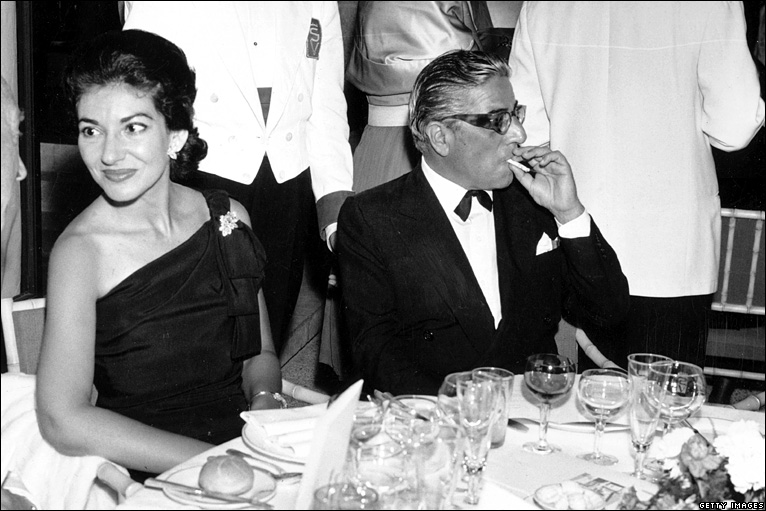
Would we still love Callas so much if she had been an ‘ordinary’ happy person, like most of her colleagues? If she had been happily married and had had children, what she so longed for? If she didn’t suffer from bulimia and was not constantly fighting with her weight and body? If she had not fallen in love with Aristoteles Onassis, the super-rich Greek shipowner who left her to marry an even more famous lady? And if she had not lost her voice prematurely? Speculations, of course, but since even the most honest opera lover has something of a tabloid reader it keeps buzzing. People simply love gossip.

callas-onassis-pinterest

Rumour, success, being in the spotlight, are the most important ingredients in the lives of people who find their lives boring and everyday and lose themselves in the stories of the ‘rich and beautiful’. It should be noted that they feast most on the dark sides of the stories, because there is no greater happiness than sorrow.

Maria Callas was a diva with a true cult status. She owed this not only to her singing, but also to her unmistakable acting talent, her attractive appearance and her, unfortunately, more than tragic personal life.

However great, famous, loved and adored, Maria Callas was, she did not invent opera, nor was she the greatest actress amongst singers. Not all singers were equally gifted actors, but the image of a fat lady standing motionless on stage fluttering only her hands is not at all accurate.

Just think of Conchita Supervia, Geraldine Farrar, Marjorie Lawrence or Grace Moore, but there were more.

supervia

Conchita Supervia as Carmen

Geraldine Farrar as Carmen in a film from 1915:

What Callas truly was, was a pioneer in (dramatic) belcanto, and that happened more or less by accident (consult the DVD The Callas Conversations vol. II). It was a genre that at the time was a little neglected. It was she who gave us back the forgotten operas of Bellini, Donizetti and Spontini, but was she really the first?

There are many more sopranos from the time of Callas who sang at the highest level and deserve to be discussed. The sopranos I am going to talk about were all more or less Callas’ contemporaries and all sang almost the same repertoire (not counting spinto sopranos that sang mainly verist roles, such as Magda Olivero, Carla Gavazzi or Clara Petrella).

These divas missed the chance to be in the right place at the right time. Or: to meet someone who was important enough not only to boost your career, but also to give you a record deal.

callas-gioconda-nanopress

Maria Callas as La Gioconda in 1952

Cynical?

It has always been like this and nowadays it is no different, although we are dealing with another aspect: the ideal of beauty. If you don’t meet it, you can say goodbye to your career in advance – fat people are not even allowed to audit in many theatres anymore and a starting Callas would have absolutely no chance at all now.


                                         ANITA CERQUETTI

cerquetti

Her career, like that of Callas, didn’t last long. She was born in 1931 and made her opera debut as Aida in Spoleto as early as 1951 (!). She became – typically enough – the most famous by stepping in for a sick Callas in 1958. While she was still in a production of Norma in Naples, she sang some performances of the same opera by Bellini at the opera house of Rome, instead of La Divina.

Anita Cerquetti sings ‘O re dei cieli’ from Agnese di Hohenstauffen by Spontini:

On the label Bongiovanni (GB 1206-2, unfortunately not on You Tube) you can hear her in the famous ‘Casta diva’ from Norma. For me this is one of the most beautiful performances of this aria ever. Goosebumps.

Cerquetti sings Norma. Recording from 1956:


                                     LEYLA GENCER

gencer

Born in 1928 in a small town close to Istanbul, Gencer, just like Callas, has a cult status, even today, but on a smaller scale. She had a Turkish father and a Polish mother, which made her proficient in that language. There is even a pirate recording of her with songs by Chopin in Polish:

Gencer’s real speciality was belcanto. She sang her first Anna Bolena only a year after Callas:

And unlike Callas, she also included the other Tudor Queen operas by Donizetti in her repertoire: Roberto Devereux and Maria Stuarda.

gencer-alle-drie-tudor

Gencer as all three Tudor Queens

Besides all her Bellini’s, Donizetti’s and Verdi’s, and between Saffo by Paccini and Francesca da Rimini by Zandonai, she also sang some of Mozart’s songs. Fortunately, her Contessa (Le nozze di Figaro) in Glyndebourne was recorded and released on  CD some time ago. For the rest, you have to settle for the pirates.

Her round and clear voice – with the famous pianissimi, which only Montserrat Caballé could match – is so beautiful that it hurts. If you have never heard of her before, listen below to ‘La vergine degli angeli’ from La forza del Destino, recorded in 1957. Bet you’re going to gasp for breath?

                                          VIRGINIA ZEANI

zeani

Have you noticed how many great singers come from Romania? Virginia Zeani is one of them, born in Solovăstru in 1925.

Zeani made her debut when she was 23 as Violetta in Bologna (indented for Margherita Carossio). That role would become her trademark. There is a costly anecdote about her debut in Covent Garden: it was in 1960 and she was a last minute replacement for Joan Sutherland, who became ill. She arrived late in the afternoon and there was hardly time to try on the costume. Before she went on stage, she asked very quickly: ‘Which of the gentlemen is my Alfredo?

zeani-traviata

The soprano sang no less than 69 roles, including many world premieres. In 1957 she created the role of Blanche in Dialogues des carmélites by Poulenc. Her repertoire ranged from Handel (Cleopatra in Giulio Cesare), via Bellini, Donizetti, Massenet and Gounod to Wagner (Elsa and Senta). With of course the necessary Verdis and Puccinis and as one of her greatest star roles Magda in The Consul by Menotti:

I myself am completely obsessed with her Tosca, but also her Violetta should not be missed by anyone. Her coloratures in the first act are more than perfect. And then her ‘morbidezza’… Do it for her!

Below her ‘Vissi d’arte’ (Tosca), recorded in 1975, when she was over fifty:

                                           CATERINA MANCINI

mancini

Never heard of her? Then it’s time to make up for the damage, because I promise you a voice out of thousands, with a beautiful height, pure coloratures (all ‘al punto’) and a drama that could make even La Divina jealous.

Mancini sings “Santo di patria… Da te questo m’è concesso” from Attila by Verdi:

Mancini’s career also lasted only a short time. People talked about health problems, but what really happened? The fact is that the soprano, born in 1924, stopped working as early as 1960. Although her name can still be found in 1963, as contralto (!) at the concert in memory of Kennedy.

Mancini made her debut in 1948, as Giselda in I Lombardi. At the Scala she already sang Lucrezia Borgia in 1951. Donizetti, Rossini and Bellini are not lacking in her repertoire.

The Italian label Cetra has recorded a lot with her; difficult to obtain, but so very worthwhile to look for!

At her best I find her as Lida in La Battaglia di Legnano by Verdi. Below a fragment of it:

                                     MARCELLA POBBE

pobbe

Marcella Pobbe may be a bit of an outsider in this list, as she had fewer belcanto roles in her repertoire (Gluck and Rossini, but no Bellini). But the Verdi and Puccini heroines she more or less had in common with La Divina.

Pobbe sings ‘D’amor sull’ali rosee’ from Il Trovatore:

She also sang a lot of Mozart and Wagner. But what made her really famous is Adriana Lecouvreur from Cilea

Pobbe was exceptionally beautiful. Elegant, elegant, almost royal. And her voice was exactly the same: her singing flowed like a kind of lava, in which you could lose yourself completely. Nobody then thought it necessary to record her. We already had La Divina, didn’t we?

Pobbe sings ‘Ave Maria’ from Otello by Verdi:

Listen below for example to ‘Io son l’umile ancella’ from Adriana Lecouvreur and think of that golden age, which is irrevocably over.

In Dutch: DE STIEFZUSSEN VAN MARIA CALLAS

see also: OPERA FANATIC: road movie met opera sterren

Translated with http://www.DeepL.com/Translator