English

Britten’s Billy Budd: brilliant music to a brilliant libretto

1700602
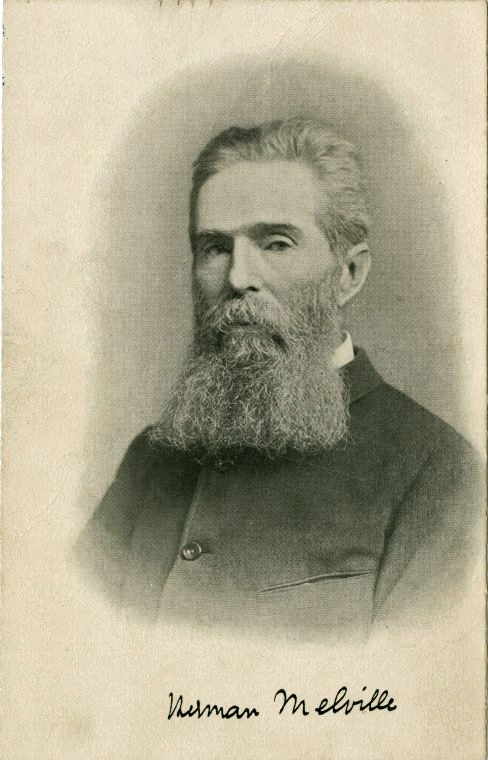
Perfect goodness, does it have the right to exist? In his novel Billy Budd, Herman Melville set the absolute evil against the perfect goodness and made them perish both.
billy-melville

The story about the angelically beautiful, honest but oh so simple and naive Billy, that takes place on a ship with only men and between men, has of course always had a double meaning. Some things could only be implied. Maybe that was a good thing, because it produced some real masterpieces.

One of them was a film by Peter Ustinov starring Terence Stamp.

Below is a trailer of the film:

And one of the best, at least for me, operas of the twentieth century.

britten

For Benjamin Britten it was a rewarding theme. Elements such as the individual versus society, corruption, sadism, despair, a sense of responsibility and, of course, homo-eroticism were often used by him in his works. He was also able to include his pacifist ideas in them.

The story can be told quickly: Billy Budd is accused of treason by Claggart, the Master-at-Arms. He then strikes his accuser dead, and is sentenced to hang by Captain Vere. However, in the background, feelings of love, powerlessness and revenge play the real leading role.

For Claggart, the personification of evil, it is clear that he must destroy beauty, otherwise it will be his own downfall. “Having seen you, what choice remains to me? With hate and envy, I am stronger than love” he sings in his big, almost Iago-like aria ‘O beauty, o handsomeness, goodness’.

Captain Vere, aware of his true feelings for the young sailor, doesn’t have the courage to save his life. Only years later, looking back at the events of that time, he realizes that he should have acted differently.

WORLD PREMIERE 1951

billy-uppman

Billy Budd is a role that is traditionally played by a (very) attractive singer. He has to be, he is not called a ‘beauty’ and a ‘baby’ for nothing. He is almost always put on the stage partially or even completely shirtless – no wonder that almost all of the baritones that are labeled as the ‘hottest’ have the role on their repertoire nowadays.

Britten himself is not entirely blameless in this. His very first Billy, Theodor Uppman, was personally selected by him for his exceptionally attractive appearance. Not that he couldn’t sing, on the contrary! The American baritone had a very pleasant, warm timbre, in which naivety went hand in hand with hidden sex appeal.

The world premiere took place on December 1, 1951 in the ROH in Covent Garden and the recording of it has fortunately been preserved (VAIA 1034-3). It is particularly fascinating to hear the voices of the singers for whom the opera was originally created.

The role of Captain Vere was written for Britten’s partner, Peter Pears. Not the most beautiful tenor voice in the world, but one with character, body and great ability to express things. The role of Claggart was sung by a good (but no more than that) Frederic Dalberg and in the smaller roles of Mr. Redburn and Mr. Flint we hear the future greats: Geraint Evans and Michael Langdon. The sound quality is amazingly good.

In 1952 Billy Budd was recorded with Upmann in the lead role for television. There is a video recording of it:

In the sixties Britten adapted and made his opera tighter: he turned the four acts into two. The new version had its premiere in 1964, under Georg Solti.

BBC, 1966
billy-glossop

In 1966 the BBC recorded the work in their studios for TV and a while ago it was released on DVD (Decca 0743256). The role of Captain Verre was again sung by Peter Pears, now audibly older, but also more experienced. And he is helped by the images: his portrait of the desperate and guilty old captain is of an unprecedented intensity.

For the role of Billy a young English baritone, Peter Glossop, was asked – it has been said that Uppman had by now become visibly too old for the role. It is also said that Britten was considering asking Fischer-Dieskau for that role. I don’t know if it’s true (since Britten himself wanted a handsome young man for the role, the rumours seem to me to be no more than rumours), but imagine! I don’t even want to think about it!

Glossop is much rougher than all the other Billy’s I know, he is also on the robust side, but it’s nowhere disturbing. It’s hard to call him a ‘baby’, but he’s very attractive and he has the power to kill someone with a slap of his arm.

Michael London has been promoted from Mr. Flint to Claggart, a role that fits him like a glove. In the smaller roles we meet again singers of name: John Shirley Quirk (Mr. Redburn), Benjamin Luxon (Novice’s Friend) and as Novice a truly inimitable young Robert Tear.

The London Symphony Orchest is led by the ever-reliable Charles Mackerras.

It is filmed in black and white and the very realistic images make you feel as if you are in the middle of an old classic, which is of course true. It is a movie. It’s certainly fascinating and a must, but of course not comparable to a live performance in the theatre.

ENGLISH NATIONAL OPERA, 1988

billy-allen

It took almost 20 years before the next Billy presented himself, at least on an official document: in 1988 Tim Albery staged the opera at the ENO (Arthaus Musik 100 278).

The production is both visually and musically very strong. The production is tight and to the point, the images speak to the imagination and the libretto is followed very faithfully. Here no spectacular shots: it is also simply filmed in the house.

As for the performance … Well, the big word has to be said: it’s the best ever and I just can’t imagine that it will ever be matched again.

Thomas Allen is Billy. He has everything to make the role his own and he will probably be associated with it for eternity. He has the looks, he can act and he has a voice that makes you melt. His “Look! Through the port comes the moonshine astray” (he was the first to include the aria in his song recitals – now every baritone does it) can’t leave you unmoved.

Philip Langridge (Vere) convinces me even more than Peter Pears and Richard Van Allan seems like a devil in persona. The English National Opera Orchestra is outstandingly conducted by David Atherton.

Below Thomas Allen as Billy:

CHANDOS, 2000

billy-keenlyside

12 years later, in 2000, the opera was recorded “semi-live” for Chandos (CHAN 9826(3)). That is to say: it was recorded in the studio, but after a series of concert performances in the Barbican Hall.

Richard Hickox is an excellent conductor, but no match for Atherton or Mackerras. But the cast is again sublime and if I could take one opera CD to a deserted island then the chances are that it will be this Billy.

John Tomlinson is probably the strongest of all Claggarts ever, especially vocally. What a dominance and what an authority!  Philip Langridge repeats his brilliant Vere and Simon Keenlyside is, at least for me, one of the best Billys after Thomas Allen.

He is less naive than Allen, tougher than Uppman but much softer than Glossop. He is the goodness … So beautiful! Mark Padmore deserves a special mention as Novice.

Below Simon Keenlyside as Billy:

VIRGIN CLASSICS, 2008
billy-gunn

In 2008 the opera was recorded by VirginClassics (50999 5190393). The London Symphony Orchestra was conducted by Daniel Harding. Definitely good, but more beautiful than the recordings above? Well, no.

Here the role of Billy is sung by one of the greatest American ‘barihunks’ of the moment, Nathan Gunn. I’ve heard the singer live a couple of times and I know how charismatic he is, but I’d rather choose one of his colleagues. His Billy is too self-confident for me, too present too.

Gidon Saks has a great voice, but it’s not enough for Claggart. Besides, he sounds too young. And I can be brief about Ian Bostridge (Vere): mannered. Like everything he touches, his Vere is his narcissistic alter ego instead of a character from the story.

If the recording hadn’t come out on CD but on DVD, I probably would have liked it better, especially because of Nathan Gunn’s part, because optically he is really more than admirable.

Below Nathan Gunn as Billy:

GLYNDEBOURNE, 2010
dvd_bri_billybudd

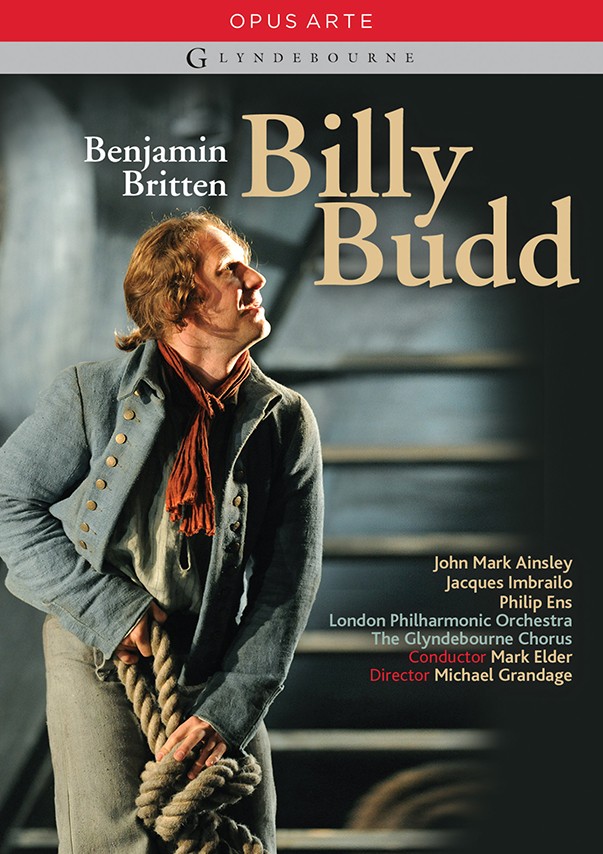
In the production of Michael Grandage (Opus Arte OA 1051 D) recorded in Glyndebourne in June 2010, we are actually on the military vessel, in the middle of the sea. The time of action is also clear: the eighteenth century.

The costumes are very realistic and everything that happens on stage is also in the libretto. The decor is beautiful and leaves a overwhelming impression. Here one can only utter ‘oh’ and ‘ah.’ But it is not only the entourage that impresses. Michael Grandage, who makes his opera debut with this, creates an atmosphere that is psychologically quite charged. The tension is excruciating. I can’t stop talking about how he directs the characters either. You rarely experience such an intelligent production these days.

We witnessed Jacques Imbrailo’s phenomenal Billy in Amsterdam in March 2011, but here, also thanks to the close-ups, he impresses even more.

John Mark Ainsley is inimitably good as Vere and Philip Ens convince as the evil spirit Claggart. Ben Johnson is a very moving Novice and Jeremy White a more than excellent Dansker.

Below is Jacques Imbrailo as Billy:


the article in Dutch:
BILLY BUDD: geniale muziek bij een geniaal libretto

Interview with Sir Thomas Allen:
SIR THOMAS ALLEN

Billy Budd in Düssseldorf:
IMMO KARAMAN regisseert BRITTEN in Düsseldorf. Deel 2: BILLY BUDD
Translated with http://www.DeepL.com/Translator

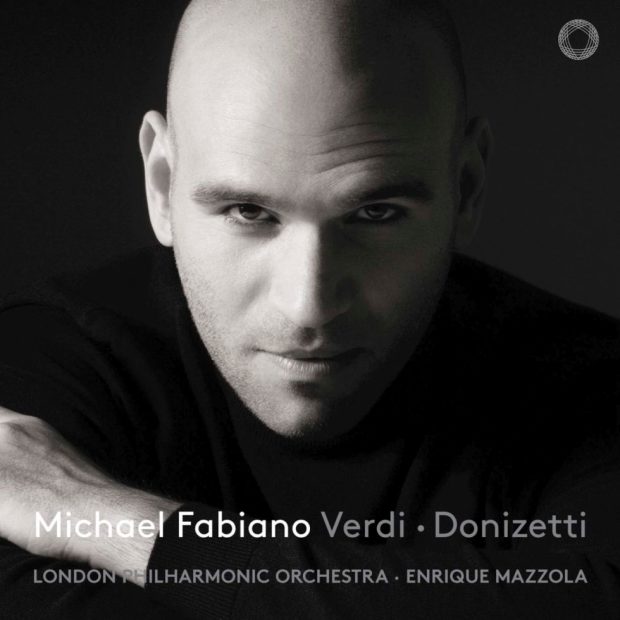
Michael Fabiano triumphs with his first CD recital
Tamara-cover-square


For me, the fact that Michael Fabiano was going to make it was indisputable. From the very first time I saw and heard him, in the highly recommended documentary The Audition, I knew for sure, the winner had arrived. That year (2007) the competition was extremely strong, with Jamie Barton, Angela Meade and Alek Shrader among the finalists. To stand out in that company you had to be really special and Fabiano certainly was.


THE AUDITION Documentary Met 2007 Fabiano Meade Barton


The young tenor, then only 22, who so fiercely contended all his opponents, not only showed himself to be extremely talented, but in his self-confident attitude and urge to win also a fighter a stayer. I wasn’t mistaken and now, twelve years later, Fabiano is one of the biggest tenors in the world. He has now released his first solo CD, for the Dutch record label Pentatone.

It is a dream of a recital, not only for the gorgeous voice of Fabiano (and the beautiful accompaniment of the London Philharmonic Orchestra conducted by Enrique Mazzola), but also for his choice of repertoire.

Fabiano chose arias that link Donizetti’s gradually maturing and developing belcanto (from Lucia, via Poliuto to Maria di Rohan) directly to Verdi’s early operas. In doing so (hurrah, hurrah!) he has often opted for the original versions of the arias. For instance, he sings ‘Qual sangue sparsi,’ the tenor aria from the original Saint-Petersburg version of La Forza del Destino.


Already in the first aria from Luisa Miller he totally has me in his power: his diminuendo! My God! Enough to stop the heart of any opera lover. There is a single mishap: ‘La donna é mobile’ (Rigoletto). Not that he sings it badly, although I think he has outgrown the Duke already. It’s just that it’ s superfluous.


GIUSEPPE VERDI, GAETANO DONIZETTI
Opera Arias
Michael Fabiano
London Voices, London Philharmonic Orchestra conducted by Enrique Mazzola
Pentatone PTC5186750

Translated with http://www.DeepL.com/Translator


In Dutch: Michael Fabiano overrompelt met zijn eerste cd-recital

Interview with Fabiano: MICHAEL FABIANO: interview (English)

The intoxicating sound of Franz Schreker

Schreker

THE SOUND

On the threshold of the twentieth century, many artists were guided in their work by the desire – and the search – for a perfect world. It had to do with the spirit of the times, among other things, and it influenced many painters, writers, poets and composers in their work. But with no other artist it was as prominent as with Franz Schreker (1878-1934). The search for ‘the’ sound dominated his entire life, he was fascinated and obsessed with it. A sound that would die of its own accord, but not really, because it had to continue to be heard – if only in your thoughts. It had to be a pure sound, but one with orgasmic desire and interwoven with visions. Intoxicating. Narcotic. In his music I really hear the perfect sound that he so desired which makes me intensely happy.

For Schreker you can wake me up in the middle of the night. The fusion of shameless emotions with undisguised eroticism and intense beauty turns me into an ‘Alice in wonderland’. I want more and more of it. Call me a junkie. I consider his operas to be the most beautiful in existence, alongside those of Puccini and Korngold.

DIE GEZEICHNETEN

Schreket noten

The idea came from Zemlinsky. He wanted to compose an opera about an ugly man – his obsession – and commissioned the libretto from Schreker. After finishing his work, it was hard for Schreker to give up his text. Fortunately, Zemlinsky abandoned the opera so Schreker started to compose himself.

Schreker _zemlinsky_schc3b6nberg_schreker1

Zemlinsky, Schoenberg and Schreker in Prague 1912

Like Der Ferne Klang, perhaps his best-known work, Die Gezeichneten also deals with the search for unattainable ideals. Alviano, a deformed rich nobleman from Genoa, dreams of beauty and perfection. On an island he has ‘Elysium’ built, a place where he hopes to realize his ideals. What he doesn’t know is that the noblemen abuse his island: they are engaged in orgies, rapes and even murders.

Schreker affiche

The title of the opera is ambiguous. Not only are the main characters ‘marked’ (Alviano by his monstrous appearance and Carlotta by a deadly illness), Carlotta also makes a drawing of Alviano, in which she tries to capture his soul.

schreker-1918

Alviano: photo from the premiere in Frankfurt 1918 via Green Integer Blog

This beautiful opera, with its thousands of colours and sensual sounds (just listen to the overture, goosebumps!), is being staged more and more nowadays. In 1990 it was performed at the Saturday Matinee, with an ugly singing but very involved and therefore very vulnerable William Cochran as Alviano and a phenomenal Marilyn Schmiege as Carlotta (Marco Polo 8.223328-330).

schreker-vara

ENTARTETE MUSIC

When the Nazis came to power, Schreker was labelled an ‘entartet’. His works were banned and no longer performed. In 1933 he was dismissed from all his engagements and suspended. Schreker was devastated. In December of that year he suffered a heart attack which became fatal to him. But even after the war Schreker was hardly ever performed. The same fate awaited him as (among others) Korngold, Braunfels, Goldschmidt, Zemlinsky, Waxman …. An unprecedented number of names of composers. They were once labeled ‘Entartet’ by the Nazis and banned, reviled, expelled and murdered. Forgotten. And that was not just the fault of the Nazis.

After the war, the young generation of composers did not want to know about emotions anymore. Music had to be devoid of any sentiment and subject to strict rules. Music had to become universal: serialism was born. The past was dealt with, including composers from the 1930s. It is only in the last twenty years that the once forbidden composers have regained their voices. The Saturday Matinee has played a major role in this and I thank them on my bare knees for that.

LISTENING SUGGESTIONS:

Vorspiel zu einem Drama’, a Prelude created by the composer himself for ‘Die Gezeichneten’:

Evelyn Lear (Carlotta) and Helmut Krebs (Alviano), scene from the second act:

On Spotify you can find several performances of the complete opera.

If you want to have images as well: below you will find the recording from Salzburg 2005.

Translated with http://www.DeepL.com/Translator

After the Darkness: the Hague String Trio brings suppressed composers back to life

Haags strijktrio cover

The title of this CD is taken from the book with the same name by Auschwitz survivor Elie Wiesel, ‘After the Darkness: Reflections on the Holocaust’.

Gideon Klein and Hans Krása:

Hans Krása (1899-1944) and Gideon Klein (1919-1945) ended up in the Terezín concentration camp (Theresienstadt), before being deported to Auschwitz where they were murdered. But until that time they continued to compose as well as they could. In Terezín, yes. That is where both Krása’s Passacaglia & Fugue and Tanec (Dance) were composed, as well as Gideon Klein’s incredibly beautiful String Trio.

László Weiner Songs, Albums, Reviews, Bio & More | AllMusic

The Hungarian Lászlo Weiner (1916-1944) was deported in February 1943 to the labour camp in Lukov (Slovakia), where he was murdered a year later. I had not heard his Serenade for string trio from 1938 before. Why is that? It’s just beautiful!


Afbeeldingsresultaat voor Dick Kattenburg

Dick Kattenburg

The Dutchman Dick Kattenburg (1919-1944) did not survive the war either: on May 19, 1944, he was deported to Auschwitz. His Trio à cordes sees its world premiere here. I can’t listen to this with dry eyes. Yes, I know, I know, one has to limit oneself to the music, but sometimes it is so damn difficult! But trust me, the standard of what is on offer is of the highest quality and that the work is still performed so infrequently is due to… What actually? Uwillingness? Guilt?

The Hague String Trio performs Trio à Cordes byDick Kattenburg


This year it is exactly seventy nine years ago that Klein, Weiner, Kattenburg and Weinberg were murdered. You would expect at least something in the form of (small) memorial concerts, wouldn’t you?

Haags strijktrio

The Hague String Trio (Justyna Briefjes, Julia Dinerstein and Miriam Kirby) was founded in 2006. In the booklet they tell us that After The Darkness is a project close to their heart, which certainly can be heard. “We feel it is a privilege to bring the music of these composers to life and to create a lasting legacy, so that their voices are never forgotten”. Thank you!


Hans Krása: Passacaglia & Fugue – Tanec (Theresienstadt 1944)
Gideon Klein: String trio (Theresienstadt 1944)
Lászlo Weiner: Serenade (1938)
Dick Kattenburg: String Trio (1937/39)
Mieczyslaw Weinberg: String trio on. 48 (1950)
The Hague String Trio
Cobra Records 0065

After the Darkness


Translated with http://www.DeepL.com/Translator

Why don’t we see Martinů’s Greek Passion more often?

Greek Passion martinu-600 Universal Edition Magazine

Once, years ago I begged the gods (and the staff of DNO) to put by Bohuslav Martinů’s The Greek Passion on the repertoire list. In vain. It doesn’t even have to be a new production, on the contrary! There is a beautiful staging made by David Pountney. It was first performed in 1999 in Bregenz (this was the first version of the opera), and a few years later at the Royal Opera House in London.

I saw the production in London and was very moved by it. In the performance I attended, the main parts were played by Christopher Ventris as Manolios (Christ) and Douglas Nasrawi as Panait (Judas), and since then I have hoped that one day a DVD will be released. In vain, so it seems …

‘Christ was crucified again’

Greek Passion Kazantzakis

Nikos Kazantzakis © Universal Edition Magazine

The subject: refugees, corruption, religious fanaticism, humanism and the search for identification was, is and will always remain topical. Bitter, tragic, but also beautiful and very humane. Martinů himself wrote the libretto for it, based on the novel ‘Ο Χριστός ξανασταυρώνεται’ (Christ was crucified again) by Nikos Kazantzakis. The book (and the opera) tells a story of the survivors of a Turkish massacre who seek shelter in a Greek village where the local population is preparing for their annual ‘Passion performances’.

FILM

Greek Passion film

There are two versions of the opera. The original version was rejected by the then management of the Royal Opera House in 1957. The score, which was drastically adapted by Martinů, was not performed until 1961 in Zurich, after the composer’s death. This ‘revision’ was recorded by Supraphon in 1981 and filmed for television in 1999 (Supraphon SU 7014-9).

For the time being, we should be satisfied with that, at least as far as the image is concerned. Not that it’s bad, on the contrary, because there’s a lot to enjoy, but it’s a film and the roles are played by professional actors who really do their best to make us believe that they’re singing too.

The film is strongly reminiscent of Zeffirelli. If you have seen his Cavalleria Rusticana, you know what I mean. There are beautiful images of the arid landscape and the heat and drought are almost palpable.

The soundtrack comes from the recording by the Brno Philharmonic Orchestra conducted by Charles Mackerras (need I say more?) with a cast including John Tomlinson as the priest Grigoris, John Mitchinson as Manolios, Helen Field as Katerina and the soloists of the Welsh National Opera.

CD

Greek Pasion Kaftan

Recently, the first, original version of the opera was published on Oehms (OC 967), recorded live in Graz in March 2016. The performance is definitely good. The Swiss tenor Rolf Romei is a very moving Manolios and Dshamilja Kaiser a convincing Katerina. The Grazer Philharmonisches Orchester is conducted very idiomatically and very appealingly by Dirk Kaftan.


Judging by the pictures in the textbooklet (and the fragments on You Tube) the production was also beautiful to see. Why is this not on DVD?

In Dutch: BOHUSLAV MARTINŮ: The Greek Passion

Translated with http://www.DeepL.com/Translator

Is verismo dead? Part 1: Cavalleria Rusticana

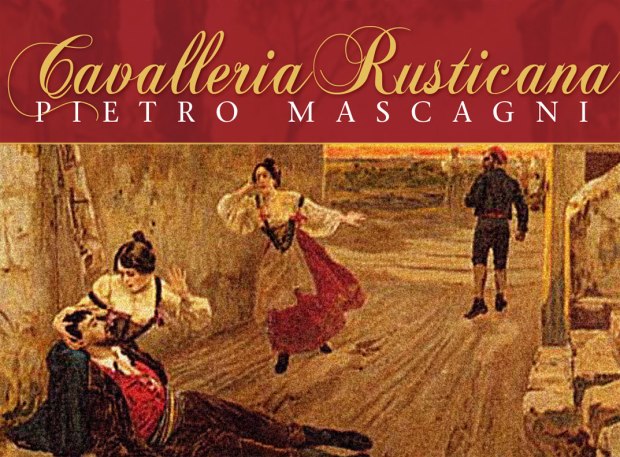
cavalleria-rusticana-mascagni


La Morte de Verismo: Verismo is dead. In recent years, this heartfelt cry has been the subject of intense discussion on opera mailing lists, in opera groups on Facebook and during emotional conversations and discussions among many fans of the genre. But is it true? Is verismo dead?

People say verismo and think: Mascagni and Leoncavallo. Rightly so? Cavalleria Rusticana and certainly Pagliacci are among the most popular operas ever. The most tragic as well. But that is not only because of their content. They are about passion, love, jealousy, revenge and murder, but that and also the rough realism does not make them more violent than Carmen. And we have also experienced ‘ordinary people’ and ‘present time’ in operas before, in La Traviata for example.

No, what actually makes these operas so tragic is the fate of their creators. Both works caused a huge sensation and left their creators with a blockbuster they could never equal again. Not that they composed nothing else or that the quality of their later operas leaves much to be desired. On the contrary. La Bohème by Leoncavallo or L’Amico Fritz by Mascagni, for example, are true masterpieces.

The ‘why’ is difficult to answer, although many explanations have been given. Mascagni would not have remained true to his style and started to compose in the romantic style again. But that is not true: Cavalleria contains many passages that are just as lyrical as L’Amico Fritz, for example,  and Cavalleria is no more dramatic than lets say Iris.


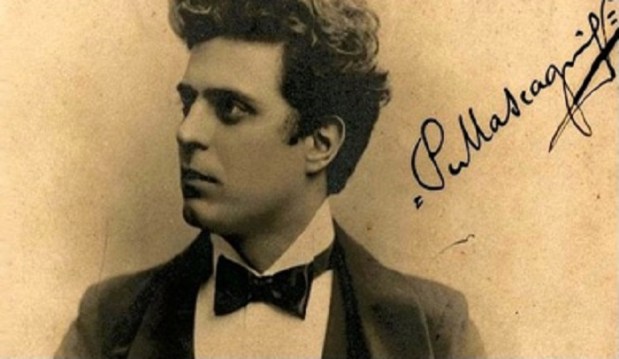
pietro-miscagni-bbc-archives

Pietro Mascagni. Photo courtesy BBC archives


“Crowned before I became king”, Mascagni sarcastically remarked (‘Cavalleria’ was his first opera, composed when he was 26 years old), and that goes for Leoncavallo as well. Whatever the cause may be, both composers have, inseparably linked, gone down in history as composers of only one opera.

The same thing happened to their contemporaries and/or contemporaries of style (they preferred to call themselves ‘La Giovane Scuola’ – ‘The Young School’). The few people who have heard of Giordano, Catalani, Franchetti or Cilea probably cannot name more than one opera. Or even worse: one aria.

It is difficult to say what caused this, and is worth exploring, but the fact is that after the thirties and forties (and also the early fifties) the genre suddenly became ‘not done’. Intellectuals considered the genre as beneath themselves and the sobs in the aria ‘Vesti la giubba’ from Pagliacci became the example of bad taste.

Cavalleria Rusticana and Pagliacci have always remained popular with audiences, though. The real lovers have never taken any notice of this intellectual criticism (especially the eighties and nineties of the last century were ruthless for verismo).


CAVALLERIA RUSTICANA


mascagni


The premiere of Cavalleria Rusticana took place in 1890, three years after Otello and three years before Falstaff by Verdi. The leading roles were sung by Gemma Bellincioni as Santuzza and her husband Roberto Stagno as Turiddu.


cavalleria-bononcioni-met-man


Thanks to Edison and his invention we know how the first Santuzza sounded, because in 1903 Bellincioni recorded ‘Voi lo sapete, o mamma’  (SRO 818-2). What do we hear? Bellincioni has a light soprano, with an easy height, but with a dramatic core. It seems that she had had little success with the then standard repertoire, but her presence, her acting and interpretation made her very suitable for the new operas composed in the verist style.


Bellincioni sings ‘Voi lo sapete o mamma’:


How does a perfect Santuzza sound? You have to have power, that is clear. You also have to be able to act, especially with your voice, because few roles have so much duality in them: her eternal nagging gets on your nerves and you get tired of it, but at the same time she is pitiful and you have sympathy for her. As in real life, and that real life must also be reflected in the interpretation, which cannot be achieved by just singing beautifully.

That’s why the greatest singing actresses have recorded the best Santuzzas. You notice that too when looking at the list of Santuzzas: Giannina Arangi-Lombardi, Zinka Milanov, Carla Gavazzi, Eileen Farrell, Giulietta Simionato, Maria Callas, Elena Souliotis, Renata Tebaldi, Renata Scotto. And Lina Bruna Rasa of course, the beloved Santuzza of Mascagni.


cavallerie-bruna-rasa-cav


Milan 1940

In 1940 the 50th anniversary of Cavalleria was celebrated with special performances at La Scala, after which the whole cast went into the studio to make a recording of it. The line-up was the best possible, with next to Lina Bruna Rasa, Benjamino Gigli as Turiddu, Gino Becchi as Alfio and Giulietta Simionato as Mamma Lucia (strangely enough Simionato often sang the role of Santuzza afterwards).


cavalleria-1940


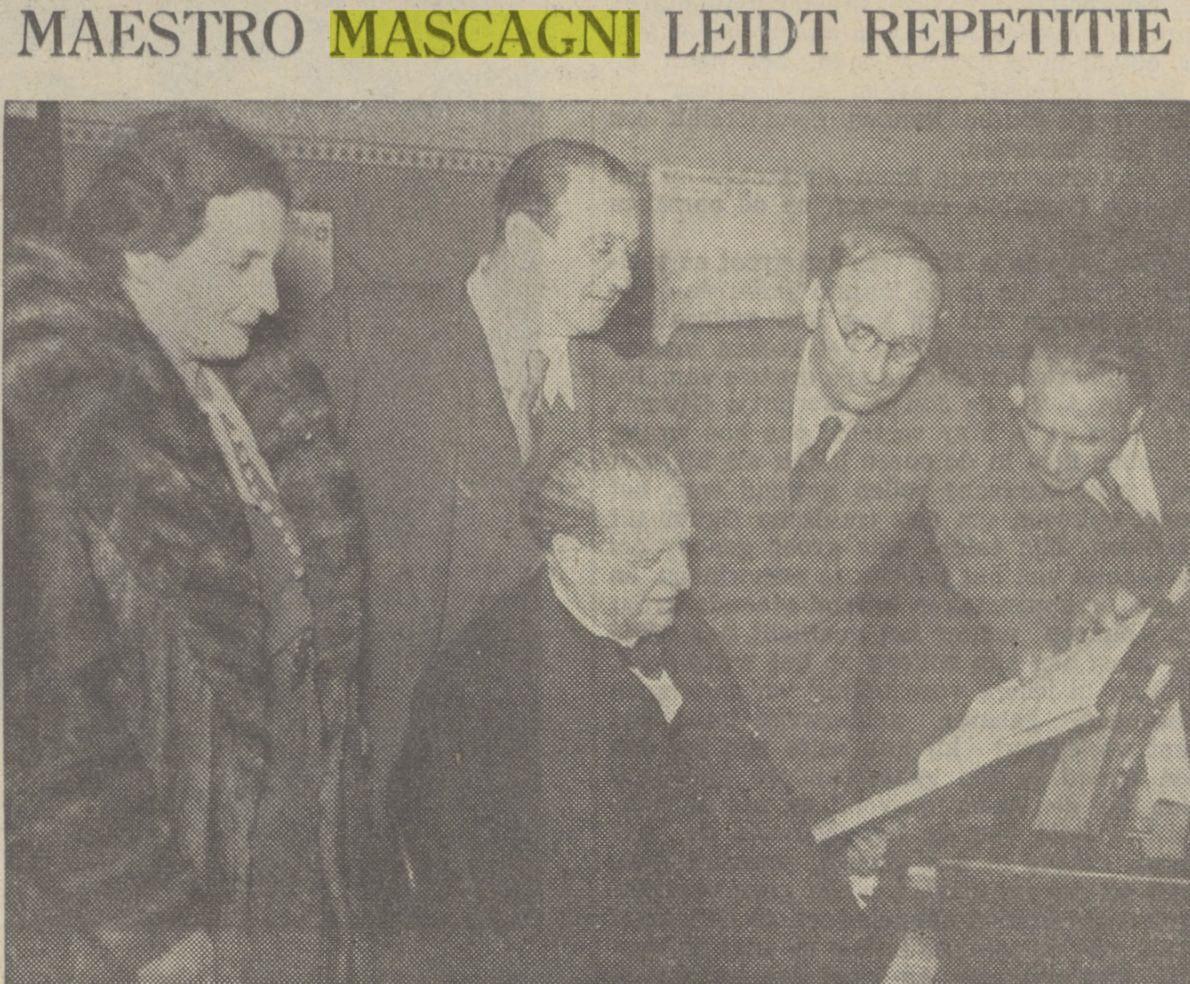
The first thing that stands out in Mascagni’s conducting is the emphasis he places on lyricism and a lilting tone , which makes the melodic lines stand out more clearly. On no other recording does the prelude sound so idyllic, and nothing better indicates the drama that is about to take place, which contrasts sharply with the Santuzza – Turiddu duet.  It makes the drama more poignant, more intense.

Gigli was one of the best Turiddu’s in history: seductive and frivolous, and (sorry, but it is true) only in Domingo did he get a worthy competitor. Because neither Giuseppe di Stefano (too light), nor Jussi Björling (too nice), nor Mario del Monaco (too roaring), nor José Carreras (although he comes close) could give Turiddu a hint of three-dimensionality.

Gigli as Turiddu. Recording from 1927:


At the time of the recording Bruna Rasa was 33 years old and since a few years she suffered from terrible depressions. The first symptoms of a mental illness had also manifested themselves and she had trouble remembering the text. Yet there was no question that anyone else would sing that role, and Mascagni helped her as much as he could.


Lina Bruna Raisa sings’ Voi la sapette o mamma’:


The original recording appeared on 2 CDs on EMI which were filled up with arias from other Mascagni operas sung by Gigli. Unfortunately on the re-release on Naxos (8110714-15) some orchestral preludes and intermezzi from different operas, all performed by the Berlin State Opera Orchestra conducted by Mascagni are added instead. Both EMI and Naxos start with a short speech by the composer.


Below the complete opera, conducted by the composer:


The Hague 193

Two years earlier, in 1938, the widow of Maurice De Hondt brought Mascagni and his opera to The Hague. The performance of 7 November was recorded live and was released on CD 


The live recording sounds pretty good, especially for its age, and the stage sounds (including a very audible prompter) and the coughing audience are not really disturbing. The tempi are a bit faster than on the Naxos recording, but still a little on the slow side.


Cavalleria Bruna Raisa NL


The line-up is slightly less spectacular than two years later, but still very good. Antonio Melandri is a baritone Turiddu and Alfro Poli gives excellent shape to Alfio. Of course Mascagni had brought Bruna Rasa, and what she shows here surpasses everything: so intense, so desperate, so heartbreaking, like no other Santuzza ever sounded. Because of her interpretation alone, this special document is invaluable.


Franco Zefirelli


cavalleria-domingo


This part movie/part studio recording of Franco Zefirelli (DG 0734033) could have been the ultimate adaptation if it had not been for Elena Obraztsova who plays the role of Santuzza. That she is a bit older and unattractive – ok, that fits the story. But her voice is lumpy, sharp and her chest register is painful to the ears. She also suffers from over acting which makes her an extremely unsympathetic Santuzza.

One can’t blame Turiddu (Domingo at his best) for preferring to look at Lola (nice Axelle Gall). Just look at his eyes and his corners of the mouth, which speak volumes! For the rest nothing but praise for this recording, which (how could it be otherwise?) is coupled with ‘Pagliacci’, with again Domingo in top form and an excellently acted Nedda by Teresa Stratas.


In 1956 in the Rai studios one of the most beautiful Cavallerias was recorded, with Carla Gavazzi, Mario Ortica and Giuseppe Valdenga.


This recording can now be found on Youtube:


DOMENICO MONLEONE


cavalleria-monleone-portret


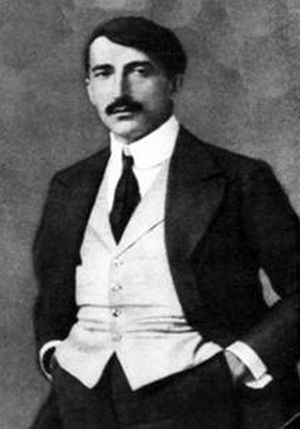
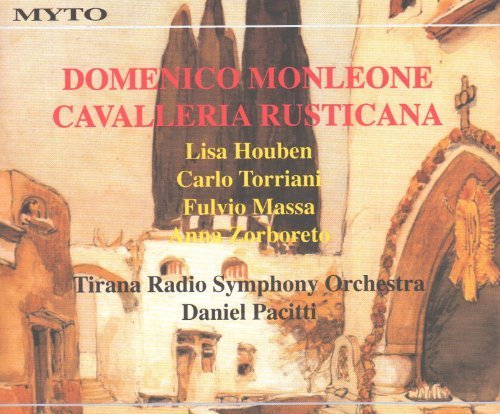
What many people don’t know: there are actually two (and even three if you include La Mala Pasqua by a certain Stanislao Gastaldon from 1888) Cavalleria Rusticana’s. Domenico Monleone (1875 – 1942), a composer not unknown  at the time, also used the story of Giovanni Verga for his one-acter, which his brother Giovanni converted into a libretto.


cavalleria-monleone-painting

Illustration Gamba Pipein. Courtesy Boston Public Library, Music Department


Sonzogno, Mascagni’s publisher, accused Monleone of plagiarism (and indeed: careful study shows that Monleone’s libretto is closer to Mascagni than to Verga’s original story), after which the opera was not performed anywhere for a long time.

Until 1907, when Maurice de Hondt brought Monleone to Amsterdam, where his opera had its belated premiere. Coupled with … yes! Cavalleria Rusticana.

Both works were directed by their composers: it apparently did not bother Mascagni that his colleague had ‘borrowed’ his libretto from him.


cavalleria-monleone


Il Mistero


cavalleria-il-mistero


Nevertheless, Monleone had to accept the court ruling, which meant that he had to find a new libretto for his music.

It was changed into Il Mistero, another story by Verga, and this time the author himself had helped Giovanni Monleone with the libretto.

Both operas with the same music but on two different libretto’s were released by Myto on CD’s (Cavalleria: 012.H063; Il Mistero: 033.H079). In both works the leading role (Santuzza/Nella) is sung by Lisa Houben, originally from the Netherlands.

Duet Santuzza/Turiddu, sung here by Denia Mazzola-Gavazzeni and Janez Lotric. Recording was made in Montpellier, in 2001:


An amusing video: eight times ‘A te la mala Pascua’:


Translated with http://www.DeepL.com/Translator

In Dutch: IS VERISMO DOOD? Deel 1: Cavalleria Rusticana


Twenty years after his death: Rolf Liebermann In Memoriam

Liebermann

Rolf Liebermann © Claude Truong-Ngoc (1980

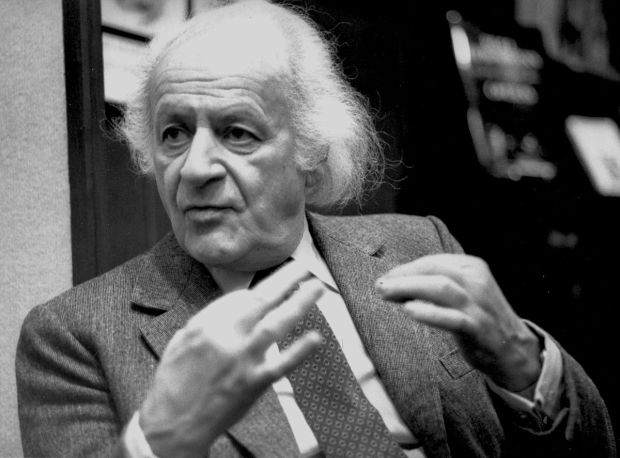
The Swiss composer Rolf Liebermann (14 September 1910 – 2 January 1999) is nowadays seen as the father of Regietheater, although he meant something different from the current conceptualism in which the boundary between the permissible and the ridiculous is explored and often crossed.

Under his leadership, the Hamburg State Opera, where he ruled for fourteen years between 1959 and 1973, grew into one of the best and most talked-about opera houses in the world. Liebermann created a good, solid and varied repertoire with special attention to contemporary works, built a fantastic artists’ ensemble and attracted foreign stars and would-be stars (Plácido Domingo’s world career began in Hamburg). Arlene Saunders, William Workman, Raymond Wolansky, Franz Grundhebber, Tom Krause, Hans Sotin, Toni Blankenheim – they all formed a solid and close-knit ensemble, with the occasional addition of a bigger (read: more familiar to the general public) name: Lucia Popp in Fidelio and Zar und Zimmerman, Cristina Deutekom, Dietrich Fischer-Dieskau and Nicolai Gedda in Die Zauberflöte, Sena Jurinac in Wozzeck.

Liebermann boek

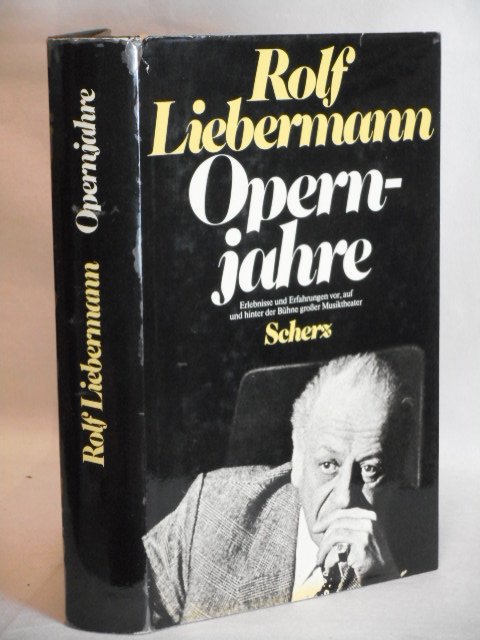
Liebermann also regularly commissioned compositions. In the years of his management no less than 28 operas and ballets had their world premiere, a number many an opera house should be jealous of. Later, in his autobiographical book ‘Opernjahre’, Liebermann described his time at the Hamburg State Opera as the happiest time of his life. I can imagine that. If you were able to realise so much beauty at such a high level, you can only be intensely happy.

Luckily for us, who have not (consciously) experienced those years, Liebermann was also thinking about the future and had director Joachim Hess record thirteen productions for television. Most of the recordings took place in a studio. With the means available at the time, it was impossible to record sound and images at the same time. This meant that first a musical soundtrack had to be pre- recorded, after which the singers could mime to it in the studio very precisely, so everything was in sync.

Liebermann box

About ten years ago, Arthaus Musik released these operas on DVD. Of course, by today’s technical standards, it’s all far from perfect. The sound is mono and the camera is rather static, but for the enthusiast there is a lot to enjoy, not in the least because of the repertoire.

PENDERECKI: DIE TEUFEL VON LOUDUN

Liebermann Penderski

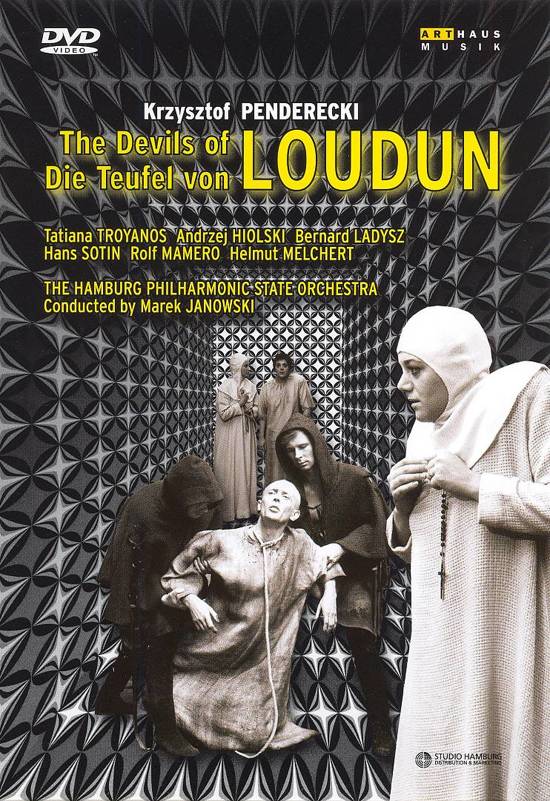
In 1967 Liebermann approached Krzysztof Penderecki with the request to compose an opera for Hamburg. The result was Die Teufel von Loudun, for which the composer himself had written the libretto. The story is based on a true event: in Loudun (France) in 1634, a Prioress of the Ursuline Order accused a priest of diabolical practices for which he was sentenced to be burned at the stake.

The opera had its world premiere on 20 June 1969 and shortly afterwards it was filmed. The leading role of mother Jeanne was performed in a very impressive way by Tatiana Troyanos, another great star whose career began in Hamburg (after she had received a grant from the Rockefeller Foundation to further her education in Europe, she auditioned in Hamburg where Liebermann immediately offered her a contract). Her portrait of the hunchbacked demonically possessed nun with sexual visions is breathtaking. Everything about her, from head to toe, acts. Her facial expression changes with every phrase she sings and her voice chills you to the bone.

The horror-like music with its many glissandi and octave leaps evokes a feeling of unease and makes the opera, despite the immense tension, rather uncomfortable to watch. The staging, with a lot of nudity and explicit sex scenes, is very progressive for that time and I can imagine it was experienced as shocking!

First act of DIE TEUFEL VON LOUDUN:

Speaking of music: did you know that William Friedkin used music by Penderecki for his film The Exorcist?

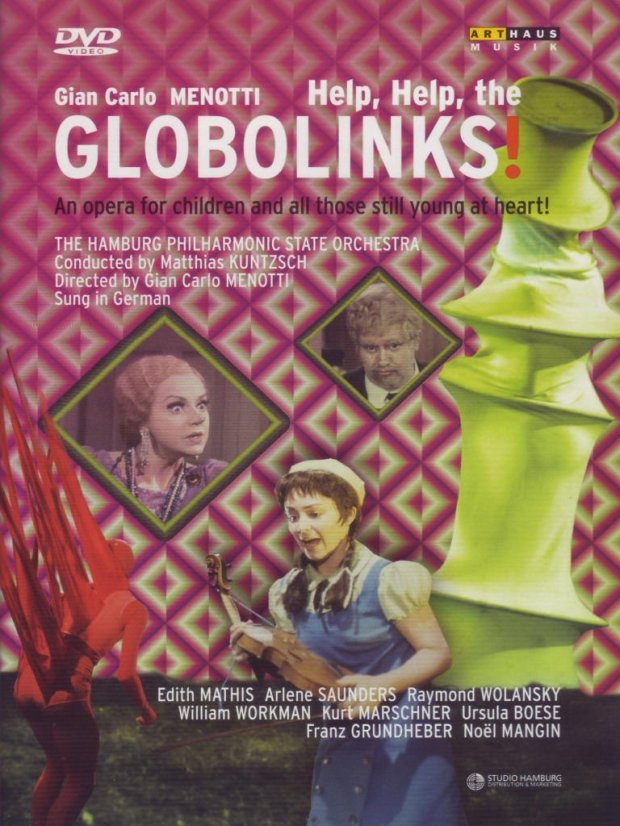
GIAN CARLO MENOTTI: HILFE, HILFE DIE GLOBOLINKS!

Liebramann Globolinks

Especially for Hamburg, the Italian-American composer and director Gian Carlo Menotti composed Hilfe, Hilfe Die Globolinks!, an opera ‘for children and for those who love children’. The premiere took place in 1968 and a year later it was filmed in the studio.

I must confess that I’m not a big fan of children’s operas, but I’ve been shamelessly enjoying this one. It is an irresistible fairy tale about aliens (Globolinks) who are allergic to music and can only be defeated by means of music.

The images are very sensational for that period, full of colour and movement and the forest little Emily (the irresistible Edith Mathis) has to go through with her violet to get help is really frightening. The aliens are a bit of a let-down according to modern standards, but that doesn’t matter, it gives the whole a cuddly shine. The work is bursting with humour and irony; musical barbarians are lashed out at: the school principal who doesn’t like music turns into an alien himself.

There are also a lot of one-liners (“music leads you to the right path” or “when music dies, the end of the world is near”). It is incomprehensible a work like this is not performed all the time in every school (and I don’t mean just for the children), the subject is (and remains) very topical.

None of the roles, including the children, could be better cast, and this once again proves the high standard of the Hamburg ensemble. In which other city would you find so many great singers/actors who can perform so many different roles on such a high level?


Translated with the http://www.DeepL.com/Translator

In Dutch: Rolf Liebermann In Memoriam

Love without sensuality is not love. A few thoughts about Tannhäuser

Tannhäuser_en_el_Venusberg,_por_John_Collier

In the Venusburg (Tannhauser), 1901 (oil on canvas) by John Collier

Text: Peter Franken

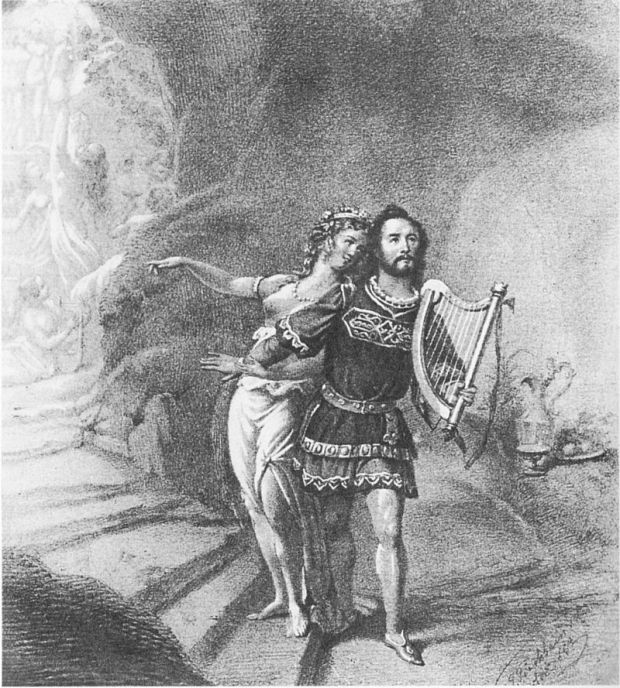
Wagner’s opera Tannhäuser und der Sängerkrieg auf Wartburg premiered on 19 October 1845 in Dresden. The composer had been working on the opera since 1842 and was actually never able to complete it to his own satisfaction. Shortly before his death in 1883 Wagner admitted that he owed the world another Tannhäuser.

Tannhauser premiere dreseden

In 1875 he had conducted a performance in Vienna himself, which had not entirely been to his liking. That performance included the virtuoso music for the violins composed for Paris, making it in fact a Viennese version of the work.

Performance practices

Tannhauser Paris

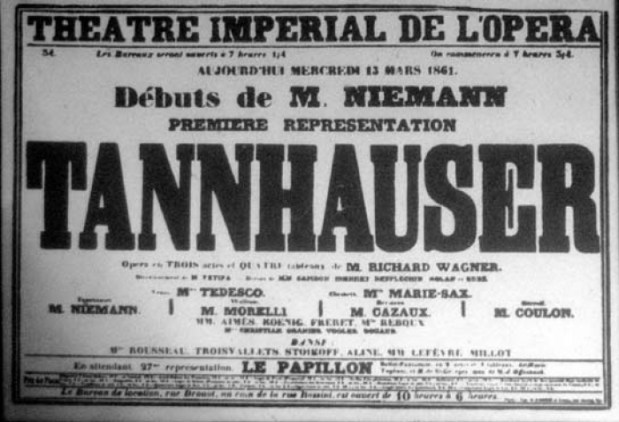
The fact that Wagner continued to tinker with the score for a large part of his life was mainly caused by performance practices. He was never really satisfied with how the work was played, mainly because singers could not cope with their role but also because of the lack of quality of the performing orchestras. In 1860 a revised edition of the score appeared. A year later the ill-fated performances in Paris took place. Here Wagner had the overture lead directly into a stormy scene in the Venusberg, the bacchanale. The performances in Paris were sung in French. What is now known as the ‘Pariser Fassung’ is a retranslation into German.

Because the singer who was cast as Walther von der Vogelweide proved to have insufficient qualities, his contribution to the singing contest had to be cut. That omission defines the later performance practices of the Paris version and it is a serious loss. A ‘schwärmerisch’ type like Walther, who sings about the pure wells of love that one can only sip from, adds much to the contrast between Tannhäuser and his fellow singers. Now he only has Wolfram as an opponent, Biterolf’s contribution is of a very different nature, which calls for violence.

All in all, there are 36 variants in the score that can be identified, all of which stem from the problems Wagner encountered in making his opera ‘performable.’ Continuing to speak of a Dresden and a Paris version is outdated as there are many more. Nevertheless, in general one sticks to these two main versions because of the recognisability, mainly found in the overture and the subsequent bacchanale. However, it is not unusual to play a hybrid of both versions, for example by having Walther sing his aria in what otherwise is the Paris version.

The story

Tannhäuser’s time in a den of sensual pleasures sends him on a pilgrimage to redeem his soul.
Wikimedia Commons

As usual, Wagner wrote the libretto himself. In it he combined the legend of the Minnesänger Tannhaüser with the legendary singing contest at the Wartburg. The work deals with the disruption of a rigid, introverted environment by the arrival of an uninhibited outsider.

In this social environment, people do not know how to deal well with sexuality and eroticism, which has led to the glorification of spiritual love. Minnesänger Tannhaüser, however, has had very different experiences at the well, the Venus cave. Spiritual love is like infertile earth: no flowers grow in it. Love without sensuality is not love.

Tannhäuser

Tannhäuser_1845

Joseph Tichatschek (Tannhäuser) and Wilhelmine Schröder-Devrient (Venus); premiere in 1845

From the story it can be concluded that Heinrich Tannhaüser is a Minnesänger who previously lived at the court of the Landgrave of Thuringia. At some point the straitjacket of this court life must have become too tight and he left, without anyone knowing where.

It is clear that he is very much missed, especially by Elisabeth, the niece of the landgrave. And by his colleagues, who may have lost a competitor but cannot take advantage of it because Elisabeth has decided to no longer attend singing competitions. Competitions, therefore,  have largely petered out.

At the start of the opera Tannhaüser has been with the goddess of love Venus and her servants for quite some time. In terms of eroticism and sex, our hero does not lack anything, in fact, he gets overfed with it. And of course too much is not good: ‘all sex and no play makes Heinrich a dull boy.’

Tannhauser-et-Venus-par-Otto-Knille-1873-©-Nationalgalerie-der-Staatlichen-Museen-zu-Berlin

Tannhäuser et Vénus, par Otto Knille, 1873 © Nationalgalerie der Staatlichen Museen zu Berlin

Venus loses her temper when he tactfully tells her that he wants to go out into the open air again. What on earth does he want there, in that chilly, rigid environment in which people are permanently working as robots to protect the supposed salvation of their souls? He hadn’t fled all this for nothing, had he Heinrich, the free bird? But it doesn’t help, Tannhaüser is not only bored but afraid of his place in the afterlife as well. Venus mocks him for this but she cannot hold on to him.

Once in the open field, the Minnesänger meets his former colleagues, who lead him along to Wartburg with the main argument that Elisabeth is waiting for him there. For them he functions as a kind of job guarantee.

Wolfram

Wolfram von Eschenbach is the singer who is closest to Tannhaüser. Wolfram clearly has his eyes on Elisabeth, but she lives with the idealised memory of Tannhaüser and has no eye for other men. By confronting Elisabeth with his rival and thus making him an average person again, he hopes to increase his own chances with her.

He brings Tannhaüser to Elisabeth when she is swooning in the Great Hall of Song (Dich, teure Halle, grüß’ ich wieder) and remains in the background to keep an eye on their encounter. Although these two almost immediately recognise love in each other’s eyes, Wolfram does not have to worry, Tannhaüser manages to make himself spectacularly impossible before the eyes of the entire court. But contrary to expectations, Elisabeth continues to cherish him and only allows Wolfram in her vicinity as a ‘good friend.’ What remains for him is a ‘Will and Grace relationship.’

Hermann Prey as Wolfram:

Elisabeth

tannhauser-elisabeth-2011 Camilla Nylund

Camilla Nylund as Elisabeth in 2011

At court, this seemingly chaste lady is the figurehead of spiritual love, the first prize for him who can best pretend to sincerely believe in it. Wolfram and Walther von der Vogelweide strive to express their claims as well as possible during the singing contest. But she only has eyes for her secret love Heinrich. All she has to do is let him win the contest and he belongs to her. If only he doesn’t do anything stupid…..

It is clear that Elisabeth is not infertile earth under her stiff appearance. She does want flowers to bloom: ‘all song and no sex makes Elisabeth a dull girl.’

But expressing this openly takes her effort, actually she is just a little shy, nothing more.

Inspired by his stay with Venus and challenged by Wolfram and Walther, Tannhaüser gives his all. Everything and everyone falls over him, his life is in danger. And it is Elisabeth who saves him. It is unnecessary to talk about this in such important terms as sacrifice and Erlösung, she just loves him and does not let him fall.

Below ‘Dich, teure Halle,’ sung by Leonie Rysanek:

The pilgrims

Bayreuth, Festspiele, "Tannhäuser", Schluss

Scherl: Von den Bayreuther Festspielen 1930. Tannhäuser Schlusszene.

The pilgrim’s chorus is one of the most famous melodies of the opera. These people play an important role in the background. They pass the Wartburg at the time of Heinrich’s discomfiture and he is pressed to go with them to Rome to ask forgiveness for his sins. And these sins are great by church standards: he has had extramarital sex and prides himself on it. That is tantamount to ignoring social codes and his presence is therefore perceived as a threat to society. From a social point of view, he is a wrong-way driver, someone who flouts the rules and thereby endangers others.

When the pilgrims return, Tannhaüser does not appear to be amongst them to Elisabeth’s despair. His absence from the group indicates that he was not absolved by the Pope. And that means that he will remain an outcast at court. The latter is Elisabeth’s final blow, she can no longer take it and dies.

Venus

Tannhäuser appears and tells the bewildered Wolfram the story of his failed pilgrimage. He wants to return to Venus since life in this form has nothing more to offer him and there is little point in hoping for a heavenly afterlife. Venus hears of this and sees her prediction confirmed. She had told him so. What should a man do with Mary if he can be with Venus, forever? She seductively sings to him: ‘Willkommen ungetreuer Mann.’

Tannhaueser The_Redemption_of_Tannhauser_1890

At the very last minute, Wolfram managed to save him for an  ecclesiastical life. He points out Elisabeth to him, praying in heaven for the salvation of his soul. In the end, Venus cannot compete with that. Her Dionysian world is defeated by the Apollonian world of medieval Christianity.

Translated with http://www.DeepL.com/Tran

La Juive, discography

Juive Halevy


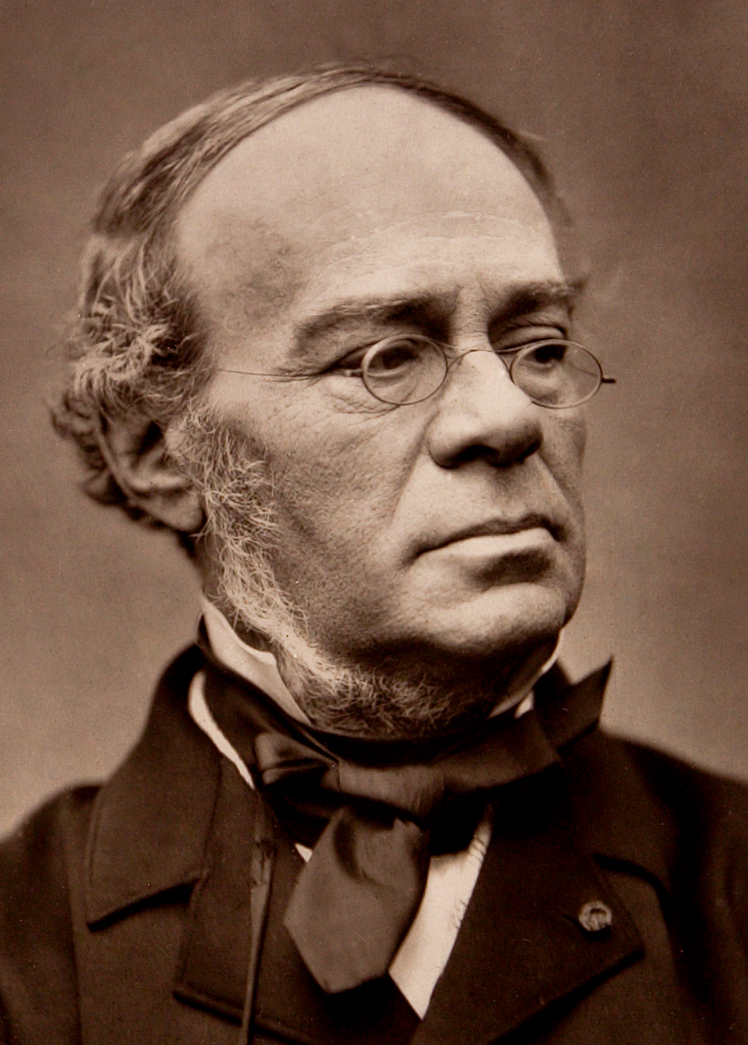
Jacques Fromental Halévy (1799-1862) was a much loved and celebrated composer during his lifetime. He composed about forty operas, of which at least half were quite successful. Yet: none of his works has ever matched the popularity of La Juive.


Juive_Act1_set_1835_-_NGO2p927

La Juive: setting for the first act from the original production in 1835.

La Juive, ‘The Jewess’ once was an absolute audience favourite and until the thirties of the last century the piece was performed with great regularity. The role of Éléazar was sung by the greatest and most famous tenors of the time: Caruso, Leo Slezak, Giovanni Martinelli… Who not?

Juive carusoterracota3

Terracota portrait of Caruso as Éléazar, made by Onorio Ruotolo in 1920.

Enrico Caruso in a recording made on 14-09-1920:


Leo Slezak (in German) in a 1928 recording:


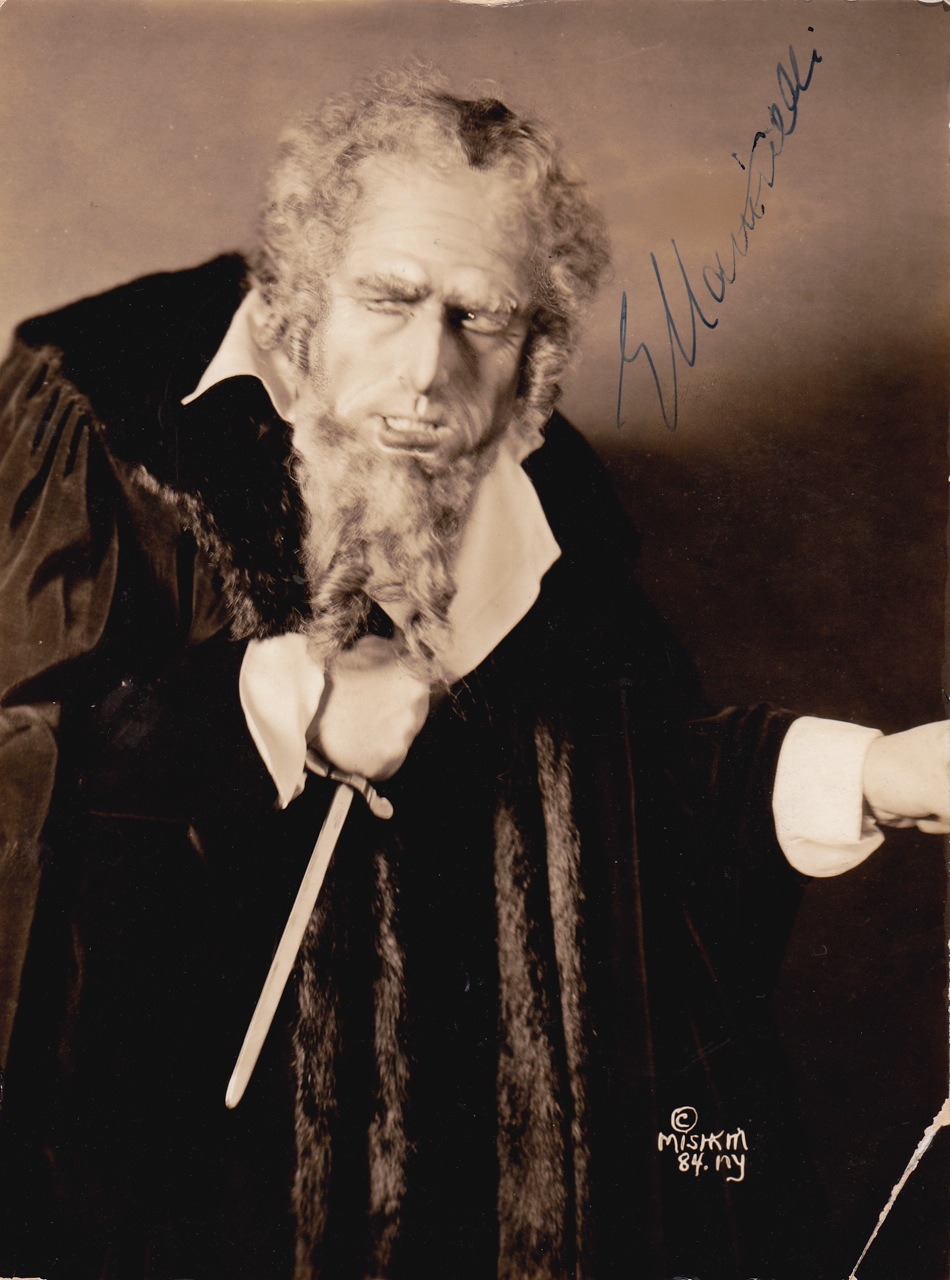
Juive Martinelli foto

Giovanni Martinelli as Éléazar

I could not find an example of Martinelli on Youtube, but a live recording from 1936 of the second act exists (with Elisabeth Rethberg as Rachel), plus some fragments of the fourth act, from 1926 (SRO 848-1).


Juive_opéra_d'Halévy_et_[...]Maleuvre_Louis_btv1b7001613w

Adolphe Nourrit, interpreter of the first Éléazar


Éléazar is not an amiable man. Like Shakespeare’s Shylock, he is repulsive and pitiful at the same time. He’s full of resentment and insists on retaliation for which he’s prepared to sacrifice anything, including what he loves most. But has he always been like that, or have circumstances made him like that? Moreover, he too has his doubts – in his great aria he sincerely asks himself (and God) whether he has acted well.

Actually, you can see him as a male equivalent of Azucena. Both have lost their own child(ren) and both have taken care of a child of their enemy and raised it as their own flesh and blood. As a result, Manrico became a gypsy boy and Rachel a Jewess. With all the consequences that follow.


RICHARD TUCKER


Juive Tucker Legato

In the 1930s Halévy was labelled ‘degenerate’ and, together with his opera, ended up in the big garbage dump of what the Nazis called ‘Entartete Musik.’

Nowadays La Juive is staged by all the major opera houses and in 2009 she even visited Amsterdam – in a magnificent production by Pierre Audi. However, it is not so long ago that Halévy was known as the composer of one aria and his opera was a real curiosity, especially in Europe. I wonder, therefore, what would have happened to La Juive if there had not been someone like Richard Tucker.

Tucker (1913-1975), one of the greatest tenors of his time, was not only the star singer at the Metropolitan Opera, but also the cantor at the New York main synagogue. Éléazar was his dream role and with his star status he could afford to get the opera on stage with different companies in different countries, if only in concert.

His greatest dream, however, was to sing La Juive in the Met, completely staged. In January 1975 he was told that the opera was planned for the 1975/1976 season. Bernstein would conduct and the other roles would be sung by Beverly Sills (Rachel), Nicolai Gedda (Léopold) and Paul Plischka (the cardinal).

It was not meant to be: on January 8, a day before the production talks were to start, Tucker suffered a heart attack, from which he died.

You can get the heavily cut La Juive with Tucker on several labels (mine is on Legato Classics LCD-120-2). The (pirate) recording was made in London, in 1973. The sound is poor and the rest of the singers are only so-so, but because of Tucker it is an absolute must.


Juive Tucker Moffo

In 1973 RCA (now Sony 88985397782) recorded highlights from the opera with Tucker, Anna Moffo and Martina Arroyo in the studio.

I have strong suspicions that the reason for this recording was Moffo (Eudoxie). At that time she was one of the stars of the firm. A literally gorgeous soprano, who not only presented herself well on the cover but also was not the worst singer. With her light, agile voice she was extremely suitable for young girl’s roles, but Eudoxie was also a good fit for her.

Martina Arroyo is a fine Rachel and Bonaldo Giaiotti a great cardinal, but the real star of the recording is – next to Tucker – the conductor. Antonio de Almeida has a clear feeling for the work.

Tucker and Martina Arroyo in the ‘Seider scene’:


JOSE CARRERAS

Juive Carreras Tokody
I have never been able to understand why José Carreras added the role of Éléazar to his repertoire. It did fit in with his desire to sing heavier, more dramatic roles. Roles that were one size too large for his beautiful, lyrical tenor. Which absolutely does not mean that he could not sing the role! He succeeded quite nicely and the result is more than worth listening to, but he doesn’t sound truly idiomatic.

In the live recording from Vienna 1981 Carreras also sounds too young (he was only thirty-five then!), something that is particularly noticeable in the Seider-evening scene. It is sung beautifully, but due to a lack of weight he tends to shout a bit.

José Carreras sings ‘Rachel, quand du Seigneur’:

Ilona Tokody is a Rachel of a Scotto-like intensity (what a pity she never sang the role onstage!) and Sona Ghazarian sings an excellent Eudoxie.

But, to be honest: nobody, but nobody can measure up to Cesare Siepi in his role as Cardinal Brogni. After his first big aria he is justifiably rewarded with a long ovation.

Below Cesare Siepi in ‘Si la rigeur’:

Chris Meritt (Léopold) may not have the most beautiful of all tenor voices, but he has all his high notes. Although they sometimes came out a little squeezed. The heavily cut score was conducted with great love by Gerd Albrecht (Legato Classics 224-2).

Juive Carreras Philips

La Juive, recorded by Philips in 1989, marked the first studio recording Carreras made after his illness. His voice was now less sweet and smooth than before, but sounded much more alive, which improved his interpretation of the role.

Julia Varady is a beautiful Rachel, perhaps one of the best ever and Eudoxie is in excellent hands with June Anderson.

Dalmacio Gonzales is a more than decent Léopold, in any case much better than Chris Merrit and the French-American-Portuguese conductor Antonio de Almeida shows he has a real affinity with the opera. (Philips 475 7629)

FRANCISCO CASANOVA

Juive Casanova

We know Eve Queler not only as one of the first famous female conductors, but also as one of the greatest champions of the unknown opera repertoire. On 13 April 1999 she conducted a very exciting performance of La Juive in New York’s Carnegie Hall.

Paul Plishka was a good cardinal and Jean-Luc Viala and Olga Makarina sounded excellent as respectively Léopold and Eudoxie.

Francisco Casanova – after Tucker and Shicoff – in my opinion is perhaps the greatest Éléazar of our time. His robust tenor sounds tormented and passionate but also extremely lyrical. The Rachel, sung by Asmik Papian with sizzling passion, fits in perfectly with this. So beautiful, I have no words for it.

If you manage to get the CDs: buy them right away! Also, because the recording is almost complete. (House of Opera CD 426)

Below Francisco Casanova sings ‘Dieu que ma voix tremblante’:

NEIL SHICOFF

Juive Shicoff Isokoski

Neil Shicoff, like Tucker, has made Éléazar the role of his life. The first time he sang him was in Vienna, in 1998. The performance, with an excellent cast (Soile Isokoski as Rachel, Zoran Todorovich as Léopold and Alastair Miles as the cardinal Brogni), was recorded live and released by RCA on CD (RCA 795962).

The same production (with Shicoff and Isokoski) travelled to the Met in 2003 and a few months later returned to Vienna, where the opera was recorded on DVD (DG 0734001). Shicoff was still present, but the other singers were replaced.

Juive Shicoff dvd

Rachel was sung by a breathtaking Krassimira Stoyanova (what a voice, and what radiance!), Eudoxie was in good hands with Simina Ivan, but Jianyi Zhang was a little problematic in his role of Léopold.

“The role that Shicoff was born to sing,” was the headline of the program booklet and that was certainly true. As the son of a cantor he was not only at home in the Jewish tradition and singing, but his voice, slightly nasal and with a tear, also sounded very Jewish.

The production by Günter Krämer was updated: no Constance in 1414, but clearly 1930s and the rise of National Socialism. And although it was not explicitly mentioned anywhere, the choir dressed in German hunter’s suits spoke volumes.

Éléazer was portrayed as a fanatic with little or no sympathetic qualities, the cardinal on the other hand was all love and forgiveness – a proposition I had quite a hard time with.

As a bonus, the DVD features an interview with Shicoff and we follow his preparations for the role. Extremely interesting and fascinating, but what a bag of nerves that man is!

Below Shicoff sings ‘Rachel, quand du Seigneur’:


La Juive at the Israeli Opera in Tel Aviv

Anathema over en weer in grootse La Juive


The Arthur Rubinstein International Piano Master Competition. A competition with a human face

Rubinstein 2014Which pianist does not dream of being the new Rubinstein? Or at least Emanuel Ax, winner of the first prize at the very first Arthur Rubinstein International Piano Master Competition in Tel Aviv forty-three years ago?
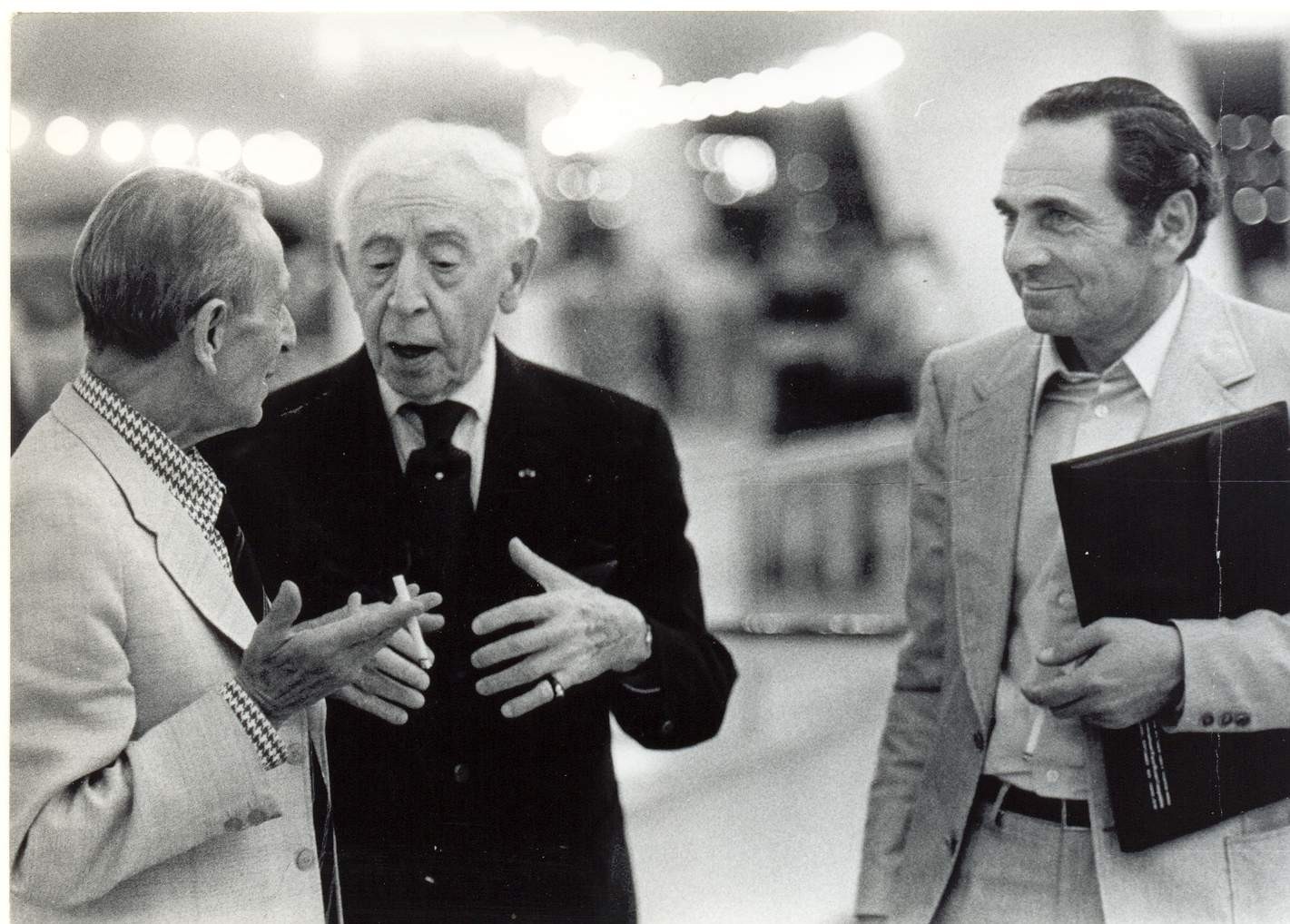
It is claimed that ‘the public’ is crazy about competitions, and I certainly believe that. Already in ancient times, people managed to keep their minds calm with bread and games; and all kinds of competitions were organized, also for singers, poets and philosophers. One wants to be entertained and the tension is tempting. Also for the spectators, but first and foremost for the participants, for whom a lot is at stake: commitments, record contracts and – who knows? – a great career and eternal fame.

The world is getting tougher, so are the competitions. Rivalry, not only among the participants but also among the competitions themselves, is increasing. In that world, the Tel Aviv competition feels a bit like a warm bath, at least that is what is claimed.

Idith Zvi © Eyal Fisher

Idith Zvi, artistic director of the Competition for thirteen years, likes that: “We want to be a competition with a human face. It is – and remains – a competition, but we must not lose sight of the human aspect, it is stressful enough for the participants.

Rubinstein Bistrizky

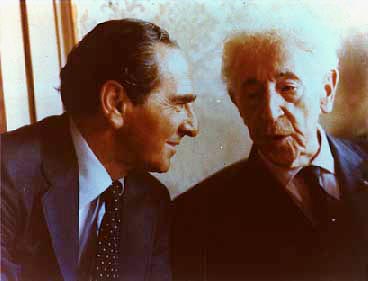
Jan Jacob Bistrizky with Arthur Rubinstein

It was Jan Jacob Bistrizky, himself a pianist and – before he emigrated to Israel in 1971 – one of the leaders of the Chopin Competition in Warsaw, who took the initiative to found a similar competition in Tel Aviv. His main intention was to enrich Israeli cultural life, but also to honour the name and artistic heritage of his friend Arthur Rubinstein.

Rubinstein Bistrizky met

Arthur Rubinstein and Jan Jacob Bistrizky

Since its foundation, the competition has also focused on promoting the work of Israeli composers. All participants are obliged to study a work of an Israeli composer ordered by the competition. There are always two of them, a man and a woman (in 2014 there were Ella Sheriff and Benjamin Yusupov) in Israel gender equality is more than important.

01_LOGO_RUBINSTEIN_2012

The enormous success of the first three editions led to the founding of the Arthur Rubinstein International Music Society in 1980. The year 2014 took a special place in the history of the competition: it was forty years ago that the competition was founded and ten years since the first ‘Piano Festivities’ had taken place. In 2014 it was also five years since the death of Bistrizky.

A few figures: in forty years fourteen competitions were held, there were six hundred participants, 43 pianists have won prizes, 180 often world famous musicians have been a member of the jury and the prizes amount to more than half a million dollars.

Idith Zvi is a famous pianist. She was the founder and director of the chamber music festival in Kfar Blum in the Upper Galilee, director of the Israel Chamber Orchestra and for many years head of the classical department of Kol Israel (Israeli radio). She became involved in the competition fourteen years ago.

How did it all start?
“In 2000 I was approached by Arie Vardi, chairman of the jury but also a well-known pianist and piano pedagogue. Among his students he counts among others Yundi. Was I interested in becoming Deputy Director? With the promise that I would succeed Bistrizky after his withdrawal. However, I first had to be interrogated by the members of the Supervisory Board and Bistrizky himself. I was elected. Three years later Bistrizky retired and I took his place as Director General.

Rubinstein Zvi Arie Rub

Idith Zvi and Arie Vardi, with the portrait of Arthur Rubinstein © Daniel Tchetchik

 “I had known him for years, also because I had done the competion’s radio broadcasts from the start. Bistrizky was a very erudite, intelligent man who was well organised and knew exactly what he wanted to achieve. It was not difficult to succeed him: what he left behind was a very well oiled and excellent running competition.”

“This year we have 39 participants, more than usual. The level of the candidates, therefore, was very high, it was not easy to choose. The medals the winners receive are decorated with drawings by Picasso of Rubinstein, with a fascimile signature of the maestro himself. Plus the emblem of the State of Israel”.

Rubinstein Picasso

Een bijschrift invoeren

Once you said that you don’t have to be a pianist to be asked for the jury.
“I still stand behind that. We are looking for real musicians in heart and soul, people we know and respect.”

“This year we have an ex-rocker, Yoni Rechter, among the jury members. He comes from the better pop music, but don’t be mistaken: he has also studied at the conservatory and has a great sense of music! But anyway: there should be at least one pianist, don’t you think? For the first time this year we have a fantastic Egyptian pianist in the jury, Ramzi Yassa.”

Ramzi Yassa talking to Arik Vardi about the Rubinstein competition. Only the introduction is in Hebrew:


“Fortunately, I am not a member of the jury and I don’t have to make any decisions! I think I would have a lot of arguments with the others!

What about the repertoire that candidates have to play? What are the rules?
“At the recitals they play what they want, they have no restrictions. Lately you see a shift towards ‘modern’ and ‘less common.’ We had a participant who had Ligeti on his list and Igor Levit, our second prize winner from 2005, played Reger and Hindemith.”

Igor Levit plays Suite 1922 Op. 26 pt 1 by Paul Hindemith:


No modern composers at the obligatory concerts? The list from which candidates may choose does not go beyond Prokofiev and Bartók?
“This is true, but how many good piano concerts from the twenty-first century do you know? The chamber music section changes each time. The emphasis is on the type of ensemble we have in mind, this year we have selected repertoire for wind ensembles”.

Among the 39 candidates there are many Russians (10) and Asians (11); do you have an explanation for this?
“It is of course due to music education and discipline. Perseverance and personal ambitions also play a significant role. Now you should not start to generalise right away. Nor should you lump all Asians together, because the differences between them are immense. Also the often heard comment that they lack emotions is not true! For example, the Chinese use a lot of expression in everything they play, more so than the Japanese, but that is also generalising and I don’t want to be guilty of that.”

What strikes me is the total lack of participants from the Netherlands. Can’t the Dutch play the piano? Or have they just not heard of the competition?
“Is our competition so unknown to you? That scares me! We need to do more about that!

“But the explanation may also be that there are few Russians studying at your conservatories. If you look closely at the list of participants, you will see that many of the American candidates, for example, originate from Russia. Or from one of the Asian countries”.

Meanwhile, the winners take over the international stages by storm. Daniil Trifonov, the sensation of 2011, has also won other competitions within a few months and signed an exclusive contract with DG.


Igor Levit, the somewhat timid winner of the second prize in 2005, has also fared well and has a CD out for Sony with Beethoven’s last piano sonatas – an absolute must for every music lover:


From 25 April to 11 May 2017, the fifteenth edition of the International Arthur Rubinstein Piano Master Competition was held. How will things turn out for Szymon Nehring, the latest winner of the competition? Time will tell, but I predict a great future for him.

Nehring plays Rachmaninoff’s third piano concerto:


And playing chamber music in Gabriel Fauré’s first piano quartet:


And what do you think of the Israeli participant Yevgeni Yontov? Below he plays Prokofiev ’s third piano concerto:

Weergaloze Liszt-recital door Boris Giltburg

Daniil Trifonovs weergaloze Rachmaninoff: cd van het jaar?

Translated with http://www.DeepL.com/Translator