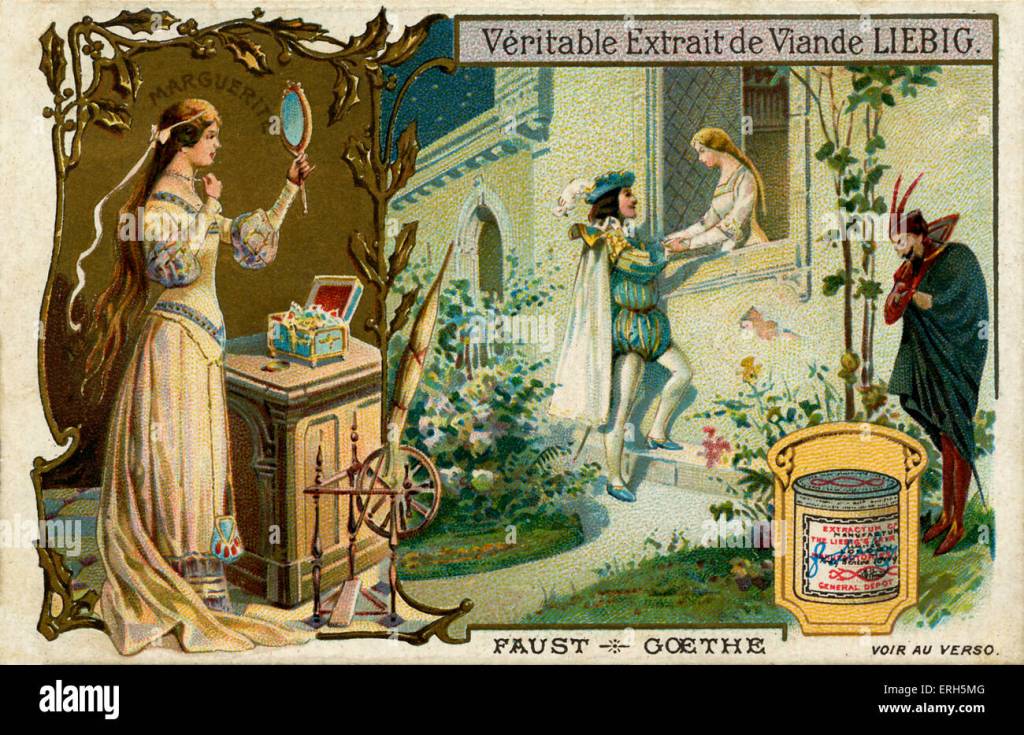
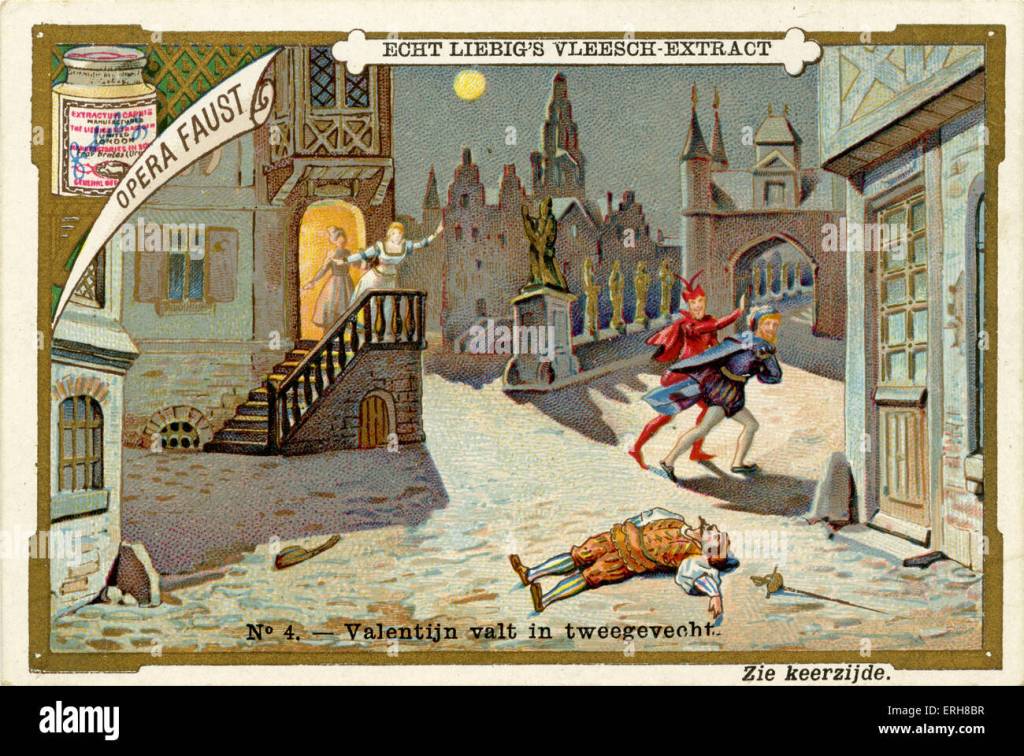
Who does not dream of being eternally young and beautiful? The wonderful story of Faust, about a scientist who sells his soul to the devil, has inspired numerous writers, poets and composers. Charles Gounod’s 1859 version is simply delightful.
If you want to see the work on screen, the choice is very limited. I myself was once absolutely blown away by Frank Van Laecke’s production at Opera Zuid, but it was not recorded. Pity.
Roberto Alagna
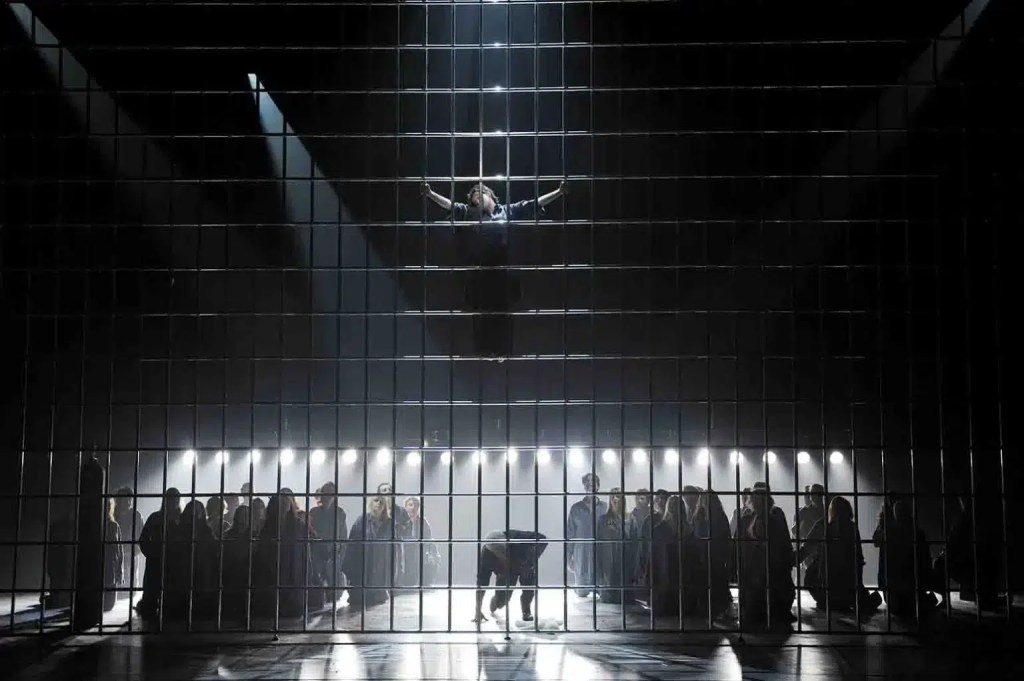
David McVicar, one of my beloved directors, staged the opera at London’s Royal Opera House. I saw it there, first with Roberto Alagna and then with Piotr Beczala. And to be honest: I was somewhat underwhelmed. There was very good singing, sure, but the direction disappointed me a bit.
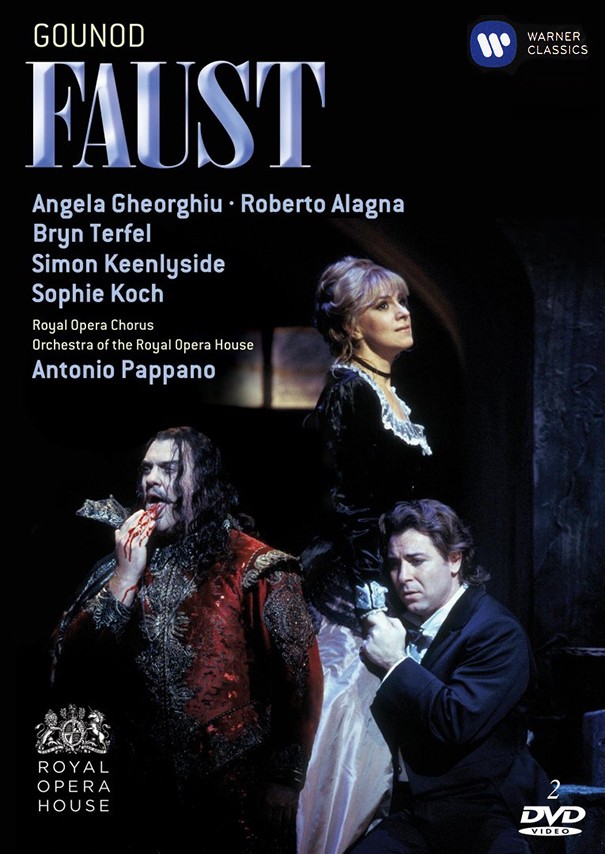
The first performances, starring Roberto Alagna, Angela Gheorghiu, Bryn Terfel, Sophie Koch and Simon Keenlyside, were filmed for Warner (5099963161199) in 2004.
Below is Angela Gheorghiu as Marguerite, with a commentary by herself:
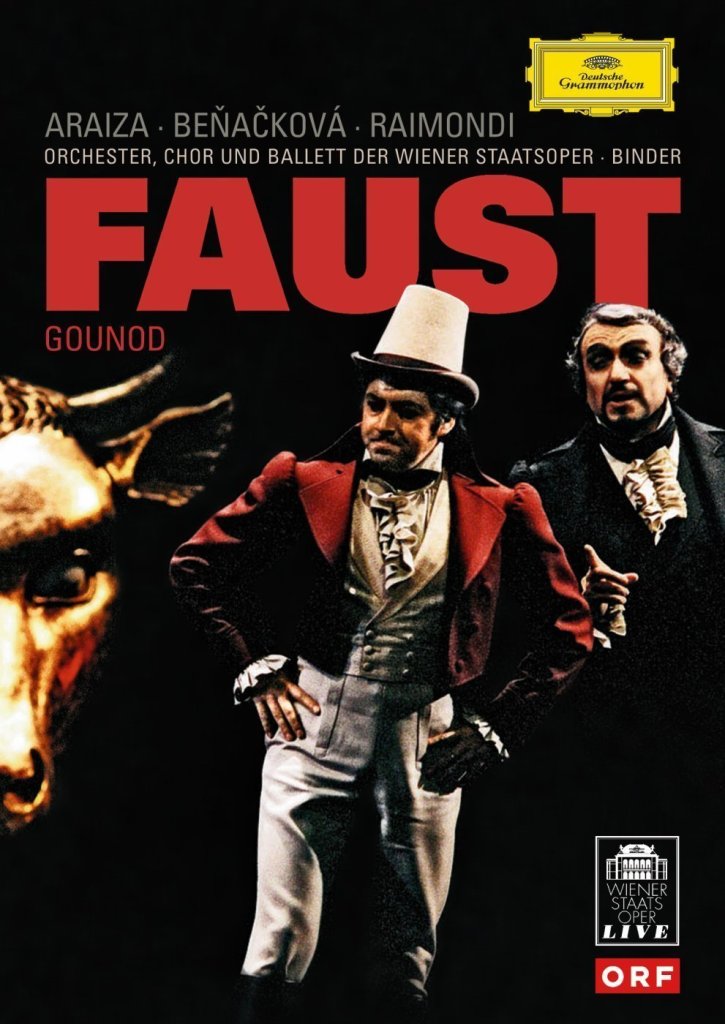
Francisco Araiza
And then we have the ˜enfant terrible” of the 1980s, Ken Russell …. To be honest, I confess that I didn’t really get very far when watching this DVD (DG 0734108). I find the direction extremely irritating with all sorts of ˜inventions” and ˜symbols”, the point of which completely escapes me. Francesco Araiza was once among my favourites, and in 1983 he still sang a splendid Ferrando in ‘Cosi fan Tutte’ but in this 1985 Viennese production his voice is a fraction of what it had been. What a shame!
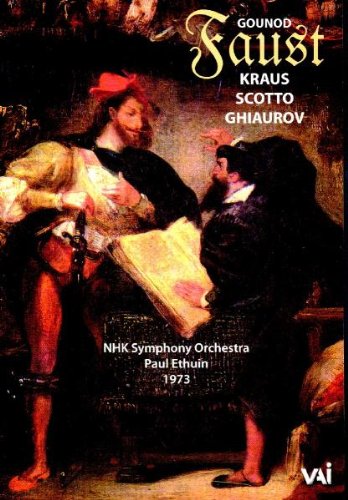
Alfredo Kraus
In 1973, Faust was performed in Tokyo and recorded live (VAI 4417). Renata Scotto, Alfredo Kraus, Nicolai Ghiaurov… what a cast! Mouthwatering, right? Yes and no.
Kraus is definitely ˜elegant”, but does Faust have to be elegant? Isn’t he rather a vulgar villain who just wants to cheat the pretty girl? Who wants money? And who wants to enjoy himself? Or have I misunderstood? There is also no passion in his singing and his high notes are somewhat ˜pressed”.
But Scotto is a very moving Marguerite and Ghiaurov a more than impressive Méphistophéles.
CD’s
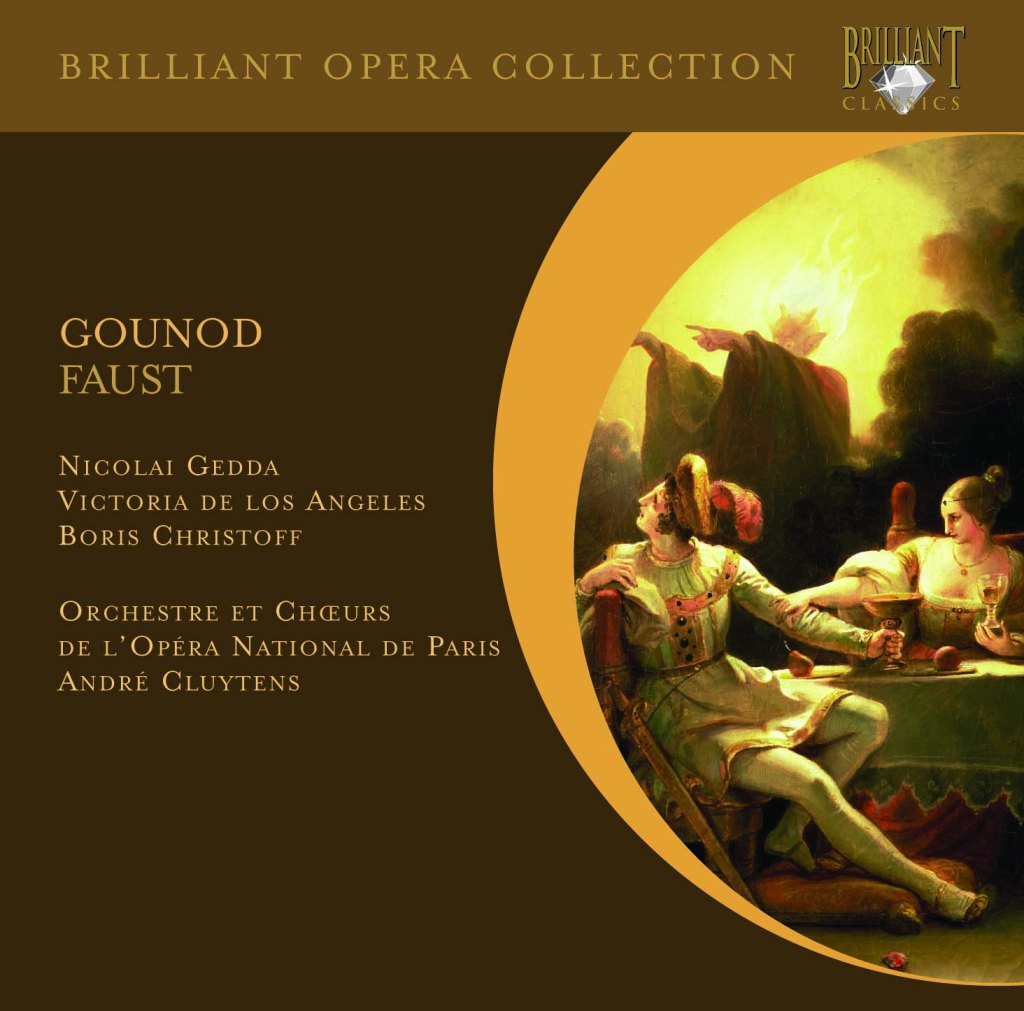
Nicolai Gedda
On CD, the choice is immense. How about Victoria de los Angeles and Nicolai Gedda? With Boris Christoff as the devil himself? Conducted by André Cluytens (Brilliant Classics 93964)? This makes my heart melt.
Gedda could probably be compared to Kraus, just a little, but his voice is big and his eloquence inexhaustible. And his sense of language is formidable. So please give me Gedda any day!
Gedda sings ˜Salut! Demeure chaste et pure”:
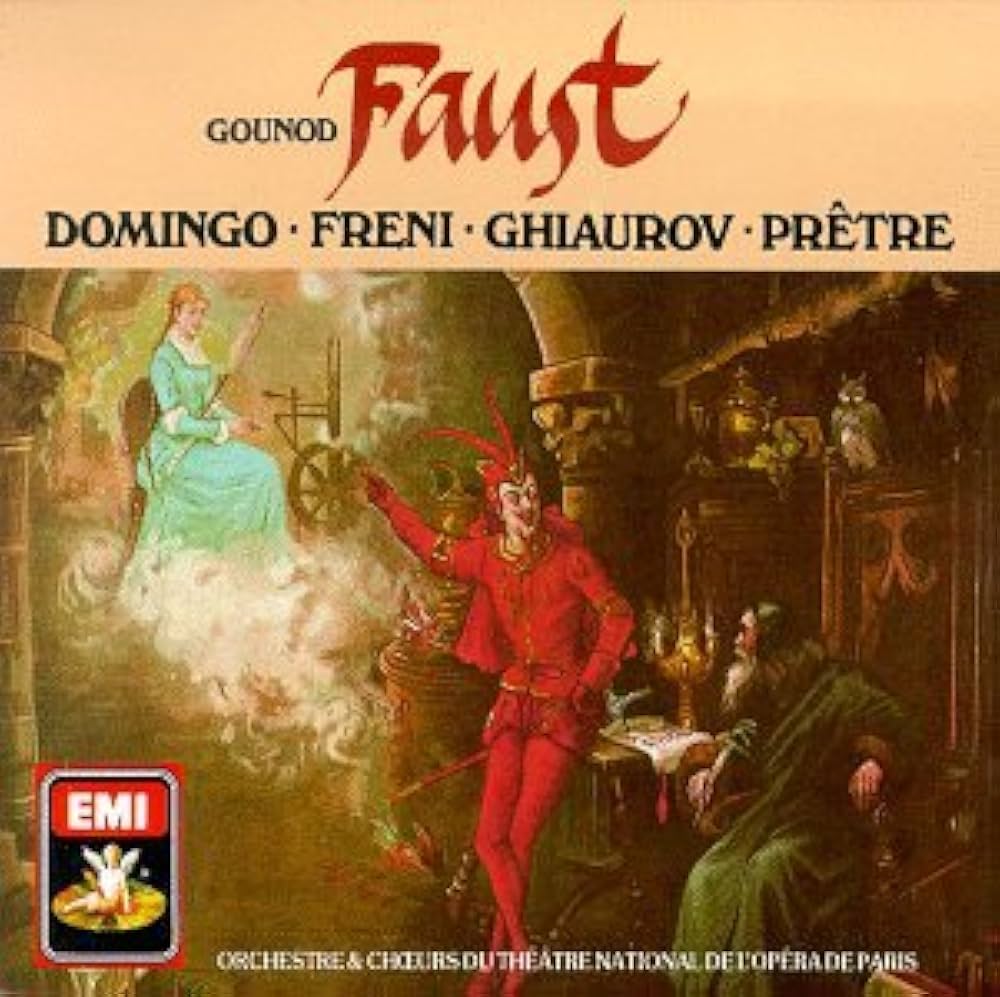
Plácido Domingo
Domingo is not really the first you think of when discussing Faust, but fortunately for the aficionado, a good studio recording of him exists. Fortunately, because in this case you can safely say it is one of the best recordings of the work (once EMI ).
The Paris Opera orchestra is conducted by Georges Pretre, one of the best conductors for the French repertoire. The cast is finger-licking good: Mirella Freni is a fragile and sensual Marguerite and Nicolai Ghiaurov a very impressive Méphistophéles. .
In the small role of Valentin, we hear none other than Thomas Allen. I have never heard ‘Avant de quitter ces lieux’ sung more beautifully before (or since).
No composer, perhaps apart from Puccini, loved women as much as Janáček did. Not that he was a womaniser, though he did fall in love with a 30-year-old younger woman at the age of 70. Whether it was anything more than a platonic relationship is totally irrelevant. Kamila Stösslová became his muse, and to her he dedicated his most beautiful works.
Kamila Stosslova & Leos Janacek, 1927
Without question, then, she was his inspiration for creating female characters, whom he treated with such deep affection that it is utterly impossible not to love them. The beautiful, sly little vixen Bystrouška (meaning ˜sharp ears”) is a case in point.
Bystrouška symbolises everything that men in opera lack, but still crave: freedom, independence, beauty, but also affection. Hence she reminds the Forester of Terynka, a beautiful gypsy girl, who also evokes warm feelings in the Schoolmaster and the Parson. But it is ultimately the Poacher who marries Terynka and gives his bride a fox fur as a gift. It couldn’t be more symbolic
Charles Mackerras on Decca
The Cunning Little Vixen is a wonderful opera, with music so beautiful it hurts you at times. Hence, conductor and orchestra not only have to be exceptionally good, but also have to have a special affinity with Janáček ’s music.
Sir Charles Mackerras is one such conductor. In the 1980s, he recorded five Janáček operas in Vienna, for which he received only the highest praise. And rightly so. A few years ago, Decca compiled all the operas and released them in a box set, which I can warmly recommend.
The role of Vixen is sung by Lucia Popp, a singer with probably one of the most beautiful lyrical voices in history: a voice with the beauty and purety of a crystal.
Apart from The Cunning Little Vixen, the box contains Jenůfa, Kát’a Kabanova, Věc Makropulos and From the House of the Dead. It comes with a clear booklet, unfortunately no librettos.
Charles Mackerras on Arthaus Musik
In 1995, The Cunning Little Vixen was staged at Châtelet in Paris, directed by Nicholas Hytner. The production was immediately awarded top prizes. No wonder, as it is of a rare beauty.
Hytner shows us a fairy tale, which is nót a fairy tale, in which people and animals are perfectly integrated into a symbiosis of nature and human desires.
Eva Jenis is truly phenomenal as Vixen. What this woman is all about, borders on the impossible. She runs, drops, rolls over the stage, jumps like crazy… The fact that she also manages to sing beautifully is unimaginable.
Also wonderful is Hana Minutillo as Fox and Ivan Kusnjer as Poacher. Thomas Allen further proves once again what a great and intelligent singer-actor he is. He had sung the role of Forester before (I remember a wonderful production from Covent Garden some 25 years ago), but now he does it in Czech (perfectly), in an otherwise almost exclusively Czech cast.
That the orchestra sounds as if it had played nothing but Janáček in the whole of its existence should come as no surprise: the conductor, after all, is no less than Charles Mackerra
Pylades and Orestes Brought as Victims before Iphigenia (1766) by Benjamin West
Ik ben geen echte Gluck-fan – zijn opera’s zijn me vaak te statisch en te ‘klassiek’ van vorm. Maar ik kan niet ontkennen dat hij een meester was in het scheppen van sfeer – meestal verstild, dat wel – die tot de diepste roerselen van je ziel kon reiken. Zijn grootste verdienste was echter het wakker schudden van de ingeslapen Franse opera. Men kwam toen niet verder dan Lully en Rameau; voor de Fransen betekenden de opera’s van Gluck hun eerste revolutie.
Het ging natuurlijk niet van harte, maar ja, zo gaat dat met revoluties. Zelfs (of misschien juist?) de culturele. En de Fransen waren strijdvaardig en fel: was de oorlog tussen de Lully- en Rameau-aanhangers eindelijk geluwd, nu kwam het tot de uitbarsting tussen de aanhangers van Gluck en Niccola Piccinni.
Beide componisten hadden net een opera over Iphigeneia gecomponeerd en dat heeft de massa’s de straat op laten gaan (hier een zucht: ik zou er heel wat voor over hebben om dat soort straatrellen en demonstraties nog mee te kunnen maken, maar dit terzijde).
Anonymous, Iphigénie en Tauride, 17th century. Oil on canvas. Musée des beaux-arts de Brest
Iphigeneia en haar lotgevallen zijn de hoofdthema’s van twee opera’s van Gluck. Ik weet eigenlijk niet of ze inderdaad bedoeld waren als een tweeluik, maar logisch is het wel. Het ‘Aulide’-deel vertelt hoe ze bijna geofferd wordt aan Diana in de aanloop naar de Trojaanse oorlog. In deel twee leren we hoe het haar verder verging in het barbaarse Tauris.
De oorlog is inmiddels lang voorbij, haar vader en moeder zijn vermoord en ook haar zus Elektra is dood. Hier beleeft zij het weerzien met haar dood gewaande broer Orestes en wordt zij weer eens verliefd. Dat alles natuurlijk niet zonder allerlei verwikkelingen en al helemaal niet zonder goddelijk ingrijpen.
In tegenstelling tot Aulide ben ik werkelijk gek op Tauride. En ik ben niet de enige, niemand minder dan Schubert ging mij voor. Volgens één van zijn vrienden heeft hij ooit gezegd dat hij ‘totaal buiten zichzelf was door de impact die deze prachtige muziek op hem heeft gehad en verklaarde dat er niets mooiers in de wereld bestaat’.
Iphigenia’s escape from Tauris. Ancient Roman relief, end of a marble sarchophagus. Middle of the 2nd century A.D.
Waarom de ene Iphigénie wel en de andere niet? Zelf vind ik Tauride veel spannender dan de nogal statische Aulide. Er zit veel meer drama in en de muziek is zonder meer innovatief – je herkent meteen de weg naar Berlioz. Hiermee was Gluck een echte precursor.
Ook de karakters zijn beter uitgewerkt en de rol van Iphigénie was dramatisch genoeg om zulke uiteenlopende zangeressen als Maria Callas, Montserrat Caballé, Shirley Verett en Sena Jurinac, om een paar grootheden te noemen, aan te spreken. Allemaal hebben ze haar op de lessenaar gehad ….
Maria Callas:
Montserrat Caballé (in het Duits):
JOHN ELLIOT GARDINER
Gardiner is zonder meer betrouwbaar (Philips 478 1705), maar echt spannend? Thomas Allen is een mannelijke, maar zeer beheerste Oreste en John Aler is een zoetgevooisde Pylade. Mooi, maar zonder – hmmmm, hoe zal ik het netjes uitdrukken? – het mannelijke testosteron… Diana Montague, een mezzo (!), heeft een pracht van een lyrische stem, licht en wendbaar. En René Massis is een voortreffelijke Thoas.
De opname is me zeer dierbaar, maar als ik eerlijk mag zijn: ik mis drama.
RICCARDO MUTI
Muti is, zoals altijd, bijzonder trouw aan de partituur en wat is het levendig! Zijn storm is inderdaad stormachtig, daar word je bijna duizelig van.
Carol Vaness is een Iphigénie naar zijn hand. Al meteen bij haar eerste aria gaat zij zo hysterisch te keer dat je meteen recht op je stoel gaat zitten. Je voelt op je klompen aan: het wordt een drama van jewelste. En je wordt niet teleurgesteld, want de spanning is om te snijden.
Carol Vaness sings ‘Ô malheureuse Iphigénie!’
Ook Thomas Allen haalt hier echt uit. Bij Muti is hij veel minder beschaafd dan bij Gardiner, je kan zelfs angst in zijn stem horen. Ik mag het. De opname heeft ook een extra troef – de rol van Pylade wordt gezongen door de veel te jong gestorven Gösta Winbergh (hij stierf in 2002 aan een hartaanval, nog geen 50 jaar oud). Een zanger die, zoals zijn landgenoot Gedda, werkelijk alles in zijn stem verenigde: de lyriek van Tagliavini, de elegantie van Kraus en de mannelijkheid van zijn andere landgenoot, Jussi Björling. Nog net met een been in Mozart, maar met het ander al voorzichtig Wagner aftastend. Daar wordt een mens droevig van.
De opname (Sony 52492) is live, wat behalve applaus en toneelgeluiden ook het gevoel ‘ik ben erbij’ meegeeft. Ik vind het prachtig, maar ik kan me voostellen dat de meeste mensen voor de veilige en betrouwbare Gardiner kiezen.
JOSEPH KEILBERTH
Over Nicolai Gedda gesproken: in de opname onder Joseph Keilberth uit 1956 (Capriccio 5005) zingt hij de rol van Pylades. De opvatting van de dirigent is zeer vooruitstrevend, zeker voor de tijd – het lijkt meer op Gardiner dan op Muti, al heeft hij ook wat van het hysterische van de laatste.
Hermann Prey doet mij een beetje aan Thomas Allen denken, zeker vanwege de lyriek, de lichte smacht en het onnadrukkelijk zingen. Echt woedend wordt hij niet, hij is meer van het treurende type.
Maar dan Gedda! Daar smelt niet alleen het hart van Iphigénie (een zeer elegante maar wel met schmalz zingende Hilde Zadek) van, daar gaat ook Diana humaan van worden. Geen wonder dat uw discografe een traantje moest wegpinken. Het geluid is een beetje dof, maar het went snel. En ja, het is in het Duits.
Bonus:
Opname onder Prétre met Rita Gorr, Nicolai Gedda en Luis Quilico:
Onegin, unlike don Giovanni, is not a colourful character. He is a rather dull, bored brat, for whom even hitting on a woman is too much trouble. Through an inheritance he has become a rich man and as such has access to the”high society”, but everything bores him and in fact he does not know himself what it is he really wants.
He dresses according to the latest fashion, the only question is whether he does it because he likes nice clothes, or because that’s the way things are supposed to be. Because he does know how things should be done.
He also shows hardly any character development over the whole course of the opera. He kills his best friend after flirting with his lover – not because he really wants to, but to teach him (and the, in his eyes horrid, countrybumpkins) a lesson – and even that leaves him unmoved. Only at the end does he “wake up” and something of a feeling enters his mind. But is it real?
Not really someone you can dedicate an entire opera to, which is why for many people the real protagonist is not Onjegin but Tatyana. If Tchaikovsky had really wanted it that way he might have named the opera “Tatyana”, but that she is a much more captivating character than the man of her dreams, is beyond any doubt.
CDs
SERGEY LEMESHEV:
One says Tatyana, one thinks Galina Vishnevskaya. The Russian soprano has created a benchmark for the role that few singers can yet match. In 1955, she recorded the role, along with all the Bolshoi greats of the time.
Her “letter scene” is perhaps the most beautiful ever, but the recording has even more to offer: how about Sergei Lemeshev as Lensky? Fingerlicking good!
Sergey Lemeshev as Lensky (his great aria & duel scene)
Valentina Petrova is a peerless Larina, unfortunately the title hero himself (Evgeny Belov) is a bit colourless. (Melodiya 1170902)
FRITZ WUNDERLICH:
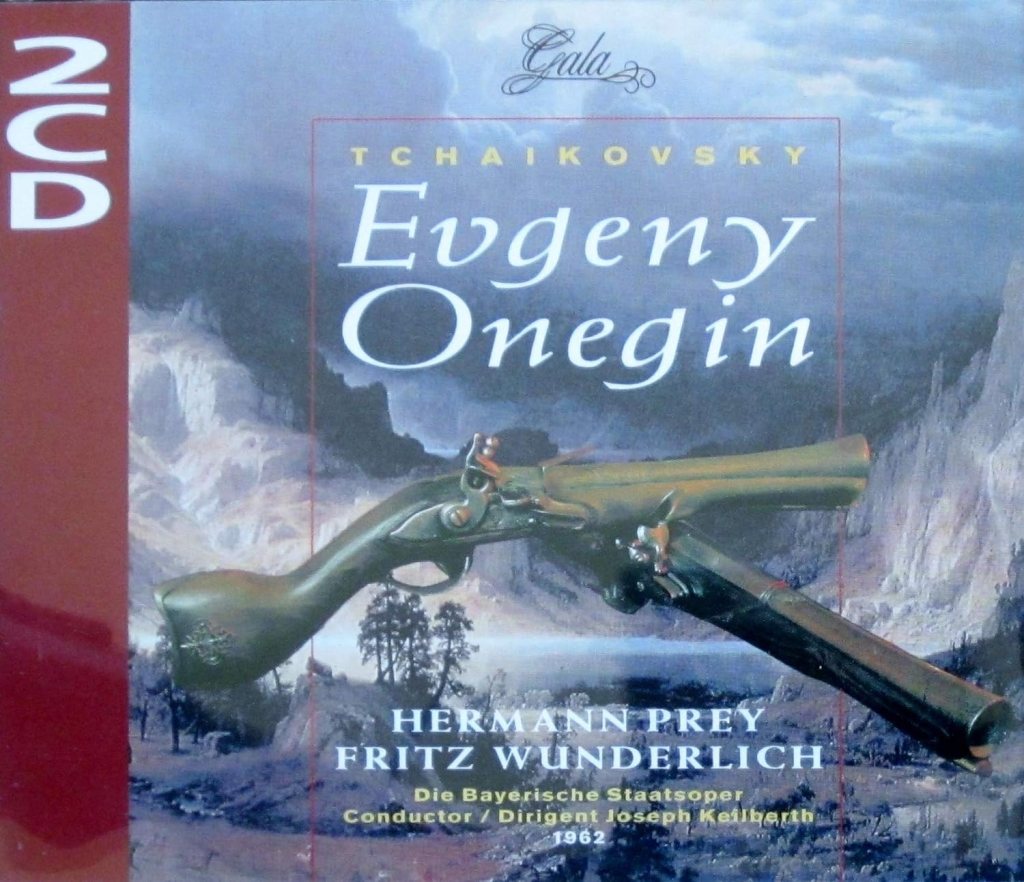
In 1962, the opera was recorded live in Munich (Gala GL 100.520).
Ingebort Bremmert is too light for Tatyana, she also sounds rather sharp, but Brigitte Fassbaender makes up for a lot as Olga. But for a change, the ladies do not make the greatest impact, you buy it, of course, for the men: Hermann Prey and Fritz Wunderlich.
Prey is a very charming, gallant Onjegin, actually more like a brother than a lover, but the voice is so divinely beautiful! And about Wunderlich’s Lensky I can be very brief: ‘wunderbar’! By the way, it strikes me once again how similar Piotr Beczala sounds to him!
There is a lot of stage noise and the sound is dull with far too many bass sounds. And of course it is in German, but yes, that’s how it was done in those days. But it is a matchless document and, especially because of both singers, actually a must-see.
Duel scene from the recording (with picture!):
BERND WEIKL:
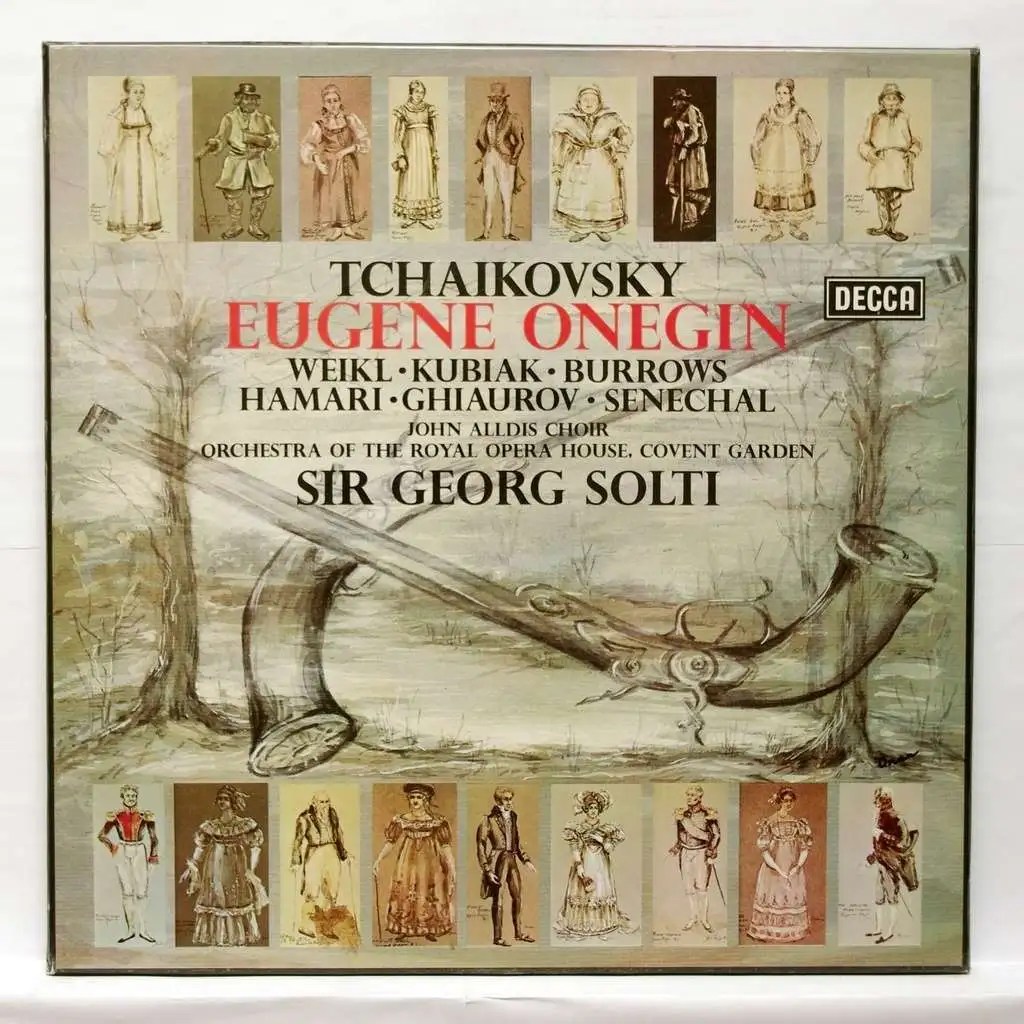
In 1974, Georg Solti recorded the opera for Decca(4174132) and that reading is still considered one of the best. In Stuart Burrows he had at his disposal the best Lensky after Wunderlich and before Beczala, and Teresa Kubiak was the very personification of Tatyana. Young, innocent, with a touch of elation at the beginning of the opera, but resigned at the end.
Under his direction, the orchestra (Orchestra of the Royal Opera House) flourished like the cornflowers in the Russian fields, making it clear why the composer considered his opus magnus to be “lyrical scenes” and not opera.
Bernd Weikl is a very seductive Onjegin, his very spicy baritone particularly sexy. Nicolai Ghiaurov is of course legendary in his role of Gremin and for me Michel Sénéchal is perhaps the best Triquet ever. Enid Hartle deserves to be especially mentioned as Filipyevna.
THOMAS ALLEN:
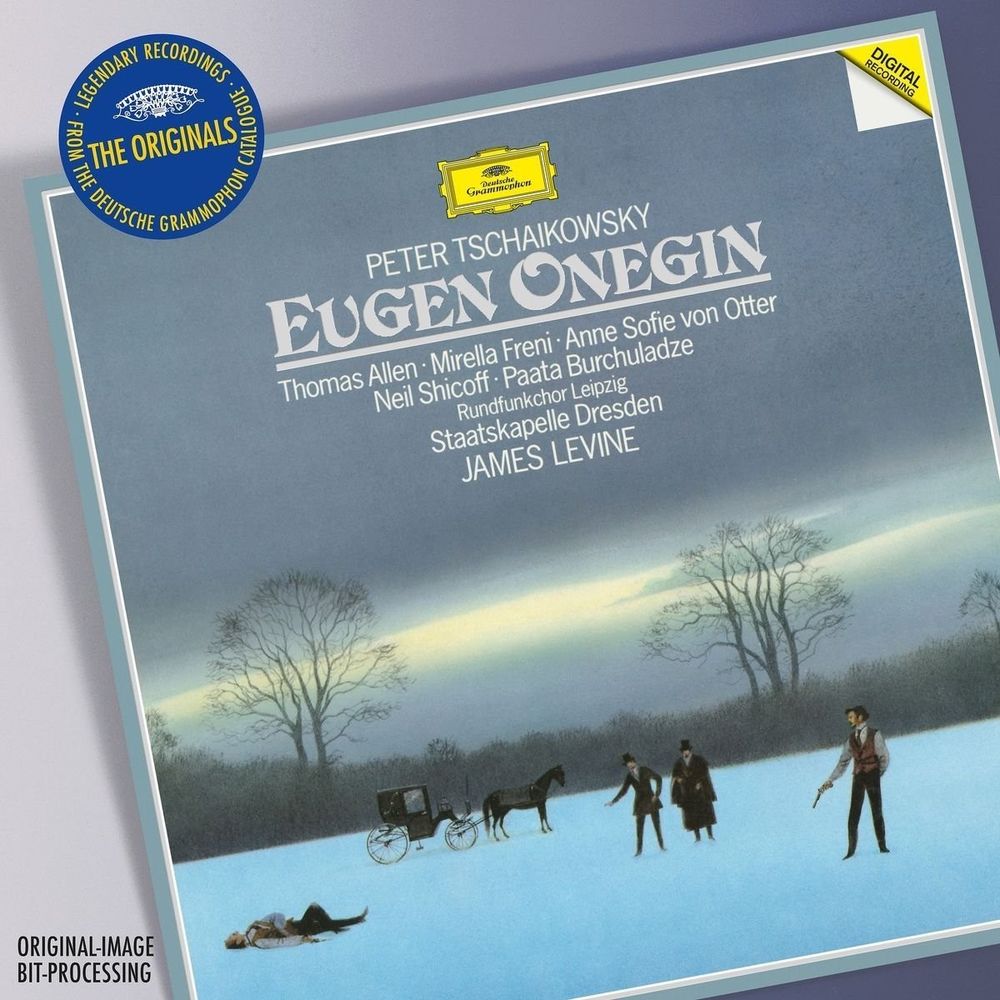
I want to dwell for a moment on Onjegin by Sir Thomas Allen. He has sung the role several times: both in Russian and in English. In 1988, he recorded it for DG (423 95923). Tatyana was sung by Mirella Freni – in the autumn of her career it became one of her showpieces. She is therefore more convincing as the older Tatyana than as the young girl, but there is nothing to criticise about her interpretation.
Neil Shicoff, then a splendid lyricist, was a very idiomatic Lensky, but Anne Sophie von Otter was only moderately convincing as Olga. Under James Levine, the Staatskapelle Dresden produced an unexpectedly lyrical sound, with lovely long arcs, but not devoid of a healthy sense of drama.
Anyway: it’s mainly about Thomas Allen. His reading of the title hero is particularly exciting and dramatically well grounded; it is truly fascinating to hear how Onjegin’s condescension in I turns into a shimmering passion in III. A vocal artist, no less.
It is also very interesting to see how he coaches young people at an ‘Onjegin master class’ (among his “students” is James Rutherford, among others)
DVDs
VLADIMIR REDKIN
Boris Pokrovsky is a living legend. For decades, from 1943 to 1982, he was opera director of the Bolshoi Theatre in Moscow. Even in the Netherlands, he is not unknown: in 1996, he was ‘visiting’ us with his new company, the Moscow Chamber Opera, with “Life with an Idiot” by Alfred Schnittke.
His production of Onjegin, recorded for TV at the Bolshoi in Moscow in 2000(Arthaus Musik 107 213) originally dates from 1944. It is, of course, a classic, complete with all the trimmings. Sumptuous costumes, true-to-life sets, everything as it ‘should’ be.
As soon as the stage curtain opens, the first ‘open curtain’ is a fact. People love it. And they are right: it is indeed so very beautiful! Of course, you don’t get to see it like that anymore. Think Zeffirelli, but really authentic, without a single liberty being taken. You have to have seen it at least once, just to know how it was originally intended.
The unknown singers are all just fine, but the close-ups are a bit laughable. Of course, it is not a production to be shown on TV, you have to actually see it in the opera house. There is no chance of that, though: Boris Pokrovsky’s production has been replaced by a new production by Dmitri Tcherniakov after more than 60 years of faithful service. Buy the DVD and muse on the ‘good old days’, because they really aren’t coming back.
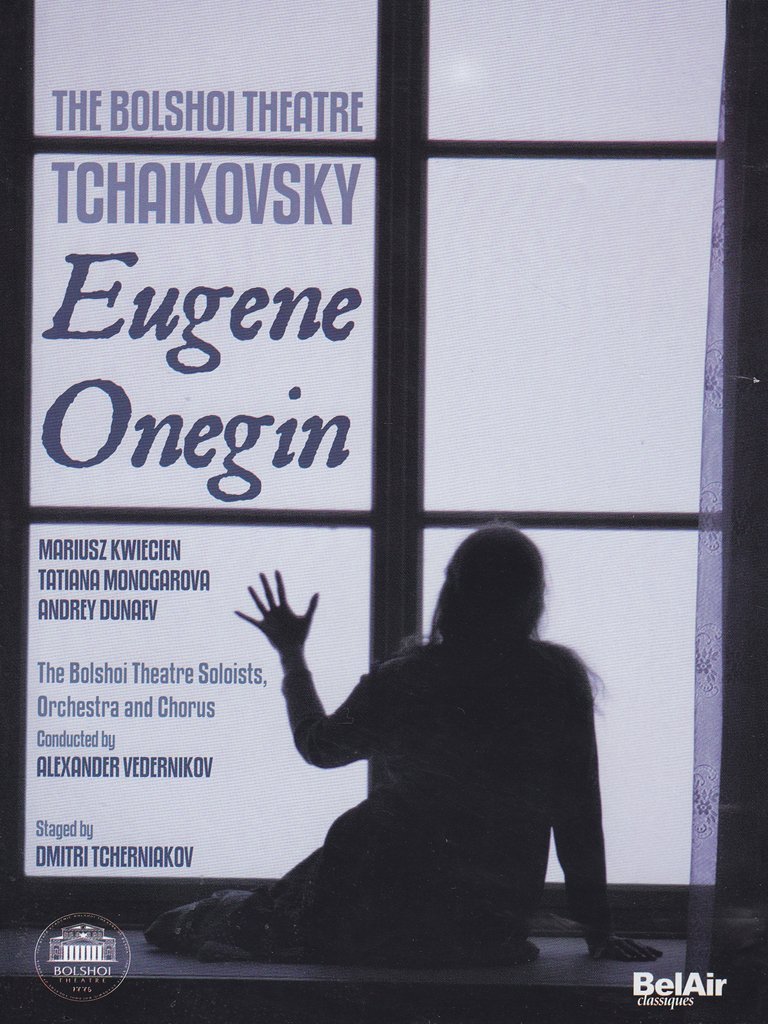
I started on Dmitri Tcherniakov’s production(Bel Air BAC046) with a huge dose of scepticism. His decision to replace Boris Pokrovsky’s old legendary production was very brave, because Muscovites (and not only Muscovites) were so very attached to it. Besides: you have to be really sure of yourself to dare to replace a LEGEND. On top of that, from the entire cast – apart from Kocherga and Kwiecien – I did not know any of the performers.
I quickly changed my mind, because from the start I was on the edge of my seat. The staging, costumes, stage design, sets and props – everything is right, even if it is not as it is in a typical ‘Onegin’. The entire first and second acts take place in the same space: the dining room in Larina’s house, with a long table and chairs prominently displayed. The same table and chairs also recur in III, but in a much richer ambience.
It is incredibly difficult to explain the whole directorial concept in a few words, you have to believe me that it is extremely fascinating and extremely exciting. Very intelligent too.
Tatyana is portrayed by Tatiana Monogarova in a very convincing way. She is pale, thin and slightly autistic, locked in her own mind. The outside world scares her as she tries to hide from it.
Olga(Margerita Mamsirova) is just a flirt and from the start she challenged Onegin. She is more than a little tired of her poet- boyfriend’s sighs. and she is not wrong!
Lensky is sung by a good, though not exeptional, Andrey Dunaev. He is a bit stupid, pushy and jealous and thus the real instigator of all evil happenings.
Larina (an insanely good singing and acting Makvala Kasrashvili) also gets more attention than usual. The moment when, thinking back to her childhood, she downs a drink and has a little cry is very touching. But she soon recovers and everything stays the same.
Mariusz Kwiecien (Onegin) is indeed irresistible. Or let me rephrase it: he portrays such a very bored and self-important arsehole (sorry for the word!). And he actually stays that way until the end. Utterly convincing!
Frantically he tries to belong to the ‘high society’, where he is not really accepted. Even his sudden passionate love for Tatyana feels unreal. On his knees, he offers her a bunch of red roses and when she refuses to run away with him, he tries to rape her.
Dignified, Tatyana walks off the stage on her husband’s arm on which Onjegin pulls out a pistol, but we are spared the suicide, because, of course!, without witnesses by his standards there is no use for it..
Trailer:
DMITRY HVOROSTOVSKY
And then there is Robert Carsen’s production for the Metropolitan Opera, recorded in February 2007(Decca 0743298). I am a huge Carsen-adept and love almost everything he does. So too this Onjegin
His staging is very realistic and he follows the libretto accurately. In the first act, the stage is strewn with autumn leaves, but everything else is basically bare and there is almost no scenery. A bed for the ‘letter scene’, otherwise some chairs in the second and third acts. At the duel, the stage is completely empty.
It is not distracting. On the contrary. The costumes are really beautiful, but especially in the first act they remind me more of English Jane Austen film adaptations than of the Russian countryside. It is not really disturbing, the eye wants something too, but Renée Fleming is too glamorous for a peasant trio, making her switch to a proud princess less impressive.
Onjegin (Dmitri Hvorostovsky) is mainly a dandy here, very concerned with his, good, looks. Well, Dima is an extremely attractive singer in all aspects, but in his confrontation scene with Tatyana, he is more reminiscent of daddy Germont than of Onjegin.
Ramón Vargas is one of the best lyric tenors in 2007, but Lensky he is not! He really does his best, he also looks like a real poet, but this role needs to be a bit more languorous.
As usual, Carsen’s character direction is truly unsurpassed and even Fleming seems to thaw out at times. Unfortunately, her Russian is totally unintelligible.
Fleming and Hvorostovsky in the final scene of the opera:
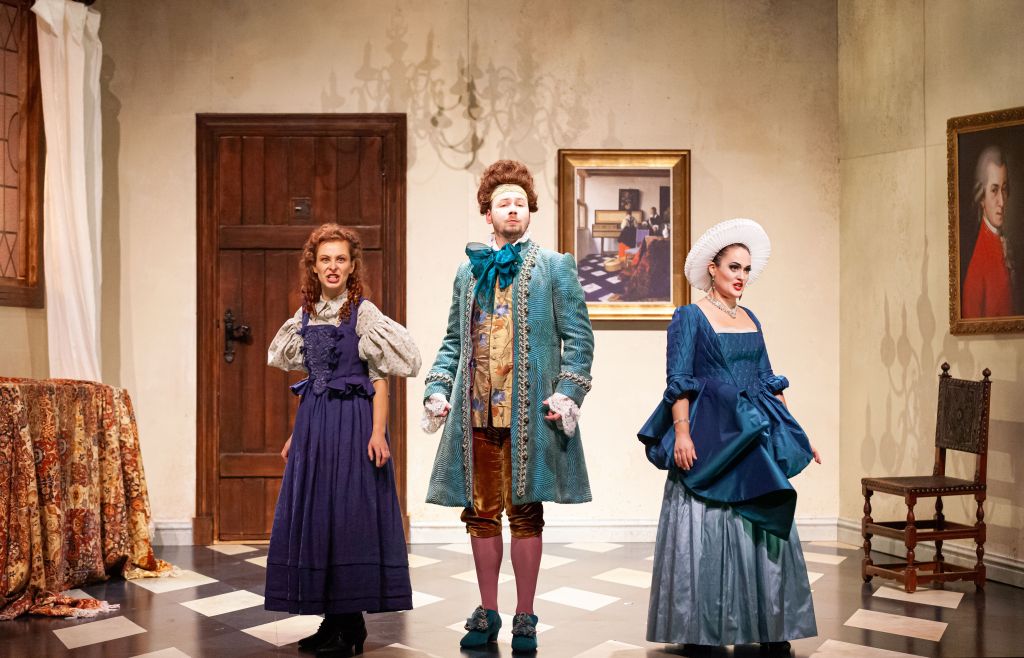
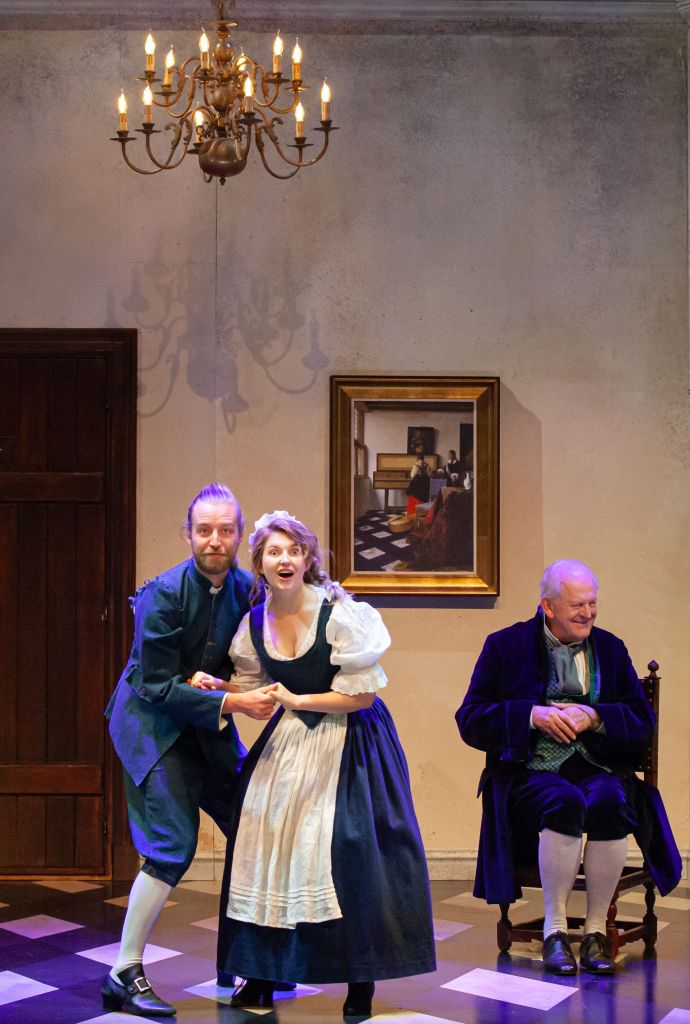
Der Schauspieldirektor is een kort komisch Singspiel dat op 7 februari 1786 voor het eerst werd opgevoerd in de Orangerie van Paleis Schönbrunn. De gelegenheid was een lunch die keizer Joseph gaf voor 80 genodigden. Zodoende had het werkje van meet af aan het karakter van een stuk dat bestemd was voor tussen de schuifdeuren. Bij diezelfde gelegenheid had Salieri’s Prima la musica e poi le parole première, eveneens een korte eenakter. De keizer wilde meer aandacht voor het Duitse Singspiel genereren maar het publiek reageerde vooral ten faveure van Salieri’s Italiaanse creatie.
Der Schauspieldirektor bevat vijf stukken muziek: een ouverture, arietta, rondo, terzet en vaudeville; bij elkaar ongeveer 25 minuten. Het werkje leunt dan ook zwaar op de gesproken teksten en die waren duidelijk toegesneden op de toenmalige actualiteit. Het is dus voor elk gezelschap dat dit Singspiel vandaag de dag programmeert zaak om hier flink de stofkam doorheen te halen. Dat kan een pakkende eenakter van een uurtje opleveren. En net als bij de keizer thuis zou daar dan die Prima la musica van Salieri tegenover gezet kunnen worden voor een avondvullend programma. Waarschijnlijk werd dat te kostbaar want Opera Zuid heeft in plaats van voor die oplossing te kiezen het Singspiel naar eigen inzicht geactualiseerd en uitgebreid met nog eens ongeveer 20 minuten muziek uit andere Mozart opera’s.
Hiertoe is geput uit Cosi fan tutte, Le nozze di Figaro en Die Zauberflöte. Verder is er een tenoraria te horen die ik niet kon plaatsen. Tussendoor wordt het geheel aan elkaar gepraat in een format dat meerdere lagen heeft. Je kijkt aanvankelijk naar een auditie. Dat blijkt vervolgens een repetitie te zijn voor een stuk over een auditie.
Als het vervolgens pauze is en de spelers achter de coulissen zich vertreden en met elkaar praten vindt er opnieuw een onderbreking door de toneelregie plaats waaruit blijkt dat we kijken naar de repetitie van een voorstelling die gaat over een repetitie van een auditie voor een opera. Niet geheel onverwacht krijgen de spelers in dit ‘matroesjkadrama’ meerdere identiteiten en namen. Het is aardig bedacht maar wordt al gauw een theatraal handigheidje.
Tijdens de pauze in de repetitie voor een auditie probeert de tenor die Herr Vogelsang vertolkt om Mademoiselle Silberklang te versieren. Inmiddels zijn het acteurs in de tweede laag die spelen dat ze zichzelf spelen.
Goed beschouwd lukte dat alleen Kristina Bitenc die geheel naturel zat te praten zoals ik haar bij eerdere gelegenheden al wel eens heb gesproken. Voeg dit bij haar stimmliche Silberklang vertolking en je hebt de echte prima donna van de avond. Ik heb van haar genoten.
Madame Herz kwam voor rekening van Chelsea Bonagura die een geweldige entree had als de Roemeense sopraan Angela, door de Schauspieldirektor gemakshalve aangeduid als Madame Ceauscescu. Bonagura wist goed raad met haar door Madame Herz gezongen arietta ‘Da schlägt die Abschiedsstunde’. En in het Eifersuchtduet ‘Ich bin die erste Sängering’ met Bitenc dreven ze elkaar steeds verder de hoogte in. Hilarisch nummer, het muzikale hoogtepunt van het werkje.
De vocale bijdragen van Marc Pantus als Buff en Mitch Raemakers als Herr Vogelsang bleven hier wel wat bij achter. Ook het koppel dat het PaPaPaPa duetje mocht voorzingen kwam niet verder dan tijdvulling. En dat was een beetje de makke van deze productie: er moest teveel tijd worden gerekt om tot ongeveer anderhalf uur te komen. Het is dat men Thomas Allen had weten te strikken voor de titelrol, anders was het een moeizame avond geworden.
De bijna 80-jarige Allen is natuurlijk een fenomeen, een van de grote baritons van yesteryear. Het is eigenlijk treurig dat hij hier uitsluitend mag spreken en de scène waarin hij lamenteert over het feit dat hij niet kan zingen is onbedoeld schrijnend: goed beschouwd is hij geen (echte) zanger meer en nu dus aangewezen op acteren.
Terwijl het toneel steeds donkerder wordt komen Pantus, Bonagura en Bitenc hem troosten met een gevoelige trio: Fiordiligi en Dorabella die roerend afscheid nemen van hun lovers terwijl Don Alfonso schijnheilig meezingt. Het was het mooiste moment van de avond.
So far so good. Waar ik teveel moeite mee had was de kwaliteit van de gedebiteerde teksten en de wijze waarop die werden voorgedragen. Dat kwam helaas vaak niet verder dan het niveau van amateurtoneel. Als je wel eens kijkt naar comedy op tv, zelf ben ik fan van ‘The big bang theory’, dan valt op dat grappen meestal heel terloops worden gemaakt. Dus niet minutenlang uitmelken, als iemand het heeft gemist heeft hij pech gehad.
Een goed voorbeeld van hoe het in mijn beleving niet moet is de grap die wordt gemaakt over een controversiële Lohengrin regie in Salzburg. Die in een wasserette, ja met 200 wasmachines, het was geweldig. Als oneliner is dat zeer geslaagd, als onderdeel van een tenen krommende scène over dat vermaledijde regietheater is het niet meer dan ongemakkelijke tijdvulling. En dat is naar mijn smaak teveel het geval in deze Schauspieldirektor.
In de bak zat de Phiharmoniezuid. Enrico Delamboye had de muzikale leiding. Op zich wel een aardige voorstelling maar er had meer ingezeten.
Behind the scenes:
Christopher Gillett vertelt over Der Schauspieldirektor – Opera Zuid
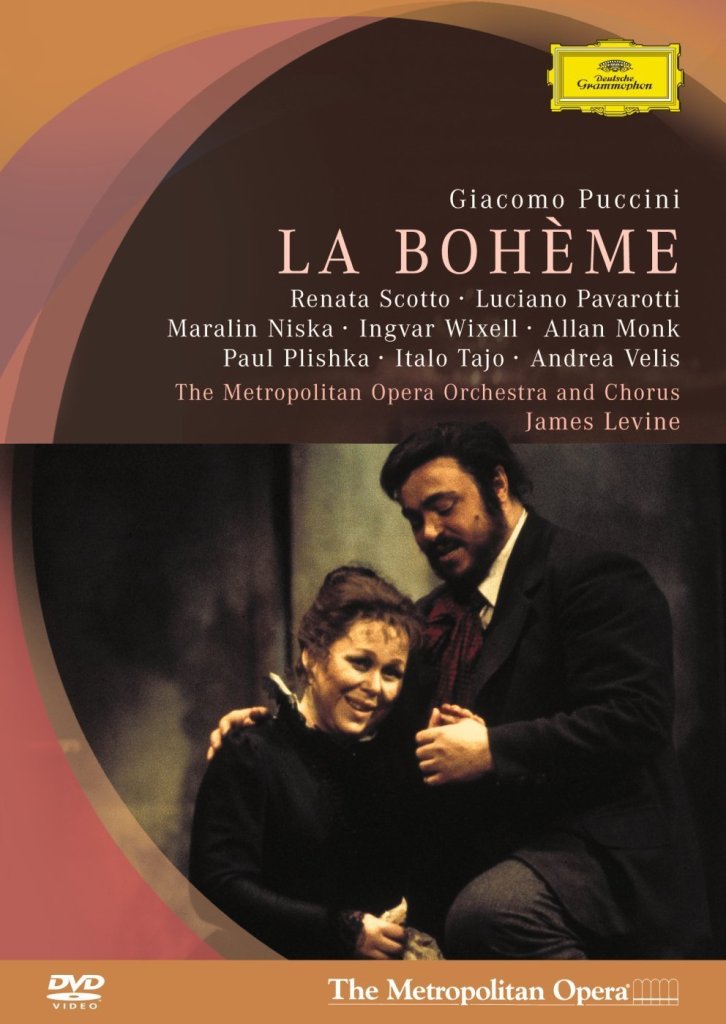
Many opera lovers will probably agree on one thing: one of the best Bohèmes ever is the 1973 version recorded by Decca under von Karajan. With Mirella Freni and Luciano Pavarotti.
Rodolfo has always been Pavarotti’s calling card. For years he was considered the best interpreter of the role – his fantastic legato, the smoothness and naturalness with which he sang the high notes are truly exemplary. Incidentally, as befitted a typical Italian tenor of the time, he sang the end of “O soave fanciulla” at the same height as the soprano. Not prescribed, but it was tradition!
Freni was undoubtedly one of the most beautiful Mimi’s in history. Tender and fragile, with her heartbreaking pianissimi and legato arches she managed to move even the greatest cynics to tears.
Von Karajan conducted theatrical and passionate way, with ample attention to the sonic beauty of the score. As the Germans would say “das gab’s nur einmal.”
In 2008 we celebrated not only Puccini’s 150th birthday, but also von Karajan’s 100th. Moreover, it was 35 years since the famed conductor recorded La Bohème: a cause for celebration! And lo and behold – Decca has released the opera in a limited deluxe edition (Decca 4780254). On the bonus CD, Mirella Freni talks, among other things, about her relationship with von Karajan and about singing Puccini roles. It is really fascinating.
Arias and duet from the first act:
Mirella Freni made her debut as Mimì at the Metropolitan Opera in September 1965. Her Rodolfo was another debutant: the (how unfair!) nowadays almost completely forgotten Italian tenor Gianni Raimondi. For me, he is preferable to Pavarotti. I find his voice more pleasant and elegant. And he could act! Freni’s and Raimondi’s renditions were captured on a wonderful film, directed by Franco Zeffirelli and conducted by Herbert von Karajan. An absolute must (DG 0476709).
“O Soave Fanciulla” with Freni and Raimondi:
Renata Scotto
History was made with La Bohème from the Met in 1977 (DG 0734025): it was the very first direct transmission from the New York opera house on TV. The production was in the hands of Pier Luigi Pizzi, who at that time was not yet obsessed with excessive ballets and the colour red.
Although I was never a big fan of Pavarotti, I cannot deny that he produces a fresh sound here and that his high notes stand like a house. Acting was never his cup of tea, but here he does the best he can.
It becomes really exciting when Mimì enters: in 1977, Renata Scotto was at her unprecedented peak. She spins the most beautiful pianissimi and her legato and mezza voce are so beautiful they make you want to cry. The rest of the cast is no more than adequate, but the young James Levine conducts as if his life depended on it!
Scotto sings ‘Si mi chiamano Mimì’:
Musetta was not really a role with which we associate Scotto. Neither did she herself, but she accepted the challenge with both hands. In the Zeffirelli Met production of 1982, she sang a Musetta to die for. Alongside the very moving José Carreras and Teresa Stratas, she was the undisputed star of this recording (DG 073 4539 9).
Scotto as Musetta:
Cristina Gallardo-Domâs
Sometimes I wonder how perverse it is when people pay a lot of money to go see, dressed in fur coats, the misery of freezing poor artists?
I myself took great pleasure in the sight of all those fur-wearing audiences on my way to a performance of La Bohème at La Scala in 2003 (Arthouse 107119). The then 40-year-old Zeffirelli production was altered a bit, but the beautiful, realistic sets and brilliant lighting remained the same. The snowflakes, the light radiating from the inn that warmly colors the white earth, the snowy bench and Mimi’s tear-stained face: there is something magical about it all and it is more like a movie than a performance in the theater. It cannot leave you unmoved, all the more so because all the protagonists are truly superb.
Cristina Gallardo-Domâs is a delicate, emotionally torn Mimì. Her lyrical soprano is a bit reminiscent of Freni. Malcero Ãlvarez convinces with a (then still) beautifully lyrically sung Rodolfo and Hei-Kyung Hong, clearly inspired by Scotto, portrays a kitschy Musetta. Bruno Bartolletti conducts lively, without shying away from sentiment.
Below, ‘O soave Fanciulla’ with Gallardo-Domâs and Ãlvarez
Gallardo-Domâs was also present in Zurich two years later. With this very realistically staged Bohème, Philippe Sireuil made a thunderous debut at the Zürich Opera House (EMI 3774529). Don’t expect Zeffirelli-like scenes with snowflakes drifting down, however.
Sireuil’s conception is very “down to earth” and as such more veristically faithful than any other production known to me. With great love of detail, he draws the lives of the foursome of artist friends: their attic is tiny and stuffy, and their struggle to better themselves is life-like. The costumes (second-hand clothing from thrift stores) is contemporary, yet timeless at the same time.
Whatever Mimì is suffering from (it is surely not tuberculosis – the director doesn’t even allow her to cough) doesn’t really matter, although it seems to be drug related. Like a sick bird (how much she resembles Edith Piaf!) she slowly slides into the abyss, and her death forces the others to really think, for the first time. The third act, set at a gloomy train station, is particularly strong and painfully poignant.
The entire cast, headed by a movingly beautiful Marcello Giordani and a very virile Michael Volle (Marcello) in addition to the heartbreaking Gallardo-Domâs, is also outstanding. The much lamented László Polgár sings Colline. Believe me: this La Bohème is really not to be missed.
Below, Marcello Giordani and Michael Volle in ‘Marcello finalmente:
Cheryl Barker
Back in time a little, to Sydney, Australia, 1993. For the first time I saw the production on TV (yes, kids: once upon a time there were the days when an opera was simply broadcast live from an opera house on TV!) and not soon will I forget that night. I didn’t know any of the singers; it was the name of the director (Baz Luhrmann) that drew my attention to the production.
The singers were mostly young – a plus, since the opera is about young people in love. They could sing, too, and with their looks of real movie stars, they could have been on the movie screen. Strange really, that, apart from Cheryl Barker (Mimì), no one had a great career. That Luhrmann was obsessed with opera is also confirmed by the film buffs: his Moulin Rouge is a direct look alike , including the red-lit “L’amour” on the rooftop. (Arthaus Musik 100 954)
Scene from the production:
Ileana Cotrubas
But, hand on heart, if I had to go through life with only one recording of La Bohème … I would choose John Copley’s 43-year-old production made for the Royal Opera House.
My “desert island recording” was captured on DVD in 1983 by NVC Arts (Warner 4509 99222-2) and – no matter how many times I watch it, I never get tired of it. And still, after all those years, it always makes me cry. Some things never age.
Neither does the cast : Ileana Cotrubas as my beloved Mimì, the irresistible young Neil Shicoff as Rodolfo and Thomas Allen as a very erotic Marcello.
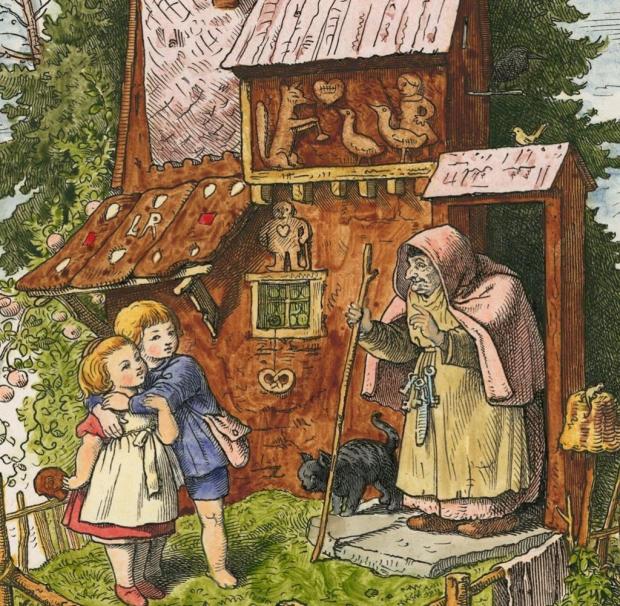
Das Bild ist ein Holzstich nach einer Zeichnung von Ludwig Richter von 1853.
Fairy tales! As a child I couldn’t get enough of them and I still love them. My small bookcase was well stocked with them then and my current bookcase has several shelves with every fairy tale I could lay my hands on.
The story of the children lost in a dark wood, the wicked witch and – yes! – the gingerbread house particularly appealed to me; a girl who loved sweets.
I knew that the fairy tale had once been turned into an opera. In the old German film adaptation of Kärstner’s The Parent Trap, Luise/Lottie visits the performance of Hänsel und Gretel conducted by her father. This very dramatic scene made a huge impression on me at the time, so the opera was very high on my wish list. My first real introduction to the opera, however, was downright disappointing. And I still cannot get really excited about the work. It is not sweet or scary enough for me. However, I immediately admit that a beautiful, well sung and acted production will give me a lot of pleasure!
The two DVD recordings known by me are certainly all that, and I really wouldn’t know which of the two to choose
Royal Opera House, 2008
Colour! That is what is most striking about Moshe Leiser and Patrice Caurier’s London (Covent Garden 2008) production. The enchanted (and enchanting) fairy- tale forest is green, the sky blue, Gretel’s jacket red, and the biscuits, cakes, pies and puddings are all the colours of the rainbow. Or even more. And they are so very bright!
It is a true feast for the eyes, but the singing is also at the highest level. Diana Damrau is a delightful Gretel and Angelika Kirschlager a boyish Hänsel. Even in the scenes together with real children, they are not out of place.
Elisabeth Connell and Thomas Allen, here as real- life riff- raff, are good for a lot of delicious “schadenfreude”. And the fact that Anja Silja convinces more with her acting than with her singing should be forgiven, she is after all a witch (Opus Arte OA BD 7032)
Metropolitan Opera, 2008
Richard Jones’ production, originally created for the Welsh National Opera and recorded at the Met in 2008, is just as much fun. Chistine Schäfer (Gretel) and Alice Coote (Hänsel) are perhaps just a little more brazen, but Rosalind Plowright and Alan Held are just as deliciously caricatured as Connell and Allen.
What makes this performance an absolute must have is Philip Langridge’s witch, even Anja Silja cannot match that! And the dream pantomime at the end of the first act is simply delicious.
During the overture and the interval, we get a look behind the scenes and get to see the make-up artists in action. Very special!
Vladimir Jurowski conducts very lightly, almost belcantesque. Warning for purists: the opera is sung in English! (Warner 5099920630898)
Below a short trailer:
von Karajan, Milan1954
Talking about foreign languages: it is not at all surprising that an opera intended for a mainly young audience is performed in a language they can understand.
In 1954, von Karajan conducted the fairy tale in Italian in Milan, but with two German sopranos in the leading roles: Elisabeth Schwarzkopf and Sena Jurinac. Which makes the notion of “intelligibility” immediately relative.
Rolando Panerai is a delightful “Pietro”, but of course the CD’s greatest attractions are the Sand- and Taumännchen sung irresistibly by Rita Streich. The orchestral sound is very refined despite the analogue sound (Date DAT 12314).
Von Karajan, 1953
Refinement is also the best word to describe the (studio) recording of Karajan from 1953. It is fully worth it for the overture alone. Orchestrally it sounds even better than the Milan recording, but that may be due to the excellent sound quality.
Both Elisabeths: Grümmer and Schwarzkopf sound very credibly childlike. Their ‘Brüderchen , komm tanz mit mir’ is simply irresistible. It is just a pity that their voices sound so similar that you cannot really tell whether it is Hansel or his sister who is singing. (Warner 509996407162)
Eichhorn, 1971
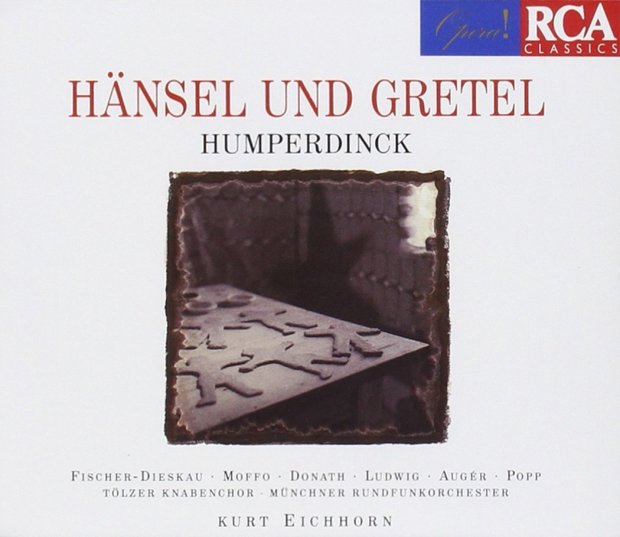
There are five reasons to buy the recording Kurt Eichhorn made for RCA in 1971: Anna Moffo (Hans), Helen Donath (Gretel), Christa Ludwig (witch), Arleen Auger and Lucia Popp (the ‘males’).
Charlotte Berthold and Fischer Dieskau are not really exciting and the orchestra is no more than okay, but those five ladies! And secretly I think I may find Helen Donath’s Gretel the most beautiful of all. (BMG 74321 252812)
Below Anna Moffo and Helen Donath in `Abendsagen`:
Er is geen barokopera die vaker werd vastgelegd dan Dido and Aeneas van Henri Purcell. Er is voor elk wat wils: met moderne instrumenten of met authentieke instrumenten, met meisjesachtige of met grote dramatische sopranen/mezzosopranen als Dido, met tenoren of baritons (en zelfs een enkele keer een countertenor) als Aeneas. Hoe moet je kiezen?
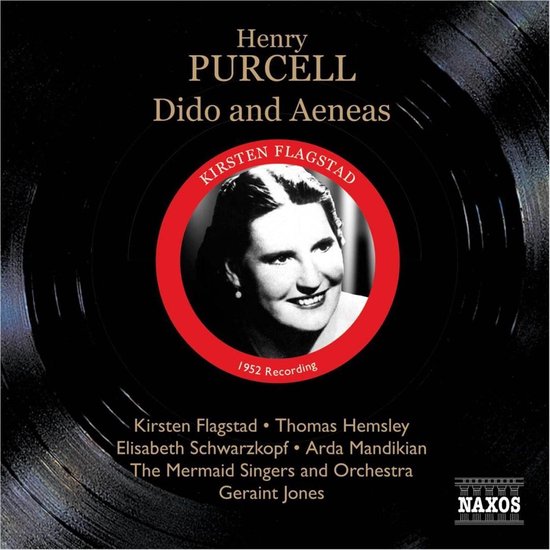
Zelf heb ik een enorme zwak voor de opname uit 1951 met Kirsten Flagstad, Geraint Jones en Elisabeth Schwarzkopf, gedirigeerd door Wilhelm Fürtwangler (verkrijgbaar bij EMI, Naxos of Nimbus), maar dat was de eerste opname van het werk die ik hoorde.
Kirsted Flagstad:
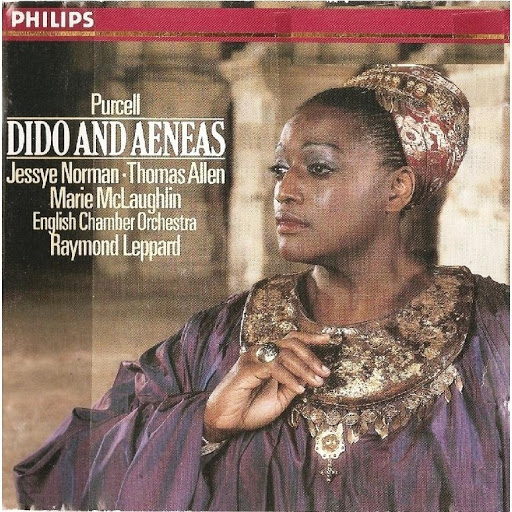
Zeer dierbaar is me ook de uitvoering met Jessye Norman en Thomas Allen (Philips 4162992) uit 1985.
Jessye Norman:
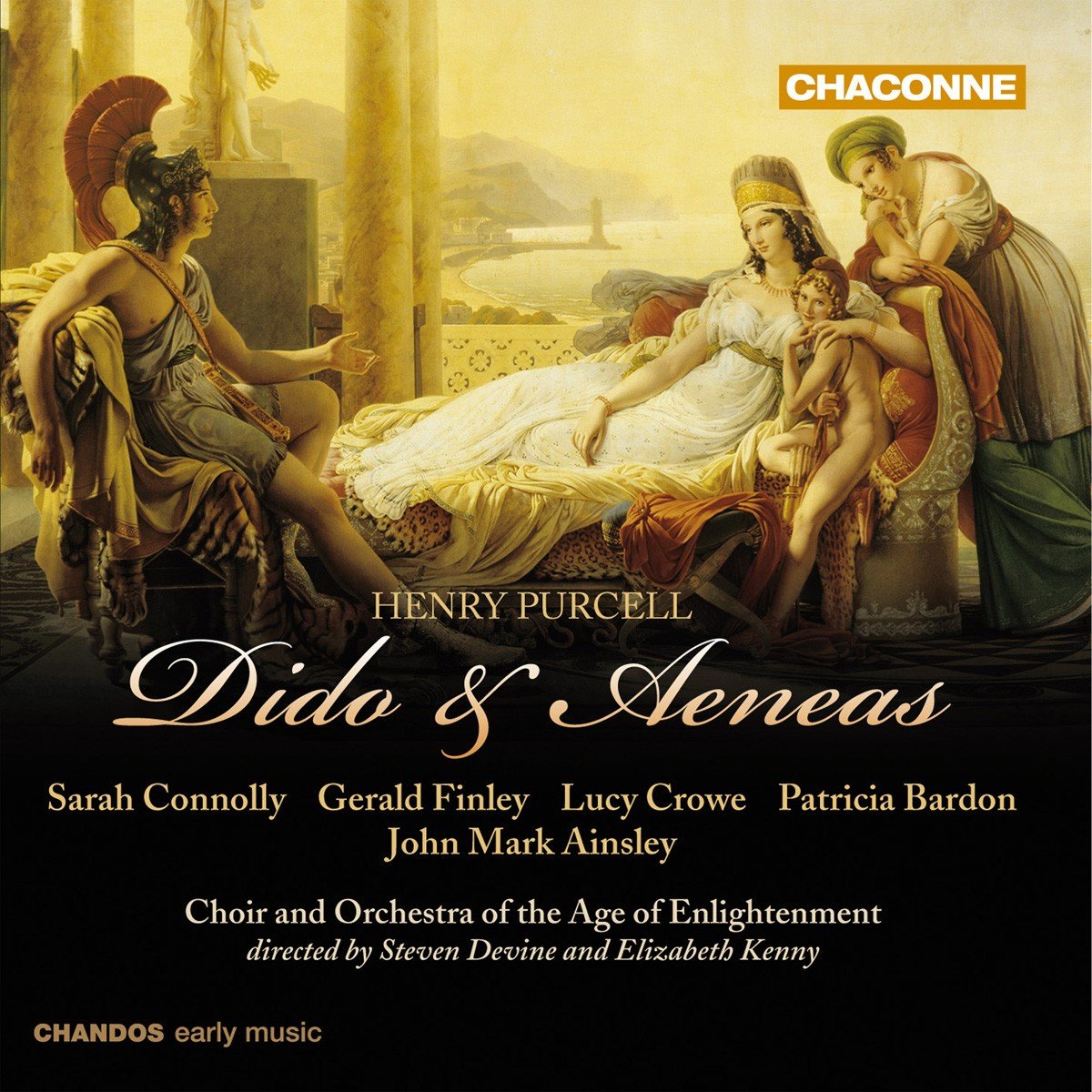
In 2009 is er nog een opname van de opera op de markt verschenen en de eerste vraag die rees was: voegt deze nieuwe iets toe aan al die bestaande? Het antwoord is een volmondig ja.
Ik ga het hier niet over de verschillende versies van de opera zelf hebben, dat staat uitgebreid in het tekstboekje. De definitieve bestaat waarschijnlijk niet, daarvoor is er in de loop der jaren te veel verloren gegaan en te veel aan toegevoegd. Zelfs de juiste premièredatum staat niet echt vast.
Die opname is op speciaal verzoek van Sarah Connolly gemaakt, een begenadigde Engelse mezzo die zo met het karakter (zij zong ook de rol van Dido in Les Troyens van Berlioz) is vergroeid, dat ze zowat haar personificatie is geworden. Haar stem is groot, dramatisch, maar ook puur – een beetje in de lijn van Tatjana Troyanos. Zij zet een zeer getormenteerde Dido neer met wie men medelijden moet hebben.
Gerald Finley zingt Aeneas in de traditie van Thomas Allen: een in de war geraakte, vriendelijke, maar ook zeer verleidelijke macho. Ook de overige rollen (Connolly zelf heeft de cast samengesteld) zijn voortreffelijk. Maar het allermooiste is het orkest (Orchestra of the Age of Enlightenment): licht en transparant, daar kan je niet anders dan verliefd op worden (Chaconne CHAN 0757).
Sarah Connolly live, Concertgebouw, Amsterdam 2018:
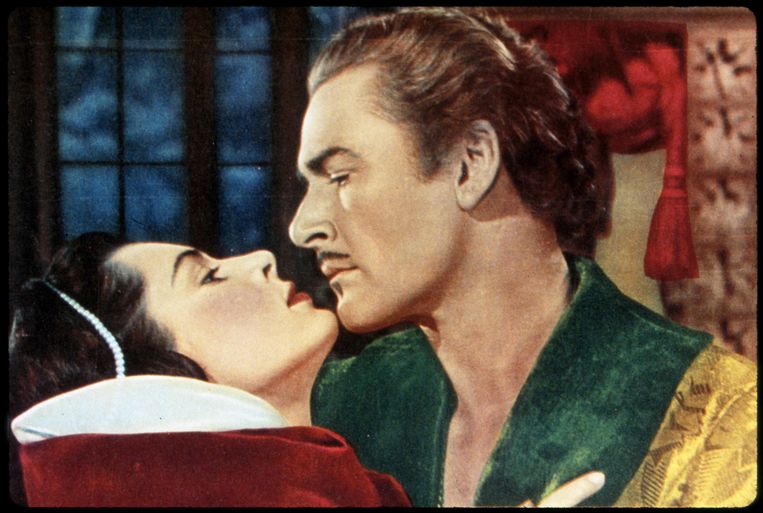
Errol Flynn als Don Juan in ‘The adventures of Don Juan’ uit 1948. Beeld Hollandse Hoogte / REX features
Kan denken door verleiden worden vervangen? Kunnen we ‘ik (word) verleid dus ik ben’ als een soort variatie op ‘cogito ergo sum’ gebruiken? Is ons leven minder waard zonder verleiding? En zou dat een verklaring kunnen zijn voor het onmetelijke aantal uitvoeringen en opnamen van de ultieme verleidingsopera? Geen dag zonder Don Giovanni?
Toegegeven: de opera is gewoon volmaakt. Wat niet alleen de verdienste is van de muziek van Mozart, maar ook (of misschien zelfs voornamelijk?) het geniale libretto van Da Ponte. Daar staat al alles in wat je hoort te weten en voor de rest gebruik je eigen fantasie, want alleen zo kom de mythische verleider je verlangens tegenmoet.
Salzburg, 1954
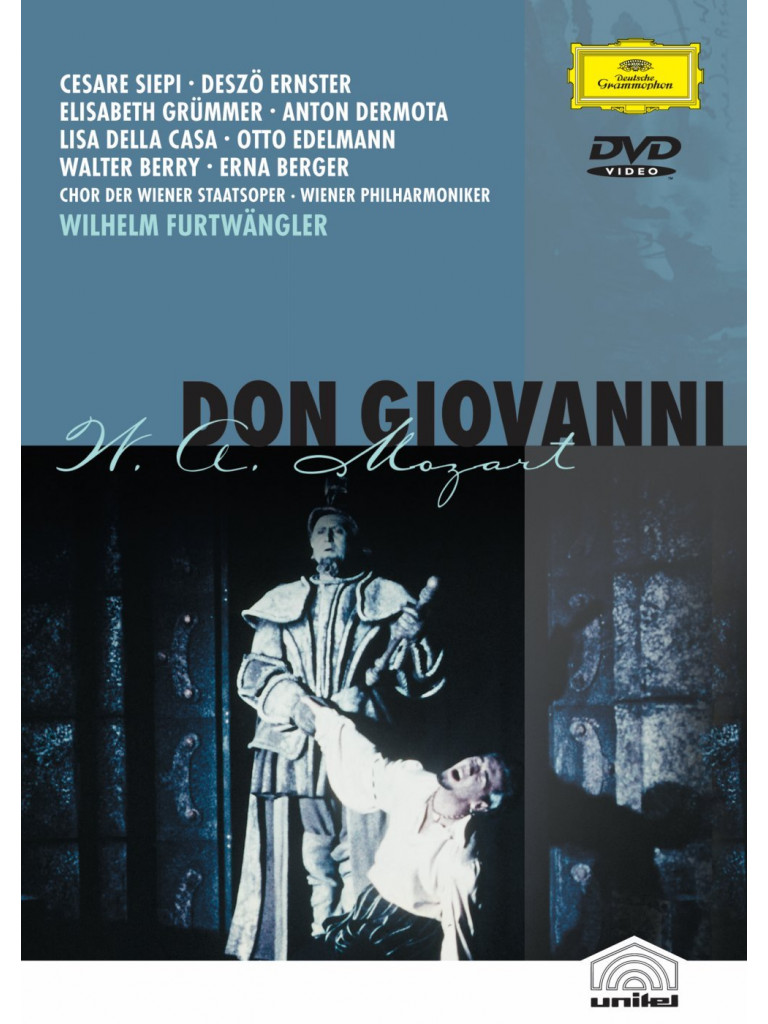
In 1954 werd in Salzburg een jaar oude productie van Don Giovanni verfilmd (DG 0730199). Het was geen registratie met publiek, maar een heuse film, gedraaid tijdens vele, meestal nachtelijke, uren in een nagebouwde studio.
Historisch document of niet – het valt mij tegen. De tempi van dirigent Wilhelm Furtwängler zijn tergend langzaam, van een regie is amper sprake en het resultaat is hopeloos statisch en saai.
Ook de zangers zijn – op de werkelijk fenomenale Cesare Siepi (Giovanni), Lisa Della Casa (Elvira) en wellicht Anton Dermota (zijn ‘Dalla sua pace’ is geschrapt!) na – weinig idiomatisch en niet echt overtuigend.
Milaan, 1987 / Koln, 1991
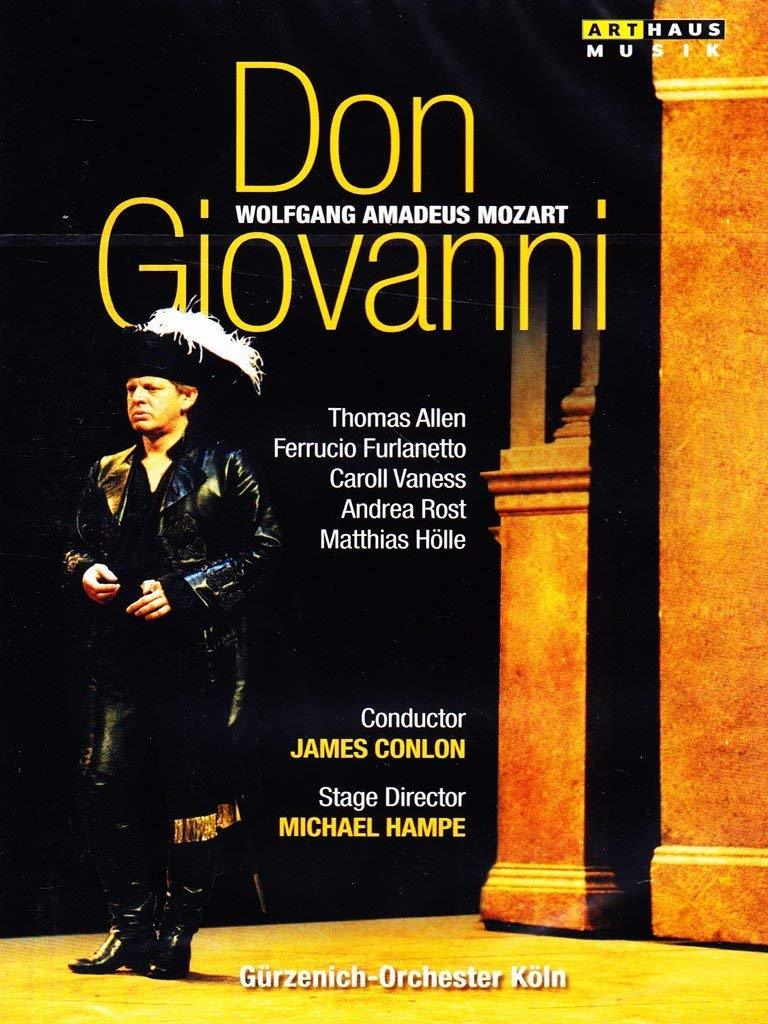
Thomas Allen was beslist één van de beste Don’s van de laatste 25 jaar van de vorige eeuw. Zijn interpretatie is twee maal op dvd vastgelegd: in de Scala-productie uit 1987 (regie: Giorgio Strehler; Opus Arte OA LS3001) en in 1991 in Köln (regie: Michael Hampe; Arthaus Musik 100020).
Hieronder Thomas Allen en Susanne Mentzer (Zerlina) in ‘La ci darem la mano’ uit La Scala:
Persoonlijk geef ik de voorkeur aan de Keulse versie, niet in de laatste plaats vanwege de intelligente regie van Hampe, de magistrale Elvira van Carol Vaness en de werkelijk onweerstaanbare Leporello van Feruccio Furlanetto.
Hieronder de complete tweede acte uit Keulen:
Aix-en-Provence, 2001
In de productie uit Aix-en-Provence (Bel Air BAC010) wordt veel aan de verbeelding overgelaten. De decors bestaan uit fel blauwe en rode houten bankjes, stoeltjes en tafeltjes, waaraan veel te sleutelen valt, en die zich voor van alles en nog wat lenen. Ook de rekwisieten zijn schaars; eigenlijk alleen maar stokjes, die naar gelang de situatie als dolken, zwaarden of pistolen dienen. Spannend om naar te kijken.
Peter Brook is een intelligente regisseur, hij ‘herïntepreteert’ niet, hij schept een eigen wereld, waarin Don Giovanni meer is dan alleen maar een gewetenloze verleider en Donna Anna niet zo onschuldig als ze beweert te zijn.
Peter Mattei is een volmaakte Giovanni: in zijn op maat gesneden pakken ziet hij er buitengewoon aantrekkelijk uit. Hij verleidt met zijn stem en zijn hele lichaam. Geen wonder dat niemand hem kan weerstaan.
Fantastisch is ook Masetto (Nathan Berg). Iedereen is eigenlijk goed, misschien op een iets te zwakke Elvira (Mireille Delunsch) en een mij maar matig overtuigende Ottavio (Mark Padmore) na.
Zürich, 2001
Ondanks de een beetje klungelig aandoende enscenering van Erich Wonder, is de Züricher productie uit 2001 (Arthaus Musik 100328) één van de spannendste die ik ooit heb gezien. Jürgen Flimm beschikte over de beste zangeracteurs van dit moment, en met een zeer adequate personenregie is het hem gelukt een spektakel van formaat neer te zetten.
Rodney Gilfry is de personificatie van Don Giovanni. Zijn aangenaam warme bariton is licht van timbre, zeer wendbaar en willig. Daar doet hij werkelijk wonderen mee. Zo kan hij naar gelang de situatie verleidelijk of beangstigend klinken. Zijn knappe verschijning is mooi meegenomen.
Cecilia Bartoli is zeer charismatisch als Donna Elvira. Lekker hysterisch, maar ook breekbaar en ontroerend.
Op papier had ik zo mijn twijfels over de bezetting van Donna Anna door Isabel Rey, maar in dit ensemble van kleine stemmen past zij wonderwel, al komt ze in ‘Non mi dir’ duidelijk aan haar grenzen.
Barcelona, 2002
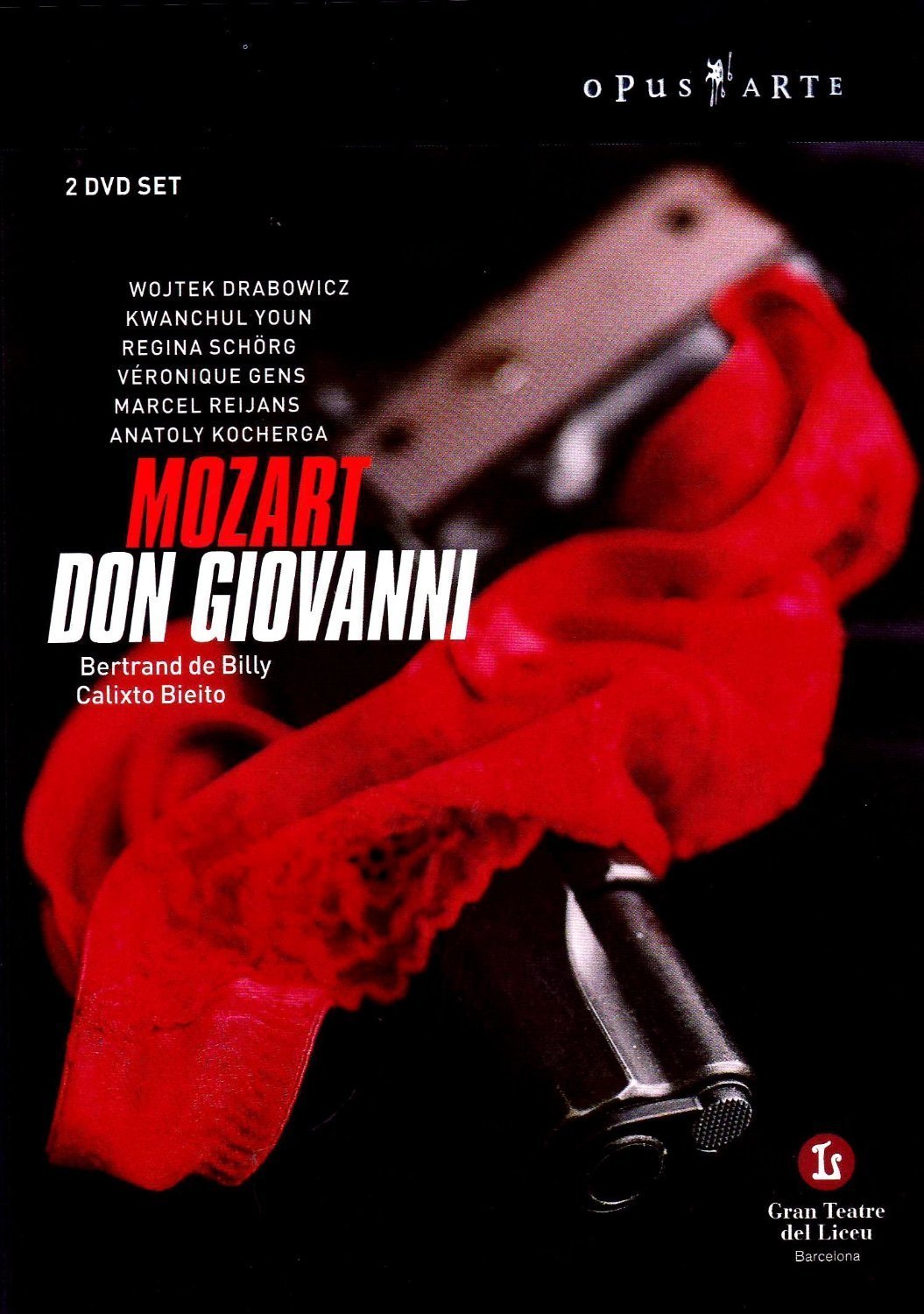
De Catalaanse regisseur Calixto Bieito zorgde voor menig schandaal in de operawereld. Zijn producties – veelal geïnspireerd door de films van Almódovar, Bunuel en Kubrick – zijn alles behalve conventioneel.
Zo ook de in december 2002 in het Liceu in Barcelona verfilmde Don Giovanni (Opus Arte OA 0921). De voorstelling baarde veel opzien met de vele seks-, drugs- en geweldsscènes, wat in de Britse pers zorgde voor koppen als ‘coke-fuelled fellatio feas’.
Toch klopt het allemaal wel en het geheel laat zich als een bijzonder spannende film volgen. Des te meer daar alle zangers ook voortreffelijke acteurs zijn.
Voor de productie werd de oerversie van de partituur gebruikt. Verder is het zeer verheugend om in de rol van Don Ottavio de Nederlandse tenor Marcel Reijans te horen.
Londen, 2008
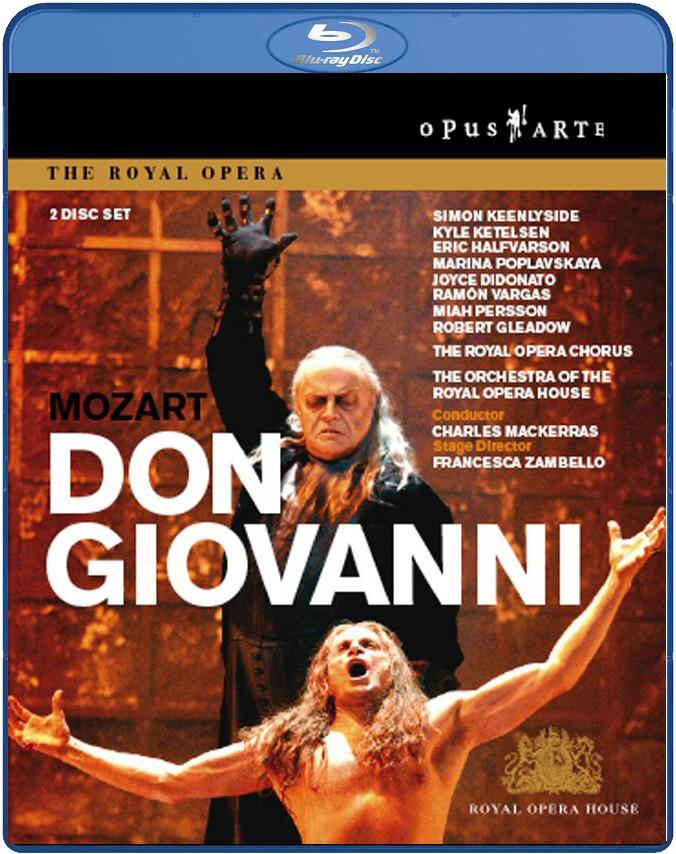
Een uitmuntende Don Giovanni werd in 2008 gemaakt door regisseur Francesca Zambello en dirigent Sir Charles Mackerras voor het Royal Opera House in Londen (Opus Arte OA 1009).
Dat kwam niet alleen door de prachtige Simon Keenlyside in de titelrol, maar ook door de sterke bezetting van de andere rollen. Iedere rol was bezet alsof het een titelrol was en heel karakteristiek uitgedacht door Zambello.
Naast Keenlyside schitterden ook Kyle Ketelsen als Leporello en Joyce DiDonato als Donna Elvira. En dan zijn Ramon Vargas, Marina Poplavskaya, Miah Persson, Robert Gleadow en Eric Halfvarson nog niet eens genoemd.
Een Don Giovanni dus om volop van te genieten. Geen vocale onvolkomenheden, wel fantastische aria’s en ensemblestukken, een indringende regie en fantastisch acteerwerk.
SALZBURG 2008
Eerlijk is eerlijk: de zich in een weelderig en donker bos afspelende productie van Claus Guth (Salzburg 2008) is best spannend. Verder vind ik het één van de domste en slechtste Don Giovanni’s ooit. Zo erg als de Amsterdamse beddenpaleis wordt het niet, maar wat we krijgen is een totaal andere opera. Waar ook nog eens alle logica ontbreekt: heeft u ooit een bus (dus ook een bushokje) midden in een bos gezien?
Dacht u dat Giovanni continu achter de vrouwtjes aan zit? U hebt het mis. Het is juist andersom. De arme Anna moet hem zelfs verkrachten als hij aan haar probeert te ontsnappen. Giovanni zelf denkt voornamelijk aan zijn volgende shot heroïne en aan zijn dodelijke schotwond, opgelopen tijdens het gevecht met de Commendatore, die overigens helemaal niet dood is (waarom weet Anna dat niet?).
Vanwege het hoge flowerpowergehalte doet de productie mij sterk aan Easy Rider denken. Het verbaast me dan ook niet dat de Don gezellig met Zerlina en Masetto een stickie zit te roken.
Erwin Schrott (Leporello) lijkt sprekend op Sylvester Stallone en verrek: hij kan ook in de bomen klimmen! Maar op Schrott en de werkelijk prachtig zingende en acterende Christopher Maltman (Giovanni) na kan geen van de zangers me echt overtuigen. Iets wat grotendeels de regisseur te verwijten valt. Want hoe kunnen ze overtuigen als alles wat ze doen zo belachelijk is? En zo tegen de muziek ingaat?
Voor de productie werd de Weense versie van de partituur gebruikt, wat onder meer inhoudt dat ‘Il mio tesoro’ is geschrapt. En dat we het onbenullige en totaal onlogische duet van Zerlina en Masetto erbij krijgen.
Voor de muzikale directie van Bertrand de Billy kan ik niet warm lopen. De ouverture begint behoorlijk hakkelend, met vreemde accenten. Er wordt zelfs vals geïntoneerd, iets wat je je bij Weners niet echt kunt voorstellen. (EuroArts 2072548)
Salzburg, 2014
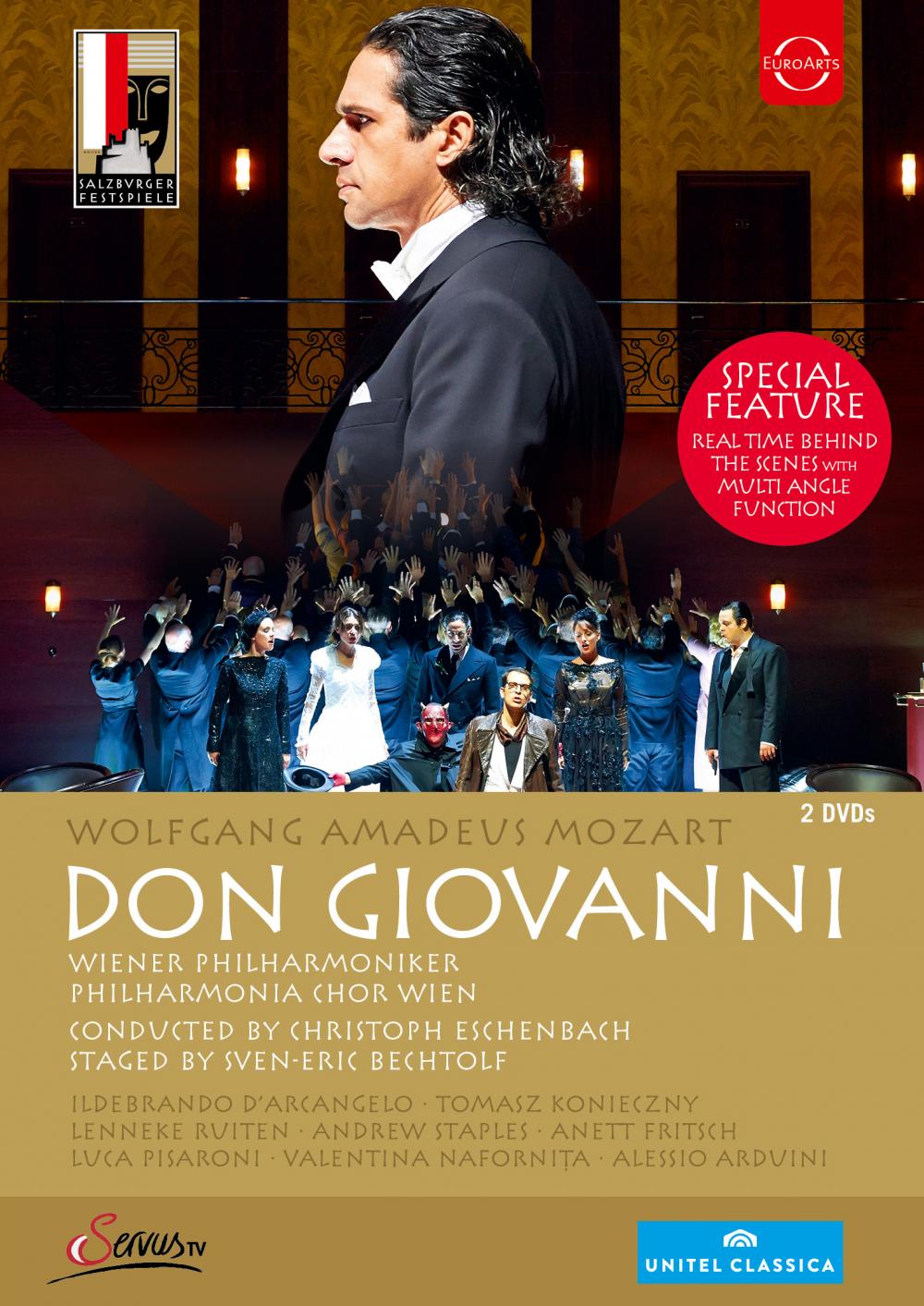
In 2014 mocht Salzburg weer een nieuwe productie van ’s werelds meest geliefde opera bewonderen. Nu ja, bewonderen… Was de rare Guth tenminste nog spannend, de voor het oog best aantrekkelijke enscenering van Eric Bechtolf is gewoon dodelijk saai. Daar kan zelfs de perfect gecaste latin lover Giovanni (een zeer aantrekkelijke Ildebrando D’Arcangelo) niets aan doen.
De actie speelt zich in de lobby van een hotel (nieuwe trend?) af en er is een komen en gaan van gasten, bruiloften, crime passionels en wat ook niet. Gedoe.
Luca Pisaroni (Leporello) stelt me een beetje teleur, zijn stem klinkt vaak vlak. Bovendien doet hij aan overacting. Donna Anna wordt gezongen door onze eigen Lenneke Ruiten, wat de opname meteen aantrekkelijker maakt. Anett Fritsch is een mooie, licht getimbreerde Elvira.
Helaas: ook in deze opname kan het orkest uit Wenen me niet echt bekoren. Eschenbach dirigeert nogal nogal sloom. (Unitel Classica 2072738)
Milaan, 2011
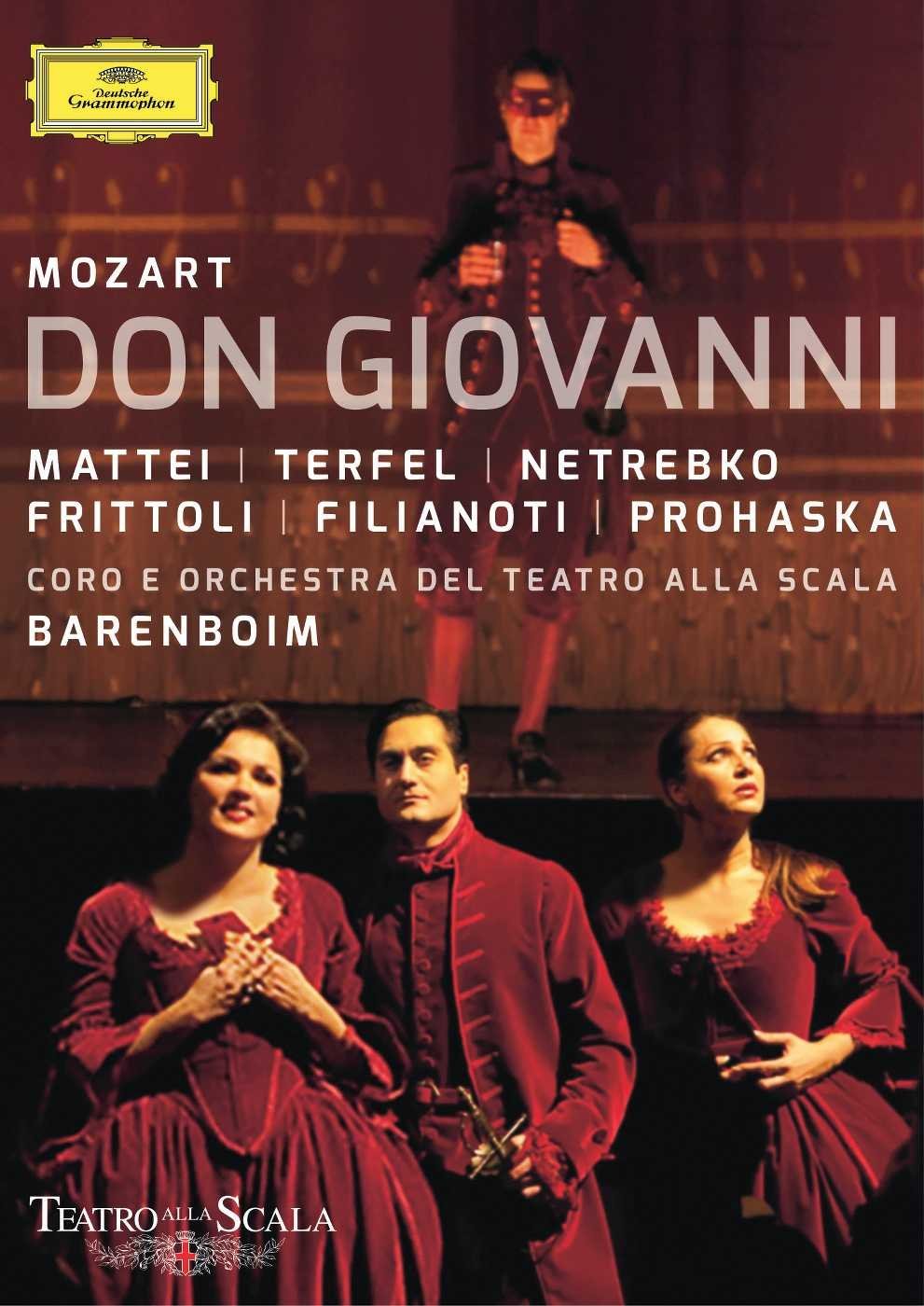
Gelukkig hebben we Robert Carsen nog. Eén van de weinige hedendaagse regisseurs die het verhaal intact weet te laten. Natuurlijk heeft ook hij zijn eigen ‘handtekening’: bij hem is het zijn liefde voor de (geschiedenis van) cinema en de grote sterren van weleer. Vaak past hij ook het concept ‘theater in het theater’ toe. Zo ook in deze Don Giovanni uit de Scala (2011).
De voorstelling ziet er prachtig, kleurig en weelderig uit en de kostuums zijn oogstrelend. Middels eindeloze doeken, die naar believen opzij schuiven en open- en dichtgaan, creëert hij een wereld die tussen verbeelding en werkelijkheid balanceert.
Anna Netrebko overtreft zichzelf als Donna Anna, die zich de liefdeskunsten van Giovanni laat welgevallen. Met haar looks à la Claudia Cardinale past ze zo in een maffiadrama uit de jaren vijftig. Haar ‘Chi mi dice mai’ is gewoonweg perfect.
Peter Mattei is een heerlijke Don: een echte dandy, die af en toe meer geeft om zijn garderobe (ach, die verkleedpartijen!) dan om de dames. Barbara Frittoli is – voornamelijk scenisch – een zeer overtuigende Elvira en Bryn Terfel een kostelijke Leporello. Het bruidspaar Zerlina en Massetto wordt zeer geloofwaardig gezongen en gespeeld door Anna Prohaska en Štefan Kocán: voor mij het beste ‘boerenkoppel’ sinds jaren.
Daniel Barenboim dirigeert bedeesd. Zijn trage tempi vallen het meest op bij ‘La ci darem la mano’. Geen nood: zo kun je er nog meer van genieten. Zeer aanbevolen! (DG 0735218)
George London
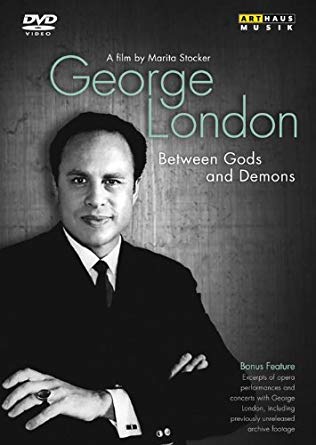
Bij mijn weten bestaat er geen complete beeldopname van Don Giovanni met George London, één van de grootste bas-baritons uit de twintigste eeuw. Des te meer kan ik iedereen het portret van de zanger aanbevelen dat een paar jaar geleden bij Arthaus Musik (101473) verscheen. De documentaire draagt de alleszeggende titel Between Gods and Demons.
Behalve van zijn Don Giovanni was London voornamelijk beroemd van zijn Scarpia en zijn Boris Godoenov. Maar hij was ook een echte entertainer, die de populaire muziek serieus nam: voor hem waren het allemaal ‘artificial art songs’. Over zijn Giovanni was iedereen het eens: als je zo veel seks uitstraalt, dan kan het demonisch worden. Iets om over na te denken.
Het is allemaal de schuld van de champagne, zeggen ze. Zou best kunnen, want het bruist, bubbelt, schittert en spettert dat het een lieve lust is. De bubbels zijn ook letterlijk ‘omnipresent’ in deze schitterende productie van Die Fledermaus, die in augustus 2003 in Glyndebourne werd opgenomen (Opus Arte OA 0889D).
Het geheel is zeer Art Deco en Jugendstil, met decors die lijken te zijn ontworpen door Otto Wagner en geschilderd door Gustav Klimt. Die laatste is eveneens alomtegenwoordig, ook in de kleding: van de jurk van Rosalinde tot de ‘schlafrok’ van von Eisenstein, waarin de arme Alfred de gevangenis ingaat.
Voor deze productie zijn nieuwe dialogen geschreven (de regisseur, Stephen Lawless, ziet het stuk als een toneelstuk met muziek), makkelijk te volgen dankzij de Nederlandse ondertitels.
Thomas Allen zet een kruidige Von Eisenstein neer, die duidelijk aan een midlifecrisis lijdt in een ietwat ingeslapen huwelijk. Pamela Armstrong is een pittige Rosalinde.
Malena Erdmann is een fantastische Orlofsky en Lybov Petrova en kittige Adele. Eigenlijk zijn ze allemaal fantastisch, inclusief de dirigent – de sprankelende Vladimir Jurowski – die ook actief deelneemt aan de actie.
Zet de champagne maar vast koud, geniet en drink. Niet noodzakelijk met mate.






















 Basia con fuoco