Het is een tijd geleden dat ik een poging deed om een discografie van Daphne van Richard Strauss te schrijven. Het viel mij niet mee.
Zoals eenieder heb ook ik mijn voorkeuren en niet alle muziek vind ik mooi. Het mag algemeen bekend zijn dat ik geen barok liefhebber ben, maar ook Strauss, met uitzondering van Elektra, Salome en Arabella (en natuurlijk de liederen!) kan me maar moeilijk boeien, en Daphne vind ik ronduit saai.
Ooit heb ik een uitvoering van bijgewoond waar mij helemaal niets van bij is gebleven: halverwege was ik in slaap gevallen. U begrijpt dus goed dat ik echt niet popelde om er voor te gaan zitten maar ik deed mijn best. Maar verder dan de opname uit La Fenice kwam ik niet.
Is het me meegevallen? Ja en nee. Nog steeds vind ik het een opera van niets en de zware symboliek van het libretto eigenlijk lachwekkend. Maar toegegeven, de laatste pakweg 20 minuten (de ‘Verwandlugscene’) waarin de nymf Daphne verandert in een laurierboom zijn werkelijk adembenemend mooi. Jammer alleen dat je er anderhalf uur op moet zitten wachten.
De productie uit La Fenice in Venetië (Dynamic 33499) maakt veel goed. De regie is niet echt opzienbarend, maar de enscenering des te meer, vooral de belichting vind ik wondermooi. En er wordt prima in gezongen, voornamelijk June Anderson is zeer indrukwekkend als Daphne.
De beide tenoren (Roberto Sacca als Leukippos en Scott Mac Allister als Apollo) zijn uitstekend, en Birgit Remmert is een zeer goede Gaea. Dus al met al zeker aanbevolen, zeker als u van die opera houdt.
In 2004 schreef ik een artikel over Angela Gheorghiu. “Ik ben een ster. Altijd al geweest” zei zij ooit tijdens een interview. En dat was waar ook, want toen had zij alles wat een hedendaagse operazangeres tot een ster maakt. Jong, slank en mooi, met een meer dan gemiddelde acteertalent en, niet onbelangrijk in dit vak, zij kon buitengewoon mooi zingen. Haar stem, met zijn snelle vibrato, was ergens tussen Cotrubas en Olivero te plaatsen, al mistte ze de intensiteit van de laatste. Zij was een echte diva en daar gedroeg zij zich ook naar. De letterlijke vertaling ven het woord betekent ‘godin’ vindt ze het leuk om een diva te zijn?
“Iemand noemde me ooit zo, en het bevalt me. Het heeft met de uitstraling te maken, bovendien kan ik als zangeres toch geen ‘normaal mens’ zijn. Zonder diva’s waren de muziek en het theater niet ver gekomen. Mensen hebben diva’s nodig, anders waren we allemaal gelijk zoals bij de communisten, het idee alleen al!”
Gheorghiu werd geboren in Roemenië, een land waar meer grote zangeressen vandaan komen. De bovengenoemde Cotrubas bijvoorbeeld, met wie ze heel goed vergeleken kan worden. Beide zangeressen beschikken over een soortgelijke ‘blanke lyriek’ en een lichtelijk maniërisme om woorden voor in de mond te zingen. Ook hun rollen zijn min of meer hetzelfde, al had Cotrubas zich nooit aan een Tosca of een Carmen gewaagd, zelfs niet in de studio. Ooit was Cotrubas de beste Adina (L’Elisir d’amore), Mimi (La Bohème) en Violetta (La Traviata) van haar tijd en van al die rollen was Gheorghiu eind jaren negentig de ongekroonde koningin. Wereldberoemd werd ze dankzij haar vertolking van Violetta in de Covent Garden onder leiding van Georg Solti. De voorstelling werd live op de televisie uitgezonden door de BBC, die er zelfs zijn zendschema voor overhoop gooide.
Het schijnt dat ze ooit honger had geleden, toen ze nog in Roemenië woonde. En dat ze zwaar bewaakt was tijdens haar eerste optreden (met een koor, dat wel, maar als soliste) in Wenen, opdat ze geen kans zou kunnen krijgen om te vluchten en het politieke asiel aan te vragen. Na de val van het communisme kreeg ze haar eerste contract buiten Roemenië aangeboden: een televisierecital in Amsterdam. En ze deed auditie voor de Covent Garden. Haar eerste grote rol daar was Mimi in ‘La Bohème’, met Roberto Alagna als Rodolfo. De liefde bleef niet beperkt tot de planken en Gheorghiu en Alagna (die net zijn vrouw aan een hersentumor had verloren en met een klein dochtertje achter bleef) gingen trouwen.
In 1998 verliet ze haar voormalige firma Decca en tekende ze een contract met EMI, het platenlabel dat onder haar exclusieve artiesten ook Alagna telde. Zeer handig, want daardoor kon ze niet alleen solo- maar ook duettenrecitals en veel integrale opera’s samen met haar (inmiddels al jaren toenmalige) man opnemen. Talloze van die cd’s kregen de meest prestigieuze prijzen: Gramophone Award, Diapason d’Or, Deutsche Schalplatten-Preise. En in 2001 werd ze tijdens de Classical Brit Awards uitgeroepen tot de vrouwelijke ‘Artiest van het jaar’
.
Voor een beetje paparazzi in de operawereld is Gheorghiu een makkelijke prooi. He schijnt dat ze voor de fotosessies een grimeur laat komen. En iemand die haar kleren strijkt.
“Maar dat is toch professionalisme? Niemand vindt het raar als fotomodellen en actrices over een limousine en een grimeur beschikken. Moet ik met mijn jurken de metro nemen door weer en wind? Heeft iemand ooit Catherine Zeta-Jones zoiets zien doen?”
Ze is een natuurtalent, maar zelfs een natuurtalent komt niet ver zonder oefenen, oefenen, en nog eens oefenen. Ze werkte heel hard aan iedere rol, en in tegenstelling tot veel collega’s werkte ze zonder coach. En ze ging te werk als een acteur: eerst lezen en herhalen de woorden en pas daarna begon ze met het bestuderen van de partituur.
Haar grote droom toen was om een componist te ontmoeten die speciaal voor haar een mooie rol zal schrijven, ze ziet zich bijvoorbeeld in een rol als Jackie Kennedy. Maar ze bleef sceptisch want de wereld is veranderd en de hedendaagse componisten weten volgens haar maar weinig van de zangers en de zangkunst af. Voor haar dus geen Schönberg noch Berg.
Het liefst zingt ze in het Italiaans en het Frans, maar sluit (lichte) Wagner rollen in de toekomst niet uit. Ook jazz heeft haar interesse, ze vindt haar stem er goed geschikt voor. Al te graag zal ze wat jazz op haar repertoire zetten, al is ze niet zo’n voorstander van cross-overs.
Haar hart klopt nog steeds in het Roemeens. In ‘Desert Islands Discs’, het bekende Channel 4 programma op de Engelse radio, presenteerde ze ooit haar keuze van haar favoriete muziek. Enescu, maar ook een paar Roemeense pop- en volksliedjes. En een wals van Chopin, maar wel gespeeld door Dinu Lipatti.
Hieronder zingt Angela Gheorghiu ‘Ciobanas cu trei sute de oí’ in Amsterdam 2013. Zij wordt begeleid door Het Gelders Orkest olv Ramon Tebar:
Avantgarde and retrospection, that could be the theme of Short Circuit, a Holland Festival event filled with four performances created by favourites of the festival’s ‘Associate Artists’ Gisèle Vienne and Ryiuchi Sakamoto. The whole program ingeniously made use of the various spaces at ‘De School’, an abandoned school building that for a while was known for its alternative art events and audio-visual parties.
Gisèle Vienne herself made a choreography for performer Katia Petrowick. One of the former classrooms is dressed up as a sort of vintage disco, apparently during in the aftermath of a dance night, with garlands, crumbled drink cans and chips bags lying around on the floor. We hear loud music in the style of mid-eighties Detroit techno or the kind of music Alex Patterson of the Orb would play during after-parties; I remember great nights at Paradiso and Fuse/La Démence in Brussels. Petrowick enters and moves across the floor in slow motion, while the music still without metre. Knowing that the whole event is supposed to last three and a half hours, at first you could be inclined to ask yourself am I ready to attend this kind of things for such a long time, but soon the whole ambiance of performance takes over, and the music catches tempo.
As absurd as it may sound, a highlight is when the character on stage finds a leftover full bag of chips in a Lidl shopping bag and slowly opens it; the thud of the exploding bag being pressed open brings us back in real-time and becomes an almost frightening event.
The whole ambiance reminded me of the magnificent, ghastly movie Climax by Gaspar Noé, about a group of young French dancers having a farewell party before leaving for a US tour, which completely runs out of hands after somebody slips LSD into the drinks, with even mortal consequences, all this on fantastic vintage techno music. I imagined the performance to be the scene of the evening after the events in Climax unfolded.
Meanwhile the performer was about 10 metres away from the front row where I sat, yet the smell of the chips from the bag was penetrating. Also, this for a moment brought me back to the present; if we can inhale the smell chips at 10 metres, what about the aerosols we were afraid of during almost one and a half year? However, no reason to worry, everybody in the audience had to be tested for COVID19 prior to the event. Good to know.
The audience was guided through the performances in various orders. For my group, the evening concluded with a concert by J. Bonnet and Stephen F. O’Malley, performing on guitars and sundry electronic devices. I deliberately use the word sundry as that was the favourite word for pioneering seventies and eighties progressive rock guitarist Robert Fripp describing the instruments he used, and indeed his is the music I had to think of. Harmoniously rich, making use of all the possibilities of distortion, reverb and feedback, and loud. Other alternative rock influences I had to think of are Throbbing Gristle, Sonic Youth, and, talking about loud, the Irish ‘shoegazer music’ band My Bloody Valentine, who were notoriously loud; like with that one My Bloody Valentine concert I attended in Paradiso, I’m still a little deaf after yesterday’s performance, although a bit less deaf than then – time soothes.
The setting was in another former classroom, overlooking a dark seemingly quiet garden outside. But the building is located next to a ramp leading to the Amsterdam ringroad behind it and through the trees every five or six seconds the head- and taillights of cars could be seen, however as their noises were drown out by the sound produced on stage, the lights looked strangely tranquil. By then the three and a half hours had almost passed and you still found yourself glued in a chair absorbed by the whole event that otherwise might have looked like something you had all seen before.
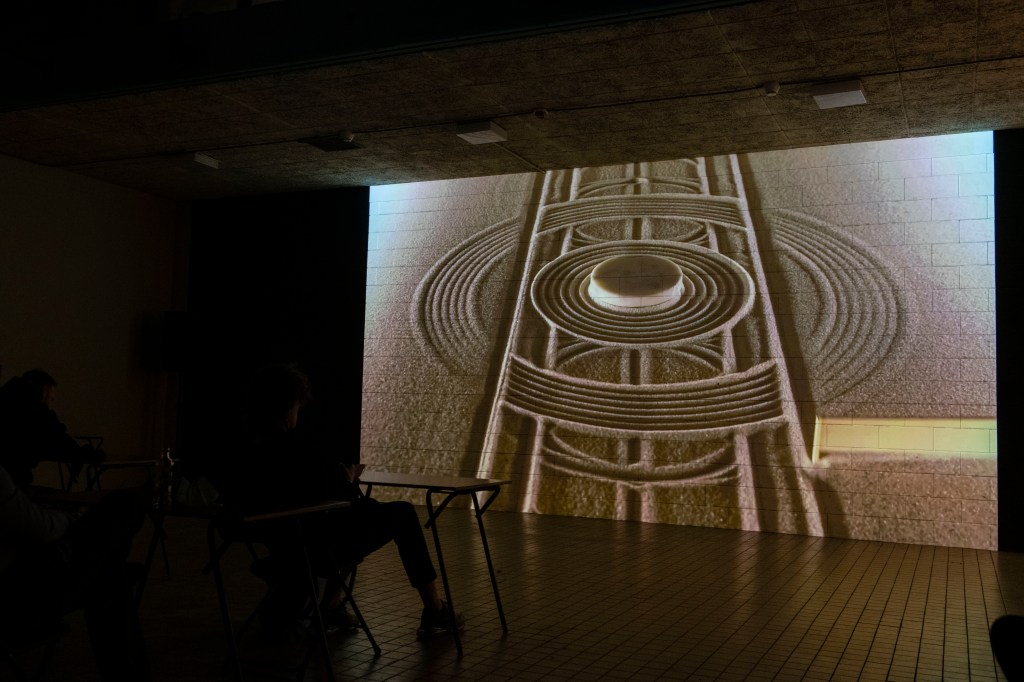
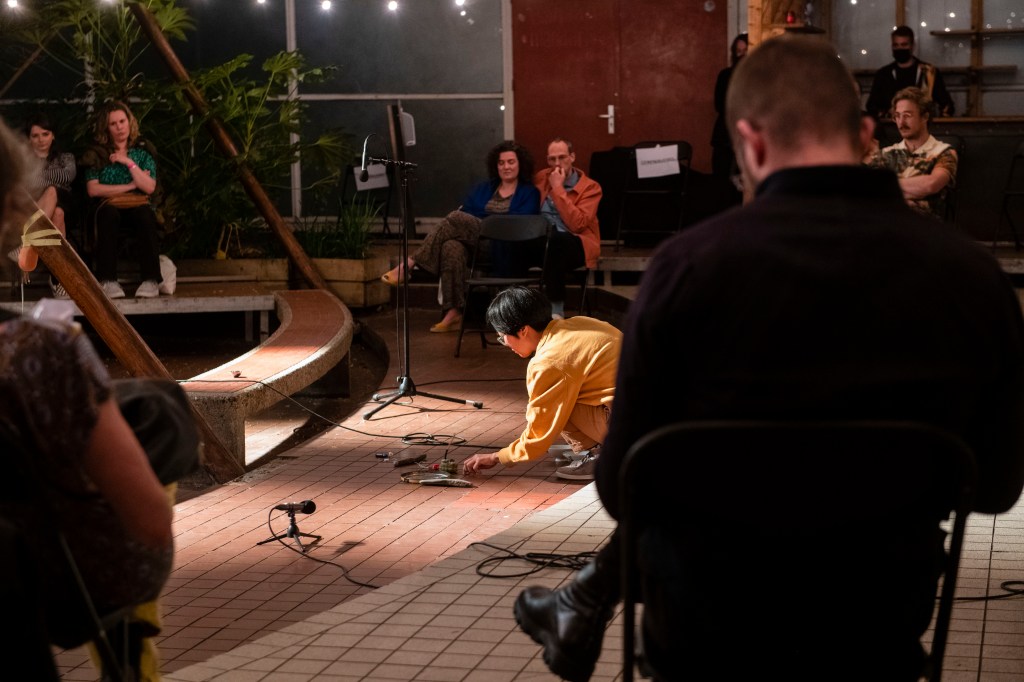
The two, both Japanese, performances in between were of no less ‘nostalgic’ interest. At first Yuko Mohri, who names Satie, Duchamp and Cage as her examples, especially as she shares their use of coincidental elements in music. She puts up small ‘sundry’ household objects dishes, pots, tins, attaching them to toylike mechanical and electric devices that create vibrations causing the objects to resonate. The resulting sounds are captured by directional microphones and transferred to an electromechanics device that play the keys of a piano. The playfulness and the loving care with which everything was carried out were a joy to watch. In the end the audience joined as the sound of the applause was also able to steer the piano keys. In between there was a viewing of a video of the zen gardens created by the artist Yuki Kawae.
For the other Japanese performance, I would also like to name a reference. Tujiko Noriko’s single long song in which she accompanies her etheric voice singing in alternatingly English and Japanese sounded like slow-motion, softened down version of Walking on Thin Ice; if there was only one great example of Yoko Ono’s contribution to pop music to be named, it was that song. She and John Lennon concluded its recording of it in December 1980, the day that on their return from the recording studio John was murdered.
This performance by Noriko, serenely standing next to her laptop in slowly shifting colours from the light installation, probably coincidentally, embodied something dramatic beyond its seemingly soothing sound.
Later in the Holland festival, the performance Kindertotenlieder will reunite Gisèle Vienne, Katia Petrowick and Stephen F. O’Malley, June 16 and 18, Westergasfabriek.
(And by chance the movie Climax is back in Amsterdam these days at LAB 111.)
Short Circuit, Yuko Mohri, Gisèle Vienne/Katia Petrowick, François J. Bonnet & Stephen F. O’Malley and Tujiko Noriko, and a video by Yuki Kawae, as part of the Holland Festival, De School building, Amsterdam, Saturday June the 12th
De première van I Lombardi vond plaats in het Teatro alla Scala in Milaan op 11 februari 1843. Later werd het werk grondig herzien ten behoeve van een opdracht die Verdi kreeg voor de Parijse Opéra. Daar ging het werk in 1847 in première onder de titel Jérusalem. Deze versie ging in 2005 in de ZaterdagMatinee met Nelly Miricioiu als Hélène.
Later werd de Franse versie weer terugvertaald in het Italiaans zodat naast het oorspronkelijke I Lombardi nu ook Gerusalemme op Verdi’s conto staat. Geen van beide versies is vaak te zien of te horen, hoewel ze muzikaal zeker niet onderdoen voor hun voorganger Nabucco. Een mogelijke reden hiervoor is de uitgesproken kritische houding die in het werk wordt ingenomen jegens het christendom als instituut. Zo zingt Giselda na de moordpartij die volgt op de inname van Antiochië: ‘Dit is niet gods wil, het gaat jullie alleen maar om het uitmoorden van de bevolking en het plunderen van de rijkdommen die hier zijn vergaard’. Dat zal het voor het 19e eeuwse publiek, in een tijd dat de kruisvaarders nog ‘de goeden’ waren, moeilijk hebben gemaakt zich met de protagonisten te vereenzelvigen.
I Lombardi bevat meerdere delen die sterk herinneren aan Nabucco. Zo doet Giselda’s aria aan het einde van de tweede akte ‘No giusta causa non è’ denken aan Abigaille’s ‘Salgo già del trono aurato’ halverwege de tweede akte van Nabucco. Verder bevat I Lombardi maar liefst twee koorscènes waarvan de ‘slepende’ stijl helemaal in het straatje van het zogenaamde Slavenkoor past. Het betreft het Pelgrimskoor ‘Gerusalem, Gerusalem’ en het koor van pelgrims en kruisvaarders ‘O Signore, dal tetto natio’.
Het verhaal is ingewikkeld. Centraal staat echter de aanwezigheid van de door Acciano, de heerser van Antiochïe, gegijzelde Giselda, dochter van kruisvaarder Arvino. Zij is verliefd geworden op Oronte, de zoon van Acciano. Een voorbeeld van wat tegenwoordig het Stockholmsyndroom genoemd wordt. Orontes moeder Sofia is heimelijk tot het christendom bekeerd en hoopt dat een huwelijk van haar zoon met de christenvrouw Giselda hem eveneens tot bekering kan leiden.
Verder is er Pagano, de in ongenade gevallen broer van Arvino (lang verhaal) die als kluizenaar in het heilige land leeft, door alles en iedereen wordt geraadpleegd maar tot het laatste toe door niemand wordt herkend. Een mix derhalve van onmogelijke liefde, godsdiensttwist, verraad, moord en doodslag. Vandaag de dag kunnen we Giselda alleen maar groot gelijk geven met haar woede uitbarsting.
Een voorstelling in het Teatro Regio di Parma is door C major op dvd uitgebracht. Het betreft een opname uit 2009 van een geslaagde productie van Lamberto Puggelli. De kostumering van Santuzza Cali schommelt wat tussen vermeend vroegmiddeleeuws en fantasie Turks. Lastig natuurlijk al die koorscènes waarin dan weer de ene en dan weer de andere partij moet zingen zonder dat men van kostuum kan wisselen. Gelukkig ontbreken hier de klassieke kruisvaarders outfits met rode kruizen op een wit vlak.
Het decor in de tweede en volgende aktes toont een muur achter op het toneel waarvoor de handeling zich afspeelt. Afwisselend is dat de stadsmuur van Antiochië, de Klaagmuur en de stadsmuur van Jeruzalem. In de slachtpartij waar Giselda in haar ‘No giusta causa’ over door het lint gaat wordt Picasso’s Guernica op de achterwand geprojecteerd. Evenzo bij de slag om Jeruzalem die eindigt met een berg gesneuvelden op het toneel die later weer overeind komen om ‘Te lodiamo, gran Dio di vittoria’ te zingen.
Muzikaal is het uitstekend verzorgd. De sopraan Dimitra Theodossiou geeft een mooie vertolking van de veelgeplaagde Giselda. Behalve in ‘No giusta causa’ toont ze haar kunnen ook overtuigend in ‘Ave Maria, di grazia il petto’ (1e akte) en ‘Qual prodigio’, de bravourearia waarin ze haar visioen met daarin de gestorven Oronte bezingt (4e akte). Ze moet wel veel volume maken om alle hoge noten te produceren waardoor het zo nu en dan wat minder subtiel is, maar het lukt allemaal prima. Sowieso laat dirigent Daniele Callegari alles en iedereen onbekommerd luid zingen.
Michele Pertusi is de bas van dienst, en dat is bij hem in goede handen. De rol van het personage met het meest dubieuze karakter Pagano is een kolfje naar zijn hand. Kort hiervoor had ik hem gezien als Il conte in La sonnambula, een totaal ander persoon, leuk om die twee te kunnen vergelijken.
De ster van de cast is natuurlijk Francesco Meli. Als Oronte zingt hij de sterren van de hemel. We moeten natuurlijk wel tot in de tweede akte op hem wachten en de vierde maakt hij helaas niet meer mee. Maar met zijn ‘La mia letizia infondere’ in de 2e akte en in de 3e akte het duet met Giselda ‘Oh belle, a questa misera’ maakt Meli zijn reputatie volledig waar.
Een speciale rol is weggelegd voor de concertmeester die aan het begin van de laatste scène van de derde akte een klein vioolconcert te spelen heeft, een beetje in de stijl van Wieniawski. Het levert hem terecht een open doekje op.
Giselda’s tirade tegen de kruisvaarders en hun slachtpartijen ‘uit gods naam’ wordt afgedaan als blasfemie van een hysterische vrouw die haar minnaar verloren denkt te hebben. Daar zit wel wat in want in de vierde akte, als Oronte definitief is verscheiden, neemt ze nog net niet als een soort Jeanne d’Arc de leiding bij de bestorming van Jeruzalem. Uiteindelijk keert ze dus, en met haar librettist Temistocle Solera en natuurlijk Verdi, terug in de schoot van de alles bepalende christelijke belevingswereld.
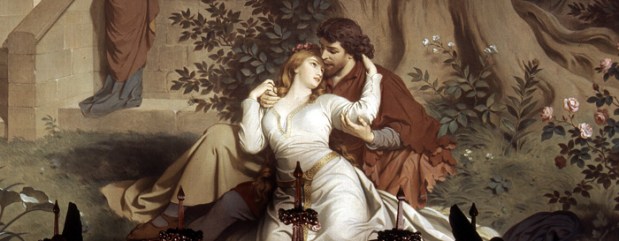
Tristan und Isolde. Wandschilderij van August Spieß, 1881
CD’S
Carlo Kleiber 1982
Writing a discography of Tristan und Isolde almost feels like being a composer yourself. Not only because there are so many recordings (no less than fifty, eleven of which are on DVD! and those are just the complete commercial editions that are still for sale!, add to that the countless editions of highlights, the pirates, videos on Youtube …. ), but also because it is an opera that will completely drain you emotionally.
But I did my best. I listened for hours to the many Furtwänglers, Böhms and Karajans (and there are many!), dusted off Artur Bodanzky… visited Janowski and Barenboim…. only to conclude, after a few weeks of almost continuously dying hundreds of Love Deaths, that were I to be banished to a desert island with only one recording, it would undoubtedly be the 1982 version under Carlos Kleiber (DG 4775355).
Margaret Price is an unforgettable Isolde. Her silver-like lyric soprano sounds very feminine and pure in its vulnerability. Oh, she is strong too, and determined, but her feminine side prevails. An Isolde to fall in love with. René Kollo lacks a little brilliance, but otherwise sings a good Tristan. It is a pity about Fischer-Dieskau, his Kurwenal is not really the best, but Kurt Moll is a fantastic Marke and Brigitte Fassbänder ditto as Brangäne.
But the conductor! How wonderful he is! From the very first distant sound to the last chord, with my eyes closed I completely immerse myself in the orchestral sound. Breathtaking. No, more than that: hypnotic.
WILLEM FURTWÄNGLER: LIVE, 1941 – 1947
A few years ago, the company The Intense Media released a Furtwängler box set, with live recorded operas on no less than 41 CDs. Apart from one stray Verdi (Otello with Ramón Vinay from Vienna 1951), all are German: Mozart, Gluck, Beethoven and von Weber. And – how can it be otherwise? -, a lot of Wagner, his music is on no less than 24 of the 41 CDs.
Tristan und Isolde are present no less than three times, in fragments from three different performances.
The recording from Vienna in 1943 with Max Lorenz and Anny Konetzni, famous among the diehards, also contains some added fragments with the same cast from 1941. A mistake, of course, but for many still an important document.
I myself have a lot of trouble with this part, which is why I quickly went through it and continued with the fragments recorded in 1947 in the Admiralspalast in Berlin, with a truly excellent Tristan sung by Ludwig Suthaus. There are few basses that can match Gottlob Frick (Marke), Erna Schlüter is a fine Isolde and Margarete Klose a very good Brangäne. The sound is unfortunately not beautiful, but a real Wagnerian does not mind that too much.
WILLEM FURTWÄNGLER: STUDIO, LONDON 1952
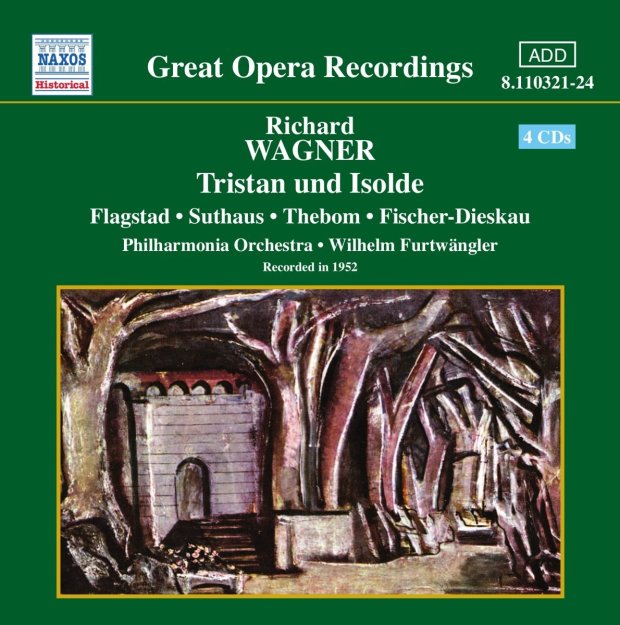
Less exciting perhaps, but the opera becomes really inimitably beautiful in the studio recording from 1952 (Naxos 8110321-24). Ludwig Suthaus is here also, but only now do you hear what a fantastic Tristan he was. He was now partnered with an Isolde of his own stature: Kirsten Flagstadt.
The young Fischer-Dieskau is a beautiful Kurwenal, Josef Greindl a brilliant Marke and Blanche Thebom a very attractive, lyrical, Brangäne.
But the orchestra is the most beautiful of all: in this recording, you really hear what a fantastic conductor Furtwängler was! Also remarkable: in the small roles of the sailor and the shepherd you can hear Rudolf Schock…. Yes… those were the days!
HERBERT VON KARAJAN BAYREUTH 1952
I am not such a fan of Martha Mödl singing Isolde. I admire her enormously, though! Her stamina is inexhaustible and her powerful voice can only be compared to a laser beam that cuts mercilessly through all the walls until nothing remains standing. Hurricane Irma is nothing in comparison.
The performance recorded live in Bayreuth in 1952 sounds quite sharp, making her voice seem even louder and bigger than usual. There is a lot to be said for that; no one had to turn the volume up because what you hear is pure nature. Even Karajan and his orchestra cannot compete with her! Legendary, yes, but I hear so little love in her interpretation! This in contrast to Ramón Vinay’s Tristan, he may be a little less powerful, but he sounds very warm and romantic.
The latter is for me the main reason to cherish the recording, but I also like the rest of the cast very much. Ida Malaniuk is an attractive Brangäne, Ludwig Weber a good Marke and Hans Hotter a somewhat heavy but otherwise beautiful Kurwenal.
DVDs
NIKOLAUS LEHNHOFF GLYNDEBOURNE 2007
The performance recorded in August 2007, directed by Nikolaus Lehnhoff, is in all respects one of the most beautiful Tristans. For the first time in my life, I completely surrendered myself to the opera. Without any regrets, by the way.
Lehnhoff took Isolde’s words: ‘Im dunkel du, im lichten ich’ as the starting point of his staging, and his play with dark and light (and with space!) results in an extraordinarily exciting and beautiful stage setting. The costumes are a kind of mixture of medieval simplicity and contemporary glitter.
Nina Stemme is literally and figuratively the most beautiful Isolde one can imagine. Her creamy, sensual soprano with its many colour nuances sounds like a balm for the soul. All her notes sound natural and effortless, as natural and bittersweet as love itself.
Robert Gambill’s voice may not quite meet the heavy demands of the part, but he portrays a very charismatic and committed Tristan. Katarina Karnéus (Brangäne), René Pape (Marke) and Bo Skovhus (Kurvenal) also sing and act in an excellent manner.
The conductor (an amazingly good Jiří Bêlohlávek) persuades the orchestra to produce the most beautiful colours as he builds up a thriller-like tension. The opera, which lasts more than four hours, is over in no time at all. That is real Art. Highly recommended. (Opus Arte 0988 D)
NIKOLAUS LEHNHOFF ORANGE 1973
In 1973, Lehnhoff directed a then very high-profile production of Tristan in Orange. The production is simple and timeless and, frankly, a little dull.
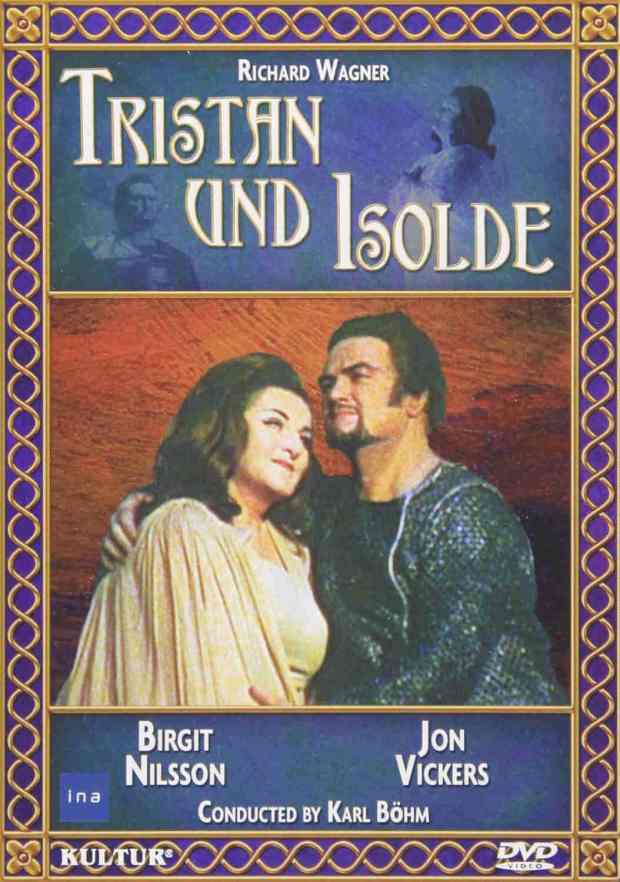
But the leading roles are sung by the then 55-year-old Birgit Nilsson and Jon Vickers and it is conducted by Karl Böhm, which makes the whole thing a document of note. The picture and sound quality is poor, but that will not deter the true music lover (Hardy Classics HCD 4009).
BARENBOIM AND PONNELLE BAYREUTH 1981
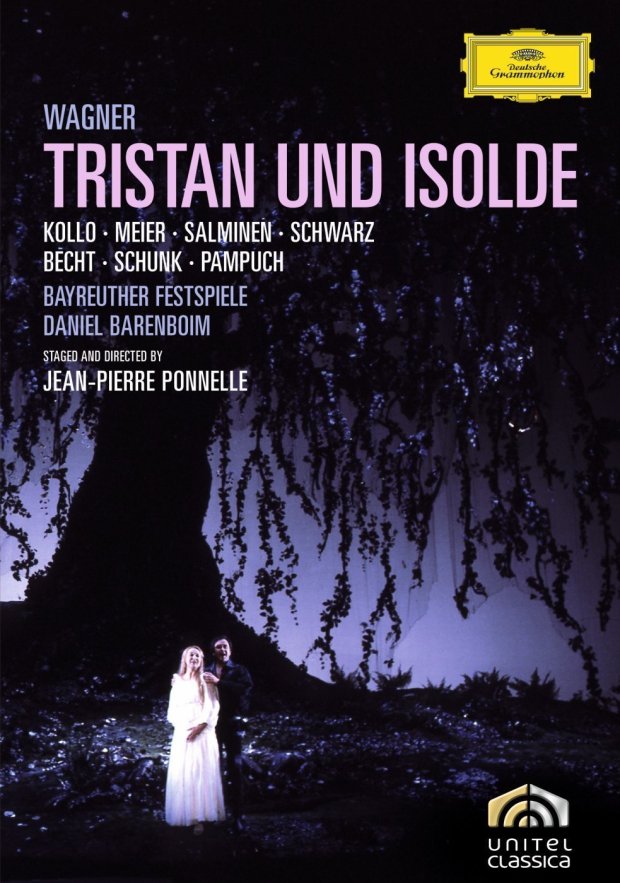
The performance of ‘Tristan’ in 1981 marked the debut of Barenboim and Ponnelle in Bayreuth. Their collaboration resulted in immense success, and both the audience and the press were wildly enthusiastic. In October ’83, the performance, this time without an audience, was recorded on video (DG 0734321).
Ponnelle’s splendid staging is a fine display of magic realism; with much symbolism, subcutaneous eroticism and dreams, where the real world turns out to be an imagination. The last act takes place in the head of the delirious Tristan: accompanied by Isolde’s Liebestod, perhaps the most beautiful music ever written, he dies in the arms of Kurvenal.
It is the first time I see Johanna Meier, and the encounter is not entirely satisfactory. Admittedly – she looks beautiful, acts well, and I have no complaints about her singing, but it all sounds so artificial … You can almost hear her work so very hard, and I don’t like that. But maybe I am wrong, and there is just no chemistry between her and me? There is no lack of the latter between her and Tristan: a bit dry sounding, but otherwise fine singing, René Kollo. Matti Salminen is irresistible as Marke and Hanna Schwarz is a truly phenomenal Brangäne. A magical performance.
BARENBOIM AND CHÉRAU MILAN 2007
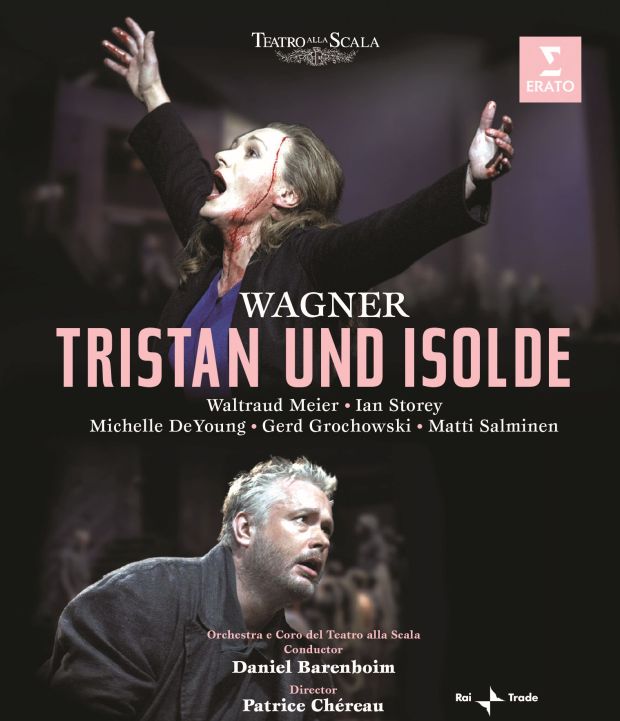
The opening night of La Scala with Tristan und Isolde directed by Daniel Barenboim and Patrice Chéreau, with Waltraud Meier in the leading role… Yes, that raises expectations. The reviews were not entirely positive, but I was enthusiastic about it, and now that I have seen the production again, I still am.
First of all, there is Chéreau’s intelligent and very humane directing and Richard Peduzzi’s sober but so ‘to the point’ stagecraft. The costumes and sparse sets are very medieval and through small details a suggestion of reality is created. For me, this is an example of how, with the use of tradition, a truly modern performance can be put upon the stage.
The direction of the characters is excellent. Chéreau knows like no other how to turn his theatrical characters into people of flesh and blood. It is not a fairy tale or a legend, everything is actually happening and the ‘everlasting kiss’ does indeed last forever.
Waltraud Meier sings (and acts!) a warm-blooded Isolde, Michelle de Young is a very convincing Brangäne, Gerd Grochowski a formidable Kurwenal and Matti Salminen as Marke is already an icon. But I was most surprised by the then unknown Ian Storey as a solid Tristan (Warner Classics 0825646055005).
Rudi Stephan’s opera or ‘Erotic Mystery’ Die ersten Menschen was to be premiered early 1915, but WWI intervened. In September that same year the composer died at Germany’s Eastern front, by a bullet through his head
Rudi Stephan
In a way it was a surprise that the opera was to be performed at all. The libretto was based on an “Erotic Mystery” play that had been performed only once in 1912 in München, before it was banned for its explicit content. It was a hyper-eroticised and quite anti-religious view on the first family on earth, Adahm and Chawa, and their sons, Kajin and Chabel (resp. Adam, Eve, Cain and Abel), by Otto Börngraber, now mostly forgotten, but then a well-known radical playwright and philosopher.
In it, Adahm and Chawa are growing older, after having been expelled from paradise. Adahm has become contemplative, focusing on acquiring knowledge through science. Chawa longs back for the days of their youth. Meanwhile Kajin, the older son, is expressing a desire to explore the world, and to look for a ‘wild woman’, but he never gets far. Chabel, the youngest, is into mysticism and prophesies about a redeemer who will come, to be sacrificed as a lamb. In fact, Chabel brings a lamb along, and cuts its throat. Adahm goes out, Kajin tries to seduce Chawa, Chawa tries to seduce Chabel, Kajin kills Chabel and drops on a funeral pyre, Chawa wants to follow Chabel, but Adahm returns and draws her away, Adah and Chawa walk into the sunrise of a new day and Kajin will be the father of humankind.
This mystic and simultaneously sensual and blasphemous family drama is clickbait for director Calixto Bieto, of whom you could somewhat profanely say that he turns everything into mystic and simultaneously sensual and blasphemous family drama. Although first the plan -shelved due to COVID19 – was to have him stage Berlioz’s Damnation de Faust, on which Bieito for sure would have been able to apply his signature key-elements in staging as well: trivialising the sacred and sanctifying the trivial.
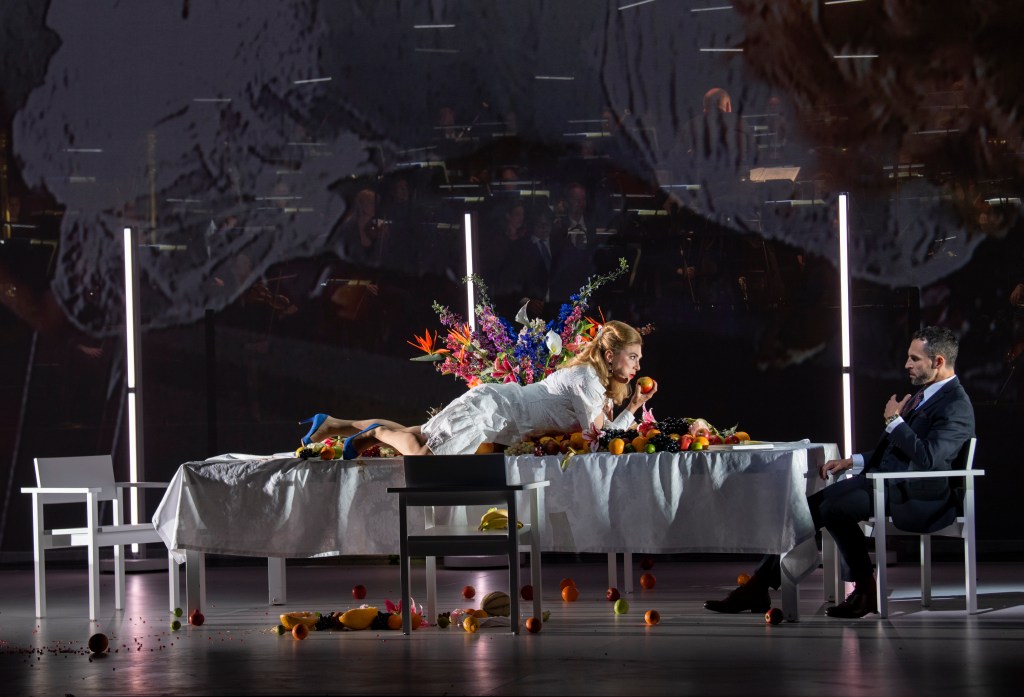
On stage we see a geometrical tent-like structure covered with gauze, the see-through home of this vulnerable first family on earth. There is a table covered with plates, filled with piles of fruit. They of course remind us of Eve and Adam having eaten the forbidden fruit from the Biblical Tree of Knowledge of Good and Evil. During the whole performance Chawa will be eating more fruits, trampling on them, or serving their contents to the other characters. The backdrop is a gauze with video-images of more fruits, alternating with lips, eyes and body parts, and later on the protagonists in close-up. Incidentally we get to see the orchestra behind it, onstage, with conductor François-Xavier Roth, sometimes just the lights of the orchestra’s music-stands, shining through like the stars Chabel sees in his visions.
Director Calixto Bieito;Set design Rebecca Ringst; Costumes Ingo Krügler; Lighting Michael Bauer;
Video Sarah Derendinger; Adahm Kyle Ketelsen
Kaijn Leigh Melrose; Chawa Annette Dasch; Chabel John Osborne;
In the opening scenes Adahm is sitting behind a white laptop, focusing on the screen instead of Chawa. Later on Adahm recounts a white, shiny miracle that he saw during the moment when the Knowledge of Good and Evil was revealed to him, so yes in a way the laptop is in the text. And yes, this is the Bieito method, reducing mythological allusions to seemingly trivial objects, that meanwhile retell the story in their own way.
It reminded me of Ruth Berghaus’ staging of Berg’s Lulu in Brussels; I remember countess Geschwitz, last one in love with Lulu, unreciprocated, vacuuming the run-down attic where she and Lulu, after living a luxurious life, are prostituting themselves –the whole staging was worlds apart from the previous staging in Paris, with the same magnificent Teresa Stratas in the title role, where Patrice Chéreau had given the characters a luscious beau-monde surrounding till the end.
The lamb that Chabel introduces in the family circle here is presented in the shape of a stuffed animal toy that he keeps caressing, behaving like a big baby. Yet, without any hesitation he decapitates his pet toy when the moment of the sacrifice arrives. The toy turns out to be filled with blood, which gushes out.
The role was performed by John Osborn, thus the role was cast as lyrical rather than as Wagnerian. Osborn often almost pushes his voice into falsetto, bringing the character closer to for instance the fool in Boris Godounov than a Wagnerian ‘Held’, and John Osborn really is the perfect performer for this, and Bieito makes full use of him. After having ‘killed’ the toy lamb, all the while showing the smile of a lunatic, he returns in pyjamas, which reveal the singer’s somewhat voluminous belly, making him so the more appear like an oversized toddler.
Kajin clings to Chawa after he murdered Chabel
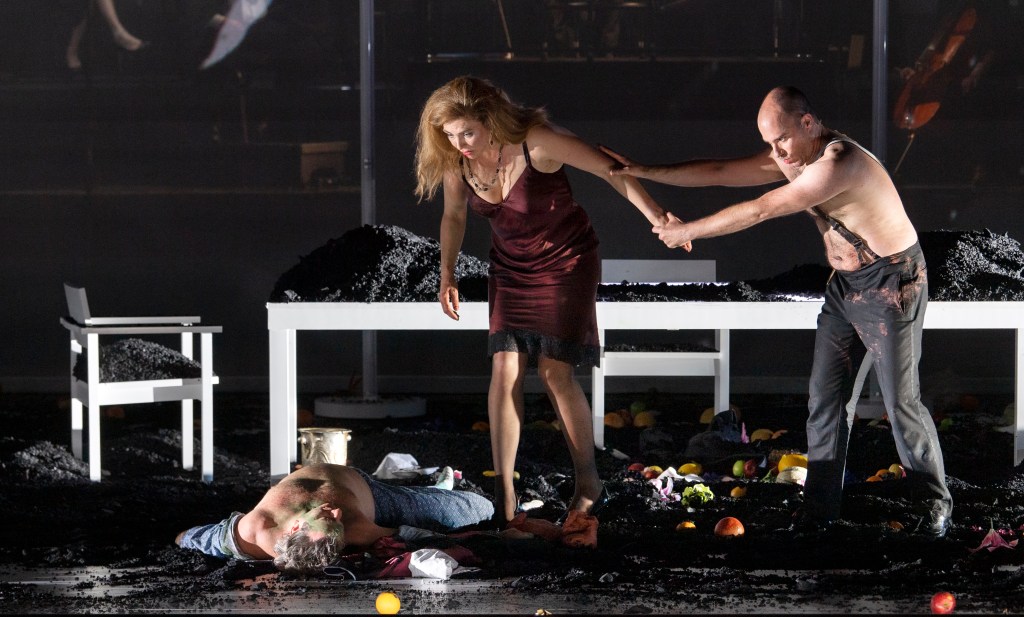
Meanwhile, his brother Kajin (superbly performed by baritone Leigh Melrose) gets to show his somewhat voluminous belly as well, but in his turn a more mannish one, as befits his character, covered abundantly with chest hair. All this leads to a scene where mother Chawa (a commanding Annette Dasch with some very demanding notes over full orchestra) strips as well, down to a negligée. And yes, still quite in line with the libretto, consecutively Kajin tries to rape Chawa, Chawa tries to rape Chabel, all join in a threesome, Kajin tries to rape Chabel, and Kajin kills Chabel.
Kajin rapes Chawa
Enter Adahm (bass-baritone Kyle Ketelsen). Apparently untouched by all the hormones flying around, Adahm stays dressed, in the end even wearing a plain raincoat on top of everything. There is no sunrise outside to walk into, but Adahm and Chawa embrace, in closeup in the backdrop video, in loving caressing.
Stephan’s musical idiom oscillates between the budding atonality of Schönberg’s Erwartung (finished 1909) and the stretched tonal idiom of Schreker; Schreker’s Die Gezeichneten was written during the same years as Die Erste Menschen. The topic is not that distant from the incest of Strauss’ Salomé, the sexual craving in Erwartung, the promiscuity of Die Gezeichneten, all topics that were already present in Wagner’s Ring meanwhile.
It took Stephan a while to finish the opera, partly it seems as librettist Börngraber had been thinking Richard Strauss might instead be interested in the text. But Strauss had already abandoned his taste for topics like Salomé and Elektra, replacing it with the saccharine world of Der Rosenkavalier, which premiered in 1911.
Finally, Die Erste Menschen was staged in 1920 in Frankfurt, to critical acclaim, but without winning the hearts of audiences. After a second failure in 1924 in an abridged, chastened version, it disappeared. This Amsterdam production is only the second post WWII production of the full score. And without Corona we would not even have had this ravishing gem. Berlioz’ Damnation will wait.
Adahm: Kyle Ketelsen Kajin: Leigh Melrose Chawa: Annette Dasch Chabel: John Osborn Musical direction: François-Xavier Roth Direction: Calixto Bieito Set design: Rebecca Ringst Costumes Ingo Krügler Lighting: Michael Bauer Video: Sarah Derendinger Orchestra: Royal Concertgebouw Orchestra
This production is part of the Holland Festival 2021
Photography Ruth Walz
The production can be seen on ARTE and on the websites of the Holland Festival and the Dutch National Opera & Ballet from June 25th on, for free:
So you don’t believe in true love? Have you become a bit cynical because your heart has been broken too often, or have you seen too many marriages end in divorce? So fairy-tales are not real and your tears are flowing for La Bohème only??
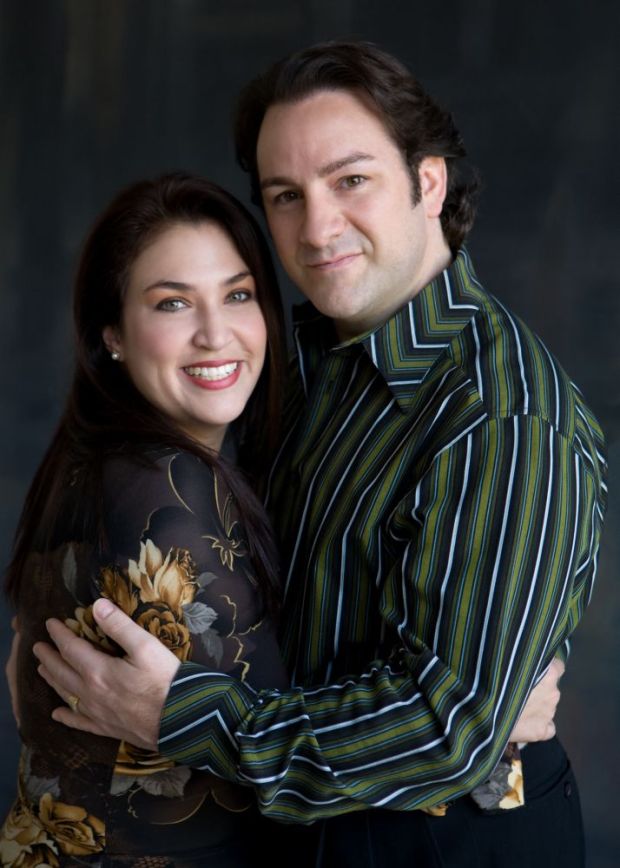
I know a remedy: meet John Osborn and the love of his life, Lynette Tapia. Their love blossoms and glows as if they have only just met and yet they have been together for many years! They also have a daughter, the now eighteen-year-old multi-talented Anna.
I met them both on a horribly cold February day in 2013 with ice, snow and wind outside, but in the café Puccini where we met, my heart and soul were soon to be warmed
The lovely Lynette Tapia with her beautiful green eyes and shiny black hair is a celebrated singer as well and sometimes she manages to sing with her husband. In September 2006, they had their Amsterdam debut together in Capricio by Richard Strauss, as the Italia13n singers.
OPERA CLASSICA
In October 2012, they both sang in Verdi’s Rigoletto at Schloss Braunfels, a production of Opera Classica Europa, an organisation that presents operas at the most beautiful historical locations in Europ
Osborn: I love what Opera Classica Europa does and the way they do it. The location was enchanting, we were wearing real, historical costumes. Old-fashioned? Yes, definitely: old-fashioned beautiful. We didn’t have that much rehearsal time, but there was no need. There was nothing you really had to learn, everything being already in the music.
The role of the Duca is particularly suited to a high tenor. I have been a singer for 22 years. I am not a baritonal tenor but I can sing ever heavier roles. It depends on the location, of course, and it also matters who your conductor is, and whether he knows how to keep the orchestra in check. The music has been shifted to a higher pitch, the orchestras are playing louder, but you still have to rise above the orchestra and you have to be audible everywhere, even in the back rows. Add to that the fact that we tenors don’t sing in falsetto any more; today’s audience would not be appreciative.
I am from the generation that grew up with the three tenors, but a lot has changed since then. You can’t afford not to look good. Or not to be fit. When I was younger, I didn’t participate in sports and fitness, I thought it was a waste of time. But in a way, I think it is fair and good that we take care to look the part a bit more, for the public’s sake. Although it is still mainly (I hope?!) about the singing!
DIRECTORS
Directors? Are they really important? Who ever heard of a director, say 50, 60 years ago? We knew who the singers were and that was all that mattered. The conductor, the orchestra, yes, but a director? We still speak of Tosca by Callas or Don Carlo by Corelli, but nowadays the name of the director is written in big, bold letters at the top of the poster, even before the composer! Many of the directors have also developed a somewhat perverse way of manipulating human feelings, which bothers me. Sometimes I think: do you really want to create something new? Then create something new! Write your own opera!
I admire Pierre Audi very much and I really enjoy working with him. OK, after a few times you know the concept and you know it’s going to be very aesthetic, static too. But he has respect for the singers, we are more to him than just pawns in a game of chess.
I also have a great affinity with the work of Moshe Leiser and Patrice Caurier. I did Clari by Halèvy and Otello by Rossini with them, both in Zurich, and we had a lot of fun together. They work in a logical way and their productions are very well put together. Clari may have been updated, but everything is just right. The directors have a kind of sixth sense for what goes with the music, so their productions are very diverse.
CONDUCTORS
Who are the really good conductors? The generation that has almost died out: Nello Santi, Claudio Abbado. But that doesn’t mean they are over, those good old days! I like Yannick Nézet-Séguin immensely, he understands the French style like no other. Unfortunately I have only worked with him once, in 2008 in Salzburg. We did Romeo et Juliette together and the performance was unforgettable! He liked my ‘French way’ of singing so much that he even invited his parents to the performance. For me that was one of the greatest compliments ever!
At the time of our conversation, Osborn is singing Arnold in the DNO production of Guillaume Tell. He first performed this role in the 2007 – 2008 season with the Accademia di Santa Cecilia Orchestra in Rome. After that we could admire him in this role in the ZaterdagMatinee (December 2012) and the general press called the performance a ‘historical event’. And now finally on stage. The difference?
“I have indeed performed the opera concertante a few times, with more or less cuts, so each time it was quite exciting to think which version we would be doing next. At the Matinee, the score was almost complete. As a singer, I have learned to act with my voice, but if I can actually show my feelings on stage as well, not only through my singing but also by the way I move, then that adds an extra dimension.
Is there anything you would like to say to your Dutch audience? “This is the sixth time I work in Amsterdam. I always love coming back to visit this beautiful city. The people are so kind and welcoming. All of the friends I’ve made from The Dutch National Opera, the members of the chorus, the musical staff, and the production staff have all been so supportive of me and the talents I’ve been given. I am so grateful for the opportunities to perform here, and I truly feel like Amsterdam has become a second home for me. I very much look forward to returning to this unique and wonderful place again in the near future. Sincerely, John Osborn’.
Lynette Tapia and John Osborn in “Parigi o cara” from La Traviata Live at Schloss Braunfels, august 12 2018 :
Lucia di Lammermoor has always been, perhaps even more than Norma, a point of contention between the supporters of Maria Callas and Joan Sutherland. The performances of both ladies are indeed fantastic and, moreover, totally different. Which of the two should you own? That is not easy. A matter of taste, shall we say?
Joan Sutherland is unprecedentedly virtuoso and her coloraturas so perfect that they hurt. And yet I remain untouched by her. Why? Perhaps because it is too perfect? I do not know. It could just be me.
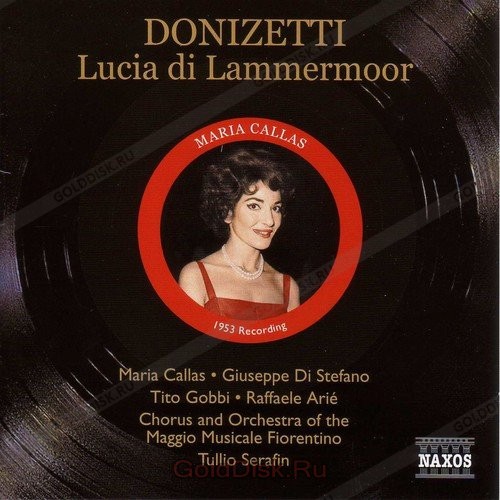
Whatever you choose, you really can’t do without at least one Callas. Try Naxos (8110131-32) with Giuseppe di Stefano and Titto Gobbi, under Tulio Serafin, for although Francesco Tagliavini (Warner Classics 2564634081) is a much better Edgardo, the rest of the cast (including Callas herself!) is much stronger here.
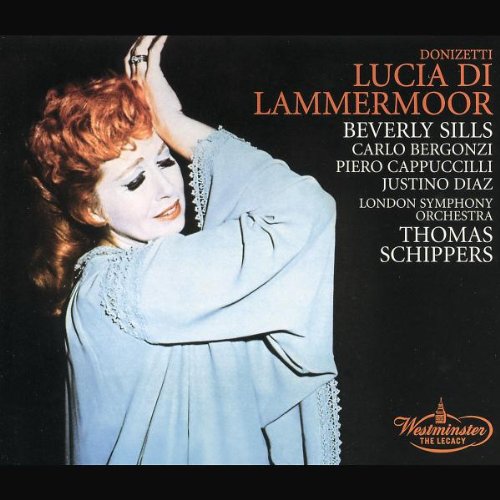
Personally, I prefer Beverly Sills (Westminster 4712502), especially when it is a choice between studio recordings. Her portrayal unites the best of both divas: the virtuosity, vocal beauty and pure intonation of la Stupenda and the great acting of la Divina. Not really a great tragédienne (but then, neither is Lucia); she is more like a passive girl child who allows herself to be completely overwhelmed. The rest of the cast (Carlo Bergonzi, Piero Cappuccilli, Justino Diaz) is also at a very high level and Thomas Schippers conducts it all with a firm hand . But what makes this recording really special is the use of a glass harmonica in the mad scene, exactly as Donizetti had originally prescribed it.
Renata Scotto
My most beloved Lucia, Renata Scotto, never recorded the role in the studio. There are, however, several pirate recordings of her in circulation, with Luciano Pavaratti, Alfredo Kraus, Carlo Bergonzi and Gianni Raimondi as Edgardo.
Of these four, the recording with Raimondi is dearest to me, not least because of the very energetic and dramatically balanced direction by Claudio Abbado. It was recorded at La Scala in December 1967 and it appeared on Nuova Era (013.6320/21). Unfortunately, this recording is very hard to find.
Below Gianni Raimondi and Giangiacomo Guelfi (Enrico) in ‘Orrida è questa notte…
Scotto’s interpretation of the tormented heroine is available on DVD (VAI 4418). The production was recorded in Tokyo in 1967. It circulated for years on pirate video, but as the sound and picture quality were particularly poor, the commercial release has made many opera lovers very happy. The sound is a little sharp, making Scotto’s high notes sound even more metallic than usual, but who cares? ‘
Her interpretation is both vocally and scenically at an unprecedented high level. With a childishly surprised expression (my brother does this to me?) on her face, she agrees, albeit not without grumbling, to the forced marriage with Arturo (an Angelo Marchiandi who is hideous in every way).
Below, Scotto sings ‘Il dolce suono’. Who could do it better?!
After her mad scene, you tend to pull the plug, because everything that comes after it can only feel like a cold shower. But you are wrong about that. Edgardo’s two arias, sung by Carlo Bergonzi, will take you straight to (singer’s) heaven.
Afterwards, you can’t help but be a little sad, because where have they gone, yesterday’s singers? Small, tall, fat, skinny, with or without acting talent… None of them was a ballet dancer, but could they sing! And it was through their voices alone that they were able to convey all of the feelings that now require a whole ‘artistic team’. In spite of the cuts that were common at the time, this is an absolute must.
Below, Bergonzi sings ‘Fra poco a me ricovero’
Patritia Ciofi (French version)
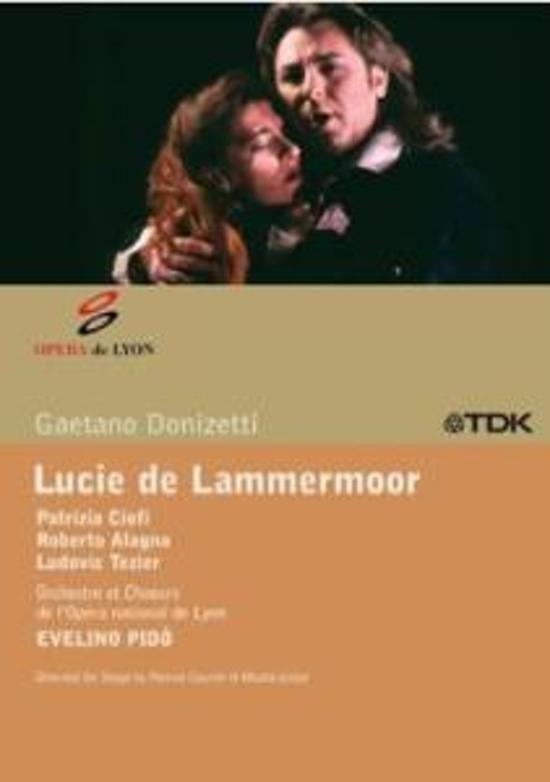
In 1839, Donizetti adapted his opera for Paris and Lucia became Lucie. It is not the language alone that distinguishes between the two versions, for Donizetti tinkered considerably with both the libretto and the music. Alisa (Lucia’s lady-in-waiting) was cut out of the opera and our heroine remains the only woman in an otherwise purely male company, which makes her even more lonely and vulnerable.
Normanno is now called Gilbert and his role has been considerably expanded. His false play and manipulations make him into a key figure and he grows to almost Iago-like proportions. Arturo has also become more three-dimensional as Henri. And although I miss ‘Regnava nel silenzio’ and scenes between Lucia and Raimondo, I must admit that the French version is dramatically much better.
In this recording (once TDK, hopefully still available), Patrizia Ciofi is nothing less than phenomenal as a rather neurotic Lucie, Ludovic Tézier is superb as a villainous Henri and Roberto Alagna is in his element as Edgar. It was (at the time) one of his best roles.
The director duo Patrick Courier/Moshe Leiser rarely disappoint. Their productions are always realistic, embedded in a historical perspective, but with enough of a nod to the present. Moreover, they do what directors are supposed to do: provide a good mise-en-scène and guide the singers in their performance as to appear convincing.
THREE LUCIAS OF RECENT TIMES
Anna Netrebko
Deutsche Grammophon released the Live in HD broadcast of Lucia di Lammermoor by the Metropolitan Opera in New York in 2009 on DVD and Blu-Ray (DG 0734545). Anna Netrebko sang the main role. I never really thought Lucia suited her. Moreover, at that time she was more concerned with showing off than with the soul- searchings of the tragic heroine she portrayed.
Piotr Beczala is, as always, a fantastic Edgardo, but all the other singers are fine too. All have an individual timbre, so that in the very homogeneously sung sextet you can also recognise the individual voices.
Valery Gergiev conducts energetically and really speeds up the orchestra, which sometimes results in breakneck tempi. On the other hand he actually stretches out the ‘mad scene’ (with glass harmonica, bravo!)
Natalie Dessay
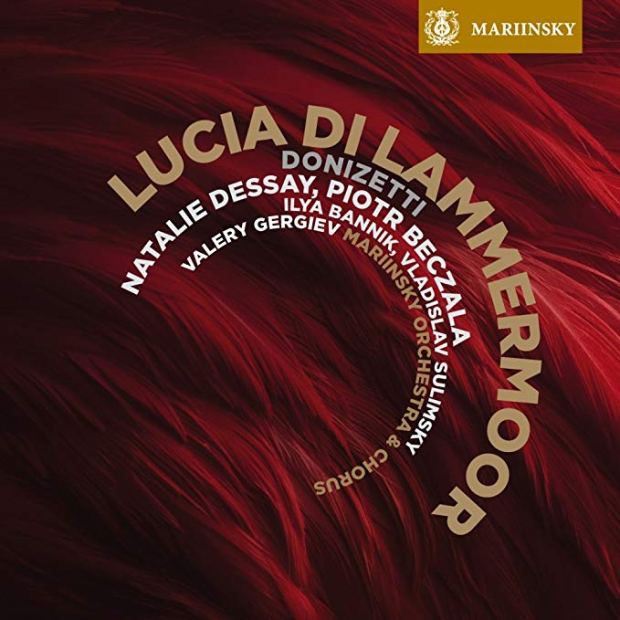
Valery Gergiev’s Mariinsky Theatre put its own Lucia di Lammermoor on CD (MARO 512). Natalie Dessay is a gifted artist. She has a beautiful voice of unprecedented height, with which she sings the most difficult coloraturas and fiorituras as if it were nothing. She is also beautiful and can act incredibly well; it is always a pleasure to see her in action. However, her voice, which is not so big, has its limitations. Scenically, she knows how to hide these through her superb acting, but without visual images, things can go wrong. Which you can hear on this live recording from 2010. Her coloraturas are perfect but empty; they have no substance. This Lucia does go mad but we do not know why. But once she is crazy, she totally makes our heads spin.
Piotr Beczala is, as always, a fantastic Edgardo, but all the other singers are fine too. All have an individual timbre, so that in the very homogeneously sung sextet you can also recognise the individual voices. Valery Gergiev conducts energetically and really speeds up the orchestra, which sometimes results in breakneck tempi. On the other hand he actually stretches out the ‘mad scene’ (with glass harmonica, bravo!).
Diana Damrau
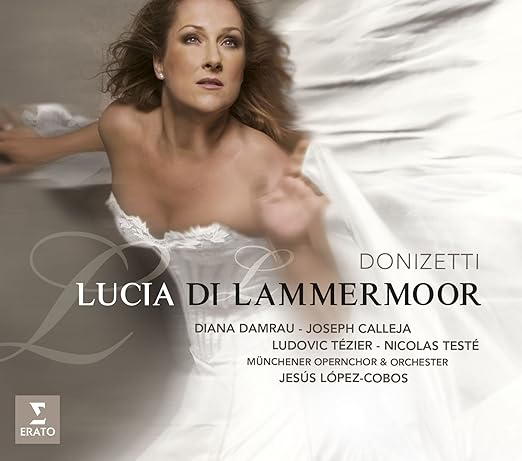
Diana Damrau, one of the world’s best and most famous sopranos, seems to be perfect for the role of Lucia in Lucia di Lammermoor. She sang the part already in 2008 at the New York Metropolitan Opera. Five years later, she delighted audiences in her home town of Munich with her interpretation. The concertante performances were recorded live by Erato, but I am sadly disappointed with the result.
Not that there is anything wrong with Damrau’s coloraturas. They are still impeccable, but to my ears they are empty, without any real substance. In her mad scene, she looks more like the mechanical puppet Olympia from Les contes d’Hoffmann than a woman of flesh and blood.
The male roles are all well cast. Joseph Calleja (Edgardo) sings his role with such ease and flexibility that I am reminded of the young Pavarotti. Ludovic Tézier and Nicolas Testé are perhaps not entirely idiomatic, but their impeccable singing is really not to to be criticized. Even the small role of Normanno is perfectly sung by the excellent Andrew Lepri Meyer.
Jesús López-Cobos’ tempi are remarkable, to say the least. It is stop and go again all the time. Sometimes I do not even recognize the music. It seems as if new embellishments have been added.
The recording itself is also quite unbalanced. It is understandable that the opera could not be recorded in one go, but some things were ‘brushed up’ in the studio and unfortunately we can hear this.
My top three remains unchanged: 1. Renata Scotto with Carlo Bergonzi, VAI 4418 2. Beverly Sills with Bergonzi, recorded in the studio in 1970 (Westminster 4712502) 3. Maria Callas, no matter which one
Net als in Nixon in China en The death of Klinghofer heeft John Adams in dit werk een contemporaine historische gebeurtenis als uitgangspunt genomen. Het libretto van Peter Sellars legt echter vooral de nadruk op de verschillende hoofdpersonen en hun zorgen, angsten en conflicten en minder op de centrale gebeurtenis zelf, de ontploffing van de allereerste atoombom ooit.
De enorme stress waaronder de twee hoofdverantwoordelijken van het Manhattan Project gebukt gaan, generaal Leslie Groves en fysicus Robert Oppenheimer, is door Sellars uitstekend en invoelbaar uitgelicht. Mooie scène is waar Oppenheimer een gesprek met Groves plotseling een andere wending geeft door over diens dieet te gaan praten. Groves gaat daar gretig op in en plotseling is de dagelijkse calorische waarde van Groves’ eetpatroon een tijdje het enige dat van belang lijkt.
Doctor Atomic werd in 2007 uitgevoerd tijdens het Holland Festival en van deze DNO productie is door Opus Arte een opname op Blu-ray uitgebracht. Solisten, het koor van DNO en het Nederlands Philharmonisch Orkest staan onder leiding van Lawrence Renes. Ze maken er met z’n allen een memorabele voorstelling van.
De eerste akte speelt zich af ongeveer een maand voor de bom zal worden getest. Er zijn twijfels over de werking van het mechanisme dat de ‘gadget’ tot ontploffing moet brengen, absolute perfectie is hier geen luxe maar een vereiste en men is bij de nadering van het beslissende moment niet geheel zeker van zijn zaak. Verder twijfelen sommige wetenschappers aan de noodzaak ermee door te gaan. De bom werd ontwikkeld voor het geval dat Duitsland de US zou aanvallen met een eigen atoombom. Die dreiging is nu verdwenen dus kan alles worden afgeblazen.
De tweede akte laat de aanloop naar de ontploffing op 16 juli 1945 zien. Politiek is de pressie groot om de test uiterlijk op die datum uit te voeren omdat de volgende dag de conferentie van Potsdam zal beginnen. Truman wil daar Stalin op de hoogte kunnen stellen van het nieuwe wapen dat tegen Japan kan worden ingezet om zodoende zijn collega tot een oorlogsverklaring tegen dat land te brengen. Samen kunnen de twee grootmachten Japan tot een snelle overgave dwingen, zo is de redenering. Daarmee wordt de druk op Groves gelegd, zozeer dat hij niet langer boodschap wil hebben aan de weersverwachting die onweer, bliksem en harde wind voorspelt. Als er geen geschikt weerbericht komt maakt Groves desnoods zijn eigen weer.
Edward Teller loopt twijfel te zaaien over het effect van bom, Oppenheimer staat op de rand van een zenuwinstorting, Groves eet een overmaats stuk chocolade. Tijdens het aftellen wordt de tijd vertraagd en dan plotseling is alles voorbij. Het beslissende moment heeft Sellars overgeslagen. In plaats daarvan horen we stemmen die afkomstig lijken te zijn uit Hiroshima, van mensen die de klap hebben overleefd. Ik was al tweemaal op die plek en de geschiedenis is daar nog altijd zeer voelbaar. Doctor Atomic roept vergelijkbare emoties op.
Het decor wordt gedomineerd door een model van de bom, hangend aan een stellage achter op het toneel. Daar zijn ook de dansers actief die een choreografie van Lucinda Childs uitvoeren. De gesprekken vinden meer op het voortoneel plaats. Voor een deel wordt daar Oppenheimers woonhuis uitgebeeld. We zien hem samen met zijn vrouw Kitty in bed en later in een woonkamer met kindermeisjes en de twee kinderen. Kitty is hier al flink aan de drank, Red Label wordt gedronken uit limonadeglazen.
Sopraan Jessica Rivera heeft twee prachtige lange solo’s waarin Kitty inzicht geeft in haar gevoelens en kijk op de hele situatie. Fenomenaal gezongen. Haar huishoudster Pasqualita heeft een korte solo waarin ze een authentiek indiaans liedje zingt. Mooie rol van Ellen Rabner. Door haar kapsel lijkt Rivera wel een beetje op de echte Kitty. Ook Oppenheimer en Teller zijn redelijk herkenbaar in hun vertolkers. Met name Richard Paul Fink komt uiterlijk dicht in de buurt van wat ik aan foto’s van Teller heb gezien. Finks rol zweeft tussen ernst, cynisme en sarcasme. Hij is duidelijk geen team player maar natuurlijk wel briljant.
Eric Owens is een zeer goede Groves. Echt zingen hoeft hij niet maar parlando acteren met een overbearing attitude is hem op het enorme lijf geschreven. Naast hem oogt Gerald Finley als een frêle kamergeleerde en dat contrast werkt uitstekend in de scènes die ze samen spelen. Finley’s vertolking van Oppenheimer is groots, ik heb er geen ander woord voor.
Wat me zo bevalt aan de muziek van Adams is dat hij het zijn zangers niet onnodig moeilijk maakt om ‘modern’ te willen klinken. Dat stoort me vaak in opera’s die in de 20e eeuw werden gecomponeerd en waarin de tekst volledig ondergeschikt is gemaakt aan het produceren van enorme vocale uithalen. Adams en Sellars willen een verhaal vertellen en dan is verstaanbaarheid een eerste vereiste. Daar zijn die twee met Doctor Atomic volledig in geslaagd.
Vĕc Makropulos (De zaak Makropulos) was de voorlaatste opera die Leoš Janáček componeerde. Dit werk uit 1926 gaat over een vrouw die al 300 jaar leeft, dankzij een soort toverdrank. Om geen argwaan te wekken verandert ze regelmatig van identiteit. Haar oorspronkelijke naam is Elina Makropulos en in het verleden heeft ze aliassen gebruikt zoals Eugenia Montez, Ekaterina Myshkin en Ellian McGregor, dus steeds met de intialen E.M. Haar huidige naam is Emilia Marti.
De handeling speelt zich af rond een vergeefse poging van Marti om het oorspronkelijke recept van het elixer in handen te krijgen. Ze heeft het op diens aandringen een kleine 100 jaar eerder aan haar toenmalige minnaar Baron Prus in bewaring gegeven. Na ruim drie eeuwen moet het effect ververst worden. Maar uiteindelijk verliest ze haar drive en geeft ze toe aan de apathie die een ‘eindeloos’ leven onherroepelijk genereert.
Centraal in de handeling staat die affaire die ze ooit heeft gehad met Prus en de buitenechtelijke zoon die daaruit is voortgekomen. De strijd om de nalatenschap van de baron heeft tot een slepende kwestie geleid die al bijna een eeuw gaande is. Inmiddels gaat het tussen de nazaten van Prus en die van de bastaard die de naam MacGregor draagt, naar die van zijn moeder Ellian MacGregor.
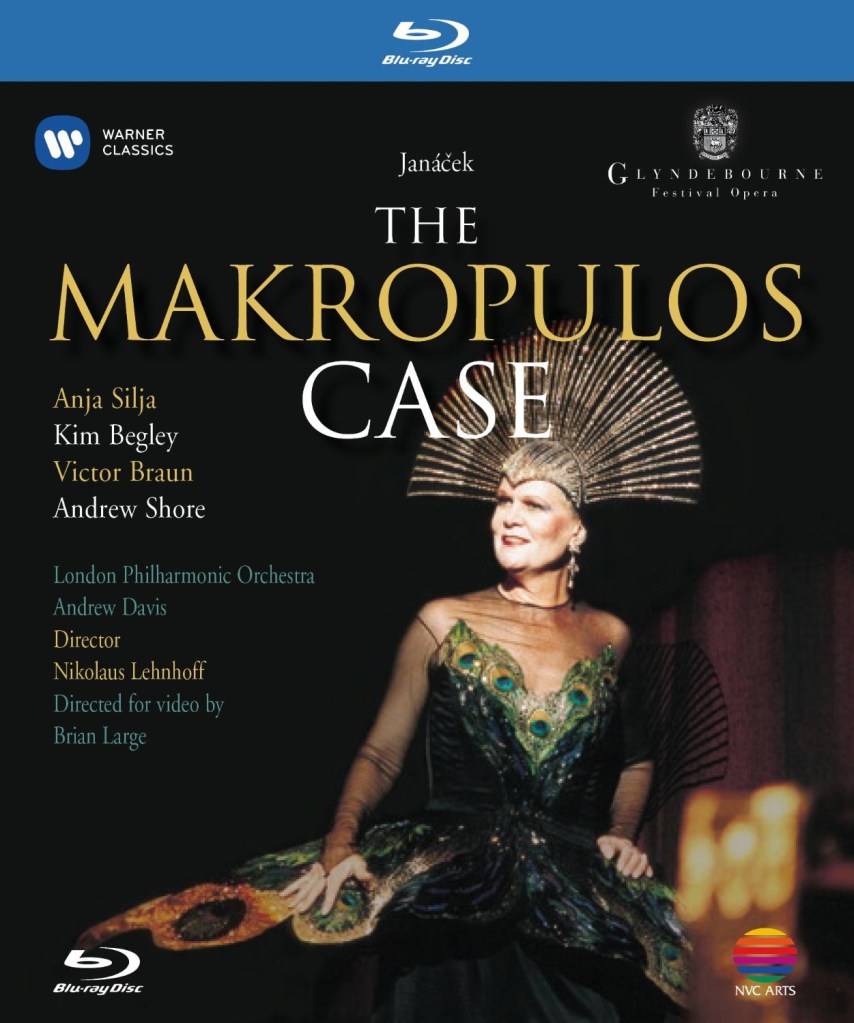
In 1995 stond het werk in Glyndebourne op het programma, een productie van Nikolaus Lehnhoff en Tobias Hoheisel. Het toneelbeeld is onberispelijk: alles getuigt van de jaren ’20 waarin de handeling zich afspeelt. Een chaise longue die zo maar uit Haus Tugendhat in Brno geleend zou kunnen zijn, authentieke kostuums en een over the top uitmonstering van Emilia Marti als ze van het toneel afkomt na haar optreden, ze ziet eruit als een pauw. Ook de diverse ruimtes, het advocatenkantoor van Dr. Kolenatý, back stage in de opera en een hotelkamer in de derde akte zijn geheel periodegetrouw ingericht. Eigenlijk is alles en iedereen levensecht, behalve die 337 jaar oude dame die de boel op stelten komt zetten.
Marti is jong gebleven en weet bijna elke man met gemak te reduceren tot iemand met de weerbaarheid van een pakje boter dat in de zon heeft gelegen. Dat is een kwestie van looks and fame en daarover beschikt ze in ruime mate. Haar gedrag is onprettig, ze schoffeert alles en iedereen en als backstage de mannen hun opwachting komen maken roept ze na de tweede gewoon ‘de volgende’. Het is vooral cynisme dat haar personage heeft gevormd tot wat het nu is. Dat de zoon van Prus zelfmoord om haar pleegt laat haar koud, is niet haar verantwoordelijkheid.
Kim Begley is zeer overtuigend in de rol van Albert Gregor die zonder het te beseffen in de ban raakt van zijn bet-bet-overgrootmoeder. Christopher Ventris zien we als Prus’ onfortuinlijke zoon die zichzelf van het leven berooft nadat Marti hem heeft weggestuurd ten faveure van zijn vader. Mooie kleine rol ook van Manuela Kriscak als zijn verloofde Kristina, die op haar beurt ook door Marti was platgewalst. ‘Ik kan maar beter stoppen met zingen want zo goed als zij wordt ik nooit’. Bij haar was het een artistieke betovering, geen seksuele.
Dr Kolenatý komt voor rekening van Andrew Shore en Baron Prus wordt vertolkt door Victor Braun, degelijke prestaties. Prus voelt zich bekocht als hij in ruil voor seks aan Marti de envelop laat waarin de formule van het elixer zit. Alsof ik met een lijk naar bed ben geweest. Marti lacht hem uit, je hebt gekregen waar je om vroeg, afspraak is afspraak.
De rol van Emilia Marti is in handen van Anja Silja en dat is een minder gelukkige keuze. Vocaal weet ze zich vrij goed staande te houden, hoewel dat tegen het einde nog maar net lukt. Maar ze kan geen moment overtuigen als een vrouw die mannen om haar vinger weet te winden. Silja is hier pas 55 jaar maar oogt 20 jaar ouder. Dat past op zich wel bij haar echte leeftijd, een oudere vrouw in de rol van een eeuwenoud persoon, maar staat haaks op hoe ze in de tekst wordt gepresenteerd en welk effect ze op haar omgeving heeft.
Anja Silja in de finale:
Wat de productie de moeite waard maakt is het totaalbeeld, over de hele linie goede prestaties van de zangers en een wonderschoon decor met oog voor details. En laten we vooral ook de inbreng van het London Philharmonic Orchestra niet vergeten.






















 Basia con fuoco