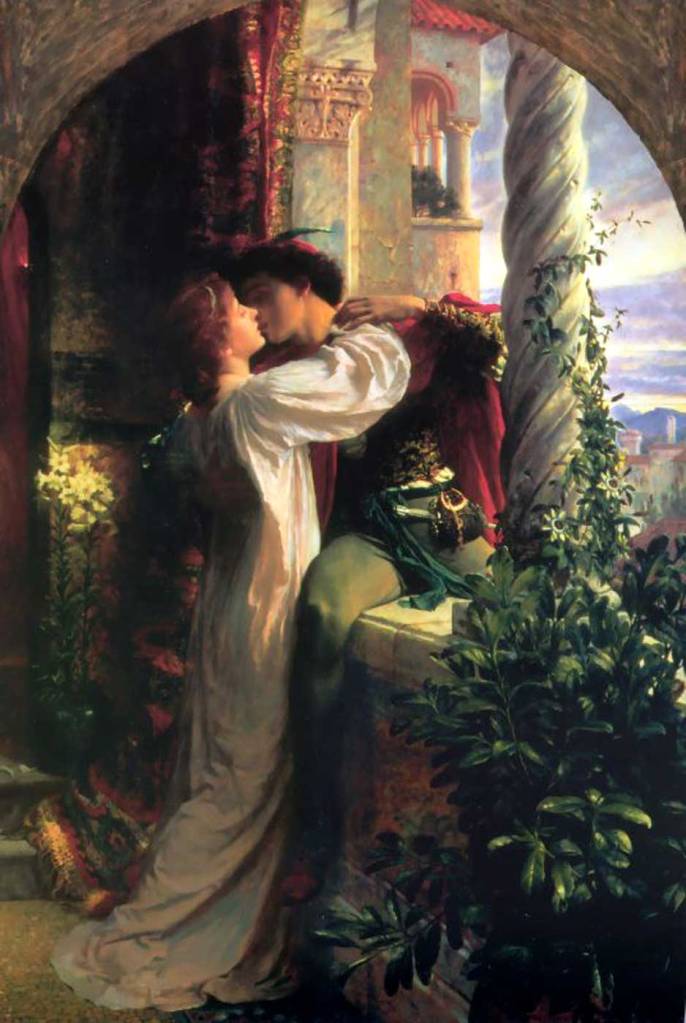
Romeo and Juliet, painting by Frank Bernard Dicksee, 1884
Throughout the centuries, unhappy love stories have been the greatest source of inspiration for writers, poets, painters and composers. This is logical, because what could be more moving than the sad fate of two people who, out of love for each other, choose death over life? It is the height of romance, and most people enjoy a good cry.
Shakespeare’s Romeo and Juliet are perhaps the most famous lovers of hem all. Plays, films and ballets have been based on and/or inspired by hem. And operas, of course.
Everyone knows Gounod’s Romeo et Juliette. Berlioz also makes an appearance here and there. But did you know that Bellini also wrote an opera about it? No? And why not? Because it is hardly ever performed anymore? And this while his I Capuletti e i Montecchi is so breathtakingly beautiful!
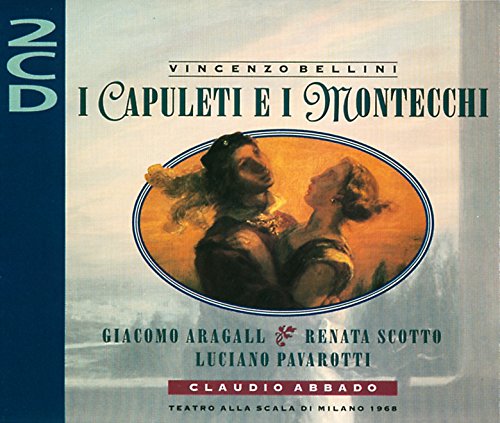
My favourite performance was recorded live at La Scala in Milan in 1968, with a tenor (Giacomo Aragal at his best!) as Romeo and Renata Scotto as Giulietta. Tebaldo was sung by (what a treat!) a young Luciano Pavarotti And Claudio Abbado conducted (Gala GL 100.517)
Aragall and Scotto in ‘Si, fuggire!… Vieni ah! vieni, e in me riposa:
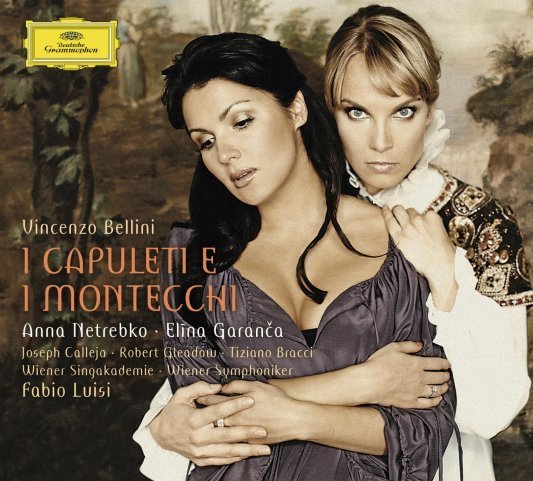
In 2009, a new recording was released featuring none other than Anna Netrebko and Elina Garanca in the leading roles. As Tebaldo, you will hear Joseph Calleja (DG 4778031), at the time a newname, now a famous tenor. Definitely worth listening to.
In the Dynamic box set (CDS 552/1-25) containing all Bellini’s operas (if you don’t already own it, go out and get it right away!), Julia is sung by Patricia Ciofi. What a singer! Not only does she hit all the notes and deliver all the witty remarks (and all “a punto”), she is also a particularlyconvincing voice actress. The recording was made in Martina Franca in 2005.
Patrizia Ciofi in “Oh! quante volte” from the production of I Capuleti e i Montecchi in Barcelona in 2016:
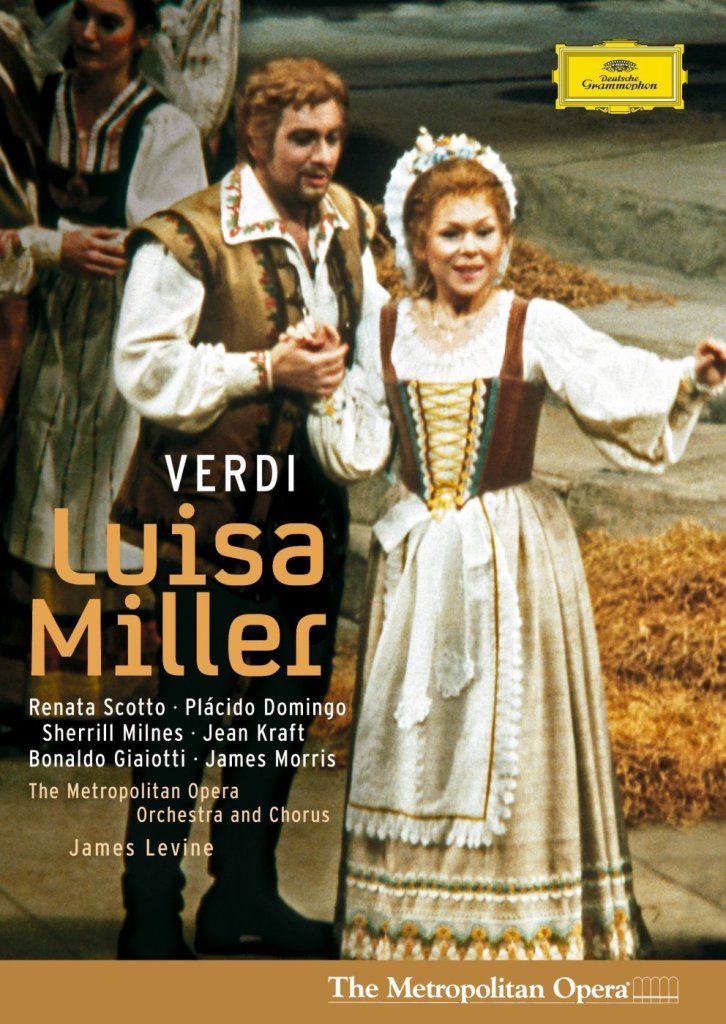
In 1979, Renata Scotto sang her first Luisa at the Metropolitan Opera and she did so with her usual devotion. But before she could start her first big aria, a ‘joker’ caused a scandal by shouting ‘brava Maria Callas’ at the top of his lungs.
Sherrill Milnes, here in the guise of Luisa’s father, took the emotional Scotto in his arms and so saved her concentration. And the performance. And the day.
All this was broadcast live on TV and thus it ended up on the pirate videos in circulation. I had been cherishing mine for years, and now the performance has been released on DVD by Deutsche Grammophon, with the necessary cuts, including that famous incident. A pity, but after all it is not about the incidents but about the opera and the performance. And there is absolutely nothing wrong with that.
Nathaniel Merrill’s staging is a bit old-fashioned and Domingo looks like hell with his blonde hair, but you quickly forget that because the singing and acting are of absolute top quality and maestro James Levine conducts masterfully (DG 0734027
In the video below, the main actors (Scotto, Domingo, Milnes and Levine) discuss Verdi’s opera and the 1979 production:
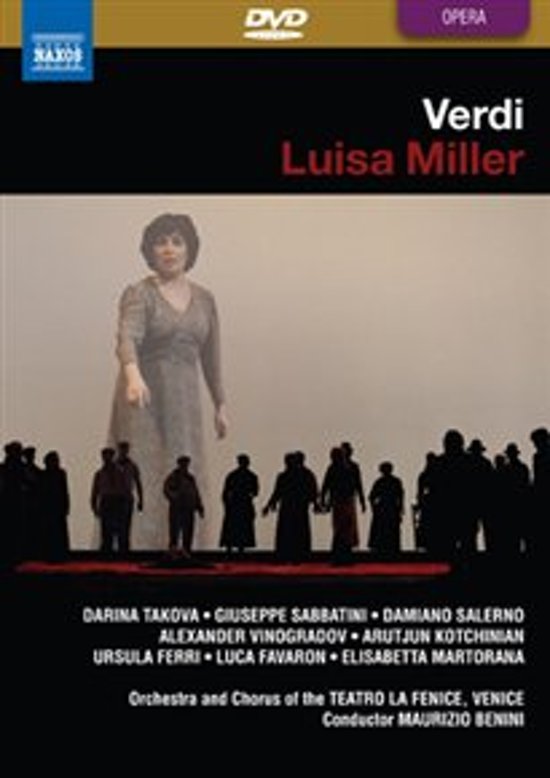
DARINA TAKOVA
For his production of Luisa Miller (originally performed at the Nationale Reisopera in 2004, recorded for this DVD in Venice in 2006), director Arnaud Bernard was inspired by Bertolucci’s Novocento. But the influence of the Italian neorealists is also unmistakably present.
Bernard situates the action in the Italian countryside in the 1920s, giving ample coverage not only of class divisions but also of rising fascism. The stage setting is abstract and apart from a few realistic props and metre-high photographs of women, the stage is almost bare.
Luisa Miller was the third of the four operas Verdi based on a play by Schiller. Like all his operas from his ˜middle period”, the work is bursting with wonderful arias and ensembles, and it possesses perhaps the most beautiful overture ever written – a challenge for conductors.
Mauricio Bennini is on fine form with the Teatro La Fenice’s orchestra, although I find his tempi a bit on the slow side at times.
The – mostly young – cast is fine, but I think Ursula Ferri is an irritating Frederica. Her voice is flat and wobbly and her acting is completely off.
Giuseppe Sabbatini (Rodolfo) has an old-fashioned beautiful, slender tenor with good top notes and Darina Takova is a moving, highly imaginative Luisa (Naxos 2110225-26).
“This is my best opera,” Giuseppe Verdi said after the premiere. And added that he “could probably never write anything so beautiful again”. That the “never” wasn’t completely correct, we know now, but at the time, some kind of electric shock must really have gone through the audience. Even now, more than 170 years after its premiere, Rigoletto continues to top the opera charts, as ever. I therefore sincerely wonder if there are any opera lovers left who do not have at least one recording of the ‘Verdi cracker’ on their shelves.
Design by Giuseppe Bertoja for the world premiere of Rigoletto (second scene of the first act)
Ettore Bastianini
My all-time favourite is a 1960 Ricordi recording (now Sony 74321 68779 2), starring an absolutely unmatchable Ettore Bastianini. His Rigoletto is so warm and human, and so full of pent-up frustrations, that his call for “vendetta” is only natural.
Renata Scotto sings a girlishly naïve Gilda, who is transformed into a mature woman by her love for the wrong man. She understands like no other, that the whole business of revenge can lead nowhere and sacrifices herself, to stop all this bloodshed and hatred.
Alfredo Kraus is a Duca in a thousand: elegant and aloof, courteous, yet cold as ice. Not so much mean, but totally disinterested and therefore all the more dangerous.
A sonorous Yvo Vinco (Sparafucile) and deliciously vulgar seductive Fiorenza Cossotto (Maddalena) are not to be sneezed at either, and the whole thing is under the inspired direction of Gianandrea Gavazzeni. Unfortunately, the sound is not too good, but a true fan will take it for granted.
Bastianini and Scotto in the finale:
Piero Cappuccilli
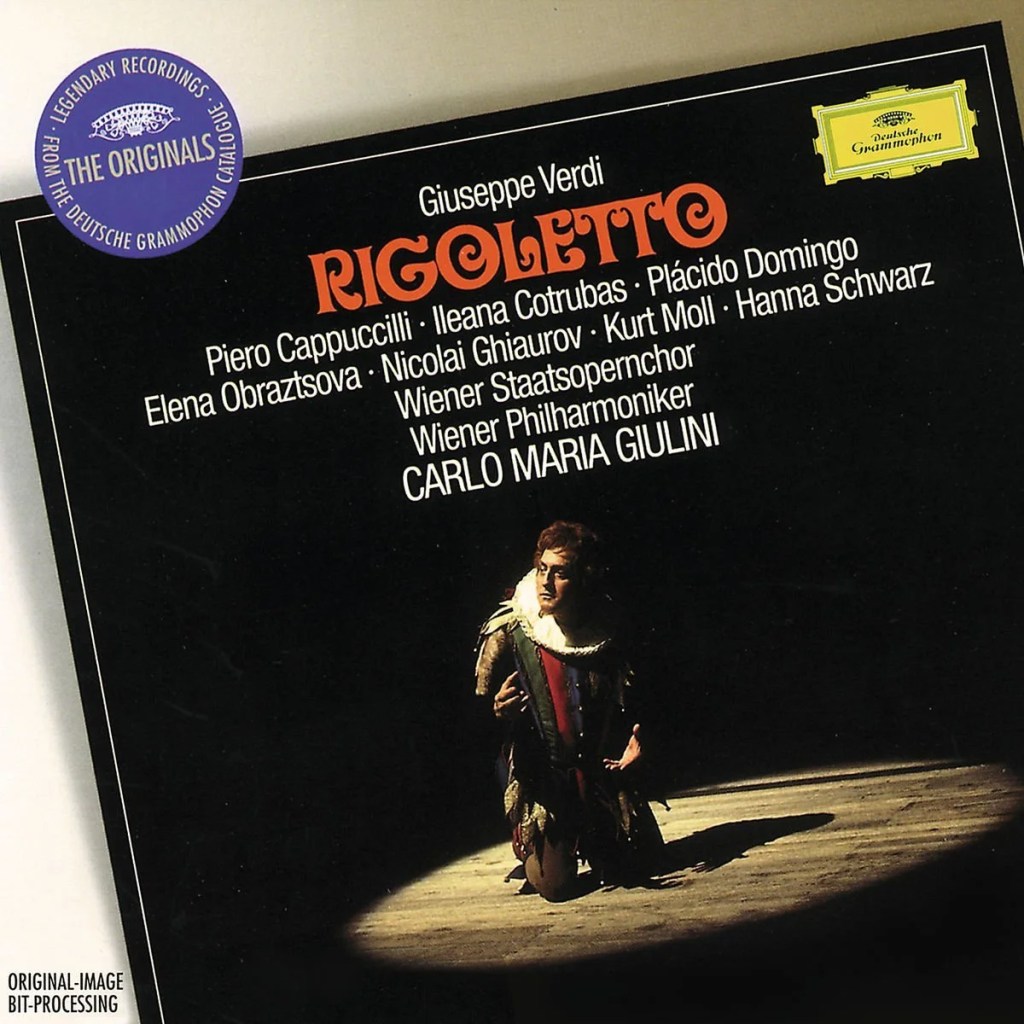
My other great favourite is the performance recorded in 1980 under Carlo Maria Giulini (DG 457 7532). Ileana Cotrubas is Gilda incarnate. She is not quite a vocal acrobat à la Gruberova, nor a wagging ‘canary’ like Lina Palliughi, decidedly less dramatic than Callas (rightly so, a Gilda is not a Leonora) and perhaps not as brilliant as Sutherland, but what empathy! What commitment! What an understanding of the text! Her Gilda, unlike Scotto’s, never grows old, and her sacrifice is a teenage girls’ own: senseless and pointless and so all the more moving.
The Duca is sung by Plácido Domingo, not really my favourite for the role, though there is nothing at all wrong with his singing. Piero Cappuccilli is a truly phenomenal Rigoletto, they don’t make ‘em like that anymore.
But we shouldn’t forget Giulini, because so lovingly as he handles the score that it couldn’t be more beautiful.
Tito Gobbi
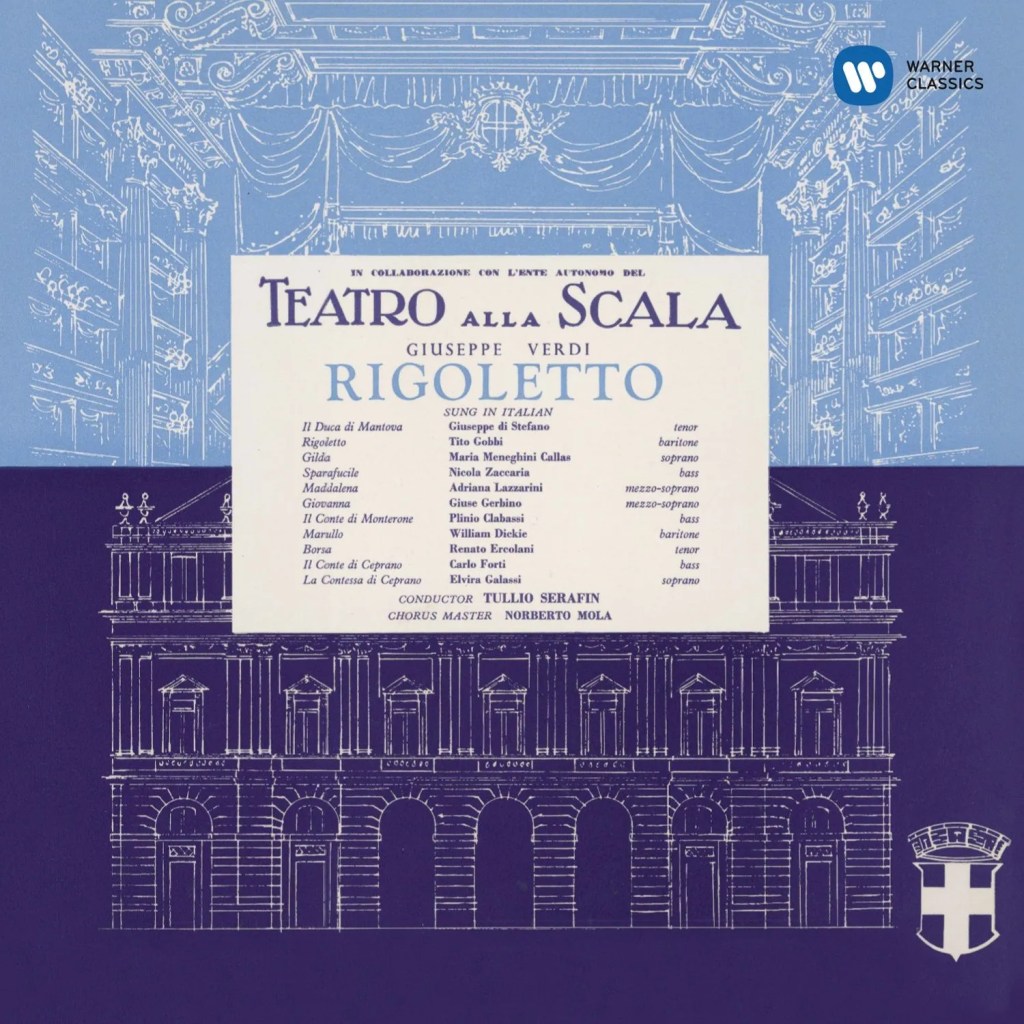
The 1955 recording with Maria Callas (Warner Classics 0825646340958) conducted by Tulio Serafin sounds pretty dull. Giuseppe Di Stefano is a pretty much perfect Duca: seductive macho, suave and totally unreliable. That his high notes in ‘Questa o Quella’ come out a bit squeezed, well… for this, he is forgiven.
Tito Gobbi is simply inimitable. Where else can you find a baritone with so many expressions at his disposal? This is no longer singing this is a lesson in acting with your voice! What you should also have the recording for is Nicola Zaccaria as Sparafucile. Unforgettable.
And Callas? Hmm. Too mature, too dramatic, too present.
Gobbi and Callas sing ‘Si, vendetta! Tremenda vendetta’
Sherrill Milnes
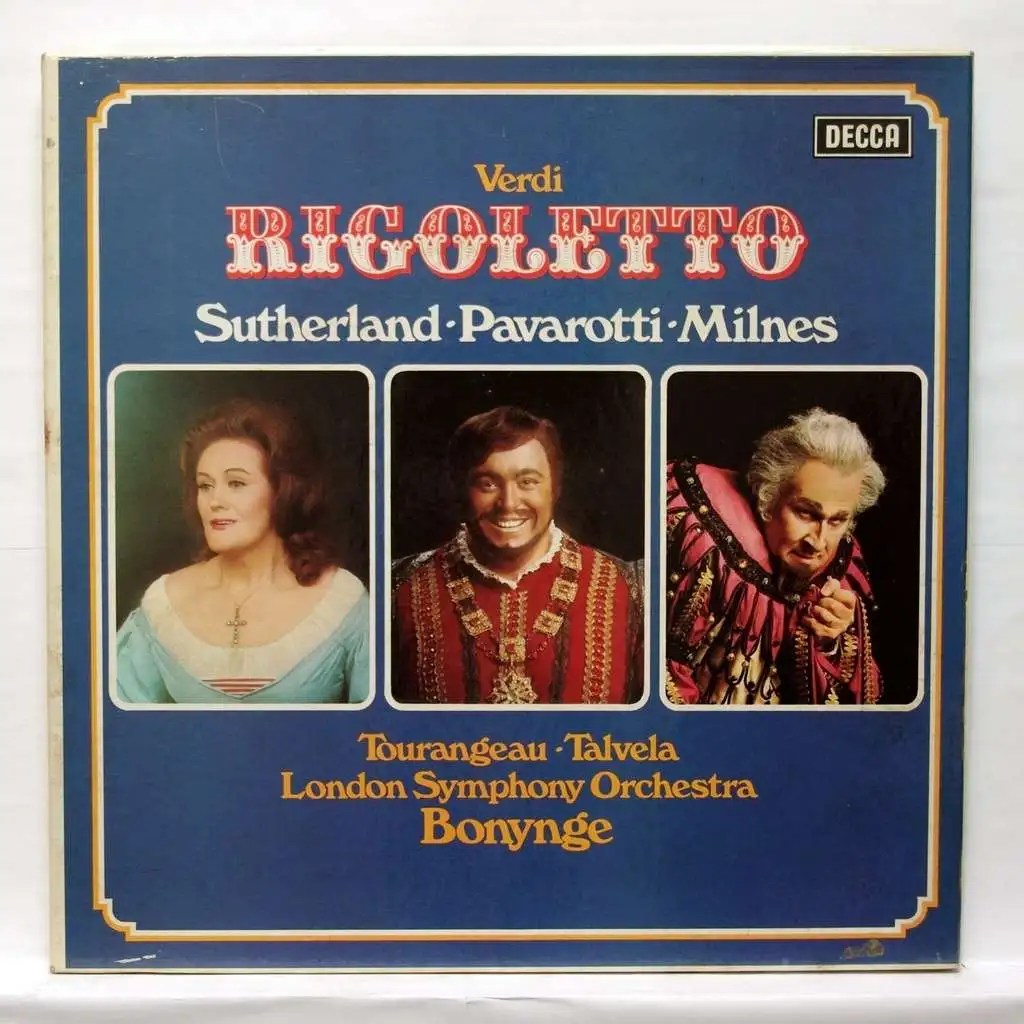
Joan Sutherland is a different story. Light voice, sparkling and indescribably virtuosic but a silly teenager? No.
Luciano Pavarotti is, I think, one of the best and most ideal Ducas in history. There is something appealingly vulgar in his voice that makes him sexually desirable which easily explains his several conquests.
Sherrill Milnes is a touching jester, who never wants to become a real jester: no matter how well he tries, he remains a loving father.
Matteo Manuguerra
Nowadays, hardly anyone knows him, but in the 1970s, Tunisian-born Manuguerra was considered one of the greatest interpreters of both bel canto and verismo.. And Verdi, of course, because his beautiful, warm, smooth-lined voice enabled him to switch genres easily.
Anyway, of course, you listen to this pirate recording (it is also for sale as a CD) mainly because of Cristina Deutekom. Just listen how, in the quartet ‘Bella figlia dell’amore’, she goes with a breathtaking portamento to the high D from the chest register. No one imitates her in that. For that, you take Giuliano Ciannella’s screaming and understated Duca at face value. The sound is abominably bad, but then again: are you a fan or not?
DVD’S
John Dexter
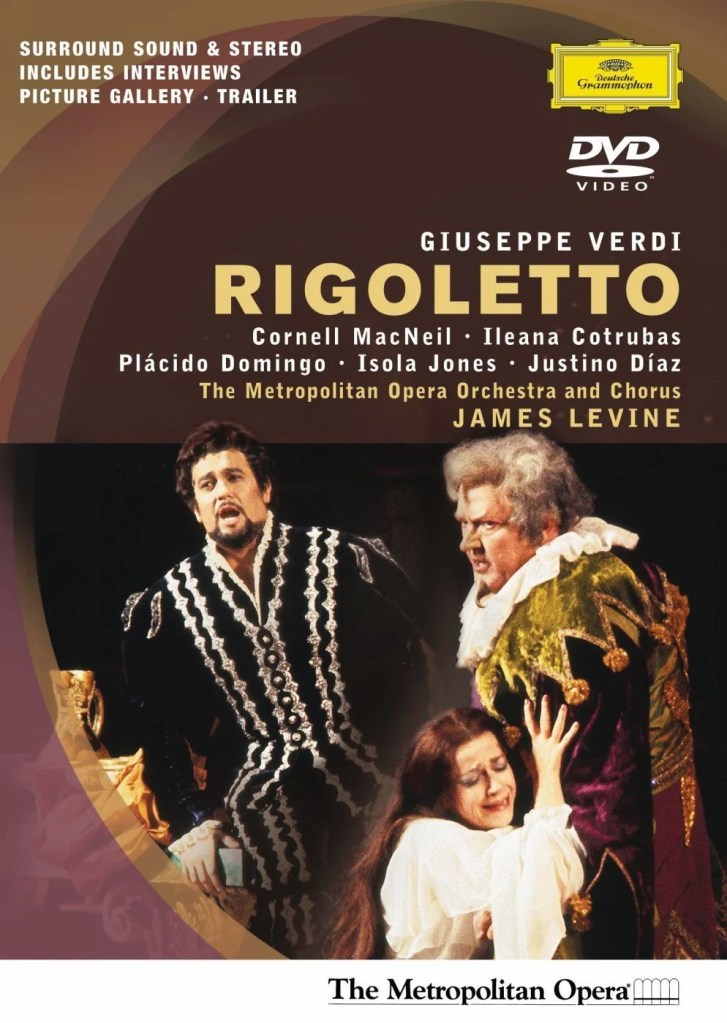
The 1977 production from the Metropolitan Opera (DG 0730939) is – of course – traditional. At first I had trouble with the close ups, which made all those stuck-up noses and thickly painted faces far too visible. But gradually I gave in to the beautiful direction and scenography which, together with the genuine 16th-century costumes, soon reminded me of Giorgione’s paintings. That this was indeed the intention was evident at the end, modelled on his ‘La Tempesta’, including the landscape and the sky drawn by lightning. But before it came to that, Rigoletto knelt with the dead Gilda (in blue, yes!) in his arms like Michelangelo’s “Pieta”, and I searched for a handkerchief because by now I had burst into tears.
Cornell MacNeil had his better days and started off rather false, but halfway through the first act, there was nothing wrong with his singing. And in the second act he sang just about the most impressive ‘Cortigiani’ I have ever heard, helped wonderfully by Levine’s very exciting accompaniment. Just watch how he pronounces the word ‘dannati’. Goosebumps.
It is an enormous pleasure to see and hear a young Domingo: tall, slim and handsome, and with a voice that audibly has no limitations, but…. As a Duca he goes nowhere. No matter how he tries his best – his eyes look cheerful and kind, and his lips constantly curl into a friendly smile. A “lover boy”, sure, but with no ill intentions. And he knows it himself, because he has sung that role very little. Actually, he hates Duca, at least so he says in an interview in a “bonus” to the Fragment from the second act:
Charles Roubaud
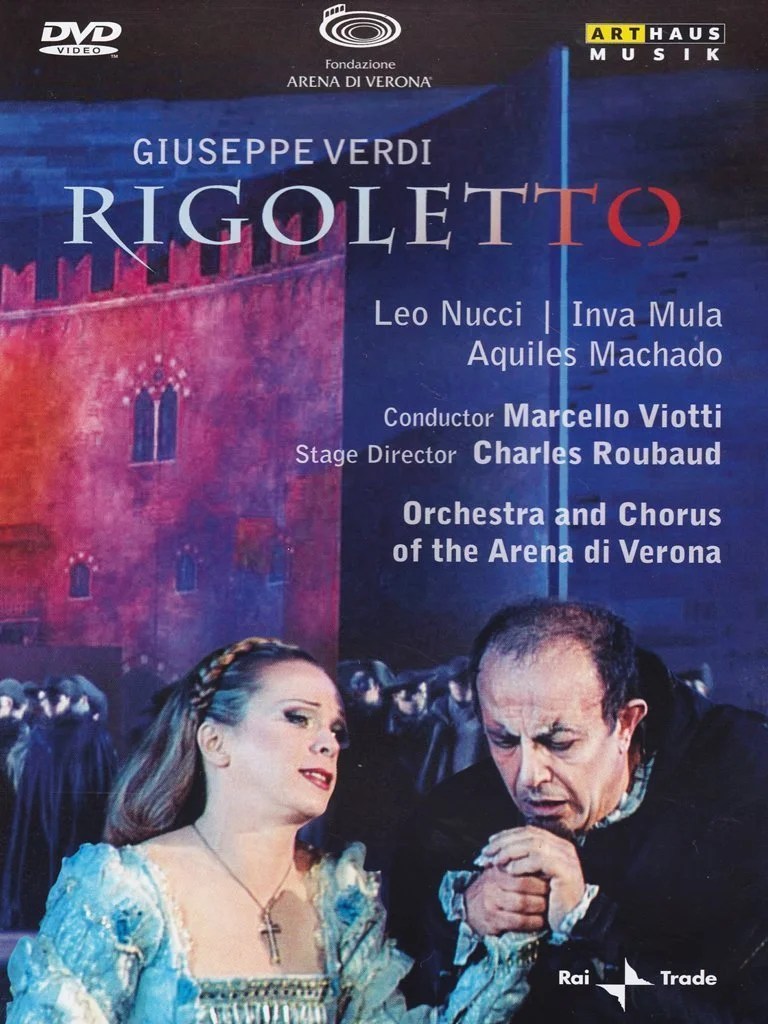
I heard a lot of good things about the performance at the arena in Verona in 2001. Reviews of the performances were rave, and people were also generally very positive about the DVD (Arthaus Musik 107096). So this will be just me, but I don’t like it.
The scenery is very sparse and looks very minimal on the large stage. It is still most reminiscent of cube boxes, but when the camera comes closer (and sometimes it comes too close!) they turn out to be walls, which close at the end in a very ingenious way – like a stage cloth, a nice invention though. The costumes are more or less okay, but I can’t find them brilliant either. And Rigoletto’s hunched back is downright ridiculous.
Leo Nucci is among the great Verdi baritones of our time but on the DVD his voice sounds anything but beautiful and in his first scenes he seems to be doing sprechgeang. Sure, his portrayal is certainly impressive, but I have seen him do better. The audience does enthuse, forcing him to encore ‘La Vendetta’ at the end of the second act.
It is not the last encore this evening: Aquiles Machado (Duca) also repeats with visible pleasure his, to my ears, roared-out ‘La donna e mobile’. It seems to be a tradition.
That he doesn’t look the part… well, he can’t help that. What is worse is that his Duca is nothing more than a silly macho man (what’s in a name?) and that his loud, in itself fine lyrical voice with solid pitch has only one colour.
Albanian Inva Mula really does her best to sing and look as beautiful as possible, and she succeeds wonderfully. All the coloraturas are there, as well as all those high notes. Her pianissimo is breathtaking, so there is nothing to criticise about that. But – it leaves me cold, because of how studied it sounds.
Marcello Viotti does not sound particularly inspired and his hasty tempi lead to an ugly ‘Cortigiani, vil razza dannata’, normally one of the opera’s most moving moments.
Leo Nucci and Inva Mula in ‘Si Vendetta’:
Gilbert Deflo
Sometimes I think that some opera directors have grown tired of all this updating and conceptualism and go back to what it’s all about: the music and the libretto. Such is the case with the Belgian Gilbert Deflo, who in 2006 in Zurich realised a Rigoletto that, were the story not too sad for that, would make you want to cry out for pure viewing pleasure (Arthaus Musik 101 283). He (and his team) created an old-fashioned beautiful, intelligent staging, with many surprising details and sparse but effective sets. The beautiful costumes may be of all times, but the main characters do not deviate from the libretto: the jester has a hunchback and the associated complexes, the girl is naive and self-sacrificing, and the seducer particularly attractive and charming.
Piotr Beczała, with his appearance of a pre-war film giant evokes (also in voice) reminiscences of Jan Kiepura. Elena Moşuc is a very virtuoso, girlish Gilda, and Leo Nucci outdoes himself as an embittered and tormented Rigoletto – for his heartbreakingly sung ‘Cortiggiani’ he is rightly rewarded with a curtain call.
Nello Santi embodies the old bel canto school, which one rarely hears these days.
Beczala, Nucci, Mosuc and Katharina Peets in ‘Bella Figlia del’amore’:
Michael Mayer
Times are changing and ‘director’s theatre’ has now also reached the New-York Metropolitan. They do not yet go as far as their European counterparts, but updating or moulding the libretto to a concept is now allowed.
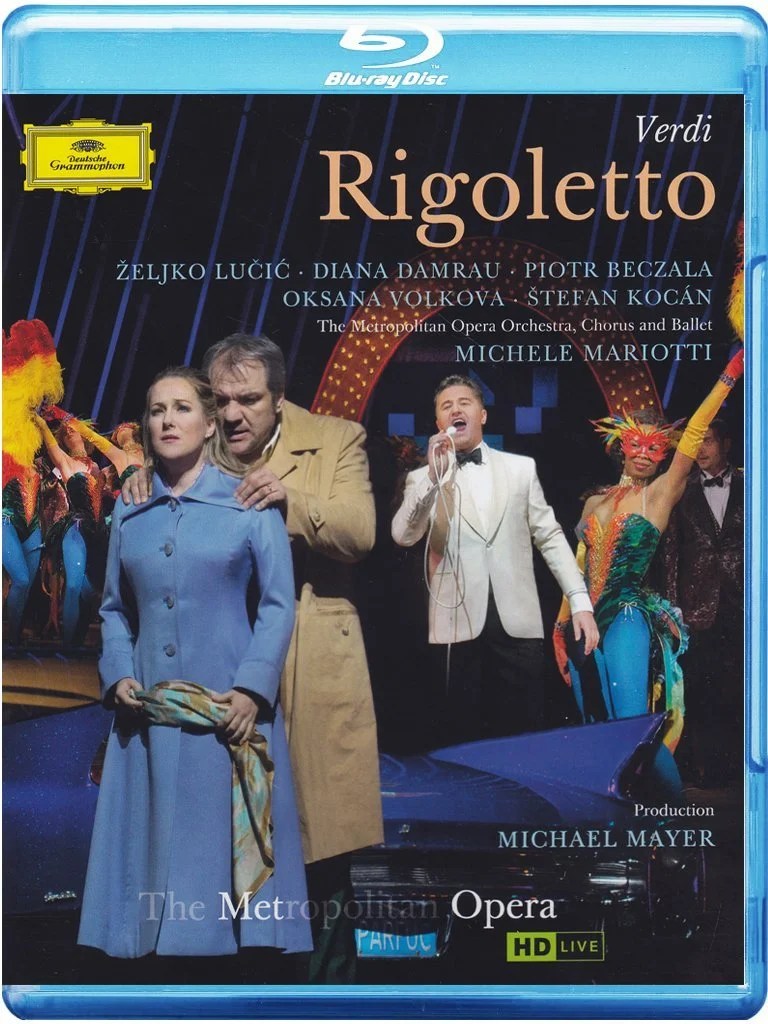
In 2013, Michael Mayer made it a “Rat Pack ‘Rigoletto'” set in 1950s Las Vegas in which Piotr Beczała (Duca), armed with a white dinner jacket and a microphone, is modelled on Frank Sinatra (or is it Dean Martin?). Beczała plays his role of the seductive entertainer for whom ‘questa o quella’ are more than excellent.
Piotr Beczała sings ‘Questa o quella’:
Diana Damrau remains a matter of taste: virtuoso but terribly exaggerated.
Zjeljko Lučić does not let me forget his predecessors, but these days he is undoubtedly one of Rigoletto’s best interpreters. The young bass Štefan Kocán is a real discovery. What a voice! And what a presence! The production is fun and engaging, but you cannot deny that you often have to look far for the logic.
‘La Donna e mobile’ in a minute and a half, sung by five tenors:
Victor Borge gives special treatment to ‘Caro Nome’:
For me an absolute ‘numero uno’ is the 1966 recording by EMI (now Warner 0190295735913) under Sir John Barbirolli. One might imagine a more lyrical or alternatively a more dramatic Cio Cio San; one with less metal in her voice or maybe one with a more childlike voice. But no other singer was able to grasp the complex nature of the girl so well and to characterise her change from a naive child into an adult woman, broken by immense grief, so impressively
CLARA PETRELLA
At number two on my list is a 1953 Italian Rai recording (Urania URN22.311) starring Clara Petrella. This terribly underrated soprano is a very dramatic Butterfly, with an intensity that just makes you ache on listening. Feruccio Tagliavini’s sweet, lyrica
l voice evokes an atmosphere of songs by Tosti: this is a Pinkerton to fall in love with.
VICTORIA DE LOS ANGELES
At number three, another oldie: a recording recorded by EMI in 1954 and now reissued on Regis (RRC 2070) featuring Victoria de los Angeles and Giuseppe di Stefano. De los Angeles is a Butterfly with a childlike warmth, brittle, fragile. Hurting her feels like hurting the Madonna herself. This is where Giuseppe di Stefano with his very macho tenor fits wonderfully.
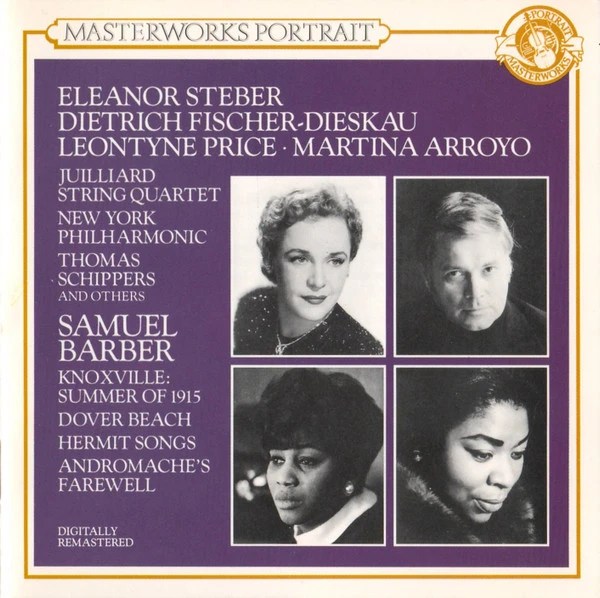
‘Knoxville, Summer of 1915’, is, apart from Adagio, perhaps the best-known work by the American tone poet Samuel Barber, who is still being blatantly and infamously neglected in the Netherlands.
Barber composed the piece after James Agee’s prose poem in 1947, when his father was on his deathbed. The nostalgia and wistfulness, the longing for the old days, for the time when you were a child and everything was taken for granted, all that immediately appealed to him. But there was more. Agee, who was more or less a peer of Barber’s, wrote the poem in memory of his own father who had died in a car accident in 1916, after which the family left Knoxville, never to return.
‘Knoxville, Summer of 1915’ was first performed by Eleanor Steber in 1948, after which the song would remain attached to her name for a long time, despite renditions – brilliant at times – by many leading sopranos such as Leontyne Price, Dawn Upshaw and Roberta Alexander.
Eleanor Steber:
Leontyne Price
Renée Fleming also has included the song in her repertoire. She recorded it in 2016 for Decca, with the Stockholm Philharmonic Orchest onder hun Finse dirigent Sakari Oram
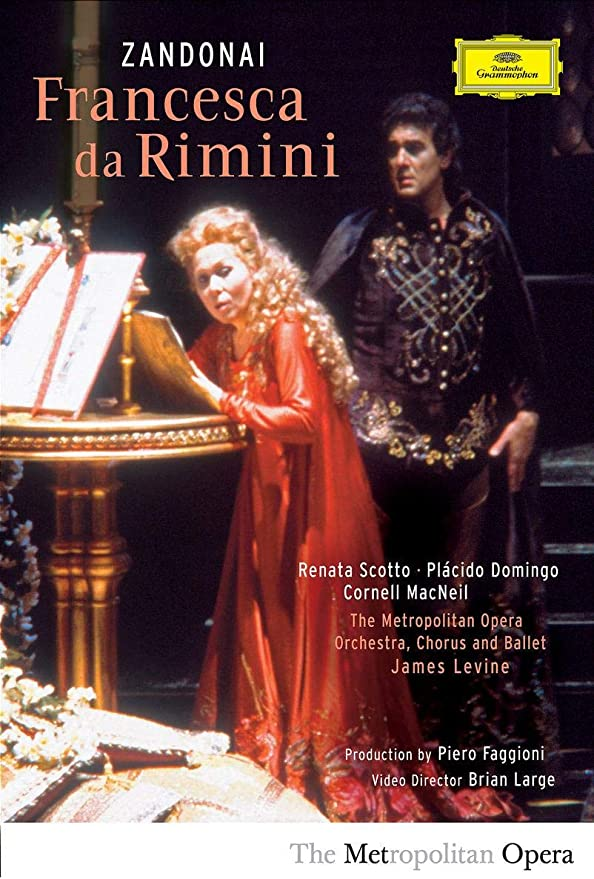
Plácido Domingo heeft een enorme staat van dienst in de Metropolitan Opera en vertolkte daar vele rollen uit het ijzeren repertoire. Maar daar bleef het niet bij, in 1984 stond de befaamde tenor op het toneel als Paolo in Zandonai’s weinig gespeelde opera Francesca da Rimini.
Dit werk ging in 1914 in première en heeft sindsdien een leven in de luwte geleid. In New York was de opera elfmaal te zien tijdens het seizoen 1916-17. Daarna zou het tot 1984 duren vooraleer de Met het opnieuw probeerde, met twee wereldsterren als het gedoemde liefdespaar: Renata Scotto en Placido Domingo. Een opname uit die reeks is op dvd uitgebracht door DG.
Het verhaal van Francesca da Polenta en Paolo Malatesta is gebaseerd op personages uit de 13e eeuw. Paolo, bijgenaamd Il bello, wordt naar Francesca gestuurd als huwelijksmakelaar voor zijn oudere broer, de weinig aantrekkelijke manke Giovanni. De twee worden op slag verliefd en beginnen een affaire. Ze worden echter ontmaskerd door Malatestino, de jongste broer van het stel en die zorgt ervoor dat Giovanni het koppel in flagrante weet te betrappen. Beiden worden samen aan het zwaard geregen en sterven in hun laatste omhelzing.
Francesca wordt wel de Italiaanse Tristan genoemd. Ook hier de aantrekkelijke jonge man die een bruid moet werven voor een onaantrekkelijke partij. Giovanni in de rol van Marke en Malatestino als Melot. Saillant detail is echter dat in de literatuur geen nadrukkelijk moreel oordeel over die liefdesrelatie wordt geveld. Dit in tegenstelling tot die van Francesca en Paolo, met dank aan Dante en zijn Goddelijke Komedie. Dante plaatst het tweetal in Canto 5 in de Tweede Kring van de hel, op zich ver verwijderd van Canto 34 in de Negende Kring waar Lucifer te vinden is, maar evengoed in de hel. Het is de straf voor diegenen die zich niet hebben kunnen beheersen en zich overgaven aan wellust. In een wervelende wind is het liefdespaar voor eeuwig aan elkaar gekoppeld, ze delen het verblijf in de hel. Daarmee vergeleken is het aardse huwelijk een korte flirt. Een plekje in het Purgatorio zou ons vandaag de dag voor Francesca wat meer geëigend hebben geleken.
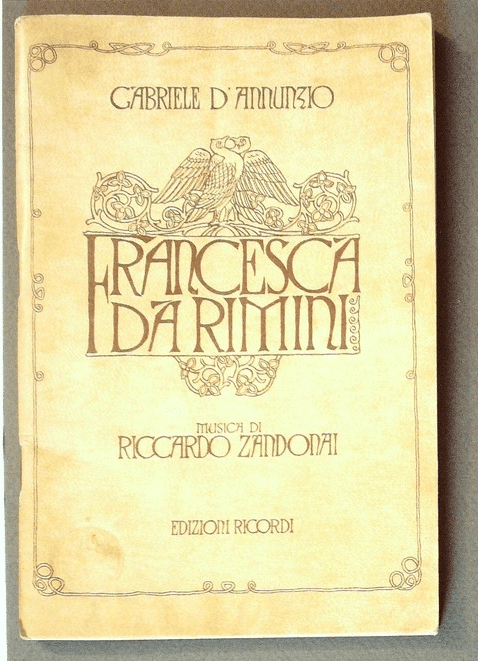
Francesca heeft vele componisten geïnspireerd tot het schrijven van een opera. Als ik goed heb geteld was die van Zandonai nummer 26. Zijn librettist Tito Ricordi baseerde zich op een toneelstuk van Gabriele d’Annunzio waarbij hij zich vooral concentreerde op de liefdesaffaire van de protagonisten. Bij Ricordi komt Paolo er een stuk slechter af dan Francesca. Eerst bedriegt hij haar om zijn oudere broer een dienst te bewijzen en vervolgens dringt hij zich zo aan haar op, zonder acht te slaan op smeekbeden haar met rust te laten, dat ze door de knieën gaat. Francesca valt weinig te verwijten, ze heeft zich tot het uiterste tegen zijn avances geweerd. Paolo verdient eerder een plek in de Achtste Kring, ergens in Canto 18 of 23, in elk geval de straf voor bedrog en verleiding.
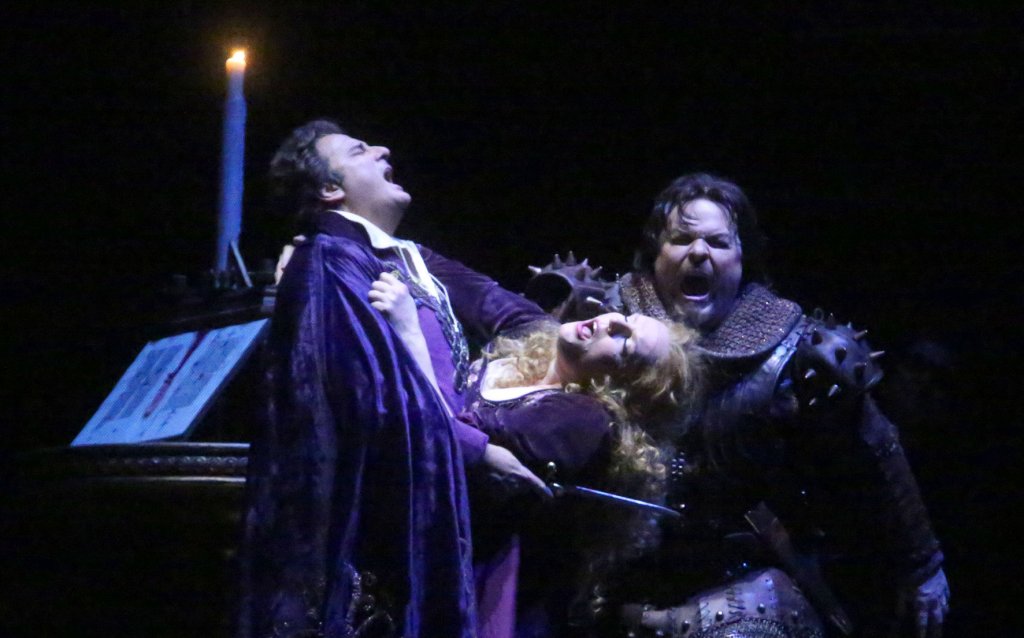
Francesca da Rimini’s Act II battle between the Guelphs and the Ghibellines, with Paolo, Gianciotto and Malatestino on the ramparts and Francesca below (Plácido Domingo as Paolo, Cornell MacNeil as Gianciotto, William Lewis as Malatestino and Renata Scotto as Francesca
De productie van Pierro Fagioni is overdadig en verzuipt bijna in de naturalistische details. De kostumering is een parade van laat middeleeuwse clichés. In de tweede akte zien we een groot aantal figuranten die de belegering van het slot van de Malatesta’s aanschouwelijk moeten maken. Hier spreken van een librettogetrouw kostuumdrama is bijna een eufemisme.
De cast is goed verzorgd, over de volle breedte. Van de hofdames en de intriganten tot de drie broers Malatesta en hun gemeenschappelijk liefdesobject Francesca, immers Malatestino is ook verliefd op haar. Nicole Lorange heeft een aardig optreden in de eerste akte als het jongere zusje Samaritana die bij Francesca op de kamer slaapt, het zijn duidelijk nog tieners die twee.
Isola Jones is een prachtige Smaragdi, in beeld en geluid. Een echte eyecatcher die als Francesca’s huisslavin door haar relatief eenvoudige kledij veel overtuigender overkomt dan al die opgetutte vrouwen om haar heen.
Bariton Cornell Macneil als Giovanni is een griezelige potentaat, je begrijpt direct dat alleen bedrog een huwelijk met de jonge mooie Francesca mogelijk heeft kunnen maken. Iets waar overigens beide families volledig aan mee hebben gewerkt. Zijn zang is dienovereenkomstig, overheersend en bedreigend. Hij doodt zijn broer Paolo en krijgt vermoedelijk van Dante een plaatsje in de Zevende Kring.
Het liefdespaar komt zoals gezegd voor rekening van Scotto en Domingo. Scotto gaat voluit in haar poging een geloofwaardige Francesca op het toneel te zetten maar ik kan er niet echt van onder de indruk raken. Domingo weet zich beter raad met de rol van de verliefde jongeman die net als Tristan het daglicht ziet als zijn vijand en het liefst alleen nog maar ’s nachts wil leven. Er zit zeker in de vierde akte erg veel Tristan in het libretto, het is bijna een commentaar op Wagners verhaal. Goed beschouwd is Domingo’s optreden de enige reden om deze opname nog eens te bekijken.
De muzikale leiding is zoals gebruikelijk in handen van James Levine.
Finale:
Voor wie dit op prijs stellen: 10 beste Francesca’s op een rijtje althans volgens Opera News
First of all, my apologies: this year I have hardly posted any new reviews. This was for personal reasons
I was forced to limit myself to translations but I did a lot of portraits of singers who deserved to be featured again.
Renata Scotto had her birthday on 24 February
Renata Scotto, ‘la mia Divina Assoluta’ made her opera debut at the age of eighteen as Violetta (La Traviata). Her ‘official’ debut was the next day in Milan. Shortly afterwards, she sang Madama Butterfly in Savona.
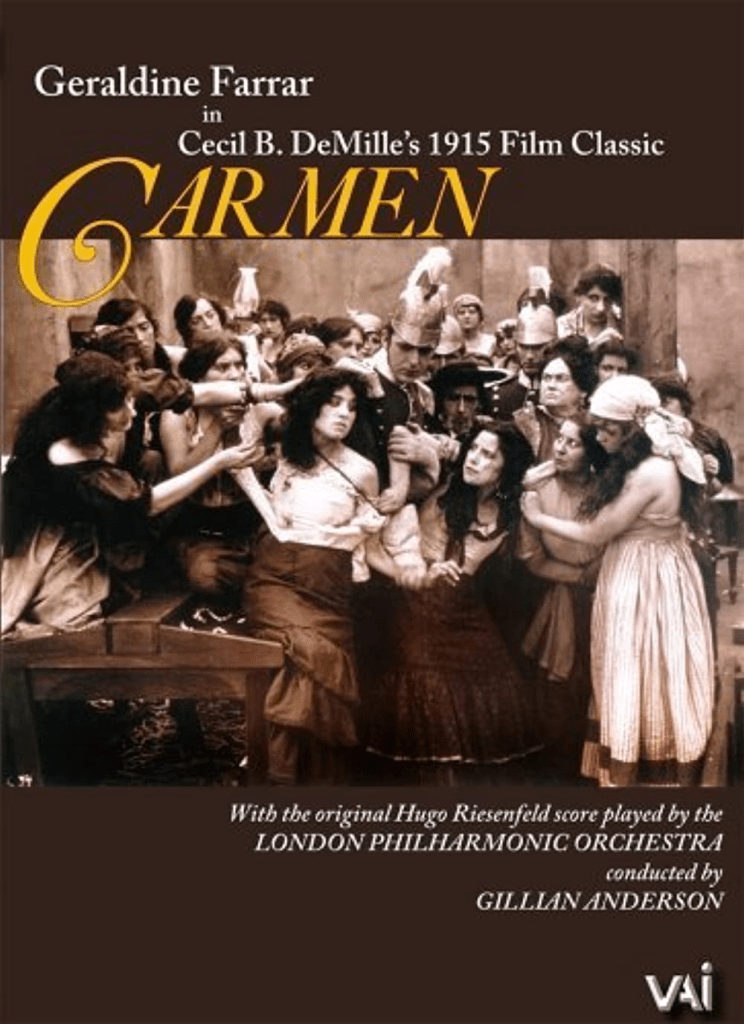
In 1915, Cecil B. DeMille filmed the opera again, this time with Geraldine Farrar as the man-eating gypsy. Now, Farrar was not only one of the greatest sopranos and MET legends of the early 20th century, her beautiful appearance and excessive acting talent also enabled her to build a career as a Hollywood actress.
Beverly Sills was born in Brooklyn as Belle Miriam Silverman. Her parents were Jewish immigrants from Odessa and Bucharest. As a child, she spoke Yiddish, Russian, Romanian, French and English. Although she had an enormous repertoire, that ranged from Handel and Mozart to Puccini, Massenet and Verdi, she was best known for her interpretations of coloratura soprano roles. Her radiant high D’s and E-flats sounded seemingly effortless and natural.
Scuderi sang in the most important theatres of the day, both in Italy and abroad, most notably in the Netherlands! She had a contract at La Scala where she received high praise for her interpretations of the most well-known operas.
High coloratura soprano is one of the most admired voice types. It’s only logical, because what these ladies do falls a bit into the category of “nightingale on a trapeze”.
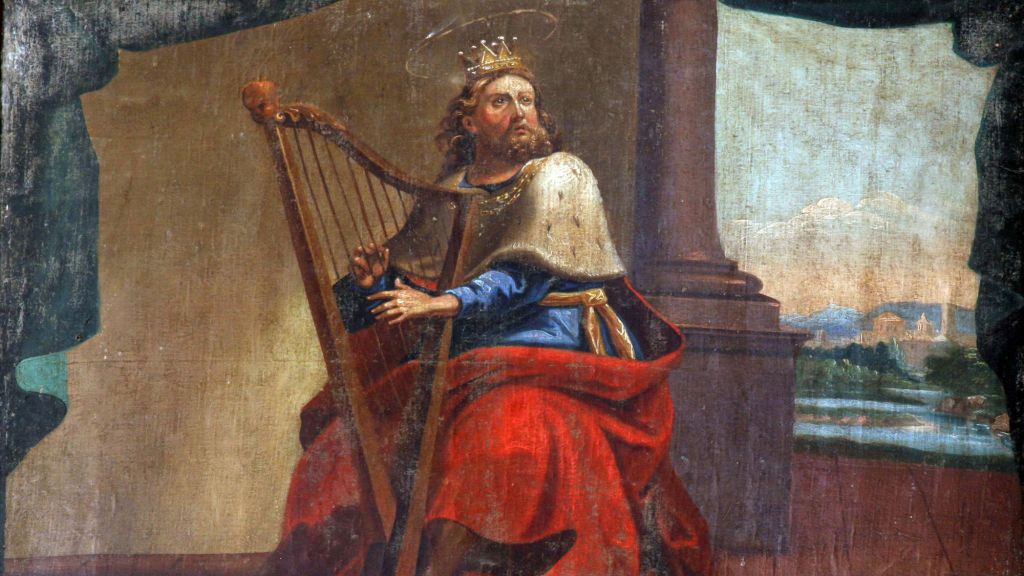
But, but…. I made an article about King David and music
King David…. One of the Bible’s most inspiring and appealing personalities. But did he really exist? We live in a time when all sorts of things are being doubted, and that is alright.
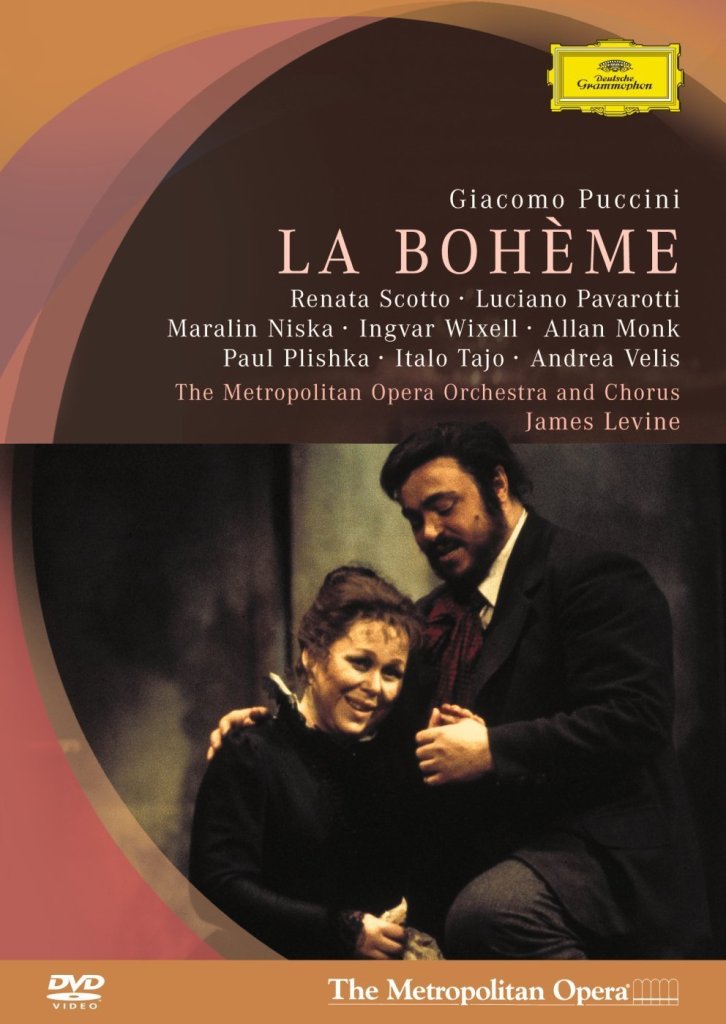
Many opera lovers will probably agree on one thing: one of the best Bohèmes ever is the 1973 version recorded by Decca under von Karajan. With Mirella Freni and Luciano Pavarotti.
Rodolfo has always been Pavarotti’s calling card. For years he was considered the best interpreter of the role – his fantastic legato, the smoothness and naturalness with which he sang the high notes are truly exemplary. Incidentally, as befitted a typical Italian tenor of the time, he sang the end of “O soave fanciulla” at the same height as the soprano. Not prescribed, but it was tradition!
Freni was undoubtedly one of the most beautiful Mimi’s in history. Tender and fragile, with her heartbreaking pianissimi and legato arches she managed to move even the greatest cynics to tears.
Von Karajan conducted theatrical and passionate way, with ample attention to the sonic beauty of the score. As the Germans would say “das gab’s nur einmal.”
In 2008 we celebrated not only Puccini’s 150th birthday, but also von Karajan’s 100th. Moreover, it was 35 years since the famed conductor recorded La Bohème: a cause for celebration! And lo and behold – Decca has released the opera in a limited deluxe edition (Decca 4780254). On the bonus CD, Mirella Freni talks, among other things, about her relationship with von Karajan and about singing Puccini roles. It is really fascinating.
Arias and duet from the first act:
Mirella Freni made her debut as Mimì at the Metropolitan Opera in September 1965. Her Rodolfo was another debutant: the (how unfair!) nowadays almost completely forgotten Italian tenor Gianni Raimondi. For me, he is preferable to Pavarotti. I find his voice more pleasant and elegant. And he could act! Freni’s and Raimondi’s renditions were captured on a wonderful film, directed by Franco Zeffirelli and conducted by Herbert von Karajan. An absolute must (DG 0476709).
“O Soave Fanciulla” with Freni and Raimondi:
Renata Scotto
History was made with La Bohème from the Met in 1977 (DG 0734025): it was the very first direct transmission from the New York opera house on TV. The production was in the hands of Pier Luigi Pizzi, who at that time was not yet obsessed with excessive ballets and the colour red.
Although I was never a big fan of Pavarotti, I cannot deny that he produces a fresh sound here and that his high notes stand like a house. Acting was never his cup of tea, but here he does the best he can.
It becomes really exciting when Mimì enters: in 1977, Renata Scotto was at her unprecedented peak. She spins the most beautiful pianissimi and her legato and mezza voce are so beautiful they make you want to cry. The rest of the cast is no more than adequate, but the young James Levine conducts as if his life depended on it!
Scotto sings ‘Si mi chiamano Mimì’:
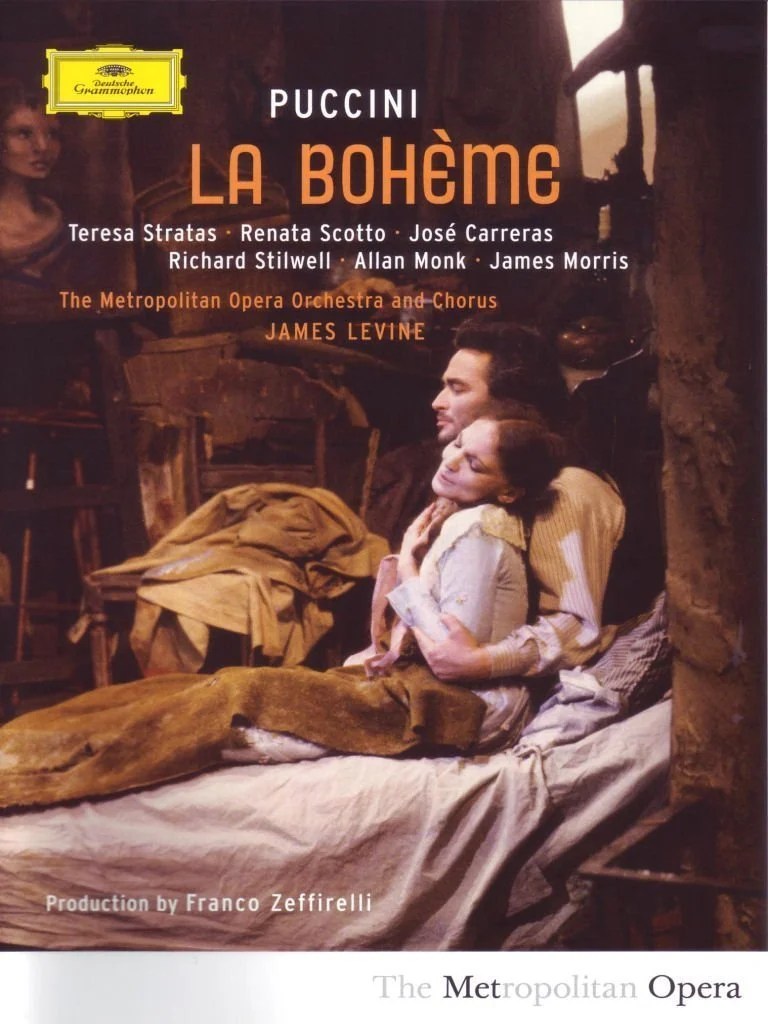
Musetta was not really a role with which we associate Scotto. Neither did she herself, but she accepted the challenge with both hands. In the Zeffirelli Met production of 1982, she sang a Musetta to die for. Alongside the very moving José Carreras and Teresa Stratas, she was the undisputed star of this recording (DG 073 4539 9).
Scotto as Musetta:
Cristina Gallardo-Domâs
Sometimes I wonder how perverse it is when people pay a lot of money to go see, dressed in fur coats, the misery of freezing poor artists?
I myself took great pleasure in the sight of all those fur-wearing audiences on my way to a performance of La Bohème at La Scala in 2003 (Arthouse 107119). The then 40-year-old Zeffirelli production was altered a bit, but the beautiful, realistic sets and brilliant lighting remained the same. The snowflakes, the light radiating from the inn that warmly colors the white earth, the snowy bench and Mimi’s tear-stained face: there is something magical about it all and it is more like a movie than a performance in the theater. It cannot leave you unmoved, all the more so because all the protagonists are truly superb.
Cristina Gallardo-Domâs is a delicate, emotionally torn Mimì. Her lyrical soprano is a bit reminiscent of Freni. Malcero Ãlvarez convinces with a (then still) beautifully lyrically sung Rodolfo and Hei-Kyung Hong, clearly inspired by Scotto, portrays a kitschy Musetta. Bruno Bartolletti conducts lively, without shying away from sentiment.
Below, ‘O soave Fanciulla’ with Gallardo-Domâs and Ãlvarez
Gallardo-Domâs was also present in Zurich two years later. With this very realistically staged Bohème, Philippe Sireuil made a thunderous debut at the Zürich Opera House (EMI 3774529). Don’t expect Zeffirelli-like scenes with snowflakes drifting down, however.
Sireuil’s conception is very “down to earth” and as such more veristically faithful than any other production known to me. With great love of detail, he draws the lives of the foursome of artist friends: their attic is tiny and stuffy, and their struggle to better themselves is life-like. The costumes (second-hand clothing from thrift stores) is contemporary, yet timeless at the same time.
Whatever Mimì is suffering from (it is surely not tuberculosis – the director doesn’t even allow her to cough) doesn’t really matter, although it seems to be drug related. Like a sick bird (how much she resembles Edith Piaf!) she slowly slides into the abyss, and her death forces the others to really think, for the first time. The third act, set at a gloomy train station, is particularly strong and painfully poignant.
The entire cast, headed by a movingly beautiful Marcello Giordani and a very virile Michael Volle (Marcello) in addition to the heartbreaking Gallardo-Domâs, is also outstanding. The much lamented László Polgár sings Colline. Believe me: this La Bohème is really not to be missed.
Below, Marcello Giordani and Michael Volle in ‘Marcello finalmente:
Cheryl Barker
Back in time a little, to Sydney, Australia, 1993. For the first time I saw the production on TV (yes, kids: once upon a time there were the days when an opera was simply broadcast live from an opera house on TV!) and not soon will I forget that night. I didn’t know any of the singers; it was the name of the director (Baz Luhrmann) that drew my attention to the production.
The singers were mostly young – a plus, since the opera is about young people in love. They could sing, too, and with their looks of real movie stars, they could have been on the movie screen. Strange really, that, apart from Cheryl Barker (Mimì), no one had a great career. That Luhrmann was obsessed with opera is also confirmed by the film buffs: his Moulin Rouge is a direct look alike , including the red-lit “L’amour” on the rooftop. (Arthaus Musik 100 954)
Scene from the production:
Ileana Cotrubas
But, hand on heart, if I had to go through life with only one recording of La Bohème … I would choose John Copley’s 43-year-old production made for the Royal Opera House.
My “desert island recording” was captured on DVD in 1983 by NVC Arts (Warner 4509 99222-2) and – no matter how many times I watch it, I never get tired of it. And still, after all those years, it always makes me cry. Some things never age.
Neither does the cast : Ileana Cotrubas as my beloved Mimì, the irresistible young Neil Shicoff as Rodolfo and Thomas Allen as a very erotic Marcello.
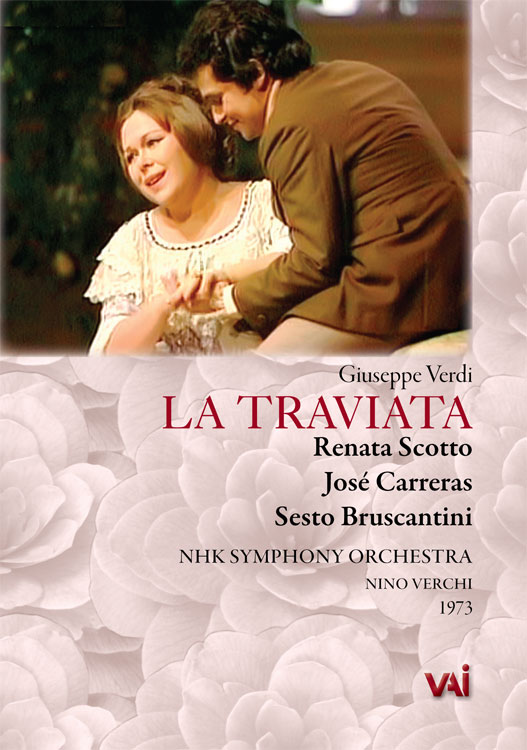
Don’t think that in the old days, when everything was done by the book, the performances were static and boring! In 1973, La Scala was on tour in Japan, and there, in Tokyo, a legendary performance of La Traviata was recorded (VAI 4434).
The leading roles were played by the then still ‘curvy’ Scotto and 27-year-old (!) José Carreras. DVD does not mention the name of the director, perhaps there was none, and the singers (and the conductor) did it all themselves? Anyway, the result is really beautiful, moving and to the point. I am not going to say any more about it, because this recording is an absolute must for every opera lover.
Finale of the opera:
L’ELISIR D’AMORE 1976
My beloved CD recording of L’elisir is live and, to be honest, far from perfect (Legato Classics LCD 218-2). Yasuko Hayashi is only so-so as Adina, she is no more than average and the use of her voice is too heavy.
But the men! José Carreras is a dream of a Nemorino – silly and hopelessly in love. On him the potion is actually well spent, it really makes him happy and elated.
Geraint Evans is a delightful Dulcamara, more than a bit exaggerated, but entirely in the spirit of the character. Thomas Allen is a very potent Belcore and the Covent Garden orchestra and choir are very spiritually and engagingly conducted by John Pritchard.
The recording (London, 1976) sounds fine. As a bonus, we get a recital that Carreras gave at Carnegie Hall 30 November 1980, on which he also sings some lesser-known arias and songs, including parts from Leoncavallo’s Lady Chatterton and Rossini’s Pietra del Paragone.
SIMON BOCCANEGRA 1977
In 1971, Claudio Abbado conducted a magisterial and now legendary performance of Boccanegra at La Scala. It was directed by Giorgio Strehler and the beautiful sets were designed by Ezio Frigerio. In 1976, the production was shown at the ROH in Covent Garden. Unfortunately, no official (there are ‘pirates’ in circulation) video of it was made, but the full cast did fortunately go into the studio, and thus the ultimate ‘Simone’ was recorded in 1977 (DG 4497522).
Abbado treats the score with such love and such reverence as if it were the greatest masterpiece of all time, and under his hands it really does transform into a masterpiece without parallel. Such tension, and with all those different nuances! It is so, so beautiful, it will make you cry. The casting, too, is the best ever. Piero Cappuccilli (Simon) and Nicolai Ghiaurov (Fiesco) are evenly matched. Both in their enmity and reconciliation, they are deeply human and always convincing, and in their final duet at the end of the opera, their voices melt together in an almost supernatural symbiosis:
Before that, they had already gone through every range of feeling and mood, from grievous to hurtful, and from loving to hating. Just hear Cappuccilli’s long-held ‘Maria’ at the end of the duet with his supposedly dead and now found daughter (‘Figlia! A tal nome palpito’).
José van Dam is an exquisitely vile Paolo and Mirella Freni and Jose Carreras are an ideal love couple. The young Carreras had a voice that seems just about created for the role of Adorno: lyrical with a touch of anger, underlining Gabriele’s brashness. Freni is more than just a naive girl; even in her love for Adorno, she shows herself to be a flesh-and-blood woman
HERODIADE 1984
This recording also may only be obtained via a pirate (or You Tube), but then it is complete and moreover with (admittedly bad) images!
Dunja Vejzovic portrays a deliciously mean Hérodiade and Juan Pons is a somewhat youthful but otherwise fine Hérode. A few years later, he will become one of the best “Hérodes” and you can already hear and see that in this recording.
Montserrat Caballé is a fantastic Salomé, the voice alone makes you believe you are in heaven and José Carreras is very moving as a charismatic Jean.
Below, Carreras sings ‘Ne pouvant réprimer les élans’:
None of the protagonists is really idiomatic, but what a pleasure it is to watch a real Diva (and Divo)! They really don’t make them like that any more
The whole opera on you tube:
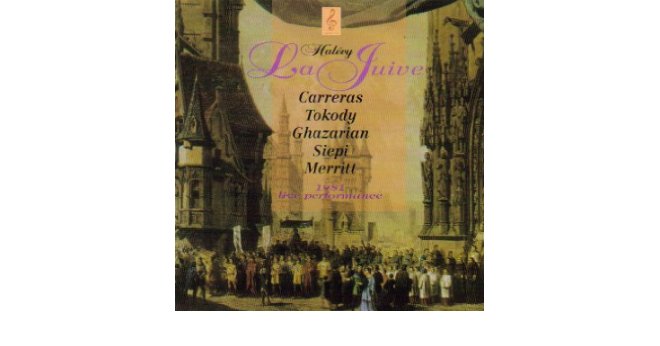
LA JUIVE Vienna 1981
I have never been able to understand why José Carreras added the role of Éléazar to his repertoire. It did fit in with his desire to sing heavier, more dramatic roles. Roles that were one size too large for his beautiful, lyrical tenor. Which absolutely does not mean that he could not sing the role! He succeeded quite nicely and the result is more than worth listening to, but he doesn’t sound truly idiomatic.
In the live recording from Vienna 1981 Carreras also sounds too young (he was only thirty-five then!), something that is particularly noticeable in the Seider-evening scene. It is sung beautifully, but due to a lack of weight he tends to shout a bit.
José Carreras sings ‘Rachel, quand du Seigneur’.
Ilona Tokody is a Rachel of a Scotto-like intensity (what a pity she never sang the role onstage!) and Sona Ghazarian sings an excellent Eudoxie.
LA JUIVE Studio recording 1989
La Juive, recorded by Philips in 1989, marked the first studio recording Carreras made after his illness. His voice was now less sweet and smooth than before, but sounded much more alive, which improved his interpretation of the role.
Julia Varady is a beautiful Rachel, perhaps one of the best ever and Eudoxie is in excellent hands with June Anderson.
Dalmacio Gonzales is a more than decent Léopold, in any case much better than Chris Merrit and the French-American-Portuguese conductor Antonio de Almeida shows he has a real affinity with the opera. (Philips 475 7629)
LA BOHEME Metropolitan Opera New York 1982
Musetta was not really a role with which we associate Scotto. Neither did she herself, but she accepted the challenge with both hands. In the Zefirelli Met production of 1982 alongside the very moving José Carreras and Teresa Stratas La_Juive
SimonIlona_she sang a Musetta to die for. (DG 073 4539 9).
TURANDOT 1983
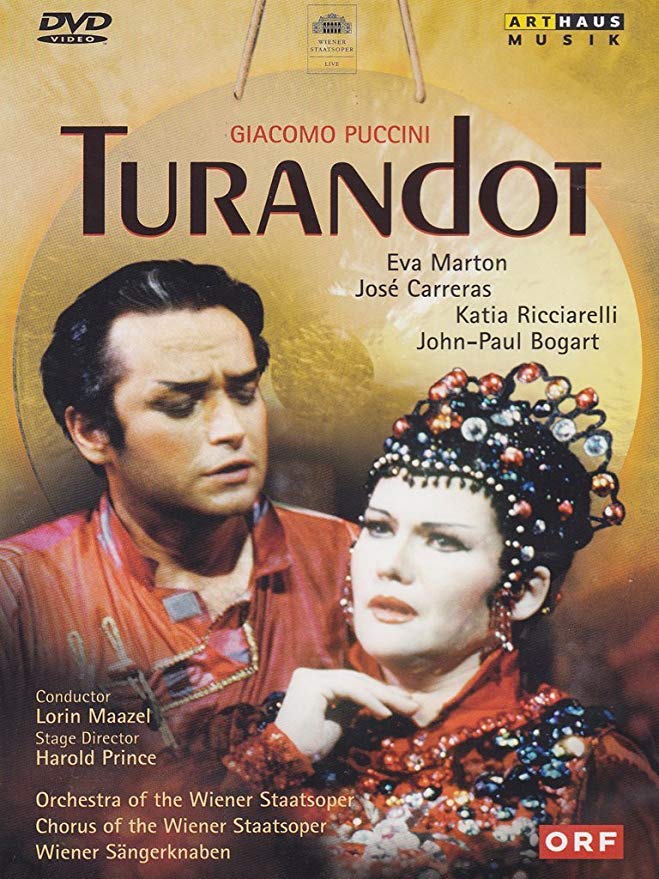
Harold Prince, with no less than 21 Tony Awards to his name, one of the biggest (if not the biggest) musical producers/directors, tackled ‘Turandot’ (Arthaus Musik 107319) in 1983, with very impressive results. He created a world of illusion ruled by fear, where the inhabitants, dressed in dazzling costumes, hide themselves (and their true feelings) behind masks. Beautiful and terrifying at the same time.
Eva Marton sings a phenomenal Turandot and Katia Ricciarelli is a fragile, pitiful Liù. Her “Signore ascolta” spun out with the most beautiful pianissimi is heartbreaking.
And José Carreras… He makes me cry too, because at the age of 37 he had one of the most beautiful (lyrical) voices in the world. But Calaf was not his role. He sings it beautifully, but one hears him crossing his own boundaries. And yet …. His hopeless macho behaviour, which goes against all odds, not only fits the concept of the director, it also illustrates Calaf’s character perfectly. At least for me.
The orchestra from Vienna is conducted by Lorin Maazel. Not my favourite conductor, but in this case, I have no reason to complain.
It is perhaps superfluous, but I have to get it off my chest: there is no such thing as objective music criticism. Of course there are criteria, but it is not science: after all, you listen to music not only with your ears, but also with your soul and your heart, and you cannot switch them off. Therefore, do not consider my mini discography as an absolute truth and, as far as possible, listen and judge for yourself.
JOAN SUTHERLAND
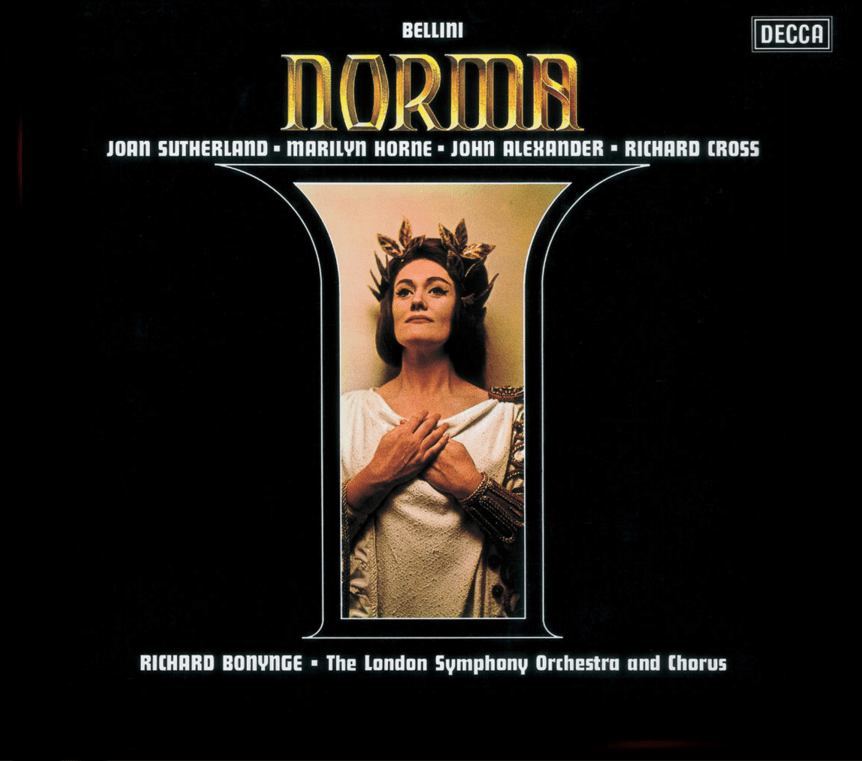
Joan Sutherland, like Callas recorded Norma twice (officially). Her first recording from 1965 (Decca 4704132) caused a real sensation. It was the very first recording of Bellini’s complete music, without any cut. Moreover, it was the first recording in the original key (Bellini composed his opera in G, but before the premiere he changed it to F).
In those days, Sutherland was considered the belcanto specialist par excellence. Her voice knew no limits and seemed to be made of elastic. High, higher, highest, and with coloraturas that sound almost inhumanly perfect.
Adalgisa was sung by Marilyn Horne, Sutherland’s alter ego in the mezzo voice. The result is dazzling, but it lacks the necessary drama, all the more so because John Alexander (Pollione) has a beautiful but insipid voice.
The orchestral playing is excellent, however, and if you like pure singing, high notes and and if you like pure singing, high notes and coloratura, this recording is the best choice.
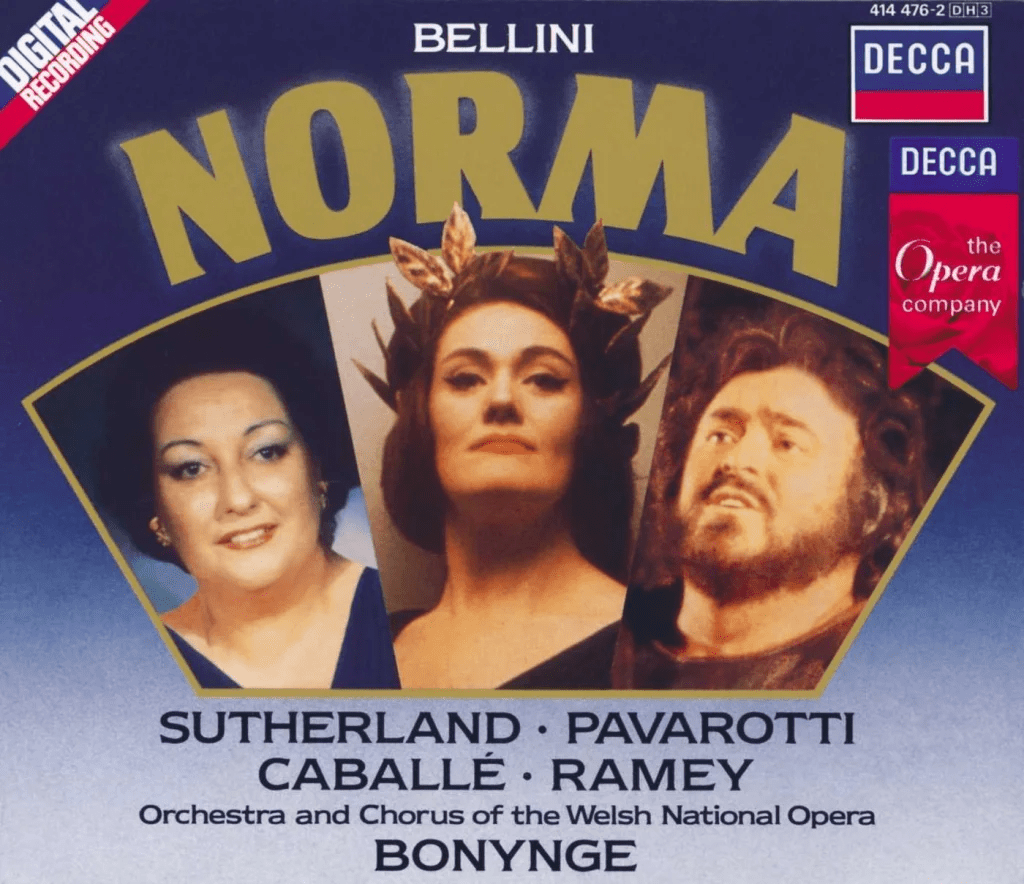
Twenty years later, Sutherland recorded the role again, this time with Montserrat Caballé (Adalgisa) and Luciano Pavarotti (Pollione). Let’s call it a mistake, although Caballé’s Adalgisa is at least interesting. It’s a pity it wasn’t thought of sooner.
MONTSERRAT CABALLÉ
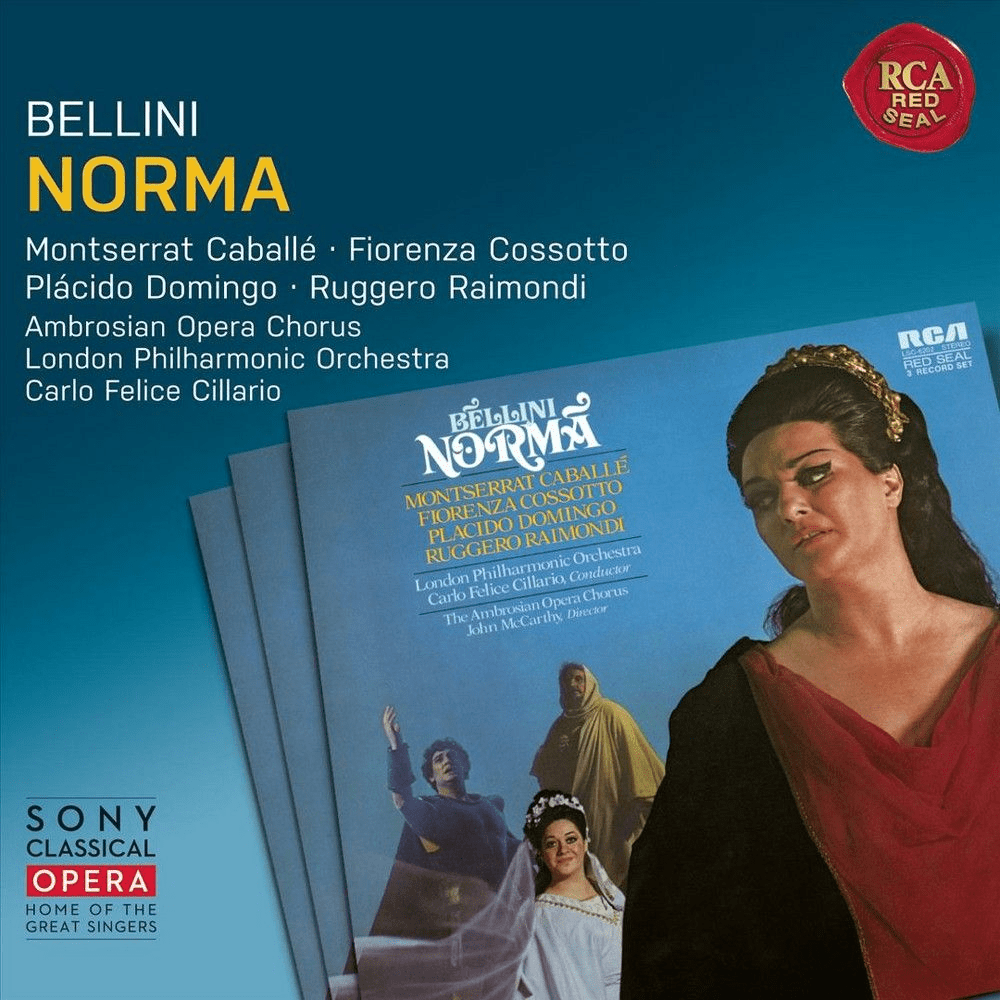
Caballé is a kind of cross between Callas and Sutherland: wonderful top notes, incredibly beautiful legato arches, perfect trills, and moreover a pianissimo that none of her colleagues could match. She was a much better actress than Sutherland, moreover she had great charisma. She never went to extremes like Callas or (later) Scotto, but her performances were always very convincing. In 1973 she recorded the role for RCA and the result was very decent (GD 86502). Her Pollione, a very young Plácido Domingo, was vocally crystal clear and sounded like a bell. However, he lacked dominance, making him sound far too young for the role.
Fiorenza Cossotto in her role of Adalgisa looked more like Azucena than a young girl, but her singing as such was flawless. Unfortunately, the orchestra sounds uninspired and hurried, which must surely be blamed on the conductor, Carlo Felice Cillario.
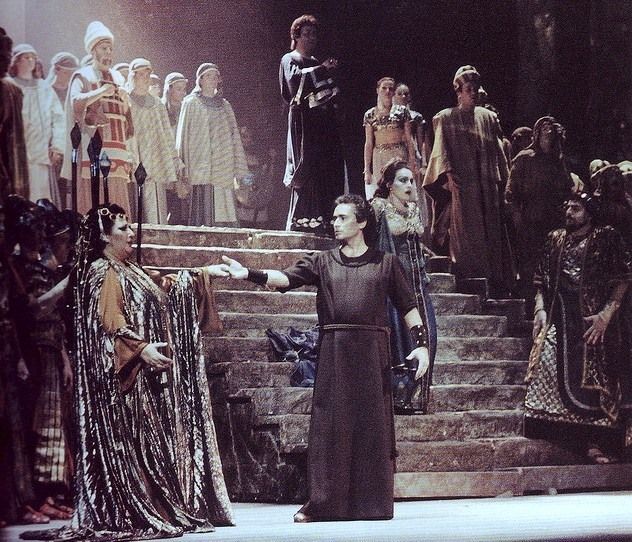
In 1974 she sang Norma in the Roman amphitheatre in Orange (Provence). It was a very windy evening, and everything blew and moved: her hair, veils and dresses. A fantastic sensation, which added an extra dimension to the already great performance. It was filmed by French television (what luck!), and has now appeared on DVD (VAIV 4229).
Caballé sings ‘Casta Diva’:
Caballé was in superb voice, very lyrical in ‘Casta Diva’, dramatic in ‘Dormono etrambi’ and moving in ‘Deh! Non volerli vittime’. Together with Josephine Veasey, she sang perhaps the most convincing ‘Mira , o Norma’ – of all, at least in a complete recording of the opera. As two feminists avant la lettre, they renounce men and transform from rivals into bosom buddies.
Jon Vickers (Pollione) was never my cup of tea, but Veasey is a fantastic (also optically) Adalgisa and Patané conducts with passion. Of all the recordings on DVD (and there are not many), this is definitely the best.
RENATA SCOTTO
Scotto sang her first Norma in 1974, in Turin. To my knowledge, there is no recording of it, at least not of the complete opera.
Casta Diva’ from Turin:
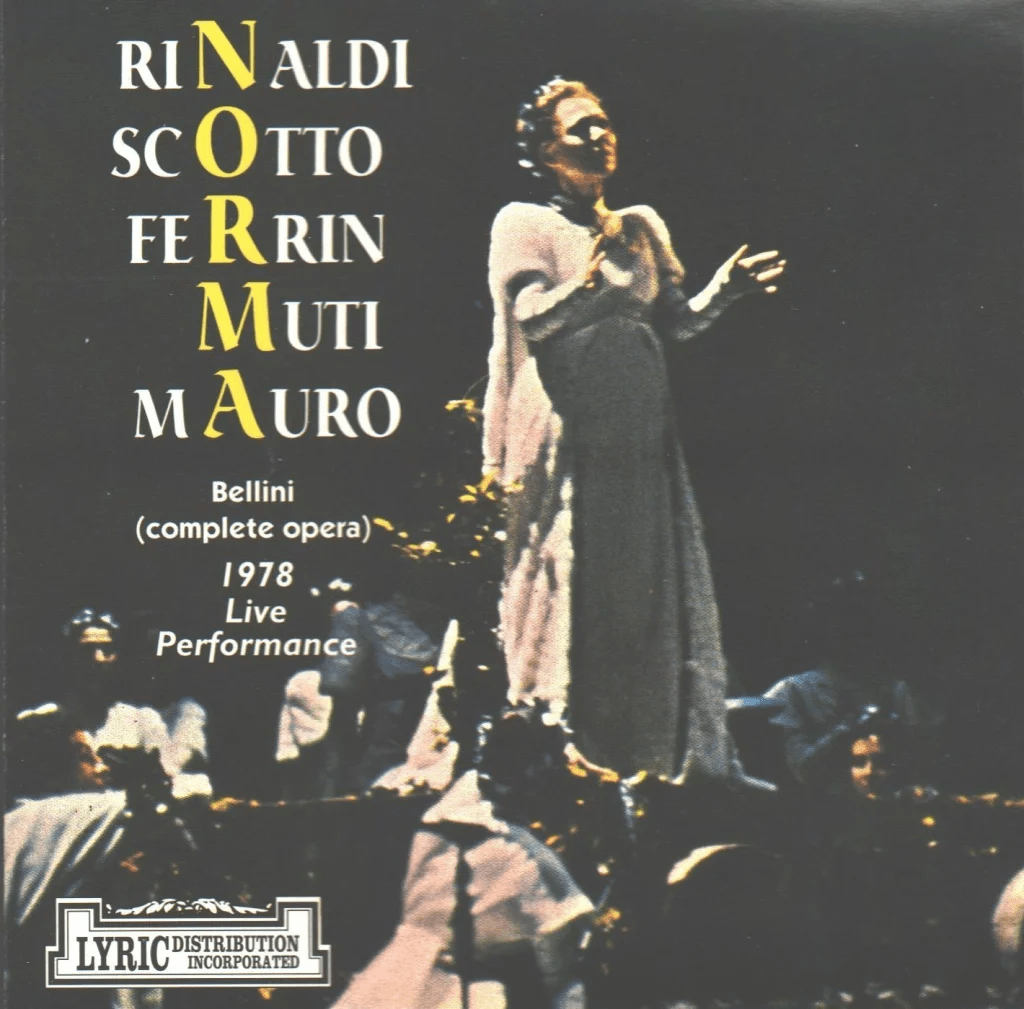
A pirate did record the 1978 performance in Florence (Legato LCD 203-2). It should have been an ideal Norma, but unfortunately the performance was marred by a no more than adequate Ermanne Mauro as Pollione.
Margherita Rinaldi (finally a soprano again) sounds young as Adalgisa and Scotto is, according to many critics, the first Norma, after Callas, who seems to know what it’s all about. Orchestrally, this recording belongs to my top three, but the sound is unfortunately not really great.
Scotto in ‘Dormono entrambi’ in 1978:
In 1980 Scotto recorded the opera in the studio (Sony SM2K 35902), conducted by James Levine. I cannot find much negative to say about her performance, although the ‘steel’ in her voice is sometimes particularly painful. The Adalgisa (incredibly beautiful Tatiana Troyanos) is also absolutely top-notch. But Giuseppe Giacomini (Pollione) is not great at all and Levine conducts far too heavily and overdramatically.





















 Basia con fuoco