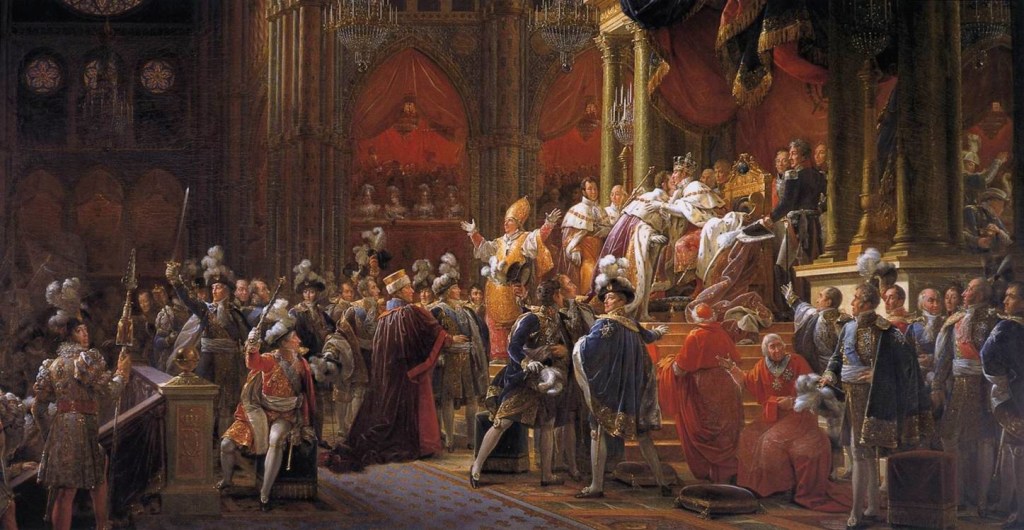
Coronation of Charles X of France by François Gérard, circa 1827
Was it ever Rossini’s real intention? To perform it and then throw it away? Rossini considered his opera Il viaggio a Reims an occasional piece, created for the coronation of Charles the X in 1825. The opera was first performed in Paris, with Giuditta Pasta as Corinna. It was a great success, but the composer pulled the plug after only three performances.
He reused much of the music in Le Comte Ory, the rest disappeared into various drawers in different countries (how appropriate, don’t you think?) and was only recovered in the late 1970s.
CLAUDIO ABBADO: Pesaro 1984
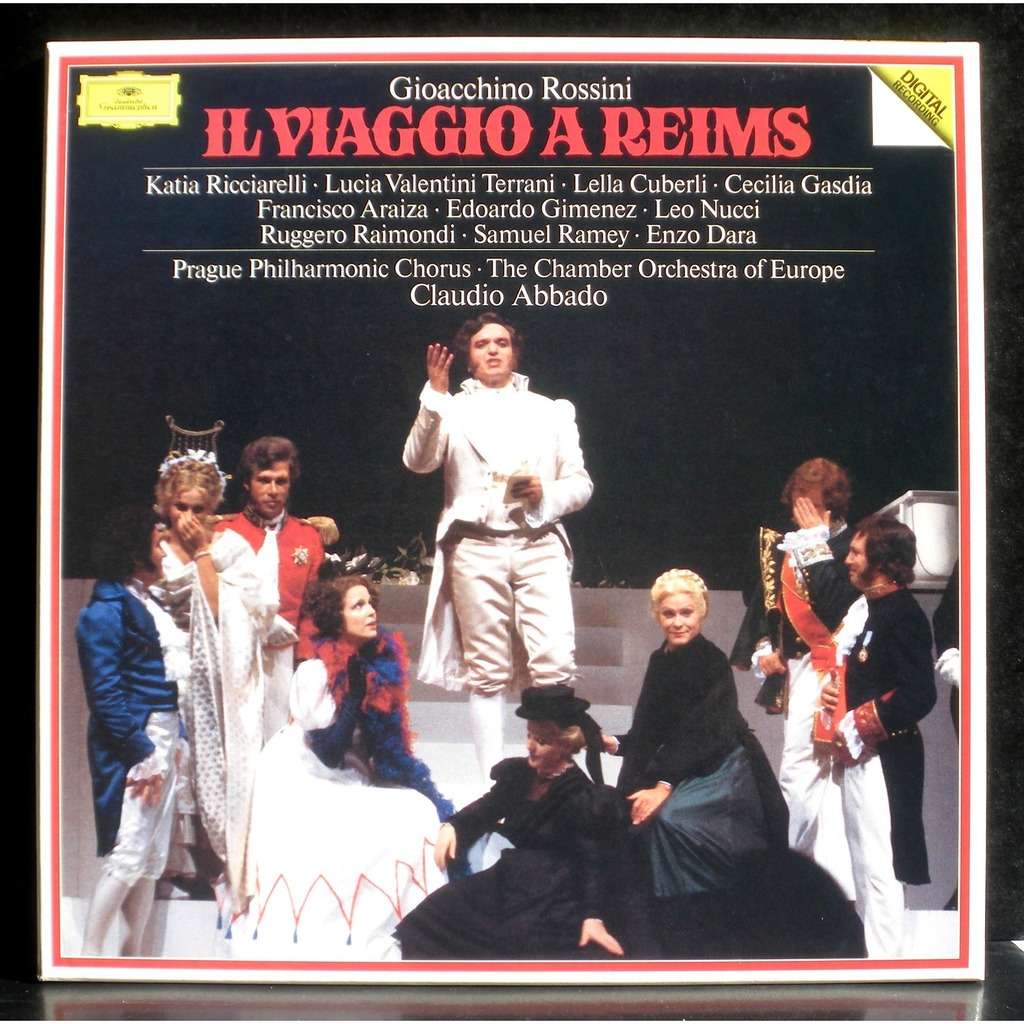
The first “modern” performance of Il viaggio took place in Pesaro, in 1984. Claudio Abbado conducted an absolute star-studded cast, which had been brought together just for this occasion… In alphabetical order: Francisco Araiza, Lella Cuberli, Enzo Dara, Cecilia Gasdia, Eduardo Gimenez, William Matteuzzi, Leo Nucci, Ruggero Raimondi, Samuel Ramey, Katia Ricciarelli and Lucia Valentini Terrani.
Youtube also offers the entire recording from Pesaro – on screen! – :
And Berlin 1992
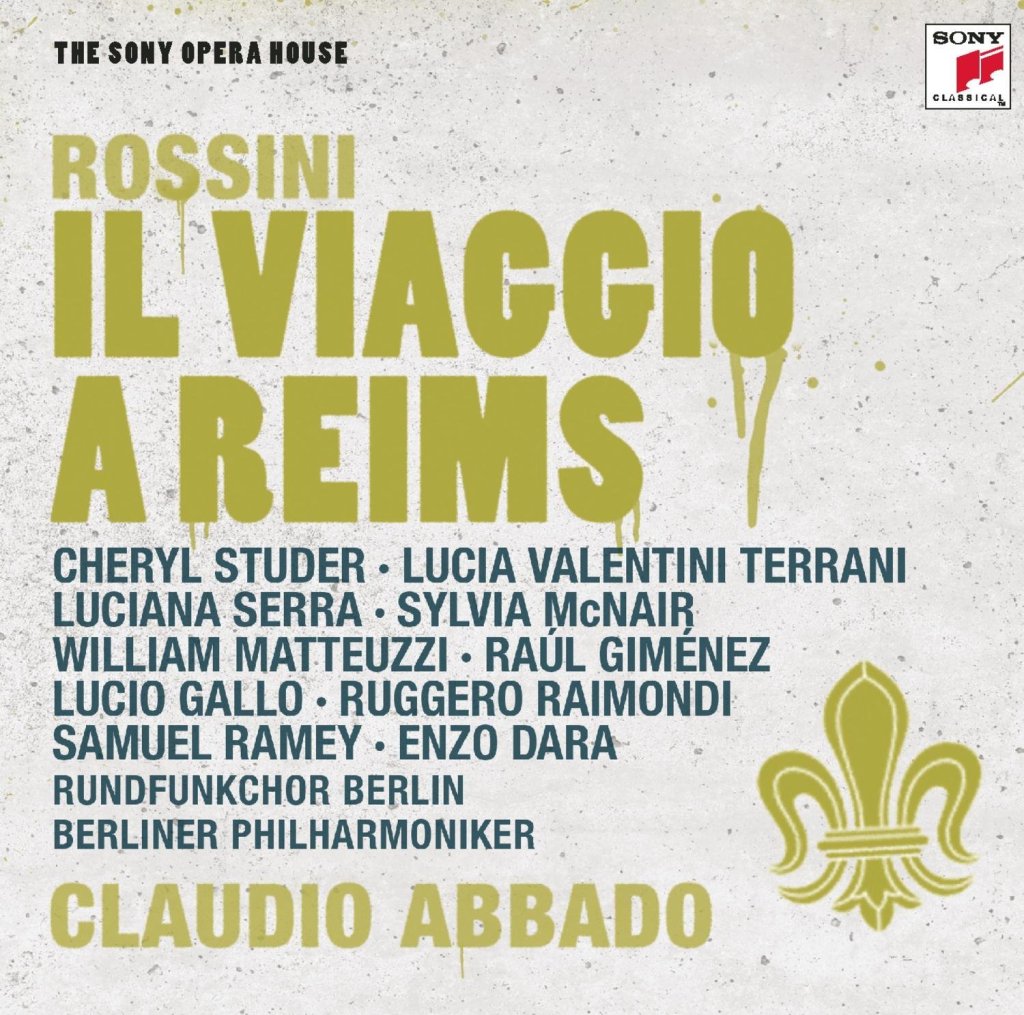
Eight years later, Abbado conducted the opera in Berlin with mostly the same singers. Both performances were recorded live and both are very good. Personally, I prefer Cheryl Studer (Madama Cortese) on Sony (53336) to Katia Ricciarelli (DG 4777435), but that is entirely personal.
Encore from Berlin 1992
BARCELONA 2003
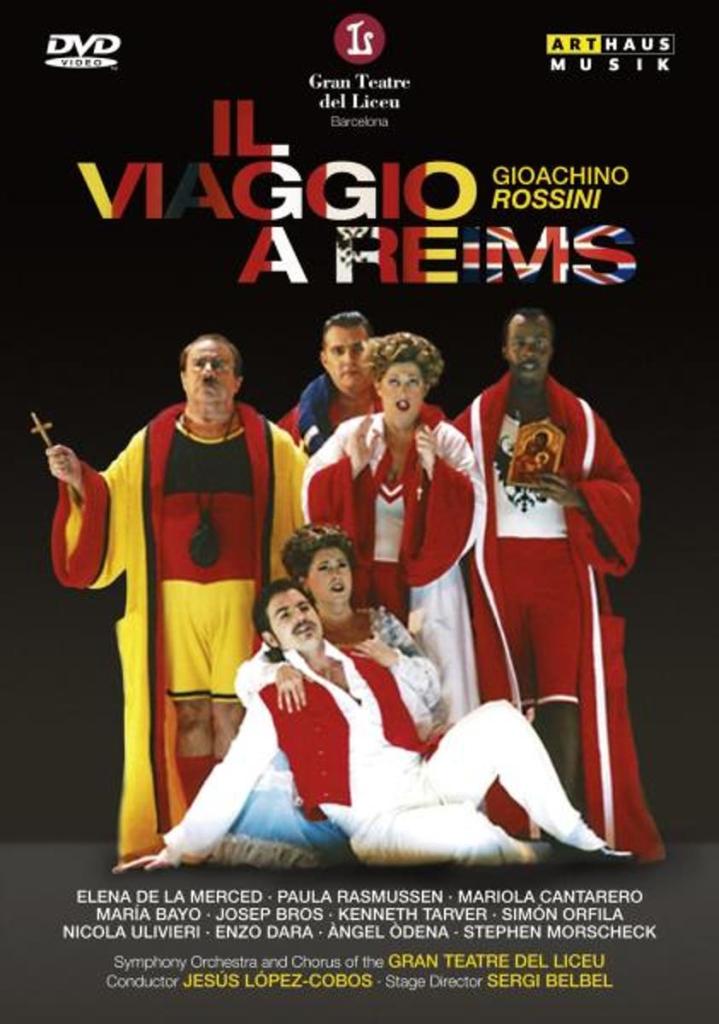
A visually arresting performance of Il viaggio was recorded at Barcelona’s Gran Teatre del Liceu in 2003 (Arthouse Musik 107 135). The action is set in a spa resort at the beginning of the 20th century, and the guests in bathing suits are being pampered by a variety of masseurs, nurses and beauticians. Everyone wears clothes with their country’s colours and the director has Corinna, dressed in an EU flag, solve every problem between them. Obvious? Definitely, but also very entertaining.
It’s just a shame that the singing is not that great. Apart from veteran Enzo Dara (Il Barone di Trombonok) and Josep Bros (Belfiore), the cast is mediocre, with the low point being the totally miscast Maria Bayo (Madama Cortese) and Simón Orfila (Lord Sydney). The latter looks very attractive in his swimming costume, but barely manages to sing a clean note.
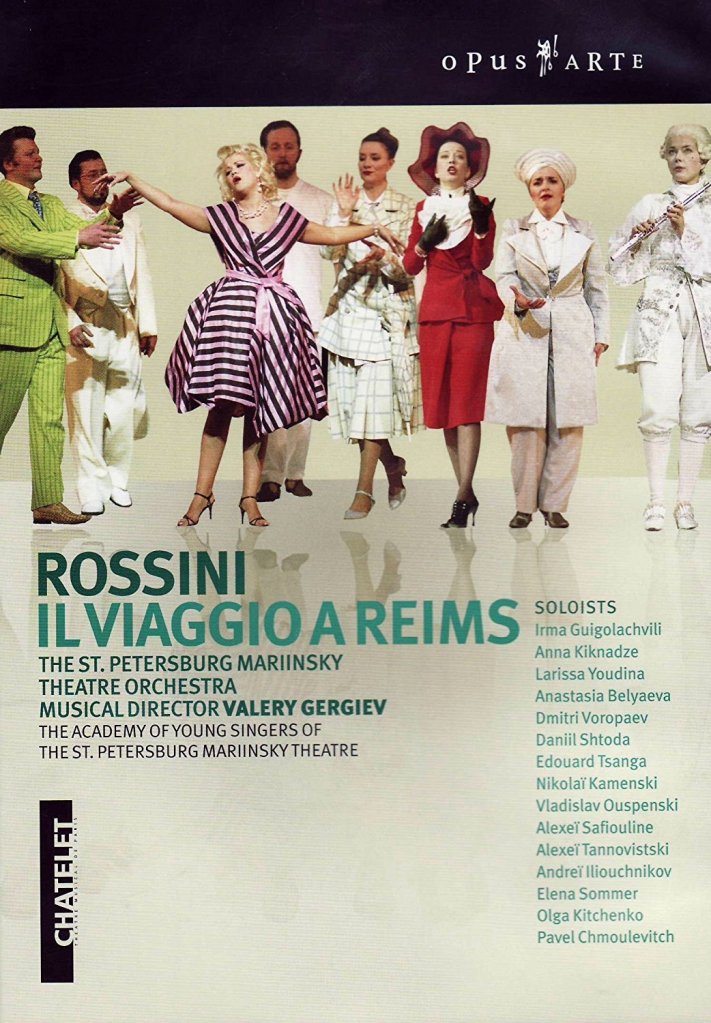
Valery Gergiev is not easily associated with Rossini’s music. Yet it was he who conducted a highly spectacular Il viaggio at the Théâtre du Châtelet in 2005, presenting young Russian singers to international audiences.
The orchestra sits at the back of the stage, forming, together with the conductor, a part of the dazzling show which really takes place everywhere, even among (and with) the audience. Props and colourful costumes also play an important role, and there is even a real horse. The singers are mostly young and, apart from Daniil Shtoda (Count Libenskof), unknown. It is clear that they still have a lot to learn, including proper pronunciation, but their performance is really very nice (Opus Arte OA 0967 D).
It has been said that ‘The Woman Without a Shadow’ is a kind of remake of The Magic Flute. There is something in that, because in this, very moralistic, fairy tale, too, the main characters are subjected to the most terrible ordeals, which, if endured well, will make them better persons. You can also detect a ˜Pelleas-like” symbolism, and Das Rheingold and Siegfried are nowhere far away either. But, simply put, this opera is mainly a kind of glorification of married life enriched with many children
˜FROSCH”, as the opera is called in the corridors, is considered Strauss’ most difficult opera to cast – one of the reasons why it is almost always cut. I think this is a pity, all the more so since the ˜melodrama” (the Empress’ outburst when she realises that the Emperor is already almost completely turned into stone), among other things, is also cut, and I think that (along with the beginning of the third act) it is one of the opera’s most exciting and dramatic moments.
DVD’S
GEORG SOLTI, 1992
In 1992, Solti conducted a totally complete performance of the work in Salzburg. Götz Friedrich’s direction was considered particularly strong at the time, but I do not find it entirely satisfactory. The mise-en-scène is undoubtedly excellent, but he falls short in the direction of the characters, leaving the singers a bit awkwardly bouncing around on the stage..
The beautifully designed stage setting is lovely with very minimalist but realistic scenery, but the costumes are a bit bizarre at times. There is a lot of use of strobe lighting, which combined with violent musical passages can come across as rather too much.
Cheryl Studer is a dream of an Empress. Her voice, with its very recognisable timbre and beautiful pitch, is soaring, transparent almost, innocent and erotic at the same time. Thomas Moser is an attractive Emperor, perhaps a touch too light for this role, which occasionally causes him breathlessness and forced notes, but his singing is fine.
Robert Hale (Barak) was already far past his prime here, at less than 50 years old. A pity, because his portrayal is very charismatic. Eva Marton hurts the ears, but is so committed that you forgive her. Her aria of despair at the beginning of the third act is touching and gives you goosebumps.
The palm of honour, however, goes to Marjana Lipovšek, who portrays a truly phenomenal Amme. What this woman has at her disposal in terms of colour nuances and how she handles her (very warm) mezzo borders on the impossible. On top of that, she is also a gifted actress; I could not take my eyes off her. (Decca 0714259
WOLFGANG SAWALLISCH, 1992
Six months later, FROSCH was presented in Japan. It was the very first time the opera was performed there, so expectations were high. The production was in the hands of an all-Japanese team led by Ennosuke Ichikawa, a famous director and stage actor of the Kabuki theatre. What he and his colleagues have achieved is simply mesmerising. FROSCH translates wonderfully to the rules of Kabuki, it gets even more convincing – it gains credibility and tension because of these rules. Lipovšek is even meaner here, even more evil than with Solti. Her movements are now smaller and more subdued which, curiously, makes them more expressive, and she can do even more with her voice.
Peter Seiffert is an excellent Emperor, his voice is rich, elegant, warm, sensitive and pliable, and all his high notes sound like a bell. Unfortunately, the Empress is not of the same level. Luana DeVol intones very broadly, her soprano sounds shrill and is totally bereft of lyricism (why didn’t they include Studer?), but she is a very convincing actress.
Alan Titus and Janis Martin may be a touch less intense than Hale and Marton with Solti, but their voices sound much more pleasant. They can also act, and how! Moreover, Martin looks very attractive, which is not unimportant for the role. I find the orchestra led by Sawallisch even more beautiful than Solti’s, more fairy-like, more transparent too, and more sultry… A truly phenomenal production. (Arthaus Musik 107245)
CD’S
KARL BÖHM 1955
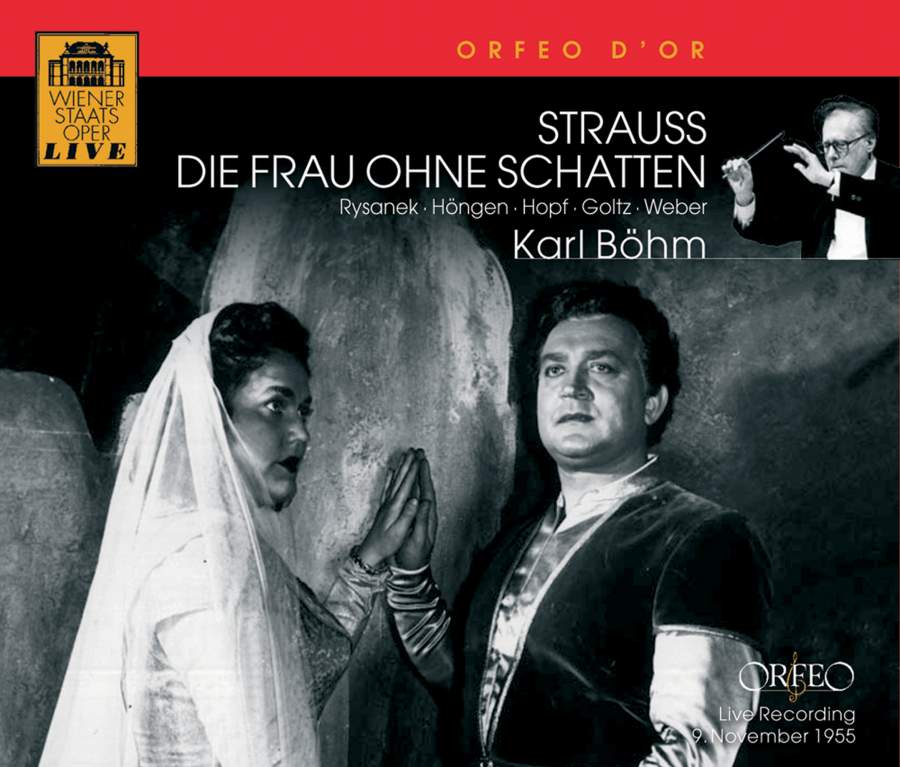
The very first recording of the opera dates from 1955. It was recorded live in Vienna, and has been amazingly polished by the Orfeo team.
Leonie Rysanek is the very best Empress I have ever heard. She dares to take risks, taking her beautiful, lyrical soprano to the limits of the impossible. With this role, she set a standard that is not easy to match. Hans Hopf (Emperor) has a kind of ˜heroic” way of singing that I don’t really like, but I imagine he is considered as ideally cast by many fans. It is a matter of taste, I would say.
Elisabeth Höngen is a vile Amme, and Christel Glotz an impressive, if not always cleanly intoned Färberin Böhm conducts very lovingly (Orfeo D’Or 668053)
HERBERT VON KARAJAN, 1964
In 1964, on the occasion of Strauss’ 100th birthday, von Karajan conducted a very inspired FROSCH at the Wiener Staatsoper. Christa Ludwig’s scoring of the Färberin is not exactly idiomatic, but her high notes and her reading of the role are very impressive to say the least.
In terms of vocal beauty, Walter Berry (then also in real life her husband) is probably the finest Barak, unfortunately is Jess Thomas (Emperor) a bit disappointing. Leonie Rysanek repeats her magnificent reading of the Empress, even more intense, and even more fused with the role.
The luxurious scoring of the minor roles by Fritz Wunderlich (the Jüngeling ) and Lucia Popp (a.o. Falke), makes the recording even more appealing. Von Karajan conducts as we have come to expect from him – narcissistic but oh so impressive and with a great sense of nuance. (DG 4576782)
GEORG SOLTI 1987-1990
You cannot avoid Solti’s studio recording (it took him three years, between 1987-1990), if only because he recorded every note as it had been written by Strauss.
The scoring of the Emperor by Plácido Domingo was considered an attack on the work by many ˜purists” at the time. Unjustly so. His voice is in every way ideal for the role, and with his musicality, the colours in his voice and his more than ordinary vocal acting skills, he portrays a very humane and vulnerable Emperor.
Julia Varady is, as far as I am concerned, along with Studer, the best Empress after Rysanek, what a voice, and what a performance! Hildegard Behrens is a torn Färberin , her complete identification with the role is limitless. (Decca 4362432)
Jules Massenet was the most prolific and, artistically as well as commercially, also the most successful French opera composer between 1870/71 and World War I, the belle Epoque of the Third French Republic. He is best known for his operas, of which he wrote more than thirty. The two most frequently staged are Manon and Werther
MANON
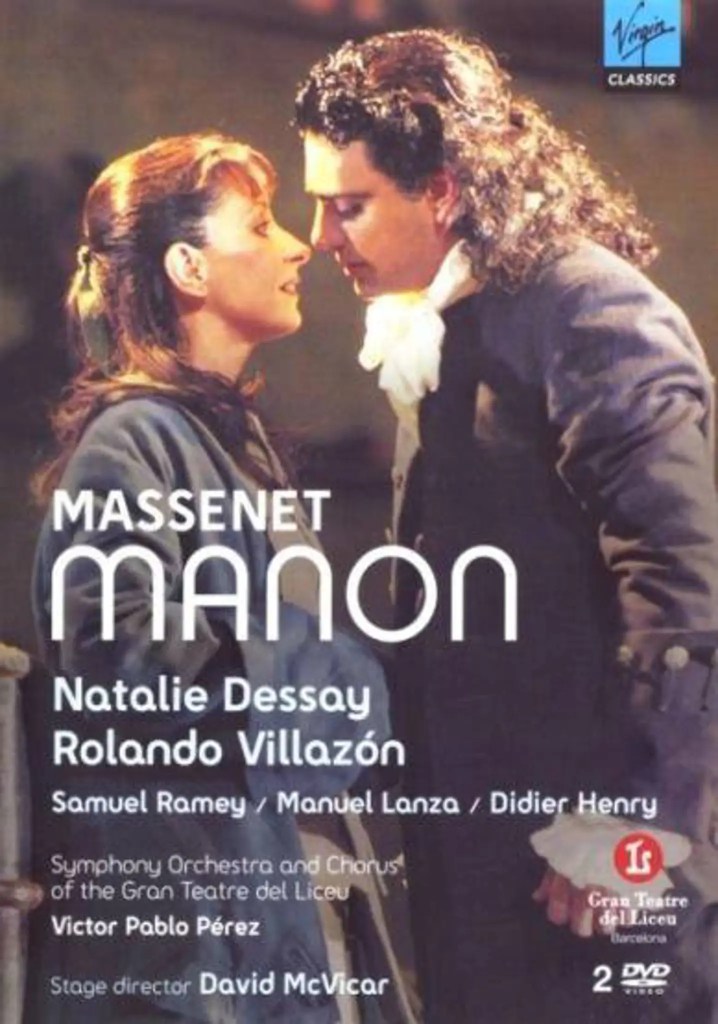
Jules Massenet’s Manon has, since its now legendary performance starring Anna Netrebko and Rolando Villazon (Berlin, April 2007), become a real hype. Anyone who had ever seen the performance could sincerely ask, like Verdi’s Ford (‘Falstaff’): ‘e sogno o realta’?
It was a reality that turned out to be a dream after all, as Netrebko found a new love, leaving Villazon with heart and voice problems. It was also not entirely clear until the last day of rehearsals whether he would sing the, scheduled for June 2007, performances of Manon in Barcelona.
He did come, and although he sang below his usual level, he managed to completely convince everyone with his acting and (sometimes a little too) intense commitment. His Manon is brilliantly portrayed by a spectacularly singing and acting, Lulu-like, Natalie Dessay.
Manuel Lanza is a fine Lescaut, but for Samuel Ramey, a singer I greatly admire, Comte des Grieux unfortunately comes too late in his career.
The mise-en-scène and character direction by David McVicar, for me still really one of the best contemporary directors, were more than excellent. The costumes were beautiful to behold and the (traditional) staging was often really surprising, all the more so as McVicar managed to give it a contemporary twist from time to time.
As a bonus, you do get a ‘peek inside’. Through a truly fascinating documentary, you can follow the stars during their rehearsals with McVicar.
WERTHER FOR BARITONE
In 1902, ten years after the premiere, Massenet produced a new version of his Werther, this at the request of Italian baritone Mattia Battistini, who was eager to sing the lead role. Massenet did not change the key, but rewrote the vocal lines of Werther’s music, making the arias, ‘Pourquoi me réveiller’ included, barely recognisable.
The “baritone version” of the opera was and remains an oddity; no original manuscript of the score even exists. In recent times, with its penchant for ever new challenges, there was also an increased interest in alternative versions of well-known operas. The baritones, tired of singing the villains, are rediscovering the repertoire, in which they can release all their lyrical melancholy.
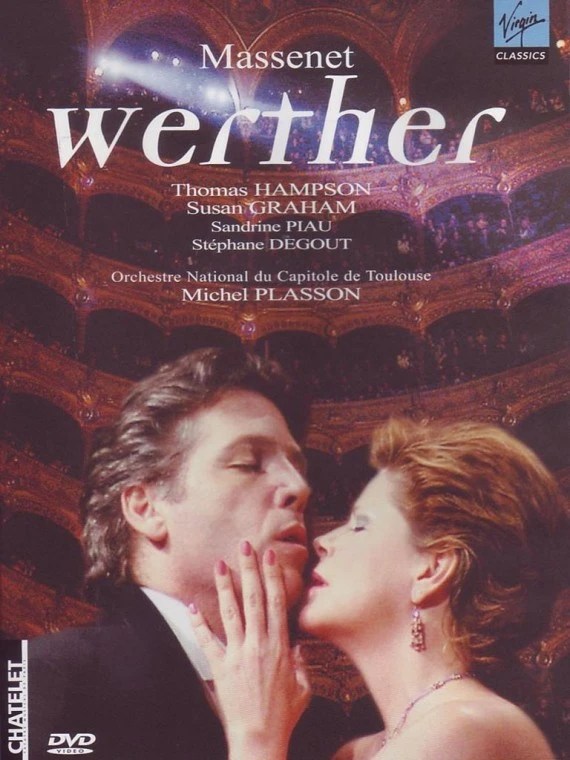
Thomas Hampson has always been an explorer of lesser-known paths and he first performed the role of Werther back in 1989. In 2004, he sang a concert performance of it at the Paris Chatelet, and that performance has been released by Virgin on two DVDs. He does an excellent job, but the manic-depressive is a bit off.
His Charlotte is sublimely sung by Susan Graham, who also performed the role in Amsterdam some years ago, where she moved the audience and press to tears. Michel Plasson has all the drama at his fingertips as you can hear.
“Pourquoi me réveiller” by three tenors
Alain Vanzo :
Sergei Lemeshev in Russian:
Jonas Kaufmann:
Piotr Beczala:
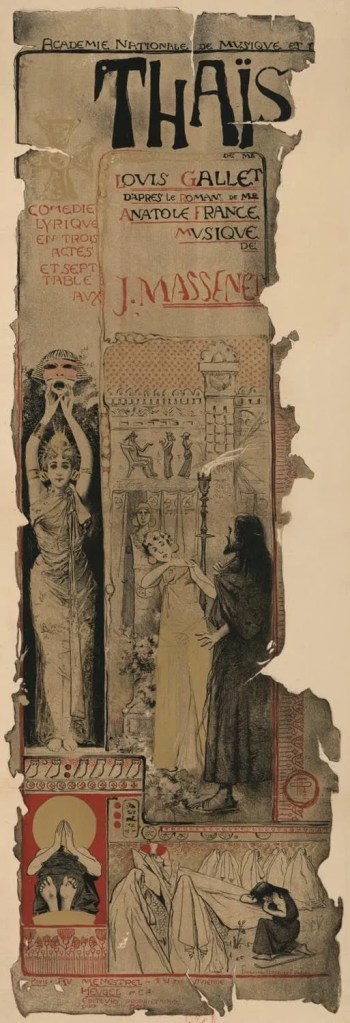
THAÏS
Who does not know ‘Méditation’, the sentimentally sweet but oh-so-beautiful piece of violin music? Most often it will make you cry.
Méditation in Josef Hassid’s performance:
However, not many people have ever heard, let alone seen, the opera in which this piece acts as a kind of interlude in the second act.
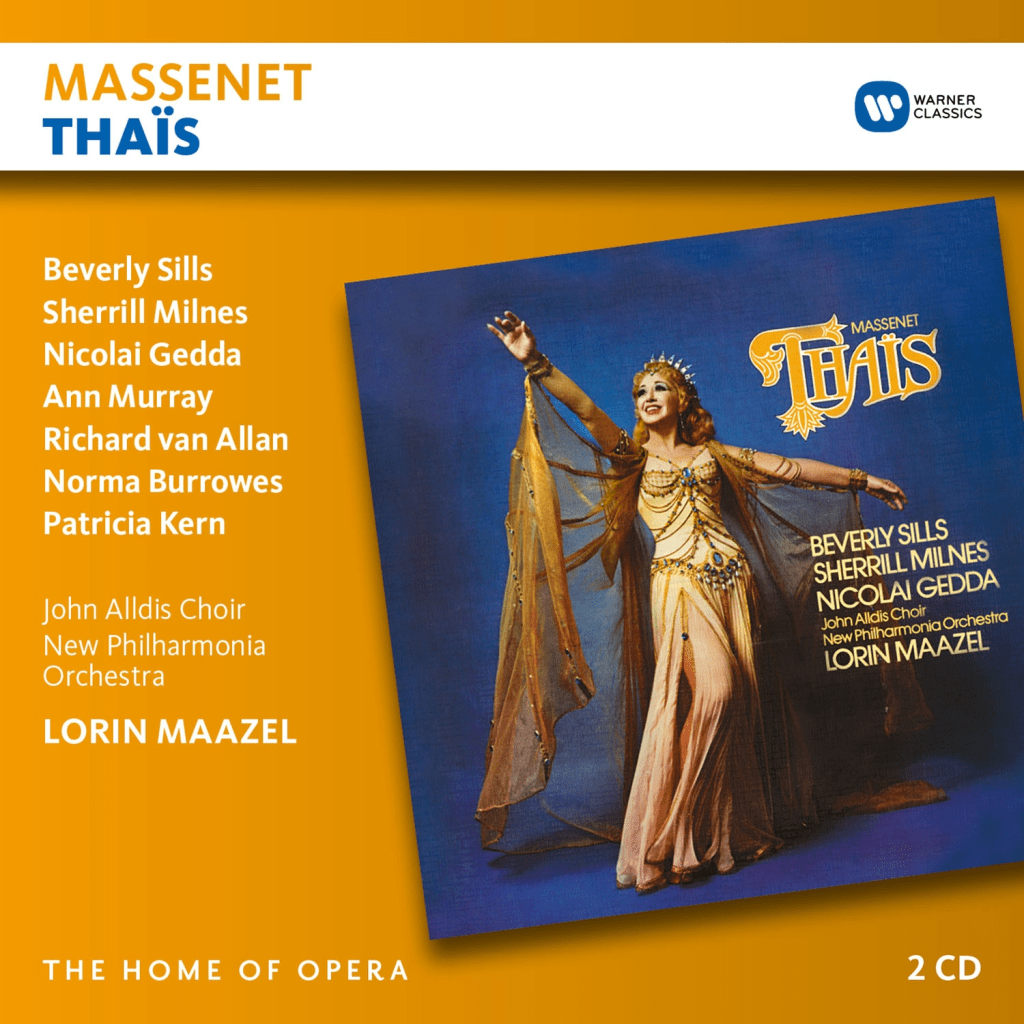
Recordings of the complete work are still scarce, I only know of three myself (with Anna Moffo, Beverly Sills and Renée Fleming), of which the one with Sills, Sherrill Milnes and Nicolai Gedda (Warner 0190295869069) is dearest to me.
Below Beverly Sills and Sherrill Milnes in the final scene of the opera:
DVD from La Fenice
Pier Luigi Pizzi’s production from La Fenice had previously been released on CD and I found it particularly strong musically and mainly vocally. I was therefore particularly curious as to whether the visuals added anything to it on Dynamic’s DVD. To which I can now say a resounding “yes”.
The sets are sparse, yet the stage seems to be completely full of them. Because of the colours (with very predominant red) perhaps, but also because of the dominant place they occupy on stage. For instance, Thaïs’ rose-covered bed, on which she – as if she were the Venus of Urbino or one of the versions of Danaë, also by Titian – lies very voluptuously. This bed is very prominently in the centre of the stage.
In the third act, when the fun life has ended and the penance begins, the roses are nowhere to be seen (a bed of thorns?) and her posture is as chaste as her white robe.
The costumes are a story apart: very opulent, oriental and barely concealing. Eva Mei doesn’t go as far as her colleague Carol Neblett, who went completely out of her clothes in New Orleans in 1973, but her see-through little nothing of a dress, from which her breasts keep escaping almost unnoticed, leaves nothing to the imagination.
Perhaps she was inspired by the very first Thaïs, Sybil Sanderson, whose breasts were also ‘accidentally’ visible during the premiere performance in 1894? Then again, it is all about the greatest (and most beautiful) courtesan in Alexandria!
Eva Mei is very virtuoso and very convincing as Thaïs . So is Michele Pertusi as Athanael. There is a lot of ballet, though. Also where it really shouldn’t be, which is very distracting at times.
Thaïs from Toronto: unearthly beautiful orchestral playing
Recordings of Thaïs are still scarce so any new releases are more than welcome. Especially if the performance is good, and this new recording on Chandos most certainly is. At least: to some extent.
The Toronto orchestra sounds so incredibly beautiful that you cannot help falling in love with it. Sir Andrew Davis truly extracts the impossible from his musicians: I have not heard the score performed so beautifully before. The pianissimi, the way they manage the quiet passages to perfection, the subcutaneous tension. Hats off! Hats off also to the violinist who manages to add new layers to the ‘Meditation’. So beautiful!
Unfortunately, the singers lag a bit behind. Erin Wall is a beautiful soprano with a crystal-clear voice, but a ‘Whore of Babylon’? More like a rather childishly naive girl.
Joshua Hopkins has the right voice for Athanael but he goes the wrong way when it comes to ‘earthly desires’. Andrew Staples is a good Nicias but he too fails to fully convince me.
CENDRILLON
A fairy tale has its own rules. Much is interchangeable, but what must never be compromised is the “happy ending”. So: the ugly duckling becomes a beautiful swan and Cinderella becomes a princess. All evil spirits are punished and we can sleep peacefully.
Sometimes I pray to those I don’t really believe in: give us back our fairy tales, because these days everything has to be totally true to nature and as realistic as possible. Fortunately, my prayers are sometimes heard and so it came to pass that I was able to enjoy an old-fashioned evening; with my cat on my lap and Cinderella on my screen.
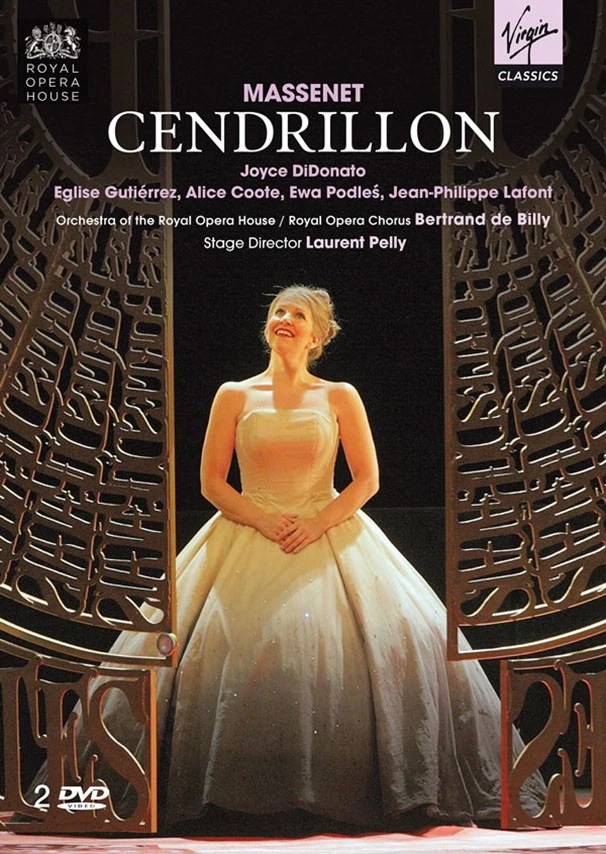
Laurent Pelly is undoubtedly one of the best contemporary directors: he puts a modern spin on everything he does, but he stays true to the libretto and the music. In the process, his staging is extraordinarily witty. As is the delightful Cendrillon, recorded at London’s Royal Opera House in 2011.
I no longer need to recommend Joyce DiDonato (Cendrillon) to anyone – she is easily the greatest ‘zwischenfach singer’ of our time. Ewa Podleś is a more than delightful stepmother and Alice Coote the most charming ‘Prince Charmant’. And to this you may add the truly idiomatic conductor (Bertrand de Billy)…. Life really can be beautiful sometimes
Trailer of the productie
HERODIADE
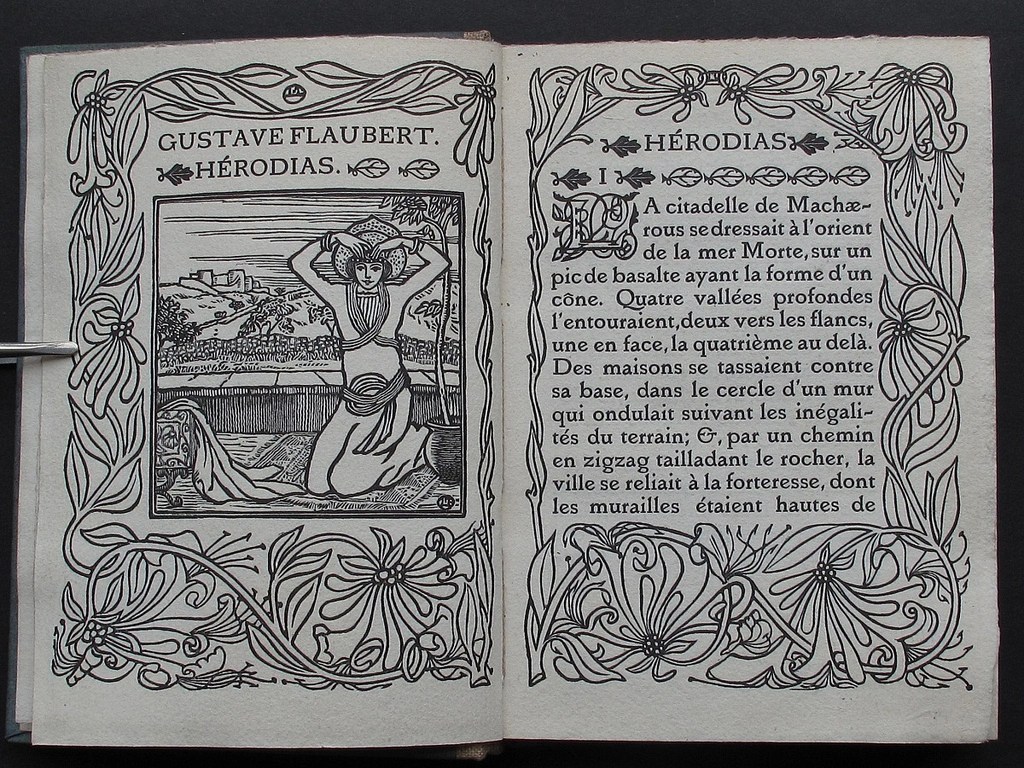
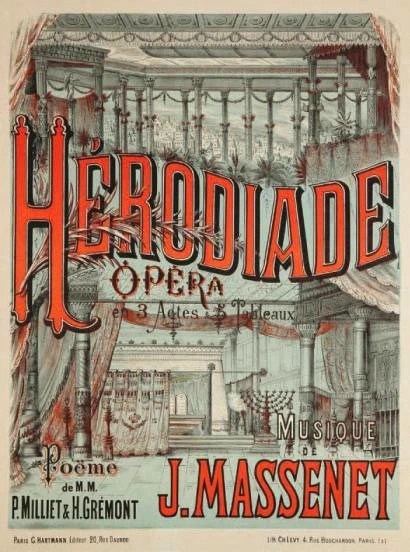
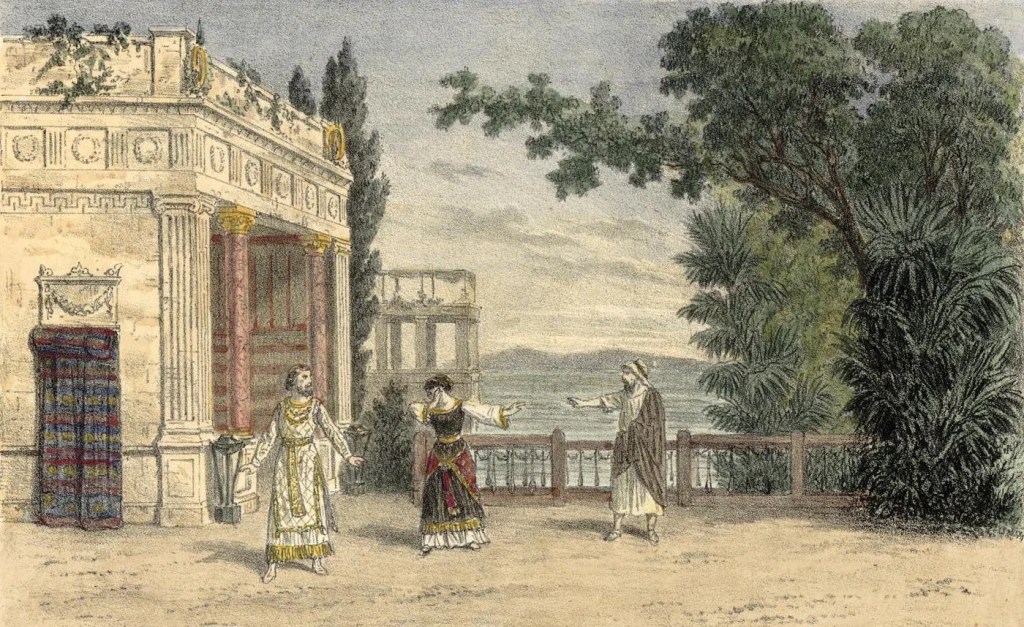
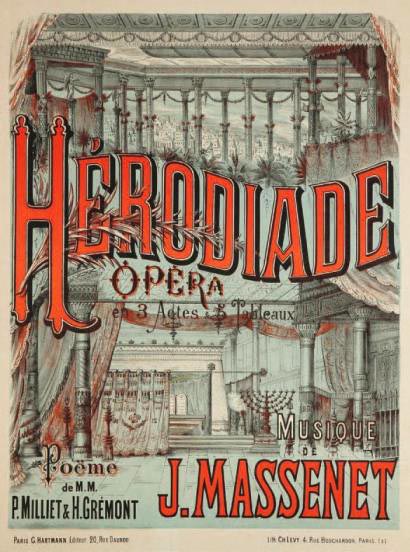
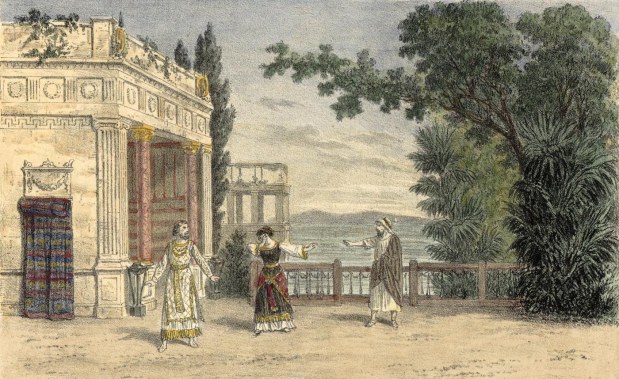
Richard Strauss composed his world hit Salome to a play by Oscar Wilde; and the latter drew his inspiration from a short story by Flaubert, ‘Herodias’. Paul Milliet and Henri Grémont also based their libretto for Massenet’s opera Herodiade on this story. Neither Wilde nor Milliet and Grémont were very faithful to Flaubert. Whereas the French novelist more or less limited himself to the biblical narrative, enriched with his poetic language and descriptions, the playwright and librettists added entirely new aspects and twists to the story.
Hérodiade was first performed in the Royal Theatre of Brussels on 19 December 1881. Anyone expecting animal eroticism, blood and sweat, as with Richard Strauss, will be disappointed. Massenet’s Salome is a truly innocent and devout girl. When her mother left her to marry Hérode, she was given shelter by Jean (John the Baptist), with whom she fell in love. A love that proved to be mutual.
No opera is complete without complications: Hérode has a crush on Salome, Hérodiade becomes jealous of her and Jean is beheaded. Salome sees Hérodiade as the instigator of all evil and wants to kill her. Hérodiade whispers “I am your mother” and Salome commits suicide.
The music already exudes a hint of the perfume of Massenet’s later works, but with all those choruses, exotic Oriental scenes and elaborate ballet scenes, it is nothing less than a real Grand Opera in the best Meyerbeer tradition.
One of the earliest recorded fragments of the opera is, I think, the famous aria of Hérode ‘Vision Fusitive’ by the French baritone Maurice Renaud, made in 1908:
And from the recording Georges Thill made in 1927, we know what an ideal Jean should sound like:
Regine Crespin 1963
If you are in possession of this performance, you need look no further. It doesn’t get any better than this. There is only one problem: this recording does not exist. At least not of the complete opera.
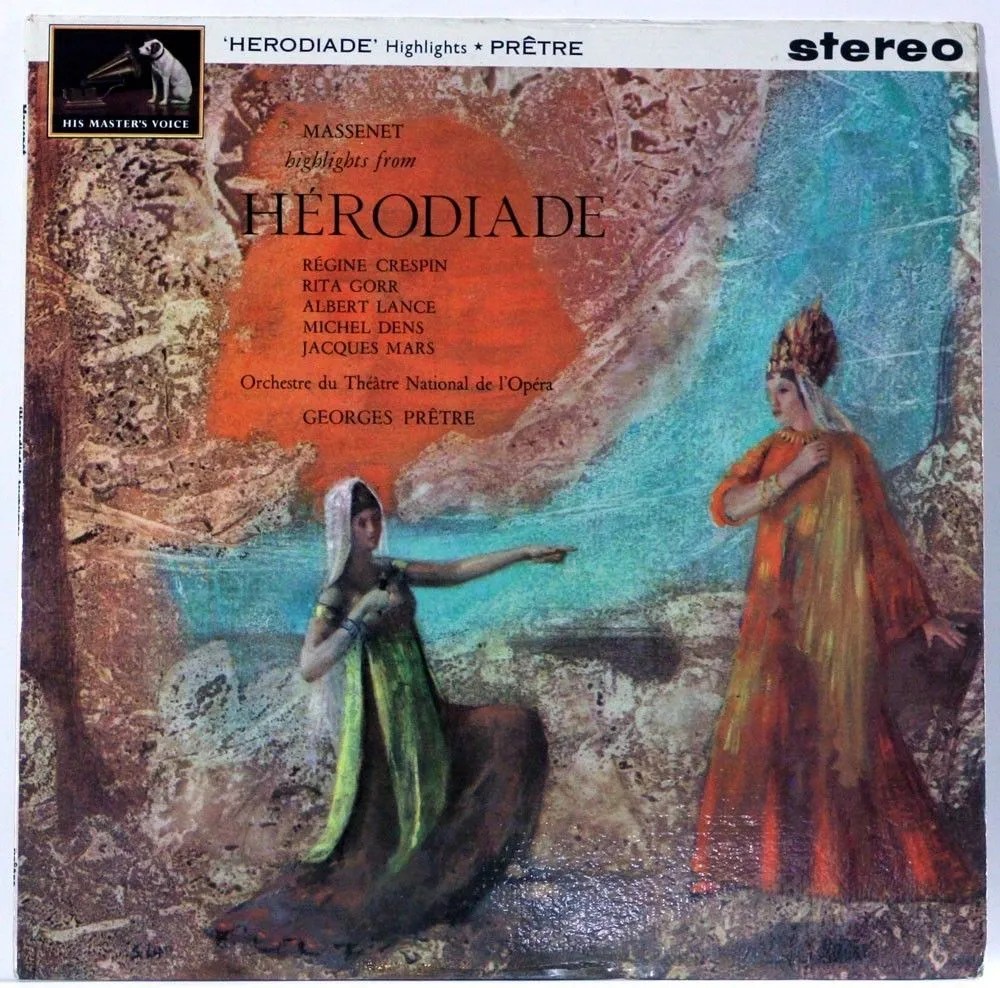
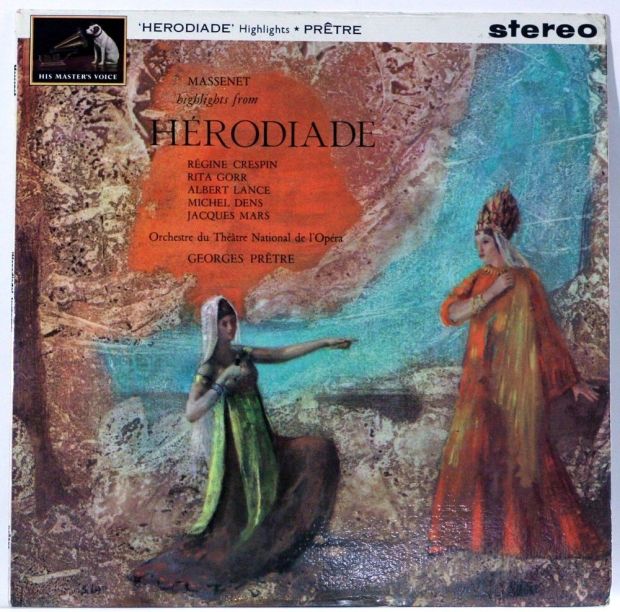
In 1963, EMI recorded the highlights of Hérodiade with the best French singers of the time (and of today, for that matter) and the answer to the “why not complete ????” will probably never be given.
Georges Prêtre conducts the orchestra of the Theater National de Paris as if his life depends upon it and every role is more than excellently cast.
Regine Crespin sings ‘Il est doux, il est bon’:
Regine Crespin’s Salomé is unequalled and so is Rita Gorr’s Hérodiade. Albert Lance (Jean) shows how that role should really be sung in the tradition of Georges Thill, and for Michel Dens as Hérode we really cannot find the right words. Such singers no longer exist.
Hopefully, Warner will one day release the recording on CD.
Montserrat Caballé (Barcelona 1984)
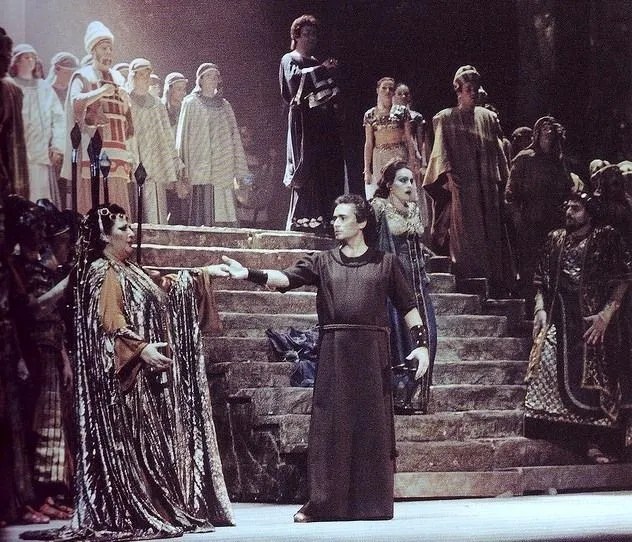
This recording also may only be obtained via a pirate (or You Tube), but then it is complete and moreover with (admittedly bad) images!
Dunja Vejzovic portrays a deliciously mean Hérodiade and Juan Pons is a somewhat youthful but otherwise fine Hérode. A few years later, he will become one of the best “Hérodes” and you can already hear and see that in this recording.
Montserrat Caballé is a fantastic Salomé, the voice alone makes you believe you are in heaven and José Carreras is very moving as a charismatic Jean.
Below, Carreras sings ‘Ne pouvant réprimer les élans’:
None of the protagonists is really idiomatic, but what a pleasure it is to watch a real Diva (and Divo)! They really don’t make them like that any more
The whole opera on you tube:
Reneée Fleming 1994
In the mid-1990s, Herodiade enjoyed a short-lived revival. The opera was then performed in several opera houses and it was even recorded – officially – three times: once in the studio and twice live.
I must admit that I was a bit concerned about Gergiev as the director, but he really did an excellent job. Under his baton the opera sounds like a real Grand Opéra, grand, fiery and compelling.
Plácido Domingo (Jean) is perhaps a touch too heroic, but his voice sounds youthful and contageous, worthy of a true prophet.
Personally, I find Dolora Zajick (Hérodiade) a bit on the (too) heavy side, but her singing is undeniably excellent and there is nothing wrong with her interpretation.
Juan Pons is an excellent Hérode, but I would have liked Phanuel (Kenneth Cox) to be a bit more idiomatic. Something that also applies to the Salomé of Renée Fleming: she sings beautifully but in this role she can not totally convince me.
Nancy Gustafson 1995
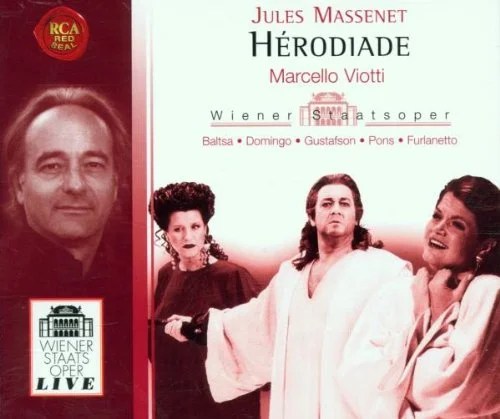
The performance in Vienna was highly praised, and that this praise was justified is proved by the recording made live in the house by ORF.
First of all, there is Agnes Baltsa’s brilliant title role: fierce and dramatic. If you ask me: apart from Rita Gorr probably the best Hérodiade ever.
Placido Domingo sings ‘Ne pouvant réprimer les élans’:
Domingo, in the role of Jean, is even more impressive here than on Sony and also Juan Pons (Hérode) actually convinces me yet more on this recording. His rendition of ‘Vision Fugitive’ is very, very moving. Unfortunately, Nancy Gustafson (Salomé) must acknowledge the superiority of Fleming (Sony), but both pale in comparison to Cheryl Studer (Warner). Not to mention Regine Crespin!
Judging by the photos in the text booklet and the sparse clips on YouTube, we should be glad that the recording appeared on CD and not on DVD.
Finale of the opera:
In any case, the sound is excellent and the Vienna Opera orchestra under the direction of Marcello Viotti plays with great passion.
Cheryl Studer 1995
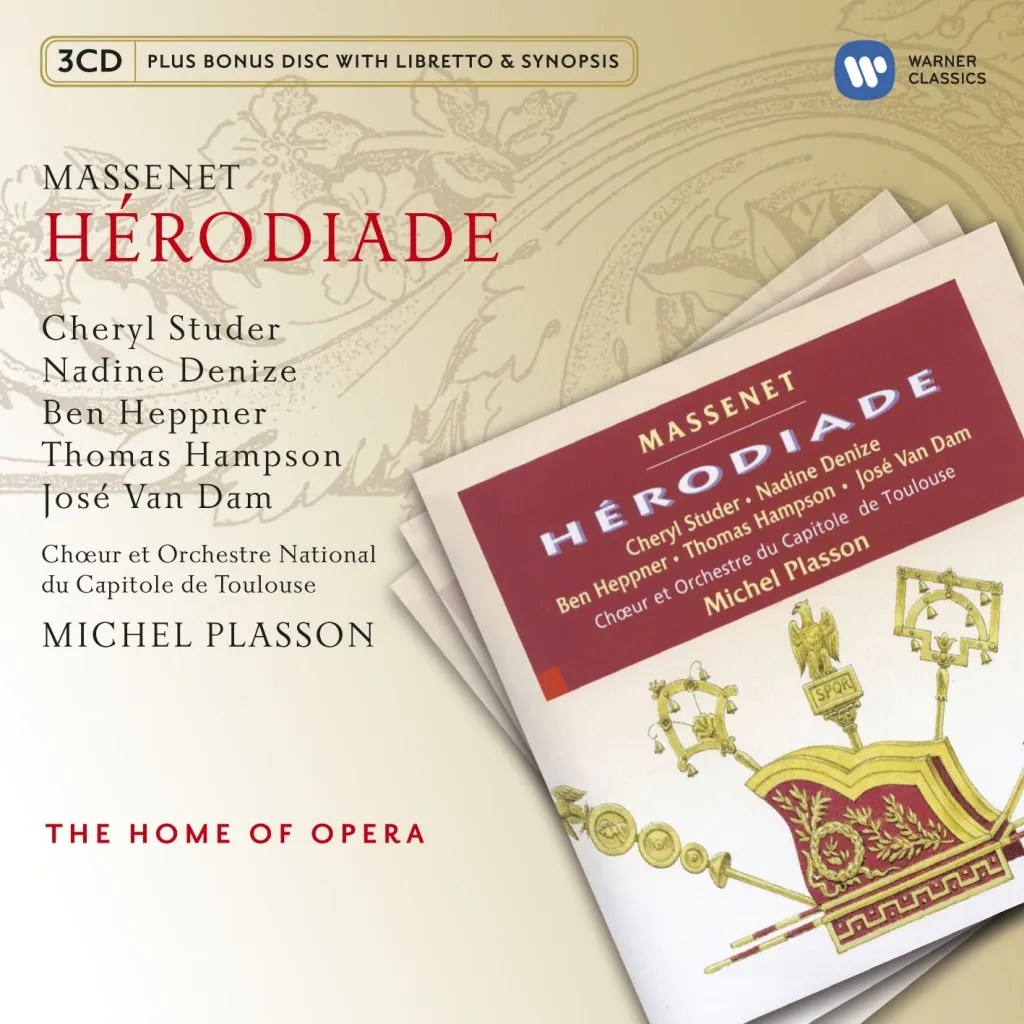
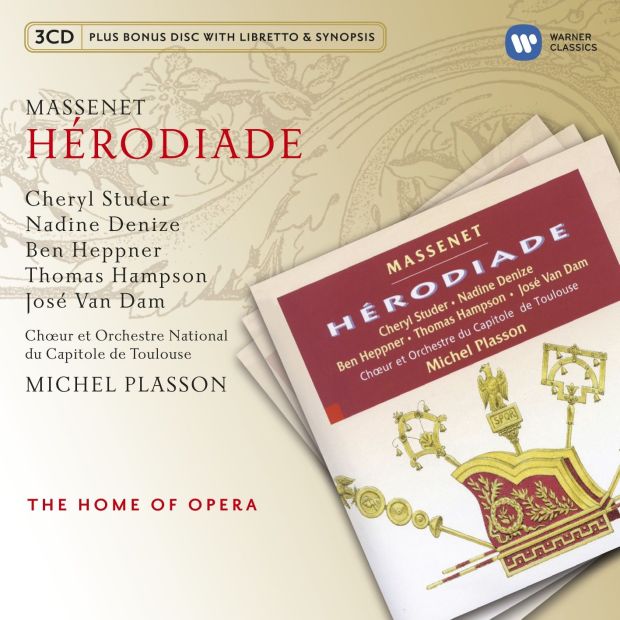
Orchestrally, this recording is really top-notch. Michel Plasson conducts the orchestra from Toulouse very energetically, with a lot of verve and drive, and he also knows how to allow space for all the subtleties. Exciting and beautiful. That is how I like to hear opera.
José van Dam is an impressive Phanuel and Nadine Denize an excellent Hérodiade., although her intonation is not always pure.
Hérode is not really a role for Thomas Hampson, but he sings it very beautifully. Something that unfortunately cannot be said of Ben Heppner’s Jean. A heroic tenor in that role is nothing but a terrible mistake.
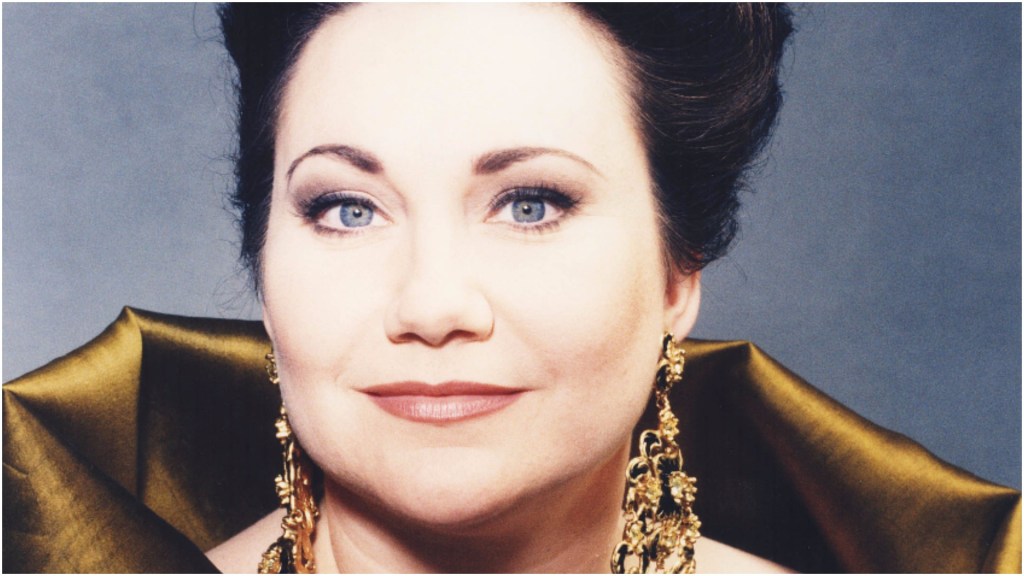
Cheryl Studer, on the other hand, is a Salomé of everyone’s dreams: girlish, innocent and naive. Her voice shines and sways and her final words “Ah! Darned Queen, if it is true that your cursed loins have given birth to me, look! Take back your blood and my life!” leave you shuddering and desperately weeping. Brava.
Orchestrally, this recording is really top-notch. Michel Plasson conducts the orchestra from Toulouse very energetically, with a lot of verve and drive, and he also knows how to allow space for all the subtleties. Exciting and beautiful. That is how I like to hear opera.
José van Dam is an impressive Phanuel and Nadine Denize an excellent Hérodiade., although her intonation is not always pure.
Hérode is not really a role for Thomas Hampson, but he sings it very beautifully. Something that unfortunately cannot be said of Ben Heppner’s Jean. A heroic tenor in that role is nothing but a terrible mistake.
Cheryl Studer, on the other hand, is a Salomé of everyone’s dreams: girlish, innocent and naive. Her voice shines and sways and her final words “Ah! Darned Queen, if it is true that your cursed loins have given birth to me, look! Take back your blood and my life!” leave you shuddering and desperately weeping. Brava.
STRAUSS:
SALOME
I realise that many of you will not agree with me, but for me Cheryl Studer is the very best Salome of the last fifty years. At least on CD, because she has never sung the complete role on stage (DG 4318102). Like few others, she knows how to portray the complex character of Salome’s psyche. Just listen to her question ‘Von wer spricht er?’ after which she realises that the prophet is talking about her mother and then she sings in a surprised, childishly naive way: ‘Er spricht von meiner Mutter’. Masterly.
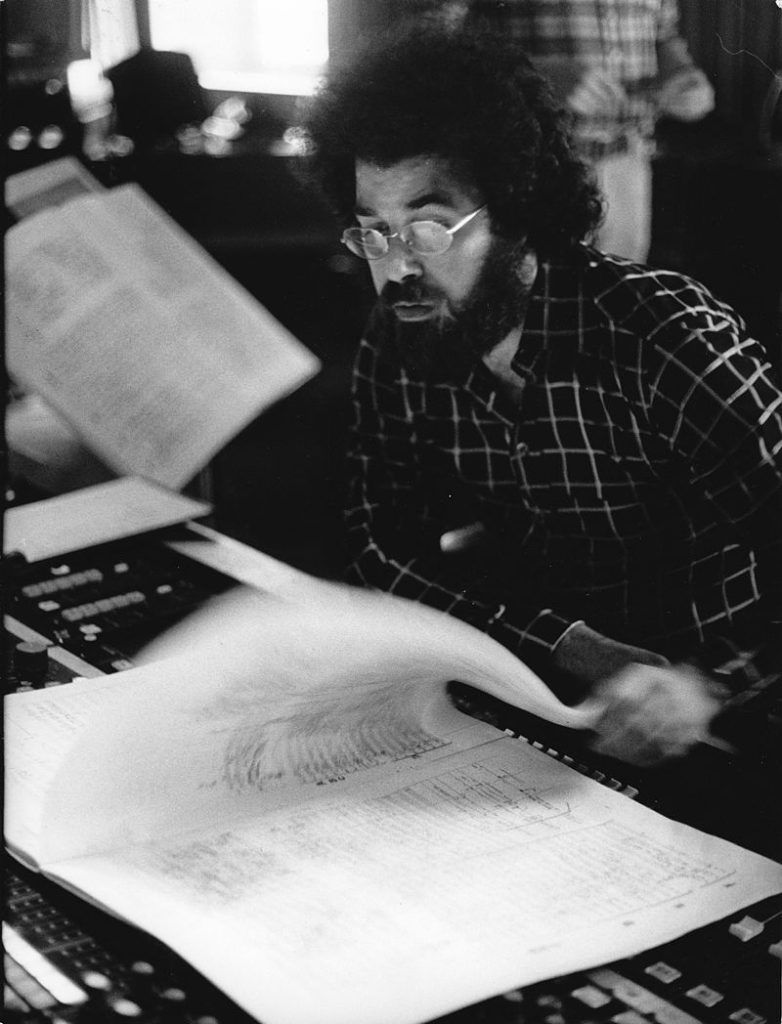
Bryn Terfel is a very virile young Jochanaan (it was, I think, the first time he sang the role), but most beautiful of all is Giuseppe Sinopoli’s very sensual, wide- sounding conducting.
ELEKTRA
This stage production from Vienna (Arthaus Musik 100 048) 1989 is more than extraordinary. Harry Kupfer’s direction is extremely gripping and terrifying, and although he is very realistic in his approach, he limits himself to the directions in the libretto.
The scene is dominated by grey in all its shades and is particularly dark. The only colour in the performance looms when Chrysotemis, at her heartfelt cry that she wants to live and bear children, rips open her blouse and reveals a red vest.
Eva Marton (Elektra) is exceptionally convincing: moving in her longing for her father, repulsive in her contempt for her sister and terrifying during her confrontation with her mother.
Cheryl Studer is a splendid Chrysothemis. With her slightly sweet, lyrical, yet still exceptionally powerful soprano, she can portray a very strong character: her Chrysotemis is a girl disappointed in life with a strong desire to escape, but without the decisiveness to actually bring it about. Also phenomenal is Brigitte Fassbänder in her portrayal of the mentally ill queen, plagued by nightmares and guilt. Both the mother and her two daughters would be on Freud’s couch in no time – talk about hysterical women! Franz Grundheber is an exemplary Orest and Claudio Abbado conducts with an intensity that borders on the impossible.
FRAU OHNE SCHATTEN
In 1992, Solti conducted a complete performance of the work in Salzburg. Götz Friedrich’s direction was considered particularly strong at the time, but I do not find it entirely satisfactory. The mise-en-scène is undoubtedly excellent, but it fails with the direction of the characters, causing the singers to run from place to place in a rather awkward way.
The stage design is beautiful with very minimalist but realistic sets, but the costumes are a bit bizarre at times. There is a lot of use of strobe lighting, which combined with violent musical passages may come across as rather violent.
Cheryl Studer is a dream of an Empress. Her voice, with its very recognisable timbre and beautiful pitch, is soaring, transparent almost, innocent and erotic at the same time. Thomas Moser is an attractive Emperor, perhaps a tad too light for the role, causing him occasional breathlessness and pressed notes, but his singing is fine.
Marjana Lipovšek is a truly phenomenal Amme. What that woman has at her disposal in terms of colour nuances and how she handles her (very warm) mezzo borders on the miraculous. In the process, she is also a gifted actress; I couldn’t take my eyes off her. (Decca 0714259)
WAGNER
TANNHÄUSER
I have never been a ‘Wagnerian’. I could never muster the patience to sit through hours of his operas. I found them bombastic. Pathetic. And even though I had to admit that there were some beautiful melodies, I felt that I really needed a pair of scissors and radically shorten them
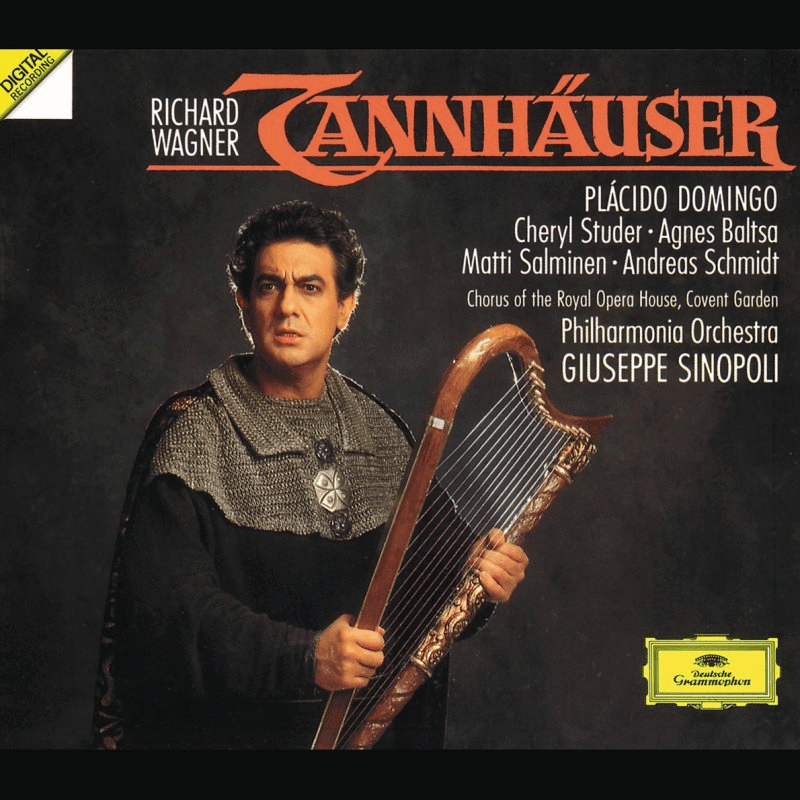
That this feeling has totally changed, I owe to Domingo. In my collector’s mania (I had to have everything he had done), I bought Tannhäuser (DG 4276252) in 1989. And then it happened: I became addicted.
Later, I learned to appreciate the music for itself and to this day, Tannhäuser is not only a very beloved Wagner opera, but also one of my absolute favourites.
I still consider this recording, conducted very sensually by Giueseppe Sinopoli, to be one of the best ever. Also because all the roles (Cheryl Studer as Elisabeth and Agnes Baltsa as Venus, such wealth!) are excellently cast. At the time, in the eighties and early nineties, this was not necessarily a given.
DER FLIEGENDE HOLLÄNDER
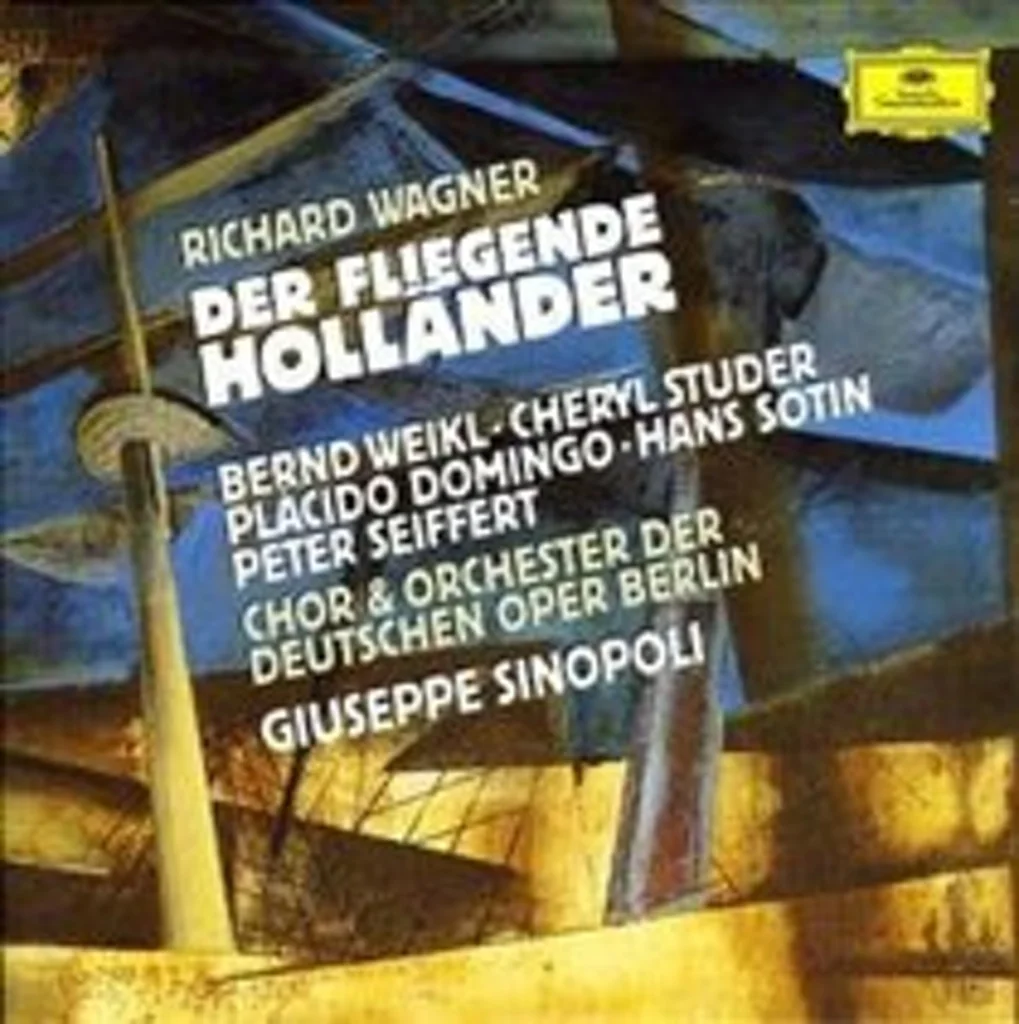
This CD recording from 1998 (DG 4377782) is particularly dear to me. First of all because of Cheryl Studer, at the time probably the most beautiful Senta one could imagine. Her wonderfully lyrical soprano with its easy and sensual height seemed made for the role.
The Holländer is sung here by Bernd Weikl. Not really the youngest anymore and you can really tell, but still very suitable for the role. Peter Seiffert is a splendid Steuerman, and in the role of Erik we hear none other than Plácido Domingo, a luxury!
But best of all is the orchestra: under the truly inspired leadership of Giuseppe Sinopoli, the Orchester der Deutsche Oper Berlin performs in a really magnificent way.
On 20 April 2001 Giuseppe Sinopoli died of a heart attack while conducting Aida in Berlin. He had just started the third act when he lost consciousness…… Sinopoli was 54 years old.
ATTILA
There are those performances where everything is just in perfect harmony and you get the feeling that it could not be any better. People keep talking about them and they become legends.
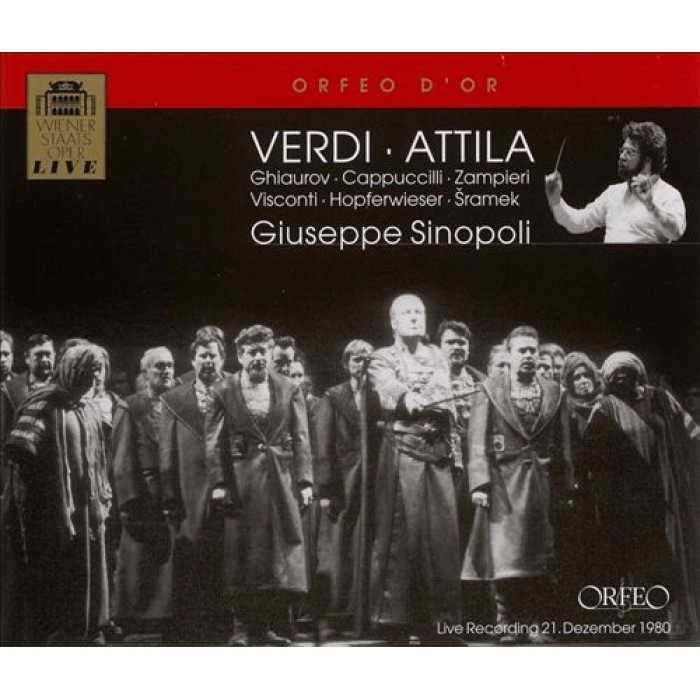
Verdi’s Attila was such a performance, at the Vienna State Opera on 21 December 1980. It was Giuseppe Sinopoli’s debut in the house, his name was still virtually unknown, but the initial reluctance of the audience turned into frenzied enthusiasm from the very first bars. Verdi’s score – not the strongest – has never been heard before with such warmth, fervour and tenderness.
Nicolai Ghiaurov was a great Attila. With his sonorous bass, he gave the character not only the allure of a general but also the gentleness of a loving man.
In her role as Odabella, Mara Zampieri proved that she is not only a fantastic singer with a radiant height and a dramatic attack, but also a great actress.
The stretta ‘E gettata la mia sorte’ in the second act requires the baritone to sing the high b flat. Piero Cappuccilli hit it with ease and suppleness, and then was forced to encore by the frenzied audience, something one seldom experiences in opera. A rare occurrence.
TANNHÄUSER
I have never been a ‘Wagnerian’. I could never muster the patience to sit through hours of his operas. I found them bombastic. Pathetic. And even though I had to admit that there were some beautiful melodies, I felt that I really needed a pair of scissors and radically shorten them
That this feeling has totally changed, I owe to Domingo. In my collector’s mania (I had to have everything he had done), I bought the recently released Tannhäuser (DG 4276252) in 1989. And then it happened: I became addicted.
At first, it was mainly Domingo who was to ‘blame’, whose deeply human interpretation of the title role gave me the goose bumps. His words: “Wie sagst du, Wofram? Bist du denn nicht mein Feind?” (sung with emphasis on ‘mein’ and ‘Feind’ and with a childish question mark at the end of the phrase) caused me to burst into tears.
Later, I learned to appreciate the music for itself and to this day, Tannhäuser is not only a very beloved Wagner opera, but also one of my absolute favourites.
I still consider this recording, conducted very sensually by Giueseppe Sinopoli, to be one of the best ever. Also because all the roles (Cheryl Studer as Elisabeth and Agnes Baltsa as Venus, such wealth!) are excellently cast. At the time, in the eighties and early nineties, this was not necessarily a given.
DER FLIEGENDE HOLLÄNDER
This CD recording from 1998 (DG 4377782) is particularly dear to me. First of all because of Cheryl Studer, at the time probably the most beautiful Senta one could imagine. Her wonderfully lyrical soprano with its easy and sensual height seemed made for the role.
The Holländer is sung here by Bernd Weikl. Not really the youngest anymore and you can really tell, but still very suitable for the role. Peter Seiffert is a splendid Steuerman, and in the role of Erik we hear none other than Plácido Domingo, a luxury!
But best of all is the orchestra: under the truly inspired leadership of Giuseppe Sinopoli, the Orchester der Deutsche Oper Berlin performs in a really magnificent way.
SALOME
I realise that many of you will not agree with me, but for me Cheryl Studer is the very best Salome of the last fifty years. At least on CD, because she has never sung the complete role on stage (DG 4318102). Like few others, she knows how to portray the complex character of Salome’s psyche. Just listen to her question ‘Von wer spricht er?’ after which she realises that the prophet is talking about her mother and then she sings in a surprised, childishly naive way: ‘Er spricht von meiner Mutter’. Masterly.
Bryn Terfel is a very virile young Jochanaan (it was, I think, the first time he sang the role), but most beautiful of all is Giuseppe Sinopoli’s very sensual, wide- sounding conducting.
In 1996 was ik in het Aalto Theater in Essen voor de Aida van Dietrich Hilsdorf. Deze regisseur had ook toen al een voorkeur voor het benadrukken van het intieme karakter van de opera’s die hij onder handen nam. Hij maakte als het ware overal een Kammerstück van. In zijn Aida speelt zich de handeling vooral af aan een soort keukentafel op een verder leeg toneel.
Om plaats te maken voor de triomfmars wordt het koor op de zijbalkons geplaats, samen met de koperblazers. Op het toneel een processie van oorlogsslachtoffers en een ballet act van twee danseressen die tevoorschijn komen uit overmaatse rieten korven aan weerszijden van het leeggemaakte toneel.
Een voice over roept met geknepen stem, vooroorlogs radiogeluid, af wat er zoal te zien is op het toneel: de vrouwen en kinderen van de gesneuvelde soldaten, de gewonden, de overwonnen vijanden, de Memphis Twins. Het geheel doet sterk denken aan de sfeer in Pasolini’s film Porcile. Deze oude productie heeft cultstatus in Essen en werd in 2019 nog maar weer eens hernomen.
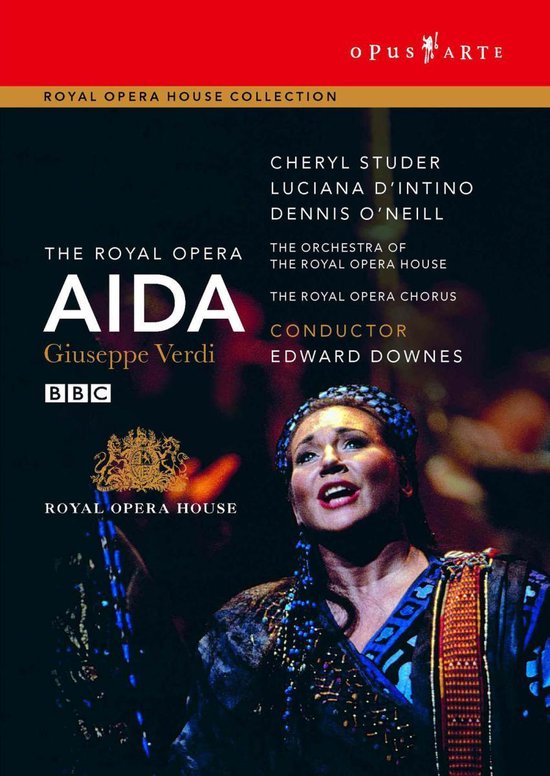
Op het label Opus Arte werd in 2008 de opname op dvd uitgebracht van een voorstelling uit 1994 in de Royal Opera. Het betrof een productie van Elijah Moshinsky waarvan het toneelbeeld vooral wordt bepaald door de eclectische decors en kostuums van Michael Yeargan. Het is een bont geheel dat een beetje het midden houdt tussen Ben Hur en een carnavalsoptocht.
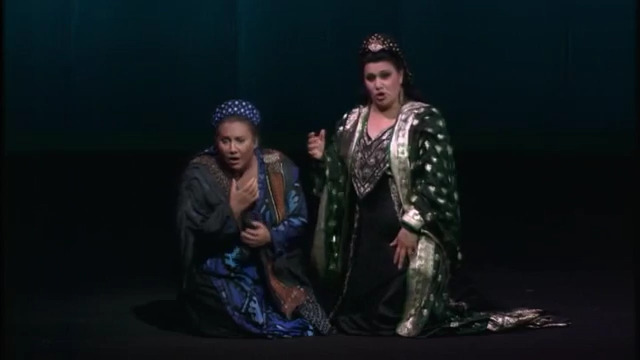
Cheryl Studer vertolkt de titelrol en Alexandru Agache die van haar vader Amonasro. Opmerkelijk genoeg zijn beiden bruin geschminkt om maar vooral te benadrukken dat ze uit zwart Afrika komen, immers Ethiopië. Anno 1994 zou je zoiets toch niet meer verwachten.
Na Don Carlos met de Infante tussen Elisabetta en Eboli is ook hier sprake van een man die begeerd wordt door twee vrouwen. Vrijwel altijd is het omgekeerd, een sopraan tussen een tenor en een bariton. Voor de afloop maakt het niet uit, alles gaat sowieso mis.
Maar kijken we naar Aida dan zien we binnen deze opzet een tweede plot die aan het gebruikelijke format voldoet: Aida tussen Radames en haar vader. Daarmee zijn we op vertrouwd terrein, denk aan Violetta en de twee Germonts.
Aida laat zich bepraten door haar vader en verraadt haar geliefde, alle protesten van het tegendeel ten spijt. En eerder al heeft ze hem in de waan gelaten dat Amonasro weliswaar haar vader is maar dat de koning is gesneuveld. Daarmee heeft Radames met zijn smeekbede aan de farao de pest in huis gehaald. Die twee Ethiopiërs Aida en Amonasro staan er gekleurd op, figuurlijk dan.
Vaderlandsliefde is voor de liefde tussen twee mensen de dood in de pot, zo blijkt maar weer eens. Alleen Amneris is recht door zee, ze doet alles om Radames in te palmen en windt daar geen doekjes om. Je weet steeds precies wat je aan haar hebt. Hogepriester Ramfis is degene die achteraf het gelijk aan zijn zijde krijgt en dan ook niet aarzelt Radames ter dood te veroordelen. Die man heeft landverraad gepleegd en is niet te vertrouwen.
Dat de gevluchte Aida stilletjes is teruggekeerd om samen met Radames de dood in te gaan is niet meer dan een goedmakertje naar het publiek. We moeten haar immers niet te hard vallen, het was allemaal de schuld van haar vader, en van de oorlog natuurlijk.
Robert Lloyd is een uitstekende Ramfis, betrouwbaar als altijd. Agache geeft een mooie vertolking van Amonasro. Het duet met Aida dat de rampzalige afloop inluidt komt prachtig over het voetlicht.
Studer zingt ‘O patria mia’:
Studer is hier toch al niet meer de sopraan die ruim tien jaar lang de successen aaneen reeg. Niet overal die vanzelfsprekende zuiverheid in de hoogte, in het middenregister wat weinig volume. Na haar aria ‘Ritorna vincitor’ blijft het opvallend stil in de zaal. Later komt ze beter op dreef en in het genoemde duet geeft ze haar vader prachtig tegenspel.
De Radames van Dennis O’Neill is heel behoorlijk maar niet geweldig. Je zou hem de tenor van dienst kunnen noemen,
De Amneris van Luciana d’Intino bevalt mij, en het publiek, het meeste. Tijdens de nazit in de bus waarmee de Vrienden van de Opera in 1996 de Aida in Essen bezochten formuleerde Fred Lingen het aldus: ‘Aida dient op maar Amneris ruimt af’. Ze heeft feitelijk het laatste woord met haar monoloog in de vierde akte. De laatste scène met Radames en Aida in de tombe is niet meer dan een afterthought.
Zoals bij veel werken van Strauss is Die Frau ohne Schatten een product van de samenwerking van de componist met Hugo von Hofmannsthal. Die wilde een sprookje schrijven, een soort moderne Zauberflöte. Dat heeft geleid tot een verhaal met de nodige ongerijmdheden.
Hugo von Hoffmansthal en Richard Strauss
Centraal staat de figuur van de Kaiserin, dochter van Keikobad, de heerser over het Geestenrijk. Zij verstond de kunst zich te veranderen in een dier en in de gedaante van een gazelle is ze de Kaiser, een hartstochtelijk jager, ten prooi gevallen. Daarbij is ze half mens geworden; ze is namelijk doorschijnend en heeft dus geen schaduw. Keikobad laat haar een jaar bij hem verwijlen. Als ze in die periode niet zwanger is geraakt, zal ze terugkeren in het Geestenrijk en zal de Kaiser tot steen worden.
Aangezien zwanger worden ondanks elke nacht geslachtsverkeer na een jaar nog niet is gelukt, gaat ze met haar voedster (Amme) naar de mensenwereld om een schaduw te kopen. Daar komt de vrouw van Barak in beeld, een jong meisje getrouwd met een veel oudere man in een huis met drie zich voortdurend misdragende broers. Zonder veel problemen kan ze worden overgehaald om te kiezen voor kinderloosheid in welvaart in ruil voor haar schaduw.
De Kaiserin krijgt echter medelijden met Barak en zijn vrouw en kan zichzelf er niet toe brengen het plan door te zetten. Daardoor verandert de Kaiser in steen, zoals voorspeld. Uiteindelijk loopt het met beide echtparen toch goed af, zo lijkt het.
De Kaiserin heeft een grote aria in de laatste akte waarin ze haar vader Keikobad toezingt en hem vertelt dat ze niet anders kan en niet anders wil, dan dat ze heeft gedaan: ‘Vater bist du es’. Het is het melodieuze hoogtepunt van deze opera die verder muzikaal niet de meest toegankelijke van Strauss’ werken is.
Het heeft er alle schijn van dat von Hofmannsthal licht gefascineerd was door het opmerkelijke karakter van Pauline, Strauss’ ruziezoekende echtgenote. Ze placht zich te gedragen als iemand die haar omgeving nooit goed genoeg vond en leek het vrijwel altijd slecht naar de zin te hebben. Strauss werd regelmatig overladen met onzinnige verwijten maar doordat hij tamelijk flegmatiek was wist hij er zo goed mee om te gaan dat het stel tot zijn dood in 1949 getrouwd is gebleven. In de lankmoedige Barak en zijn ruziezoekende vrouw zit een behoorlijke dosis huwelijksleven van Richard en Pauline.
Van de productie die Götz Friedrich maakte voor de Salzburger Festspiele van 1992 is een dvd uitgebracht. Friedrich en zijn decorbouwer Rolf Glittenberg hebben zich veel moeite getroost om een librettogetrouwe FroSch op het toneel te brengen daarbij de regieaanwijzingen van von Hofmannthal zo veel als mogelijk opvolgend. De kostumering van Marianne Glittenberg sluit daar perfect op aan. Het toneelbeeld oogt wonderschoon en door middel van snelle scènewisselingen achter gesloten doek wordt de strikte scheiding tussen de feeënwereld en de mensenwereld volledig in stand gehouden.
De ervaring van het bijwonen van een voorstelling is hoe dan ook vluchtig, je kan je er maar een deel van blijven herinneren. In dat opzicht is deze dvd een monument, een mogelijkheid die schitterende gebeurtenis in Salzburg opnieuw te beleven.
Cheryl Studer had in die tijd de bijnaam ‘Kaiserin’ en dat sloeg op haar vertolking van deze rol in Strauss grote opera en natuurlijk ook op haar helaas tijdelijke dominantie op het operatoneel. In deze productie maakt ze door haar optreden als Die Kaiserin die bijnaam en reputatie geheel waar. Naast schitterende zang weet Studer ook nadrukkelijk de inwendige strijd van haar personage zichtbaar te maken. Om te voorkomen dat haar geliefde in steen zal veranderen dwingt ze haar Amme om naar de mensenwereld af te dalen om daar een schaduw te kopen. Maar eenmaal in dat proces gaat ze steeds meer twijfelen, zozeer dat uiteindelijk ten overstaan van haar vader als een soort noodkreet klinkt ‘Ich will nicht’. Daarmee volgt ze haar ‘geweten’ of ‘moreel besef’, voor zover een half mens half fee wezen dat bezit. Feitelijk is ze al mens geworden en na die beproeving te hebben doorstaan laat haar vader Keikobad haar gaan en mag ze in vrede en vooral liefde leven met haar ontsteende Kaiser.
Die Frau ohne Schatten wordt wel eens vergeleken met Die Zauberflöte omdat er twee koppels in voorkomen die beiden ‘beproevingen’ moeten doorstaan. Daarmee wordt Schikaneder teveel eer gegund. Zijn libretto is je reinste vaudeville, opgeleukt met beelden die ontleend zijn aan de vrijmetselarij om het een diepzinnig tintje te geven. Maar die beproevingen zijn scouting uitjes vergeleken met wat von Hofmannsthal zijn protagonisten voorschotelt. Liefde, zelfopoffering, kinderloosheid, het zijn serieuze thema’s en dat kan van Die Zauberflöte niet gezegd worden.
Marjana Lipovsek is een zeer goede Amme, een beetje creepy en overtuigend in haar afkeer van het mensengeslacht. Ze heeft tot het uiterste geprobeerd haar opdracht te vervullen maar wordt aan het eind afgedankt en veroordeeld tot een leven onder de mensen. En dat alleen omdat ze de mentale ommezwaai van haar meesteres niet kan volgen. Studer en Lipovsek hebben duidelijk contrasterende stemmen waardoor hun vertolkingen ook vocaal duidelijk te onderscheiden zijn.
De Färberin van Eva Marton blijft daarbij achter. Haar kijvende bijdragen in de eerste en tweede akte zijn toch teveel precies dat: kijven. Pas in de derde akte klinkt Marton minder geforceerd maar daar heeft ze natuurlijk eindelijk wat langere zanglijnen van Straus gekregen.
Robert Hale is als Barak de lankmoedigheid zelve. Hij had die jonge bruid al meegekregen met een gebruiksaanwijzing en lijkt te wachten tot ze een beetje uit haar puberale kuren is gegroeid. Komt wel goed allemaal. Dat ze in werkelijkheid diep ongelukkig is ontgaat hem en dat maakt haar woedend. Dat het tussen die twee uiteindelijk wel goed lijkt te komen is minder voor de hand liggend dan de verlossing van het ‘hogere’ paar. Der Kaiser wordt uitstekend gezongen door Thomas Moser, acterend wordt er niet heel veel van hem gevergd.
Een opvallende bijrol is die van Bryn Terfel als Der Geisterbote, niets mis mee natuurlijk.
De vele bijrollen zijn goed bezet en de Wiener Philharmoniker levert een fenomenale prestatie onder leiding van een zeer geïnspireerde Georg Solti. Alsof de dagen van Karl Böhm herleefden.
Richard Strauss composed his world hit Salome to a play by Oscar Wilde; and the latter drew his inspiration from a short story by Flaubert, ‘Herodias’. Paul Milliet and Henri Grémont also based their libretto for Massenet’s opera Herodiade on this story. Neither Wilde nor Milliet and Grémont were very faithful to Flaubert. Whereas the French novelist more or less limited himself to the biblical narrative, enriched with his poetic language and descriptions, the playwright and librettists added entirely new aspects and twists to the story.
Hérodiade was first performed in the Royal Theatre of Brussels on 19 December 1881. Anyone expecting animal eroticism, blood and sweat, as with Richard Strauss, will be disappointed. Massenet’s Salome is a truly innocent and devout girl. When her mother left her to marry Hérode, she was given shelter by Jean (John the Baptist), with whom she fell in love. A love that proved to be mutual.
No opera is complete without complications: Hérode has a crush on Salome, Hérodiade becomes jealous of her and Jean is beheaded. Salome sees Hérodiade as the instigator of all evil and wants to kill her. Hérodiade whispers “I am your mother” and Salome commits suicide.
The music already exudes a hint of the perfume of Massenet’s later works, but with all those choruses, exotic Oriental scenes and elaborate ballet scenes, it is nothing less than a real Grand Opera in the best Meyerbeer tradition.
One of the earliest recorded fragments of the opera is, I think, the famous aria of Hérode ‘Vision Fusitive’ by the French baritone Maurice Renaud, made in 1908:
And from the recording Georges Thill made in 1927, we know what an ideal Jean should sound like:
REGINE CRESPIN 1963
If you are in possession of this performance, you need look no further. It doesn’t get any better than this. There is only one problem: this recording does not exist. At least not of the complete opera.
In 1963, EMI recorded the highlights of Hérodiade with the best French singers of the time (and of today, for that matter) and the answer to the “why not complete ????” will probably never be given.
Georges Prêtre conducts the orchestra of the Theater National de Paris as if his life depends upon it and every role is more than excellently cast.
Regine Crespin sings ‘Il est doux, il est bon’:
Regine Crespin’s Salomé is unequalled and so is Rita Gorr’s Hérodiade. Albert Lance (Jean) shows how that role should really be sung in the tradition of Georges Thill, and for Michel Dens as Hérode we really cannot find the right words. Such singers no longer exist.
Hopefully, Warner will one day release the recording on CD.
MONTSERRAT CABALLÉ (Barcelona 1984)
This recording also may only be obtained via a pirate (or You Tube), but then it is complete and moreover with (admittedly bad) images!
Dunja Vejzovic portrays a deliciously mean Hérodiade and Juan Pons is a somewhat youthful but otherwise fine Hérode. A few years later, he will become one of the best “Hérodes” and you can already hear and see that in this recording.
Montserrat Caballé is a fantastic Salomé, the voice alone makes you believe you are in heaven and José Carreras is very moving as a charismatic Jean.
Below, Carreras sings ‘Ne pouvant réprimer les élans’:
None of the protagonists is really idiomatic, but what a pleasure it is to watch a real Diva (and Divo)! They really don’t make them like that any more
The whole opera on you tube:
RENÉE FLEMING 1994 (Sony 66847)
In the mid-1990s, Herodiade enjoyed a short-lived revival. The opera was then performed in several opera houses and it was even recorded – officially – three times: once in the studio and twice live.
I must admit that I was a bit concerned about Gergiev as the director, but he really did an excellent job. Under his baton the opera sounds like a real Grand Opéra, grand, fiery and compelling.
Plácido Domingo (Jean) is perhaps a touch too heroic, but his voice sounds youthful and contageous, worthy of a true prophet.
Personally, I find Dolora Zajick (Hérodiade) a bit on the (too) heavy side, but her singing is undeniably excellent and there is nothing wrong with her interpretation.
Juan Pons is an excellent Hérode, but I would have liked Phanuel (Kenneth Cox) to be a bit more idiomatic. Something that also applies to the Salomé of Renée Fleming: she sings beautifully but in this role she can not totally convince me.
NANCY GUSTAFSON 1995 (RCA 74321 79597 2)
The performance in Vienna was highly praised, and that this praise was justified is proved by the recording made live in the house by ORF.
First of all, there is Agnes Baltsa’s brilliant title role: fierce and dramatic. If you ask me: apart from Rita Gorr probably the best Hérodiade ever.
Placido Domingo sings ‘Ne pouvant réprimer les élans’:
Domingo, in the role of Jean, is even more impressive here than on Sony and also Juan Pons (Hérode) actually convinces me yet more on this recording. His rendition of ‘Vision Fugitive’ is very, very moving. Unfortunately, Nancy Gustafson (Salomé) must acknowledge the superiority of Fleming (Sony), but both pale in comparison to Cheryl Studer (Warner). Not to mention Regine Crespin!
Judging by the photos in the text booklet and the sparse clips on YouTube, we should be glad that the recording appeared on CD and not on DVD.
Finale of the opera:
In any case, the sound is excellent and the Vienna Opera orchestra under the direction of Marcello Viotti plays with great passion.
CHERYL STUDER 1995 (Warner 55983525)
Orchestrally, this recording is really top-notch. Michel Plasson conducts the orchestra from Toulouse very energetically, with a lot of verve and drive, and he also knows how to allow space for all the subtleties. Exciting and beautiful. That is how I like to hear opera.
José van Dam is an impressive Phanuel and Nadine Denize an excellent Hérodiade., although her intonation is not always pure.
Hérode is not really a role for Thomas Hampson, but he sings it very beautifully. Something that unfortunately cannot be said of Ben Heppner’s Jean. A heroic tenor in that role is nothing but a terrible mistake.
Cheryl Studer, on the other hand, is a Salomé of everyone’s dreams: girlish, innocent and naive. Her voice shines and sways and her final words “Ah! Darned Queen, if it is true that your cursed loins have given birth to me, look! Take back your blood and my life!” leave you shuddering and desperately weeping. Brava.
In 1990 verkeerde Cheryl Studer in haar wonderyears waarin ze de successen aaneen reeg. Zo trad ze dat jaar zowel in de Staatsoper Wien als tijdens de Bayreuther Festspiele op als Elsa in Wagners Lohengrin, een rol die haar op het lijf geschreven was.
Arthaus bracht een opname op dvd uit van een voorstelling in de Staatsoper die bijna als muzikale benchmark zou kunnen dienen. De titelrol is in handen van een indrukwekkende Plácido Domingo en naast Studer treedt er een topcast aan met Robert Lloyd als Koning Heinrich, Hartmut Welker als Telramund en Dunja Vejzovic als Ortrud. Als Heerrufer is George Tichy te horen.
De productie van Wolfgang Weber is rechttoe rechtaan, alles keurig volgens het boekje. Decors en kostuums ogen fantasie middeleeuws en als de belichting het weer eens toelaat ziet het er prachtig uit. Dat is wel een minpunt, het toneel wordt voortdurend erg donker gehouden. Voordeel is wel dat de kijker zich geheel op de tekst en de zang kan richten wat met de Duitse ondertitels natuurlijk goed lukt.
Zodoende dacht ik weer eens na over wat er eigenlijk met Elsa gaande is. Ze wordt van ontvoering en moord op haar broertje beschuldigd, een incident dat zich al een tijdje terug moet hebben voorgedaan gelet op het feit dat Telramund inmiddels met Ortrud is getrouwd. Dit zijn de middeleeuwen, het is een wonder dat Elsa überhaupt nog in leven is. Ook ten overstaan van Heinrich heeft ze feitelijk geen schijn van kans, totdat die kerel met die zwaan ineens komt opdagen.
Claudio Abbadao leidt koor en orkest van de Staatsoper in een topuitvoering. En de solisten betalen hem met gelijke munt. Hartmut Welker is een van de beste Telramunds die ik tot op heden heb beleefd. Meestal valt die rol me nogal tegen maar Welker overtuigt in spel en zang. Dunja Vejzovic is een creepy Ortrud die een groot deel van de tweede akte naar zich toe weet te trekken. Lloyd is bijna een luxe bezetting in de rol van de weinig standvastige koning. Heinrich is een opportunist en dat valt gemakkelijk op al zingt hij nog zo heldhaftig.
Domingo is een mooie Lohengrin maar ik speelde deze dvd voor het eerst in lange tijd weer eens af omwille van Cheryl Studer. Ze is een ideale Elsa, oogt kwetsbaar en wereldvreemd genoeg om haar personage herkenbaar gestalte te geven en zingt de sterren van de hemel. Ik was indertijd helemaal weg van die stem en weet nu weer precies waardoor dat kwam.
De eerste keer dat ik Cheryls stem hoorde was bij het afspelen van een cd met highlights van Tannhäuser onder Sinopoli, opgenomen in 1989. De eerste track was ‘Dich teure Halle’ en haar stem kwam als een klaroenstoot de kamer en blies me bijna van mijn sokken. Overweldigend, die eerste kennismaking. Ik heb die cd talloze malen afgespeeld, kon er niet genoeg van krijgen en nam me voor alles aan te schaffen waarop ze te horen was. Ik ben een heel eind gekomen.
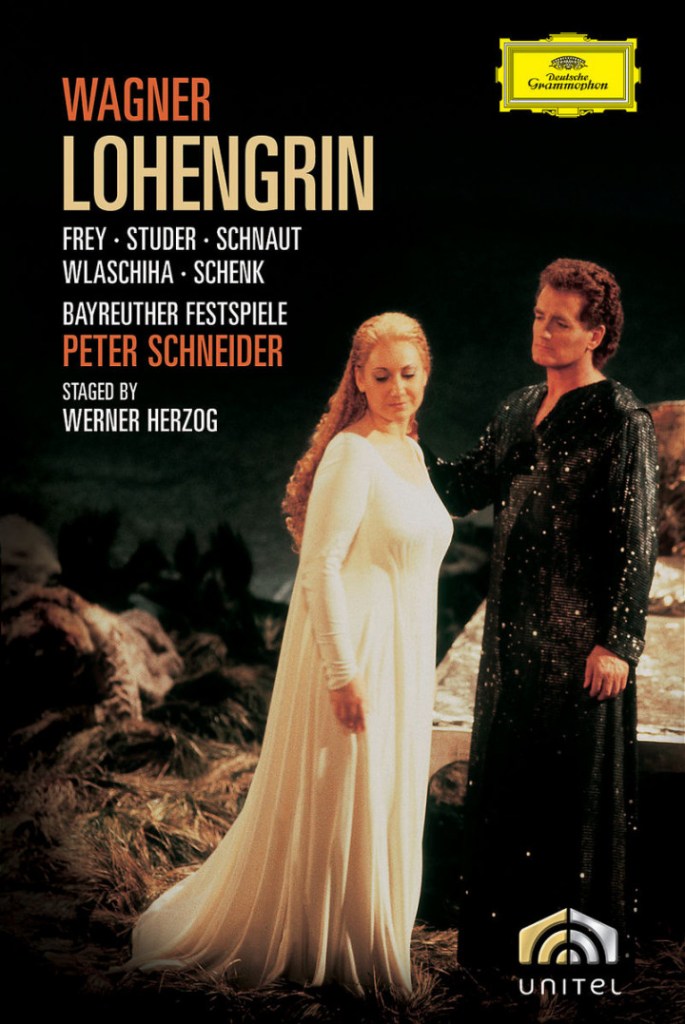
Als Elsa in de productie van Werner Herzog voor de Bayreuther Festspiele van 1990 doet ze dit nog eens dunnetjes over. Ik vind haar hier nog mooier dan in die Weense productie. Sowieso is deze Lohengrin een stuk interessanter dan die van Weber.
Herzog neemt het romantische middeleeuwse gebeuren voor kennisgeving aan en brengt het zo goed en mooi mogelijk op het toneel. Hij gebruikt een toneelbeeld dat overigens op twee gedachten hinkt. Enerzijds toont hij de schamele overblijfselen van een kerk met gotische spitsbogen, het enige ‘gebouw’ op het toneel maar wel een directe verwijzing naar het christendom als ‘overwinnaar’. Anderzijds probeert hij recht te doen aan Ortruds weigering dit te accepteren, ze roept letterlijk Wotan en Freia aan. Om dat aannemelijk te maken wordt de bevolking getoond in een zo basaal mogelijke levensomstandigheid alsof we een paar eeuwen eerder zitten.
De gehele handeling speelt zich buiten af en bij het begin van de kerkscène in de tweede akte zien we personen gewoon buiten op de grond slapen. Het ‘dorpsplein’ wordt gemarkeerd door een stel megaliethen. Het liefst zou Herzog nog een paar druïden aan het geheel willen toevoegen, zo lijkt het. De strijd tussen de oude goden en het christendom is nog niet beslist, ‘is hanging in the balance’. Dat weerhoudt Henning von Gierke er niet van iedereen op en top gekleed er bij te laten lopen, een kleurrijk ‘mideleeuws’ geheel.
Verder ziet alles er een beetje somber uit, niet zozeer donker maar er is weinig tot geen zon te zien door de permanente nevel. Alleen als Elsa is getrouwd komt de zon even door, maar evengoed staat het bruidsbed gewoon weer buiten in de nacht. En als ze die Frage heeft gesteld begint het te sneeuwen.
Muzikaal staat deze uitvoering op een zeer hoog niveau. Behalve Studer laten ook de andere protagonisten zich van hun beste kant zien en horen.
Manfred Schenk is een welluidende Heinrich en Eike Wim Schulte een goede Heerrufer. Ekkehard Wlaschiha weet me aangenaam te verrassen met een zeer goede vertolking van Telramund. Soms vind ik hem wat ruw maar hier zingt hij een rol die hem past als een handschoen.
Gabriele Schnaut is een zeer felle Ortrud die in ‘haar‘ akte veel aandacht weet weg te halen bij Elsa, ook bij Telramund overigens. Paul Frey doet me een beetje denken aan Klaus Florian Vogt, in de verte dan. Mooi optreden van deze Canadese tenor. Koor en orkest spelen zonder meer weergaloos, met dank aan maestro Peter Schneider. Zeer de moeite waar om nog eens terug te luisteren.
Deze opera speelt zich af op Sicilië en voor een beter begrip van de inhoud is enige kennis van de regionale geschiedenis vereist. Sicilië maakte deel uit van het Romeinse Rijk en na de Romeinen kwamen de Vandalen gevolgd door de Ostrogoten, Byzantijnen en Arabieren. In de 11e eeuw werd het eiland veroverd door de Noormannen, feitelijk Vikingen, die een krachtig bewind wisten uit te oefenen. Spanjaarden uit Aragon, Fransen, Duitsers en later Spanjaarden van het huis Bourbon completeren de stoet. Het Franse bestuur was van korte duur. Het repressieve karakter van het régime leidde al na ongeveer twintig jaar tot een opstand waarbij alle Fransen werden verdreven of gedood. Op 31 maart 1282 sloeg de vlam in de pan nadat een Franse officier een Siciliaanse vrouw op weg naar het avondgebed zou hebben beledigd. De man werd in de kerk doodgestoken.
Deze gebeurtenis is in Verdi’s Les vêpres Siciliennes verwerkt, beter bekend als I vespri Siciliani. Het was een opdrachtwerk van de Parijse Opéra waar het in 1855 in première ging. In zijn oorspronkelijke vorm is het een grand opéra in vijf aktes met een groot ballet.
Het Franse libretto is van Charles Duveyrier en Eugène Scribe naar hun werk Le duc d’Albe, de opera waaraan Donizetti in 1840 had gewerkt maar die om uiteenlopende redenen onvoltooid was gebleven.
Het genre Grand Opéra heeft als inhoudelijk kenmerk dat de handeling losjes wordt bepaald door historische figuren tegen de achtergrond van grote gebeurtenissen die pogingen van de protagonisten om het leven naar hun hand te zetten bijna op voorhand doen mislukken. Zo ook Les Vêpres Siciliennes waarin Henri wordt vermorzeld tussen de intuïtieve liefde voor zijn vader Montfort en zijn afkeer voor de verpersoonlijking van de onderdrukking van het Siciliaanse volk, de Franse gouverneur Montfort. De overeenkomsten met Donizetti’s Le Duc d’Albe zijn heel duidelijk. Alleen de namen zijn veranderd.
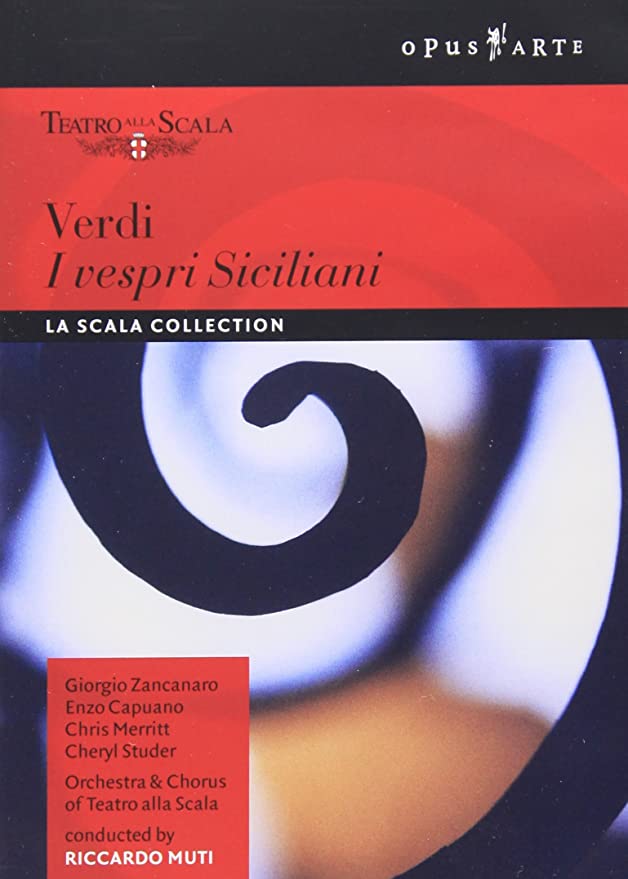
In 1989 stond I vespri Siciliani op het programma van La Scala. In de hoofdrollen Giorgio Zancanaro als Monforte, Cheryl Studer als Elena en Ferruccio Furlanetto als Procida. Chris Merrit vertolkte de rol van Arrigo, de Italiaanse versie van Henri. Zoals gezegd wordt deze opera vrij zelden gespeeld, een lot dat het werk deelt met een reeks vroege Verdi’s. Maar voor een opera die vlak na Verdi’s succesnummer La traviata kwam is dat op zijn zachtst gezegd opmerkelijk.
Toen ik na vele jaren de dvd van de opname uit 1989 nog eens afspeelde, werd me echter toch wel veel duidelijk. Alles wat La traviata na een moeilijke start tot een megasucces heeft gemaakt, ontbreekt in Vespri. La traviata is een aansprekende liefdesgeschiedenis met een schitterende rol voor de prima donna en een ontroerend duet van Violetta met Germont sr. De rol van Alfredo is routine Verdi, het gaat om de sopraan en de bariton. Verder is de opera heel compact, er staat geen noot teveel in.
In Vespri komt de liefdesgeschiedenis van Arrigo en Helena nauwelijks uit de verf. De scènes van Montfort worden nodeloos gerekt, zeker in de briefscène lijkt er geen einde aan te komen. Het ballet in de derde akte kan natuurlijk gemakkelijk worden geschrapt maar zelfs dan blijft er een onnodig lang werk over waarin de componist de protagonisten zich moeizaam laat voortslepen. Mijn conclusie is dan ook dat dit werk terecht wordt genegeerd, het is eerder een curiosum dan een aansprekende latere Verdi.
De enscenering in La Scala is basaal. Een plein met een blauwe achtergrond, de zee. Een kamer in het paleis van de gouverneur, een balzaal en een gevangenis waarin zich een beul meldt met een heuse grote hakbijl. De gebeurtenissen spelen zich af in de 13e eeuw maar de kostumering duidt op de periode waarin de opera is ontstaan. De Fransen zien er schitterend uit in hun uniformen waarin hemelsblauw is gecombineerd met roomwit. Elena loopt in een zwarte jurk, ze is in de rouw vanwege haar broer. Het volk is aanwezig in een ‘Cavalleria’ kostumering.
Men heeft in deze productie het ballet zeer serieus genomen. Het wordt in zijn volle lengte uitgevoerd en is aardig om te zien. Ook al wordt er uitstekend gedanst, het blijft natuurlijk een showstopper.
Zancanero laat een goede Montfort horen al heeft hij toch wel wat moeite de spanning vast te houden als Verdi hem langer laat zingen dan op dat moment wenselijk is. Chris Merritt biedt een uitstekende vertolking van de geplaagde Arrigo die echter te veel moet lamenteren over zijn genadeloze lot. Hoe goed hij ook zingt, zijn personage gaat irriteren.
Helena is in mijn beleving een van de minst aansprekende rollen die Verdi een prima donna heeft toebedacht. Ze is feitelijk onnodig voor het verhaal. De roof van aanstaande bruiden door Franse soldaten is voldoende om de vlam in de pan te laten slaan.
Het loyaliteitsprobleem van Arrigo speelt tussen hem en Procida. Helena is er tussen gewurmd omdat Verdi anders zonder sopraan kwam te zitten. Dat gezegd hebbende moet ik vaststellen dat Cheryl Studer zich uitstekend weet te weren. De opname dateert uit haar ‘wonder years’ toen ze gezien werd als the voice of the century. Met name het bekende ‘Mercè, dilette amiche’ in de vijfde akte gaat haar heel goed af.
Ferrucio Furlanetto overtuigt als verpersoonlijking van het geschonden Siciliaanse zelfbeeld, een echte revolutionair. Sowieso is het altijd een genoegen deze man te horen zingen.
Riccardo Muti heeft de muzikale leiding. Het zal vooral aan hem te danken zijn dat deze productie er überhaupt is gekomen.




















 Basia con fuoco