Lucrezia Borgia, once a seldom-performed opera, is being performed more and more often today. The leading role has been a showpiece for the greatest bel canto singers of history: Caballe, Gencer, Sutherland …
In 2009, Edita Gruberova, at 63!, added this role to her repertoire. Her particularly dramatic portrayal of the poisoner with the maternal heart was recorded in Munich. Her voice sounds crystal clear on the recording and her ornamentation is impeccable. She really has no equal! Just listen to ‘Comé è bello’, if that is not bel canto singing, I don’t know what is.
The young Slovakian tenor Pavol Breslik is ideally cast as Gennaro. He is a good-looking, charismatic singer, with an expressive and supple voice. He sounds and acts like an adolescent, exactly as the role is meant to be.
Alice Coote is a very impressive Orsini and Franco Vassallo is imposing as the vicious Don Alfonso. His very intense singing of ‘Vieni! La mia vendetta’, rightly earns him an open curtain call.
I love the modern production directed by Christof Loy. It is simple and effective, and very moving too. Included as a bonus there is an extremely interesting documentary about the diva, The Art of Bel Canto.
Les Huguenots, once one of the most successful operas in the history of the Paris Opera, had the misfortune, along with its creator, to be labelled ‘Entartet’ (degenerate) by the Nazis. One of the reasons why the work was ignored for decades and was only sporadically performed.
Marguerite de Valois has always been one of Joan Sutherland’s favourite roles, she sang her in 1962 at La Scala, and she chose to sing her in her last opera production on stage, on October 2, 1990 in Sydney.
The voice of the over 60-year old La Stupenda is not so solid anymore, but her height and her coloratura are still very much present, and apart from Amanda Thane (Valentine) and the really splendid Suzanne Johnston (Page), none of the singers manage to perform at her level. The acting is very good and the inevitable ballet is anything but irritating.SusSuzanne_Johnston
The costumes and the scenery are true-to-life and evocatively beautiful, and the entire stage most resembles a large, seventeenth-century painting. The very traditional production is not only beautiful to look at, but also insanely exciting: this is proof that a good director (Lotfi Mansuri) does not need concepts.
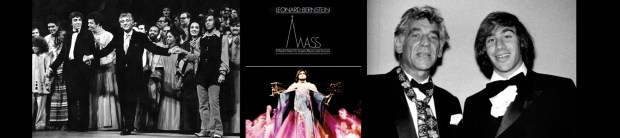
Did you know that the FBI shadowed Leonard Bernstein for decades? He was suspected of having communist sympathies. One of the reasons was – at least according to The New Yorker – the planned premiere in 1971 of his Mass, an eleven-part ‘Theatre piece for singers, actors and dancers’, based on the Latin mass, with English texts by Stephen Schwartz (and Bernstein himself) and dedicated to the assassinated President J.F. Kennedy.
According to the FBI, Bernstein “concocted a left-wing plot to embarrass the, then-President, Nixon, with an ‘anti-war’ composition.”
It is a story – briefly put – about a boy who is forced by his friends to become a priest while he prefers to honour God with his guitar and his songs: ‘Sing God a simple song…. for God is the simplest of all’. At the end, he desecrates the altar and regains his trust in God.
To me, the work with its strong reminiscences of ‘Hair’ and ‘The Age of Aquarius’ feels quite dated, and the rock-solid performance under Yannick Nézet-Séguin can’t do anything to change that.
Yannick Nézet-Séguin on Bernstein and his Mass:
I am very surprised that the Mass has not been released on DVD. For although the composition is really strong and the purely vocal/instrumental part may be called grandiose: the whole still lacks an essential part of what Bernstein had in mind.
LEONARD BERNSTEIN Mass A Theatre piece for singers, players and dancers Diverse solisten en koren The Philadelphia Orchestra olv Yannick Nézet-Séguin DG 4835009 (2cd’s)
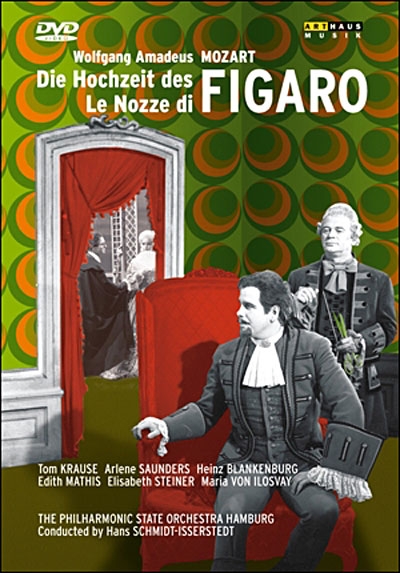
In 1967 Liebermann was still in charge of the Hamburg opera house. He made sure they offered a good, solid and varied repertoire with special attention to the contemporary repertoire.He built a fantastic ensemble of singers and attracted foreign stars and would-be stars ( the world career of Plácido Domingo took off in Hamburg).
Liebermann is now regarded as the founding father of Regietheater, (German for director’s theater), although his ideas were very different from today’s conceptualism, in which the boundary between the permissible and the ridiculous is sought and often crossed
The reconstructed production of Die Hochzeit des Figaro (yes, it is sung in German) is of great historical value. But it has more to offer; the production is magnificent, the orchestra of the Hamburg Opera under conductor Hans Schmidt-Isserstedt is excellent and the singers are all idiomatic.
The American baritone Heinz Blankeburg is a droll Figaro and as Susanna, Edith Mathis is simply wonderful. I would actually like to shout it from the rooftops: this is how Susanna is meant to be! The young Tom Krause is a more than delightful Count and Arlene Saunders as the Countess, is a real match for him (and his timbre).
We even get a bit of historical ‘maestro to the pit’ as part of the recording. Atmittedly, the tape is not completely reconstructed, there are gaps and the colours are very much “the sixties”. It doesn’t matter, I’m very happy to enjoy it al (Arthaus Musik 101263)
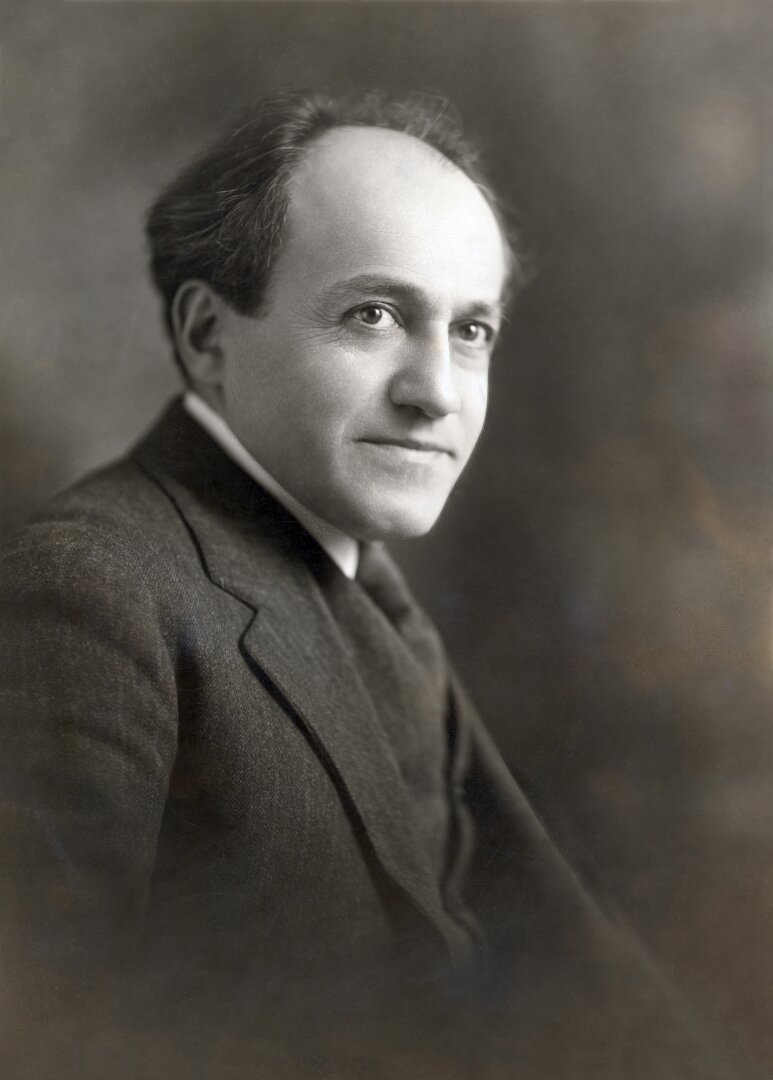
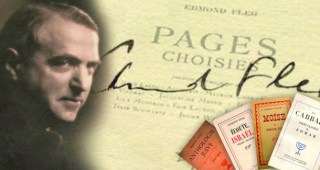
Ernest Bloch was born into an assimilated Jewish family in Geneva in 1880. Around the age of twenty-five he became interested in all things Jewish and he translated them into his own language – music. “I am interested in the Jewish soul” he wrote to his friend Edmund Fleg (Flegenheimer): cantor, poet, philosopher and playwright. “I want to translate all that into music”. He succeeded.
But Bloch is more than the ‘Jewish soul alone’. Before the war he was one of the most performed and appreciated composers. People even called him the fourth great ‘B’ after Bach, Beethoven and Brahms. The name Bloch stands for concertos, symphonies, string quartets, piano quintets, violin sonatas, suites for solo strings and songs. And an opera.
Bloch was only 24 years old when he and Fleg came up with the idea to create musical theatre. It was Fleg who thought of ‘Macbeth’. Bloch had his doubts, because he actually wanted to compose something cheerful, but soon he started with the first sketches. It took him five years to complete the opera, but when it was finally done, the boss of the Opéra Comique, the famous Albert Carré, was immediately interested.
We can hardly imagine it now, but at that time Verdi’s Macbeth was almost unknown. It had not yet been performed at the Opéra or the Opéra Comique. The sole performance in Paris had been in 1865 at the Théâtre Lyrique where it was received with very moderate enthusiasm.
Albert Carré
Whether Carré’s interest was sincere or whether it was because his Prima Donna, at the time one of the greatest dramatic sopranos, Lucienne Bréval (a compatriot and good friend of Bloch) was so keen to sing it? We will probably never know, but on 30 November 1910 that was it.
Lucienne Bréval as Lady Macbeth
The leading parts were played by the greatest singers of the time, with besides Brevál the Dutch baritone Henri Alber
Albers als Artus in Le roi Arthus van Chausson
Bloch’s opera was performed 13 times in 1910. Reactions and opinions were divided: they ranged from almost ecstatic (Romain Roland was among the greatest admirers) to scathing. In January 1911, there were 15 more performances and that was it. It was not until 1938 that the opera was performed again: curiously, in Naples. Remember: this was in Mussolini’s fascist Italy! There were only two performances: the third was cancelled by the orders of Mussolini himself.
After the war, there was a brief revival; in 1953, ‘Macbeth’ was staged in Rome in the Italian translation by Mary Tibaldi Chiesa. The cast was a real delight: the leading roles were sung by Nicola Rossi Lemeni and Gianna Pederzini; Gianandrea Gavazzeni conducted.
Gianna Pederzini, Ernest Bloch, Gianandrea Gavazzeni en Nicola Rossi Lemeni in Rome, 1953.
Performances in Trieste in 1957 and in Brussels in 1958 (sponsored by Queen Elisabeth, who loved the opera) followed; and after Bloch’s death, Macbeth” was also presented at La Scala.
In April 1960, Geneva gathered the best forces in the opera world to pay tribute to the opera. Heinz Rehfuss and Lucienne Devallier sang the leading roles and the direction was in the hands of Ernest Ansermet. If you ask me: it doesn’t get much more beautiful than this. At least orchestral.
Highlights from the Geneva performance:
In 1968, Rossi Lemeni was allowed to repeat his phenomenal Macbeth interpretation, also in Geneva. His Lady was none other than Inge Borkh, Pierre Colombo conducted. Thanks to YouTube, the whole performance can now be heard in your own home: please do so
I do not know why, but the opera is nowhere as popular as it is in the United States. In 1973, the work was performed in English translation at the Juilliard School of Music under Adler’s direction. Frederic Burchinal (not an unfamiliar name to Dutch opera fans) sang the lead role.
Long Beach Opera presented the opera in 2013 starring the Panamanian “barihunk” Nmon Ford and the production was taken over by the Chicago Opera Theater in 2014. The Manhattan School of Music was the first to present the opera in French in December 2014.
Trailer from Chicago:
And now for the opera itself. The story is very Shakespearean, more so than Verdi’s. It has three instead of five acts, but otherwise there is not too much of a difference.
The music is often described as a mix of Wagner, Mussorgsky and Debussy, but for me, it is mainly Debussy, lightly peppered with a touch of Pizzetti and Bartók (yes, Bartók!). And I also hear reminiscences of Verdi, but of his “Otello”.
But Bloch was also ahead of his time, because the great aria of Lady is very ‘Hitchcockians’, especially if you listen to it in the performance of Inge Borkh. Her Lady is terrifying!
Borkh as Lady Macbeth, unparalleled!
Recordings:
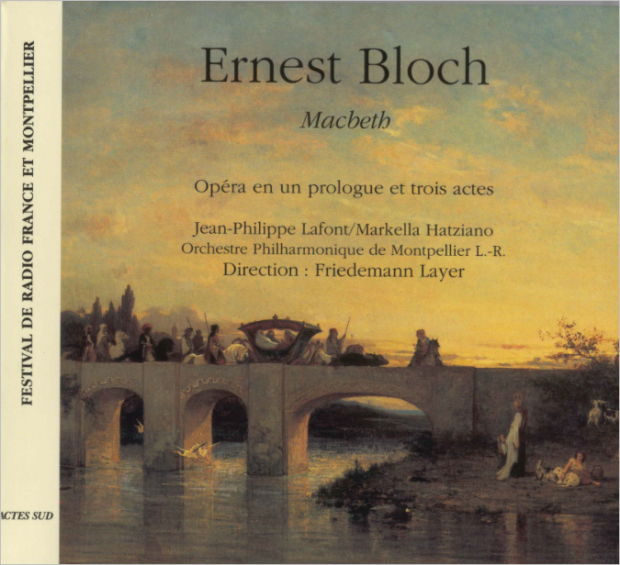
As far as I know, there are only two commercial editions on the market. I have them both and both have their merit. The concert performance from Montpellier, recorded live on 26 July 1997 (Actes Sud OMA34100) is conducted by Friedemann Layer who makes quite a bombastic mess of it, but Jean-Philippe Lafont is without doubt a brilliant Macbeth. The role calls for a “French sounding” baritone with an easy and supple pitch, but also with great depth and resonance. The Golaud type. Lafont more than satisfies this requirement. Merkella Hatziano is to my taste a somewhat too light Lady, but her sleepwalking scene is scorching. The textbook contains the complete libretto, but only in French.
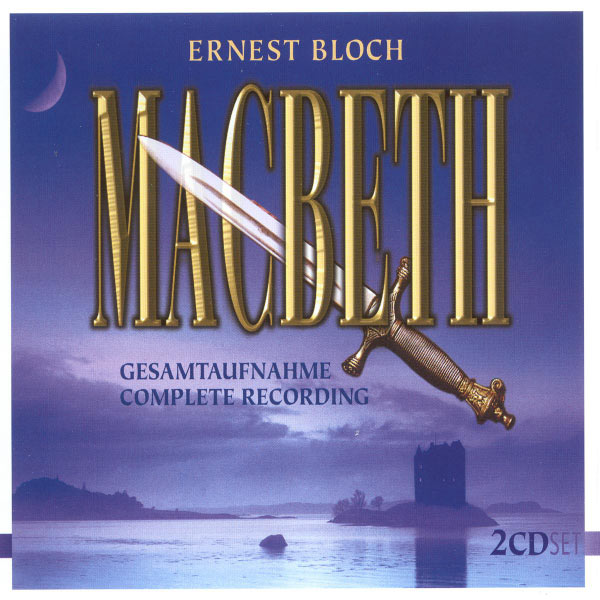
The other recording (Capriccio 10889/90) is from Dortmund. It was the very first time the opera was performed in Germany. The live recording from 2001 is far from perfect, but it is atmospheric. And the Lady, sung here by Sonja Borowski-Tudor, is absolutely impressive. There is no libretto, but the synopsis in three languages is very useful if French is not your strongest language!
And speaking of the unknown Bloch, don’t forget his symphonic poem ‘Hiver-Printemps; ! Together with the beautiful song cycle “Poèmes d’Automne” (composed for the texts of Béatrix Rodès, at the time Bloch’s beloved), they form as it were a whole, a kind of ‘Seasons’, with only summer missing. How appropriate!
Some forty years ago, I paid a real fortune for those two badly copied cassette tapes of Saverio Mercadante’s Il Giuramento, recorded live in Vienna on September 9, 1979. And now that the Austrian broadcaster ORF is digging up one after the other live recorded opera from their archives and transferring them to CDs, this splendid opera also came on the market – for little money and in an excellent sound quality (Orfeo C 6800621).
Il Giuramento is, just like La Gioconda, based on Victor Hugo’s play ‘Angelo, Tyrant de Padoue’, but there is a world of difference between the two works. La Gioconda is a very passionate, at times overwhelming, opera and contains a selection of (over)famous arias. Think of ‘Suicidio’ or ‘Cielo e mare’. Il Giuramento is smaller and more intimate. Think of Bellini with a touch of early Verdi.
The whole opera is really nothing but a succession of the most beautiful melodies, which force you to listen without even wanting to sing along. Or it must be ‘Compita è ormai la giusta e terribil vendetta’, a beautiful aria sung with much melancholy and elan by Domingo.
Domingo rehearsed the role, which was completely new to him, in four days (!) and stepped in – after only one rehearsal – for the sick Peter Dvorsky. Who else would be capable of pulling this off?
Mara Zampieri, unlike many of her contemporary colleagues, had a very individual sound that you may or may not like, but you cannot not possibly confuse her with anyone else. Her silver-coloured, sensuous soprano blends in beautifully with the golden velvet of Agnes Baltsa (then still without the ugly register break that marred her later performances so much) and in ‘Oh! Qual nome pronunziaste’ their voices melt together into a wonderful unity that is so beautiful it hurts.
Poveri fiori’ (poor flowers), Adriana sings in one of the most moving arias in the history of opera, smelling the bunch of wilted violets. If only we could warn her, because those violets are poisoned, you can smell the contamination even from your armchair in front of the TV. And indeed they prove fatal. She launches into a big monologue, and that was it! Tutto e finito.
The orchestra plays a few more bars, and then there is the final chord. Pian-pianissimo, and so movingly beautiful that my tears, which had already begun to flow at the beginning of the last act, turn into a veritable flood.
The real Adriana, a star of the Comédie Française, died in Voltaire’s arms in 1730. Eugene Scribe made her immortal by creating a play about her life and her role was played by the greatest actresses of the time: Sarah Bernhardt, Eleonora Duse, Helena Modjeska.
The opera, which Francesco Cilea based on the play, thus requires a singer with the greatest acting skills, such as a Mafalda Favero, Magda Olivero or Renata Scotto.
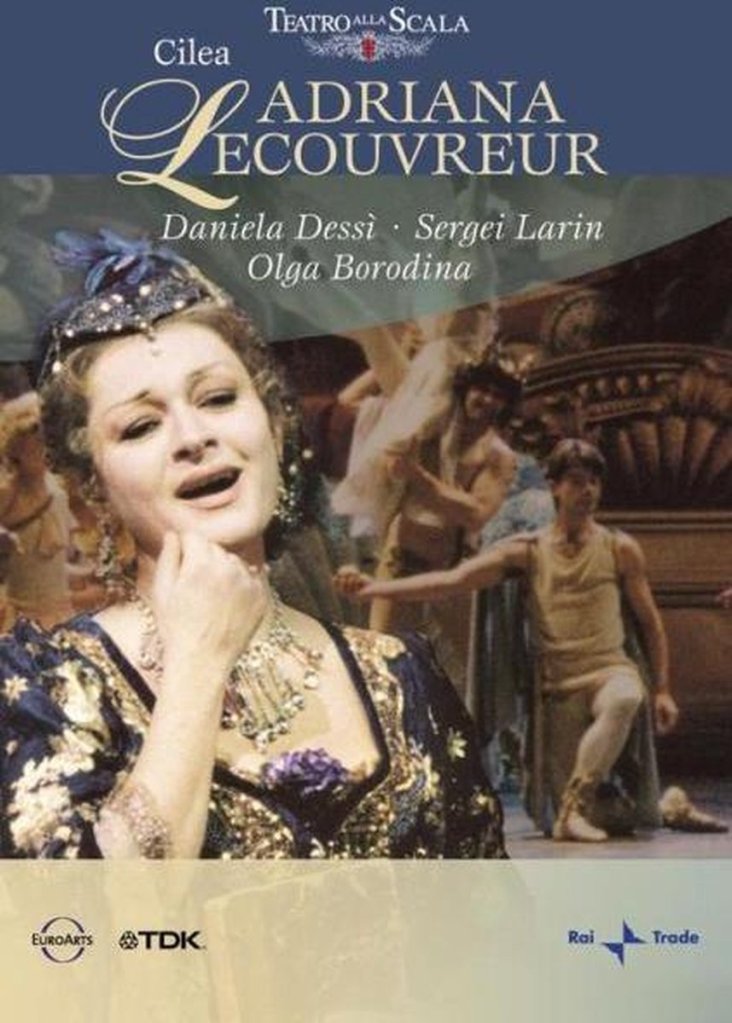
Daniela Dessi, by the way, can do both the singing and the acting. 21 years ago (the recording was made at La Scala in January 2000), her sound was still lyrical, but already well developed dramatically. A true lirico-spinto, even if it was still a bit ‘in spe’ then.
Maurizio was one of Sergei Larin’s favourite roles, he also sang it in 2006 in Amsterdam (Saturday Matinee) alongside Nelly Miricioiu. The much-lamented Latvian tenor (he died in January 2008 at the age of 51) presents a beautiful and elegant sound, not devoid of passion, but still without the ‘roar’ that marred his last performances. Olga Borodina is a deliciously mean Principessa di Bouillon and Carlo Guelfi a sonorous Michonnet, although his voice lacks ‘that certain something’, that made Sherrill Milnes one of the best interpreters of the role.
Roberto Rizzi Brignoli elicits from the orchestra all the colours of the rainbow and then some more. Here he is at the very beginning of his career (I once wrote: remember that name, we will be hearing more from him). Now he has become one of the greatest. For those who appreciate it: the direction and the stage setting are traditional.
Dessì and Borodina in the finale of the third act:
Francesco Cilea Adriana Lecouvreur Daniela Dessì, Sergei Larin, Olga Borodina, Carlo Guelfi e.a. Orchestra e Coro del Teatro alla Scala olv Roberto Rizzi Brignoli
“Music should primarily bring physical pleasure, even ecstasy, to the listener. It is not philosophy, its origin lies in ecstatic situations and its expression in rhythm” Erwin Schulhoff wrote in 1919.
From his earliest youth, Schulhoff was fascinated by everything new. His music transcended borders and genres – sometimes even those of ‘good decency’. He was a man of extremes, heartily embracing dada and jazz, and he also had a particular liking for the grotesque. No wonder that the synthesis of jazz and classical music, of everything in fact, became for him not only a challenge, but ultimately his artistic credo.
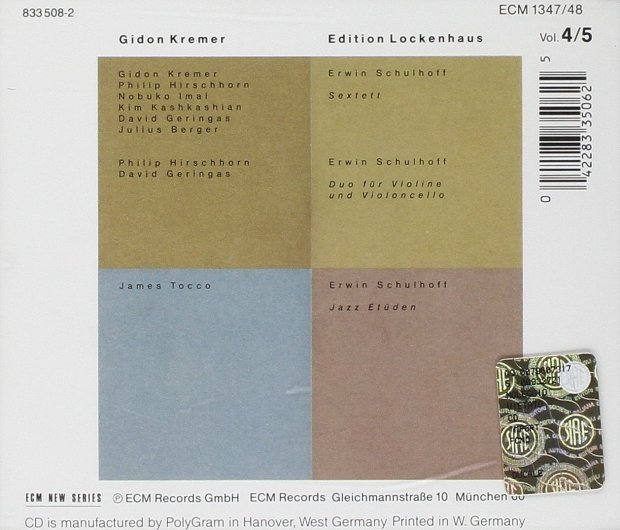
My first acquaintance with the composer and his music was thirty years ago, at the Lockenhaus chamber music festival, led by Gidon Kremer. It was mainly his string sextet, with its strong Janaček influences, that made me gasp for air. Since that day I was hooked. It took a long time, but in the meantime Schulhoff has found his way to the concert stages and recording studios. Especially the latter, because he is still too rarely programmed at concerts.
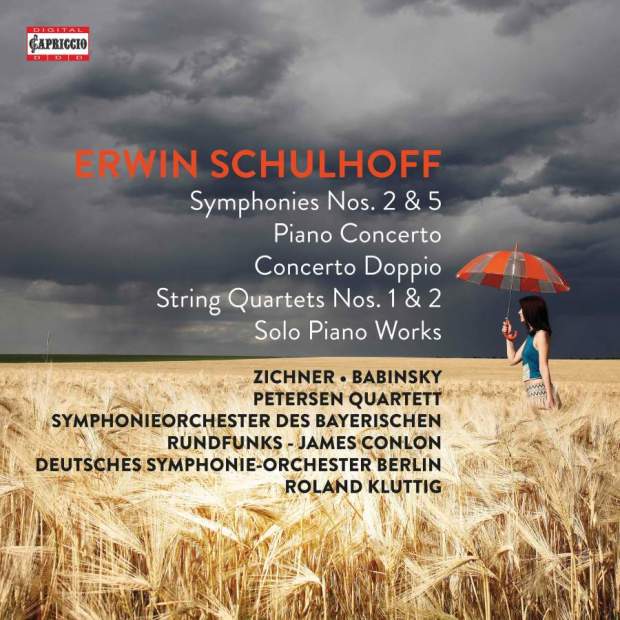
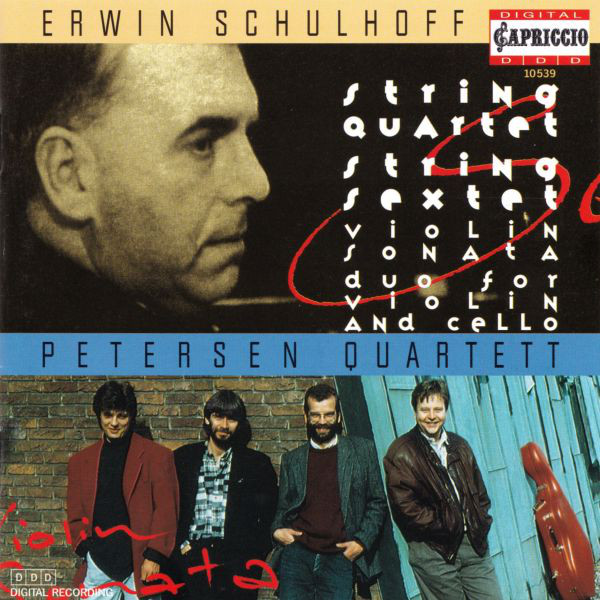
My very first record encounter with the composer was the recording of his complete string quartets by the Petersen Quartet, in 1992. To my delight, the string quartets are also in the six-CD box set recently released by the Capriccio label. These are recordings of many of his works (dear Capriccio: there is more!) made by Deutschlandfunk Kultur between 1992 and 2007. Most of these recordings have already appeared on Capriccio (but also on other, often no longer existing labels).
The 2007 recording of the Double Concerto for flute and piano, with Dutch flutist Jacques Zoon as soloist, is new to me. And it is so beautiful! Also new to me is the recording of the Second and Fifth Symphonies, in which the Symphonieorchester des Bayerischen Rundfunks is conducted by the greatest advocate of ‘entartete composers’, James Conlon.
ERWIN SCHULHOFF Symphonies no. 2 & 5, Piano Concerto op. 34, Concerto Doppio, Concert for string quartet and winds, String quartets no. 1 & 2, String sextet, Sonata for violin solo, Duo for violin and cello, Piano sonatas no. 1 & 3, Piano works Jacques Zoon (flute); Frank-Immo Zichner, Margarete Babinsky (piano); Petersen Quartet; Leipzicher Streichquartett; Symphonieorchester des Bayerischen Rundfunks conducted by James Conlon; Deutscher Symphonie-Orchester Berlin conducted by Roland Kluttig Capriccio C7297
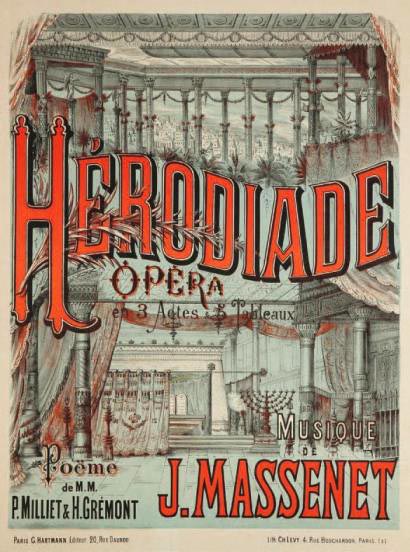
Richard Strauss composed his world hit Salome to a play by Oscar Wilde; and the latter drew his inspiration from a short story by Flaubert, ‘Herodias’. Paul Milliet and Henri Grémont also based their libretto for Massenet’s opera Herodiade on this story. Neither Wilde nor Milliet and Grémont were very faithful to Flaubert. Whereas the French novelist more or less limited himself to the biblical narrative, enriched with his poetic language and descriptions, the playwright and librettists added entirely new aspects and twists to the story.
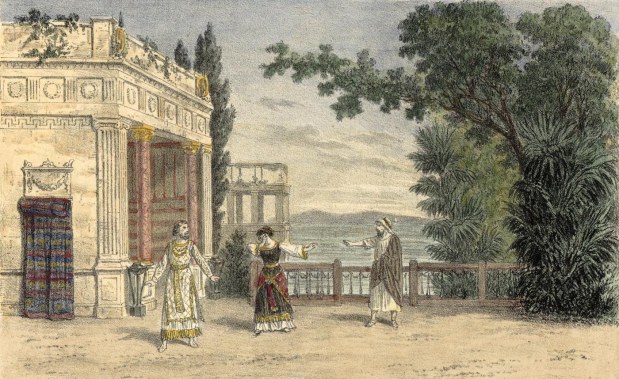
Hérodiade was first performed in the Royal Theatre of Brussels on 19 December 1881. Anyone expecting animal eroticism, blood and sweat, as with Richard Strauss, will be disappointed. Massenet’s Salome is a truly innocent and devout girl. When her mother left her to marry Hérode, she was given shelter by Jean (John the Baptist), with whom she fell in love. A love that proved to be mutual.
No opera is complete without complications: Hérode has a crush on Salome, Hérodiade becomes jealous of her and Jean is beheaded. Salome sees Hérodiade as the instigator of all evil and wants to kill her. Hérodiade whispers “I am your mother” and Salome commits suicide.
The music already exudes a hint of the perfume of Massenet’s later works, but with all those choruses, exotic Oriental scenes and elaborate ballet scenes, it is nothing less than a real Grand Opera in the best Meyerbeer tradition.
One of the earliest recorded fragments of the opera is, I think, the famous aria of Hérode ‘Vision Fusitive’ by the French baritone Maurice Renaud, made in 1908:
And from the recording Georges Thill made in 1927, we know what an ideal Jean should sound like:
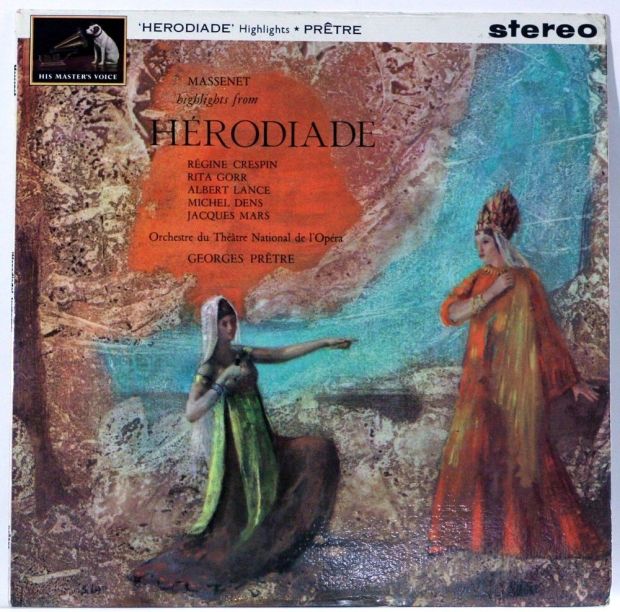
REGINE CRESPIN 1963
If you are in possession of this performance, you need look no further. It doesn’t get any better than this. There is only one problem: this recording does not exist. At least not of the complete opera.
In 1963, EMI recorded the highlights of Hérodiade with the best French singers of the time (and of today, for that matter) and the answer to the “why not complete ????” will probably never be given.
Georges Prêtre conducts the orchestra of the Theater National de Paris as if his life depends upon it and every role is more than excellently cast.
Regine Crespin sings ‘Il est doux, il est bon’:
Regine Crespin’s Salomé is unequalled and so is Rita Gorr’s Hérodiade. Albert Lance (Jean) shows how that role should really be sung in the tradition of Georges Thill, and for Michel Dens as Hérode we really cannot find the right words. Such singers no longer exist.
Hopefully, Warner will one day release the recording on CD.
MONTSERRAT CABALLÉ (Barcelona 1984)
This recording also may only be obtained via a pirate (or You Tube), but then it is complete and moreover with (admittedly bad) images!
Dunja Vejzovic portrays a deliciously mean Hérodiade and Juan Pons is a somewhat youthful but otherwise fine Hérode. A few years later, he will become one of the best “Hérodes” and you can already hear and see that in this recording.
Montserrat Caballé is a fantastic Salomé, the voice alone makes you believe you are in heaven and José Carreras is very moving as a charismatic Jean.
Below, Carreras sings ‘Ne pouvant réprimer les élans’:
None of the protagonists is really idiomatic, but what a pleasure it is to watch a real Diva (and Divo)! They really don’t make them like that any more
The whole opera on you tube:
RENÉE FLEMING 1994 (Sony 66847)
In the mid-1990s, Herodiade enjoyed a short-lived revival. The opera was then performed in several opera houses and it was even recorded – officially – three times: once in the studio and twice live.
I must admit that I was a bit concerned about Gergiev as the director, but he really did an excellent job. Under his baton the opera sounds like a real Grand Opéra, grand, fiery and compelling.
Plácido Domingo (Jean) is perhaps a touch too heroic, but his voice sounds youthful and contageous, worthy of a true prophet.
Personally, I find Dolora Zajick (Hérodiade) a bit on the (too) heavy side, but her singing is undeniably excellent and there is nothing wrong with her interpretation.
Juan Pons is an excellent Hérode, but I would have liked Phanuel (Kenneth Cox) to be a bit more idiomatic. Something that also applies to the Salomé of Renée Fleming: she sings beautifully but in this role she can not totally convince me.
NANCY GUSTAFSON 1995 (RCA 74321 79597 2)
The performance in Vienna was highly praised, and that this praise was justified is proved by the recording made live in the house by ORF.
First of all, there is Agnes Baltsa’s brilliant title role: fierce and dramatic. If you ask me: apart from Rita Gorr probably the best Hérodiade ever.
Placido Domingo sings ‘Ne pouvant réprimer les élans’:
Domingo, in the role of Jean, is even more impressive here than on Sony and also Juan Pons (Hérode) actually convinces me yet more on this recording. His rendition of ‘Vision Fugitive’ is very, very moving. Unfortunately, Nancy Gustafson (Salomé) must acknowledge the superiority of Fleming (Sony), but both pale in comparison to Cheryl Studer (Warner). Not to mention Regine Crespin!
Judging by the photos in the text booklet and the sparse clips on YouTube, we should be glad that the recording appeared on CD and not on DVD.
Finale of the opera:
In any case, the sound is excellent and the Vienna Opera orchestra under the direction of Marcello Viotti plays with great passion.
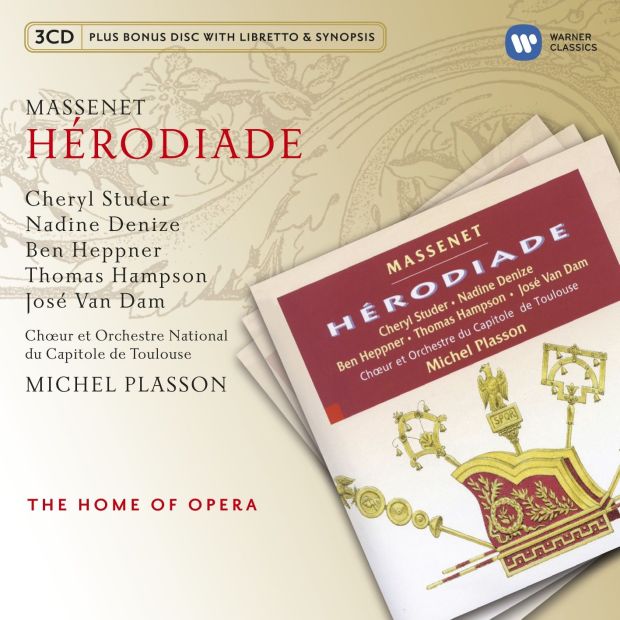
CHERYL STUDER 1995 (Warner 55983525)
Orchestrally, this recording is really top-notch. Michel Plasson conducts the orchestra from Toulouse very energetically, with a lot of verve and drive, and he also knows how to allow space for all the subtleties. Exciting and beautiful. That is how I like to hear opera.
José van Dam is an impressive Phanuel and Nadine Denize an excellent Hérodiade., although her intonation is not always pure.
Hérode is not really a role for Thomas Hampson, but he sings it very beautifully. Something that unfortunately cannot be said of Ben Heppner’s Jean. A heroic tenor in that role is nothing but a terrible mistake.
Cheryl Studer, on the other hand, is a Salomé of everyone’s dreams: girlish, innocent and naive. Her voice shines and sways and her final words “Ah! Darned Queen, if it is true that your cursed loins have given birth to me, look! Take back your blood and my life!” leave you shuddering and desperately weeping. Brava.
Karl Ignaz Weigl was born into an assimilated Jewish family in 1881 in Vienna. In 1938 he fled to New York, where he died ten years later. The composer and his music were ‘forgotten for a while’, which was not only due to the Nazis.
In 1938 Arnold Schönberg wrote: ‘I have always regarded Dr. Weigl as one of the best composers of the old school; one of those who continued the glittering Viennese tradition’. No one could have put it better.
The ‘glittering Viennese tradition’ is Weigl’s main trademark. To put it irreverently, his music may be seen as sort of a gateway. A kind of corridor that runs from a classical Beethoven via a soul-stirring Schubert and an underground erotic Zemlinsky to finally end up in Weigl’s calm waters, and from there it finds its way to our hearts.
Weigl is not a composer I have heard much of (no, it’s not my fault) and apart from his, by the way, wonderful songs and a few of his chamber music compositions, I did not know him very well. So this CD is more than welcome, especially because the musicianship is so incredibly good.
I am most charmed by the violinist David Frühwirth. His tone is very sweet, as sweet as a Viennese Sachertarte. You can hear it best in the very Schubertian piano trio, but make no mistake! Just listen to the allegro molto, the third movement of the second violin sonata from1937 and you discover the complexity of the ‘Wiener-sound’.
And I feel free to use another quote, this time from Pablo Casals: “His music will not be lost, after the storm we will return to it, one day we will return to those who wrote real music.” It has taken a while and we are still far away, but a beginning has been made.
KARL WEIGL Violin Sonata No.2, Two pieces for violin, Two pieces for cello, Piano Trio David Frühwirth (violin), Benedict Kloeckner (cello), Florian Krumpöck (piano) Capriccio C5318











 Basia con fuoco