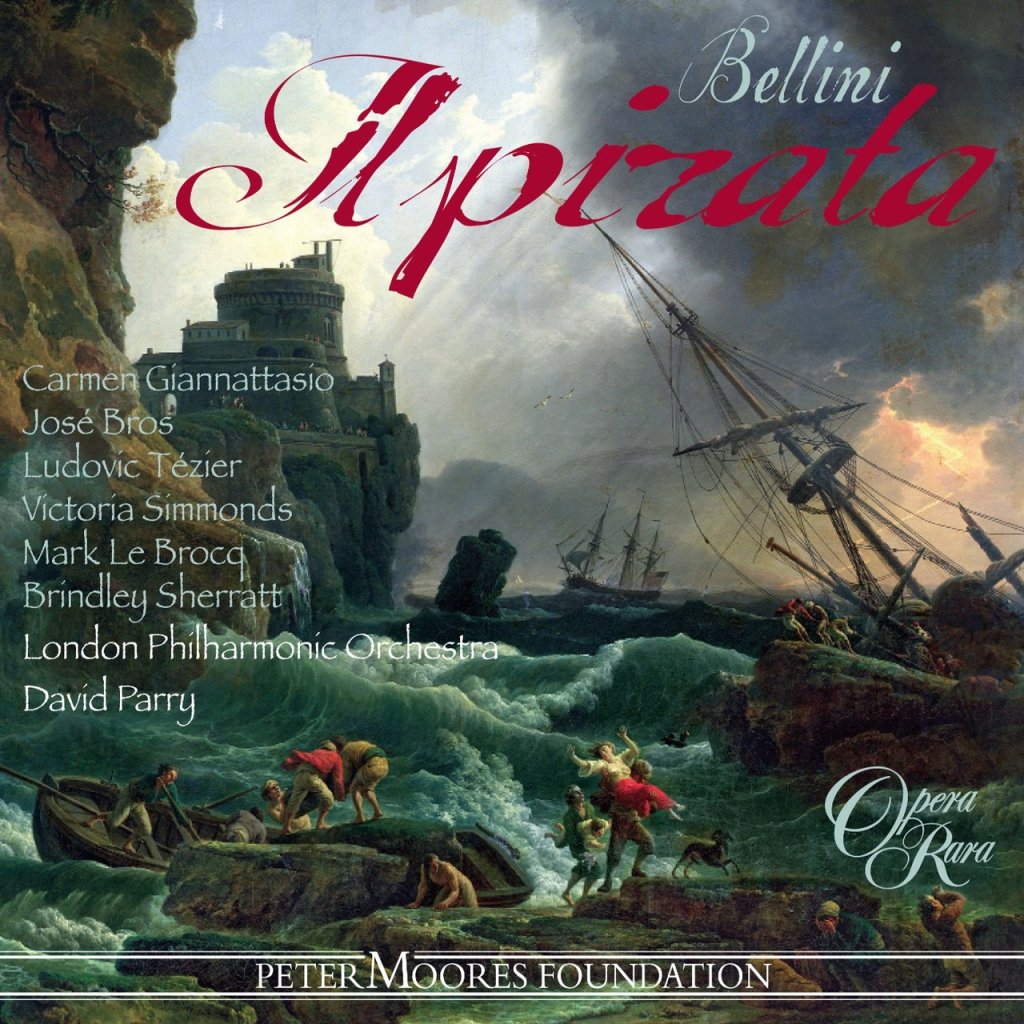
Il Pirata, for me one of Bellini’s most beautiful operas, is for many people nothing more than a title. Understandable, as it is rarely performed nowadays and (studio) recordings are scarce. Incomprehensible, because this opera is not only indescribably beautiful but also incredibly good!
Take the final scene alone: it is among the best Bellini ever wrote. You can already hear Donizetti’s Lucia di Lammermoor in it. And the opening chorus from the third act, “Che rechi tu”, can be found again, almost exactly the same, in Verdi’s Macbeth and Luisa Miller.
Until recently, I was only familiar with three studio recordings of the opera, featuring Montserrat Caballé, Maria Callas and Lucia Aliberti as Imogene. For convenience, I am not including the Saturday Matinee performance with Nelly Miricioiu, as it was never released (a shame!).
Carmen Giannattasio’s timbre is much lighter and less dramatic than Callas’s and much more rigid than Caballé’s, but if you do not think about their voices for a moment, you cannot help but admi tthat she has a lot to offer, especially in her mad scene.
I have more difficulties with the gentlemen. Ludovic Tézier is an excellent singer, but bel canto… no, his baritone is just not supple enough. In the parts where he has less coloratura to sing and can simply be authoritative, he is nevertheless thoroughly convincing.
José Bros was once considered one of the most promising young bel canto singers of his generation, but he never really fulfilled that promise. He has excellent high notes and good coloratura, but his voice occasionally sounds constricted.
David Parry, one of today’s greatest bel canto specialists, conducts with great enthusiasm.
Whole opera with Montserrat Caballé:
Maria Callas sings “Oh! S’io potessi”:
And Happily, there is a YouTube recording of Nelly Miricioiu in Amsterdam!
Have you ever heard of Catarina Mancini (10 November 1924 – 21 January 2011)? This soprano, born at Genzano di Roma had the true ’voce Verdiana’: she combined a beautiful height and pure coloratura with a drama that even La Divina might have envied her for.
Never heard of her? Then it’s time to make up for the damage, because I promise you a voice out of thousands. And this is exactly how her Leonora sounds in the recording from 1951 Rome (Warner Fonit 2564661890). Extraordinary.
Her Manrico was sung by the very heroic sounding (then already nearly 60 years old) Giacomo Lauri-Volpi and a very charismatic Carlo Tagliabue sang the role of di Luna. Miriam Pirazzini (Azucena) completed the cast and the whole was very impressively conducted by Fernando Previtali.
Here are Mancini, Lauri-Volpi and Tagliabue in the trio of the first act:
Highlights on Spotify:
Price and Corelli, 1961
With their 1961 performance recorded live for Sony, both Leontyne Price and Franco Corelli made their debuts at the Metropolitan Opera. For me, Corelli, alongside Del Monaco and Domingo, is the best Manrico ever. Very masculine and very sexy, you can hardly resist that as a woman.
Mario Sereni and Irene Dalis are more than adequate as Luna and Azucena respectively, and it is a great joy to discover none other than Teresa Stratas in the small role of Inez. And Charles Anthony as Ruiz should not be forgotten
Price and Domingo, 1970
The recording made 19 years later for RCA shows a more mature Price, but her sound is still that of an excited teenager, with just about the most perfect Verdian ‘morbidezza’. Her ‘D’amor sull’ali rosee’ seems like a little prayer, weeping so beautifully.
This Trovatore was the very first opera that Plácido Domingo, then 28(!), recorded in the studio. Fiorenza Cossotto shines as Azucena, but what really makes the recording indispensable, at least for me, is one of the most delightful Lunas ever: Sherrill Milnes (88883729262).
Below Price, Domingo and Milnes in ‘E deggio e posso crederlo’:
Maria Callas, 1956
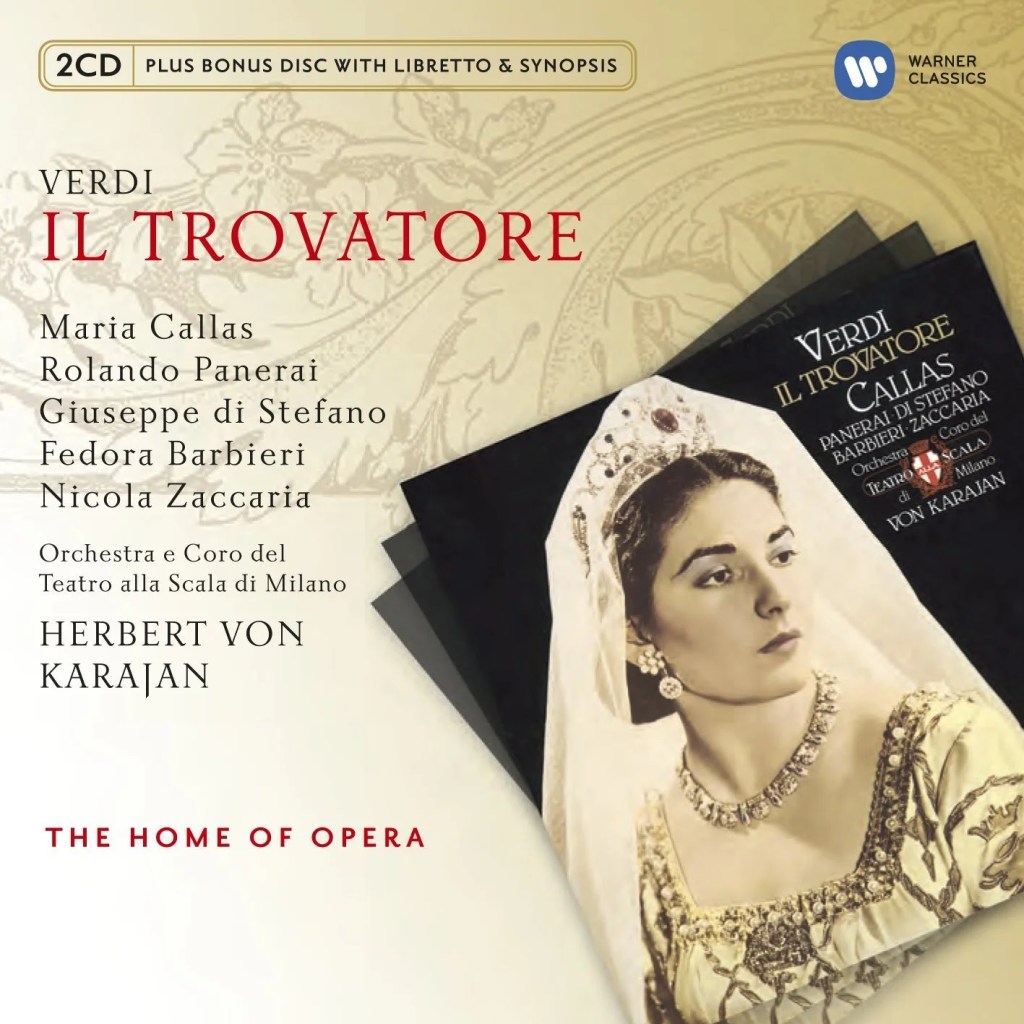
A problem in the 1956 recording conducted by Herbert von Karajan very excitingly is Giuseppe di Stefano. Beautiful though he is, for Manrico he lacks power.
Fedora Barbieri comes into her own even better here than on the Myto recording, which may be partly due to the much better sound quality. Rolando Panerai is a solid Luna, but his “Il balen” neither makes me hot nor cold, especially with Bastianini and Milnes to my ears.
And Maria Callas? Callas remains Callas. Overdramatic. Her Leonora is anything but an adolescent in love. Her ‘D’amor sull’ali rosee’ is more than beautiful, perfect almost, but it leaves me utterly cold (Warner 5099964077321).
Below Callas in D’amor sull’ali rosee’:
Leyla Gencer, 1957
I don’t think I need introduce you to Leyla Gencer. The Turkish diva enjoys a cult following comparable only to that of Olivero and Callas. Her supple, round and clear voice – with pianissimi with which she could rival Montserrat Caballé – made her exceptionally suited to Verdi operas. Her Leonora is simply perfect: you can’t get any more beautiful than that.
Nor do I think there has ever been a better, more beautiful and impressive Luna than Ettore Bastianini. Del Monaco is otherwise a very macho Manrico. His radiant height in ‘Di quella pira’ compensates for his sometimes lacklustre interpretation.
Fedora Barbieri impresses as Azucena and Plinio Cabassi is a Ferrando to kiss. The recording was made in Milan in 1957 (Myto 00127).
Gré Brouwenstijn, 1953
It is almost unbelievable, but there were times when even an opera like Il Trovatore could be cast with only Dutch singers. You can also hear them all in the performance recorded live by Osteria (OS-1001) at the Amsterdam Schouwburg in 1953.
Annie Delorie’s Azucena disappoints me a little, but Gerard Holthaus, unknown to me (is there anyone who can tell me more about him?), is a surprisingly beautiful Luna.
Gré Brouwenstijn is definitely fantastic as Leonora. And yet… her ‘Tacea la notte placida’ doesn’t really penetrate my soul. Mario Cordone was unfortunately not among the very best conductors in the world, which is a pity: sometimes I get the feeling that he is a hindrance to the singers.
Cristina Deutekom, 1976
Give me Cristina Deutekom! In the 1976 recording (Gala GL 100.536), she manages to convince me completely and penetrate deep into my heart. Unlike Callas who remains just Callas in everything she sings, she is Leonora. With her feathery coloraturas, she sounds exactly how I imagine a Leonora to be: a young girl in love with a strong tendency to exaggerate. The latter in the best sense of the word.
Jan Derksen is also a Luna to be reckoned with and secretly I think he may be even better than Bastianini and Milnes. His “Il bales” is among the best versions of the aria I had ever heard.
Carolyne James is an okay Azucena, but the reason the recording is not my absolute number one is because of the very dickish (sorry!) sounding Juan Lloveras (Manrico).
Below, Cristina Deutekom and Lloveras in ‘Miserere’:
Raina Kabaivanska 1978
Il trovatore was one of Von Karajan’s favourite operas. In 1962, he directed a series of performances in Salzburg, which were taken over and televised in Vienna in 1978. It is a very old-fashioned and static performance, with realistic sets and costumes.
Terribly underrated outside Italy, Raina Kabaivanska portrays a flesh-and-blood Leonora: her voice is dark, with an old-fashioned vibrato and clearly lined phrasing.
Domingo was a last-minute substitute for the angry runaway Bonisolli. For his ravishing ‘Ah si, ben mio’, sung with radiant top notes, he was rewarded by the audience with a minute-long ovation.
Cossotto’s Azucena has since become legendary: like no other singer, she left a mark on that role (Arthouse Music 107117)
Below Domingo, Kabaivanska, Cappuccilli and Cossotto in ‘Prima che d’ altri vivere’:
Di quella pira
For those who cannot get enough of ‘Di quella pira’: Bongiovanni (GB 1051-2) has released a CD with no fewer than 34 performances of the tenor hit, recorded between 1903 (Julian Biel) and 1956 (Mario Filipeschi). Lauri-Volpi, here in a recording from 1923 (!), displays a radiant and long-held high c. However, he is surpassed by Aureliano Pertile: what a sound!
Helge Rosvaenge is disappointingly dull, but Richard Tauber’s 1926 recording (in German) is a delightful curio (yes, he can do it!).
Jan Kiepura can’t get enough of trills and welds them into everything, but what a ringing sound he has! Even Gigli ventures into it: something he had better leave out. The best of them all I think is Jussi Björling from 1939. Please let me know who your favourite was?
Gigliola Frazzoni
For dessert, I give you ‘Tacea la notte placida’, sung by Gigliola Frazzoni, one of Minnie’s best (La fanciulla del West). It was recorded in Amsterdam, on 16 October 1954. Marijke van der Lugt sings Ines and the Amsterdam Broadcating Orchestra (?) is conducted by Arture BasileDanny
It is perhaps superfluous, but I have to get it off my chest: there is no such thing as objective music criticism. Of course there are criteria, but it is not science: after all, you listen to music not only with your ears, but also with your soul and your heart, and you cannot switch them off. Therefore, do not consider my mini discography as an absolute truth and, as far as possible, listen and judge for yourself.
Norma is considered the pinnacle of bel canto, but at the same time, this is a tremendous musical drama that leaves Verdi’s early works quite behind and carries with it the promise of a ‘Tristan’. And although it is a love story and both protagonists die a kind of ‘Liebestod’ at the end, love is not the heroine’s only motivation. She is also a mother, a priestess, a patriot, a daughter and a friend, and to be able to express all these aspects of human feelings, you need to be more than a ‘singer’.
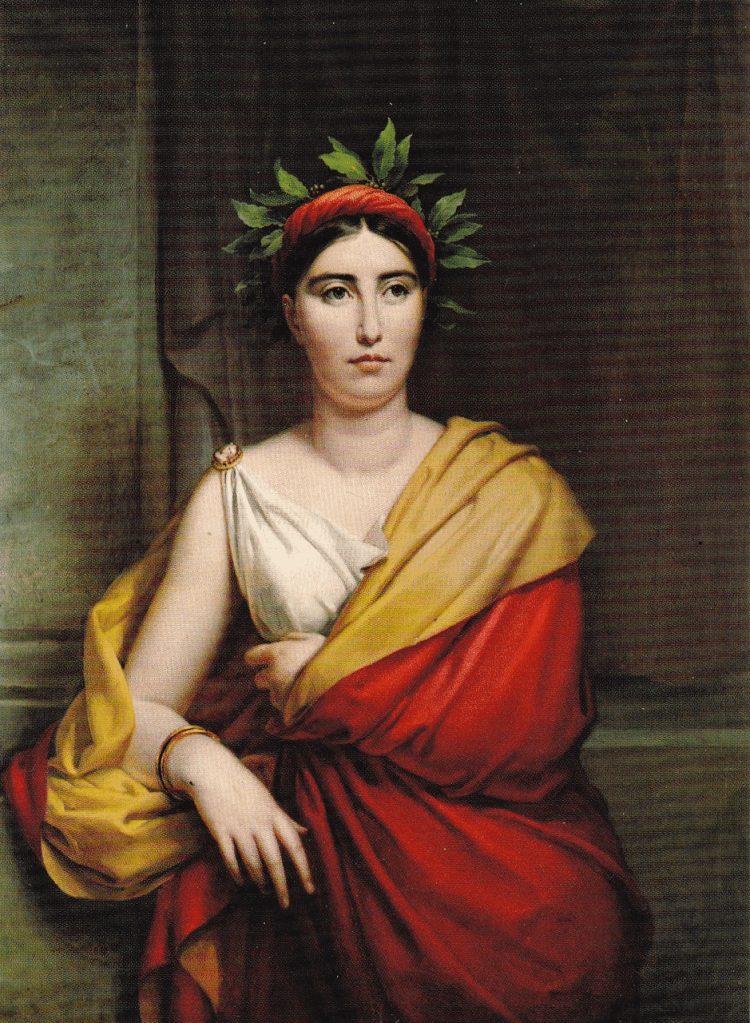
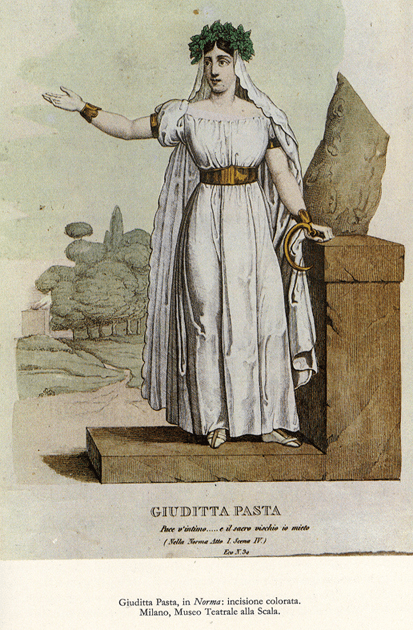
The role of Norma was created by Giuditta Pasta, originally a mezzo, who had trained her voice upwards. Pasta was an exceptionally intelligent singer with a great stage personality and a great voice range but her technique was not optimal, which caused her voice to deteriorate very early in her career. Pauline Viardot (one of the most famous mezzos of her time) once said about Pasta: “She looks like ‘The Last Supper’ by Leonardo da Vinci – a ruin of a painting, but it is still the greatest painting in the world”.
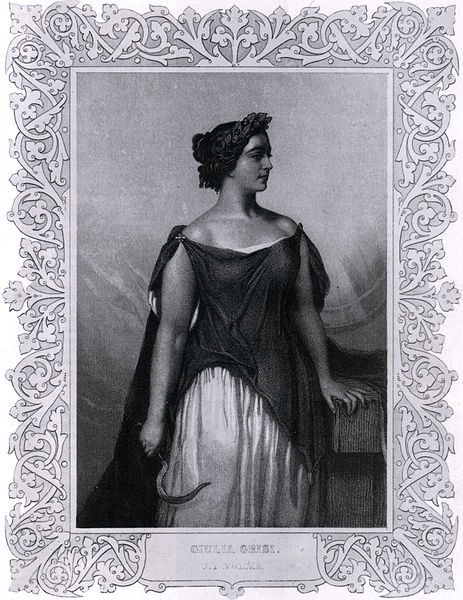
Giulia Grisi as Norma
The first Adalgisa was sung by Giulia Grisi, a soprano who also created the roles of Elvira (I Puritani) and Giulia (I Capuletti e i Montecchi), and who would later become a great Norma herself.
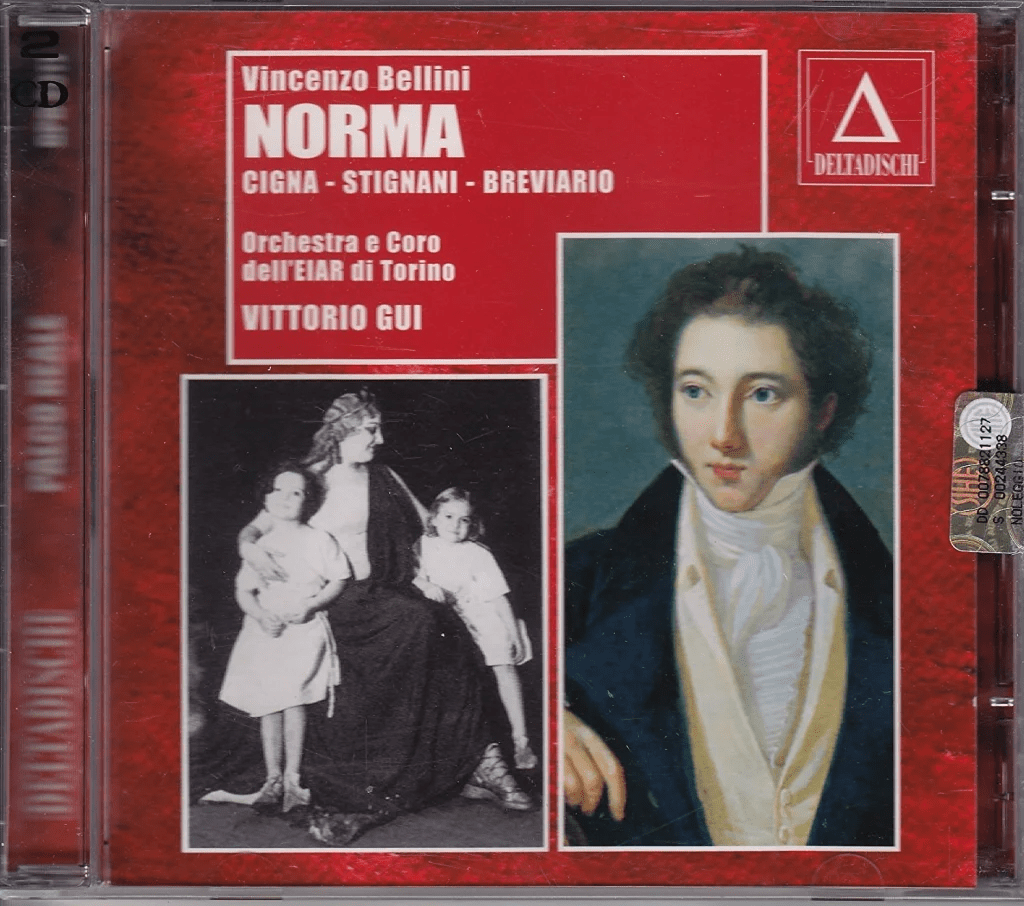
Gina Cigna
In the first fifty years of the twentieth century, Norma was only rarely performed. Opera history mentions only two memorable performances: in 1926 at the Metropolitan Opera (with Rosa Ponselle and Lauri-Volpi) and in 1936 at La Scala, with Gina Cigna.
In 1937, the very first (almost) complete recording of “Norma” was made: with Gina Cigna, Ebe Stignani and Giovanni Brevario, conducted by Vittorio Gui (various labels). the sound is still quite good, although obviously not optimal.
In the opera world there is a general opinion that most (Bel canto) singers before Callas were light, like canaries. This is not true. Just listen to Cigna’s full, dark timbre and to her sense of drama.
Cigna approaches the role from the verist tradition and plays it heavily. There are no coloraturas, but her technique is phenomenal and her top notes firm and pure. However, she is not a real actress, thus her interpretation is far behind that of Callas (among others).
Adalgisa is sung here by the young Ebe Stignani: a beautiful, warm mezzo, much more convincing here than in all her later recordings. Giovanni Breviario is an inferior Pollione, but orchestrally this recording is, together with those of Serafin (Rome 1955) and Muti (Turin 1974), one of the three finest Normas. Partly because of this (and the particularly moving sung ‘Deh! Non volerli vittime’) it is well worth listening to.
Gina Cigna and Giovanni Breviario in ‘Deh! non volerli vittime’:
MARIA CALLAS
One thinks Norma, one says Callas. Rightly so, because like no other La Divina has left her mark on this role. Between 1950 and 1964, she was undeniably the best Norma. Perhaps she was the best Norma ever. She sang the role more than 90 times and recorded it twice in the studio, both times under Tulio Serafin.
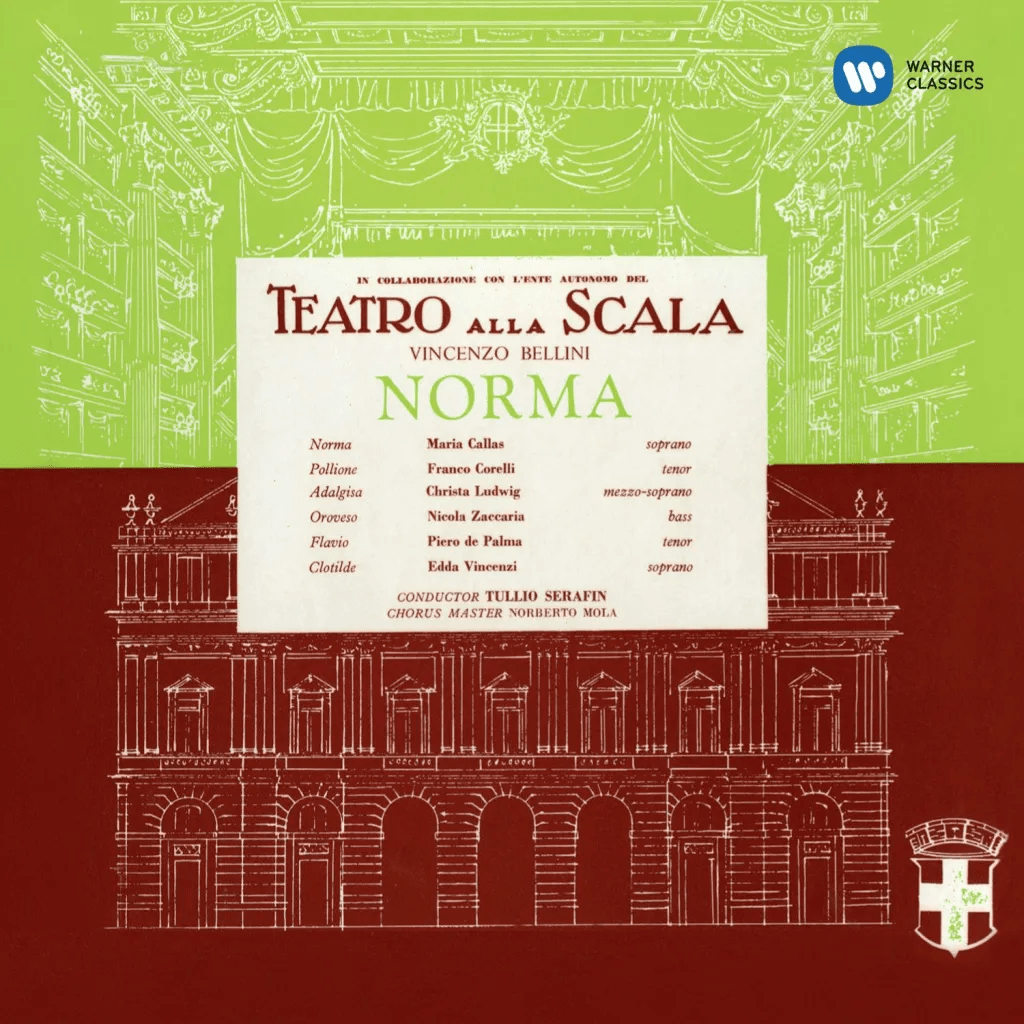
The first dates from 1954 (Warner Classics 0825646341115). Callas was then at her best vocally, yet this recording does not really captivate me. I find Serafin’s accompaniment downright boring, Filippeschi, despite his beautiful voice, is no Pollione of weight, and Stignani simply sounds (too) old. I also have some comments on Callas’ acting. Her ‘Casta Diva’ seems much more a love aria than an ode to the moon goddess, which it actually should be. But her singing is phenomenally beautiful, with wonderful heights and good trills.
In the autumn of 1960, Callas insisted on recording the opera again. It is claimed that she wanted to make her comeback with it (due to all sorts of scandals, Callas had not sung for nine months). This is possibly true, but it is also very likely that her views on the role had changed so much that she wanted to record it again.
Anyway it is fortunate that she did, because her second ‘official’ Norma (Warner Classics 0825646340842) is in all respects superior to the first. Franco Corelli is probably the best Pollione ever: a real warlord with a very masculine voice. Certain of himself and his appearance, resolute, macho, but also loving and very, very sensual and sexy. No wonder, then, that a young priestess would fall for him. And no wonder that a woman like Norma – strong, beautiful and powerful – continues to love him, despite his betrayal.
Adalgisa is sung by a young Christa Ludwig. Not really Italian, also (for me) a bit too dark in timbre, but with so much empathy that it doesn’t really matter. Callas herself is past her vocal peak and here and there she lets out a painful note, but as an actress she is absolutely unequalled. Here, too, she occasionally wants to “make believe” (the scene with her children, for example), but her intense involvement, her complete understanding and surrender – it is unique. Serafin, too, is clearly much more inspired, although I occasionally have trouble with his tempi.
Next to these two studio- recordings there are half a dozen radio- and pirate-recordings made from her live- performances. They are from London, Milan and Rome. One of them I will discuss here, because for me, this is the greatest Norma of them all! It is a registration of a performance on 29 june 1955 in Rome (amongst others on Opera d’Oro 7003).
Callas, in wonderful voice, never misses a (top) note, nor a gasp or a nuance. From pianissisimo to forte and back again, from dark to light and open, from glissando to portamento she goes on and on and all this with a great feeling for style and a deep understanding of the text. This is dramatic Belcanto singing pur sang; this is what Bellini must have had in mind.
Mario del Monaco sings a dream of a Pollione. sometimes a bit loud, but he is allowed, because he is a warrior after all. In ‘Qual cor tradisti, qual cor perdisti’ he is audibly moved and falling in love again. Their voices melt together in the ultimate love duet which can only lead unto death.
Maria Callas and Mario del Monaco in ‘Qual cor tradisti’:
Serafin conducts it all with feeling for both drama and lyricism and if Stignani still does not convince me, it is only because I want to hear a soprano in that role.
1959 was a good Callas year. In January that year she first sang at Carnegie Hall, where she gave a concert performance of Il Pirata. It was a great triumph. This was followed by a few Medea’s(Cherubini) in London and a short tour in Spain and Germany.
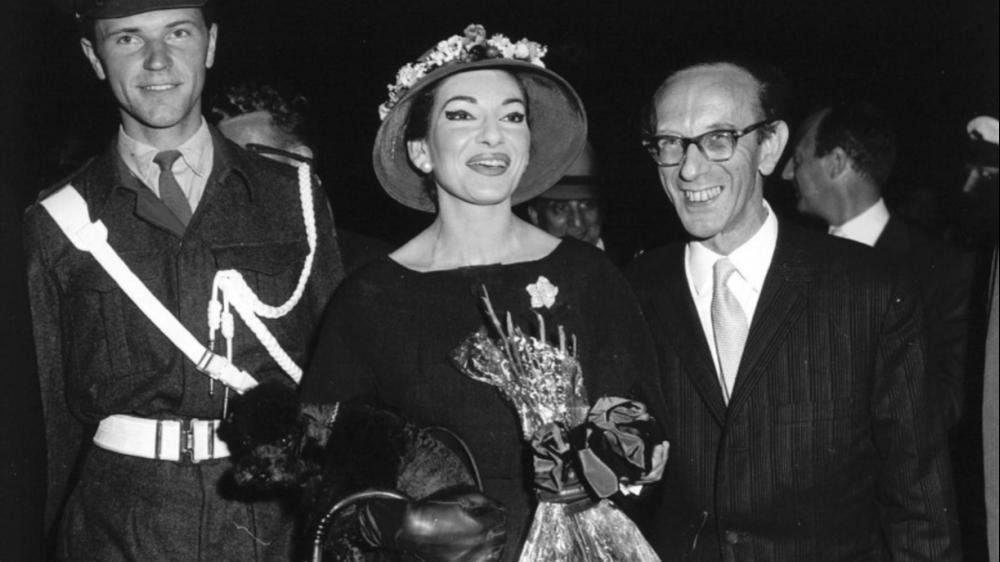
And then the great moment arrived: her long-awaited performance in Amsterdam. Thousands of people gathered at Schiphol Airport to greet her.
Maria Callas arrives in the Netherlands in 1959. On the right: Peter Diamand, chairman of the Holland Festival.
The lights in the Hall were extinguished and all the spotlights were on her as she descended the Concertgebouw steps. Only the musicians of the Concertgebouw Orchestra had lights on their desks, which, according to witnesses, had wrapped the stage in a romantic atmosphere.
Callas was then technically at the height of her powers. She began with a tather cautiously sung ‘Tu che vedi il mio tormento’ from Spontini’s La vestale, but with ‘Surta è la notte’ from Verdi’s Ernani she already let go of all brakes.
The audience went wild with enthusiasm, which stimulated Callas to become even more intense and dramatic in her perfectly intoned reading of ‘Tu che le vanità ‘ (Don Carlo). She finished with the mad scene from Il Pirata, a true tour-de-force.
She gave every note a different colour, her pianissimo was breathtaking and the coloraturas optimal. A true Divina. If only I had been there then!
Spontini, Verdi, Bellini Live in Amsterdam 1959 Maria Callas, Concertgebouw Orchestra conducted by Nicola Rescigno EMI 5626832
It is said of I Puritani that it is a true soprano opera, but that is not really quite the case. Elvira may be the pivot around which everything revolves, she is also one of the most passive opera heroines I know. Everything that happens around her and to her, happens in spite of her; because apart from loving and going mad, she doesn’t seem to be able to do much of anything at all.
It is the bass (her uncle Giorgio) who devises all sorts of plans to steer the action in the desired direction, and for this he is rewarded by Bellini with a most beautiful aria (‘Cinta di fiori’).
Nicolai Ghiaurov:
In order to save the mad soprano from certain death, he asks the baritone to spare the tenor’s life, which ends in a gorgeous duet (‘Suoni la tromba’), a real show-stopper.
Samuel Ramey and Sherrill Milnes:
The tenor also, who in a fit of patriotinic frenzy seems to send the whole thing into disarray, gets to sing a lot of beautiful (and high!) notes.
John Osborn with Mariola Cantarero from Amsterdam 2009:
All these roles require an excellent bel canto technique, with good coloratura, leggiero and legato. And don’t forget a sense of pure drama, because Bellini (and his librettist!) have created a lot of havoc for the poor soprano: first she becomes delirious with joy, then she loses her mind. She then regains it, only to lose it again immediately. Are you still there? Because it’s not over yet: her mind comes back once more and immediately she’s delirious with joy again. Ouch… Fortunately, the opera stops here, because poor Elvira apparently has to repeat such tricks a few times a day
CD’S
JOAN SUTHERLAND
Elvira, like Lucia, was a showpiece for Maria Callas and Joan Sutherland, both of whom recorded it several times. In 1974, Richard Bonynge (Decca 4175882) made a peerless recording of the opera, besides Sutherland, there was the sublime male trio: Luciano Pavarotti, Nicolai Ghiaurov and Piero Cappuccilli. Sutherland sounds like a little heap of misery, and her virtuosity knows no limits. Pavarotti still possessed all his glorious long high notes in those days and he pops them out with no effort at all.
MARIA CALLAS
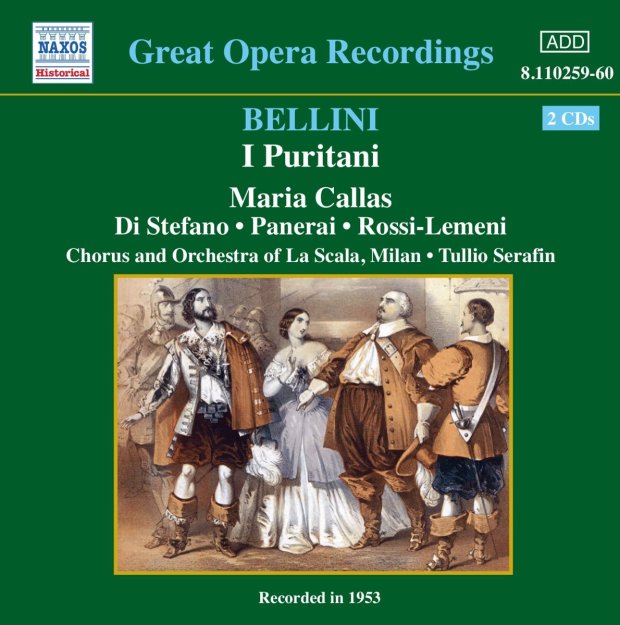
The recording with Callas from 1953 (Naxos 8110259-60) is weighed down by the fact that Giuseppe di Stefano is totally unfit to sing Arturo. But Nicola Rossi-Lemeni (Giorgio) and Rolando Panerai (Riccardo) are excellent, and Tulio Serafin conducts with verve and theatricality. Unfortunately, the score is not complete.
BEVERLY SILLS
A good (and complete!) alternative is the 1973 recording under Julius Rudel (Westminster 4712072), with a very virtuoso Beverly Sills. Arturo is sung in an extraordinarily beautiful and elegant way by Nicolai Gedda. His approach to the high notes is delightful, and personally I find it very pleasant to listen to him.
Conclusion; you are best off with the Decca and Westminster recordings. You get all the music, all the high notes and the best male voices. But since Naxos’ recording with Callas is in the budget class, why not buy it! Because of the conductor, because of the bass, but mainly because of La Divina. Because let’s be honest – nobody else can go so deliciously mad.
DVD’S
ANNA NETREBKO
It gets more difficult if you want to buy the work on DVD, because I cannot recommend either of the performances I watched without any reservations.
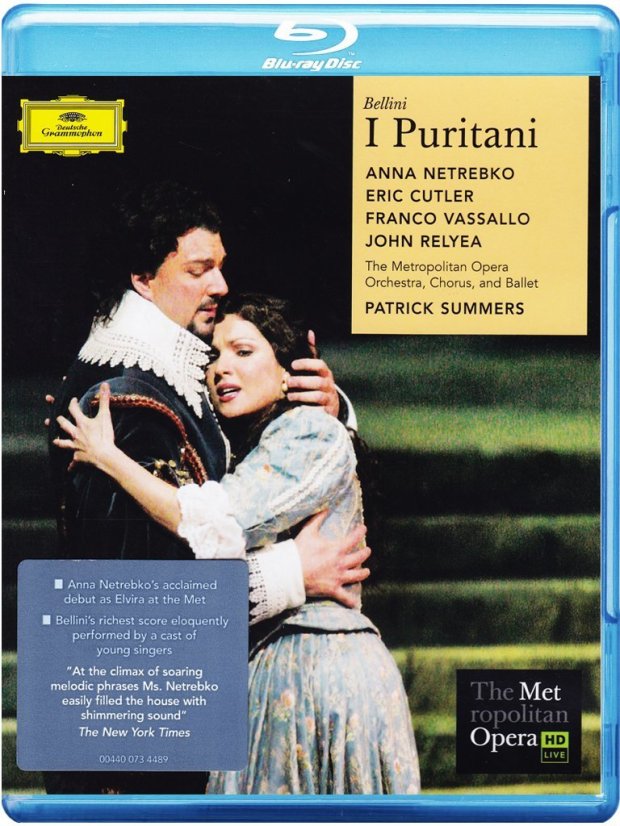
The Metropolitan Opera production, filmed in January 2007 (DG 0734421), is over 30 years old and was originally made for the Sutherland/Pavarotti duo. Perhaps this explains its total lack of personal direction?
There are these monumental tableaux-vivants , in which nobody seems to be allowed to move. The sets are ‘larger than life’ and all the costumes ‘historically accurate’. Anna Netrebko is a very imaginative Elvira. And although she lacks trills, her top notes are there and her presentation (charisma?) is more than convincing.
Both the bass (John Relyea) and the baritone (Franco Vassallo) are reasonable, but no more than that. Eric Cutler (Arturo) has a pleasant timbre and he reaches (albeit with difficulty) the high notes, but it is not really spectacular.
Netrebko sings ‘Deh Vieni al Tempio’ from the first act:
EDITA GRUBEROVA
But Cutler is much better than the totally miscast José Bros in the fifteen-year-old production from Barcelona (ArthouseMusik 107267). His voice is at least a size too small for Arturo. Edita Gruberova is a matter of taste. I do not like her ‘pussy-mouthed ways’ and I do not really want to watch her, but with my eyes closed there is little to complain about, because yes, she can sing bel canto.
Carlos Álvarez is a first-class Riccardo, but the rest of the cast …. Ah, let’s not talk about it. Andrei Serban’s direction, on the other hand, is truly sublime and exciting, I enjoyed it a lot. A friend I was watching with summed it up like this: Netrebko is for straight men and Gruberova (because of Álvarez) for gays and women, but of course it is not that simple. If only we could cut and paste!
BELLINI-BOX
A 25-cd Bellini box set is an absolute must. For 90 euros only, you get all of Bellini’s operas, two of which (La Sonnambula, Norma) are also available in two different versions. Many well known names too: Callas, Caballé, Scotto, Ciofi, Bernstein…
Most recordings are live and the sound and performance quality vary, but who cares? Among them, of course, is I Puritani, recorded in Catania in 1989, with Mariella Devia as Elvira. In the beginning, she is a bit of a disappointment, but gradually she gets better. Not only does she have all the top notes at the ready, she also brings in a lot of (her own) embellishments, and if that is not part of the art of bel canto, then I don’t know what is.
Mariella Devia:
Unfortunately, the men are not of the same level, although Paulo Washington is a moving and very imaginative Giorgio. A special CD-ROM contains all the libretti. A MUST! (Dynamic CDS 52/1-25)
Lucia di Lammermoor has always been, perhaps even more than Norma, a point of contention between the supporters of Maria Callas and Joan Sutherland. The performances of both ladies are indeed fantastic and, moreover, totally different. Which of the two should you own? That is not easy. A matter of taste, shall we say?
Joan Sutherland is unprecedentedly virtuoso and her coloraturas so perfect that they hurt. And yet I remain untouched by her. Why? Perhaps because it is too perfect? I do not know. It could just be me.
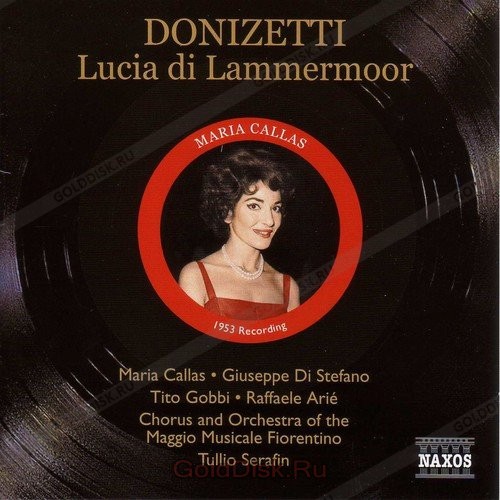
Whatever you choose, you really can’t do without at least one Callas. Try Naxos (8110131-32) with Giuseppe di Stefano and Titto Gobbi, under Tulio Serafin, for although Francesco Tagliavini (Warner Classics 2564634081) is a much better Edgardo, the rest of the cast (including Callas herself!) is much stronger here.
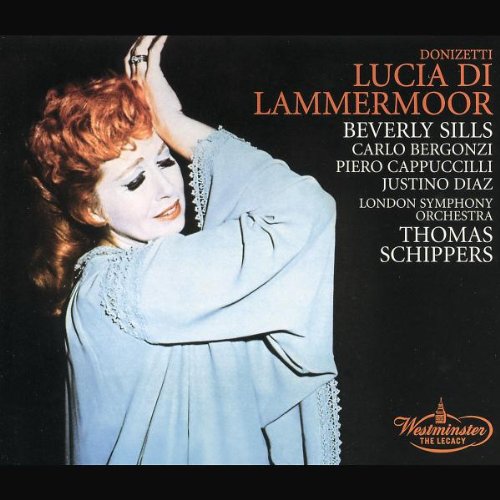
Personally, I prefer Beverly Sills (Westminster 4712502), especially when it is a choice between studio recordings. Her portrayal unites the best of both divas: the virtuosity, vocal beauty and pure intonation of la Stupenda and the great acting of la Divina. Not really a great tragédienne (but then, neither is Lucia); she is more like a passive girl child who allows herself to be completely overwhelmed. The rest of the cast (Carlo Bergonzi, Piero Cappuccilli, Justino Diaz) is also at a very high level and Thomas Schippers conducts it all with a firm hand . But what makes this recording really special is the use of a glass harmonica in the mad scene, exactly as Donizetti had originally prescribed it.
Renata Scotto
My most beloved Lucia, Renata Scotto, never recorded the role in the studio. There are, however, several pirate recordings of her in circulation, with Luciano Pavaratti, Alfredo Kraus, Carlo Bergonzi and Gianni Raimondi as Edgardo.
Of these four, the recording with Raimondi is dearest to me, not least because of the very energetic and dramatically balanced direction by Claudio Abbado. It was recorded at La Scala in December 1967 and it appeared on Nuova Era (013.6320/21). Unfortunately, this recording is very hard to find.
Below Gianni Raimondi and Giangiacomo Guelfi (Enrico) in ‘Orrida è questa notte…
Scotto’s interpretation of the tormented heroine is available on DVD (VAI 4418). The production was recorded in Tokyo in 1967. It circulated for years on pirate video, but as the sound and picture quality were particularly poor, the commercial release has made many opera lovers very happy. The sound is a little sharp, making Scotto’s high notes sound even more metallic than usual, but who cares? ‘
Her interpretation is both vocally and scenically at an unprecedented high level. With a childishly surprised expression (my brother does this to me?) on her face, she agrees, albeit not without grumbling, to the forced marriage with Arturo (an Angelo Marchiandi who is hideous in every way).
Below, Scotto sings ‘Il dolce suono’. Who could do it better?!
After her mad scene, you tend to pull the plug, because everything that comes after it can only feel like a cold shower. But you are wrong about that. Edgardo’s two arias, sung by Carlo Bergonzi, will take you straight to (singer’s) heaven.
Afterwards, you can’t help but be a little sad, because where have they gone, yesterday’s singers? Small, tall, fat, skinny, with or without acting talent… None of them was a ballet dancer, but could they sing! And it was through their voices alone that they were able to convey all of the feelings that now require a whole ‘artistic team’. In spite of the cuts that were common at the time, this is an absolute must.
Below, Bergonzi sings ‘Fra poco a me ricovero’
Patritia Ciofi (French version)
In 1839, Donizetti adapted his opera for Paris and Lucia became Lucie. It is not the language alone that distinguishes between the two versions, for Donizetti tinkered considerably with both the libretto and the music. Alisa (Lucia’s lady-in-waiting) was cut out of the opera and our heroine remains the only woman in an otherwise purely male company, which makes her even more lonely and vulnerable.
Normanno is now called Gilbert and his role has been considerably expanded. His false play and manipulations make him into a key figure and he grows to almost Iago-like proportions. Arturo has also become more three-dimensional as Henri. And although I miss ‘Regnava nel silenzio’ and scenes between Lucia and Raimondo, I must admit that the French version is dramatically much better.
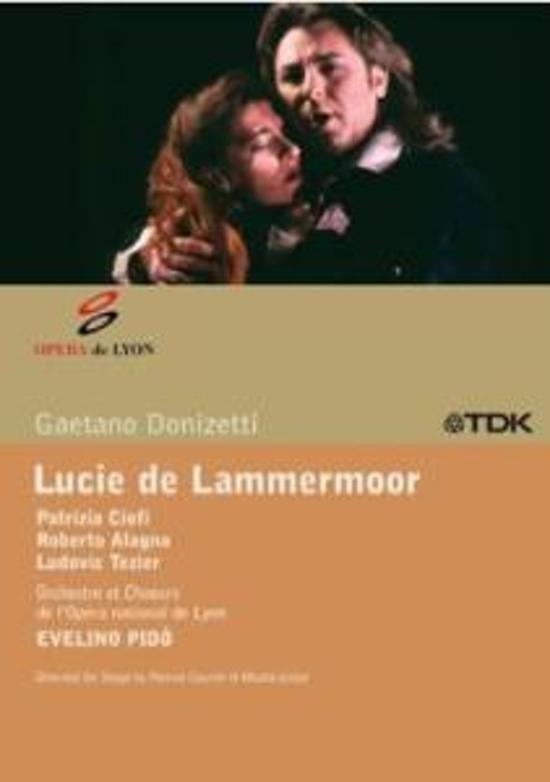
In this recording (once TDK, hopefully still available), Patrizia Ciofi is nothing less than phenomenal as a rather neurotic Lucie, Ludovic Tézier is superb as a villainous Henri and Roberto Alagna is in his element as Edgar. It was (at the time) one of his best roles.
The director duo Patrick Courier/Moshe Leiser rarely disappoint. Their productions are always realistic, embedded in a historical perspective, but with enough of a nod to the present. Moreover, they do what directors are supposed to do: provide a good mise-en-scène and guide the singers in their performance as to appear convincing.
THREE LUCIAS OF RECENT TIMES
Anna Netrebko
Deutsche Grammophon released the Live in HD broadcast of Lucia di Lammermoor by the Metropolitan Opera in New York in 2009 on DVD and Blu-Ray (DG 0734545). Anna Netrebko sang the main role. I never really thought Lucia suited her. Moreover, at that time she was more concerned with showing off than with the soul- searchings of the tragic heroine she portrayed.
Piotr Beczala is, as always, a fantastic Edgardo, but all the other singers are fine too. All have an individual timbre, so that in the very homogeneously sung sextet you can also recognise the individual voices.
Valery Gergiev conducts energetically and really speeds up the orchestra, which sometimes results in breakneck tempi. On the other hand he actually stretches out the ‘mad scene’ (with glass harmonica, bravo!)
Natalie Dessay
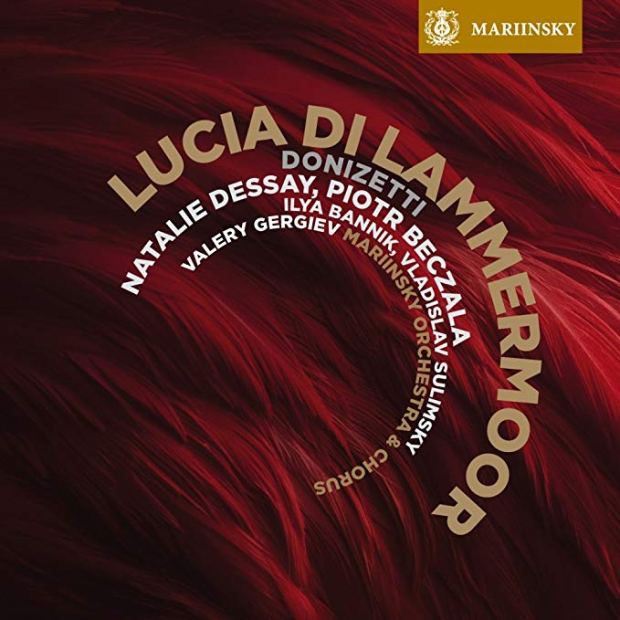
Valery Gergiev’s Mariinsky Theatre put its own Lucia di Lammermoor on CD (MARO 512). Natalie Dessay is a gifted artist. She has a beautiful voice of unprecedented height, with which she sings the most difficult coloraturas and fiorituras as if it were nothing. She is also beautiful and can act incredibly well; it is always a pleasure to see her in action. However, her voice, which is not so big, has its limitations. Scenically, she knows how to hide these through her superb acting, but without visual images, things can go wrong. Which you can hear on this live recording from 2010. Her coloraturas are perfect but empty; they have no substance. This Lucia does go mad but we do not know why. But once she is crazy, she totally makes our heads spin.
Piotr Beczala is, as always, a fantastic Edgardo, but all the other singers are fine too. All have an individual timbre, so that in the very homogeneously sung sextet you can also recognise the individual voices. Valery Gergiev conducts energetically and really speeds up the orchestra, which sometimes results in breakneck tempi. On the other hand he actually stretches out the ‘mad scene’ (with glass harmonica, bravo!).
Diana Damrau
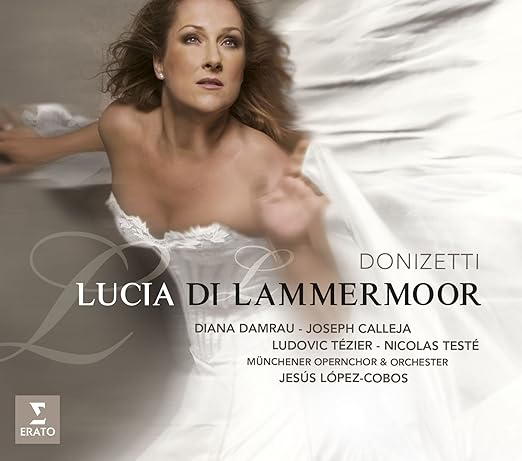
Diana Damrau, one of the world’s best and most famous sopranos, seems to be perfect for the role of Lucia in Lucia di Lammermoor. She sang the part already in 2008 at the New York Metropolitan Opera. Five years later, she delighted audiences in her home town of Munich with her interpretation. The concertante performances were recorded live by Erato, but I am sadly disappointed with the result.
Not that there is anything wrong with Damrau’s coloraturas. They are still impeccable, but to my ears they are empty, without any real substance. In her mad scene, she looks more like the mechanical puppet Olympia from Les contes d’Hoffmann than a woman of flesh and blood.
The male roles are all well cast. Joseph Calleja (Edgardo) sings his role with such ease and flexibility that I am reminded of the young Pavarotti. Ludovic Tézier and Nicolas Testé are perhaps not entirely idiomatic, but their impeccable singing is really not to to be criticized. Even the small role of Normanno is perfectly sung by the excellent Andrew Lepri Meyer.
Jesús López-Cobos’ tempi are remarkable, to say the least. It is stop and go again all the time. Sometimes I do not even recognize the music. It seems as if new embellishments have been added.
The recording itself is also quite unbalanced. It is understandable that the opera could not be recorded in one go, but some things were ‘brushed up’ in the studio and unfortunately we can hear this.
My top three remains unchanged: 1. Renata Scotto with Carlo Bergonzi, VAI 4418 2. Beverly Sills with Bergonzi, recorded in the studio in 1970 (Westminster 4712502) 3. Maria Callas, no matter which one
The talk show with (and about) Maria Callas, broadcast on French television in April 1969, is simply fascinating. Callas, clearly inspired by Jackie O., looks very sophisticated and sweet in her elegant dress. She accepts all compliments with confident modesty, and she doesn’t seem to be bothered by the cigarette smoke that is blown in her face.
With Luchino Visconti she muses about acting, and discusses her latest project: Medea in a film by Passolini in which he acts as well. Captivated she watches the filmed conversation with Elvira de Hidalgo, who, chain-smoking, puts her former pupil in the limelight.
We hear her say what we have always secretly known: she loves Norma and Violetta because of their selflessness. She finds Tosca ridiculous and Carmen horrible: she has no interest in promiscuous women, they do not fit in with her ideal world view.
The conversation is interspersed with fragments and scenes from various operas and concerts. Most of the material is well known, but remains fascinating.
The Callas Conversations – Volume II: L’invitée du dimanche (1969) Le Monde de la Musique EMI Classics DVB 38845799
De talkshow met en rondom Maria Callas, op de Franse televisie in april 1969 uitgezonden is ronduit fascinerend.
Callas, duidelijk geïnspireerd door Jackie O. ziet er zeer sophisticated en lief uit in haar elegante jurk. Alle complimenten neemt ze aan met een zelfverzekerde bescheidenheid, en ze lijkt zich niet te storen aan de sigarettenrook die in haar gezicht wordt uitgeblazen.
Er wordt met geen woord over haar privéleven gerept, haar stem klinkt zacht en straalt een serene kalmte uit. Af en toe reageert zij uitgelaten, net een klein meisje. Met Francesco Siciliani haalt ze herinneringen op aan hoe hij haar, geholpen door Tulio Serafin, ontdekt had en haar haar eerste belcanto rollen liet zingen.
Met Luchino Visconti mijmert ze over acteren, en neemt haar nieuwste project: Medea in een film van Passolini met hem door. Vertederd kijkt ze naar het gefilmde gesprek met Elvira de Hidalgo, die, kettingrokend, haar voormalige leerlinge in het zonnetje zet.
Wij horen haar zeggen, wat we heimelijk altijd al wisten: zij houdt van Norma en Violetta vanwege hun opofferingsgezindheid. Tosca vindt ze belachelijk en Carmen verschrikkelijk: zij heeft niets met de promiscue vrouwen, ze passen niet in haar ideale wereldbeeld.
Het programma is gelardeerd met fragmenten en scènes uit verschillende opera’s en concerten. Het meeste materiaal is goed bekend, maar het blijft boeien.
The Callas Conversations – Volume II: L’invitée du dimanche (1969)
Le Monde de la Musique
EMI Classics DVB 38845799
“Allemaal hebben wij buitengewoon veel aan muziek te danken (…) Het is een vorm van expressie die niet zo zeer van het denken als van het voelen komt”. Die woorden komen van één van de grootste zangeressen van de twintigste eeuw, Montserrat Cabballé.
In zijn film Caballé Beyond Music portretteert Antonio Farré de diva*, haar leven en haar carrière, hij spreekt met haar, haar intimi en haar collega’s. In de documentaire zijn er ook veel (archief)beelden te zien en te bewonderen, beginnend met Caballé’s debuut in Il Pirata in 1966 in Parijs.
De film is gelardeerd met leuke anekdotes zoals die, hoe ze een deur kapot smeet omdat men haar niet toestond om vrij te nemen (Caballé wilde de voorstelling van Norma met Maria Callas bezoeken). Hoe ze een generale repetitie in La Scala had stopgezet omdat ze merkte dat het orkest niet goed was gestemd. Over haar debuut in de Metropolitan Opera in New York, de ontdekking van José Carreras (wat was hij mooi!), haar vriendschap met Freddy Mercury ….
Over haar Tosca in het ROH in Londen in de productie die voor Callas was gemaakt. Daar was zij niet gelukkig mee, het voelde niet goed, maar niemand die er iets aan wilde veranderen. Caballé belde Callas op, het was precies acht dagen voor haar dood, en beklaagde haar lot. “Maar natuurlijk voelt het niet goed”, zei Callas. “Ik ben lang en jij niet, ik ben slank en jij niet, ik heb lange armen en jij niet. Zeg tegen ze, dat ze me bellen, ik zal ze overtuigen dat je mij niet bent”.
En zo werd de productie voor Caballé aangepast. “Kopieën zijn nooit goed”, zegt Caballé, en ik ben het met haar eens. Dit is een fascinerend portret van een fascinerende zangeres. Zeer, zeer de moeite waard.
* Londense taxichauffeur: “wat is het verschil tussen terrorist en een diva? Met terrorist kun je onderhandelen”.
Caballé beyond music
Met José Carreras, Plácido Domingo, Joan Sutherland, Cheryl Studer, Giuseppe di Stefano, Freddie Mercury, Claudio Abbado e.a.
Regie Antonio A. Farré
EuroArts 2053198
1959 was een goed Callas jaar. In januari dat jaar gaf ze haar eerste concert in Carnegie Hall, waar ze in concertante gezongen Il Pirata triomfeerde. Er volgden een paar ‘Medea’s’ (Cherubini) in Londen en een kort tournee door Spanje en Duitsland.
En toen was het zover: haar lang verwacht optreden in Amsterdam. Duizenden mensen verzamelden zich op Schiphol om haar te begroeten.
Maria Callas arriveert in Nederland in 1959. Rechts: Peter Diamand, voorzitter van het Holland Festival.
De lichten in de zaal waren gedoofd en alle schijnwerpers waren op haar gericht toen ze het Concertgebouwtrap afdaalde. Alleen de musici van het Concertgebouworkest hadden lichtjes op hun lessenaars aan, wat volgens de getuigen, het podium in een romantische sfeer had gehuld.
Callas was toen zang technisch op het hoogtepunt van haar kunnen. Ze begon met voorzichtig gezongen ‘Tu che vedi il mio tormento’ uit La vestale van Spontini, maar al bij ‘Surta è la notte’ uit Ernani van Verdi liet ze alle remmen los.
Het publiek werd uitzinnig van enthousiasme, wat Callas stimuleerde om nog intenser, en nog dramatischer te worden in haar perfect geïntoneerde lezing van ‘Tu che le vanità’ (Don Carlo). Ze besloot met de waanzinscène uit La Pirata, een waarlijk tour-de-force.
Een iedere noot voorzag ze van een andere kleur, haar pianissimo was adembenemend en de coloraturen optimaal. Een echte La Divina. Was ik maar toen erbij!
Spontini, Verdi, Bellini
Live in Amsterdam 1959
Maria Callas, Concertgebouworkest olv Nicola Rescigno
EMI 5626832















 Basia con fuoco