Merkwaardige man, die Adams, maar componeren kan hij als geen ander. Hij is één van de meest succesvolle en het vaakst uitgevoerde hedendaagse componisten en dat is niet zonder reden: zijn muziek is zeer toegankelijk en prettig in het oor liggend, zonder dat het meteen aan klanktapijt of muzak doet denken.
Zijn inspiratie haalt Adams uit “de landschappen en hun relatie met de menselijke psyche” (zijn eigen woorden!) en beschouwt zijn muziek als “etnisch, maar dan beïnvloed door jazz en pop”. Zijn stijl noemt hij zelf ‘post-style-style’ en zegt dat zijn meeste composities een celebratie zijn van de Amerikaanse cultuur.
Hij houdt van Amerika en haar dichters. Zijn (volgens mij) mooiste werk, The Wound dresser, heeft hij bij een gedicht van Walt Whitman gecomponeerd.
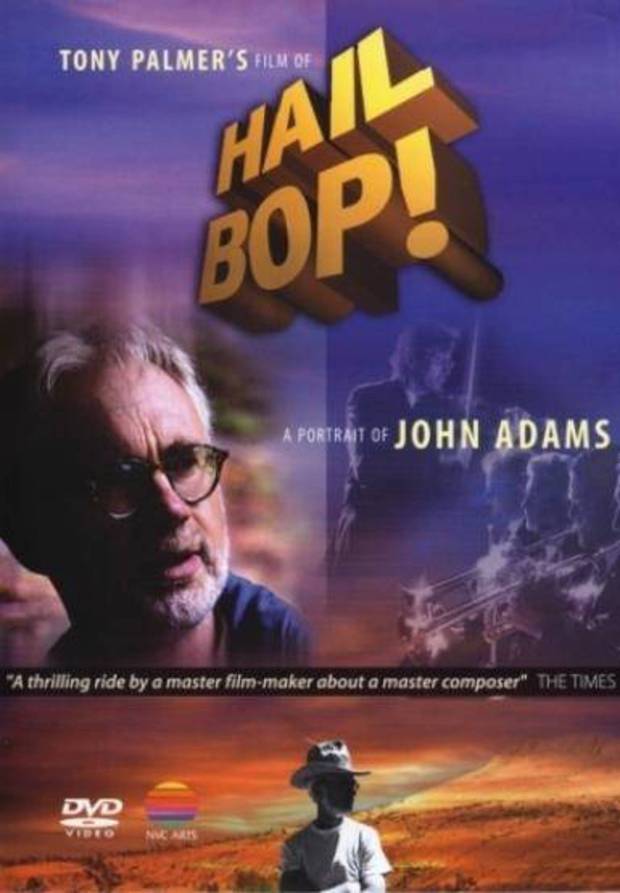
‘Hail Bop’, de documentaire van Tony Palmer over John Adams is mooi, spannend en informatief. Er zijn veel muziek- en operafragmenten, er zijn interessante interviews, en prachtige beelden van het door Adams zo geliefde Amerikaanse landschap.
Ik kan mij het gebeurtenis namelijk nog steeds meer dab goed herinneren
Moeite heb ik alleen met de fragmenten van de verfilmde versie van ‘Death of Klinghoffer’. Ik heb de opera nooit als antisemitisch of zelfs anti-Israëlisch ervaren, maar de overrealistiche beelden van de met stenen gooiende Palestijnse kinderen en schietende Israëlische soldaten vind ik te veel van het goede en niet ter zake doend: de opera werd gecomponeerd in 1991, bijna tien jaar voor de uitbarsting van de tweede Intifada. Maar goed, daar hoeft u het niet met mij eens te zijn (Warner Music Vision 50-51011-4857-2-5)
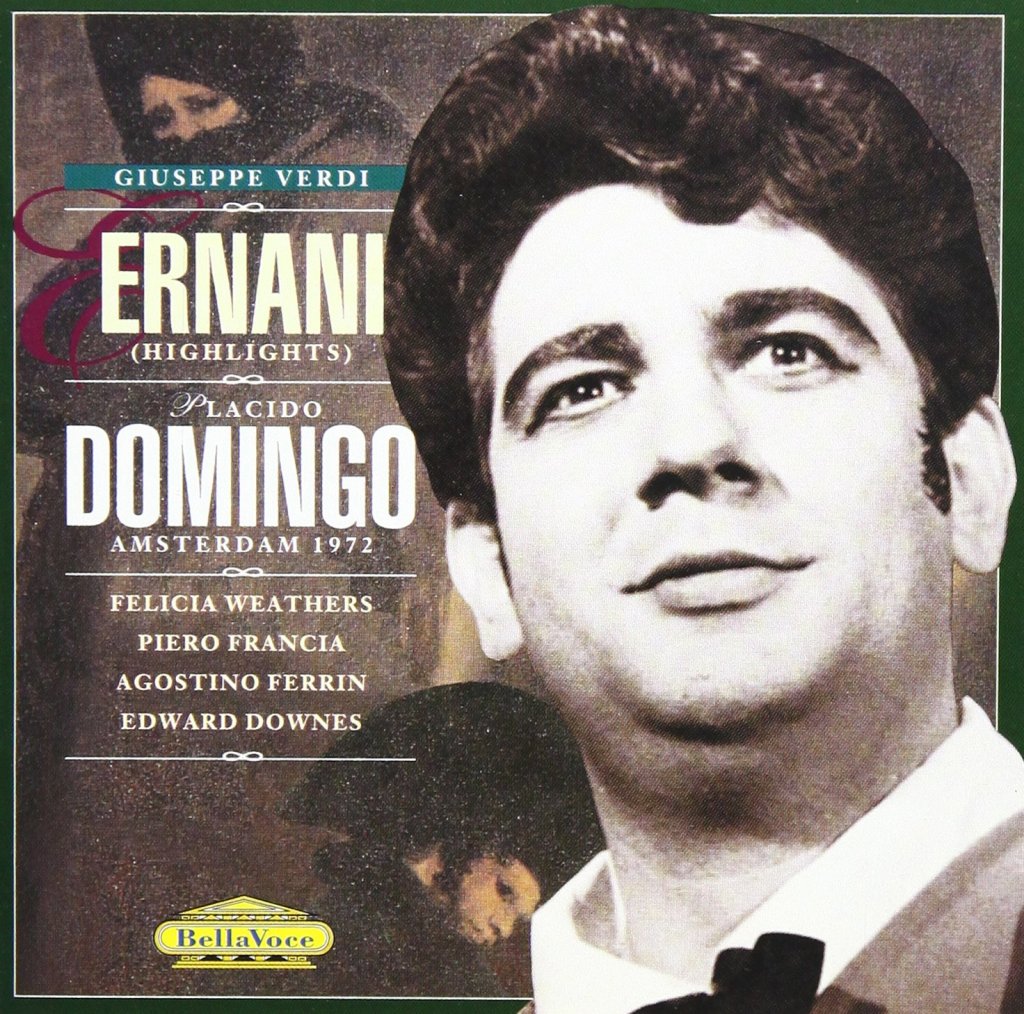
Ernani is an important opera to a Domingo collector. Domingo made his debut with it at La Scala on 7 December 1969. It was also the only opera he sang in Amsterdam, on 15 January 1972. Concertante, of course (yes, during the Matinee, where else?). Unfortunately, no complete recording exists, so we have to make do with fragments only (Bella Voce BV 107.004). Felicia Weathers, who sang the role of Elvira, had a terrible head cold and neither Piero Francia nor Agostino Ferrin are names to remember, but it remains an important document.
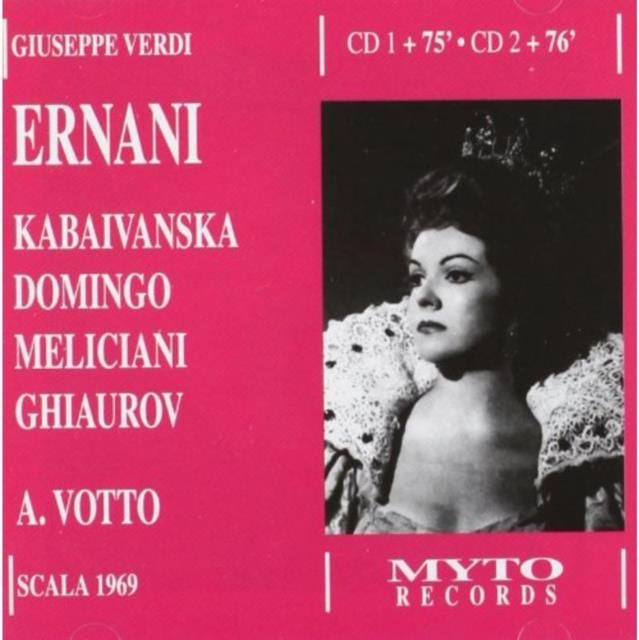
At La Scala, besides Domingo, there were two other greats of bygone days: Raina Kabaivanska and Nicolai Ghiaurov. Unfortunately, Cappuccilli had to cancel due to illness, but his replacement, Carlo Meliciani, really gives his best. Add to this the truly sublime direction of Antonino Votto and you know that you can expect a special ‘evening’ of opera.
AIDA
Radames was among Domingo’s favourite roles. No wonder. Here he could really ‘show it all’, because the hero is very complex. He is a ‘macho with a lot of muscles’ and a vulnerable boy at the same time, and he is torn between duty and passion. Unfortunately, the two are not compatible. To sing Radames well you need not only a cannon of a voice but also an intellectual ability. And he has both.
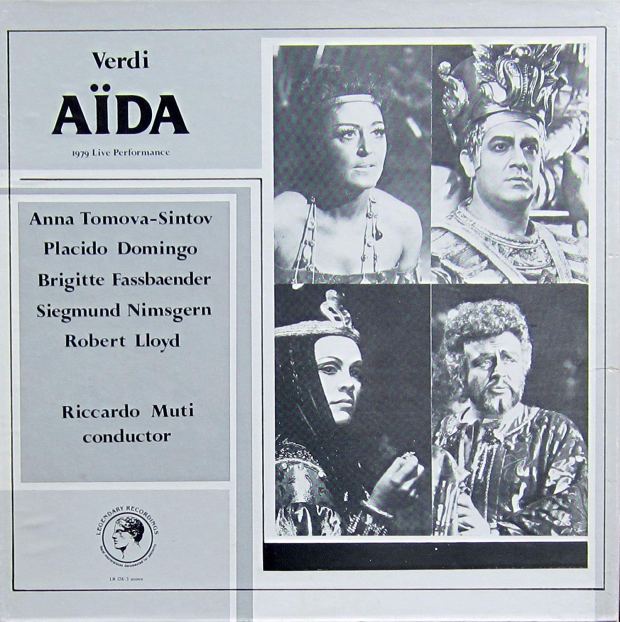
He made his debut with Aida in 1968 in Hamburg and he has since sung the opera thousands of times. There are many recordings on the market, both studio and live. I would like to dwell on a recording that will not evoke an ‘aha’ moment for most of you – also because at first glance the cast is not idiomatically perfect.
The fact that Anna Tomowa-Sintow was one of Karajan’s favourite singers had its advantages and disadvantages. She was a welcome guest in Salzburg and her name appears on many recordings conducted by the maestro. But it also meant that she was primarily rated as a Mozart and Strauss singer, while she had so much more to offer. Her Desdemona and Amelia were legendary and after her Munich Aida, Leonie Rysanek praised her performance for its pure beauty.
Fassbaender is really surprising and particularly convincing as Amneris. Just listen to what she does with the single word ‘pace’ at the end of the opera. The opera was recorded by Bayeriche Rundfunk on 22 March 1979 and released on Orfeo (C583 022).
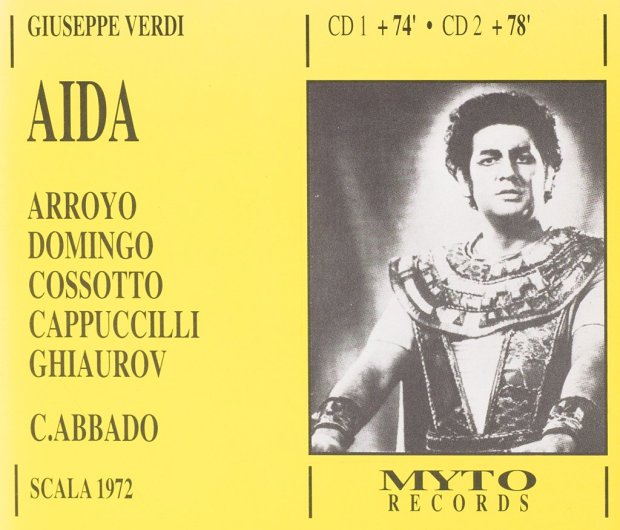
Also noteworthy is the recording from Munich 1972, with a now almost forgotten Verdi singer, Martina Arroyo. As Amneris, we hear Fiorenza Cossotto and Cappuccilli and Ghiaurov complete the excellent cast conducted by Claudio Abbado.
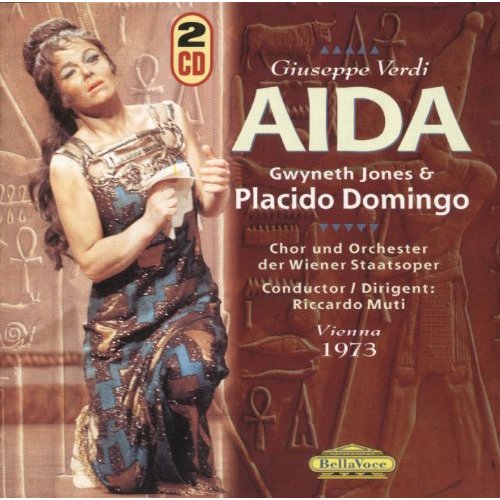
The recording from Vienna 1973 (Bela Voce BLV 107.209), under Riccardo Muti, is also of particular interest. In the leading role we meet Gwyneth Jones and Amneris is sung by an exceptional mezzo: Viorica Cortez.
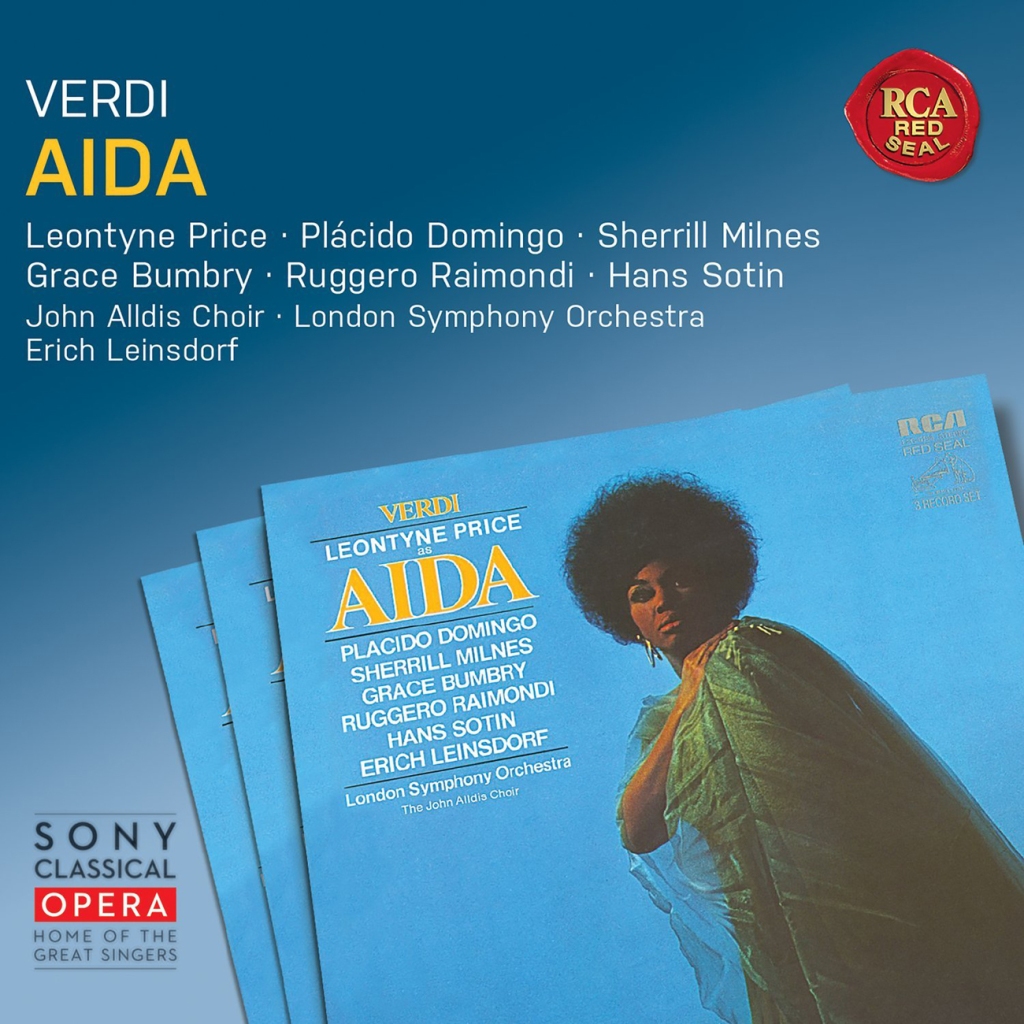
Of Domingo’s studio recordings the 1970 RCA (now Sony)release, is probably the best. How could it be otherwise, when you know that the conductor is Erich Leinsdorf and the other roles are sung by Leontyne Price, Sherrill Milnes, Grace Bumbry and Ruggero Raimondi. The whole thing almost pops out of your speakers.
IL TROVATORE
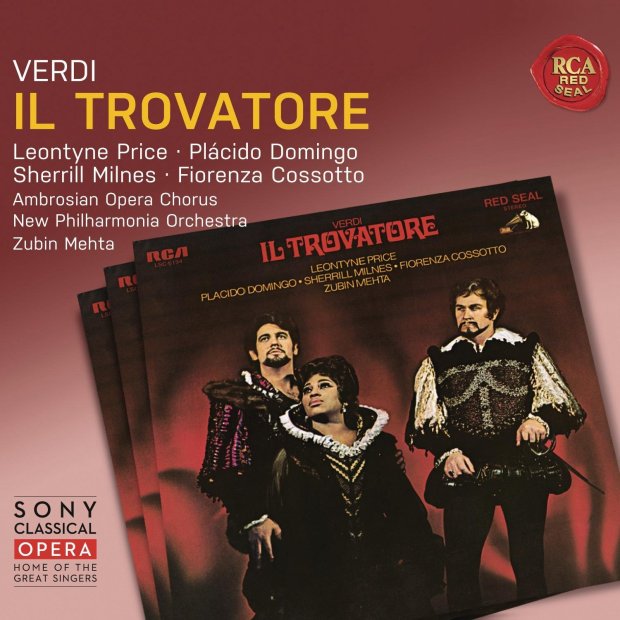
Il Trovatore was the very first opera Placido Domingo, then 28 years old (!), recorded in the studio in 1970. Fiorenza Cossotto stars as Azucena, but the recording is really indispensable because of one of the most riveting Lunas ever: Sherrill Milnes .
Below: Price, Domingo and Milnes in ‘E deggio e posso crederlo?’
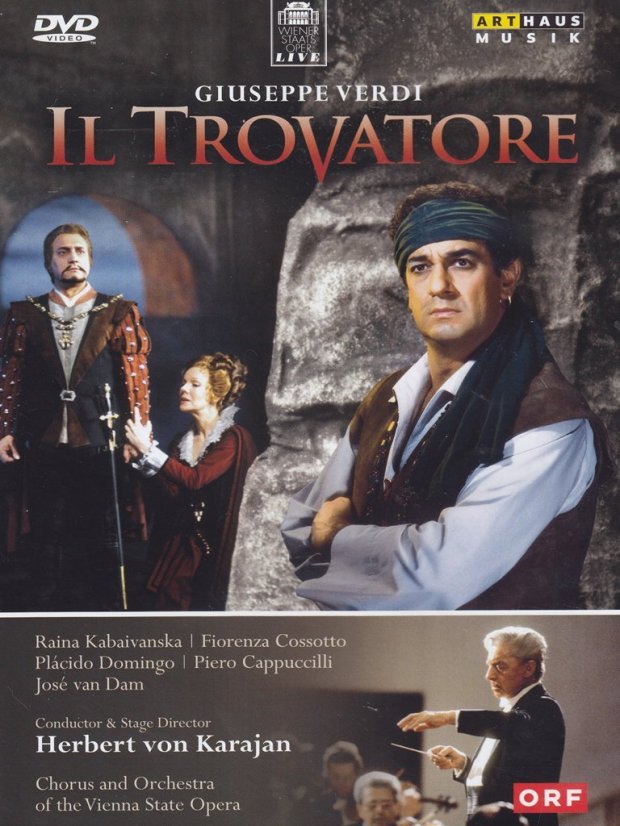
Il trovatore was one of Von Karajan’s favorite operas. In 1962 he directed a series of performances in Salzburg, those were taken over by Vienna in 1978 and broadcast on television.
Domingo was a last minute replacement for Franco Bonisolli, who had left the production in a fit of temper. Domingo’s delightful, radiant topnotes in ‘Ah si, ben mio’ earned him an ovation that lasted for many minutes.
Cossotto’s Azucena is now legendary: like no other singer she put her mark on the role (Arthouse Music 107117).
Below: Domingo, Kabaivanska, Cappuccilli en Cossotto in ‘Prima che d’ altri vivere’
BALLO IN MASCHERA
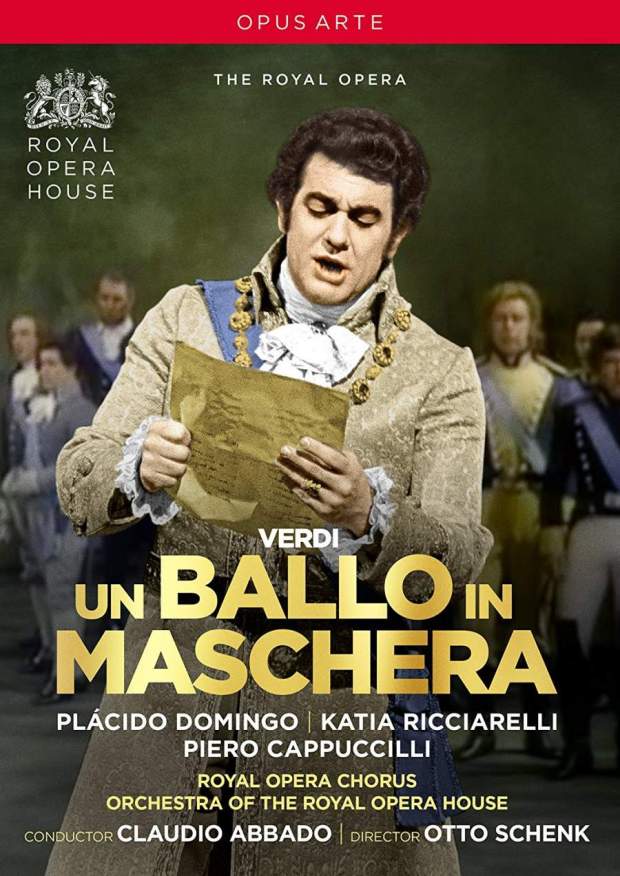
The Royal Opera House production released by Opus Arte (OA 1236D) dates from early 1975. The sound is a little dull, but you will forget that as soon as you hear the beautiful voices of the singers.
Katia Ricciarelli is one of the most moving Amelias I know. The sound that she produces is perhaps not really ‘Verdian’, and perhaps her voice is a little too light, (she has sadly destroyed her voice by singing this type of role), but the pianissimi that she spins deserve a prize for sheer beauty, and her fragility is palpable.
The kindly anxious, loving, but also playful tenor of the young Placido Domingo fits the role of Gustavo like a glove. Piero Cappuccilli is an excellent Renato and Reri Grist an Oscar such as you do not often hear them anymore. Her performance alone is worth buying the DVD.
Claudio Abbado (how young he was then!) conducts lightly and keeps the tempi sparkling, resulting in an effervescent orchestral sound.
The direction by Otto Schenk is effective. Conventional and yet surprising. And like no other, he exposes the comic aspects of the opera.
Trailer of the production:
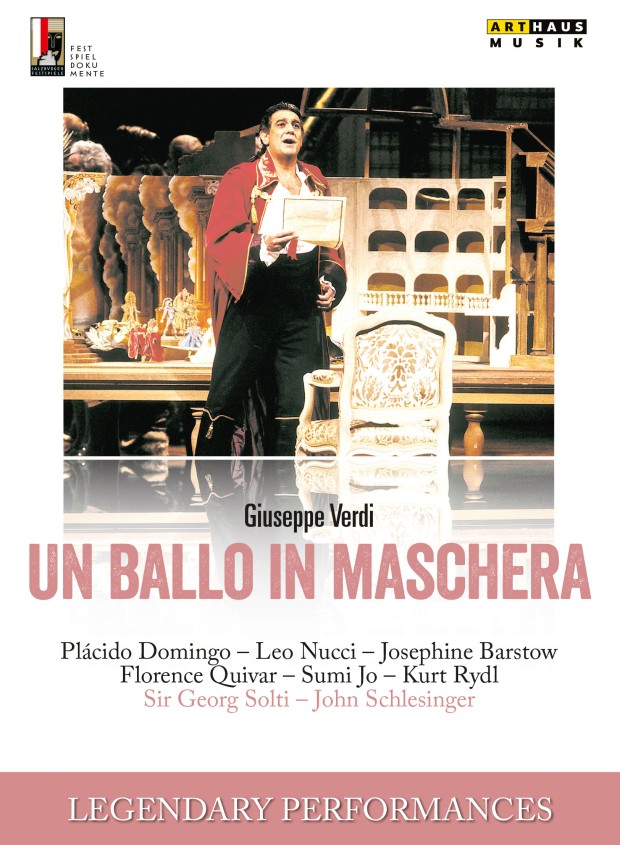
Fifteen years later, Domingo is already a seasoned Gustavo. His king is now more mature, more serious too… But although he says he doesn’t believe Ulrica’s predictions, you can still see something like terror in his eyes. It could so easily be true… This production includes also a more mature Amelia. Now she is not a dreamy girl, but a woman with intense desires. Josephine Barstow certainly lives up to this interpretation. She is a torn Amelia, full of love, sorrow, pain and tears. In ‘Ecco l’orrido campo’, her fear is physically palpable and in ‘Morro’ you think you may die with her. Leo Nucci shines as Renato and Sumi Yo is a light, bouncy Oscar.
The direction lies in the hands of the famous film director John Schlesinger. The end result is devastating: overwhelming, true-to-life sets, beautiful costumes and dazzling mass scenes. The picturesque image is occasionally reminiscent of enormous tableaux-vivants, and the direction of the characters is- as you would expect from a renowned director – phenomenal. At the opera’s finale, when the dying king gathers his last strength and, gasping for breath, bids farewell to his beloved, his subjects and the fatherland, no one can suspect that with his last ‘addio’ an entire era is also coming to an end. It would be Herbert von Karajan’s last production in Salzburg. He died just before the premiere in 1989 and was replaced by Solti, who also conducted the revival of the opera in 1990 (Arthaus Musik 109105).
Dat de baan van een casting director geen sinecure is, ja, dat weten wij wel. Maar niemand kan zich voorstellen hoe rampzalig en stressy het soms is. Het gebeurt vaker dat de zangers afzeggen, maar dat alle hoofdrol vertolkers het laten afweten, nee, dat komt (gelukkig) niet zo vaak voor. Het overkwam Mauricio Fernandez, de casting director van Amsterdamse ZaterdagMatinee bij de concertante uitvoering van Tosca op 19 mei 2012
Eerst zegde Cavaradossi af. Toen Angelotti. En toen werden we op een echte soapopera getrakteerd want maar liefst vier (VIER!) Scarpia’s hebben laten afweten; de laatste nog maar een dag voor de voorstelling. Maar het noodlot was nog niet afgewend: op de avond vóór dé dag werd Tosca ziek.
De letterlijk ‘last minute’ vervangster, de Roemeense Cellia Costea kwam rond 11 uur die ochtend in Amsterdam aan en vers van het vliegtuig kreeg ze haar eerste (en enige) repetitie met het orkest.
Het resultaat was adembenemend goed. Costea beschikt over een mooie, donkere sopraan met soepele hoge noten. Indrukwekkend dramatisch in de tweede acte en net zo indrukwekkend lyrisch in haar liefdesduetten. Niet alleen kende ze de rol uit haar hoofd, zij wist het ook te acteren. Brava!!
Hieronder: Cellia Costea zingt ‘Vissi d’Arte’ bij de Griekse Nationale Opera in 2015
Carlos Almaguer
De vijfde Scarpia, Carlos Almaguer vond ik niet zo sterk, soms had ik de indruk dat hij zichzelf overschreeuwde, maar gezien de omstandigheden was hij meer dan voldoende.
Giorgio Berrugi zong een ouderwets Italiaanse Cavaradossi, alle noten waren er en er ontbrak hem ook niet aan passie.
Hieronder Giorgio Berrugi zingt ‘E lucevan le stelle’ in opera van Marseille
Tomislav Lučič was een voortreffelijke Angelotti en Luca Casalin een zeer overtuigende Spoletta.
Pinchas Steinberg
Het was de eerste keer dat ik Pinchas Steinberg live hoorde en ik moet bekennen dat ik zowat van mijn stoel viel van bewondering. Hij leidde het Radio Filharmonisch Orkest met de vaste hand, legde de accenten op de juiste plekken en – wellicht allerbelangrijkste, zeker tijdens de uitvoering met allemaal invallers – hij volgde de zangers. Daar werd ik werkelijk stil van.
Nicolas Joel (6 februari 1953–18 juni 2020), regisseur van deze bijzonder fraaie Aida uit Zürich, stond in 2009 uitgebreid in het nieuws toen bekend werd dat hij, na het vertrek van Mortier, de baas van de Bastille ging worden. Het nieuws werd door de opera minnend publiek toegejuicht: Joels producties werden bijna altijd jubelend ontvangen.
Ook de in 2006 opgenomen Aida ziet er werkelijk schitterend uit. In zijn regie speelt het verhaal zich nog steeds in Egypte af, maar dan eeuwen later, in de late negentiende eeuw, het koloniale tijdperk. De verhoudingen tussen de heersers en de lokale bevolking zijn koel maar correct, mits ze het zich niet in hun hoofd halen om gelijkheid te eisen. Of een liefdesrelatie met een ‘meerdere’ te beginnen.
Het klopt allemaal wel, en levert niet alleen een spannend avondje opera op, maar ook bijzonder fraaie plaatjes (enscenering Ezio Frigerio), die heel veel aan de films van James Ivory doen denken. Bovendien bewijst hij dat het ook zonder paarden en olifanten mogelijk is om en zeer indrukwekkende en imposante triomfscène te ensceneren.
De mannelijke zangers zijn helaas, om het aardig uit te drukken, een beetje onevenwichtig maar beide vrouwen leveren schitterende prestaties op. Luciana D’Intino is een zeer opwindende Amneris en Nina Stemme’s lyrische, maar met een enorme kracht gezongen Aida herinnert me af en toe aan Birgit Nilsson.
Nina Stemme, Salvatore Licitra, Luciana D’Intino, Juan Pons
Zurich Opera Orchestra olv Adam Fischer BelAir classiques BAC022 (2dvd’s)
Religion, there is nothing wrong with it. Provided that it is well- dosed, it can be a source of a lot of happiness (and salvation). People can draw hope from it and the pure belief in miracles may also cause miracles. Although it is not very tangible.
Paul Claudel
The French poet and playwright Paul Claudel (1868 – 1955) was a deeply religious man and almost all of his works were inspired by his Catholic faith. The same is true of ‘The message to Mary’, on which the Verkündigung by Braunfels is based
Violaine is engaged to Jacobëus but she rejects him: by her act of charity (out of pity she kissed a man with leprosy) she herself becomes infected. Jakobëus marries Violaine’s sister Mara and, when their child dies after birth, Violaine miraculously brings it back to life. This mystical story full of love, tragedy and sacrifice smells strongly of incense and is not averse to primary sentiments.
Thus also Walter Braunfels’ score: narrative and dark, because even the miracles leave little to hope for. An unadulterated mystery play, with a lot of attention to martyrdom, but larded with the most beautiful notes that seem to have descended straight from heaven.
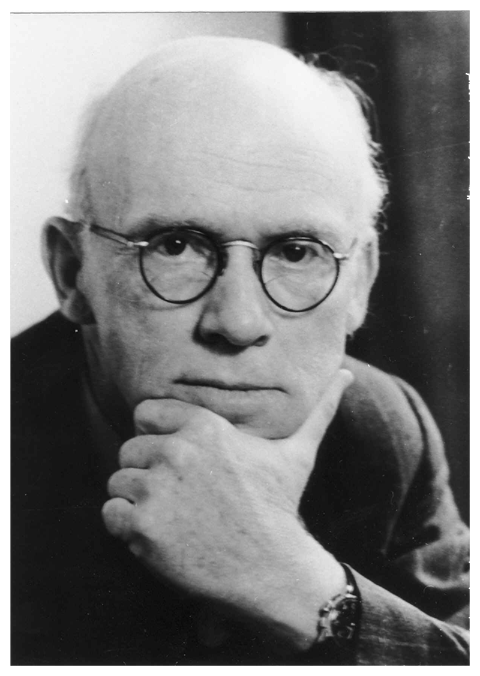
Walter Braunfels
Verkündigung was my first introduction to the composer Braunfels. In 1994 the work was released by EMI (now Warner). A publication that has shaken my worldview. Because I didn’t get it: how could such an unadulterated masterpiece remain unknown for so long? Why was it never performed? Since then Braunfels (together with Korngold, Zemlinsky and Schreker) is at the top of my list of my beloved composers.
That EMI recording, including John Bröcheler as Jakobëus, is certainly fantastic, but the new edition by BR Klassiek proves that it can even be bettered!
This performance, directed by Ulf Schirmer, was recorded live in Munich in 2014. Juliane Banse (Violaine) is totally absorbed in her role. She sings softly, swaying and lovingly. Perfect goodness. Janina Baechle is a good Mara and Hanna Schwarz and Robert Holl shine as the parents.
Adrian Eröd is a much better Jakobëus than Bröcheler: his voice is lighter and higher, more loving also, which gives more clarity to his character.
Walter Braunfels Verkündigung Robert Holl, Hanna Schwarz, Julian Banse, Janina Baechle, Adrian Eröd, Matthias Klink, Mauro Peter e.a. BR Klassik 900311
In maart stond Kurt Weils Mahagonny geprogrammeerd bij DNO maar de coronacrisis gooide roet in het eten. Voorlopig zal een uitvoering van deze productie uit Aix en Provence in regie van Ivo van Hove er wel niet van komen. Bij wijze van substituut belicht ik daarom een oude opname onder leiding van James Conlon. Het betreft de productie van John Doyle voor LA Opera in 2007, op dvd uitgebracht door EuroArts.
De opera Mahagonny heeft als voorloper het Mahagonny Songspiel, een concertante eenakter die in 1927 in première ging. Hieruit zijn de twee Engelstalige nummers afkomstig die ook buiten het werk grote bekendheid hebben gekregen: de ‘Benares Song’ en vooral de ‘Alabama Song’. In 1930 ging de ‘grote’ opera in première, afgezien van die twee songs geheel in het Duits op teksten van Berthold Brecht.
De productie in Los Angeles gebruikt Engels als voertaal en daarmee gaat veel van de sfeer verloren. Met name het topnummer ‘Denn wie man sich bettet, so liegt man‘ wordt in mijn beleving volledig onherkenbaar. Iedere liefhebber van Weil en Brecht kijkt uit naar de volgende tekst:
‘Meine Herren, meine Mutter prägte auf mich einst ein schlimmes Wort:
Ich würde enden im Schauhaus oder an einem noch schlimmern Ort.
Ja, so ein Wort, das ist leicht gesagt, aber ich sage euch: Daraus wird nichts!
Das könnt ihr nicht machen mit mir! Was aus mir noch wird, das werdet ihr schon sehen!
Ein Mensch ist kein Tier!
Denn wie man sich bettet, so liegt man, es deckt einen da keiner zu
Und wenn einer tritt, dann bin ich es, und wird einer getreten, dann bist’s du.
Audra McDonald heeft als operasopraan en toneelactrice geen enkele moeite met de vertolking van dit lied maar het doet me niets. De rauwe sfeer ontbreekt die de technisch onvolkomen interpretatie van Lotte Lenya kenmerkt. Net als de ‘Alabama Song’ moet ook dit nummer meer cabaretesk gebracht worden, vind ik. Denk aan Ute Lemper.
De decors van Mark Bailey en de kostuums van Ann Hould-Ward zijn inventief en goed verzorgd, ze sluiten uitstekend aan bij de inhoud van het stuk. Dat laatste geldt ook de casting van de voornaamste rollen. Zo wordt Fatty the Bookkeeper vertolkt door een zeer omvangrijke Robert Wörle en Trinity Moses door de zwaargewicht Donny Ray Albert.
Patti LuPone is op zich goed gecast als de Weduwe Begbick maar vertolkt de rol naar mijn smaak iets teveel als Norma Desmond in Sunset Boulevard. Haar bravoure is te gekunsteld, echte hardheid en sarcasme ontbreken. Hier was een ervaren Klytemnestra beter op haar plaats zijn geweest.
De tenor Anthony Dean Griffey is zeer goed op dreef als Jimmy Mahoney, hier Jimmy MacIntyre. Zijn vertolking van ‘When the sky turns brighter’ waarin hij de zon vraagt niet op te komen om zodoende de dag van zijn proces uit te stellen, is een hoogtepunt in Griffey’s optreden. Het nummer doet enigszins denken aan ‘E lucevan le stelle’ uit Tosca.
De hoer Jenny, hier alomtegenwoordig op het toneel, is in goede handen bij Audra McDonald. Ze is een absolute blikvanger, een effect dat nog wordt versterkt door haar ‘scanty costume’, en zet al haar acteertalent in om Jenny zoveel als mogelijk in de pas te laten lopen met wat men zich bij een ervaren professional in het Wilde Westen voorstelt. Maar betaalde liefde is geen liefde, ze laat Jim als een baksteen vallen en verklaart zich nader met ‘Meine Herren…. und wird einer getreten, dann bist’s du’.
Overigens is zij niet de enige. Jim heeft zich schuldig gemaakt aan de grootste misdaad die men in Mahagonny kan begaan: hij heeft geen geld en kan zijn whisky niet betalen. Daarvoor wordt hij ter dood veroordeeld, niemand springt voor hem in de bres.
Mahagonny is een politieke satire maar de inhoud is zo weinig eenduidig dat men er zeer verschillende interpretaties aan kan geven. De kritiek op de oppermacht van het geld in de maatschappij is echter duidelijk genoeg.
James Conlon heeft de muzikale leiding en is verantwoordelijk voor een muzikaal smetteloze vertolking van dit weinig gespeelde stuk, een opera die naar mijn smaak echter beter gespeeld kan worden als cabareteske musical. Alleen zo kan recht worden gedaan aan de tijd en sfeer waarin het stuk is ontstaan.
There are those operas you just don’t know what to do with. You find them beautiful, divinely beautiful even, and you are moved to the depths of your soul. And that without understanding even a single word. Apparently the composer knows how to hit a sensitive chord, because as you listen you keep hoping that the heavenly music will never stop.
Heavenly is perhaps indeed the best word with which to describe Cecilia by Licinio Refice (1883 – 1954), an opera that most resembles a mystery play.
I am not insensitive to the miraculous, I grew up as a Jewish girl in a strongly Catholic Poland. But even as a child I was already aware that all those miracles were unattainable to me and therefore I found them extremely exciting and attractive.
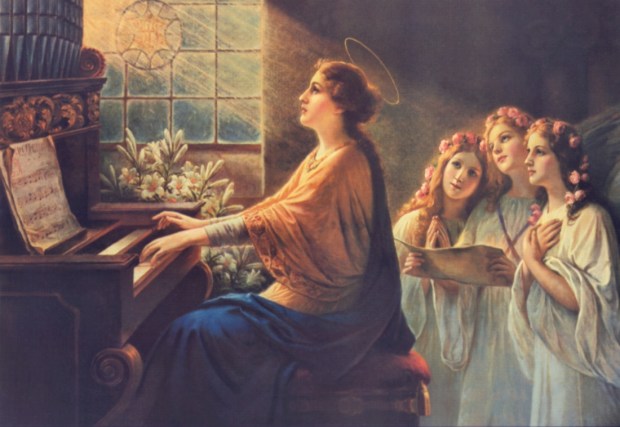
We know Saint Cecilia as the patron saint of music and church music, which, according to many hagiographers, is based on a misunderstanding. What we know of her comes mainly from the Legenda Aurea by Jacopo da Voragine, a reference book on the lives of saints, written in the thirteenth century. That book was the starting point for Refice’s opera. Refice, who was not only a composer and a conductor, but also a priest!
The legend (and the libretto) in short: the stunningly beautiful Cecilia went to martyrdom as a virgin, but not before she had persuaded her husband Vergilio (whom she never de facto made her husband) and his brother Tiburzio to come to the true faith. Both gentlemen share the same fate as Cecilia (beheading), with Cecilia being tortured first, which she endures in a miraculous way.
The premiere in Rome in 1934 was an unprecedented success and the opera was performed more than a thousand times until the rational took over from the mysterious. Cecilia’s musical language is blatantly veristic, with sentiment increased to exeptional heights. You recognize fragments from Butterfly, but the rousing chords and the scents of roses and lilies, as captured in notes, remind me most of Zandonai and his Francesca da Rimini. One also tastes the atmosphere of Byzantium, that of La Fiamma of Respighi. I love it very much and I can completely lose myself in this music.
Until recently I only knew the opera from two shortened recordings, one with Renata Scotto and one with Renata Tebaldi, and from two arias sung by Claudia Muzzio.
Renata Scottio sings ‘Per amore di Gesù’:
The performance, recorded live in the Cathedral of Monte Carlo in 2013, is, as far as I know, the first complete commercial recording of the work and I am sorry to say that the performance is no more than satisfactory.
Denia Mazzolla Gavazzeni
Denia Mazzolla Gavazzeni has for years been the greatest advocate of obscure and little-known veristic operas and for that alone she deserves the greatest praise. She has never been the best opera singer of the world; there was always a frayed edge to her voice and her high notes could sound unpleasantly metallic. But I could (and can!) forgive her these flaws. She was always able to strongly identify with her roles and her performances could be scorching at times. But now that her voice has lost its freshness, her Cecilia cannot convince me of her unearthly beauty. To produce the heavenly sounds he composed for Cecilia, Refice needed someone to sing with ‘God in the throat’. And that is lacking here.
Giuseppe Veneziano is a decent Valeriano, Corrado Cappitta is convincing in the double roles of Tiburzio and Amachio and Serena Pasquini sounds angelic enough for the “L’annunzio” sung by God’s Angel. Everyone really is trying their best, it is just not good enough for a top performance, which may also be due to the very prosaic and down to earth direction of Marco Fracassi.
Below: Claudia Muzio in two scenes from Cecilia: the prologue ‘Per amor di Gesu’, recorded in 1934, and the death scene, ‘Grazie, sorelle’, from 1935:
The fact that Refice has not yet been completely forgotten is due to ‘Ombra di Nube’ (Shadow of the clouds) a song that is still being sung and recorded, a.o. by Jonas Kaufmann:
And here again is Claudia Muzzio, for whom Refice originally composed the song. Now you can hear what Refice meant by ‘God in the throat’, this singer can and does give a tangible feeling to his deep faith and she is also able to make you believe that the ‘dark clouds will disappear naturally, making life beautiful again’.
Domingo and Belcanto? Surely that was more something for his colleagues Pavarotti, Carreras and Kraus? And yet: certainly at the beginning of his career Domingo was also a Belcanto singer, although his high notes were not always really that high. For him, the interpretation of both the music and the text was essential. That is why even in this repertoire he was looking for the roles in which the character had more to offer than just ‘clean’ singing.
Lucia di Lammermoor
Domingo made his international debut at the age of 21, as Edgardo in Lucia di Lammermoor in Dallas. A special event, because his Lucia was then sung by 61-year-old Lilly Pons, who said her farewell to the operatic stage with this role.
In 1970 he sang Edgardo at the Metropolitan Opera, with none other than Joan Sutherland as Lucia. Gala (GL 100.571) released the highlights, combined with excerpts from La Traviata, from December that same year (also with La Stupenda). The sound is very poor, but it is definitely a noteworthy document.
It was only in 1993 that Domingo sang the role in the recording studio. The result is not entirely satisfactory. Which is not his fault. His Edgardo sounds less lyrical than twenty years earlier, but with such passion!
Cheryl Studer, who at that time was recording anything and everything soprano, was no real Lucia. She was a great Strauss and Mozart singer and her Wagners and Verdi’s were outstanding, but Lucia was too ambitious for her. Understand me well: she did have the high notes and they were very solid, but that’s exactly what you do not want for Lucia. The notes shouldn’t stand rock solid, they should shine, sparkle, sprint if necessary, and she couldn’t do that.
However, the real ‘culprit’ is the conductor. He is rushing things along and never ever stops. Still, the recording is very worthwhile, especially if you want to hear something else from Domingo and appreciate the quality of the sound.
Roberto Devereux
A reviewer from the New York Times wrote that it was without a doubt the most exciting event of the musical year 1970, and that I can totally believe. The performance of 24 October 1970 was recorded live and we are very lucky to have it.
Julius Rudel (well, where have all these great maestros gone?) conducts with a firm hand and with great love for the work. To cry so beautiful.
Domingo’s voice sounds like a bell and his performance causes ecstatic ovations. And about Beverly Sills (Elisabetta) I can be brief: overwhelming! No one, but no one has ever sung the part better than she has. She surely is Elisabetta. Everybody should see or hear her in this role (there’s also a DVD, unfortunately without Domingo). The applause after her ‘L’Amor suo mi fé benata’ seems to last forever.
Anna Bolena
Anna Bolena is considered to be the first important Romantic Italian opera and for Donizetti it was his big breakthrough. For Domingo too, Anna Bolena was a milestone: with the role of Percy he made his debut in New York.
He was then (can you believe it?) 25 years old, but his voice was completely ‘mature’: full, firm, soft, hard, begging, determined, with all the nuances in between. Talk about phenomenon!
The leading role was sung by Elena Souliotis, then 23. An almost forgotten singer now (her career didn’t last), but her intensity can only be compared to that of Maria Callas. A fun fact: La Divina was in the audience at the time!
Giovanna was sung by Marylin Horne and their duets will surely give goosebumps to the devotees. Janet Baker also made her American debut in the role of Smeton. The opera was recorded live at Carnegie Hall in 1966. My copy is by Legato (LCD-149-3), but the recording is now also available on other labels.
Norma
Pollione is one of the shining roles of the young Domingo. No wonder. A warlord and a lover: that’s what he is all about. In Norma he could show it all. He took the role in 1973 (once RCA GD 86502) and I think that’s a bit premature. Oh yes, his voice is crystal clear and so beautiful that it almost hurts, but he yet has to gain more of the needed authority. Nevertheless: recommended, not in the least because of Montserrat Caballé, who sings the leading part.
Giuseppe Martucci (1856-1909) is op zijn zestiende begonnen met het componeren van korte pianostukjes waarin hij sterk werd beïnvloed door pianocomposities van Robert Schumann.
In tegenstelling tot zijn land- en (bijna)tijdgenoot Ottorino Respighi componeerde hij geen opera’s. Zijn oeuvre bevat voornamelijk orkest- en kamerwerken, maar echt beroemd is hij geworden met de liederencyclus “La canzone dei Ricordi”. Geen wonder: geen romantische ziel kan er omheen.
Hieronder: Renata Tebaldi zingt ‘La canzone dei Ricordi’:
Zijn werken voor piano zijn van wisselende kwaliteit. De twee Notturni op 70 genieten een bescheiden bekendheid, maar dan wel in de bewerking voor (kamer)orkest.
Zo kende ik ze ook en het valt niet mee om om te schakelen. En toch: eenmaal gewend kan ik er buitengewoon van genieten. Zo doen ze me sterk aan Chopin denken en dat vind ik mooi.
Iets meer moeite heb ik met andere stukken op de cd, die vind ik niet bijzonder interessant. Het zijn net salonstukjes, leuk om op de achtergrond te hebben, meer niet. Maar Alberto Miodino speelt ze alsof het de grootste pianomeesterwerken zijn die ooit gecomponeerd zijn en dat ontroert mij zeer.
De zeer virtuoze Fantasia op.51 voorziet hij van een heuse “Liszt-schwung” en de 6 Pezzi op.44 geeft hij de allure van een sprankelende waterval.
GIUSEPPE MARTUCCI
6 Pezzi op.44, Novella op.50, Fantasia op.51, 2 Notturni op.70
Alberto Miodini piano
Brilliant Classics 94800
Samuïl Feinberg. Wie kent hem nog wel? Ooit wereldberoemde pianovirtuoos, hij was de eerste die in USSR de complete ‘Wohltemperierte Klavier’ van Bach heeft uitgevoerd. Ook als componist was hij in zijn tijd best bekend en dat ondanks het reisverbod.
In totaal heeft Feinberg twaalf pianosonates geschreven, allemaal gecomponeerd tussen 1915 en 1923. En allemaal werden ze toen ook uitgevoerd en uitgegeven. Op één uitzondering na: de derde. De componist hield de publicatie zelf tegen. Waarom? Volgens Nicolo-Alexander Figowy (zelf pianist en Feinberg-kenner die in het bijhorend tekstboekje ons van alle belangrijke insiders informatie heeft voorzien) vond Feinberg zijn compositie iets te ver gaan. Hij dacht dat de wereld er nog niet rijp voor was.
Zelf vind ik zijn derde sonate niet moeilijker dan de andere vijf. Het zijn geen van allen makkelijke stukken die je zo maar in je kunt opnemen, allemaal vereisen ze geconcentreerde aandacht.
En dat gaat niet vanzelf, daar heb je een goede vertolker voor nodig. Daarbij kan ik mij geen betere gids voorstellen dan de Canadese meesterpianist Marc-André Hamelin. Een van de grootste pleitbezorgers voor het onbekende repertoire, vergeten werken en hun scheppers. Zijn spel is ongeëvenaard groots. Geen makkelijke muziek, je moet er echt moeite voor doen, maar de moeite, die loont zich (Hyperion CDA68233)!





 Paul Claudel
 Walter Braunfels



 Basia con fuoco