Antônio Carlos Gomes (1836-1896) has sometimes been called the ‘Brazilian Verdi’. Not without reason: not only his music, but also his strongly nationalistic themes are strongly reminiscent of his Italian colleague.
Il Guarany
I am a great lover of his operas and I don’t think I am the only one. I am therefore very surprised that his operas do not enjoy the fame they deserve. While he was very successful during his lifetime, nowadays he is pretty much completely forgotten, although his operas dó still get performed here and there.
Plácido Domingo has always been the greatest champion of Gomes’ music and it is only thanks to him that Il Guarany was performed in Bonn in 1994 and recorded live by Sony (66273).
Admittedly, the libretto is occasionally a bit ridiculous. Just imagine two rival Indian tribes, both fighting Portuguese nobles, Spanish adventurers and each other. Cannibals also pass by, gold mines are robbed and castles set on fire, and in between, a beautiful white woman runs off with the Indian chief, but first, of course, he has to be baptised. It is impossible to recreate, but the music is so divine!
Domingo sings Pery, the Guarany chief with a tremendous sense of style that automatically makes you sit up and listen. A dragon of a role, but he makes it believable.
I have never been a great admirer of Verónica Villaroel (Cecilia) and here too she sounds a bit pinched. Carlos Ãlvarez, on the other hand, is very good as Gonzales and the rest of the cast is also fine.
Below is the opera’s finale:
Maybe I’m a bit biased (I was there!), but I highly recommend the recording to all of you.
Colombo
The Italian company Bongiovanni (GB 2429-2) released Gomes’ Colombo in 2008. The ‘Brazilian Verdi’ composed the work, a four-part cantata, to mark the 400th anniversary of the discovery of America. Colombo is a very surprising work. The music is so evocative that even without the libretto – enclosed in a very informative textbook – you can imagine exactly what the story is about.
The work was recorded live at Teatro Massimo in Catania in May 2006, starring the highly charismatic baritone Alexandru Agache.
This stunningly beautiful composition consists of short pieces (children’s scenes) flowing into each other. The first scene Canto d’amore is followed by the sound of clappers (The Only Instruments). There are quotes from Klezmer music and Yiddish songs. We hear train sounds, a grim March of Suitcase, shoes and coats and several songs.
Song I is about fear. Song II about children’s furniture that no longer inspires trust, and Song III about being locked in a dark closet. A closet so small there is only room for one leg. All three songs are filled with immense fear and darkness and death (“bei den Toten ist mein Haus und in der Finsternis is mein Bett gemacht”)
The fourth and final song (The End. What really happened) is based on the eyewitness report by Marek Rudnicki, which was published in the Polish Tygodnik Powszechny in 1988
Burkhardt Söll was born in Marienberg in 1944. His mother was Jewish. During his first violin lessons, which he took from his aunts, he was allowed to play klezmer music by the one, but not by the other!
Söll studied viola with the famous Rudolf Kolisch. Already in school he composed for the school orchestra. He continued his training at the Hochschule der Künste in Berlin where he studied composition with Boris Blacher and Paul Dessau and painting with Horst Antes. Afterwards, he was the assistant of Bruno Maderna and later of Otmar Suitner at the Berlin Staatsoper Unter den Linden.
Kinderdinge is a concert version of Söll’s earlier piece of musical theatre Ach und Requiem from 1994/1995, which in turn was preceded by Little Requiem composed in 1991.
What interested me was why Söll wrote a piece of musical theatre on Korczak? Where did his interest in the fate of the old doctor and his children come from? Is it at all possible to tell his story in music? These questions were enough reason to visit the composer in Leiden where he has lived since 1977.
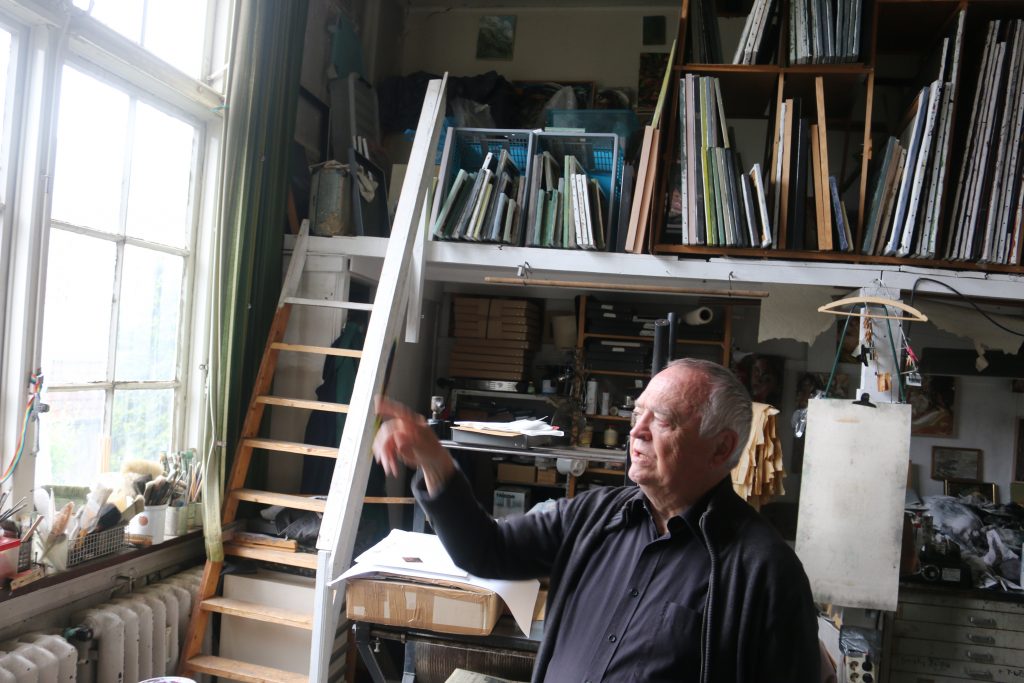
Burhardt Söll self portrait
In the seventies Söll took part in a research project on children’s aesthetics. He developed a teaching strategy combining music composition with painting. In 1985 he was appointed as a teacher at the Utrecht School of the Arts. His paintings were exhibited in Berlin, Frankfurt, Paris, The Hague, and other places.
Söll has known Janusz Korczak and his books since his early childhood. Krol Macius I (King Matt the First) is still his favourite book. The life of the old doctor has always fascinated him: someone who put his life at the service of (orphan) children and remained faithful to his own ideals until death.
Reinhart Büttner’s designs for black and misshapen children furniture inspired Söll to write his piece of musical theatre. Ach und Requiem was performed only once in 1995, but luckily a recording exists. It is a shame the textbook, with a Jewish child playing the violin on its cover, is almost illegible. The letters are too small, and the colour combination (dark brown and light blue) makes it even harder to read.
Burkhardt Söll Kinderdinge Music for Korczak and his children Djoke Winkler Prins (soprano), Mary Oliver (viola), Alison McRae (cello), Huub van de Velde (double-bass), Jörgen van Rijen (trombone),Wilbert Grootenboer (percussion), Dil Engelhard (flute), Jan Jansen (clarinet), Henri Bok (saxophone) Conductor: Peter Stamm BVHAAST CD 9703
Don’t be alarmed! It is not a rather weird performance of – or a variation on – Beethoven’s fifth symphony but the beginning of Zemlinsky’s 1934 Sinfonietta, a work in which the composer is barely recognizable. I read somewhere that he wanted to prove to his greatest critics that, in the symphonic genre, he was not inferior to the three big Bs: Beethoven, Brahms and Bruckner.
Zemlinsky’s Sinfonietta played Gürzenich-Orchester Köln/ James Conlon
Total nonsense, of course, because his greatest appeal greatly depends on his very own idiom: a sultry, barely-there erotic tension. And the Sinfonietta lacks, precisely, those essential elements. I had not heard the work before and I don’t think I will often listen to it again, but that is not down to the excellent performance: Finnish conductor Susanna Mälkki clearly has an affinity with it.
Unfortunately, the performance of the “Sechs Maeterlinck Gesänge” is not on the same level. This is mainly because of Petra Lang. I have never been a big fan of hers but here she sounds, how shall I put it… anything but erotic? Too bad.
And for ˜dessert” we get the prelude and monologue from the third act of ” König Kandaules”, an opera Zemlinsky never finished. The monologue is very impressively sung by Siegfried Lorenz and the orchestra conducted by Gerd Albrecht, who died in 2014, sounds simply heavenly. The recording dates from 1992.
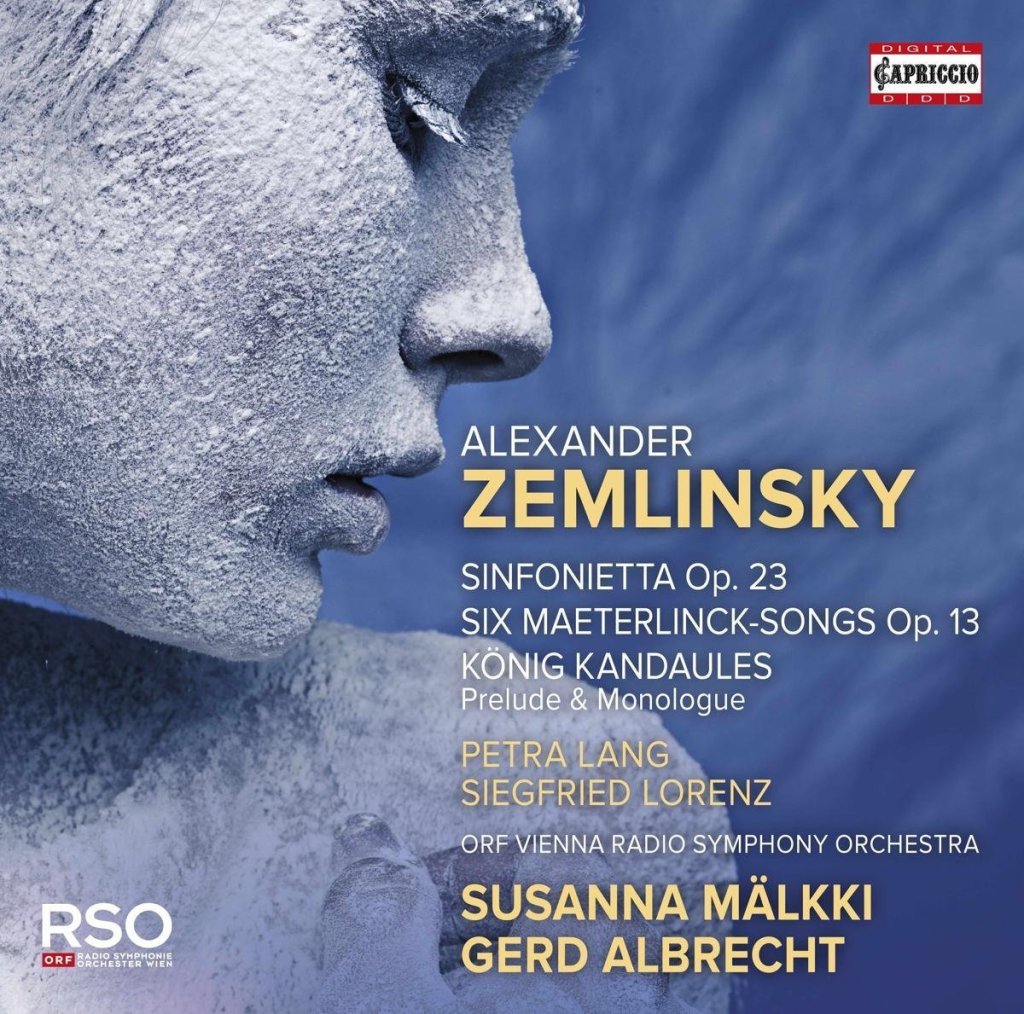
Alexander Zemlinsky Sinfonietta, op. 23, Six Maeterlinck-Songs Op. 13 Petra Lang (soprano) ORF Vienna Radio Symphony Orchestra olv Susanna Mälkki
Der König Kandaules (two excerpts) Siegfried Lorenz (baritone), ORF Vienna Radio Symphony Orchestra conducted by Gerd Albrecht
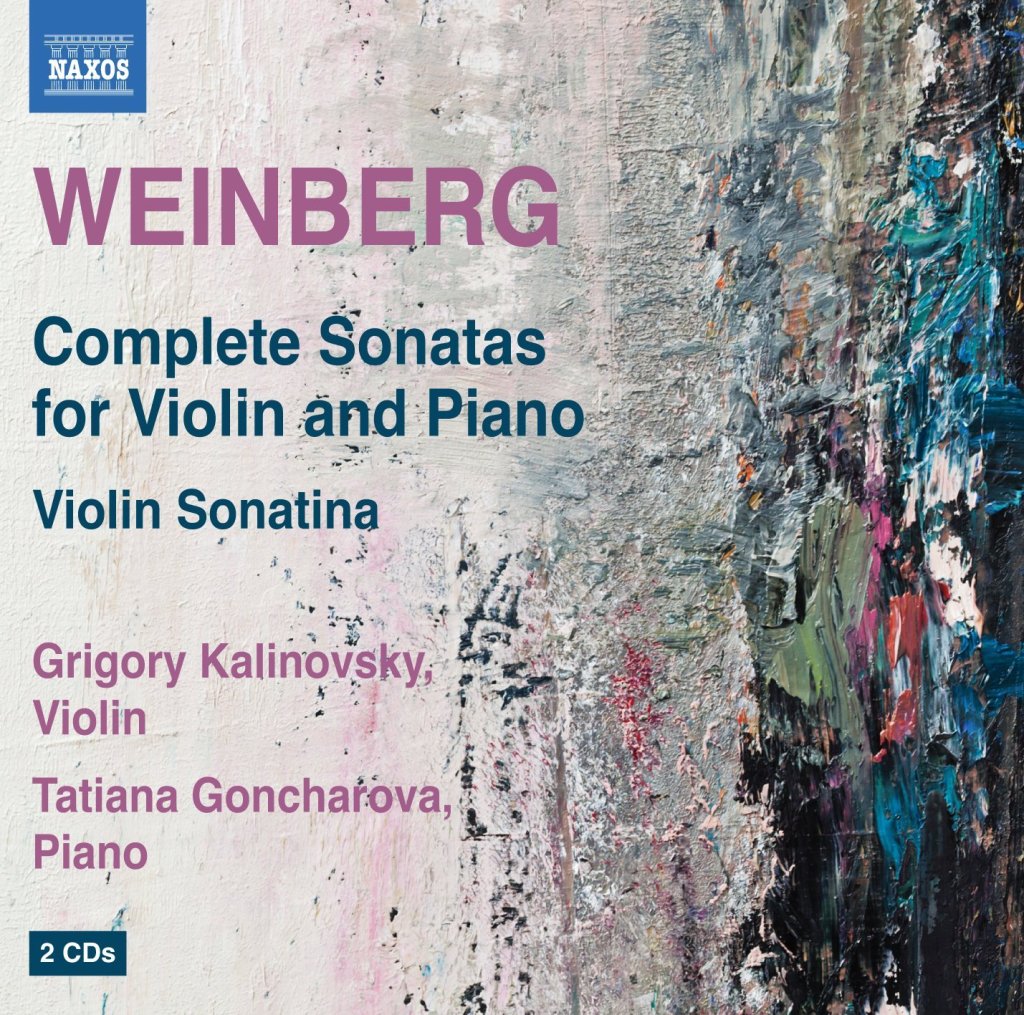
I know the risk of my umpteenth ultimate praise for a ‘new Weinberg’, but believe me: I have no choice.
Not that I didn’t have my doubts. Especially on the first time listening; I had a bit of trouble with the violinist, because to say that his violin really sings… well, no.
I found his playing too fierce, too straightforward . . violent at times. The singing came mainly from the piano, at least it seemed so at first, because the more I listened to the CDs the more layers I discovered in the renditions of – both – soloists.
Just take the moving Lento in the second sonata, here time stood still for a moment. This also because the work reminded me most of film music. Black-and-white images from ‘The Cranes are Flying’ automatically loomed before my eyes. It is one of the most moving films ever, for which Weinberg composed music.
And what a difference with the Lento from the 1947 third sonata! Here you can already see Shostakovich lurking around the corner, smiling approvingly. And here it was that I finally heard Kalinovsky sing on his violin as I was, again, marvelling at Goncharova’s beautiful touch.
The first four sonatas were created between 1943 and 1947 and, despite the major Shostakovich influences, they are rather conservative in nature. Especially number four, for me, the least interesting of these first four pieces: despite the passionate plea of both soloists, I noticed that somewhere along the way my attention had waned.
Only in the fifth sonata from 1953 does the true genius Weinberg reappear: it was the first composition that he completed after being released from prison. Listen to the Allegro moderato in which he manages to forge totally different themes into one whole.
His sixth sonata is a bit of an odd one out. Weinberg composed it in 1982; it was not premiered until 2007, eleven years after his death.
How many opera lovers know Lalo’s Le Roy d’Ys? I think few have even heard of it, let alone ever had the chance to see the opera. It is totally forgotten.
How unjustified that is, is proven by the performance recorded by Dynamic (33592) in Liège in April 2008. Le Rois d’Ys is a very melodious opera with many choral parts and duets, and the music is romantic and compelling.
The libretto is simple: the daughters of the king of Ys (an ocean-threatened city) love the same man. When he chooses Rozenn, Margared takes revenge. Together with Karnac (enemy of the city and of the king), she opens the floodgates, resulting in a flood. But Margared is consumed by guilt and sacrifices herself by jumping into the swirling waters. The city and its inhabitants are saved.
The staging is simple and realistic. The flood is depicted as a huge rainstorm. Not really threatening, but then again, all of us probably possess a healthy dose of imagination.
The cast is good to very good. Gylaine Girard is a fantastic, poised Rozenn. Her very flexible soprano has a particularly pleasant timbre. This is in rather sharp contrast to the mezzo Giuseppina Piunti (Margared), who is almost screeching at times. But she is so committed to the role that I soon forgive her.
We know Sébastien Guéze (Mylio) – among others – from his fantastic rendition of Romeo at the Saturday Matinee in 2008. He has a pleasant, light tenor with an unmistakable French touch, and his interpretation is really right for the role. Werner van Mechelen is a very good Karnac. Recommended!
Sébastien Guéze in the same production but from Opera St.Etienne :
Onegin, unlike don Giovanni, is not a colourful character. He is a rather dull, bored brat, for whom even hitting on a woman is too much trouble. Through an inheritance he has become a rich man and as such has access to the”high society”, but everything bores him and in fact he does not know himself what it is he really wants.
He dresses according to the latest fashion, the only question is whether he does it because he likes nice clothes, or because that’s the way things are supposed to be. Because he does know how things should be done.
He also shows hardly any character development over the whole course of the opera. He kills his best friend after flirting with his lover – not because he really wants to, but to teach him (and the, in his eyes horrid, countrybumpkins) a lesson – and even that leaves him unmoved. Only at the end does he “wake up” and something of a feeling enters his mind. But is it real?
Not really someone you can dedicate an entire opera to, which is why for many people the real protagonist is not Onjegin but Tatyana. If Tchaikovsky had really wanted it that way he might have named the opera “Tatyana”, but that she is a much more captivating character than the man of her dreams, is beyond any doubt.
CDs
SERGEY LEMESHEV:
One says Tatyana, one thinks Galina Vishnevskaya. The Russian soprano has created a benchmark for the role that few singers can yet match. In 1955, she recorded the role, along with all the Bolshoi greats of the time.
Her “letter scene” is perhaps the most beautiful ever, but the recording has even more to offer: how about Sergei Lemeshev as Lensky? Fingerlicking good!
Sergey Lemeshev as Lensky (his great aria & duel scene)
Valentina Petrova is a peerless Larina, unfortunately the title hero himself (Evgeny Belov) is a bit colourless. (Melodiya 1170902)
FRITZ WUNDERLICH:
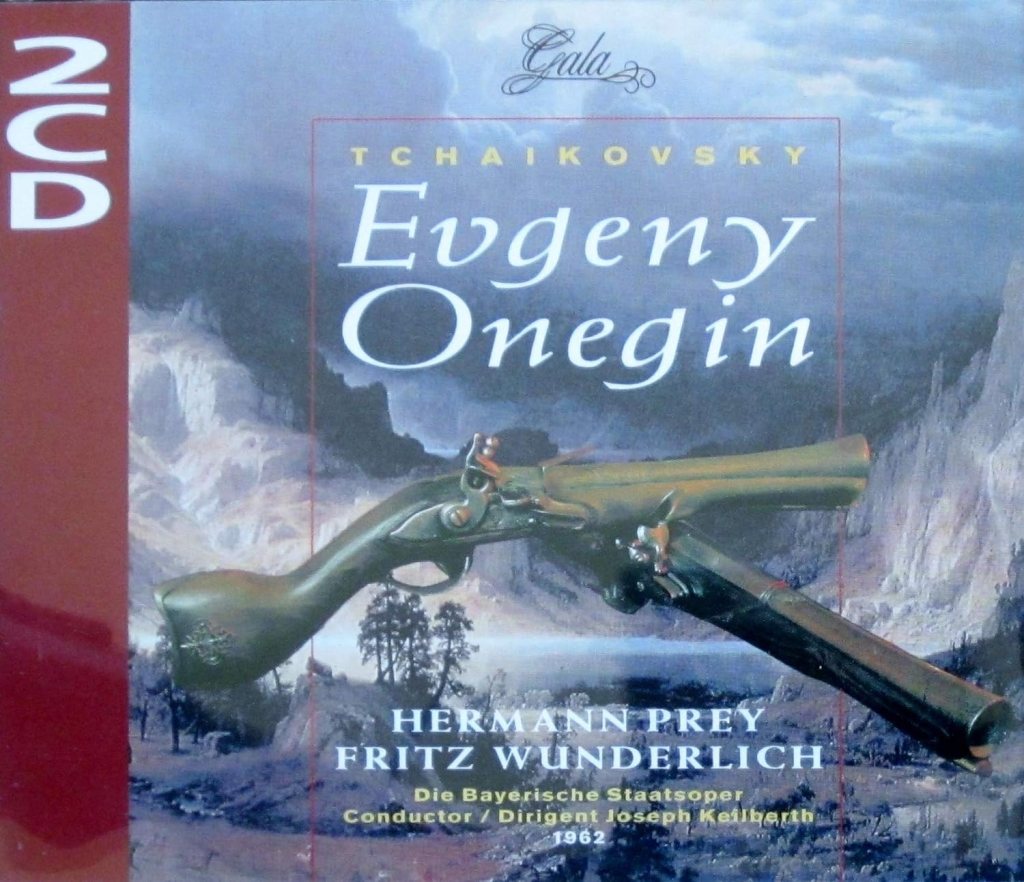
In 1962, the opera was recorded live in Munich (Gala GL 100.520).
Ingebort Bremmert is too light for Tatyana, she also sounds rather sharp, but Brigitte Fassbaender makes up for a lot as Olga. But for a change, the ladies do not make the greatest impact, you buy it, of course, for the men: Hermann Prey and Fritz Wunderlich.
Prey is a very charming, gallant Onjegin, actually more like a brother than a lover, but the voice is so divinely beautiful! And about Wunderlich’s Lensky I can be very brief: ‘wunderbar’! By the way, it strikes me once again how similar Piotr Beczala sounds to him!
There is a lot of stage noise and the sound is dull with far too many bass sounds. And of course it is in German, but yes, that’s how it was done in those days. But it is a matchless document and, especially because of both singers, actually a must-see.
Duel scene from the recording (with picture!):
BERND WEIKL:
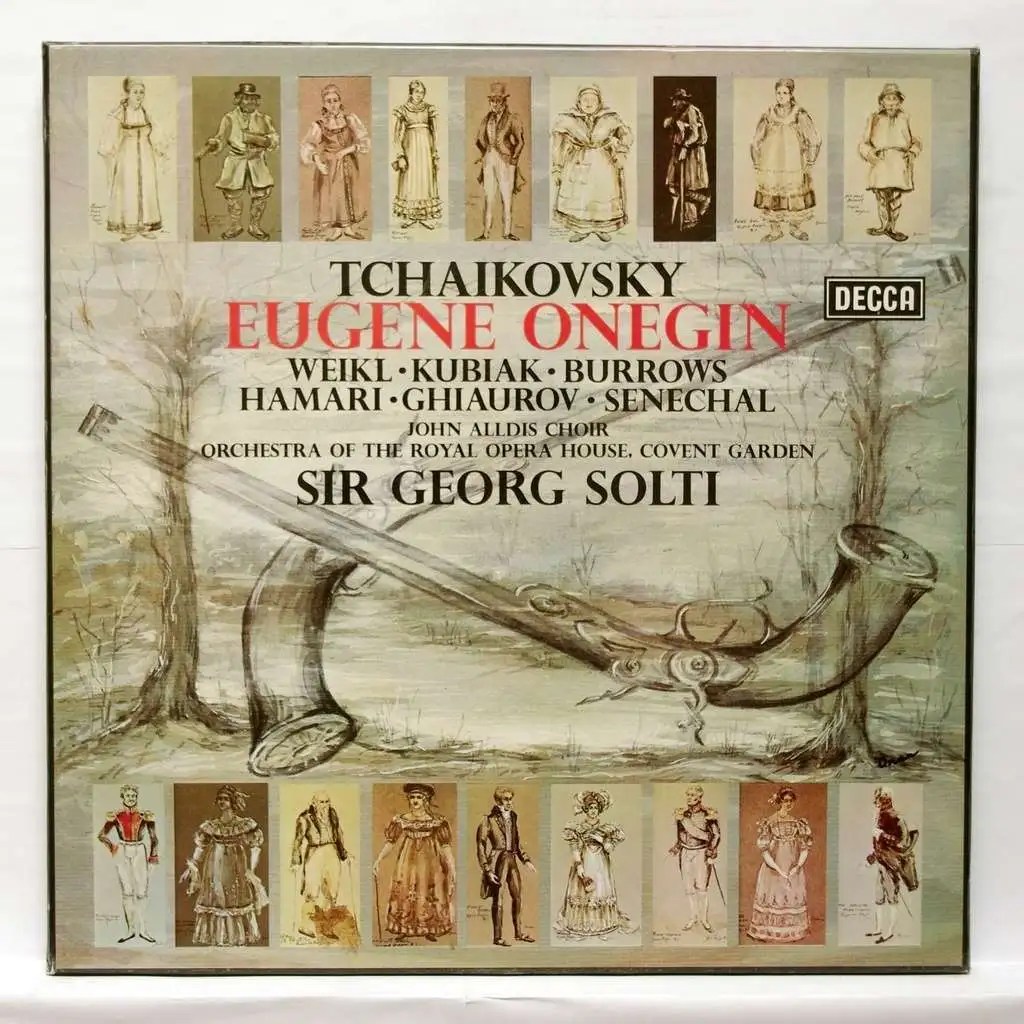
In 1974, Georg Solti recorded the opera for Decca(4174132) and that reading is still considered one of the best. In Stuart Burrows he had at his disposal the best Lensky after Wunderlich and before Beczala, and Teresa Kubiak was the very personification of Tatyana. Young, innocent, with a touch of elation at the beginning of the opera, but resigned at the end.
Under his direction, the orchestra (Orchestra of the Royal Opera House) flourished like the cornflowers in the Russian fields, making it clear why the composer considered his opus magnus to be “lyrical scenes” and not opera.
Bernd Weikl is a very seductive Onjegin, his very spicy baritone particularly sexy. Nicolai Ghiaurov is of course legendary in his role of Gremin and for me Michel Sénéchal is perhaps the best Triquet ever. Enid Hartle deserves to be especially mentioned as Filipyevna.
THOMAS ALLEN:
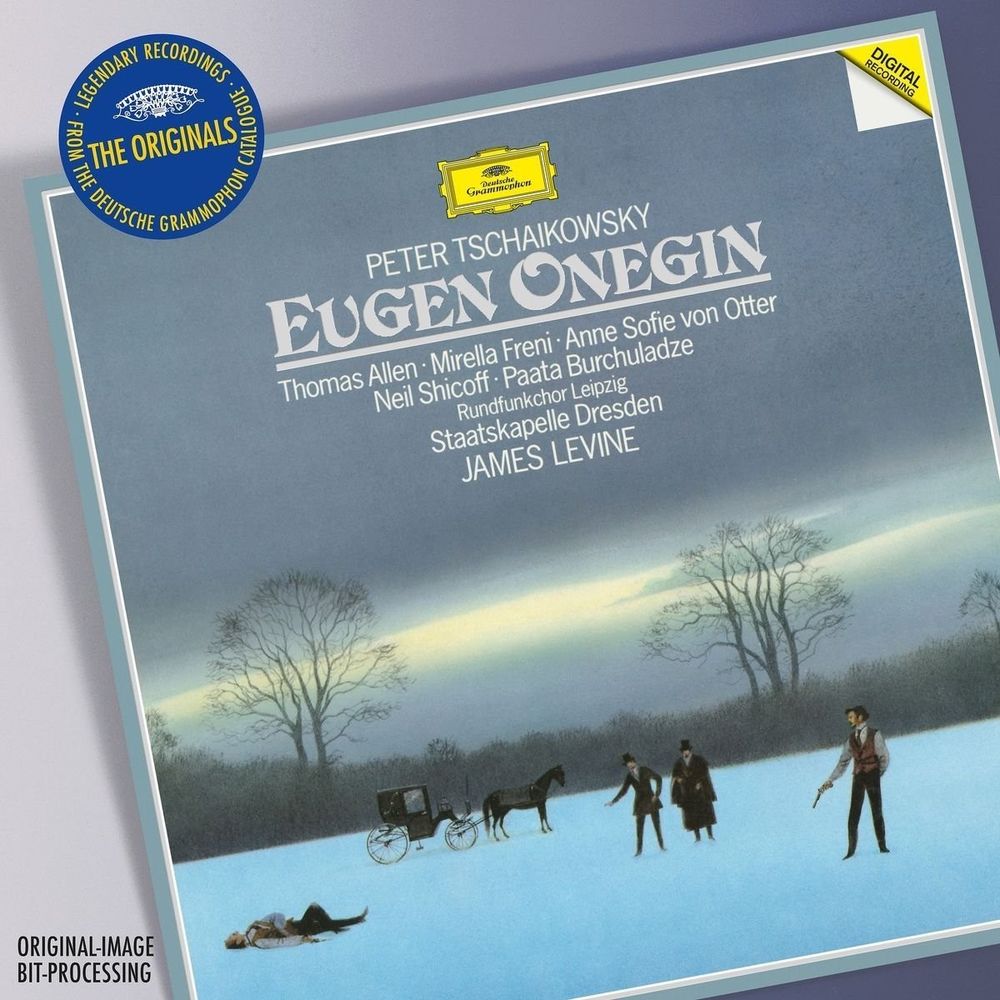
I want to dwell for a moment on Onjegin by Sir Thomas Allen. He has sung the role several times: both in Russian and in English. In 1988, he recorded it for DG (423 95923). Tatyana was sung by Mirella Freni – in the autumn of her career it became one of her showpieces. She is therefore more convincing as the older Tatyana than as the young girl, but there is nothing to criticise about her interpretation.
Neil Shicoff, then a splendid lyricist, was a very idiomatic Lensky, but Anne Sophie von Otter was only moderately convincing as Olga. Under James Levine, the Staatskapelle Dresden produced an unexpectedly lyrical sound, with lovely long arcs, but not devoid of a healthy sense of drama.
Anyway: it’s mainly about Thomas Allen. His reading of the title hero is particularly exciting and dramatically well grounded; it is truly fascinating to hear how Onjegin’s condescension in I turns into a shimmering passion in III. A vocal artist, no less.
It is also very interesting to see how he coaches young people at an ‘Onjegin master class’ (among his “students” is James Rutherford, among others)
DVDs
VLADIMIR REDKIN
Boris Pokrovsky is a living legend. For decades, from 1943 to 1982, he was opera director of the Bolshoi Theatre in Moscow. Even in the Netherlands, he is not unknown: in 1996, he was ‘visiting’ us with his new company, the Moscow Chamber Opera, with “Life with an Idiot” by Alfred Schnittke.
His production of Onjegin, recorded for TV at the Bolshoi in Moscow in 2000(Arthaus Musik 107 213) originally dates from 1944. It is, of course, a classic, complete with all the trimmings. Sumptuous costumes, true-to-life sets, everything as it ‘should’ be.
As soon as the stage curtain opens, the first ‘open curtain’ is a fact. People love it. And they are right: it is indeed so very beautiful! Of course, you don’t get to see it like that anymore. Think Zeffirelli, but really authentic, without a single liberty being taken. You have to have seen it at least once, just to know how it was originally intended.
The unknown singers are all just fine, but the close-ups are a bit laughable. Of course, it is not a production to be shown on TV, you have to actually see it in the opera house. There is no chance of that, though: Boris Pokrovsky’s production has been replaced by a new production by Dmitri Tcherniakov after more than 60 years of faithful service. Buy the DVD and muse on the ‘good old days’, because they really aren’t coming back.
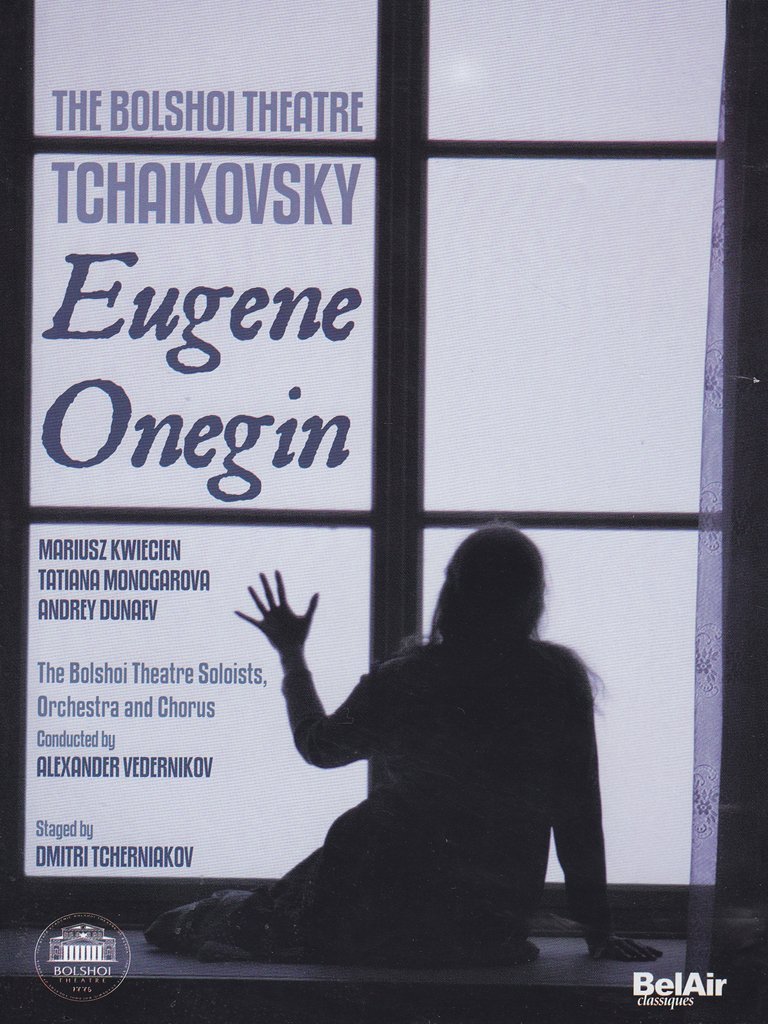
I started on Dmitri Tcherniakov’s production(Bel Air BAC046) with a huge dose of scepticism. His decision to replace Boris Pokrovsky’s old legendary production was very brave, because Muscovites (and not only Muscovites) were so very attached to it. Besides: you have to be really sure of yourself to dare to replace a LEGEND. On top of that, from the entire cast – apart from Kocherga and Kwiecien – I did not know any of the performers.
I quickly changed my mind, because from the start I was on the edge of my seat. The staging, costumes, stage design, sets and props – everything is right, even if it is not as it is in a typical ‘Onegin’. The entire first and second acts take place in the same space: the dining room in Larina’s house, with a long table and chairs prominently displayed. The same table and chairs also recur in III, but in a much richer ambience.
It is incredibly difficult to explain the whole directorial concept in a few words, you have to believe me that it is extremely fascinating and extremely exciting. Very intelligent too.
Tatyana is portrayed by Tatiana Monogarova in a very convincing way. She is pale, thin and slightly autistic, locked in her own mind. The outside world scares her as she tries to hide from it.
Olga(Margerita Mamsirova) is just a flirt and from the start she challenged Onegin. She is more than a little tired of her poet- boyfriend’s sighs. and she is not wrong!
Lensky is sung by a good, though not exeptional, Andrey Dunaev. He is a bit stupid, pushy and jealous and thus the real instigator of all evil happenings.
Larina (an insanely good singing and acting Makvala Kasrashvili) also gets more attention than usual. The moment when, thinking back to her childhood, she downs a drink and has a little cry is very touching. But she soon recovers and everything stays the same.
Mariusz Kwiecien (Onegin) is indeed irresistible. Or let me rephrase it: he portrays such a very bored and self-important arsehole (sorry for the word!). And he actually stays that way until the end. Utterly convincing!
Frantically he tries to belong to the ‘high society’, where he is not really accepted. Even his sudden passionate love for Tatyana feels unreal. On his knees, he offers her a bunch of red roses and when she refuses to run away with him, he tries to rape her.
Dignified, Tatyana walks off the stage on her husband’s arm on which Onjegin pulls out a pistol, but we are spared the suicide, because, of course!, without witnesses by his standards there is no use for it..
Trailer:
DMITRY HVOROSTOVSKY
And then there is Robert Carsen’s production for the Metropolitan Opera, recorded in February 2007(Decca 0743298). I am a huge Carsen-adept and love almost everything he does. So too this Onjegin
His staging is very realistic and he follows the libretto accurately. In the first act, the stage is strewn with autumn leaves, but everything else is basically bare and there is almost no scenery. A bed for the ‘letter scene’, otherwise some chairs in the second and third acts. At the duel, the stage is completely empty.
It is not distracting. On the contrary. The costumes are really beautiful, but especially in the first act they remind me more of English Jane Austen film adaptations than of the Russian countryside. It is not really disturbing, the eye wants something too, but Renée Fleming is too glamorous for a peasant trio, making her switch to a proud princess less impressive.
Onjegin (Dmitri Hvorostovsky) is mainly a dandy here, very concerned with his, good, looks. Well, Dima is an extremely attractive singer in all aspects, but in his confrontation scene with Tatyana, he is more reminiscent of daddy Germont than of Onjegin.
Ramón Vargas is one of the best lyric tenors in 2007, but Lensky he is not! He really does his best, he also looks like a real poet, but this role needs to be a bit more languorous.
As usual, Carsen’s character direction is truly unsurpassed and even Fleming seems to thaw out at times. Unfortunately, her Russian is totally unintelligible.
Fleming and Hvorostovsky in the final scene of the opera:
I am not going to bore you with a detailed explanation of the various versions of Boris Godunov – two of them by Mussorgsky himself. Enough has already been written about it and if you want to know more, you can find some on the internet. Besides: really getting sidetracked by this doesn’t work, I’m afraid. Hence I judge these few selectively chosen recordings purely on performance (and direction).
ANDREI TARKOVSKY
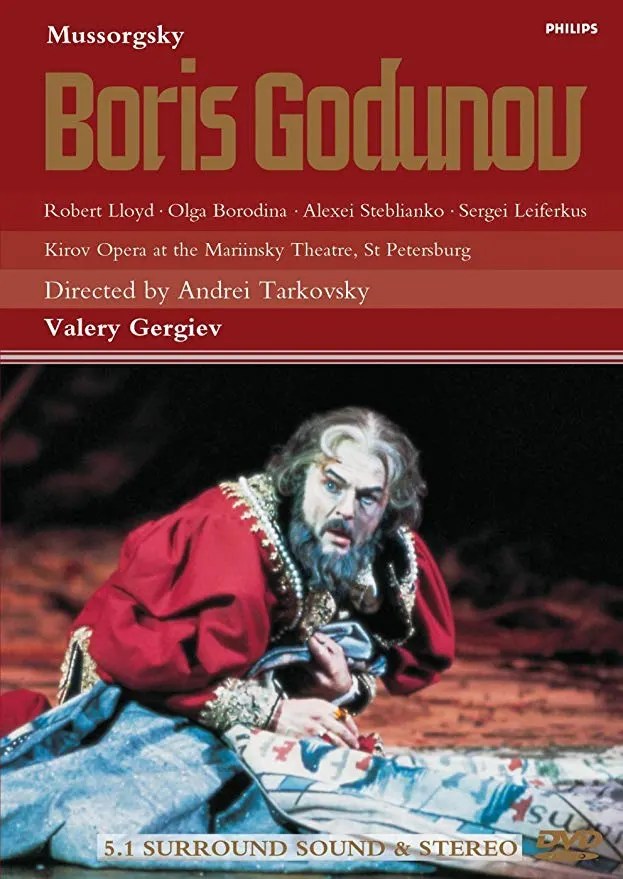
In 1983, Andrei Tarkovsky staged ‘Boris Godunov’ for Covent Garden. It was his first opera direction and also his last. Something very regrettable because his vision of Mussorgsky’s magnum opus is truly breathtaking.
The staging exudes the same style so characteristic of all his films: visionary and poetic. The whole shows itself as a colourful film with lots of Christian symbolism, images in slow motion and an enormous attention to every detail. In 1990, the production was taken on by the Mariinsky theatre and broadcast live on English television, a first at the time.
The lead role was also performed in London by the English bass, Robert Lloyd, and his interpretation is among the most impressive I have ever seen in my life. His voice was still truly great then, both in volume and timbre, and in his acting he was not inferior to the best stage actor. In the process, he managed to hold his own excellently among the otherwise exclusively Russian cast.
About the cast by the way, which apart from Lloyd includes (among others) Olga Borodina, Alexei Steblianko and Sergei Leiferkus. Nothing but praise, by the way. Valery Gergiev has the opera at his fingertips. An absolute must. (Philips 0750899)
WILLY DECKER
Filmed in Barcelona in 2004, Willy Decker’s production had already been presented in Amsterdam in 2001. The direction is heavily centred around the protagonist: for Decker, the drama is psychological rather than historical. The setting betrays Russia of the early 20th century, just before the revolution, and the scenery is very minimalist.
The chairs and tiny houses, Decker’s trademark are obviously present, a giant seat dominates the mise-en-scéne from the start. It makes for some very nice scenes – the ascent to the throne, for instance.
Eric Halfvarson is a bit of a weak Pimen, but the rest of the cast, with Matti Salminen (Boris), Anatoli Kotscherga (Varlaam) and Philip Langridge (Shuisky) leading the way is truly outstanding.
And then there’s Fyodor sung by the unforgettable Brian Asawa, who left us far too soon.
Alex Grigoriev deserves special mention for his superb performance in the role of Yuriodivy. (Arthaus Musik 107 237)
CALIXTO BIEITO
Sometimes I suspect that opera directors imagine themselves to be some kind of modern-day dictator, trying to force their own opinions down our throats. And if we don’t want to swallow it then we are mistaken for stupid.
That the abuse of power is a product of all times is clear; even toddlers know that these days. The news, whether we want it or not, invades our households and there is no shortage of images – on Youtube or otherwise. So I don’t think we need a director to tell us yet again that Putin or Blair (?) is the new Godunov, with the gory images included, otherwise the opera won’t do any more.
If I want to watch Boris Godunov by Mussorgsky, I don’t expect Putin and I don’t expect Pussy Riot. I expect the boyars, the monks, the ‘Old Believers’ and the church bells of St Petersburg. I can make the link to the present myself.
You get the point: Calixto Bieito’s Boris Godunov (Munich 2013) just cannot charm me, and I am putting that mildly here.
I prefer Willy Decker’s production, which was also shown in Amsterdam. It also had better singing.(BelAir BAC102)he role of Yuriodivy. (Arthaus Musik 107 237)
FILM
‘Boris’ was filmed in Russian studios in 1954. It was directed by Vera Stroyeva, a grand lady of Soviet cinema, who captured the opera in the best social-realist (think Eisenstein!) traditions.
It is a mix of all versions with many cuts but it doesn’t matter: you must have seen it at least once. Just for the atmosphere the film exudes, which really brings you frighteningly close to the story.
And it features insanely good singing by the likes of Alexander Pirogov, Georgi Nelepp and Ivan Kozlovsky, the then stars of the Bolshoi. Legendary (VAI 4253).
Boris’ death scene
CDS
Martti Talvela
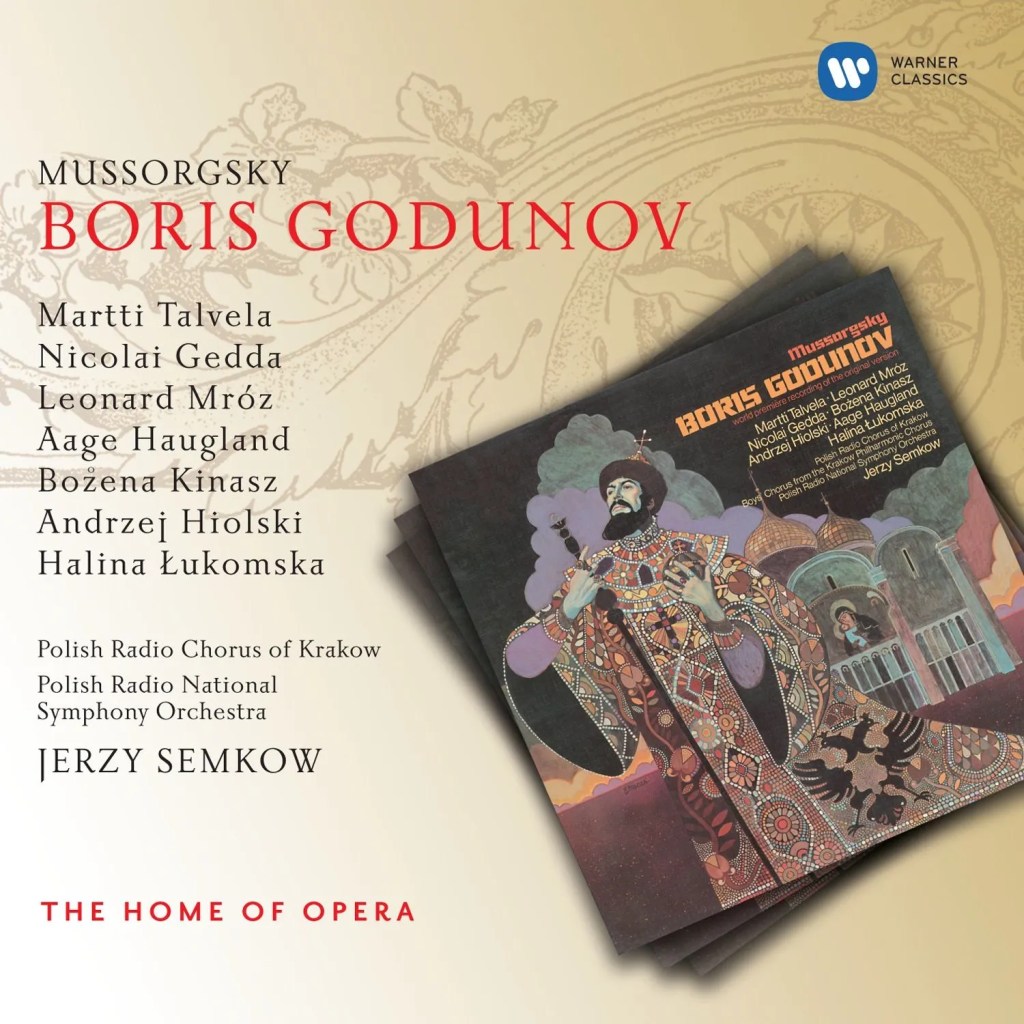
The first ever recording of Mussorgsky’s original score, (the revised version from 1872) was made in 1976. Anyone familiar with Rimsky-Korsakov’s polished arrangement(s) (which at the time was most of us) was in for a shock by the rough-hewn sounds. But once you adjust to the shock, you could not help but give in. Less beautiful, though it may be, it fits the story much better.
The all-Polish cast, except Martti Talvela (Boris), Aage Haugland (Varlaam) en Nicolai Gedda (Grigori/Dimitri) is more than up to the job, but not quite thrilling under the direction of Jerzy Semkow.
Boris Christoff
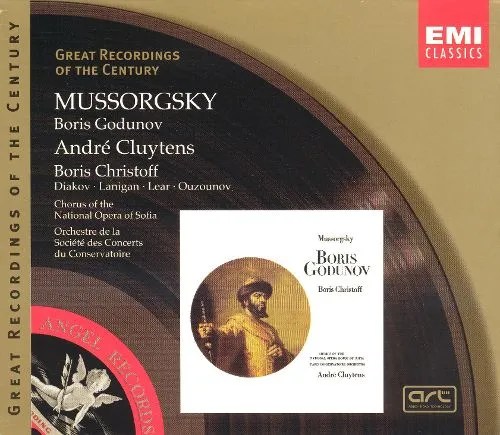
We cannot ignore Boris Christoff, one of the all-time great Borises. He has recorded the role several times, of which the performance under André Cluytens is dearest to me.
Here, apart from Boris, he also sings Pimen and Varlaam, which is a bit confusing at times, but gives him the opportunity to showcase different possibilities of his fantastic bass. The version is of course by Rimsky-Korsakov, and the 1962 recording still sounds fine. (once EMI 5678772)
Speaking of Boris Christoff, not long ago the budget label Andromeda reissued a 3-CD box set of all the songs of Mussorgsky he sang. The recordings, with both piano and orchestral accompaniment were made in 1951, 1955, 1957 respectively. Unfortunately no lyrics, nor any liner notes. (ANDRCD 5098)
Lady Macbeth of Mtsensk illustration by B.M. Kustodiyev
It was supposed to be a four-part opera, an operatic tetralogy dedicated to the position of women in Russia in different eras.
A Soviet Russian Ring des Nibelungen, of which part one, `Lady Macbeth of Mtsensk’ would be a kind of Rheingold. But alas, it was not to be. Though initially no one could have suspected any impending doom.
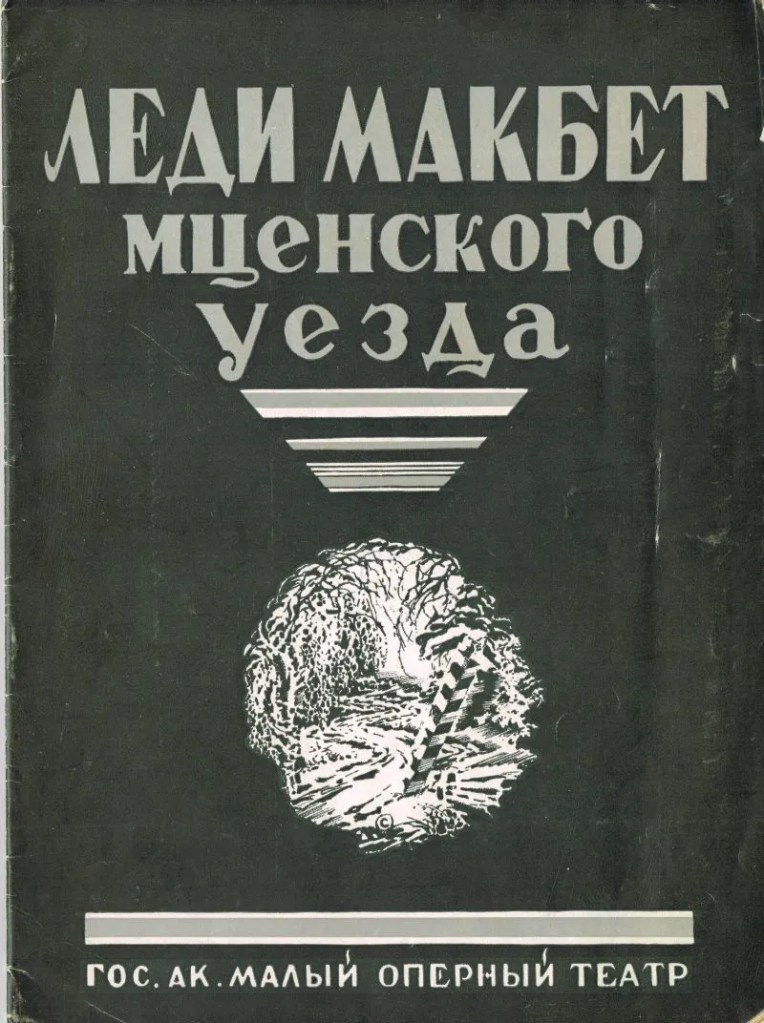
Premiere poster 1934 QED Art and press from the USSR and Central Europe
The premiere on 22 January 1934 at the Maly Theatre in Leningrad was a tremendous success, and for two years the opera was performed several times a week both in Leningrad and Moscow. The opera was also very succesful abroad: after Cleveland the New York City Opera followed , and then Stockholm, Prague and Zurich.
Until Stalin attended a performance in January 1936 and left early. The next day, an article appeared in Pravda under the headline ‘Chaos instead of music’.
It was signed by a certain Zaslavsky, but according to Shostakovich, it was written by Stalin himself. The opera was immediately dropped from the programmes and the composer was labelled an ‘enemy of the people’.
After Stalin’s death, Shostakovich revised his opera, and under a new title, Katerina Ismailova, it was first performed in Moscow in 1963. Prague and Zurich.
Shostakovich loved his heroine. To Solomon Volkov, he confessed: “Although Yekaterina Lvovna is a murderess, she is not yet lost as a human being. Her conscience torments her, she keeps thinking about the people she killed. I have sympathy for her. […] I wanted to show a woman who morally stands much higher than all the people around her. Because around Yekaterina there are only villains. She lives like in a prison and this is how she has been suffering for five years.”
“Her life is sad and uninteresting. But then comes love, a great passion. And it turns out that this passion is worth a crime to her. After all, it doesn’t matter, since otherwise life makes has no meaning to her.” (From Testimony. Memoirs of Dimitri Shostakovich.)
The opera, about the tragic fate of Katerina, who after marrying a rich merchant ends up in a kind of prison, from which she believes she can escape through her passionate love for Sergei and then ends her life in an icy river in Siberia, is a mix of tragedy and satire, seriousness and humour, lyrical melodies and – yes, indeed – chaos.
With a dizzying pace, the atmosphere changes from touching melancholy (Katja’s lament ‘Zherebyonok k kob’lke toropotsa’) to sexually charged (seduction scene), to end in actually pornographic sounds – Shostakovich has succeeded in describing ‘the deed’ through music in detail.
The premiere on 22 January 1934 at the Maly Theatre in Leningrad was a tremendous success, and for two years the opera was performed several times a week both in Leningrad and Moscow. The opera was also very succesful abroad: after Cleveland the New York City Opera followed , and then Stockholm, Prague and Zurich.
Until Stalin attended a performance in January 1936 and left early. The next day, an article appeared in Pravda under the headline ‘Chaos instead of music’.
It was signed by a certain Zaslavsky, but according to Shostakovich, it was written by Stalin himself. The opera was immediately dropped from the programmes and the composer was labelled an ‘enemy of the people’. After Stalin’s death, Shostakovich revised his opera, and under a new title, Katerina Ismailova, it was first performed in Moscow in 1963. Prague and Zurich.
Shostakovich loved his heroine. To Solomon Volkov, he confessed: “Although Yekaterina Lvovna is a murderess, she is not yet lost as a human being. Her conscience torments her, she keeps thinking about the people she killed. I have sympathy for her. […] I wanted to show a woman who morally stands much higher than all the people around her. Because around Yekaterina there are only villains. She lives like in a prison and this is how she has been suffering for five years.”
“Her life is sad and uninteresting. But then comes love, a great passion. And it turns out that this passion is worth a crime to her. After all, it doesn’t matter, since otherwise life makes has no meaning to her.” (From Testimony. Memoirs of Dimitri Shostakovich.)
The opera, about the tragic fate of Katerina, who after marrying a rich merchant ends up in a kind of prison, from which she believes she can escape through her passionate love for Sergei and then ends her life in an icy river in Siberia, is a mix of tragedy and satire, seriousness and humour, lyrical melodies and – yes, indeed – chaos.
With a dizzying pace, the atmosphere changes from touching melancholy (Katja’s lament ‘Zherebyonok k kob’lke toropotsa’) to sexually charged (seduction scene), to end in actually pornographic sounds – Shostakovich has succeeded in describing ‘the deed’ through music in detail.
GALINA VISHNEVSKAYA, 1978
Shortly after the composer’s death, his friend, the cellist and conductor Mstislav Rostropovich, found the original score of Lady Macbeth. In 1978, the opera was recorded in full for the first time (Warner 0825646483204). Rostropovich conducted and the leading roles were performed by the best singers from the Russian tradition. Galina Vishnevskaya is a phenomenal Katerina. In her interpretation, you can hear her character’s full range of emotions and character developments. She is bored, in love and passionate, and her despair at the end is the very deepest.
Nicolai Gedda portrays a very attractive and masculine Sergei, and Dimiter Petkov and Werner Krenn are matched as father and son Ismailov. Robert Tear is (as always, by the way) extremely convincing in his character role as the shabby labourer and only Birgit Finnila (Sonyetka) sounds a little too old-fashioned for me.
Rostropovich conducts with an eye for all the details and emphasises the contrasts. All in all: a better CD recording is unthinkable. Not that you have a choice: the only real competitor on CD, a DG recording (4375112) with Maria Ewing and Sergei Larin conducted by Myung Whun Chung, has now been dropped.
NADINE SECUNDE, Barcelona, 2002
EMI (5997309) once released a production from Barcelona (May 2002) on DVD, which may be called convincing to say the very least. It was directed by a former actor from Norway, Stein Winge, who made a very moving, mainly personal drama of it.
The setting suits the opera’s period of origin. The stage is dominated by a giant bed, which is prominently displayed even during the first bars of the music. Above it, a window with clouds, too high to see through, and too high to escape from. Good find.
Katerina’s arioso:
The staging is quite realistic without being vulgar. The lovemaking scene is particularly beautifully portrayed. Katerina ties the endless sheets to the legs of the bed, creating a kind of sea. She and Sergei disappear under it, and the commentary is left to the music (and our own imaginations), which is very evocative.
Nadine Secunde is a fine Katerina, very believable and extremely convincing both vocally and scenically. Christoper Ventris seems born for the role of Sergei: extremely attractive and very macho, he lives up to his reputation that no woman can resist him.
The rest of the cast is also phenomenal. Most impressive to me is the veteran Yevgeny Nesterenko in the small role of the old forced labourer.
And yet I still have a side note: the end of the opera. I won’t give it away to you, but it’s different from the libretto (for the umpteenth time already). Where does the new fashion of changing an opera’s ending come from anyway?
EVA-MARIA WESTBROEK, Amsterdam, 2006
In October 2006, Eva-Maria Westbroek made her widely acclaimed debut at London’s Royal Opera House as Katerina Izmailova. It was even spoken of as ‘one of the most important debuts at Covent Garden ever’
. But we, the Dutch opera lovers, already knew it, because at the Holland Festival in June 2006, Westbroek made her debut at the Netherlands Opera in the same role, in a performance that received nothing but overenthusiastic reactions.
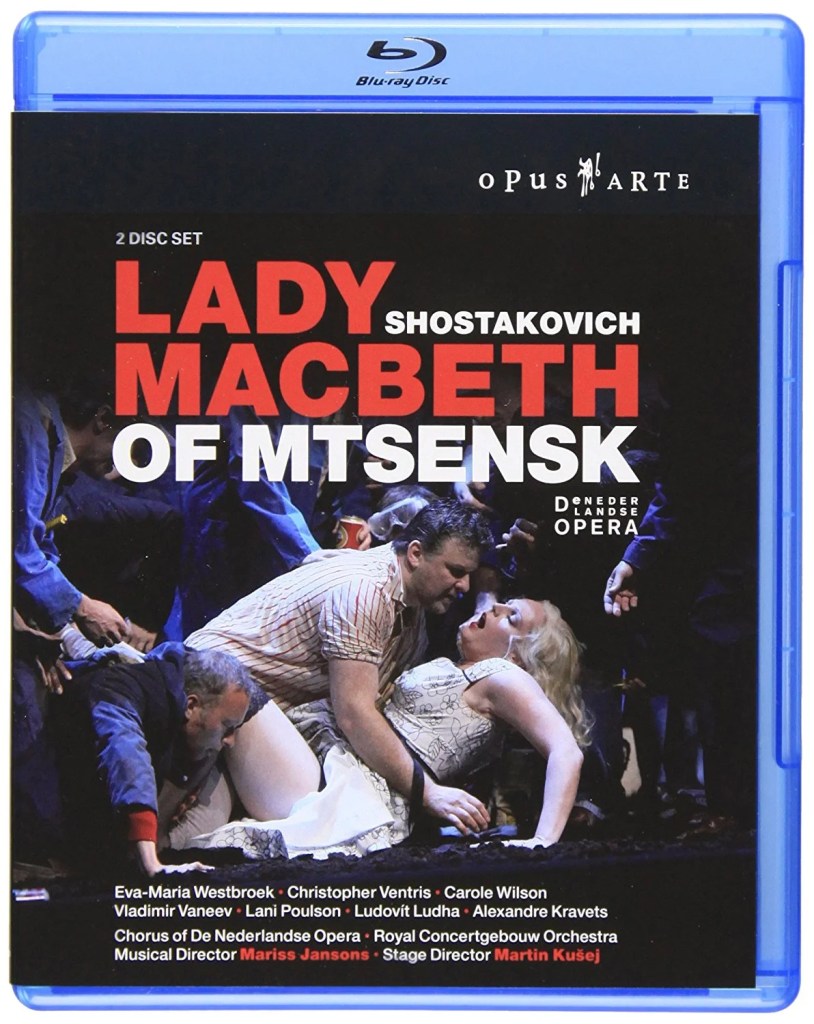
The production also saw Martin Kušej, a not uncontroversial Austrian opera director, make his debut in our country. In his concept, sexuality and power are closely linked and the opera is a terrible abyss, which can only be described with words like orgasm and manslaughter.
Katerina lives in a glass cage with a hundred pairs of shoes, guarded by dogs and surrounded by mud. Her longing for love and security is never satisfied, because what Sergei has in store for her is pure sex, devoid of any affection.
The musical mix of tragedy and satire, seriousness and humour, lyrical melodies and hard porn was perfectly portrayed scenically by KuÅ¡ej, which was only enhanced by the phenomenally playing Concertgebouw Orchestra conducted by Mariss Jansons. As a bonus, you get an extremely interesting ‘the making of’ documentary (Opus Arte OA 0965).
GLORIA LANE, Rome, 1976
To my knowledge, only one recording exists of Katerina Ismailova’s 1963 adaptation of Lady Macbeth, on the budget label Opera D’Oro (OPD 1388). It is an RAI recording of a broadcast on 29 May 1976 in Rome.
The differences from the original are noticeable right from the first bars: it is milder, without the biting irony, with more melancholy and sadness. The biggest differences are in the intermezzi. The first, for instance, has been replaced by completely different music. Even in the big seduction scene, the bulk of the music has been killed off and almost all the high notes have disappeared from Katerina’s music.
The performance, conducted by Yuri Ahronovich, is most certainly adequate, although I have trouble with William Cochran’s Sergei. It may be just me, but I experience his tenor as pinched rather than sexy. In the lead role, another one of those forgotten greats of yesteryear: Gloria Lane. Her Katerina is very dramatic and full of passion.he making of’ documentary (Opus Arte OA 0965).
Finally, the very interesting documentary Shostakovich against Stalin by Larry Weinstein was once released on Philips (Philips 0743117) with very much historical footage and even more music. The docu can also be found in its entirety on You Tube
“The” sound. That is what Schreker was obsessed and fascinated by. A sound that died off on its own, but not really, because it had to keep resounding – if only in your mind. It had to be a pure sound, but one containing orgasmic desire and it should be intertwined with visions.
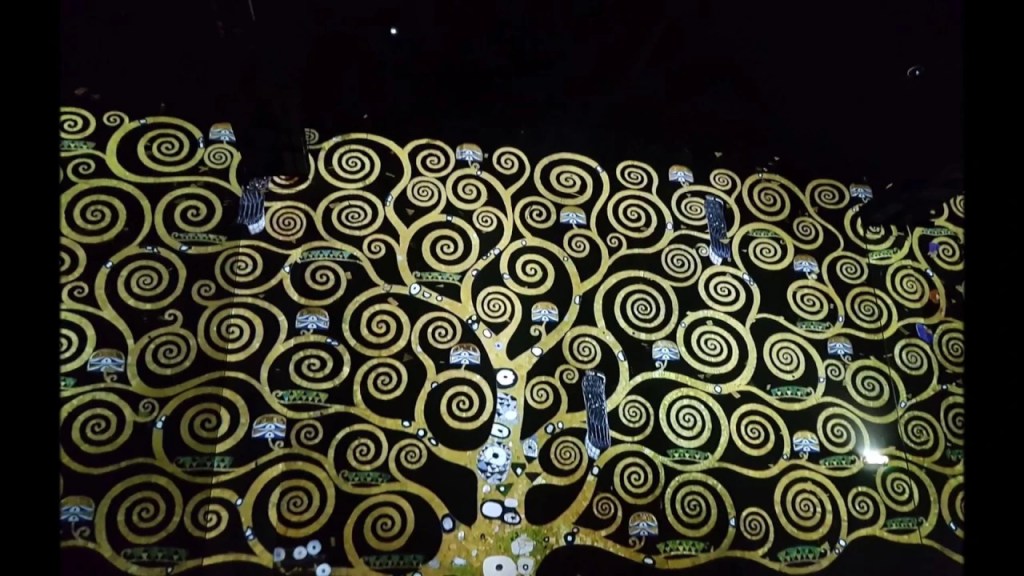
Sight & Sound Experience of Gustav Klimt – Atelier des lumières Paris
Of course, it also had to do with the spirit of that time; other artists too were experimenting with it, though perhaps not so fanatically. “The” sound, Schreker never let go of it, even when, at the end of his short life, he seemed to be going in a different direction.
This sound, which according to our chief conductor Marc Albrecht is “narcotic”, is abundant in Der Schatzgräber. It was Albrecht’s deepest wish to conduct the opera one day, a dream that came true in September 2012.
The making of Der Schatzgräber in Amsterdam:
And Albrecht is good at it, at creating the perfect sound. It still needs to be perfected, though, as the sound at the premiere was, especially at the beginning, far too loud. Fortunately, after the intermission it became more lyrical and softer, gently guiding you through the music, just like in Els’s stunning lullaby at the beginning of the third act.
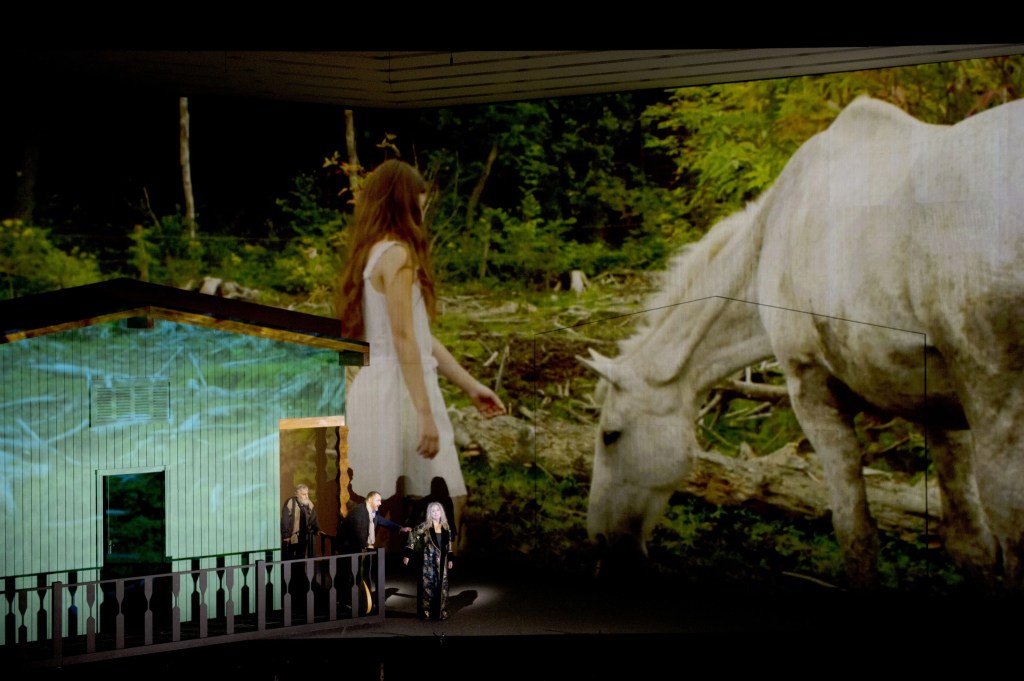
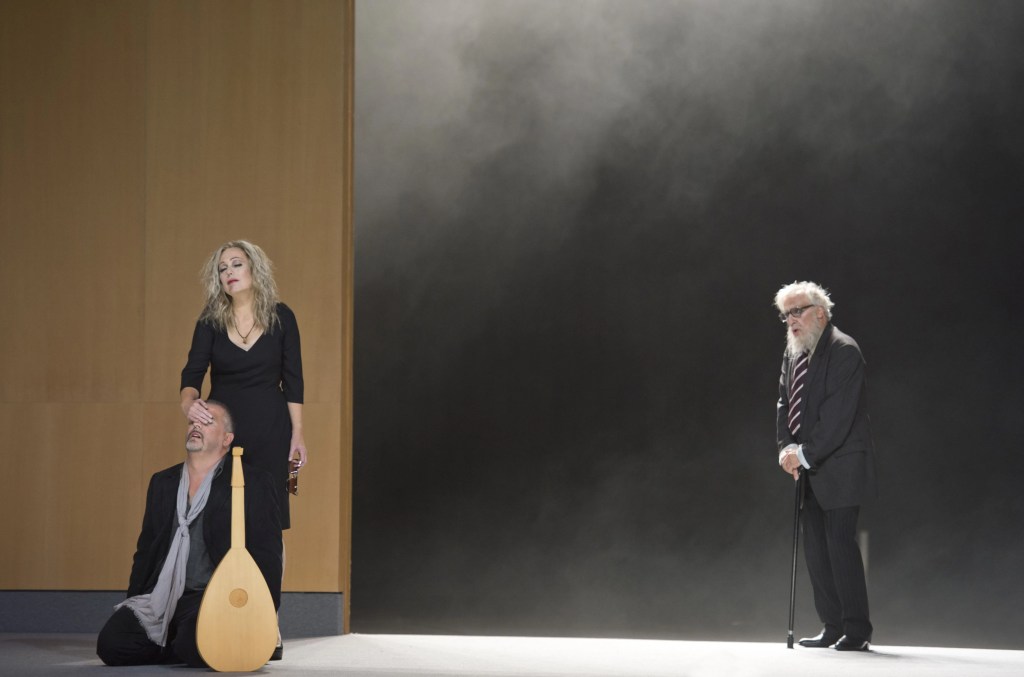
About the staging, I can be brief: it sucks. In the first two acts I was still able to somewhat relate to the neglected, aggressive cult members (?). The beautiful Els resembled Catherine Deneuve in Belle de Jour, with her blonde wig and the very high heels under her short, sexy dresses. Something that was also a bit true for the Queen (good silent role by Basja Chanowski).
But the geriatric hospital/nursing home, with stumbling old people with walkers? Sorry, that didn’t even make me reflect; I found it ugly and unnecessary. And speaking of films, I was reminded a bit of Lars von Trier’s Breaking the Waves. The ultimate sacrifice.
The video projections were too much of a good thing for me. A lot of them also didn’t add anything at all or were just too obvious (white horse, children being born or a twinkling starry sky during the love night – Kubrick’s ‘2001 Odyssey’?). It made me restless. Schreker’s music has to be experienced, then the images will come naturally.
I do have to admit that van Hove kept reasonably to the libretto, there were very few discrepancies between what you saw and what you read. What he did do is translate the medieval fairy tale into our contemporary (hyper)realism, and that is alright. In his introduction, he said he did not want to start from a concept, what he wanted was to create a universal drama.
It was a first for everyone. For the director, for the conductor and for the orchestra. And for all the, more than outstanding singers. Hats off!
First of all, the interpreter of the title role, Raymond Very. His tenor is lyrical and agile, he just throws his high notes into the air as if they are very easy to sing, and he manages not to overpower himself with the, at times, very intense music. What a relief to enjoy the long Schrekerian arcs so completely in style. You may notice that he is struggling towards the end, but try to walk in his shoes! Three times BRAVO!
Manuela Uhl (Els) was also a bit spent towards the end. But her performance before that borders on the impossible. Beautiful woman with above-average acting skills and with a voice that went from whispery-soft to bellows and from very low to very high, chapeau.
Kay Stieferman made a particularly strong impression. His baritone is of an immense size and blessed with thousands of colour nuances. He certainly needed all those for Der Vogt, because there were so many emotions in this character. He managed to convey them all clearly, even allowing you to have some sympathy for his actions. Very impressive.
About Graham Clark (the Jester), I can be short. He was exactly what was expected of him – nothing but really wonderful!
Have you ever heard of Catarina Mancini (10 November 1924 – 21 January 2011)? This soprano, born at Genzano di Roma had the true ’voce Verdiana’: she combined a beautiful height and pure coloratura with a drama that even La Divina might have envied her for.
Never heard of her? Then it’s time to make up for the damage, because I promise you a voice out of thousands. And this is exactly how her Leonora sounds in the recording from 1951 Rome (Warner Fonit 2564661890). Extraordinary.
Her Manrico was sung by the very heroic sounding (then already nearly 60 years old) Giacomo Lauri-Volpi and a very charismatic Carlo Tagliabue sang the role of di Luna. Miriam Pirazzini (Azucena) completed the cast and the whole was very impressively conducted by Fernando Previtali.
Here are Mancini, Lauri-Volpi and Tagliabue in the trio of the first act:
Highlights on Spotify:
Price and Corelli, 1961
With their 1961 performance recorded live for Sony, both Leontyne Price and Franco Corelli made their debuts at the Metropolitan Opera. For me, Corelli, alongside Del Monaco and Domingo, is the best Manrico ever. Very masculine and very sexy, you can hardly resist that as a woman.
Mario Sereni and Irene Dalis are more than adequate as Luna and Azucena respectively, and it is a great joy to discover none other than Teresa Stratas in the small role of Inez. And Charles Anthony as Ruiz should not be forgotten
Price and Domingo, 1970
The recording made 19 years later for RCA shows a more mature Price, but her sound is still that of an excited teenager, with just about the most perfect Verdian ‘morbidezza’. Her ‘D’amor sull’ali rosee’ seems like a little prayer, weeping so beautifully.
This Trovatore was the very first opera that Plácido Domingo, then 28(!), recorded in the studio. Fiorenza Cossotto shines as Azucena, but what really makes the recording indispensable, at least for me, is one of the most delightful Lunas ever: Sherrill Milnes (88883729262).
Below Price, Domingo and Milnes in ‘E deggio e posso crederlo’:
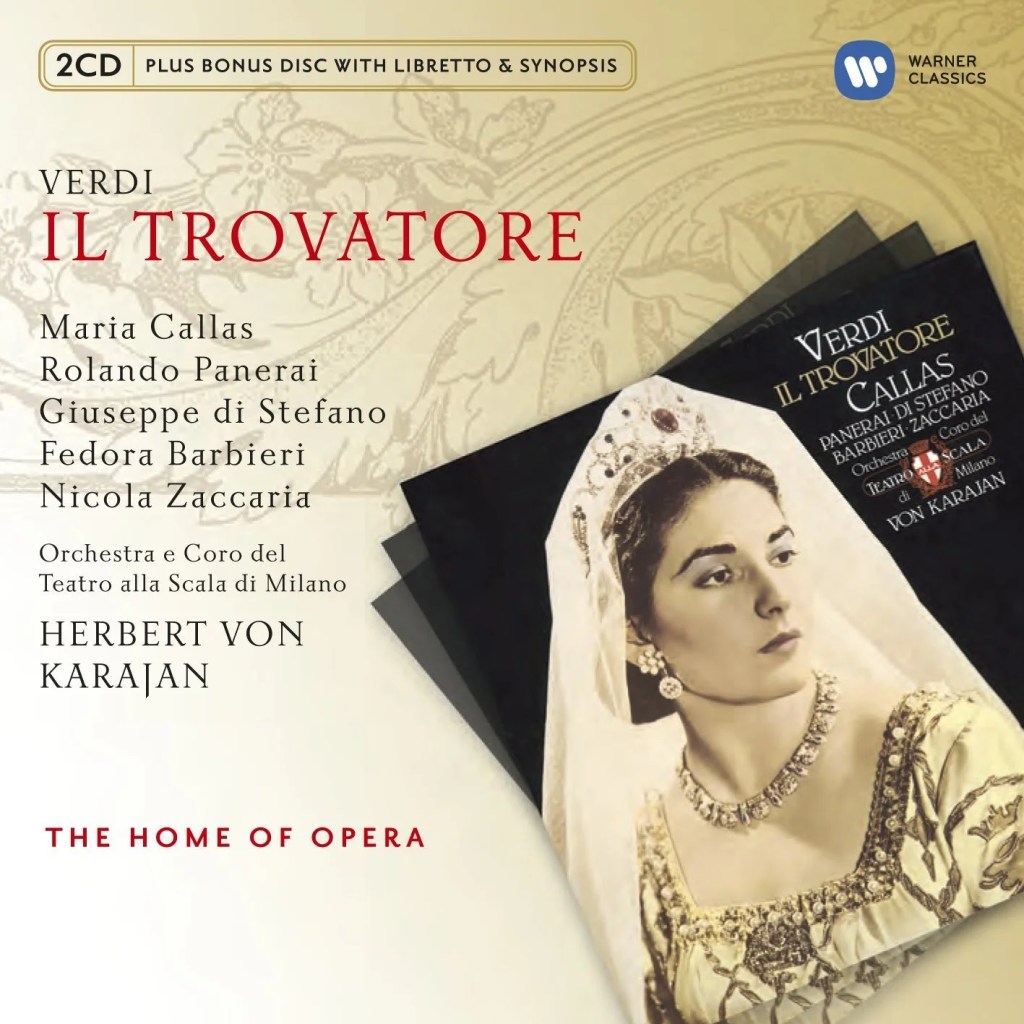
Maria Callas, 1956
A problem in the 1956 recording conducted by Herbert von Karajan very excitingly is Giuseppe di Stefano. Beautiful though he is, for Manrico he lacks power.
Fedora Barbieri comes into her own even better here than on the Myto recording, which may be partly due to the much better sound quality. Rolando Panerai is a solid Luna, but his “Il balen” neither makes me hot nor cold, especially with Bastianini and Milnes to my ears.
And Maria Callas? Callas remains Callas. Overdramatic. Her Leonora is anything but an adolescent in love. Her ‘D’amor sull’ali rosee’ is more than beautiful, perfect almost, but it leaves me utterly cold (Warner 5099964077321).
Below Callas in D’amor sull’ali rosee’:
Leyla Gencer, 1957
I don’t think I need introduce you to Leyla Gencer. The Turkish diva enjoys a cult following comparable only to that of Olivero and Callas. Her supple, round and clear voice – with pianissimi with which she could rival Montserrat Caballé – made her exceptionally suited to Verdi operas. Her Leonora is simply perfect: you can’t get any more beautiful than that.
Nor do I think there has ever been a better, more beautiful and impressive Luna than Ettore Bastianini. Del Monaco is otherwise a very macho Manrico. His radiant height in ‘Di quella pira’ compensates for his sometimes lacklustre interpretation.
Fedora Barbieri impresses as Azucena and Plinio Cabassi is a Ferrando to kiss. The recording was made in Milan in 1957 (Myto 00127).
Gré Brouwenstijn, 1953
It is almost unbelievable, but there were times when even an opera like Il Trovatore could be cast with only Dutch singers. You can also hear them all in the performance recorded live by Osteria (OS-1001) at the Amsterdam Schouwburg in 1953.
Annie Delorie’s Azucena disappoints me a little, but Gerard Holthaus, unknown to me (is there anyone who can tell me more about him?), is a surprisingly beautiful Luna.
Gré Brouwenstijn is definitely fantastic as Leonora. And yet… her ‘Tacea la notte placida’ doesn’t really penetrate my soul. Mario Cordone was unfortunately not among the very best conductors in the world, which is a pity: sometimes I get the feeling that he is a hindrance to the singers.
Cristina Deutekom, 1976
Give me Cristina Deutekom! In the 1976 recording (Gala GL 100.536), she manages to convince me completely and penetrate deep into my heart. Unlike Callas who remains just Callas in everything she sings, she is Leonora. With her feathery coloraturas, she sounds exactly how I imagine a Leonora to be: a young girl in love with a strong tendency to exaggerate. The latter in the best sense of the word.
Jan Derksen is also a Luna to be reckoned with and secretly I think he may be even better than Bastianini and Milnes. His “Il bales” is among the best versions of the aria I had ever heard.
Carolyne James is an okay Azucena, but the reason the recording is not my absolute number one is because of the very dickish (sorry!) sounding Juan Lloveras (Manrico).
Below, Cristina Deutekom and Lloveras in ‘Miserere’:
Raina Kabaivanska 1978
Il trovatore was one of Von Karajan’s favourite operas. In 1962, he directed a series of performances in Salzburg, which were taken over and televised in Vienna in 1978. It is a very old-fashioned and static performance, with realistic sets and costumes.
Terribly underrated outside Italy, Raina Kabaivanska portrays a flesh-and-blood Leonora: her voice is dark, with an old-fashioned vibrato and clearly lined phrasing.
Domingo was a last-minute substitute for the angry runaway Bonisolli. For his ravishing ‘Ah si, ben mio’, sung with radiant top notes, he was rewarded by the audience with a minute-long ovation.
Cossotto’s Azucena has since become legendary: like no other singer, she left a mark on that role (Arthouse Music 107117)
Below Domingo, Kabaivanska, Cappuccilli and Cossotto in ‘Prima che d’ altri vivere’:
Di quella pira
For those who cannot get enough of ‘Di quella pira’: Bongiovanni (GB 1051-2) has released a CD with no fewer than 34 performances of the tenor hit, recorded between 1903 (Julian Biel) and 1956 (Mario Filipeschi). Lauri-Volpi, here in a recording from 1923 (!), displays a radiant and long-held high c. However, he is surpassed by Aureliano Pertile: what a sound!
Helge Rosvaenge is disappointingly dull, but Richard Tauber’s 1926 recording (in German) is a delightful curio (yes, he can do it!).
Jan Kiepura can’t get enough of trills and welds them into everything, but what a ringing sound he has! Even Gigli ventures into it: something he had better leave out. The best of them all I think is Jussi Björling from 1939. Please let me know who your favourite was?
Gigliola Frazzoni
For dessert, I give you ‘Tacea la notte placida’, sung by Gigliola Frazzoni, one of Minnie’s best (La fanciulla del West). It was recorded in Amsterdam, on 16 October 1954. Marijke van der Lugt sings Ines and the Amsterdam Broadcating Orchestra (?) is conducted by Arture BasileDanny























 Basia con fuoco