discografieën

La Bohème: few of my favorite recordings on DVD

Mirella Freni


Many opera lovers will probably agree on one thing: one of the best Bohèmes ever is the 1973 version recorded by Decca under von Karajan. With Mirella Freni and Luciano Pavarotti.


Rodolfo has always been Pavarotti’s calling card. For years he was considered the best interpreter of the role – his fantastic legato, the smoothness and naturalness with which he sang the high notes are truly exemplary. Incidentally, as befitted a typical Italian tenor of the time, he sang the end of “O soave fanciulla” at the same height as the soprano. Not prescribed, but it was tradition!

Freni was undoubtedly one of the most beautiful Mimi’s in history. Tender and fragile, with her heartbreaking pianissimi and legato arches she managed to move even the greatest cynics to tears.

Von Karajan conducted theatrical and passionate way, with ample attention to the sonic beauty of the score. As the Germans would say “das gab’s nur einmal.”

In 2008 we celebrated not only Puccini’s 150th birthday, but also von Karajan’s 100th. Moreover, it was 35 years since the famed conductor recorded La Bohème: a cause for celebration! And lo and behold – Decca has released the opera in a limited deluxe edition (Decca 4780254). On the bonus CD, Mirella Freni talks, among other things, about her relationship with von Karajan and about singing Puccini roles. It is really fascinating.

Arias and duet from the first act:


Mirella Freni made her debut as Mimì at the Metropolitan Opera in September 1965. Her Rodolfo was another debutant: the (how unfair!) nowadays almost completely forgotten Italian tenor Gianni Raimondi. For me, he is preferable to Pavarotti. I find his voice more pleasant and elegant. And he could act!
Freni’s and Raimondi’s renditions were captured on a wonderful film, directed by Franco Zeffirelli and conducted by Herbert von Karajan. An absolute must (DG 0476709).

“O Soave Fanciulla” with Freni and Raimondi:


Renata Scotto


History was made with La Bohème from the Met in 1977 (DG 0734025): it was the very first direct transmission from the New York opera house on TV. The production was in the hands of Pier Luigi Pizzi, who at that time was not yet obsessed with excessive ballets and the colour red.
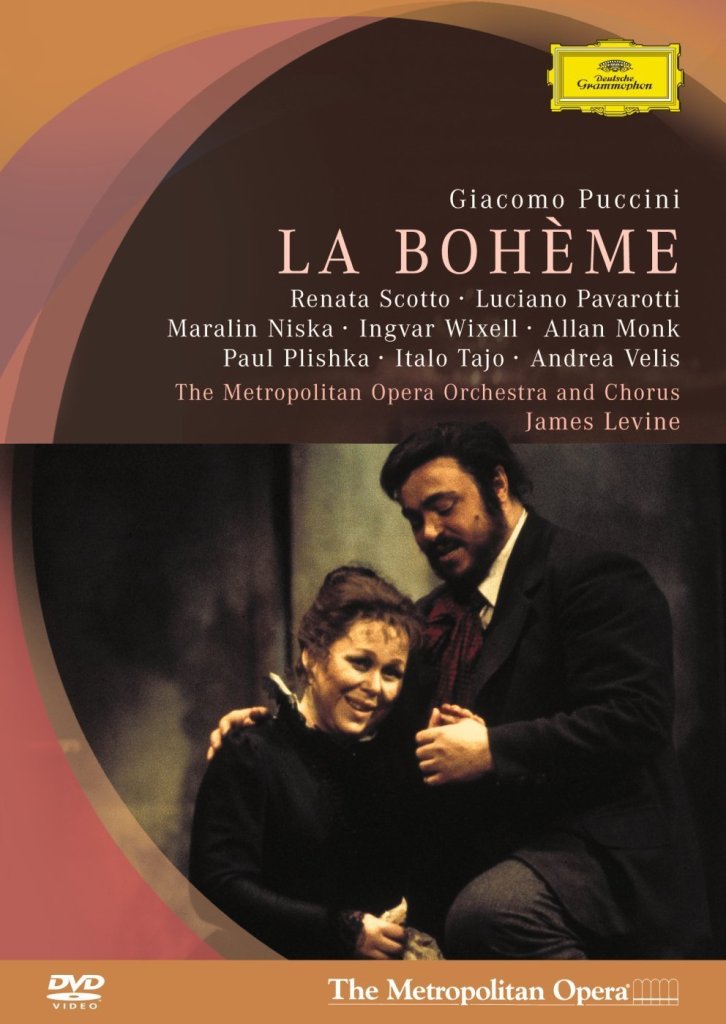


Although I was never a big fan of Pavarotti, I cannot deny that he produces a fresh sound here and that his high notes stand like a house. Acting was never his cup of tea, but here he does the best he can.

It becomes really exciting when Mimì enters: in 1977, Renata Scotto was at her unprecedented peak. She spins the most beautiful pianissimi and her legato and mezza voce are so beautiful they make you want to cry. The rest of the cast is no more than adequate, but the young James Levine conducts as if his life depended on it!

Scotto sings ‘Si mi chiamano Mimì’:


Musetta was not really a role with which we associate Scotto. Neither did she herself, but she accepted the challenge with both hands. In the Zeffirelli Met production of 1982, she sang a Musetta to die for. Alongside the very moving José Carreras and Teresa Stratas, she was the undisputed star of this recording (DG 073 4539 9).


Scotto as Musetta:


Cristina Gallardo-Domâs


Sometimes I wonder how perverse it is when people pay a lot of money to go see, dressed in fur coats, the misery of freezing poor artists?


I myself took great pleasure in the sight of all those fur-wearing audiences on my way to a performance of La Bohème at La Scala in 2003 (Arthouse 107119). The then 40-year-old Zeffirelli production was altered a bit, but the beautiful, realistic sets and brilliant lighting remained the same. The snowflakes, the light radiating from the inn that warmly colors the white earth, the snowy bench and Mimi’s tear-stained face: there is something magical about it all and it is more like a movie than a performance in the theater. It cannot leave you unmoved, all the more so because all the protagonists are truly superb.

Cristina Gallardo-Domâs is a delicate, emotionally torn Mimì. Her lyrical soprano is a bit reminiscent of Freni. Malcero Ãlvarez convinces with a (then still) beautifully lyrically sung Rodolfo and Hei-Kyung Hong, clearly inspired by Scotto, portrays a kitschy Musetta. Bruno Bartolletti conducts lively, without shying away from sentiment.

Below, ‘O soave Fanciulla’ with Gallardo-Domâs and Ãlvarez


Gallardo-Domâs was also present in Zurich two years later. With this very realistically staged Bohème, Philippe Sireuil made a thunderous debut at the Zürich Opera House (EMI 3774529). Don’t expect Zeffirelli-like scenes with snowflakes drifting down, however.

Sireuil’s conception is very “down to earth” and as such more veristically faithful than any other production known to me. With great love of detail, he draws the lives of the foursome of artist friends: their attic is tiny and stuffy, and their struggle to better themselves is life-like. The costumes (second-hand clothing from thrift stores) is contemporary, yet timeless at the same time.

Whatever Mimì is suffering from (it is surely not tuberculosis – the director doesn’t even allow her to cough) doesn’t really matter, although it seems to be drug related. Like a sick bird (how much she resembles Edith Piaf!) she slowly slides into the abyss, and her death forces the others to really think, for the first time. The third act, set at a gloomy train station, is particularly strong and painfully poignant.

The entire cast, headed by a movingly beautiful Marcello Giordani and a very virile Michael Volle (Marcello) in addition to the heartbreaking Gallardo-Domâs, is also outstanding. The much lamented László Polgár  sings Colline. Believe me: this La Bohème is really not to be missed.

Below, Marcello Giordani and Michael Volle in ‘Marcello finalmente:


Cheryl Barker


Back in time a little, to Sydney, Australia, 1993. For the first time I saw the production on TV (yes, kids: once upon a time there were the days when an opera was simply broadcast live from an opera house on TV!) and not soon will I forget that night. I didn’t know any of the singers; it was the name of the director (Baz Luhrmann) that drew my attention to the production.


The singers were mostly young – a plus, since the opera is about young people in love. They could sing, too, and with their looks of real movie stars, they could have been on the movie screen. Strange really, that, apart from Cheryl Barker (Mimì), no one had a great career. That Luhrmann was obsessed with opera is also confirmed by the film buffs: his Moulin Rouge is a direct look alike , including the red-lit “L’amour” on the rooftop. (Arthaus Musik 100 954)


Scene from the production:


Ileana Cotrubas


But, hand on heart, if I had to go through life with only one recording of La Bohème … I would choose John Copley’s 43-year-old production made for the Royal Opera House.

My “desert island recording” was captured on DVD in 1983 by NVC Arts (Warner 4509 99222-2) and – no matter how many times I watch it, I never get tired of it. And still, after all those years, it always makes me cry. Some things never age.

 Neither does the cast : Ileana Cotrubas as my beloved Mimì, the irresistible young Neil Shicoff as Rodolfo and Thomas Allen as a very erotic Marcello.

‘Saint François d’Assise’ by Olivier Messiaen in three audio recordings

SEIJI OZAWA

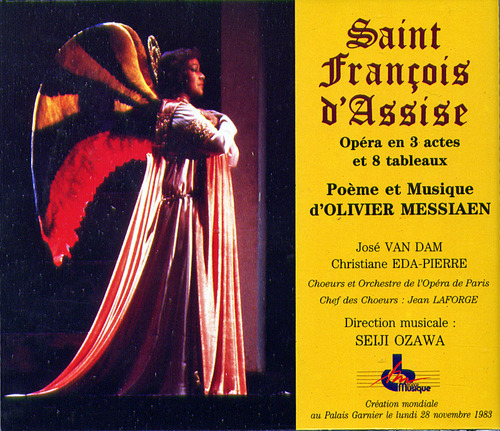
Olivier Messiaen was a very religious man and most of his works revolve around the Christian faith. For his only opera, about St Francis, he also wrote the libretto, which he considered his personal declaration of faith and a kind of testament. This was at least as important to him as the music itself. He worked on it for seven years; the premiere took place in 1983, in Paris.

The performance, with José van Dam in the lead role and conducted by Seiji Ozawa was released on CD, on the Cybélia label, unfortunately the recording is very hard to find these days. YouTube offers solace

LOTHAR ZAGROSEK


Two years later, in 1985, the opera was presented (albeit greatly shortened) in Salzburg, conducted by Lothar Zagrosek and featuring Dietrich Fischer-Dieskau as Francis, Rachel Yakar as the Angel and Kenneth Riegel as the Leper. It was broadcast live on ORF, and then released on Orfeo (C485 982).

KENT NAGANO


In 1998, ‘Francis’ returned to Salzburg, this time complete. Kent Nagano (when he was still Ozawa’s assistant he had once rehearsed the opera under Messiaen himself) conducted, and the lead role was performed by the now very grown-up José van Dam, seconded by Dawn Upshaw (the Angel) and Chris Merritt (the Leper).
The opera was recorded live during the performances and released on four CDs a year later, so we now have the only complete performance of this wonderful work on CD. (DG 4451762).


This recording is also on You Tube:


The performance is a very solid one. Chris Merritt does not possess the most beautiful voice in the world, but he doesn’t have to. He is supposed to come across as vulnerable and plaintive, and he succeeds superbly. Kenneth Riegel on the Orfeo recording is perhaps slightly more impressive, but you’re not going to buy the opera for one scene, though I myself like to have that recording alongside it.

Dawn Upshaw is a radiant, mercurial Angel, more esoteric than Rachel Yakar on Orfeo, and otherworldly beautiful. Fiescher-Dieskau had already retired in 1985, but agreed to rehearse the role of Francis (well, half of it). The result is certainly not bad, but for me it is very lacking in idiom, and he does not even come close to matching van Dam’s performance.

The music is very pleasant to listen to and it exudes a certain serenity, which cannot be attributed to the influence of the Gregorian chants alone. Occasionally reminiscent of Debussy’s Peleas and Melisande, Poulenc also comes quite close.

And Messiaen would not be Messiaen without the frequent use of the ondes Martenot (played on both editions by his sister-in-law, Jeanne Loriod), and without the chirping of birds.


Saint Francois d’Assis is an opera that lends itself beautifully to listening to on CD. It is a true masterpiece, but when it plays in the background only you will still enjoy it. You can read the synopsis, occasionally watch the dialogues (which may also be read beforehand, nothing much is happening anyway) and then you know it all. You can fold the laundry and listen to it just fine. Or just sit an

A brief summary about Cheryl Studer in some of her best roles

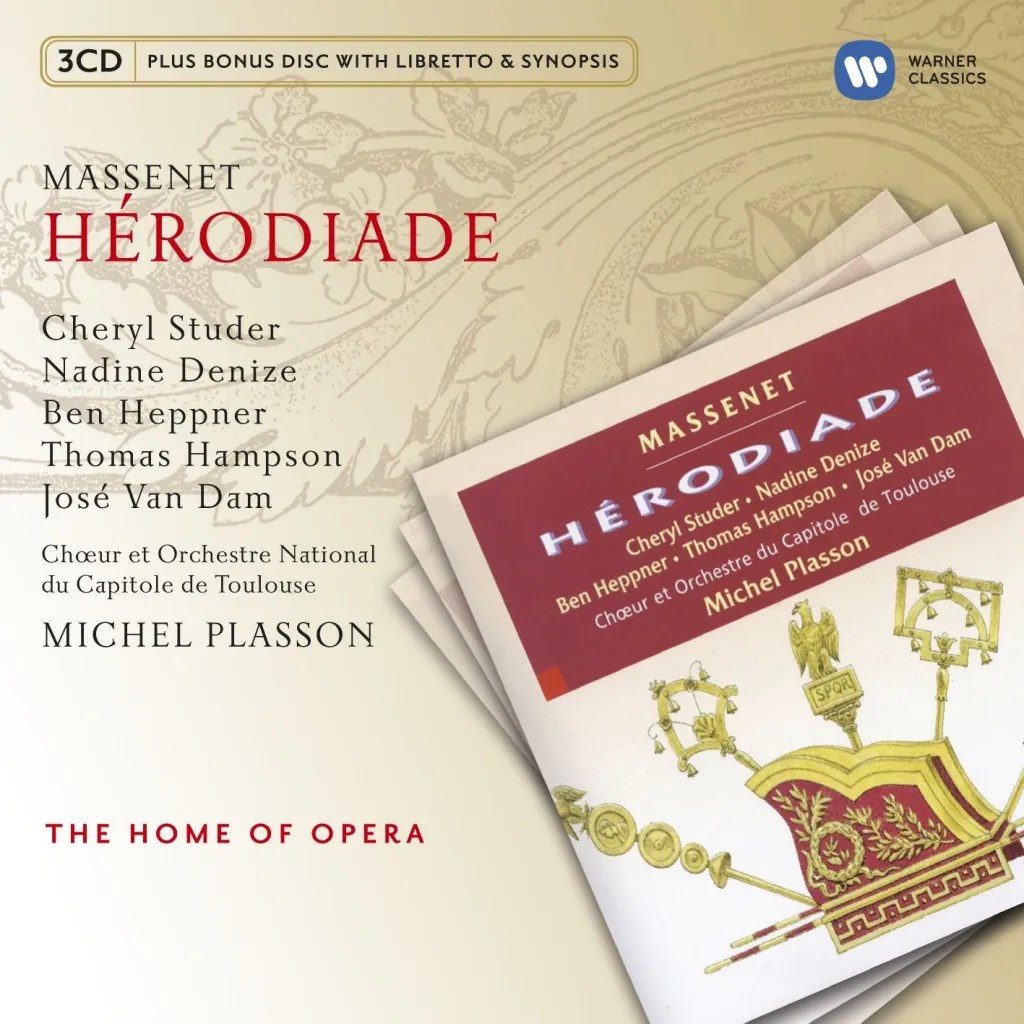
SALOME BY MASSENET: HERODIADE


Orchestrally, this recording is really top-notch. Michel Plasson conducts the orchestra from Toulouse very energetically, with a lot of verve and drive, and he also knows how to allow space for all the subtleties. Exciting and beautiful. That is how I like to hear opera.

José van Dam is an impressive Phanuel and Nadine Denize an excellent Hérodiade., although her intonation is not always pure.

Hérode is not really a role for Thomas Hampson, but he sings it very beautifully. Something that unfortunately cannot be said of Ben Heppner’s Jean. A heroic tenor in that role is nothing but a terrible mistake.

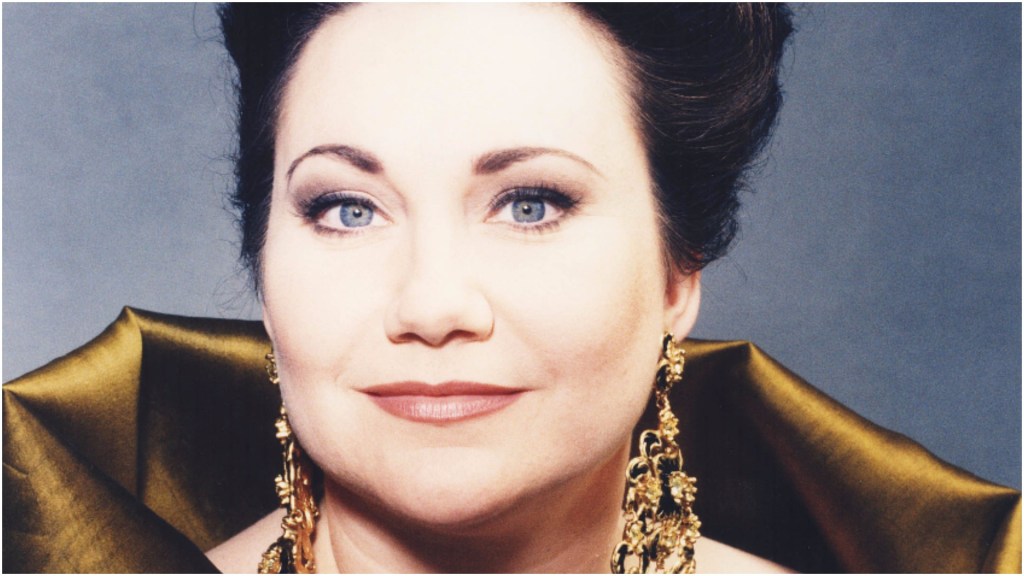
Cheryl Studer, on the other hand, is a Salomé of everyone’s dreams: girlish, innocent and naive. Her voice shines and sways and her final words “Ah! Darned Queen, if it is true that your cursed loins have given birth to me, look! Take back your blood and my life!” leave you shuddering and desperately weeping. Brava.

STRAUSS:

SALOME


I realise that many of you will not agree with me, but for me Cheryl Studer is the very best Salome of the last fifty years. At least on CD, because she has never sung the complete role on stage (DG 4318102). Like few others, she knows how to portray the complex character of Salome’s psyche. Just listen to her question ‘Von wer spricht er?’ after which she realises that the prophet is talking about her mother and then she sings in a surprised, childishly naive way: ‘Er spricht von meiner Mutter’. Masterly.

Bryn Terfel is a very virile young Jochanaan (it was, I think, the first time he sang the role), but most beautiful of all is Giuseppe Sinopoli’s very sensual, wide- sounding conducting.


ELEKTRA


This stage production from Vienna (Arthaus Musik 100 048) 1989 is more than extraordinary. Harry Kupfer’s direction is extremely gripping and terrifying, and although he is very realistic in his approach, he limits himself to the directions in the libretto.

The scene is dominated by grey in all its shades and is particularly dark. The only colour in the performance looms when Chrysotemis, at her heartfelt cry that she wants to live and bear children, rips open her blouse and reveals a red vest.

Eva Marton (Elektra) is exceptionally convincing: moving in her longing for her father, repulsive in her contempt for her sister and terrifying during her confrontation with her mother.

Cheryl Studer is a splendid Chrysothemis. With her slightly sweet, lyrical, yet still exceptionally powerful soprano, she can portray a very strong character: her Chrysotemis is a girl disappointed in life with a strong desire to escape, but without the decisiveness to actually bring it about.
Also phenomenal is Brigitte Fassbänder in her portrayal of the mentally ill queen, plagued by nightmares and guilt. Both the mother and her two daughters would be on Freud’s couch in no time – talk about hysterical women!
Franz Grundheber is an exemplary Orest and Claudio Abbado conducts with an intensity that borders on the impossible.


FRAU OHNE SCHATTEN


In 1992, Solti conducted a complete performance of the work in Salzburg. Götz Friedrich’s direction was considered particularly strong at the time, but I do not find it entirely satisfactory. The mise-en-scène is undoubtedly excellent, but it fails with the direction of the characters, causing the singers to run from place to place in a rather awkward way.

The stage design is beautiful with very minimalist but realistic sets, but the costumes are a bit bizarre at times. There is a lot of use of strobe lighting, which combined with violent musical passages may come across as rather violent.

Cheryl Studer is a dream of an Empress. Her voice, with its very recognisable timbre and beautiful pitch, is soaring, transparent almost, innocent and erotic at the same time. Thomas Moser is an attractive Emperor, perhaps a tad too light for the role, causing him occasional breathlessness and pressed notes, but his singing is fine.

Marjana Lipovšek is a truly phenomenal Amme. What that woman has at her disposal in terms of colour nuances and how she handles her (very warm) mezzo borders on the miraculous. In the process, she is also a gifted actress; I couldn’t take my eyes off her. (Decca 0714259)

WAGNER

TANNHÄUSER


I have never been a ‘Wagnerian’. I could never muster the patience to sit through hours of his operas. I found them bombastic. Pathetic. And even though I had to admit that there were some beautiful melodies, I felt that I really needed a pair of scissors and radically shorten them

That this feeling has totally changed, I owe to Domingo. In my collector’s mania (I had to have everything he had done), I bought Tannhäuser (DG 4276252) in 1989. And then it happened: I became addicted.

Later, I learned to appreciate the music for itself and to this day, Tannhäuser is not only a very beloved Wagner opera, but also one of my absolute favourites.

I still consider this recording, conducted very sensually by Giueseppe Sinopoli, to be one of the best ever. Also because all the roles (Cheryl Studer as Elisabeth and Agnes Baltsa as Venus, such wealth!) are excellently cast. At the time, in the eighties and early nineties, this was not necessarily a given.


DER FLIEGENDE HOLLÄNDER


This CD recording from 1998 (DG 4377782) is particularly dear to me. First of all because of Cheryl Studer, at the time probably the most beautiful Senta one could imagine. Her wonderfully lyrical soprano with its easy and sensual height seemed made for the role.

The Holländer is sung here by Bernd Weikl. Not really the youngest anymore and you can really tell, but still very suitable for the role. Peter Seiffert is a splendid Steuerman, and in the role of Erik we hear none other than Plácido Domingo, a luxury!

But best of all is the orchestra: under the truly inspired leadership of Giuseppe Sinopoli, the Orchester der Deutsche Oper Berlin performs in a really magnificent way.


On Tannhäuser in non-obvious recordings

PLÁCIDO DOMINGO


I have never been a ‘Wagnerian’. I could never muster the patience to sit through hours of his operas. I found them bombastic. Pathetic. And even though I had to admit that there were some beautiful melodies, I felt that I really needed a pair of scissors and radically shorten them

That this feeling has totally changed, I owe to Domingo. In my collector’s mania (I had to have everything he had done), I bought the recently released Tannhäuser (DG 4276252) in 1989. And then it happened: I became addicted.

At first, it was mainly Domingo who was to ‘blame’, whose deeply human interpretation of the title role gave me the goose bumps. His words:  “Wie sagst du, Wofram? Bist du denn nicht mein Feind?” (sung with emphasis on ‘mein’ and ‘Feind’ and with a childish question mark at the end of the phrase) caused me to burst into tears.

Later, I learned to appreciate the music for itself and to this day, Tannhäuser is not only a very beloved Wagner opera, but also one of my absolute favourites.

I still consider this recording, conducted very sensually by Giueseppe Sinopoli, to be one of the best ever. Also because all the roles (Cheryl Studer as Elisabeth and Agnes Baltsa as Venus, such wealth!) are excellently cast. At the time, in the eighties and early nineties, this was not necessarily a given.

RICHARD CASSILY 1982


In those years there was a lack mainly of good tenors and that can be clearly heard on these two DVD – recordings. Otto Schenk’s insanely beautiful 1982 production, recorded at the Metropolitan Opera in New York (DG 0734171) dates from 1977. If you like very realistic, lavish sets and ditto costumes (I do) you can have a lot of fun with this. Just about the entire Venus grotto from Schloss Neuschwanstein was recreated for the opening scene, and the ballet presents us with a truly orgasmic Bacchanal.


The orchestra, conducted by James Levine, plays mostly lyrical and light, there is nothing to criticise at all. Eva Marton is a fine Elisabeth, Tatiana Troyanos a wonderfully sensual and seductive Venus.

Bernd Weikl, one of my favourite baritones sings an irresistible Wolfram, although he messes up his great aria by trying to give his (in principle) lyrical voice too much volume, making his voice unsteady.

And although the Landgrave (John Macurdy) is really terrible, I would not have had a problem with that recording, provided … yes … provided the tenor had not been so awful. The textbook mentions “the very highest standard”, well, I’m not so sure about that. Richard Cassilly is a physically very unattractive Tannhäuser with a pinched voice and a total lack of lyricism, giving the impression of having wandered into the wrong opera.

Arrival of the guests at Wartburg:


RICHARD VERSALLE 1989


Even worse is the 1989 recording (Euroarts 2072008) from Beyrouth. Wolfgand Wagner’s direction is mainly symbolic, thus everything takes place in a circle (circle of life? Seasons? Panta Rhei?) and already during the overture the pilgrims are walking around the stage.

The costumes are not particularly flattering to the singers, which is particularly merciless for poor Cheryl Studer (Elisabeth). Her breathtakingly sung evening prayer is of a touching beauty. Both Hans Sotin (de Landgraaf) and Wolfgang Brendel (Wolfram) are undoubtedly excellent, but yes, again, there is no good leading role.


Richard Versalle as Tannhäuser:


Richard Versalle is not much like a young man obsessed with (physical) love. There is also little of his dichotomy between the earthly and the heavenly. His voice is not pretty and devoid of any charm. A macabre fact: the fact, that his name has not yet been forgotten owes it to his death: during the premiere of Vec Makropoulos (MET 1996), he fell from a ladder, stricken by a heart attack, just after singing the words “You can only live so long”.


Trailer of the production:


In both of the above recordings, Messrs Tannhäuser and Wolfram are continuously walking around with harps, on which they ‘accompany’ themselves at the appropriate moments. That imaginary pinging should be banned, it’s so fake!


PETER SEIFFERT 2003 (for fans of Jonas Kaufmann)


The in itself nicely designed production from Zurich (once EMI 5997339) is suffering from the highly irritating TV direction, it really seems as if the TV director has taken over directing. The ‘manager of images’ likes close-ups, so that during Elisabeth’s prayer we look at the clarinetist’s fingernails. Or we are being zoomed in on Tannhäuser’s sweat-covered forehead. He also finds it necessary to film the singers behind the scenes, which very much disrupts the romance and the magic.

Once you get used to it, there is undoubtedly much to enjoy. The stage setting is beautiful, the colourful costumes – apparently from the early twentieth century – are handsome, and Jens-Daniel Herzog’s character direction is fine. But what makes this production especially worthwhile are the vocal contributions of the singers.

Isabelle Katabu is an extraordinarily beautiful and sensual Venus, darkly coloured and highly erotic. Solveig Kringelborn’s Elisabeth sounds especially pure and lyrical as does her appearance. At the time, Peter Seiffert was one of the best Tannhäusers, both vocally and as a actor. Torn between the sensual and the spiritual, he chooses the higher, which can only result in death.

Nice detail for his many fans: the small role of Walther is sung by none other than Jonas Kaufmann. Only: we don’t get to see him, as during his aria the camera focuses on the faces of Tannhäuser or Elisabeth. Incidentally, I think that recording is now sold out, but yes: fans will remain fans, won’t they?


http://www.operaonvideo.com/tannhauser-zurich-2003-seiffert-kaufmann-kringelborn-kabatu-trekel/


ROBERT GAMBILL 2008


That Nikolaus Lehnhoff can direct Wagner in a very beautiful way, yes, we already knew that. Already in his earlier productions for Baden Baden he showed that modern staging does not have to produce weird images, and that concepts are not necessarily ridiculous. This Tannäuser, previously seen in Amsterdam, is also exceptionally successful (Arthaus Musik 101 351).

Lehnhoff emphasises Tannhäuser’s search for the balance between the physical and the spiritual by creating a world where tradition goes hand in hand with innovation. He builds on a discrepancy (but also a symbiosis) between innocence and evil, and between art and kitsch. Thus, the singing competition degenerates into a kind of glorified form of ‘Idols’, and Tannhäuser’s symbolic ‘redemption’ is painfully beautiful and effective.


Musically, too, there is little to complain about. Robert Gambill sings a particularly moving Tannhäuser, his ‘Rom-Erzählung’ cutting through the marrow. Camilla Nylund is a beautiful, somewhat understated Elisabeth which makes her unapproachable and Waltraud Meier is a Venus out of thousands. Only with Roman Trekel do I have a little trouble. There is nothing wrong with his carrying, solid baritone, but for Wolfram I still opt for a bit more warm lyricism (Hermann Prey, where are you?).


Hermann Prey sings ‘O du mein holder Abendstern’:


BACK IN TIME


About ten years ago, budget label Walhall reissued two historic recordings of Tannhäuser on CD. These are respectively. the 1949 Berlin performance conducted by Leopold Ludwig (WLCD 0145), featuring Ludwig Suthaus (Tannhäuser), Martha Musial (Elisabeth) and a very young Fischer-Dieskau (Wolfram); and a performance from the MET (WLCD 0095), conducted by Rudolf Kempe in 1955, with, excluding a not very idiomatic Astrid Varnay as Elisabeth, a selection of the greatest singers of the time: Blanche Thebom, George London, Jerome Hines and Ramon Vinay.

George London sings ‘O du mein holder Abendstern’:


In both cases, the sound is entirely acceptable and the performances are of a standard that seems very hard to reach these days.

Leopold Ludwig on Spotify:


Rudolf Kempe on Spotify:


\

Händel’s Alcina: it’s about sex, isn’t it? Discography

Dosso Dossi (1479-1542): Alcina

“Well, it’s about sex, isn’t it?” In her introduction to the 2011 Alcina, recorded by Arthaus Musik in Vienna, American thriller writer Donna Leon argues that (we didn’t know this, of course) virtually all operas are about sex, whether it’s Der Rosenkavalier, Madama Butterfly or Dido and Aeneas. With Alcina, the story from Ariosto’s Orlando Furioso, set to music by Handel, taking the crown.

Yearning for (young) male flesh, the sorceress, once she is bored, transforms her victims into wild animals and sets out to find new food for … no … not for the soul. Until she herself finally falls in love, which will be her downfall. One could almost feel sorry for her!


ANJA HARTEROS

The DVD recording from Vienna is exceptionally fine, thanks in part to director Adrian Noble. Unlike other operas by Handel, Alcina contains a lot of ballet music, something that is seamlessly integrated into the beautiful and atmospheric staging.

Anja Harteros is an outstanding Alcina. Her ‘Regina sei tradita’ is followed by a very well-deserved applause. Kassarova is completely in her element as Ruggiero, Adam Plachetka is a delightful Melisso and the young German tenor Benjamin Bruns convinces as a hot-tempered Oronte.

But my heart is stolen by the boy soprano Alois Mühlbacher. The boy is absolutely peerless in the role of Oberto searching for his missing father. Highly recommended!

Below ‘Ah! Mio cor’ by Anja Harteros:


ARLEEN AUGÉR


Many Handel fans claim that nothing can rival the 1986 EMI (now Warner 50999 0880212) recording under Hickox, starring the unforgettable Arleen Augér. I can agree with this sentiment, as the voice of the soprano, who died far too young, is unearthly beautiful.


Della Jones (Ruggiero) and Kathleen Kuhlmann (Bradamante) are also absolutely irresistible, but the rest of the voices don’t really appeal to me. A pity, because I really like the tempi. Although I must admit that virtually the same cast in 1990 under William Christie sounds much more exciting.


Below, Arleen Auger and her version of ‘Ah! Mio cor’:


RENÉE FLEMING


In 1999, William Christie recorded Alcina live for Erato. Renée Fleming is a matter of taste, especially in the role of Alcina. But Susan Graham is a wonderful Ruggiero and Natalie Dessay perhaps the best Morgana ever. And Kathleen Kuhlmann once again gets to show why she is one of the most beautiful mezzos in history.


JOAN SUTHERLAND


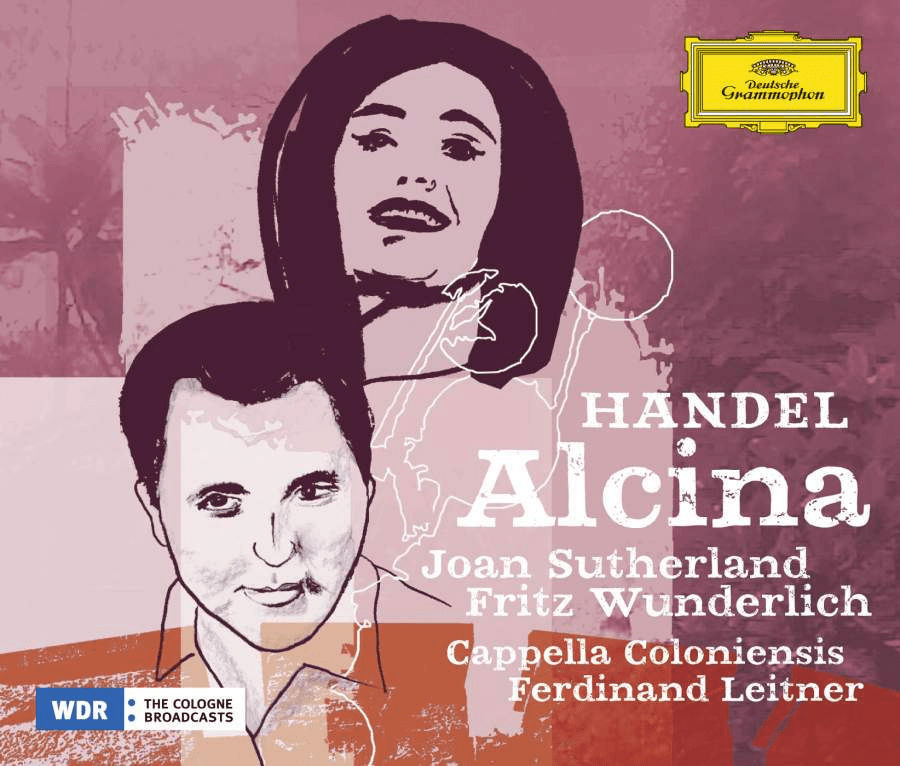
The fact that the opera has become so incredibly popular and has been performed so very frequently in recent decades is largely thanks to Joan Sutherland. Back in 1957, she brought Alcina to life in London and directed by Zefirelli. Unfortunately, we do not have a video recording of it, but La Stupenda sang and recorded the role several times afterwards and there are many both official and pirate recordings of it in circulation.


Personally, I have a soft spot for the 1959 live recording (DG, made to mark the 200th anniversary of Handel’s death), not least because of Fritz Wunderlich, who sings the role of Ruggiero. Last but not least, Dutch soprano Jeannette van Dijck sings the role of Morgana. And believe it or not, the Cappella Coloniensis, led by Ferdinand Leitner, is already playing on authentic instruments. In 1959!


The score has been considerably shortened. Thus, pretty much the entire role of Oberto has been dropped. And yet… opera is mostly about voices, isn’t it? And Sutherland’s ‘Tornami a vagheggiar’ and Wunderlich’s ‘Mi lusinga il dolce affetto’ are simply second to none. (DG 4778017)

Below Joan Sutherland:


Ildebrando Pizzetti: Murder in the cathedral. And more

Ildebrando Pizzetti – along with Respighi, Zandonai, Alfano and Malipiero, among others – belonged to the so-called ‘Generazione dell’80’, a group of Italian composers born around 1880. What they all had in common was a certain leaning towards neoclassicism and an interest in Renaissance and Byzantine music.


All this is prominent in Assassinio nella Cattedrale, a musical drama based on T.S. Elliott’s play Murder in the cathedral, for which Pizzetti himself wrote the libretto. I think it is a beauty of a piece, with a very strong libretto, beautiful choral parts and a perfectly crafted leading role that gives a good bass-baritone all the room it needs to shine. Incredible really that the opera is still so rarely performed.

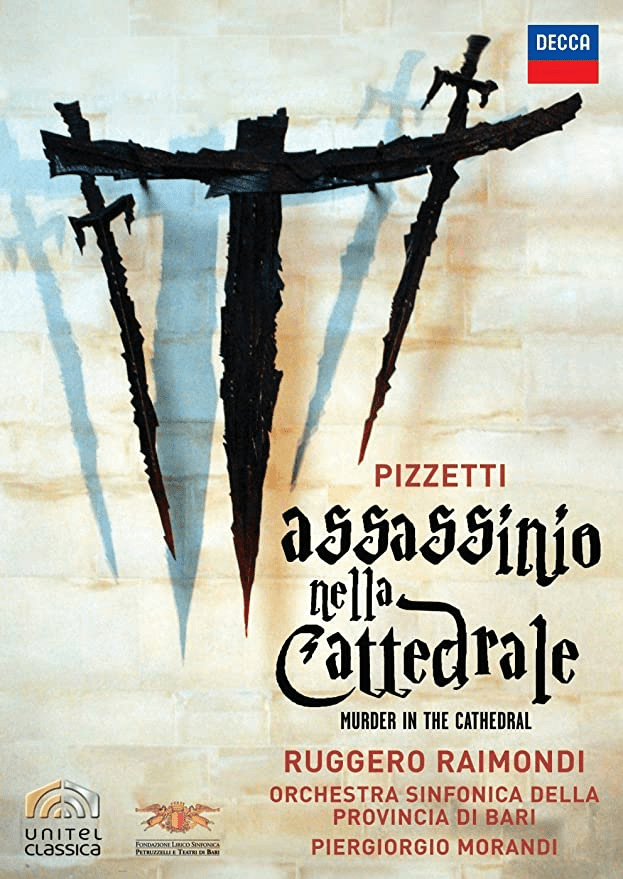
This Decca recording was filmed in December 2006 in the dazzling Basilica di San Nicola in Bari. It all makes it feel very authentic, although I think it must have been more impressive live than on DVD. Logical, really.

The performance itself is fine, not overwhelming, but certainly sufficient. The Archbishop’s rise does make a huge impression, it’s a lot like Scarpia’s first rise; that makes you quiet. Especially when the singer in question is called Ruggero Raimondi. His voice has become a bit dry, but he is a real theatre animal and puts down a very impressive Thomas Becket


NICOLA ROSSI-LEMENI AND LEYLA GENCER/VIRGINIA ZEANI


The premiere of Assassinio nella Cattedrale took place at La Scala in Milan, in March 1958. The leading roles were sung by Nicola Rossi-Lemeni for whom Pizetti composed the opera and Leyla Gencer.


Shortly after its premiere, the opera was recorded live in Turin. Absolutely indispensable for the ‘Generazione dell’80’ and verism lover (Stradivarius STR 10067/57)

Virginia Zeani in an aria from the recording:


Should you want to hear more from Pizzetti (which I can well imagine), I can recommend the recording of Debora e Jaele. The cast is to please, with the very impressive Clara Petrella leading the way in the role of Jaele. The opera was recorded inMilan in 1952, Gianandrea Gavazzeni conducted (GOP 66.354)

Almost all about Les Dialogues des Carmélites: part 4

There are those operas that you just can’t spoil and Les Dialogues des Carmélites is one of them. For Poulenc, melody is the centre of the universe. His music is so poignantly beautiful and his composition so expressive that you don’t really need a director.

The opera’s themes are sacrifice, martyrdom, revolutions and ideologies, but those are just the side lines, because the main theme is an all-devouring fear that makes it impossible to live or die: “Fear is a terrible disease. I was born of fear, in fear I live and in fear I shall die. Everyone despises fear, so I am condemned to be despised.


Paris, 2013


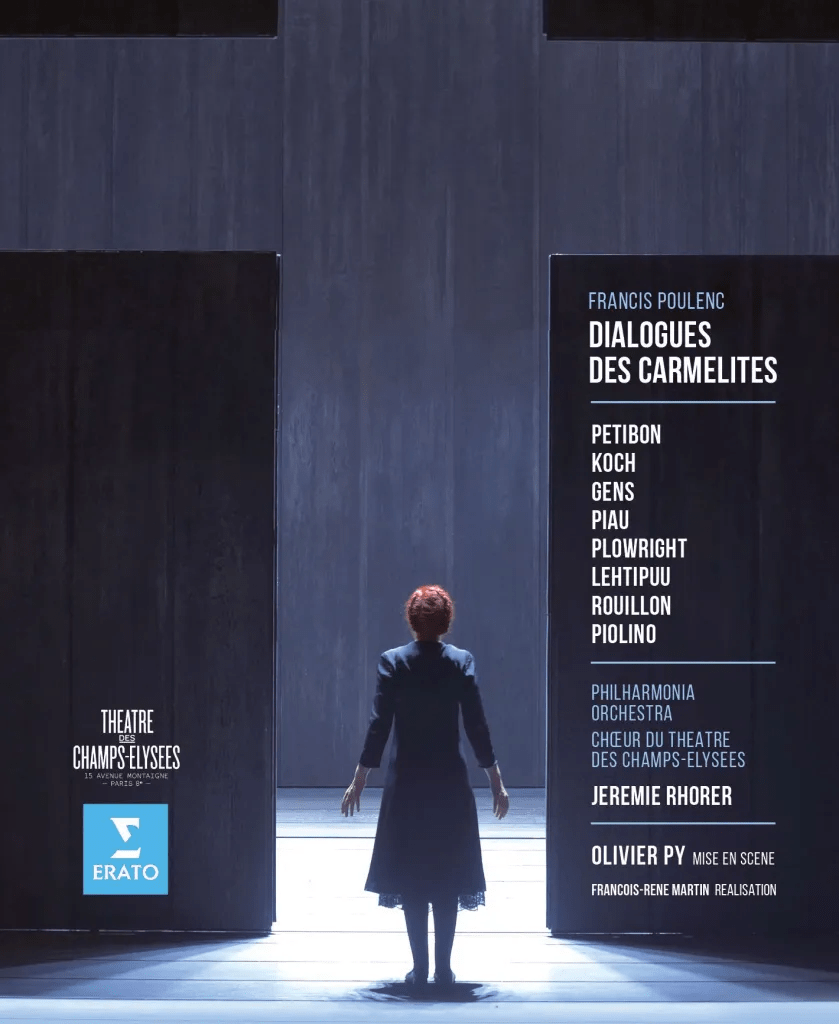
You just never know with Olivier Py, though I have to say that, apart from the awful Romeo et Juliette in Amsterdam, most of his productions are usually excellent. So too his Dialogues des Carmélites, recorded in Paris in 2013.

Patricia Petibon is a singer with a tendency to exaggerate, but here she is perfectly matched as Blanche. Watching her, I involuntarily get visions of Edith Piaf. Which of course suits the role very well: a small, skinny, frightened bird.

Her timbre is close to that of Denise Duval, but she lacks her carrying power and – mainly – her lyricism. Still, there is no denying that the role of Blanche is more or less tailor-made for her.

Sophie Koch is a strange choice for Marie. She looks far too young and lacks the confident superiority and power of persuasion so characteristic of the role. And the contrast with Lidoine (a wonderful Veronique Gens) is not great enough. Rosalind Plowright is an excellent Croissy and Sandrine Piau a delightful Constance.

Py uses the orchestral interludes to showcase religious scenes, including the evocation of the Last Supper and the Crucifixion. Sometimes a little “too much”, but the last scene, with the dark starry sky, brings a lump to my throat (Erato 0825646219537).

Here is the trailer:


Film adaptation


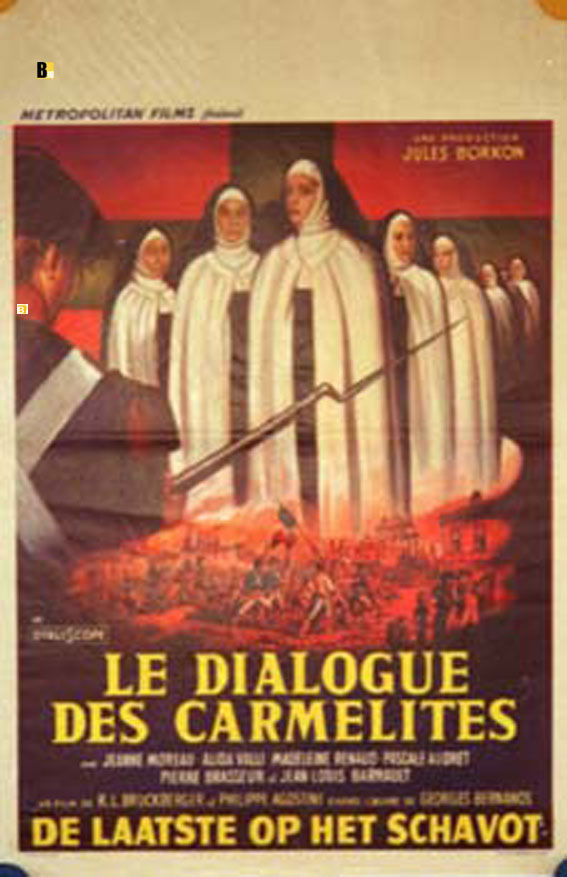
Did you know that the story of Dialogues des Carmélites was filmed in 1960? In the film you can see, among others, Jeanne Moreau as Mère Marie and Pascale Audret as Blanche.
Below is the last scene:

Almost all about Les Dialogues des Carmélites: part 3

There are those operas that you just can’t spoil and Les Dialogues des Carmélites is one of them. For Poulenc, melody is the centre of the universe. His music is so poignantly beautiful and his composition so expressive that you don’t really need a director.

The opera’s themes are sacrifice, martyrdom, revolutions and ideologies, but those are just the side lines, because the main theme is an all-devouring fear that makes it impossible to live or die: “Fear is a terrible disease. I was born of fear, in fear I live and in fear I shall die. Everyone despises fear, so I am condemned to be despised.

Hamburg, 2008


The opera came to Hamburg in 2008, it was directed by Nikolaus Lehnhoff. His Blanche, Alexia Voulgaridou, is very much like Liu: sweet, scared but steadfast and very impressive.

Kathryn Harries as Madame de Croissy is even more impressive than Anja Silja. She acts not only with her whole body but also with her perfectly used voice. Her fear is physically palpable and her death scene cannot leave anyone unmoved.

Unfortunately, Gabrielle Schnaut’s Mère Marie is not of the same calibre. With the remnants of the once so imposing voice, she only causes irritation: not one note is pure and her terrible wobble feels like torture to your ears. How different then is warm and sweet Madame Lidoine, here sung incredibly lovely by Anne Schwanewilms!

The staging is very simple and there are hardly any sets, which is not at all disturbing. And the final scene is almost better than Carsen. (Arthouse Musik 101494)


https://my.mail.ru/video/embed/9182112244547191280


Munich, 2010


Munich would not be Munich without its ‘high-profile’ new productions that will cause scandals over and over again. Dmitri Tcherniakov’s Dialogues des Carmélites from 2010 was therefore not well received by everyone. I myself find the production very exciting, although his vision sometimes goes a little too far for me.

First of all: forget about the nuns, there are none. There is a community of women, locked up in a glass house. They have left the outside world, but that world can still see them and interfere with them. Claustrophobic.

Blanche, phenomenally sung and acted by Susan Gritton, clearly has mental problems. Her heroic act at the end stems from the same emotions as her fear. Two extremes of the same problem.

The contrast between a resolute, here caricatured a bit as a butch kapo, Mère Marie (a fantastic Susanne Resmark) and the sweet, clearly striving for a different course, Madame Lidoine (Soile Isokoski at her best) could not be greater.

And oh yes: also forget about the guillotine, because it’s not there either. Tcherniakov also changed the ending.

By the way: the chance that the DVD is still for sale is small. The Poulenc heirs thought that Tcherniakov had allowed himself too much freedom and they went to court (BelAir BAC061).


Below the trailer:


Almost all about Les Dialogues des Carmélites. Part one

Almost all about Les Dialogues des Carmélites: part 2

Almost all about Les Dialogues des Carmélites: part 4

Almost all about Les Dialogues des Carmélites: part 2

There are those operas that you just can’t spoil and Les Dialogues des Carmélites is one of them. For Poulenc, melody is the centre of the universe. His music is so poignantly beautiful and his composition so expressive that you don’t really need a director.

The opera’s themes are sacrifice, martyrdom, revolutions and ideologies, but those are just the side lines, because the main theme is an all-devouring fear that makes it impossible to live or die: “Fear is a terrible disease. I was born of fear, in fear I live and in fear I shall die. Everyone despises fear, so I am condemned to be despised.

Vienna, 2008 and 2011


In 2011, Oehms released a ‘Zusamennschnitt’ of performances of Dialogues des Carmélites, recorded live at the Theater an der Wien in January 2008 and April 2011.

Sally Matthews is a very moving Blanche, girlish but with just enough personality to give her character a bit more body. Occasionally whiny too – Blanche to the full.

Deborah Polaski is irresistible as Madame de Croissy and Michelle Breedt is a more than impressive Mère Marie. Just because of her fantastic achievement it is regrettable that this performance (the wonderful Carsen production!) was not released on DVD!

The ORF Orchestra under Bertrand de Billy plays the stars from the sky. Firm, where necessary, and whisper-soft when needed. (Oehms OC 931)


Milan, 2004


Speaking of Robert Carsen: for me, his production of Dialogues des Carmélites is one of the absolute highlights in the history of De Nationale Opera in Amsterdam.
In February 2004, the production was filmed at La Scala but I am not entirely happy with it. My disappointment mainly relates to Dagmar Schellenberger’s performance as the lead role.

Admittedly, it is not easy to emulate the unforgettable Susan Chilcott (she died in 2003 of breast cancer, only 40 years old), and Schellenberger indeed cannot not do it. In the beginning  her strong tremolo and her not always pure notes are irritating.. But as the opera progresses, she gains a great deal of credibility, and through her brilliant acting and complete abandonment, she makes the development of her character very tangible. And almost as a matter of course, her singing also becomes more beautiful and softer.

The role of Madame de Croissy is played by one of the best singing actresses of our time, Anja Silja. Her performance is truly breathtaking, and even though her voice is not that steady anymore – it suits the character of an old and mortally ill prioress very well. Her death struggle makes for unprecedentedly thrilling theatre, and it is a great credit to Carsen (and the rest of the cast) that the scenes that follow do not make us lose interest.


Muti conducts with verve and knows exactly how to strike the right tone. He really succeeds in translating the spectre of the revolution and its excesses into sound. He is at his very best, however, in the lyrical, contemplative scenes, and  in his hands the chilling ending reaches a truly blood-curdling climax. Make sure you have a big bag of Kleenex within reach, because you really won’t keep it dry (Arthaus 107315).


Below is the trailer:


Part one
Almost all about Les Dialogues des Carmélites. Part one

Almost all about Les Dialogues des Carmélites. Part one

There are those operas that you just can’t spoil and Les Dialogues des Carmélites is one of them. For Poulenc, melody is the centre of the universe. His music is so poignantly beautiful and his composition so expressive that you don’t really need a director.

The opera’s themes are sacrifice, martyrdom, revolutions and ideologies, but those are just the side lines, because the main theme is an all-devouring fear that makes it impossible to live or die: “Fear is a terrible disease. I was born of fear, in fear I live and in fear I shall die. Everyone despises fear, so I am condemned to be despised.


Milan, 1957


The world premiere of Dialogues des Carmélites took place on 26 January 1957 at La Scala in Milan, in an Italian translation. The cast reads like a ‘who’s who’ in the opera world, because, ask yourself: were there any bigger names in those days?

Blanche was sung by Virginia Zeani, a singer with a full, large and dramatic voice, that was suitable for both Violetta and Tosca. Marie was played by Gigliola Frazzoni, one of the best Minnies (La fanciulla del West) in history. And Madame Lidoine was given to Leyla Gencer.

With Fiorenza Cossotto, Gianna Pederzini, Eugenia Ratti and Scipio Colombo in the smaller roles, the opera sounded less lyrical than we are used to nowadays, almost veristic even. But that made the dramatic effect even more poignant.

Virginia Zeani and Francis Poulenc, Milano 1957


In The Operatic PastCast, Virginia Zeani talks about Poulenc, the influence the opera has had on her life, her colleagues and the production in Milan.
The entire performance from Milan, fantastically conducted by Nino Sanzogno, is on YouTube. Do not miss it!


Paris, 1957


The Paris premiere of Dialogues des Carmélites followed six months later. On 21 June 1957, the opera, now in French, was presented at the Théâtre National de l’Opéra.
Blanche was sung by Poulenc’s beloved soprano Denise Duval. Duval’s voice (girlishly naive, light, almost ethereal) fitted Blanche like a glove.
The rest of the cast, including Régine Crespin as Madame Lidoine and Rita Gorr as probably the best Mère Marie ever, was also chosen by Poulenc himself


Régine Crespin (Madame Lidoine) in “Mes chères filles”:


The orchestra was conducted by Pierre Dervaux and I can be very brief about him: there is no better. Full stop. (Warner 08256483211)


Almost all about Les Dialogues des Carmélites: part 2

Almost all about Les Dialogues des Carmélites: part 3

Almost all about Les Dialogues des Carmélites: part 4