Evelyn_Lear

Otto Schenk In Memoriam

©Ian Ehm /News

Otto Schenk, one of the greatest opera directors died 9 January 2025 at the age of 94. This is brief summary of few of his many productions, arranged alphabetically

ANDREA CHÉNIER

For me, Andrea Chénier is one of the best and most beautiful operas ever. I think the music is nothing less than divine and the story is timeless. It remains current, perhaps now more than ever. The tyrant must be cast off his throne and the people must take control. Surely, we all agree on that?

If only it were that simple! If only it were that simple! Anyone who grew up in a post-revolutionary totalitarian regime knows how much horror it brings. One terror is replaced by another. This, at least for me, is the main theme in Giordano’s biggest hit. I don’t think the real lead role is the actual poet, André Chénier It is the French Revolution, which, as Gérard (once Maddalena’s houseboy and now one of the revolutionary leaders) bitterly observes, devours its own children.

I myself think the role of the poet/revolutionary fits Placido Domingo like a glove. Passion for love and enormous involvement in everything that happens in the world were – and still are – his trademarks.

In 1981 the opera in Vienna was recorded for TV. That recording has since been released on DVD. Gabriela Beňačková, one of the most underrated singers in history, sings a Maddalena of flesh and blood. Horrifyingly beautiful and moving.

Piero Cappuccilli is a Gérard among thousands and the small roles are also filled by great singers: Madelon is sung by none other than Fedora Barbieri. Otto’s Schenk’s production is a feast for the eyes (DG 073 4070 7).

ARABELLA

Film 1977:
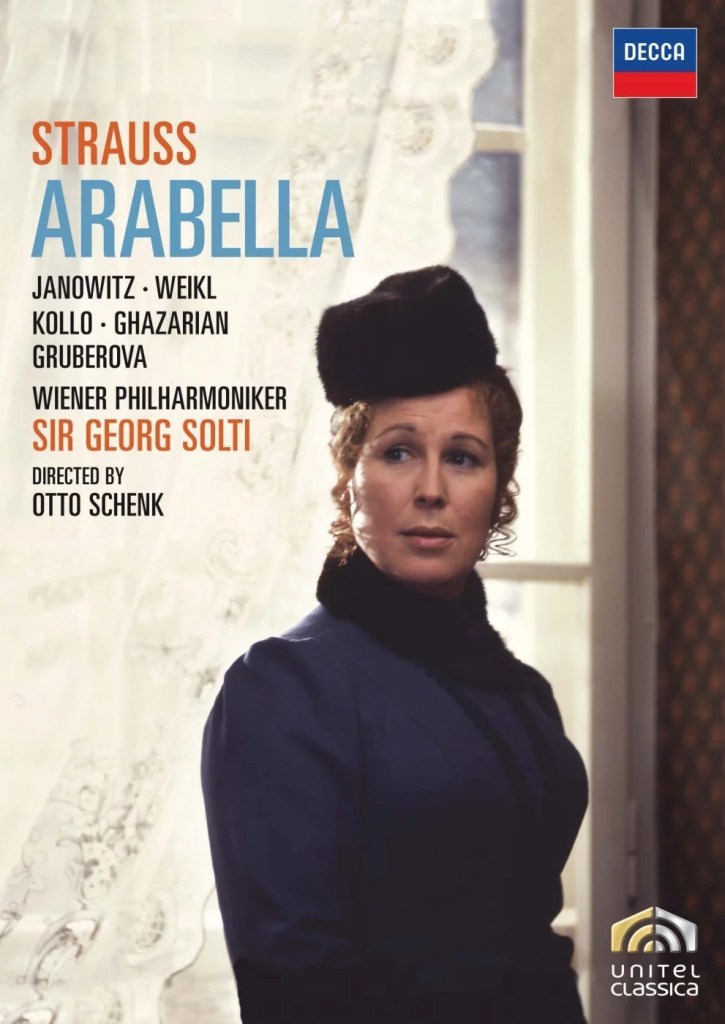


If you have never seen the opera, you would do well to start with Otto Schenk’s 1977 film (DG0743255). Larger than life, with lifelike sets. Of course, no ordinary live performance can compete with that.

Gundula Janowitz is a delightful Arabella. Perhaps not the best actress in the world, but her high notes are so very beautiful. Sona Ghazarian is a good Zdenka, but what really makes the recording, alongside the very erotic playing of the Wiener Philharmoniker (Solti!), more than worthwhile, is Bernd Weikl’s Mandryka. Any woman would certainly want to be kissed awake by him.

The minor roles are also fantastically cast: René Kollo is a Matteo out of thousands and I know of no better Fiakermilli than the young Gruberova. Add to this the very young (30!) Kurt Rydl as Lamoral and Margarita Lilova (Adelaide).  It is definitely very good.

Below Gundula Janowitz and Bernd Weikl in the last act:


Metropolitan 1995:
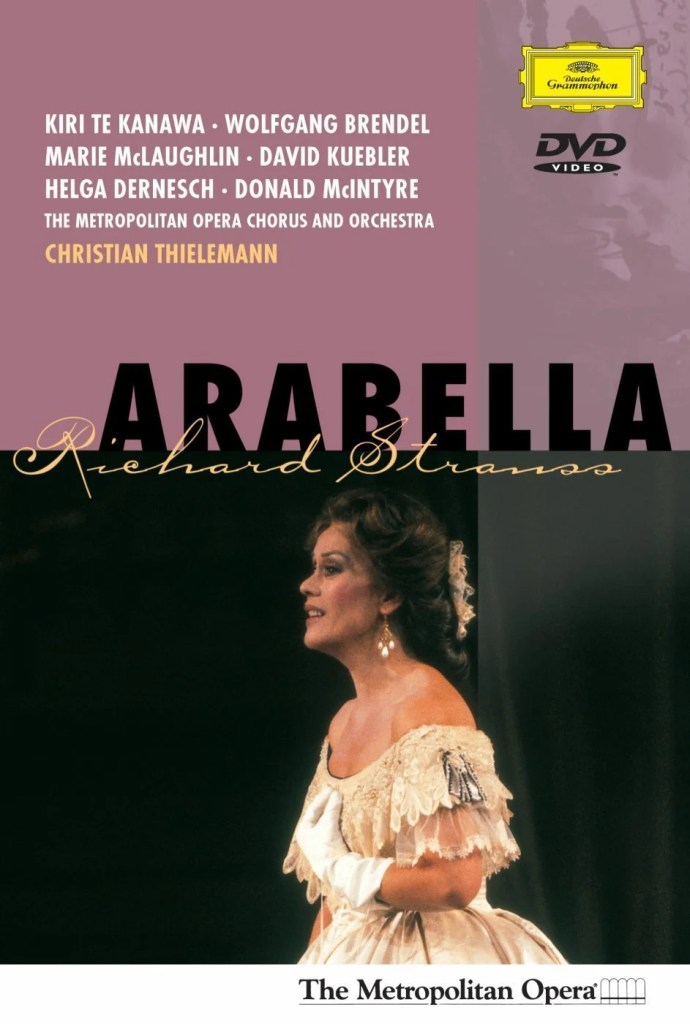
Kiri te Kanawa is an exemplary Arabella; there are few singers who can match her in this role. Strauss has always been a bit like her personal composer and optically, of course, she is a dream Arabella.

Her sister Zdenka (Marie McLaughlin) is also wonderful, something that cannot be said of Wolfgang Brendel (Mandryka). He doesn’t succeed in making my female heart beat any faster. Thielemann conducts well, but he lacks the sensuality of Solti.  (DG 0730059).

Below is a scene with Kiri te Kanawa and Marie McLaughlin:


BALLO IN MASCHERA


The Royal Opera House production released by Opus Arte (OA 1236D) dates from early 1975. The sound is a little dull, but you will forget that as soon as you hear the beautiful voices of the singers.

Katia Ricciarelli is one of the most moving Amelias I know. The sound that she produces is perhaps not really ‘Verdian’, and perhaps her voice is a little too light, (she has sadly destroyed her voice by singing this type of role), but the pianissimi that she spins deserve a prize for sheer beauty, and her fragility is palpable.

The kindly anxious, loving, but also playful tenor of the young Placido Domingo fits the role of Gustavo like a glove. Piero Cappuccilli is an excellent Renato and Reri Grist an Oscar such as you do not often hear them anymore. Her performance alone is worth buying the DVD.
Claudio Abbado (how young he was then!) conducts lightly and keeps the tempi sparkling, resulting in an effervescent orchestral sound.


The direction by Otto Schenk is effective. Conventional and yet surprising. And like no other, he exposes the comic aspects of the opera.

Trailer of the production:

DIE FLEDERMAUS

For me, the performance recorded at the Wiener Staatsoper on New Year’s Eve 1980 is by far one of the best, if not THE best. The production was then one year old and it was directed by Otto Schenk, a famous Viennese actor, who himself had played the role of Frosch 29 times. In a rich and detailed setting, an intrigue full of lies unfolds, which is at once exciting, comic and sad.

The cast simply could not be better: Bernd Weikl portrays the dissolute and primal Eisenstein with the necessary wink and humour, Lucia Popp is delightful as the bored housewife Rosalinde, and Brigitte Fassbaender irresistible as Orlovsky. But the very best is the young Edita Gruberova (Adele): she coquettes, makes us laugh at her mock accent, and moves us with her naivety. And all this with perfectly sung colouratura, brava!
Theodor Guschlbauer shows already in the overture that it is going to be an evening of masterfully performed beautiful melodies. Delightful.

DIE MEISTERSINGER VON NÜRNBERG
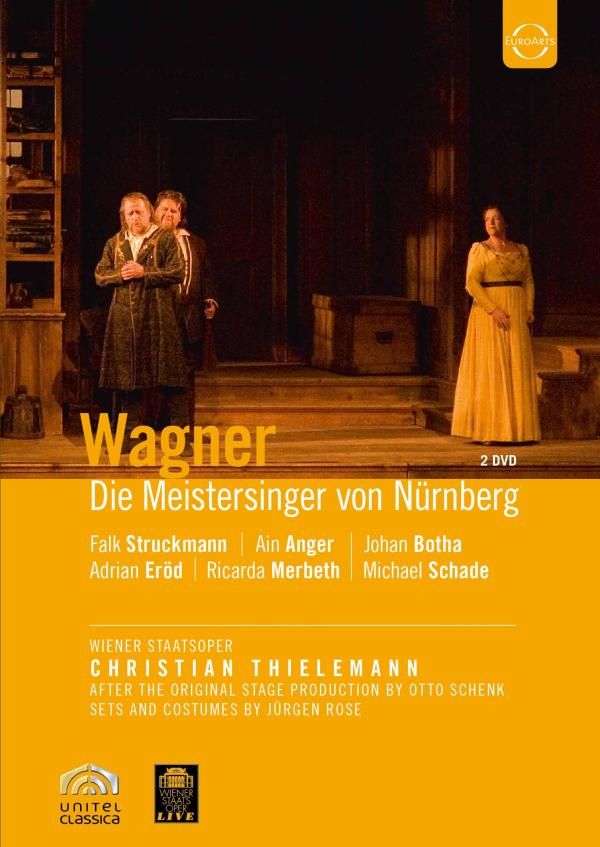

If you want a really beautiful Die Meistersinger on DVD, I can recommend Otto Schenk’s production. The wonderful performance was remade and recorded in Vienna in 2008. (Euroarts 0880242724885). HUGE! You really hardly ever get an experience like this; everything is in its context: the sets, the costumes, the story….

You may not believe it, but even Johan Botha (Walther) does some acting in this production! For that alone, the DVD is a must-see…But there is more. How about Falk Struckmann as Sachs (OK, the man can do no wrong with me)? And the deliciously vile Adrian Eröd (Beckmesser)? And if you know that the conductor’s name is Christian Thielemann … well!

Trailer:

LULU
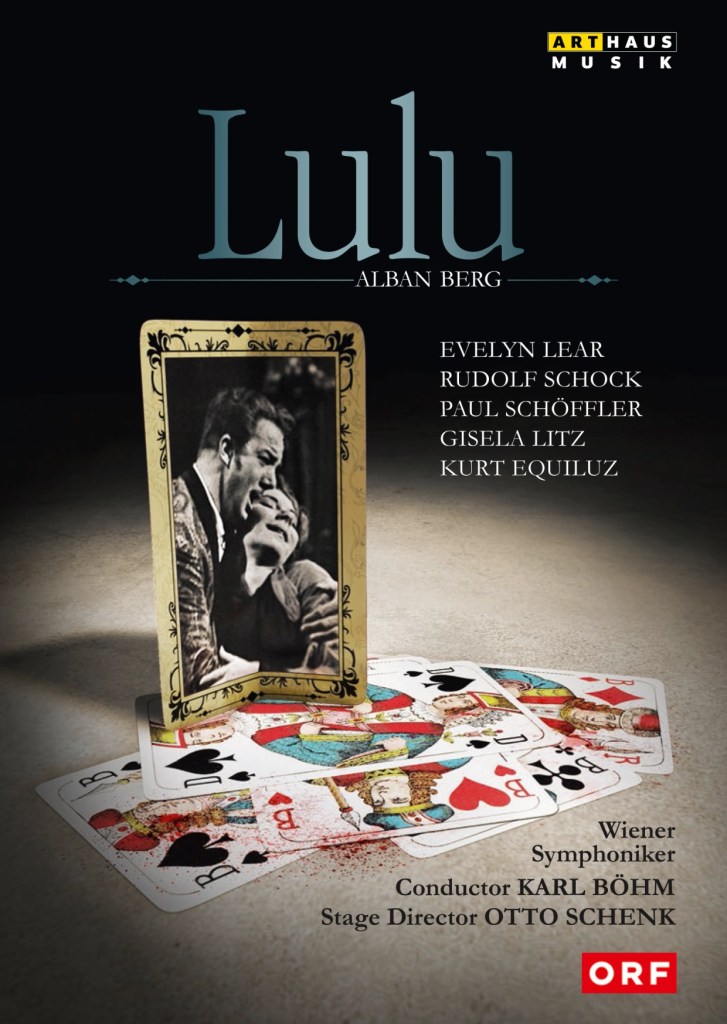
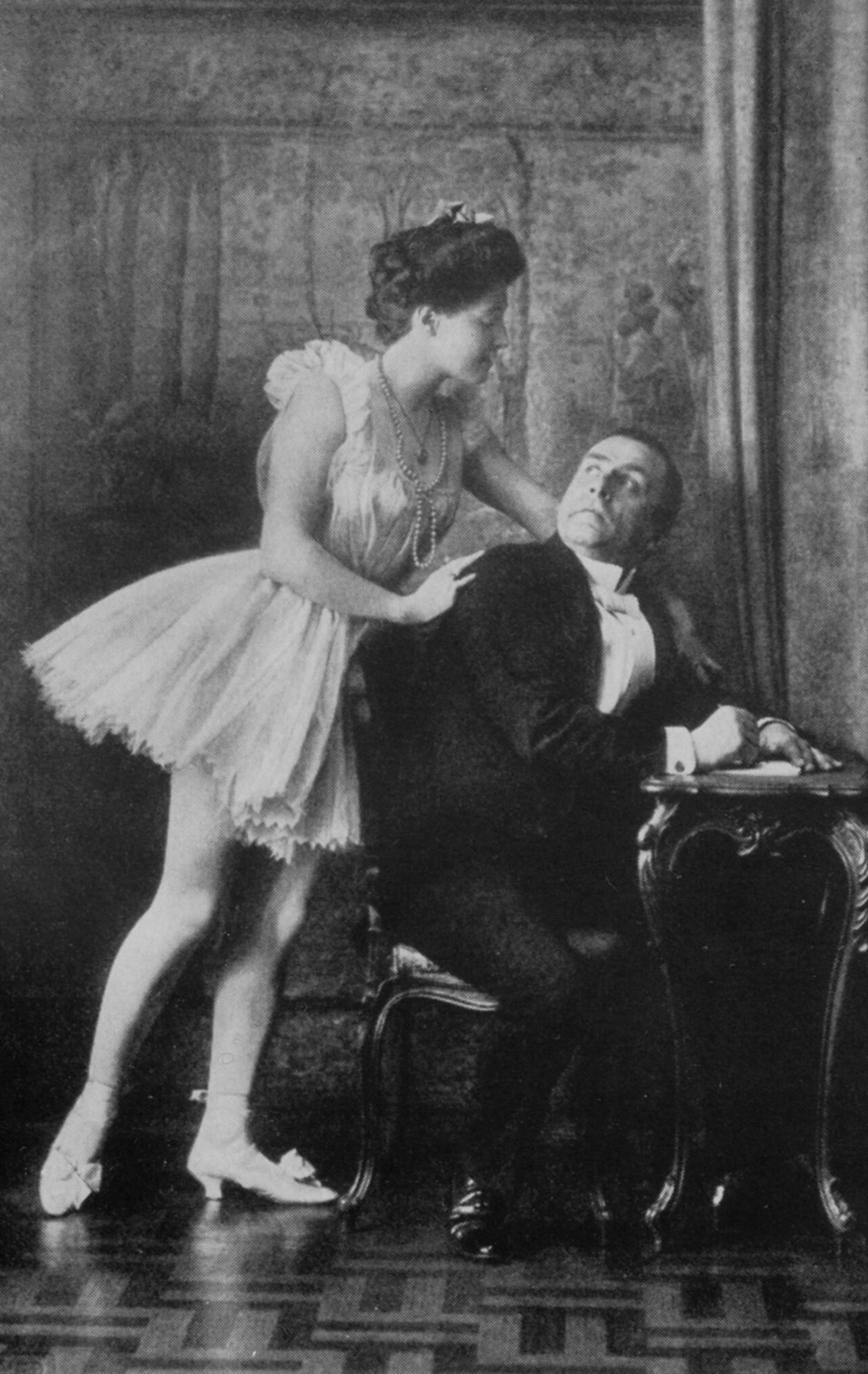
With her movie-star looks and angelic voice, Evelyn Lear has been referred to in the press as ‘Elisabeth Taylor meets Elisabeth Schwarzkof’. Personally, I find the American soprano, very popular in the 1960s to 1980s, much more interesting than her German colleague. Lear was one of the greatest and best advocates of modern music.
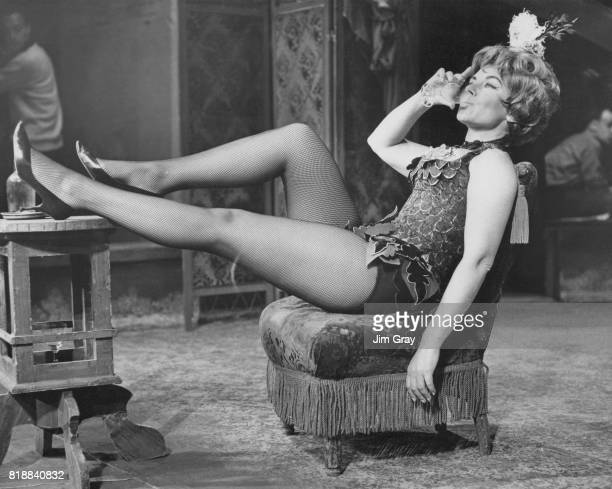
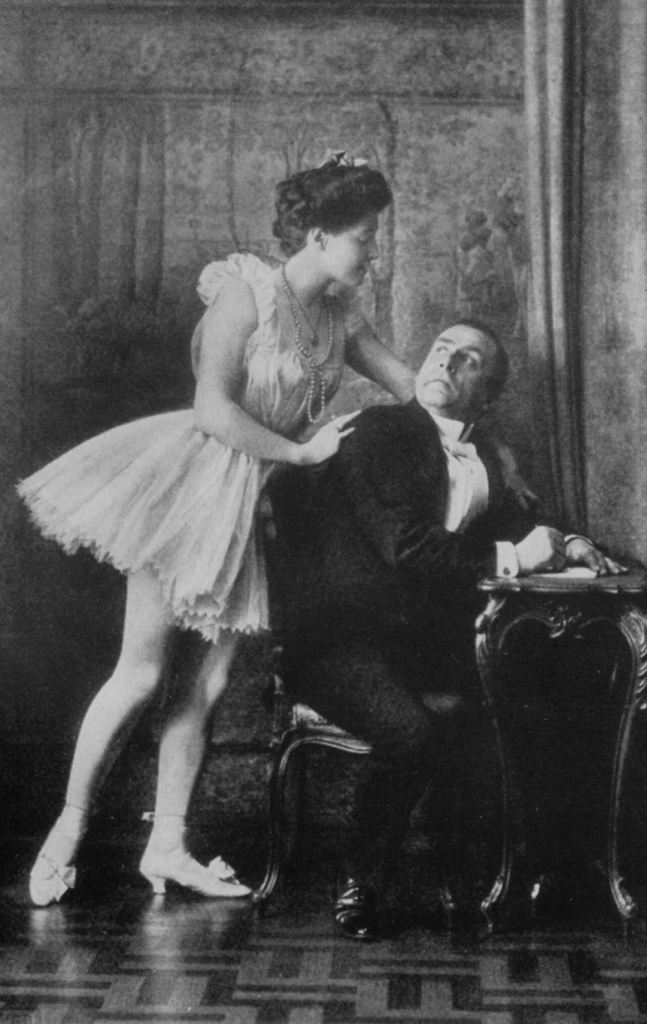
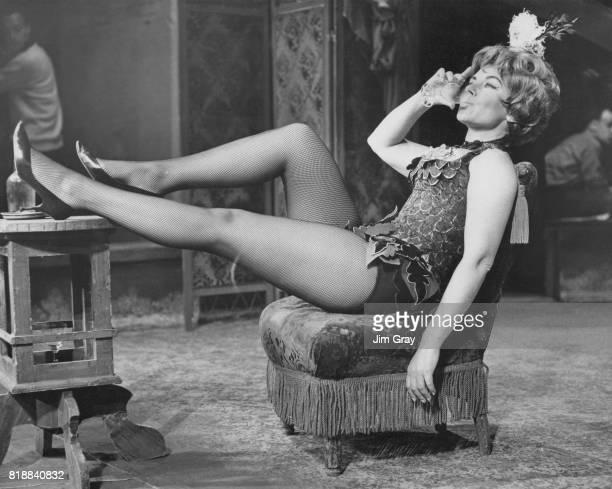
Opera singer Evelyn Lear of the Hamburg State Opera Company in the title role of the opera ‘Lulu’ at Sadler’s Wells in London, UK, 3rd May 1966. (Photo by Jim Gray/Keystone/Hulton Archive/Getty Images)

On 9 June 1962, she sang the role of Lulu in the first Austrian production of the work, at the newly reopened Theater an der Wien. I can imagine that the posh premiere audience may have been a bit surprised to see a prima donna dressed only in a tight-fitting corset and fishnet stockings, but if so, nobody showed it. It was directed by the then very young Otto Schenk, who followed the libretto closely.

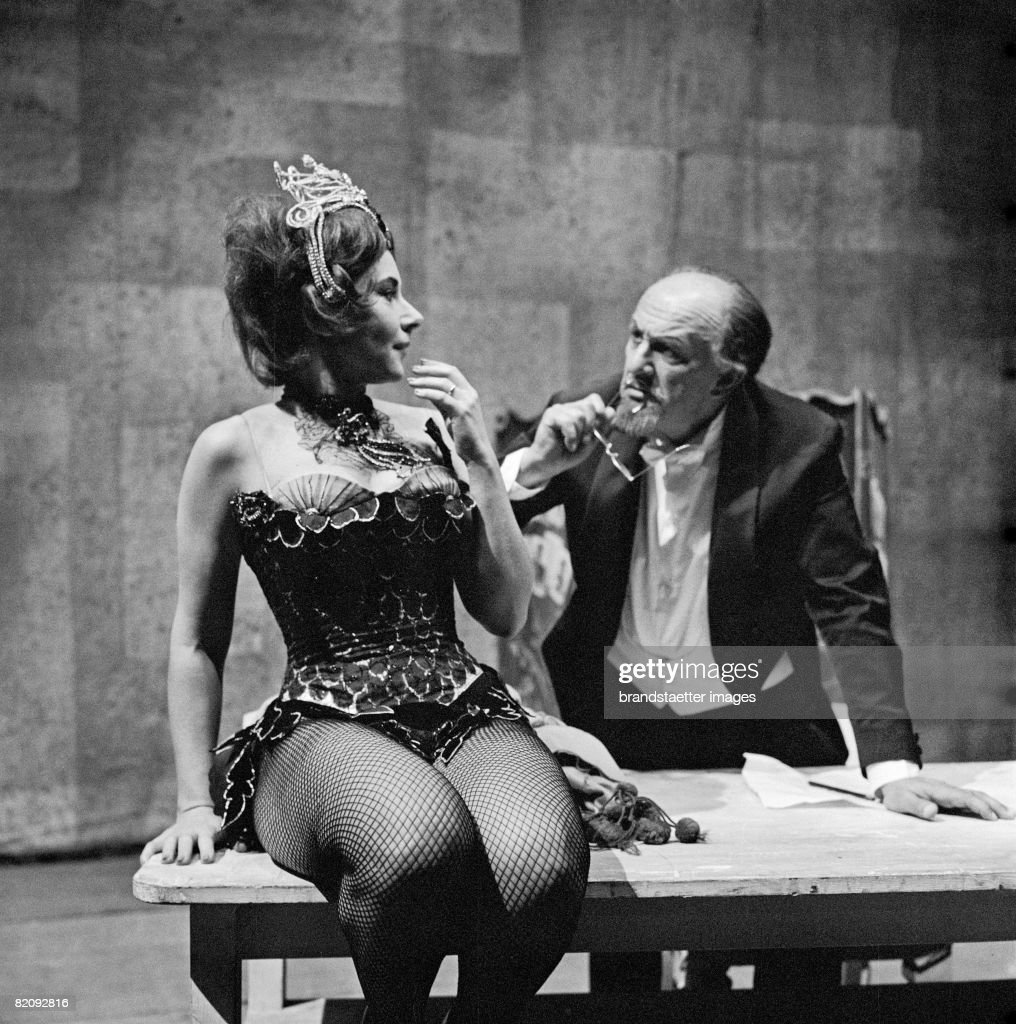
UNSPECIFIED – CIRCA 1970: Evelyn Lear and Paul Sch?ffler in Lulu by Alban Berg in the Theater an der Wien, , Photography, 1962 (Photo by Imagno/Getty Images) [Evelyn Lear und Paul Sch?ffler in “Lulu” von Alban Berg im Theater an der Wien, Photographie, 1962]

That Paul Schöffler (Dr Schön ) reminded me of Professor Unrath from Der blaue Engel is, of course, no coincidence. Nor is his resemblance to Freud.

The last scene, beginning with Geschwitz’s plea followed by images of Jack the Ripper, could just as well have been taken from one of the best Hitchcock films. Especially since Gisela Lintz, who sings the role of the Countess, looks a lot like one of the director’s beloved actresses.

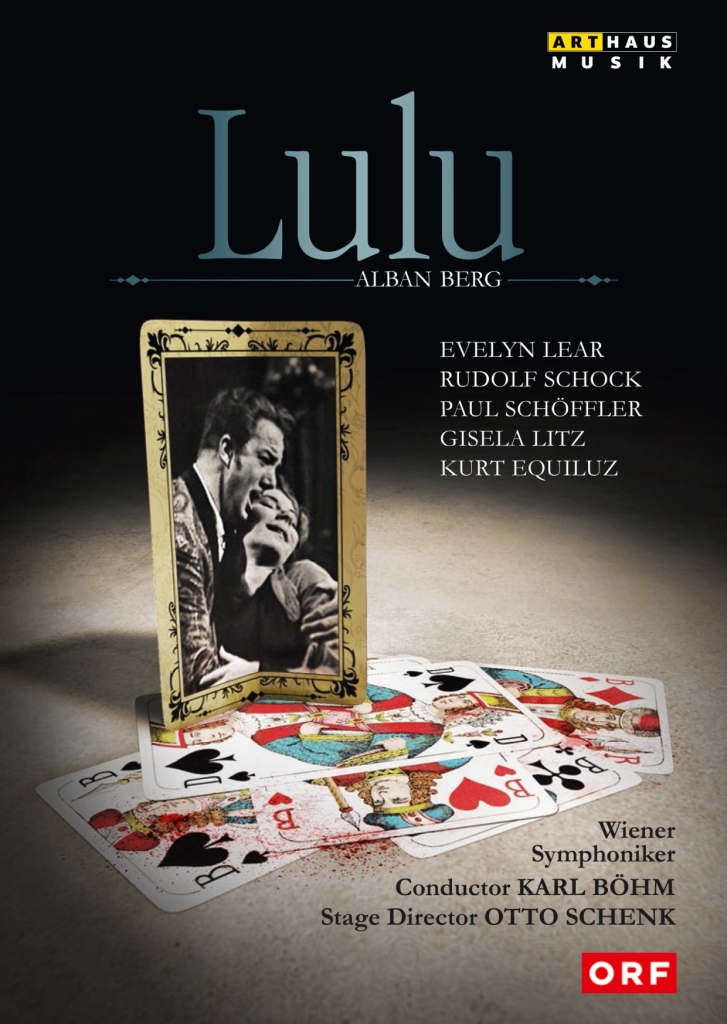
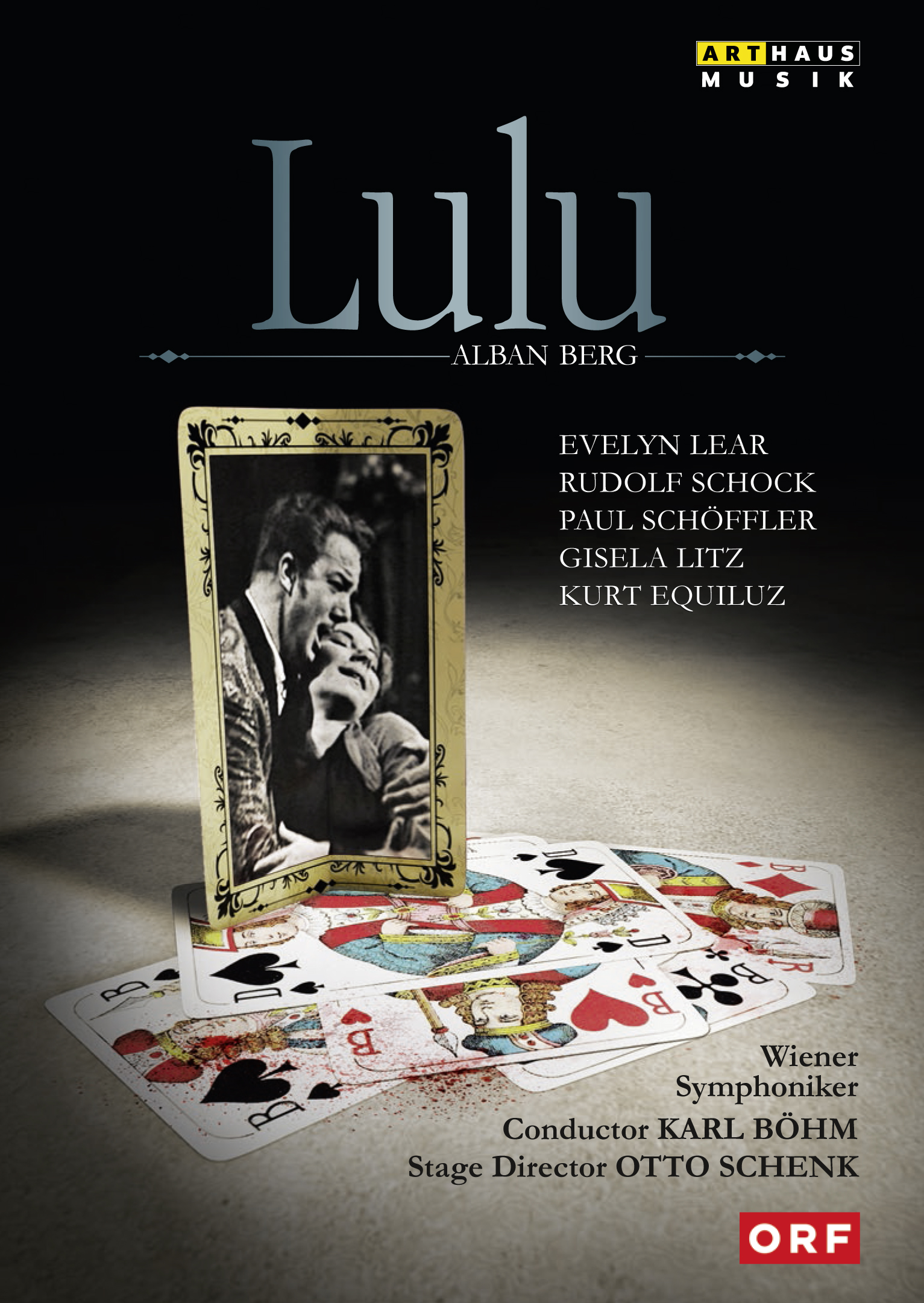
Watching Karl Böhm conducting is also extremely exciting. I have never seen him gesticulating so violently. An absolute must (Arthaus Musik 101 687).

TANNHAUSER
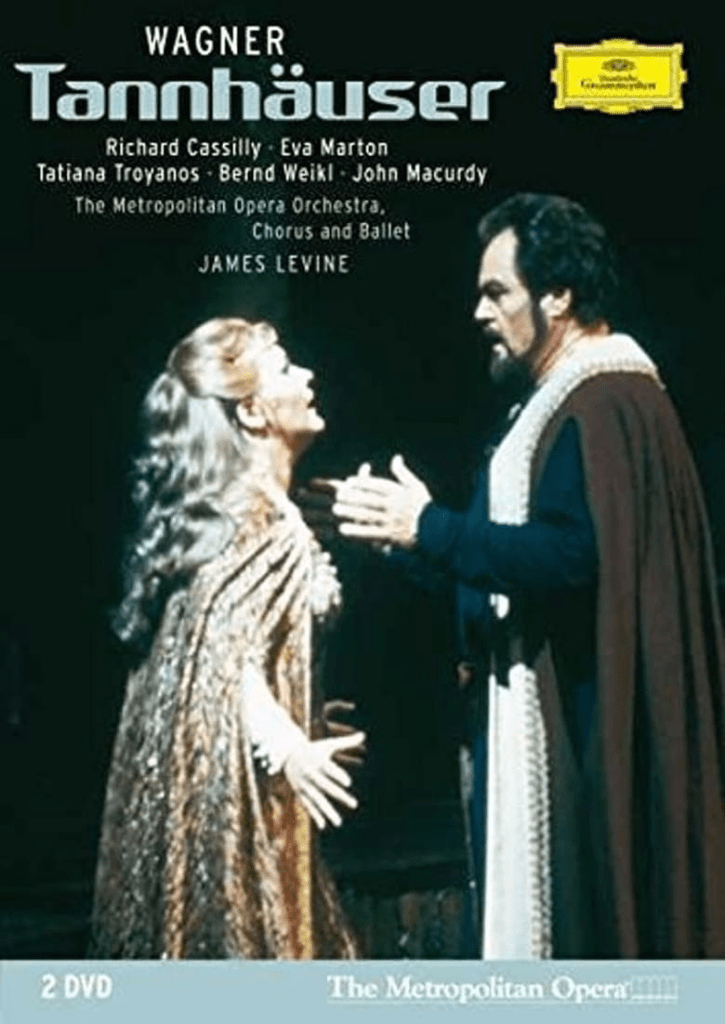


Otto Schenk’s insanely beautiful 1982 production, recorded at the Metropolitan Opera in New York (DG 0734171) dates from 1977. If you like very realistic, lavish sets and ditto costumes (I do) you can have a lot of fun with this. Just about the entire Venus grotto from Schloss Neuschwanstein was recreated for the opening scene, and the ballet presents us with a truly orgasmic Bacchanal. The orchestra, conducted by James Levine, plays mostly lyrical and light, there is nothing to criticise at all.

Eva Marton is a fine Elisabeth, Tatiana Troyanos a wonderfully sensual and seductive Venus.
Bernd Weikl, one of my favourite baritones sings an irresistible Wolfram, although he messes up his great aria by trying to give his (in principle) lyrical voice too much volume, making his voice unsteady.

And although the Landgrave (John Macurdy) is really terrible, I would not have had a problem with that recording, provided … yes … provided the tenor had not been so awful. The textbook mentions “the very highest standard”, well, I’m not so sure about that. Richard Cassilly is a physically very unattractive Tannhäuser with a pinched voice and a total lack of lyricism, giving the impression of having wandered

into the wrong opera.

Goodbye Otti! We will never forget you!
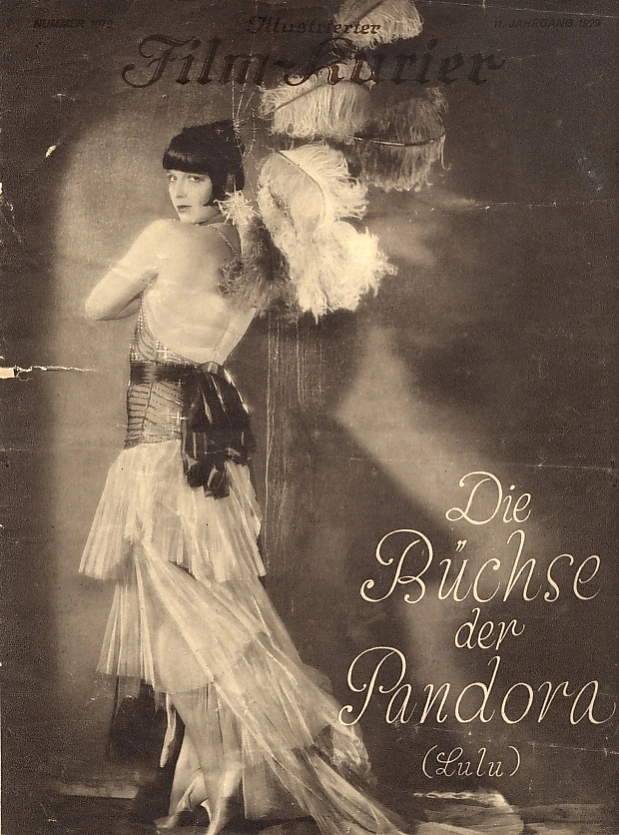


Lulu by Wedekind and Alban Berg. A mystery? A phantom?


Who is Lulu? What do we know about her? Does she really exist or is she nothing more than a fantasy?

Wiedekind als Dr.Schön en zijn vrouw Tilly als Lulu in’Der Erdgeist’ ©Bildarchiv EFWFrank

A portrait of her is painted in the first act, which then runs like a thread through the whole opera, much like the portrait of Dorian Gray. Whatever happens to Lulu, her portrait remains unchanged.

Alban Berg was quite obsessed with her character, taken from Wedekind’s plays Der Erdgeist and Die Büchse der Pandora.

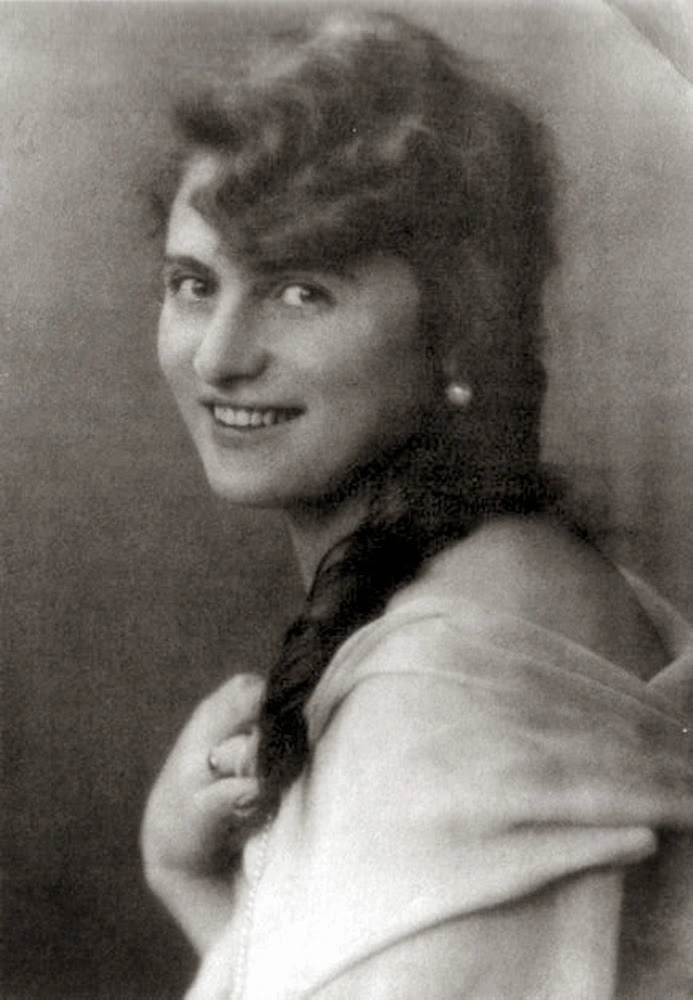
Hanna Fuchs

This may also have had to do with his personal life. She might be the personification of Czech Hanna Fuchs, Berg’s last great love. But there are also music psychologists who want to see Berg himself in Lulu

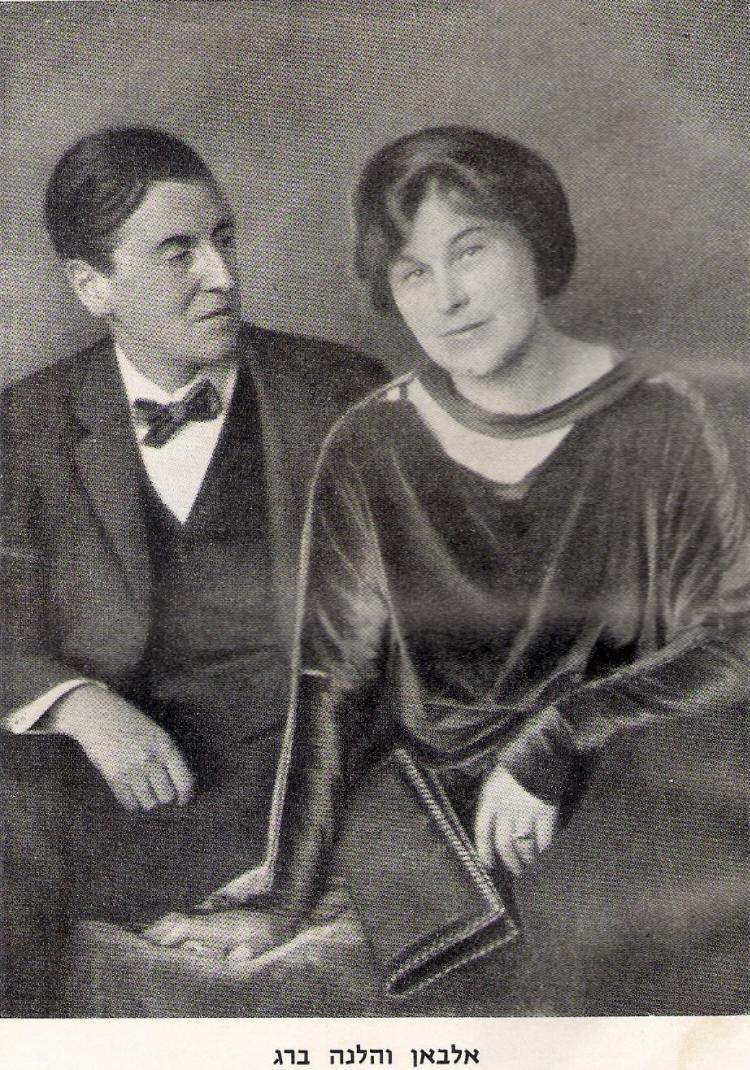
Berg and his wife

Berg did not finish his opera: when he died in 1935, the third act consisted only of sketches.

It was the Austrian composer Friedrich Cerha who orchestrated 1979’s unfinished third act; until then, only the first two acts were being performed.

CD’S

Teresa Stratas

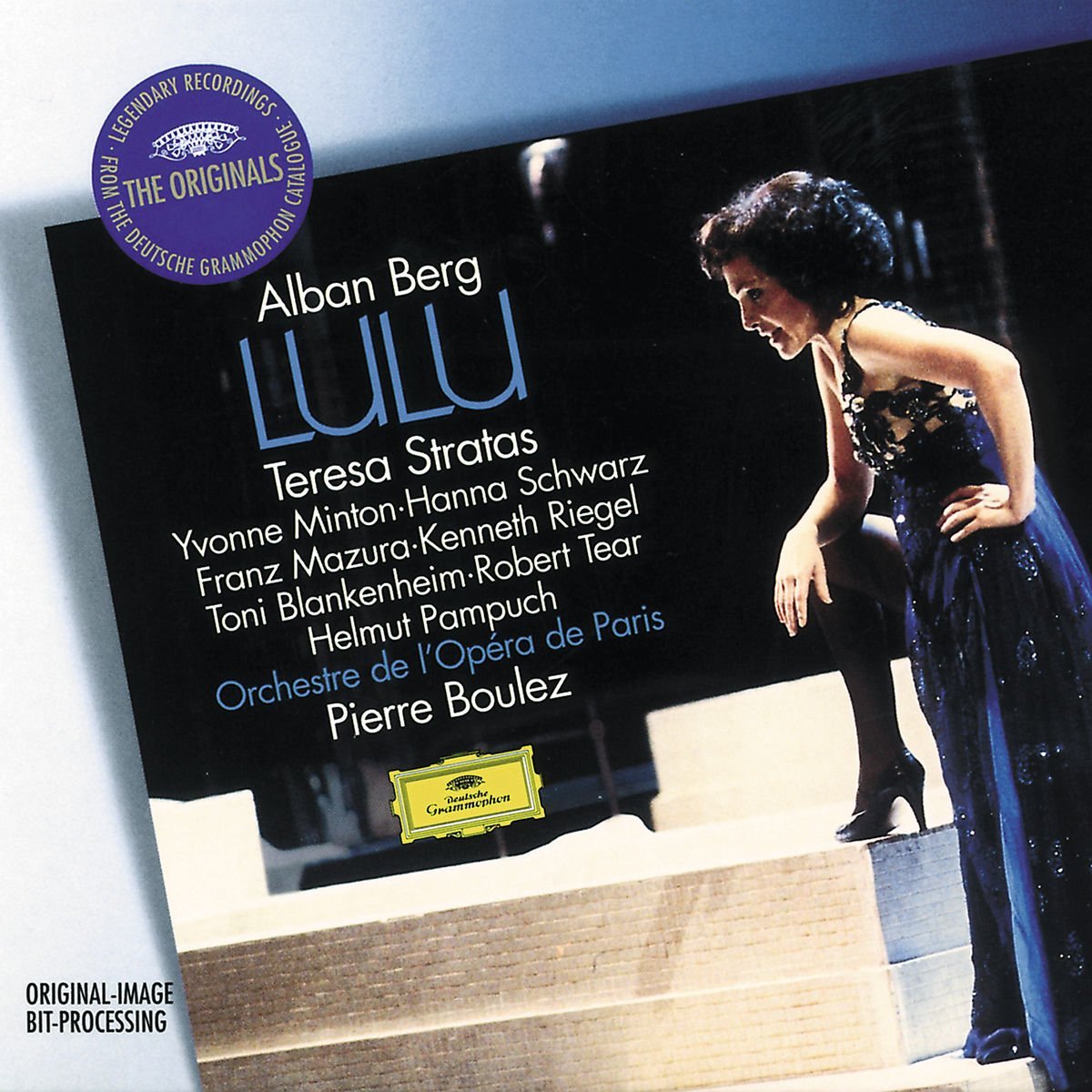
You simply cannot live without the very first recording of the complete opera with the third act, as it was finalized by Cerha. Deutsche Grammophon made a studio recording in 1979 immediately after the Paris premiere (DG 4154892).

All fantastic Lulu’s notwithstanding, no one can match Teresa Stratas. Even without the textbook, you will not only clearly hear but also really understand every word. Robert Tear is a delightfully naive painter and Franz Mazura an unrivalled Dr Schön. Kenneth Riegel’s Alwa is a matter of taste, but his empathy is just about perfect.

Pierre Boulez’s seemingly cool and analytical approach makes the drama sizzle even more.

You can also watch the complete recording with Stratas on YouTube:

Anneliese Rothenberger

The recording made by EMI in 1968 (91233028) should really not be missing from any collection. Anneliese Rothenberger is a very light, bouncy Lulu, truly an innocent girl.

Forget about Gerhard Unger (Alwa), but Toni Blankenheim’s surprisingly light and sarcastic Dr Schön (Schigolch with Boulez) is really irrisistable.

What makes the recording extra desirable is Benno Kusche in the small role of Tierbändiger. The recording itself also sounds surprisingly good.

Ilona Steingruber

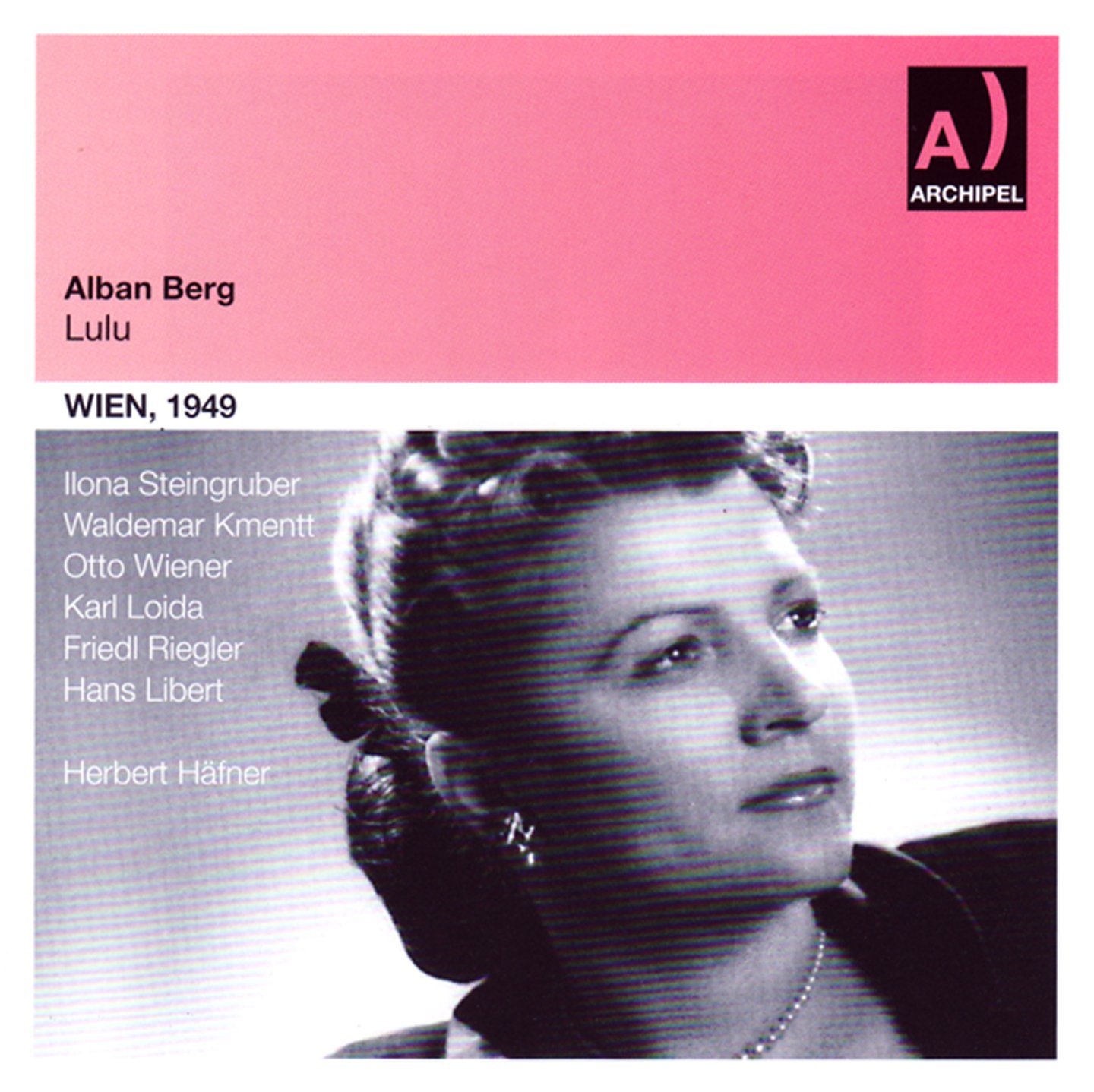
Ilona Steingruber’s name does not ring a bell these days, but in her time she was a celebrated soprano, whose repertoire included Mahler, Korngold, Strauss and Alban Berg.

On the 1949 recording directed by Herbert Häfner (including Archipel Desert Island Collection ARPCD 0540), Steingrubber sings a very sensual Lulu: erotic and exciting in her singing and remarkably childlike in the dialogues.

Otto Wiener is a very authoritarian Dr Schön and Waldemar Kmentt a not very idiomatic but very present Maler. The confrontation between the two, ‘Du hast eine halbe Million geheiratet’, is therefore particularly exciting.

DVD’S

Evelyn Lear

With her movie-star looks and angelic voice, Evelyn Lear has been referred to in the press as ‘Elisabeth Taylor meets Elisabeth Schwarzkof’. Personally, I find the American soprano, very popular in the 1960s to 1980s, much more interesting than her German colleague.

Lear was one of the greatest and best advocates of modern music. On 9 June 1962, she sang the role of Lulu in the first Austrian production of the work, at the newly reopened Theater an der Wien.

I can imagine that the posh premiere audience may have been a bit surprised to see a prima donna dressed only in a tight-fitting corset and fishnet stockings, but if so, nobody showed it.

It was directed by the then very young Otto Schenk, who followed the libretto closely. That Paul Schöffler (Dr Schön ) reminded me of Professor Unrath from Der blaue Engel is, of course, no coincidence. Nor is his resemblance to Freud.

The last scene, beginning with Geschwitz’s plea followed by images of Jack the Ripper, could just as well have been taken from one of the best Hitchcock films. Especially since Gisela Lintz, who sings the role of the Countess, looks a lot like one of the director’s beloved actresses.

Watching Karl Böhm conducting is also extremely exciting. I have never seen him gesticulating so violently. An absolute must (Arthaus Musik 101 687).

Julia Migenes


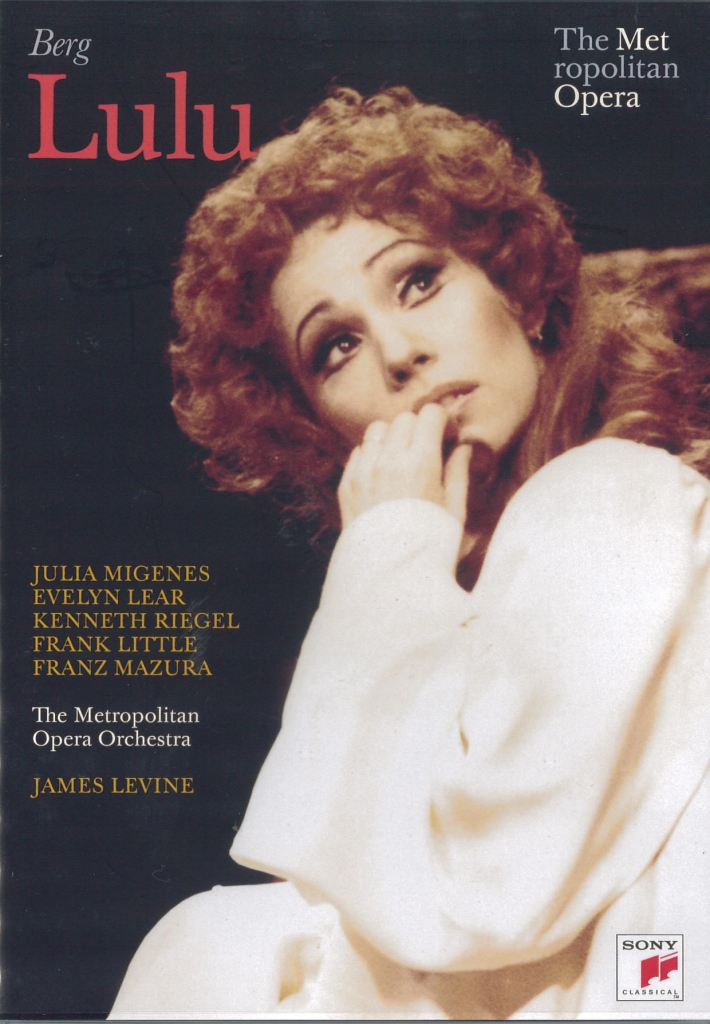
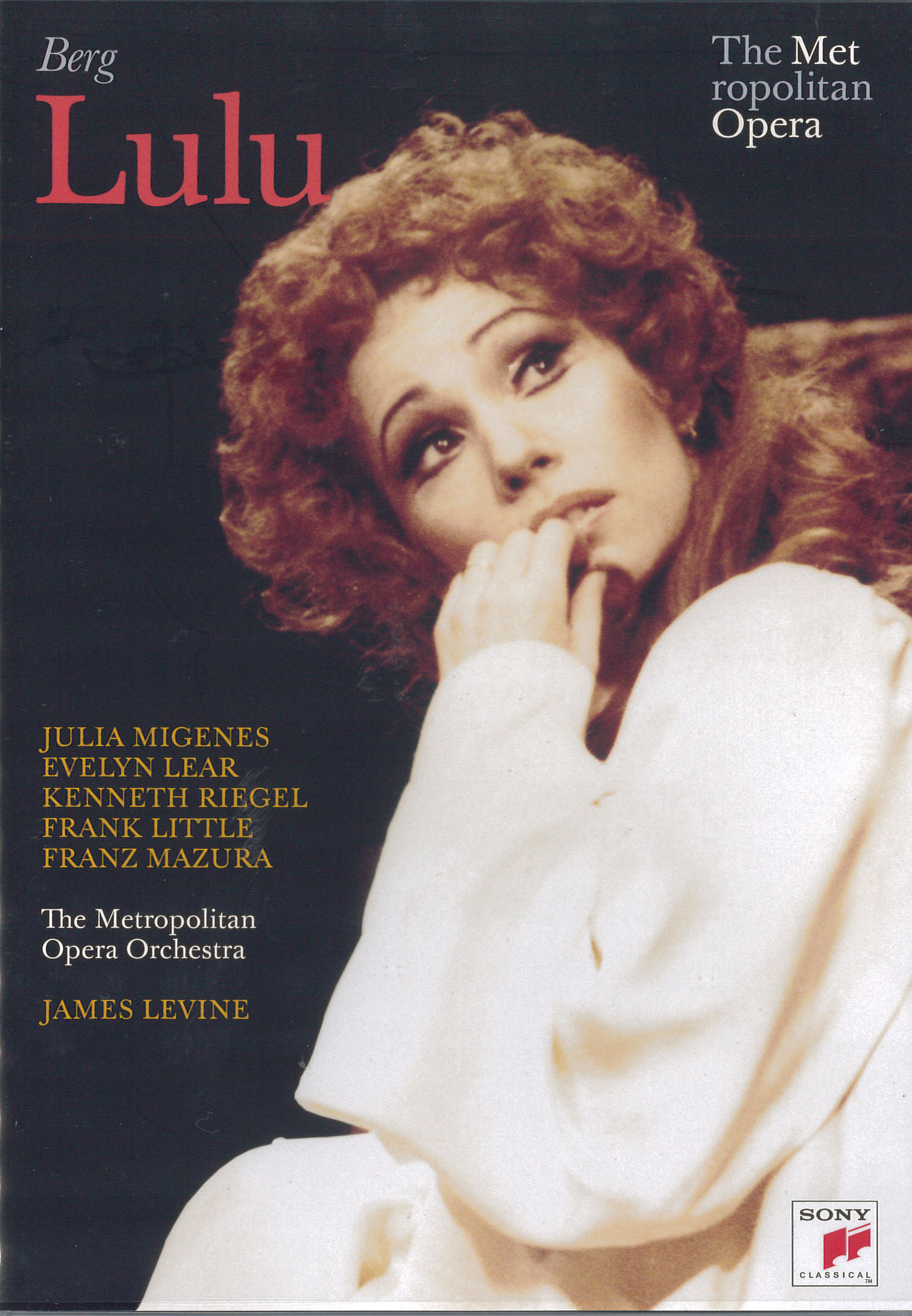
I have never understood why Julia Migenes wasn’t allowed to sing ‘real’ operas more often. She was a big star on Broadway and she triumphed in several musical films, but to my knowledge, apart from Lulu, she has performed very few other opera roles on the stage. Both her appearance and acting are so formidable that one can readily forgive her for not always singing cleanly.

Franz Mazura is a phenomenal Dr Schön. In the scene where he writes the farewell letter to his fiancée, you can almost smell his sweat. What a performanc

As Geschwitz, the now older but still gorgeous Evelyn Lear is convincing in every way. John Dexter’s very fine production was recorded at the Metropolitan Opera in 1980 (Sony 88697910099).

The complete recording can be viewed here:

https://www.operaonvideo.com/lulu-met-1985-levine-migenes-mazura-riegel-lear/

Agneta Eichenholz

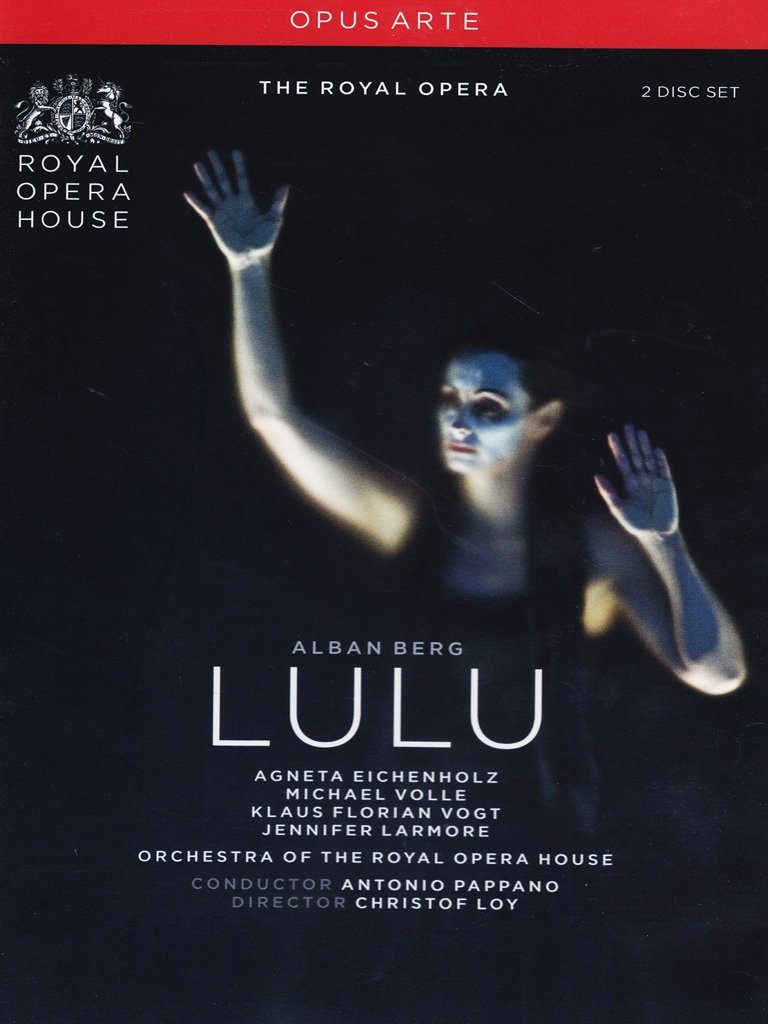
This totally unadorned production by Christof Loy was recorded at London’s Royal Opera House in June 2009. Loy has stripped the opera completely and reduced it to its pure essence, something I find very fascinating.

His minimalist approach allows all attention to be paid to the characters, their motivations and their development. Whatever you think of the direction: musically it is spot on. Antonio Pappano really works wonders with the orchestra; you will rarely hear this music so transparent and at the same time so emotionally charged.

Klaus Florian Vogt cannot really convince me as Alwa, but Jennifer Larmore is an exceptionally attractive Geschwitz. And Agneta Eichenholz (with her big eyes pretty much the reincarnation of Audrey Hepburn) is a beautiful Lulu in every way. Michael Volle is for me, after Franz Mazura, the best Dr Schön (Opus Arte OA 1034 D).

Below is an excerpt from the production:

Patrizia Petibon

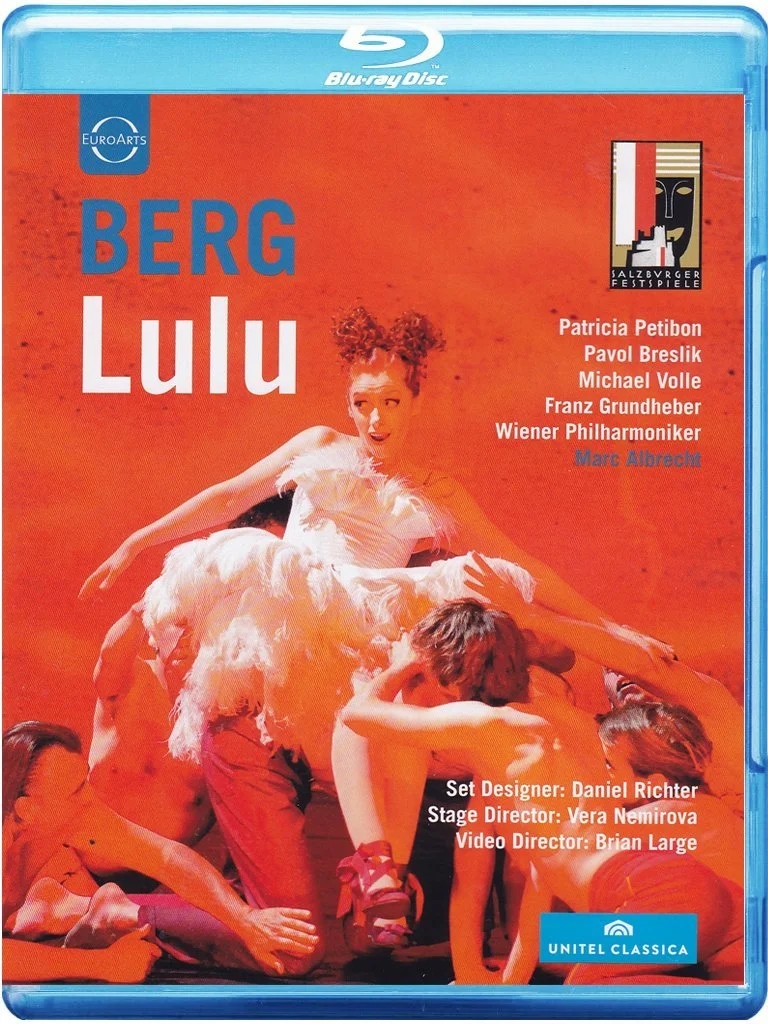
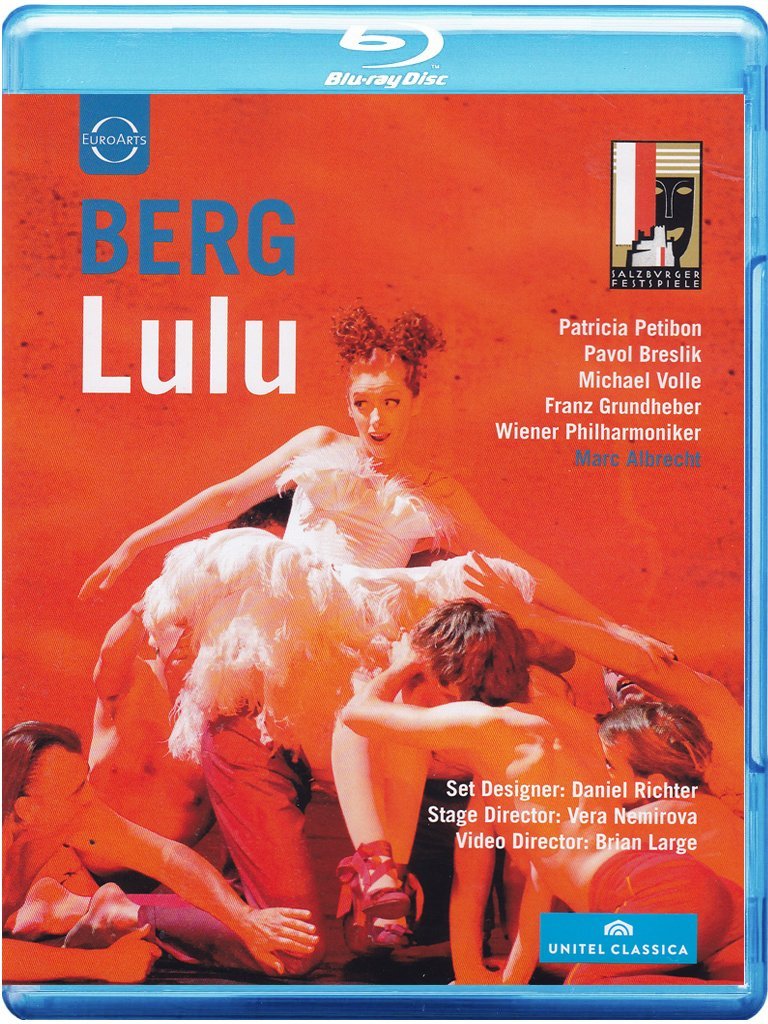
I am not a fan of Patrizia Petibon: I find her posturing is rather irritating. Her voice is also on the small side, so she often has to force it. Not conducive to the very high and difficult notes Berg has his lead singer sing. I also find her physically ill-suited for the role. She is not a ‘Lolita’, but an adult whore dressed like a little girl with ditto behaviour.

I also have trouble with Geschwitz (Tanja Ariane Paumfartner, an unknown to me), but the rest of the singers are more than excellent, with the unsurpassed Michael Volle as the inimitably good Dr Schön.

Thomas Piffka is an outstanding Alwa, unmistakably a composer who is constantly working on his opera. Pavol Breslik is a horny Maler, Grundhebber a fantastic Schigolch and Cora Burggraaf a sparkling Gymnasian.

Vera Nemirova’s production (Salzburg 2010) is colourful and highly expressionistic. Marc Albrecht is a perfect conductor for the work: under his direction, the Vienna orchestra shows its very best side (Euroarts 2072564).

Below the trailer:

Mojca Erdmann

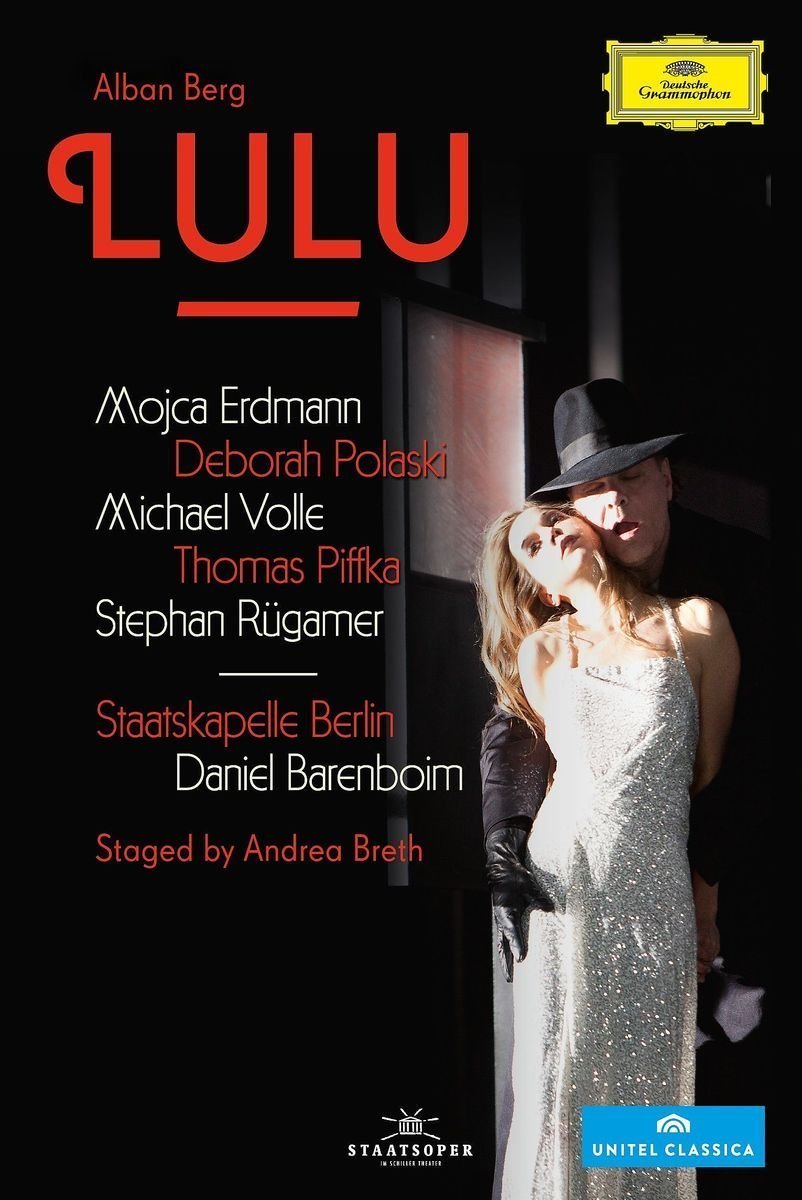
Whoever came up with the unholy idea of having an unknown and unremarkable composer (have you ever heard of David Robert Coleman?) recompose Lulu for this production in Berlin in 2012, I don’t know, but I am not at all grateful.

Only the third act was adapted, because they dared not touch the real Berg. At least… the prologue has been scrapped, which totally ruins the opera. In its place we get a man, lying down quoting Kierkegaard: “Alles Erlebte tauche ich hinab.” Well well…??

Andrea Breth, by now on my no-no list of directors shows her worst side here. The production is deadly dull. Neither the ethereally singing Mojca Erdmann, nor the scorching Deborah Polaski, nor Michael Volle or Thomas Piffka can undo this cruel murder of a masterpiece (DG 0734934).


lGevloerd door Lulu van Krzysztof Warlikowski in Brussel 2012

Schreker’s ‘Die Gezeichneten’: discography

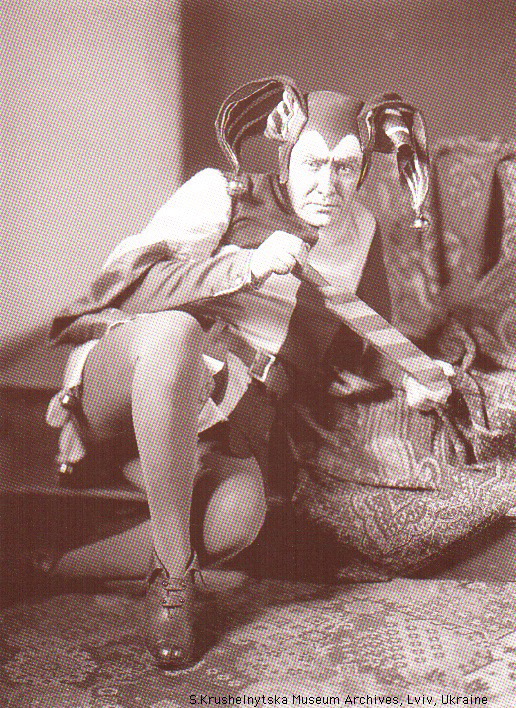
Modest Menzinsky in F. Schreker’s Die Gezeichneten
Modest Menzinsky in Die Gezeichneten in Cologne

The idea came from Zemlinsky. He wanted to compose an opera about an ugly man – his obsession – and commissioned the libretto from Schreker. After finishing his work, it was hard for Schreker to give up his text. Fortunately, Zemlinsky abandoned the opera so Schreker started to compose himself.

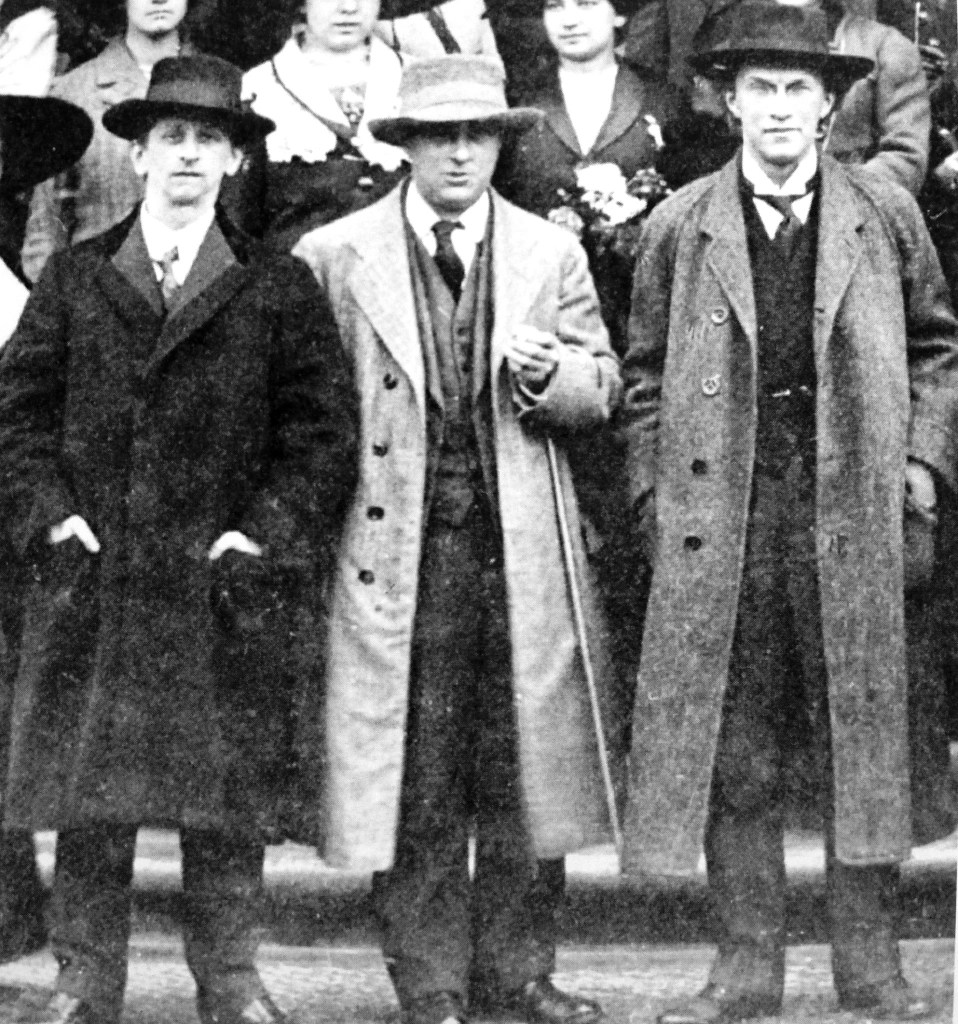
Zemlinsky, Schoenberg and Schreker in Prague 1912

Like Der Ferne Klang, perhaps his best-known work, Die Gezeichneten also deals with the search for unattainable ideals. Alviano, a deformed rich nobleman from Genoa, dreams of beauty and perfection. On an island he has ‘Elysium’ built, a place where he hopes to realize his ideals. What he doesn’t know is that the noblemen abuse his island: they are engaged in orgies, rapes and even murders.

The title of the opera is ambiguous. Not only are the main characters ‘marked’ (Alviano by his monstrous appearance and Carlotta by a deadly illness), Carlotta also makes a drawing of Alviano, in which she tries to capture his soul.

EDO DE WAART 1990

This beautiful opera, with its thousands of colours and sensual sounds (just listen to the overture, goosebumps!), is being staged more and more nowadays. In 1990 it was performed at the Saturday Matinee, with an ugly singing but very involved and therefore very vulnerable William Cochran as Alviano and a phenomenal Marilyn Schmiege as Carlotta (Marco Polo 8.223328-330).


LOTHAR ZAGROSEK 1994


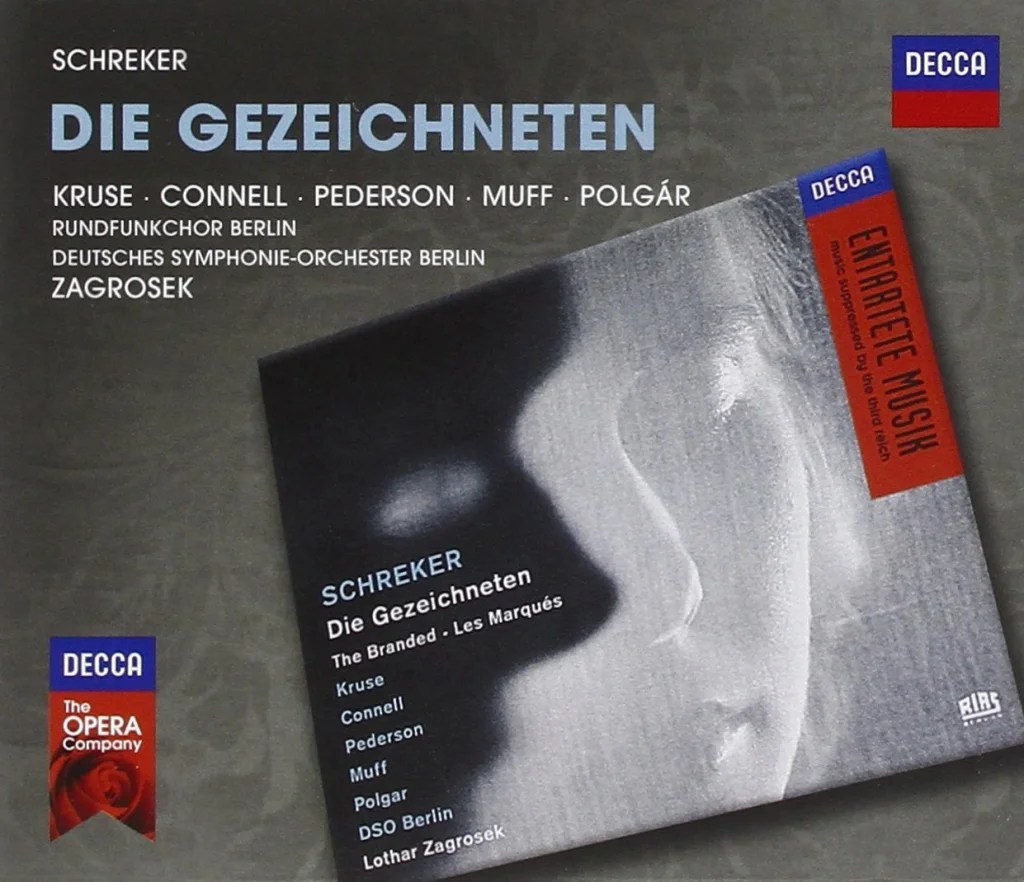
In 1994, Decca (4444422) recorded Die Gezeichneten in the ‘Entartete Musik’ series. I am not particularly enamoured with either the orchestra or the soloists, but, like Marco Polo, it is complete.


WINFRIED ZILLIG 1966


I am not very enthousiastic about Helmut Krebs in the lead role of Alviano: while his timbre is beautiful, his height is pinched. The roles of Carlotta and the sadistic seducer Tamare are perfectly cast by married couple Evelyn Lear and Thomas Stewart.

American baritone Stewart was a highly celebrated Wagner singer at the time, famous for his Wotans and his various interpretations of Amfortas. Lear was often compared to Elisabeth Schwarzkopf, I myself find her way of singing more natural and pleasant. Her beautiful appearance made her an ideal Carlotta, it is a pity that we have no footage of it.

Evelyn Lear (Carlotta) and Helmut Krebs (Alviano), scene from the second act:


However, it is the wonderful bass Franz Cras who dominates the recording in his role of Duke Adorno.
Initially the sound is on the poor side, but it seems to get better as the opera progresses. Of course, it could also be that you get used to it.


I don’t really like the Norddeutsche Rundfunk under Winfried Zillig. I miss the sensuality, but it could also be down to the recording. The score is, as was usual at the time, considerably shortened. A pity, but it is nevertheless undoubtedly an extremely important release! (Walhall WLCD 0376)

FRANZ SCHREKER 1928 (extracts)


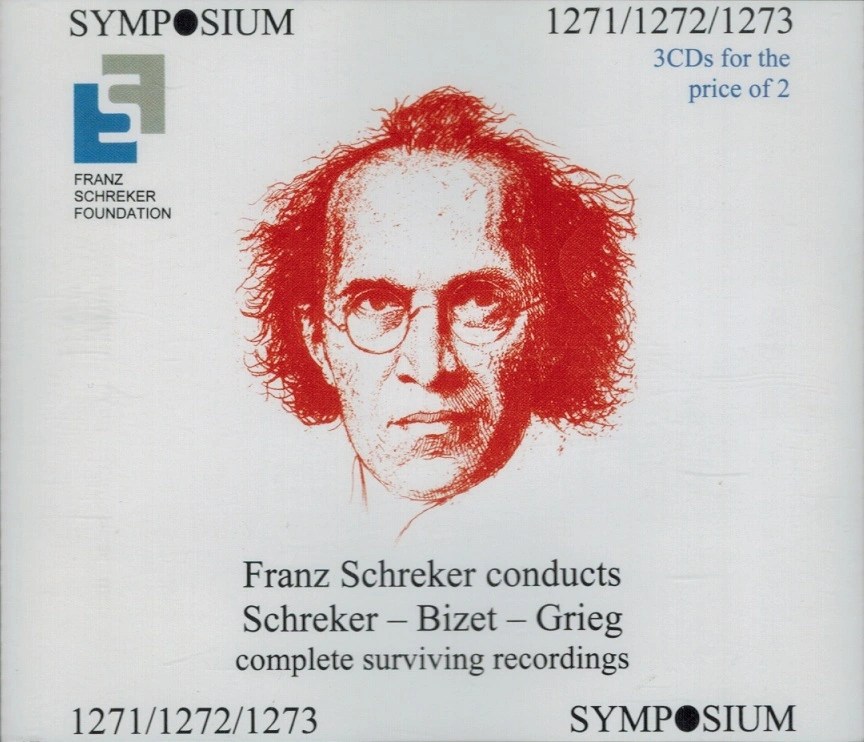
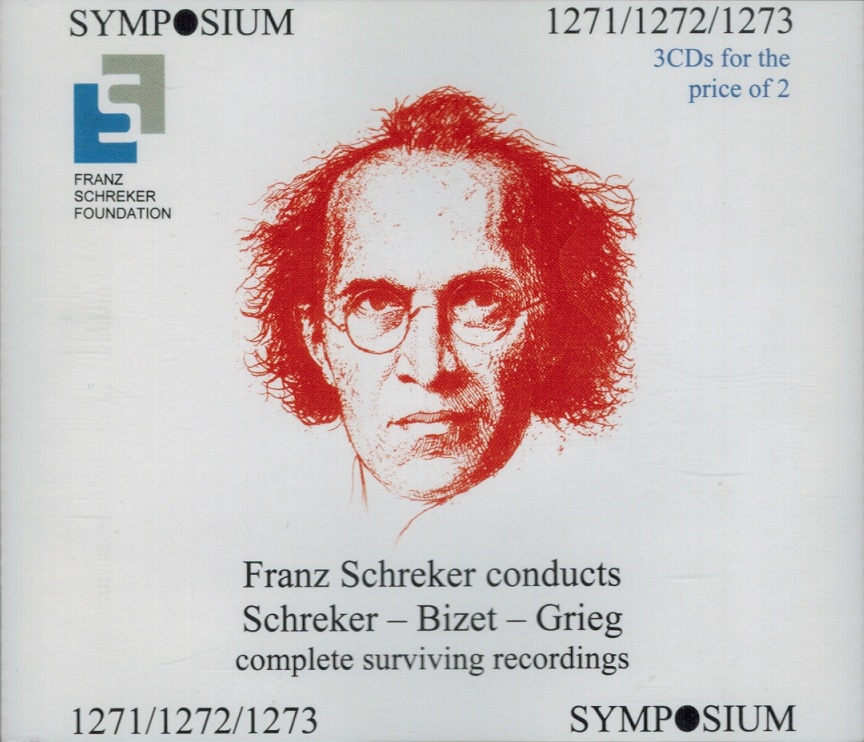
A box set of three CDs (Symposium 1271/1272/1273) on which Schreker can be admired as the conductor of his own works, among others, also includes a few excerpts from Die Gezeichneten, recorded in 1928, with his wife Maria in the role of Carlotta.


DVD: LEHNHOFF/NAGANO 2005


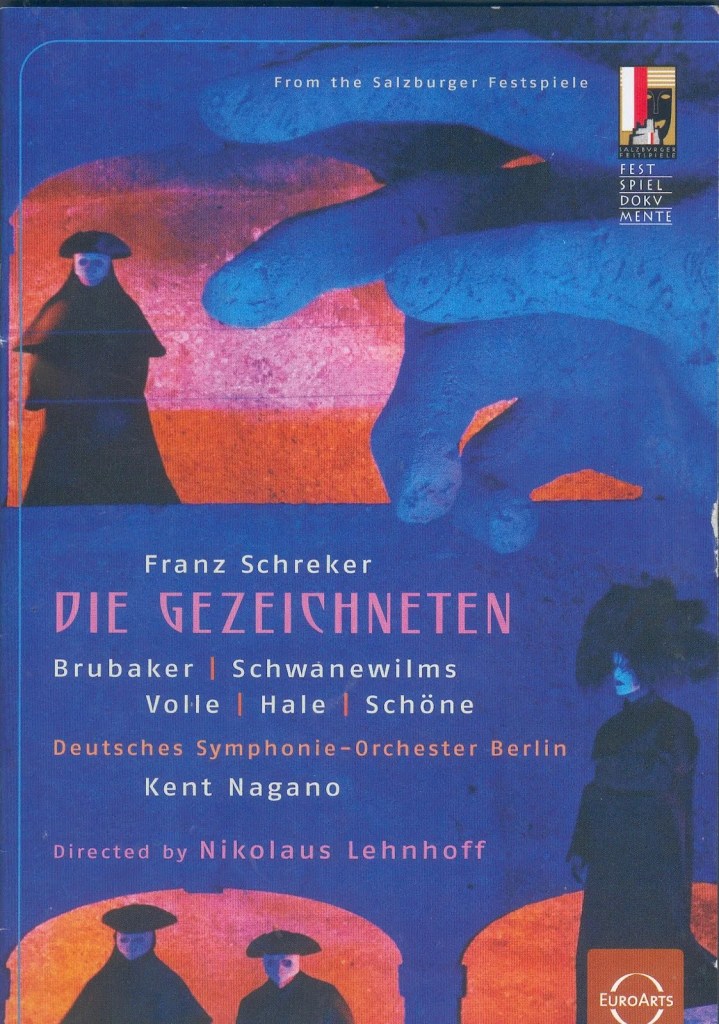
In 2005, a widely acclaimed production by Nikolaus Lehnhoff was recorded live in Salzburg and released on DVD (EuroArts 2055298). Personally, I am not unreservedly enthusiastic about it, although I must admit that it is all very spectacular and very excitingly staged.

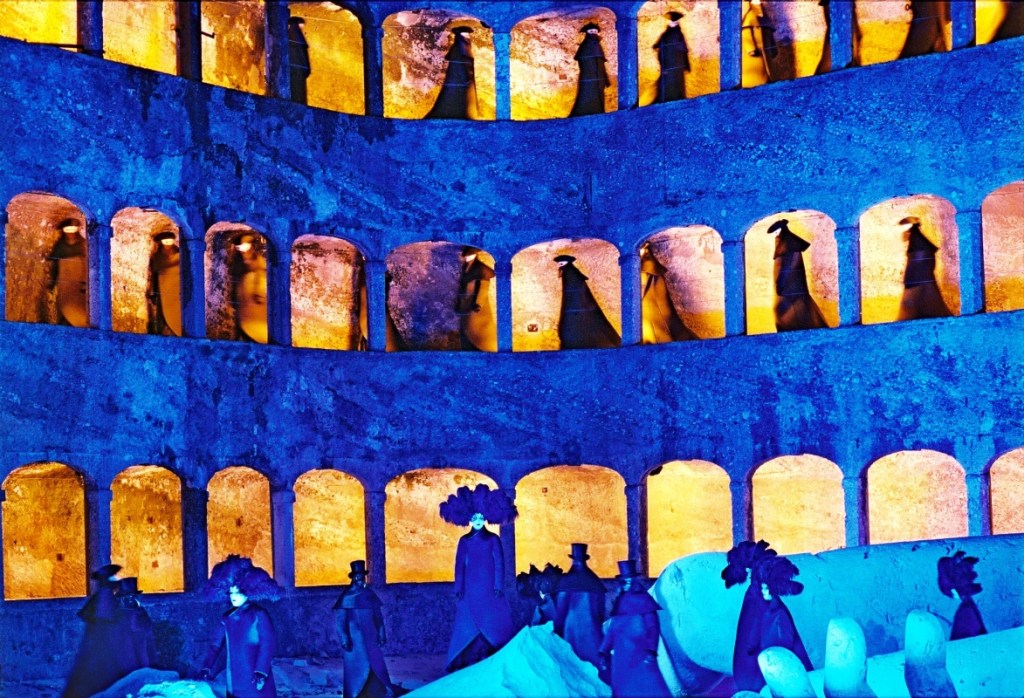
To begin with, I find the setting (the reclining body of a dead woman, the head separated from the torso, with everybody walking all over her remains) too emphatic and laden with cheap and unnecessary symbolism. I also find the final scene to be in bad taste: nowadays you need a lot more than kidnapped young virgins to shock, so Lehnhoff lets them be emphatically young.

These virgins, including Ginevra Scotti, are no more than 10 years old, so it may really be called paedophilia. Yes, that does indeed come across as shocking, but was it necessary? I’m not so sure about that.

But compared to Kušej’s horribly flat staging at De Nederlandse Opera (thankfully not recorded, but at the same time a shame because of Gabriel Sadè’s wonderfully good leading role), Lehnhoff is of course a hero.


So buy Lehnhoff anyway, because there is undeniably much to enjoy. First, there is the music itself, beautifully and very erotically played by the Berlin Deutsches Symphonie-Orchester under the direction of Kent Nagano. The visuals are beautiful, the colours (with predominantly deep blue) are lovely and the singers/actors, styled after contemporary stars like Johnny Depp and Tom Cruise, are beautiful – after all, everything here is about outer beauty, and Lehnhoff and his team manage to highlight that very clearly.


Robert Brubakker is an endearing Alviano, and although I don’t quite understand why he is put in female clothes at the beginning – he is impressive. Anne Schwanewilms is a beautiful, cool Carlotta, and Michael Volle convinces as the virile Count Tamare.

Extract from the first act:


And the whole opera:

Photos: © Bernd Uhlig  


The intoxicating sound of Franz Schreker

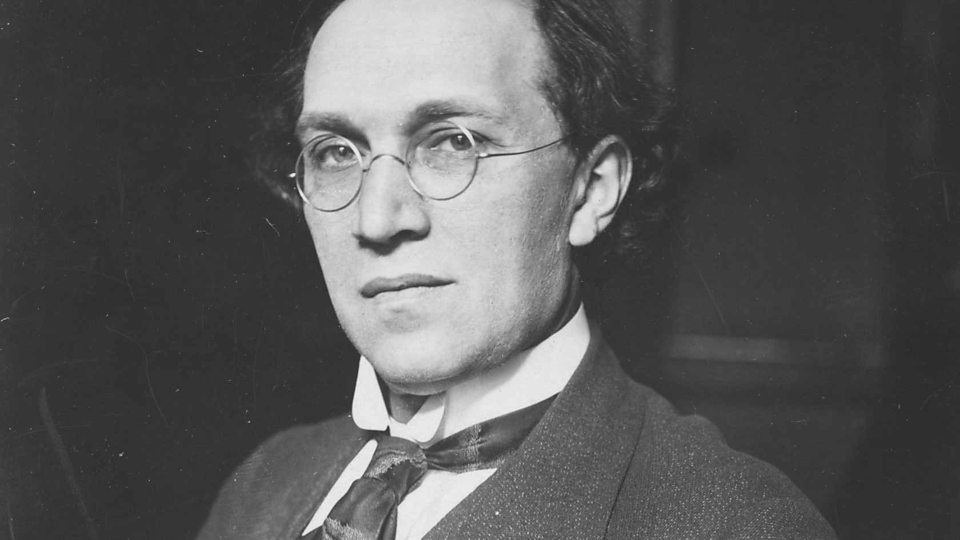
Schreker

THE SOUND

On the threshold of the twentieth century, many artists were guided in their work by the desire – and the search – for a perfect world. It had to do with the spirit of the times, among other things, and it influenced many painters, writers, poets and composers in their work. But with no other artist it was as prominent as with Franz Schreker (1878-1934). The search for ‘the’ sound dominated his entire life, he was fascinated and obsessed with it. A sound that would die of its own accord, but not really, because it had to continue to be heard – if only in your thoughts. It had to be a pure sound, but one with orgasmic desire and interwoven with visions. Intoxicating. Narcotic. In his music I really hear the perfect sound that he so desired which makes me intensely happy.

For Schreker you can wake me up in the middle of the night. The fusion of shameless emotions with undisguised eroticism and intense beauty turns me into an ‘Alice in wonderland’. I want more and more of it. Call me a junkie. I consider his operas to be the most beautiful in existence, alongside those of Puccini and Korngold.

DIE GEZEICHNETEN

Schreket noten

The idea came from Zemlinsky. He wanted to compose an opera about an ugly man – his obsession – and commissioned the libretto from Schreker. After finishing his work, it was hard for Schreker to give up his text. Fortunately, Zemlinsky abandoned the opera so Schreker started to compose himself.

Schreker _zemlinsky_schc3b6nberg_schreker1

Zemlinsky, Schoenberg and Schreker in Prague 1912

Like Der Ferne Klang, perhaps his best-known work, Die Gezeichneten also deals with the search for unattainable ideals. Alviano, a deformed rich nobleman from Genoa, dreams of beauty and perfection. On an island he has ‘Elysium’ built, a place where he hopes to realize his ideals. What he doesn’t know is that the noblemen abuse his island: they are engaged in orgies, rapes and even murders.

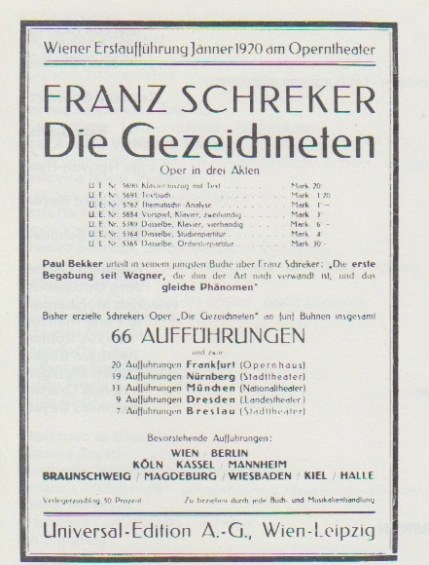
Schreker affiche

The title of the opera is ambiguous. Not only are the main characters ‘marked’ (Alviano by his monstrous appearance and Carlotta by a deadly illness), Carlotta also makes a drawing of Alviano, in which she tries to capture his soul.

schreker-1918

Alviano: photo from the premiere in Frankfurt 1918 via Green Integer Blog

This beautiful opera, with its thousands of colours and sensual sounds (just listen to the overture, goosebumps!), is being staged more and more nowadays. In 1990 it was performed at the Saturday Matinee, with an ugly singing but very involved and therefore very vulnerable William Cochran as Alviano and a phenomenal Marilyn Schmiege as Carlotta (Marco Polo 8.223328-330).

schreker-vara

ENTARTETE MUSIC

When the Nazis came to power, Schreker was labelled an ‘entartet’. His works were banned and no longer performed. In 1933 he was dismissed from all his engagements and suspended. Schreker was devastated. In December of that year he suffered a heart attack which became fatal to him. But even after the war Schreker was hardly ever performed. The same fate awaited him as (among others) Korngold, Braunfels, Goldschmidt, Zemlinsky, Waxman …. An unprecedented number of names of composers. They were once labeled ‘Entartet’ by the Nazis and banned, reviled, expelled and murdered. Forgotten. And that was not just the fault of the Nazis.

After the war, the young generation of composers did not want to know about emotions anymore. Music had to be devoid of any sentiment and subject to strict rules. Music had to become universal: serialism was born. The past was dealt with, including composers from the 1930s. It is only in the last twenty years that the once forbidden composers have regained their voices. The Saturday Matinee has played a major role in this and I thank them on my bare knees for that.

LISTENING SUGGESTIONS:

Vorspiel zu einem Drama’, a Prelude created by the composer himself for ‘Die Gezeichneten’:

Evelyn Lear (Carlotta) and Helmut Krebs (Alviano), scene from the second act:

On Spotify you can find several performances of the complete opera.

If you want to have images as well: below you will find the recording from Salzburg 2005.

Translated with http://www.DeepL.com/Translator

LULU: discografie

Lulu Pandora

Filmaffiche van Die Büchse der Pandora

Wie is Lulu? Wat weten we van haar? Bestaat ze echt of is ze niet meer dan een hersenschim?

In de eerste akte wordt een portret van haar geschilderd dat daarna als een rode draad door de opera loopt, als een soort portret van Dorian Gray. Wat er ook met Lulu gebeurt, haar portret verandert nooit.

Lulu Tilly Wedekind als Lulu und Frank Wedekind als Dr. Schön

Frank Wiedekind als Dr.Schön en zijn vrouw Tilly als Lulu in’Der Erdgeist’ ©Bildarchiv EFW

Alban Berg was behoorlijk door haar personage, afkomstig uit Wedekinds toneelstukken Der Erdgeist en Die Büchse der Pandora, geobsedeerd. Dat had wellicht ook met zijn persoonlijke leven te maken. Zij zou de personificatie van de Tsjechische Hanna Fuchs, Bergs laatste grote liefde, kunnen zijn. Maar er zijn ook muziekpsychologen die in Lulu Berg zelf willen zien…

Lulu Hanna_Werfel_Fuchs_Robettin

Hanna Fuchs

Lulu Alban&HeleneBerg

Alban Berg met zijn vrouw Helena. Hun huwelijk gold als voorbeeldig

Berg heeft zijn opera niet afgemaakt: toen hij in 1935 stierf, bestond de derde akte alleen uit sketches. Het was de Oostenrijkse componist Friedrich Cerha die 1979 de onvoltooid gebleven derde akte instrumenteerde, tot die tijd werden alleen de eerste twee akten opgevoerd.

Hieronder een selectie van de beschikbare opnames:

CD’s:

Teresa Stratas

Lulu Stratas

Waar u absoluut niet zonder kunt, is de allereerste opname van de complete opera met de door Cerha nagecomponeerde derde akte. Deutsche Grammophon maakte in 1979 direct na de Parijse première een studio-opname (DG 4154892).

Alle fantastische Lulu’s ten spijt, niemand kan zich met Teresa Stratas meten. Zelfs zonder het tekstboekje erbij kun je ieder woord niet alleen verstaan maar ook begrijpen.

Robert Tear is een heerlijk naïeve schilder en Franz Mazura een ongeëvenaarde Dr. Schön. De Alwa van Kenneth Riegel is een kwestie van smaak, maar zijn inleving is zowat volmaakt.

De ogenschijnlijk koele en analytische benadering van Pierre Boulez laat het drama nog meer zinderen.


Op YouTube is de complete opname op video te vinden:

Anneliese Rothenberger

Lulu Rothenberger

De opname die in 1968 door EMI is gemaakt (91233028) mag eigenlijk in geen verzameling ontbreken. Anneliese Rothenberger is een heel erg lichte, springerige Lulu, echt een onschuldig meisje.

Vergeet Gerhard Unger (Alwa), maar de verrassend lichte en sarcastische Dr. Schön van Toni Blankenheim (Schigolch bij Boulez) is werkelijk niet te versmaden.

Wat de opname extra begerenswaardig maakt, is Benno Kusche in de kleine rol van Tierbändiger. Ook de opname zelf klinkt verrassend goed.


Ilona Steingruber

Lulu Steingruber

Bij de naam van Ilona Steingrubber rinkelt er tegenwoordig geen belletje, maar in haar tijd was ze een gevierd sopraan, met op haar repertoire onder anderen Mahler, Korngold, Strauss en Alban Berg.

Op de door Herbert Häfner gedirigeerde opname uit 1949 (Archipel Desert Island Collection ARPCD 0540) zingt Steingrubber een zeer sensuele Lulu: erotisch en opwindend in haar zang en opmerkelijk kinderlijk in de dialogen.

Otto Wiener is een zeer autoritaire Dr. Schön en Waldemar Kmentt een niet echt idiomatische maar wel zeer aanwezige Maler. De confrontatie tussen de twee, ‘Du hast eine halbe Million geheiratet’, is dan ook bijzonder spannend.


DVD’S

Evelyn Lear

Lulu-Lear

Met haar filmsterrenlook en stem als een engel werd Evelyn Lear in de pers aangeduid als ‘Elisabeth Taylor meets Elisabeth Schwarzkof’. Zelf vind ik de in de jaren ’60 tot ’80 zeer populaire Amerikaanse sopraan veel interessanter dan haar Duitse collega.

Lear was één van de grootste en beste pleitbezorgsters van de moderne muziek. Op 9 juni 1962 zong ze de rol van Lulu in de eerste Oostenrijkse productie van het werk, in het net heropende Theater an der Wien. Ik kan me indenken dat het chique premièrepubliek moeite had met de enkel in nauwsluitend korset en netkousen geklede prima donna, maar als dat zo was, dan lieten ze het niet merken.

De regie lag in handen van de toen nog piepjonge Otto Schenk, die het libretto op de voet volgde. Dat Paul Schöffler (Dr. Schön) mij aan professor Unrath uit Der blaue Engel deed denken, is natuurlijk geen toeval. Net zo min als zijn gelijkenis met Freud.

De laatste scène, beginnend met de smeekbede van Geschwitz, gevolgd door de beelden van Jack the Ripper, kon net zo goed uit één van de beste Hitchcocks zijn overgenomen. Zeker ook omdat Gisela Lintz, die de rol van de gravin zingt, veel weg heeft van één van de geliefde actrices van de regisseur.

Het is ook buitengewoon spannend om naar het dirigeren van Karl Böhm te kijken. Zo heftig gebarend heb ik hem nog nooit gezien. Een absolute must (Arthaus Musik 101 687).

Hieronder de trailer:

Julia Migenes

Lulu-Migenes

Nooit heb ik begrepen waarom men Julia Migenes niet vaker ‘echte’ opera’s liet zingen. Ze was een grote ster op Broadway en schitterde in verschillende muziekfilms, maar buiten Lulu heeft ze naar mijn weten maar weinig andere operarollen op de planken gebracht. Zowel haar verschijning als haar acteren zijn zo formidabel dat men het haar vergeeft dat ze niet altijd zuiver zingt.

Franz Mazura is een fenomenale Dr. Schön. In de scène waarin hij de afscheidsbrief aan zijn verloofde schrijft, kun je bijna zijn zweet ruiken. Wat een prestatie!

Als Geschwitz maakt de inmiddels ouder geworden maar nog steeds in alle opzichten prachtige Evelyn Lear haar opwachting.

De zeer fraaie productie van John Dexter werd in 1980 in de Metropolitan Opera opgenomen (Sony 88697910099). Op de website van JPC zijn fragmenten uit de productie te bekijken.

Agneta Eichenholz

Lulu-Eichenholz

Deze kale productie van Christof Loy werd in juni 2009 in het Londense Royal Opera House opgenomen. Loy heeft de opera helemaal gestript en teruggebracht tot de pure essentie, iets wat ik zeer fascinerend vind. Door zijn minimalistische aanpak kan alle aandacht besteed worden aan de personages, hun beweegredenen en hun ontwikkeling.

Wat u ook van de regie denkt: muzikaal zit het snor. Antonio Pappano doet met het orkest werkelijk wonderen; zo transparant en tegelijkertijd zo emotioneel geladen hoor je de muziek zelden.

Klaus Florian Vogt kan mij als Alwa niet echt overtuigen, maar Jennifer Larmore is een buitengewoon aantrekkelijke Geschwitz. En Agneta Eichenholz (met haar grote ogen zowat de reïncarnatie van Audrey Hepburn) is een in alle opzichten mooie Lulu. Michael Volle is voor mij, na Franz Mazura de beste dr.Schön Schön (Opus Arte OA 1034 D).

Hieronder een fragment uit de productie:

Patrizia Petibon

Lulu-Betibon

Ik ben geen fan van Patrizia Petibon: ik vind haar vaak aanstellerig. Haar stem is ook aan de kleine kant, waardoor ze vaak moet forceren. Niet bevorderlijk voor de zeer hoge en moeilijke noten die Berg zijn hoofdrolzangeres laat zingen. Ook fysiek vind ik haar niet bij de rol passen. Ze is geen ‘Lolita’, maar een als een klein meisje uitgedoste volwassen hoer met dito gedrag.

Ik heb ook moeite met Geschwitz (de mij onbekende Tanja Ariane Paumfartner), maar de rest van de zangers zijn meer dan excellent, met de onvolprezen Michael Volle als onnavolgbaar goede Dr. Schön.

Thomas Piffka is een voortreffelijke Alwa, onmiskenbaar een componist die continu aan zijn opera bezig is. Pavol Breslik is een geile Maler, Grundhebber een fantastische Schigolch en Cora Burggraaf een sprankelende Gymnasiast.

De productie van Vera Nemirova (Salzburg 2010) is kleurrijk en zeer expressionistisch. Marc Albrecht is voor het werk een perfecte dirigent: het Weense orkest laat zich onder zijn leiding van zijn allerbeste kant horen (Euroarts 2072564).

Hieronder de trailer:

Mojca Erdmann

Lulu Erdman

Wie op het onzalige idee is gekomen om voor deze productie in Berlijn in 2012 een onbekende en onbetekende componist (hebt u ooit van David Robert Coleman gehoord?) Lulu opnieuw te laten componeren, weet ik niet, maar ik denk het hem of haar niet in dank af.

Alleen de derde akte is aangepast, want aan de echte Berg durfde men niet komen. Althans… de proloog is wel geschrapt, waardoor de opera naar de sodemieter is geholpen. Daarvoor in de plaats krijgen we een man, die liggend Kierkegaard citeert: “Alles Erlebte tauche ich hinab.” Ja ja…

Andrea Breth, inmiddels op mijn ‘no-no-lijstje’ van regisseurs laat zich hier van haar slechtste kant zien. De productie is dodelijk saai. Noch de etherisch zingende Mojca Erdmann, noch de verschroeiende Deborah Polaski, noch Michael Volle of Thomas Piffka kunnen er iets aan doen dat hier een meesterwerk om zeep wordt geholpen (DG 0734934).

Franz Schreker: De Gezeichneten. Discografie

schreker-1918

Alviano: foto uit de première in Frankfurt 1918 via Green Integer Blog

Het idee kwam van Zemlinsky: hij wilde een opera maken over een lelijke man en het libretto bestelde hij bij Schreker. Eenmaal klaar met zijn werk viel het Schreker zwaar om afstand te doen van zijn tekst. Gelukkig zag Zemlinsky van de opera af en zo sloeg Schreker zelf aan het componeren.

Net als Der Ferne Klang, gaat ook De Gezeichneten over de zoektocht naar de onbereikbare idealen. Alviano, een mismaakte rijke edelman uit Genua droomt van schoonheid en volmaaktheid. Op een eiland laat hij “Elysium” bouwen, een plek waar hij zijn idealen hoopt te verwezenlijken. Wat hij niet weet, is dat de edelen zijn eiland misbruiken: zij houden zich er bezig met orgieën, verkrachtingen en zelfs met moorden.

De titel van de opera is dubbelzinnig. Niet alleen zijn de hoofdpersonen ‘getekend’ (Alviano door zijn monsterlijke uiterlijk en Carlotta door een dodelijke ziekte), ook maakt Carlotta een tekening van Alviano, waarin zij zijn ziel probeert te vangen

CD’S

EDO DE WAART 1990

schreker-vara

Deze prachtige opera, rijk aan duizenden kleuren en zwoele klanken (luister alleen maar naar de ouverture, kippenvel!) wordt de laatste tijd steeds vaker op de planken gebracht. In 1990 werd het  werk onder leiding van Edo de Waart in de Matinee uitgevoerd, met een lelijk zingende, maar zeer betrokken en daardoor zeer kwetsbare William Cochran als Alviano en een fenomenale Marilyn Schmiege als Carlotta (Marco Polo 8.223328-330).


LOTHAR ZAGROSEK 1994

schreker-decca

In 1994 heeft Decca (4444422)  De Gezeichneten in de serie ‘Entartete Musik’ opgenomen. Hier ben ik niet zo gecharmeerd van, noch van het orkest, noch van de solisten, maar het is in ieder geval helemaal compleet.


WINFRIED ZILLIG 1966

schreker-walhall

Ik ben niet kapot van Helmut Krebs in de hoofdrol van Alviano: zijn timbre is weliswaar mooi, maar zijn hoogte is geknepen. De rollen van Carlotta en de sadistische verleider Tamare zijn door het echtpaar Evelyn Lear en Thomas Stewart perfect bezet.

De Amerikaanse bariton Stewart was in die tijd een zeer gevierde Wagnerzanger, beroemd om zijn Wotans en Amfortassen. Lear werd vaak vergeleken met Elisabeth Schwarzkopf, zelf vind ik haar manier van zingen natuurlijker en aangenamer. Haar prachtige verschijning maakte haar een ideale Carlotta, het is jammer dat wij er geen beelden van hebben. Het is echter de prachtige bas Franz Cras die de opname domineert in zijn rol van hertog Adorno.

Het geluid vind ik aanvankelijk aan de povere kant, maar het lijkt beter te worden naarmate de opera vordert. Het kan natuurlijk ook dat je eraan went. Het Noord-Duitse radio-orkest onder Winfried Zillig vind ik niet echt geweldig. Ik mis de zinnelijkheid, maar het kan ook aan de opname liggen.

De partituur is, zoals toen gebruikelijk was, behoorlijk ingekort. Jammer, maar het is niettemin een zonder meer bijzonder belangrijke uitgave! (Walhall WLCD 0376)


FRANZ SCHREKER 1928 (fragmenten)

schreker-eigen

Op een box met drie cd’s (Symposium 1271/1272/1273) waarop Schreker te bewonderen valt als dirigent van onder meer zijn eigen werk, staan ook een paar fragmenten uit Die Gezeichneten, opgenomen in 1928, met zijn vrouw Maria in de rol van Carlotta.

schreker_wife

Franz en Maria Schreker

DVD:

LEHNHOFF/NAGANO 2005

schreker-dvd1

In 2005 werd in Salzburg een alom bejubelde productie van Nikolaus Lehnhoff live opgenomen en op DVD (EuroArts 2055298) uitgebracht. Persoonlijk ben ik er niet onverdeeld enthousiast over, al moet ik toegeven dat het allemaal zeer spectaculair en zeer spannend is geënsceneerd.

Om te beginnen vind ik het decor (het liggende lichaam van een dode vrouw, het hoofd gescheiden van de romp, waarover volop gewandeld word) te nadrukkelijk aanwezig en beladen met goedkope en overbodige symboliek. Ook de eindscène vind ik getuigen van slechte smaak: tegenwoordig heb je heel wat meer nodig dan ontvoerde jonge maagden om te choqueren, dus Lehnhoff laat ze nadrukkelijk jong zijn. Deze maagden, inclusief Ginevra Scotti, zijn niet ouder dan 10 jaar oud, het antwoord van de regisseur heet dus pedofilie. Ja, dat komt inderdaad schokkend over, maar was het nodig? Daar ben ik niet zo zeker van.

Maar in vergelijking met de afschuwelijk platte enscenering van Kušej bij De Nederlandse Opera (gelukkig niet opgenomen, wat wel zonde is van de geweldig goede hoofdrol van Gabriel Sadè) is Lehnhoff natuurlijk een held.

Dus toch maar Lehnhoff aanschaffen, want er valt ontegenzeggelijk veel te genieten. Ten eerste is er de muziek zelf, prachtig en zeer erotisch gespeeld door het Berlijnse Deutsches Symphonie-Orchester onder leiding van Kent Nagano. De beelden zijn mooi, de kleuren (met overheersend diep blauw) zijn mooi en de zangers/acteurs, gestileerd naar hedendaagse sterren als Johnny Depp en Tom Cruise, zijn mooi – alles tenslotte draait hier om de uiterlijke schoonheid, en dat weet Lehnhoff met zijn team mooi te benadrukken.

Robert Brubakker is een aandoenlijke Alviano, en al snap ik niet helemaal waarom hij in het begin in vrouwelijke kleren wordt gestoken – indrukwekkend is het wel. Anne Schwanewilms is een mooie, koele Carlotta, en Michael Volle overtuigt als de viriele graaf Tamare.

Trailer van de opname:

Scènes met Robert Brubakker:

De bedwelmende klank van Franz Schreker

DER SCHATZGRÄBER: Amsterdam september 2012

SCHREKER: Irrelohe, Der Schmied von Gent en nog meer…

DER FERNE KLANG

SCHÖNE WELT. Anne Schwanewilms

‘Zij was toch de mijne, of was zij het niet’?