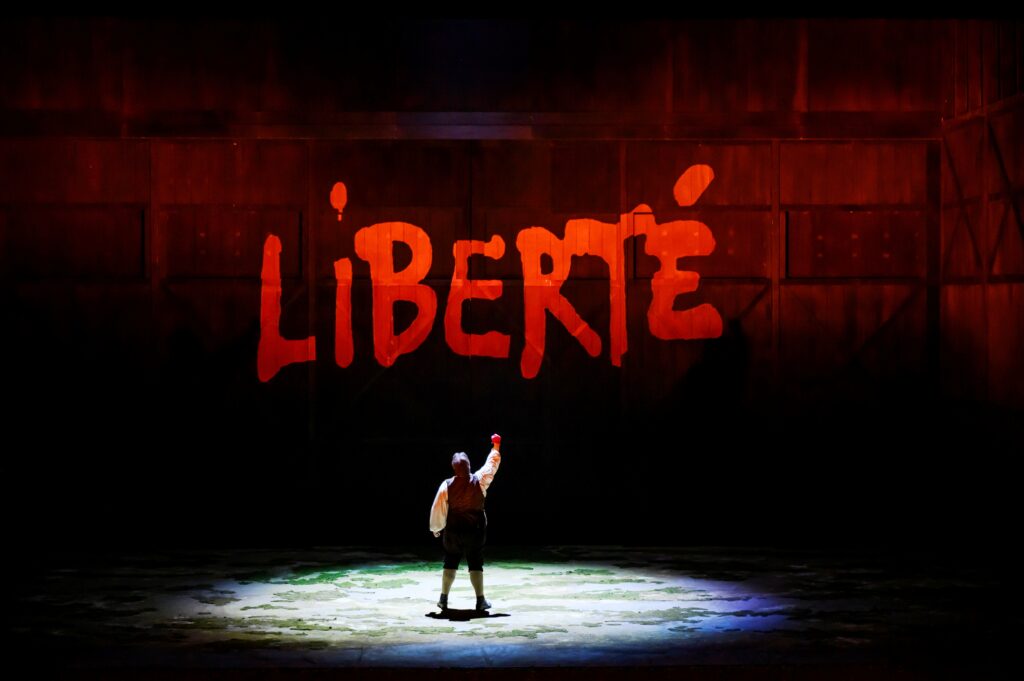
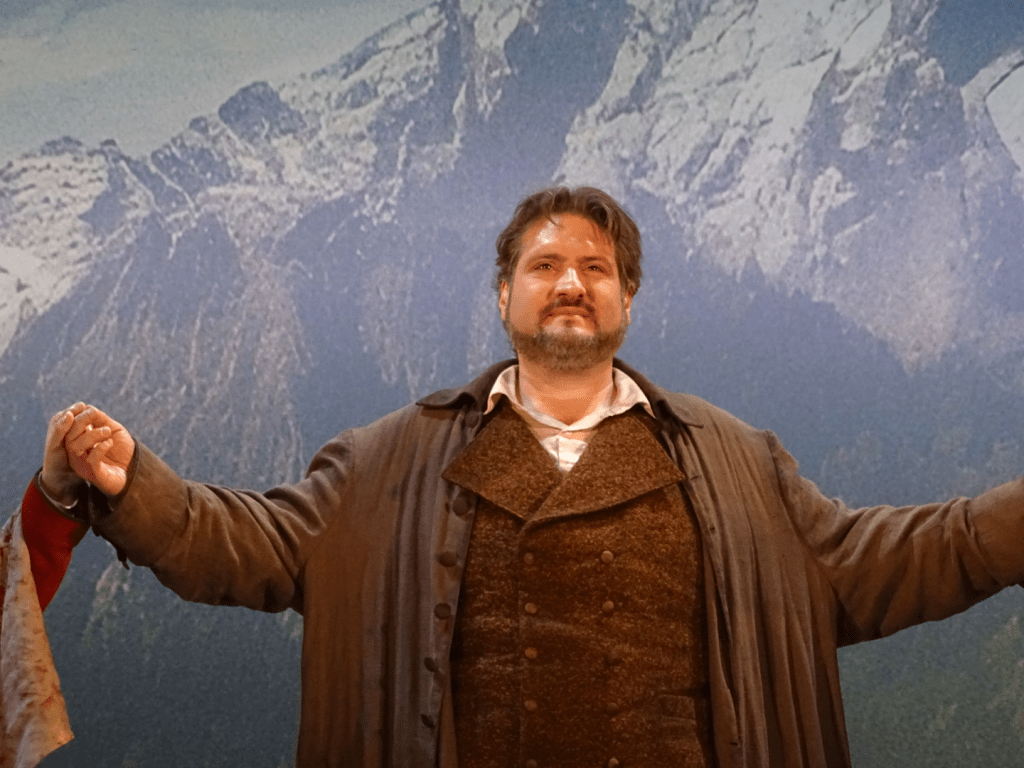
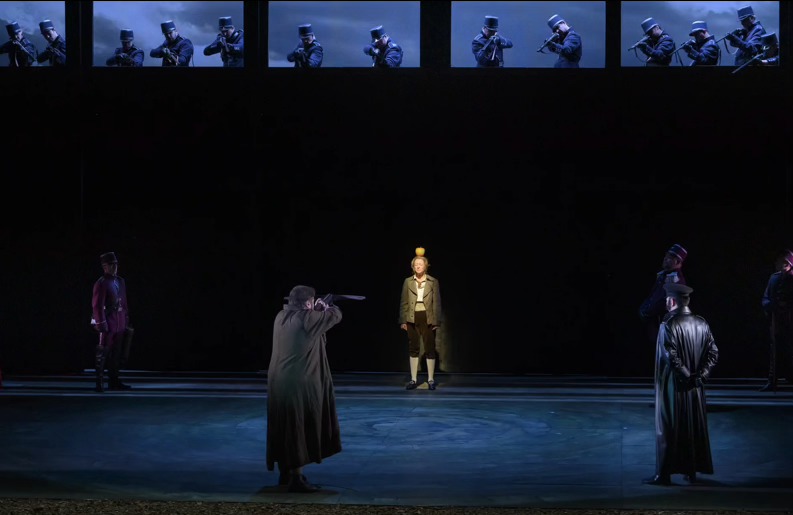
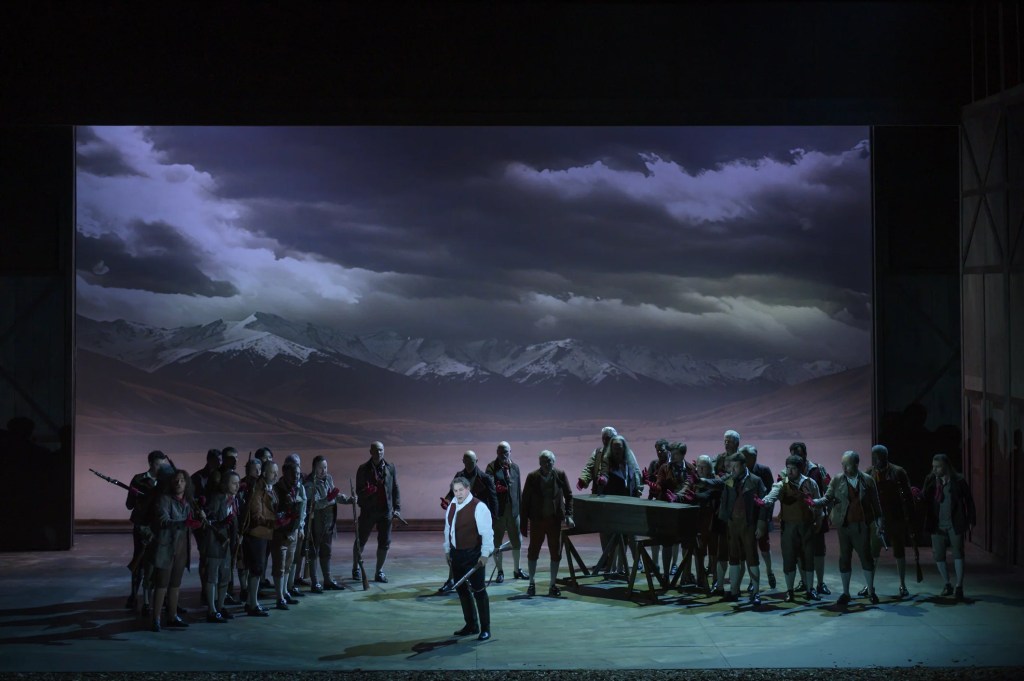
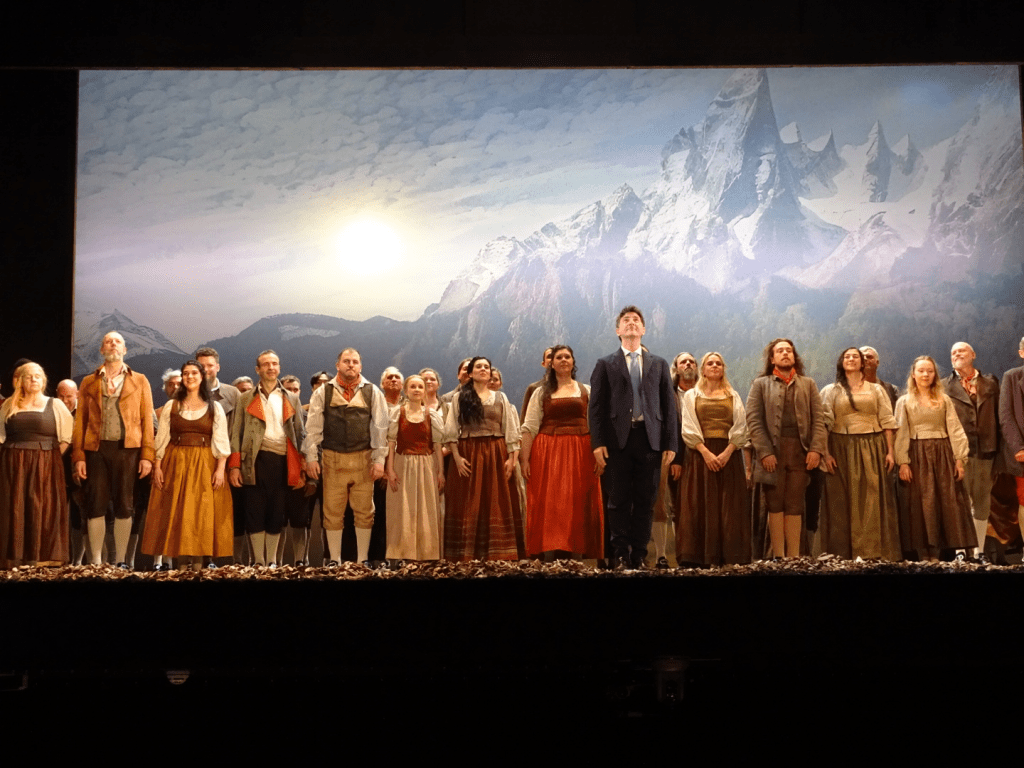
Nicola Alaimo zette een formidabele Guillaume Tell neer. Zijn stem was warm en buigzaam, dwingend waar nodig. Alle facetten van de rol werden door hem overtuigend ingevuld. Een absoluut hoogtepunt was Sois immobile, de aria die Tell zingt voordat hij onder immense druk de appel van het hoofd van zijn zoon Gemmy moet schieten.
Toen Richard Wagner in 1860 in gesprek was met Rossini en deze aria prees, vertelde Rossini dat hij de juiste toon voor deze aria had gevonden door de liefde die hij had voor zijn moeder en vader. Dat gevoel wist Alaimo perfect over te brengen en hij ontroerde daarmee zeer.
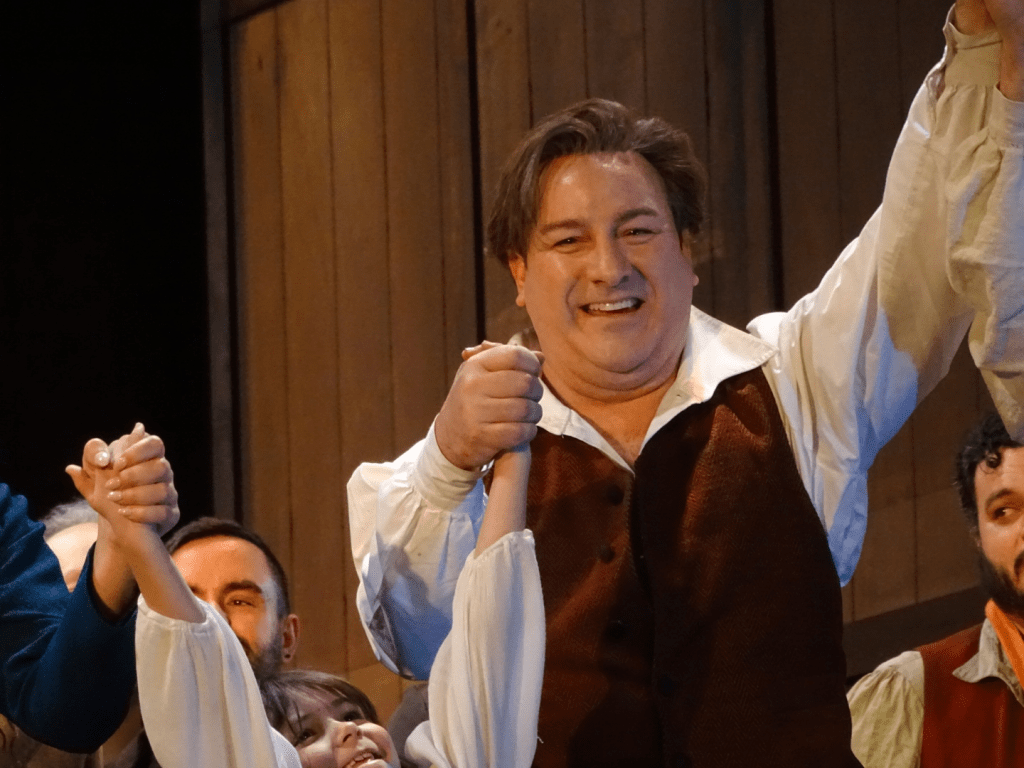
Ongelofelijk hoe John Osborn, in wat inmiddels zijn 16e of 17e vertolking van Arnold moet zijn, niets aan overtuigingskracht heeft ingeboet. Zijn stem heeft iets meer staal gekregen, maar dat kan de rol van Arnold goed hebben.
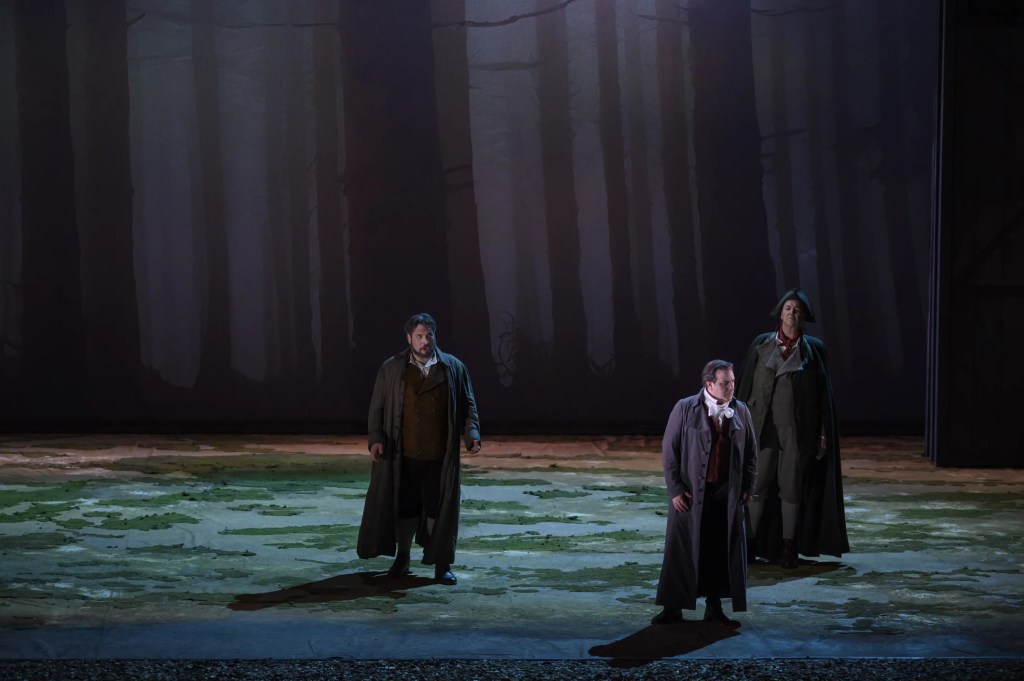
Zoals altijd wist hij me te ontroeren in het trio in de tweede akte, dat dezelfde bezetting had als in 2013 bij De Nationale Opera: met Nicola Alaimo en Patrick Bolleire (Walter Fürst).
Osborn blijft een belcanto-zanger pur sang, wat vooral bleek in zijn adembenemende vertolking van Asile héréditaire. Het aansluitende Amis, amis, secondez ma vengeance werd met verve gezongen en bekroond met een lang aangehouden slotnoot. Heerlijk!
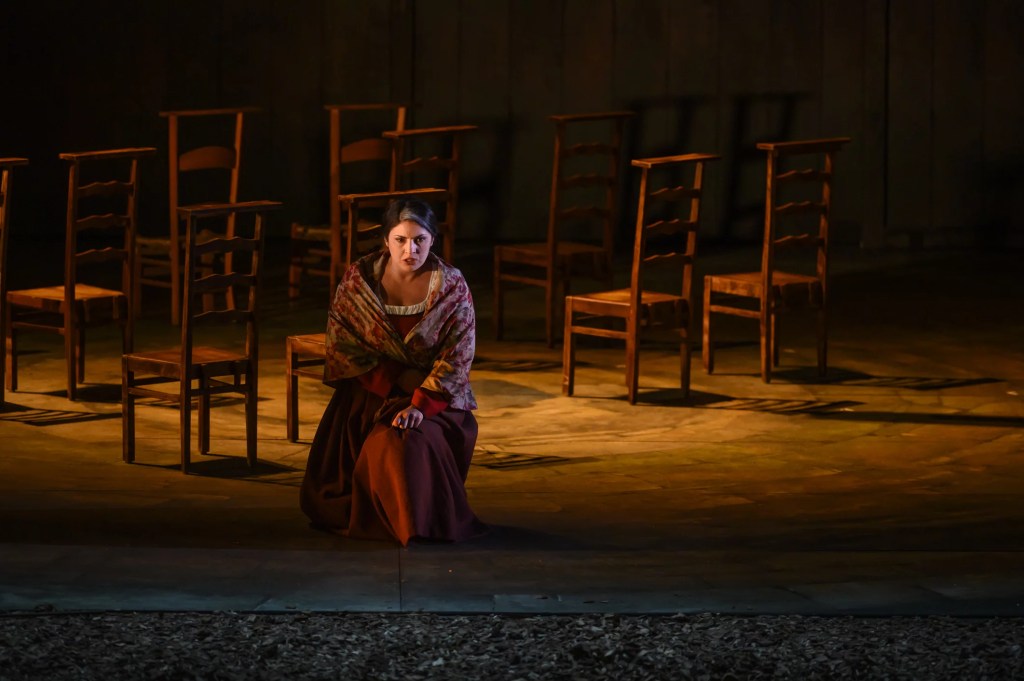
Salome Jicia bracht Mathilde met veel hart en overtuiging. Haar Sombre forêt was prachtig, mede dankzij de liefdevolle begeleiding van dirigent Stefano Montanari. Mede door haar werd het trio met Emanuela Pascu (Hedwige) en Elena Galitskaya (Gemmy) in de vierde akte een fraai hoogtepunt. Jammer dat dit trio vaak wordt gecoupeerd.
Ook Nico Darmanin verdient een vermelding: zijn openingsaria als visser Ruodi was schitterend. De overige zangers, waaronder Ugo Rabec (Melchtal), Inho Jeong (Gessler), Tomislav Lavoie (Leuthold) en Kresimir Spicer (Rodolphe), waren eveneens uitstekend en droegen bij aan de kracht van de voorstelling.
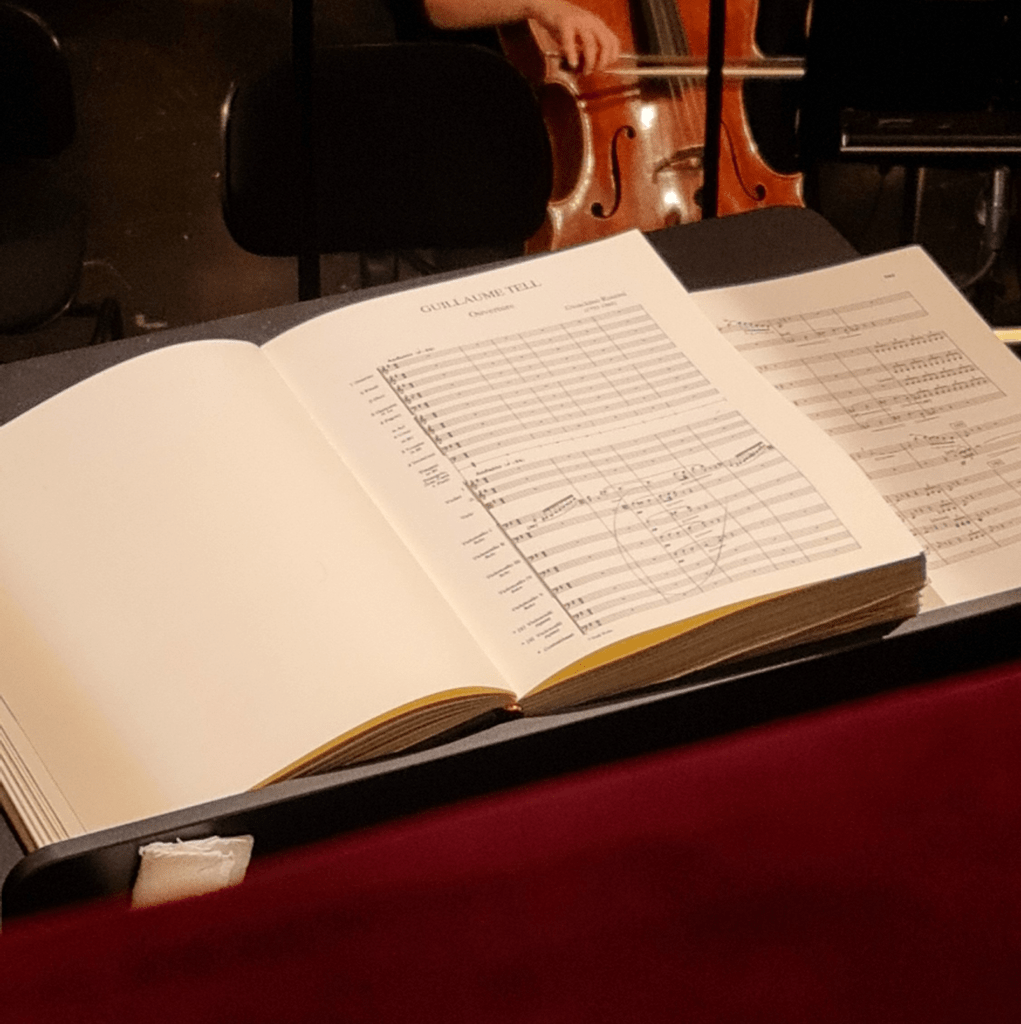
En dat brengt mij bij de dirigent en het orkest. Ik zat deze avond op de eerste rij vlak achter de dirigent. Dat was een belevenis. Stefano Montanari (hij dirigeerde Il Viaggio a Reims bij DNO) danste, sprong, ging diep door de knieën en ademde heerlijk mee met de zangers. Dat leidde tot prachtige klanken uit het orkest, maar af en toe liet hij de teugels toch iets te veel vieren naar mijn smaak.
Dit was hoorbaar in de ouverture, maar helaas ook in het prachtige slot dat voor mij toch iets van zijn werking verloor omdat de strijkers helemaal ten onder gingen. Maar het moet gezegd: hij had een hoge amusementswaarde.
Enscenering en regie
Jean-Louis Grinda’s regie maakte gebruik van een eenheidsdecor met mooie achtergrondtaferelen en fraaie belichting. . Persoonlijk vond ik het jammer dat er na de pauze een aantal scènewisselingen waren waarbij het doek dicht ging, dit haalde de vaart een beetje uit de voorstelling.
For most people, Switzerland is a beautiful, but boring country. Everything is perfectly regulated there and even the cows’ udders produce real chocolate- milk right away. Right? Anything and everything will always thrive there and nothing ever really happens.
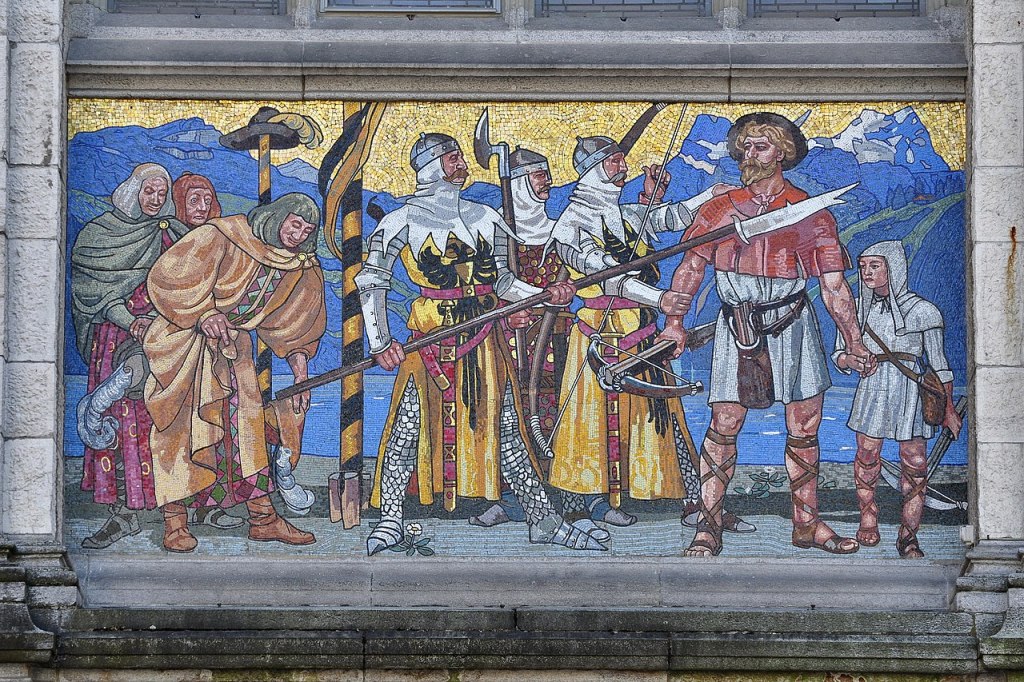
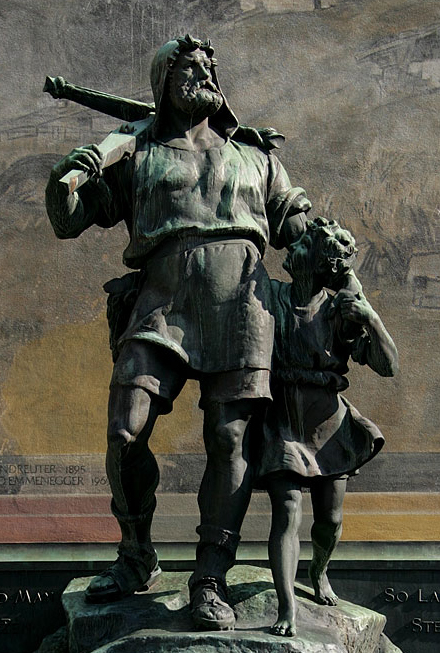
But even the Swiss have experienced something of an uprising, and they too have their national hero, although it is not entirely certain that he ever existed (take it from me: he did not).
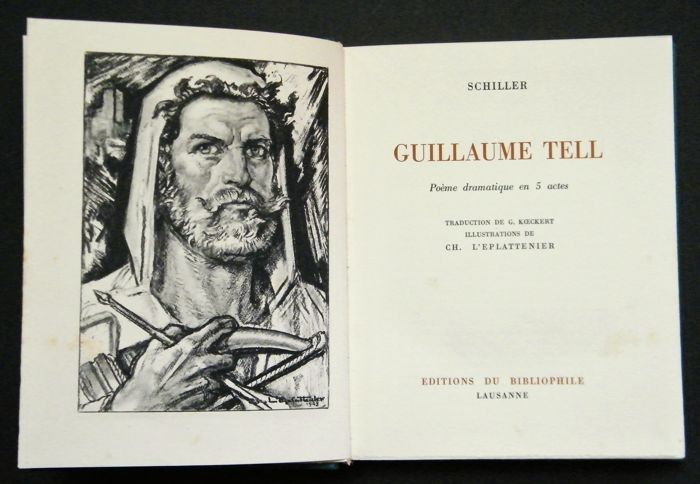
William Tell, the Swiss national pride and freedom fighter, owes his fame mainly to the play by Friedrich Schiller, who, as we might expect from a Romantic poet, did not take the truth very seriously.
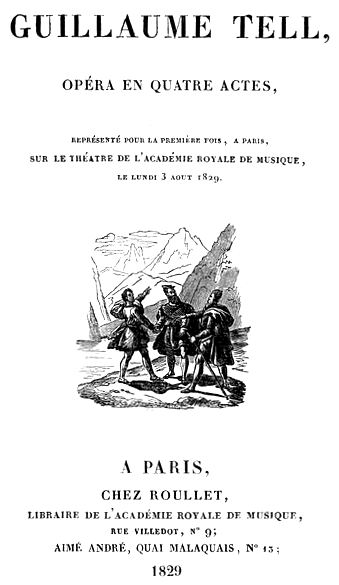
William Tell became even more famous because of an opera by Rossini. Although…. The opera wasn’t really well known until recently but: who doesn’t know the overture? Even my cat can meow it.
CDs
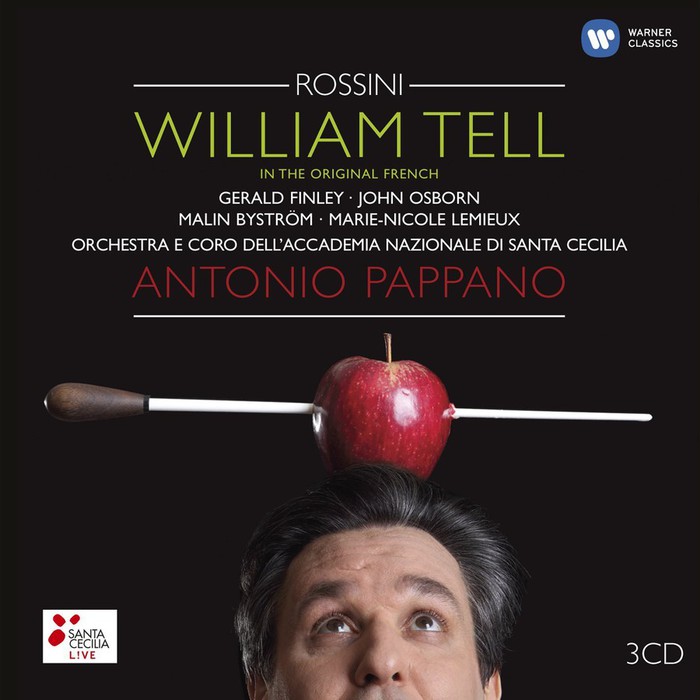
Antonio Pappano’s 2011 recording with the Orchestra e Coro dell’ Accademia Nazionale di Santa Cecilia Roma is far from complete. A shame and a missed opportunity, especially since the performance is really good.
Gerald Finley is a very good Tell (is there anything he can’t sing?), yet something is lacking. For me, at least. I can’t describe it, it’s more like an instinctive response, but I do get that ˜something” when I listen to Gabriel Baquier, on the old 1973 EMI recording.
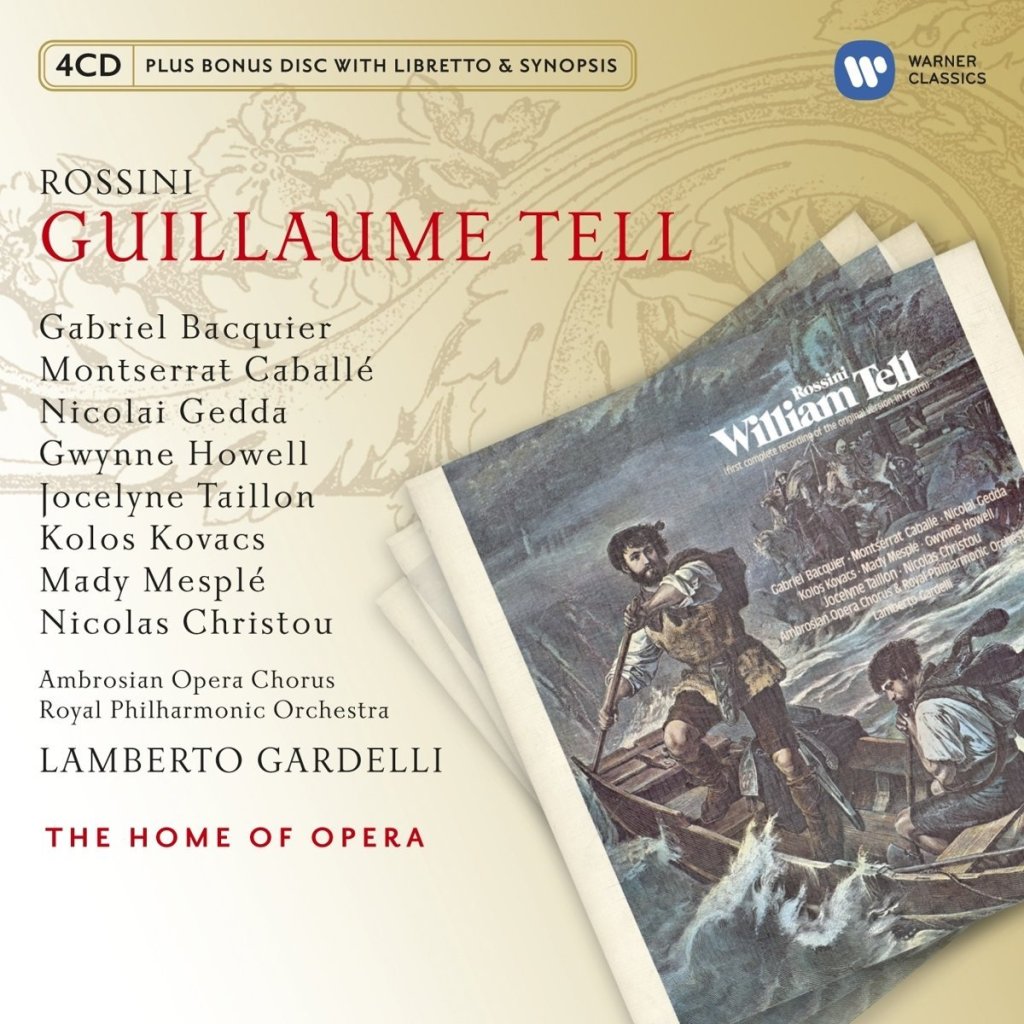
The cast of that recording, led by the very spirited Lamberto Gardelli, has even more ˜plusses”. The biggest is Montserrat Caballé’s Mathilde. I suppose I don’t need to tell you how beautiful and flowing her notes are, how she ˜waves” through them, as it were, and how whispery her pianissimo is. No, Malin Byström (Pappano,) although good enough, really can’t compete with that! Her colouratures may be pure, but that’s all there is to it.
Another big plus is Mady Mesplé’s Jemmy, the real ˜veteran” in the ˜birdsong profession”. So incredibly beautiful! And Nicolai Gedda of course, a singer once called ˜a chameleon among singers” by one of my colleagues (do you know any other tenor who managed to sing so many different roles with so much talent?). And to all that you can add the playing time of almost 238 minutes versus Pappano’s ramshackle 208 minutes.
But if you think I am rejecting Pappano, you are wrong! Orchestrally, he is definitely superior to Gardelli. His choir sounds more beautiful and subtle, and on top of that comes the sound quality. The greatest asset of the Pappano recording, however, is John Osborn, a tenor who throws out the very highest notes as if they were child’s play. It was he who helped make the Saturday Matinee performance unforgettable. The (concertante) recording was done live, which heightens the atmosphere, especially with all those ˜bravos”.
What never came out on CD (shame!) is the absolutely complete performance in the unsurpassed NTR ZaterdagMatinee. Without cuts. A long sitting of almost five hours, but such unforgettable hours! The audience was delirious and just about broke down the Concertgebouw.
The power of the performance lay in the fact that every role was brilliantly cast, right down to the smallest. Paolo Olmi conducted a great cast of really fantastic singers: Michele Pertusi, Marina Poplavskaya, Ilse Eerens and John Osborn. The Groot Omroepkoor performed its leading role in the opera with verve. So, there is no CD (cursing softly for a moment), but many fond memories.
In Rudi Stephans opera Die ersten Menschen zien we hoe de mens, om precies te zijn Abel, zoon van Adam en Eva, God uitvond. Religieuze thema’s waren er al te over in de opera, maar dit was nog nooit vertoond. Het operapubliek had Richard Strauss’ Salome uit 1905 al geaccepteerd, en zelfs omarmd, maar Rudi Stephans opera uit 1914 (première 1920) ging vele stappen verder.
Of die immorele strekking de belangrijkste reden is waarom de opera lange tijd werd vergeten weten we niet. De componist was in 1915 op 28-jarige leeftijd tijdens de eerste dag van zijn militaire op het slagveld van de Eerste Wereldoorlog omgekomen.
Tijdens zijn korte leven had hij een klein, verfijnd oeuvre achtergelaten. Prachtige muziek, maar moeilijk te definiëren. Tussen post-romantisch en modernistisch in. Hij was geen iconoclast als Schönberg, maar ook minder ‘conservatief’ en ‘welluidend’ dan bijvoorbeeld Korngold. Korngolds Die Tote Stadt, ook première 1920, was een enorm succes in de Duitstalige operawereld.
Eigenlijk heeft Stephans idioom wel wat weg van dat van Franz Schreker. Diens Die Gezeichneten, première 1918, was wél succesvol. Strikt genomen een niet minder immorele of amorele opera dan Die ersten Menschen, maar dan zonder de ‘Godsvraag’. Misschien hielp het ook niet dat Stephans eerdere, ook prachtige orkestwerken flegmatische titels kregen als Opus 1 für Orchester, Musik für sieben Saiteninstrumente, Musik für Orchester, Musik für Geige und Orchester.
De opera, naar een libretto van Otto Borngräber, gaat over Adahm, Chawa, Kajin en Chabel, de Hebreeuwse namen voor Adam, Eva, Kain en Abel. Het is dus een familiedrama. Maar dan wel heel Freudiaans; de theorieën van de psychoanalyse waren net in zwang gekomen. Adahm is bezig met zijn werk (in de voorstelling zit hij een groot deel van de tijd achter een laptop), en heeft geen tijd voor dan wel geen zin in Chawa’s behoefte aan huiselijkheid en haar seksuele verlangens.
Kajin, de oudste zoon, wordt afgewezen door vooral zijn vader maar ook door zijn moeder. Hij trekt eropuit, de wilde wereld in, op zoek naar ‘Das Wilde Weib’; dat er strikt volgens de Bijbel maar vier mensen waren op de wereld – Die ersten Menschen – doet er even niet toe. Maar hij komt erachter dat zijn moeder eigenlijk de ideale vrouw is. Hij keert terug, maar als zij hem negeert, randt hij haar min of meer aan. Maar ze geeft toe, omdat ze in een fantasie denkt dat het Adahm is. Als ze bij zinnen komt, schudt ze hem van zich af. Chawa valt dan weer wel op haar andere zoon Chabel, de Benjamin van de hele familie. Vervolgens ontpopt Chabel zich tot profeet, en vindt God uit; de mens schept God naar zijn evenbeeld, aldus de tekst. Chawa en Adahm bekeren zich onmiddellijk enthousiast tot de nieuwe leer.
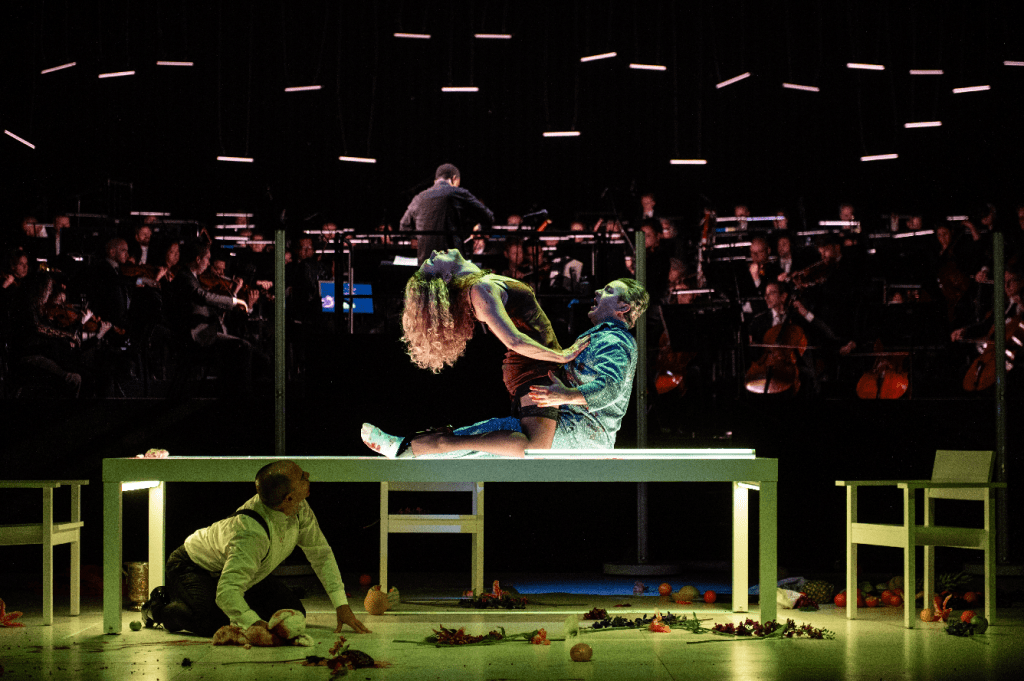
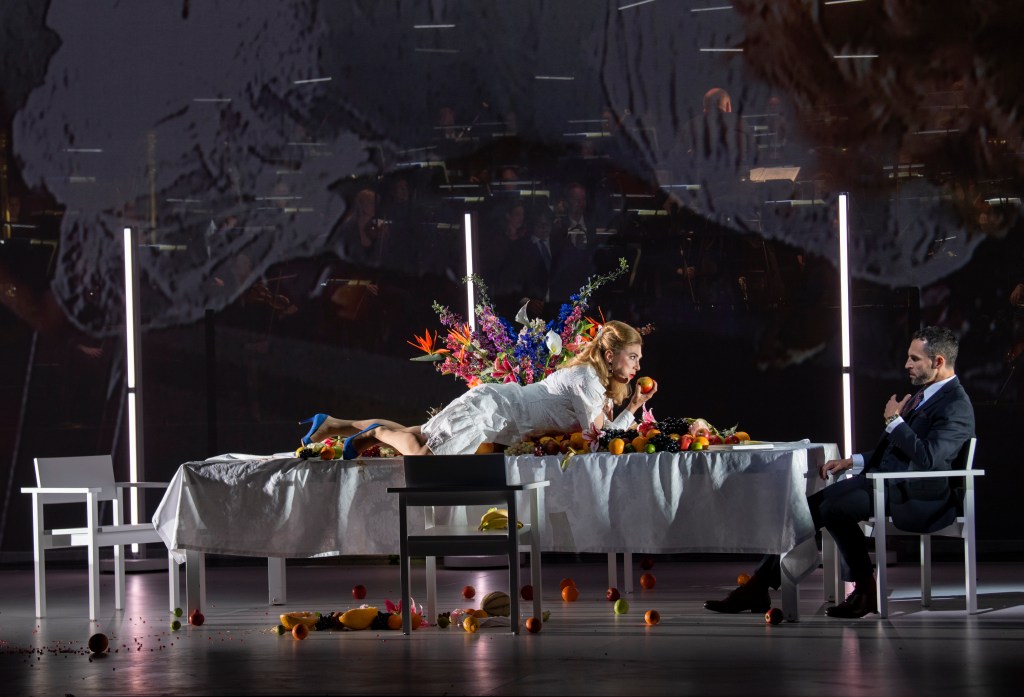
De handeling speelt zich op en rond een enorme witte tafel af. In de openingsscène is het een eettafel bezaait met vruchten. Later wordt een offertafel, de plek waar de protagonisten seks hebben, een schuilplaats voor Kajin, het kruisbeeld en volgens mij zelfs de wereld. Hierover verderop meer.
De rolbezetting is dezelfde als bij de première van de voorstelling drie jaar geleden, en die was en is ijzersterk. Sopraan Annette Dasch is een fenomenale Chawa en trekt daarbij wel alle registers open, zowel vocaal- als acteer-technisch
Als je Chawa’s karaktertekening in het libretto als misogyn wil zien, dan verandert Bieito daar weinig aan. Ze moet de hele tijd verleidelijk zijn, ze loopt heupwiegend rond, komt met de ene na de andere sensuele jurk opkomen, enz. Maar dat doet Dasch overtuigend.
Adahm (bas-bariton Kyle Ketelsen) zet fraai een wijfelaar neer, die een al wat bezadigder levenshouding heeft. Zijn respectievelijke “Chabel, mein Sohn” en “Kajin, mein Sohn” laat hij net zo gebiedend klinken als Alberichs “Hagen, mein Sohn” in Wagners Götterdämmerung moet zijn, en ik denk dat Stephan in deze korte frasen Wagner muzikaal letterlijk citeert.
De eveneens fraai zingende bariton Leigh Melrose (Kajin) drukt zowel de wanhoop als het machismo uit die in de rol zitten. Zijn personage wekt ook empathie, ondanks de broedermoord. Nou ja, die moest gebeuren. En bovendien is Chabel eigenlijk een ontzettende druiloor, een grote baby, uit een horrorfilm. John Osborn zet hem geweldig neer. De rol schrijft hele passages in falsetregisters voor. Die geven Chabel iets onaards, maar in deze enscenering maakt John Osborn er een bijna-gek van, een Parsifaleske reine Tor, een associatie die past bij de Parsifaliaanse muziek die Stephan hem meegeeft als hij zijn visioenen profeteert.
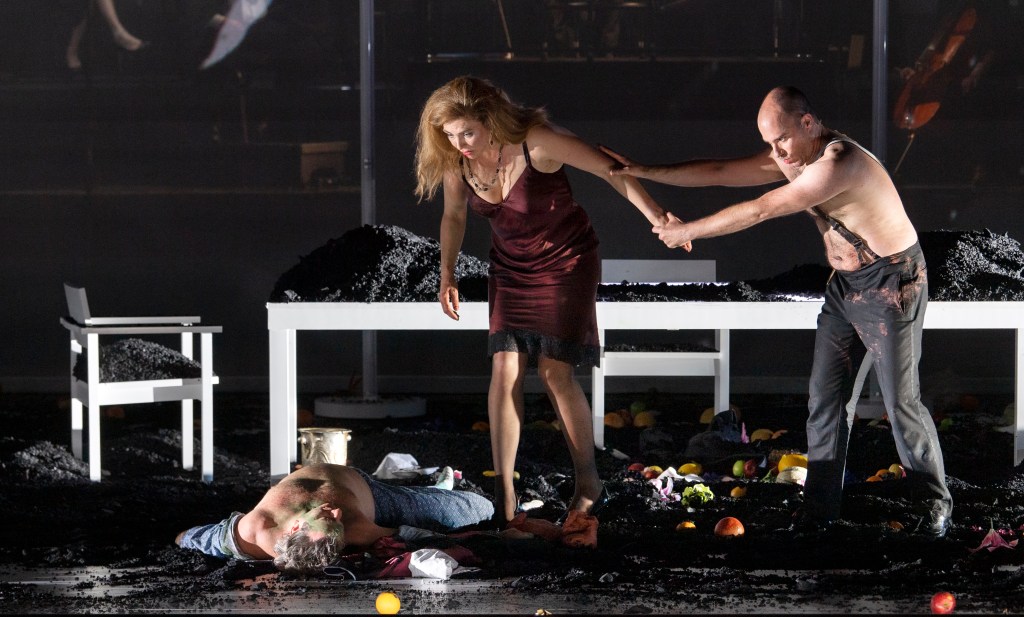
Chabel brengt een lam mee naar huis, het Lam Gods. Maar het is een onooglijke vuilwit-pluchen speelgoedbeest. Als een verwend kind snijdt Chabel het beest aan stukken. “Het offer” noemt Chabel het. Het eerste offer, volgens het libretto, het tweede offer wordt Chabel even later zelf, wanneer hij, Bijbel-conform, door Kajin wordt vermoord. De Jezus-analogie ligt er duimendik bovenop, en Bieito buit die gretig uit. Chabels ‘kindsheid’ belet Bieito overigens niet om voorafgaand aan de broedermoord een prachtig in scène gezette seksscène te hebben, met Chawa, maar intussen ook met Kajin, en met alle twee tegelijk.
Uiteindelijk vinden Chawa en Adahm elkaar weer, en we zien hen tegenover een ‘sterrennacht’ (lampjes boven het orkest) zingen dat de toekomst er toch hoopvol uit ziet en dat ze ervoor gaan zorgen dat er nog een zoon zal komen. (Dat zou volgens de Bijbel dan Seth moeten worden, de ‘vergeten’ derde zoon van Adam en Eva.)
Kleuren en uitlichting, ook van alle bloemen en vruchten die door het decor slingeren, doen denken aan Caravaggio. Chawa zingt dat ze van bloemen houdt terwijl Adahm stelt dat voor hem de vruchten het belangrijkst zijn; Chawa smijt daarop lustig kilo’s meloenen, sinaasappels en ananassen kapot.
Ook de mystiek-erotische tekst roept associaties met Caravaggio op. Bijvoorbeeld zijn in zijn Conversione di San Paolo zien we Saulus c.q. Paulus, als hij op weg naar Damascus, verblind door Goddelijk licht, zo te zien een bijna orgastische ervaring beleeft.
Het orkest zit net als drie jaar geleden weer op het podium. Dat was toen vanwege Corona. Zo kon je met minder musici toch een mooie orkestklank krijgen. De opstelling van toen is gehandhaafd, maar nu was het mogelijk met voltallig orkest te werken. Het Rotterdams Philharmonisch Orkest klinkt op deze manier spectaculair. Dirigent Kwamé Ryan weet intussen ondanks het veel grotere orkest een fraai klinkende balans met de zangers te bereiken.
Het orkest heeft trouwens een rol in het decor. Als de protagonisten het aan het begin en aan het eind over de sterren hebben lichten de lampen boven het orkest zachtjes op. Tussen orkest en speelvloer hangt het grootste deel van de tijd een gaasdoek, maar als de personages ergens tijdens de tekst vertellen dat ze de waarheid zien of zoiets dan gaat het gaasdoek omhoog; om even later als hun blik blijkbaar weer vertroebelt omlaag te gaan.
Als Kajin uiteindelijk als een verschrompeld hoopje ellende onder de tafel ligt, lijkt hij even op Judas. Heb ik nou ergens ooit gelezen dat Judas misschien een broer van Jezus was? Maar helemaal tegen het eind spreidt hij zijn armen uit langs het tafelblad. Een verwijzing naar Jezus zelf? En dan moet ik ook even denken aan Atlas uit de Griekse mythologie, die de wereld op zijn schouders draagt.
Bieito zou toen eigenlijk Berlioz’ La Damnation de Faust regisseren. Om Corona-redenen moest die plaats maken voor een werk met veel minder personages. Ik hoop dat we die Damnation nog tegoed hebben.
Rudi Stephan (1887 – 1915) Die ersten Menschen (1914, première 1920) Libretto Otto Borngräber Regie Calixto Bieito Adahm Kyle Ketelsen Chawa Annette Dasch Kajin Leigh Melrose Chabel John Osborn
Decor Rebecca Ringst Rotterdams Philharmonisch Orkest Muzikale leiding Kwamé Ryan
Benvenuto Cellini was a 16th-century Italian artist considered the representative of Mannerism. He was a sculptor, silversmith, writer and musician, clearly an example of the ˜uomo universale.”
We know from his memoirs that he was no sweetheart: he is portrayed as a self-assured, egotistical man who was not averse to sexual excesses and who had lots of affairs, both with women and with men. That he also did not treat his fellow man with the utmost decency was forgiven from higher up: after all, he was a gifted artist.
Why exactly did Berlioz choose Cellini for his first opera? Perhaps he thought he had found a new Don Giovanni and thus created a new masterpiece?
The premiere of the opera in Paris in September 1838 was a flop. For the revival a year later, Berlioz made some changes, but to no avail. Later, for a performance in Weimar in 1852, he made another shorter version of his work, on the advice and in collaboration with Liszt and Von Bülow.
CD’S
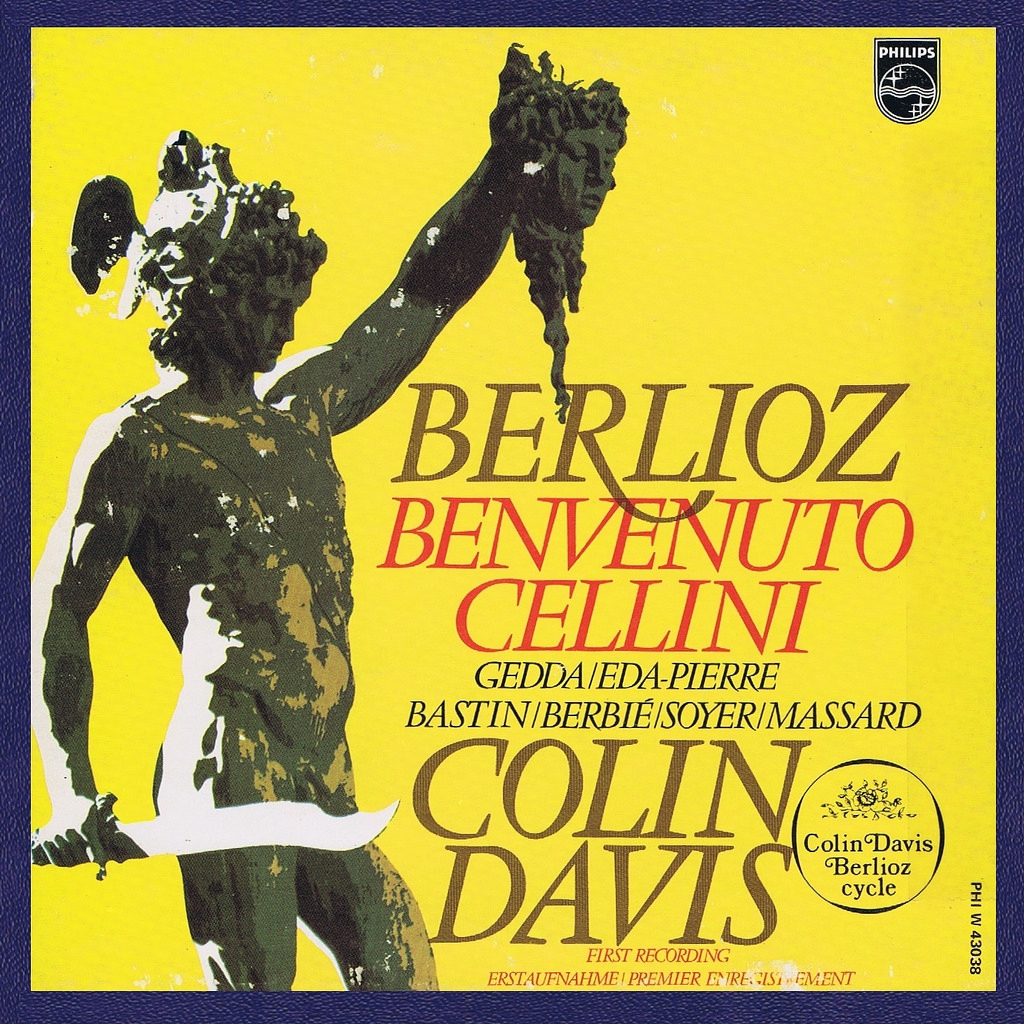
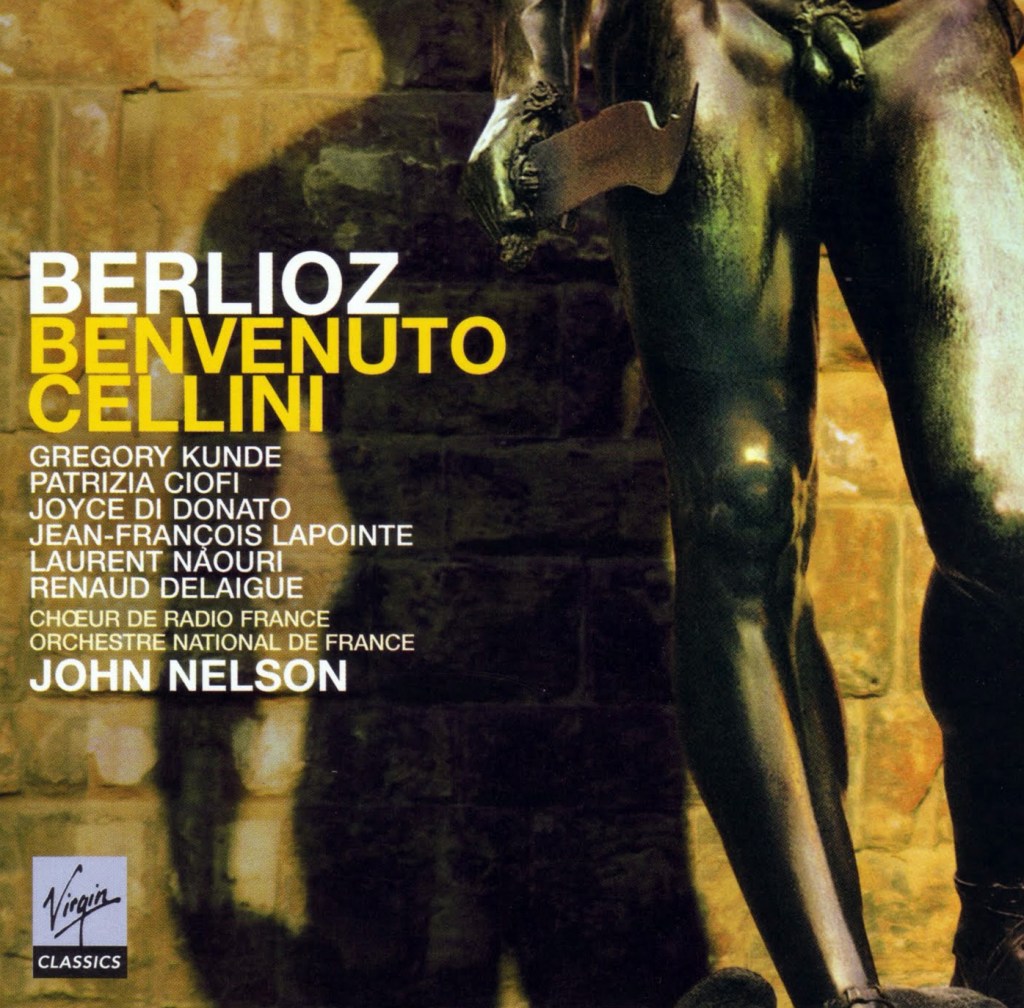
Colin Davis, one of the greatest advocates of Berlioz’s music, recorded the opera in 1972. For years, the recording (Philips 4169552) was regarded as the example of how it should be done. It took more than 30 years before it met a formidable opponent in John Nelson’s registration (once Virgin Classics 54570629).
Whichever of the two you choose: the orchestra is fine and both conductors are a match for each other. Nelson is perhaps a bit brighter while Davis is more into lyricism.
Can you imagine a better Cellini than Nicolai Gedda (Davis)? One would say not. I thought so too. Until recently, at least, because Gregory Kunde comes pretty close.
I love Kunde’s slim, agile yet firm tenor. His high notes are produced so easily that you’d almost think he was rehearsing a shopping list. And then his power… What a voice, what a singer! Incredible that the record companies ignored him for so long. He almost didn’t participate in this recording either: he replaced Roberto Alagna.
Jules Bastin (Balducci with Davis) was matched by Laurent Naouri. I personally prefer the second, but that’s personal.
The choice for my favourite Ascanio is quickly made: even Jane Berbié (Davis) has to concede superiority to Joyce DiDonato (Nelson). Just listen to her ˜Mais quai-je donc”. No, not everything was always better in the olden days!
But Nelson has more to offer, should you feel the need: the score is more than complete, as he combines both Paris versions and adds another appendix with a whopping 15 minutes of additional music.
Below is the trio ‘Ô Teresa’, sung by Gedda, Eda-Pierre and Massard under Colin Davis:
And by Kunde, Ciofi and Lapointe under John Nelson:
Nelson’s recording is officially off the market, but you can find it on Spotify:
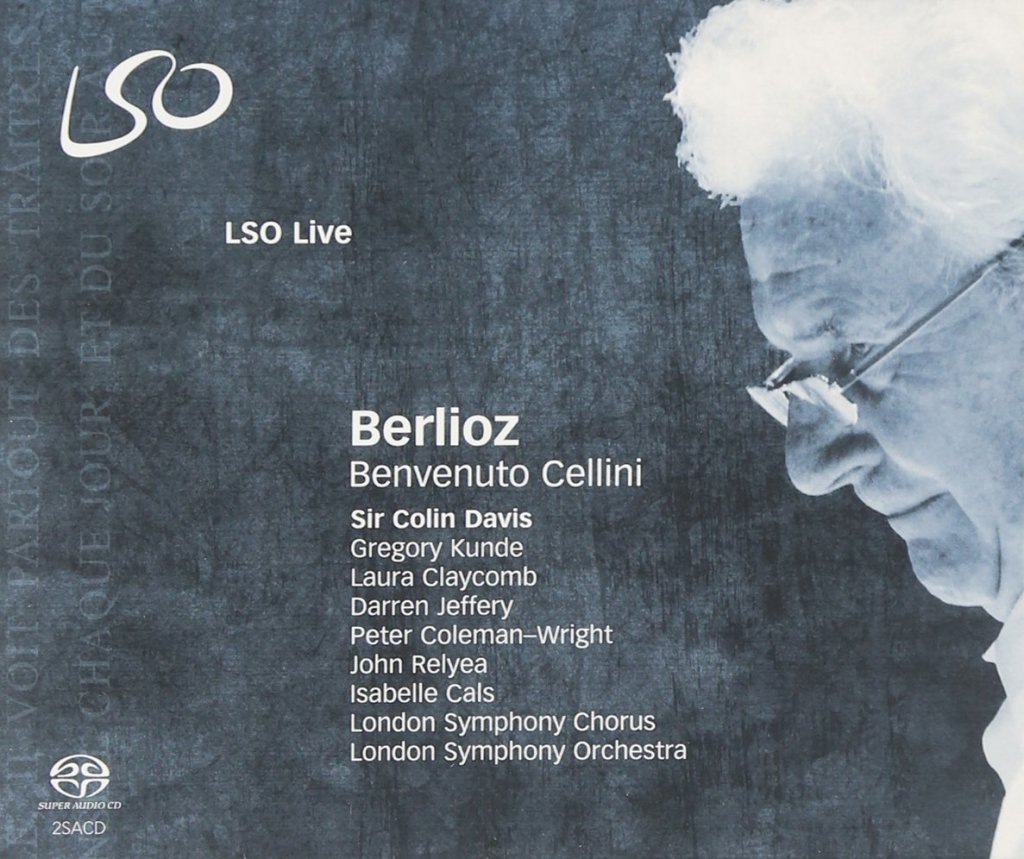
And then there is Colin Davis II. In 2007, he once again ˜dusted off” the opera, resulting in several cuts in the dialogues. Cellini and Teresa’s duet from the second act also had to go. The live performance from Barbican Hall was released on two SACDs on London Symphony Orchestra’s own label (LSO Live 0623).
I find the result satisfactory, but a little too polished for me. Gregory Kunde once again shows what a great singer he is: for him alone, the recording is more than worthwhile. I am less pleased with Laura Claycomb (Teresa) and the other singers do not really appeal to me either.
DVD’S
Salzburg 2007
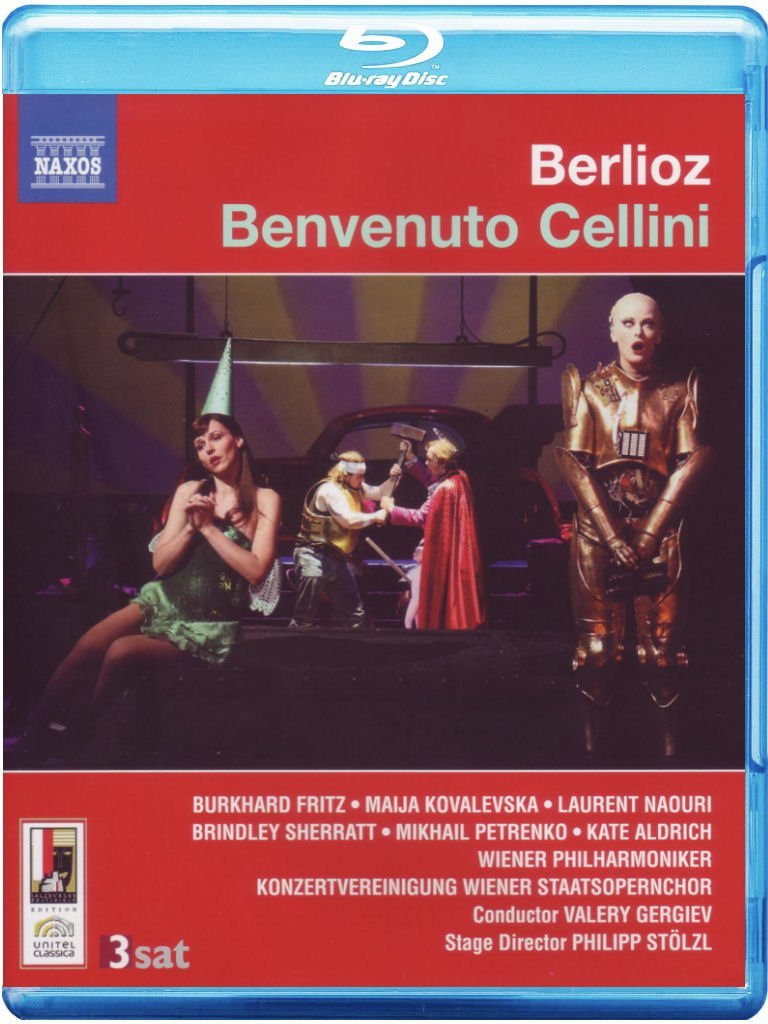
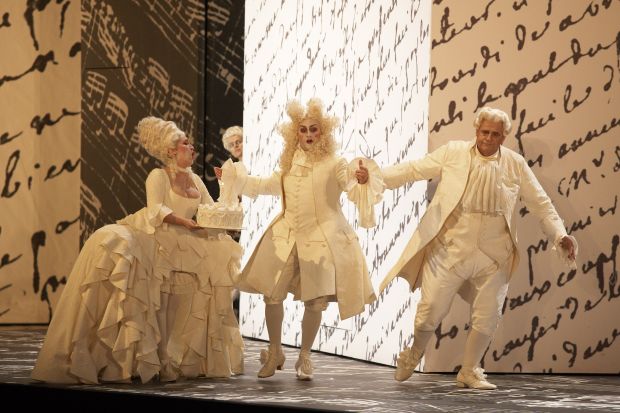
Presented in Salzburg in 2007, Benvenuto Cellini was subsequently recorded for DVD (Naxos 2110271). The production is great fun. It contains all sorts of things that makes one laugh: commedia dell’arte, comedy theatre, a pope accompanied by dancing blonde drag queens, a helicopter, robots as house servants, a madonna as a naked angel with wings… You name it and it’s there. It starts off in quite a nice way: Rome, carnival, fireworks… Almost Fellini-like. The whole thing is set in a ˜world of once upon a time”. The Wizard of Oz is not far away. Yes, director Philipp Stölzl knows his film classics! Beautiful, yes. Funny? Yes. Logical? No. The audience is overenthusiastic, I am not.
There is good singing without any question, though I don’t really get excited. Burkhard Fritz (also a substitute, this time for Shicoff) at the time still had both feet firmly in the heavier belcanto repertoire, but he lacks charisma.
You can leave the latter to Maija Kovalevska. She is beautiful and slender (an indispensable requirement these days, it seems) and has a ditto voice. She is a good actress too. What she lacks is the ˜typical characterization” needed for this role. Without it she sounds like just one of many beautiful slender sopranos from Eastern Europe. Terr Whether Valery Gergiev is the appropriate conductor for this work I doubt. He makes a lot of noise, like heavy fireworks. At the start of the overture, I thought for a moment I was in the middle of one of the Bruckners.
Below is the trailer of the Salzburg production:
Amsterdam 2015
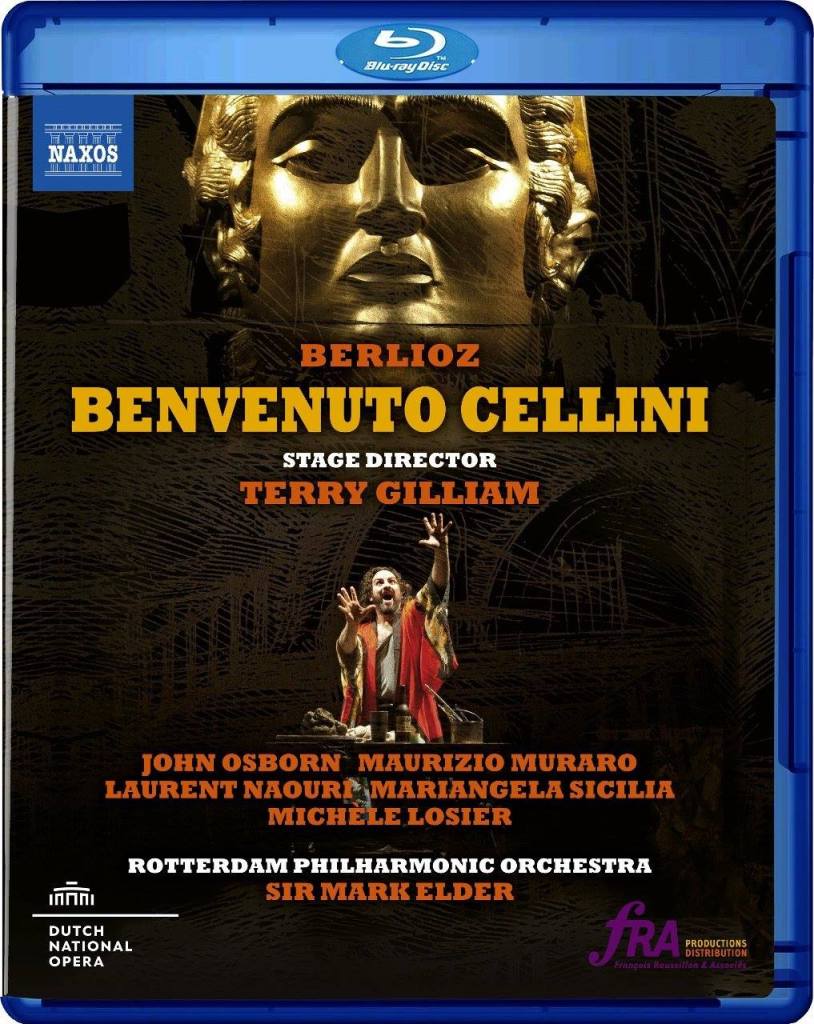
It’s still not really my kind of opera but I enjoyed Terry Gilliams’ 2015 Amsterdam production so immensely that I visited the show several times.
I can sum up the lavish, rich production in one word: whirlwind. Cellini is one hell of a role, but leave it to John Osborn! Just listen to his ˜La gloire était ma seule idole”, wow!
Mariangela Sicilia is a fantastic Teresa. Her light soprano seems created for the role but it is mainly thanks to the fantastic persona direction and the unimaginably good orchestral accompaniment by Sir Mark Elder that she is able to make the role her very own.
Laurent Naouri (Fieramosca) is a delicious schemer. What a voice and what an actor! Michèle Losier is a superb Ascanio, Maurizio Muraro an excellent Balducci and Orlin Anastasov a fine Pope.
In the innkeeper scene, it is Marcel Beekman who steals the show with his irresistible performance as Le Cabaretier, but the smaller roles of Bernardino (Scott Conner), Francesco (Nicky Spence) and Pompeo (André Morsch) are also more than excellently cast.
François Roussillon’s video direction is excellent. He highlights all the important details without losing sight of the whole. As a result, you can perfectly see what really good direction does for an opera. Also note the more than excellent chorus: each chorus member is an individual character.
Those who were not there can now catch up on a missed opportunity. For those who did attend: this DVD is a lasting memory of one of the finest DNO productions ever.
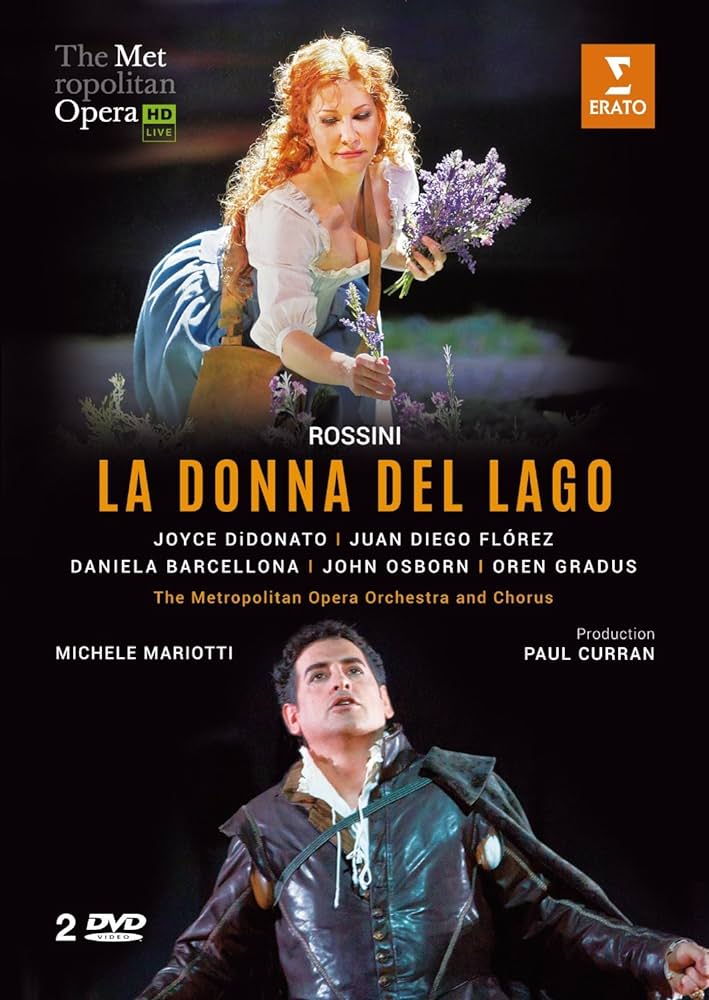
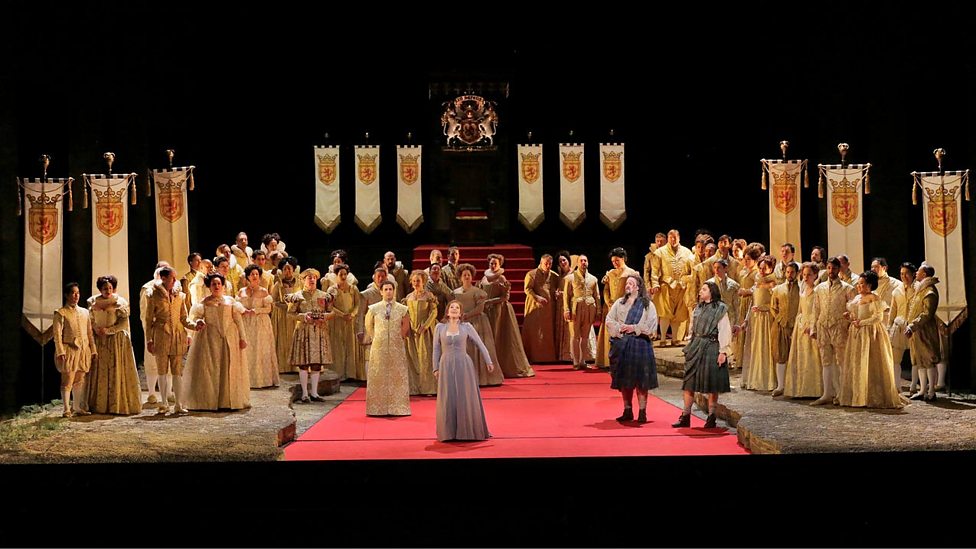
In 2015 stond Rossini’s La Donna del Lago op het programma van de Metropolitan Opera. Een van de voorstellingen was wereldwijd in de bioscoop te zien in de serie Live in HD. Een opname daarvan is op dvd uitgebracht. Het moet een spectaculaire avond geweest zijn met veel vocaal vuurwerk.
De handeling van de opera is eenvoudig: drie mannen strijden om de gunst van Elena, de Donna uit de titel. Ze heeft trouw beloofd aan Malcolm maar die is al langere tijd weg, ergens aan het rebelleren tegen de koning. Haar vader heeft haar beloofd aan Rodrigo, leidend krijgsman in de opstand. En plotseling staat een vriendelijke jonge man op de stoep die zich Uberto noemt.
Voor Rossini een uitgelezen gelegenheid om een tenorenduel te schrijven waarin Rodrigo en Uberto elkaar naar het leven staan, overigens zonder echt te beseffen dat ze concurrenten in de liefde zijn.
John Osborn is geweldig op dreef als de alfa male Rodrigo, mooie vertolking met passend assertieve voordracht.
Zijn tegenstrever Uberto krijgt hem vocaal er niet onder maar buiten beeld kennelijk wel. In de apotheose waarin Uberto zich bekend maakt als de koning en iedereen vergiffenis schenkt, zien we Rodrigo niet meer terug.
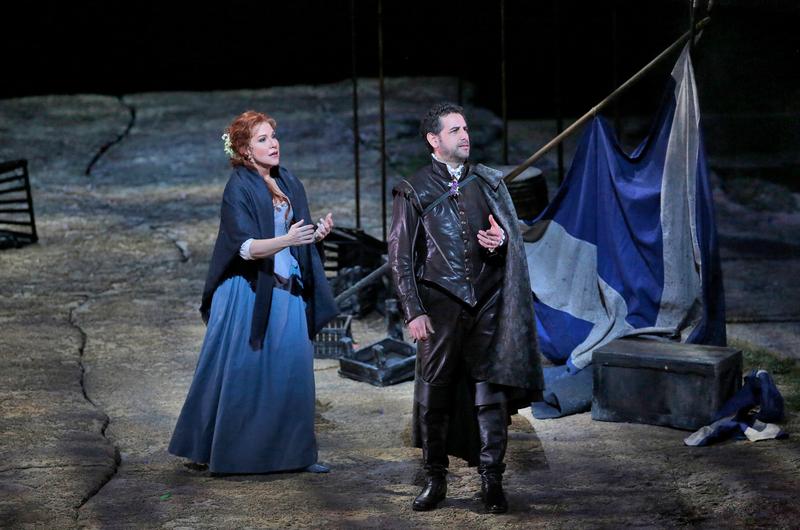
Juan Diego Flórez weet het publiek op zijn hand te krijgen met een uitstekende vertolking van Uberto alias James V. Hij wordt op slag verliefd op Elena die hij aanvankelijk aanziet voor een bosnimf. Het is een licht ontvlambaar type, die Uberto. Voor de bevrediging van zijn amoureuze gevoelens is hij bereid grote risico’s te nemen.
Regisseur Paul Curran laat hem zo op het oog volledig zijn eigen gang gaan. De kleine handtastelijkheden die hij zich veroorlooft jegens Elena maken duidelijk dat hij gewend is aan een vanzelfsprekende meegaandheid waar het de vrouwen in zijn omgeving betreft. Flórez’ vertolking van Rossini’s vocale capriolen ontaardt nergens in een circusact maar blijft voortdurend geloofwaardig. Uiteraard met hoge goed getroffen noten.
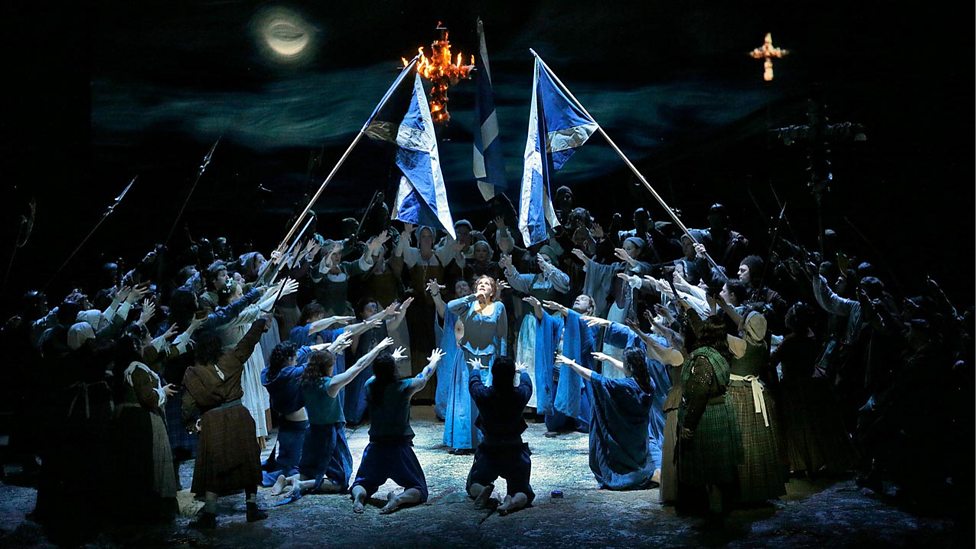
Elena’s vader komt voor rekening van de bas Oren Gradus, geheel in de stijl van de oudere patriarch die geen tegenspraak duldt. Mooie bijrollen verder voor Olga Makarina als Albina en Eduardo Valdez als Serano. Verder een uitstekende bijdrage van het koor van de Met.
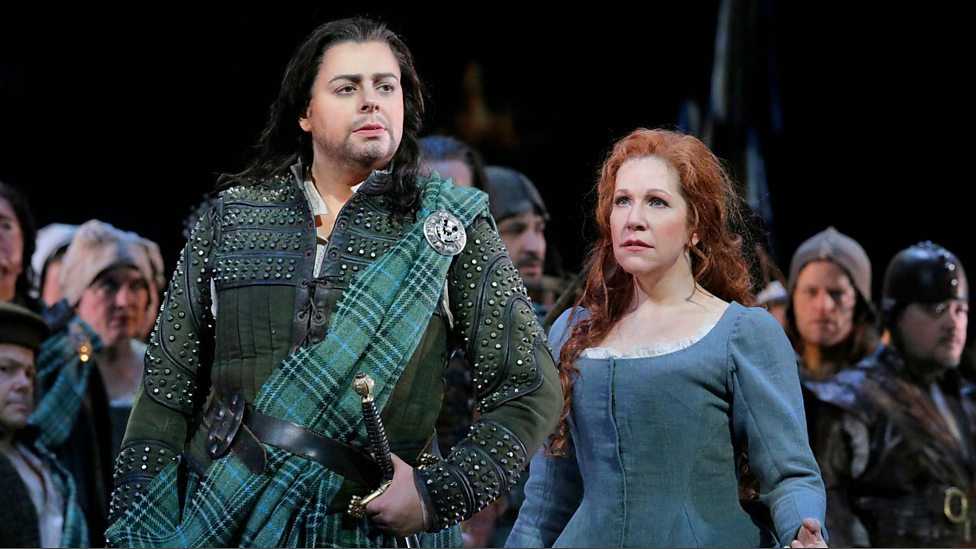
Malcolm is een Hosenrolle maar in deze productie draagt de zangeres een kilt, dus geen broek. De kostumering van Kevin Knight suggereert een authentiek kostuumdrama al moet eraan worden getwijfeld of de kostuums in kwestie 16e eeuws zijn, de periode waarin de handeling zich afspeelt.
Al die mannen in kilts maken een wat onbeholpen indruk, vooral door hun gemiddelde lichaamsomvang. Daniela Barcellona vormt hierop geen uitzondering, ze oogt weinig geloofwaardig als Elena’s love interest maar haar zang maakt veel goed. Malcolm is maar weinig op het toneel maar krijgt steeds een vrij veld als hij verschijnt. Het is een zware rol, zang technisch vooral en dat wordt door het publiek ruimhartig beloond.
Als liefdesobject tussen drie mannen die om haar strijden, al moet de dood erop volgen want zonder haar heeft verder leven immers geen enkele zin meer, is Elena meestentijds onderdeel van een duet of een terzet. Ze is dan wel veel op het toneel, veelal is ze niet agerend maar reagerend waarbij een tegenspeler het voortouw neemt. Aan het begin heeft ze een solo maar pas tegen het einde, als al die mannen haar eindelijk eens met rust laten, krijgt ze de kans zich ongestoord te manifesteren.
Joyce DiDonato is absoluut top in deze voorstelling. Ze werpt zich vol in de moeilijkste passages en het resultaat is elke keer weer verbluffend. Haar coloraturen zijn wellicht niet altijd geheel vlekkeloos maar steeds zo goed als men redelijkerwijs mag verwachten in een live uitvoering.
Acterend komt ze erg overtuigend over, het meisje dat zich moet verweren tegen een overheersende vader, een koning incognito die haar vanaf het eerste moment dat hij in de buurt komt al probeert te kussen, de voor haar uitgekozen echtgenoot die geen misverstand laat bestaan over zijn argwaan en ongenoegen en dan ook nog Malcolm die vooral achter de schermen aan trekt. Didonato laat prachtige mimiek en subtiel klein spel zien, ze is geweldig.
Ondanks de verwoede pogingen van de twee tenoren om haar voor zich te winnen trekt de mezzo aan het langste eind. Refererend aan DiDonato’s stemtype merkt moderator Patricia Racette aan het begin van de avond dan ook een tikje sarcastisch op: ‘Tonight the mezzo gets the mezzo, bad luck for the tenor.’
Het orkest van de Met staat onder leiding van Michele Mariotti.
Deze opera bleek achteraf in 1829 Rossini’s zwanenzang als operacomponist. Het was bedoeld als eerste van een serie van vijf grand opéra’s voor Parijs maar de revolutie van 1830 maakte het afgesloten contract van nul en gener waarde.
Aubers La muette de Porticistamt uit 1828 dus toen Rossini begon te werken aan zijn Guillaume Tell was er nog geen sprake van een grand opéra traditie. Hij volgt echter inhoudelijk wel het stramien dat later zozeer bepalend zou worden. Kort gezegd: een persoonlijke drama tegen een historische achtergrond. Het gekozen format wijkt echter af, slechts 4 aktes maar er zijn wel twee balletten. Een pas de six in de eerste en een groot ballet in de derde akte.
Muzikaal lijkt het alsof er sinds Il viaggio a Reims en Le comte Ory een heel andere componist aan het werk is geweest. Het maakt je nieuwsgierig naar het idioom van de vier opera’s die nog hadden zullen volgen. Belangrijker nog is het volledig ontbreken van vaart en verve, altijd zo kenmerkend voor Rossini. Hoewel het gaat over onderdrukking en verzet sleept de handeling zich in een gezapig tempo voort, ‘glacial’ noemen we dat tegenwoordig. Het heeft er de schijn van dat Rossini er teveel van is uitgegaan dat het werk vooral heel lang moest duren zodat ook de abonnementhouders die later arriveerden aan hun trekken konden komen. Zodoende komt de voorstelling eigenlijk pas echt op gang in de tweede akte, vooral dankzij de grote inbreng van Mathilde en Arnold. Die twee zorgen er ook in het vervolg voor dat belcantoliefhebbers niet voortijdig afhaken. Er wordt wel beweerd dat de opera zo weinig wordt opgevoerd omdat die twee rollen erg moeilijk te bezetten zijn. Waar natuurlijk, maar een tweede reden is zonde twijfel dat het een nogal langdradig werk is.
************** The Guardian:
“Guillaume Tell review – sex, violence and protracted booing
Royal Opera House, London Rossini and a fine cast of singers just about survive Damiano Michieletto’s wretched new production of Guillaume Tell” *************
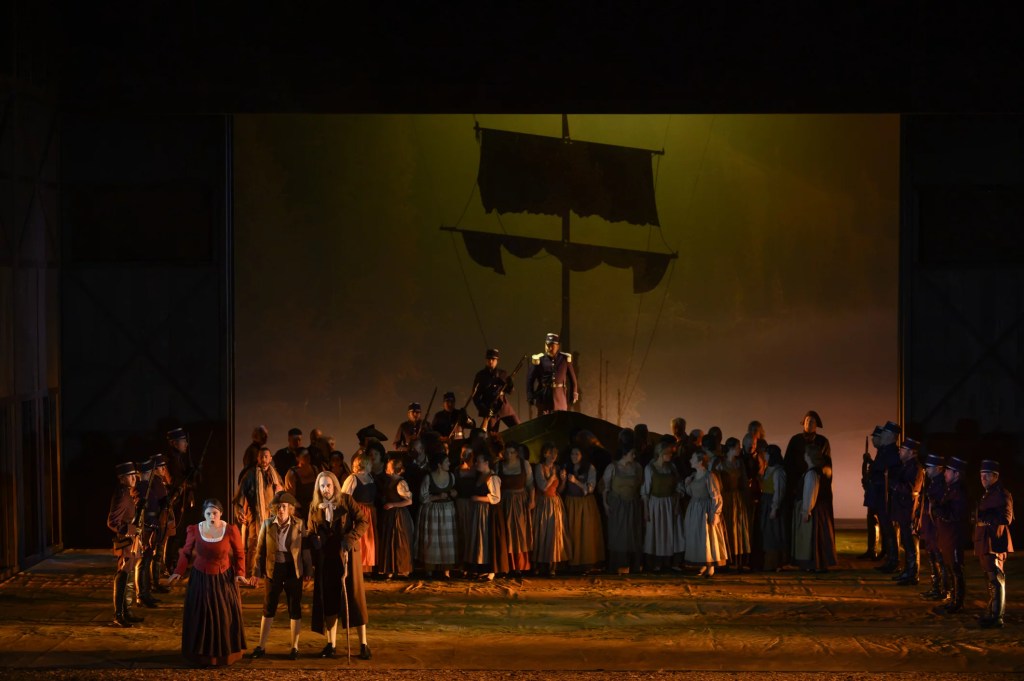
De première van Guilaume Tell bij de Royal Opera in Londen zorgde in 2015 voor de nodige ophef. Die had niet zozeer betrekking op de opera als wel op een verkrachtingsscène die in het derde bedrijf de plaats in had genomen van het voorgeschreven ballet. In de opname die voor Opus Arte aan het einde van de voorstellingenreeks is gemaakt, zijn de scherpe kantjes van deze scène afgevijld maar het blijft een onprettig intermezzo.
Regisseur Damiano Michieletto benadrukt in zijn enscenering de gewelddadige kant van het verhaal over Zwitsers die zuchten onder het juk van een Oostenrijkse bezetter. Ware het niet vanwege de legende van ‘William Tell’ dan zou deze langdurige episode niet meer zijn dan een voetnoot in de geschiedenis. Nu is het gebeuren in elk geval aan operaliefhebbers bekend, al blijft het een folkloristische anekdote.
Michieletto neemt de legendarische held Tell als uitgangspunt door Jemmy, Tells zoontje, een stripverhaal te laten lezen en met soldaatjes van verschillende kleur te laten spelen. Gesuggereerd wordt dat het verhaal zich in zijn verbeelding afspeelt, een idee dat verder zichtbaar wordt gemaakt door een als de historische Tell geklede figurant zo nu en dan ten tonele te voeren om in de handeling in te grijpen.
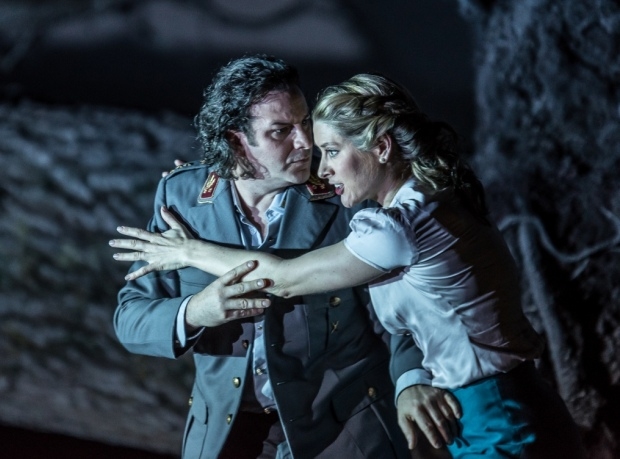
Dat laatste is in zoverre niet onnodig omdat de setting verder nogal modern is. Niet geheel eigentijds maar zeker niet middeleeuws. De Zwitsers zijn gekleed conform de stijl Engeland jaren veertig. Je zou bijna denken dat ROH wat kleding uit een Britten opera heeft recycled. De Oostenrijkers in keurige uniformen, stijl Duitsland jaren veertig. Dat laatste maakt bovengenoemde verkrachtingsscène extra storend: geüniformeerde mannen die veel durven omdat ze met veel zijn en ook nog eens wapens dragen.
Moderne wapens zijn er te over in Michieletto’s geschiedenisles over oorlog en bezetting. Figurant Tell overhandigt de zingende Tell een kruisboog en pijlen maar voor het overige is het automatische wapens dat de klok slaat. Bij aanvang van de derde akte probeert een groep Oostenrijkse soldaten een paar kinderen geduldig en vriendelijk glimlachend te leren schieten met automatische pistolen. Het heeft een hoog HJ-gehalte allemaal. Maar de bedoeling schijnt te zijn geweest om de toeschouwer de link met Bosnië te laten leggen, ach ja, Bosnië.
Het toneelbeeld wordt bepaald door een witte doos die aan de voorzijde open is. Daarin hangt een groot aantal buislampen die zo nu en dan voor enige belichting zorgen. Het toneel is kaal op een stel stoelen na. Michieletto’s opvatting van acteren beperkt zich in deze productie tot veel duw- en trekwerk, op de grond werken van mensen en dreigen met wapens. De enige die hieraan grotendeels ontsnapt is Mathilde, maar dat is dan ook een prinses. Neemt niet weg dat zij door Gesler ruw wordt behandeld als ze in het conflict tussenbeide wil komen.
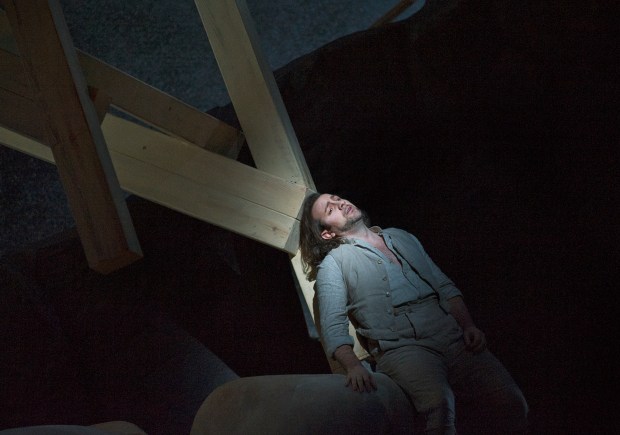
In de tweede en navolgende aktes ligt een ontwortelde boom dwars over het toneel, symbool voor de geschonden Heimat. Verder staat er zo nu en dan wat meubilair opgesteld om een specifieke omgeving te suggereren. De grond is bedekt met aarde en het oorlogskarakter van de handeling wordt benadrukt door de Zwitsers elkaar een bloed-eed te laten afleggen. Voorspelbaar loopt iedereen er na verloop van tijd bij onder de zwarte en/of rode vlekken.
De hoofdrollen waren in de opgenomen voorstelling goed bezet. John Osborn moest in de eerste akte duidelijk nog wat opwarmen maar was in de latere aktes zeer goed op dreef. Zijn rol is veeleisend in de hoogte en Osborn wist daar zeer goed raad mee. Jammer dat de regie hem opzadelde met een catalogus aan stereotiepe gebaren. Het personage Arnold is al zo ‘wishy washy’ en nu balanceerde hij op de rand van een schertsfiguur.
Gerald Finley kreeg alle ruimte om de titelrol in te vullen als de held van het verhaal. Zijn gehele optreden kwam geloofwaardig over en de zang was absoluut van een goed niveau. Ook de interactie met Jemmy, mooi vertolkt door Sofia Fomina, kwam goed uit de verf. Enkelejda Shkosa completeerde op adequate wijze de familie Tell als handenwringende moeder Hedwige.
Malin Byström was in deze productie te bewonderen als Mathilde. Net als in haar Salome raakt ze aan de grenzen van haar mogelijkheden, maar dat lijkt haar niet te deren. Geen moment is ze in echte problemen, ook niet in de lastigste passages. Haar Mathilde mag er zijn, het is het sieraad van deze opname.
Het geheel stond onder leiding van Antonio Pappano. Hij liet het orkest voluit spelen tijdens de beroemde ouverture maar beperkte het vervolgens tot een ondersteunende rol. De zangers kregen van Pappano alle ruimte, meer dan van Michieletto. Compliment nog voor de prestatie van het koor o.l.v. Renato Balsadonna. Aangeraden vanwege de zang. De enscenering als geheel mist spanning en als die zich op momenten toch aandient wekt dat vooral irritatie.
It is said of I Puritani that it is a true soprano opera, but that is not really quite the case. Elvira may be the pivot around which everything revolves, she is also one of the most passive opera heroines I know. Everything that happens around her and to her, happens in spite of her; because apart from loving and going mad, she doesn’t seem to be able to do much of anything at all.
It is the bass (her uncle Giorgio) who devises all sorts of plans to steer the action in the desired direction, and for this he is rewarded by Bellini with a most beautiful aria (‘Cinta di fiori’).
Nicolai Ghiaurov:
In order to save the mad soprano from certain death, he asks the baritone to spare the tenor’s life, which ends in a gorgeous duet (‘Suoni la tromba’), a real show-stopper.
Samuel Ramey and Sherrill Milnes:
The tenor also, who in a fit of patriotinic frenzy seems to send the whole thing into disarray, gets to sing a lot of beautiful (and high!) notes.
John Osborn with Mariola Cantarero from Amsterdam 2009:
All these roles require an excellent bel canto technique, with good coloratura, leggiero and legato. And don’t forget a sense of pure drama, because Bellini (and his librettist!) have created a lot of havoc for the poor soprano: first she becomes delirious with joy, then she loses her mind. She then regains it, only to lose it again immediately. Are you still there? Because it’s not over yet: her mind comes back once more and immediately she’s delirious with joy again. Ouch… Fortunately, the opera stops here, because poor Elvira apparently has to repeat such tricks a few times a day
CD’S
JOAN SUTHERLAND
Elvira, like Lucia, was a showpiece for Maria Callas and Joan Sutherland, both of whom recorded it several times. In 1974, Richard Bonynge (Decca 4175882) made a peerless recording of the opera, besides Sutherland, there was the sublime male trio: Luciano Pavarotti, Nicolai Ghiaurov and Piero Cappuccilli. Sutherland sounds like a little heap of misery, and her virtuosity knows no limits. Pavarotti still possessed all his glorious long high notes in those days and he pops them out with no effort at all.
MARIA CALLAS
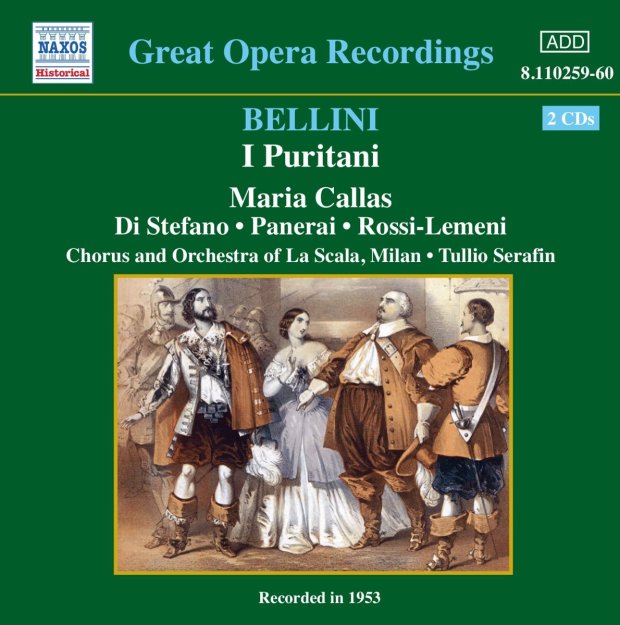
The recording with Callas from 1953 (Naxos 8110259-60) is weighed down by the fact that Giuseppe di Stefano is totally unfit to sing Arturo. But Nicola Rossi-Lemeni (Giorgio) and Rolando Panerai (Riccardo) are excellent, and Tulio Serafin conducts with verve and theatricality. Unfortunately, the score is not complete.
BEVERLY SILLS
A good (and complete!) alternative is the 1973 recording under Julius Rudel (Westminster 4712072), with a very virtuoso Beverly Sills. Arturo is sung in an extraordinarily beautiful and elegant way by Nicolai Gedda. His approach to the high notes is delightful, and personally I find it very pleasant to listen to him.
Conclusion; you are best off with the Decca and Westminster recordings. You get all the music, all the high notes and the best male voices. But since Naxos’ recording with Callas is in the budget class, why not buy it! Because of the conductor, because of the bass, but mainly because of La Divina. Because let’s be honest – nobody else can go so deliciously mad.
DVD’S
ANNA NETREBKO
It gets more difficult if you want to buy the work on DVD, because I cannot recommend either of the performances I watched without any reservations.
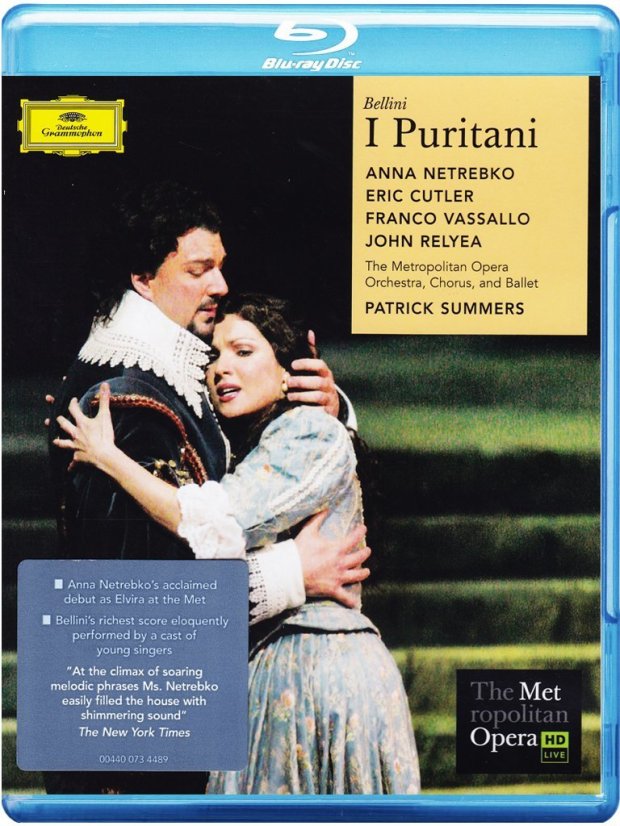
The Metropolitan Opera production, filmed in January 2007 (DG 0734421), is over 30 years old and was originally made for the Sutherland/Pavarotti duo. Perhaps this explains its total lack of personal direction?
There are these monumental tableaux-vivants , in which nobody seems to be allowed to move. The sets are ‘larger than life’ and all the costumes ‘historically accurate’. Anna Netrebko is a very imaginative Elvira. And although she lacks trills, her top notes are there and her presentation (charisma?) is more than convincing.
Both the bass (John Relyea) and the baritone (Franco Vassallo) are reasonable, but no more than that. Eric Cutler (Arturo) has a pleasant timbre and he reaches (albeit with difficulty) the high notes, but it is not really spectacular.
Netrebko sings ‘Deh Vieni al Tempio’ from the first act:
EDITA GRUBEROVA
But Cutler is much better than the totally miscast José Bros in the fifteen-year-old production from Barcelona (ArthouseMusik 107267). His voice is at least a size too small for Arturo. Edita Gruberova is a matter of taste. I do not like her ‘pussy-mouthed ways’ and I do not really want to watch her, but with my eyes closed there is little to complain about, because yes, she can sing bel canto.
Carlos Álvarez is a first-class Riccardo, but the rest of the cast …. Ah, let’s not talk about it. Andrei Serban’s direction, on the other hand, is truly sublime and exciting, I enjoyed it a lot. A friend I was watching with summed it up like this: Netrebko is for straight men and Gruberova (because of Álvarez) for gays and women, but of course it is not that simple. If only we could cut and paste!
BELLINI-BOX
A 25-cd Bellini box set is an absolute must. For 90 euros only, you get all of Bellini’s operas, two of which (La Sonnambula, Norma) are also available in two different versions. Many well known names too: Callas, Caballé, Scotto, Ciofi, Bernstein…
Most recordings are live and the sound and performance quality vary, but who cares? Among them, of course, is I Puritani, recorded in Catania in 1989, with Mariella Devia as Elvira. In the beginning, she is a bit of a disappointment, but gradually she gets better. Not only does she have all the top notes at the ready, she also brings in a lot of (her own) embellishments, and if that is not part of the art of bel canto, then I don’t know what is.
Mariella Devia:
Unfortunately, the men are not of the same level, although Paulo Washington is a moving and very imaginative Giorgio. A special CD-ROM contains all the libretti. A MUST! (Dynamic CDS 52/1-25)
Rudi Stephan’s opera or ‘Erotic Mystery’ Die ersten Menschen was to be premiered early 1915, but WWI intervened. In September that same year the composer died at Germany’s Eastern front, by a bullet through his head
Rudi Stephan
In a way it was a surprise that the opera was to be performed at all. The libretto was based on an “Erotic Mystery” play that had been performed only once in 1912 in München, before it was banned for its explicit content. It was a hyper-eroticised and quite anti-religious view on the first family on earth, Adahm and Chawa, and their sons, Kajin and Chabel (resp. Adam, Eve, Cain and Abel), by Otto Börngraber, now mostly forgotten, but then a well-known radical playwright and philosopher.
In it, Adahm and Chawa are growing older, after having been expelled from paradise. Adahm has become contemplative, focusing on acquiring knowledge through science. Chawa longs back for the days of their youth. Meanwhile Kajin, the older son, is expressing a desire to explore the world, and to look for a ‘wild woman’, but he never gets far. Chabel, the youngest, is into mysticism and prophesies about a redeemer who will come, to be sacrificed as a lamb. In fact, Chabel brings a lamb along, and cuts its throat. Adahm goes out, Kajin tries to seduce Chawa, Chawa tries to seduce Chabel, Kajin kills Chabel and drops on a funeral pyre, Chawa wants to follow Chabel, but Adahm returns and draws her away, Adah and Chawa walk into the sunrise of a new day and Kajin will be the father of humankind.
This mystic and simultaneously sensual and blasphemous family drama is clickbait for director Calixto Bieto, of whom you could somewhat profanely say that he turns everything into mystic and simultaneously sensual and blasphemous family drama. Although first the plan -shelved due to COVID19 – was to have him stage Berlioz’s Damnation de Faust, on which Bieito for sure would have been able to apply his signature key-elements in staging as well: trivialising the sacred and sanctifying the trivial.
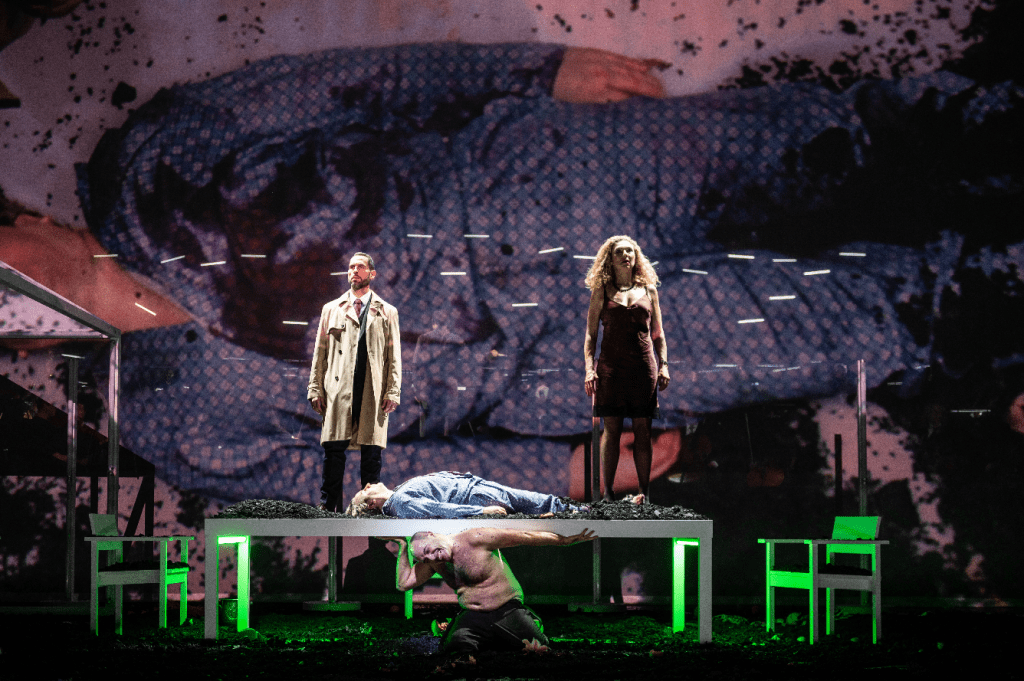
On stage we see a geometrical tent-like structure covered with gauze, the see-through home of this vulnerable first family on earth. There is a table covered with plates, filled with piles of fruit. They of course remind us of Eve and Adam having eaten the forbidden fruit from the Biblical Tree of Knowledge of Good and Evil. During the whole performance Chawa will be eating more fruits, trampling on them, or serving their contents to the other characters. The backdrop is a gauze with video-images of more fruits, alternating with lips, eyes and body parts, and later on the protagonists in close-up. Incidentally we get to see the orchestra behind it, onstage, with conductor François-Xavier Roth, sometimes just the lights of the orchestra’s music-stands, shining through like the stars Chabel sees in his visions.
Director Calixto Bieito;Set design Rebecca Ringst; Costumes Ingo Krügler; Lighting Michael Bauer;
Video Sarah Derendinger; Adahm Kyle Ketelsen
Kaijn Leigh Melrose; Chawa Annette Dasch; Chabel John Osborne;
In the opening scenes Adahm is sitting behind a white laptop, focusing on the screen instead of Chawa. Later on Adahm recounts a white, shiny miracle that he saw during the moment when the Knowledge of Good and Evil was revealed to him, so yes in a way the laptop is in the text. And yes, this is the Bieito method, reducing mythological allusions to seemingly trivial objects, that meanwhile retell the story in their own way.
It reminded me of Ruth Berghaus’ staging of Berg’s Lulu in Brussels; I remember countess Geschwitz, last one in love with Lulu, unreciprocated, vacuuming the run-down attic where she and Lulu, after living a luxurious life, are prostituting themselves –the whole staging was worlds apart from the previous staging in Paris, with the same magnificent Teresa Stratas in the title role, where Patrice Chéreau had given the characters a luscious beau-monde surrounding till the end.
The lamb that Chabel introduces in the family circle here is presented in the shape of a stuffed animal toy that he keeps caressing, behaving like a big baby. Yet, without any hesitation he decapitates his pet toy when the moment of the sacrifice arrives. The toy turns out to be filled with blood, which gushes out.
The role was performed by John Osborn, thus the role was cast as lyrical rather than as Wagnerian. Osborn often almost pushes his voice into falsetto, bringing the character closer to for instance the fool in Boris Godounov than a Wagnerian ‘Held’, and John Osborn really is the perfect performer for this, and Bieito makes full use of him. After having ‘killed’ the toy lamb, all the while showing the smile of a lunatic, he returns in pyjamas, which reveal the singer’s somewhat voluminous belly, making him so the more appear like an oversized toddler.
Kajin clings to Chawa after he murdered Chabel
Meanwhile, his brother Kajin (superbly performed by baritone Leigh Melrose) gets to show his somewhat voluminous belly as well, but in his turn a more mannish one, as befits his character, covered abundantly with chest hair. All this leads to a scene where mother Chawa (a commanding Annette Dasch with some very demanding notes over full orchestra) strips as well, down to a negligée. And yes, still quite in line with the libretto, consecutively Kajin tries to rape Chawa, Chawa tries to rape Chabel, all join in a threesome, Kajin tries to rape Chabel, and Kajin kills Chabel.
Kajin rapes Chawa
Enter Adahm (bass-baritone Kyle Ketelsen). Apparently untouched by all the hormones flying around, Adahm stays dressed, in the end even wearing a plain raincoat on top of everything. There is no sunrise outside to walk into, but Adahm and Chawa embrace, in closeup in the backdrop video, in loving caressing.
Stephan’s musical idiom oscillates between the budding atonality of Schönberg’s Erwartung (finished 1909) and the stretched tonal idiom of Schreker; Schreker’s Die Gezeichneten was written during the same years as Die Erste Menschen. The topic is not that distant from the incest of Strauss’ Salomé, the sexual craving in Erwartung, the promiscuity of Die Gezeichneten, all topics that were already present in Wagner’s Ring meanwhile.
It took Stephan a while to finish the opera, partly it seems as librettist Börngraber had been thinking Richard Strauss might instead be interested in the text. But Strauss had already abandoned his taste for topics like Salomé and Elektra, replacing it with the saccharine world of Der Rosenkavalier, which premiered in 1911.
Finally, Die Erste Menschen was staged in 1920 in Frankfurt, to critical acclaim, but without winning the hearts of audiences. After a second failure in 1924 in an abridged, chastened version, it disappeared. This Amsterdam production is only the second post WWII production of the full score. And without Corona we would not even have had this ravishing gem. Berlioz’ Damnation will wait.
Adahm: Kyle Ketelsen Kajin: Leigh Melrose Chawa: Annette Dasch Chabel: John Osborn Musical direction: François-Xavier Roth Direction: Calixto Bieito Set design: Rebecca Ringst Costumes Ingo Krügler Lighting: Michael Bauer Video: Sarah Derendinger Orchestra: Royal Concertgebouw Orchestra
This production is part of the Holland Festival 2021
Photography Ruth Walz
The production can be seen on ARTE and on the websites of the Holland Festival and the Dutch National Opera & Ballet from June 25th on, for free:
So you don’t believe in true love? Have you become a bit cynical because your heart has been broken too often, or have you seen too many marriages end in divorce? So fairy-tales are not real and your tears are flowing for La Bohème only??
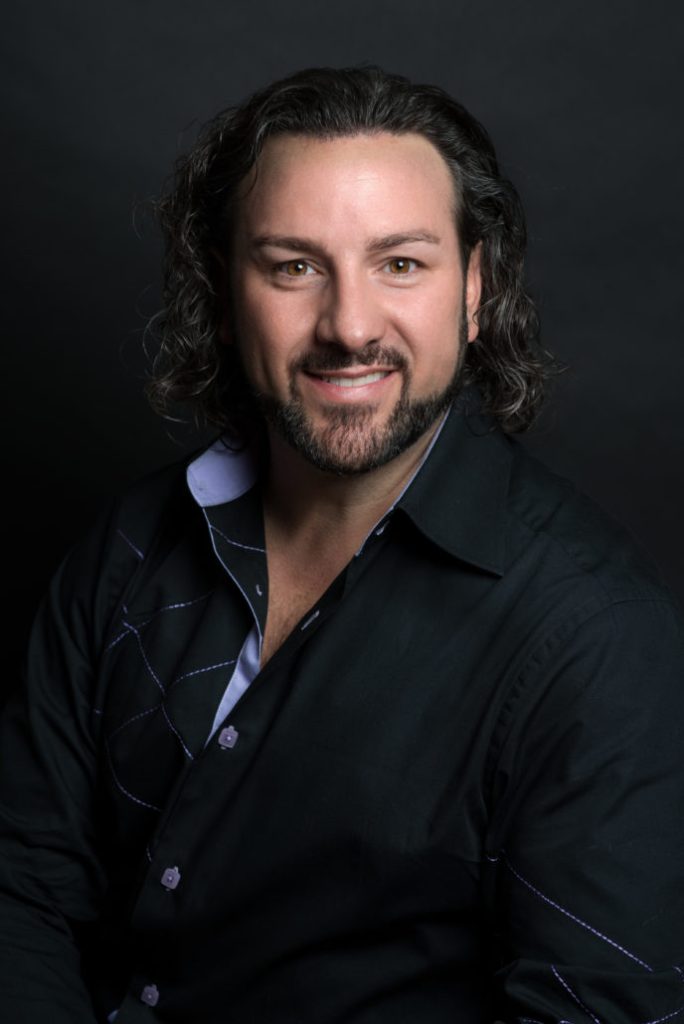
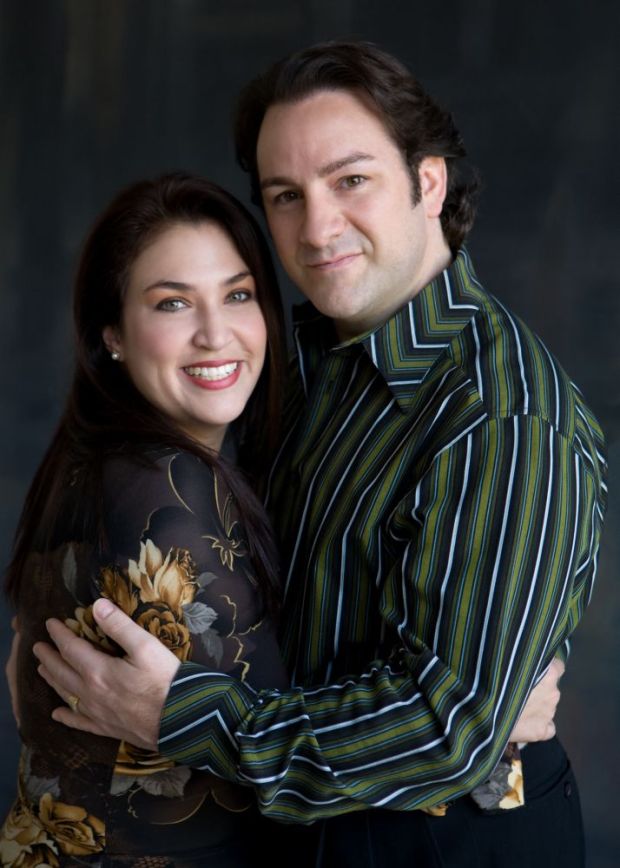
I know a remedy: meet John Osborn and the love of his life, Lynette Tapia. Their love blossoms and glows as if they have only just met and yet they have been together for many years! They also have a daughter, the now eighteen-year-old multi-talented Anna.
I met them both on a horribly cold February day in 2013 with ice, snow and wind outside, but in the café Puccini where we met, my heart and soul were soon to be warmed
The lovely Lynette Tapia with her beautiful green eyes and shiny black hair is a celebrated singer as well and sometimes she manages to sing with her husband. In September 2006, they had their Amsterdam debut together in Capricio by Richard Strauss, as the Italia13n singers.
OPERA CLASSICA
In October 2012, they both sang in Verdi’s Rigoletto at Schloss Braunfels, a production of Opera Classica Europa, an organisation that presents operas at the most beautiful historical locations in Europ
Osborn: I love what Opera Classica Europa does and the way they do it. The location was enchanting, we were wearing real, historical costumes. Old-fashioned? Yes, definitely: old-fashioned beautiful. We didn’t have that much rehearsal time, but there was no need. There was nothing you really had to learn, everything being already in the music.
The role of the Duca is particularly suited to a high tenor. I have been a singer for 22 years. I am not a baritonal tenor but I can sing ever heavier roles. It depends on the location, of course, and it also matters who your conductor is, and whether he knows how to keep the orchestra in check. The music has been shifted to a higher pitch, the orchestras are playing louder, but you still have to rise above the orchestra and you have to be audible everywhere, even in the back rows. Add to that the fact that we tenors don’t sing in falsetto any more; today’s audience would not be appreciative.
I am from the generation that grew up with the three tenors, but a lot has changed since then. You can’t afford not to look good. Or not to be fit. When I was younger, I didn’t participate in sports and fitness, I thought it was a waste of time. But in a way, I think it is fair and good that we take care to look the part a bit more, for the public’s sake. Although it is still mainly (I hope?!) about the singing!
DIRECTORS
Directors? Are they really important? Who ever heard of a director, say 50, 60 years ago? We knew who the singers were and that was all that mattered. The conductor, the orchestra, yes, but a director? We still speak of Tosca by Callas or Don Carlo by Corelli, but nowadays the name of the director is written in big, bold letters at the top of the poster, even before the composer! Many of the directors have also developed a somewhat perverse way of manipulating human feelings, which bothers me. Sometimes I think: do you really want to create something new? Then create something new! Write your own opera!
I admire Pierre Audi very much and I really enjoy working with him. OK, after a few times you know the concept and you know it’s going to be very aesthetic, static too. But he has respect for the singers, we are more to him than just pawns in a game of chess.
I also have a great affinity with the work of Moshe Leiser and Patrice Caurier. I did Clari by Halèvy and Otello by Rossini with them, both in Zurich, and we had a lot of fun together. They work in a logical way and their productions are very well put together. Clari may have been updated, but everything is just right. The directors have a kind of sixth sense for what goes with the music, so their productions are very diverse.
CONDUCTORS
Who are the really good conductors? The generation that has almost died out: Nello Santi, Claudio Abbado. But that doesn’t mean they are over, those good old days! I like Yannick Nézet-Séguin immensely, he understands the French style like no other. Unfortunately I have only worked with him once, in 2008 in Salzburg. We did Romeo et Juliette together and the performance was unforgettable! He liked my ‘French way’ of singing so much that he even invited his parents to the performance. For me that was one of the greatest compliments ever!
At the time of our conversation, Osborn is singing Arnold in the DNO production of Guillaume Tell. He first performed this role in the 2007 – 2008 season with the Accademia di Santa Cecilia Orchestra in Rome. After that we could admire him in this role in the ZaterdagMatinee (December 2012) and the general press called the performance a ‘historical event’. And now finally on stage. The difference?
“I have indeed performed the opera concertante a few times, with more or less cuts, so each time it was quite exciting to think which version we would be doing next. At the Matinee, the score was almost complete. As a singer, I have learned to act with my voice, but if I can actually show my feelings on stage as well, not only through my singing but also by the way I move, then that adds an extra dimension.
Is there anything you would like to say to your Dutch audience? “This is the sixth time I work in Amsterdam. I always love coming back to visit this beautiful city. The people are so kind and welcoming. All of the friends I’ve made from The Dutch National Opera, the members of the chorus, the musical staff, and the production staff have all been so supportive of me and the talents I’ve been given. I am so grateful for the opportunities to perform here, and I truly feel like Amsterdam has become a second home for me. I very much look forward to returning to this unique and wonderful place again in the near future. Sincerely, John Osborn’.
Lynette Tapia and John Osborn in “Parigi o cara” from La Traviata Live at Schloss Braunfels, august 12 2018 :
The 2009-2010 season of De Nationale Opera (then the Netherlands Opera) in Amsterdam started very strongly with Jacques Fromental Halévy’s La Juive. This production had already been staged in Paris, where it was highly praised despite its unsuccessful premiere (the opera staff were once again on strike and there was no lighting).
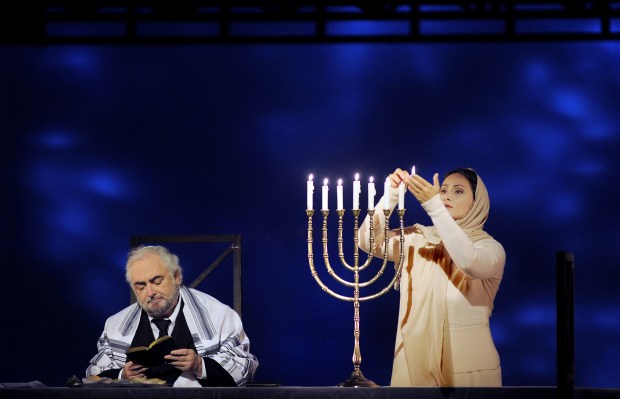
Pierre Audi’s direction was particularly beautiful and effective. As is (almost) always the case with him, the images were stylised, aesthetic and beautiful to look at. The understated aesthetics worked perfectly with the highly emotional music, not to mention the subject matter.
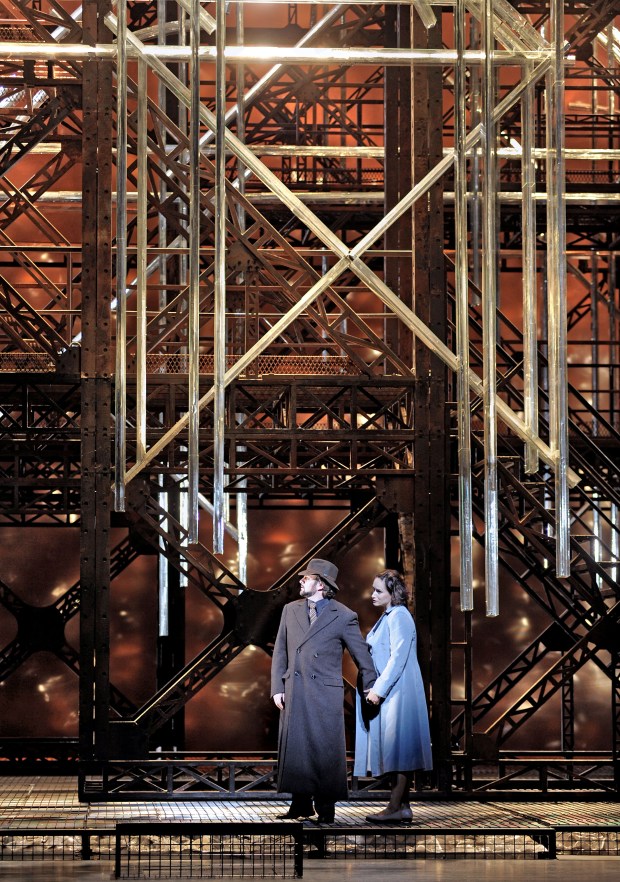
Jean Kalman’s grandiose lighting was an important part of the stage concept, making the final scene, in which Eléazar and Rachel calmly walk towards their deaths, one of the most moving moments in opera history. I just had to cry and I was not alone. George Tsypin’s setting: a steel cathedral that also served as a prison, was also very impressive.
Musically, it was a dream performance. Dennis O’Neill really wás Eléazar. Not so young anymore, tormented, full of revenge, but also doubting – a truly perfect performance. He sang his great aria full of glow and passion, and with the necessary sob. And although it was not entirely perfect here and there, it was just so very moving.
The voice of Angeles Blancas Gulin (Rachel), with its very recognisable timbre, is not exactly ordinary. At times metallic and sharp, yet warm and round. Her portrayal of a young girl torn between duty and love was very credible and her fear physically palpable.
John Osborn (Léopold) and Annick Massis (Eudoxie) were also present in Paris. Both singers possess a truly phenomenal bel canto technique and dazzling, supple high notes.
Alaistair Miles (Brogni) may not have had the best low notes, but his charisma was very impressive.
Carlo Rizzi conducted the excellently playing Netherlands Philharmonic Orchestra with the necessary momentum and the Netherlands Opera Chorus (rehearsal: Martin Wright) was, as always, compelling and unmatched. A big BRAVO to all.



















 Basia con fuoco