English

Avantgarde and retrospection

Text: Neil van der Linden

Short Circuit

Avantgarde and retrospection, that could be the theme of Short Circuit, a Holland Festival event filled with four performances created by favourites of the festival’s ‘Associate Artists’ Gisèle Vienne and Ryiuchi Sakamoto. The whole program ingeniously made use of the various spaces at ‘De School’, an abandoned school building that for a while was known for its alternative art events and audio-visual parties.

Gisèle Vienne herself made a choreography for performer Katia Petrowick. One of the former classrooms is dressed up as a sort of vintage disco, apparently during in the aftermath of a dance night, with garlands, crumbled drink cans and chips bags lying around on the floor. We hear loud music in the style of mid-eighties Detroit techno or the kind of music Alex Patterson of the Orb would play during after-parties; I remember great nights at Paradiso and Fuse/La Démence in Brussels. Petrowick enters and moves across the floor in slow motion, while the music still without metre. Knowing that the whole event is supposed to last three and a half hours, at first you could be inclined to ask yourself am I ready to attend this kind of things for such a long time, but soon the whole ambiance of performance takes over, and the music catches tempo.

As absurd as it may sound, a highlight is when the character on stage finds a leftover full bag of chips in a Lidl shopping bag and slowly opens it; the thud of the exploding bag being pressed open brings us back in real-time and becomes an almost frightening event.

The whole ambiance reminded me of the magnificent, ghastly movie Climax by Gaspar Noé, about a group of young French dancers having a farewell party before leaving for a US tour, which completely runs out of hands after somebody slips LSD into the drinks, with even mortal consequences, all this on fantastic vintage techno music. I imagined the performance to be the scene of the evening after the events in Climax unfolded.

Meanwhile the performer was about 10 metres away from the front row where I sat, yet the smell of the chips from the bag was penetrating. Also, this for a moment brought me back to the present; if we can inhale the smell chips at 10 metres, what about the aerosols we were afraid of during almost one and a half year? However, no reason to worry, everybody in the audience had to be tested for COVID19 prior to the event. Good to know.

The audience was guided through the performances in various orders. For my group, the evening concluded with a concert by J. Bonnet and Stephen F. O’Malley, performing on guitars and sundry electronic devices. I deliberately use the word sundry as that was the favourite word for pioneering seventies and eighties progressive rock guitarist Robert Fripp describing the instruments he used, and indeed his is the music I had to think of. Harmoniously rich, making use of all the possibilities of distortion, reverb and feedback, and loud. Other alternative rock influences I had to think of are Throbbing Gristle, Sonic Youth, and, talking about loud, the Irish ‘shoegazer music’ band My Bloody Valentine, who were notoriously loud; like with that one My Bloody Valentine concert I attended in Paradiso, I’m still a little deaf after yesterday’s performance, although a bit less deaf than then – time soothes.

The setting was in another former classroom, overlooking a dark seemingly quiet garden outside. But the building is located next to a ramp leading to the Amsterdam ringroad behind it and through the trees every five or six seconds the head- and taillights of cars could be seen, however as their noises were drown out by the sound produced on stage, the lights looked strangely tranquil. By then the three and a half hours had almost passed and you still found yourself glued in a chair absorbed by the whole event that otherwise might have looked like something you had all seen before.
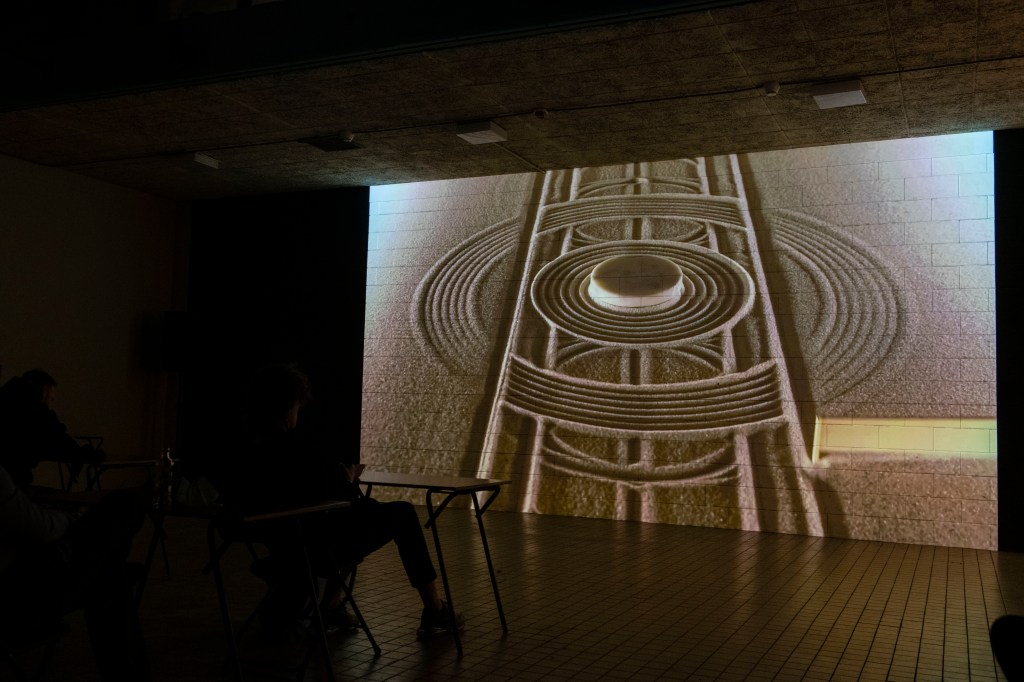
The two, both Japanese, performances in between were of no less ‘nostalgic’ interest. At first Yuko Mohri, who names Satie, Duchamp and Cage as her examples, especially as she shares their use of coincidental elements in music. She puts up small ‘sundry’ household objects dishes, pots, tins, attaching them to toylike mechanical and electric devices that create vibrations causing the objects to resonate. The resulting sounds are captured by directional microphones and transferred to an electromechanics device that play the keys of a piano. The playfulness and the loving care with which everything was carried out were a joy to watch. In the end the audience joined as the sound of the applause was also able to steer the piano keys. In between there was a viewing of a video of the zen gardens created by the artist Yuki Kawae.
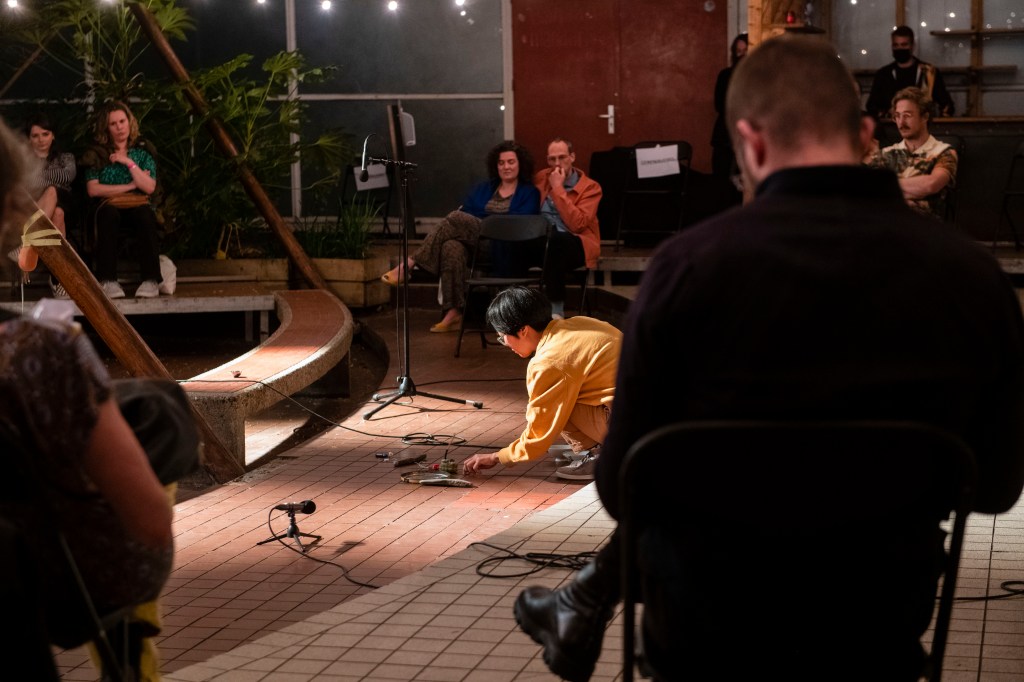
For the other Japanese performance, I would also like to name a reference. Tujiko Noriko’s single long song in which she accompanies her etheric voice singing in alternatingly English and Japanese sounded like slow-motion, softened down version of Walking on Thin Ice; if there was only one great example of Yoko Ono’s contribution to pop music to be named, it was that song. She and John Lennon concluded its recording of it in December 1980, the day that on their return from the recording studio John was murdered.

This performance by Noriko, serenely standing next to her laptop in slowly shifting colours from the light installation, probably coincidentally, embodied something dramatic beyond its seemingly soothing sound.

Later in the Holland festival, the performance Kindertotenlieder will reunite Gisèle Vienne, Katia Petrowick and Stephen F. O’Malley,  June 16 and 18, Westergasfabriek.

(And by chance the movie Climax is back in Amsterdam these days at LAB 111.)

Short Circuit, Yuko Mohri, Gisèle Vienne/Katia Petrowick, François J. Bonnet & Stephen F. O’Malley and Tujiko Noriko, and a video by Yuki Kawae, as part of the Holland Festival, De School building, Amsterdam, Saturday June the 12th

https://www.hollandfestival.nl/nl/programma/2021/short-circuit/
Tristan und Isolde: kind of discography

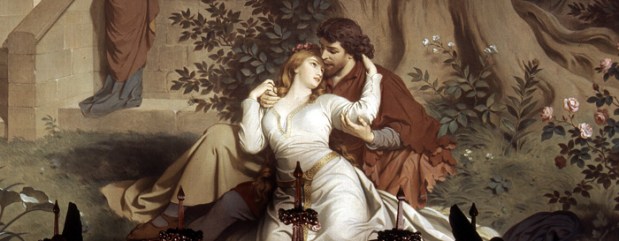
tristan August Spieß,
Tristan und Isolde. Wandschilderij van August Spieß, 1881

CD’S


Carlo Kleiber 1982

Tristan Kleiber

Writing a discography of Tristan und Isolde almost feels like being a composer yourself. Not only because there are so many recordings (no less than fifty, eleven of which are on DVD! and those are just the complete commercial editions that are still for sale!, add to that the countless editions of highlights, the pirates, videos on Youtube …. ), but also because it is an opera that will completely drain you emotionally.

But I did my best. I listened for hours to the many Furtwänglers, Böhms and Karajans (and there are many!), dusted off Artur Bodanzky… visited Janowski and Barenboim…. only to conclude, after a few weeks of almost continuously dying hundreds of Love Deaths, that were I to be banished to a desert island with only one recording, it would undoubtedly be the 1982 version under Carlos Kleiber (DG 4775355).

Margaret Price is an unforgettable Isolde. Her silver-like lyric soprano sounds very feminine and pure in its vulnerability. Oh, she is strong too, and determined, but her feminine side prevails. An Isolde to fall in love with.
René Kollo lacks a little brilliance, but otherwise sings a good Tristan. It is a pity about Fischer-Dieskau, his Kurwenal is not really the best, but Kurt Moll is a fantastic Marke and Brigitte Fassbänder ditto as Brangäne.

But the conductor! How wonderful he is! From the very first distant sound to the last chord, with my eyes closed I completely immerse myself in the orchestral sound. Breathtaking. No, more than that: hypnotic.

WILLEM FURTWÄNGLER: LIVE, 1941 – 1947

600168_FurtwŠngler_BOX_.indd

A few years ago, the company The Intense Media released a Furtwängler box set, with live recorded operas on no less than 41 CDs. Apart from one stray Verdi (Otello with Ramón Vinay from Vienna 1951), all are German: Mozart, Gluck, Beethoven and von Weber. And – how can it be otherwise? -, a lot of Wagner, his music is on no less than 24 of the 41 CDs.

Tristan und Isolde are present no less than three times, in fragments from three different performances.

The recording from Vienna in 1943 with Max Lorenz and Anny Konetzni, famous among the diehards, also contains some added fragments with the same cast from 1941. A mistake, of course, but for many still an important document.

I myself have a lot of trouble with this part, which is why I quickly went through it and continued with the fragments recorded in 1947 in the Admiralspalast in Berlin, with a truly excellent Tristan sung by Ludwig Suthaus. There are few basses that can match Gottlob Frick (Marke), Erna Schlüter is a fine Isolde and Margarete Klose a very good Brangäne. The sound is unfortunately not beautiful, but a real Wagnerian does not mind that too much.


WILLEM FURTWÄNGLER: STUDIO, LONDON 1952

Tristan Furtwangler Naxos


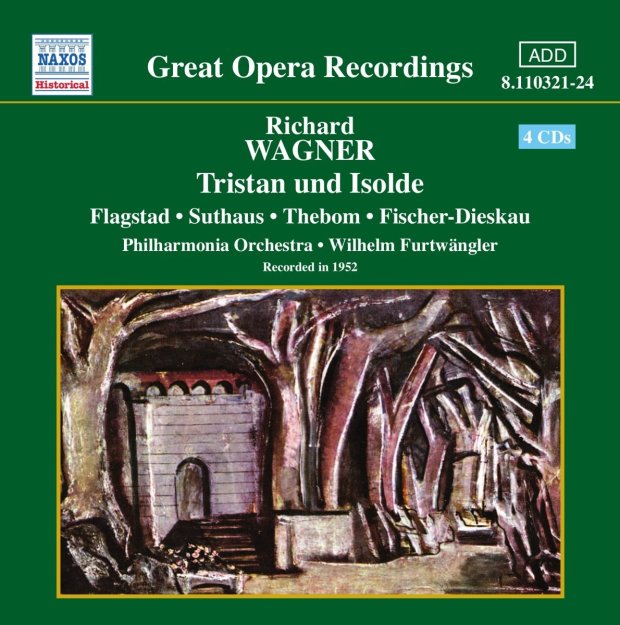
Less exciting perhaps, but the opera becomes really inimitably beautiful in the studio recording from 1952 (Naxos 8110321-24). Ludwig Suthaus is here also, but only now do you hear what a fantastic Tristan he was. He was now partnered with an Isolde of his own stature: Kirsten Flagstadt.

The young Fischer-Dieskau is a beautiful Kurwenal, Josef Greindl a brilliant Marke and Blanche Thebom a very attractive, lyrical, Brangäne.

But the orchestra is the most beautiful of all: in this recording, you really hear what a fantastic conductor Furtwängler was! Also remarkable: in the small roles of the sailor and the shepherd you can hear Rudolf Schock…. Yes… those were the days!


HERBERT VON KARAJAN BAYREUTH 1952


Tristan Karajan 1952


I am not such a fan of Martha Mödl singing Isolde. I admire her enormously, though! Her stamina is inexhaustible and her powerful voice can only be compared to a laser beam that cuts mercilessly through all the walls until nothing remains standing. Hurricane Irma is nothing in comparison.

The performance recorded live in Bayreuth in 1952 sounds quite sharp, making her voice seem even louder and bigger than usual. There is a lot to be said for that; no one had to turn the volume up because what you hear is pure nature. Even Karajan and his orchestra cannot compete with her! Legendary, yes, but I hear so little love in her interpretation! This  in contrast to Ramón Vinay’s Tristan, he may be a little less powerful, but he sounds very warm and romantic.

The latter is for me the main reason to cherish the recording, but I also like the rest of the cast very much. Ida Malaniuk is an attractive Brangäne, Ludwig Weber a good Marke and Hans Hotter a somewhat heavy but otherwise beautiful Kurwenal.


DVDs


NIKOLAUS LEHNHOFF GLYNDEBOURNE 2007

Tristan Lehnhoff Glyndebourne


The performance recorded in August 2007, directed by Nikolaus Lehnhoff, is in all respects one of the most beautiful Tristans. For the first time in my life, I completely surrendered myself to the opera. Without any regrets, by the way.

Lehnhoff took Isolde’s words: ‘Im dunkel du, im lichten ich’ as the starting point of his staging, and his play with dark and light (and with space!) results in an extraordinarily exciting and beautiful stage setting. The costumes are a kind of mixture of medieval simplicity and contemporary glitter.

Nina Stemme is literally and figuratively the most beautiful Isolde one can imagine. Her creamy, sensual soprano with its many colour nuances sounds like a balm for the soul. All her notes sound natural and effortless, as natural and bittersweet as love itself.

Robert Gambill’s voice may not quite meet the heavy demands of the part, but he portrays a very charismatic and committed Tristan. Katarina Karnéus (Brangäne), René Pape (Marke) and Bo Skovhus (Kurvenal) also sing and act in an excellent manner.

The conductor (an amazingly good Jiří Bêlohlávek) persuades the orchestra to produce the most beautiful colours as he builds up a thriller-like tension. The opera, which lasts more than four hours, is over in no time at all. That is real Art. Highly recommended. (Opus Arte 0988 D)


NIKOLAUS LEHNHOFF ORANGE 1973

Tristan Böhm Orange


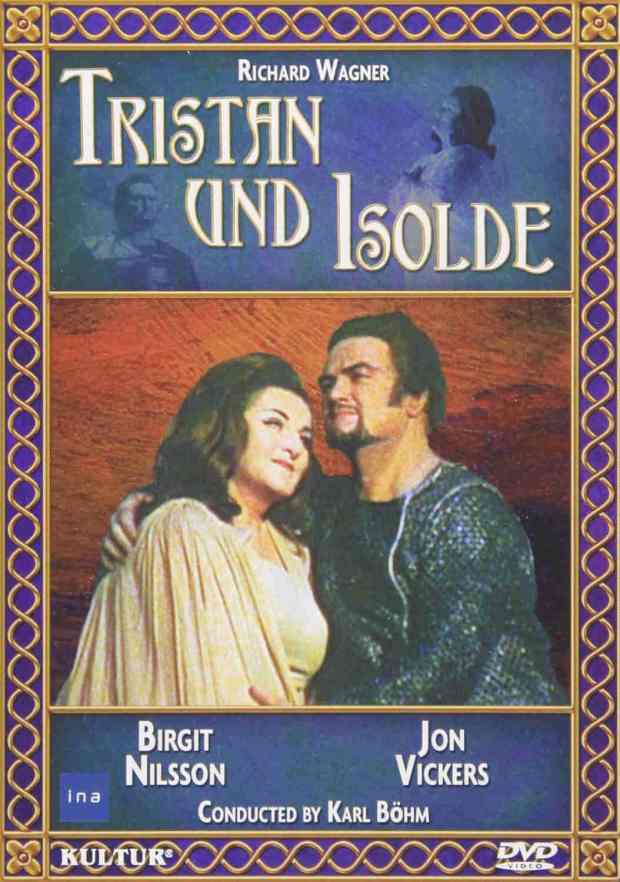
In 1973, Lehnhoff directed a then very high-profile production of Tristan in Orange. The production is simple and timeless and, frankly, a little dull.

But the leading roles are sung by the then 55-year-old Birgit Nilsson and Jon Vickers and it is conducted by Karl Böhm, which makes the whole thing a document of note. The picture and sound quality is poor, but that will not deter the true music lover (Hardy Classics HCD 4009).


BARENBOIM AND PONNELLE BAYREUTH 1981

Tristan Barenboim Ponnelle


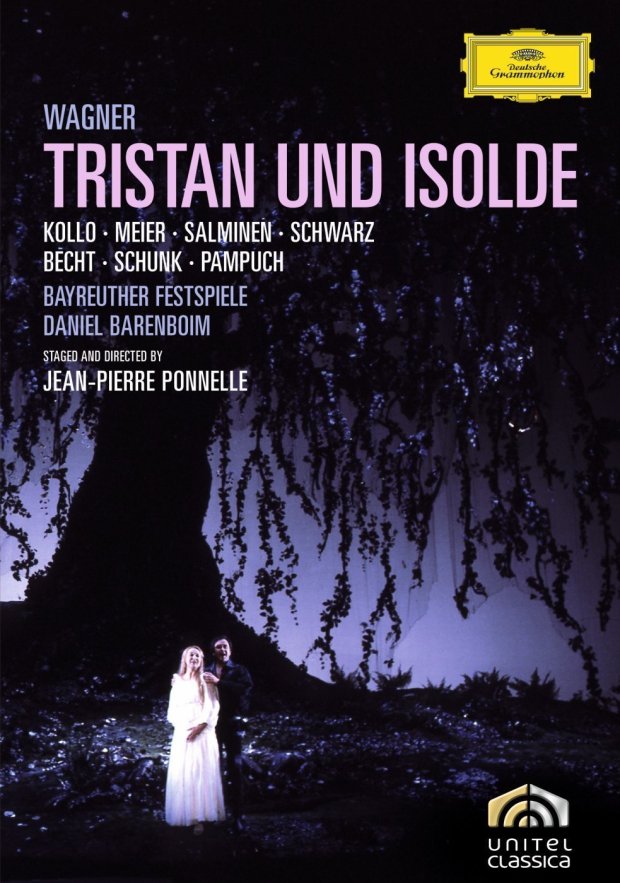
The performance of ‘Tristan’ in 1981 marked the debut of Barenboim and Ponnelle in Bayreuth. Their collaboration resulted in immense success, and both the audience and the press were wildly enthusiastic. In October ’83, the performance, this time without an audience, was recorded on video (DG 0734321).

Ponnelle’s splendid staging is a fine display of magic realism; with much symbolism, subcutaneous eroticism and dreams, where the real world turns out to be an imagination. The last act takes place in the head of the delirious Tristan: accompanied by Isolde’s Liebestod, perhaps the most beautiful music ever written, he dies in the arms of Kurvenal.

It is the first time I see Johanna Meier, and the encounter is not entirely satisfactory. Admittedly – she looks beautiful, acts well, and I have no complaints about her singing, but it all sounds so artificial … You can almost hear her work so very hard, and I don’t like that. But maybe I am wrong, and there is just no chemistry between her and me? There is no lack of the latter between her and Tristan: a bit dry sounding, but otherwise fine singing, René Kollo. Matti Salminen is irresistible as Marke and Hanna Schwarz is a truly phenomenal Brangäne.
A magical performance.


BARENBOIM AND CHÉRAU MILAN 2007

BLURAY:BLURAY


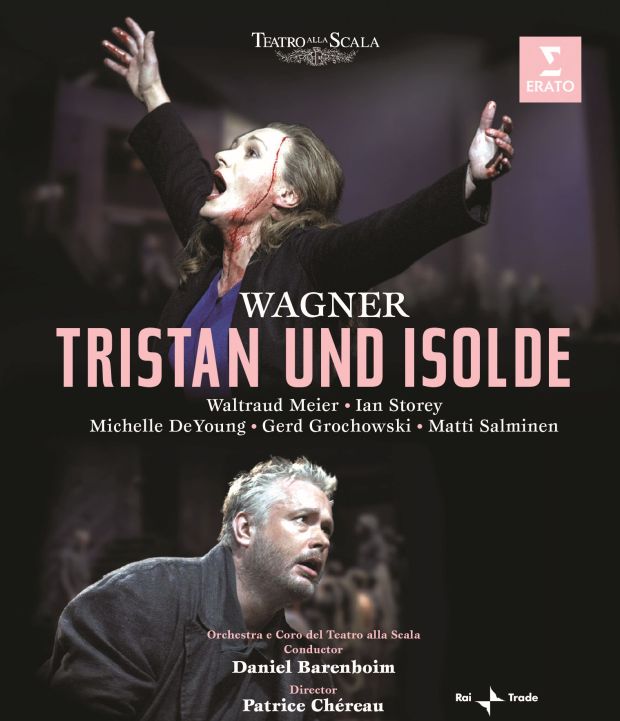
The opening night of La Scala with Tristan und Isolde directed by Daniel Barenboim and Patrice Chéreau, with Waltraud Meier in the leading role… Yes, that raises expectations. The reviews were not entirely positive, but I was enthusiastic about it, and now that I have seen the production again, I still am.

First of all, there is Chéreau’s intelligent and very humane directing and Richard Peduzzi’s sober but so ‘to the point’ stagecraft. The costumes and sparse sets are very medieval and through small details a suggestion of reality is created. For me, this is an example of how, with the use of tradition, a truly modern performance can be put upon the stage.

The direction of the characters is excellent. Chéreau knows like no other how to turn his theatrical characters into people of flesh and blood. It is not a fairy tale or a legend, everything is actually happening and the ‘everlasting kiss’ does indeed last forever.

Waltraud Meier sings (and acts!) a warm-blooded Isolde, Michelle de Young is a very convincing Brangäne, Gerd Grochowski a formidable Kurwenal and Matti Salminen as Marke is already an icon. But I was most surprised by the then unknown Ian Storey as a solid Tristan (Warner Classics 0825646055005).


More Tristan und Isolde:

Tristan und Isolde door Pierre Audi: weinig emoties maar wat een zangers!

Daniel Harding dirigeert de tweede akte van Tristan en Isolde: grote namen en weinig emotie

Heimwee naar Waltraud Meier en Kurt Moll: Tristan und Isolde

Domingo and Wagner

Mystery and eroticism after paradise: Rudi Stephan’s ‘Die ersten Menschen’

Text: Neil van der Linden

Rudi Stephan’s opera or ‘Erotic Mystery’ Die ersten Menschen was to be premiered early 1915, but WWI intervened. In September that same year the composer died at Germany’s Eastern front, by a bullet through his head

In a way it was a surprise that the opera was to be performed at all. The libretto was based on an “Erotic Mystery” play that had been performed only once in 1912 in München, before it was banned for its explicit content. It was a hyper-eroticised and quite anti-religious view on the first family on earth, Adahm and Chawa, and their sons, Kajin and Chabel (resp. Adam, Eve, Cain and Abel), by Otto Börngraber, now mostly forgotten, but then a well-known radical playwright and philosopher.

In it, Adahm and Chawa are growing older, after having been expelled from paradise. Adahm has become contemplative, focusing on acquiring knowledge through science. Chawa longs back for the days of their youth. Meanwhile Kajin, the older son, is expressing a desire to explore the world, and to look for a ‘wild woman’, but he never gets far. Chabel, the youngest, is into mysticism and prophesies about a redeemer who will come, to be sacrificed as a lamb. In fact, Chabel brings a lamb along, and cuts its throat. Adahm goes out, Kajin tries to seduce Chawa, Chawa tries to seduce Chabel, Kajin kills Chabel and drops on a funeral pyre, Chawa wants to follow Chabel, but Adahm returns and draws her away, Adah and Chawa walk into the sunrise of a new day and Kajin will be the father of humankind.

This mystic and simultaneously sensual and blasphemous family drama is clickbait for director Calixto Bieto, of whom you could somewhat profanely say that he turns everything into mystic and simultaneously sensual and blasphemous family drama. Although first the plan -shelved due to COVID19 – was to have him stage Berlioz’s Damnation de Faust, on which Bieito for sure would have been able to apply his signature key-elements in staging as well: trivialising the sacred and sanctifying the trivial.

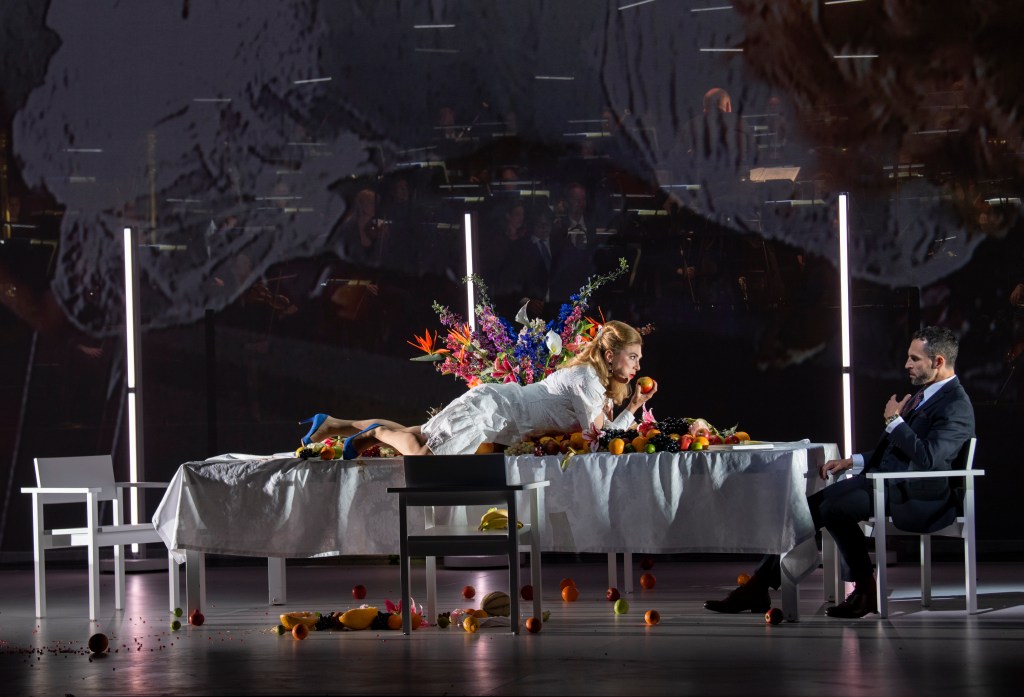
On stage we see a geometrical tent-like structure covered with gauze, the see-through home of this vulnerable first family on earth. There is a table covered with plates, filled with piles of fruit. They of course remind us of Eve and Adam having eaten the forbidden fruit from the Biblical Tree of Knowledge of Good and Evil. During the whole performance Chawa will be eating more fruits, trampling on them, or serving their contents to the other characters.  The backdrop is a gauze with video-images of more fruits, alternating with lips, eyes and body parts, and later on the protagonists in close-up. Incidentally we get to see the orchestra behind it, onstage, with conductor François-Xavier Roth, sometimes just the lights of the orchestra’s music-stands, shining through like the stars Chabel sees in his visions.

In the opening scenes Adahm is sitting behind a white laptop, focusing on the screen instead of Chawa. Later on Adahm recounts a white, shiny miracle that he saw during the moment when the Knowledge of Good and Evil was revealed to him, so yes in a way the laptop is in the text.  And yes, this is the Bieito method, reducing mythological allusions to seemingly trivial objects, that meanwhile retell the story in their own way.

It reminded me of Ruth Berghaus’ staging of Berg’s Lulu in Brussels; I remember countess Geschwitz, last one in love with Lulu, unreciprocated, vacuuming the run-down attic where she and Lulu, after living a luxurious life, are prostituting themselves –the whole staging was worlds apart from the previous staging in Paris, with the same magnificent Teresa Stratas in the title role, where Patrice Chéreau had given the characters a luscious beau-monde surrounding till the end.

The lamb that Chabel introduces in the family circle here is presented in the shape of a stuffed animal toy that he keeps caressing, behaving like a big baby. Yet, without any hesitation he decapitates his pet toy when the moment of the sacrifice arrives. The toy turns out to be filled with blood, which gushes out.

The role was performed by John Osborn, thus the role was cast as lyrical rather than as Wagnerian. Osborn often almost pushes his voice into falsetto, bringing the character closer to for instance the fool in Boris Godounov than a Wagnerian ‘Held’, and John Osborn really is the perfect performer for this, and Bieito makes full use of him. After having ‘killed’ the toy lamb, all the while showing the smile of a lunatic, he returns in pyjamas, which reveal the singer’s somewhat voluminous belly, making him so the more appear like an oversized toddler.

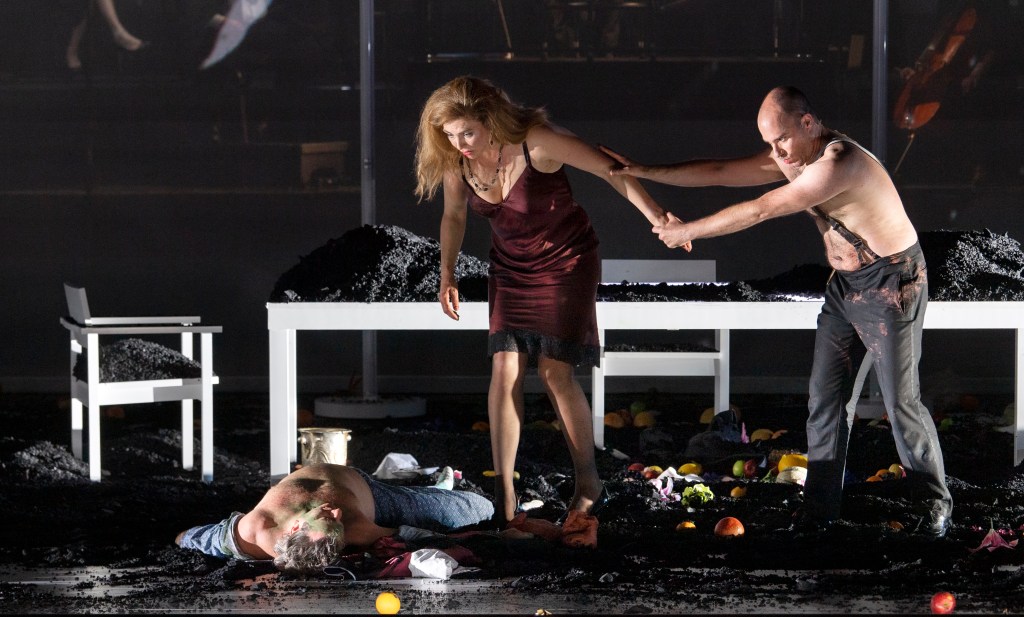
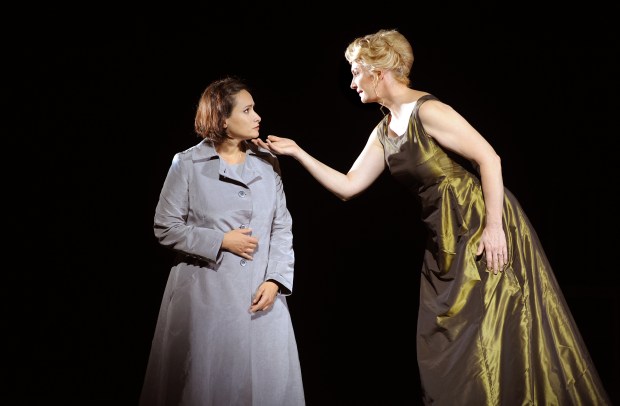
Meanwhile, his brother Kajin (superbly performed by baritone Leigh Melrose) gets to show his somewhat voluminous belly as well, but in his turn a more mannish one, as befits his character, covered abundantly with chest hair. All this leads to a scene where mother Chawa (a commanding Annette Dasch with some very demanding notes over full orchestra) strips as well, down to a negligée. And yes, still quite in line with the libretto, consecutively Kajin tries to rape Chawa, Chawa tries to rape Chabel, all join in a threesome, Kajin tries to rape Chabel, and Kajin kills Chabel.

Enter Adahm (bass-baritone Kyle Ketelsen). Apparently untouched by all the hormones flying around, Adahm stays dressed, in the end even wearing a plain raincoat on top of everything. There is no sunrise outside to walk into, but Adahm and Chawa embrace, in closeup in the backdrop video, in loving caressing.

Stephan’s musical idiom oscillates between the budding atonality of Schönberg’s Erwartung (finished 1909) and the stretched tonal idiom of Schreker;  Schreker’s Die Gezeichneten was written during the same years as Die Erste Menschen. The topic is not that distant from the incest of Strauss’ Salomé, the sexual craving in Erwartung, the promiscuity of Die Gezeichneten, all topics that were already present in Wagner’s Ring meanwhile.

It took Stephan a while to finish the opera, partly it seems as librettist Börngraber had been thinking Richard Strauss might instead be interested in the text. But Strauss had already abandoned his taste for topics like Salomé and Elektra, replacing it with the saccharine world of Der Rosenkavalier, which premiered in 1911. 

Finally, Die Erste Menschen was staged in 1920 in Frankfurt, to critical acclaim, but without winning the hearts of audiences. After a second failure in 1924 in an abridged, chastened version, it disappeared. This Amsterdam production is only the second post WWII production of the full score. And without Corona we would not even have had this ravishing gem. Berlioz’ Damnation will wait.


Adahm: Kyle Ketelsen 
Kajin: Leigh Melrose 
Chawa: Annette Dasch 
Chabel: John Osborn
Musical direction:  François-Xavier Roth
Direction:  Calixto Bieito
Set design: Rebecca Ringst
Costumes  Ingo Krügler
Lighting:  Michael Bauer
Video: Sarah Derendinger  
Orchestra: Royal Concertgebouw Orchestra

This production is part of the Holland Festival 2021

Photography Ruth Walz

The production can be seen on ARTE and on the websites of the Holland Festival and the Dutch National Opera & Ballet from June 25th on, for free:

https://www.arte.tv/en/videos/084458-006-A/the-first-humans-trailer/

Love is in the air – an interview with John Osborn

Osborn Tapia

So you don’t believe in true love? Have you become a bit cynical because your heart has been broken too often, or have you seen too many marriages end in divorce? So fairy-tales are not real and your tears are flowing for La Bohème only??

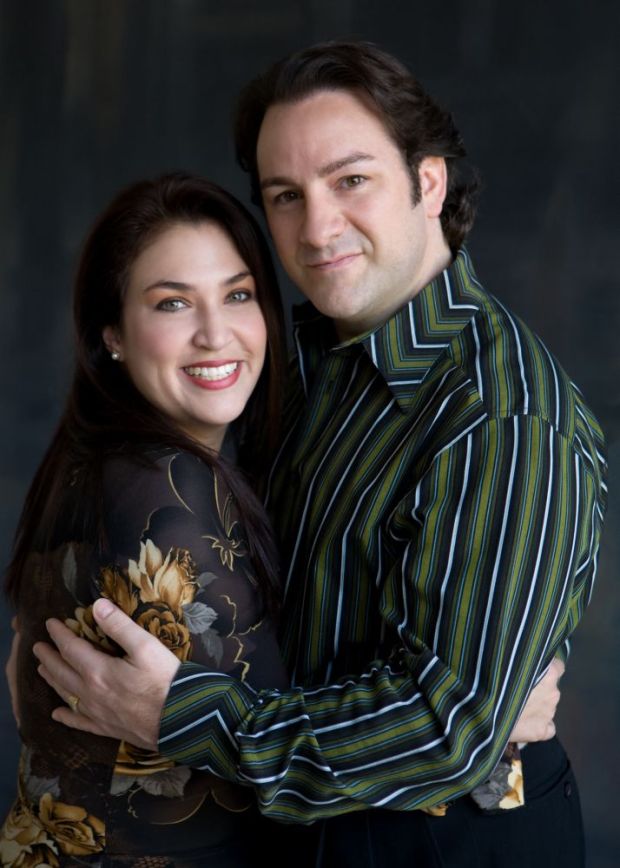
I know a remedy: meet John Osborn and the love of his life, Lynette Tapia.
Their love blossoms and glows as if they have only just met and yet they have been together for many years! They also have a daughter, the now eighteen-year-old multi-talented Anna.

Osborn-en-Lynette-Tapia-2


I met them both on a horribly cold February day in 2013 with ice, snow and wind outside, but in the café Puccini where we met, my heart and soul were soon to be warmed

Capriccio, DNO 2006

Lynette Tapia (Eine italienischer Sängerin), John Osborn (Ein italienischer Tenor) © Foto: Hans Hilmering

The lovely Lynette Tapia with her beautiful green eyes and shiny black hair is a celebrated singer as well and sometimes she manages to sing with her husband. In September 2006, they had their Amsterdam debut together in Capricio by Richard Strauss, as the Italia13n singers.


OPERA CLASSICA


In October 2012, they both sang  in Verdi’s Rigoletto at Schloss Braunfels, a production of Opera Classica Europa, an organisation that presents operas at the most beautiful historical locations in Europ


Osborn:
I love what Opera Classica Europa does and the way they do it. The location was enchanting, we were wearing real, historical costumes. Old-fashioned? Yes, definitely: old-fashioned beautiful. We didn’t have that much rehearsal time, but there was no need. There was nothing you really had to learn, everything being already in the music.

The role of the Duca is particularly suited to a high tenor. I have been a singer for 22 years. I am not a baritonal tenor but I can sing ever heavier roles. It depends on the location, of course, and it also matters who your conductor is, and whether he knows how to keep the orchestra in check. The music has been shifted to a higher pitch, the orchestras are playing louder, but you still have to rise above the orchestra and you have to be audible everywhere, even in the back rows. Add to that the fact that we tenors don’t sing in falsetto any more; today’s audience would not be appreciative.

I am from the generation that grew up with the three tenors, but a lot has changed since then. You can’t afford not to look good. Or not to be fit. When I was younger, I didn’t participate in sports and fitness, I thought it was a waste of time. But in a way, I think it is fair and good that we take care to look the part a bit more, for the public’s sake. Although it is still mainly (I hope?!) about the singing!


DIRECTORS


Directors? Are they really important?
Who ever heard of a director, say 50, 60 years ago? We knew who the singers were and that was all that mattered. The conductor, the orchestra, yes, but a director? We still speak of Tosca by Callas or Don Carlo by Corelli, but nowadays the name of the director is written in big, bold letters at the top of the poster, even before the composer! Many of the directors have also developed a somewhat perverse way of manipulating human feelings, which bothers me. Sometimes I think: do you really want to create something new? Then create something new! Write your own opera!

Carlo Rizzi (conductor), Pierre Audi (director), George Tsypin (sets), Dagmar Niefind (costumes), Jean Kalman (lighting design), Amir Hosseinpour (choreography), Willem Bruls (dramaturge)


I admire Pierre Audi very much and I really enjoy working with him. OK, after a few times you know the concept and you know it’s going to be very aesthetic, static too. But he has respect for the singers, we are more to him than just pawns in a game of chess.

Afbeeldingsresultaat voor Clari osborn"


I also have a great affinity with the work of Moshe Leiser and Patrice Caurier. I did Clari by Halèvy and Otello by Rossini with them, both in Zurich, and we had a lot of fun together. They work in a logical way and their productions are very well put together. Clari may have been updated, but everything is just right. The directors have a kind of sixth sense for what goes with the music, so their productions are very diverse.


CONDUCTORS


Who are the really good conductors? The generation that has almost died out: Nello Santi, Claudio Abbado. But that doesn’t mean they are over, those good old days! I like Yannick Nézet-Séguin immensely, he understands the French style like no other. Unfortunately I have only worked with him once, in 2008 in Salzburg. We did Romeo et Juliette together and the performance was unforgettable! He liked my ‘French way’ of singing so much that he even invited his parents to the performance. For me that was one of the greatest compliments ever!

Pierre Audi (director), Paolo Carignani (conductor), George Tsypin (sets), Andrea Schmidt-Futterer (costumes), Jean Kalman (lighting), Kim Brandstrup (choreography), Klaus Bertisch (dramaturgy)

© Ruth Waltz


At the time of our conversation, Osborn is singing Arnold in the DNO production of Guillaume Tell. He first performed this role in the 2007 – 2008 season with the Accademia di Santa Cecilia Orchestra in Rome. After that we could admire him in this role in the ZaterdagMatinee (December 2012) and the general press called the performance a ‘historical event’. And now finally on stage. The difference?

“I have indeed performed the opera concertante a few times, with more or less cuts, so each time it was quite exciting to think which version we would be doing next. At the Matinee, the score was almost complete. As a singer, I have learned to act with my voice, but if I can actually show my feelings on stage as well, not only through my singing but also by the way I move, then that adds an extra dimension.

Is there anything you would like to say to your Dutch audience?
“This is the sixth time I work in Amsterdam. I always love coming back to visit this beautiful city. The people are so kind and welcoming. All of the friends I’ve made from The Dutch National Opera, the members of the chorus, the musical staff, and the production staff have all been so supportive of me and the talents I’ve been given. I am so grateful for the opportunities to perform here, and I truly feel like Amsterdam has become a second home for me. I very much look forward to returning to this unique and wonderful place again in the near future. Sincerely, John Osborn’.

Lynette Tapia and John Osborn in “Parigi o cara” from La Traviata Live at Schloss Braunfels, august 12 2018 :


More John Osborn:

Nicola Alaimo en John Osborn schitteren in Guillaume Tell

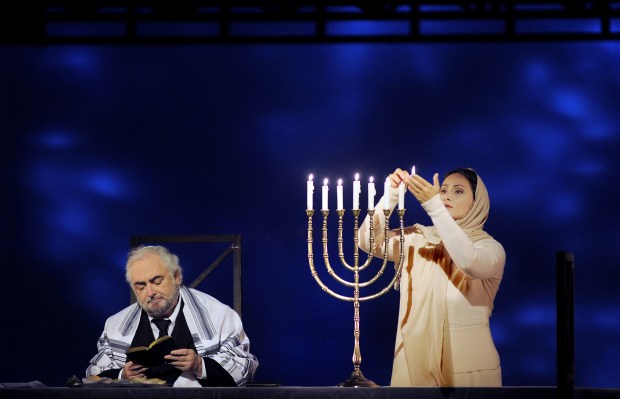
Memories of La Juive in Amsterdam

MEYERBEER: LE PROPHÈTE. Essen 2017


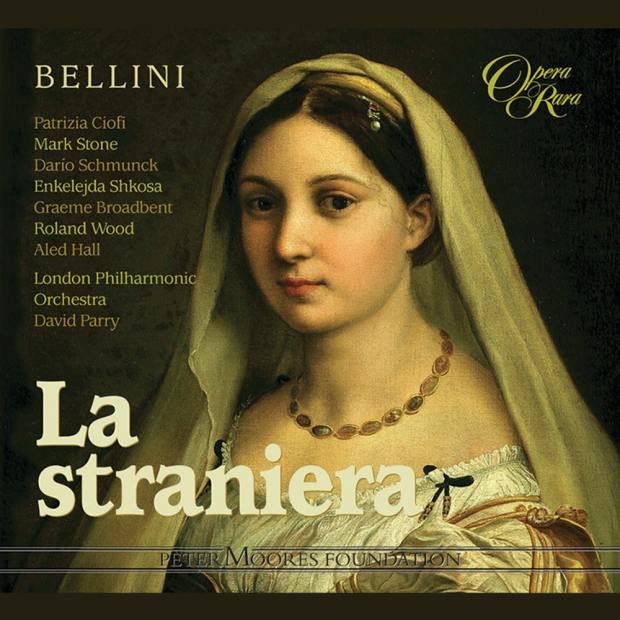
La Straniera: Bellini’s heavenly cantilenas

La straniera - Wikipedia
Henriette Meric-Lalande as Alaidein the original 1829 production

Admittedly, the libretto is so confusing that even the main characters themselves probably do not know who they are, and, with whom, or why, they are doing whatever they are doing. But the music! If angels existed, they would be singing Bellini’s cantilenas from La Straniera for all eternity (can one get bored by that?).

This is even more true because, apart from one or three times, there are no real arias, at least not in the old-fashioned way. It is more of a ‘conversation piece’ with many dialogues and very theatrical long scenes, which nevertheless follow each other in rapid succession.

Bellini composed La Straniera in 1929, three years before Norma and La Sonnambula, and you can already hear some early references  to his most famous music (‘Casta Diva!’). Strangely enough, I can also hear fragments from La Traviata here and there…


Straniera

All roles are excellently cast. Dari­o Schmunck with his pleasant sounding tenor is particularly suitable as a romantic lover and the lyrical baritone Mark Stone (remember that name!) is a warm-blooded Valdeburgo. The virtuoso mezzo Enkelejda Shkosa sings a moving Isoletta and for Patrizia Ciofi one word suffices: phenomenal.  Nowadays there is no other singer who can sing the role of Alaide better or with more commitment (ORC 38).

Patrizia Ciofi:

Rising like a phoenix from the ashes: Różycki’s Violin Concerto

Ludomir Różycki: who still knows this composer? I fear that even in Poland he is no longer more than just a name, although I cannot swear to it. And if he is mentioned anywhere in the music history books, it is because of his ballet Pan Twardowski. And yet he composed so much more!

Together with (among others) Mieczyslaw Karlowicz, Karol Szymanowski and Grzegorz Fitelberg, Różycki was part of the group ‘Młoda Polska’ (Young Poland). The movement, which lasted for roughly thirty years (1890 – 1920) and featured decadence, neo-romanticism, symbolism, impressionism and art nouveau, was not exclusively a Polish phenomenon. Just think of the Italian Novecento. Parabellum. Zeitgeist.

Różycki started working on his violin concerto in the summer of 1944, the summer of the Warsaw Uprising. When the situation became too dangerous, Różycki fled Warsaw with his family members. He hid his unfinished manuscript in a suitcase and buried it in his garden. Różycki’s house did not survive the uprising and the composer started working in Katowice after the war. He never thought about his violin concerto again. It was gone. Lost. It was only years, really years later that construction workers found the score in the ruins of his house. Polish National Library included it in its archive and … and nothing else happened.

But the miracles are not over yet. In 2018, violinist Janusz Wawrowski discovered the score and was just about stunned. He knew immediately that he had struck gold, that he had found a real musical wonder. Not that it was perfect. When you are pulled out from under the ashes, you are likely to be a bit battered. The score was missing 87 opening bars, but in collaboration with pianist and composer Ryszard Bryla, Wawrowski managed to reconstruct the concerto.


The concerto was recorded by Warner Classics (0190295191702) and when I put the CD on, it was my turn to be stunned, indeed I was knocked for six. So extraordinarily beautiful, so full of unadulterated emotion. It is unimaginable that this treasure has lain hidden underground (and after that in the library) for so many years.

Różycki’s concerto is coupled with Tchaikovsky’s. Not very surprising, since both concertos have so much in common. The performance by Janusz Wawrowski and the Royal Philharmonic Orchestra, conducted by Grzegorz Nowak, is just like the concertos themselves: divinely beautiful.

Memories of La Juive in Amsterdam

Carlo Rizzi (conductor), Pierre Audi (director), George Tsypin (sets), Dagmar Niefind (costumes), Jean Kalman (lighting design), Amir Hosseinpour (choreography), Willem Bruls (dramaturge)

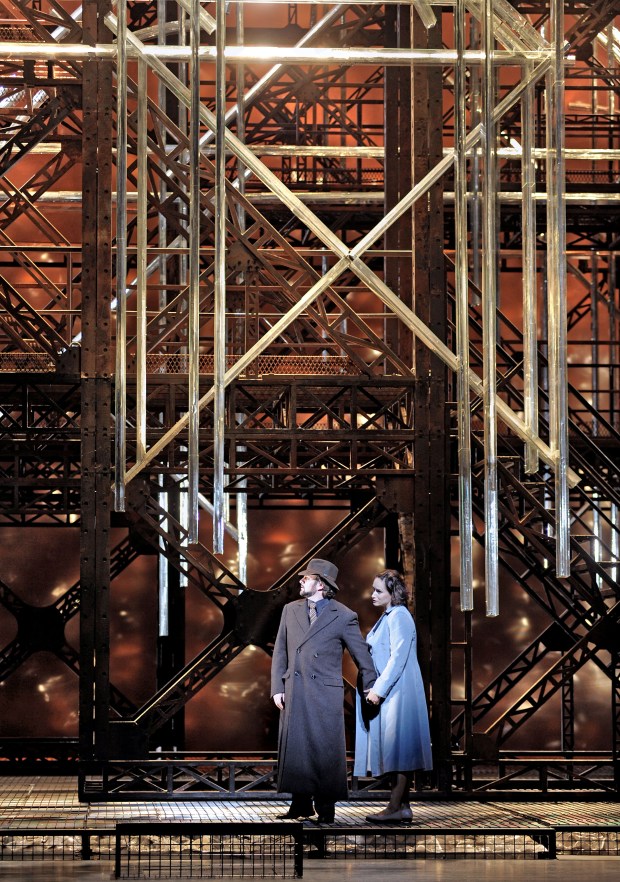
The 2009-2010 season of De Nationale Opera (then the Netherlands Opera) in Amsterdam started very strongly with Jacques Fromental Halévy’s La Juive. This production had already been staged in Paris, where it was highly praised despite its unsuccessful premiere (the opera staff were once again on strike and there was no lighting).

Pierre Audi’s direction was particularly beautiful and effective. As is (almost) always the case with him, the images were stylised, aesthetic and beautiful to look at. The understated aesthetics worked perfectly with the highly emotional music, not to mention the subject matter.

Carlo Rizzi (conductor), Pierre Audi (director), George Tsypin (sets), Dagmar Niefind (costumes), Jean Kalman (lighting design), Amir Hosseinpour (choreography), Willem Bruls (dramaturge)
© Ruth Walz

Jean Kalman’s grandiose lighting was an important part of the stage concept, making the final scene, in which Eléazar and Rachel calmly walk towards their deaths, one of the most moving moments in opera history. I just had to cry and I was not alone. George Tsypin’s setting: a steel cathedral that also served as a prison, was also very impressive.

Carlo Rizzi (conductor), Pierre Audi (director), George Tsypin (sets), Dagmar Niefind (costumes), Jean Kalman (lighting design), Amir Hosseinpour (choreography), Willem Bruls (dramaturge)
john Osborn (Léopold) en Angeles Blancas Gulin (Rachel) © Ruth Walz

Musically, it was a dream performance. Dennis O’Neill really wás Eléazar. Not so young anymore, tormented, full of revenge, but also doubting – a truly perfect performance. He sang his great aria full of glow and passion, and with the necessary sob. And although it was not entirely perfect here and there, it was just so very moving.

The voice of Angeles Blancas Gulin (Rachel), with its very recognisable timbre, is not exactly ordinary. At times metallic and sharp, yet warm and round. Her portrayal of a young girl torn between duty and love was very credible and her fear physically palpable.

Carlo Rizzi (conductor), Pierre Audi (director), George Tsypin (sets), Dagmar Niefind (costumes), Jean Kalman (lighting design), Amir Hosseinpour (choreography), Willem Bruls (dramaturge)
Angeles Blancas Gulin (Rachel) en Annick Massis (Eudocxie) © Ruth Walz

John Osborn (Léopold) and Annick Massis (Eudoxie) were also present in Paris. Both singers possess a truly phenomenal bel canto technique and dazzling, supple high notes.

Carlo Rizzi (conductor), Pierre Audi (director), George Tsypin (sets), Dagmar Niefind (costumes), Jean Kalman (lighting design), Amir Hosseinpour (choreography), Willem Bruls (dramaturge)
Alastair Miles (Brogni), Dennils O’Neill (Eléazar) en Angeles Blancas Gulin (Rachel) © Ruth Walz

Alaistair Miles (Brogni) may not have had the best low notes, but his charisma was very impressive.

Carlo Rizzi conducted the excellently playing Netherlands Philharmonic Orchestra with the necessary momentum and the Netherlands Opera Chorus (rehearsal: Martin Wright) was, as always, compelling and unmatched.
A big BRAVO to all.

Trailer of the production:

‘Prehistoric’ Ligeti brilliantly performed

Belcea Ligeti


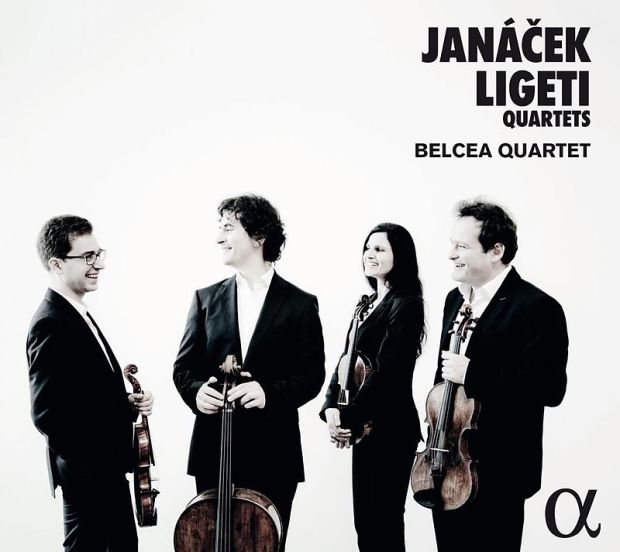
For me, Leoš Janáček’s string quartets form the absolute opus magnus of the genre. Call me sentimental, but at the very first bars of number two my eyes fill with tears and I am really swept up in all the emotions. Over the years, many excellent versions have appeared on the market, of which the DG recording, by the then still very young Hagen Quartet, is the most precious to me.

It is not the first time that Belcea tried their hand at the string quartets: already in 2001, they recorded them for Zig Zag Territoires (ZZT 010701). I was not exactly over the moon then, somehow I did not feel they got to the core of the music. Still, I cherish the recording: I am a real ‘Belcea fan’.

I find the recording on Alpha Classis refreshing. The tempi are a bit fast, but that does not hurt. The players somewhat control their emotions, so that a lot of underground tension can be felt. Nice.


But what makes the CD a real must is the performance of Ligeti’s first string quartet. The Hungarian master composed it in 1954, two years later he had to flee the country, after which he referred to this composition as a ‘prehistoric Ligeti’.

Prehistoric or not: I think it is genius. It keeps you nailed to your seat and you can’t help but listen: preferably with all doors and windows closed, so you will not be disturbed.
The string quartet, which for a good reason bears the name Métamorphoses nocturnes (yes, call it programmatic), is not performed very often, but of all the performances I have heard so far, the Belceas’ is definitely at the top.

Raphael Wallfisch plays works for cello by Weinberg: a great CD!

Weinberg Wallfish

I think, no, I’m sure that Mieczyslaw Weinberg’s cello concerto is one of his best-known works. Weinberg composed it in 1948 and dedicated it to Mstislav Rostropovich, who also gave the premiere in 1957. And it did not stop there: Rostropovich was so convinced of the high quality of the composition that he included the concerto in his repertoire. He took the concerto with him to his live performances and also to the recording studios, as a result of which it is very well documented.

Now, the origin of the work is more complicated than we (or I!) thought. In short: first there was a Concertino for cello and orchestra that was just sitting on the shelf until Rostropovich came across it and appreciated it a lot. This was Weinberg’s main reason for rewriting it into a real concerto.

All this can be read in the textbook that ‘accompanies’ the new recording of the cello concerto by Raphael Wallfisch. The textbook alone is reason enough to purchase the CD. In addition we also get the original Concertino (which has now been given the designation opus 43 bis)! It was first performed in 2017 and, to my knowledge, was recorded for the first time in 2020. It is such a luxury to be able to listen to both ‘versions’ side by side!


And then there is the beautiful, melancholic Fantasy for cello and orchestra. Weinberg composed it in the winter of 1952/53 and the premiere took place on November 23, 1953, but without the orchestra. It was performed by Daniil Shafran (cello) accompanied by Nina Musinyan (piano). The piece takes only 17 minutes: but that is long enough for a whole range of emotions to pass by.

The performance by Raphael Wallfisch is unequalled, it is only natural that he has an affinity with it. The Kristiansand Symphony Orchestra under Maestro Lukasz Borowicz is also excellent. It is a huge asset.

Dmitri Hvorostovsky in two live recitals


Songs and Dances of Death (VAI 4330)

Hvorostovsky Dutoit


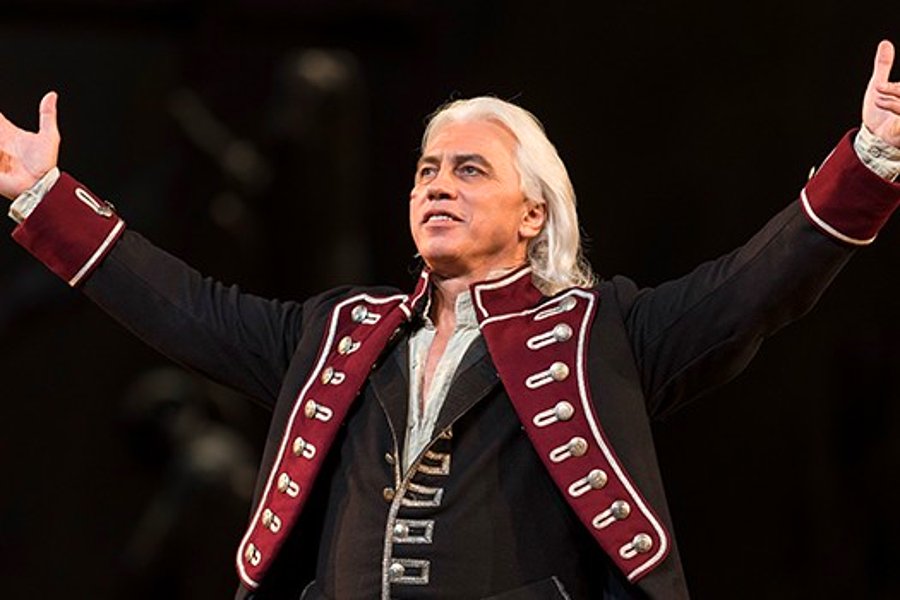
After Hvorostovsky won the Cardiff Competition in 1989, record companies were queuing up to sign a contract with him. Philips was chosen and promptly a small number of recitals and a few complete operas were recorded with him.

Hvorostovsky in Cardiff:


It was all too premature, Hvorostovsky was not ready: he did not speak any languages but his own, and his repertoire was much too limited. His contract was not renewed, and things went downhill for him.

But he redeemed himself in a big way! On 18 July 1998, he gave a recital for thousands of enthusiastic listeners at the Festival de Lanaudière. He sang the Songs and Dances of Death by Mussorgsky, followed by a number of arias.


I have to confess that I had been planning to read a book to help me pass the time, but I never did. Instead I listened breathlessly to his velvety voice, his matchless legato and his flawless interpretation, which moved me to tears. As Hvorostovsky is such a very charismatic singer, it is a pure unadulterated pleasure to be watching him.

Hvorostovsky and Charles Dutoit in Rossini’s ‘Largo al Factotum’ (Barbiere di Seviglia by Rossini):


Russian Songs from the war years (VAI 4318)

Hvorostovsky War years


Patriotism has become an old-fashioned word. Everything has to be international, global, multicultural and cosmopolitan, and maybe that’s for the best. The Second World War ended seventy-five years ago, and it seems so long gone….

Yet there are still people alive who experienced ‘The Great Patriotic War’. There are still (personal) stories. And then there are the songs. I grew up with them; the Russian songs from that time. My mother, who had fought in the Red Army throughout the war, sang them instead of lullabies, and they made me dream about the lonely accordionist looking for his beloved.

None other than Dmitri Hvorostovsky brought them back to the concert hall, and on 8 April 2003 he performed them for no less than 6,500 spectators in the Kremlin Palace.

Below, Hvorostovsky sings  “Журавли” (Cranes) from the film “When the cranes fly over”, by Mikhail Kalatozov:


The arrangements have been slightly altered; they sound less over the top, they have been loosened up a little and they are foremost nostalgic. There is no ‘hurrah patriotism’.

Hvorostovsky sings in a clearly relaxed way, with a mild smile around his mouth, without any vocal exaggeration or obvious articulation. A bit like a crooner, a Sinatra or a Bing Crosby.

The audience sniffles softly and mouthes the words, soundlessly singing along. I too become fascinated and feel a tingling sensation in my eyes. Nostalgia? My Dutch friend, born on Curaçao, was just as moved. Very touching.