The good news: the overture is played with the curtain closed! The overture is the best-known piece of the entire opera, so it goes without saying that it is given plenty of space. Otherwise, Béatrice et Bénédict is not exactly what you would call a box office hit. No wonder: the opera is not particularly exciting, which is partly due to the endless stretches of spoken text.
The story (Berlioz himself wrote the libretto based on Shakespeare’s Much Ado About Nothing) is insignificant, but the music is at times enchantingly beautiful.
The 2016 Glyndebourne production is very disappointing to me. Laurent Pelly is one of my favourite opera directors, but he has overreached himself here. He has taken the main characters’ “thinking outside the box ” too literally, and the end result is as dull and grey as the colours of the sets, the costumes and even the singers’ make-up.
Fortunately, the singers are all excellent. In her first aria, “Je vais le voir”, Sophie Karthäuser (Héro) still sounds a little heavy, but her duet with the excellent Katarina Bradic (Ursule), “Nuit paisible et sereine!”, sounds just as it should, like a real gem.
Stephanie D’Oustrac is a fantastic Béatrice, and the sexual attraction between her and Paul Appleby (Bénédict) is palpable from the start.
But it is the young baritone Philippe Sly who really steals the show as the gangly Claudio.
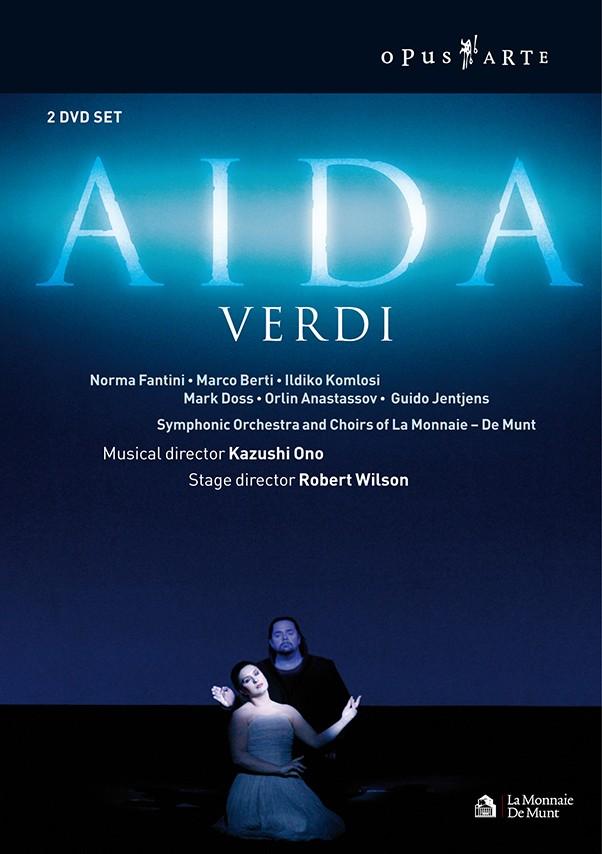
Don’t expect any elephants in this Aida from Brussels. Also, no big mass scenes and – mainly – don’t expect emotions. With Robert Wilson, everything has to be minimalist and aesthetically pleasing, which undeniably makes for nice pictures but it makes for a very large discrepancy with the music. The singers move very slowly, almost in slow motion, and their (sparse) gestures are stylised after ancient Egyptian drawings.
No one touches anyone and no one is even looking at anyone else. All the characters are mainly preoccupied with themselves and their own suffering, which, according to the director, may be the key to the drama. For me it is too far-fetched.
The staging is dominated by the colours black and blue, there are hardly any sets and/or props. Deadly dull.
The truly amazing singers seem to be trapped in a straitjacket of emotionless acting, although Ildiko Komosi (Amneris) occasionally manages to sneak in a gesture. Together with Norma Fantini (Aida), she provides most of the tension and emotion, and their duet in the first act is a vocal highlight.
Marco Berti is an excellent Radames with beautiful high notes and a touch of “Pavarotti” in his timbre, and the rest of the cast is also first-rate. Kazushi Ono conducts calmly, with great attention to detail.
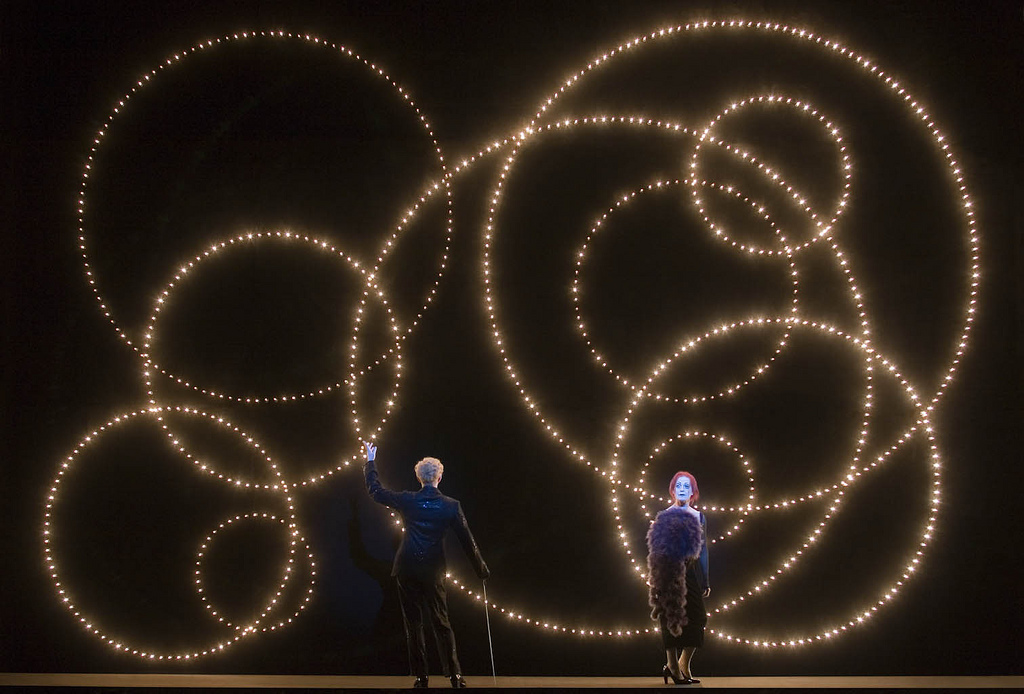
Returning to the director: Robert Wilson seems to repeat himself over and over again. If you have seen one of his productions, you have seen them all. Almost..
But then……
Nothing less than phenomenal: Die Dreigroschen in Amsterdam 2009
At the end of April 2009, the renowned Berliner Ensemble visited Amsterdam. They brought with them Die Dreigroschenoper, in the magnificent staging Robert Wilson had given to the company two years earlier. Worth knowing: the Berliner Ensemble is based in the Theater am Schiffbauerdam where the work was premiered in 1928.
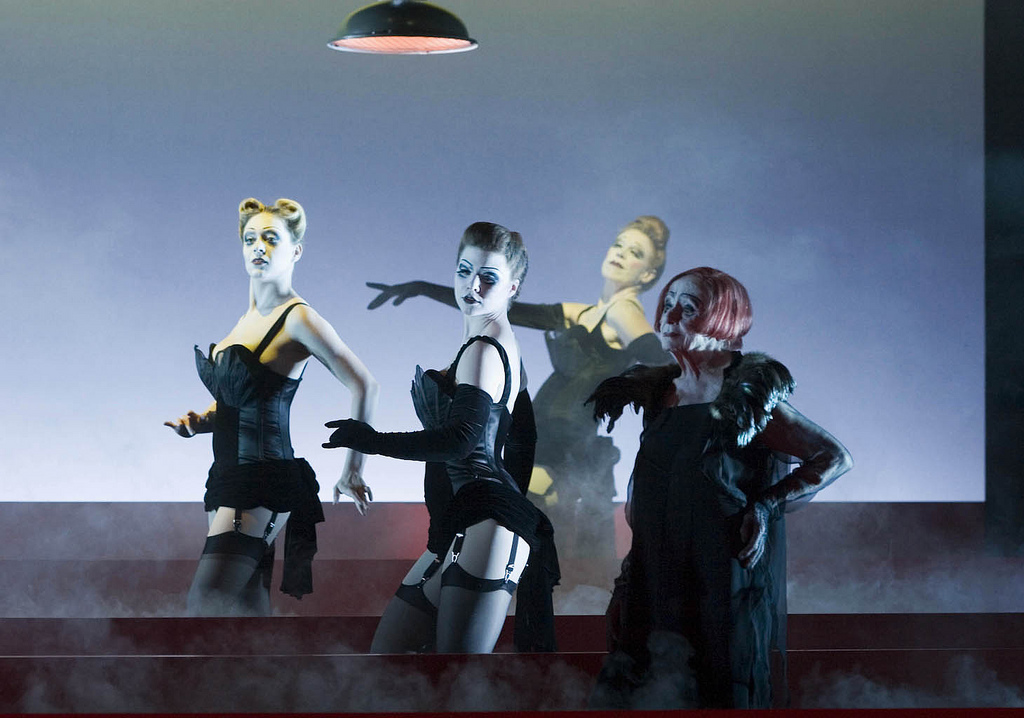
All four performances at the Muziektheater were sold out and audiences responded with frenzied enthusiasm. Perfectly justified because everything was just great. The production, the direction, the lighting, the costumes, the movements…. And the performance, of course, because isn’t that why we go to the music theatre?
The performance was very cabaret-like, in the good sense of the word. It was grotesque and vaudeville-like with lots of slapstick, (film) quotes and whatnot without it becoming a complete farce. Occasionally I was reminded of Otto Dix.
In a word: breathtaking. And of course it was a treat to be able to hear all those well-known and still oh-so-current songs again, but now as part of a whole.
The performance did take a long time (yes folks, it was not only Wagner who took his time), over three hours, but then also you got a lot. For a start, the complete dialogues.
Stefan Kurt was a formidable, androgynous dandy Macheath and Angela Winkler a very moving Jenny. Also great were Jürgen Holtz as J.J. Peachum and Axel Werner as Tiger Brown, and Christina Drechsler was a terrific Polly.
Curious man, that Henze. Once flirting with communism and dreaming of a world revolution, he was also an aesthete and an erudite which – in part – made him decide to bid farewell to Germany and move to Italy in 1953.
His music has always been highly theatrical: he never liked the strict rules of serialism and felt a close connection with opera, which, unlike the hardliners of the avant-garde at the time, he had never labelled as obsolete. His discography therefore lists more than 20 musical theatre works, performed with great regularity.
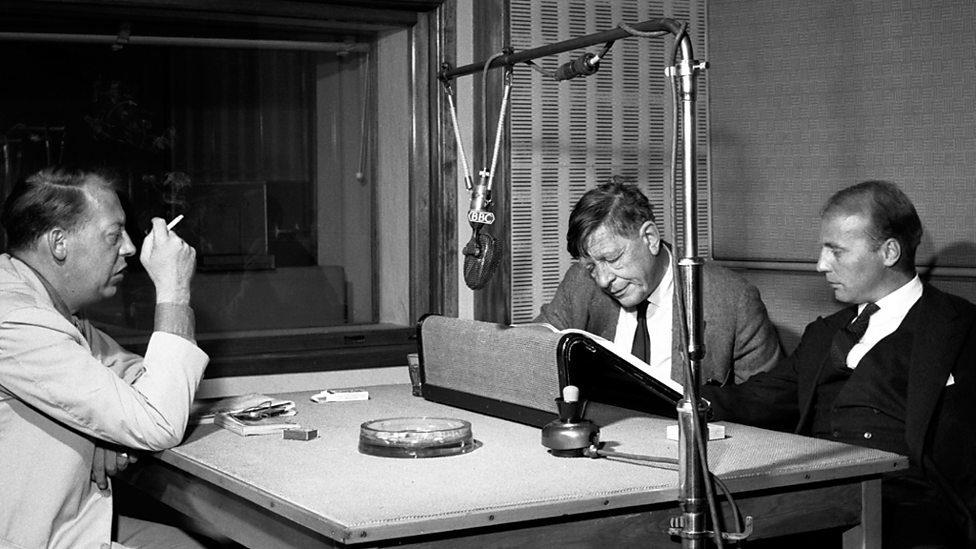
L-R: Chester Kallman, W. H. Auden and Hans Werner Henze
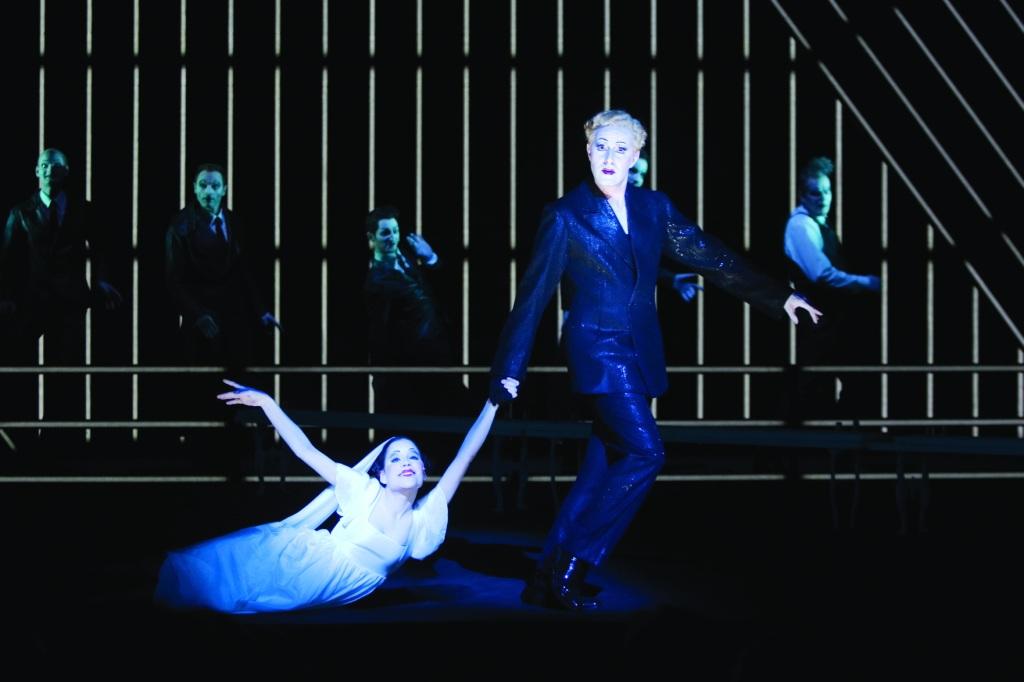
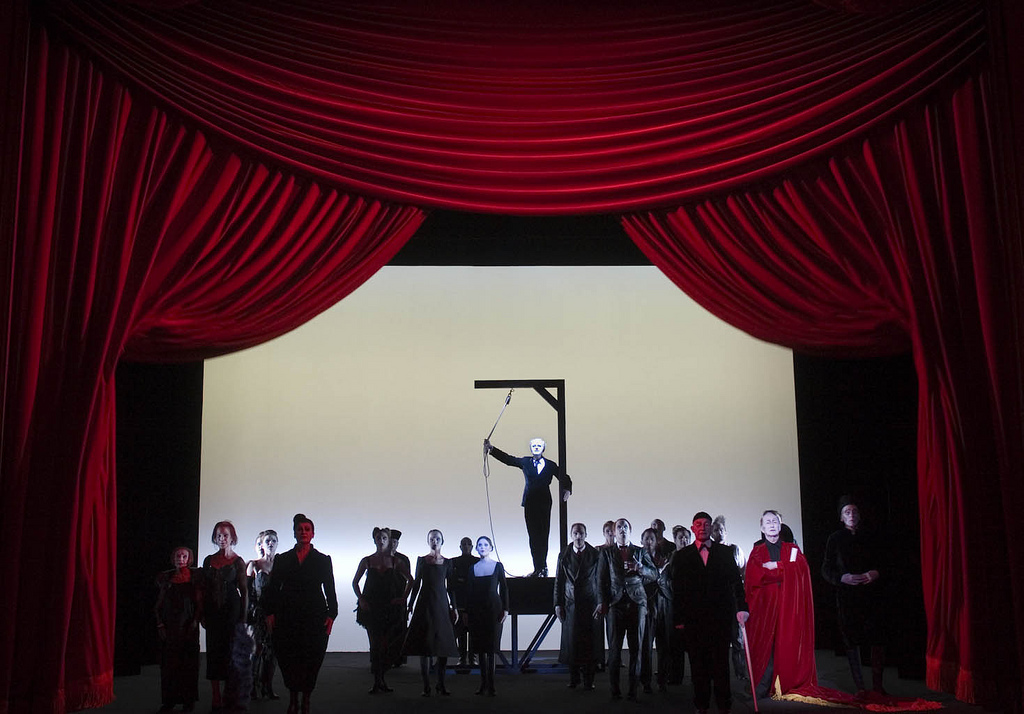
Die Bassariden is among Henze’s finest and most important compositions. The English Language libretto, after ‘The Bacchantes’ by Eurypides, was written by W.H.Auden (does anyone remember the ‘Funeral Blues’ from Four Weddings and a Funeral?) and Charles Kallman.
It became a massive, through-composed score, anchored in the Wagnerian tradition (it is whispered that the librettists insisted that Henze, before turning to composing, study the ‘Götterdammerung’) and constructed as a four-movement symphony with voices.
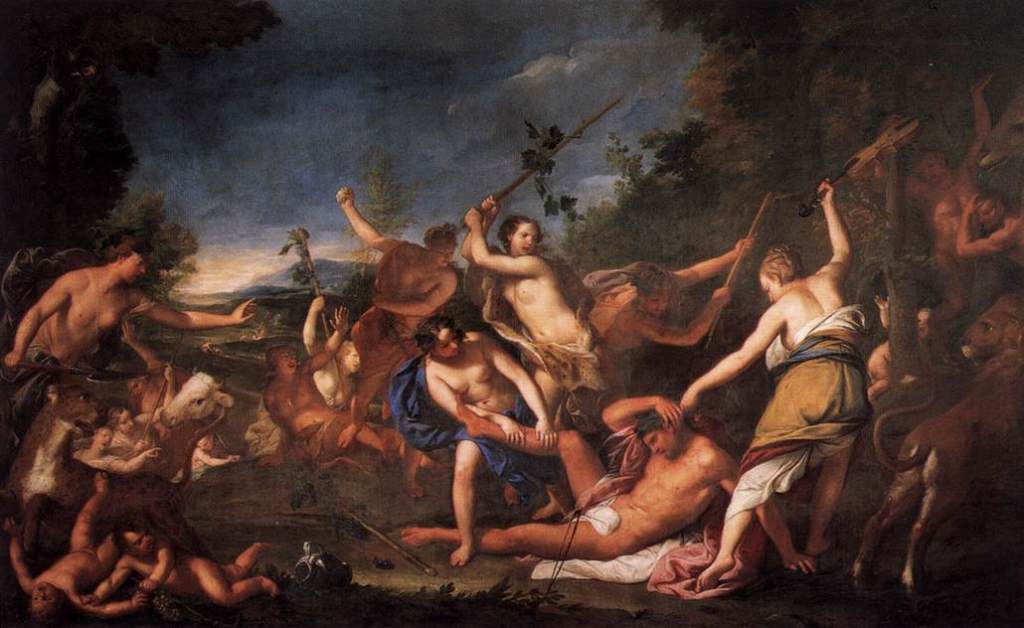
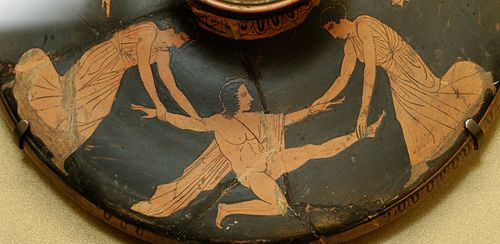
Pentheus being torn apart by Agave and Ino, Attic red-figure vase painting, c. 450-425 BC
The story of King Pentheus, who, by wanting to banish all sensuality, comes into conflict with Dionysus and his adepts and is ultimately torn apart by his own mother, serves as a metaphor for the conflict between Eros and Ratio.
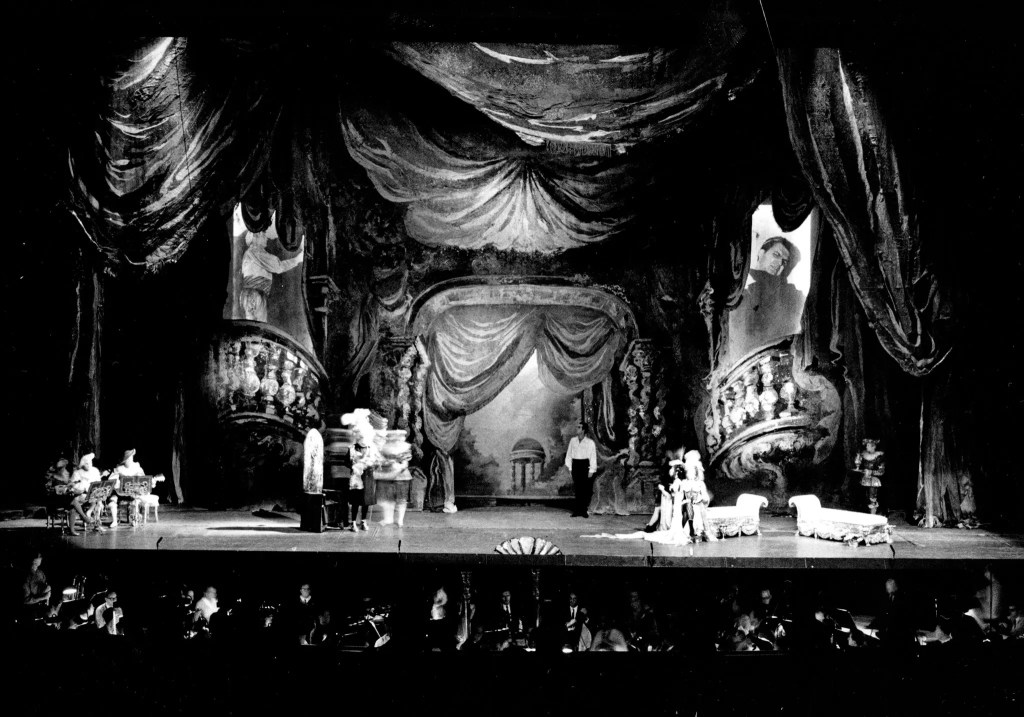
The opera premiered (in the German translation) at the Salzburg Festival in August 1966. It became a huge success, even prompting one of the reviewers to cry that Richard Strauss had finally got a successor. Henze laughingly and rightly dismissed this with a simple “where are the man’s ears?!”
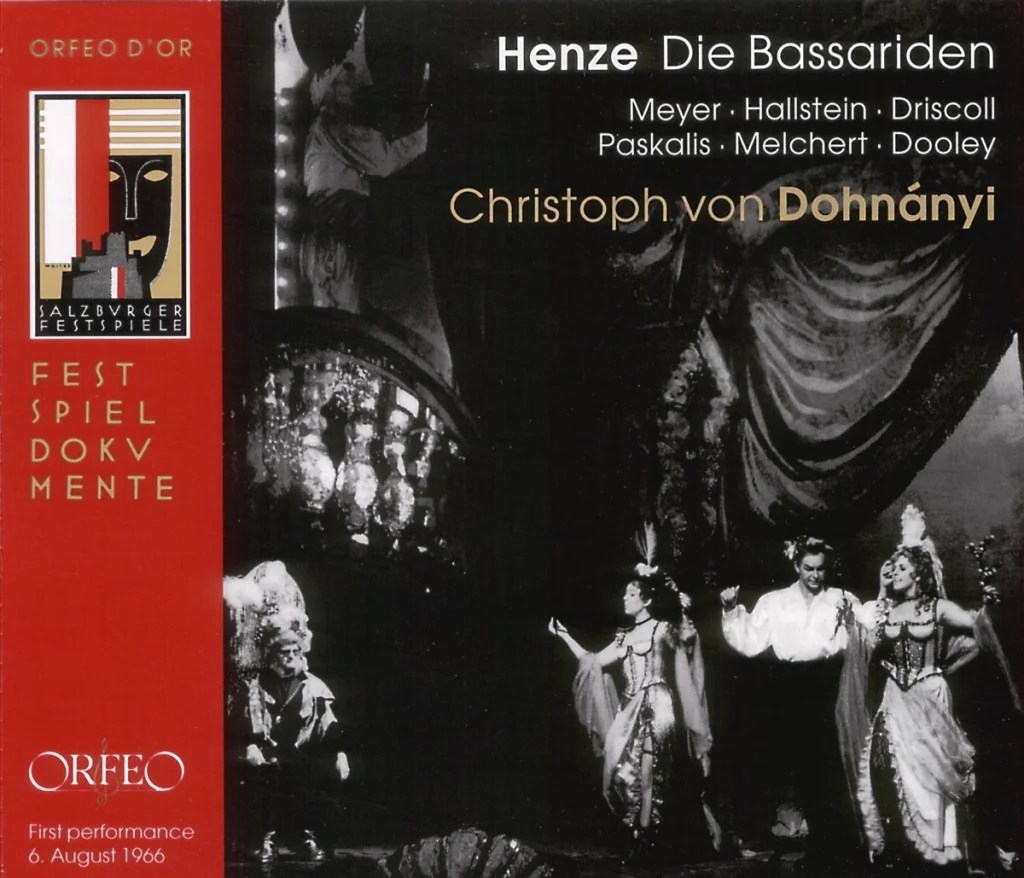
A few years ago, the live-recorded premiere performance (in German translation) was released by Orfeo (C 605 032 1). The highly emotional playing of the Wiener Philharmoniker, under the inspired direction of Christoph von Dohnányi, reaches unprecedented heights.
Kostas Paskalis is very credible in his role of Pentheus and Kerstin Meyer moves as Agave.It’s just a pity no libretto was included, after all, it’s not everyday fare.
[Editorial: A later performance of the English Language version was released on the Musica Mundi label, conducted by Gerd Albrecht, but this revised edition omits the interlude]
Das Urteil der Kalliope, interlude from Die Bassariden :
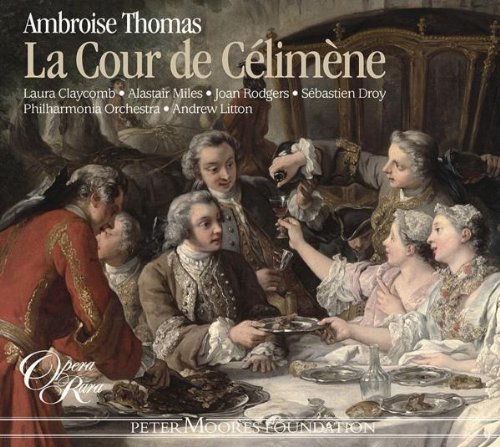
Ever heard of La Cour de Célimène by Ambroise Thomas? No, neither have I. Such a pity because that opera really is not to be sneezed at! It is a delightful, erotically tinged comedy in which a young, wealthy widow pits no less than fourteen (!) of her admirers against each other to eventually enter into a marriage of convenience with an old commander.
In between, we also get a duel, as Célimènes latest recruit, the Chevallier (brilliant Sébastien Droy) is hot-tempered, but it all works out and in exchange for a comfortable life in her manor, the commander is only too willing to accept all his wife’s lovers.
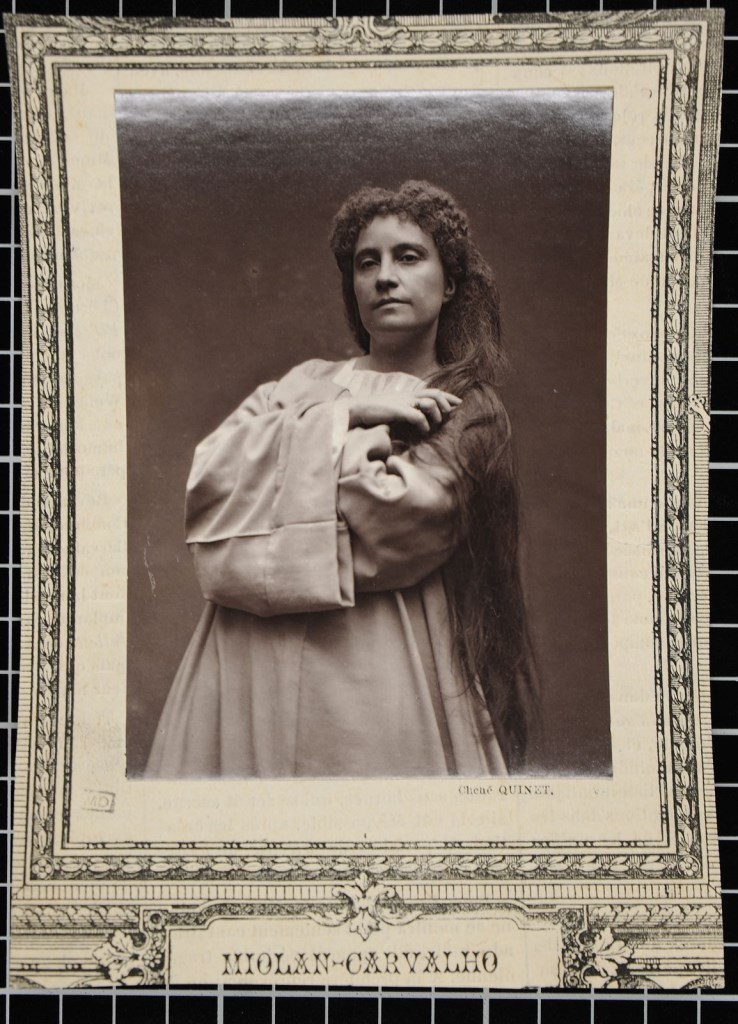
La Comtesse (a role written for the legendary colouratura soprano, Marie Miolan-Carvalho) is beautifully sung by a very virtuoso Laura Claycomb. Joan Rodgers counters her as her more serious sister and Alastair Miles is truly delightful as the Commander.
It’s entertainment of the highest order and the sparkling music is wonderful. What a treat! (ORC 37)
On one of his latest, already his seventh, recording for Decca, Benjamin Grosvenor has taken care of Liszt. That he did so very carefully, even meticulously, he told candidly in the interview he gave to the New York Times. ‘I almost feel like you should know the notable recordings of a work like this’ he said, referring to the piano sonata. So he studied just about every possible performance of the work: Lupu, Cherkassky, Horowitz, you name it.
Whether it also influenced his own interpretation? Undoubtedly. We, humans, we are influenced even if we don’t notice it. And yet his reading of the sonata is completely his own. Virtuoso, mainly. So much so that I was breathless by just listening to it. His technique is fabulous. What I admire even more is his, how shall I put it, “acting” skills. Acting, as it were, on the piano and building the tension with only the keys at your disposal
I am slightly less charmed by the other pieces on the CD. Mainly the three Petrarch Sonets from the second book of “Années de Pèlerinage”, which I have heard more beautiful and lyrical: Arrau, Lazar Berman… And no one can really match Michael Rudy’s interpretation. In my opinion, then.
Boris Giltburg: matchless
Wow, how great is that CD! Whereas Giltburg’s performance of Rachmaninoff’s Third Concerto disappointed me a little (I thought it was too forceful and too rushed), now I just have to admit that I may have been wrong about him.
Just take the “Rigoletto paraphrases” with which he opens his recital: mamma mia! The first bar already made me sit up because this is how it should be, this way and no other. It splashes out of the boxes, but more importantly: Giltburg takes ample time to bring out Liszt’s poetic, salon-like, if you will, side. I am very much impressed..
But it’s obviously all about the 12 Études d’exécution transcendante, works previously considered unplayable and which only the all-time great master pianists dared to try.
Giltburg plays them – all of them – naturally, decidedly, as if they are nothing at all. Well; his attaque may still be fierce, but he also knows how to conjure breathtaking, enchanting, pianissimi from the keys. And those glissandi!
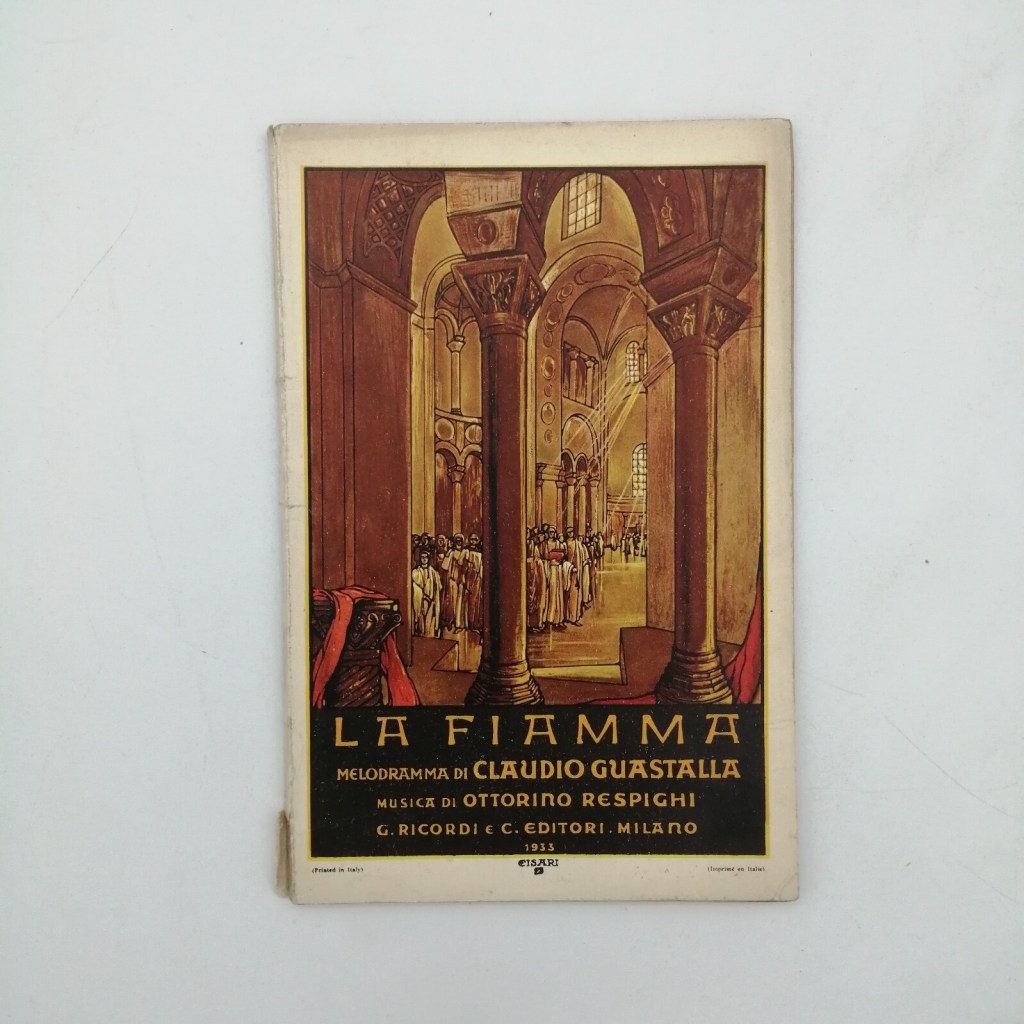
La Fiamma ging in 1934 in première en was redelijk succesvol met voorstellingen in Rome, Milaan, Buenos Aires, Montevideo, Chicago en Wenen. In 1936 ging er een Duitstalige versie aan de Staatsoper Berlin.
De première op 29 september 2024 van Christof Loy’s nieuwe productie voor Deutsche Oper Berlin is sindsdien de eerste keer dat dit vergeten werk in Duitsland op de bühne te zien is.
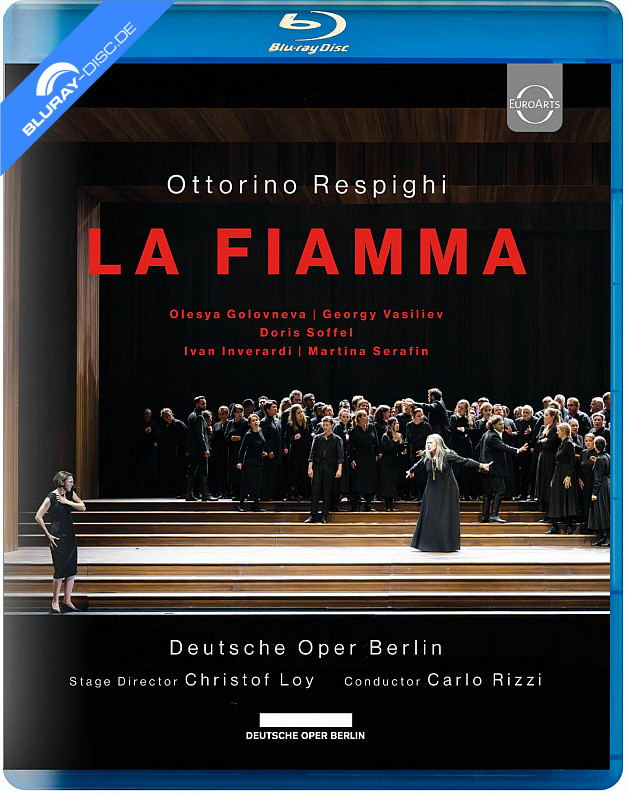
Opmerkelijk snel daarna is hiervan een opname op Bluray uitgebracht. Carlo Rizzi, artistiek directeur van ‘Opera Rara’, heeft de muzikale leiding.
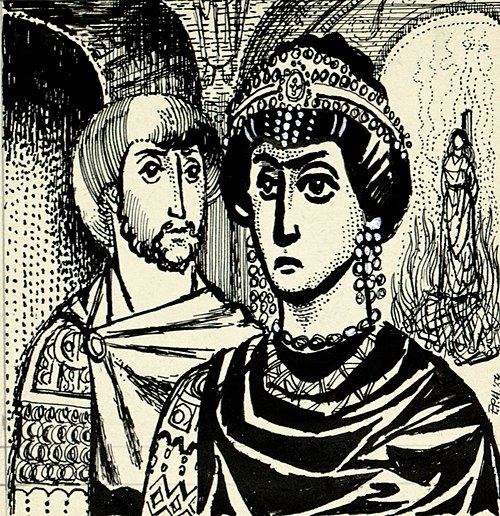
Het libretto van Claudio Guastalla is losjes gebaseerd op het toneelstuk Anne Pedersdotter, de Heks. Het gaat over een vrouw die ervan wordt beschuldigd haar stiefzoon te hebben verleid door middel van tovenarij. Na een veroordeling wordt ze als heks verbrand. Anne Pedersdotter is een historische figuur en haar proces en executie in het Noorwegen van 1590 is goed gedocumenteerd.
De gebeurtenis kan gemakkelijk worden geplaatst in de tijd dat angst voor heksen en verbrandingen wegens vermeende hekserij veelvuldig voorkwamen. Het was typisch een laat middeleeuws fenomeen en dat maakt de keuze van Guastalla om de handeling te situeren in het Byzantijnse Exarchaat begin 8e eeuw nogal opmerkelijk. Zonder enig probleem had hij Ravenna en Byzantium kunnen vervangen door bijvoorbeeld Genua zes eeuwen later. Ook met de tijdlijn neemt de librettist het niet zo nauw getuige het meermalen noemen van de Byzantijnse keizerin Irene die nog geboren moest worden toen het Exarchaat ophield te bestaan. Maar goed, het gaat uiteindelijk om een vrouw die haar stiefzoon weet te verleiden en dat hoort natuurlijk niet, ongeacht het tijdsgewricht.
Basilio is de Exarch die namens de Byzantijnse keizer het bewind voert over dat deel van Italië dat nog niet door de Longobarden is veroverd. Voor de Rooms Katholieke paus in Rome zijn beide groeperingen wezensvreemd: de Longobarden zijn Ariaanse christenen en de Byzantijnen zijn Grieks Orthodox. Eigenlijk zijn het gewoon allemaal ketters.
Basilio is betrekkelijk oud en kennelijk al geruime tijd in functie. Uit zijn eerste huwelijk heeft hij een zoon, Donello, die wordt opgeleid in Byzantium. Kort na het begin van de opera keert hij terug in Ravenna en dat zal grote gevolgen hebben.
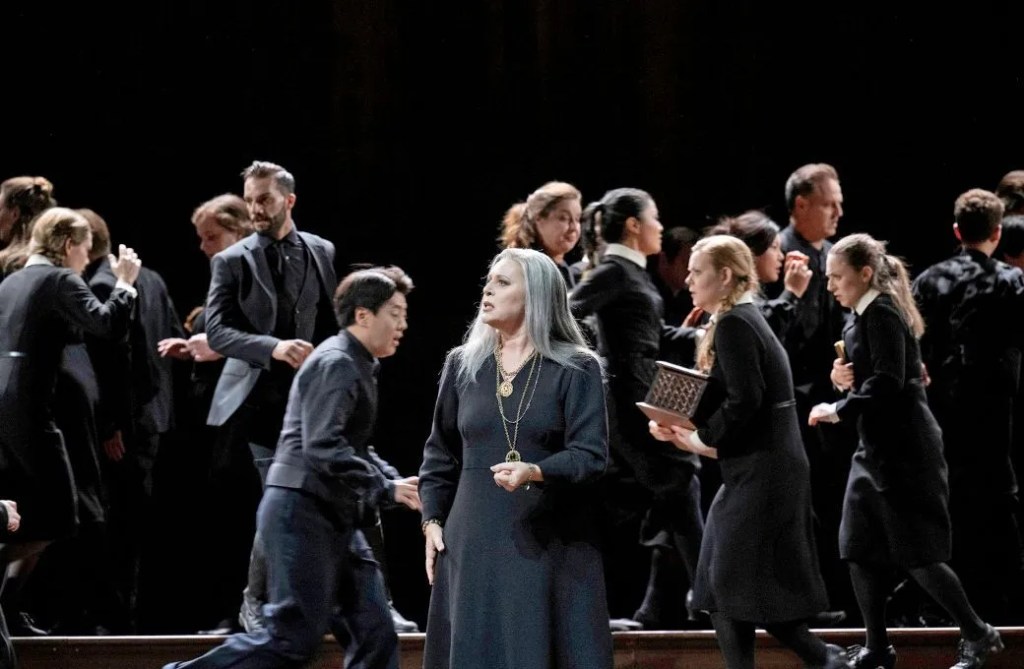
Basilio’s moeder Eudossia bestiert het hof, een dominante vrouw met onaangename trekjes in de trant van de Kosteres bij Janacek. Ze laat niet na om haar nieuwe schoondochter Silvana in te peperen dat ze door haar onbeduidende komaf niets aan het hof heeft te zoeken. In de eerste scène bezingt ze de lof van Basilio’s eerste vrouw op een wijze die sterk doet denken aan het liedje ‘My husbands first wife’ van Jerome Kern, zo leuk vertolkt door Maartje Rammeloo op haar cd ‘Longing to be loved’.
Als het verhaal zich ontrolt wordt duidelijk dat Basilio zich door een vrouw heeft laten overhalen om haar dochtertje, een kind nog, mee te nemen en met haar te trouwen. Hij beschrijft dit als een ervaring waarbij hij volledig werd overweldigd door de wijze waarop de vrouw met hem sprak en naar hem keek. Hij voelde zich gereduceerd tot een willoos object dat niets anders kon doen dan gehoorzamen.
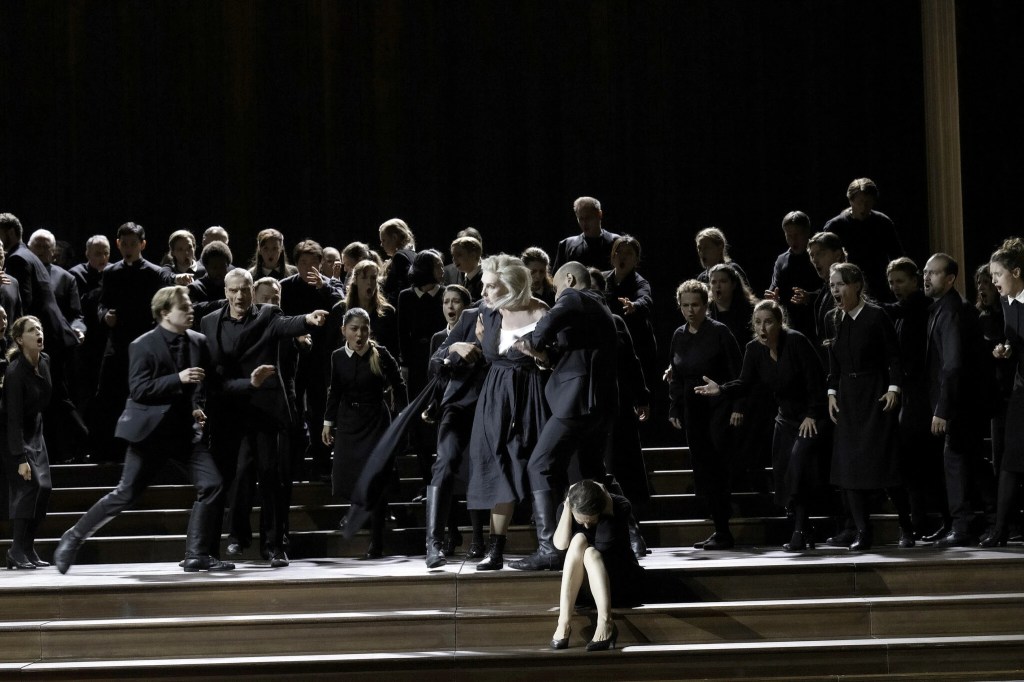
Silvana’s moeder blijkt een dubieuze reputatie te hebben en als Agnese di Cervia tijdens de eerste akte het paleis invlucht om te ontkomen aan een woedende menigte die haar van hekserij beschuldigt zinspeelt ze daarop om Silvana over te halen haar te helpen. Eudossia laat de menigte binnen als de officiële exorcist van de stad dat van haar eist en Agnese vervloekt alles en iedereen voor ze op de brandstapel sterft. Daarmee is Silvana verdacht gemaakt en Eudossia zal daar te gelegener tijd gebruik van maken.
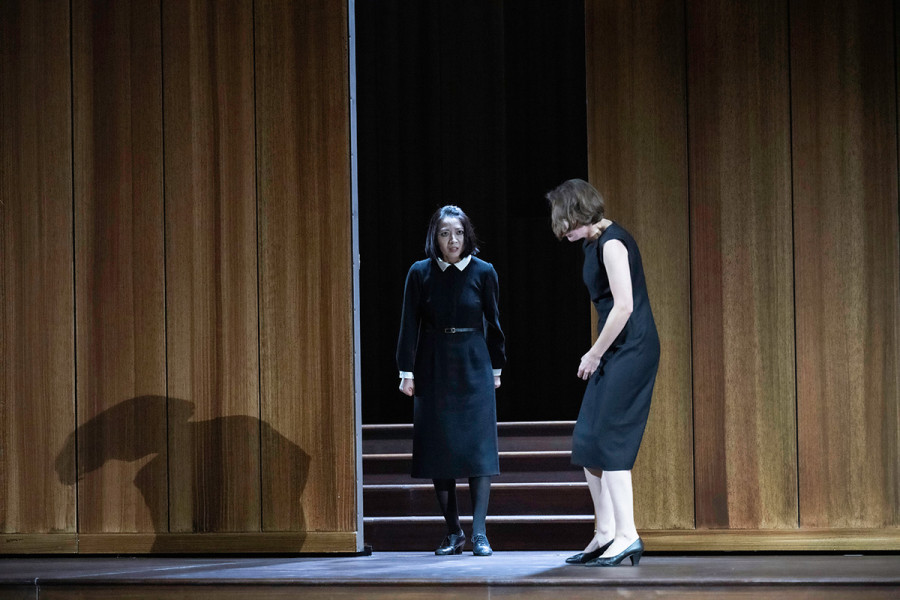
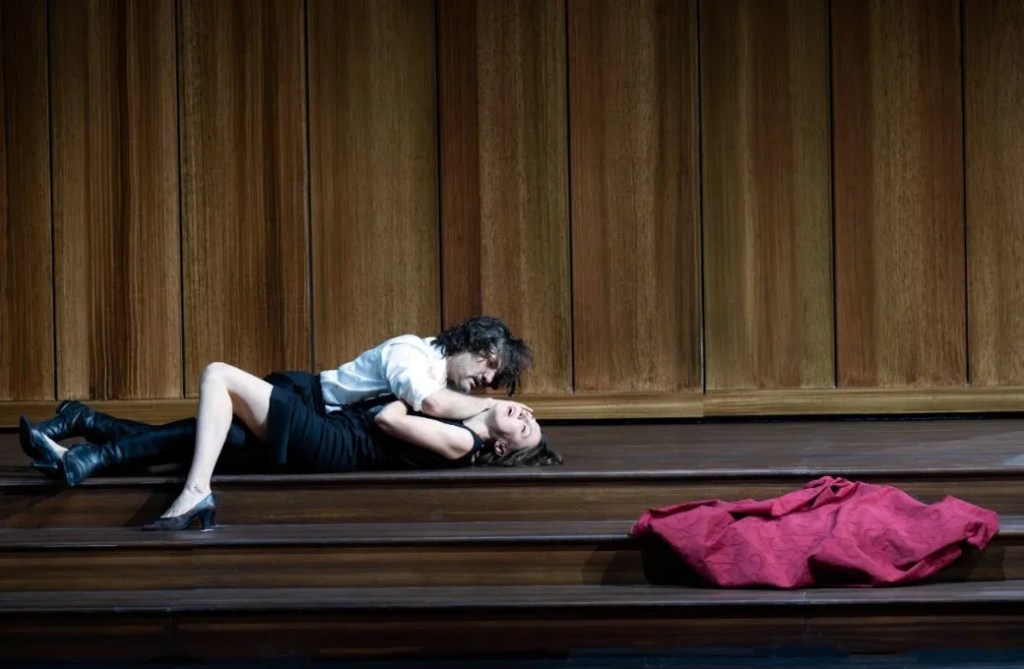
Silvana heeft een grote groep jonge vrouwen om zich heen, in deze productie doen ze denken aan kostschoolmeisjes, versterkt door hun zwarte jurkjes met witte kraag. Haar favoriete is Monica, feitelijk haar enige vriendin. Als Donello zijn opwachting maakt raakt dit meidenaquarium in grote staat van opwinding maar vooral Monica valt voor hem als een blok.
Als Silvana dat merkt reageert ze overdreven streng en stuurt Monica naar een klooster om haar voor verdere zonden te behoeden.
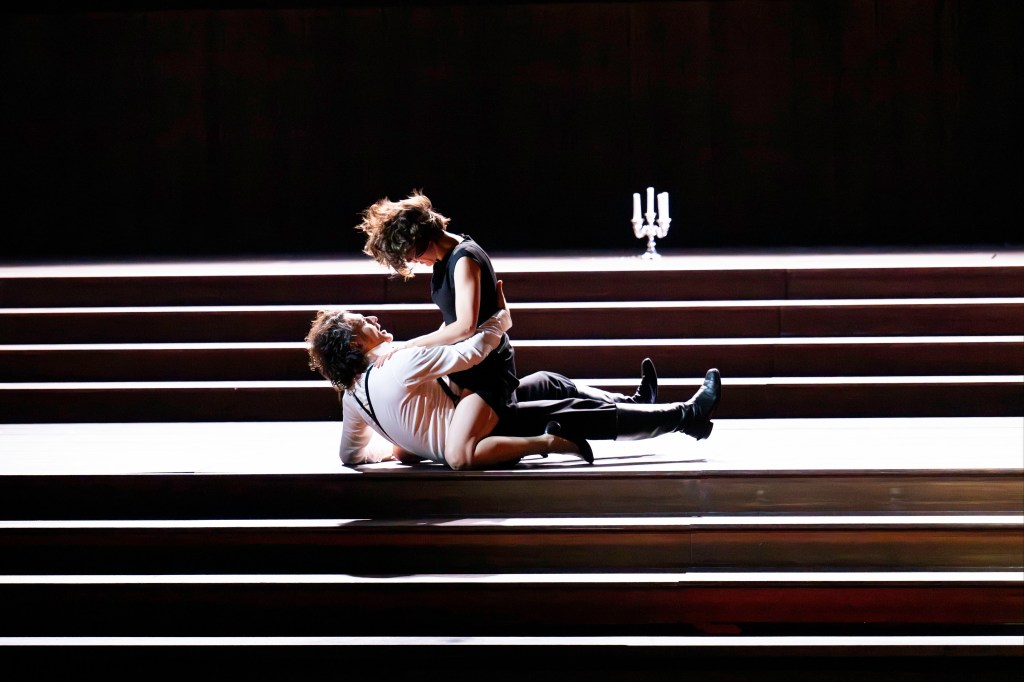
Voorspelbaar legt ze het later zelf met de jonge man aan, een leeftijdgenoot die ze ooit als kind al eens heeft gezien. Als ze van haar echtgenoot heeft begrepen hoe die door haar moeder is beïnvloed probeert ze zelf iets dergelijks met Donello. Ze wenst hem als het ware naar zich toe en als hij daadwerkelijk verschijnt is er weinig voor nodig om een affaire te laten beginnen.
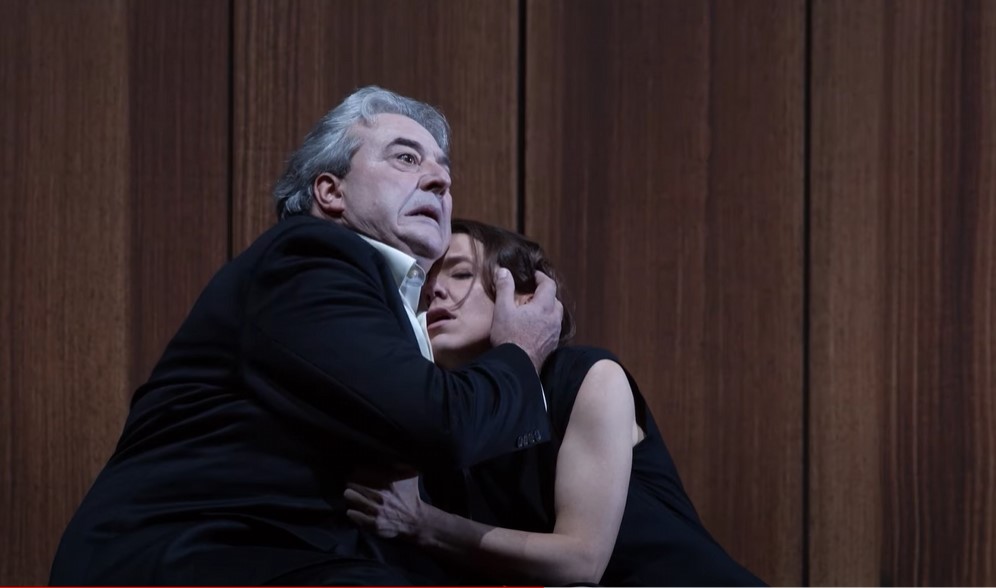
Dat loopt een paar maanden aan en Eudossia doet alsof ze het niet in de gaten heeft. Intussen is ze bezig om het hof in Byzantium zover te krijgen dat Donello terug wordt geroepen. Als dat bericht komt weigert hij te vertrekken. En Silvana bepleit zijn zaak bij Basilio: ze wil niet dat hij haar verlaat. Als ze vervolgens een tirade houdt waarin hem wordt verweten haar jeugd gestolen te hebben en dat ze hem vreselijk vindt, krijgt de man een hartinfarct en sterft.
Uiteraard wordt Silvana van moord beschuldigd maar haar verweer is dat ze slechts het pad van oprechte liefde heeft gevolgd en alleen aan god verantwoording schuldig is. Dan komt Eudossia op de proppen met het verhaal over Silvana’s moeder die haar zoon Basilio ooit heeft behekst. En nu doet haar dochter hetzelfde met diens zoon. Als Silvana hapert in het herhalen van de tekst die de bisschop haar voorspreekt om zichzelf door een eed van alle beschuldigingen vrij te pleiten, ziet men hierin het bewijs van hekserij. Ook Silvana eindigt op de brandstapel.
Teaser:
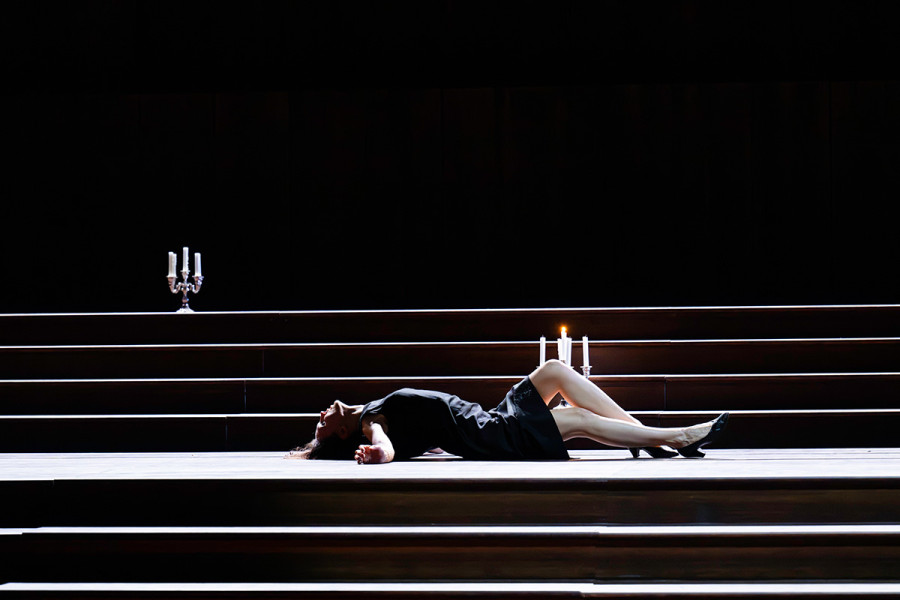
Het toneelbeeld met decor van Herbert Muraurer is sober. We zien een toneel dat trapsgewijs oploopt Daarachter een wand die soms geopend wordt en dan een minder relevantvergzicht toont, kennelijk om wat kleur in het geheel te brengen. Iedereen loopt in zwarte of donkerblauwe kledij wat de troosteloosheid van het leven voor Silvana aan het hof benadrukt. Alleen de twee mannen Basilio en Donello is enige kleur gegund. De twee verbrandingsscènes vinden op het achtertoneel plaats met de suggestie van veel vuur.
De muziek van Respighi is weinig eenduidig, nergens een consistent voorbeeld van een bepaalde stijlperiode uit de operageschiedenis. In plaats daarvan gebruikt hij een stijl die kennelijk in zijn beleving het beste bij een bepaalde scène past, of dat nu Gregoriaans, Monteverdi of Strauss is Dirigent Carlo Rizzi geeft daarvan zelf een paar voorbeelden:
Daar waar de handeling refereert aan het Griekse Byzantium en als Eudossia aan het woord is maakt Respighi gebruik van Gregoriaanse koormuziek of vergelijkbare motieven. Maar als Donello verschijnt klinkt de muziek lyrisch en wordt hij begeleid door een prachtige klarinet passage.
Het liefdesduet van Silvana en Donello aan het begin van de derde akte wordt voorafgegaan door een orkestraal intermezzo dat buitengewoon gepassioneerd klinkt. Het einde markeert het begin van de postcoïtale fase van de ontmoeting waarin de twee geliefden met elkaar beginnen te praten. Het doet sterk denken aan de tweede akte Tristan, de overeenkomst kan weinig luisteraars ontgaan. Als in een later stadium Silvana aangeeft met Donello te willen sterven gebruikt Respighi een muzikale taal die doet denken aan Monteverdi. Aldus een parafrase van een paar van Rizzi’s overwegingen.
Het volk roert zich als er iemand beschuldigd kan worden en dat gebeurt tweemaal met donderend geluid. Voor de solisten is het nauwelijks mogelijk zich daartegen staande te houden maar ook zonder koor is het erg hard werken voor met name Silvana die een partij heeft die in de hoogte een moeilijkheidsgraad heeft vergelijkbaar met Aitra of Helena in Strauss ’Die Agyptische Helena. Of gewoon Brünnhilde in het slot van Götterdämmerung.
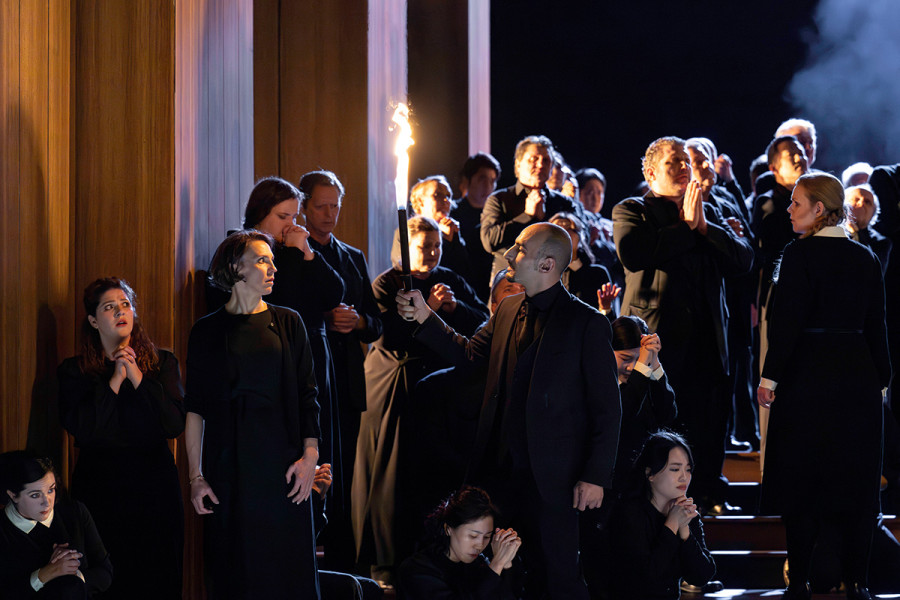
Het koor van DOB verzorgt een uitstekende bijdrage aan de voorstelling, zowel acterend als zingend. De beperkte bewegingsruimte op het toneel wordt uitstekend benut en de massa komt dreigend over, zoals het een op hol geslagen volksmassa betaamt.
Rizzi leidt het orkest van DOB met vaste hand. Hij laat het op gezette momenten donderen maar is zeer alert zijn zangers alle ruimte te geven voor het etaleren van hun mogelijkheden. Voor zover het mogelijk is dat te beoordelen bij een volslagen onbekend werk brengt Rizzi de partituur tot leven op een wijze die Respighi voor ogen moet hebben gestaan.
De Koreaaanse sopraan Sua Jo heeft een mooie scène met Silvana als die ontdekt dat ze verliefd is op Donello. Het is een schitterend duet waarin Jo’s personage Monica met de eer gaat strijken maar niettemin wordt afgevoerd, haar zien we niet meer terug.
Veterane Doris Soffel vertolkt de rol van de gedoemde Agnese di Cervia, adequaat maar niet bijzonder. Maakt niet uit natuurlijk, geweldig om haar op het toneel te zien.
Martina Serafin kruipt in de huid van Eudossia en geeft die manipulerende vrouw de juiste toneelprésence mee. Ook qua zang komt haar personage goed uit de verf.
Bariton Ivan Inverardi is adequaat als Basilio, hij doet wat hij moet doen zonder verder veel indruk te maken. Tenor Georgy Vasiliev zet een geloofwaardige Donello neer. Hij zingt goed maar zijn rol is niet van dien aard dat ik me gemakkelijk in zijn personage kan verplaatsen waardoor het allemaal wat op afstand blijft.
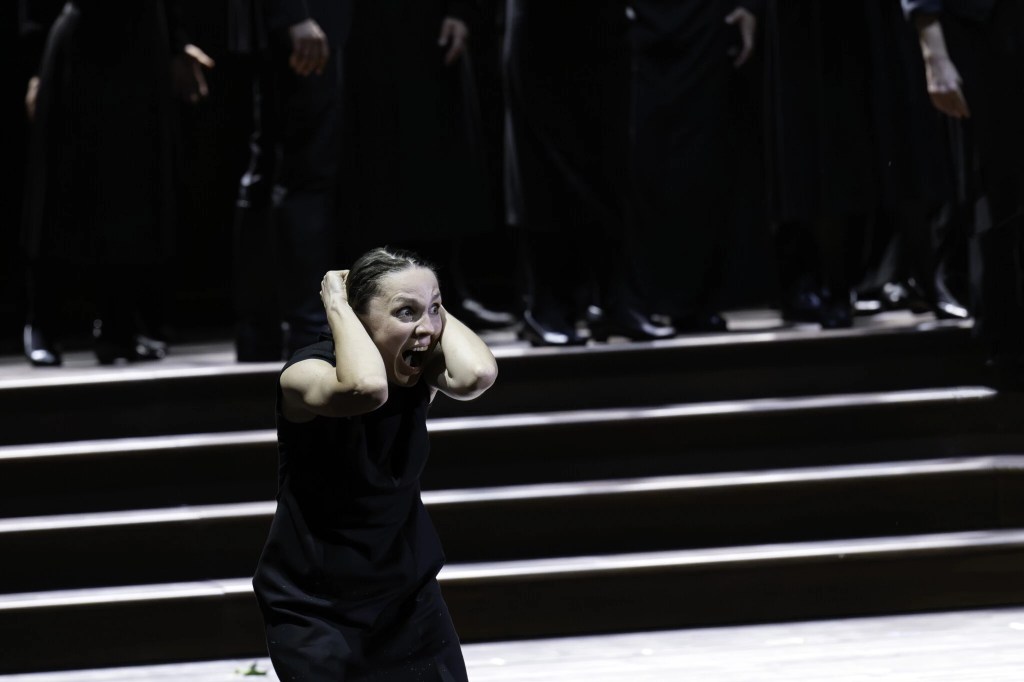
Olesya Golovneva is zoals verwacht de ster van de show. Ik zag haar voor het eerst als Natacha in Oorlog en Vrede, een van de laatste producties die in 2011 in de opera van Keulen gingen voor de eindeloze renovatie een aanvang nam. Ik vond haar aandoenlijk in die rol, Natacha is natuurlijk ook aandoenlijk dus wat wil je.
Twee jaar nadien schitterde ze als Anna Bolena waarbij opviel dat ze ook een laag bereik heeft. Als Silvana is dat van minder belang, hier gaat het om topnoten en wel heel erg veel daarvan. Golvovneva acteert afwisselend als een meisje dat zich zo onopvallend mogelijk probeert te maken maar op andere momenten is ze een tijgerin. Het gaat haar gemakkelijk af, zo lijkt het en haar zang laat geen moment af. Het is een absolute triomf voor deze van oorsprong Russische sopraan.
Al met al een bijzondere opname van een absolute rariteit. Voor liefhebbers van dit genre een must, voor de overige operaliefhebbers van harte aanbevolen.
Franz Schubert (1797-1828) staat vooral bekend om zijn liederen en symfonieën. Hij heeft echter ook de nodige werken voor het theater geschreven, veelal Singspiele en een klein aantal opera’s. Geen van allen brachten ze de componist het succes waar hij zo hoopte, vooral om een reputatie te vestigen als operacomponist.
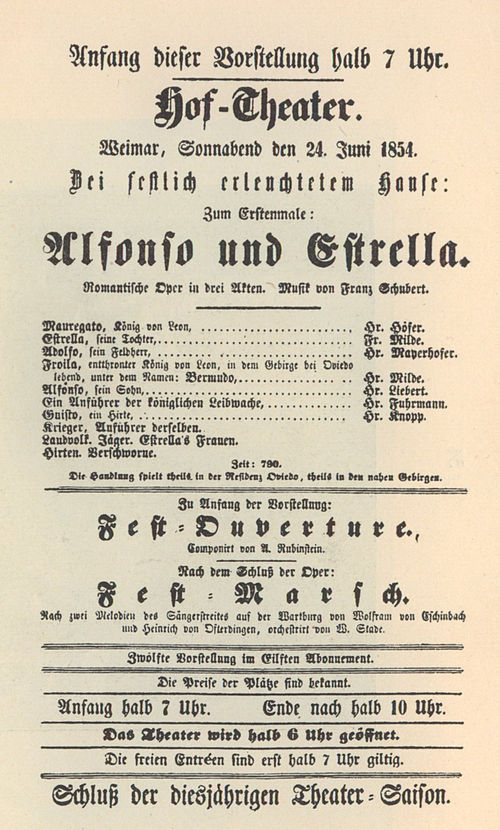
Playbill Weimar 1854, conductor Liszt
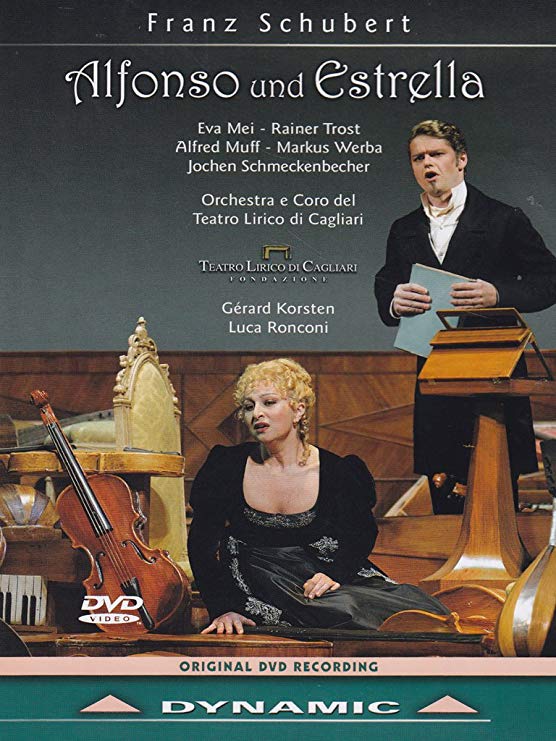
Het Teatro Lirico Cagliari kwam in 2004 met een uitvoering van zijn meest geslaagde werk: Alfonso und Estrella uit 1822. Een opname is door Dynamic op dvd uitgebracht. Het werk volgde zeer kort na Webers Der Freischütz maar werd genegeerd. De première vond pas in 1854 plaats in Weimar door toedoen van Liszt.
Het libretto van Franz von Schober gaat uit van een simpel verhaal. Koning Froila van Léon leeft al vele jaren in ballingschap in een vallei die door bergen van zijn vroegere rijk wordt afgeschermd. De usurpator Mauregato heeft het te druk met onder de duim krijgen van de Moren om zich te bekommeren om die zonderling daar achter de bergen.
Na weer een succesvolle campagne begaat Mauregato de klassieke vergissing zijn legeraanvoerder een wens te laten doen die op voorhand zal worden ingewilligd. Generaal Adolfo vraagt om de hand van zijn dochter Estrella die hem echter absoluut niet accepteert. Uit wraak komt Adolfo in opstand: als hij zelf koning is krijgt hij Estrella er gratis bij. Dat meisje is al eens verdwaald na een jachtpartij en toevallig is ze Alonso tegen het lijf gelopen, de zoon van Froila. Liefde op het eerste gezicht. Vanwege Estrella komt Alfonso de troepen van Mauregato te hulp als die dreigen te verliezen van Adolfo. Hij neemt deze veldheer persoonlijk gevangen als die Estrella bedreigt om zijn zin te krijgen. Mauregato denkt zich verslagen en geeft het op: hij laat zijn gestolen rijk weer aan Froila en zo krijgt het verhaaltje een happy end.
Bij het horen van de ouverture moest ik direct aan Schuberts symfonische muziek denken. Bepaalde wat opgewonden klimmende passages herinnerden me onwillekeurig aan Fidelio. De koormuziek is erg fraai maar doet weinig meer dan de handeling ophouden. Dat geldt ook voor veel van de aria’s. Ze klinken eerder als opgerekte liederen waar Schubert natuurlijk zijn faam aan te danken heeft dan als onderdelen van een theaterstuk.
Teatro Lirico Cagliari heeft wel een behoorlijke gok genomen met deze productie. Ik kan me niet voorstellen dat er in andere theaters veel publiek op af zou komen maar daar op Sardinië houdt men kennelijk wel van een rariteit zo nu en dan. En Dynamic is er altijd bij om dat vast te leggen.
Het speelvlak is heel opvallend. Het bestaat uit decorstukken die de vorm hebben van muziekinstrumenten, voornamelijk celli en bassen. Maar hier en daar zien we ook een trede of een plint in de vorm van een toetsenbord. Verder staan er muziekstandaards waarop een solist zogenaamd kijkt tijdens het zingen. Als de camera inzoomt blijkt er gewoon een prentenboek op te staan. Het toneel verandert niet per scène of akte, alles speelt zich daar af.
Variaties in de handeling worden uitgebeeld door op het achtertoneel marionetten op een lopende band langs te sturen. Ze zijn op normale grootte en gekleed als de personen die ze uitbeelden. Omdat ze worden bediend door in het donker gehulde toneelknechten kan men zich afvragen of het niet eenvoudiger was geweest daar normale levende figuranten voor in te zetten. Regisseur Luva Ronconi en Margherita Palli die verantwoordelijk was voor de algehele aankleding zullen daar wel hun redenen voor hebben gehad.
Wat de voorstelling muzikaal de moeite waard maakt is vooral de topcast die men bijeen heeft gebracht. Eva Mei excelleert als de koningsdochter Estrella, de enige grote rol voor een vrouw. Tenor Rainer Trost vertolkt de rol van de koningszoon Alfonso die nu eindelijk die benauwde vallei eens uit wil. Bariton Markus Werba als Froila heeft dat verboden om tenminste nog een plekje voor zichzelf te hebben. Leven en laten leven is zijn motto t.a.v. Mauregato.
Het duet van Alfonso en Froila zet de toon waar het Schuberts benadering van theatermuziek betreft. Het klinkt prachtig allemaal maar de handeling komt er geen millimeter mee vooruit. Mauregato komt voor rekening van bariton Jochen Schmechenbecher. Generaal Adolfo wordt ten tonele gevoerd door de bas Alfred Muff.
Koor en orkest van Teatro Lirico Cagliari staan onder leiding van Gérard Korsten.
P.s. (BJ) in 1978 is de opera onder Suitner opgenomen met een all star cast: Edith Mathis, Hermann Prey, Dietrich Fischer-Dieskau, Peter Schreie en Theo Adams:
P.s. 2: en vergeet Fierrabras niet, mijns inziens (BJ) een meesterwerk
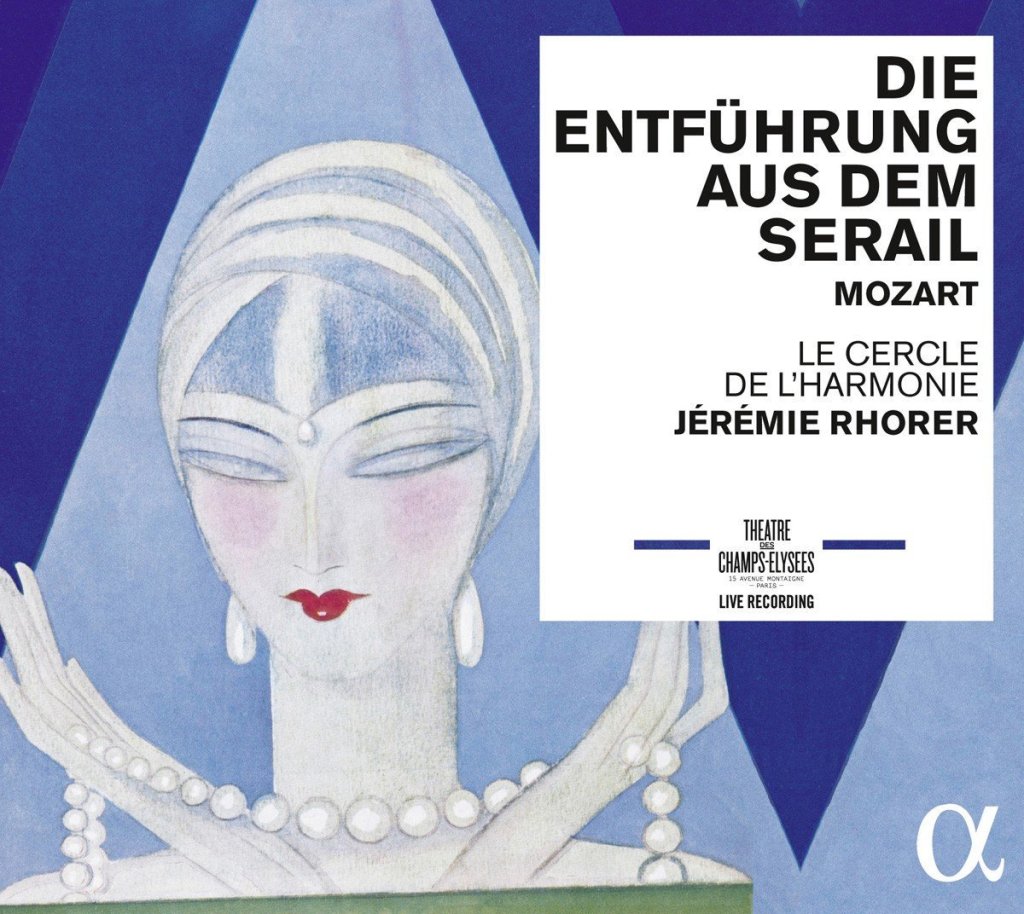
There is no shortage of recordings of Die Entführung aus dem Serail, but really good ones may be counted on the fingers of one hand. Moreover,you often have to go quite far back in time to find the real gems. But the performance recorded live at the Théâtre des Champs-Élysées on 21 September 2015 – and conducted very vividly by Jérémie Rhorer – is, for me, among the very best.
David Portillo is an extraordinarily fine Pedrillo. Light and airy,entertaining and amusing; and meanwhile singing utterly brilliantly…. Superb.
Rachelle Gilmore is a delightful Blonde. Just listen to “Welche Wonne,welche Lust”, which she sings with impeccable height and crystal-clearcolouratura! Breathtaking.
Mischa Schelomianski shines as Osmin. That he sings the role with a thick Russian accent is anything but disturbing here. It is quite right for Osmin. Jane Archibald (Konstanze) sounds a bit shrill at times, but as soon asshe starts singing “Ach ich liebte” I surrender completely.
Only Belmonte (Norman Reinhardt) I have heard better. His voice iscreamy and his timbre pleasant, but he lacks a bit of suppleness, which prevents him from being really satisfying in his “Wenn der Freude Tränen liessen”. Fortunately, “Ich baue ganz auf deine Stärke” succeeds much better, but I continue to have trouble with his ornamentation.
It’s not perfect, no, but live performances never are. It is one of the reasons why they are so much fun; after all, nothing beats live theatre! The tempi are on the brisk side but nowhere rushed, and the orchestra sparkles like a cosy fire. And there is no director to ruin it for me. This is how I want my opera’s (Alpha 242)
DVD
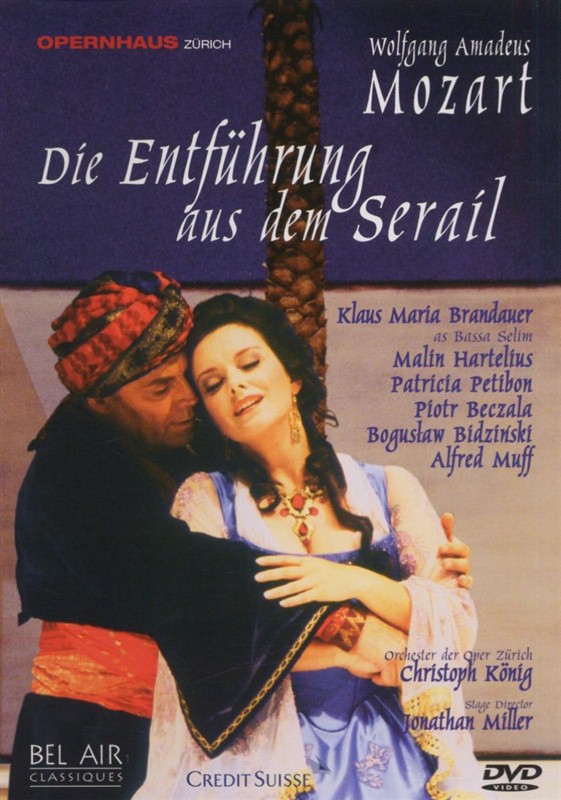
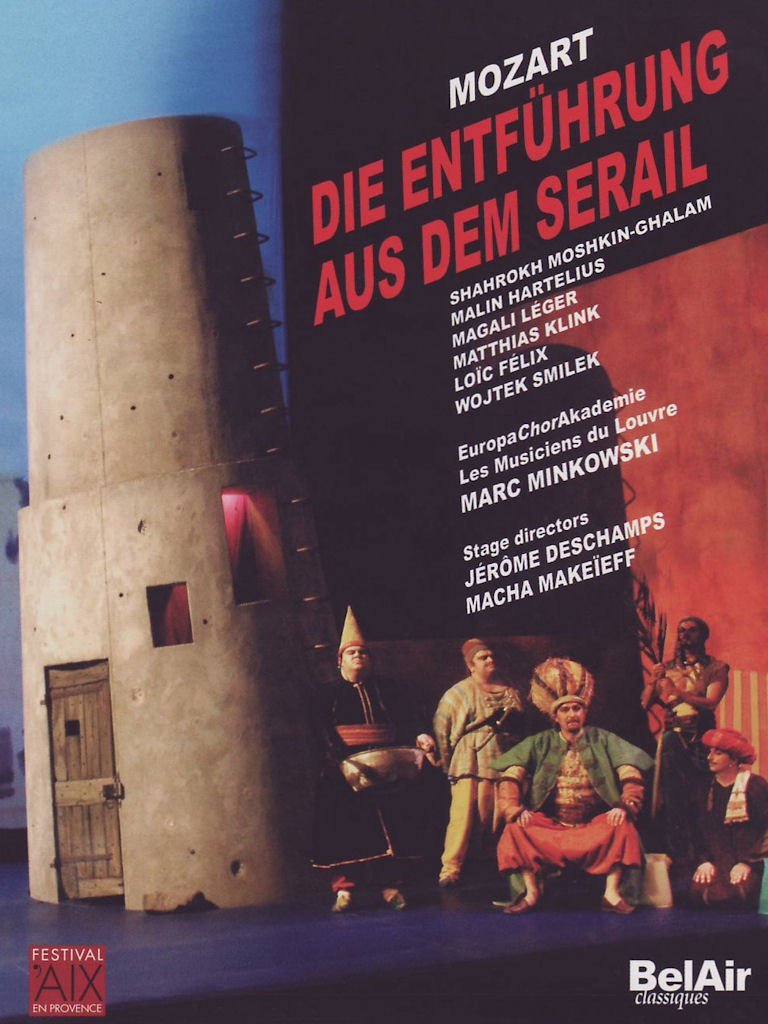
The ways of record companies are sometimes inscrutable and so it couldhappen that two different performances of Entführung aus de Serail were released within a short space of time by the same company, BelAirClassics. These are respectively a production by Jonathan Miller made for the Zürcher Festspiele in 2003 (BAC007) and a performance filmed in Aix-en-Provence in 2004, directed by Jérome Deschamps and Macha Makeïeff and conducted by Marc Minkowski (BAC028). There is aworld of difference between the two productions, it just goes to show what good (or, if you like, bad) direction can do to an opera.
Zürcher Festspiele 2003
Jonathan Miller, normally a pretty big deal, simply fails. Nothing happens. There is a palm tree in the middle and the singers come up, lean against it and sing their aria.They are totally left to their own devices, which for most results in clichéd gestures and gestures. With Patricia Petibon (Blonde), just the opposite happens: she exaggerates like her life is depending on it and she is overacting. In short: here are six characters looking for a director.
Patricia Petibon sings “Durch Zartlichkeit und Schmeicheln”:
I am not enthusiastic about the singing either, as even Piotr Beczala (Belmonte) and Malin Hartelius (Konstanze) perform far below their level.
There is one plus though: Klaus Maria Brandauer in the speaking role of Bassa Selim. Every scene with him in it turns into pure theatre. He doesn’t act, no, he just gives a masterclass in acting.
The production from Aix-en-Provence can be described in one word: precious. As soon as you see the orchestra (all wearing turbans and other exotic headgear) and the entrance of a broadly smiling Minkowski, you know you are going to be amused.
The stage is populated by a motley collection of rather weird characters in oriental costumes, one joke follows another, with no cliché shunned. It is no longer comedy, it is slapstick. And why not? Mozart can take it, especially when it comes to a singspiel.
The dancing emergence on the stage of Bassa Selim (a fantastic Shahrokh Moshkin-Ghalam, a dancer and actor very famous in France) is a story in itself. His German is abominable, but he must be forgiven, because everything else he does with the role (including a spectacular disappearing act at the end) is breathtaking
Malin Hartelius shows what a fantastic Kostanze she is. Magali Léger (Blonde), Matthias Klink (Belmonte), Loïc Félix (Pedrillo) and Wojtek Smilek (Osmin) are all fine, the orchestra fierce and Minkowski on target. But be warned: it is packed with Mohammed jokes.
Ernest Bloch, Oct. 1948. Oreg. Hist. Soc. Research Lib., bb006122
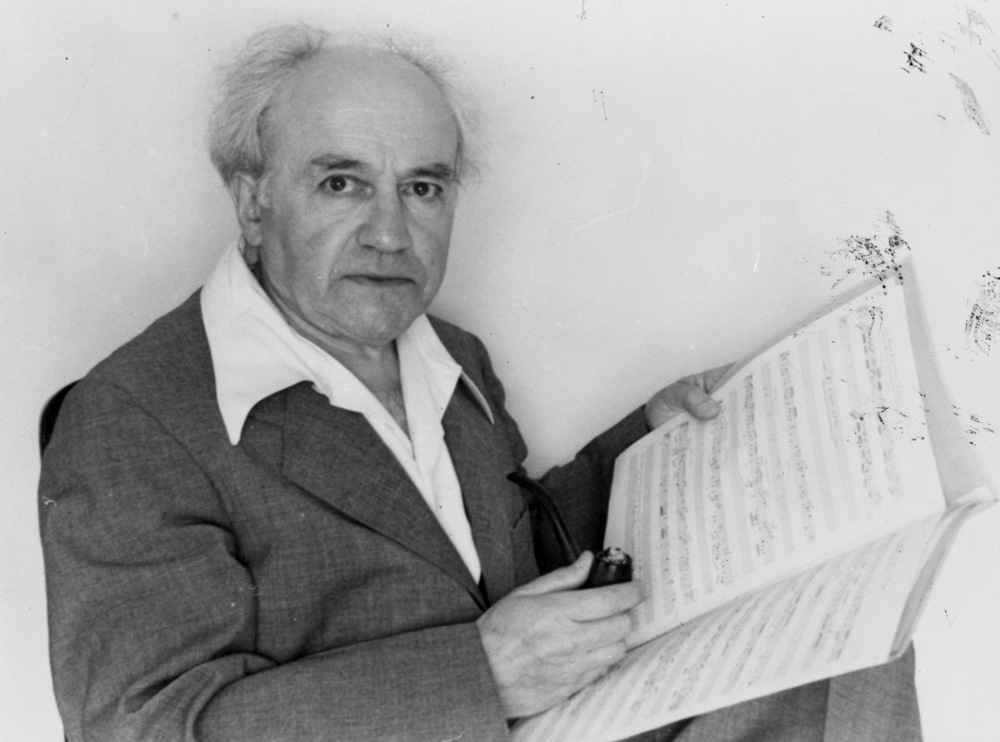
I am often asked if there is such a thing as Jewish music ….. Well, there certainly is! Just take Ernest Bloch. He was born in 1880 in Geneva in an assimilated family. Around the age of twentyfive he became interested in everything to do with Judaism and translated it into his language – music.
“I’m interested in the Jewish soul” he wrote to Edmund Fleg, cantor and librettist of his opera Macbeth. “I want to translate all this into music.”
He developed a very personal style: his compositions reflect the atmosphere of Hebrew chant, without actually being a literal imitation of it. His intention was not to reconstruct old Hebrew music, but to write his own, good music, because, as he said, he was not an archaeologist. He succeeded.
Before the war, he was among the most played and appreciated composers. People even called him the fourth great ˜B,” after Bach, Beethoven and Brahms. It is not that people now no longer know his name, but they usually do not get any further than his cello concerto.
Baal Shem
\
For the Baal Shem Suite (1923), one of his best-known works, he was inspired by Israel ben Eliezer (Baal Shem Tov), the founder of modern Chassidism, a movement that originated in eighteenth-century Poland and was based on mysticism, spiritualism and magical doctrines. It proclaimed a kind of bliss that could only be achieved through music, dance and song because that was the only way to achieve direct contact with God.
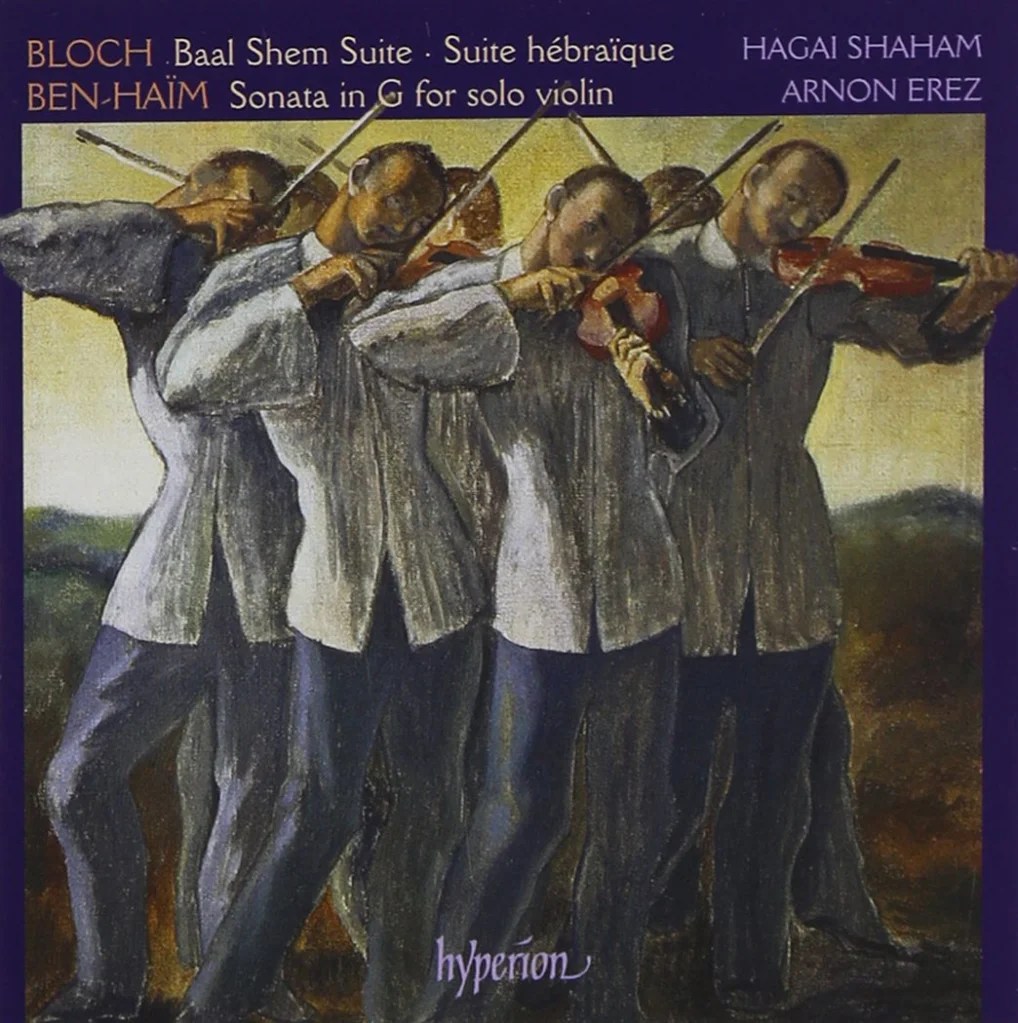
Of all the performances of those made of “Baal Shem” (and there are many), this one, played by Hagai Shaham and accompanied by Arnon Erez is for me one of the dearest. Shaham’s tone is round and warm with a healthy dose of “schmalz”. And though he often balances just on the edge, nowhere does he degenerate into banalities.
Seasons without the summer
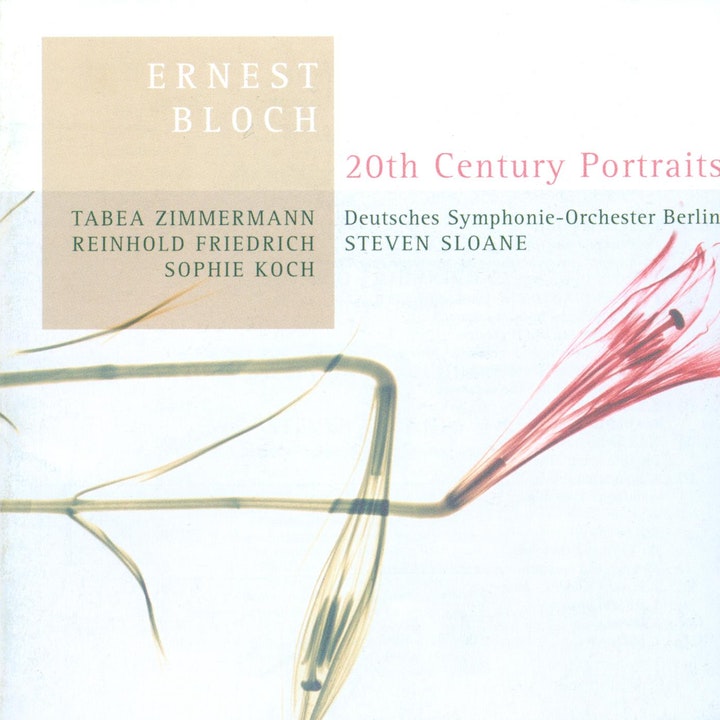
The symphonic poems Hiver-Printemps are very evocative. Together with the beautiful song cycle ‘Poèmes d’Automne’, composed for the texts of Béatrix Rodès, Bloch’s lover at the time, and sung very emotionally by Sophie Koch (Kleenex at hand?), they form, as it were, a kind of ˜Seasons”, from which only the summer is missing.
The suite for viola is among Bloch’s best compositions and one cannot imagine a better performance than Tabea Zimmermann’s.
The Deutches Symphonie-Orchester Berlin, conSloane, plays in a very animated way
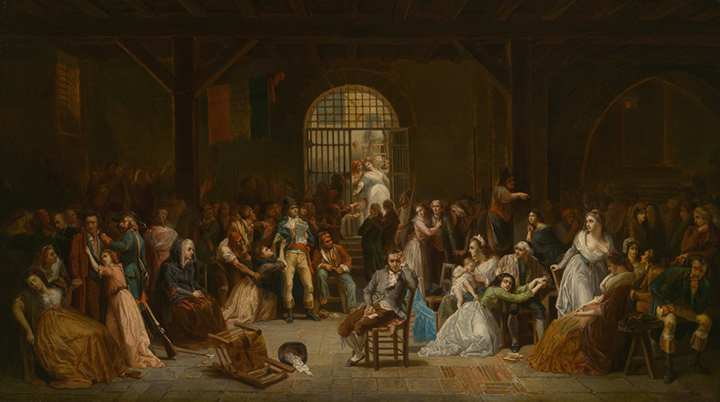
Appeal of the last victims of terror in the prison of St. Lazarus. Chénier appears seated at the foreground’s center.. Painting by Charles Louis Müller, (Musée de la Révolution française).
For me, Andrea Chénier is one of the best and most beautiful operas ever. I think the music is nothing less than divine and the story is timeless. It remains current, perhaps now more than ever. The tyrant must be cast off his throne and the people must take control. Surely, we all agree on that?
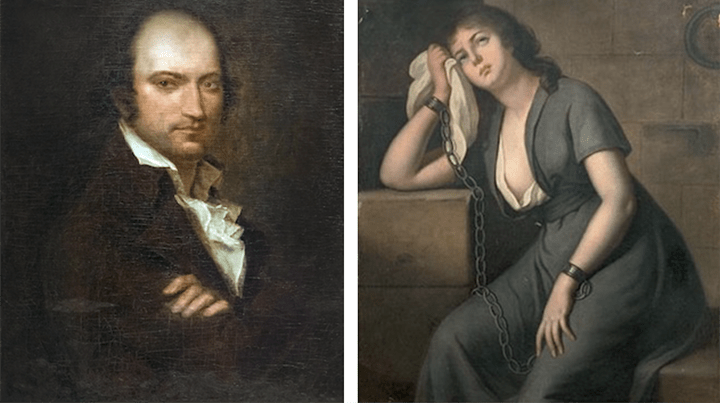
Ten days before Chénier’s death, the painter Joseph-Benoît Suvée completed this portrait of him – not exactly the romantic figure we would cast. On the right Aimée de Coigny, La Jeune Captive
If only it were that simple! Anyone who grew up in a post-revolutionary totalitarian regime knows how much horror it brings. One terror is replaced by another.
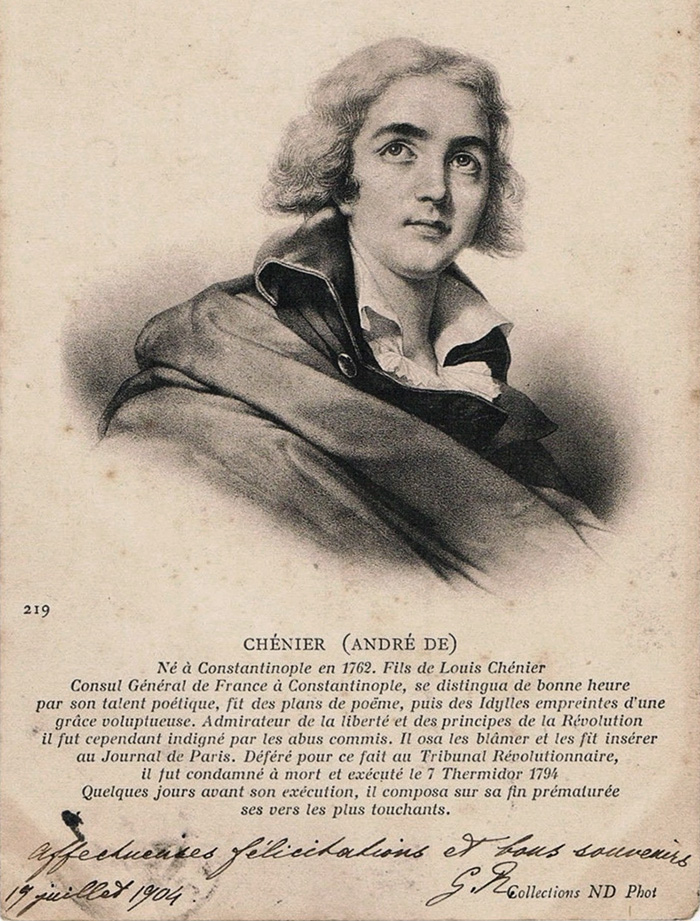
This, at least for me, is the main theme in Giordano’s biggest hit. I don’t think the real lead role is the actual poet, André Chénier (did you know that Giordano used Chénier’s poems in his arias?) nor his beloved Maddalena. It is the French Revolution, which, as Gérard (once Maddalena’s houseboy and now one of the revolutionary leaders) bitterly observes, devours its own children.
Domingo
To my great surprise, I read that Domingo didn’t much like the part of Andrea Chénier. He loved the opera, but the role, one of the toughest in the ‘lirico-spinto’ repertoire, was not really interesting for him dramatically. For him, Chénier was ‘an idealist who always has his head in the clouds’. And yet it was one of the operas he loved to sing!
I myself think the role of the poet/revolutionary fits him like a glove. Passion for love and enormous involvement in everything that happens in the world were – and still are – his trademarks.
He sang his first Cheniér in 1966 in New Orleans, as the last-minute replacement for Franco Corelli, but that was not his first performance of the opera. In the 1960/61 season he sang The Incredible and The Abbot, in Mexico.
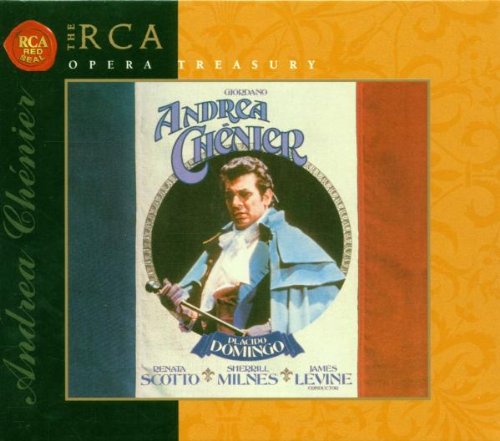
My favourite CD recording was recorded in 1976 by RCA (GD 82046). The cast is delectable. Renata Scotto sings Maddalena, Sherrill Milnes is Gérard and in the small roles we hear, among others, Jean Kraft, Maria Ewing, Michel Sénéchal and Gwendolyn Killebrew. James Levine, who conducts the National Philharmonic Orchestra, understands exactly what the opera is about. Tear jerkingly beautiful.
Scotto sings ‘La Mamma morta’:
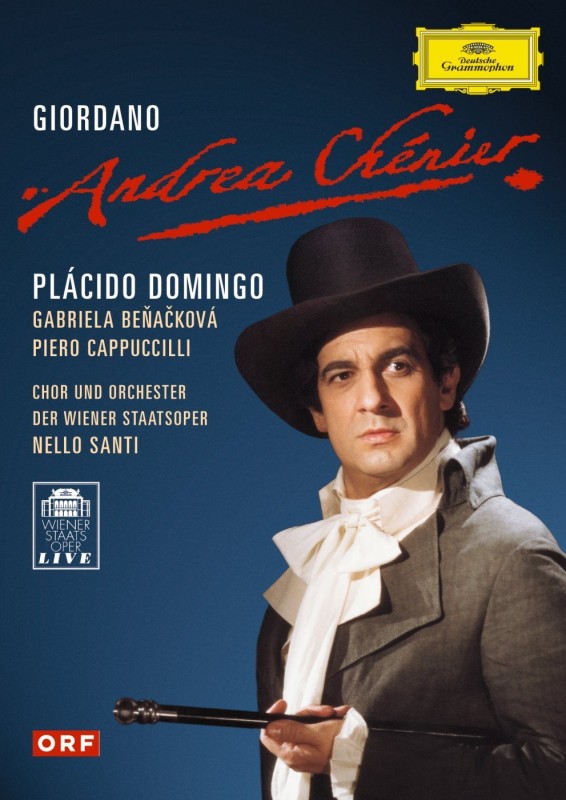
In 1981 the opera in Vienna was recorded for TV. That recording has since been released on DVD (DG 073 4070 7). Gabriela Beňačková, one of the most underrated singers in history, sings a Maddalena of flesh and blood. Horrifyingly beautiful and moving.
Piero Cappuccilli is a Gérard among thousands and the small roles are also filled by great singers: Madelon is sung by none other than Fedora Barbieri. Otto’s Schenk’s production is a feast for the eyes.
LES DIALOGUES ES CARMÉLITES
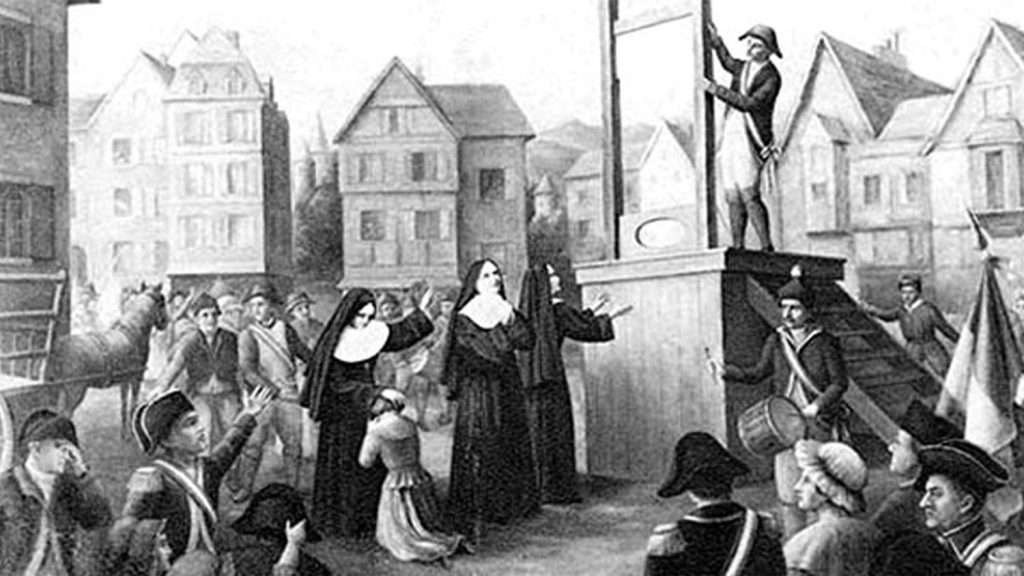
There are those operas that you just can’t spoil and Les Dialogues des Carmélites is one of them. For Poulenc, melody is the centre of the universe. His music is so poignantly beautiful and his composition so expressive that you don’t really need a director.
The opera’s themes are sacrifice, martyrdom, revolutions and ideologies, but those are just the side lines, because the main theme is an all-devouring fear that makes it impossible to live or die: “Fear is a terrible disease. I was born of fear, in fear I live and in fear I shall die. Everyone despises fear, so I am condemned to be despised.”
Just few recordings:
Milan, 1957
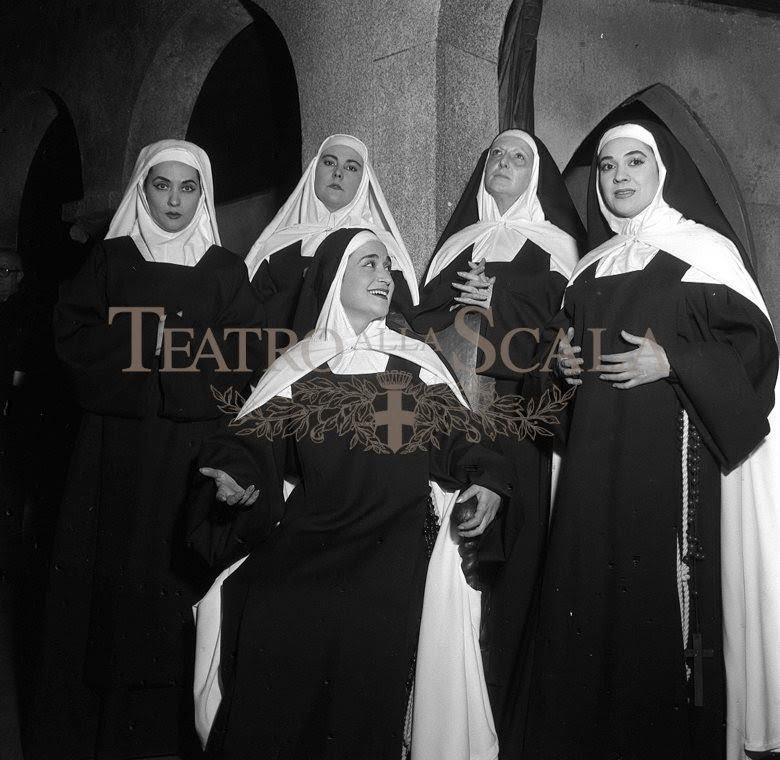
The world premiere of Dialogues des Carmélites took place on 26 January 1957 at La Scala in Milan, in an Italian translation. The cast reads like a ‘who’s who’ in the opera world, because, ask yourself: were there any bigger names in those days?
Blanche was sung by Virginia Zeani, a singer with a full, large and dramatic voice, that was suitable for both Violetta and Tosca. Marie was played by Gigliola Frazzoni, one of the best Minnies (La fanciulla del West) in history. And Madame Lidoine was given to Leyla Gencer.
With Fiorenza Cossotto, Gianna Pederzini, Eugenia Ratti and Scipio Colombo in the smaller roles, the opera sounded less lyrical than we are used to nowadays, almost veristic even. But that made the dramatic effect even more poignant.
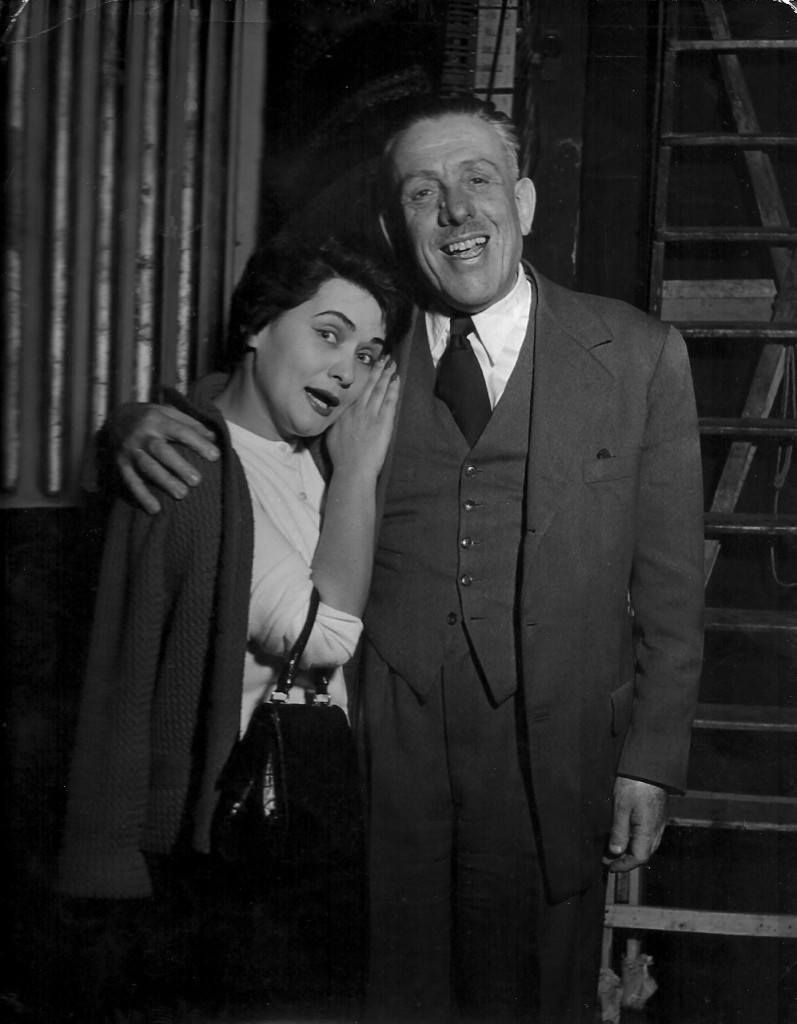
Virginia Zeani and Francis Poulenc, Milano 1957
In The Operatic PastCast, Virginia Zeani talks about Poulenc, the influence the opera has had on her life, her colleagues and the production in Milan.
The entire performance from Milan, fantastically conducted by Nino Sanzogno, is on YouTube. Do not miss it!
Paris, 1957
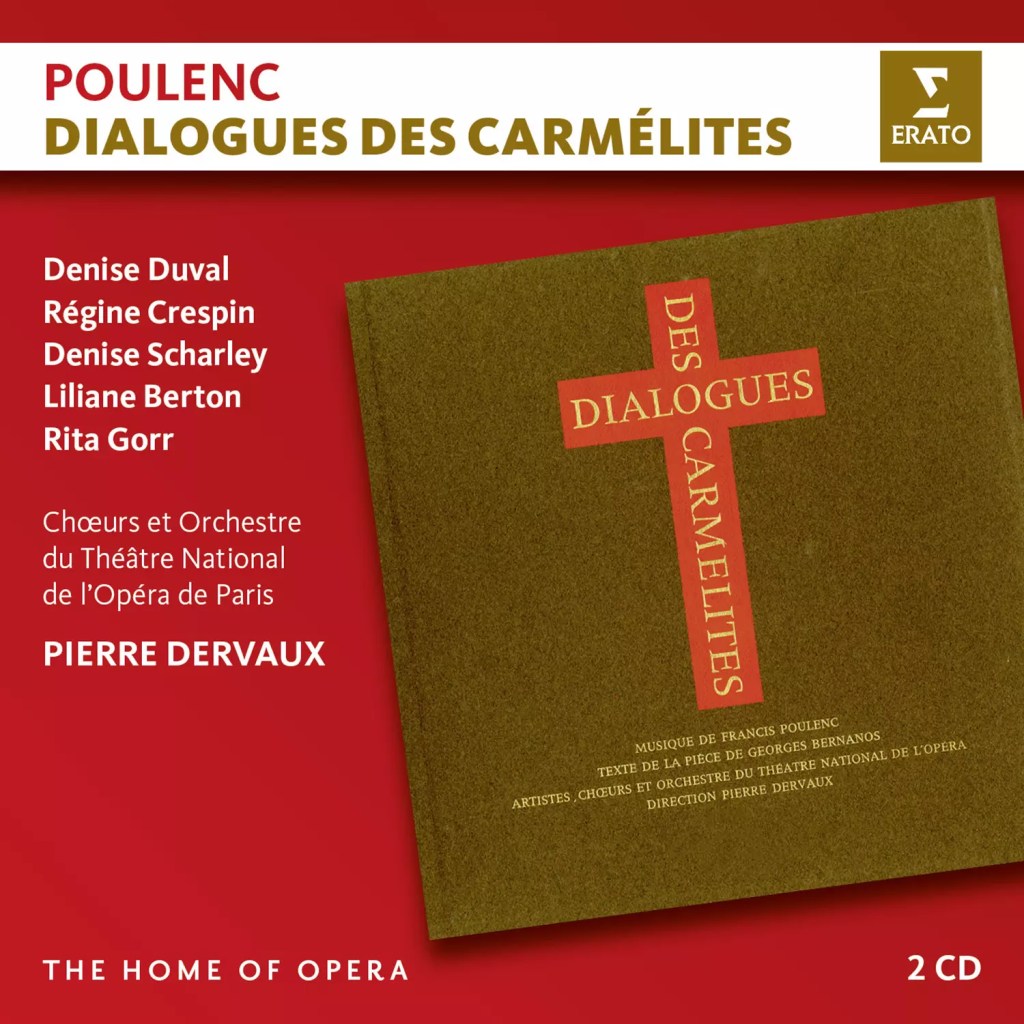
The Paris premiere of Dialogues des Carmélites followed six months later. On 21 June 1957, the opera, now in French, was presented at the Théâtre National de l’Opéra. Blanche was sung by Poulenc’s beloved soprano Denise Duval. Duval’s voice (girlishly naive, light, almost ethereal) fitted Blanche like a glove.
The rest of the cast, including Régine Crespin as Madame Lidoine and Rita Gorr as probably the best Mère Marie ever, was also chosen by Poulenc himself
Régine Crespin (Madame Lidoine) in “Mes chères filles”:
he orchestra was conducted by Pierre Dervaux and I can be very brief about him: there is no better. Full stop. (Warner 08256483211)
Milan, 2004
Robert Carsen’s production of Dialogues des Carmélites is one of the absolute highlights in the history of De Nationale Opera in Amsterdam.
Trailer from Amsterdam:
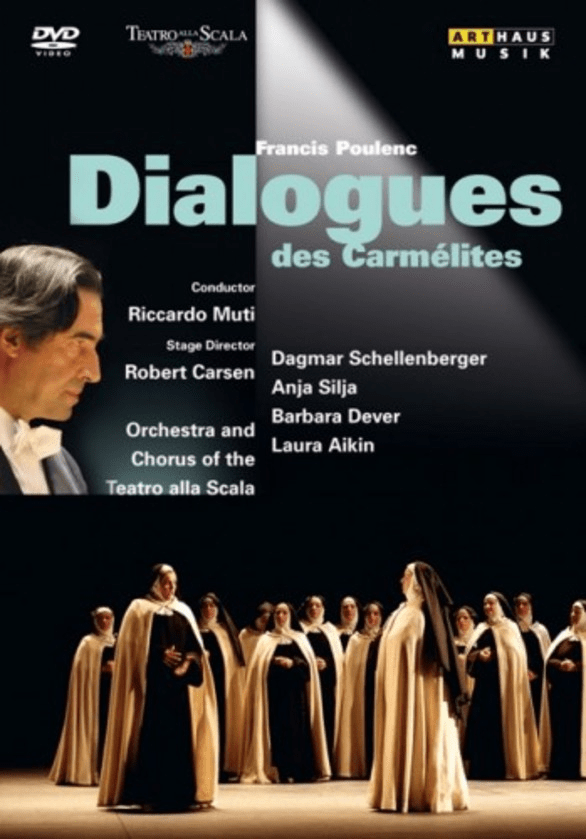
In February 2004, the production was filmed at La Scala but I am not entirely happy with it. My disappointment mainly relates to Dagmar Schellenberger’s performance as the lead role.
Admittedly, it is not easy to emulate the unforgettable Susan Chilcott (she died in 2003 of breast cancer, only 40 years old), and Schellenberger indeed cannot not do it. In the beginning her strong tremolo and her not always pure notes are irritating.. But as the opera progresses, she gains a great deal of credibility, and through her brilliant acting and complete abandonment, she makes the development of her character very tangible. And almost as a matter of course, her singing also becomes more beautiful and softer.
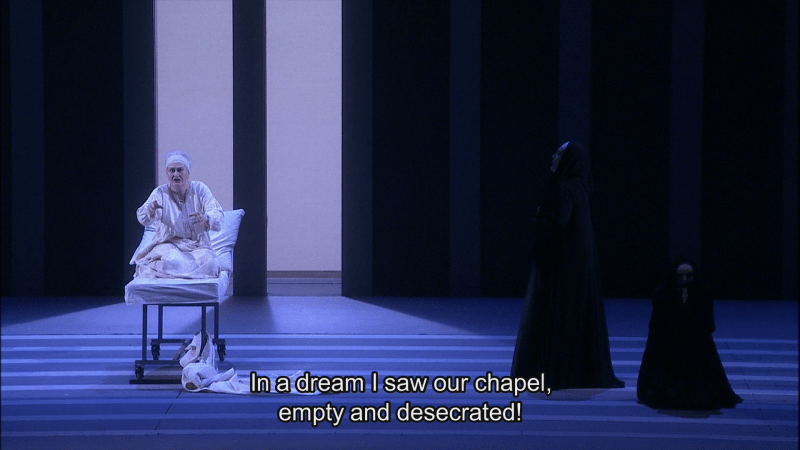
The role of Madame de Croissy is played by one of the best singing actresses of our time, Anja Silja. Her performance is truly breathtaking, and even though her voice is not that steady anymore – it suits the character of an old and mortally ill prioress very well. Her death struggle makes for unprecedentedly thrilling theatre, and it is a great credit to Carsen (and the rest of the cast) that the scenes that follow do not make us lose interest.
Muti conducts with verve and knows exactly how to strike the right tone. He really succeeds in translating the spectre of the revolution and its excesses into sound. He is at his very best, however, in the lyrical, contemplative scenes, and in his hands the chilling ending reaches a truly blood-curdling climax. Make sure you have a big bag of Kleenex within reach, because you really won’t keep it dry (Arthaus 107315).
Below is the trailer:
Hamburg, 2008
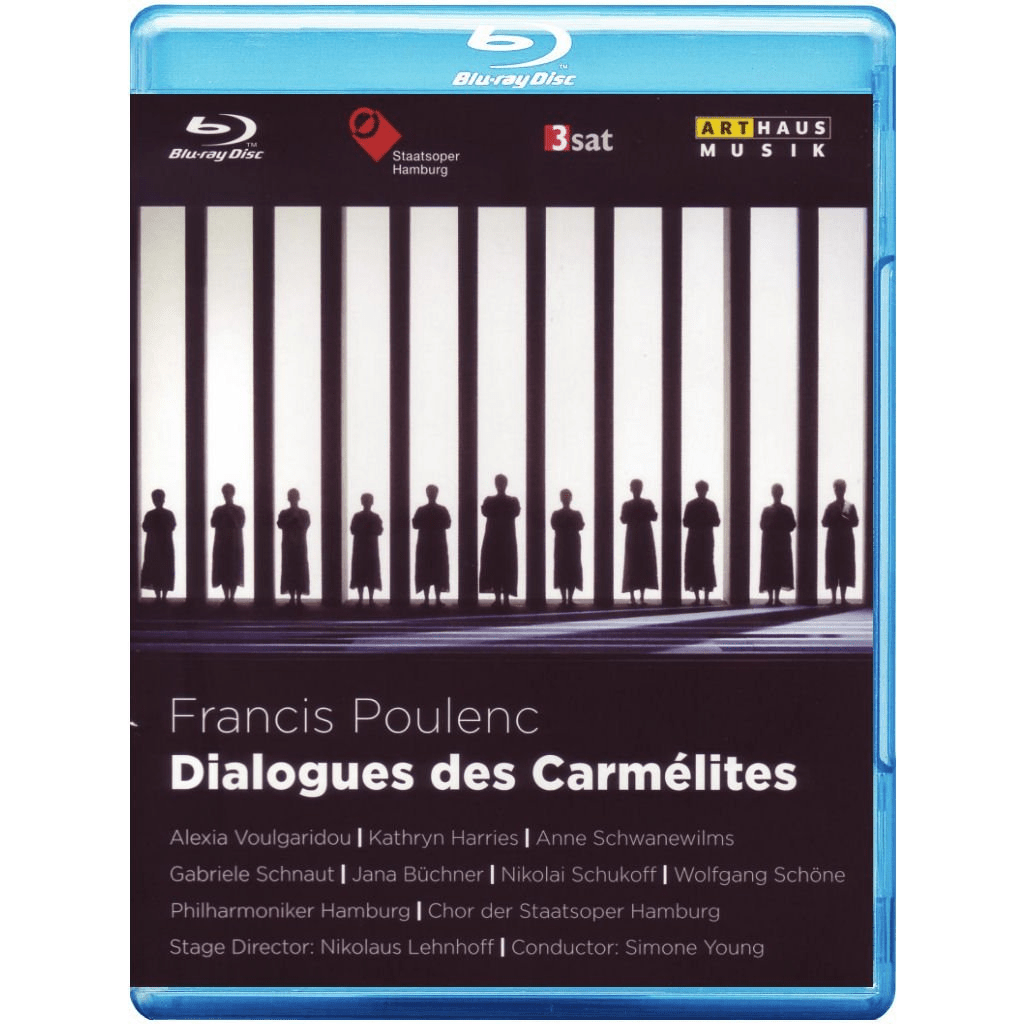
The opera came to Hamburg in 2008, it was directed by Nikolaus Lehnhoff.
His Blanche, Alexia Voulgaridou, is very much like Liu: sweet, scared but steadfast and very impressive.
Kathryn Harries as Madame de Croissy is even more impressive than Anja Silja. She acts not only with her whole body but also with her perfectly used voice. Her fear is physically palpable and her death scene cannot leave anyone unmoved.
Unfortunately, Gabrielle Schnaut’s Mère Marie is not of the same calibre. With the remnants of the once so imposing voice, she only causes irritation: not one note is pure and her terrible wobble feels like torture to your ears. How different then is warm and sweet Madame Lidoine, here sung incredibly lovely by Anne Schwanewilms!
The staging is very simple and there are hardly any sets, which is not at all disturbing. And the final scene is almost better than Carsen. (Arthouse Musik 101494)
Trailer:
Paris, 2013
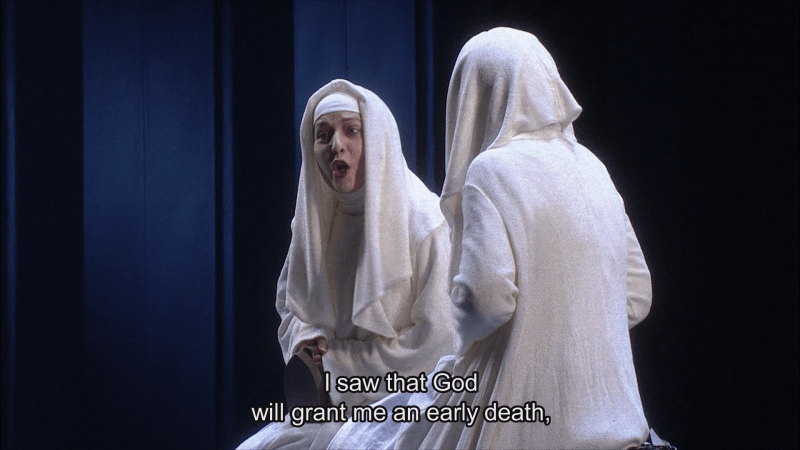
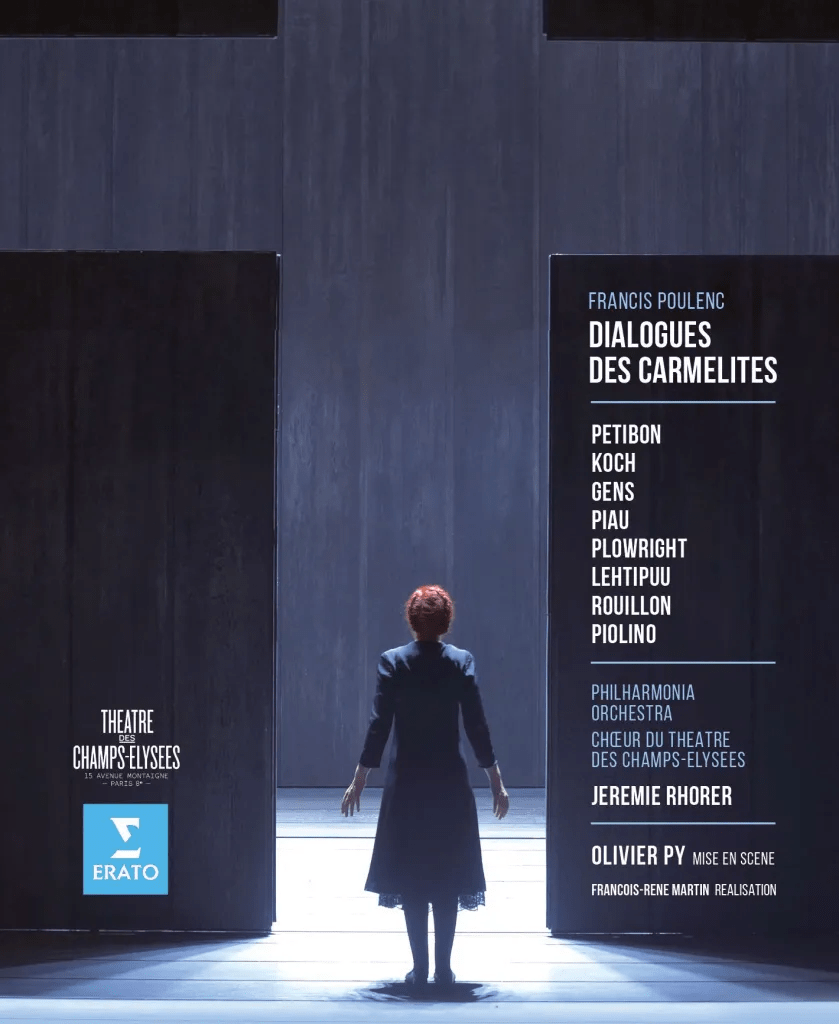
You just never know with Olivier Py, though I have to say that, apart from the awful Romeo et Juliette in Amsterdam, most of his productions are usually excellent. So too his Dialogues des Carmélites, recorded in Paris in 2013.
Patricia Petibon is a singer with a tendency to exaggerate, but here she is perfectly matched as Blanche. Watching her, I involuntarily get visions of Edith Piaf. Which of course suits the role very well: a small, skinny, frightened bird.
Her timbre is close to that of Denise Duval, but she lacks her carrying power and – mainly – her lyricism. Still, there is no denying that the role of Blanche is more or less tailor-made for her.
Sophie Koch is a strange choice for Marie. She looks far too young and lacks the confident superiority and power of persuasion so characteristic of the role. And the contrast with Lidoine (a wonderful Veronique Gens) is not great enough. Rosalind Plowright is an excellent Croissy and Sandrine Piau a delightful Constance.
Py uses the orchestral interludes to showcase religious scenes, including the evocation of the Last Supper and the Crucifixion. Sometimes a little “too much”, but the last scene, with the dark starry sky, brings a lump to my throat (Erato 0825646219537).
Here is the trailer:
Film adaptation:
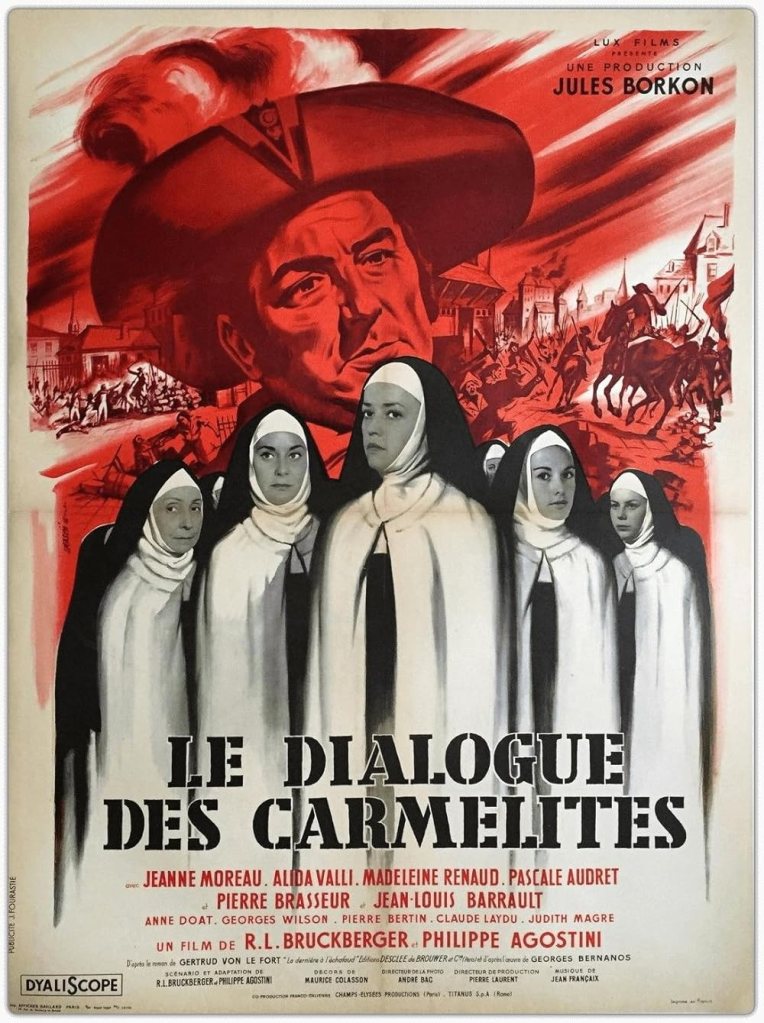
Did you know that the story of Dialogues des Carmélites was filmed in 1960? In the film you can see, among others, Jeanne Moreau as Mère Marie and Pascale Audret as Blanche.



 Basia con fuoco