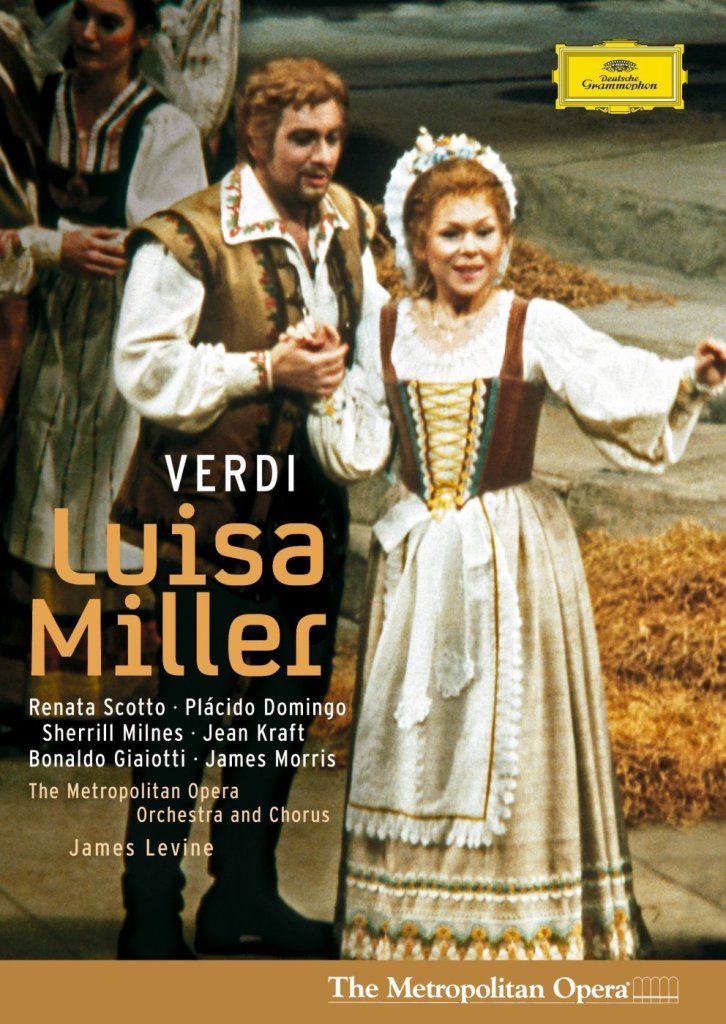
In 1979, Renata Scotto sang her first Luisa at the Metropolitan Opera and she did so with her usual devotion. But before she could start her first big aria, a ‘joker’ caused a scandal by shouting ‘brava Maria Callas’ at the top of his lungs.
Sherrill Milnes, here in the guise of Luisa’s father, took the emotional Scotto in his arms and so saved her concentration. And the performance. And the day.
All this was broadcast live on TV and thus it ended up on the pirate videos in circulation. I had been cherishing mine for years, and now the performance has been released on DVD by Deutsche Grammophon, with the necessary cuts, including that famous incident. A pity, but after all it is not about the incidents but about the opera and the performance. And there is absolutely nothing wrong with that.
Nathaniel Merrill’s staging is a bit old-fashioned and Domingo looks like hell with his blonde hair, but you quickly forget that because the singing and acting are of absolute top quality and maestro James Levine conducts masterfully (DG 0734027
In the video below, the main actors (Scotto, Domingo, Milnes and Levine) discuss Verdi’s opera and the 1979 production:
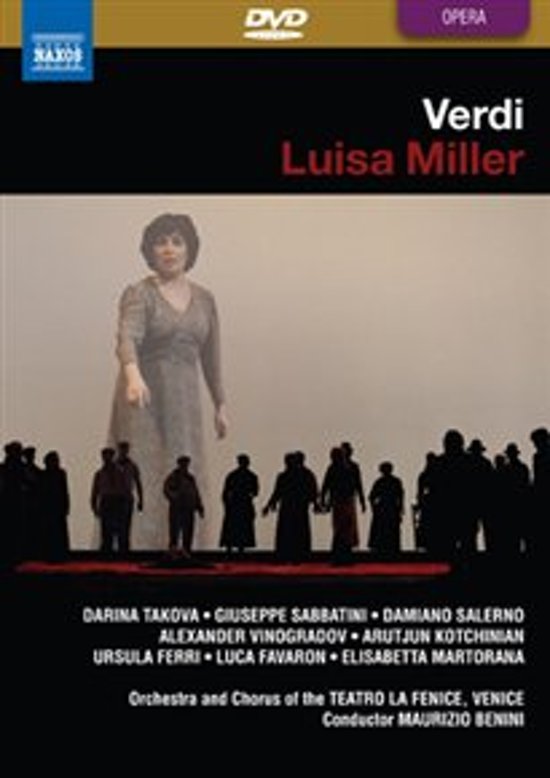
DARINA TAKOVA
For his production of Luisa Miller (originally performed at the Nationale Reisopera in 2004, recorded for this DVD in Venice in 2006), director Arnaud Bernard was inspired by Bertolucci’s Novocento. But the influence of the Italian neorealists is also unmistakably present.
Bernard situates the action in the Italian countryside in the 1920s, giving ample coverage not only of class divisions but also of rising fascism. The stage setting is abstract and apart from a few realistic props and metre-high photographs of women, the stage is almost bare.
Luisa Miller was the third of the four operas Verdi based on a play by Schiller. Like all his operas from his ˜middle period”, the work is bursting with wonderful arias and ensembles, and it possesses perhaps the most beautiful overture ever written – a challenge for conductors.
Mauricio Bennini is on fine form with the Teatro La Fenice’s orchestra, although I find his tempi a bit on the slow side at times.
The – mostly young – cast is fine, but I think Ursula Ferri is an irritating Frederica. Her voice is flat and wobbly and her acting is completely off.
Giuseppe Sabbatini (Rodolfo) has an old-fashioned beautiful, slender tenor with good top notes and Darina Takova is a moving, highly imaginative Luisa (Naxos 2110225-26).
Who does not know ‘Méditation’, the sentimentally sweet but oh-so-beautiful piece of violin music? Most often it will make you cry.
Méditation in Josef Hassid’s performance:
However, not many people have ever heard, let alone seen, the opera in which this piece acts as a kind of interlude in the second act.
Recordings of the complete work are still scarce, I only know of three myself (with Anna Moffo, Beverly Sills and Renée Fleming), of which the one with Sills, Sherrill Milnes and Nicolai Gedda (Warner 0190295869069) is dearest to me.
Below Beverly Sills and Sherrill Milnes in the final scene of the opera:
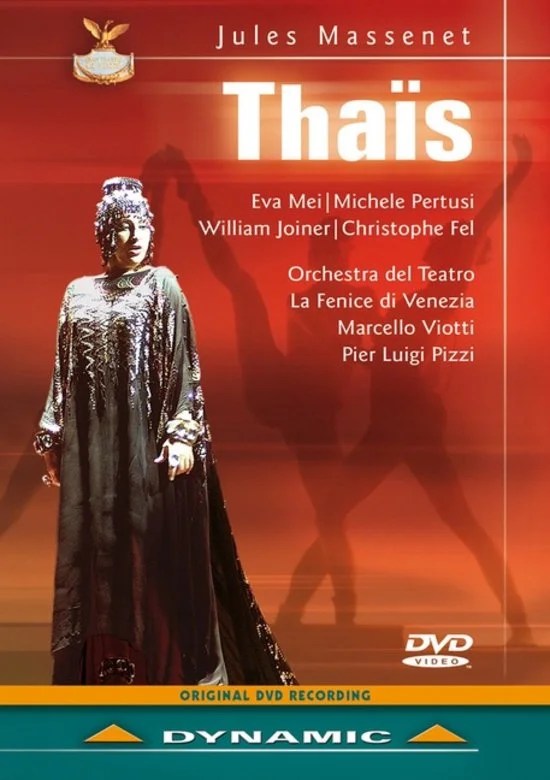
Pier Luigi Pizzi’s production from La Fenice had previously been released on CD and I found it particularly strong musically and mainly vocally. I was therefore particularly curious as to whether the visuals added anything to it on Dynamic’s DVD. To which I can now say a resounding “yes”.
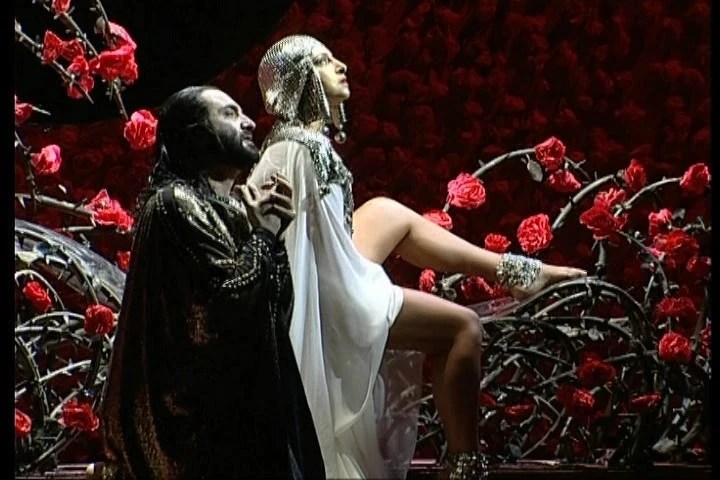
The sets are sparse, yet the stage seems to be completely full of them. Because of the colours (with very predominant red) perhaps, but also because of the dominant place they occupy on stage. For instance, Thaïs’ rose-covered bed, on which she – as if she were the Venus of Urbino or one of the versions of Danaë, also by Titian – lies very voluptuously. This bed is very prominently in the centre of the stage.
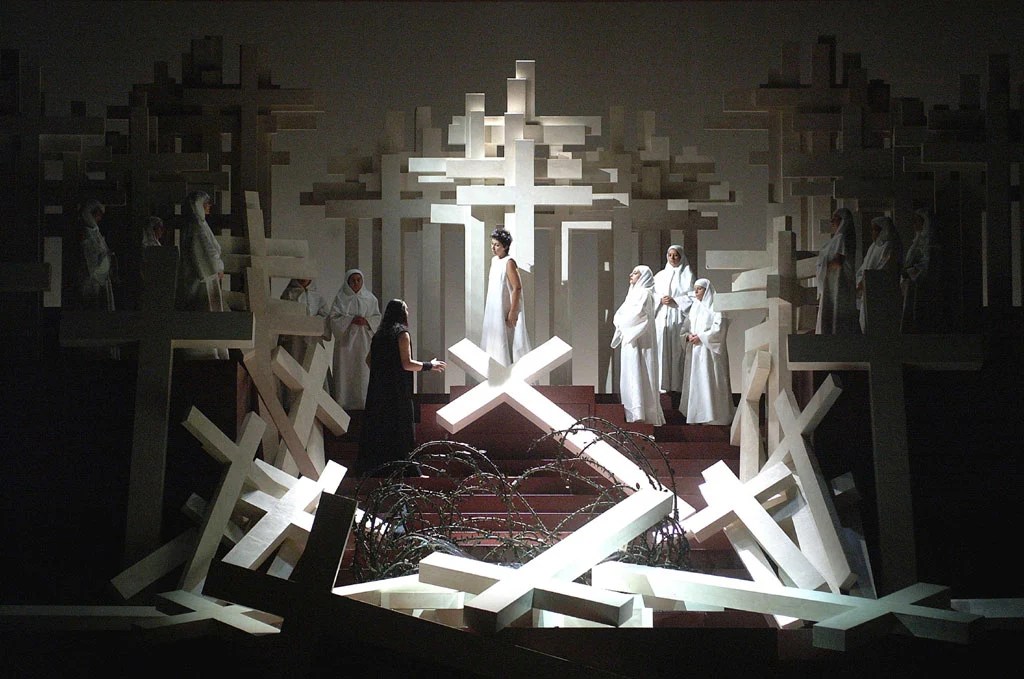
In the third act, when the fun life has ended and the penance begins, the roses are nowhere to be seen (a bed of thorns?) and her posture is as chaste as her white robe.
The costumes are a story apart: very opulent, oriental and barely concealing. Eva Mei doesn’t go as far as her colleague Carol Neblett, who went completely out of her clothes in New Orleans in 1973, but her see-through little nothing of a dress, from which her breasts keep escaping almost unnoticed, leaves nothing to the imagination.
Perhaps she was inspired by the very first Thaïs, Sybil Sanderson, whose breasts were also ‘accidentally’ visible during the premiere performance in 1894? Then again, it is all about the greatest (and most beautiful) courtesan in Alexandria!
Eva Mei is very virtuoso and very convincing as Thaïs . So is Michele Pertusi as Athanael. There is a lot of ballet, though. Also where it really shouldn’t be, which is very distracting at times.
Thaïs from Toronto: unearthly beautiful orchestral playing
Recordings of Thaïs are still scarce so any new releases are more than welcome. Especially if the performance is good, and this new recording on Chandos most certainly is. At least: to some extent.
The Toronto orchestra sounds so incredibly beautiful that you cannot help falling in love with it. Sir Andrew Davis truly extracts the impossible from his musicians: I have not heard the score performed so beautifully before. The pianissimi, the way they manage the quiet passages to perfection, the subcutaneous tension. Hats off! Hats off also to the violinist who manages to add new layers to the ‘Meditation’. So beautiful!
Unfortunately, the singers lag a bit behind. Erin Wall is a beautiful soprano with a crystal-clear voice, but a ‘Whore of Babylon’? More like a rather childishly naive girl.
Joshua Hopkins has the right voice for Athanael but he goes the wrong way when it comes to ‘earthly desires’. Andrew Staples is a good Nicias but he too fails to fully convince me.
“This is my best opera,” Giuseppe Verdi said after the premiere. And added that he “could probably never write anything so beautiful again”. That the “never” wasn’t completely correct, we know now, but at the time, some kind of electric shock must really have gone through the audience. Even now, more than 170 years after its premiere, Rigoletto continues to top the opera charts, as ever. I therefore sincerely wonder if there are any opera lovers left who do not have at least one recording of the ‘Verdi cracker’ on their shelves.
Design by Giuseppe Bertoja for the world premiere of Rigoletto (second scene of the first act)
Ettore Bastianini
My all-time favourite is a 1960 Ricordi recording (now Sony 74321 68779 2), starring an absolutely unmatchable Ettore Bastianini. His Rigoletto is so warm and human, and so full of pent-up frustrations, that his call for “vendetta” is only natural.
Renata Scotto sings a girlishly naïve Gilda, who is transformed into a mature woman by her love for the wrong man. She understands like no other, that the whole business of revenge can lead nowhere and sacrifices herself, to stop all this bloodshed and hatred.
Alfredo Kraus is a Duca in a thousand: elegant and aloof, courteous, yet cold as ice. Not so much mean, but totally disinterested and therefore all the more dangerous.
A sonorous Yvo Vinco (Sparafucile) and deliciously vulgar seductive Fiorenza Cossotto (Maddalena) are not to be sneezed at either, and the whole thing is under the inspired direction of Gianandrea Gavazzeni. Unfortunately, the sound is not too good, but a true fan will take it for granted.
Bastianini and Scotto in the finale:
Piero Cappuccilli
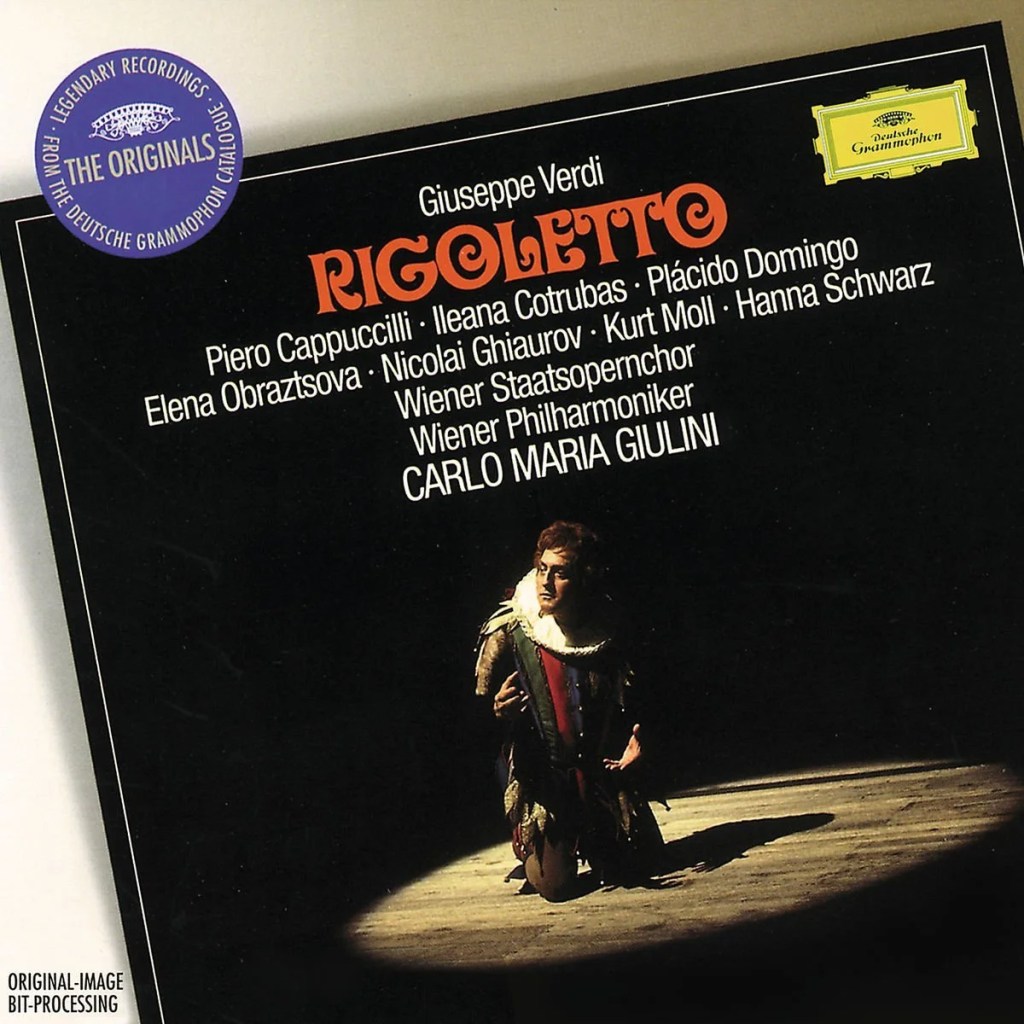
My other great favourite is the performance recorded in 1980 under Carlo Maria Giulini (DG 457 7532). Ileana Cotrubas is Gilda incarnate. She is not quite a vocal acrobat à la Gruberova, nor a wagging ‘canary’ like Lina Palliughi, decidedly less dramatic than Callas (rightly so, a Gilda is not a Leonora) and perhaps not as brilliant as Sutherland, but what empathy! What commitment! What an understanding of the text! Her Gilda, unlike Scotto’s, never grows old, and her sacrifice is a teenage girls’ own: senseless and pointless and so all the more moving.
The Duca is sung by Plácido Domingo, not really my favourite for the role, though there is nothing at all wrong with his singing. Piero Cappuccilli is a truly phenomenal Rigoletto, they don’t make ‘em like that anymore.
But we shouldn’t forget Giulini, because so lovingly as he handles the score that it couldn’t be more beautiful.
Tito Gobbi
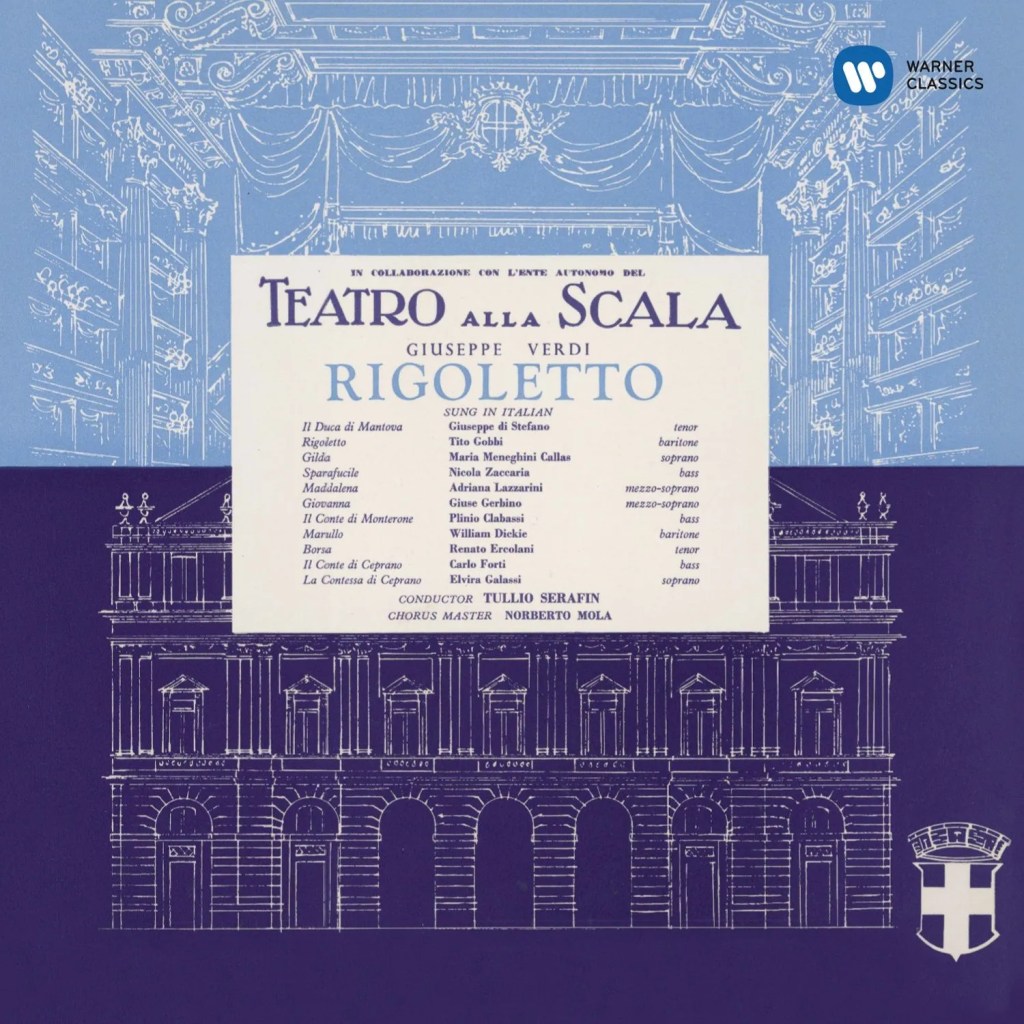
The 1955 recording with Maria Callas (Warner Classics 0825646340958) conducted by Tulio Serafin sounds pretty dull. Giuseppe Di Stefano is a pretty much perfect Duca: seductive macho, suave and totally unreliable. That his high notes in ‘Questa o Quella’ come out a bit squeezed, well… for this, he is forgiven.
Tito Gobbi is simply inimitable. Where else can you find a baritone with so many expressions at his disposal? This is no longer singing this is a lesson in acting with your voice! What you should also have the recording for is Nicola Zaccaria as Sparafucile. Unforgettable.
And Callas? Hmm. Too mature, too dramatic, too present.
Gobbi and Callas sing ‘Si, vendetta! Tremenda vendetta’
Sherrill Milnes
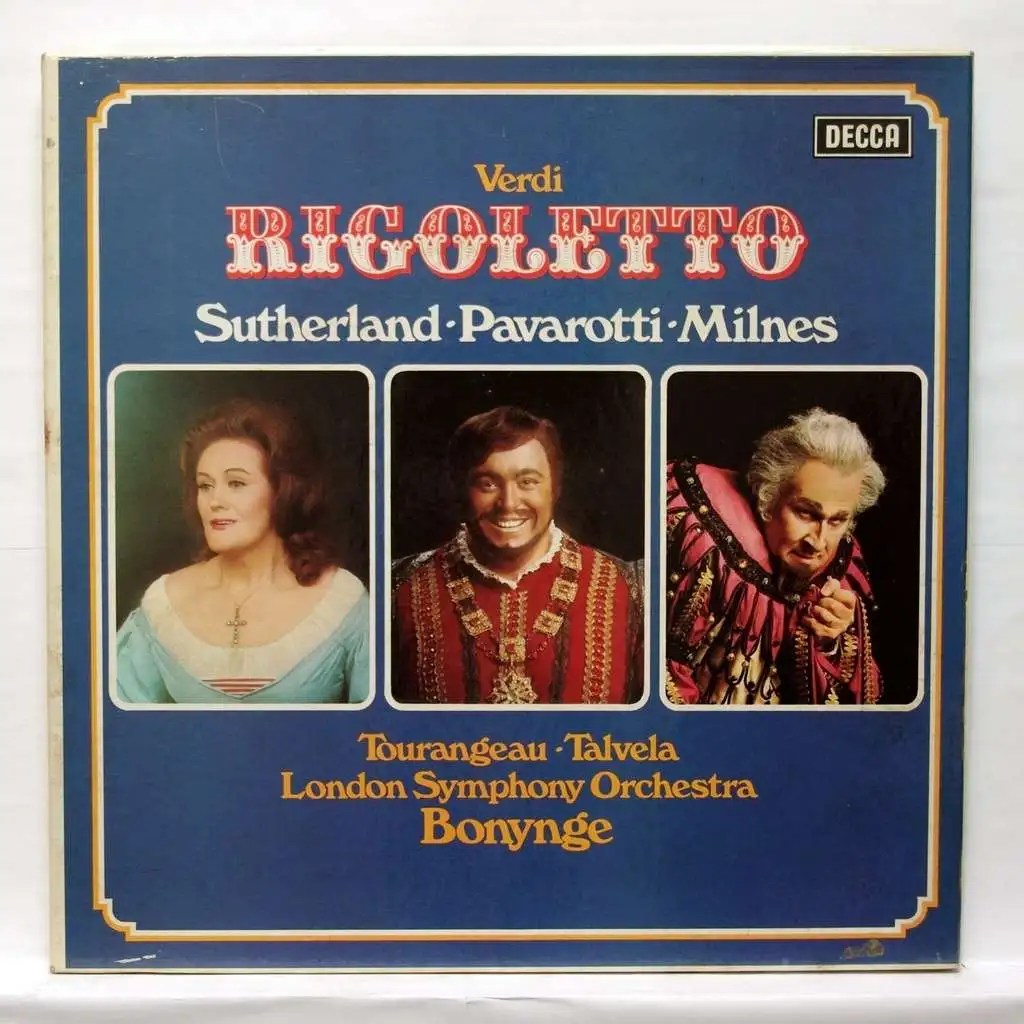
Joan Sutherland is a different story. Light voice, sparkling and indescribably virtuosic but a silly teenager? No.
Luciano Pavarotti is, I think, one of the best and most ideal Ducas in history. There is something appealingly vulgar in his voice that makes him sexually desirable which easily explains his several conquests.
Sherrill Milnes is a touching jester, who never wants to become a real jester: no matter how well he tries, he remains a loving father.
Matteo Manuguerra
Nowadays, hardly anyone knows him, but in the 1970s, Tunisian-born Manuguerra was considered one of the greatest interpreters of both bel canto and verismo.. And Verdi, of course, because his beautiful, warm, smooth-lined voice enabled him to switch genres easily.
Anyway, of course, you listen to this pirate recording (it is also for sale as a CD) mainly because of Cristina Deutekom. Just listen how, in the quartet ‘Bella figlia dell’amore’, she goes with a breathtaking portamento to the high D from the chest register. No one imitates her in that. For that, you take Giuliano Ciannella’s screaming and understated Duca at face value. The sound is abominably bad, but then again: are you a fan or not?
DVD’S
John Dexter
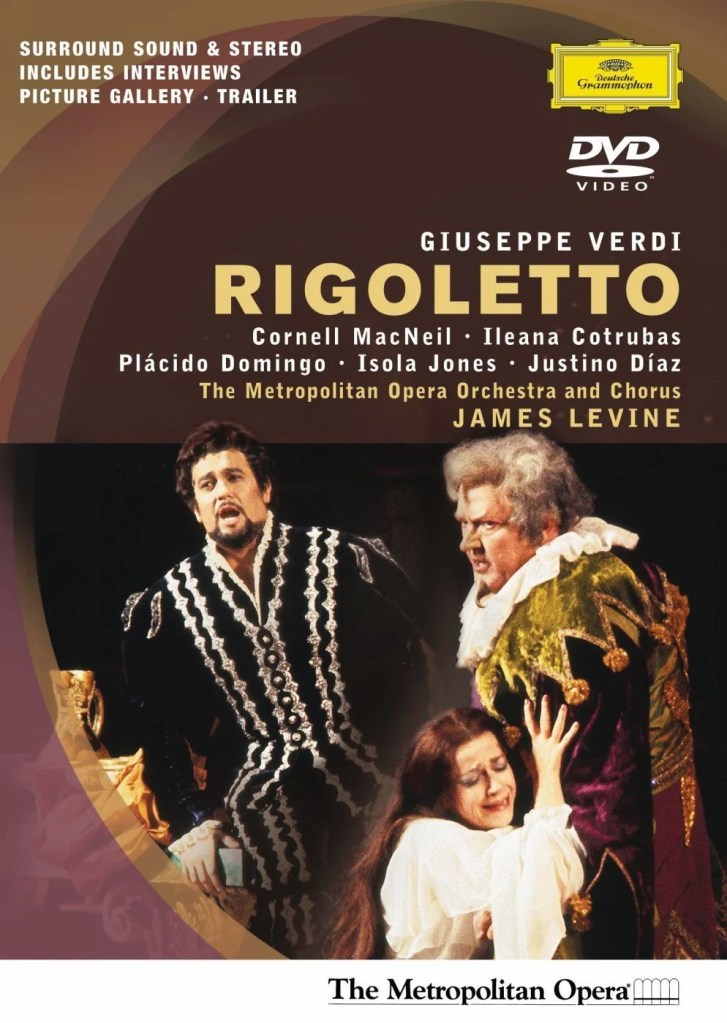
The 1977 production from the Metropolitan Opera (DG 0730939) is – of course – traditional. At first I had trouble with the close ups, which made all those stuck-up noses and thickly painted faces far too visible. But gradually I gave in to the beautiful direction and scenography which, together with the genuine 16th-century costumes, soon reminded me of Giorgione’s paintings. That this was indeed the intention was evident at the end, modelled on his ‘La Tempesta’, including the landscape and the sky drawn by lightning. But before it came to that, Rigoletto knelt with the dead Gilda (in blue, yes!) in his arms like Michelangelo’s “Pieta”, and I searched for a handkerchief because by now I had burst into tears.
Cornell MacNeil had his better days and started off rather false, but halfway through the first act, there was nothing wrong with his singing. And in the second act he sang just about the most impressive ‘Cortigiani’ I have ever heard, helped wonderfully by Levine’s very exciting accompaniment. Just watch how he pronounces the word ‘dannati’. Goosebumps.
It is an enormous pleasure to see and hear a young Domingo: tall, slim and handsome, and with a voice that audibly has no limitations, but…. As a Duca he goes nowhere. No matter how he tries his best – his eyes look cheerful and kind, and his lips constantly curl into a friendly smile. A “lover boy”, sure, but with no ill intentions. And he knows it himself, because he has sung that role very little. Actually, he hates Duca, at least so he says in an interview in a “bonus” to the Fragment from the second act:
Charles Roubaud
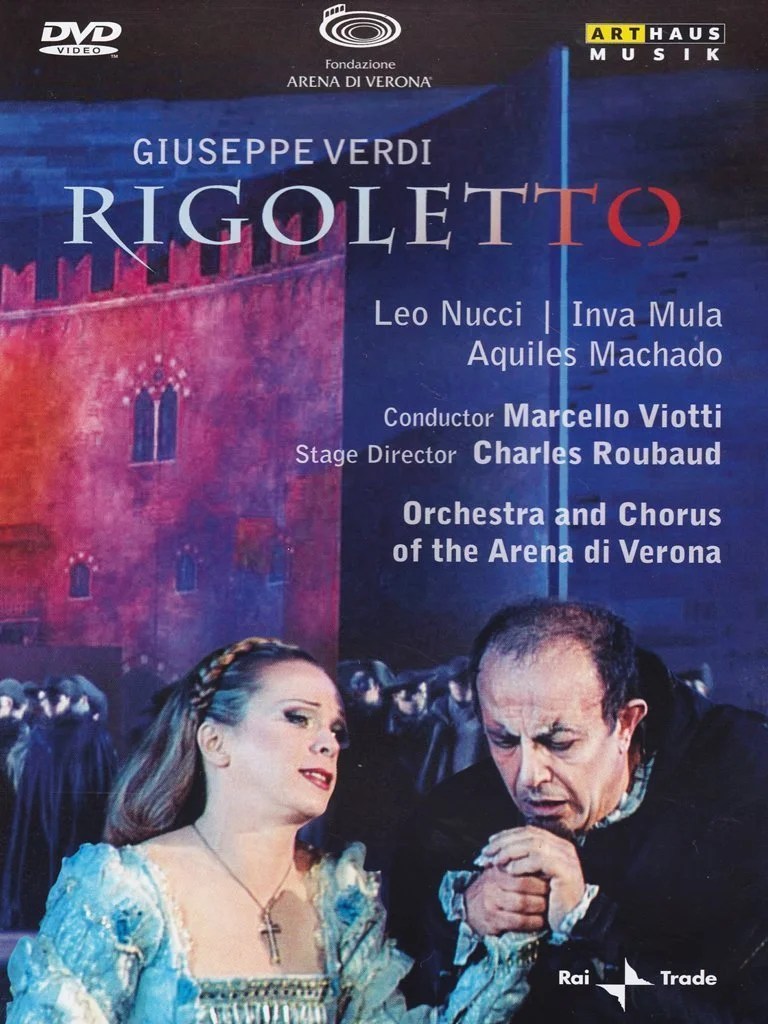
I heard a lot of good things about the performance at the arena in Verona in 2001. Reviews of the performances were rave, and people were also generally very positive about the DVD (Arthaus Musik 107096). So this will be just me, but I don’t like it.
The scenery is very sparse and looks very minimal on the large stage. It is still most reminiscent of cube boxes, but when the camera comes closer (and sometimes it comes too close!) they turn out to be walls, which close at the end in a very ingenious way – like a stage cloth, a nice invention though. The costumes are more or less okay, but I can’t find them brilliant either. And Rigoletto’s hunched back is downright ridiculous.
Leo Nucci is among the great Verdi baritones of our time but on the DVD his voice sounds anything but beautiful and in his first scenes he seems to be doing sprechgeang. Sure, his portrayal is certainly impressive, but I have seen him do better. The audience does enthuse, forcing him to encore ‘La Vendetta’ at the end of the second act.
It is not the last encore this evening: Aquiles Machado (Duca) also repeats with visible pleasure his, to my ears, roared-out ‘La donna e mobile’. It seems to be a tradition.
That he doesn’t look the part… well, he can’t help that. What is worse is that his Duca is nothing more than a silly macho man (what’s in a name?) and that his loud, in itself fine lyrical voice with solid pitch has only one colour.
Albanian Inva Mula really does her best to sing and look as beautiful as possible, and she succeeds wonderfully. All the coloraturas are there, as well as all those high notes. Her pianissimo is breathtaking, so there is nothing to criticise about that. But – it leaves me cold, because of how studied it sounds.
Marcello Viotti does not sound particularly inspired and his hasty tempi lead to an ugly ‘Cortigiani, vil razza dannata’, normally one of the opera’s most moving moments.
Leo Nucci and Inva Mula in ‘Si Vendetta’:
Gilbert Deflo
Sometimes I think that some opera directors have grown tired of all this updating and conceptualism and go back to what it’s all about: the music and the libretto. Such is the case with the Belgian Gilbert Deflo, who in 2006 in Zurich realised a Rigoletto that, were the story not too sad for that, would make you want to cry out for pure viewing pleasure (Arthaus Musik 101 283). He (and his team) created an old-fashioned beautiful, intelligent staging, with many surprising details and sparse but effective sets. The beautiful costumes may be of all times, but the main characters do not deviate from the libretto: the jester has a hunchback and the associated complexes, the girl is naive and self-sacrificing, and the seducer particularly attractive and charming.
Piotr Beczała, with his appearance of a pre-war film giant evokes (also in voice) reminiscences of Jan Kiepura. Elena Moşuc is a very virtuoso, girlish Gilda, and Leo Nucci outdoes himself as an embittered and tormented Rigoletto – for his heartbreakingly sung ‘Cortiggiani’ he is rightly rewarded with a curtain call.
Nello Santi embodies the old bel canto school, which one rarely hears these days.
Beczala, Nucci, Mosuc and Katharina Peets in ‘Bella Figlia del’amore’:
Michael Mayer
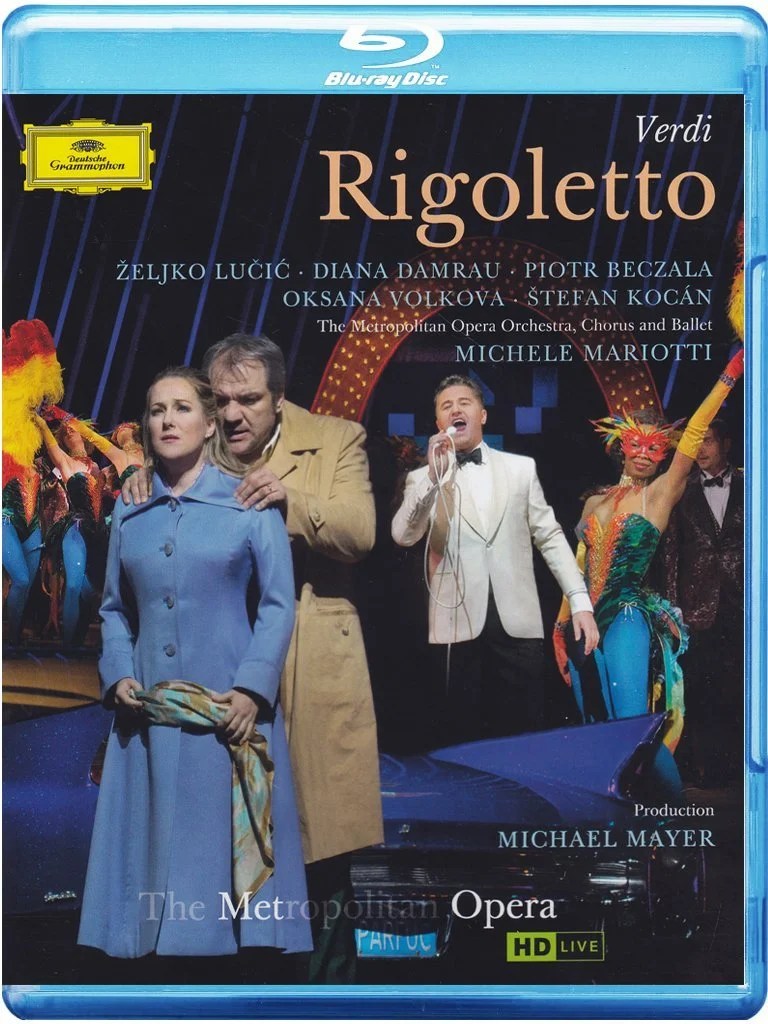
Times are changing and ‘director’s theatre’ has now also reached the New-York Metropolitan. They do not yet go as far as their European counterparts, but updating or moulding the libretto to a concept is now allowed.
In 2013, Michael Mayer made it a “Rat Pack ‘Rigoletto'” set in 1950s Las Vegas in which Piotr Beczała (Duca), armed with a white dinner jacket and a microphone, is modelled on Frank Sinatra (or is it Dean Martin?). Beczała plays his role of the seductive entertainer for whom ‘questa o quella’ are more than excellent.
Piotr Beczała sings ‘Questa o quella’:
Diana Damrau remains a matter of taste: virtuoso but terribly exaggerated.
Zjeljko Lučić does not let me forget his predecessors, but these days he is undoubtedly one of Rigoletto’s best interpreters. The young bass Štefan Kocán is a real discovery. What a voice! And what a presence! The production is fun and engaging, but you cannot deny that you often have to look far for the logic.
‘La Donna e mobile’ in a minute and a half, sung by five tenors:
Victor Borge gives special treatment to ‘Caro Nome’:
Have you ever heard of Catarina Mancini (10 November 1924 – 21 January 2011)? This soprano, born at Genzano di Roma had the true ’voce Verdiana’: she combined a beautiful height and pure coloratura with a drama that even La Divina might have envied her for.
Never heard of her? Then it’s time to make up for the damage, because I promise you a voice out of thousands. And this is exactly how her Leonora sounds in the recording from 1951 Rome (Warner Fonit 2564661890). Extraordinary.
Her Manrico was sung by the very heroic sounding (then already nearly 60 years old) Giacomo Lauri-Volpi and a very charismatic Carlo Tagliabue sang the role of di Luna. Miriam Pirazzini (Azucena) completed the cast and the whole was very impressively conducted by Fernando Previtali.
Here are Mancini, Lauri-Volpi and Tagliabue in the trio of the first act:
Highlights on Spotify:
Price and Corelli, 1961
With their 1961 performance recorded live for Sony, both Leontyne Price and Franco Corelli made their debuts at the Metropolitan Opera. For me, Corelli, alongside Del Monaco and Domingo, is the best Manrico ever. Very masculine and very sexy, you can hardly resist that as a woman.
Mario Sereni and Irene Dalis are more than adequate as Luna and Azucena respectively, and it is a great joy to discover none other than Teresa Stratas in the small role of Inez. And Charles Anthony as Ruiz should not be forgotten
Price and Domingo, 1970
The recording made 19 years later for RCA shows a more mature Price, but her sound is still that of an excited teenager, with just about the most perfect Verdian ‘morbidezza’. Her ‘D’amor sull’ali rosee’ seems like a little prayer, weeping so beautifully.
This Trovatore was the very first opera that Plácido Domingo, then 28(!), recorded in the studio. Fiorenza Cossotto shines as Azucena, but what really makes the recording indispensable, at least for me, is one of the most delightful Lunas ever: Sherrill Milnes (88883729262).
Below Price, Domingo and Milnes in ‘E deggio e posso crederlo’:
Maria Callas, 1956
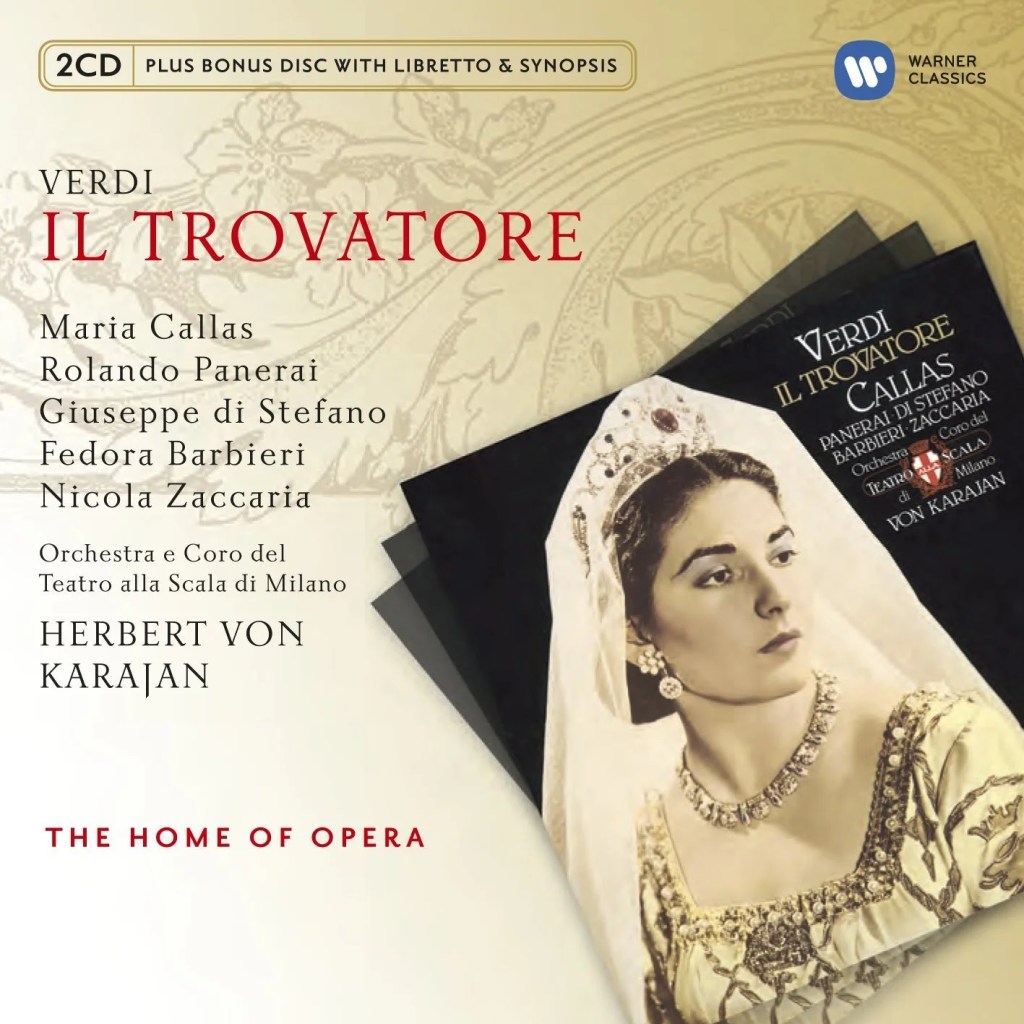
A problem in the 1956 recording conducted by Herbert von Karajan very excitingly is Giuseppe di Stefano. Beautiful though he is, for Manrico he lacks power.
Fedora Barbieri comes into her own even better here than on the Myto recording, which may be partly due to the much better sound quality. Rolando Panerai is a solid Luna, but his “Il balen” neither makes me hot nor cold, especially with Bastianini and Milnes to my ears.
And Maria Callas? Callas remains Callas. Overdramatic. Her Leonora is anything but an adolescent in love. Her ‘D’amor sull’ali rosee’ is more than beautiful, perfect almost, but it leaves me utterly cold (Warner 5099964077321).
Below Callas in D’amor sull’ali rosee’:
Leyla Gencer, 1957
I don’t think I need introduce you to Leyla Gencer. The Turkish diva enjoys a cult following comparable only to that of Olivero and Callas. Her supple, round and clear voice – with pianissimi with which she could rival Montserrat Caballé – made her exceptionally suited to Verdi operas. Her Leonora is simply perfect: you can’t get any more beautiful than that.
Nor do I think there has ever been a better, more beautiful and impressive Luna than Ettore Bastianini. Del Monaco is otherwise a very macho Manrico. His radiant height in ‘Di quella pira’ compensates for his sometimes lacklustre interpretation.
Fedora Barbieri impresses as Azucena and Plinio Cabassi is a Ferrando to kiss. The recording was made in Milan in 1957 (Myto 00127).
Gré Brouwenstijn, 1953
It is almost unbelievable, but there were times when even an opera like Il Trovatore could be cast with only Dutch singers. You can also hear them all in the performance recorded live by Osteria (OS-1001) at the Amsterdam Schouwburg in 1953.
Annie Delorie’s Azucena disappoints me a little, but Gerard Holthaus, unknown to me (is there anyone who can tell me more about him?), is a surprisingly beautiful Luna.
Gré Brouwenstijn is definitely fantastic as Leonora. And yet… her ‘Tacea la notte placida’ doesn’t really penetrate my soul. Mario Cordone was unfortunately not among the very best conductors in the world, which is a pity: sometimes I get the feeling that he is a hindrance to the singers.
Cristina Deutekom, 1976
Give me Cristina Deutekom! In the 1976 recording (Gala GL 100.536), she manages to convince me completely and penetrate deep into my heart. Unlike Callas who remains just Callas in everything she sings, she is Leonora. With her feathery coloraturas, she sounds exactly how I imagine a Leonora to be: a young girl in love with a strong tendency to exaggerate. The latter in the best sense of the word.
Jan Derksen is also a Luna to be reckoned with and secretly I think he may be even better than Bastianini and Milnes. His “Il bales” is among the best versions of the aria I had ever heard.
Carolyne James is an okay Azucena, but the reason the recording is not my absolute number one is because of the very dickish (sorry!) sounding Juan Lloveras (Manrico).
Below, Cristina Deutekom and Lloveras in ‘Miserere’:
Raina Kabaivanska 1978
Il trovatore was one of Von Karajan’s favourite operas. In 1962, he directed a series of performances in Salzburg, which were taken over and televised in Vienna in 1978. It is a very old-fashioned and static performance, with realistic sets and costumes.
Terribly underrated outside Italy, Raina Kabaivanska portrays a flesh-and-blood Leonora: her voice is dark, with an old-fashioned vibrato and clearly lined phrasing.
Domingo was a last-minute substitute for the angry runaway Bonisolli. For his ravishing ‘Ah si, ben mio’, sung with radiant top notes, he was rewarded by the audience with a minute-long ovation.
Cossotto’s Azucena has since become legendary: like no other singer, she left a mark on that role (Arthouse Music 107117)
Below Domingo, Kabaivanska, Cappuccilli and Cossotto in ‘Prima che d’ altri vivere’:
Di quella pira
For those who cannot get enough of ‘Di quella pira’: Bongiovanni (GB 1051-2) has released a CD with no fewer than 34 performances of the tenor hit, recorded between 1903 (Julian Biel) and 1956 (Mario Filipeschi). Lauri-Volpi, here in a recording from 1923 (!), displays a radiant and long-held high c. However, he is surpassed by Aureliano Pertile: what a sound!
Helge Rosvaenge is disappointingly dull, but Richard Tauber’s 1926 recording (in German) is a delightful curio (yes, he can do it!).
Jan Kiepura can’t get enough of trills and welds them into everything, but what a ringing sound he has! Even Gigli ventures into it: something he had better leave out. The best of them all I think is Jussi Björling from 1939. Please let me know who your favourite was?
Gigliola Frazzoni
For dessert, I give you ‘Tacea la notte placida’, sung by Gigliola Frazzoni, one of Minnie’s best (La fanciulla del West). It was recorded in Amsterdam, on 16 October 1954. Marijke van der Lugt sings Ines and the Amsterdam Broadcating Orchestra (?) is conducted by Arture BasileDanny
Radames was among Domingo’s favourite roles. No wonder. Here he could really ‘show it all’, because the hero is very complex. He is a ‘macho with a lot of muscles’ and a vulnerable boy at the same time, and he is torn between duty and passion. Unfortunately, the two are not compatible.
To sing Radames well you need not only a cannon of a voice but also an intellectual ability. And he has both.
He made his debut with Aida in 1968 in Hamburg and he has since sung the opera thousands of times. There are many recordings on the market, both studio and live. I would like to dwell on a recording that will not evoke an ‘aha’ moment for most of you – also because at first glance the cast is not idiomatically perfect.
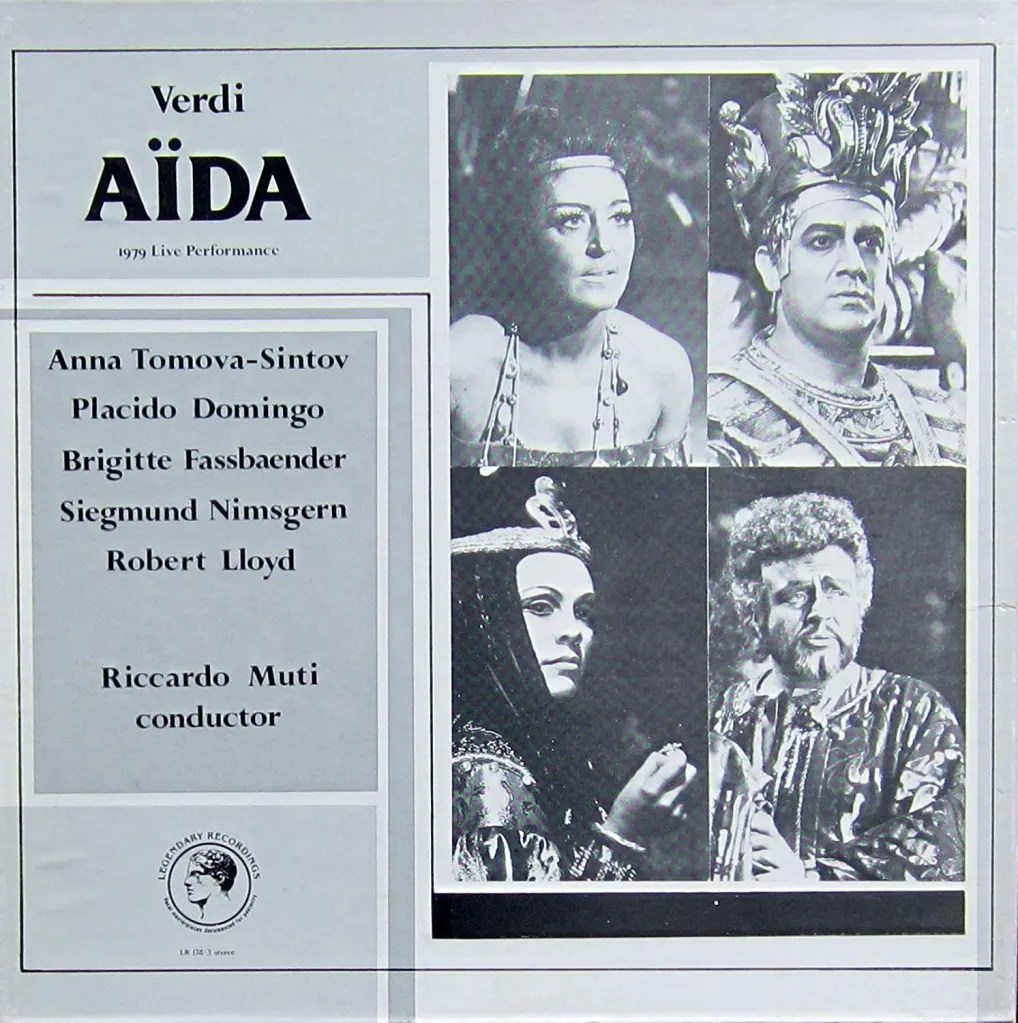
The fact that Anna Tomowa-Sintow was one of Karajan’s favourite singers had its advantages and disadvantages. She was a welcome guest in Salzburg and her name appears on many recordings conducted by the maestro. But it also meant that she was primarily rated as a Mozart and Strauss singer, while she had so much more to offer. Her Desdemona and Amelia were legendary and after her Munich Aida, Leonie Rysanek praised her performance for its pure beauty.
Fassbaender is really surprising and particularly convincing as Amneris. Just listen to what she does with the single word ‘pace’ at the end of the opera. The opera was recorded by Bayeriche Rundfunk on 22 March 1979 and released on Orfeo (C583 022).
Also noteworthy is the recording from Munich 1972, with a now almost forgotten Verdi singer, Martina Arroyo. As Amneris, we hear Fiorenza Cossotto and Cappuccilli and Ghiaurov complete the excellent cast conducted by Claudio Abbado.
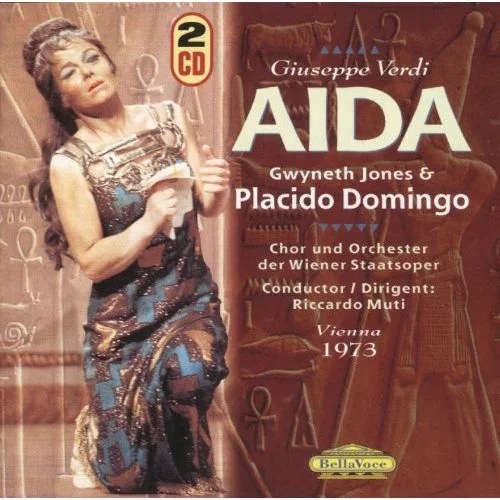
The recording from Vienna 1973 (Bela Voce BLV 107.209), under Riccardo Muti, is also of particular interest. In the leading role we meet Gwyneth Jones and Amneris is sung by an exceptional mezzo: Viorica Cortez.
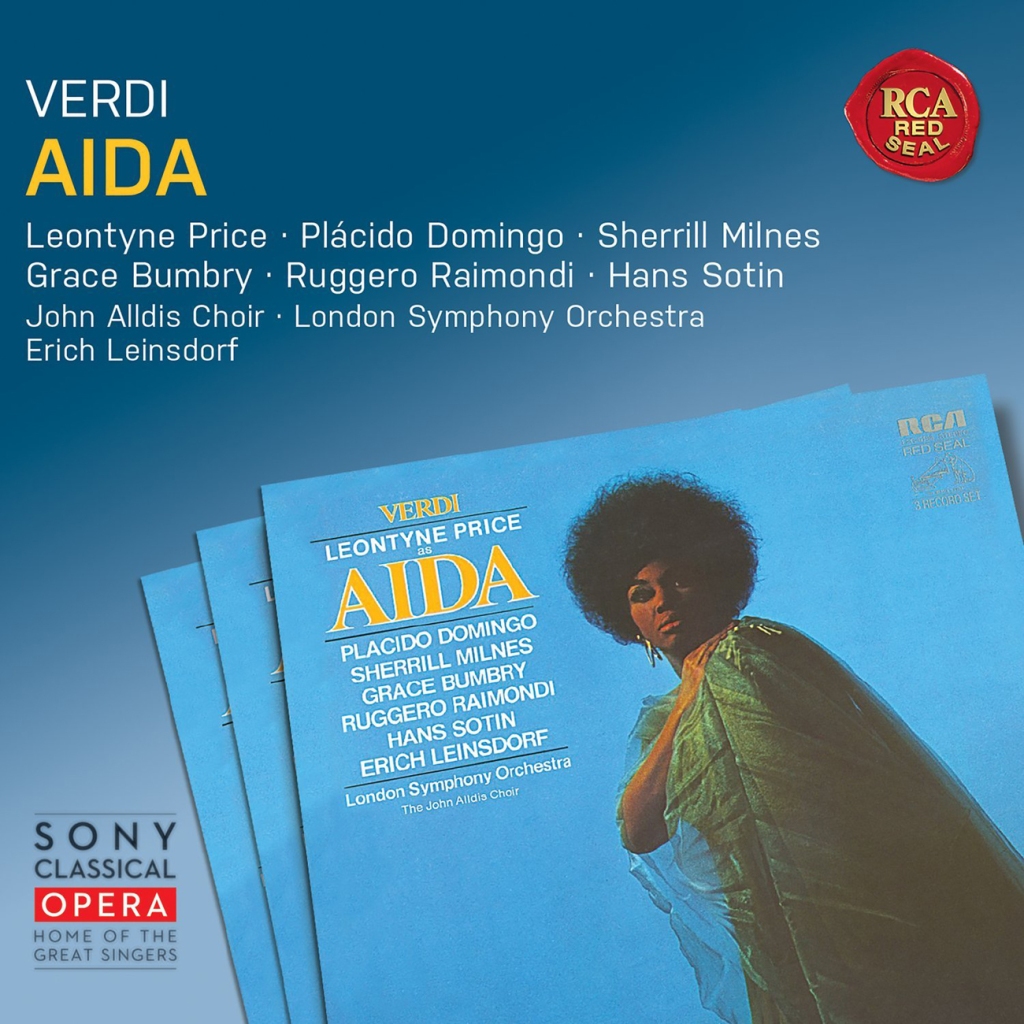
Of Domingo’s studio recordings the 1970 RCA release (probably from the catalogue), is probably the best. How could it be otherwise, when you know that the conductor is Erich Leinsdorf and the other roles are sung by Leontyne Price, Sherrill Milnes, Grace Bumbry and Ruggero Raimondi. The whole thing almost pops out of your speakers.
Metropolitan Opera’s production of “Norma” starring Montserrat Caballé, John Alexander, Fiorenza Cossotto, and Giorgio Tozzi in February 1973. Photo by Jack Mitchell/Getty Images
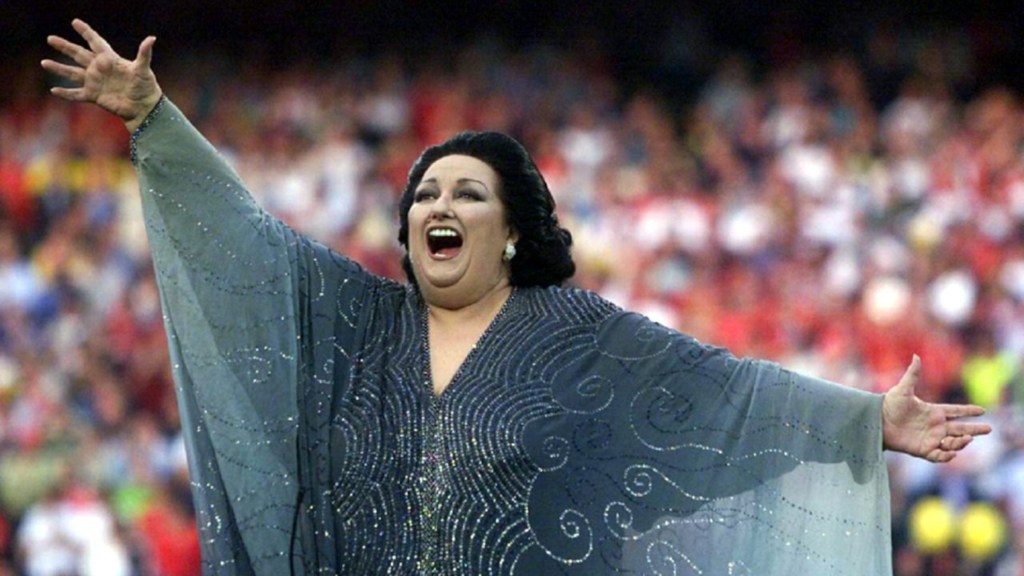
Caballé is a kind of cross between Callas and Sutherland: wonderful top notes, incredibly beautiful legato arches, perfect trills, and moreover a pianissimo that none of her colleagues could match. She was a much better actress than Sutherland, moreover she had great charisma. She never went to extremes like Callas or (later) Scotto, but her performances were always very convincing.
In 1973 she recorded the role for RCA and the result was very decent (GD 86502). Her Pollione, a very young Plácido Domingo, was vocally crystal clear and sounded like a bell. However, he lacked dominance, making him sound far too young for the role.
Fiorenza Cossotto in her role of Adalgisa looked more like Azucena than a young girl, but her singing as such was flawless. Unfortunately, the orchestra sounds uninspired and hurried, which must surely be blamed on the conductor, Carlo Felice Cillario.
In 1974 she sang Norma in the Roman amphitheatre in Orange (Provence). It was a very windy evening, and everything blew and moved: her hair, veils and dresses. A fantastic sensation, which added an extra dimension to the already great performance. It was filmed by French television (what luck!), and has now appeared on DVD (VAIV 4229).
Caballé sings ‘Casta Diva’:
Caballé was in superb voice, very lyrical in ‘Casta Diva’, dramatic in ‘Dormono etrambi’ and moving in ‘Deh! Non volerli vittime’. Together with Josephine Veasey, she sang perhaps the most convincing ‘Mira , o Norma’ – of all, at least in a complete recording of the opera. As two feminists avant la lettre, they renounce men and transform from rivals into bosom buddies.
John Vickers (Pollione) was never my cup of tea, but Veasey is a fantastic (also optically) Adalgisa and Patané conducts with passion. Of all the recordings on DVD (and there are not many), this is definitely the best.
Herodiade
This recording may only be obtained via a pirate (or You Tube), but then it is complete and moreover with (admittedly bad) images!
Dunja Vejzovic portrays a deliciously mean Hérodiade and Juan Pons is a somewhat youthful but otherwise fine Hérode. A few years later, he will become one of the best “Hérodes” and you can already hear and see that in this recording.
Montserrat Caballé is a fantastic Salomé, the voice alone makes you believe you are in heaven and José Carreras is very moving as a charismatic Jean.
None of the protagonists is really idiomatic, but what a pleasure it is to watch a real Diva (and Divo)! They really don’t make them like that anymore
The whole opera on you tube:
Salome
Montserrat Caballé as Salome? Really? Yes, really. Caballé sang her first Salome in Basel in 1957, she was only 23 at the time.
Salome was also the first role she sang in Vienna in 1958 and I want to (and can) assure you: she was one of the very best Salome’s ever. Especially on the recording she made in 1969 under the blistering direction of Erich Leinsdorf.
Her beautiful voice, with the whisper-soft pianissimi and a velvety high even then, sounded not only childlike but also very deliberately sexually charged, a true Lolita.
The Jochanaan, sung very charismatically by Sherrill Milnes, has an aura of a fanatical sect leader, and Richard Lewis (Herod) and Regina Resnik (Herodias) complete the excellent cast (Sony 88697579112).
Caballé as Salome in 1979:
<
What’s the difference between a terrorist and a diva? ‘Caballé, beyond music’
“We all owe a great deal to music (…) It is a form of expression that originates not so much from thinking as from feeling”. These words come from one of the greatest singers of the twentieth century, Montserrat Caballé.
In his film Caballé Beyond Music, Antonio Farré portrays the diva*, her life and her career, talking to her, her family and her colleagues. The documentary also contains a lot of wonderful (archival) footage, starting with Caballé’s debut in Il Pirata in 1966 in Paris.
The film is interspersed with fun anecdotes such as how she smashed a door because she was not allowed to take time off (Caballé wanted to attend a performance of Norma with Maria Callas). How she had stopped a dress rehearsal in La Scala because she noticed that the orchestra was not tuned well. About her debut at the Metropolitan Opera in New York, the discovery of José Carreras (how beautiful he was!), her friendship with Freddy Mercury ….
About her Tosca in the ROH in London in the production that was made for Callas. She wasn’t happy with that, it didn’t feel good, but no one wanted to change it. Caballé called Callas, it was exactly eight days before her death, and complained about her fate. “But of course it doesn’t feel right”, said Callas. “I am tall and you are not, I am slim and you are not, I have long arms and you have not. Tell them to call me, I will convince them that you are not me”.
And so the production was adapted for Caballé. “Copies are never good,” Caballé says, and I agree with her. This is a fascinating portrait of a fascinating singer. Very, very worthwhile.
* London taxi driver: “What is the difference between a terrorist and a diva? You can negotiate with a terrorist”.
Caballé beyond music With José Carreras, Plácido Domingo, Joan Sutherland, Cheryl Studer, Giuseppe di Stefano, Freddie Mercury, Claudio Abbado and others. Directed by Antonio A. Farré, EuroArts 2053198
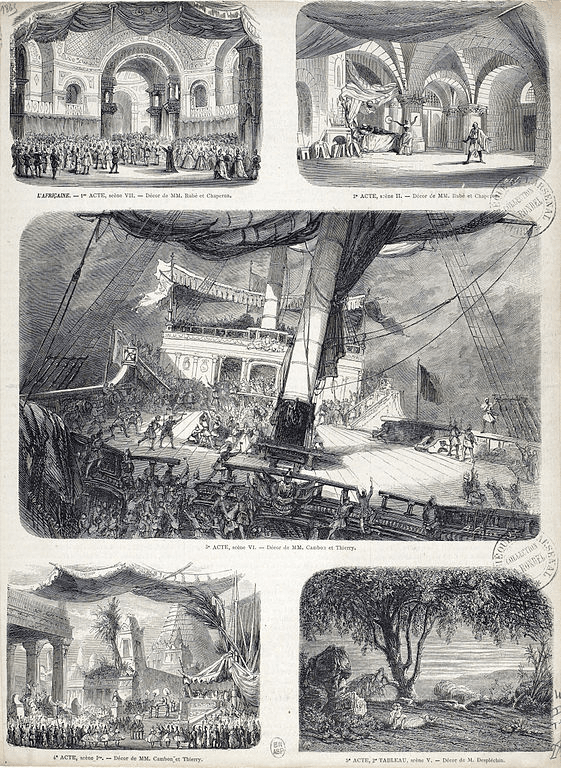
Settings for the 1865 premiere of a L’Africaine (press illustrations). The stage designs for Act I (Council Scene) and Act II (Dungeon Scene) were created by Auguste-Alfred Rubé and Philippe Chaperon; for Act III (Sea Scene and Shipwreck) and Act IV (Hindu Temple), by Charles-Antoine Cambon and Joseph-François-Désiré Thierry; for Scene 1 of Act V (Queen’s Garden, not shown), by Jean Baptiste Lavastre; and for Scene 2 of Act V (The Machineel Tree), by Edouard-Désiré-Joseph
SHIRLEY VERRETT
Shrirley Verrett (Selika)and Plácido Domingo (Vasco da Gama) in San Francisco
Vasco da Gama (yes, the Vasco da Gama) loves Inès, but when his own life is in danger, he takes refuge with the African queen, Sélika. Poor Sélika! She loves him wholeheartedly, but as soon as Inès reappears on the scene, she has to step asie. She does so literally; by smelling a poisonous flower.
Of course, much more happens in the opera, especially in the music. I wonder why it is that the opera is performed so little. Is it due to the weak male lead, who mainly pursues fame? In any case, Meyerbeer gave him a magnificent aria, probably one of the most beautiful ever: ‘Pays merveilleux/Oh paradis’:
Domingo has always had faith in the opera and he has sung da Gama several times. It is also thanks to him that the opera experienced a minor revival in the 1970s.
There is a pirate recording on CD (Legato Classics LCD-116-3), starring Shirley Verrett and a truly brilliant Norman Mittlemann as Nélusco. It is from 1972, but there is no mention of where it was recorded. But since Verrett sang a series of performances that year, in San Francisco, it is actually quite clear.
The sound quality is poor, but not to worry: the opera was later also recorded for television, so that we can now enjoy it to the full on DVD (Arthaus Music 100217).
The truly wonderful production was created by Lotfi Mansouri (direction) and Wolfram and Amrei Skalicki (stage and costumes). Inès is sung by a (literally) beautiful, light coloratura soprano Ruth Ann Swenson and Justino Díaz does his best to convince us that he is scary. You should really watch it!
MONTSERRAT CABBALÉ
In 1977, the opera was recorded at the Teatre Liceu in Barcelona, again with Plácido Domingo as da Gama. But should I really recommend this recording? Probably not. Montserrat Caballé is a fine but unconvincing Sélika, Juan Pons has seen better days and Christine Weidinger is a merely decent Inez (Legato Classics LCD 208-2).
MARTINA ARROYO
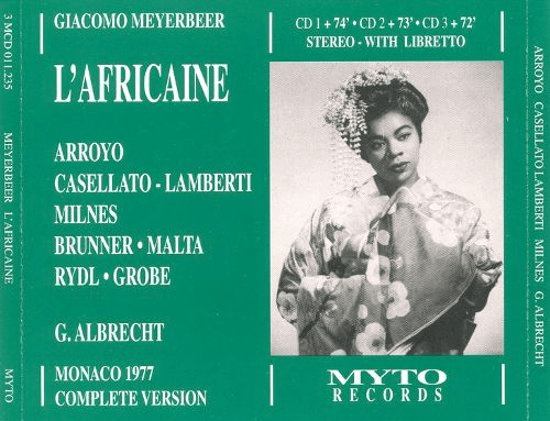
In November 1977, L’Africaine was recorded live in Monaco with a fine Martina Arroyo in the leading role. The textbook says it is probably the most complete performance of the score ever recorded. Unfortunately, Giorgio Casellato-Lamberti is a weak Vasco da Gama, but Sherrill Milnes’ superb Nélusco makes up for a lot (Myto 3MCD 011.235).
The operas of Ermanno Wolf-Ferrari (1876-1948) are still rarely performed. We do not even need to guess at the reason. That it is not because of the quality, is proven by the recording of Sly ovvero La leggenda del dormiente risvegliato (Sly or the legend of the awakened sleeper), released in 2001 on Koch Schwann.
The tragicomic story tells us about a poor poet who, blind drunk, is brought to the palace of the Count of Westmoreland to be made a fool of. He is dressed up in expensive clothes and, as soon as he comes to, he is led to believe that he is the earl and that he has just recovered from a long illness. The Count’s lover Dolly pretends to be his wife but gradually falls in love with him.
“No, io non sono un buffone” (No, I am not a fool) he sings at the end and cuts his wrists with a broken bottle. His beloved Dolly, like Charlotte in Werther, arrives too late. The music is a cross between opera buffa, surrealism and mainly verism, although one should not forget the Wagnerian influences.
Francesco Merli sings “No, io non sono un buffone”, recorded for the Columbia label in Milan on February 6, 1928:
There was already a recording of the opera in German (Accanta) with Deborah Polaski, and the Italian original was eagerly awaited. This recording was made live in Barcelona. The lead role is sung by José Carreras, who celebrated his 30th anniversary with it. He is a very moving Sly. His voice sounds very fragile and his performance leaves you in tears.
Sherill Milnes once again proves his reputation as the interpreter of villainous roles, but the greatest praise goes to the Zairean soprano Isabelle Kabatu. Her voice is a little reminiscent of Leontyne Price’s: velvety and slightly shrouded.
Sly with Domingo, Matosa and Mastromarino from Teatro dell’Opera di Roma, on 24 April 2003:
De opera’s van Ermanno Wolf-Ferrari (1876-1948) worden nog maar zelden gespeeld. Naar de oorzaak ervan hoeven wij niet eens te gissen. Dat het niet aan de kwaliteit ligt bewijst de, in 2001 op Koch Schwann uitgekomen opname van Slyovvero La leggenda del dormiente risvegliato (Sly of de legende van de ontwaakte slaper).
Het tragikomische verhaal vertelt van een arme dichter die, stomdronken naar het paleis van Conte di Westmoreland wordt gebracht om daar voor gek te worden gehouden. Hij wordt verkleed in dure kleren en zodra hij bijkomt wordt hij wijsgemaakt dat hij de graaf is en dat hij net hersteld is van een langdurige ziekte. Dolly, de minnares van de graaf doet zich voor als zijn echtgenote maar wordt gaandeweg daadwerkelijk verliefd op hem.
“No, io non sono un buffone” (Nee, ik ben geen nar) zingt hij aan het eind en snijdt zijn polsen door met een gebroken fles. Zijn geliefde Dolly komt, net als Charlotte in Werther, te laat. De muziek houdt het midden tussen opera buffa, surrealisme en voornamelijk verisme, al moet men ook de wagneriaanse invloeden niet vergeten.
Er bestond al een opname van de opera in het Duits (Accanta) met Deborah Polaski en naar het Italiaanse origineel werd met spanning uitgekeken. Deze registratie is live opgenomen in Barcelona. De hoofdrol wordt gezongen door José Carreras, die hiermee zijn dertigste jubileum vierde. Hij zingt een zeer ontroerende Sly. Zijn stem klinkt zeer breekbaar en zijn vertolking laat je in tranen achter.
Sherill Milnes bewijst nog eens zijn reputatie als de vertolker van schurkenrollen, doch de erepalm gaat naar de Zaïrese sopraan Isabelle Kabatu. Haar stem doet een beetje aan die van Leontyne Price denken: fluweelzacht en lichtelijk omfloerst.
Wolf-Ferrari Sly José Carreras, Isabelle Kabatu, Sherill Milnes Koor en orkest van het Gran Teatre del Liceu olv David Giménes Koch Schwann 3-6449-2















 Basia con fuoco