Operetta may be seen and heard again, and even in the poshest opera houses it appears in the repertoire these days.
Die Lustige Witwe is often chosen, and not without reason: this is a beautiful work, full of wonderful melodies and witty dialogue.
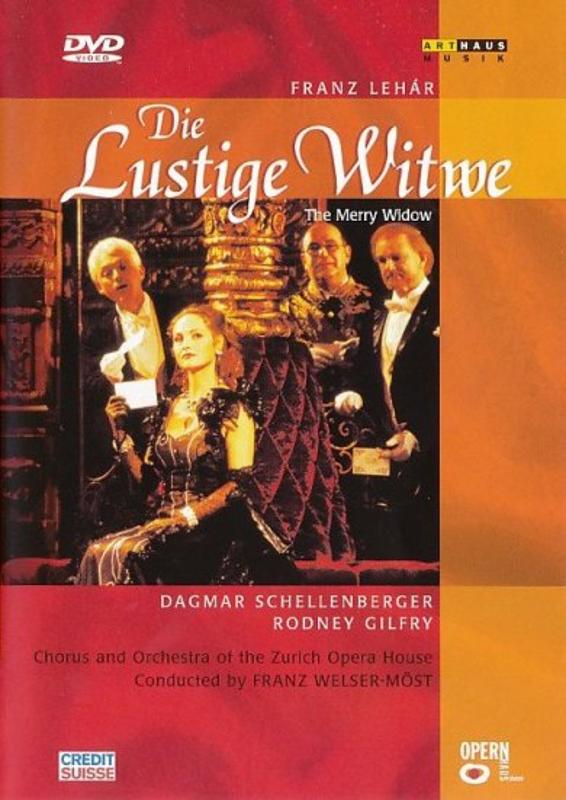
Helmuth Lohner, originally a film and stage actor and also an operetta singer has been concentrating on directing in recent years and he does so superbly. His 2004 production from Zurich is very traditional, rich in colour and movement, and his satirical characterisation of the characters makes perfect sense.
He does allow himself a small ˜adaptation”: after the men’s sextet ˜Wie die Weiber”, he has the women sing an equivalent of it.
Initially I had a bit of trouble with the somewhat shrill Dagmar Schellenberg (Hanna), but gradually she gets better and better and she really redeems herself with a perfectly performed Vilja song.
Rodney Gilfrey is an irresistibly charming and sexy Danilo, Ute Gferer a kitschy Valencienne, and Piotr Beczala revives the good old days of a Kiepura with his beautiful, lyrical tenor (Arthaus Music 100451)
THE MERRY WIDOW
Yes, it’s in English. So what? The ˜unvergessliche süsse Melodien” sound no less beautiful. This production of Franz Lehár’s Die Lustige Witwe by San Francisco Opera is simply wonderful.
In 2003, The Merry Widow was the last production by Lotfi Mansouri, the face of San Francisco Opera for more than forty years. A new English translation of the libretto, of its French version!, was produced for the occasion. In it, the last act does not take place at Hanna’s home, but in the real ˜Maxim’s”.
Mansouri sees Hanna as an already somewhat mature woman, who should be sung by a singer who has already been performing the Marschallin. Into this concept Yvonne Kenny fits wonderfully and she makes her role debut with it. She possesses a brilliant stage personality, her voice is creamy, velvety and enchanting.
Bo Skovhus, too, is a Danilo true to Mansouri’s vision: youthful and irresistibly attractive. His voice rings like a bell, he is a gifted actor and a superb dancer.
Angelika Kirschschlager and Gregory Turay excel as Valencienne and Camille, and the rest of the cast is also outstanding. A wonderful production (Opus Arte OA 0836 D)
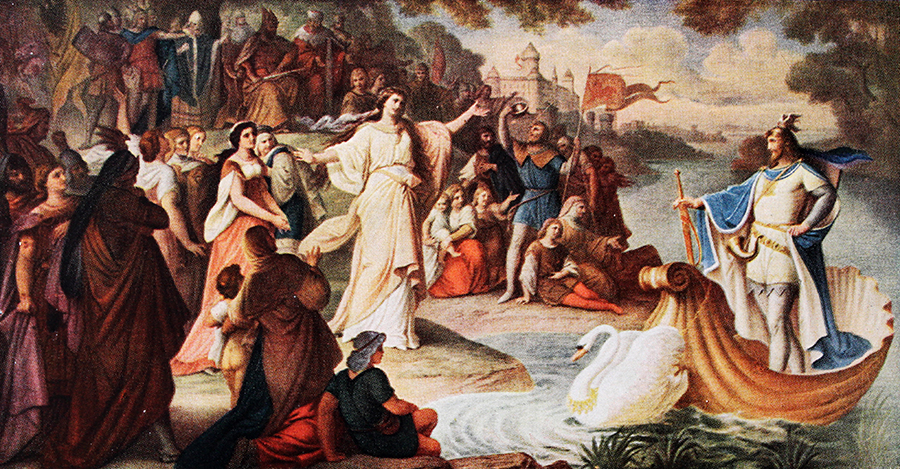
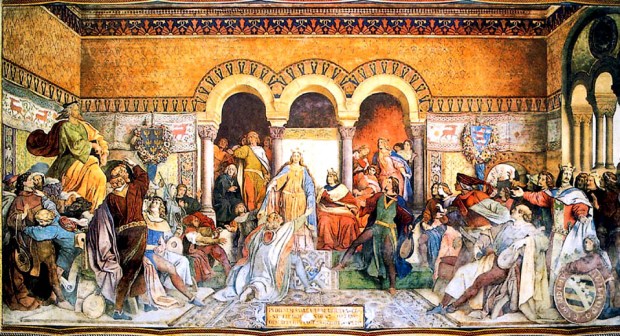
Lohengrin arrives in Antwerp, painting from the Lohengrin mural cycle, by August von Heckel , Neuschwanstein Castle
For me (definitely not a Wagnerian!), Richard Wagner’s Lohengrin ranks as high as his Tannhäuser : I can never get too much of it. No wonder my Lohengrin shelf is well-stocked. A selection of recommendations and turn-offs.
CD’S
GEORG SOLTI
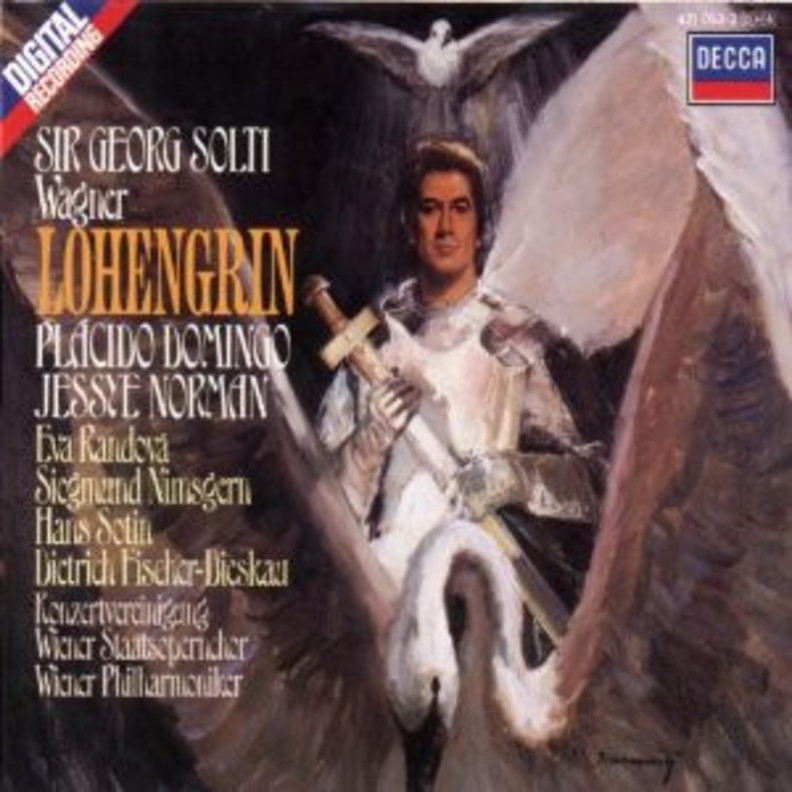
My favourite CD recording is the one conducted by Georg Solti (Decca 4210532), mainly because of the conductor. It starts already with the overture: very mysterious yet with both feet on the ground. Very sensitive, but also emphatically real without any sectarianism; no Hare Krishna here, but no Halleluja either.
Despite all the swans, Lohengrins do not usually fall out of the sky. Before officially recording the role Domingo had been preparing for it for almost twenty years. His Lohengrin is loving and warmblooded.
Jessye Norman was the perfect Elsa in those days; young and innocent with a voice that completely blows you away. Fischer-Dieskau’s Heerrufer is a matter of taste, but Siegmund Nimsgern and Eva Randová are a perfectly vicious pair!
Domingo’s baptism of fire in the role of Lohengrin was in Hamburg in 1968. He was then 27 (!) years old. It was not only his first Wagner, it was also the very first time he sang an opera in German, a language he did not yet master.
Fragments of the performance have been preserved (e.g. Melodram MEL 26510). His voice sounds like a bell, with a lot of bronze and a golden shine. The high notes are high and sung in full. Where can you still experience a Lohengrin like this? So beautiful that it makes you want to cry.
His Elsa was Arlene Saunders, at that time a much-loved prima donna in Hamburg, today she is totally forgotten. How unjust! Saunders was not only an amazingly good singer, she was also a beautiful woman and an exemplary actress.
MAREK JANOWSKI
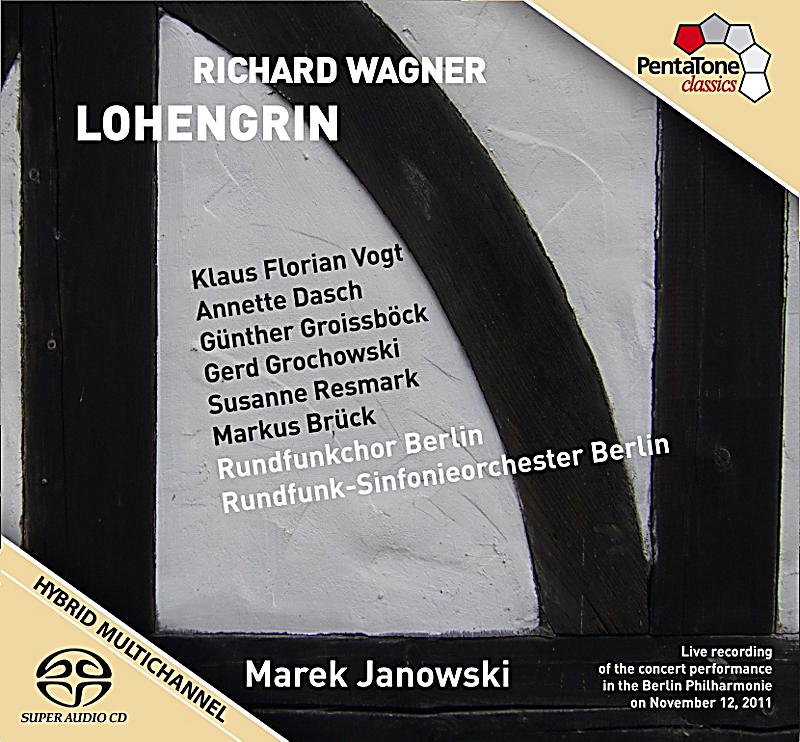
Marek Janowski is considered one of the best Wagner conductors of our time, but his Lohengrin, recorded live in Berlin in November 2011 (PentaToneClassics PTC 5186403) is a little disapppointing to me.
Janowski conducts very carefully, too carefully for me, making the overture most like an overly- stretched mush. Fortunately, he soon recovers and in the second act he makes the menace palpable. In the Wedding March, he makes the notes flow nicely into each other and he succeeds very well with his choice of tempi, all the while neatly restraining the orchestra. Yet I cannot escape the impression that he loses himself into the details.
I am not a fan of Annette Dasch, I find her voice a bit ‘ordinary’, but perhaps it does suit the character of Elsa? Susanne Resmark is a decent Ortrud, with a big voice and a nice dark timbre. But her ample vibrato is sometimes annoying.
The rest of the singers are certainly superb, but there is one problem: they do not blend. Klaus Florian Vogt’s sound is very ‘white’, his timbre quite sweet and his approach very lyrical. Beautiful, yes, but frankly I’ve had it by now with the same thing over and over again: he doesn’t develop. Moreover, he cannot compete with the deep low sound of Günther Groisböck (Heinrich) and the truly phenomenal volume of Gerd Grochowski (Telramund). In the ensembles, he simply shrinks away to nothing.
Below Günther Groisböck sings the ‘Gebet des König Heinrich’
BERTRAND DE BILLY
One of the newer Lohengrins, at least on CD, was conducted by Bertrand de Billy and recorded live at the Frankfurter Opern in March 2013 (OEHMS classics OC946). Judging by pictures in the textbook, we are to be happy that the production was not released on DVD but on CD!
Camilla Nylund is a wonderful Elsa, for me perhaps the best Elsa of recent years. Michaela Schuster, meanwhile, has made Ortrud into one of her showpieces, although there is something in her interpretation that displeases me a little. For Falk Struckman (King Heinrich) I am willing to commit murder, so I will forgive him for his voice becoming a bit unstable. The German-Canadian tenor Michael König (Lohengrin) is new to me. His voice and interpretation really make me quiet, so beautiful and so moving! Just because of him and Nylund, I am going to cherish this recording!
ERICH LEINSDORF
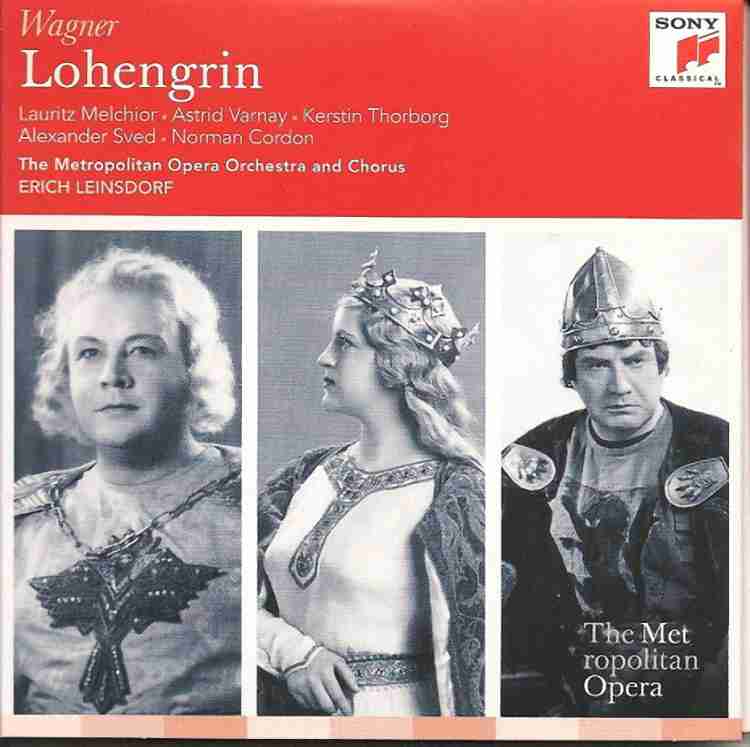
Back in time for a moment. In 1943, Erich Leinsdorf conducted a wonderful Lohengrin at the Metropolitan Opera in New York (Sony 88765 42717 2). The overture is to die for, just like a fairytale. I can’t get enough of it.
Lauritz Melchior is of course the Lohengrin of the era and Astrid Varnay sounds surprisingly lyrical. It’s a pity that she pronounces the consonants so very emphatically, something I don’t like. Alexander Sved is a very authoritative Telramund and Kerstin Thorborg a good Ortrud.
FRITZ STIEDRY
Opposite Leinsdorf’s recording is a 1950 recording under Fritz Stiedry (Walhall WLCD 0146). His approach is very down-to-earth, straightforward, which is also amplified by the poor sound quality. But it is undeniably beautiful and very surprising.
The singers also: Helen Traubel is a delightful Elsa and Astrid Varnay has been promoted from Elsa to a very impressive Ortrud after those seven years. And then Herbert Janssen’s Telramund: what a voice and what an impressive interpretation.
DVDS
AUGUST EVERDING
Even on DVD there is no shortage of good, not so good or even ridiculous performances (long live the director!). I start with an undoubtedly fine performance from the Metropolitan Opera, recorded in 1986 (DG 0734176) .
August Everding’s production is very traditional, with ditto costumes and sets. It is very beautiful, but for me there is something missing, as if the soul has been taken out of the performance.
But then there is Leonie Rysanek (Ortrud) and you have to keep looking at her with fascination. Just watch her glance at Elsa’s accusation. Delightful! James Levine conducts with verve and gives all the shine to the score, truly magnificent. Watching his face while he conducts is also fascinating; it shows complete commitment to the music.
Below, Leonie Rysanek as Ortrud:
GÖTZ FRIEDERICH
It was August Everding who first recognised Götz Friedrich’s enormous qualities. It was also he who ensured that Friedrich was appointed chief producer in Hamburg after his escape from the GDR.
Contrary to what is written about him, Friedrich never saw himself as a representative of ‘Regietheater’. On the contrary, his productions are very faithful to the libretto and the music. Do not expect strange concepts from him.
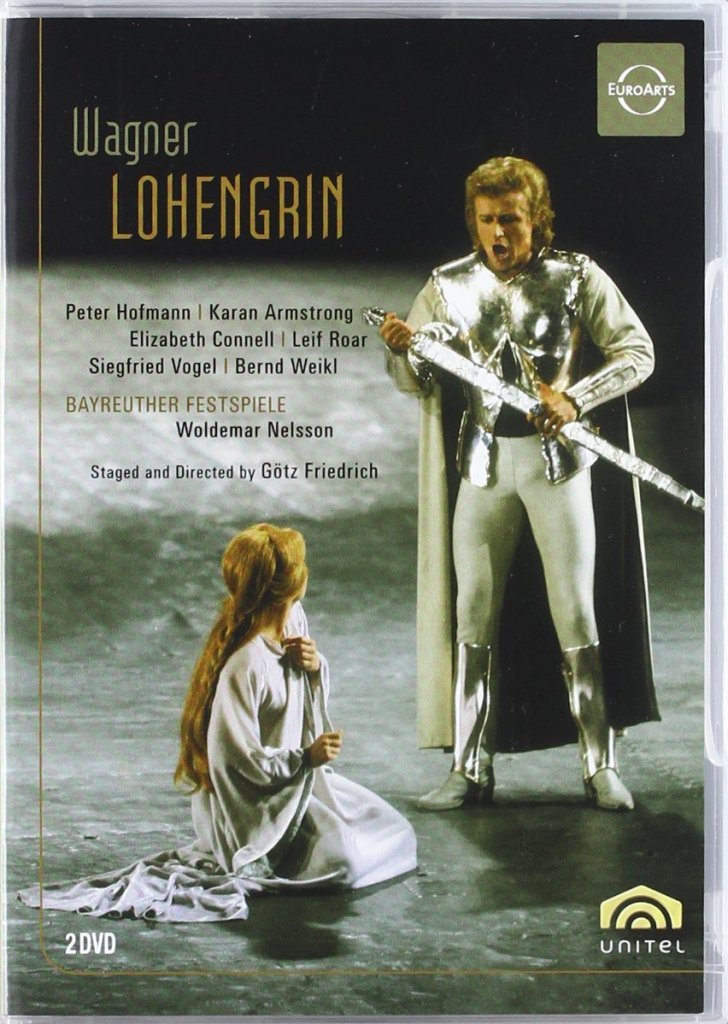
The Lohengrin he made in Bayreuth in 1982 (Euroarts 2072028) is, for me, among the opera’s finest productions. It moves between harsh reality and the utopian dream world of an adolescent girl. Karan Armstrong is a beautiful woman and a great actress, but her tremolo is very annoying at times. Peter Hofmann is in every way a dream Lohengrin: with his handsome looks, clad in white and silver, he seems to have literally stepped out of a girl’s reveries. Elisabeth Connell is an impressive Ortrud and Bernd Weikl a terrific Heerrufer.
Below is a short excerpt from the production:
NIKOLAUS LEHNHOFF
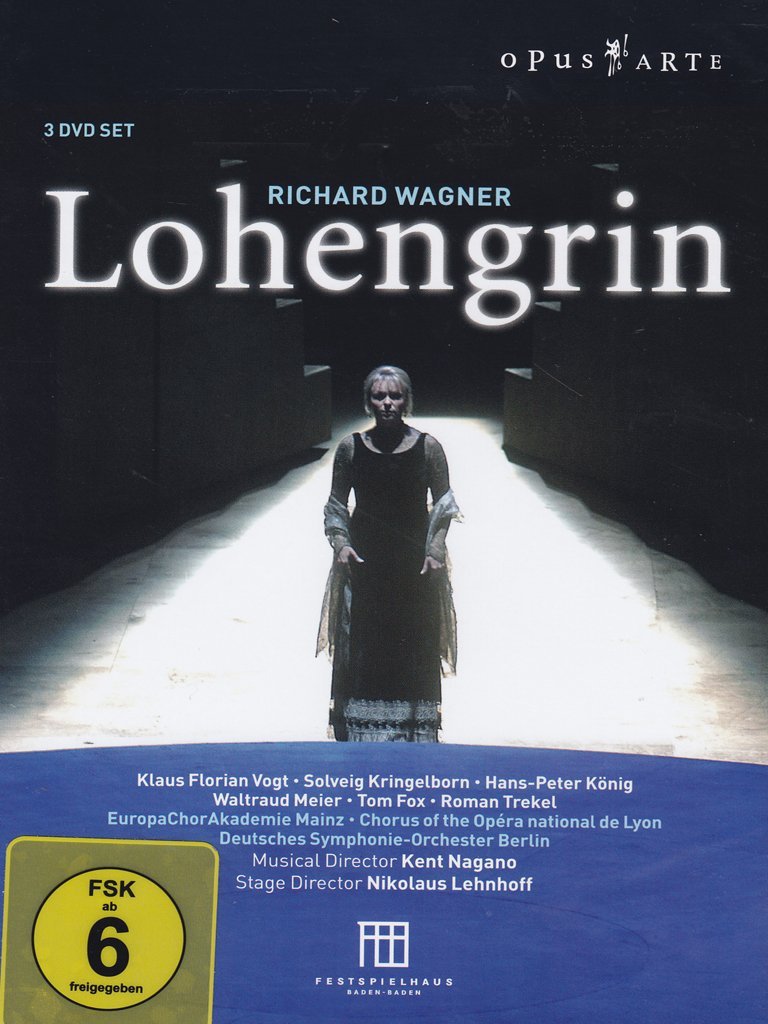
That Nikolaus Lehnhoff was very familiar with Friedrich’s production is obvious. Like Friedrich, he omits the swan. Lohengrin (Klaus Florian Vogt in one of his best roles) is preceded by a ray of light, giving him the allure of a 1950s pop star. Talk about girlish dreams!
Light and soft, like the first rays of the rising sun, this is how the first bars of the overture sound. In the middle of the stage, shrouded in shades of dark blue and black, Elsa ( a very poignant Solveig Kringelborn) comes up, her hands on a chair. This chair will remain the centre of her universe, and her only foothold, from now until the end of the opera. The feeling of loneliness takes hold of you, and you realise that things will never work out, all the knights and swans notwithstanding. The most striking thing about this brilliant Baden-Baden production is its matchless lyricism. The singers seem to have walked straight out of Bellini operas and even Ortrud, in the interpretation of the phenomenal Waltraud Meier, is like a Lady Macbeth with human traits. After Götz Friedrich, this is for me the best Lohengrin on DVD (Opus Arte OA 0964D)
Below is a scene between Elsa and Ortrud:
RICHARD JONES
Does the libretto speak of a regime? Dictatorship? Persecution and/or lack of democracy? Yes? Hup, then we simply move the action to the 1930s. So banal, and so clearly a lack of inspiration! I blame Richard Jones especially for the latter. His Lohengrin, in its banality, is not only weird, but also predictable and uninspired. At least for me.
Right at the start the beautiful overture, sublimely and sensitively played by the Bayerischer Staatsorchester under Kent Nagano, is totally destroyed by the picture. We see a girl with dark braids, dressed in green dungarees, sitting at a drawing table, drawing a house.
Lohengrin (Jonas Kaufmann) is a hippy dressed in jeans. He emerges, with under his arm, a big, white plastic swan, which is also mechanically controlled: it pecks around and into its feathers. I find it tacky.
The Munich production, July 2009 (Decca 0743387), marked Kaufmann’s debut in the role of Lohengrin. Did he succeed? Yes and no. His voice is naturally powerful and lyrical at the same time and with a big volume. He does not have to force anything and his highs and lows are beautifully balanced. Yet I miss something in his performance, that little ‘etwas’… Maybe it’s because it’s his debut, but on me he makes a not too happy impression.
Anja Harteros is a heartbreaking Elsa. She plays the role very impressively and manages to combine girlishness with a budding femininity.
Michaela Schuster did not know how to be portray Ortrud at the time, but Wolfgang Koch (Telramund) makes up for a lot. Such a beautiful voice! Deep, grand, supple, lithe, majestic and authoritative. He also manages to impress particularly as an actor. Evgeny Nikitin is a convincing Heerrufer.
Below is the trailer of the production:
HANS NEUNFELS
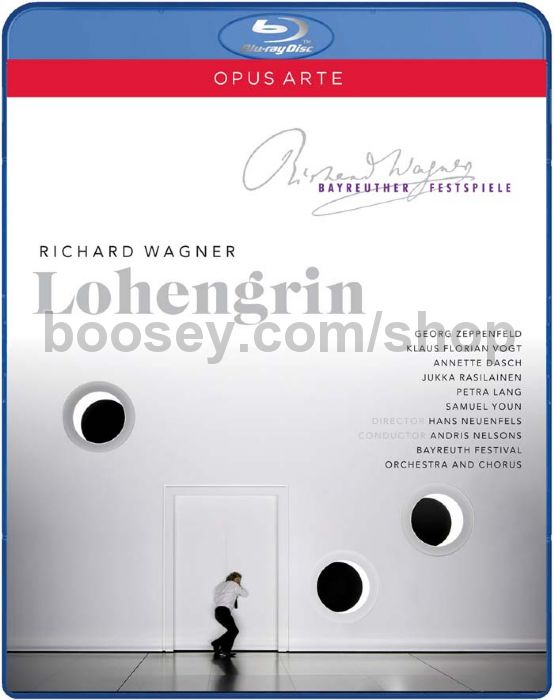
Recorded in Bayreuth in 2011, Hans Neuenfels’ production (Opus Arte OA 1071 D) is a bit obscure. Because, what are rats doing in Lohengrin? Now… here’s the thing: the Brabanders have been turned into rats by failed experiments and Lohengrin comes to help them, like someone from the animal liberation front. Something like that. Sort of. No, I didn’t think it up and I wouldn’t have been able to understand it if I hadn’t read the reviews. But apparently the enthusiastic (yes, the production was enthusiastically received!) fellow reviewers are either clairvoyant, or they had a special sit-down with the director. Even the overture is teeming with (animated) rats in pink, white and grey. And that’s just the beginning. And to also give away the ending: Elsa’s little brother is a just-born fat baby with the umbilical cord still on…. Annette Dasch looks beautiful and innocent and acts well and Klaus Florian Vogt sings beautifully and lyrically. Once and never again.
“This is my best opera,” Giuseppe Verdi said after the premiere. And added that he “could probably never write anything so beautiful again”. That the “never” wasn’t completely correct, we know now, but at the time, some kind of electric shock must really have gone through the audience. Even now, more than 170 years after its premiere, Rigoletto continues to top the opera charts, as ever. I therefore sincerely wonder if there are any opera lovers left who do not have at least one recording of the ‘Verdi cracker’ on their shelves.
Design by Giuseppe Bertoja for the world premiere of Rigoletto (second scene of the first act)
Ettore Bastianini
My all-time favourite is a 1960 Ricordi recording (now Sony 74321 68779 2), starring an absolutely unmatchable Ettore Bastianini. His Rigoletto is so warm and human, and so full of pent-up frustrations, that his call for “vendetta” is only natural.
Renata Scotto sings a girlishly naïve Gilda, who is transformed into a mature woman by her love for the wrong man. She understands like no other, that the whole business of revenge can lead nowhere and sacrifices herself, to stop all this bloodshed and hatred.
Alfredo Kraus is a Duca in a thousand: elegant and aloof, courteous, yet cold as ice. Not so much mean, but totally disinterested and therefore all the more dangerous.
A sonorous Yvo Vinco (Sparafucile) and deliciously vulgar seductive Fiorenza Cossotto (Maddalena) are not to be sneezed at either, and the whole thing is under the inspired direction of Gianandrea Gavazzeni. Unfortunately, the sound is not too good, but a true fan will take it for granted.
Bastianini and Scotto in the finale:
Piero Cappuccilli
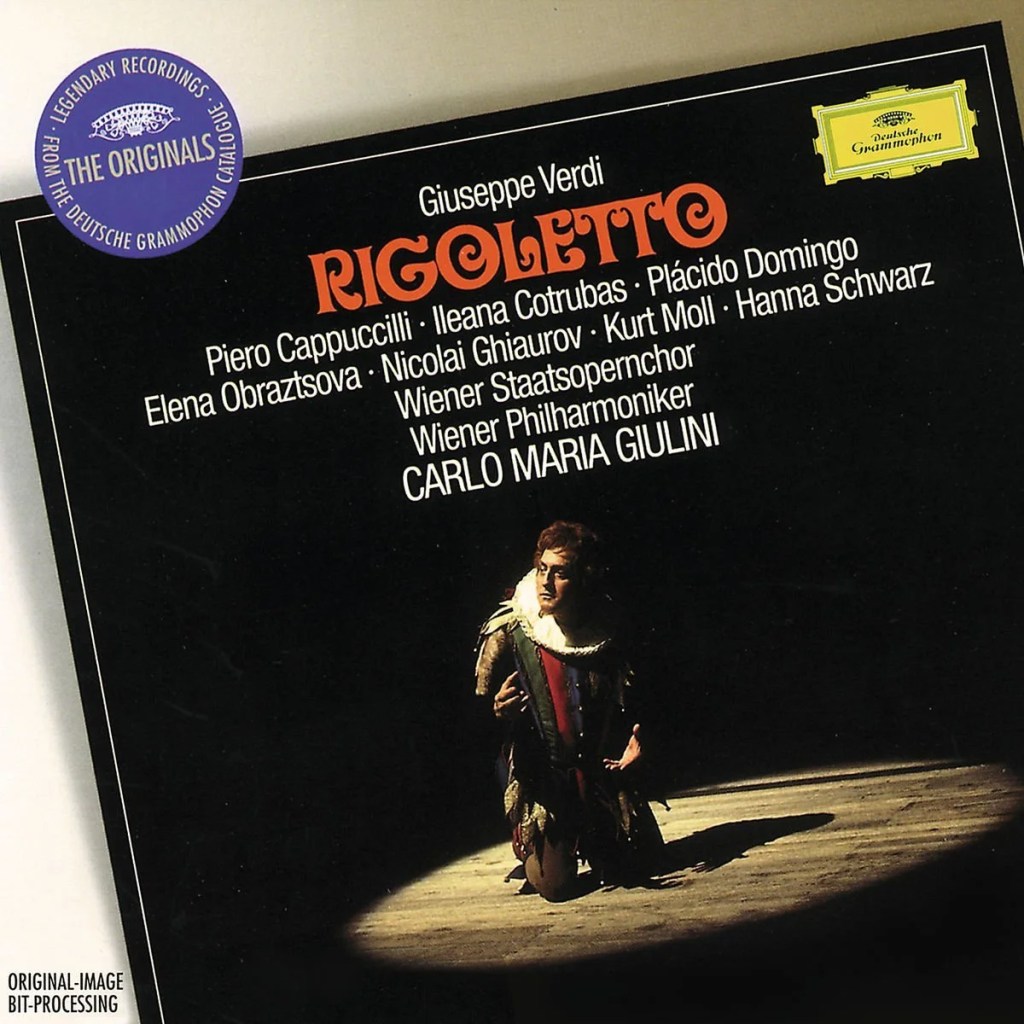
My other great favourite is the performance recorded in 1980 under Carlo Maria Giulini (DG 457 7532). Ileana Cotrubas is Gilda incarnate. She is not quite a vocal acrobat à la Gruberova, nor a wagging ‘canary’ like Lina Palliughi, decidedly less dramatic than Callas (rightly so, a Gilda is not a Leonora) and perhaps not as brilliant as Sutherland, but what empathy! What commitment! What an understanding of the text! Her Gilda, unlike Scotto’s, never grows old, and her sacrifice is a teenage girls’ own: senseless and pointless and so all the more moving.
The Duca is sung by Plácido Domingo, not really my favourite for the role, though there is nothing at all wrong with his singing. Piero Cappuccilli is a truly phenomenal Rigoletto, they don’t make ‘em like that anymore.
But we shouldn’t forget Giulini, because so lovingly as he handles the score that it couldn’t be more beautiful.
Tito Gobbi
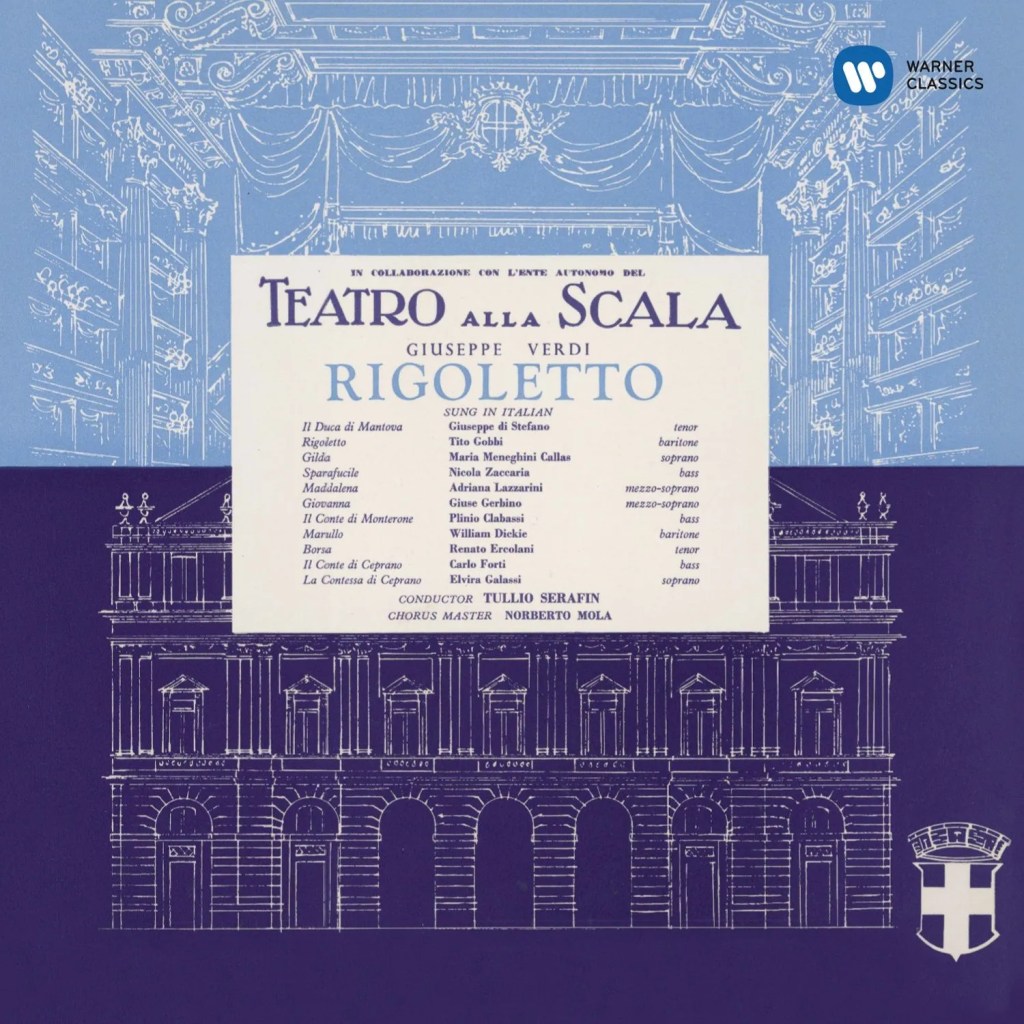
The 1955 recording with Maria Callas (Warner Classics 0825646340958) conducted by Tulio Serafin sounds pretty dull. Giuseppe Di Stefano is a pretty much perfect Duca: seductive macho, suave and totally unreliable. That his high notes in ‘Questa o Quella’ come out a bit squeezed, well… for this, he is forgiven.
Tito Gobbi is simply inimitable. Where else can you find a baritone with so many expressions at his disposal? This is no longer singing this is a lesson in acting with your voice! What you should also have the recording for is Nicola Zaccaria as Sparafucile. Unforgettable.
And Callas? Hmm. Too mature, too dramatic, too present.
Gobbi and Callas sing ‘Si, vendetta! Tremenda vendetta’
Sherrill Milnes
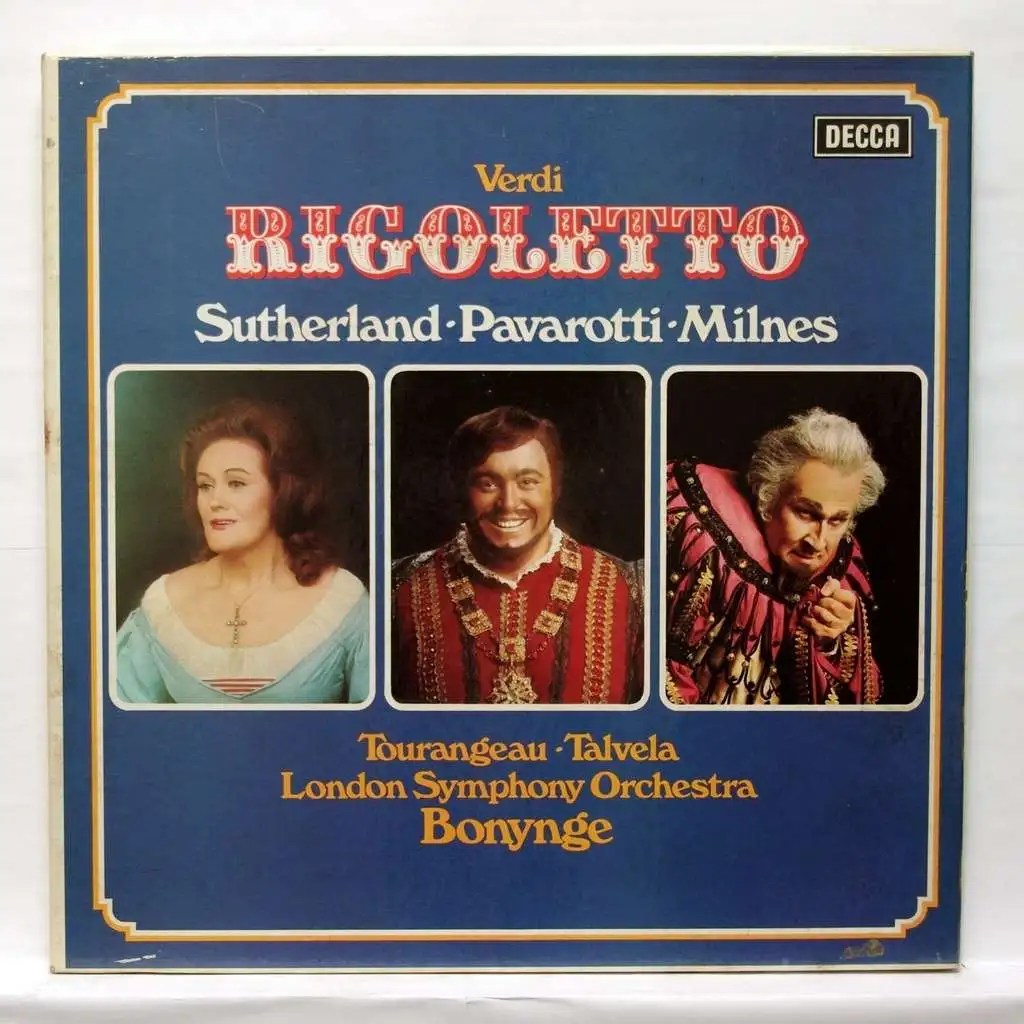
Joan Sutherland is a different story. Light voice, sparkling and indescribably virtuosic but a silly teenager? No.
Luciano Pavarotti is, I think, one of the best and most ideal Ducas in history. There is something appealingly vulgar in his voice that makes him sexually desirable which easily explains his several conquests.
Sherrill Milnes is a touching jester, who never wants to become a real jester: no matter how well he tries, he remains a loving father.
Matteo Manuguerra
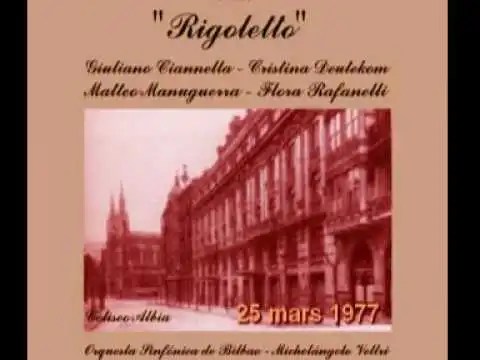
Nowadays, hardly anyone knows him, but in the 1970s, Tunisian-born Manuguerra was considered one of the greatest interpreters of both bel canto and verismo.. And Verdi, of course, because his beautiful, warm, smooth-lined voice enabled him to switch genres easily.
Anyway, of course, you listen to this pirate recording (it is also for sale as a CD) mainly because of Cristina Deutekom. Just listen how, in the quartet ‘Bella figlia dell’amore’, she goes with a breathtaking portamento to the high D from the chest register. No one imitates her in that. For that, you take Giuliano Ciannella’s screaming and understated Duca at face value. The sound is abominably bad, but then again: are you a fan or not?
DVD’S
John Dexter
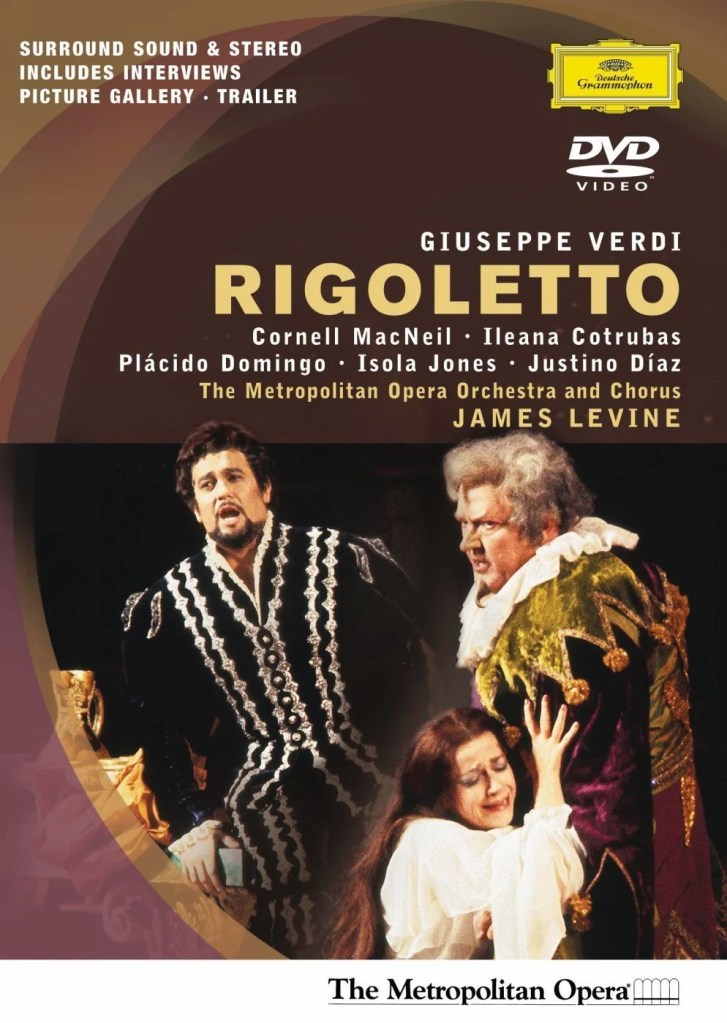
The 1977 production from the Metropolitan Opera (DG 0730939) is – of course – traditional. At first I had trouble with the close ups, which made all those stuck-up noses and thickly painted faces far too visible. But gradually I gave in to the beautiful direction and scenography which, together with the genuine 16th-century costumes, soon reminded me of Giorgione’s paintings. That this was indeed the intention was evident at the end, modelled on his ‘La Tempesta’, including the landscape and the sky drawn by lightning. But before it came to that, Rigoletto knelt with the dead Gilda (in blue, yes!) in his arms like Michelangelo’s “Pieta”, and I searched for a handkerchief because by now I had burst into tears.
Cornell MacNeil had his better days and started off rather false, but halfway through the first act, there was nothing wrong with his singing. And in the second act he sang just about the most impressive ‘Cortigiani’ I have ever heard, helped wonderfully by Levine’s very exciting accompaniment. Just watch how he pronounces the word ‘dannati’. Goosebumps.
It is an enormous pleasure to see and hear a young Domingo: tall, slim and handsome, and with a voice that audibly has no limitations, but…. As a Duca he goes nowhere. No matter how he tries his best – his eyes look cheerful and kind, and his lips constantly curl into a friendly smile. A “lover boy”, sure, but with no ill intentions. And he knows it himself, because he has sung that role very little. Actually, he hates Duca, at least so he says in an interview in a “bonus” to the Fragment from the second act:
Charles Roubaud
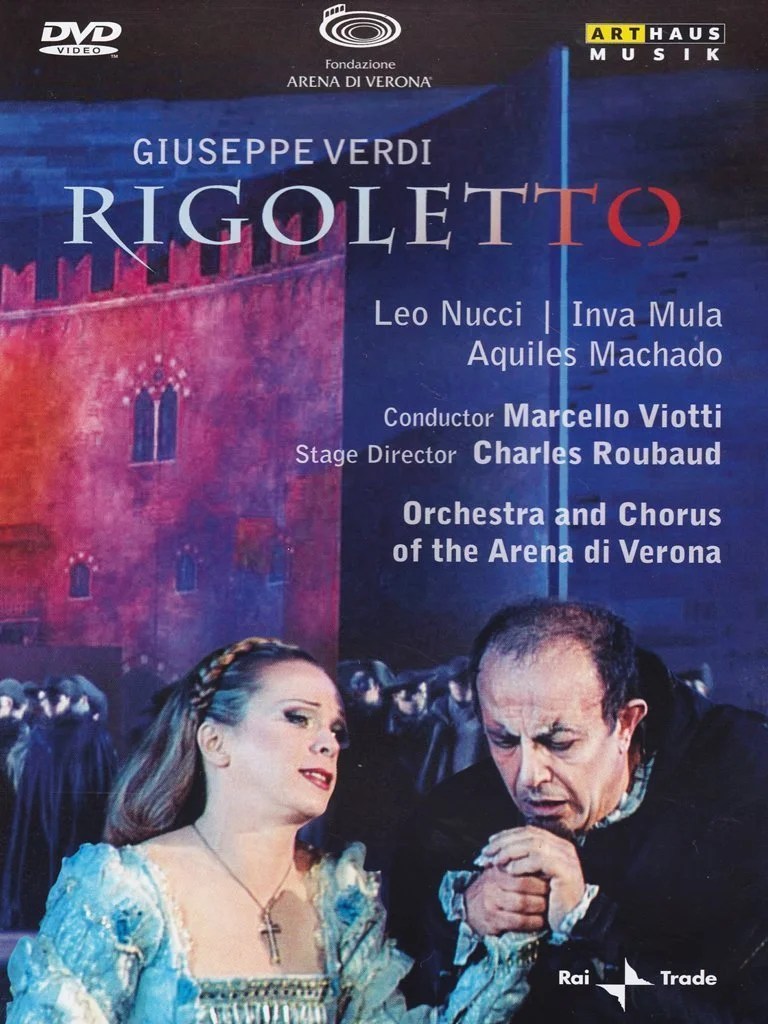
I heard a lot of good things about the performance at the arena in Verona in 2001. Reviews of the performances were rave, and people were also generally very positive about the DVD (Arthaus Musik 107096). So this will be just me, but I don’t like it.
The scenery is very sparse and looks very minimal on the large stage. It is still most reminiscent of cube boxes, but when the camera comes closer (and sometimes it comes too close!) they turn out to be walls, which close at the end in a very ingenious way – like a stage cloth, a nice invention though. The costumes are more or less okay, but I can’t find them brilliant either. And Rigoletto’s hunched back is downright ridiculous.
Leo Nucci is among the great Verdi baritones of our time but on the DVD his voice sounds anything but beautiful and in his first scenes he seems to be doing sprechgeang. Sure, his portrayal is certainly impressive, but I have seen him do better. The audience does enthuse, forcing him to encore ‘La Vendetta’ at the end of the second act.
It is not the last encore this evening: Aquiles Machado (Duca) also repeats with visible pleasure his, to my ears, roared-out ‘La donna e mobile’. It seems to be a tradition.
That he doesn’t look the part… well, he can’t help that. What is worse is that his Duca is nothing more than a silly macho man (what’s in a name?) and that his loud, in itself fine lyrical voice with solid pitch has only one colour.
Albanian Inva Mula really does her best to sing and look as beautiful as possible, and she succeeds wonderfully. All the coloraturas are there, as well as all those high notes. Her pianissimo is breathtaking, so there is nothing to criticise about that. But – it leaves me cold, because of how studied it sounds.
Marcello Viotti does not sound particularly inspired and his hasty tempi lead to an ugly ‘Cortigiani, vil razza dannata’, normally one of the opera’s most moving moments.
Leo Nucci and Inva Mula in ‘Si Vendetta’:
Gilbert Deflo
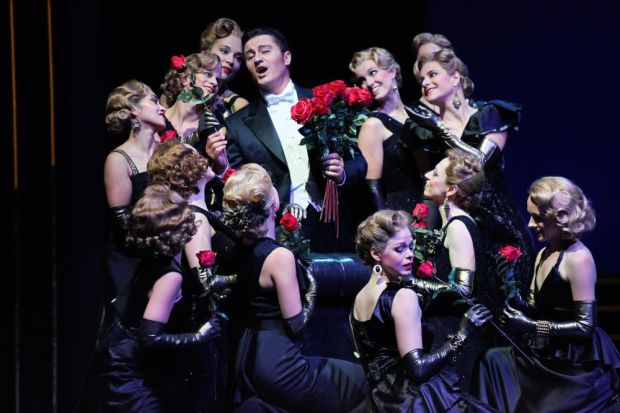
Sometimes I think that some opera directors have grown tired of all this updating and conceptualism and go back to what it’s all about: the music and the libretto. Such is the case with the Belgian Gilbert Deflo, who in 2006 in Zurich realised a Rigoletto that, were the story not too sad for that, would make you want to cry out for pure viewing pleasure (Arthaus Musik 101 283). He (and his team) created an old-fashioned beautiful, intelligent staging, with many surprising details and sparse but effective sets. The beautiful costumes may be of all times, but the main characters do not deviate from the libretto: the jester has a hunchback and the associated complexes, the girl is naive and self-sacrificing, and the seducer particularly attractive and charming.
Piotr Beczała, with his appearance of a pre-war film giant evokes (also in voice) reminiscences of Jan Kiepura. Elena Moşuc is a very virtuoso, girlish Gilda, and Leo Nucci outdoes himself as an embittered and tormented Rigoletto – for his heartbreakingly sung ‘Cortiggiani’ he is rightly rewarded with a curtain call.
Nello Santi embodies the old bel canto school, which one rarely hears these days.
Beczala, Nucci, Mosuc and Katharina Peets in ‘Bella Figlia del’amore’:
Michael Mayer
Times are changing and ‘director’s theatre’ has now also reached the New-York Metropolitan. They do not yet go as far as their European counterparts, but updating or moulding the libretto to a concept is now allowed.
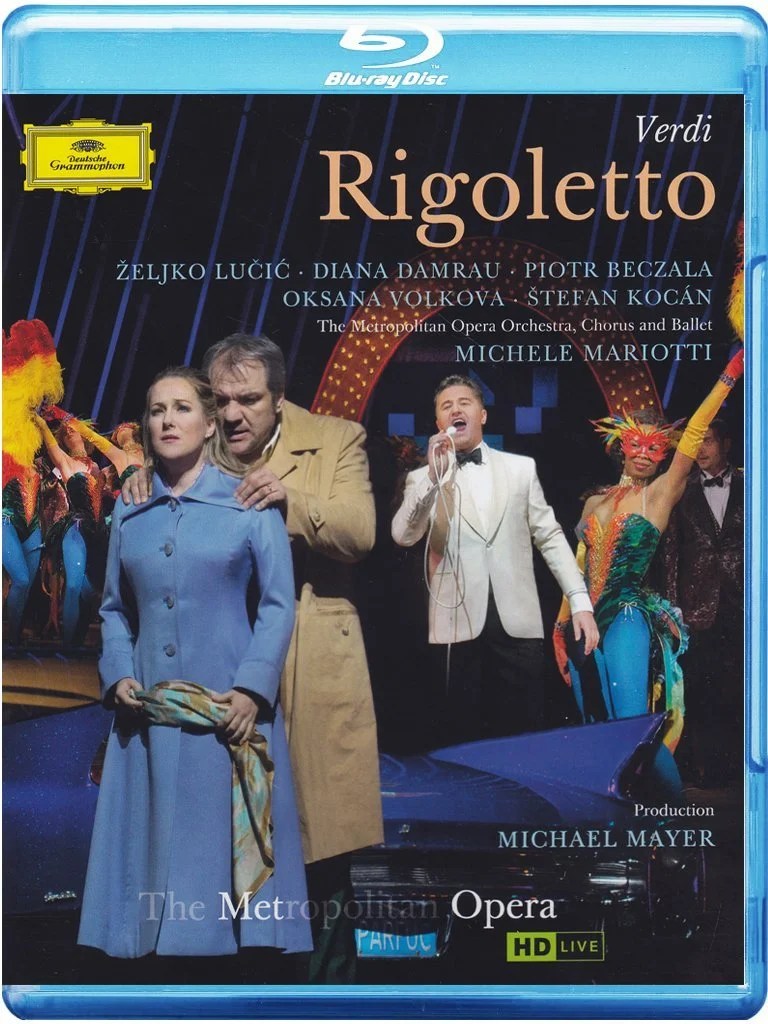
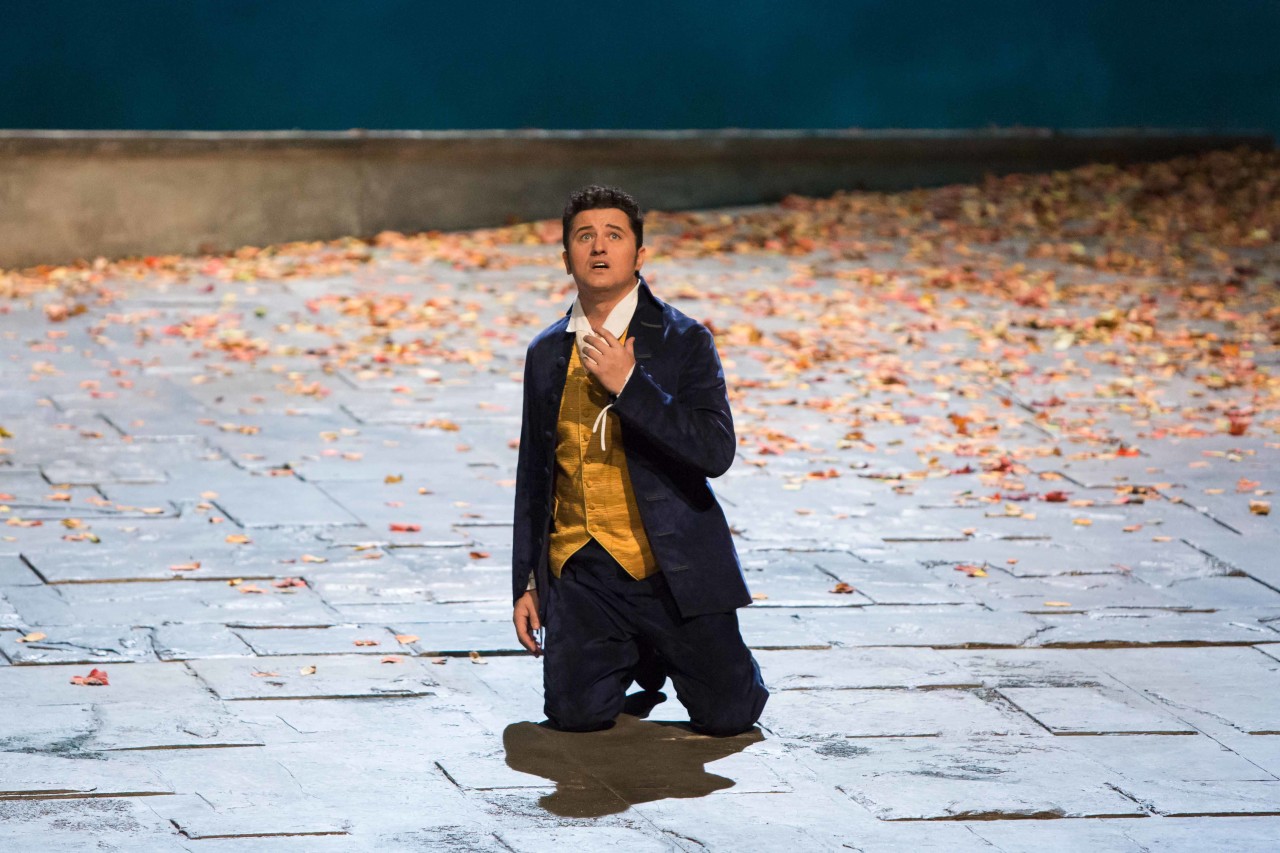
In 2013, Michael Mayer made it a “Rat Pack ‘Rigoletto'” set in 1950s Las Vegas in which Piotr Beczała (Duca), armed with a white dinner jacket and a microphone, is modelled on Frank Sinatra (or is it Dean Martin?). Beczała plays his role of the seductive entertainer for whom ‘questa o quella’ are more than excellent.
Piotr Beczała sings ‘Questa o quella’:
Diana Damrau remains a matter of taste: virtuoso but terribly exaggerated.
Zjeljko Lučić does not let me forget his predecessors, but these days he is undoubtedly one of Rigoletto’s best interpreters. The young bass Štefan Kocán is a real discovery. What a voice! And what a presence! The production is fun and engaging, but you cannot deny that you often have to look far for the logic.
‘La Donna e mobile’ in a minute and a half, sung by five tenors:
Victor Borge gives special treatment to ‘Caro Nome’:
My dear readers: you should know how important you all are. We music reviewers, we too are ego-trippers, just as much as novelists or psychologists. We do what we do because it helps us get rid of our problems. Or not.
Because you are all so faithful and take the trouble to read me (I hope), I am going to tell you a bit about myself. Also because I received ‘death threats’ following an interview (am I a BN now?) and got a bit ‘unheimlich’ about it.
Music is not a science, certainly not in the strict sense. There are no mathematical rules for it, although there were (and still are) plenty of ‘pioneers’ who claimed so. The result of their mathematical calculations was cacophony or just the opposite: the endlessly repeating sequence of three notes. I know there are plenty of enthusiasts for it and I grant them their pleasure. But now I want to talk to you about something that is still a taboo subject: sentiment.
When I was a 4-year-old girl, my parents ‘separated’. My violin-playing father took me to see Sviatoslav Richter, which naturally resulted in piano lessons. My mother loved operetta and since there was no one else to accompany her, I was taken along. I went along and I enjoyed myself. Still, more than 60 years later, I know most operettas by heart. In Polish, that is, because everything was translated back then.
Jan Kiepura and Martha Eggerth in the duet from Lehár’s Lustige Witwe. In Polish:.
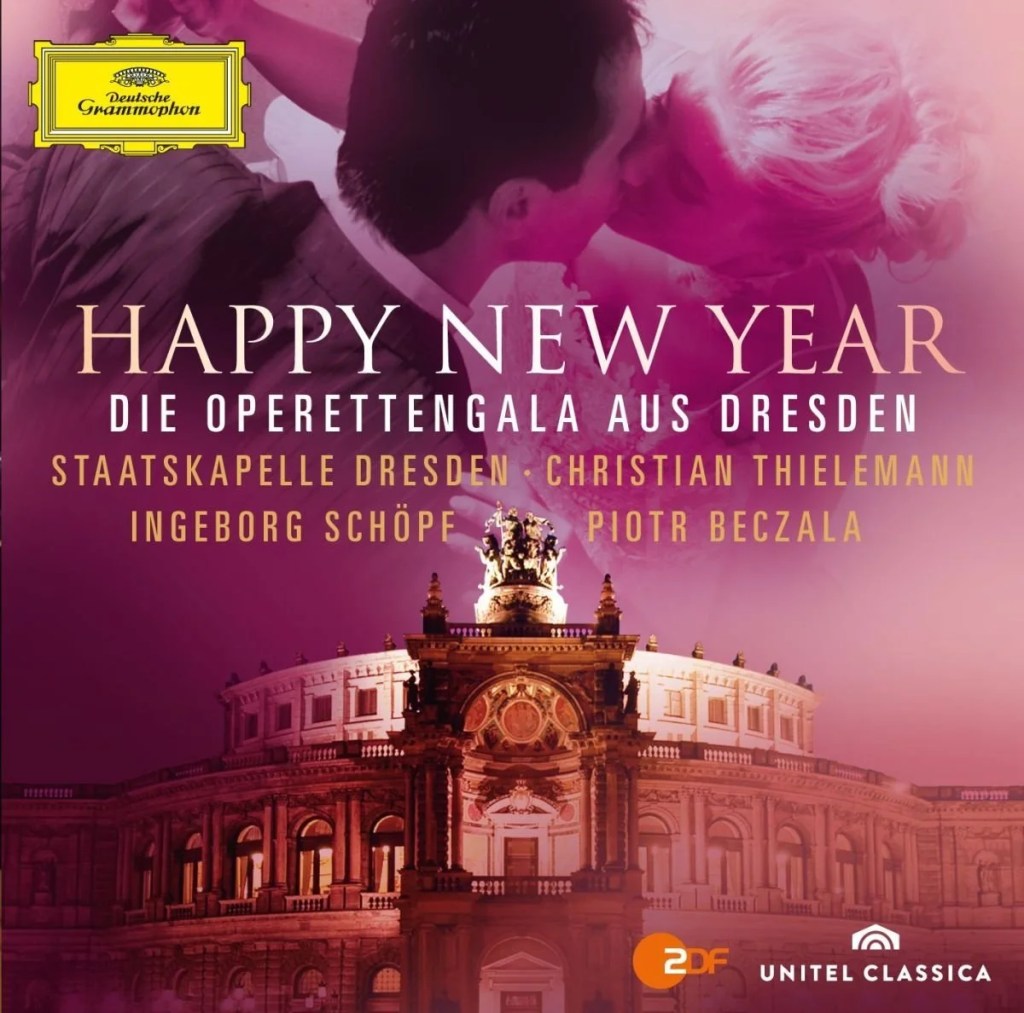
Why am I telling you about it? Because I want to share with you what I call ‘my little sentimental journey’. On New Year’s Eve – sitting on the sofa in my heated home, with my cat beside me and glass of bubbles in hand – I listened and watched the operetta night from Dresden and I was overcome with melancholy and, well, longing for the old days. I felt like the four-year-old girl again and all I wished was that my mother could sit next to me and experience it too. Too bad there is no phone connection to the afterlife, otherwise I could call her: ‘Mom, you have to hear this!’
Below, Beczala sings ‘Freunde, das Leben ist lebenswert’ from Giuditta. Live recording from 2007:
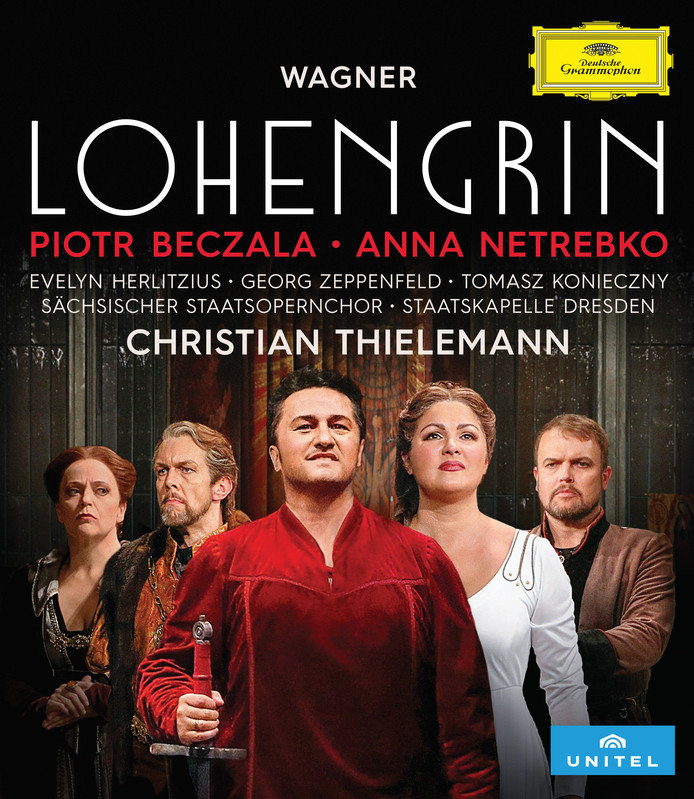
Anyway. Now we’ll leave the sentiments and confine ourselves to the ‘product’. The annual ‘Christmas Operette Galas’ in Dresden are now famous and achieve high viewing figures. The Staatskapelle Dresden is conducted by none other than Christian Thielemann, and apart from Piotr Beczała, a soprano (or two) also take part.
In 2011, Angela Denoke and Ana Maria Labin were featured; in 2012, the scheduled Diana Damrau had to cancel at the last minute due to illness and was replaced by Ingeborg Schlöpff. Both Galas were released by DG in 2013: Kalmán (2012) on CD with a bonus Lehár from 2011 on DVD.
Angela Denoke & Piotr Beczala – Warum hat jeder Fruhling, ach, nur einen Mai (Franz Lehar):
That I rate the CD (why not on DVD?) slightly higher than the DVD has everything to do with my own preferences: I love Lehár insanely, but Kalmán has long since more than stolen my heart. ‘Weisst du es noch’ from the Csárdásfürstin did not leave my CD player (and my head) for days (and nights!).
Do you think it’s a weird review? So do I. But if you like operetta, no, if you like music and don’t shy away from sentiment, then go buy the box set. I assure you it will warm your heart.
February 2015 was the day: The French Connection, the long-awaited sequel to Piotr Beczala’s DG debut CD was out.
And it was worth the wait. Not least because of the repertoire: French opera, along with the more lyrical Verdi, is Piotr Beczala’s strong suit. I truly know of no singer who can surpass him in Massenet and Gounod.
His wonderfully juicy tenor voice is light and elegant and his Werther, Des Grieux, Faust and (certainly!) Roméo are among the best interpretations you can expect from the current generation of young tenors. You could say that Beczala is the epitome of French singing.
The tone is set with a perfectly sung “Pourquoi me réveiller” from Werther. Beczala’s languorous recitation betrays not only text understanding, but also (or perhaps mainly?) his affinity with the music. In one of his last interviews, he said he prefers to sing sad roles, roles in which he dies at the end, because then he can express all his feelings. You can really hear this.
That the Polish tenor is gradually moving towards heavier repertoire is rather logical. His voice has developed considerably in depth, without his high notes having to suffer for it.
Don José (Carmen) is therefore on his “to do list”, hopefully he will also add Don Carlos. But most of all, I would love to hear him right now in the complete Herodiade and (why not?) Robert le Diable. And most certainly in “Le Cid”: I cannot remember the last time I heard “Ô” Souverain” sung so beautifully.
The only downside I can find is the duet from Massenet’s Manon, in which he is accompanied by Diana Damrau. Her voice does not appeal to me personally and I find her a not very sexy Manon.
Other than that: a CD to have and to cherish for ever!
Trailer of the album:
The French Collection Arias by Massenet, Berlioz, Verdi, Donizetti, Boieldieu and Bizet Piotr Beczala (tenor) with Diana Damrau (soprano) Orchestre de l’Opera National de Lyon conducted by Alain Altinoglu DG 4794101
After a carefully built career of 25 years at smaller opera houses, Piotr Beczala has been at the absolute top for many years now. Here is a se veral years old conversation with the Polish tenor: about saying no, his love for operetta and about everything else.
It is not that the tenors (and not just the tenors!) suddenly fall out of the sky, even if it sometimes looks like it. A voice has to grow, mature, gain experience, build repertoire. Slowly, slowly… only then will you get there. And – more importantly – you stay there.
No one is more aware of this than Piotr Beczala. “You have to be patient, don’t rush things and don’t take on roles that don’t suit you”, he says. “I used to be a notorious ‘no-sayer’. It’s almost unbelievable what kind of roles were offered to me, roles that I couldn’t sing at all, especially then. But I always stuck to my guns, because I didn’t want to be only a one-day wonder”.
“Now, after more than twenty years of carefully building my career, I can do a lot more. My voice has developed and it has become bigger and darker, my technique is solid and my confidence has grown, so now I can concentrate much more on my acting. I can sing most of the roles that I am now offered, so most of the time I don’t have to say no anymore. Casting directors and intendants know very well what I will or won’t accept, so I get less and less of the crazier proposals. And to those I’ll just say no again”.
Tauber
Beczała was a was an ‘insider tip’ for a long time. His professional career started in 1992 in Linz, but he was really discovered in 1997 in Zurich, the opera house that apparently has a good nose for spotting tenors (Jonas Kaufmann and Pavol Breslik are also from there).
Before he made his debut in the biggest and most important opera houses in the world, he also sang in Amsterdam. Three times no less: in Król Roger by Szymanowski, Yevgeny Onegin by Tchaikovsky and La Bohème by Puccini.
Below Beczala sings aria by Pasterz from Król Roger. The sound comes from the Naxos recording by Jacek Kaspszyk
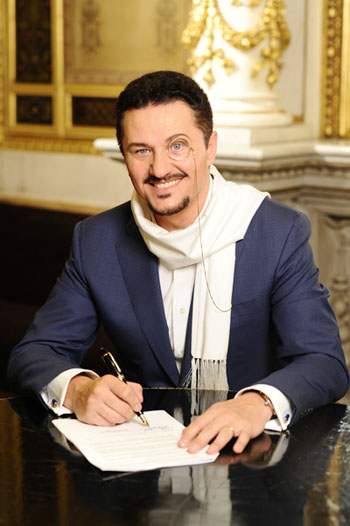
Beczala has somewhat “pre-war” looks and he has more than a little talent for acting, which is not unimportant these days. Nevertheless, the contracts with record companies did not quickly materialize, which was probably a good thing for him. It enabled him to develop into what he has now become: one of the best lyrical tenors in the world, and that without any need of loud advertising campaigns. Deutsche Grammophon couldn’t get around him anymore and Beczala signed an exclusive contract with the company in the autumn of 2012.
Beczala bij de ondertekening van zijn contract met Deutsche Grammophon (foto: StefanieStarz)
Beczala’s somewhat old-fashioned timbre is reminiscent of a Wunderlich, Gedda or even Kiepura. What he also has in common with these predecessors is his fondness for operetta, a genre he loves and loves to sing.
It is therefore not surprising that his first solo recital with DG, Mein ganzes Herz, includes an operetta programme.
“DG gave me the green light for my own choice of orchestra and conductor. I immediately thought of the young Polish conductor Łukasz Borowicz, with whom I previously recorded a CD of Slavonic opera arias (Orfeo C814 101). As far as the orchestra was concerned, my choice was immediately clear: it had to be the Royal Philharmonic!
“The programme is simple: operetta! From Lehár and Kalmán to Robert Stoltz and Carl Bohm. Modern technology is also used, so in addition to today’s real guests such as Anna Netrebko, Avi Avital and the Berlin Comedian Harmonists, Richard Tauber himself is making an appearance! I’m going to sing a duet with him! If that is not something special…”
Lohengrin
“Now is also the time to expand my repertoire. By 2015 I will try out heavier roles.
Below: trailer of ‘Lohengrin’ from Dresden, with Anna Netrebko, Piotr Beczala & Christian Thielemann.
With Christian Thielemann I sang songs by Strauss and in Santa Monica I gave a recital with, among others, Schumann and Karłowicz, an unusual but beautiful and logical combination”.
Piotr Beczała & Helmut Deutsch (piano) in ‘”Skąd pierwsze gwiazdy”‘ (hence the first stars) by Mieczyslaw Karlowicz:
‘E lucevan le stelle’ (Tosca) – encore in the Wienner Staatsoper 10.02.2019
CONDUCTORS
Piotr Beczala & Nello Santi: Un ballo di Maschera in Opernhaus Zurich
What other maestros, besides Thielemann and Borowicz, would Beczala like to work with? “For me, the very best is Nello Santi. Absolutely. But I also love Marco Armiliato. Or is that because his brother is an opera singer? That may be it, but I don’t know for sure…”
There are also the conductors that make Beczala less happy. “I don’t want to work with conductors that have no respect for singers and don’t know how to deal with singers. I don’t want to name names, but most of them come from early music. Which certainly does not mean that all early music conductors are no good”.
What is his experience with singers who have started conducting, such as Plácido Domingo? “Domingo has the flaw that he lives in the present, in the now. How shall I explain that… Consider the difference between a ‘vocal conductor’ and a ‘normal’ conductor as the difference between a pianist and an organist. A pianist thinks about the sound as it is there now, an organist thinks ahead, about the resonance of the sound that is to come”.
DIRECTORS (and his famous ‘black book’)
Beczala als Rodolfo in Salzburg
“I have nothing against updating, as long as it is recognizable. I am not against modern, but I am against stupid, foolish, far-fetched! I do indeed have a ‘black book’ with the names of directors with whom I never (ever) want to work”.
“I am lucky to be able to accept or refuse things, but many of my (starting) colleagues do not have that privilege. Some think, that once they get into a high-profile production, they will make it big, but that’s not how it works. In our profession you háve to have the musicality and the dedication. Directors often think they are God, but they are not, you must not surrender to them, but adhere only to the genius of the composers”.
“Which director do I admire the most? Franco Zefirelli, without a doubt. Zefirelli is more than a director, he is a monument, you may consider him to be our cultural heritage. His productions were (and still are!) always fantastic, they should be cherished. It was a feast for me to work with him, it gives the person inside the singer immense pleasure.
I also have a weakness and great admiration for Guy Joosten. His Romeo et Juliette in the New York Metropolitan was really beautiful, we, the singers, also enjoyed it immensely.”
HOME
When you travel so much and stay in so many different cities, do you still feel like you’re ‘home’ anywhere? “We feel at home everywhere now “, laughs Beczala. “Though Kasia, my wife, loves New York the most of all.”
“Our real home is in the mountains, in Poland, but we are there for no more than two weeks a year. Fortunately, I now have apartments in the cities where I perform most often: Vienna, Zurich and New York. They are nice and familiar. Your own bed, your own bathroom and your own wine: it helps!
On my: “can we expect you in Amsterdam too” comes a deep sigh. But then there is an answer: “Who knows? I would love to perform in the Saturday Matinee”.
Listening to this CD, I was reminded of La Fontaine’s fable about the ant and the cricket, the moral of which is, ‘whistling in the summer is fun, but when the winter comes you need your savings’. More or less.
Change the ‘savings’ to voice and you have the secret of Piotr Beczala. Starting with the delicate Mozarts and the most lyrical Verdis, he climbed, via poetic Rodolfo and Massenet’s Des Grieux, to what’s generally considered heavier repertoire. First, a careful step towards Lohengrin and Gustavo (Ballo in Maschera), but then the floodgates opened and voilà! Here is a tenor at the beginning of the third important phase in his professional life, that of the lyrico-spinto.
After Mario (Tosca) and Maurizio (Adriana Lecouvreur), it’s now the turn of Radames and Calaf and these roles are no small endeavour. And guess what? He can do it! He approaches these roles less ‘heroically’ than some, since it’s not really necessary. Listen to his illustrious predecessors whose voices most resembled his, with the sob and the tear, Tauber and Kiepura. He approaches his heroes emotionally and does not shy away from sentiment, which doesn’t mean he robs the role of anything.
What I do regret is that he has chosen the most famous arias from the repertoire. But on the other hand, this has given him a chance to compare himself to others in this repertoire and the comparison is in his favor, especially with regard to his contemporaries.
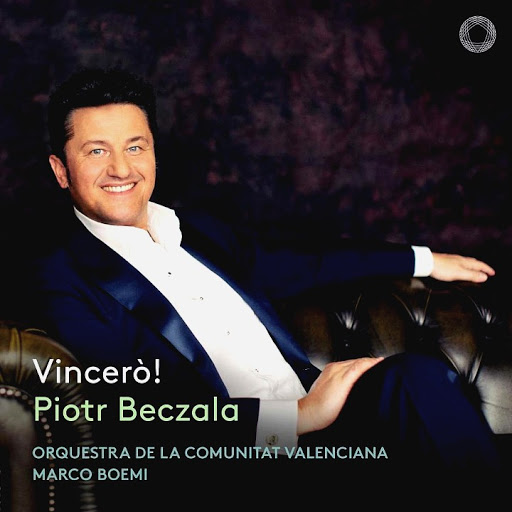
Radames is not on the CD, but Calaf is, which immediately explains the title. His ‘Nessun dorma’ is mainly tender and the Cor de la Generalitat Valenciana supports him well. There is one downside: ‘Aveto torto … Firenze è come un albero fiorito’ from Puccini’s Gianni Schicchi. Beczala has long since outgrown this role.
English translation Douglas Nasrawi
VINCERÓ
Puccini, Cilea, Mascagni, Giordano, Leoncavallo, Verdi
Piotr Beczala (tenor)
Evgenya Khomurtova (mezzo-soprano)
Cor de la Generalitat Valenciana
Orquestra de la Comunitat Valenciana conducted by Marco Boemi
Pentatone PTC 5186 733
Luisterend naar deze cd moest ik ongewild denken aan de fabel van de La Fontaine, die over de mier en de krekel. De moraal: flierefluiten in de zomer is leuk maar als de winter komt heb je je spaarcenten nodig. Zo ongeveer.
Verander de ‘spaarcenten’ nu in stem en dan heb je het geheim van Piotr Beczala. Begonnen met de delicate Mozarts en de meest lyrische Verdi’s klom hij, via poëtische Rodolfo’s en Massenets des Grieux naar het repertoire wat zwaarder heet te zijn. Eerst een voorzichtige stap richting Lohengrin en Gustavo (Ballo in Maschera), maar toen ging het hek open en: et voilà! Hier staat een tenor aan een begin van de derde belangrijke fase in zijn professionele leven, die van het lyrico-spinto.
Na Mario (Tosca) en Maurizio (Adriana Lecouvreur) komen nu Radames en Calaf aan de beurt en dat is geen kattenpis. En weet u wat? Hij kan het! Hij benadert die rollen minder ‘heldisch’, iets wat eigenlijk helemaal niet hoeft. Luister naar zijn illustere voorgangers waar zijn stem – met de snik en de traan – het meeste op lijkt, Tauber en Kiepura. Hij benadert zijn helden emotioneel en schuwt het sentiment niet, want niet inhoudt dat hij schmiert.
Wat ik wel jammer vind is dat hij voor de bekendste aria’s uit het repertoire heeft gekozen. Maar van de andere kant: het gaf hem kans om te vergelijken en die vergelijking valt in zijn voordeel uit, zeker wat de hedendaagse tenoren betreft.
Radames staat er niet op, wel Calaf, wat de titel van de cd meteen verklaart. Zijn ‘Nessun dorma’ is voornamelijk teder en het Cor de la Generalitat Valenciana steunt hem er goed bij. Er is wel een minpuntje: ‘Aveto torto … Firenze è come un albero fiorito’ uit Puccini’s Gianni Schicchi. Die rol is Beczala al ontgroeid.
VINCERÒ
Puccini, Cilea, Mascagni, Giordano, Leoncavallo, Verdi
Piotr Beczala (tenor)
Evgenya Khomurtova (mezzosopraan)
Cor de la Generalitat Valenciana
Orquestra de la Comunitat Valenciana olv Marco Boemi
Pentatone PTC 5186 733
As a young singer you could, so to speak, take part in a singing competition every week. Everywhere there are opportunities to sing yourself into the spotlights. Great news for the many talents that are around. But not everything is necessarily positive.
It is claimed that ‘the public’ is fond of competitions and I believe that. Already in antiquity people were able to keep their minds at rest with bread and games; and all kinds of competitions were organised, for poets and philosophers, but also for singers. The tradition lived on, and singing competitions also found their way into operas. Just think of Die Meistersinger or Tannhaüser. You were always rewarded for your singing skills. Once you were allowed to take the beautiful bride home, nowadays your price has become more tangible. A sum of money, a contract with an opera house and secret hopes of fame and a great career. No wonder, then, that there are so many competitions.
But: aren’t there too many now? Shouldn’t there be an age limit? Can you compare a singer who already sings at big houses with a starting colleague? Do competitions bring what the often very young participants have hoped for? Does it help them in their careers? You win and then? And how do you deal with your loss?
All these questions made me decide to take a closer look at the phenomenon of ‘singing competitions’ and to talk to some directly involved.
Maartje Rammeloo (soprano):
Een bijschrift invoeren
In 2008 Maartje Rammelo was one of the semi-finalists of the IVC, where she eventually won the Staetshuijs Fund Prize. At the Belvedere Competition in 2013 she reached the semi-finals. She also won an engagement in Essen. Rammeloo was a finalist at the Montserrat Caballé Competition in Zaragosa and at the Wilhelm Stennhammer Competition in Sweden.
“Taking part in competitions gives a double feeling. It inspires and is exciting, but results are either terribly predictable or completely bizarre.
You always participate with the aim to show the best of yourself and hope that this is sufficient to convince a jury of your quality: but how can you judge the skill and artistry of a musician in a competition? In an audition for a production, an artistic team has a concept and an idea about who should play a role. But in such a contest, several judges, each with their own taste, compare apples with pears: a Figaro with a Tosca, a Handel countertenor with a Wagner soprano.
Not to mention the intrigues and the hidden agendas of some judges, the chauvinism in regional competitions and the exoticism/commercialism of sometimes choosing singers who don’t necessarily give the best performance, but who are very interesting because of their origin or appearance.
So why participate? It gives you a chance to try out new repertoire and get feedback. It’s a chance to sing for the most important people in the profession, for whom you’ll never get an audition arranged in real life without a brilliant agent who guides you in.
I haven’t yet participated in a competition that didn’t either involve me in work or contacts, or gave me some useful feedback. And that is ultimately what we want: to work! Sing! To stand in front of an audience!
The prizes make it easier to practise your profession. From a financial point of view, because our profession doesn’t make us rich in the first few years, and also in terms of fame, which in turn can create more work. But just as well there are plenty of prize winners of whom we will never hear from again and singers who have never won a competition that now have a world career. At the end of the day it’s all about the long haul, not about the quick success…
What is always very difficult with competitions, is choosing your repertoire. First of all, few singers are 100% sure of their ‘fach’. Most of them doubt again and again what judges would like to hear them in.
Each competition has its own requirements. So many arias in total, so many of them from the list of compulsory works, of which your first round may only last for so many minutes and the jury detirmines the number of arias for the next round, and so on. Terribly difficult. Because you want to be heard as much as possible. Different languages, different styles, different techniques and topics.
There are also a number of competitions that offer more than just the competition element. I now also encourage my own students to look out for those. Contests like the IVC that use things like a youth jury, master classes, concerts and lectures to make it a real singing festival. And these are often the competitions that keep in touch with you in the years that follow. Who are committed to the further development of the singers. But unfortunately there are very few of them…
I have learned that if you sing what you feel comfortable with and what you are really good at, then at least one person will be happy after your performance. Namely you.
Maartje Rammeloo sings ‘I want magic!’ from The Streetcar named Desire by André Previn:
In 2012, Piotr Barański was a semi-finalist at the IVC in Den Bosch.
“For a long time I didn’t want to know anything about competitions, I didn’t think I was the type for them. You not only have to prepare yourself well, but also be sure of yourself and show the best of yourself to the jury, you have to perform while under stress. You have to be able to handle that very well and not everyone can.
And yet – competitions are very important. You get the chance to present yourself to a wider audience, to get to know new, important people – and in our profession we have to rely on connections and networks. And of course it’s very important that you can show yourself to conductors, agents, planners and casting directors who are looking for new talents.
Unfortunately, there are competitions where the eliminations and the first preliminaries take place behind closed doors and only the finals are open to the public. The chances of learning something from such competitions are then minimal.
The criteria of the jury are not always clear and the results can be very controversial. I know singers who, singing at the same level, win the highest prizes at one competition, while at the other they do not get any further than the preliminaries.
What is very important to me is the feedback. It is of the utmost importance for the further development of a singer to at least exchange a few words with the jury members, something that indeed happened at IVC and that has helped me enormously. A healthy, positive critique is indispensable and constructive.”
Piotr Barański (countertenor) and Hans Eijsackers (piano) in “Lullaby” from ‘Songs and Dances of Death’ by Modest Mussorgsky.
“The results of singing competitions are already quite unpredictable – how a career goes after that is even more like gazing into a crystal ball! A performance (because that is what singing at a competition in fact is) is and remains a snapshot, even for those who listen and/or judge. There are so many factors involved: age, experience, musicality, voice, repertoire, language skills, etc. that it is sometimes difficult to determine which aspect is decisive.
The preparations for a competition, selecting and working on the repertoire with a singing teacher and a coach are invaluable. This requires great concentration and discipline – the pieces you have to learn will not be forgotten for the rest of your life – and in addition you have to make yourself strong to present yourself, you have to find the courage to do so, and you have to be able to cope with nervousness.
My experience is that a competition is always good for the development of a singer, even if in the worst case you are sent home. After all, the next day you have the choice: either you stop, or you decide to continue and develop yourself further in order to find new opportunities. Almost always you choose the second option and then it has been a good experience! Competitions are very valuable, even if you don’t win a prize…”
Reinild Mees accompanies Tania Kross in ‘Der Kaiser’ by Henriëtte Bosman±.
Reinild Mees and all Szymanowski songs, sang by (a.o.) Piotr Beczala and Iwona Sobotka.
Mauricio Fernández (from 1983 to 2016 casting director NTR Saturday Matinee):
“As casting director of one of the most ambitious and internationally recognised concert series in the world, I have attended several singing competitions over the past thirty years – as a juror and as an ‘observer’.
If you ask me who the real star singers were that I have heard, I have to dig deep into my memory to give you an honest answer. It is a fact, at least for me, that the really interesting singers, who have an international career by now, often didn’t even reach the semi-finals or even won a prize at all.
It’s a waste of time to pain yourself with the question why the singers who didn’t deserve it in your ears/eyes go home with the biggest prizes. There’s no point in understanding the thoughts of those who have rewarded them: artistic directors, casting directors, directors, singers or teachers.
We should think about why we need all these competitions. Are they primarily intended to broaden the judges’ network or are they supposed to serve the interests of the young talented singers in order to help them build a decent career? A long lasting career that can pay for everything they have invested in it – money and often personal sacrifices.
Don’t forget that singers, like all sincere musicians and artists, have an important mission: to warm the hearts of the audience, in the theatre or in your living room. They are in favour of treating the legacy of the composer with respect and of ensuring that opera, as a living art form, does not become extinct”.
Annett Andriesen (director of the IVC in Bosch from 2006 till 2018):
In the past, Andriesen herself has participated in several competitions. Now that she is leading a competition, she knows what a singer needs: care and respect.
“The IVC is a tough competition, but with a human face. I don’t want to make wimps out of the participants, they have to be able to cope in the big bad world. A competition is a place where opinions are formed, where singers meet and can see where they stand, they can learn to sing under high pressure, they can build a network. Above all, they have to feel safe.
The IVC places much higher demands on the composition of the repertoire, the longer list consists of three periods and requires three works from after 1915. In addition, the candidates must learn a new work by a Dutch composer.
We use the “Triple D” method: “Discover”, “Develop” (master classes, training session, feedback by jury members in personal conversations) and “Deal” (making contact with impresarios, concert directors and casting directors).
Let me make it clear that I don’t believe in hidden agendas or cheating jurors. I have no experience with that. I have now led three competitions and I have a lot of respect for jury members who really care about the singers and have conversations about the profession and the possible place the singer can take in it. There are singers who still have contact with jury members and on their advice have found a coach.
The jury at the IVC consists of singers/musicians who at the end of their career share their knowledge and often their network and want to share it with the young generation. In addition, casting directors or agents and intendants who you know want to help young people at the beginning of their careers. And not only because a young soloist would be ‘cheap’.
I think that the usefulness of a competition lies in meeting like-minded people, the conversations, listening to colleagues, learning repertoire from the other voice types, making friendships, making contacts and mirroring yourself to the other. There are so many singers on offer that it is good to be seen and heard in certain places and a competition could be that place. Top talent always comes to the fore.
Na een zorgvuldig opgebouwde carrière van meer dan 25 jaar bij kleinere operahuizen staat Piotr Beczala inmiddels al vele jaren aan de absolute top. Een vijf jaar oud gesprek met de Poolse tenor, over nee zeggen, zijn liefde voor operette en over eigenlijk van alles
Het is niet zo dat de tenoren (en niet alleen de tenoren!) plotseling uit de hemel vallen, al lijkt het er soms wel op. Een stem moet groeien, rijpen, ervaring opdoen, repertoire opbouwen. Slowly, slowly… alleen dan kom je er. En – nog belangrijker – je blijft er.
Niemand die daar beter van doordrongen is dan Piotr Beczala. “Je moet geduld hebben, dingen niet overhaasten en geen rollen aannemen die niet bij je passen”, zegt hij. “Vroeger was ik een notoire ‘nee-zegger’. Het is bijna niet te geloven wat voor rollen mij wel eens werden aangeboden, rollen die ik absoluut niet kon zingen, zeker toen niet. Maar ik stond stevig in mijn schoenen. Ik wilde geen eendagsvlieg zijn.”
“Nu, na een jarenlange carrière, kan en ken ik veel meer. Mijn stem heeft zich ontwikkeld en is groter en donkerder geworden, mijn techniek is solide en mijn zekerheid is gegroeid, waardoor ik mij nu veel meer op het acteren kan concentreren. De meeste rollen die mij nu aangeboden worden, kan ik zingen, dus steeds minder vaak hoef ik nee te zeggen. Casting directors en intendanten weten heel goed wat ik wel of niet zal aannemen, zodoende krijg ik ook steeds minder krankzinnige voorstellen. En mochten ze er toch mee aankomen, dan zeg ik gewoon weer nee.”
Tauber
Beczała was lange tijd een ‘geheimtip’. Zijn professionele carrière begon in 1997 in Linz, maar echt ontdekt werd hij in Zürich, het operahuis dat blijkbaar een goede neus heeft voor tenoren (ook Jonas Kaufmann en Pavol Breslik komen daar vandaan).
Voordat hij zijn debuut maakte in de grootste en belangrijkste operahuizen ter wereld, zong hij ook in Amsterdam. Drie keer maar liefst: in Król Roger van Szymanowski, Jevgeni Onjegin van Tsjaikovski en La Bohème van Puccini.
Hieronder zingt Beczala aria van Pasterz uit Król Roger. Het geluid komt uit de Naxos opname olv Jacek Kaspszyk:
Beczala heeft een wat vooroorlogse look en beschikt over een meer dan gewoon acteertalent, wat tegenwoordig niet onbelangrijk is. Toch bleven de contracten met platenfirma’s uit, wat misschien ook wel goed voor hem was. Zo kon hij zich zonder lawaaierige reclamecampagnes ontwikkelen tot wat hij is geworden: één van de beste lyrische tenors ter wereld. Ook Deutsche Grammophon kon niet langer meer om hem heen en Beczala tekende in het najaar van 2012 een exclusief contract bij de firma.
Beczala bij de ondertekening van zijn contract met Deutsche Grammophon (foto: Stefanie Starz)
Beczala’s ietwat ouderwetse timbre doet denken aan een Wunderlich, Gedda of zelfs Kiepura. Wat hij verder met die voorgangers gemeen heeft, is zijn voorliefde voor operette, een genre dat hij een warm hart toedraagt en dat hij vaak en graag zingt.
Het is dan ook niet verwonderlijk dat zijn eerste solorecital bij DG, Mein ganzes Herz, een operetteprogramma bevat
“Van DG kreeg ik groen licht voor mijn eigen keuze van het orkest en de dirigent. Ik dacht onmiddellijk aan de jonge Poolse dirigent Łukasz Borowicz, met wie ik eerder een cd met Slavische opera-aria’s heb opgenomen (Orfeo C814 101). Ook wat het orkest betreft stond mijn keuze meteen vast: het moest het Royal Philharmonic zijn!”
“Het programma is simpel: operette! Van Lehár en Kalmán tot Robert Stoltz en Carl Bohm. Er wordt ook moderne technologie toegepast, dus behalve echte gasten van nu, zoals Anna Netrebko, Avi Avital en de Berlin Comedian Harmonists, komt ook Richard Tauber zelf langs. Met hem ga ik een duet zingen! Als dat niet bijzonder is…”
Lohengrin
“Het is nu ook de tijd om mijn repertoire te gaan uitbreiden. Tegen 2015 ga ik zwaardere rollen uitproberen.
Hieronder: trailer van Lohengrin uit Dresden, met Anna Netrebko, Piotr Beczala & Christian Thielemann
En hier ‘E lucevan le stelle’ (Tosca) – encore in de Wienner Staatsoper 10.02.2019
Beczala wil niet de geschiedenis ingaan als de operettezanger. “Ik houd van operette, maar ik ben een operazanger en ik wil ook meer doen met de liederen. Voorlopig ben ik dat aan het aftasten.
Hieronder zingt Piotr Beczala ‘Daleko zostal caly swiat’ van Karol Szymanowski:
Met Christian Thielemann heb ik liederen van Strauss gezongen en in Santa Monica heb ik een recital gegeven met onder anderen Schumann en Karłowicz, een ongebruikelijke maar mooie en logische combinatie.”
Piotr Beczala en Helmut Deutsch in ; Skąd pierwsze gwiazdy’ van Mieczyslaw Karlowicz:
Dirigenten
Piotr Beczala & Nello Santi: Un ballo di Maschera in Opernhaus Zürich
Met welke maestro’s Beczala, naast Thielemann en Borowicz, nog meer graag samenwerkt? “De allerbeste is voor mij Nello Santi. Absoluut. Maar ik houd ook van Marco Armiliato. Of dat komt doordat zijn broer een operazanger is? Het kan. Maar of het echt zo is…”
Er zijn ook dirigenten waar Beczala minder blij van wordt. “Ik wil niet meer werken met dirigenten die geen respect hebben voor zangers en niet weten hoe ze met zangers moeten omgaan. Ik noem geen namen, maar de meesten komen uit de oude muziek. Wat absoluut niet betekent dat álle oudemuziekdirigenten niet deugen.”
Wat zijn ervaring is met zangers die zijn gaan dirigeren, zoals Plácido Domingo? “Domingo heeft het euvel dat hij in het heden leeft, in de tegenwoordige tijd. Hoe zal ik dat uitleggen… Beschouw het verschil tussen een ‘zangerdirigent’ en een ‘gewone’ dirigent als het verschil tussen een pianist en een organist. Een pianist denkt aan de klank die nu klinkt, een organist denkt vooruit, aan de resonans van de klank die komen gaat.”
REGISSEURS (en zijn beroemd ‘zwartboekje’)
Beczala als Rodolfo in Salzburg
“Ik heb helemaal niets tegen updaten, als het maar herkenbaar wordt. Ik ben dan ook niet tegen modern, maar wel tegen dom, tegen idioot, tegen vergezocht! Ik heb inderdaad een ‘zwartboekje’ met de namen van regisseurs met wie ik nooit (meer) samen wil werken.”
“Ik heb het geluk dat ik dingen kan aannemen of weigeren, maar veel van mijn (beginnende) collega’s hebben het privilege niet. Soms denken ze dat als ze in een spraakmakende productie staan ze het dan gaan maken, maar zo werkt dat niet. In ons beroep moet je het van de muzikaliteit en de toewijding hebben. De regisseurs denken vaak dat ze God zijn, maar dat zijn ze niet, je moet je je niet aan hen overleveren maar aan de genius van de componisten.”
“Welke regisseur ik het meeste bewonder? Franco Zeffirelli, zonder meer. Zeffirelli is meer dan een regisseur, hij is een monument, je kan hem inmiddels als ons cultureel erfgoed beschouwen. Zijn producties waren (en zijn nog steeds!) immer fantastisch, ze moeten gekoesterd worden. Het was voor mij een feest om met hem te werken, het geeft een mens achter de zanger immens veel plezier.
Ik heb ook een bijzonder zwak en veel bewondering voor Guy Joosten. Zijn Romeo et Juliette in de Newyorkse Metropolitan was werkelijk prachtig, daar hebben wij, de zangers ook enorm van genoten.
THUIS
Als je zo veel reist en in zo veel verschillende steden verblijft, heb je dan nog het gevoel dat je ergens ‘thuis’ bent? “Thuis zijn wij inmiddels overal”, lacht Beczala. “Al houdt Kasia, mijn vrouw, het meeste van New York.”
“Ons echte thuis is in Kraków, in Polen, maar daar zijn we niet vaker dan twee weken per jaar. Gelukkig heb ik nu appartementen in steden waar ik het meeste optreed: Wenen, Zürich en New York. Dat is fijn en vertrouwd. Eigen bed, eigen toilet en eigen wijn: het helpt!
Op mijn: “kunnen wij je ook in Amsterdam verwachten” komt een diepe zucht. Maar dan komt er toch een antwoord: “Wie weet? Ik zou best graag in de ZaterdagMatinee willen optreden”.





















 Basia con fuoco