Who does not know ‘Méditation’, the sentimentally sweet but oh-so-beautiful piece of violin music? Most often it will make you cry.
Méditation in Josef Hassid’s performance:
However, not many people have ever heard, let alone seen, the opera in which this piece acts as a kind of interlude in the second act.
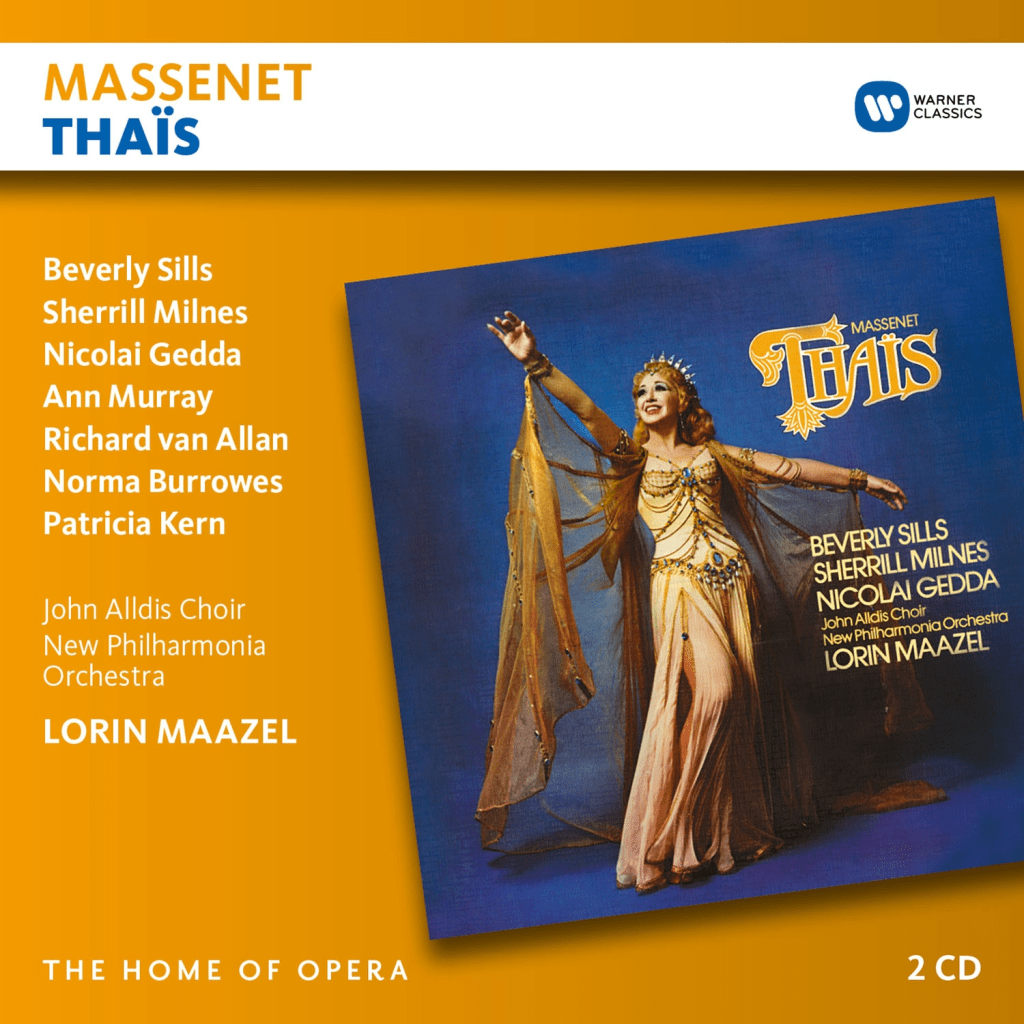
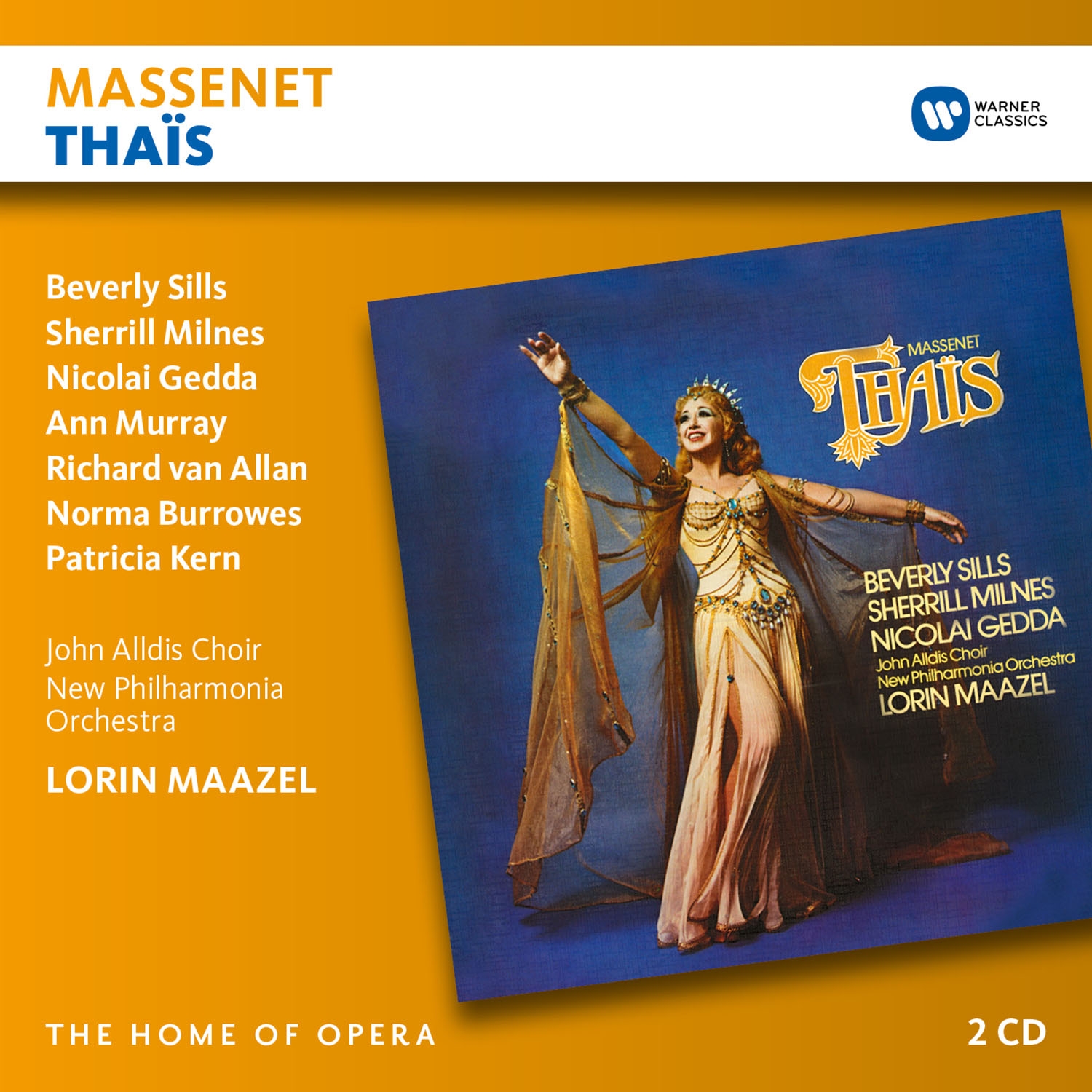
Recordings of the complete work are still scarce, I only know of three myself (with Anna Moffo, Beverly Sills and Renée Fleming), of which the one with Sills, Sherrill Milnes and Nicolai Gedda (Warner 0190295869069) is dearest to me.
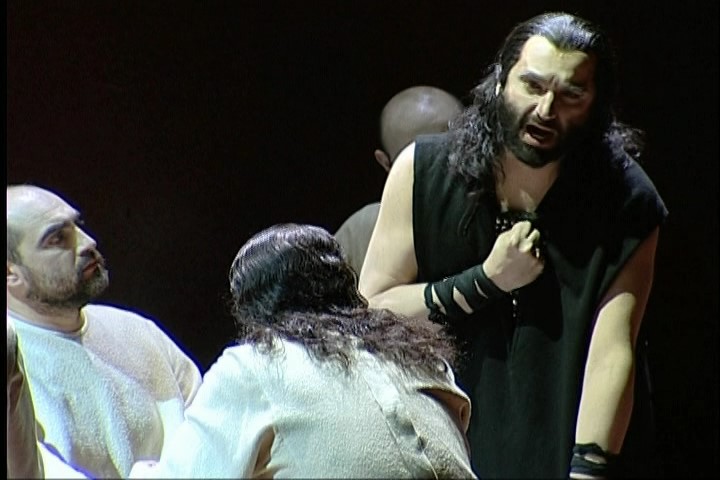
Below Beverly Sills and Sherrill Milnes in the final scene of the opera:
Pier Luigi Pizzi’s production from La Fenice had previously been released on CD and I found it particularly strong musically and mainly vocally. I was therefore particularly curious as to whether the visuals added anything to it on Dynamic’s DVD. To which I can now say a resounding “yes”.
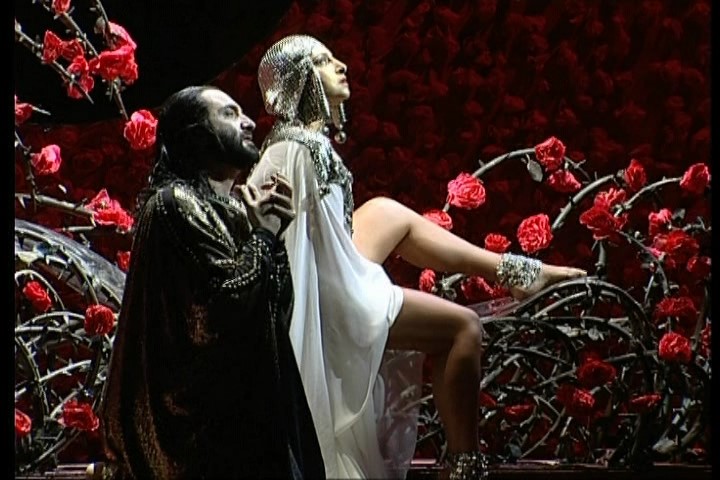
The sets are sparse, yet the stage seems to be completely full of them. Because of the colours (with very predominant red) perhaps, but also because of the dominant place they occupy on stage. For instance, Thaïs’ rose-covered bed, on which she – as if she were the Venus of Urbino or one of the versions of Danaë, also by Titian – lies very voluptuously. This bed is very prominently in the centre of the stage.
In the third act, when the fun life has ended and the penance begins, the roses are nowhere to be seen (a bed of thorns?) and her posture is as chaste as her white robe.
The costumes are a story apart: very opulent, oriental and barely concealing. Eva Mei doesn’t go as far as her colleague Carol Neblett, who went completely out of her clothes in New Orleans in 1973, but her see-through little nothing of a dress, from which her breasts keep escaping almost unnoticed, leaves nothing to the imagination.
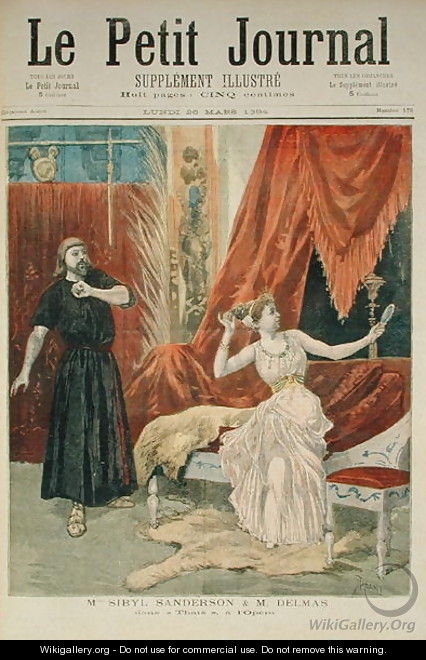
Perhaps she was inspired by the very first Thaïs, Sybil Sanderson, whose breasts were also ‘accidentally’ visible during the premiere performance in 1894? Then again, it is all about the greatest (and most beautiful) courtesan in Alexandria!
Eva Mei is very virtuoso and very convincing as Thaïs . So is Michele Pertusi as Athanael. There is a lot of ballet, though. Also where it really shouldn’t be, which is very distracting at times.
Thaïs from Toronto: unearthly beautiful orchestral playing
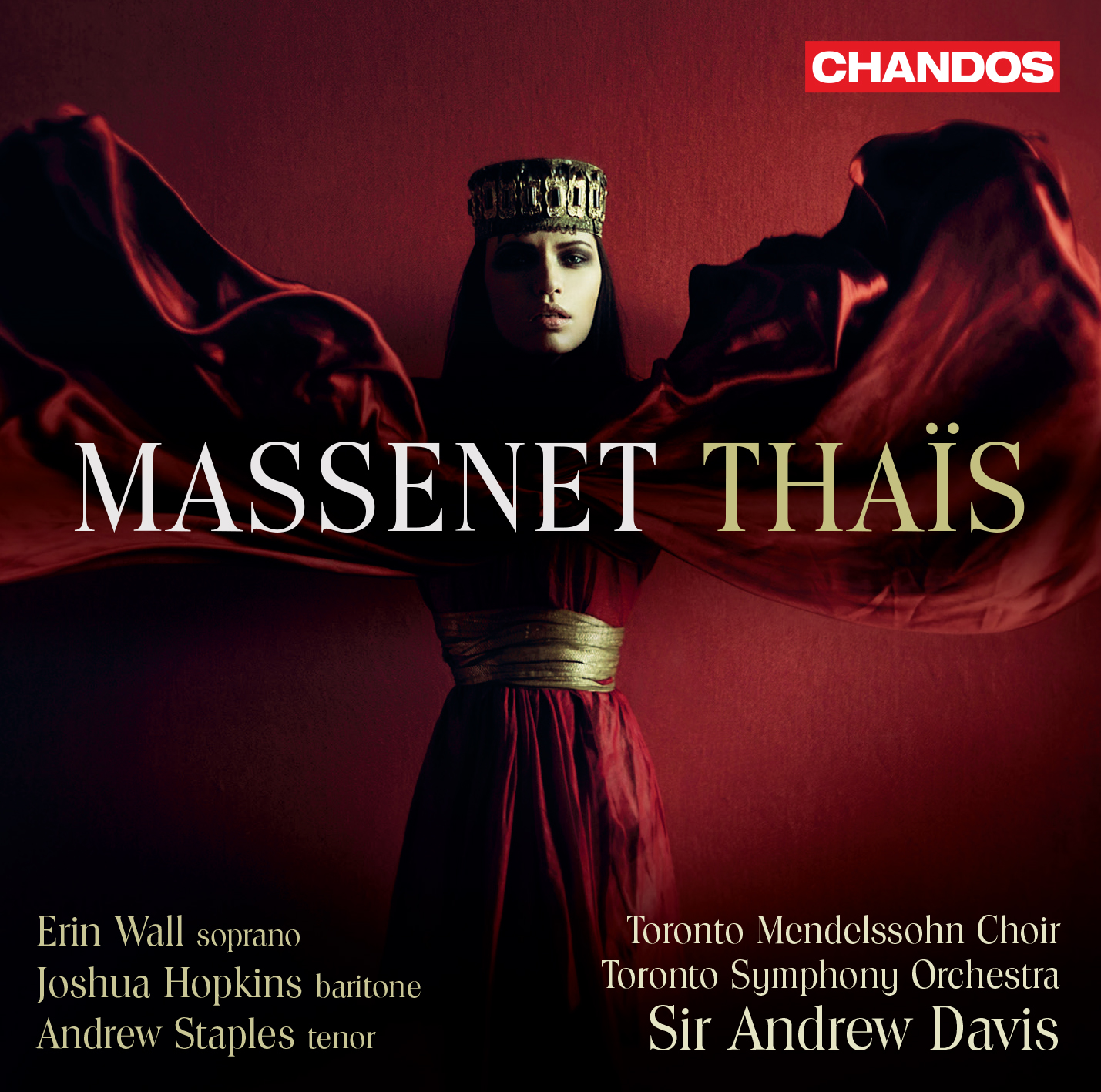
Recordings of Thaïs are still scarce so any new releases are more than welcome. Especially if the performance is good, and this new recording on Chandos most certainly is. At least: to some extent.
The Toronto orchestra sounds so incredibly beautiful that you cannot help falling in love with it. Sir Andrew Davis truly extracts the impossible from his musicians: I have not heard the score performed so beautifully before. The pianissimi, the way they manage the quiet passages to perfection, the subcutaneous tension. Hats off! Hats off also to the violinist who manages to add new layers to the ‘Meditation’. So beautiful!
Unfortunately, the singers lag a bit behind. Erin Wall is a beautiful soprano with a crystal-clear voice, but a ‘Whore of Babylon’? More like a rather childishly naive girl.
Joshua Hopkins has the right voice for Athanael but he goes the wrong way when it comes to ‘earthly desires’. Andrew Staples is a good Nicias but he too fails to fully convince me.
In 2021 ging in Wenen een nieuwe productie van Massenets opera Thaïs. De regie was in handen van Peter Konwitschny. Decors en kostuums kwamen voor rekening van Johannes Leiacker. Dit gerenommeerde duo stond voor de taak om ondanks alle corona gerelateerde beperkingen een volwaardige productie af te leveren. Daar zijn ze redelijk in geslaagd. Een opname zonder publiek is op Bluray uitgebracht door Unitel.
Het libretto van Thaïs is gebaseerd op de gelijknamige roman van Anatole France uit 1890. Daarin wordt het losbandige leven, de bekering door toedoen van een doortastende monnik en de boetedoening van de legendarische courtisane Thaïs beschreven. Deze vermoedelijk historische figuur leefde in de vierde eeuw in Alexandrië en werd later heilig verklaard. Santa Thaïs heeft een reputatie die ruwweg te vergelijken is met die van Maria Magdalena.
Anatole France voegde een geheel nieuwe dimensie aan het verhaal toe door de monnik in kwestie verliefd te laten worden op zijn ‘bekeringsproject’ waardoor hij weliswaar haar ziel redt maar de zijne verspeelt. ‘Eeuwig leven en zielenheil, wat doet het er toe. De enige echte liefde is die tussen levende mensen’ zingt hij vertwijfeld.
De handeling speelt zich in Wenen af op een vrijwel leeg toneel met een groot gordijn als achterdoek. Door dit gedeeltelijk opzij te schuiven of op te halen kunnen personages of zelfs een geheel koor snel opkomen en afgaan.
Athanaël maakt zijn opwachting in Alexandrië bij zijn jeugdvriend Nicias die toevallig net ten koste van zijn complete (?) vermogen een week exclusieve aandacht van Thaïs heeft weten te verwerven. Het wordt zijn laatste avond met haar en hij is niet te beroerd die verdwaasde monnik aan haar voor te stellen.
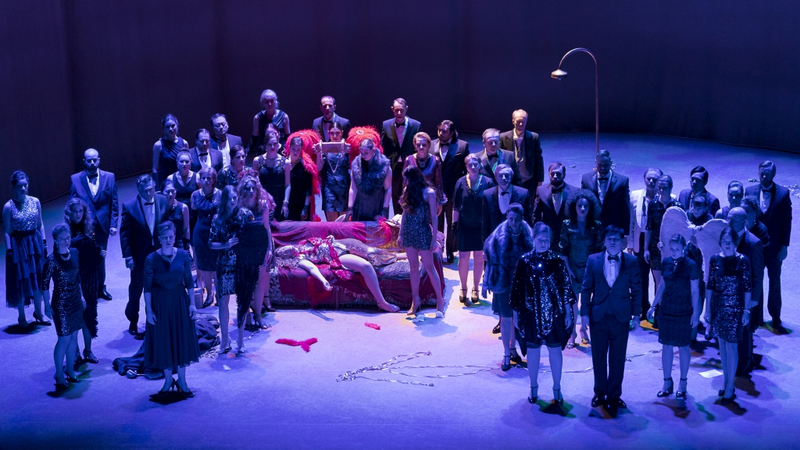
Het huis van Thaïs wordt slechts geduid door een kleurige sofa. Haar rijkdom moeten we aflezen aan een exuberant kostuum, getooid met rode vleugels. Alle anderen lopen ook met vleugels rond maar die ogen veelal wat meer ingehouden. De menigte is modern stemmig gekleed, met witte vleugels. Ter onderscheid lopen alle monniken rond in het zwart met bijpassende vleugels. Wellicht wordt hier bedoeld dat je niet perse in een klooster hoeft te leven om een engel te kunnen zijn.
Athanaël begint voortvarend aan zijn missie om Thaïs terug tot het christelijk geloof te brengen door haar levenswijze af te kraken en haar een prachtig bestaan in het hiernamaals voor te spiegelen. Konwitschny heeft echter zo zijn twijfels over wat er in het hoofd van die monnik omgaat.
Athanaël gaat zo tekeer dat hij Thaïs angst inboezemt. Zij zingt ‘Pitié, ne me pas de mal’. De regie laat hem haar zonder pardon verkrachten en vervolgens wordt hij door haar bereden. Dat gebeurt natuurlijk niet in werkelijkheid maar zo wordt op niet mis te verstane wijze getoond dat hij niet denkt wat hij zegt. Later geeft hij dat toe: ‘Het was een leugen. Er is geen hiernamaals, alleen het leven telt.’
Aanvankelijk wil Thaïs er allemaal niets van weten maar tijdens een droom, begeleid door de overbekende vioolsolo ‘Meditation’, komt ze tot inkeer en laat zich door Athanaël wegvoeren naar de woestijn met achterlating van al haar bezittingen. Dat gaat niet zonder slag of stoot. Ze wil een beeldje meenemen dat Eros voorstelt. Het wordt hier voorgesteld door een klein jongetje met een pijl en boog dat zo nu en dan gezellig bij Thaïs op schoot kruipt. Als Athanaël hoort dat ze het ooit van Nicias heeft gekregen, dat verdorven heidense individu, ontsteekt hij in woede en schiet het jongetje neer.
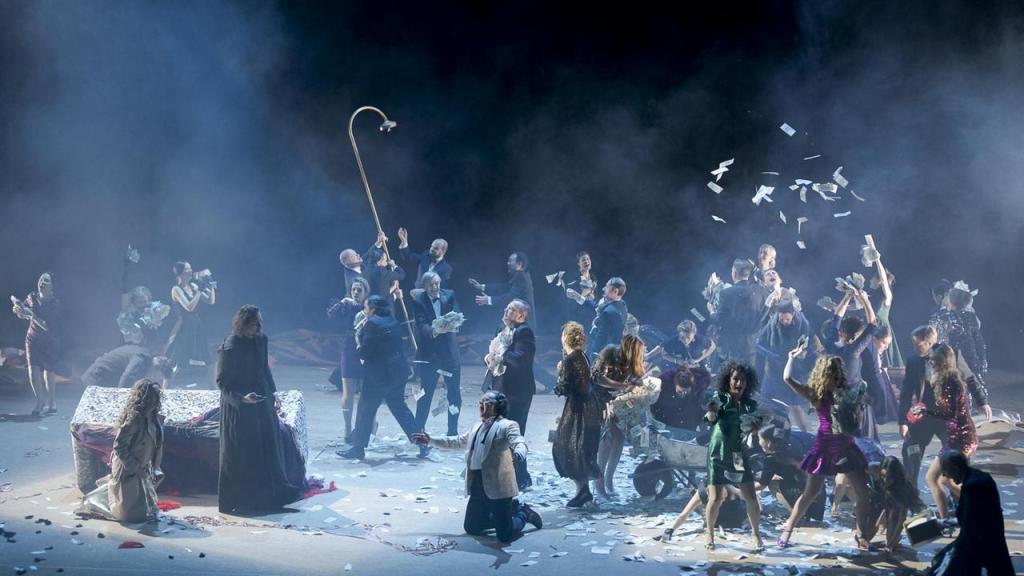
De menigte krijgt lucht van Thaïs’ vermeende ontvoering en wil die beletten. Athanaël schiet wild in het rond om hen op afstand te houden maar het volk komt pas tot bedaren als Nicias arriveert met een kruiwagen vol geld dat hij begint rond te strooien. Kennelijk had hij nog iets achter de hand gehouden.
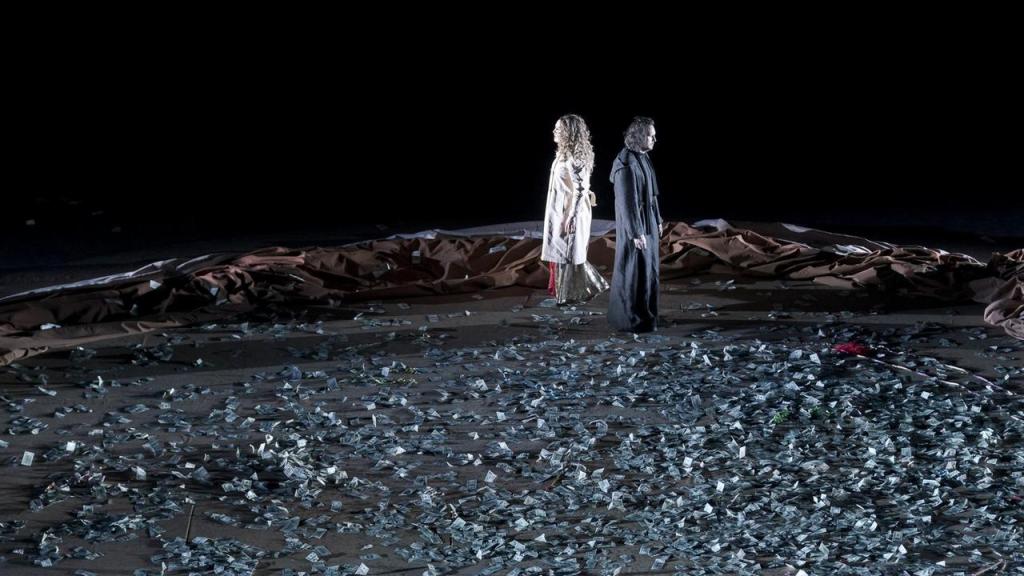
Muzikaal doet Thaïs me zo nu en dan denken aan Manon, een van Massenets grote succesnummers. Als ze zichzelf in de spiegel bekijkt en zingt ‘Dis-moi que je suis belle’ hoor ik echo’s van ‘Je marche sur tous les chemins’. Ook scenisch is er een parallel: beide dames slepen zich aan het einde voort door een woestijn. Manon sterft, Thaïs bereikt nog net het nonnenklooster waar Athanaël haar naar toe brengt. De scène waarin hij terugkeert in zijn eigen klooster is gecoupeerd. We zien en horen hem direct aansluitend van zijn geloof afvallen.
Nicole Chevalier is niet helemaal opgewassen tegen de eisen die de titelrol aan haar stelt maar houdt zich toch vrij goed staande. Hetzelfde kan worden gezegd van Josef Wagner als Athanaël. Roberto Sacca geeft een goede vertolking van Nicias. De overige rollen zijn adequaat bezet.
Dirigent Leo Hussain geeft leiding aan het Arnold Schoenberg Chor en het ORF Radio-Symphonieorchester Wien. Al met al toch een wat tegenvallende Thaïs, ik had me er in elk geval meer van voorgesteld.
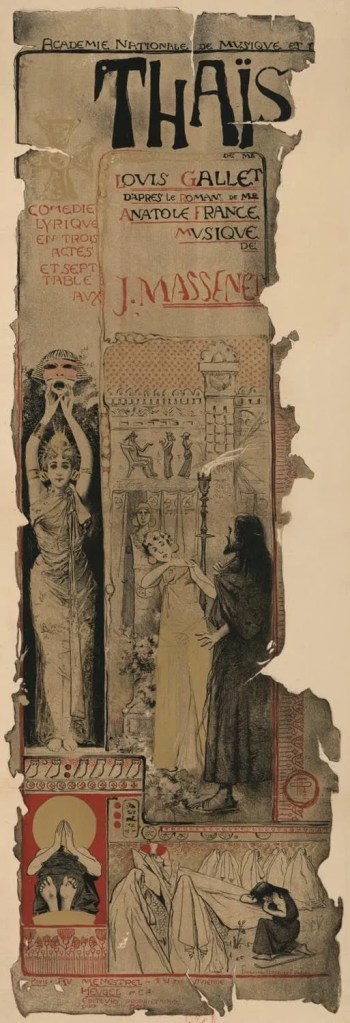
Jules Massenet was the most prolific and, artistically as well as commercially, also the most successful French opera composer between 1870/71 and World War I, the belle Epoque of the Third French Republic. He is best known for his operas, of which he wrote more than thirty. The two most frequently staged are Manon and Werther
MANON
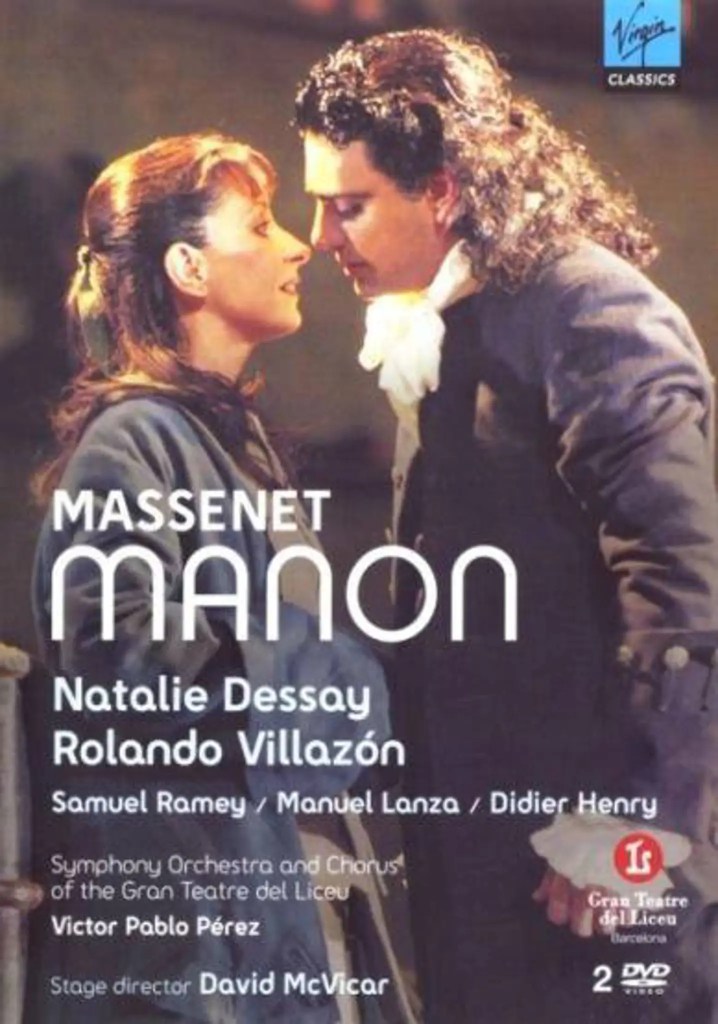
Jules Massenet’s Manon has, since its now legendary performance starring Anna Netrebko and Rolando Villazon (Berlin, April 2007), become a real hype. Anyone who had ever seen the performance could sincerely ask, like Verdi’s Ford (‘Falstaff’): ‘e sogno o realta’?
It was a reality that turned out to be a dream after all, as Netrebko found a new love, leaving Villazon with heart and voice problems. It was also not entirely clear until the last day of rehearsals whether he would sing the, scheduled for June 2007, performances of Manon in Barcelona.
He did come, and although he sang below his usual level, he managed to completely convince everyone with his acting and (sometimes a little too) intense commitment. His Manon is brilliantly portrayed by a spectacularly singing and acting, Lulu-like, Natalie Dessay.
Manuel Lanza is a fine Lescaut, but for Samuel Ramey, a singer I greatly admire, Comte des Grieux unfortunately comes too late in his career.
The mise-en-scène and character direction by David McVicar, for me still really one of the best contemporary directors, were more than excellent. The costumes were beautiful to behold and the (traditional) staging was often really surprising, all the more so as McVicar managed to give it a contemporary twist from time to time.
As a bonus, you do get a ‘peek inside’. Through a truly fascinating documentary, you can follow the stars during their rehearsals with McVicar.
WERTHER FOR BARITONE
In 1902, ten years after the premiere, Massenet produced a new version of his Werther, this at the request of Italian baritone Mattia Battistini, who was eager to sing the lead role. Massenet did not change the key, but rewrote the vocal lines of Werther’s music, making the arias, ‘Pourquoi me réveiller’ included, barely recognisable.
The “baritone version” of the opera was and remains an oddity; no original manuscript of the score even exists. In recent times, with its penchant for ever new challenges, there was also an increased interest in alternative versions of well-known operas. The baritones, tired of singing the villains, are rediscovering the repertoire, in which they can release all their lyrical melancholy.
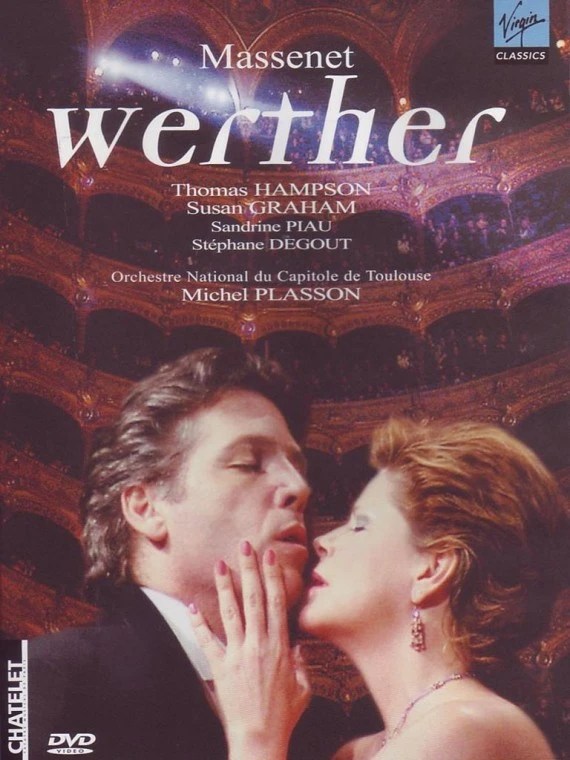
Thomas Hampson has always been an explorer of lesser-known paths and he first performed the role of Werther back in 1989. In 2004, he sang a concert performance of it at the Paris Chatelet, and that performance has been released by Virgin on two DVDs. He does an excellent job, but the manic-depressive is a bit off.
His Charlotte is sublimely sung by Susan Graham, who also performed the role in Amsterdam some years ago, where she moved the audience and press to tears. Michel Plasson has all the drama at his fingertips as you can hear.
“Pourquoi me réveiller” by three tenors
Alain Vanzo :
Sergei Lemeshev in Russian:
Jonas Kaufmann:
Piotr Beczala:
THAÏS
Who does not know ‘Méditation’, the sentimentally sweet but oh-so-beautiful piece of violin music? Most often it will make you cry.
Méditation in Josef Hassid’s performance:
However, not many people have ever heard, let alone seen, the opera in which this piece acts as a kind of interlude in the second act.
Recordings of the complete work are still scarce, I only know of three myself (with Anna Moffo, Beverly Sills and Renée Fleming), of which the one with Sills, Sherrill Milnes and Nicolai Gedda (Warner 0190295869069) is dearest to me.
Below Beverly Sills and Sherrill Milnes in the final scene of the opera:
DVD from La Fenice
Pier Luigi Pizzi’s production from La Fenice had previously been released on CD and I found it particularly strong musically and mainly vocally. I was therefore particularly curious as to whether the visuals added anything to it on Dynamic’s DVD. To which I can now say a resounding “yes”.
The sets are sparse, yet the stage seems to be completely full of them. Because of the colours (with very predominant red) perhaps, but also because of the dominant place they occupy on stage. For instance, Thaïs’ rose-covered bed, on which she – as if she were the Venus of Urbino or one of the versions of Danaë, also by Titian – lies very voluptuously. This bed is very prominently in the centre of the stage.
In the third act, when the fun life has ended and the penance begins, the roses are nowhere to be seen (a bed of thorns?) and her posture is as chaste as her white robe.
The costumes are a story apart: very opulent, oriental and barely concealing. Eva Mei doesn’t go as far as her colleague Carol Neblett, who went completely out of her clothes in New Orleans in 1973, but her see-through little nothing of a dress, from which her breasts keep escaping almost unnoticed, leaves nothing to the imagination.
Perhaps she was inspired by the very first Thaïs, Sybil Sanderson, whose breasts were also ‘accidentally’ visible during the premiere performance in 1894? Then again, it is all about the greatest (and most beautiful) courtesan in Alexandria!
Eva Mei is very virtuoso and very convincing as Thaïs . So is Michele Pertusi as Athanael. There is a lot of ballet, though. Also where it really shouldn’t be, which is very distracting at times.
Thaïs from Toronto: unearthly beautiful orchestral playing
Recordings of Thaïs are still scarce so any new releases are more than welcome. Especially if the performance is good, and this new recording on Chandos most certainly is. At least: to some extent.
The Toronto orchestra sounds so incredibly beautiful that you cannot help falling in love with it. Sir Andrew Davis truly extracts the impossible from his musicians: I have not heard the score performed so beautifully before. The pianissimi, the way they manage the quiet passages to perfection, the subcutaneous tension. Hats off! Hats off also to the violinist who manages to add new layers to the ‘Meditation’. So beautiful!
Unfortunately, the singers lag a bit behind. Erin Wall is a beautiful soprano with a crystal-clear voice, but a ‘Whore of Babylon’? More like a rather childishly naive girl.
Joshua Hopkins has the right voice for Athanael but he goes the wrong way when it comes to ‘earthly desires’. Andrew Staples is a good Nicias but he too fails to fully convince me.
CENDRILLON
A fairy tale has its own rules. Much is interchangeable, but what must never be compromised is the “happy ending”. So: the ugly duckling becomes a beautiful swan and Cinderella becomes a princess. All evil spirits are punished and we can sleep peacefully.
Sometimes I pray to those I don’t really believe in: give us back our fairy tales, because these days everything has to be totally true to nature and as realistic as possible. Fortunately, my prayers are sometimes heard and so it came to pass that I was able to enjoy an old-fashioned evening; with my cat on my lap and Cinderella on my screen.
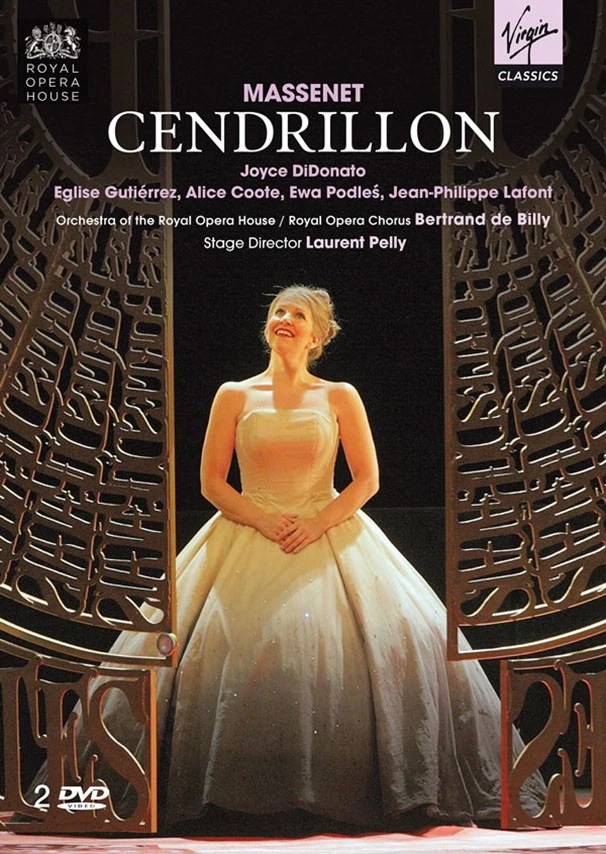
Laurent Pelly is undoubtedly one of the best contemporary directors: he puts a modern spin on everything he does, but he stays true to the libretto and the music. In the process, his staging is extraordinarily witty. As is the delightful Cendrillon, recorded at London’s Royal Opera House in 2011.
I no longer need to recommend Joyce DiDonato (Cendrillon) to anyone – she is easily the greatest ‘zwischenfach singer’ of our time. Ewa Podleś is a more than delightful stepmother and Alice Coote the most charming ‘Prince Charmant’. And to this you may add the truly idiomatic conductor (Bertrand de Billy)…. Life really can be beautiful sometimes
Trailer of the productie
HERODIADE
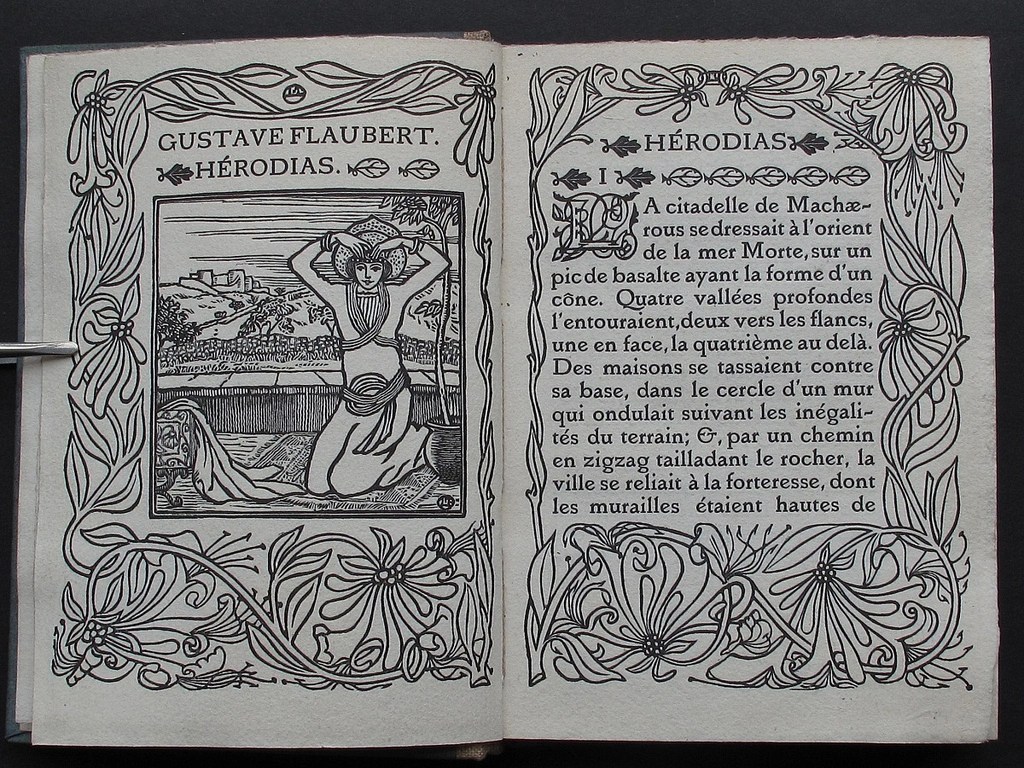
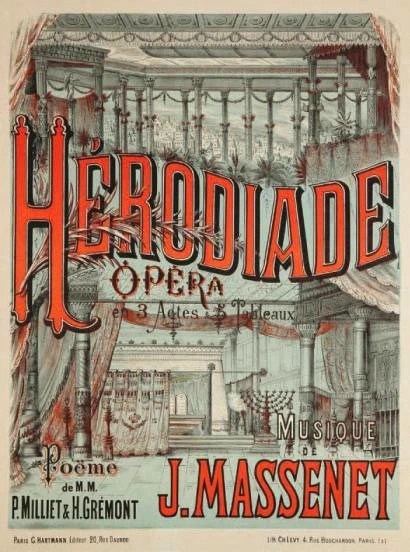
Richard Strauss composed his world hit Salome to a play by Oscar Wilde; and the latter drew his inspiration from a short story by Flaubert, ‘Herodias’. Paul Milliet and Henri Grémont also based their libretto for Massenet’s opera Herodiade on this story. Neither Wilde nor Milliet and Grémont were very faithful to Flaubert. Whereas the French novelist more or less limited himself to the biblical narrative, enriched with his poetic language and descriptions, the playwright and librettists added entirely new aspects and twists to the story.
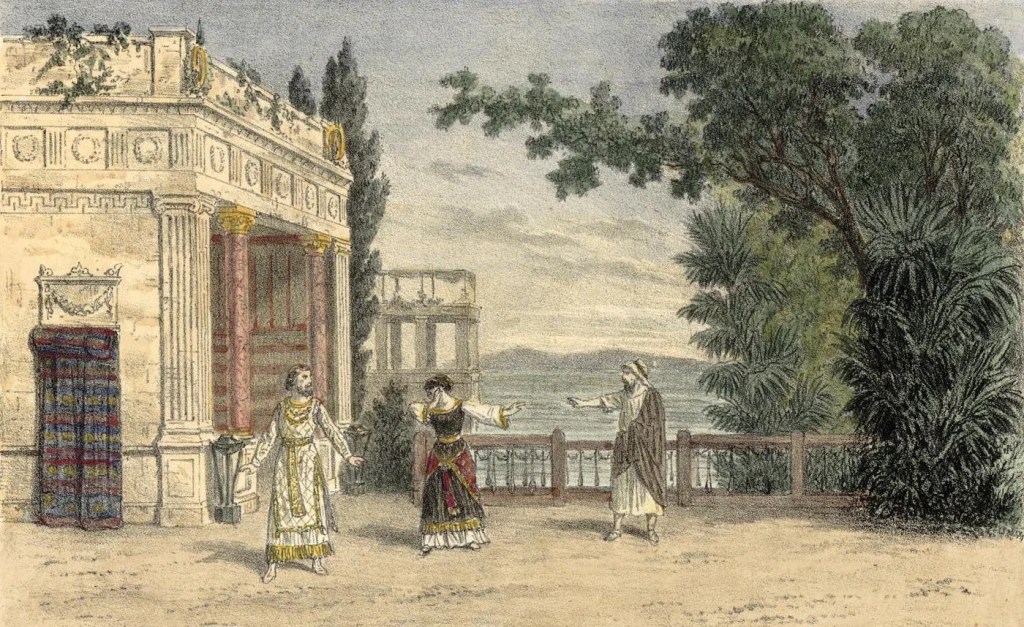
Hérodiade was first performed in the Royal Theatre of Brussels on 19 December 1881. Anyone expecting animal eroticism, blood and sweat, as with Richard Strauss, will be disappointed. Massenet’s Salome is a truly innocent and devout girl. When her mother left her to marry Hérode, she was given shelter by Jean (John the Baptist), with whom she fell in love. A love that proved to be mutual.
No opera is complete without complications: Hérode has a crush on Salome, Hérodiade becomes jealous of her and Jean is beheaded. Salome sees Hérodiade as the instigator of all evil and wants to kill her. Hérodiade whispers “I am your mother” and Salome commits suicide.
The music already exudes a hint of the perfume of Massenet’s later works, but with all those choruses, exotic Oriental scenes and elaborate ballet scenes, it is nothing less than a real Grand Opera in the best Meyerbeer tradition.
One of the earliest recorded fragments of the opera is, I think, the famous aria of Hérode ‘Vision Fusitive’ by the French baritone Maurice Renaud, made in 1908:
And from the recording Georges Thill made in 1927, we know what an ideal Jean should sound like:
Regine Crespin 1963
If you are in possession of this performance, you need look no further. It doesn’t get any better than this. There is only one problem: this recording does not exist. At least not of the complete opera.
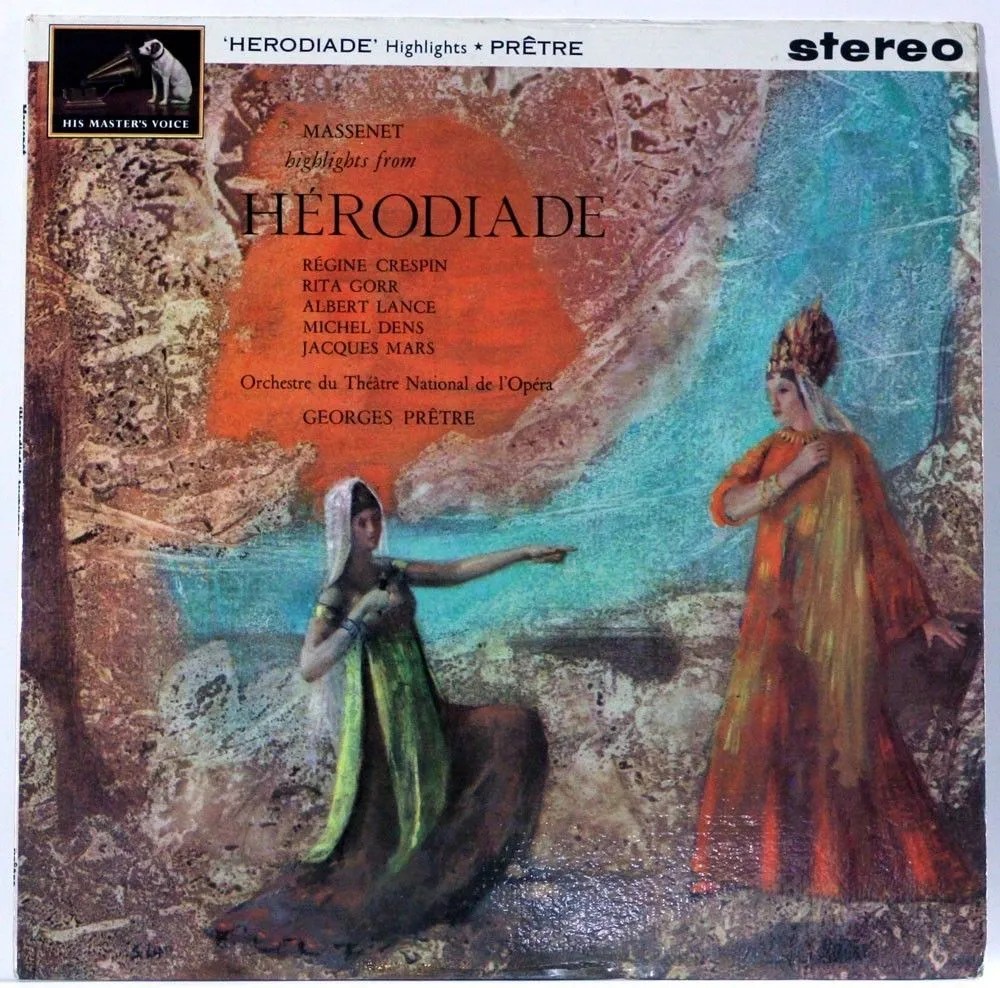
In 1963, EMI recorded the highlights of Hérodiade with the best French singers of the time (and of today, for that matter) and the answer to the “why not complete ????” will probably never be given.
Georges Prêtre conducts the orchestra of the Theater National de Paris as if his life depends upon it and every role is more than excellently cast.
Regine Crespin sings ‘Il est doux, il est bon’:
Regine Crespin’s Salomé is unequalled and so is Rita Gorr’s Hérodiade. Albert Lance (Jean) shows how that role should really be sung in the tradition of Georges Thill, and for Michel Dens as Hérode we really cannot find the right words. Such singers no longer exist.
Hopefully, Warner will one day release the recording on CD.
Montserrat Caballé (Barcelona 1984)
This recording also may only be obtained via a pirate (or You Tube), but then it is complete and moreover with (admittedly bad) images!
Dunja Vejzovic portrays a deliciously mean Hérodiade and Juan Pons is a somewhat youthful but otherwise fine Hérode. A few years later, he will become one of the best “Hérodes” and you can already hear and see that in this recording.
Montserrat Caballé is a fantastic Salomé, the voice alone makes you believe you are in heaven and José Carreras is very moving as a charismatic Jean.
Below, Carreras sings ‘Ne pouvant réprimer les élans’:
None of the protagonists is really idiomatic, but what a pleasure it is to watch a real Diva (and Divo)! They really don’t make them like that any more
The whole opera on you tube:
Reneée Fleming 1994
In the mid-1990s, Herodiade enjoyed a short-lived revival. The opera was then performed in several opera houses and it was even recorded – officially – three times: once in the studio and twice live.
I must admit that I was a bit concerned about Gergiev as the director, but he really did an excellent job. Under his baton the opera sounds like a real Grand Opéra, grand, fiery and compelling.
Plácido Domingo (Jean) is perhaps a touch too heroic, but his voice sounds youthful and contageous, worthy of a true prophet.
Personally, I find Dolora Zajick (Hérodiade) a bit on the (too) heavy side, but her singing is undeniably excellent and there is nothing wrong with her interpretation.
Juan Pons is an excellent Hérode, but I would have liked Phanuel (Kenneth Cox) to be a bit more idiomatic. Something that also applies to the Salomé of Renée Fleming: she sings beautifully but in this role she can not totally convince me.
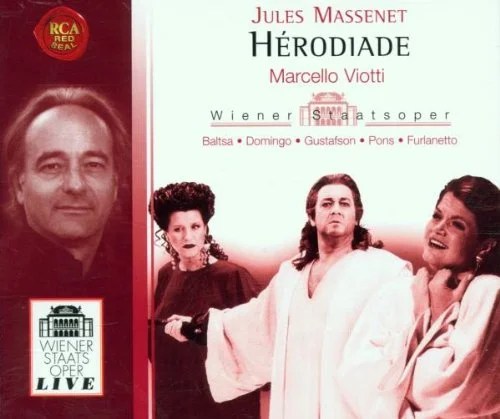
Nancy Gustafson 1995
The performance in Vienna was highly praised, and that this praise was justified is proved by the recording made live in the house by ORF.
First of all, there is Agnes Baltsa’s brilliant title role: fierce and dramatic. If you ask me: apart from Rita Gorr probably the best Hérodiade ever.
Placido Domingo sings ‘Ne pouvant réprimer les élans’:
Domingo, in the role of Jean, is even more impressive here than on Sony and also Juan Pons (Hérode) actually convinces me yet more on this recording. His rendition of ‘Vision Fugitive’ is very, very moving. Unfortunately, Nancy Gustafson (Salomé) must acknowledge the superiority of Fleming (Sony), but both pale in comparison to Cheryl Studer (Warner). Not to mention Regine Crespin!
Judging by the photos in the text booklet and the sparse clips on YouTube, we should be glad that the recording appeared on CD and not on DVD.
Finale of the opera:
In any case, the sound is excellent and the Vienna Opera orchestra under the direction of Marcello Viotti plays with great passion.
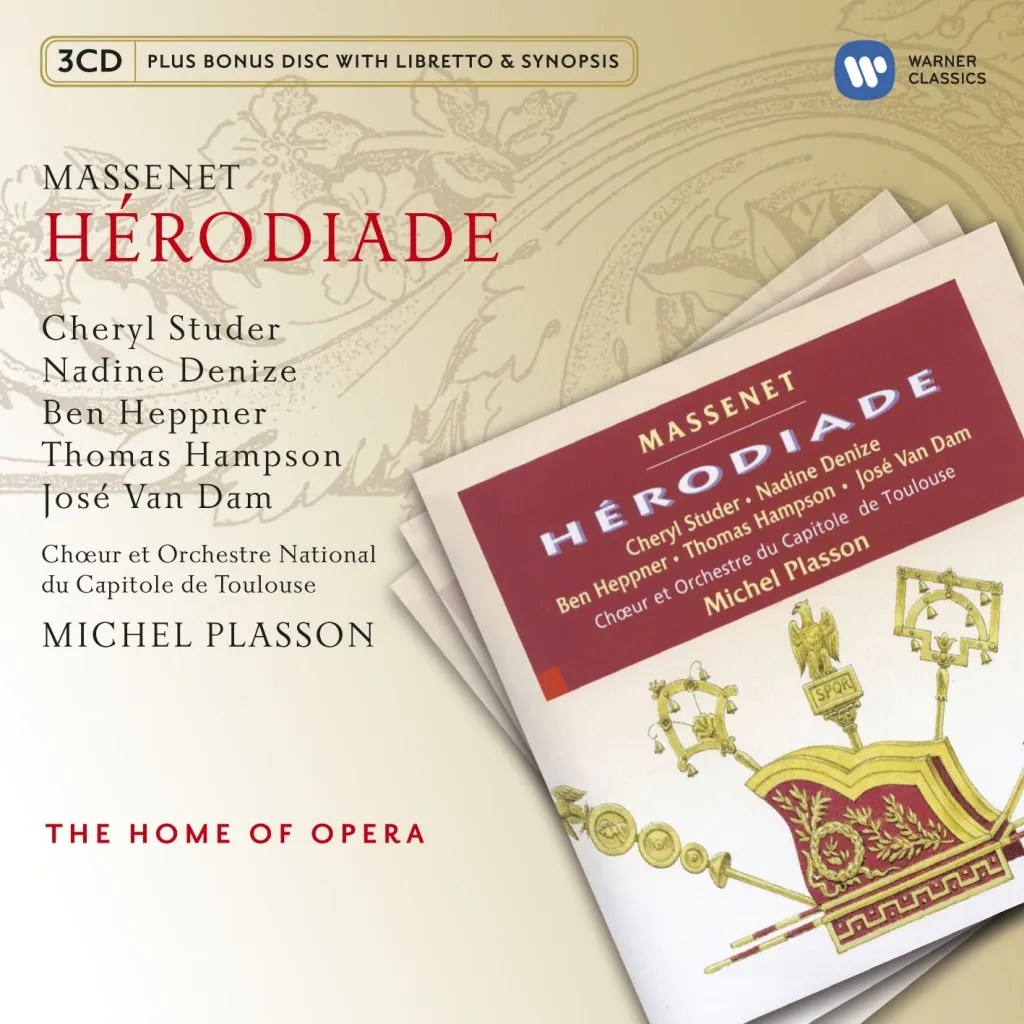
Cheryl Studer 1995
Orchestrally, this recording is really top-notch. Michel Plasson conducts the orchestra from Toulouse very energetically, with a lot of verve and drive, and he also knows how to allow space for all the subtleties. Exciting and beautiful. That is how I like to hear opera.
José van Dam is an impressive Phanuel and Nadine Denize an excellent Hérodiade., although her intonation is not always pure.
Hérode is not really a role for Thomas Hampson, but he sings it very beautifully. Something that unfortunately cannot be said of Ben Heppner’s Jean. A heroic tenor in that role is nothing but a terrible mistake.
Cheryl Studer, on the other hand, is a Salomé of everyone’s dreams: girlish, innocent and naive. Her voice shines and sways and her final words “Ah! Darned Queen, if it is true that your cursed loins have given birth to me, look! Take back your blood and my life!” leave you shuddering and desperately weeping. Brava.
In 2004 ging bij Teatro la Fenice de weinig gespeelde opera Thaïs, samen met Manon en Werther een van Massenet’s bekendste opera’s. Na de mislukte première in 1894 groeide het na een tweede poging in 1898 uit tot een groot succes. Toch wordt het tegenwoordig maar weinig geprogrammeerd, niet in de laatste plaats vanwege de moeilijk te bezetten hoofdrol.
Het libretto van Thaïs is gebaseerd op de gelijknamige roman van Anatole France uit 1890. Daarin wordt het losbandige leven, de bekering door toedoen van een doortastende monnik en de boetedoening van de legendarische courtisane Thaïs beschreven. Deze historische (?) figuur leefde in de vierde eeuw in Alexandrië en werd later heilig verklaard. Santa Thaïs heeft een reputatie die ruwweg te vergelijken is met die van Maria Magdalena.
We komen het personage Thaïs echter ook tegen in Dantes Inferno, in drek ondergedompeld, in de achtste kring. Hier betreft het een hoertje uit het toneelstuk Eunuchus van Publius Terentius Afer, een toneelschrijver uit de tijd van de Romeinse Republiek. Het is goed mogelijk dat de Alexandrijnse Thaïs een op haar gebaseerde fictieve figuur is waarvan het levensverhaal werd bedacht ter stichting van de christelijke gelovigen.
Anatole France voegde een geheel nieuwe dimensie aan het verhaal toe door de monnik in kwestie verliefd te laten worden op zijn ‘bekeringsproject’ waardoor hij weliswaar haar ziel redt maar de zijne verspeelt. ‘Eeuwig leven en zielenheil, wat doet het er toe. De enige echte liefde is die tussen levende mensen’ zingt hij vertwijfeld.
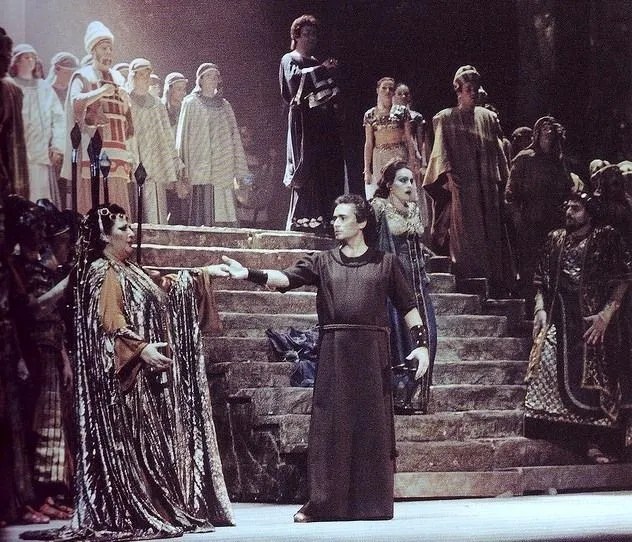
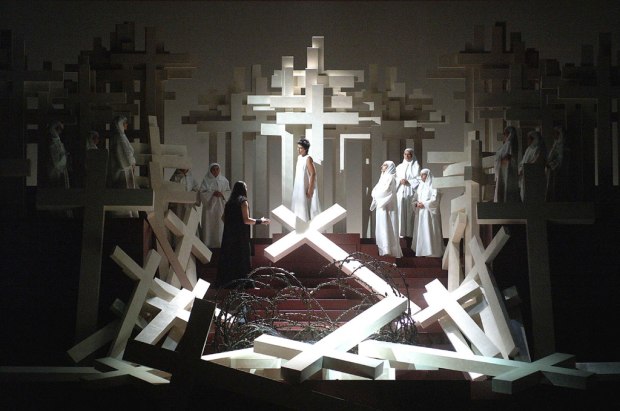
Zoals wel vaker voert Pier Luigi Pizzi niet alleen de regie maar is hij tevens verantwoordelijk voor de decors en kostuums. In de eerste akte zien we het woestijnklooster waar Athanaël leeft. Het toneelbeeld wordt gedomineerd door een groot Romeins kruis, een letter T, tevens verwijzend naar Thaïs natuurlijk. Deze monnik heeft een visioen gehad dat hij interpreteert als een goddelijke opdracht om Thaïs, die in Alexandrië gezien wordt als priesteres van Venus en daardoor zeer invloedrijk is, te redden van de hel en verdoemenis die haar zonder twijfel te wachten staat. In Pizzi’s regie is dat visioen een voorbode van wat ons nog te wachten staat: halfnaakte ballerina’s, rode belichting, sensuele dans, kortom ‘everything thats’s on a man’s mind’, zou Freud zeggen.
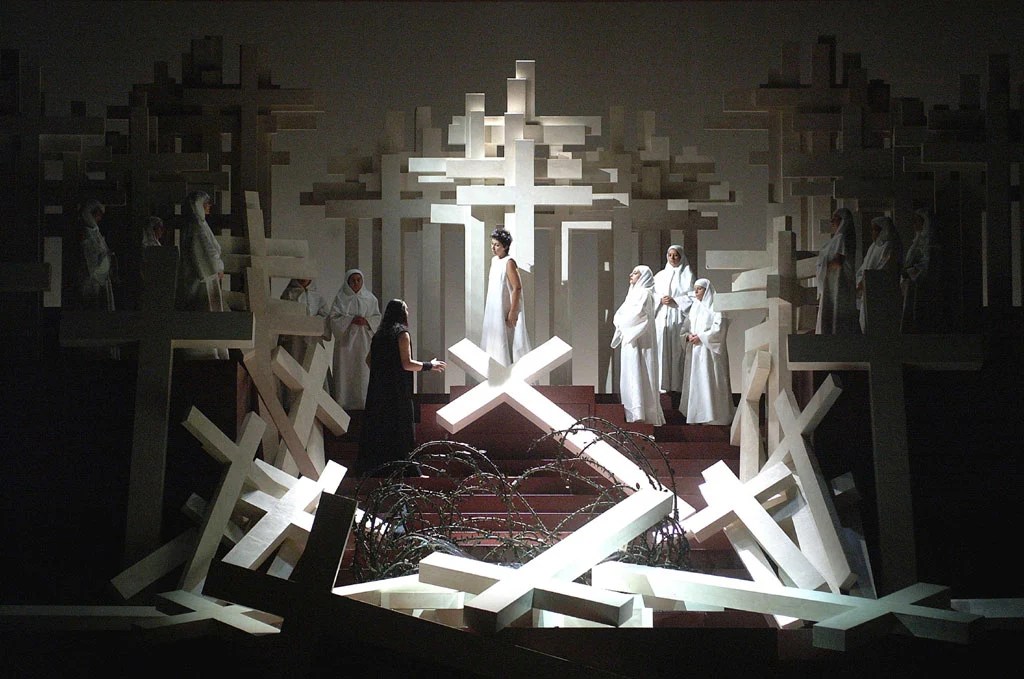
Het huis van Thaïs wordt gedomineerd door een trappartij met links en rechts spiegelende wanden. Binnen staat een ligbank die toont als een ‘bed of roses’. Maar de stekels in het vlechtwerk zien er dreigend uit: love hurts. Athanaël arriveert ter plaatse en begint aan zijn missie. Aanvankelijk wil Thaïs er niets van weten maar tijdens een droom, begeleid door de overbekende vioolsolo ‘Meditation’, komt ze tot inkeer en laat zich door Athanaël wegvoeren naar de woestijn, getoond als een vlakte die is bezaaid met witte christelijke kruisen.
Nadat hij haar in een nonnenklooster heeft afgeleverd keert hij terug naar zijn broeders zonder vanaf dat moment nog rust te hebben. In het boek van Anatole France wordt beschreven dat hij steeds maar weer van Thaïs droomt en er niet in slaagt zijn kuisheid in die dromen te bewaren. Uiteraard komen die ballerina’s weer terug en toepasselijk ligt Athanaël nu op het stekelbed zonder de rode rozen.
De titelrol is toevertrouwd aan Eva Mei en dat is een goede keuze. Ze heeft een volledige beheersing van de partij en hoeft nergens te forceren, het klink altijd mooi. Alleen daar waar Massenet zijn sopraan een eindeloze lijn laat zingen die eindigt met een paar topnoten zonder tussentijds de mogelijkheid te bieden om even adem te halen, klinkt Mei weliswaar zuiver maar een tikje luid, alsof ze al die tijd een aanloopje heeft genomen.
Michele Pertusi vertolkt de rol van de overmoedige monnik Athanaël die volledig door het ijs zakt als hij zijn emoties niet langer weet te beheersen. Aan het slot van de opera ligt hij als een jankende hond aan de poort van het nonnenklooster waar hij Thaïs naar toe heeft gebracht. Zij heeft zich daar zozeer uitgeput in fysieke boetedoening dat ze stervende is. Dat maakt het voor hem nog erger. Pertusi zingt en acteert fenomenaal, hij levert een schitterende prestatie.
Tenor William Joyner is goed op dreef als Nicia, een jeugdvriend van Athanaël die volledig aan Thaïs is verslingerd. Een week haar minnaar mogen zijn heeft al zijn bezittingen opgeslokt. Gelukkig voor hem wint hij later het tienvoudige terug door flink te gokken.
De vioolsolo halverwege de tweede akte wordt puntgaaf gespeeld door Roberto Baraldi. Tijdens deze ‘meditation’ wordt Thaïs geacht ‘het licht’ te zien en daarmee haar overgave aan het christendom. Pizzi vindt dat maar niks en in plaats daarvan zien we prima ballerina Letizia Giuliani nog net niet naakt op een plateau boven de slapende Eva Mei een erotisch getinte dans uitvoeren, op het kleine vlak is het bijna een paaldans. Pizzi heeft er duidelijk alles aan gedaan de in het stuk aanwezige erotiek goed uit te lichten.
De muzikale leiding is in handen van Marcello Viotti. De opname is uitgebracht door Dynamic.
Wie kent ‘Méditation’ niet, het sentimenteel zoete maar o zo mooie stuk vioolmuziek, met een hoog tranengehalte? Er zijn echter niet veel mensen die de hele opera waarin het stuk als een soort intermezzo in de tweede akte fungeert ooit hebben gehoord. De opnamen ervan zijn nog steeds schaars dus alle nieuwe uitgaven zijn meer dan welkom. Zeker als de uitvoering goed is, en deze nieuwe opname op Chandos is het zeer zeker wel. Althans: tot op zekere hoogte.
Het orkest uit Toronto klinkt zo ontzettend mooi dat je er verliefd op wordt. Sir Andrew Davis haalt uit de musici werkelijk het onmogelijke: zo mooi heb ik de partituur nog niet eerder uitgevoerd gehoord. De pianissimi, de manier hoe ze de stille passages tot in de puntjes weten te verzorgen, de onderhuidse spanning. Petje af! Petje af ook voor de violist die de ‘Meditation’ van nieuwe lagen weet te voorzien. Zo mooi!
Helaas blijven de zangers een beetje achter. Erin Wall is een pracht van een sopraan met een kristalheldere stem, maar een ‘hoer van Babylon’? Eerder een kinderlijk naïef meisje dat zo met de lucifers gaat venten.
Joshua Hopkins heeft de juiste stem voor Athanaël maar gaat de mist in als het op ‘aardse verlangens’ aankomt. Andrew Staples is een goede Nicias maar ook hij weet mij niet volledig te overtuigen.
Jules Massenet
Thaïs
Erin Wall, Joshua Hopkins, Andrew Staples, Nathan Berg, e.a.
Toronto Mendelssohn Choir
Toronto Symphony Orchestra olv Sir Andrew Davis
Chandos CHSA 5258(2)
Wie kent ‘Méditation’ niet, het sentimenteel zoete maar o zo mooie stuk vioolmuziek, met een hoog tranengehalte? Er zijn echter niet veel mensen die de opera waarin het stuk als een soort intermezzo in de tweede akte fungeert, ooit hebben gehoord, laat staan gezien.
Méditation in de uitvoering van Josef Hassid (opname uit 1940):
De opnamen ervan zijn nog steeds schaars, ik ken er zelf maar drie (met Anna Moffo, Beverly Sills en Renée Fleming), waarvan die met Sills, Sherrill Milnes en Nicolai Gedda (Warner 0190295869069) me het dierbaarst is.
De productie van Pier Luigi Pizzi uit La Fenice was al eerder op cd uitgebracht en ik vond het muzikaal en voornamelijk vocaal bijzonder sterk. Bijzonder nieuwsgierig was ik daarom of de beelden er iets aan toevoegden op de dvd van Dynamic. Daar ik nu volmondig ja op kan zeggen.
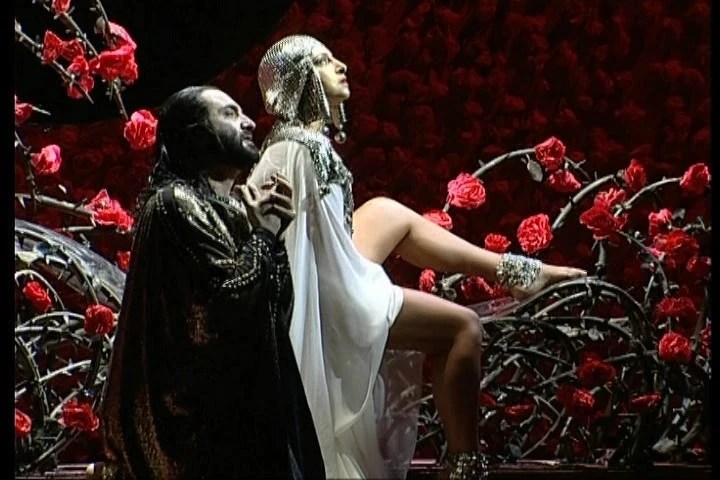
De decors zijn schaars, maar toch lijkt het alsof het toneel er helemaal vol mee is. Vanwege de kleuren (met zeer overheersend rood) wellicht, maar ook vanwege de dominante plaats die ze op de bühne innemen. Zo staat het met rozen overdekte bed van Thaïs, waar ze – als was ze Venus uit Urbino of een Danaë van Titiaan – zeer voluptueus op ligt, zeer prominent in het midden van het toneel.
Eva Mei (Thaïs) en Michele Pertusi (Athanaël)
In de derde acte, wanneer het leuke leven is afgelopen en het boeten begint, zijn de rozen nergens meer te bekennen (een doornen bed?) en is haar houding net zo kuis als haar witte gewaad.
De kostuums zijn een verhaal apart: zeer weelderig, oriëntaals en weinig verhullend. Eva Mei gaat niet zover als haar collega Carol Neblett, die in 1973 in New Orleans geheel uit de kleren ging, maar haar doorzichtig niemendalletje, waar haar borsten haast ongemerkt uit floepen, laat niets aan de verbeelding over.
Wellicht werd ze geïnspireerd door de allereerste Thaïs, Sybil Sanderson, wier borsten tijdens de premièrevoorstelling in 1894 ook ‘per ongeluk’ zichtbaar werden? Maar goed, het gaat dan ook over de grootste (en mooiste) courtisane in Alexandrië!
Eva Mei is zeer virtuoos en zeer overtuigend als Thaïs. Zo ook Michele Pertusi als Athanaël. Er is wel heel erg veel ballet. Ook daar waar het eigenlijk niet hoort, wat soms zeer storend werkt.
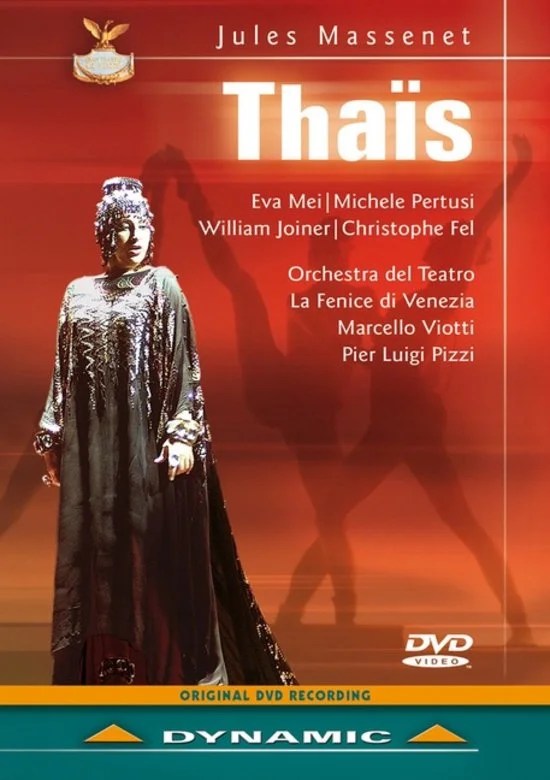
Jules Massenet
Thaïs
Eva Mei, Michele Pertusi, William Joiner, Christophe Fel e.a.
Orchestra del Teatro La Fenice do Venezia olv Marcello Viotti
Regie: Pier Luigi Pizzi
Dynamic 33427















 Basia con fuoco