Don’t be alarmed! It is not a rather weird performance of – or a variation on – Beethoven’s fifth symphony but the beginning of Zemlinsky’s 1934 Sinfonietta, a work in which the composer is barely recognizable. I read somewhere that he wanted to prove to his greatest critics that, in the symphonic genre, he was not inferior to the three big Bs: Beethoven, Brahms and Bruckner.
Zemlinsky’s Sinfonietta played Gürzenich-Orchester Köln/ James Conlon
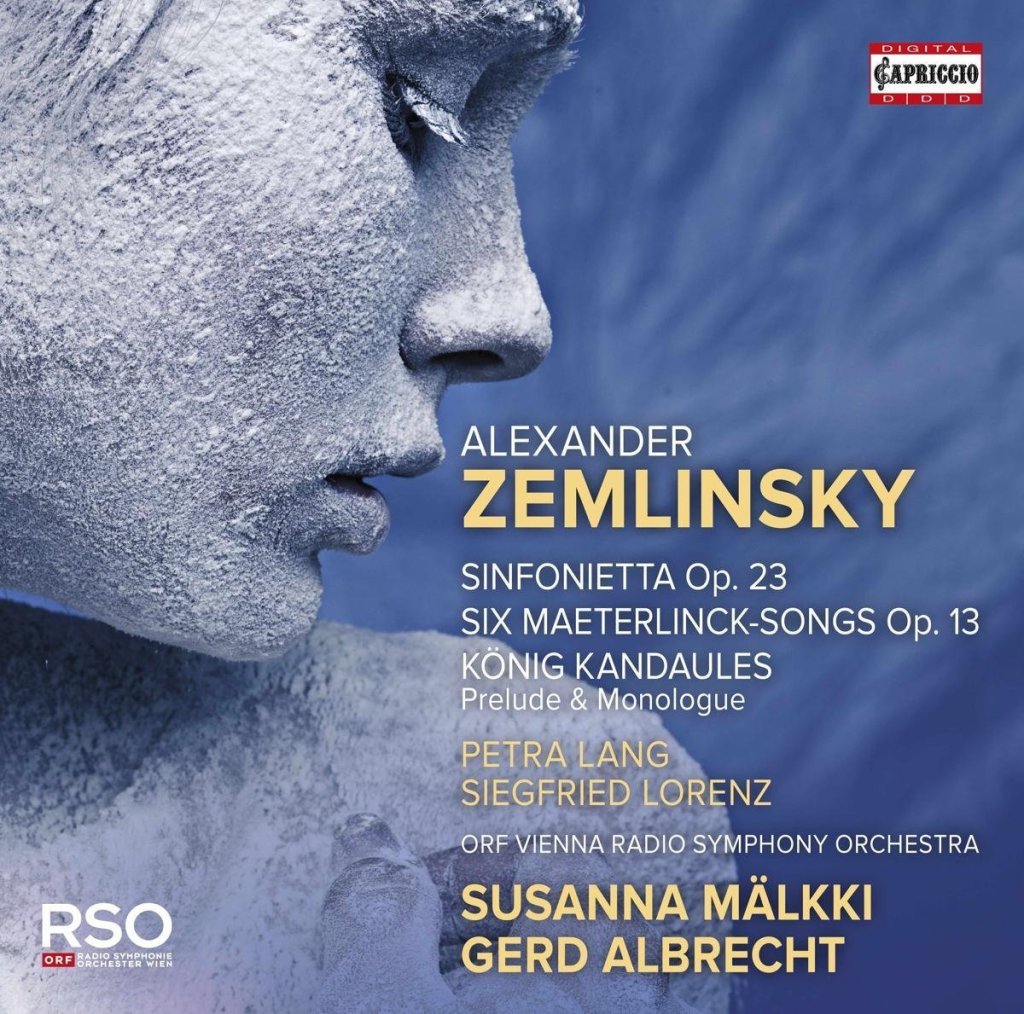
Total nonsense, of course, because his greatest appeal greatly depends on his very own idiom: a sultry, barely-there erotic tension. And the Sinfonietta lacks, precisely, those essential elements. I had not heard the work before and I don’t think I will often listen to it again, but that is not down to the excellent performance: Finnish conductor Susanna Mälkki clearly has an affinity with it.
Unfortunately, the performance of the “Sechs Maeterlinck Gesänge” is not on the same level. This is mainly because of Petra Lang. I have never been a big fan of hers but here she sounds, how shall I put it… anything but erotic? Too bad.
And for ˜dessert” we get the prelude and monologue from the third act of ” König Kandaules”, an opera Zemlinsky never finished. The monologue is very impressively sung by Siegfried Lorenz and the orchestra conducted by Gerd Albrecht, who died in 2014, sounds simply heavenly. The recording dates from 1992.
Alexander Zemlinsky Sinfonietta, op. 23, Six Maeterlinck-Songs Op. 13 Petra Lang (soprano) ORF Vienna Radio Symphony Orchestra olv Susanna Mälkki
Der König Kandaules (two excerpts) Siegfried Lorenz (baritone), ORF Vienna Radio Symphony Orchestra conducted by Gerd Albrecht
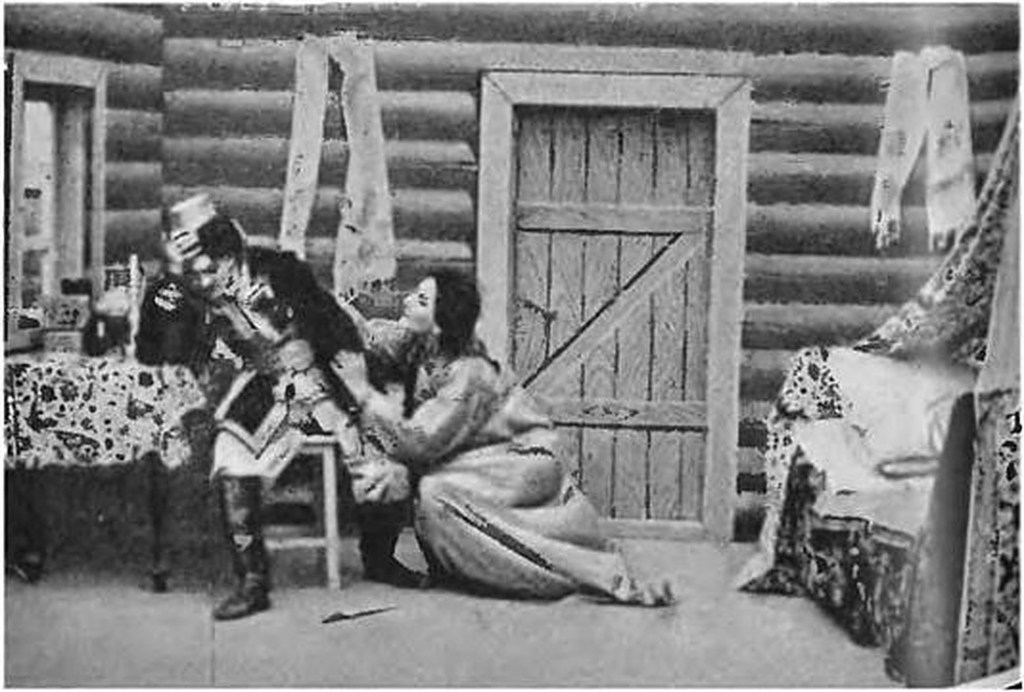
Charodeyka: scènefoto afkomstig van de Russische film uit 190, geregisseerd door Pyotr Chardynin en Vasisli Goncharoev
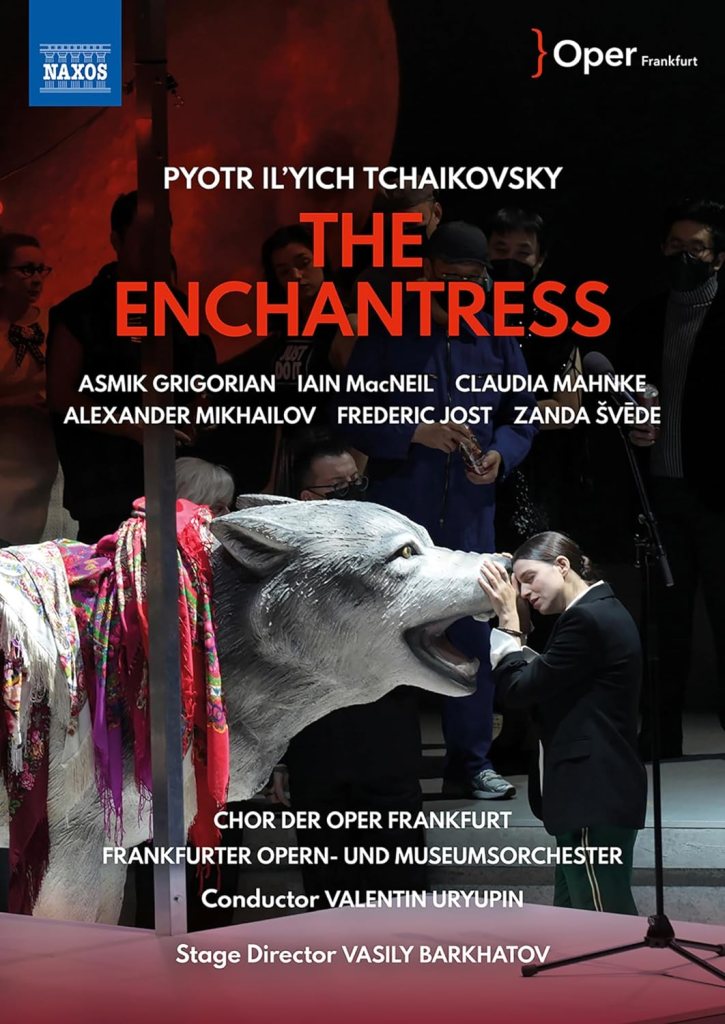
Deze zelden gespeelde opera van Tsjaikovski had in 1887 première in het Maly theater te Sint Petersburg. In december 2022 was het te zien in Frankfurt. De nieuwe productie van Vasily Barkhatov met Asmik Grigorian in de titelrol bleek zonder meer een pleidooi voor deze onbekende opera. Zeer recent is hiervan een opname door Naxos op dvd en Bluray uitgebracht.
Hoewel zeer verschillende personages hebben Natasja in Charodéyka en Tatiana in Onegin wel degelijk iets gemeen. Beiden zijn verliefd op een persoon die ze niet echt kennen, zien op afstand een man door een roze bril. Niettemin zetten ze een stap, nemen het risico afgewezen te worden. Alleen is dat voor Natasja, die overigens door iedereen Kuma wordt genoemd, een stuk riskanter dan in geval van Tatiana. Haar ‘ik hou van je’ eindigt in een tienertrauma, Kuma daarentegen flirt met de dood. Haar would be lover Prins Juri is binnen komen sluipen met de bedoeling haar te doden.
Dat Kuma hem van dat plan af weet te brengen zegt iets over haar kwaliteiten als übercharmante vrouw die mannen om haar vinger windt maar deze keer blijft het niet aan de oppervlakte: ze houdt echt van hem. Ze was voor hem gewaarschuwd, wist van zijn plan en is desondanks op hem blijven wachten. Het is voor haar de dood of de gladiolen.
Tsjaikovski heeft voor het duet waarin Juri tot een 180 graden draai wordt bewogen behoorlijk wat tijd nodig en dat is maar goed ook. In deze scène beleven we Asmik Grigorian in volle glorie: ze krijgt de kans alle kwaliteiten tentoon te spreiden die haar tot zo’n gevierde zangeres hebben gemaakt.
Aria van Kuma:
Wat uit het bovenstaande kan worden opgemaakt is dat de plot van dit werk bepaald niet alledaags is. Kuma is een weduwe die in het laat middeleeuwse Nizhny Novgorod een dranklokaal drijft aan de rand van de stad. In deze productie is dat veranderd in een galerie, Kuma schildert, maar kan zich in het bezoek van het halve stadje verheugen waarbij de drank rijkelijk vloeit.
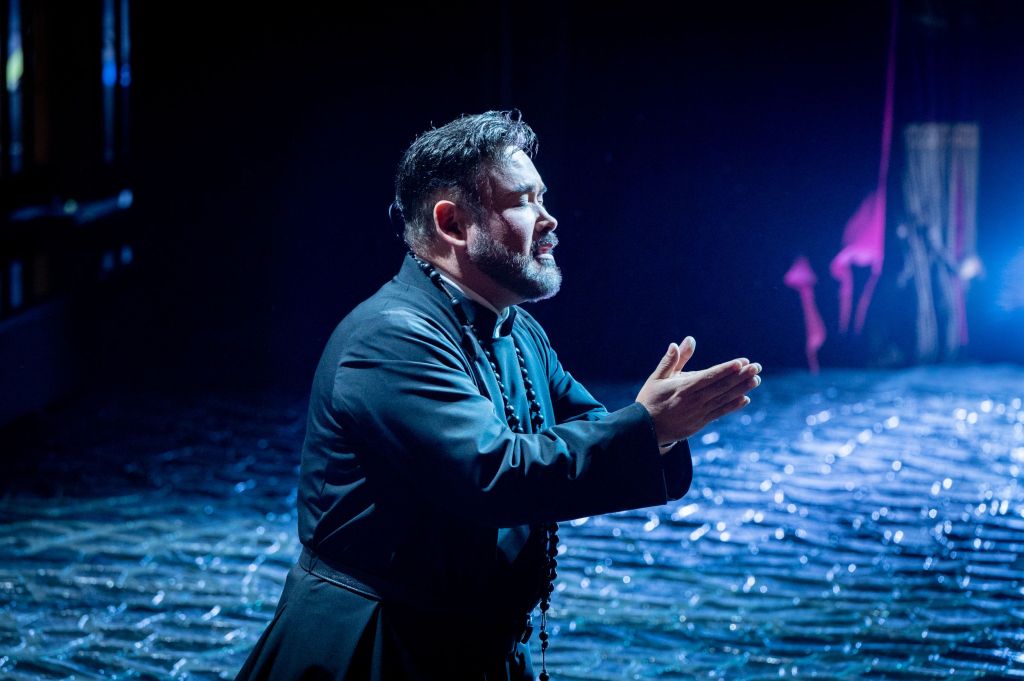
Het is zo’n plek die is uitgegroeid tot ‘the place to be’ en dat heeft de argwaan gewekt bij de plaatselijke bisschop Mamyrow, die in dit stuk de rol van religieuze griezel mag spelen. Dat iedereen naar Kuma trekt duidt op hekserij. Bovendien is het daar elke avond een losbandige boel met drank en seks, bedenk maar iets.
Mamyrow weet zijn Vorst mee te tronen om het met eigen ogen te aanschouwen, uiteraard met de bedoeling Kuma uit de weg te laten ruimen. Die doet haar reputatie eer aan en windt de Vorst binnen de kortste keren om haar vinger, gewoon door rustig en vriendelijk te blijven. Het eindigt met een drinkwedstrijdje tussen beiden waarin wodka achterover wordt geslagen.
Een tikje overmoedig geworden laat Kuma een groep half blote mannen in derwish rokken een ‘wolvendans’ uitvoeren en weet de vorst zo ver te krijgen dat hij Mamyrow beveelt om mee te doen. Daarmee maakt ze de vernederde prelaat tot doodsvijand en tekent ze haar eigen vonnis.
De Vorst is in Kuma’s ban geraakt en zoekt haar elke dag op. Hij wil gewoon graag de hele tijd bij haar zijn maar alles blijft vooralsnog heel onschuldig al ziet iedereen wel aankomen dat dit wat hem betreft niet lang zo kan voortduren. De Vorstin heeft argwaan gekregen en Mamyrow weet dat goed te voeden.
Prins Juri, een bokser maar tevens moederskindje, merkt dat haar iets heel erg dwars zit. Doorvragen brengt het probleem aan het licht: zijn vader gaat vreemd met een herbergierster. Dubbele schande en hij besluit haar te vermoorden om de familie eer te redden. Moeder weet van niets en beraamt haar eigen plan. Ze weet Kuma te vergiftigen met hulp van Mamyrow als haar rivale op het punt staat om met haar zoon te vluchten naar blijde verten aan de andere kant van de regenboog.
Als de inmiddels door Kuma afgewezen Vorst dit bemerkt doodt hij zowel zijn vrouw als zijn zoon en wordt zoals dat een melodrama betaamt prompt waanzinnig. Mamyrows normale orde is hersteld, de orthodoxie wint immers altijd in Rusland en een nieuwe vorst is zo gevonden.
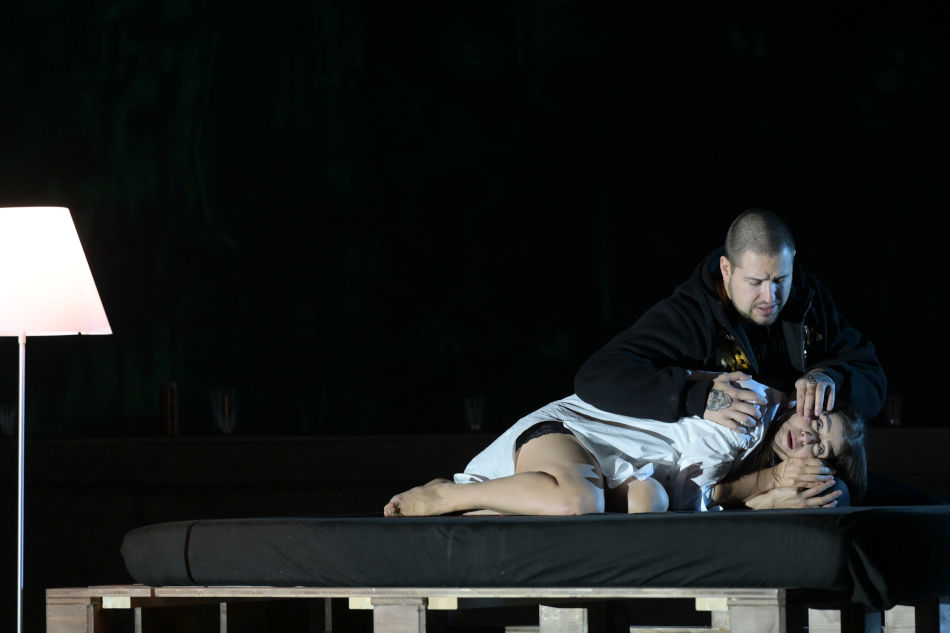
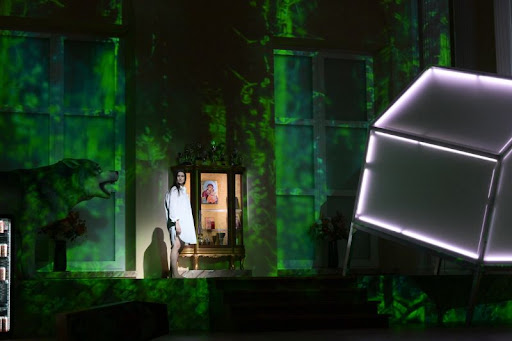
Barkhatov situeert de handeling in het heden met accenten die verwijzen naar de 15e eeuwse context. Kuna’s ‘herberg’ heeft de vorm van een uit neonbuizen opgebouwd huisje. Er omheen speelt zich de zeer turbulente handeling in de eerste akte af. Een knap staaltje regiewerk wordt hier geleverd, met een groot koor op het toneel dat een flinke steen bijdraagt aan de bijna chaotische interactie tussen de vele protagonisten.
Door middel van een draaitoneel kan snel worden gewisseld met de huiskamer van de vorstelijke familie. Even het doek neer en na een halve minuut weer op. Het heeft het effect van een snelle cut tussen twee filmscènes.
Niet alleen op dit punt maar ook in de aankleding wordt dat effect beoogd. Het ziet er bij de Vorst thuis uit als in een oude soap serie, denk aan Dallas of Dynasty, compleet met een personal trainer voor de Vorstin en een (zeer goed getrainde) herdershond waartegen de Vorst een lange monoloog afsteekt.
Als we afstevenen op het dramatische einde krijgt het publiek die wisselingen gewoon te zien waarbij het draaitoneel ook halverwege stokt en iemand staat te zingen in de ruimte ertussen. In toenemende mate loopt alles door elkaar waarbij het neonhuisje opduikt in de woonkamer van de Vorst. De verwarring is compleet en als aan het einde onder een bulderende muzikale galop de Vorst er zelf een einde aan wil maken zitten er geen kogels in zijn pistool. Dann ist alles aus.
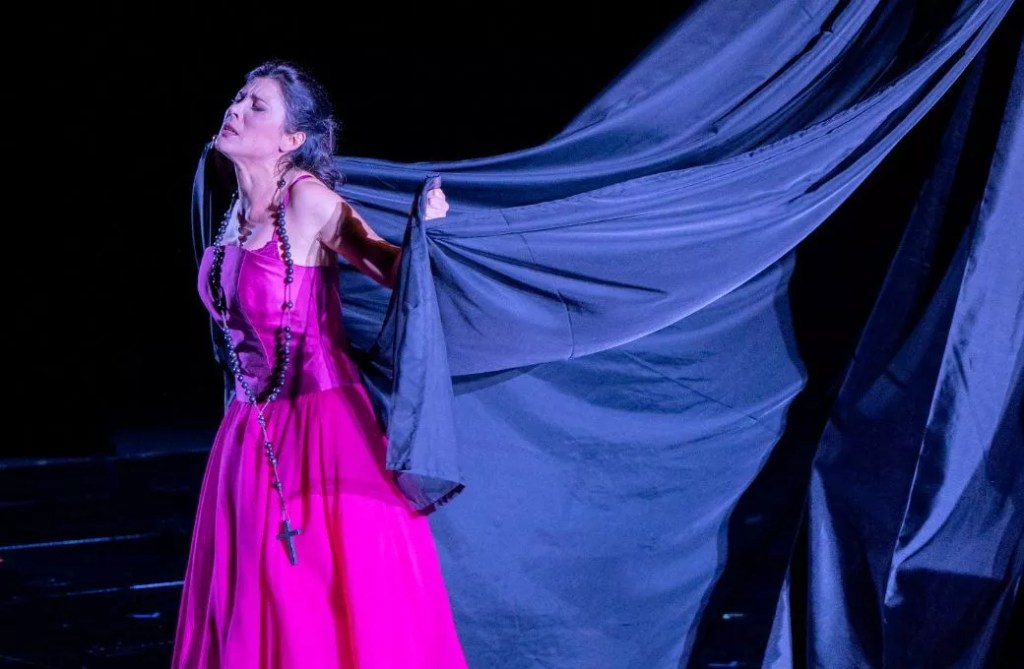
De absolute ster van de voorstelling is Asmik Grigorian maar in de tweede akte hoort het toneel toe aan dramatische mezzo Claudia Mahnke die een werkelijk voortreffelijke vertolking geeft van de Vorstin die zich bedrogen weet en het er niet bij laat zitten. In de Ring van Staatsoper Unter den Linden vertolkt Mahne een vergelijkbare rol, die van Fricka. Ze is dus op bekend terrein.
De Vorst komt voor rekening van bariton Ian MacNeil die zich ook acterend uitstekend weet te weren. Tenor Alexander Mikhailov zingt het enige echte liefdesduet van de avond, weliswaar met zijn moeder, maar toch. Door zijn personage op te voeren als bokser wordt het hem niet gemakkelijk gemaakt om naturel te acteren, het blijft een beetje opgepompt allemaal. Maar zijn zang maakt alles goed.
De rol van de slechterik wordt aardig tot leven gebracht door de bas Frederic Jost. Sopraan Zanda Svede maakt van de rol van Nenila als personal trainer een aardig optreden.
Koordirigent Tilman Michael verdient een groot compliment voor de instudering van het koor, een van de meest complexe partijen die er in het repertoire te vinden zijn. Het Frankfurter Oper und Museumsorchester staat onder leiding van Valentin Uryupin. Samen weten ze Tsjaikovsky’s partituur alle eer te geven die deze toekomt, prachtig orkestspel.
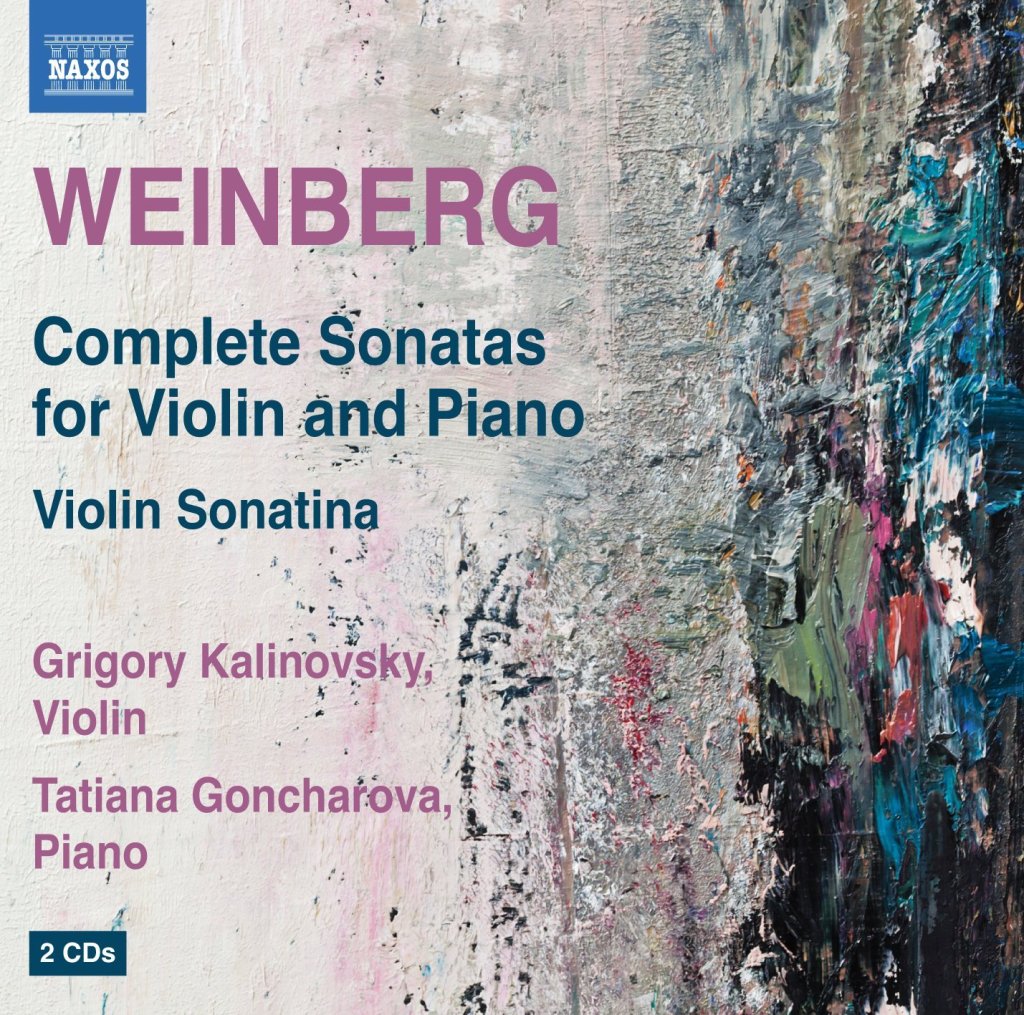
I know the risk of my umpteenth ultimate praise for a ‘new Weinberg’, but believe me: I have no choice.
Not that I didn’t have my doubts. Especially on the first time listening; I had a bit of trouble with the violinist, because to say that his violin really sings… well, no.
I found his playing too fierce, too straightforward . . violent at times. The singing came mainly from the piano, at least it seemed so at first, because the more I listened to the CDs the more layers I discovered in the renditions of – both – soloists.
Just take the moving Lento in the second sonata, here time stood still for a moment. This also because the work reminded me most of film music. Black-and-white images from ‘The Cranes are Flying’ automatically loomed before my eyes. It is one of the most moving films ever, for which Weinberg composed music.
And what a difference with the Lento from the 1947 third sonata! Here you can already see Shostakovich lurking around the corner, smiling approvingly. And here it was that I finally heard Kalinovsky sing on his violin as I was, again, marvelling at Goncharova’s beautiful touch.
The first four sonatas were created between 1943 and 1947 and, despite the major Shostakovich influences, they are rather conservative in nature. Especially number four, for me, the least interesting of these first four pieces: despite the passionate plea of both soloists, I noticed that somewhere along the way my attention had waned.
Only in the fifth sonata from 1953 does the true genius Weinberg reappear: it was the first composition that he completed after being released from prison. Listen to the Allegro moderato in which he manages to forge totally different themes into one whole.
His sixth sonata is a bit of an odd one out. Weinberg composed it in 1982; it was not premiered until 2007, eleven years after his death.
How many opera lovers know Lalo’s Le Roy d’Ys? I think few have even heard of it, let alone ever had the chance to see the opera. It is totally forgotten.
How unjustified that is, is proven by the performance recorded by Dynamic (33592) in Liège in April 2008. Le Rois d’Ys is a very melodious opera with many choral parts and duets, and the music is romantic and compelling.
The libretto is simple: the daughters of the king of Ys (an ocean-threatened city) love the same man. When he chooses Rozenn, Margared takes revenge. Together with Karnac (enemy of the city and of the king), she opens the floodgates, resulting in a flood. But Margared is consumed by guilt and sacrifices herself by jumping into the swirling waters. The city and its inhabitants are saved.
The staging is simple and realistic. The flood is depicted as a huge rainstorm. Not really threatening, but then again, all of us probably possess a healthy dose of imagination.
The cast is good to very good. Gylaine Girard is a fantastic, poised Rozenn. Her very flexible soprano has a particularly pleasant timbre. This is in rather sharp contrast to the mezzo Giuseppina Piunti (Margared), who is almost screeching at times. But she is so committed to the role that I soon forgive her.
We know Sébastien Guéze (Mylio) – among others – from his fantastic rendition of Romeo at the Saturday Matinee in 2008. He has a pleasant, light tenor with an unmistakable French touch, and his interpretation is really right for the role. Werner van Mechelen is a very good Karnac. Recommended!
Sébastien Guéze in the same production but from Opera St.Etienne :
Uit Teatro Donizetti in Bergamo komt een nieuwe opname die daar in 2022 is gemaakt. De Bluray verscheen in 2023 op het label Dynamic, zo langzamerhand de plek waar je als operaliefhebber het eerste gaat zoeken naar iets bijzonders.
Donizetti’s opera La favorite, geschreven voor Parijs in 1840, past goed in het genre ‘Grand Opéra’ dat toen de maat aller dingen was. Het werk bestaat weliswaar uit vier aktes in plaats van de gebruikelijke vijf, maar de thematiek past volledig binnen de traditie.
La favorite handelt, zoals een Grand Opéra betaamt, over historische personages en een liefdesgeschiedenis. Het titelpersonage is gebaseerd op Léonor de Guzman, de maîtresse van koning Alfonso XI van Castilië en Leon. De koning heeft haar naar het hof gehaald maar is vervolgens om dynastiek politieke redenen getrouwd met Maria, dochter van de koning van Portugal.
Léonor baart hem tien kinderen wat haar positie aardig cementeert maar als Alfonso in 1350 op 38 jarige leeftijd overlijdt aan de pest laat Maria haar uit wraak executeren. Tot zover de historie.
In de opera is aan het verhaal een nieuw personage toegevoegd, Fernand, een jonge novice die verliefd is geworden op Léonor toen hij haar hand aanraakte bij het verstrekken van de communie. Hij verlaat het klooster en gaat naar haar op zoek.
Léonor laat hem naar het hof komen, echter zonder haar naam en status duidelijk te maken. Met hem trouwen is onmogelijk maar zij overhandigt hem een commissie in het leger. Fernand onderscheidt zich in de strijd om Sevilla en wordt door Alphonse met eer overladen.
Maar als hij ontdekt dat zijn geliefde Léonor – teleurgesteld omdat hij haar heeft gepasseerd voor Maria – verliefd is op de jonge held Fernand, neemt hij wraak door haar ter plekke aan de nietsvermoedende jongeman uit te huwelijken. Als deze erachter komt dat hij de maîtresse van de koning toebedeeld heeft gekregen, voelt hij zich onteerd, schopt een scène en gaat terug naar het klooster. De verstoten Léonor komt daar uiteindelijk ook terecht, smeekt Fernand om vergeving en sterft de liefdesdood in zijn armen.
De grote rol voor bas is die van Balthazar, de abt van het klooster, tevens een soort voorloper van de Grootinquisiteur, zozeer meent hij zich boven de koning te kunnen stellen. Uit naam van de paus beveelt hij de koning om zijn relatie met Léonor op te geven op straffe van beider excommunicatie.
Dat geeft Alphonse een extra zetje om haar aan Fernand over te doen, die niets vermoedende jongeman komt eigenlijk als geroepen. Het verbale gevecht tussen Alphonse en Balthazar weerspiegelt de strijd om de macht in de christelijke wereld: ligt het primaat bij de koning of bij de paus?
Balthazar wordt goed gezongen door de Italiaanse bas Evgeny Stavinsky, begin 2024 te horen als Vodnik in de nieuwe Rusalka productie van Opéra de Wallonie. Alphonse komt voor rekening van de Franse bariton Mario Cassi, zeker in zijn optreden en muzikaal tot in de puntjes verzorgd. De ‘lagere regionen’ van de partituur waren bij beide heren in goede handen.
De Mexicaanse belcanto tenor Javier Camarena tekent voor de rol van Fernand. Zijn repertoire omvat meer dan 20 belcantorollen en het is goed merkbaar dat hij zich in de rol van Fernand op vertrouwd terrein bevindt. Met veel inzet en groot enthousiasme weet hij een zeer geloofwaardige Fernand neer te zetten. Zijn woede uitbarsting op het moment dat hij ontdekt bedrogen te zijn door de koning, vormt vocaal het hoogtepunt van zijn optreden.
Léonor komt voor rekening van de Italiaanse mezzo Annalisa Stroppa. Ze draagt de voorstelling, zowel zingend als acterend. Uiteindelijk draait alles om haar, ze is de vrouw die bedoeld en onbedoeld de handeling bepaalt.
Bij Stroppa is deze veeleisende rol in zeer goede handen. Met haar lage mezzo kan ze de lage passages goed aan zonder in de hoogte aan kracht te verliezen. Haar grote aria ‘L’ai je bien entendu?’ in de derde akte is een bijna negen minuten durende eruptie van opgekropte emoties die muzikaal perfect worden geëtaleerd, schitterend gedaan.
Teatro Donizetti en dirigent Riccardo Frizza waren er op gebrand de opera zonder coupures te brengen en dat stuitte op verzet van regisseur Valentina Carrasco die van mening was dat een ruim 20 minuten durend ballet tegen het einde van de tweede akte een onbeholpen onderbreking van de handeling zou betekenen aangezien feitelijk alles wordt stilgezet en het publiek bezig wordt gehouden met een niet relevante show van technische hoogstandjes.
Ze kreeg in zoverre haar zin dat het ballet is vervangen door het optreden van een groep oudere vrouwen die nog net niet willekeurig van de straat zijn geplukt. Ze symboliseren de meer dan wat met elkaars kleren bezig zijn en rond hobbelen laten ze niet zien, het is beeldvulling en dan ook nog van dien aard dat ik bij een volgende keer afspelen dit deel gewoon oversla. Geen coupures impliceert een volwaardig ballet, geen flauwekul.
Overigens kan het ballet welzeker een theatrale functie hebben door de handeling te becommentariëren, voorbeelden te over. Maar Carrasco kiest voor het uitlichten van het lot van de vroegere favorieten waarbij ze wellicht onbedoeld suggereert dat de Spaanse koningen uit de 14e eeuw veel van hun Moorse collega’s hadden overgenomen: een completen harem.
De decors laten een klooster zien en door middel van een paar goed gekozen accenten een ruimte die oogt als het Alcazar in Sevilla. Op het emiraat Granada na is de Reconquista voltooid, anderhalve eeuw voor de Reyes Catolicos het laatste zetje zullen geven. De zeer fraaie kostuums zijn het werk van Sylvia Aymonino en de decors zijn ontworpen door Carles Berga en Peter van Praet die tevens verantwoordelijk is voor de belichting.
Het orkest en het koor van de Donizetti Opera, aangevuld met het Coro dell’Accademia Teatro alla Scala zorgen voor de begeleiding. Daarmee is dit een volwaardige uitvoering van een werk uit Donizetti’s middenperiode geworden die als pleitbezorger van deze minder gespeelde grand opéra kan dienen.
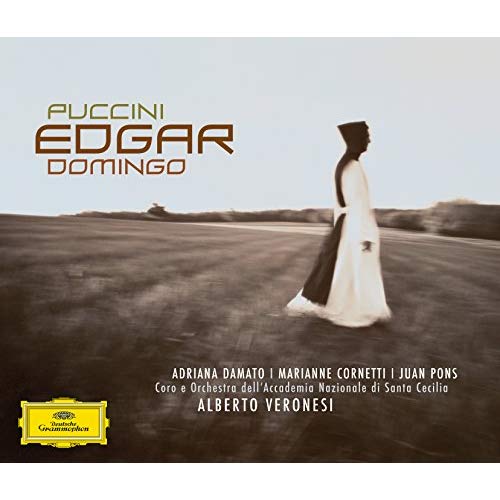
There were – and there still are – at least two good reasons to give a warm welcome to this Edgar, recorded by Deutsche Grammophon in 2006: it was the very first studio recording of the work (the only two others I knew of at the time were recorded live) and it was the first time Placido Domingo sung this role; the only one still missing from his Puccini discography.
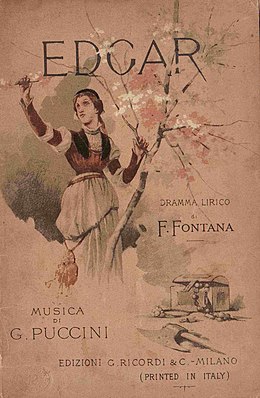
I have never been able to understand why this opera was so unloved. Granted, it is not Puccini’s best work, but that is mainly down to the libretto. Musically, the opera is an extension of Verdi, but one can already hear snatches of the ‘real’ Puccini: a vague promise of Manon Lescaut, a study for La Bohème, finger exercises for Turandot.
It is the only Puccini opera with a major role for a mezzo- soprano, a voice type Puccini obvoiusly did not normally use for his female protagonists, who, with him, were never really either thoroughly good or truly bad women.
Tigrana and Fidelia (note the names!) are each-other’s opposites. In their battle for the tenor there cannot actually be a winner: Edgar leaves Tigrana who then promptly stabs Fidelia to death.
With Adriana Damato (Fidelia) and Marianne Cornetti (Tigrana) we welcomed a new generation of phenomenal female singers and Domingo is, as always, very musical and committed to his role
Edgar with José Cura and Amarilli Nizza. Recorded live in Torino 2018
Onegin, unlike don Giovanni, is not a colourful character. He is a rather dull, bored brat, for whom even hitting on a woman is too much trouble. Through an inheritance he has become a rich man and as such has access to the”high society”, but everything bores him and in fact he does not know himself what it is he really wants.
He dresses according to the latest fashion, the only question is whether he does it because he likes nice clothes, or because that’s the way things are supposed to be. Because he does know how things should be done.
He also shows hardly any character development over the whole course of the opera. He kills his best friend after flirting with his lover – not because he really wants to, but to teach him (and the, in his eyes horrid, countrybumpkins) a lesson – and even that leaves him unmoved. Only at the end does he “wake up” and something of a feeling enters his mind. But is it real?
Not really someone you can dedicate an entire opera to, which is why for many people the real protagonist is not Onjegin but Tatyana. If Tchaikovsky had really wanted it that way he might have named the opera “Tatyana”, but that she is a much more captivating character than the man of her dreams, is beyond any doubt.
CDs
SERGEY LEMESHEV:
One says Tatyana, one thinks Galina Vishnevskaya. The Russian soprano has created a benchmark for the role that few singers can yet match. In 1955, she recorded the role, along with all the Bolshoi greats of the time.
Her “letter scene” is perhaps the most beautiful ever, but the recording has even more to offer: how about Sergei Lemeshev as Lensky? Fingerlicking good!
Sergey Lemeshev as Lensky (his great aria & duel scene)
Valentina Petrova is a peerless Larina, unfortunately the title hero himself (Evgeny Belov) is a bit colourless. (Melodiya 1170902)
FRITZ WUNDERLICH:
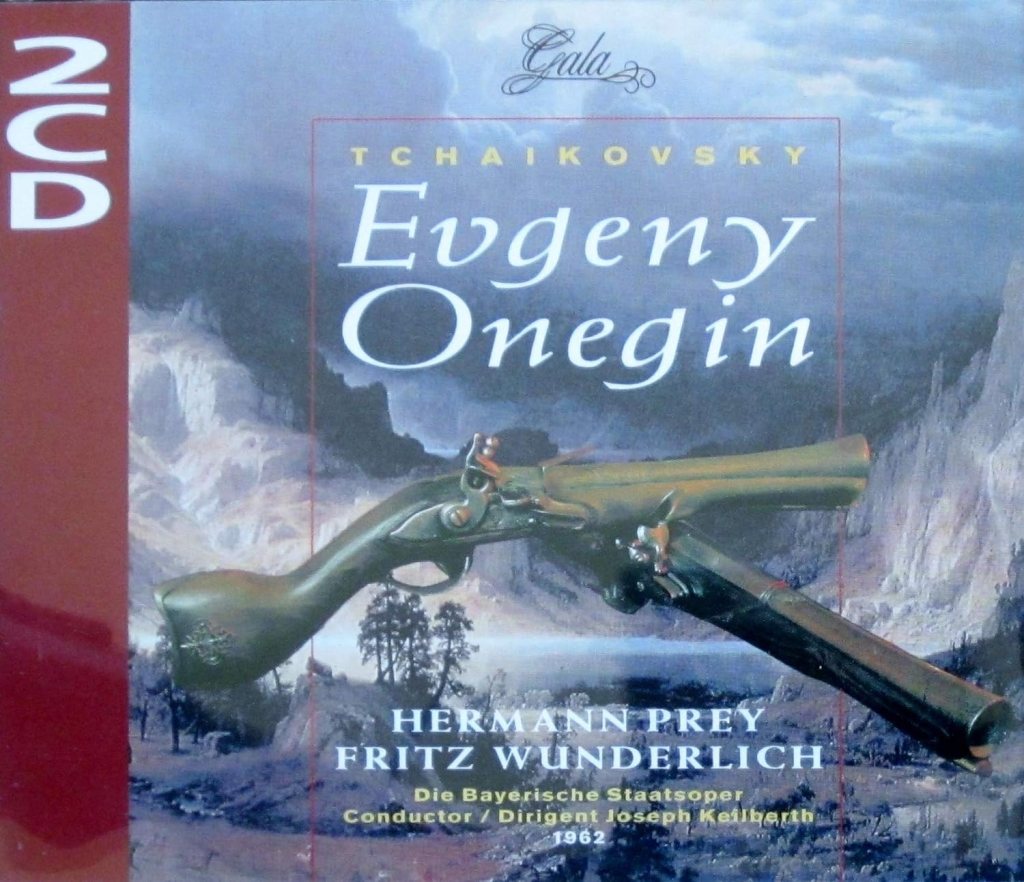
In 1962, the opera was recorded live in Munich (Gala GL 100.520).
Ingebort Bremmert is too light for Tatyana, she also sounds rather sharp, but Brigitte Fassbaender makes up for a lot as Olga. But for a change, the ladies do not make the greatest impact, you buy it, of course, for the men: Hermann Prey and Fritz Wunderlich.
Prey is a very charming, gallant Onjegin, actually more like a brother than a lover, but the voice is so divinely beautiful! And about Wunderlich’s Lensky I can be very brief: ‘wunderbar’! By the way, it strikes me once again how similar Piotr Beczala sounds to him!
There is a lot of stage noise and the sound is dull with far too many bass sounds. And of course it is in German, but yes, that’s how it was done in those days. But it is a matchless document and, especially because of both singers, actually a must-see.
Duel scene from the recording (with picture!):
BERND WEIKL:
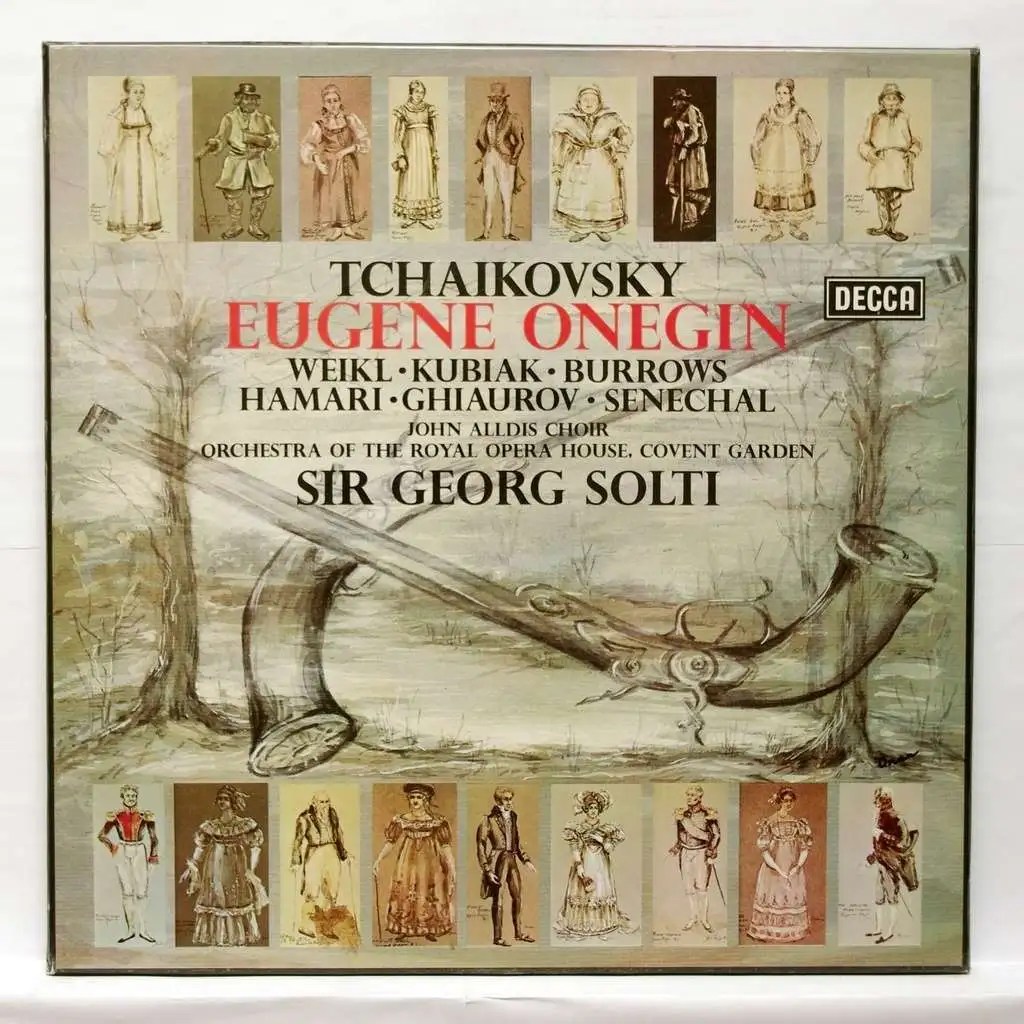
In 1974, Georg Solti recorded the opera for Decca(4174132) and that reading is still considered one of the best. In Stuart Burrows he had at his disposal the best Lensky after Wunderlich and before Beczala, and Teresa Kubiak was the very personification of Tatyana. Young, innocent, with a touch of elation at the beginning of the opera, but resigned at the end.
Under his direction, the orchestra (Orchestra of the Royal Opera House) flourished like the cornflowers in the Russian fields, making it clear why the composer considered his opus magnus to be “lyrical scenes” and not opera.
Bernd Weikl is a very seductive Onjegin, his very spicy baritone particularly sexy. Nicolai Ghiaurov is of course legendary in his role of Gremin and for me Michel Sénéchal is perhaps the best Triquet ever. Enid Hartle deserves to be especially mentioned as Filipyevna.
THOMAS ALLEN:
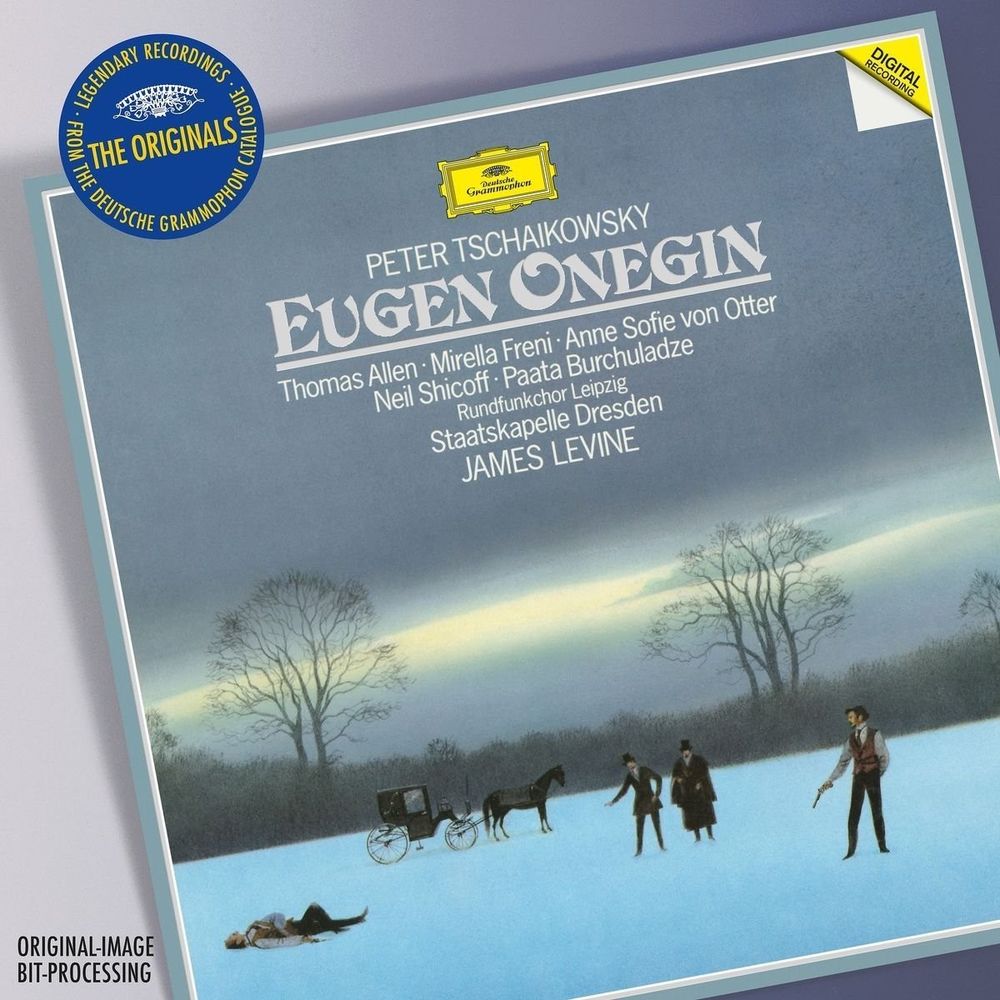
I want to dwell for a moment on Onjegin by Sir Thomas Allen. He has sung the role several times: both in Russian and in English. In 1988, he recorded it for DG (423 95923). Tatyana was sung by Mirella Freni – in the autumn of her career it became one of her showpieces. She is therefore more convincing as the older Tatyana than as the young girl, but there is nothing to criticise about her interpretation.
Neil Shicoff, then a splendid lyricist, was a very idiomatic Lensky, but Anne Sophie von Otter was only moderately convincing as Olga. Under James Levine, the Staatskapelle Dresden produced an unexpectedly lyrical sound, with lovely long arcs, but not devoid of a healthy sense of drama.
Anyway: it’s mainly about Thomas Allen. His reading of the title hero is particularly exciting and dramatically well grounded; it is truly fascinating to hear how Onjegin’s condescension in I turns into a shimmering passion in III. A vocal artist, no less.
It is also very interesting to see how he coaches young people at an ‘Onjegin master class’ (among his “students” is James Rutherford, among others)
DVDs
VLADIMIR REDKIN
Boris Pokrovsky is a living legend. For decades, from 1943 to 1982, he was opera director of the Bolshoi Theatre in Moscow. Even in the Netherlands, he is not unknown: in 1996, he was ‘visiting’ us with his new company, the Moscow Chamber Opera, with “Life with an Idiot” by Alfred Schnittke.
His production of Onjegin, recorded for TV at the Bolshoi in Moscow in 2000(Arthaus Musik 107 213) originally dates from 1944. It is, of course, a classic, complete with all the trimmings. Sumptuous costumes, true-to-life sets, everything as it ‘should’ be.
As soon as the stage curtain opens, the first ‘open curtain’ is a fact. People love it. And they are right: it is indeed so very beautiful! Of course, you don’t get to see it like that anymore. Think Zeffirelli, but really authentic, without a single liberty being taken. You have to have seen it at least once, just to know how it was originally intended.
The unknown singers are all just fine, but the close-ups are a bit laughable. Of course, it is not a production to be shown on TV, you have to actually see it in the opera house. There is no chance of that, though: Boris Pokrovsky’s production has been replaced by a new production by Dmitri Tcherniakov after more than 60 years of faithful service. Buy the DVD and muse on the ‘good old days’, because they really aren’t coming back.
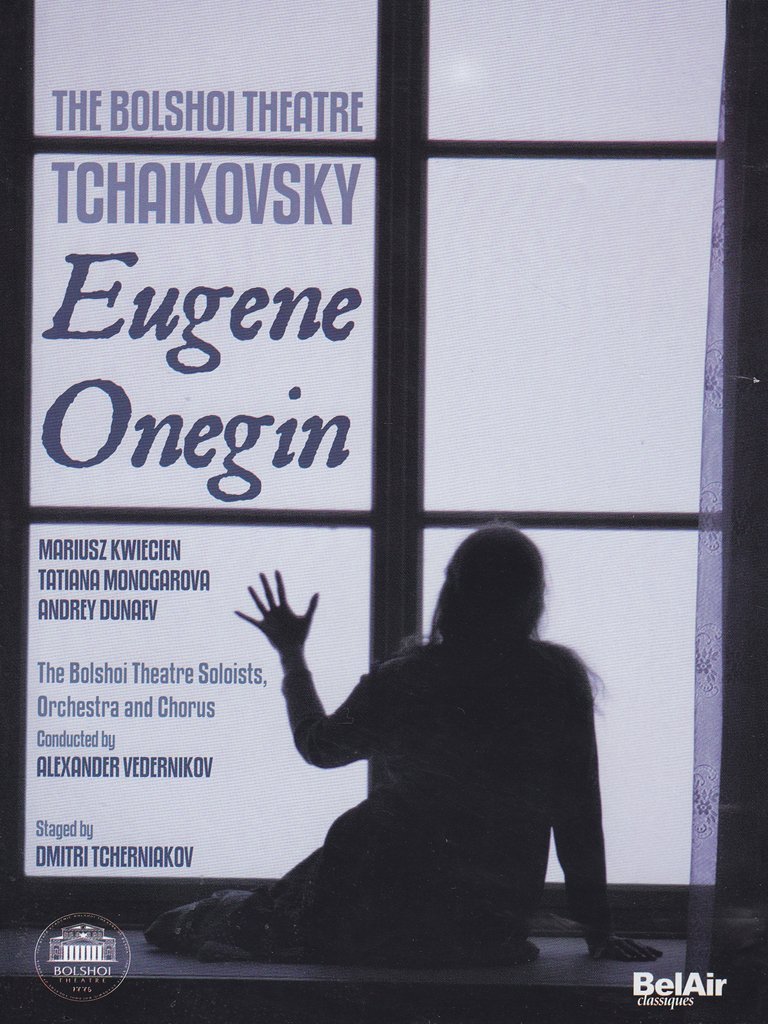
I started on Dmitri Tcherniakov’s production(Bel Air BAC046) with a huge dose of scepticism. His decision to replace Boris Pokrovsky’s old legendary production was very brave, because Muscovites (and not only Muscovites) were so very attached to it. Besides: you have to be really sure of yourself to dare to replace a LEGEND. On top of that, from the entire cast – apart from Kocherga and Kwiecien – I did not know any of the performers.
I quickly changed my mind, because from the start I was on the edge of my seat. The staging, costumes, stage design, sets and props – everything is right, even if it is not as it is in a typical ‘Onegin’. The entire first and second acts take place in the same space: the dining room in Larina’s house, with a long table and chairs prominently displayed. The same table and chairs also recur in III, but in a much richer ambience.
It is incredibly difficult to explain the whole directorial concept in a few words, you have to believe me that it is extremely fascinating and extremely exciting. Very intelligent too.
Tatyana is portrayed by Tatiana Monogarova in a very convincing way. She is pale, thin and slightly autistic, locked in her own mind. The outside world scares her as she tries to hide from it.
Olga(Margerita Mamsirova) is just a flirt and from the start she challenged Onegin. She is more than a little tired of her poet- boyfriend’s sighs. and she is not wrong!
Lensky is sung by a good, though not exeptional, Andrey Dunaev. He is a bit stupid, pushy and jealous and thus the real instigator of all evil happenings.
Larina (an insanely good singing and acting Makvala Kasrashvili) also gets more attention than usual. The moment when, thinking back to her childhood, she downs a drink and has a little cry is very touching. But she soon recovers and everything stays the same.
Mariusz Kwiecien (Onegin) is indeed irresistible. Or let me rephrase it: he portrays such a very bored and self-important arsehole (sorry for the word!). And he actually stays that way until the end. Utterly convincing!
Frantically he tries to belong to the ‘high society’, where he is not really accepted. Even his sudden passionate love for Tatyana feels unreal. On his knees, he offers her a bunch of red roses and when she refuses to run away with him, he tries to rape her.
Dignified, Tatyana walks off the stage on her husband’s arm on which Onjegin pulls out a pistol, but we are spared the suicide, because, of course!, without witnesses by his standards there is no use for it..
Trailer:
DMITRY HVOROSTOVSKY
And then there is Robert Carsen’s production for the Metropolitan Opera, recorded in February 2007(Decca 0743298). I am a huge Carsen-adept and love almost everything he does. So too this Onjegin
His staging is very realistic and he follows the libretto accurately. In the first act, the stage is strewn with autumn leaves, but everything else is basically bare and there is almost no scenery. A bed for the ‘letter scene’, otherwise some chairs in the second and third acts. At the duel, the stage is completely empty.
It is not distracting. On the contrary. The costumes are really beautiful, but especially in the first act they remind me more of English Jane Austen film adaptations than of the Russian countryside. It is not really disturbing, the eye wants something too, but Renée Fleming is too glamorous for a peasant trio, making her switch to a proud princess less impressive.
Onjegin (Dmitri Hvorostovsky) is mainly a dandy here, very concerned with his, good, looks. Well, Dima is an extremely attractive singer in all aspects, but in his confrontation scene with Tatyana, he is more reminiscent of daddy Germont than of Onjegin.
Ramón Vargas is one of the best lyric tenors in 2007, but Lensky he is not! He really does his best, he also looks like a real poet, but this role needs to be a bit more languorous.
As usual, Carsen’s character direction is truly unsurpassed and even Fleming seems to thaw out at times. Unfortunately, her Russian is totally unintelligible.
Fleming and Hvorostovsky in the final scene of the opera:
For most Dutch opera lovers is Menotti no more than a vaguely familiar name. His operas have never been very popular here and performances can be counted on one hand. Why? I don’t know. O yes, there are performances here and there, mostly made by students. But at the DNO? Matinee?
A pity, really, because not only is his music exceptionally beautiful (think of a combination of Mascagni and Britten), but the subjects he deals with in his (self-written) libretti are socially engaged and they address current topics.
Menotti met his longtime partner Samuel Barber
A newspaper article of February 12, 1947 on the suicide of a Polish emigrant whose visa for the USA had been rejected, was seen by Menotti, who sadly remembered the fate of his Jewish friends in Austria and Germany.
He took this sorry tale and used it as a basis for his first full-length opera. The subject has – unfortunately – lost none of its actuality and The Consul is and remains an opera that cuts right through your soul.
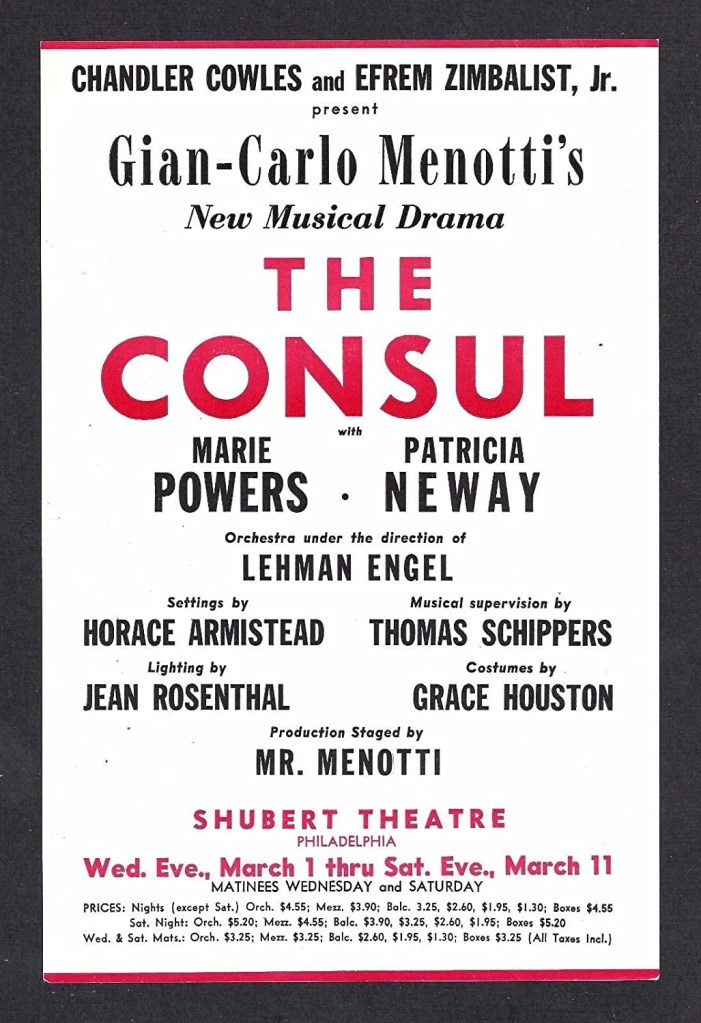
In 1960, it was produced for television, and that registration has been released on DVD by VAI (4266 ). In black and white, without subtitles (don’t be alarmed, there is very clear singing) and extremely dramatically portrayed by Jean Dalrymple.
Patricia Neway sings ‘To This We’ve Come’:
The Consul was Cornell MacNeill’s first opera recording:
How many operas can claim to have shot the world order hell by sparking a revolution and thereby creating an entirely new country?
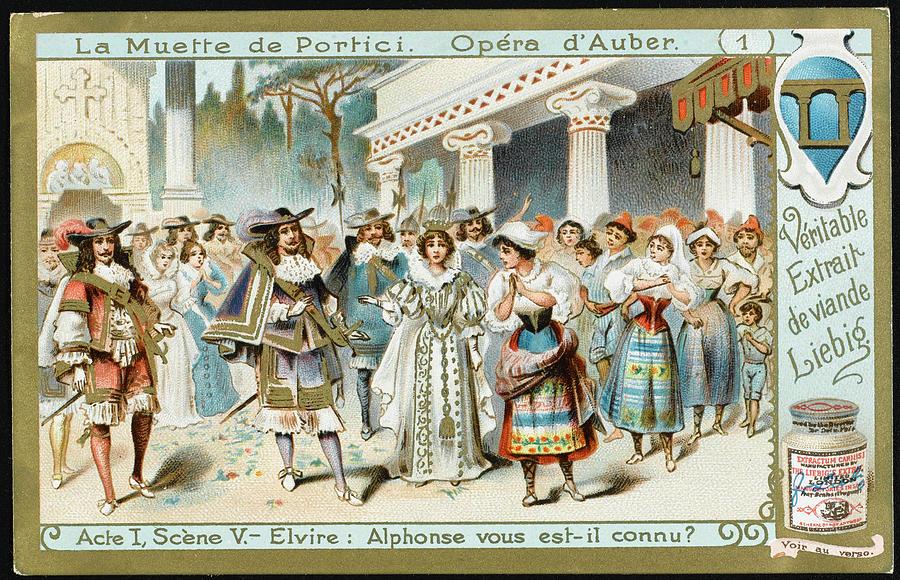
The honour falls to La Muette de Portici, an opera almost forgotten today by an almost equally forgotten French composer Daniel-François-Esprit Auber (1782 – 1971).
The situation ignited during a performance at Brussels’ La Monnaie in 1830, a performance in honour of the birthday of King William I. The moment suprème came during an aria, in which one of the protagonists sang the text: “Holy patriotism, give us back our courage and pride. My life I owe to my country, it will owe its freedom to me.” The audience left the hall, took to the streets and voilà: the Kingdom of Belgium was born.
That La Muette is different from all other operas also has to do with the protagonist. The latter may be present but has no note to sing – poor fisherman’s girl Fenella is mute.
Anna Pavlova as Finella
She is seduced by the young Neapolitan count Alphonse, who then exchanges her for a better match: a Spanish princess Elvire. Fenella is imprisoned, escapes and – using only sign language – manages to attract Elvire’s attention and pity, turning her brother Masaniello into the destroying angel.
This also becomes the signal to spark an uprising against the hated rulers; after which everything that can go wrong does. Masaniello is poisoned, the revolt fails and Fenella finds self-death in the lava flow from Vesuvius. I can’t make it more logical for you, but that doesn’t matter, because the opera itself is more than delightful and provides you with more than two hours of pure listening pleasure.
La Muette is considered the first true ‘grand opéra’. That may also be why it was so rarely staged, given our long-standing condescending view of the phenomenon of ‘grand opéra’.
But the tide is turning. A few years ago, La Monnaie dared to include the opera in its repertoire. Unfortunately, their courage did not go so far as to include performances in Brussels.
Peter de Caluwe, the director of La Monnaie, said with that, “That was done deliberately. Staging the opera in Brussels now would not only be an artistic act, but also a political statement; it would be interpreted as a plea for Belgian unity at a politically precarious moment.”
In 2011, a German opera house, the progressive Anhaltisches Theater in Dessau, where the young Dutch conductor Antony Hermus, then Generalmusikdirektor, also staged the opera. The performances were recorded live by CPO. It was about time!
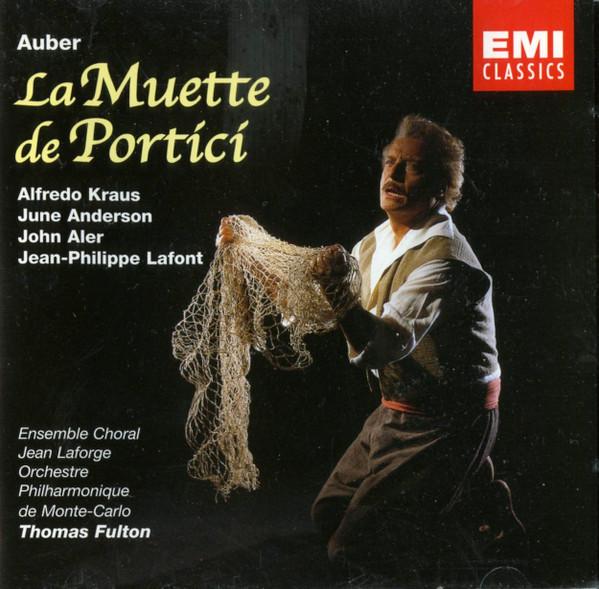
I knew of only one recording of the opera, with Alfredo Kraus, June Anderson, John Aler and Jean-Philipe Lafont conducted by Thomas Fulton (EMI not available anymore)). No one can match Alfredo Kraus’ elegant phrasing, but I still prefer Diego Torres’ more heroic sound. As Masaniello, he manages to convince much better. With him, you can practically hear the hormones coursing through his veins.
In his madness scene (yes, why not? Men are allowed to go mad too!), he sounds a lot like John Osborn.His high notes are not only spectacular but he also sings them at the top of his voice. Occasionally he sounds a little tired, but that doesn’t matter, especially in the context of the whole thing.
In “Mieux vaut mourir que rester misérable!”, from which the incendiary text thus comes, he is joined by Wiard Withold as Pietro. I also find him more interesting than Jean-Philipe Lafont on the Fulton (EMI) recording. It has now been recorded by CPO. It was about time
The young Dutch singer is at his best in the fifth act. His barcarolle “Voyez du haut de ces rivages” is particularly impressive. His lyrical baritone, meanwhile, has darkened a little without compromising on suppleness and lyricism, which goes without a hitch.
Angelina Ruzzafante is a wonderful Elvire. Her voice is light, supple and agile, her pitch beautiful and pure, and her vocal acting is perfect.Sometimes she reminds me of Cristina Deutekom, but without her oh-so-typical “staccato” (no offence!). It is about time the we get to hear the Dutch soprano on our stages too!
Oscar de la Torre (Alphonse) starts out weak – his tenor sounds a bit pinched – but in the fourth act he more than recovers. He is still young and – from the looks of it – inexperienced, but he will get there!
The chorus is formidable and I find Hermus’ tempi definitely better than Fulton’s.
Set design by Alfred Roller for ‘Der Traumgörge’. Vienna Court Opera 1907
“The fairy tales must become reality,” sings Görge, after his dream has been laughed at by the farmers and his fiancée Grete. And so it happens: Görge finds his dreamed princess in the form of Gertraud, cast out by the farmers, and his dream comes true.
Zemlinski has provided the story of Görge the dreamer and his search for the unattainable ideal with music of touching beauty. Sehnsucht, shimmering eroticism, symbolism …. You name it and you’ll find it. The work reminds me strongly of Szymanowski’s Król Roger, the same long, spun-out lines in the soprano aria, the same overwhelming choral parts, swelling orchestra. I love it.
Josef Protschka as Geörge:
Der Traumgörge (Leo Feld’s libretto after Richard von Volkmann-Leander’s fairytale ‘Vom unsichtbaren Königreich’ and Heine’s poem ‘Der arme Peter’) was meant by Zemlinsky as a tribute to his then beloved Alma. Due to circumstances, the opera was never performed during his lifetime; the first – considerably shortened – performance only took place in 1980.
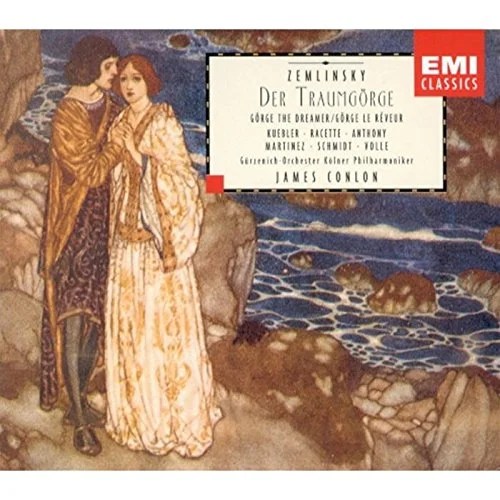
The first complete recording from 1999 proves that the music is not to blame. The Cologne orchestra conducted by James Conlon alone deserves an A-plus and the soloists are absolutely sublime.
David Kuebler plays a beautiful Görge with a radiant height. His voice mixes the right amount of metal with sottovoce, which is necessary for this role.
Patricia Racette, then still a great unknown, is unearthly beautiful as Gertraud (her velvet tones in ‘Oh! Ich wil zu dir in die Welt’ are of a Korgoldian beauty) and Andreas Schmidt has enough of a peasant to be a convincing Hans. The live recording sounds excellent.
Just imagine: The world premiere of Der Traumgörge took place in Nuremberg in 1980 – almost 80 years after it was written. Find out more in this documentary by Staatsoper Hannover:

















 Basia con fuoco