Susan_Graham

Thomas Hampson: always a hiker of the lesser-known paths,

TIDES OF LIFE: exciting arrangements of songs by Wolf, Schubert, Brahms
and Barber


In the winter of 2014, Amsterdam Sinfonietta and American baritone Thomas Hampson toured Europe. In a fortnight, they gave 12 concerts in six different European countries.

Especially for this tour and commissioned by Amsterdam Sinfonietta, British composer David Matthews arranged songs by Wolf, Schubert and Brahms. Schubert’s ‘Ständchen’ was given a new arrangement by Bob Zimmerman. Only Samuel Barber’s “Dover Beach” was not given a real ‘make over’ and remained close to the original composition.


The songs are sometimes barely recognisable, but I don’t mind. It’s quite exciting to hear what an arrangement can do with familiar melodies.

The text remains the same, of course, but the melody line – and ertainly the tone – does change. In the new arrangements, Brahms’ “Vier ernste Gesänge” sound a little less sombreand Wolf’s songs (“Der Rattenfänger”!) actually become much more serious in tone and less ironic.

In Bob Zimmerman’s setting, the lovely “Ständchen” sounds a little unheimlich. A feeling reinforced by the reversal of the ‘roles’: it is now not a girl assisted by a male choir, it is now the women who accompany the man. It takes some getting used to, but beautiful it most certainly is. In any case, the National Women’s Youth Choir knows it well.

Hampson’s voice is not as beautiful and cultured as it used to be, which is only a plus here.Thus, the songs sound sort of spicy, with plenty of punch. Nice!

Amsterdam Sinfonietta proves yet again that they are one of the best chamber music ensembles in the world.


TO THE SOUL: AMERICAN SONGBOOK
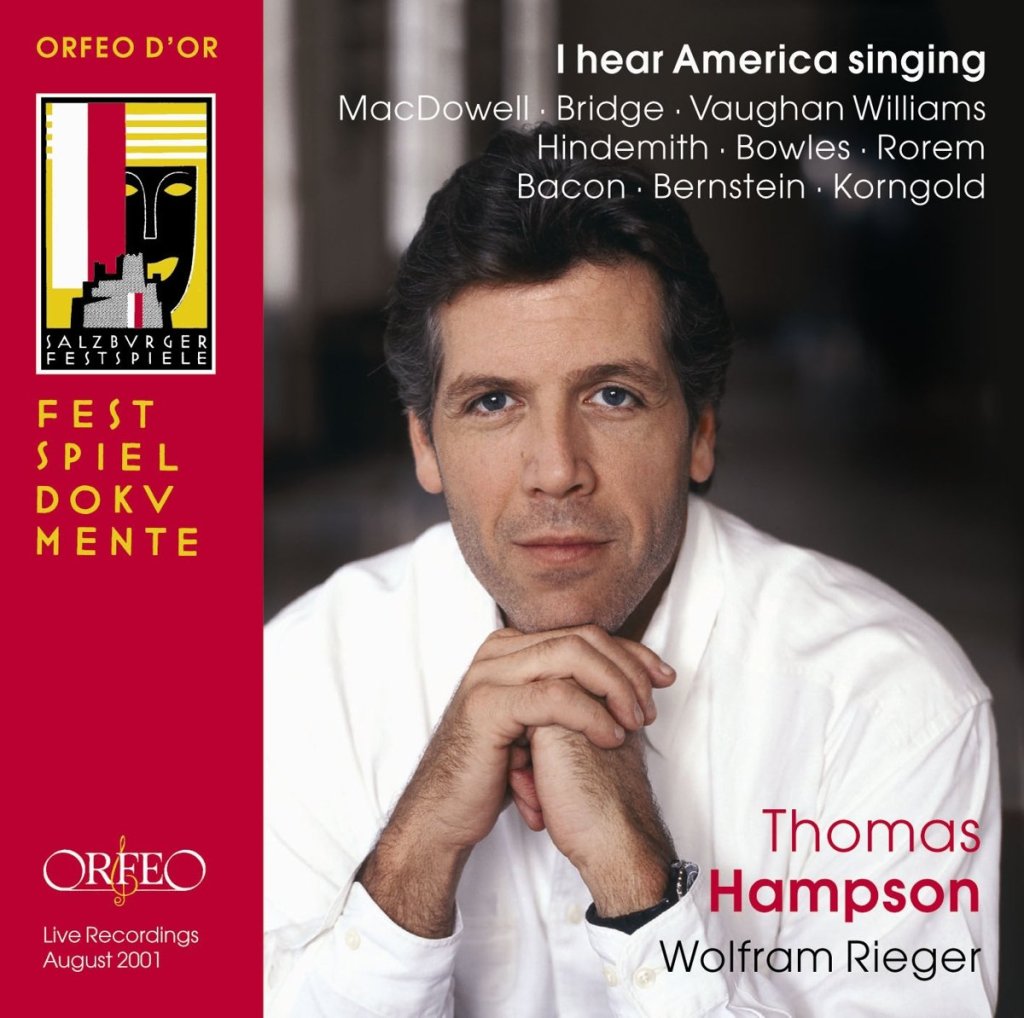


For decades, Thomas Hampson has been a tireless ambassador for art songs by American
composers, as well as American poetry. In 1991, he recorded a CD for Teldec with “German” songs by Charles Ives, Charles Tomlinson Griffes and Edward MacDowell

Griffes’ “Mein Herz ist wie die dunkle Nacht”:


To the Soul was released by EMI in 1997, featuring songs on texts by Walt Whitman.


Those names were therefore not missing from the recitals he gave in Salzburg in 2001, part of what was called a “Hampson Project”.

The theme of this mini-festival (there was also a symposium) was American poetry, set to music by various, not only American, composers. Hampson did more than just sing. He introduced the songs, commented on them and talked
about the composers, poets, writers and traditions.

Thomas Hampson on “American Songbook” :


To the delight of anyone who cares about American music and poetry, three of those recitals, from 12 (and not 15), 17 and 22 August 2001 respectively, were released on two CDs a few years ago. Hampson sings as we have come to expect: cultured and beautiful, and his diction
and text handling are exemplary.

This clip is not from the CDs (neither found on You Tube nor Spotify), but it illustrates Hampson’s commitment to the music and poetry of his homeland:


As a bonus, we get three songs by Korngold, taken from the project Forbidden and Exiled, from Salzburg 2005.


WERTHER : Can a baritone be a convincing Werther?


In 1902, ten years after the premiere, Massenet made a new version of his Werther, this at the request of Italian baritone Mattia Battistini, who was eager to sing the lead role. Massenet did not change the key, but rewrote the vocal lines of Werther’s music, making the arias, “Pourquoi me réveiller” included, barely recognisable.


The “baritone version” of the opera was and remains an oddity; no original manuscript of the score even exists. In recent times, with its penchant for ever new challenges, there was also an increased interest in the alternative versions of well-known operas.

Thomas Hampson has always walked the lesser-known paths, and he first performed the role of Werther back in 1989. In 2004, he sang a concert performance of it at the Paris Chatelet, and that performance has been released by Virgin on two DVDs. He does an excellent job, but
the manic-depressive is a bit off.

His Charlotte is sublimely sung by Susan Graham, who also performed the role in Amsterdam some years ago, where she had moved the audience and press to tears. Michel Plasson has drama in his fingertips and you can hear it.

Händel’s Alcina: it’s about sex, isn’t it? Discography

Dosso Dossi (1479-1542): Alcina

“Well, it’s about sex, isn’t it?” In her introduction to the 2011 Alcina, recorded by Arthaus Musik in Vienna, American thriller writer Donna Leon argues that (we didn’t know this, of course) virtually all operas are about sex, whether it’s Der Rosenkavalier, Madama Butterfly or Dido and Aeneas. With Alcina, the story from Ariosto’s Orlando Furioso, set to music by Handel, taking the crown.

Yearning for (young) male flesh, the sorceress, once she is bored, transforms her victims into wild animals and sets out to find new food for … no … not for the soul. Until she herself finally falls in love, which will be her downfall. One could almost feel sorry for her!


ANJA HARTEROS

The DVD recording from Vienna is exceptionally fine, thanks in part to director Adrian Noble. Unlike other operas by Handel, Alcina contains a lot of ballet music, something that is seamlessly integrated into the beautiful and atmospheric staging.

Anja Harteros is an outstanding Alcina. Her ‘Regina sei tradita’ is followed by a very well-deserved applause. Kassarova is completely in her element as Ruggiero, Adam Plachetka is a delightful Melisso and the young German tenor Benjamin Bruns convinces as a hot-tempered Oronte.

But my heart is stolen by the boy soprano Alois Mühlbacher. The boy is absolutely peerless in the role of Oberto searching for his missing father. Highly recommended!

Below ‘Ah! Mio cor’ by Anja Harteros:


ARLEEN AUGÉR


Many Handel fans claim that nothing can rival the 1986 EMI (now Warner 50999 0880212) recording under Hickox, starring the unforgettable Arleen Augér. I can agree with this sentiment, as the voice of the soprano, who died far too young, is unearthly beautiful.


Della Jones (Ruggiero) and Kathleen Kuhlmann (Bradamante) are also absolutely irresistible, but the rest of the voices don’t really appeal to me. A pity, because I really like the tempi. Although I must admit that virtually the same cast in 1990 under William Christie sounds much more exciting.


Below, Arleen Auger and her version of ‘Ah! Mio cor’:


RENÉE FLEMING


In 1999, William Christie recorded Alcina live for Erato. Renée Fleming is a matter of taste, especially in the role of Alcina. But Susan Graham is a wonderful Ruggiero and Natalie Dessay perhaps the best Morgana ever. And Kathleen Kuhlmann once again gets to show why she is one of the most beautiful mezzos in history.


JOAN SUTHERLAND


The fact that the opera has become so incredibly popular and has been performed so very frequently in recent decades is largely thanks to Joan Sutherland. Back in 1957, she brought Alcina to life in London and directed by Zefirelli. Unfortunately, we do not have a video recording of it, but La Stupenda sang and recorded the role several times afterwards and there are many both official and pirate recordings of it in circulation.


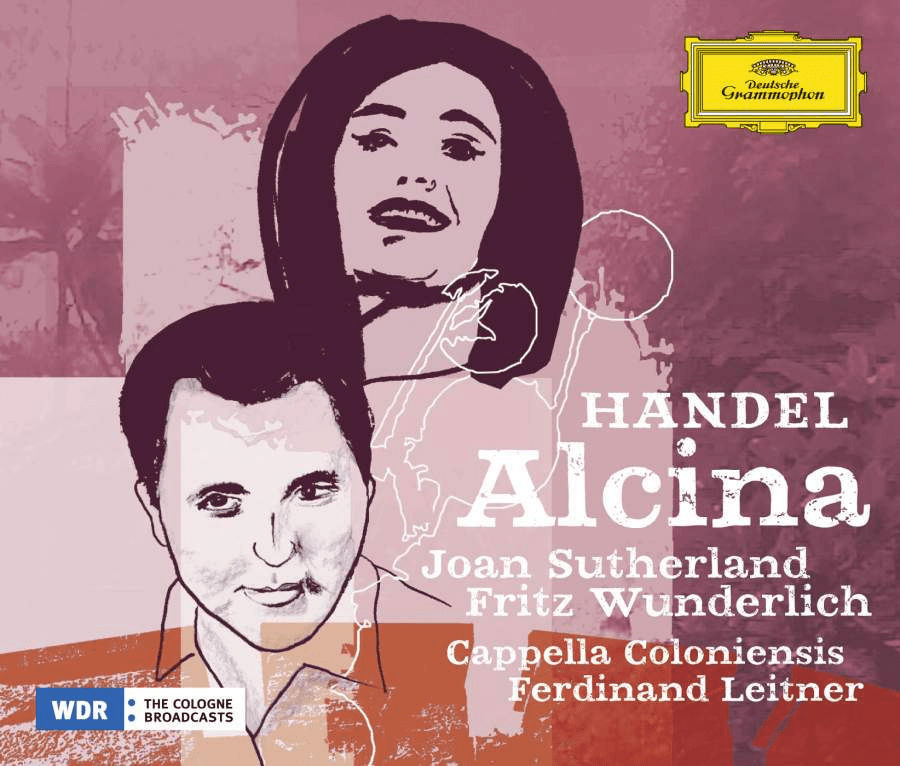
Personally, I have a soft spot for the 1959 live recording (DG, made to mark the 200th anniversary of Handel’s death), not least because of Fritz Wunderlich, who sings the role of Ruggiero. Last but not least, Dutch soprano Jeannette van Dijck sings the role of Morgana. And believe it or not, the Cappella Coloniensis, led by Ferdinand Leitner, is already playing on authentic instruments. In 1959!


The score has been considerably shortened. Thus, pretty much the entire role of Oberto has been dropped. And yet… opera is mostly about voices, isn’t it? And Sutherland’s ‘Tornami a vagheggiar’ and Wunderlich’s ‘Mi lusinga il dolce affetto’ are simply second to none. (DG 4778017)

Below Joan Sutherland:


Twee ‘Les Troyens’ uit de archieven

berlioz_les_troyens_-_gardiner

Persoonlijk houd ik niet zo van Les Troyens. Het is me te statisch, te klassiek van vorm ook, want op zoek naar zijn ideale klankbeeld reisde Berlioz terug in de tijd, Gluck achterna.

Een goede voorstelling kan echter wonderen verrichten, en zie: een wonder is geschied.

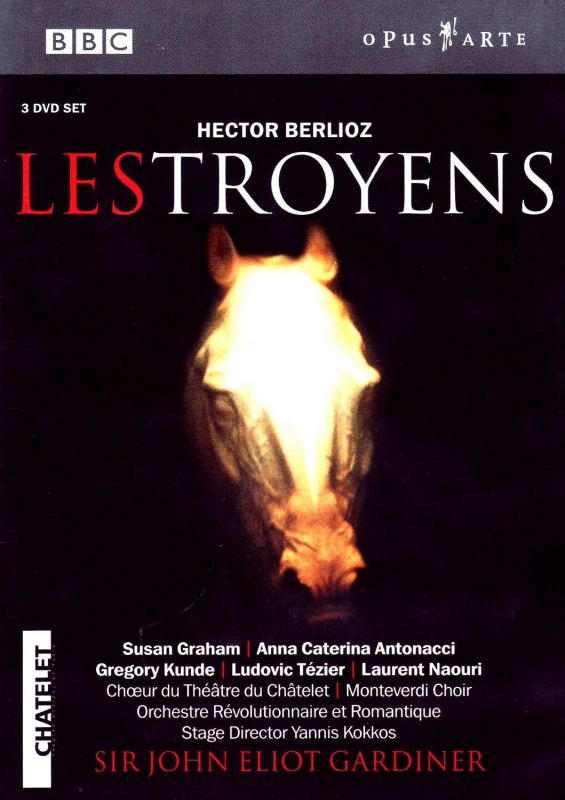
De in 2003 in Théatre du Châtelet op 3 DVD’s (Opus Arte OA 0900 D) opgenomen productie van Yannis Kokkos kan ik in één woord worden beschrijven – FANTASTISCH!

Van het begin tot het eind keek ik geboeid, en was vol bewondering voor zowel de regisseur (die ook de enscenering en kostuums voor zijn rekening nam) als ook de zangers.

In de eerste twee akten koos Kokkos voor sensationele visuele effecten, die beginnen nog voordat het doek opengaat. Middels spiegels en projecties, kleuren en lichten, ontstaat een multidimensionale voorstelling, niet begrensd door regels, noch door de logica.

Zo creëert hij een stad in een stad, zo kunnen we de glorie van de oude Troje nog aanschouwen op hetzelfde moment als zij al onder gaat. Het Carthago gedeelte is wat rustiger, hier overheersen de harmonie en geometrische lijnen.

De opera wordt gedragen door twee zangeressen: Anna Caterina Antonacci, een sopraan met een fantastische laagte, sensationele gebaren en onbegrensde mimiek imponeert als de gekwelde Cassandre en de zoetgevooisde Susan Graham zet een bijzonder ontroerende Didon neer.

Susan Graham en Gregory Kunde in ‘Nuit d’ivresse’:

Maar ook met de heren is er helemaal niets mis: Gregory Kunde (wat een prachtige, makkelijke hoogte!) schittert als Énée en Laurent Naouri is een imponerende Narbal/Le Grand Prêtre.

John Eliot Gardiner dirigeert het zeer transparant spelende Orchestre Révolutionnaire et Romantique

Troyens Domingo

Een jaar of tien geleden heeft DG (0734310) een behoorlijk ingekorte voorstelling van de Metropolitan Opera op dvd uitgebracht. Het dateert uit 1983 en is (hoe kan dat anders?) zeer traditioneel, met alles daarop en daaraan. Prachtig vind ik het! Machtig, overweldigend…

En kijk maar eens wie de vertolkers van de hoofdrollen zijn: Jessye Norman (Cassandra), Tatiana Troyanos (Dido), Plácido Domingo (Aeneas)!

Jessye Norman als Cassandra:

Sterfscène van Didon (probeer het droog te houden!):

De opname zelf is ook bijzonder: omdat er, tijdens de live tv-uitzending op 8 oktober de elektriciteit was uitgevallen, werd een klein deel van de tweede akte geplukt uit een eerdere voorstelling.

Jimmy Levine dirigeert zoals we van hem gewend zijn: spannend, groots en met spierballen.

Kan een bariton overtuigend Werther zingen?

werther-concert Hampson

In 1902, tien jaar na de première, maakte Massenet een nieuwe versie van zijn Werther, dit op verzoek van de Italiaanse bariton Mattia Battistini, die de hoofdrol graag wilde zingen. Massenet veranderde de toonsoort niet, maar herschreef de vocale lijnen van Werthers muziek, waardoor de aria’s, ‘Pourquoi me réveiller’ incluis, nauwelijks te herkennen zijn.

De ‘bariton versie’ van de opera was en blijft een rariteit, er bestaat zelfs geen origineel manuscript van de score. De laatste tijd, met zijn hang naar steeds nieuwe uitdagingen, kwam er ook een verhoogde belangstelling voor de alternatieve versies van de bekende opera’s. De (hoge) baritons, het zingen van de slechteriken beu, herontdekken het repertoire, waarin zij al hun lyrische melancholie kwijt kunnen.

Thomas Hampson is altijd al een bewandelaar van minder bekende paden geweest en de rol van Werther heeft hij al in 1989 voor het eerst vertolkt. In 2004 zong hij een concertante uitvoering ervan in het Parijse Chatelet, en die uitvoering is door Virgin op twee dvd’s uitgebracht. Hij doet het uitstekend, maar het manisch-depressieve is een beetje weg.

Zijn Charlotte wordt subliem gezongen door Susan Graham, die de rol enkele jaren geleden ook in Amsterdam heeft vertolkt, waarbij zij het publiek en de pers tot tranen toe had geroerd. Michel Plasson heeft de drama in zijn vingertoppen en dat hoor je.

Jules Massenet
Werther
Thomas Hampson, Susan Graham, Sandrine Piau, Stéphane Degout
Orchestre National du Capitole de Toulouse olv Michel Plasson
Virgin 3592579

2 x RAVEL. OZAWA & SLATKIN

L’ENFANT ET LES SORTILÈGES
SHÉHÉRAZADE

ravel-ozawa

Ik denk niet dat het fair is om de op zichzelf zeer fraaie uitvoering van Shéhérazade door Susan Graham met de legendarische Régine Crespin te vergelijken. Je hebt eenmaal van die monumenten waar je alleen bewonderend tegenop kan kijken.

Maar ook als je dat grote voorbeeld vergeet, blijft er iets te wensen over bij deze opname. Er knaagt iets. Grahams stem is goddelijk mooi en glanzend, en haar voordracht is subliem. Maar waarom word ik toch niet echt warm van en waarom blijf ik iets missen?

Het ligt niet aan Jacques Zoon, wiens fluitsolo in “La Flûte enchantée” werkelijk betoverend klinkt.

Het ligt ook niet aan Ozawa en zijn Saito Kinen Orkest, die de sprookjesachtige, met exotica geparfumeerde liedcyclus van Ravel perfect weet te benaderen. Ozawa, een leerling van zowel Charles Munch als Pierre Monteux is altijd één van de grootste interpreten van de Franse muziek geweest.

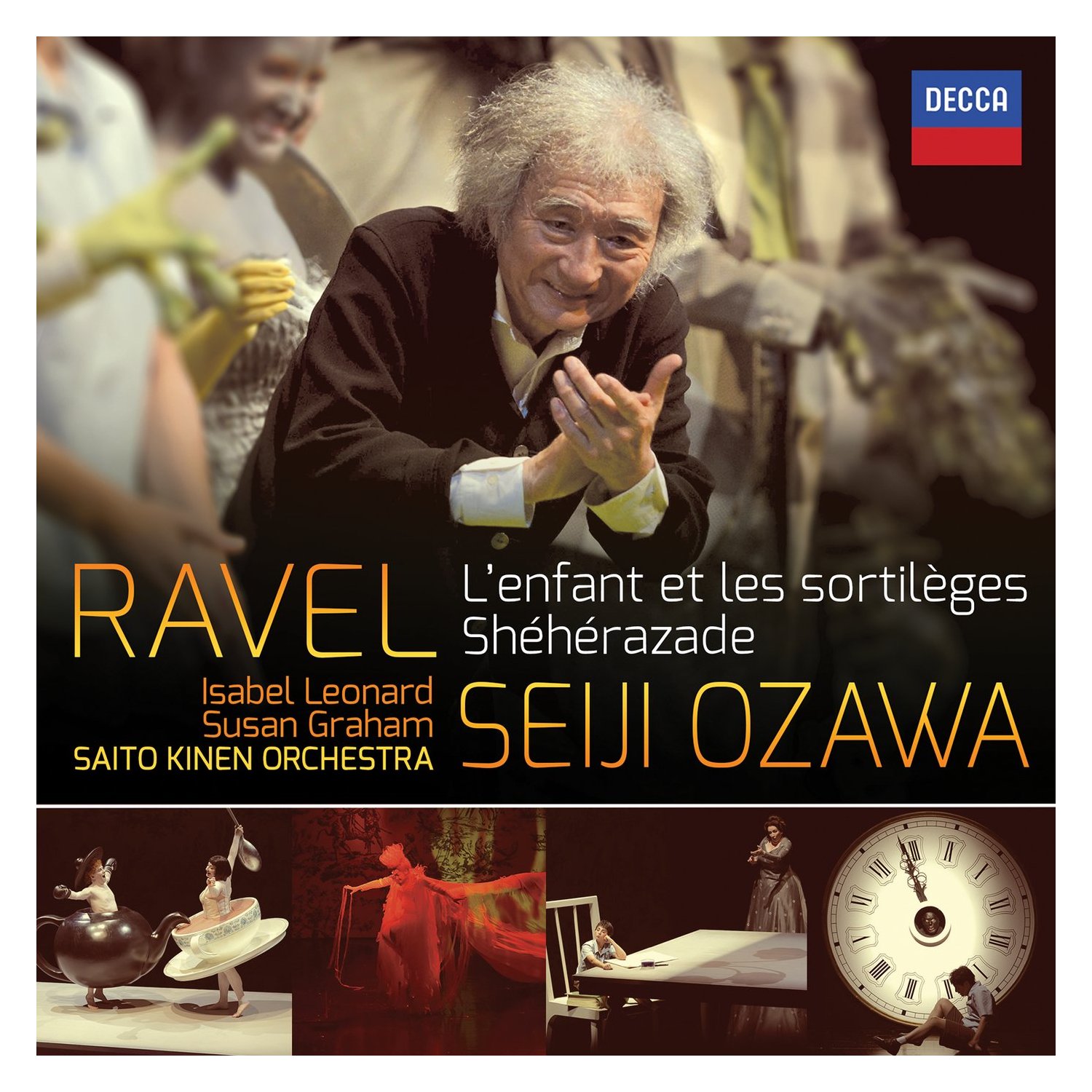
Dat hoor je in de heerlijk dansante Alborada del gracioso. En dat hoor je ook in zijn begeleiding van L’enfant et les sortileges. De tijdens het Matsumoto Festival in 2014 live opgenomen heerlijke mini-opera krijgt onder zijn handen één van de beste uitvoeringen die ik ken.

Hij heeft dan ook een onvoorstelbaar goede cast tot zijn beschikking, met Isabel Leonard als het verwende kind volop


L’enfant et les sortileges
Isabel Leonard, Paul Gay, Yvonne Nef e.a.;
Shéhérazade
Susan Graham (mezzosopraan)
Alborada del gracioso
Saito Kinen Orchestra olv Seiji Ozawa
Decca 4786760 • 66’

(meer…)