English

Plácido Domingo as Andrea Chénier

chenier-portret
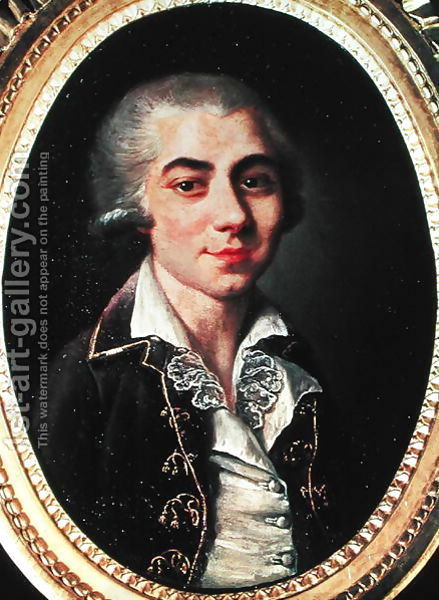
André Chénier


For me, Andrea Chénier is one of the best and most beautiful operas ever. I think the music is nothing less than divine and the story is timeless. It remains current, perhaps now more than ever. The tyrant must be cast off his throne and the people must take control. Surely, we all agree on that?

If only it were that simple! Anyone who grew up in a post-revolutionary totalitarian regime knows how much horror it brings. One terror is replaced by another.

This, at least for me, is the main theme in Giordano’s biggest hit. I don’t think the real lead role is the actual poet, André Chénier (did you know that Giordano used Chénier’s poems in his arias?) nor his beloved Maddalena. It is the French Revolution, which, as Gérard (once Maddalena’s houseboy and now one of the revolutionary leaders) bitterly observes, devours its own children.

To my great surprise, I read that Domingo didn’t much like the part of Andrea Chénier. He loved the opera, but the role, one of the toughest in the ‘lirico-spinto’ repertoire, was not really interesting for him dramatically. For him, Chénier was ‘an idealist who always has his head in the clouds’. And yet it was one of the operas he loved to sing!

I myself think the role of the poet/revolutionary fits him like a glove. Passion for love and enormous involvement in everything that happens in the world were – and still are – his trademarks.

Domingo sings ‘One of all’azzurro spazio’:


He sang his first Cheniér in 1966 in New Orleans, as the last-minute replacement for Franco Corelli, but that was not his first performance of the opera. In the 1960/61 season he sang The Incredible and The Abbot, in Mexico.


chenier-domingo-cd


My favourite CD recording was recorded in 1976 by RCA (GD 82046). The cast is delectable. Renata Scotto sings Maddalena, Sherrill Milnes is Gérard and in the small roles we hear, among others, Jean Kraft, Maria Ewing, Michel Sénéchal and Gwendolyn Killebrew. James Levine, who conducts the National Philharmonic Orchestra, understands exactly what the opera is about. Tear jerkingly beautiful.

Scotto sings ‘La Mamma morta’:


chenier domingo dg


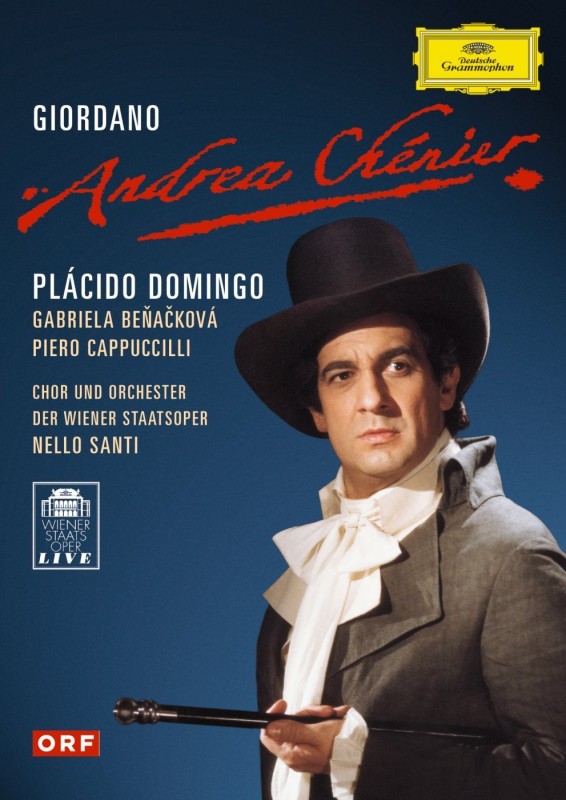
In 1981 the opera in Vienna was recorded for TV. That recording has since been released on DVD (DG 073 4070 7). Gabriela Beňačková, one of the most underrated singers in history, sings a Maddalena of flesh and blood. Horrifyingly beautiful and moving.

Piero Cappuccilli is a Gérard among thousands and the small roles are also filled by great singers: Madelon is sung by none other than Fedora Barbieri. Otto’s Schenk’s production is a feast for the eyes.


English translation: Douglas Nasrawi

Between Gods and Demons: George London

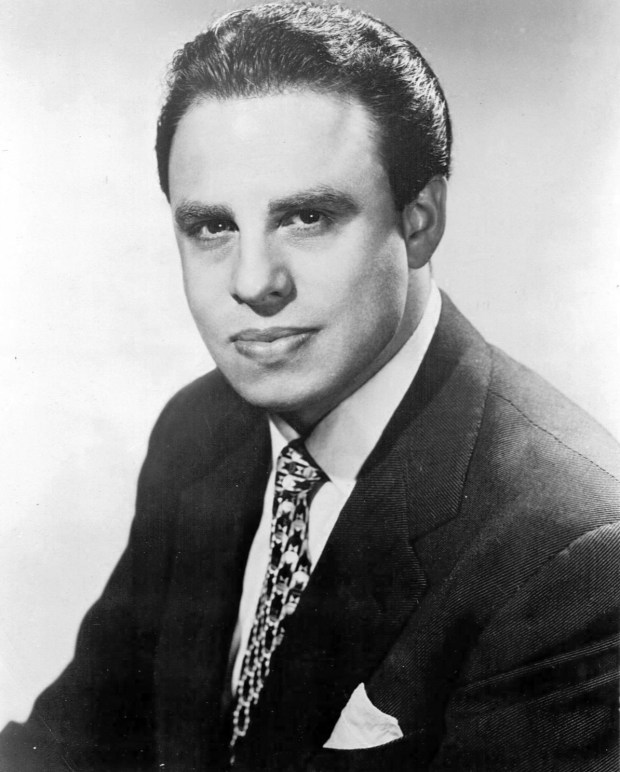
And now I would like to tell you about George London. Born as George Burnstein into a family of Russian Jewish immigrants in Montreal, Canada in May 1920, he grew up in Los Angeles and began his career in the 1940s in the Bel-Canto Trio. The other two were soprano Frances Yeend and … Mario Lanza!

                                                              with Mario Lanza


London was the very first American to sing Boris Godunov (in Russian!) at the Bolshoi in Moscow and was considered one of the best Wotans/Wanderers of his era. His Scarpia was also already legendary during his lifetime.

Here is a wonderful recording from a 1962 concert of George London (in perfect Russian!) as Boris,


In addition to his Boris Godunov and Scarpia, London was mainly renowned for his Don Giovanni. Everyone agreed about his Don Juan that if you ooze that much sex appeal, it can be demonic. Definitely something to think about! As far as I know, there is no complete film of the opera with him in it. All the more reason to recommend to all of you the portrait of the singer that came out a couple of years ago at Arthaus Musik (101473). The title of the documentary says it all, Between Gods and Demons.

About a decade ago, the budget label Walhall re-issued two historic recordings of Tannhäuser on CDs, one a Berlin performance in 1949 conducted by Leopold Ludwig (WLCD 0145) with Ludwig Suthaus (Tannhäuser), Martha Musial (Elisabeth) and a very young Fischer-Dieskau (Wolfram), and the other a performance at the Met (WLCD 0095) conducted by Rudolf Kempe in 1955. Except for the not very idiomatic Astrid Varnay as Elisabeth, it featured a magnificent array of the greatest singers of the day, Blanche Thebom, George London, Jerome Hines and Ramon Vinay. Here is George London singing ‘O du mein holder Abendstern’:


Decca London

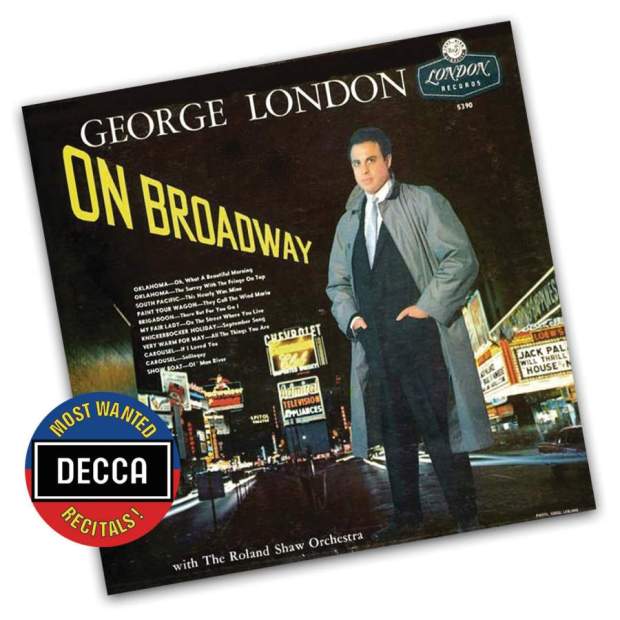
But he was also a real entertainer who took popular music seriously, to him they were all ‘artificial art songs’. On the CD On Broadway (Decca 4808163) he gives us a lesson on how to sing the songs of musical composers Rogers, Kern and Loewe.

Below London sings Rogers and Hammerstein’s If I Loved You:

And you get Wagner as a bonus.


English translation: Sheila Gogol

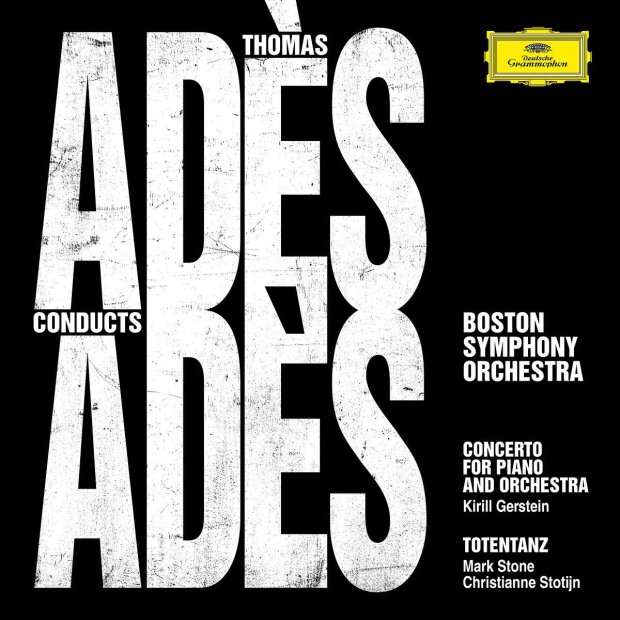
Thomas Adès by Thomas Adès: You can’t get it any better

Ades picos

Thomas Àdes (1971) is one of my beloved contemporary composers. In contrast to many of his (older, I admit) colleagues, he writes music that is not too complicated, without it becoming a tapestry of sound. His music is exciting, stimulating, progressive and yet accessible. In one sentence, he has brought the ‘classic’ and the ‘innovative’ to each other and melted them together. In addition, he does not shy away from horror-like outbursts and even dodecaphony, which makes his music extremely visual and often terrifying.

This is also the case with Totentanz, a composition for mezzo-soprano, baritone and orchestra based on an anonymous text from the fifteenth century, a story about the struggle between Life and Death. The latter always wins. Adès dedicated the work to Witold Lustoslawski and his wife. It was first performed at the Proms in 2013, with Christianne Stotijn and Simon Keenlyside.

This recording was made live in Boston in 2016 and I can’t imagine a better performance is possible. Mark Stone (Death) and Christianne Stotijn sing their roles chilling, melancholic, provocative and resigned. Just listen to the last two parts: it’s as if Schubert and Mahler run into each other and find each other in a deadly embrace. With the dying copper sound like the exhaling of the last breath.

Adès composed his piano concerto for the Russian master pianist Kirill Gerstein, an unprecedented virtuoso who combines his romantic beat with an enormous gift for improvisation. I had to listen to it a few times because the concert does not show itself quickly. Mainly because of the many colors and ‘intermediate colors’, which means more than just nuances.

The transitions between the parts are great, so the tension makes you gasp for breath. The fact that the composer himself stands in front of the really impressive performing orchestra from Boston can only be regarded as an enormous advantage. What a CD!

English translation: Frans Wentholt

THOMAS ADÈS
Concerto for Piano and Orchestra; Totentanz
Kirill Gerstein (piano)
Christianne Stotijn (mezzo-soprano)
Mark Stone (baritone)
Boston Symphony Orchestra conducted by Thomas Adès
DG 48379989

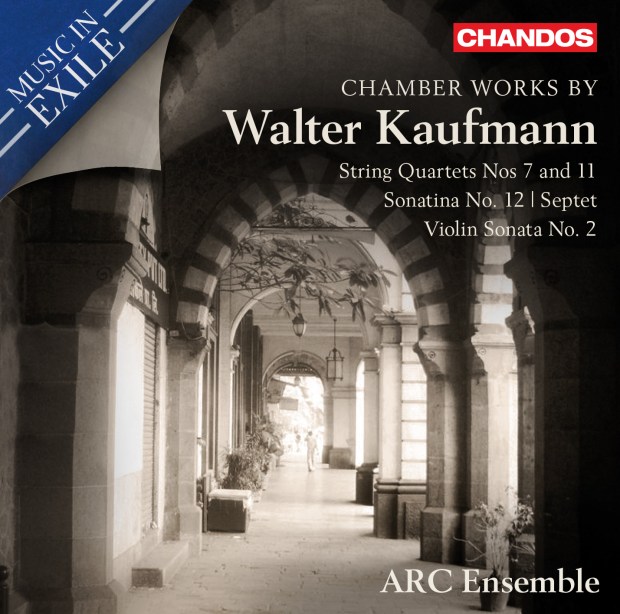
Discovering Walter Kaufmann: when Bombay meets Berlin

Slow, way too slow and actually way too late, but the music world is waking up. One gap after another is finally being filled and the (consciously or unconsciously) ‘forgotten’ composers are also entering our CD players. It’s also partly thanks to the Canadian ARC Ensemble. A few years ago, together with the English label Chandos, they set up the project ‘Music in Exile’, to which we owe splendid recordings of works by, among others, Szymon Laks, Jerzy Fittelberg and Paul Ben-Haim.

And now it is Walter Kaufmann’s (1907-1984) turn, an originally Czechoslovakian composer whose name, even to me, was nothing more than a name. Not that he had been completely forgotten: in Canada, his new homeland since 1947, he was a highly regarded piano teacher at the Halifax Conservatory. In 1956 he was offered a job at a conservatory in US where he was adored by his students. But as much as he was loved as a teacher, as forgotten he was as a composer. And that is extremely unfortunate because Kaufmann’s life course – and his works – are quite different from those of his exile fellows.

Early on, Kaufmann became obsessed with Indian music, which made him decide to flee to India in 1933. Once at his destination, Kaufmann immersed himself in the music of his host country. Among other things, he composed a tune for ‘All India Radio’ and founded the ‘Bombay Chamber Music Society’. All the chamber music works, on this Chandos recording really magnificently played by the ARC Ensemble, are also composed in India.

No, it’s not that you should immediately think of Ravi Shankar, but the Indian influence is undeniable. And that, while you are clearly dealing with western music from the twenties / thirties. A bit hybrid, yes, but luckily that is allowed again.

Translation: Frans Wentholt


Walter Kaufmann
String Quartet No. 7, String Quartet No. 11, Violin Sonata No. 2 op. 44, Violin Sonatin No. 12, Septet (for three violins, viola, two cellos and piano)
ARC Ensemble, Chandos CHAN 20170

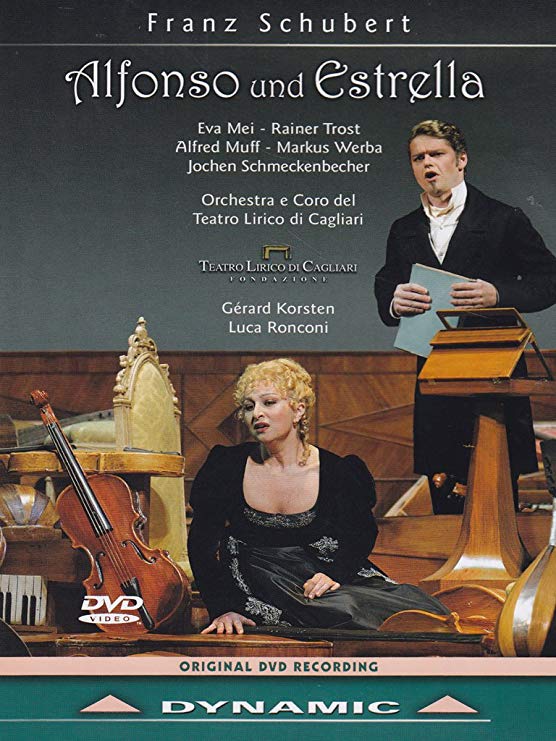
Schubert’s Alfonso und Estrella: what a surprise!

Dynamic Schubert

What a surprise! I have to admit: I love, love, love it! A romantic fairy tale about an old king, who is thrown off the throne by his rival, and about his son who falls in love with the daughter of his father’s rival.

After some complications (there is also a real bad guy) everything goes well: Alfonso and Estrella get married and the old king gets his throne back, which he then promptly hands over in favour of the young couple. And there is also a moral: a really big man forgives his enemies.

The music is very beautiful. No, it’s not a masterpiece, but still … it’s unmistakably Schubert. There are a few incredibly beautiful ballads: a song by Froila about the cloud girl, for example. Or a touching ‘Wo ist sie’ by Mauregato, who thinks he has lost his daughter.

Eva Mei, Rainer Trost, Alfred Muff, Markus Werba and Jochen Schmeckenbacher play and sing exceptionally well, and I also think the staging (directed by Luca Ronconi) is a great success. In a setting of string instruments only, the opera is played out two-dimensionally: on stage and on the platform behind it, where puppets play the scenes.

In the first act the singers are dressed in evening dress (suggesting a song recital?), in the second and third act they wear period costumes from the region  (Spain in the eighteenth century).

The opera was recorded in 2004 in Cagliari, an opera house that is not afraid of unknown repertoire.

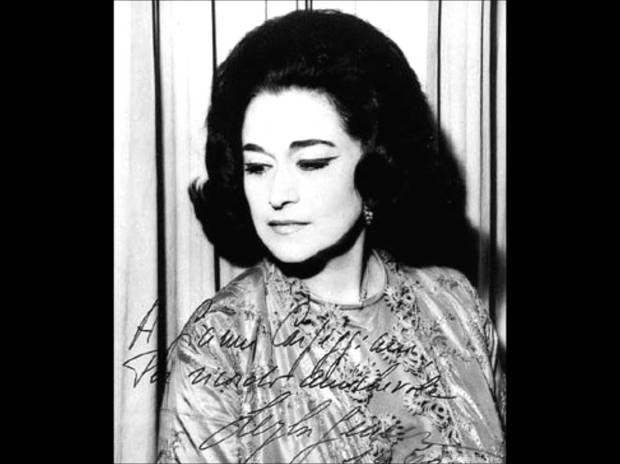
A few words about Leyla Gencer

gencer

Born 10 October 1928 in Polonezköv, a small town close to Istanbul, Leyla Gencer had – just like Maria Callas – a cult status, even today, but on a smaller scale. She had a Turkish father and a Polish mother, which made her proficient in that language. There is even a pirate recording of her with songs by Chopin in Polish:

Gencer’s real speciality was belcanto. She sang her first Anna Bolena only a year after Callas:

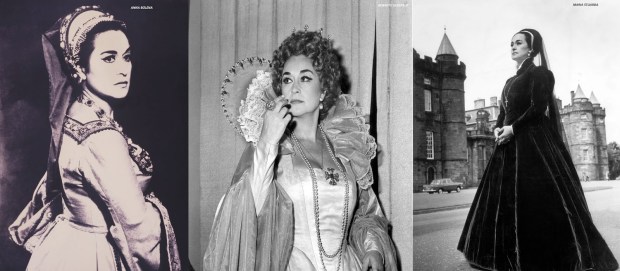
And unlike Callas, she also included the other Tudor Queen operas by Donizetti in her repertoire: Roberto Devereux and Maria Stuarda.

Gencer as all three Tudor Queens

gencer-alle-drie-tudor

Besides all her Bellini’s, Donizetti’s and Verdi’s, and between Saffo by Paccini and Francesca da Rimini by Zandonai, she also sang some of Mozart’s songs. Fortunately, her Contessa (Le nozze di Figaro) in Glyndebourne was recorded and released on  CD some time ago. For the rest, you have to settle for the pirates.

Her round and clear voice – with the famous pianissimi, which only Montserrat Caballé could match – is so beautiful that it hurts. If you have never heard of her before, listen below to ‘La vergine degli angeli’ from La forza del Destino, recorded in 1957. Bet you’re going to gasp for breath?

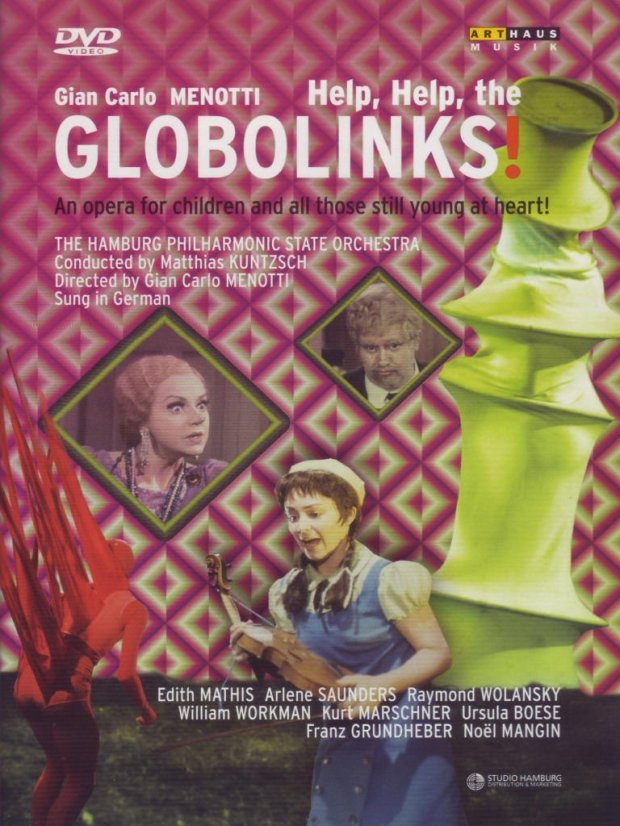
Help, help, the Globolinks are coming and only music can save us!

Liebramann Globolinks

Especially for Hamburg, the Italian-American composer and director Gian Carlo Menotti composed Hilfe, Hilfe Die Globolinks!, an opera ‘for children and for those who love children’. The premiere took place in 1968 and a year later it was filmed in the studio.

I must confess that I’m not a big fan of children’s operas, but I’ve been shamelessly enjoying this one. It is an irresistible fairy tale about aliens (Globolinks) who are allergic to music and can only be defeated by means of music.

The images are very sensational for that period, full of colour and movement and the forest little Emily (the irresistible Edith Mathis) has to go through with her violin to get help is really frightening. The aliens are a bit of a let-down according to modern standards, but that doesn’t matter, it gives the whole a cuddly shine. The work is bursting with humour and irony; musical barbarians are lashed out at: the school principal who doesn’t like music turns into an alien himself.

There are also a lot of one-liners (“music leads you to the right path” or “when music dies, the end of the world is near”). It is incomprehensible a work like this is not performed all the time in every school (and I don’t mean just for the children), the subject is (and remains) very topical.

None of the roles, including the children, could be better cast, and this once again proves the high standard of the Hamburg ensemble. In which other city would you find so many great singers/actors who can perform so many different roles on such a high level?

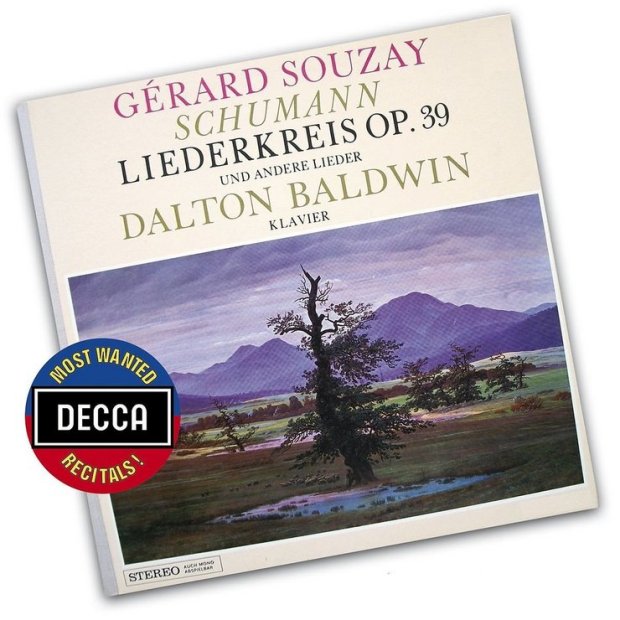
Gérard Souzay. So we don’t forget him

Decca-Souzay-Liederkreis-op.-39


The in all respects beautiful baritone Gérard Souzay has made the big mistake to sing on for far too long. His last Philips recordings are unlistenable and with his hair dyed pitch black he looked rather pathetic. A great pity, because if you listen to his earlier recordings, you can only fall in love with him and his voice.

Souzay was without a doubt one of the greatest performers of French song and his Faurés and Ravels are a delight. But don’t underestimate his German lieder either! Listening to his recording of Schumann’s Liederkreis from 1965, one cannot escape the thought that this music should go like this, and not otherwise. Just listen to his ‘In der Fremde’; I want to bet you cannot escape the feeling of being displaced yourself.

Below Liederkreis:


His Dichterliebe is just as beautiful: with his light baritone and his sweet, sweet sound he makes you actually fall in love. The recording dates from 1953 and in addition to the cycle we get three separate Schumann songs, including an interpretation of ‘Nussbaum’, which moves me to teans unfortunatelynot available anymore)

Below Winterreise from 1959:


In these recordings Souzay’s then regular accompanist Jacqueline Bonneau accompanies him. After 1954 she gave way to Dalton Baldwin (Bonneau did not like travelling). Souzay had a kind of musical marriage with Baldwin. Their collaboration guarantees ultimate beauty

Below is Dichterliebe:


Piotr Beczala and his new heroes

Beczala Vincero

Listening to this CD, I was reminded of La Fontaine’s fable about the ant and the cricket, the moral of which is, ‘whistling in the summer is fun, but when the winter comes you need your savings’. More or less.

Change the ‘savings’ to voice and you have the secret of Piotr Beczala.  Starting with the delicate Mozarts and the most lyrical Verdis, he climbed, via poetic Rodolfo and Massenet’s Des Grieux, to what’s generally considered heavier repertoire. First, a careful step towards Lohengrin and Gustavo (Ballo in Maschera), but then the floodgates opened and voilà!  Here is a tenor at the beginning of the third important phase in his professional life, that of the lyrico-spinto.

After Mario (Tosca) and Maurizio (Adriana Lecouvreur), it’s now the turn of Radames and Calaf and these roles are no small endeavour. And guess what? He can do it! He approaches these roles less ‘heroically’ than some, since it’s not really necessary. Listen to his illustrious predecessors whose voices most resembled his, with the sob and the tear, Tauber and Kiepura.  He approaches his heroes emotionally and does not shy away from sentiment, which doesn’t mean he robs the role of anything.

What I do regret is that he has chosen the most famous arias from the repertoire.  But on the other hand, this has given him a chance to compare himself to others in this repertoire and the comparison is in his favor, especially with regard to his contemporaries.

Radames is not on the CD, but Calaf is, which immediately explains the title. His ‘Nessun dorma’ is mainly tender and the Cor de la Generalitat Valenciana supports him well.  There is one downside: ‘Aveto torto … Firenze è come un albero fiorito’ from Puccini’s Gianni Schicchi.  Beczala has long since outgrown this role.


English translation Douglas Nasrawi

 VINCERÓ
Puccini, Cilea, Mascagni, Giordano, Leoncavallo, Verdi
Piotr Beczala (tenor)
Evgenya Khomurtova (mezzo-soprano)
Cor de la Generalitat Valenciana
Orquestra de la Comunitat Valenciana conducted by Marco Boemi
Pentatone PTC 5186 733

Ever heard of Wilhelm Grosz?

Enetartet Grosz

In the 1920s old values were shaken. The Great War had just ended. Countries had become independent, or had just lost their independency. Powerful new influences like jazz, blues, and exotic folklore appeared. Boundaries between classical and popular music were fading.

Of all the composers from that period, Wilhelm Grosz was perhaps the most versatile. He was born in Vienna in 1894 into a wealthy Jewish family. In 1919 he graduated from the Viennese Music Academy, where he was taught by, amongst others, Franz Schreker. In 1920 he finished his musicological studies at the Vienna University.

Grosz composed songs, operas, operettas, ballet music and  chamber music, and was a famous pianist as well. In 1928 he was appointed the artistic director of the Ultraphon record company in Berlin.

In 1929, commissioned by the prestigious Radio Breslau, he composed the song cycle Afrika Songs on lyrics by African-American poets.

Afrika Songs was premiered on 4 February 1930 and enthusiastically received. The cycle also became known as the  Jugendstil Spirituals, which probably is the most fitting description for it. There are jazz and blues influences, but the songs were also quite heavily influenced by the music of Zemlinsky, Mahler and … Puccini (compare Tante Sues Geschichten with Ho una casa nell’ Honan from the second act of Turandot!).

When he Nazis came to power, Grosz returned to Vienna. In 1934 he was forced to flee again, this time to London. There his popular works grew more distinct from his serious ones. His name became forever attached to a series of world wide hits. The Isle of Capri, for example, was the big hit of 1934.

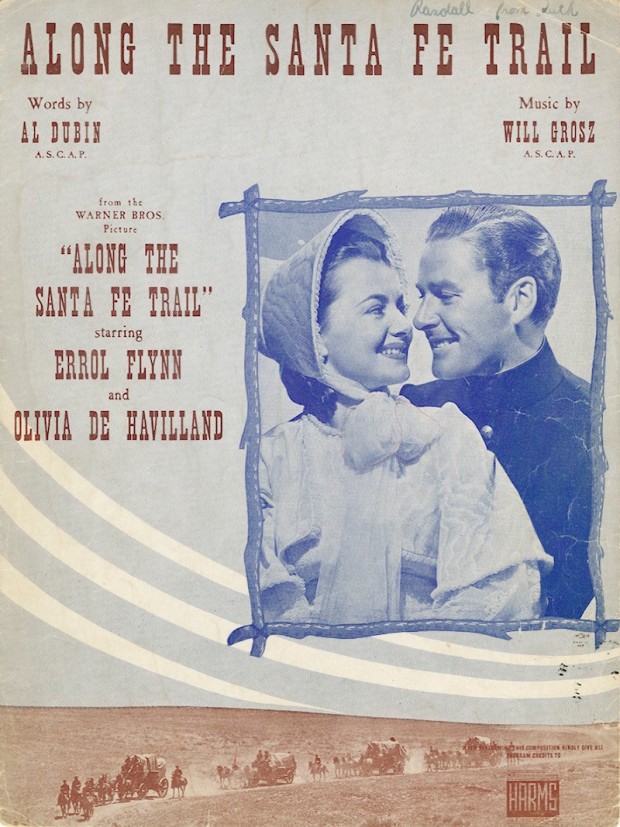
ALONG THE SANTA FE TRAIL

Entartet Gosz Santa Fe

In 1938 Grosz left for Hollywood but didn’t get further then New York. He had a heart attack in 1939 and died, aged only 45. He composed the famous song for Along the Santa Fe Trail, a movie with Errol Flynn, Olivia de Havilland and Ronald Reagan in the leads. The song was not sung in the film and only used only instrumentally as background music.

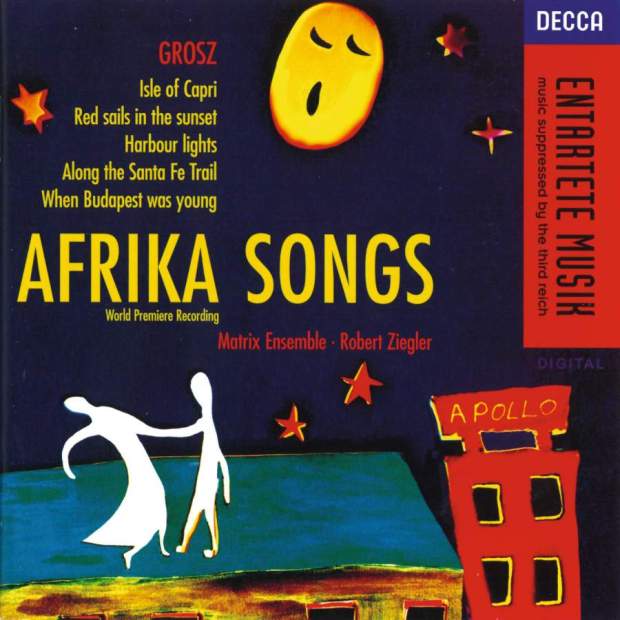
AFRIKA SONGS AND MORE

Entartete Gosz Africa

After almost sixty years Grosz was rediscovered, although only briefly. It is hard to believe, but the Afrika Songs were not recorded until 1996! The Matrix Ensemble performed them for the firs time at the Proms in 1993. The CD also includes the song cycle Rondels, Bänkel und Balladen and the hits Isle of Capri, When Budapest Was Young and Red Sails in the Sunset, songs we all know but never knew who composed them.

Vera Lynn sings Red Sails in the Sunset in 1935

When Budapest was young, sung by Greta Keller:

Mezzo Cynthia Clarey and baritone Jake Gardner are splendid in the Afrika Songs and Andrew Shore makes a party of Bänkel und Balladen. Nothing but praise for the  Matrix Ensemble.

English translation: Remko Jas

With many thanks for Brendan Carroll