While I was more than enthusiastic about part one, part two is, believe it or not, even better. Or, to be more precise: more surprising. More exciting. This is partly due to the pieces played by Jennifer Pike, because as well as Szymanowski, she has also immersed herself in works by Poldowski and Grazyna Bacewicz.
Now Bacewicz is not really that unknown, at least I hope so. At least not among the _real_ classical music lovers, but I suspect that the average concert and recital programmers, especially in the Netherlands, have never heard of her. Will we ever hear her compositions in the concert halls? Recordings of her works are also scarce. Why would that be? Is the ‘Einaudi-sation’ of the classical music sector a fait accompli?
Poldowski
Poldowski is still very much unknown, although here and there people are finally waking up. Not long ago Philip Jarousski recorded a song by her, but the most beautiful plea comes from Merel Vercammen and Dina Ivanova who recorded Poldowski’s violin sonata in D two years ago, and how! (Gutman Records CD 191)
Who is Poldowski? Her real name is Irene Régine Wieniawski, yes the daughter of! Irene Régine (1879-1932) was born in Brussels but soon after the death of her father (he died when she was 10 months old) she and her British mother moved to London. She studied in Brussels, lived in Paris and was married to Sir Aubrey Dean Paul, 5th Baronet. She did not want to use her husband’s or her father’s name, she wanted to be judged purely for her music. That is why she adopted the pseudonym Poldowski.
The performance by Jennifer Pike is just as good as Vercammen’s and in fact everyone should get both CDs. Vercammen because of Mathilde Wantenaar and Pike because of Poldowski’s wonderful Tango, which was once recorded by no one less than Jascha Heifetz. And the highly virtuoso performance of Bacewicz’ Kaprys polski for solo violin. And don’t forget the wonderful piano accompaniment by Peter Limonov!
Szymanowski, Poldowski, Bacewicz Jennifer Pike (viool), Peter Limonov (piano) CHAN 20189
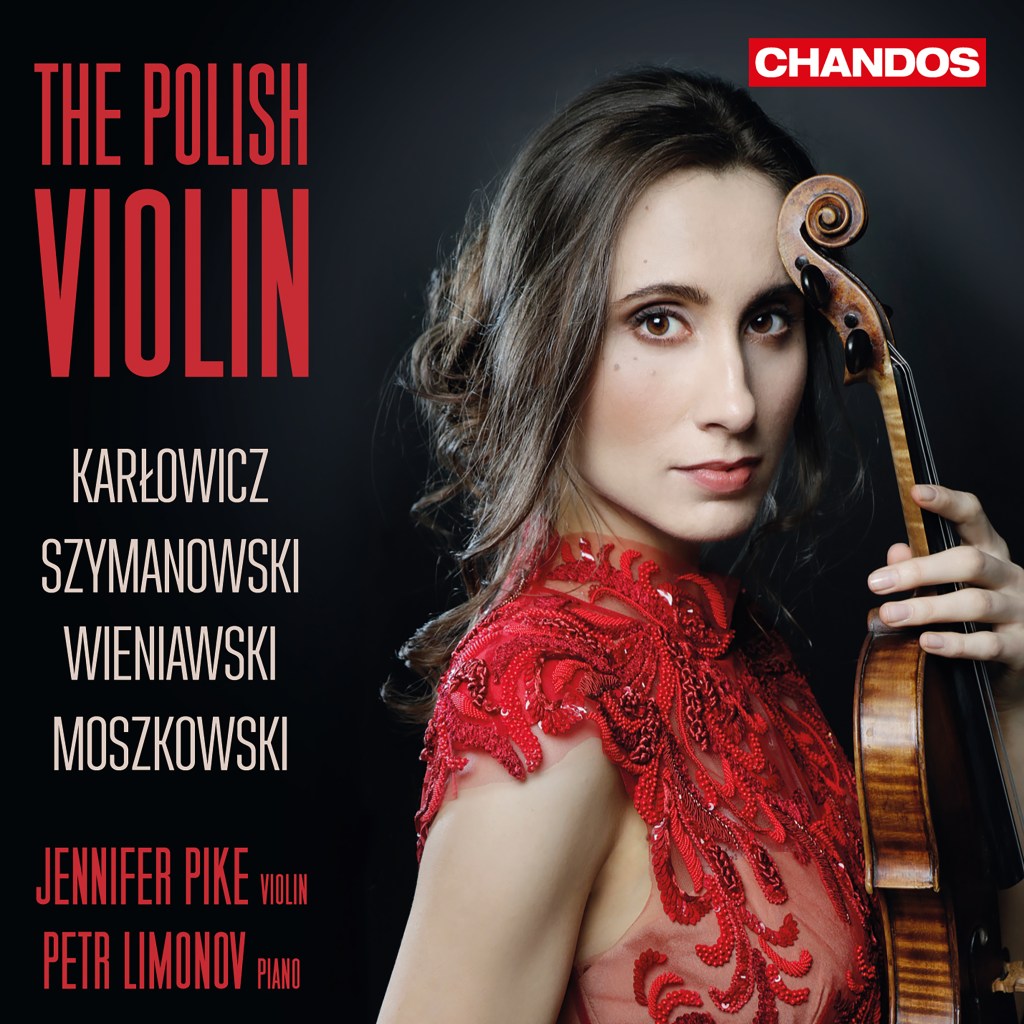
No, there is no such thing as a ‘Polish violin’. British violinist Jennifer Pike plays a Guarneri del Gesù from 1733 and there is nothing Polish about it. But the four composers on her album are Polish. At least as far as nationality is concerned, because their works, apart from Wieniawski’s Polonaise de concert (who was Jewish, nota bene) are not ‘Polish’.
Not that it matters. A CD has to sell and a catchy title is always a bonus. But if not only the repertoire but also the performance is truly phenomenal, I will not complain.
For anyone who loves violin concerts, Henryk Wieniawski is a well-known name, although these days he is not being performed very often. Szymanowski, after years of silence and ridicule, has become one of the most played composers today. His Myths, for me one of his most beautiful compositions, is also appearing more and more often in recitals. And even the arrangement of Roxane’s song from Król Roger has been recorded before.
Moritz Moszkowski is probably still known here and there for his piano concerto, but you just never hear Mieczyslaw Karlowicz. Why? Who knows? This composer, who was born in December 1876 and died in February 1909 (he was caught in an avalanche during a skiing trip in the high Tatra mountains), left behind a large oeuvre of brilliant works: symphonies, concertos, chamber music and irresistible songs. So it is a pity that the duo Jennifer Pike and Petr Limonov have only recorded one piece by Karlowicz. Especially since they have an audible affinity with it. Something for the future?
But anyway: this CD is a must for all violin, chamber music or just music lovers. Everything about it is beautiful. Really everything. Pike’s phrasing is sensual, even almost erotic , which fits the music like a glove. Petr Limonov is her best ‘partner in crime’ and together they provide a ‘once in a lifetime’ experience. Don’t miss this CD!
Szymanowski, Moszkowski, Karlowicz, Wieniawski Jennifer Pike (violin), Petr Limonov (piano) Chandos CHAN 20082
Was ik over deel één al meer dan enthousiast, deel twee is, geloof het of niet, nog beter. Of, beter gezegd: verrassender. Spannender. Het ligt onder andere aan het door Jennifer Pike gespeelde stukken, want naast Szymanowski heeft zij zich ook over werken van Poldowski en Grazyna Bacewicz ontermt.
Nu is Bacewicz niet echt zo onbekend, dat hoop ik althans. Misschien niet onder de _echte_ klassieke muziekliefhebbers maar ik vermoed dat de doorsnee concert- en recitalprogrammeurs, zeker in Nederland nog nooit van haar hebben gehoord. Wanneer hoor je haar composities in de concertzalen? Maar ook de opnamen van haar werken zijn schaars. Hoe zou dat komen? Is de ‘Einaudisering’ van de klassieke muziek sector een voldongen feit?
Wie is nou Poldowski? Haar echte naam is Irene Régine Wieniawski, ja de dochter van. Irene Régine (1879-1932) werd geboren in Brussel maar al gauw na de dood van haar vader (hij stierf toen zij tien maanden oud was) verhuisde zij met haar Britse moeder naar Londen. Zij studeerde in Brussel, woonde in Parijs en was getrouwd met Sir Aubrey Dean Paul, 5th Baronet. Zij wilde noch de naam van haar echtgenoot noch van haar vader willen gebruiken, zij wilde louter op haar muziek worden beoordeeld. Vandaar dat ze het pseudoniem Poldowski heeft aangenomen.
De uitvoering door Jennifer Pike is niet minder goed dan die van Vercammen en eigenlijk zou iedereen beide cd’s in huis moeten halen. Vercammen vanwege Mathilde Wantenaar en Pike vanwege Poldowski’s heerlijke Tango, die ooit door niemand minder dan Jascha Heifetz werd opgenomen. Én de zeer virtuoze uitvoering van Bacewicz’ Kaprys polski voor viool solo. Vergeet trouwens niet de schitterende pianobegeleiding door Peter Limonov!
Szymanowski, Poldowski, Bacewicz Jennifer Pike (viool), Petr Limonv (piano) CHAN 20189
Het Spectrum Concerts Berlin werd in 1988 opgericht door de cellist Frank Sumner Dodge met als doel om de hedendaagse, Amerikaanse kamermuziek te verbinden met werken uit de Europese traditie. Mooie woorden, dat wel. Maar kloppen ze wel?
Over Korngold kun je alles zeggen, behalve dat het hedendaags is: hij is in 1957 gestorven, nog geen zestig jaar oud en toen was zijn muziek al een beetje ‘ouderwets’. Begrijp mij goed: ik ben een enorme Korngold adept en liefhebber en ik kan eindeloos naar hem luisteren, maar bij ‘modern’ heb ik toch een andere klank in mijn hoofd. Ook dat ‘Amerikaanse’ klopt ook niet. Korngold woonde en werkte (noodgedwongen) in Hollywood, dat wel, maar zijn muziek was zo Weens als de bonbons en de Sachertarte.
Zijn pianokwintet componeerde hij rond 1921, hij was toen een jaar of 22. Het is een briljante compositie, waarin de emoties, de drama en expressie hand in hand samen gaan. De Suite stamt uit 1930 en daar hoor je de Korngold die, inderdaad, een beetje aan het experimenteren is geslagen. Dat komt ook een beetje door de keuze van de instrumenten: twee violen, cello en piano voor de linker hand. Hij componeerde het voor Paul Wittgenstein die zijn rechterarm in 1914 verloor. De uitvoering van beide werken is zonder meer goed.
ERICH WOLFGAND KORNGOLD Suite op. 23. Piano Quintet op. 15 Spectrum Concerts Berlin Naxos 8574019
De naam ‘Trio Wanderer’ hebben de Franse musici: Vincent Coq (piano), Jean-Marc Phillips-Varjabédian (viool) en Raphaël Pidoux (cello) niet zo maar gekozen. Op hun site las ik dat ze de wereld wilden benaderen “vol gevoel en introspectie, nieuwsgierigheid naar nieuwe omgevingen, en nostalgische liefde voor wat achter ligt”.
Dat geloof ik graag, want: wie wil dat niet? Ze bestaan al 30 jaar en zijn volkomen op elkaar ingespeeld. Wat ook een minpuntje oplevert omdat het verassingseffect kan worden ondergesneeuwd door de voorspelbaarheid.
En nu hebben ze een box uitgebracht met niet alleen de trio’s. Nee, zowat de hele Schumanns kamermuziek staat er op. Met medewerking van Chaterine Montier (viool) en Christophe Gaugué (altviool) hebben ze ook diens pianokwartet en kwintet opgenomen en al denk ik dat daar behoefte aan was, toch heb ik mijn bedenkingen. Ze spelen waanzinnig goed, dat wel, maar ik kan mij niet aan de indruk onttrekken dat het enigszins onderkoeld klinkt.
Wellicht heeft het met de tijdgeest te maken, waarin elk schijn van sentimentaliteit vermeden moet worden? Ik weet het niet. Het klinkt allemaal niet alleen (voor mij té) introvert maar hun spaarzame vibrato doet mij aan de beginjaren van de ‘authentieke uitvoeringen’ denken. Maar wellicht was het de bedoeling?
ROBERT SCHUMANN Pianokwartet op. 47, Pianokwintet op. 44, Pianotrio nr. 1, 2 en 3, Fantasiestücke op. 88 Trio Wanderer: Vincent Coq (piano), Jean-Marc Phillips-Varjabédian (viool), Raphaël Pidoux (cello), m.m.v. Chaterine Montier (viool), Christophe Gaugué (altviool) Harmonia Mundi HMM 902344.46 (3 cd’s)
Wat weten we tegenwoordig nog van Georges Onslow? Niet veel, vrees ik. Hij werd geboren in Clemont-Ferrand (Frankrijk) in 1784, zijn vader was een Engelsman, zijn moeder een Française. In zijn tijd was hij voornamelijk bekend (nou ja, bekend, bekend) als componist van kamermuziekwerken, voornamelijk strijkkwartetten en kwintetten. Na zijn dood in 1853 werd hij vrijwel geheel vergeten. Terecht? Nee. Zelf vind ik zijn muziek echt heerlijk. Het ligt lekker in het gehoor en het is buitengewoon fijn om er naar te luisteren, al is het op de achtergrond.
Het Spaanse Elan Quintet, in 2014 opgericht in Valencia is, in samenwerking met Naxos in 2015 begonnen met het opnemen van alle 34 strijkkwintetten van Onslow en inmiddels zijn ze bij deel 4 beland. De uitvoering is om door een ringetje te halen zo mooi, maar er is meer: hoe vaak hoor je een combinatie van een strijkkwartet met een contrabas? Door het ‘bulderende’ geluid van het instrument is de klank rijker dan bij een doorsnee strijkensemble en maakt het luisterplezier des te verrassender.
In een tijd van steeds meer hetzelfde is het fijn om iets nieuws te ontdekken en dat verdient Onslow zeer zeker. Koop de cd en geniet!
GEORGES ONSLOW Strijkkwintetten deel 4; nr.31 en 23 Elan Quintet Naxos 8.574187
“Music should primarily bring physical pleasure, even ecstasy, to the listener. It is not philosophy, its origin lies in ecstatic situations and its expression in rhythm” Erwin Schulhoff wrote in 1919.
From his earliest youth, Schulhoff was fascinated by everything new. His music transcended borders and genres – sometimes even those of ‘good decency’. He was a man of extremes, heartily embracing dada and jazz, and he also had a particular liking for the grotesque. No wonder that the synthesis of jazz and classical music, of everything in fact, became for him not only a challenge, but ultimately his artistic credo.
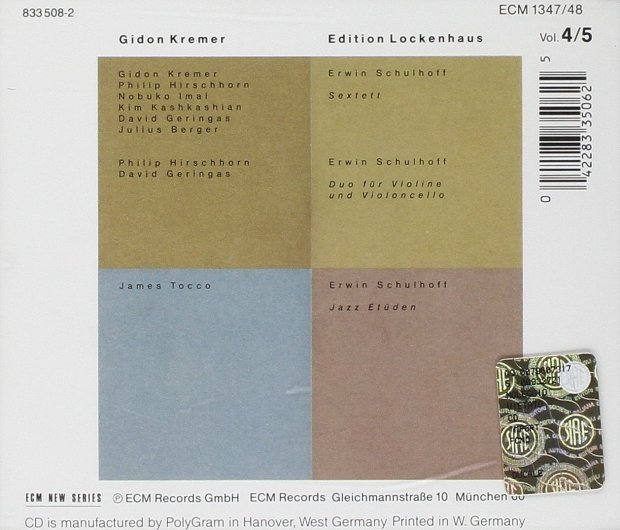
My first acquaintance with the composer and his music was thirty years ago, at the Lockenhaus chamber music festival, led by Gidon Kremer. It was mainly his string sextet, with its strong Janaček influences, that made me gasp for air. Since that day I was hooked. It took a long time, but in the meantime Schulhoff has found his way to the concert stages and recording studios. Especially the latter, because he is still too rarely programmed at concerts.
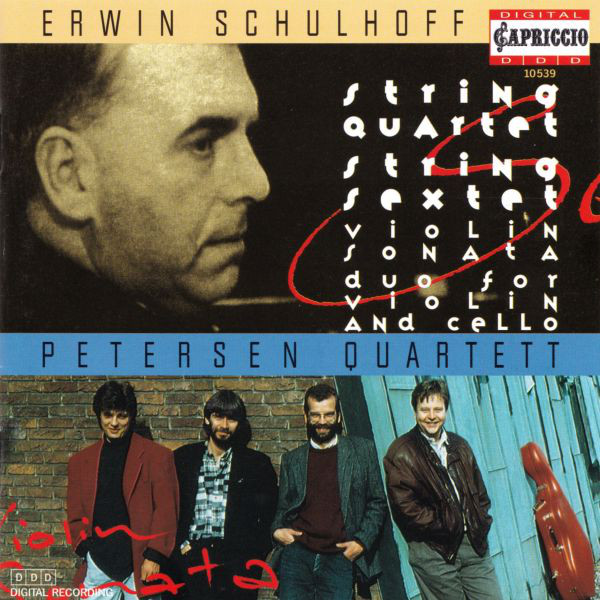
My very first record encounter with the composer was the recording of his complete string quartets by the Petersen Quartet, in 1992. To my delight, the string quartets are also in the six-CD box set recently released by the Capriccio label. These are recordings of many of his works (dear Capriccio: there is more!) made by Deutschlandfunk Kultur between 1992 and 2007. Most of these recordings have already appeared on Capriccio (but also on other, often no longer existing labels).
The 2007 recording of the Double Concerto for flute and piano, with Dutch flutist Jacques Zoon as soloist, is new to me. And it is so beautiful! Also new to me is the recording of the Second and Fifth Symphonies, in which the Symphonieorchester des Bayerischen Rundfunks is conducted by the greatest advocate of ‘entartete composers’, James Conlon.
ERWIN SCHULHOFF Symphonies no. 2 & 5, Piano Concerto op. 34, Concerto Doppio, Concert for string quartet and winds, String quartets no. 1 & 2, String sextet, Sonata for violin solo, Duo for violin and cello, Piano sonatas no. 1 & 3, Piano works Jacques Zoon (flute); Frank-Immo Zichner, Margarete Babinsky (piano); Petersen Quartet; Leipzicher Streichquartett; Symphonieorchester des Bayerischen Rundfunks conducted by James Conlon; Deutscher Symphonie-Orchester Berlin conducted by Roland Kluttig Capriccio C7297
Op deze cd staat een selectie van Weinbergs vroege werken, allemaal composities die hij schreef tijdens de laatste twee jaar van de Tweede Wereldoorlog.
Zelf ben ik meer dan dol op zijn pianokwintet, de compositie die behoort tot zijn beste (en de meest succesvolle, dat ook nog!)) werken. Weinberg componeerde het in 1944 en dat het zo’n een groot succes is geworden is niet verwonderlijk: het werk is wondermooi, makkelijk toegankelijk en zeer tot hart (en ziel) sprekend.
Het is niet de eerste keer dat Elisaveta Blumina zich over het kwintet ontfermt, zij heeft het werk al eerder opgenomen, zei het in de versie voor piano en strijkers in een arrangement van Matthias Bauer (Capriccio C5366).
Dat zij haar Weinberg ‘under the skin” heeft is nogal wiedes en dat bewijst zij ook met de selectie van diens ‘Children’s Notebooks’. De pianominiaturen zijn allesbehalve makkelijk om te spelen en het is werkelijk onvoorstelbaar wat zij met de stukjes doet, petje af!
Ook daar heeft zij al eerder een selectie van opgenomen, t.w. opp. 16 en 19, dus deze schijf is de ideale aanvulling! Ook haar ‘partners in the crime’ doen niet voor haar onder. Mooie cd, warm aanbevolen
Mieczyslaw Weinberg Piano Quintet, Op. 18; Children’s Notebooks, Op. 23 Elisaveta Blumina, piano Noah Bendix-Balgley, Shanshan Yao (viool), Máté Szücs (altviool), Bruno Delepelaire (cello) Oehms OC 487
Karl Ignaz Weigl was born into an assimilated Jewish family in 1881 in Vienna. In 1938 he fled to New York, where he died ten years later. The composer and his music were ‘forgotten for a while’, which was not only due to the Nazis.
In 1938 Arnold Schönberg wrote: ‘I have always regarded Dr. Weigl as one of the best composers of the old school; one of those who continued the glittering Viennese tradition’. No one could have put it better.
The ‘glittering Viennese tradition’ is Weigl’s main trademark. To put it irreverently, his music may be seen as sort of a gateway. A kind of corridor that runs from a classical Beethoven via a soul-stirring Schubert and an underground erotic Zemlinsky to finally end up in Weigl’s calm waters, and from there it finds its way to our hearts.
Weigl is not a composer I have heard much of (no, it’s not my fault) and apart from his, by the way, wonderful songs and a few of his chamber music compositions, I did not know him very well. So this CD is more than welcome, especially because the musicianship is so incredibly good.
I am most charmed by the violinist David Frühwirth. His tone is very sweet, as sweet as a Viennese Sachertarte. You can hear it best in the very Schubertian piano trio, but make no mistake! Just listen to the allegro molto, the third movement of the second violin sonata from1937 and you discover the complexity of the ‘Wiener-sound’.
And I feel free to use another quote, this time from Pablo Casals: “His music will not be lost, after the storm we will return to it, one day we will return to those who wrote real music.” It has taken a while and we are still far away, but a beginning has been made.
KARL WEIGL Violin Sonata No.2, Two pieces for violin, Two pieces for cello, Piano Trio David Frühwirth (violin), Benedict Kloeckner (cello), Florian Krumpöck (piano) Capriccio C5318
Martha! She is eighty now but is she thinking about retirement? No way! On the contrary, she is still making new recordings, and knowing her, I expect her to keep stealing the show with her performances all over the world. For example look at the DG-cd with her interpretation of Debussy’s ‘Fantasy for piano and orchestra’. She has never recorded this work before, so it is a first.
She plays it in her own unique and inimitable way: a bit boisterous, with many colour nuances and demanding all attention. Center stage all of the time! The Barenboim-led Staatskappele Berlin is no more than just a decent accompanist to the real star. Which I don’t mind.
In ‘La Mer’, Barenboim loses me a bit. Used as I am to more impressionistic ‘brush strokes’, I am frightened a bit by the sheer violence of the sea. But well: it is surely a matter of taste and interpretation.
As for the violin sonata, played by Barenboim’s son Michael, I have heard it better. Not that it is bad, but it lacks the mysticism that I appreciate so much in other recordings. Try Shlomo Mintz with Yefim Bronfman:
Kian Soltani also does not quite convince me in the cello sonata. And since it is Barenboim and not Argerich playing the piano in both works, the cover of the CD is a bit misleading
Claude Debussy Fantaisie pour piano et orchestre L 73; Violin Sonata in G minor, L. 148; Cello Sonata in D Minor, L. 135; La Mer, L. 109 Martha Argerich and Daniel Barenboim (piano), Michael Barenboim (violin), Kian Soltani (cello) DG 74797990





 Basia con fuoco