Songs by Chopin… Many a song lover looks down on them with a bit of condescension. They seem so simple, so ˜no big deal”. One opens one’s throat and voila, they come rolling out naturally and easily.
That nothing could be further from the truth was proved not so long ago by Dawn Upshaw, surely one of the best song singers of our time. She approached them in completely the wrong way, creating an unintelligible mush that had nothing to do with the Polish genius’s beautiful melodies.
That you don’t really need to be Polish to understand them (should Schubert be sung exclusively by the Austrians and Rachmaninoff solely by the Russians?), had been proved long ago by one of the best performers of the songs, Elisabeth Söderstrom. Layla Gencer (admittedly, she was half Polish) also did an excellent job.
Elisabeth Söderstrom sings Chopin with Vladimir Askenazy (piano)
Leyla Gencer sings Chopin with Nikita Magaloff (piano):
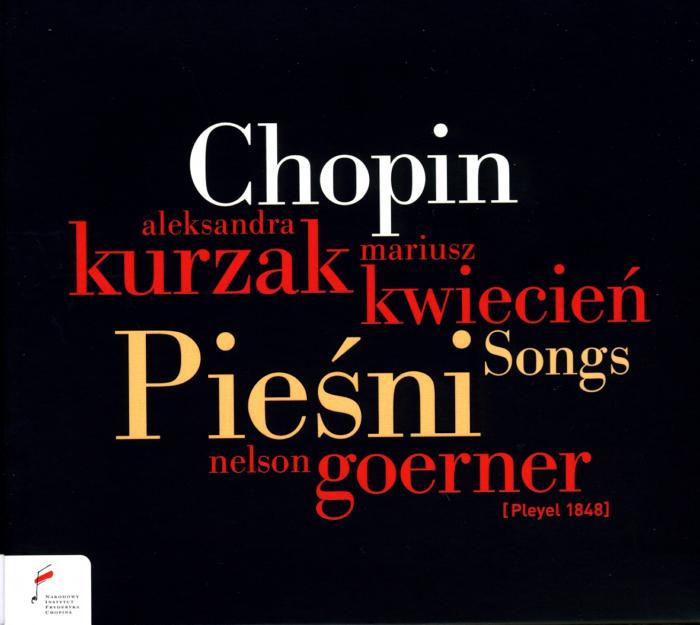
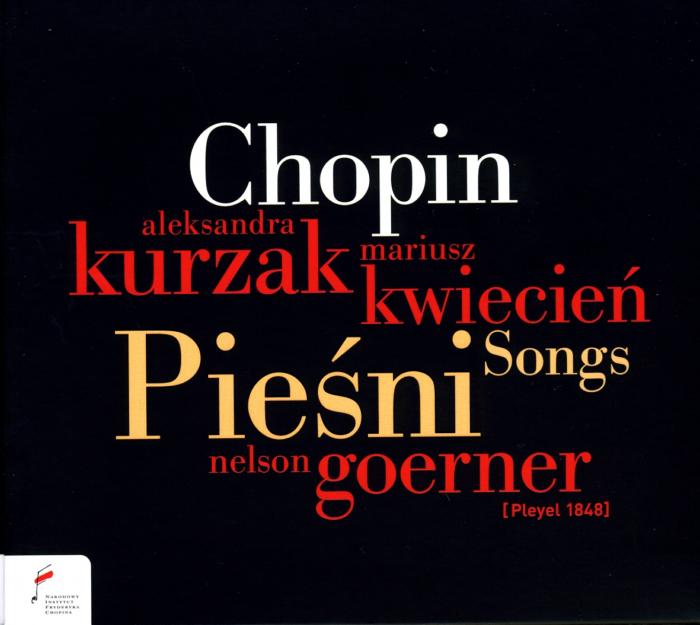
In 2010, the ˜Chopin year” (he was born in March 1810), a recording of all his songs was made by the Fryderyk Chopin Institute ((NIFCCD 016). As performers, two of the most successful Polish singers worldwide (why did no one think of Piotr Beczala?) were engaged: Aleksandra Kurzak and Mariusz Kwiecien.
Aleksandra Kurzak with Jeff Cohen (piano):
The first thing that stands out is their obvious, natural way of singing. They left behind their Polish predecessors’ very irritating habit of pressing on the consonants – especially the “Ł” (sounds like the English W) had always been pronounced very unnaturally, Russian-style, before them.
I have always had my doubts about Kwiecien being a true Lieder singer (he sometimes gives song recitals) and I still have those doubts. He is an excellent actor and also does fantastic things with his voice, but sometimes it’s a bit too much. And I miss the lyricism. He also colours too little and sometimes goes over the top, like a whole cavalry of soldiers.
But Aleksandra Kurzak is simply irresistible. Her beautiful, lyrical soprano has a lovely silvery sheen, it is truly delightful. Her girlish timbre seems created for singing Chopin’s simple-sounding melodies, and her delivery is exquisite. And her voice… Ah, it simply cannot be more beautiful! If that does not make a person happy!
But don’t forget the pianist: Argentine Nelson Goerner is an excellent Chopin interpreter and an wonderful accompanist.
Bonus: Teresa Zylis-Gara and Halina Czerny-Stefanska:
Not so long ago ago, one of the leading Dutch music critics (no, I’m not going to name names) wrote: “Karol Szymanowski, a composer from whom few pieces have held repertoire, still experienced his Król Roger being put on in the 1920s. Later, his semi-destillates from Nietzsche’s Geburt der Tragödie, Euripides’ Bacchants and Shakespeare’s Lear, disappeared from view altogether. One cannot ultimately blame the great eclectic Szymanowski, maybe only the fact that he wanted an opera so badly.”
He was not alone in this: because his works betrayed a variety of influences, Szymanowski was long mistaken for an eclectic, an insult at the time.
Times are changing. Szymanowski is now counted among the greatest composers of the early twentieth century and his works are always being performed on concert stages and recording studios.
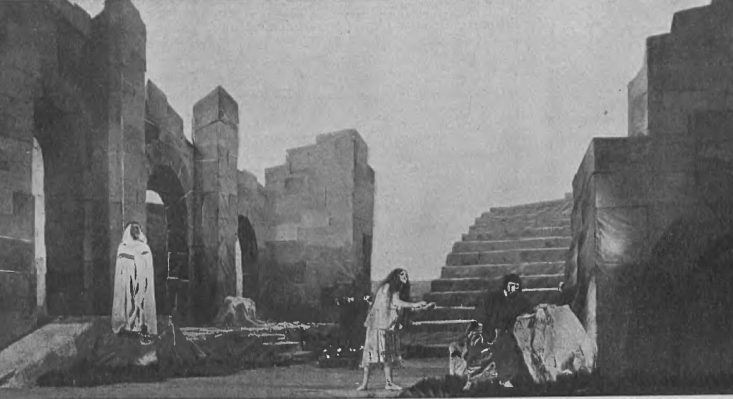
His Król Roger, a poetic opera full of symbolism and perfumed with myrthe has – rightly – achieved true cult status. Take the opening chorus alone! The softly emerging “Hagios, Kyrios, Theos Sabaoth”, sung by the immense choir, with the added high voices of the boys’ choir, rivals Verdi’s Requiem.
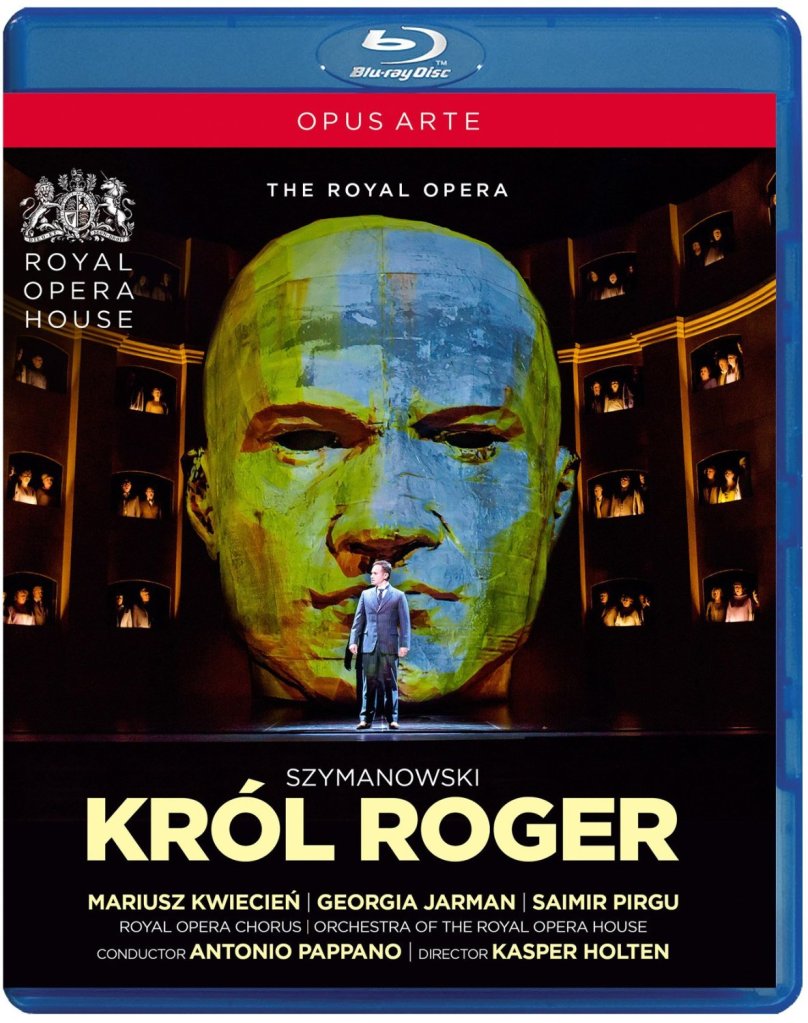
The performance at Covent Garden, directed by Kasper Holten and conducted by Antonio Pappano was a true triumph for all involved. Holten depicted the opera as a kind of journey of the protagonist into the deeps of his psyche. Figuratively, but also literally. Everything takes place in Roger’s head, so it is a huge head that dominates the stage and also acts as his palace if necessary. It made me speechless.
That the opera is enigmatic is rather obvious. The libretto by Jaroslaw Iwaszkiewicz is rather pompous and the text is, even for Poles, difficult to understand and unpronouncable. Big kudos to the Polish coach (Marek Ruszczyński) who made all the singers sound as if they were native speakers.
Saimir Pirgu (Pasterz) was the biggest surprise of the evening for me. His voice sounded cultured and seductive and his entire performance was a delight to the ear and to the eye,
Georgia Jarman was a very good Roxana: her cantilena in the first act went deeply into my heart.
Roxana’s Song:
Mariusz Kwiecień was one of the best Roger’s of our time. It is a role he has made his own and which no one can take away from him. In fact, I am struck by how differently he performs the role in different productions!
Kim Bagley was an excellent Edrisi and Agnes Zwierko is a luxurious choice for Dyakonissa. Highly recommended, this recording!
Below is an introduction to the opera:
One of the best recordings of the opera from Teatr Wielki in Warsaw dated 23.11.1965
Onegin, unlike don Giovanni, is not a colourful character. He is a rather dull, bored brat, for whom even hitting on a woman is too much trouble. Through an inheritance he has become a rich man and as such has access to the”high society”, but everything bores him and in fact he does not know himself what it is he really wants.
He dresses according to the latest fashion, the only question is whether he does it because he likes nice clothes, or because that’s the way things are supposed to be. Because he does know how things should be done.
He also shows hardly any character development over the whole course of the opera. He kills his best friend after flirting with his lover – not because he really wants to, but to teach him (and the, in his eyes horrid, countrybumpkins) a lesson – and even that leaves him unmoved. Only at the end does he “wake up” and something of a feeling enters his mind. But is it real?
Not really someone you can dedicate an entire opera to, which is why for many people the real protagonist is not Onjegin but Tatyana. If Tchaikovsky had really wanted it that way he might have named the opera “Tatyana”, but that she is a much more captivating character than the man of her dreams, is beyond any doubt.
CDs
SERGEY LEMESHEV:
One says Tatyana, one thinks Galina Vishnevskaya. The Russian soprano has created a benchmark for the role that few singers can yet match. In 1955, she recorded the role, along with all the Bolshoi greats of the time.
Her “letter scene” is perhaps the most beautiful ever, but the recording has even more to offer: how about Sergei Lemeshev as Lensky? Fingerlicking good!
Sergey Lemeshev as Lensky (his great aria & duel scene)
Valentina Petrova is a peerless Larina, unfortunately the title hero himself (Evgeny Belov) is a bit colourless. (Melodiya 1170902)
FRITZ WUNDERLICH:
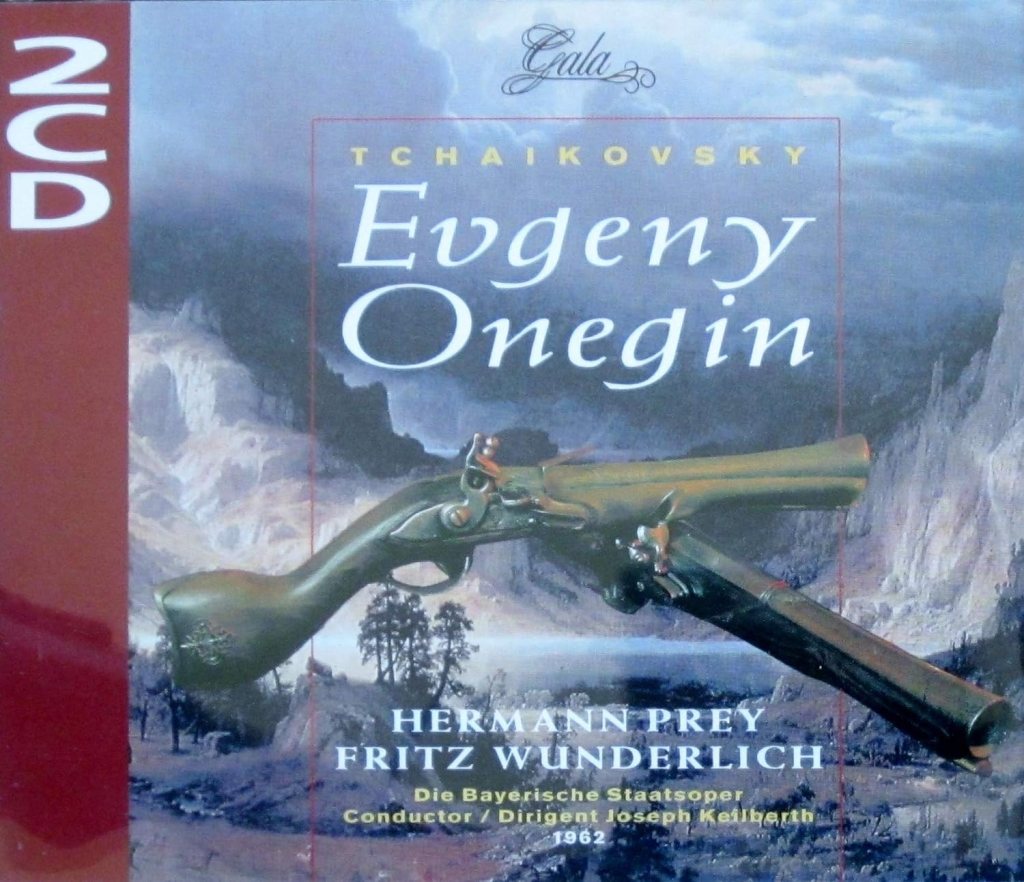
In 1962, the opera was recorded live in Munich (Gala GL 100.520).
Ingebort Bremmert is too light for Tatyana, she also sounds rather sharp, but Brigitte Fassbaender makes up for a lot as Olga. But for a change, the ladies do not make the greatest impact, you buy it, of course, for the men: Hermann Prey and Fritz Wunderlich.
Prey is a very charming, gallant Onjegin, actually more like a brother than a lover, but the voice is so divinely beautiful! And about Wunderlich’s Lensky I can be very brief: ‘wunderbar’! By the way, it strikes me once again how similar Piotr Beczala sounds to him!
There is a lot of stage noise and the sound is dull with far too many bass sounds. And of course it is in German, but yes, that’s how it was done in those days. But it is a matchless document and, especially because of both singers, actually a must-see.
Duel scene from the recording (with picture!):
BERND WEIKL:
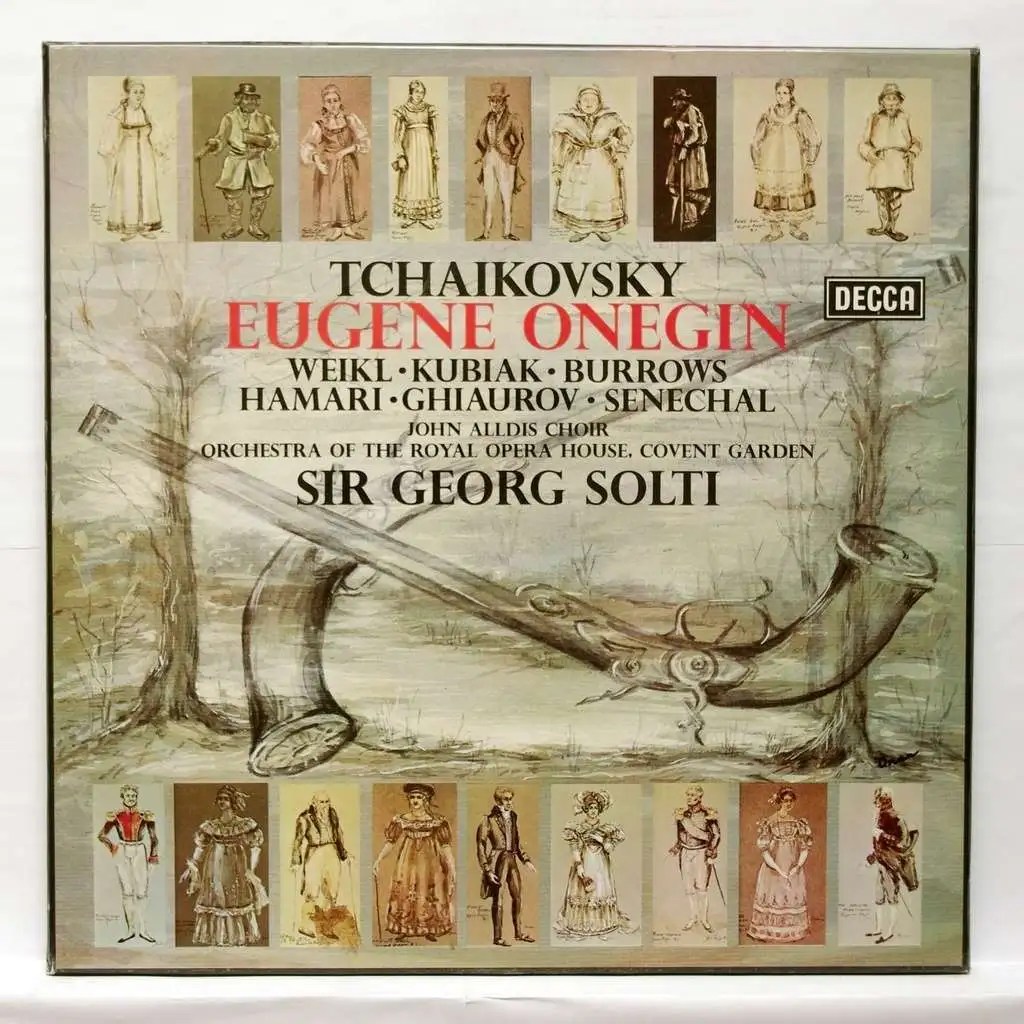
In 1974, Georg Solti recorded the opera for Decca(4174132) and that reading is still considered one of the best. In Stuart Burrows he had at his disposal the best Lensky after Wunderlich and before Beczala, and Teresa Kubiak was the very personification of Tatyana. Young, innocent, with a touch of elation at the beginning of the opera, but resigned at the end.
Under his direction, the orchestra (Orchestra of the Royal Opera House) flourished like the cornflowers in the Russian fields, making it clear why the composer considered his opus magnus to be “lyrical scenes” and not opera.
Bernd Weikl is a very seductive Onjegin, his very spicy baritone particularly sexy. Nicolai Ghiaurov is of course legendary in his role of Gremin and for me Michel Sénéchal is perhaps the best Triquet ever. Enid Hartle deserves to be especially mentioned as Filipyevna.
THOMAS ALLEN:
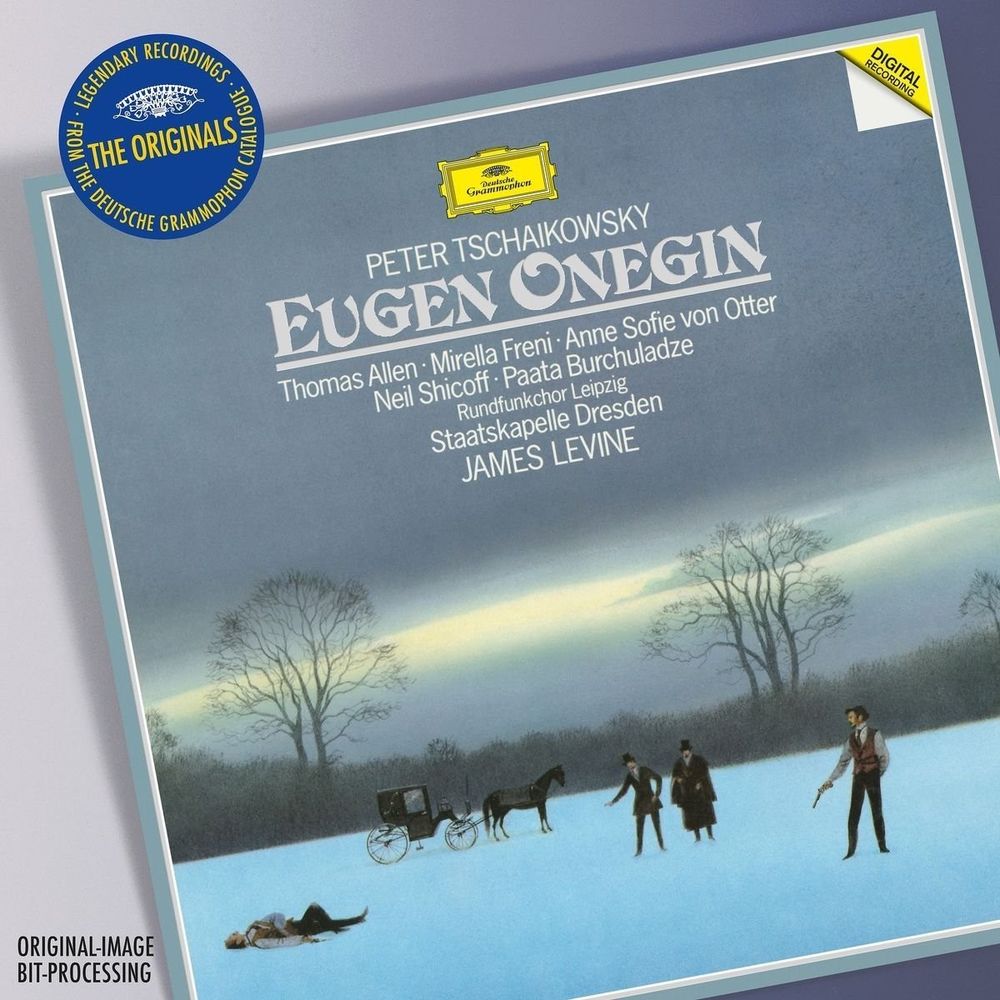
I want to dwell for a moment on Onjegin by Sir Thomas Allen. He has sung the role several times: both in Russian and in English. In 1988, he recorded it for DG (423 95923). Tatyana was sung by Mirella Freni – in the autumn of her career it became one of her showpieces. She is therefore more convincing as the older Tatyana than as the young girl, but there is nothing to criticise about her interpretation.
Neil Shicoff, then a splendid lyricist, was a very idiomatic Lensky, but Anne Sophie von Otter was only moderately convincing as Olga. Under James Levine, the Staatskapelle Dresden produced an unexpectedly lyrical sound, with lovely long arcs, but not devoid of a healthy sense of drama.
Anyway: it’s mainly about Thomas Allen. His reading of the title hero is particularly exciting and dramatically well grounded; it is truly fascinating to hear how Onjegin’s condescension in I turns into a shimmering passion in III. A vocal artist, no less.
It is also very interesting to see how he coaches young people at an ‘Onjegin master class’ (among his “students” is James Rutherford, among others)
DVDs
VLADIMIR REDKIN
Boris Pokrovsky is a living legend. For decades, from 1943 to 1982, he was opera director of the Bolshoi Theatre in Moscow. Even in the Netherlands, he is not unknown: in 1996, he was ‘visiting’ us with his new company, the Moscow Chamber Opera, with “Life with an Idiot” by Alfred Schnittke.
His production of Onjegin, recorded for TV at the Bolshoi in Moscow in 2000(Arthaus Musik 107 213) originally dates from 1944. It is, of course, a classic, complete with all the trimmings. Sumptuous costumes, true-to-life sets, everything as it ‘should’ be.
As soon as the stage curtain opens, the first ‘open curtain’ is a fact. People love it. And they are right: it is indeed so very beautiful! Of course, you don’t get to see it like that anymore. Think Zeffirelli, but really authentic, without a single liberty being taken. You have to have seen it at least once, just to know how it was originally intended.
The unknown singers are all just fine, but the close-ups are a bit laughable. Of course, it is not a production to be shown on TV, you have to actually see it in the opera house. There is no chance of that, though: Boris Pokrovsky’s production has been replaced by a new production by Dmitri Tcherniakov after more than 60 years of faithful service. Buy the DVD and muse on the ‘good old days’, because they really aren’t coming back.
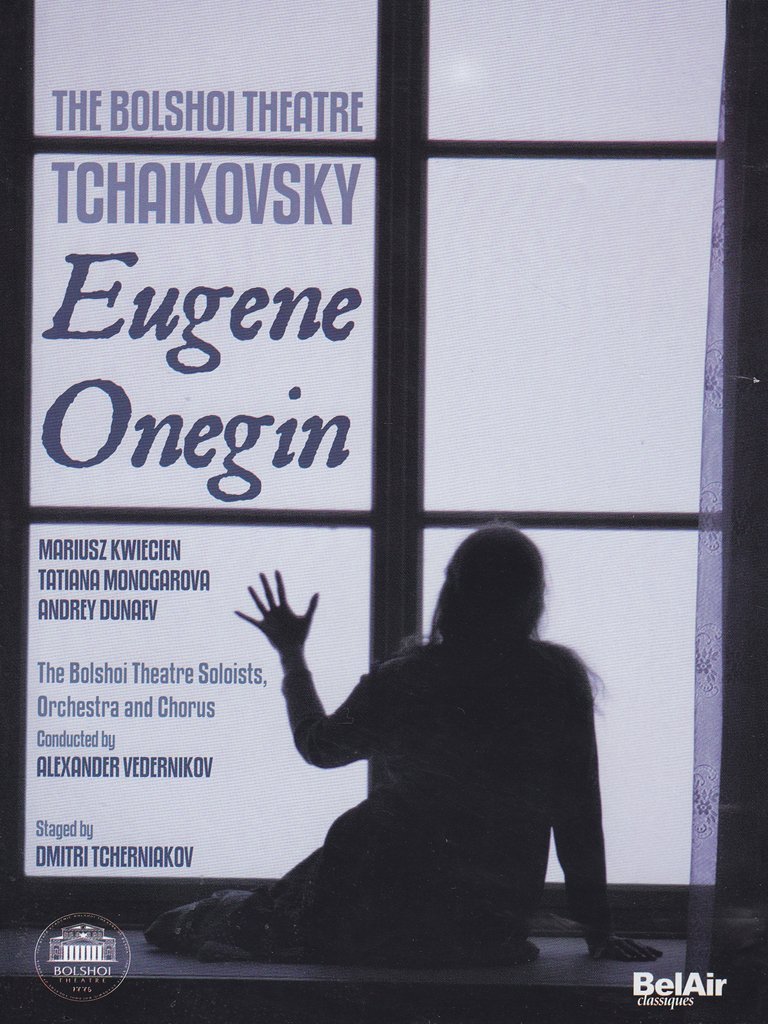
I started on Dmitri Tcherniakov’s production(Bel Air BAC046) with a huge dose of scepticism. His decision to replace Boris Pokrovsky’s old legendary production was very brave, because Muscovites (and not only Muscovites) were so very attached to it. Besides: you have to be really sure of yourself to dare to replace a LEGEND. On top of that, from the entire cast – apart from Kocherga and Kwiecien – I did not know any of the performers.
I quickly changed my mind, because from the start I was on the edge of my seat. The staging, costumes, stage design, sets and props – everything is right, even if it is not as it is in a typical ‘Onegin’. The entire first and second acts take place in the same space: the dining room in Larina’s house, with a long table and chairs prominently displayed. The same table and chairs also recur in III, but in a much richer ambience.
It is incredibly difficult to explain the whole directorial concept in a few words, you have to believe me that it is extremely fascinating and extremely exciting. Very intelligent too.
Tatyana is portrayed by Tatiana Monogarova in a very convincing way. She is pale, thin and slightly autistic, locked in her own mind. The outside world scares her as she tries to hide from it.
Olga(Margerita Mamsirova) is just a flirt and from the start she challenged Onegin. She is more than a little tired of her poet- boyfriend’s sighs. and she is not wrong!
Lensky is sung by a good, though not exeptional, Andrey Dunaev. He is a bit stupid, pushy and jealous and thus the real instigator of all evil happenings.
Larina (an insanely good singing and acting Makvala Kasrashvili) also gets more attention than usual. The moment when, thinking back to her childhood, she downs a drink and has a little cry is very touching. But she soon recovers and everything stays the same.
Mariusz Kwiecien (Onegin) is indeed irresistible. Or let me rephrase it: he portrays such a very bored and self-important arsehole (sorry for the word!). And he actually stays that way until the end. Utterly convincing!
Frantically he tries to belong to the ‘high society’, where he is not really accepted. Even his sudden passionate love for Tatyana feels unreal. On his knees, he offers her a bunch of red roses and when she refuses to run away with him, he tries to rape her.
Dignified, Tatyana walks off the stage on her husband’s arm on which Onjegin pulls out a pistol, but we are spared the suicide, because, of course!, without witnesses by his standards there is no use for it..
Trailer:
DMITRY HVOROSTOVSKY
And then there is Robert Carsen’s production for the Metropolitan Opera, recorded in February 2007(Decca 0743298). I am a huge Carsen-adept and love almost everything he does. So too this Onjegin
His staging is very realistic and he follows the libretto accurately. In the first act, the stage is strewn with autumn leaves, but everything else is basically bare and there is almost no scenery. A bed for the ‘letter scene’, otherwise some chairs in the second and third acts. At the duel, the stage is completely empty.
It is not distracting. On the contrary. The costumes are really beautiful, but especially in the first act they remind me more of English Jane Austen film adaptations than of the Russian countryside. It is not really disturbing, the eye wants something too, but Renée Fleming is too glamorous for a peasant trio, making her switch to a proud princess less impressive.
Onjegin (Dmitri Hvorostovsky) is mainly a dandy here, very concerned with his, good, looks. Well, Dima is an extremely attractive singer in all aspects, but in his confrontation scene with Tatyana, he is more reminiscent of daddy Germont than of Onjegin.
Ramón Vargas is one of the best lyric tenors in 2007, but Lensky he is not! He really does his best, he also looks like a real poet, but this role needs to be a bit more languorous.
As usual, Carsen’s character direction is truly unsurpassed and even Fleming seems to thaw out at times. Unfortunately, her Russian is totally unintelligible.
Fleming and Hvorostovsky in the final scene of the opera:
The young Polish baritone Mariusz Kwiecień (Difficult to pronounce? I am going to help you! It is, in Dutch: Marjush Kfjetsjenj) is hot, really hot. The ‘Barihunks’ site was created especially for him. Still ….. no matter how much I admired the young Pole’s acting skills and charisma – the voice usually left me cold. But little boys grow up and the truth must now be told: I was mistaken.
When I saw his Onjegin directed by Dmitri Tcherniakov (Bel Air BAC046), I was already won over, but now, with his first (sic!) solo CD, I can only deeply bow my head in admiration. First of all, it is the choice of repertoire. Along with his greatest starring roles: Yevgeny Onegin and Krol Roger by Szymanowski, he sings mainly unknown treasures from the Slavonic operas.
As an opera lover, you may know the baritone aria from Sadko by Rimsky-Korsakov and perhaps ‘Oh Mariya, Mariya’ from Tchaikovsky’s Mazeppa. But have you ever heard of Smetana’s Čertova stěna? Or Verbuum Nobile by Stanislaw Moniuszko? That is what I mean!
Apart from the choice of repertoire, we are dealing with a voice and – it must be said – his voice sounds like a bell! Beautiful, warm and very attractive. The Polish Radio Orchestra, conducted by Łukasz Borowicz, also sounds excellent.
Mariusz Kwiecień
Slavic Heroes
Arias by Tchaikovsky, Moniuszko, Szymanowski, Rachmaninov, Dvorak, Smetana and others.
Polish Radio Symphony Orchestra conducted by Łukasz Borowicz
Harmondia Mundi HMW906101
Liederen van Chopin… Menig liedliefhebber kijkt er neerbuigend tegenaan. Ze lijken zo simpel, zo ‘niets aan de hand’. Men doet zijn strot open en voila, daar komen ze vanzelfsprekend uit.
Dat niets minder waar is bewees niet zo lang geleden Dawn Upshaw, toch één van de beste liedzangeressen van onze tijd. Zij pakte ze totaal verkeerd aan, waardoor een onverstaanbaar brij ontstond dat niets met de prachtige melodieën van het Poolse genie te maken had.
Dat je niet echt Pools hoeft te zijn om ze te begrijpen (moet Schubert uitsluitend gezongen worden door de Oostenrijkers en Rachmaninoff door de Russen?), heeft één van de beste vertolksters van de liederen, Elisabeth Söderstrom, al lang geleden bewezen. Ook Layla Gencer (toegegeven, zij was half Pools) deed het voortreffelijk.
In 2010, het ‘Chopin-jaar’ (hij werd in maart 1810 geboren), werd een opname van al zijn liederen door het Fryderyk Chopin Instituut ((NIFCCD 016) gemaakt. Als vertolkers werden twee van de meest succesvolle Poolse zangers (waarom heeft niemand aan Piotr Beczala gedacht?) wereldwijd geëngageerd: Aleksandra Kurzak en Ryszard Kwiecien.
Het eerste wat opvalt is hun vanzelfsprekende, natuurlijke manier van zingen. De zeer irritante gewoonte van hun Poolse voorgangers om op de consonanten te drukken – voornamelijk de letter “Ł” (spreek uit as het Engelse “W”) werd altijd zeer onnatuurlijk, op zijn Russisch, uitgesproken – hebben ze achter zich gelaten. Gelukkig.
Ik heb altijd mijn twijfels gehad of Kwiecien een echte liedzanger is (hij treedt wel eens met liedrecitals op) en die twijfels blijf ik nog steeds houden. Hij is een voortreffelijke acteur en doet ook fantastische dingen met zijn stem, maar soms is het een beetje te veel. En ik mis lyriek. Hij kleurt ook te weinig en gaat soms als een hele cavalerie soldaten eroverheen.
Maar Aleksandra Kurzak is simpelweg onweerstaanbaar. Haar prachtige, lyrische sopraan heeft een glans van zilver, en daar word je blij van. Haar meisjesachtige timbre lijkt geschapen voor het zingen van de eenvoudig klinkende melodieën van Chopin en haar voordracht is voortreffelijk. En haar stem… Ach, mooier kan gewoon niet! Daar wordt een mens gelukkig van.
Maar vergeet ook de pianist niet: de Argentijnse Nelson Goerner is een uitstekende Chopin-interpreet en een voortreffelijke begeleider
De jonge Poolse bariton Mariusz Kwiecień (moeilijk uit te spreken? Ik ga u helpen! Het is, op zijn Hollands gezegd: Marjoesj Kfjetsjenj) is hot, echt hot. Speciaal voor hem werd ooit de ‘Barihunks’- site opgericht. Toch ….. hoezeer ik de acteerprestaties en het charisma van de jonge Pool bewonderde – zijn stem liet mij meestal koud. Maar kleine jongens worden groot en de waarheid moet nu gezegd worden: ik heb mij vergist
Toen ik zijn Onjegin in de regie van Dmitri Tcherniakov (Bel Air BAC046) zag, toen al heb ik mij gewonnen moeten geven, maar nu, met zijn eerste (sic!) solo-cd, kan ik alleen maar mijn hoofd diep buigen in bewondering. Vooraleerst is het de repertoire keuze. Naast zijn grootste glansrollen: Jevgeni Onegin en Krol Roger van Szymanowski zingt hij voornamelijk onbekende schatten uit de Slavische opera’s.
Als operaliefhebber kent u wellicht de baritonaria uit Sadko van Rimski-Korsakov en misschien ook ‘Oh Mariya, Mariya’ uit Mazeppa van Tsjaikovski. Maar heeft u ooit van Čertova stěna van Smetana gehoord? Of van Verbuum Nobile van Stanislaw Moniuszko? Dat bedoel ik maar!
Buiten de repertoirekeuze hebben we nog met een stem te maken en – het moet gezegd, zijn stem klinkt als een klok! Mooi, warm en zeer aantrekkelijk.
Ook het Poolse Radio Orkest onder leiding van Łukasz Borowicz klinkt voortreffelijk.
Mariusz Kwiecień
Slavic Heroes
Aria’s van Tchaikovsky, Moniuszko, Szymanowski, Rachmaninov, Borodin, Dvorak en Smetana
Polish Radio Symphony Orchestra olv Łukasz Borowicz
Harmondia Mundi HMW906
Nog maar 15 jaar geleden schreef één van de vooraanstaande Nederlandse muziekrecensenten (nee, ik ga geen namen noemen): “Karol Szymanowski, een componist van wie weinig stukken repertoire hebben gehouden heeft in de jaren twintig nog meegemaakt dat Król Roger werd opgevoerd. Later verdween zijn halfdestillaat uit Nietzsches Geburt der Tragödie, Euripides’ Bacchanten en Shakespeares Lear uit het vizier. Je kan de grote eclecticus Szymanowski uiteindelijk maar weinig kwalijk nemen, behalve dat hij zo nodig een opera wou.”
Hij was de enige niet: doordat zijn werken een verscheidenheid aan invloeden verraadden, werd Szymanowski lang voor een eclecticus uitgemaakt, een scheldnaam in de tijd.
Tijden veranderen. Szymanowski wordt inmiddels gerekend tot de grootste componisten van het begin van de twintigste eeuw en zijn werken zijn niet weg te denken van de concertpodia en opnamestudio’s.
Zijn Król Roger, een poëtische opera vol symboliek en geparfumeerd met myrthe heeft – terecht – een ware cultstatus bereikt. Neem alleen al de openingskoor! Het zacht opdoemende, door het immense koor gezongen “Hagios, Kyrios, Theos Sabaoth”, met de invallende hoge stemmen van het jongenskoor steekt het Requiem van Verdi naar de kroon.
De voorstelling in Covent Garden, geregisseerd door Kasper Holten en gedirigeerd door Antonio Pappano was een ware triomf voor alle betrokkenen. Holten verbeeldde de opera als een soort reis van de hoofdpersoon in het binnenste van zijn psyche. Figuurlijk, maar ook letterlijk. Alles speelt zich in het hoofd van Roger, het is dan ook een enorm hoofd die de bühne domineert en die zonodig ook als zijn paleis fungeert. Het maakte mij sprakeloos.
Dat de opera enigmatisch is, is nogal wiedes. Het libretto van de hand van Jarosław Iwaszkiewicz is nogal hoogdravend en de tekst is, zelfs voor Polen moeilijk verstaanbaar en onuitspreekbaar. Grote hulde voor de Poolse coach (Marek Ruszczyński) die alle zangers liet klinken als waren ze native speakers. Of misschien zelfs beter!
Saimir Pirgu (Pasterz) was voor mij de grootste verrassing van de avond. Zijn stem klonk gecultiveerd en verleidelijk en zijn hele optreden was een oor- en oogstrelend.
Georgia Jarman was een zeer goede Roxana: haar cantilena in de eerste akte drong diep tot mijn hart.
Roxana’s song:
Mariusz Kwiecień is dé Roger van onze tijd. Het is een rol die hij zich eigen heeft gemaakt en die niemand hem kan afnemen. Het valt mij trouwens op hoe anders hij de rol in verschillende producties vertolkt!
Kim Bagley was een voortreffelijke Edrisi en Agnes Zwierko is een luxe bezetting voor Dyakonissa. Een aanrader, deze opname!
Hieronder een introductie tot de opera:
KAROL SZYMANOWSKI
Król Roger
Mariusz Kwiecień, Georgia Jarman, Saimir Pirgu, Kim Begley, Alan Ewing, Agnes Zwierko
Royal Opera Chorus (Renato Balsadonna), Orchestra of the Royal opera House olv Antonio Pappano
Regie: Kasper Holten








 Basia con fuoco