Clara_Petrella

Madama Butterfly: three (CD) recordings I can’t live without

For me an absolute ‘numero uno’ is the 1966 recording by EMI (now Warner 0190295735913) under Sir John Barbirolli. One might imagine a more lyrical or alternatively a more dramatic Cio Cio San; one with less metal in her voice or maybe one with a more childlike voice. But no other singer was able to grasp the complex nature of the girl so well and to characterise her change from a naive child into an adult woman, broken by immense grief, so impressively

CLARA PETRELLA

At number two on my list is a 1953 Italian Rai recording (Urania URN22.311) starring Clara Petrella. This terribly underrated soprano is a very dramatic Butterfly, with an intensity that just makes you ache on listening. Feruccio Tagliavini’s sweet, lyrica

l voice evokes an atmosphere of songs by Tosti: this is a Pinkerton to fall in love with.

VICTORIA DE LOS ANGELES

At number three, another oldie: a recording recorded by EMI in 1954 and now reissued on Regis (RRC 2070) featuring Victoria de los Angeles and Giuseppe di Stefano. De los Angeles is a Butterfly with a childlike warmth, brittle, fragile. Hurting her feels like hurting the Madonna herself. This is where Giuseppe di Stefano with his very macho tenor fits wonderfully.

Ildebrando Pizzetti: Murder in the cathedral. And more

Ildebrando Pizzetti – along with Respighi, Zandonai, Alfano and Malipiero, among others – belonged to the so-called ‘Generazione dell’80’, a group of Italian composers born around 1880. What they all had in common was a certain leaning towards neoclassicism and an interest in Renaissance and Byzantine music.


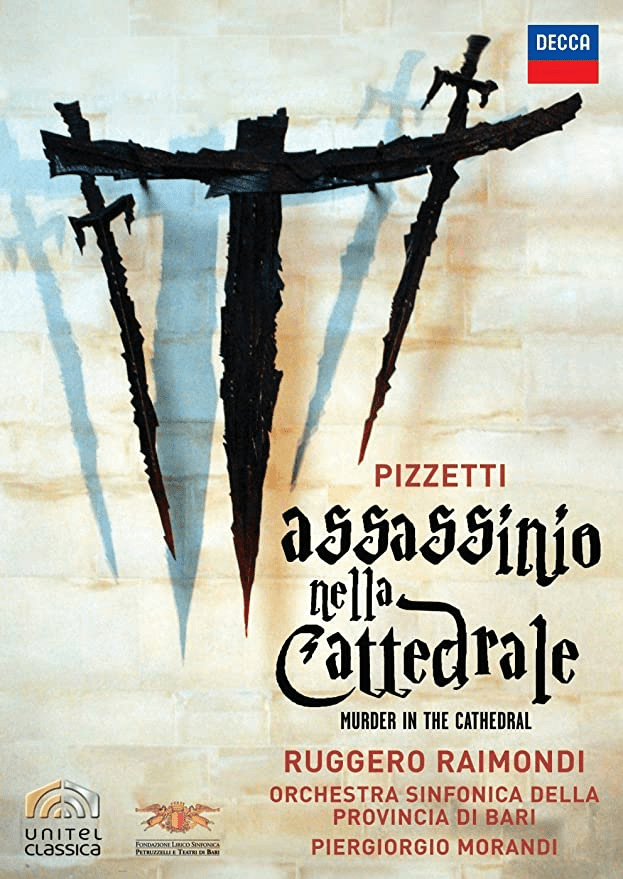
All this is prominent in Assassinio nella Cattedrale, a musical drama based on T.S. Elliott’s play Murder in the cathedral, for which Pizzetti himself wrote the libretto. I think it is a beauty of a piece, with a very strong libretto, beautiful choral parts and a perfectly crafted leading role that gives a good bass-baritone all the room it needs to shine. Incredible really that the opera is still so rarely performed.

This Decca recording was filmed in December 2006 in the dazzling Basilica di San Nicola in Bari. It all makes it feel very authentic, although I think it must have been more impressive live than on DVD. Logical, really.

The performance itself is fine, not overwhelming, but certainly sufficient. The Archbishop’s rise does make a huge impression, it’s a lot like Scarpia’s first rise; that makes you quiet. Especially when the singer in question is called Ruggero Raimondi. His voice has become a bit dry, but he is a real theatre animal and puts down a very impressive Thomas Becket


NICOLA ROSSI-LEMENI AND LEYLA GENCER/VIRGINIA ZEANI


The premiere of Assassinio nella Cattedrale took place at La Scala in Milan, in March 1958. The leading roles were sung by Nicola Rossi-Lemeni for whom Pizetti composed the opera and Leyla Gencer.


Shortly after its premiere, the opera was recorded live in Turin. Absolutely indispensable for the ‘Generazione dell’80’ and verism lover (Stradivarius STR 10067/57)

Virginia Zeani in an aria from the recording:


Should you want to hear more from Pizzetti (which I can well imagine), I can recommend the recording of Debora e Jaele. The cast is to please, with the very impressive Clara Petrella leading the way in the role of Jaele. The opera was recorded inMilan in 1952, Gianandrea Gavazzeni conducted (GOP 66.354)

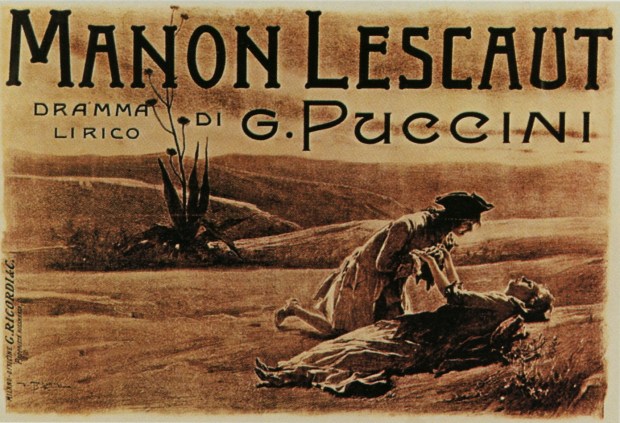
Why do we love Manon Lescaut: discography

manon-lescau

Why do we love Manon so very much? She is not really virtuous. She leaves the love of her life for an old rich man, but as soon as she gets bored, she allows her young lover to come back to her. She is willing to run away with him, but not without her jewels. A child can see that it cannot end well.

Once caught, Manon is taken prisoner and exiled to America, where she dies in the arms of her lover. The poor soul refused to leave her. Talk about real love!

It is thanks to Puccini, who captured her character in the most beautiful notes, that she never becomes one-dimensional and you must be made of stone if you do not love her.

The role of Manon was created in 1893 at the Teatro Reggio in Turin by Cesira Ferrari, an Italian soprano who made her debut as Micaëla in Carmen and three years later sang the first Mimì in La bohème. Perhaps here is an indication of the type of voice that Puccini had in mind for his Manon?

How many good Manons are there nowadays? Not many, I think. The role makes very high demands on the performer. It requires a voice that can combine the childishly naive sex appeal of the silly girl in the first three acts with the real tragédienne in act four.

But Des Grieux, too, is a role that is not easy to fill. The man himself may be a sissy, but Puccini has written such violent notes for him, challenging him with such utterly emotional outbursts, that the singer must be a would-be Calaf to survive the opera with his voice intact.


MAGDA OLIVERO


manon-olivero-domingo


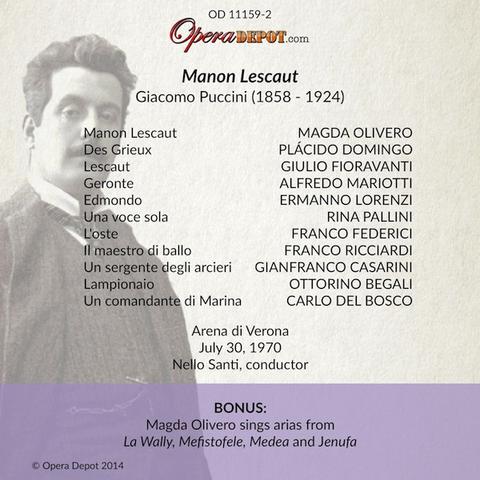
There is no doubt about it: Magda Olivero was the very best Manon Lescaut of the second half of the twentieth century. In 1970, when she was 60 (!) years old, she sang the role in Verona with the not yet 30-year-old Domingo at her side. Quite bizarre when you consider that Olivero made her professional debut eight years before Domingo was born. And yet her portrayal of the young heroine was utterly convincing. Most of her colleagues could not (and cannot) match her performance!


The role of Des Grieux was a role that could have been written for Domingo. As Renato, he was able to combine all his charm, his sehnsucht and his boyishness (something he has managed to retain to an advanced age) with a cannon-like voice. My copy was released on Foyer (2-CF 2033), but nowadays there are more releases in better sound quality and the recording can also be found on You Tube.


manon-olivero-tucker-foto


Two years later, Olivero sang the role in Caracas. The performance of 2 June 1972 was recorded by Legato Classics (LCD-113-2). The sound quality is reasonably good, but what makes the recording really desirable is Des Grieux by the then 60-year-old Richard Tucker. So yearning, so in love, so beautiful…. Sigh. Yes, folks: once upon a time, opera was made by voices, not by beautiful bodies!


Duet from the fourth act:


RAINA KABAIVANSKA


manon-kabaivanska

\

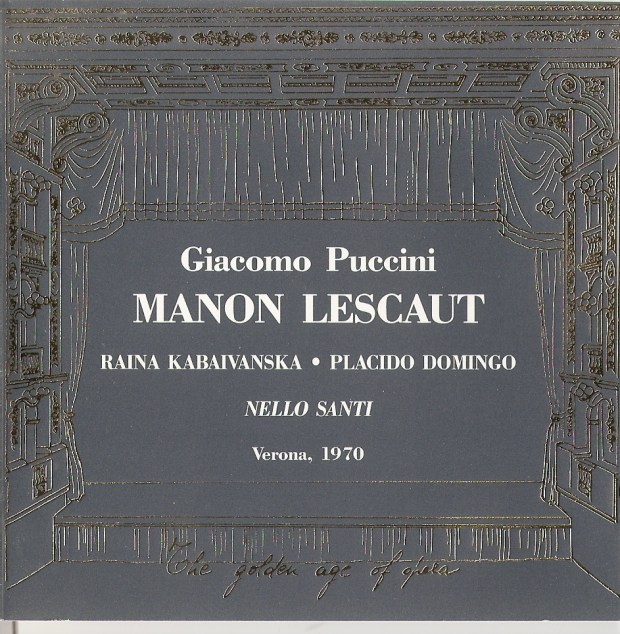
Manon was sung in Verona in 1970 not by Magda Olivero alone, but also by Raina Kabaivanska, with the same cast and the same conductor. The recording is very poor and therefore only for the diehards among us, but if you have a chance to listen to it: please do! Between Kabaivanska, who is still extremely underrated, and the young Domingo, a chemistry can be heard that, despite the poor sound quality, comes across really well.

The duet from II Tu, tu, Amore? tu?

As a bonus, you get fragments from 1953 of the live performance in Mexico, with Mario del Monaco and Clara Petrella. Not bad at all! (GAO 162/63)


MIRIAM GAUCI

manon-gauci


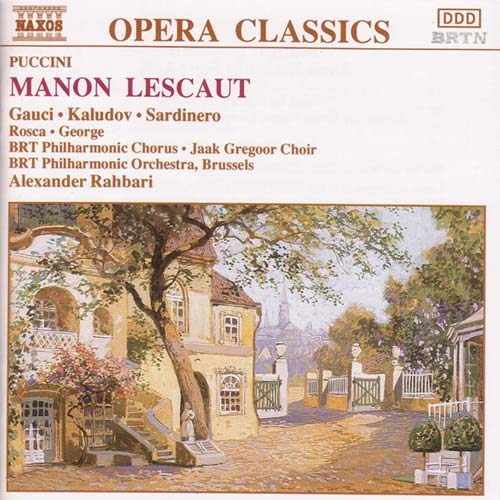
In 1991, the Maltese Gauci was not exactly an unknown, but her great career only took off with her role as Manon Lescaut at the Vlaamse Opera in Antwerp. The opera was the first in the Puccini cycle, created by the then fledgling Canadian director Robert Carsen. Those who were present will never forget it. Because of the magnificent production, of course, but also because of Gauci’s scorching performance.


In 1992, Gauci recorded the role for Naxos (8660019-20), with Bulgarian tenor Kaludi Kaludov at her side as a very lyrical sounding Des Grieux. His “Donna non vidi mai” is very passionate, but at the same time kept within the boundaries of lyricism. To fall in love with, so beautiful. Alexander Rahbari’s direction is very intense, but also lacks many nuances. A real must because of Gauci and Kaludov.

Highlights are on Spotify:


RENATA SCOTTO

manon-scotto


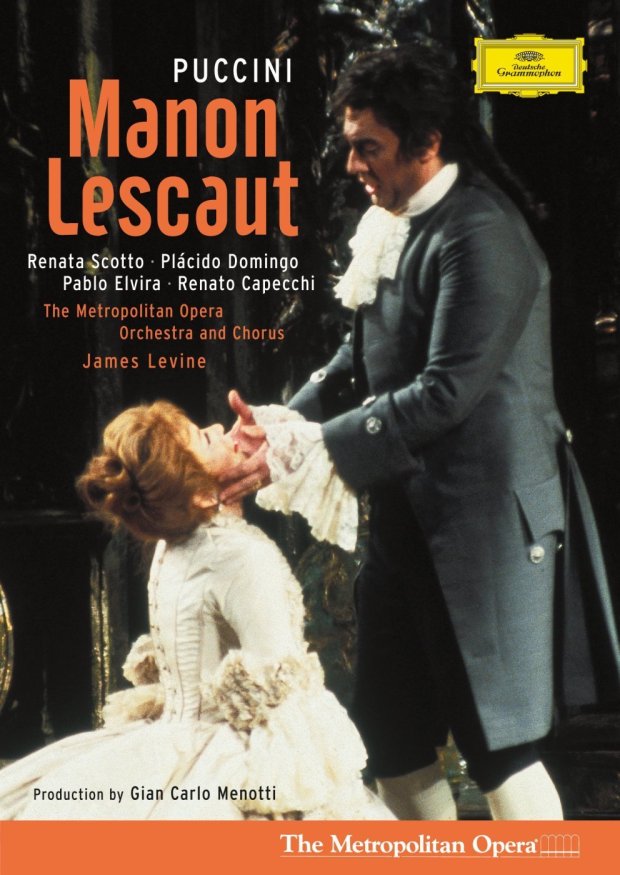
I can be very brief about the offers on DVD: buy the Menotti production with Renata Scotto and Plácido Domingo from the Metropolitan Opera (1980) and you are set for life. There is no other production that comes even close to it and I do not expect that event to happen any time soon. The compulsiveness with which many contemporary directors want to update everything can only kill the opera. Such was the case with Mariusz Trelinski’s production in Brussels a few years ago, with Eva-Maria Westbroek and Brandon Jovanovich.  And this was also the case with the latest production from the MET, directed by Richard Eyre, with Kristine Opolais and Roberto Alagna in the leading roles.

Scotto sings and acts Manon like no one else has done before, and together with Domingo she provides us with a lovely evening filled with a whole lot of old-fashioned crying. Menotti’s very realistic, true-to-nature and oh-so-exciting production could not be any better.
It is quite unique (DG 0734241).


THE VERY FIRST MANON


Back to the very first Manon. What did she sound like? There is a recording by Cesira Ferrari of “In quelle trine morbide”, made in 1905. It is on a double CD by Standing Room Only (SRO-818-2) with the title “Creators Records”. What you hear is a light, almost soubrette-like voice, but with dark undertones. And with a lot of body. You could say it’s a bit of a big-boned Lolita.

Riccardo Zandonai, Ildebrando Pizzetti en Arrigo Boito in een paar liveopnamen

francesca-zandonai
Riccardo Zandonai werd ooit beschouwd als de opvolger van Puccini. Hij schreef een kleine dertiental opera’s, waarvan eigenlijk alleen Conchita (1911), Francesca da Rimini (1914) en Giulietta e Romeo (1921) ooit zeer succesvol waren. Heden worden ze nog maar zelden opgevoerd en de doorsnee operaliefhebber komt niet verder dan Francesca da Rimini. Jammer, want de werken van de leerling van Mascagni en wellicht de laatste der veristen zijn een puur genot om naar te luisteren.

Romeo Zandonai

Giulietta e Romeo (GOP 66352) werd in 1955 in Milaan opgenomen. De hoofdrollen worden gezongen door Annamaria Rovere, een prima sopraan met een voor die tijd typisch stemgeluid, en de mij lichtelijk irriterende Angelo Lo Forese. Fantastisch daarentegen is Renato Capecchi als Tebaldo.


https://images-na.ssl-images-amazon.com/images/I/81KTzkL3PhL._SL1000_.jpg

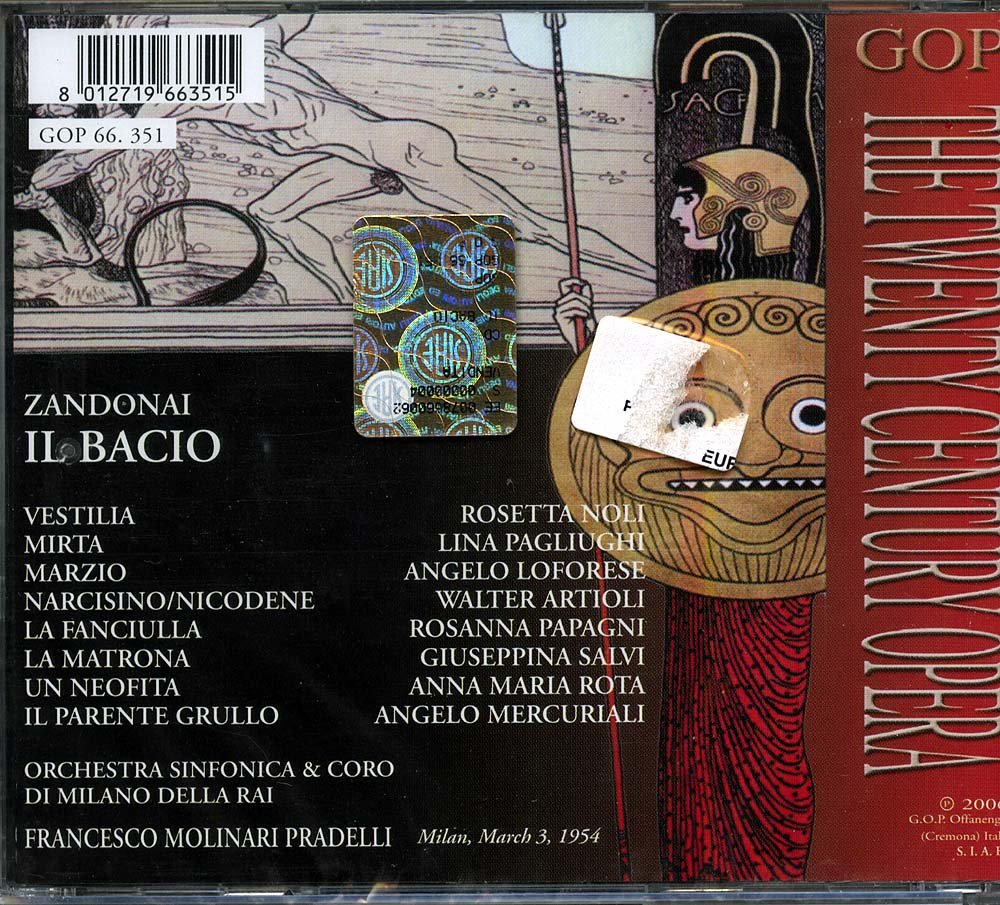
Il Bacio (GOP 66351) beleefde in 1954 in Milaan zijn allereerste opvoering (Il Bacio (GOP 66351) beleefde in 1954 in Milaan zijn allereerste opvoering (toen Zandonai in 1944 stierf, liet hij de opera onafgemaakt achter). Gelukkig voor ons werd de voorstelling door RAI opgenomen en op cd gezet. De uitgever verontschuldigt zich voor het ontbreken van het libretto maar er is ook geen synopsis, dus naar de inhoud van de opera kan men alleen maar gissen. Niet erg, de muziek is boeiend genoeg, en er wordt prachtig in gezongen door onder andere Lina Pagliughi in de rol van Mirta.


https://upload.wikimedia.org/wikipedia/commons/thumb/3/37/Ildebrando_Pizzetti_%28before_1968%29_-_Archivio_Storico_Ricordi_FOTO002672_%28cropped%29.jpg/640px-Ildebrando_Pizzetti_%28before_1968%29_-_Archivio_Storico_Ricordi_FOTO002672_%28cropped%29.jpg

Ildebrando Pizzetti behoorde – samen met onder andere Respighi, Zandonai, Alfano en Malipiero – tot de zogenoemde ‘Generazione dell’80’, een groep Italiaanse componisten geboren rond 1880. Ooit leerling van Puccini, keerde hij zich op zijn dertigste tegen zijn leraar en ontwikkelde een ‘neoklassieke’ stijl van componeren, Zijn voornaamste inspiratiebronnen waren gregoriaanse melodieën en de Italiaanse polyfonie uit de Renaissance.

pizzetti-debora

Debora e Jaele (o.a. GOP 66354), gecomponeerd in 1921 is losjes gebaseerd op het Bijbelse verhaal over de profetes Debora en de strijd van de Israëlieten tegen de Kanaänieten en hun legeraanvoerder, Sisera. Anders dan in de Bijbel wordt Jael verliefd op haar vijand, en vermoordt ze hem om hem voor het lynchen door de woedende menigte te redden. Onder leiding van Gianandrea Gavazzeni werd in 1952 in Milaan een pracht van een uitvoering van dit bijzondere werk gegeven, met Clara Petrella als Jaele, Gino Penno als Sisera en Cloe Elmo als Debora.


https://lastfm.freetls.fastly.net/i/u/770x0/38466e9191554eb1aeacf53d49345c21.jpg

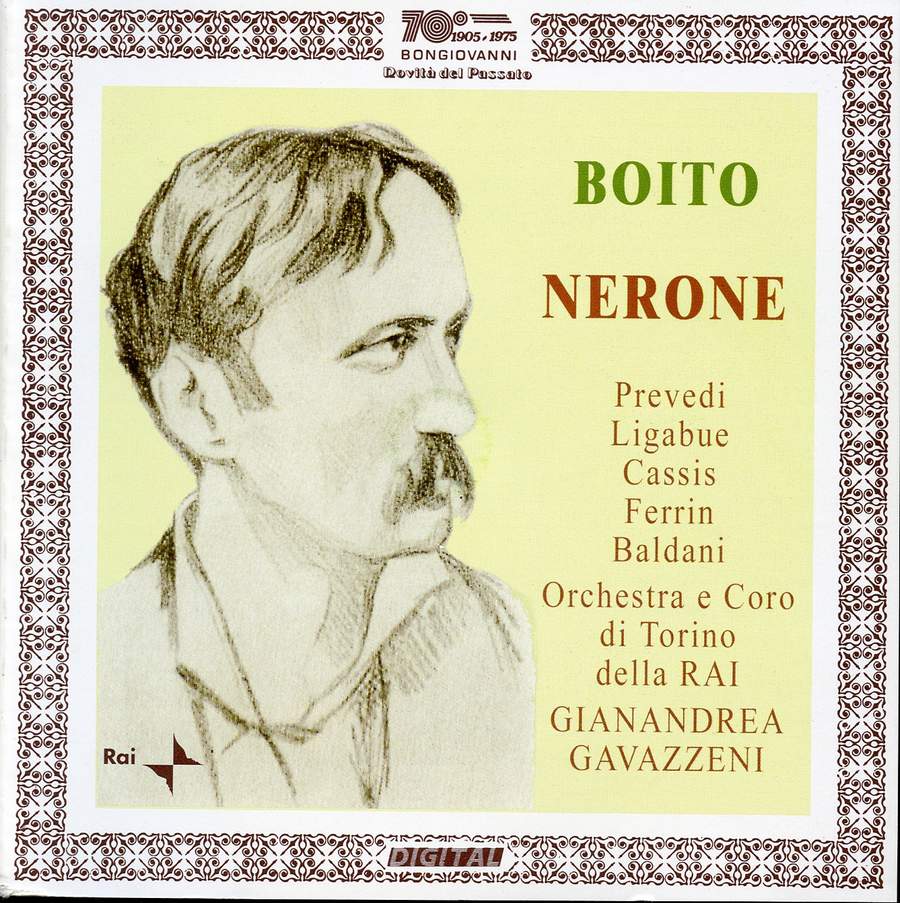
Arrigo Boito heeft bijna 60 jaar aan Nerone gewerkt, maar toen hij in 1918 overleed was de opera nog niet af. Na de dood van de componist werd de manuscript door Toscanini gevonden, hij voltooide de score en in 1924 dirigeerde hij een succesvolle première van de opera.

https://d1iiivw74516uk.cloudfront.net/eyJidWNrZXQiOiJwcmVzdG8tY292ZXItaW1hZ2VzIiwia2V5IjoiNzk4OTUxMC4xLmpwZyIsImVkaXRzIjp7InJlc2l6ZSI6eyJ3aWR0aCI6OTAwfSwianBlZyI6eyJxdWFsaXR5Ijo2NX0sInRvRm9ybWF0IjoianBlZyJ9LCJ0aW1lc3RhbXAiOjE0OTM2NTYwMzR9

Nerone wordt nog maar zelden opgevoerd en er zijn maar bitter weinig opnamen ervan. Tot voor kort kende ik maar één, op Hungaroton, maar die was, ondanks twee goede vrouwenrollen (Ilona Tokody en Klára Tákacs) maar matig, dus de uitgave van Bongiovanni (GB 2388/89-2) is meer dan welkom. Het is een live opname uit Turijn 1975, en over de uitvoering ben ik zeer enthousiast. Gianandrea Gavazzeni dirigeert een werkelijk fenomenale cast met o.a. Bruno Prevedi (waar worden nog zulke tenoren gemaakt?) als Nerone en Ilva Ligabue als Asteria. Alleen al vanwege de intense bijdrage van de laatste is het een absolute must voor de operaliefhebber


Madama Butterfly: drie (cd) opnamen waar ik niet zonder kan

Butterfly

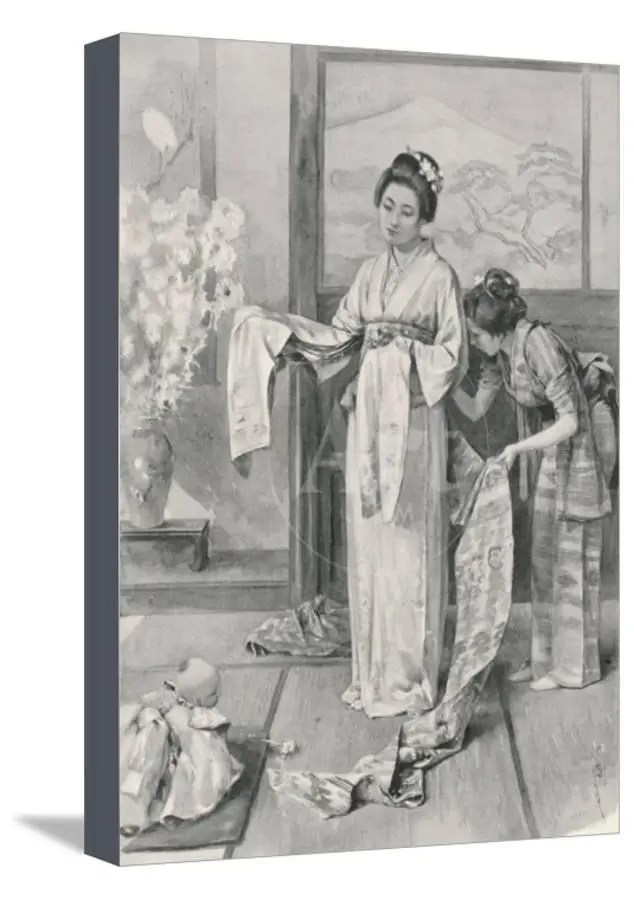
Female Attendant Helps Madama Butterfly to Dress Giclee Print by C.d. Weldon | Art.com

Het leven van een operaliefhebber is incompleet zonder minstens één Madama Butterfly op de plank – tenzij u natuurlijk een Puccini-hater bent (ze bestaan echt!), maar in dit geval leest u het toch niet….

RENATA SCOTTO

Butterfly Scotto

Voor mij een absolute ‘numero uno’ is de in 1966 bij EMI (tegenwoordig Warner 0190295735913) verschenen opname onder Sir John Barbirolli. Renata Scotto bewonder ik niet alleen vanwege haar prachtige stem, maar ook (en misschien voornamelijk) vanwege haar totale identificatie met iedere rol die ze ooit gezongen heeft.

Begonnen als een lyrische coloratuursopraan, schitterde ze voornamelijk in opera’s van Bellini en Donizetti, om in de jaren zestig langzamerhand ook zwaardere rollen op haar repertoire te zetten. Madama Butterfly was er één van, en daarmee zette ze een standaard die nog steeds niet is geëvenaard.

Hieronder: privé opname van het liefdesduet met Renata Scotto en Giacomo Giacomini

Je kan je een lyrischer of juist een meer dramatische Cio Cio San indenken; eentje met minder metaal in haar stem of eentje met kinderlijker stem. Maar geen andere zangeres wist zo het complexe wezen van het meisje te doorgronden en haar verandering van een naïef kind in een volwassen, door immens verdriet gebroken vrouw zo te karakteriseren.

Hieronder: Scotto zing ‘Con onor muero’ in Arena di Verona in 1987

Vijftien is Cio Cio San als de opera begint en nog maar achttien bij haar tragische einde, maar in die drie jaar heeft zij een ontwikkeling doorgemaakt, waar een gewoon iemand een heel leven voor nodig heeft. En dat alles hoor ik in Scotto’s interpretatie.

Carlo Bergonzi is een prachtig gezongen, een ietwat afstandelijke Pinkerton en Rolando Panerai een zeer warme Sharpless.


CLARA PETRELLA

Butterfly Petralla

Op nummer twee op mijn lijstje staat een Italiaanse Rai-opname uit 1953 (Urania URN22.311) met in de hoofdrol Clara Petrella. Deze verschrikkelijk ondergewaardeerde sopraan is een zeer dramatische Butterfly, met een intensiteit die je bij het beluisteren gewoon pijn doet.

Feruccio Tagliavini roept met zijn zoete, lyrische stem een sfeer van liederen van Tosti op: dit is een Pinkerton om verliefd op te worden.


VICTORIA DE LOS ANGELES

Butterfly de los Angels

Op nummer drie ook een oudje: een in 1954 door EMI opgenomen en inmiddels op Regis (RRC 2070) heruitgebrachte opname met Victoria de los Angeles en Giuseppe di Stefano. De los Angeles is een Butterfly met een kinderlijke warmte, broos, breekbaar. Haar te kwetsen voelt alsof je de Madonna zelf gekwetst hebt. Daar past Giuseppe di Stefano met zijn zeer macho tenor wonderwel bij.