Who does not dream of being eternally young and beautiful? The wonderful story of Faust, about a scientist who sells his soul to the devil, has inspired numerous writers, poets and composers. Charles Gounod’s 1859 version is simply delightful.
If you want to see the work on screen, the choice is very limited. I myself was once absolutely blown away by Frank Van Laecke’s production at Opera Zuid, but it was not recorded. Pity.
Roberto Alagna
David McVicar, one of my beloved directors, staged the opera at London’s Royal Opera House. I saw it there, first with Roberto Alagna and then with Piotr Beczala. And to be honest: I was somewhat underwhelmed. There was very good singing, sure, but the direction disappointed me a bit.
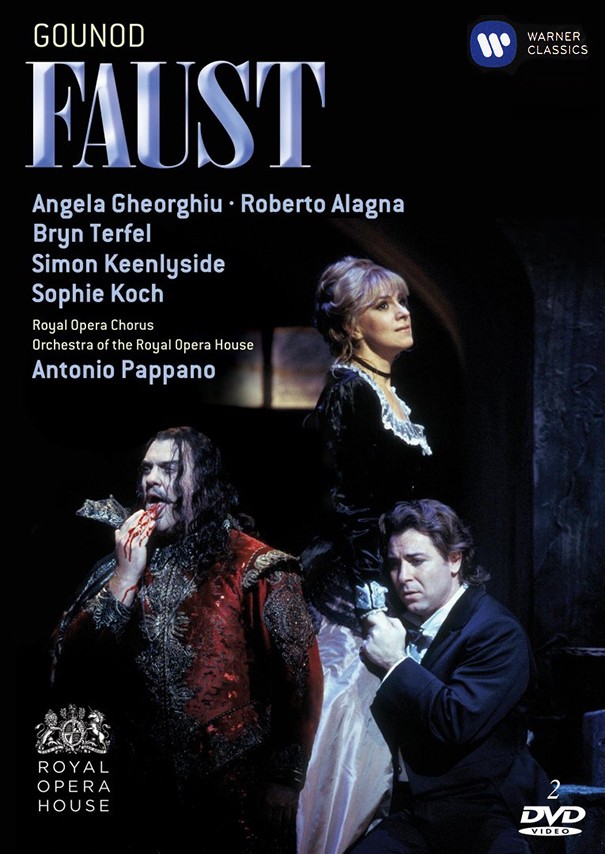
The first performances, starring Roberto Alagna, Angela Gheorghiu, Bryn Terfel, Sophie Koch and Simon Keenlyside, were filmed for Warner (5099963161199) in 2004.
Below is Angela Gheorghiu as Marguerite, with a commentary by herself:
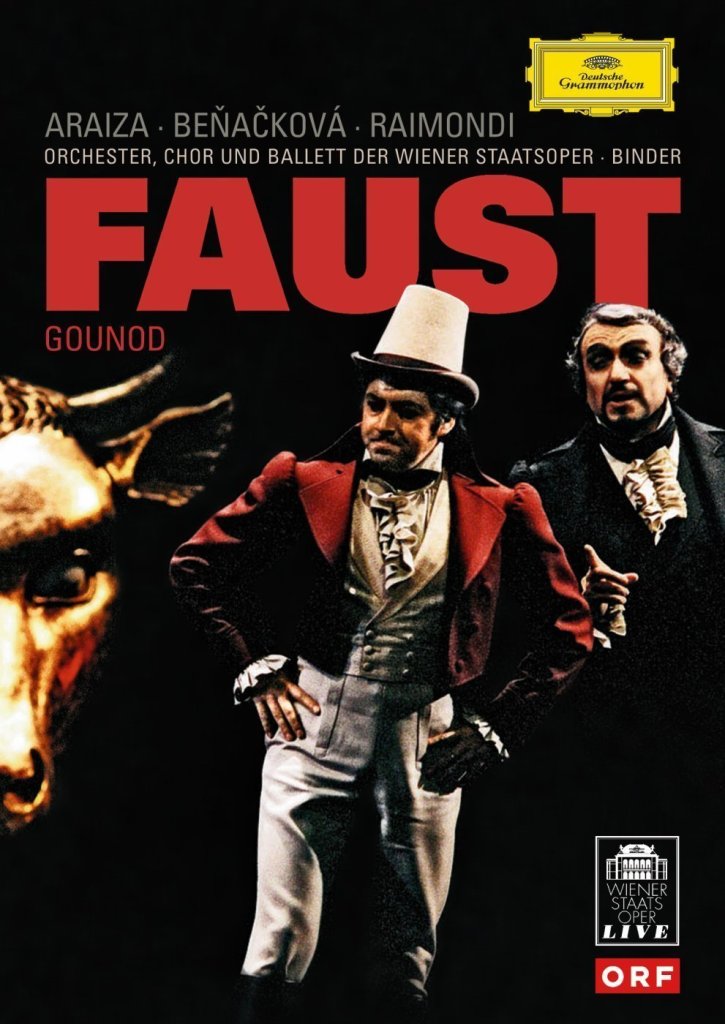
Francisco Araiza
And then we have the ˜enfant terrible” of the 1980s, Ken Russell …. To be honest, I confess that I didn’t really get very far when watching this DVD (DG 0734108). I find the direction extremely irritating with all sorts of ˜inventions” and ˜symbols”, the point of which completely escapes me. Francesco Araiza was once among my favourites, and in 1983 he still sang a splendid Ferrando in ‘Cosi fan Tutte’ but in this 1985 Viennese production his voice is a fraction of what it had been. What a shame!
Alfredo Kraus
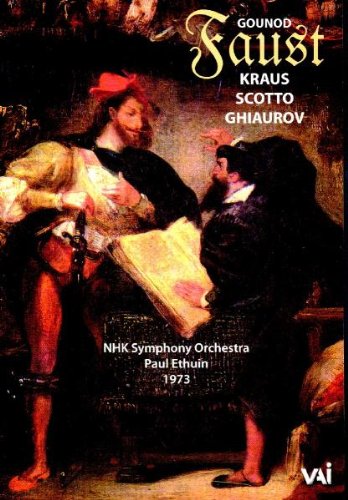
In 1973, Faust was performed in Tokyo and recorded live (VAI 4417). Renata Scotto, Alfredo Kraus, Nicolai Ghiaurov… what a cast! Mouthwatering, right? Yes and no.
Kraus is definitely ˜elegant”, but does Faust have to be elegant? Isn’t he rather a vulgar villain who just wants to cheat the pretty girl? Who wants money? And who wants to enjoy himself? Or have I misunderstood? There is also no passion in his singing and his high notes are somewhat ˜pressed”.
But Scotto is a very moving Marguerite and Ghiaurov a more than impressive Méphistophéles.
CD’s
Nicolai Gedda
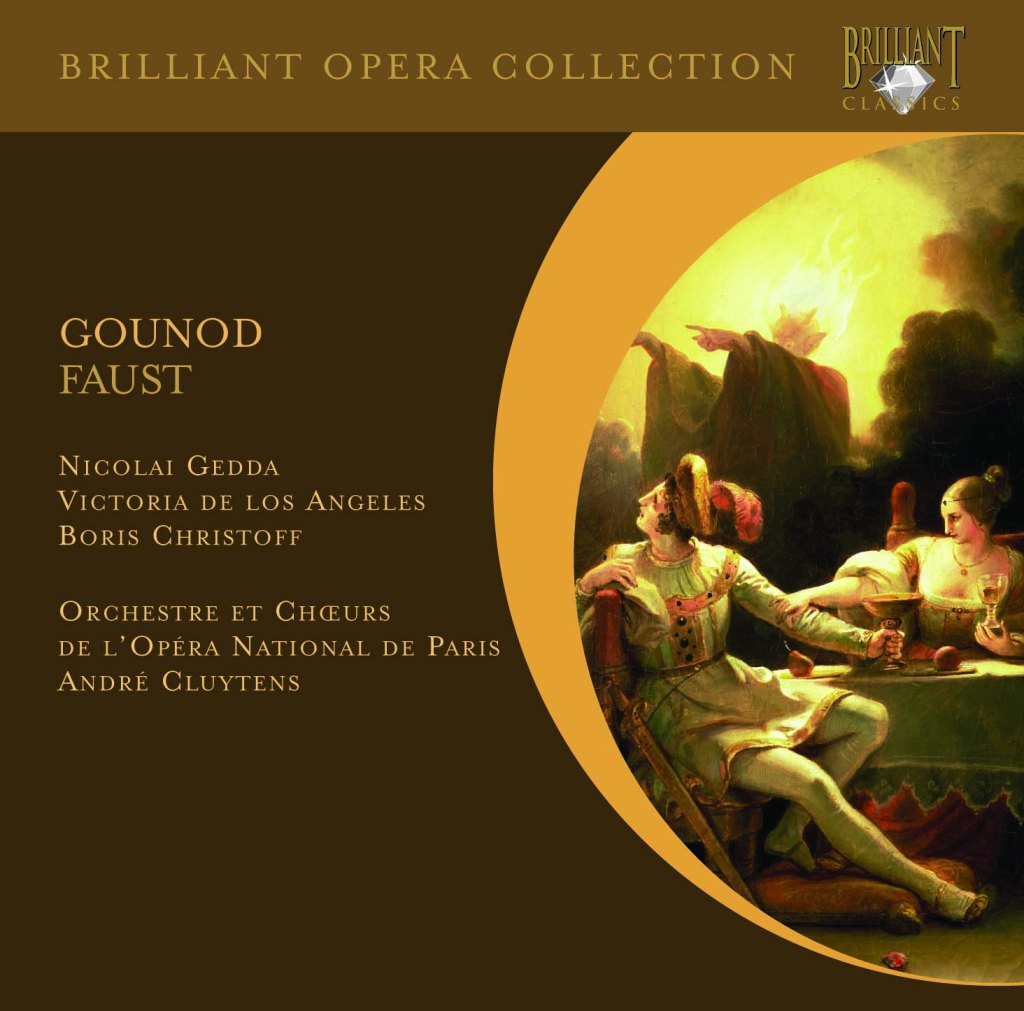
On CD, the choice is immense. How about Victoria de los Angeles and Nicolai Gedda? With Boris Christoff as the devil himself? Conducted by André Cluytens (Brilliant Classics 93964)? This makes my heart melt.
Gedda could probably be compared to Kraus, just a little, but his voice is big and his eloquence inexhaustible. And his sense of language is formidable. So please give me Gedda any day!
Gedda sings ˜Salut! Demeure chaste et pure”:
Plácido Domingo
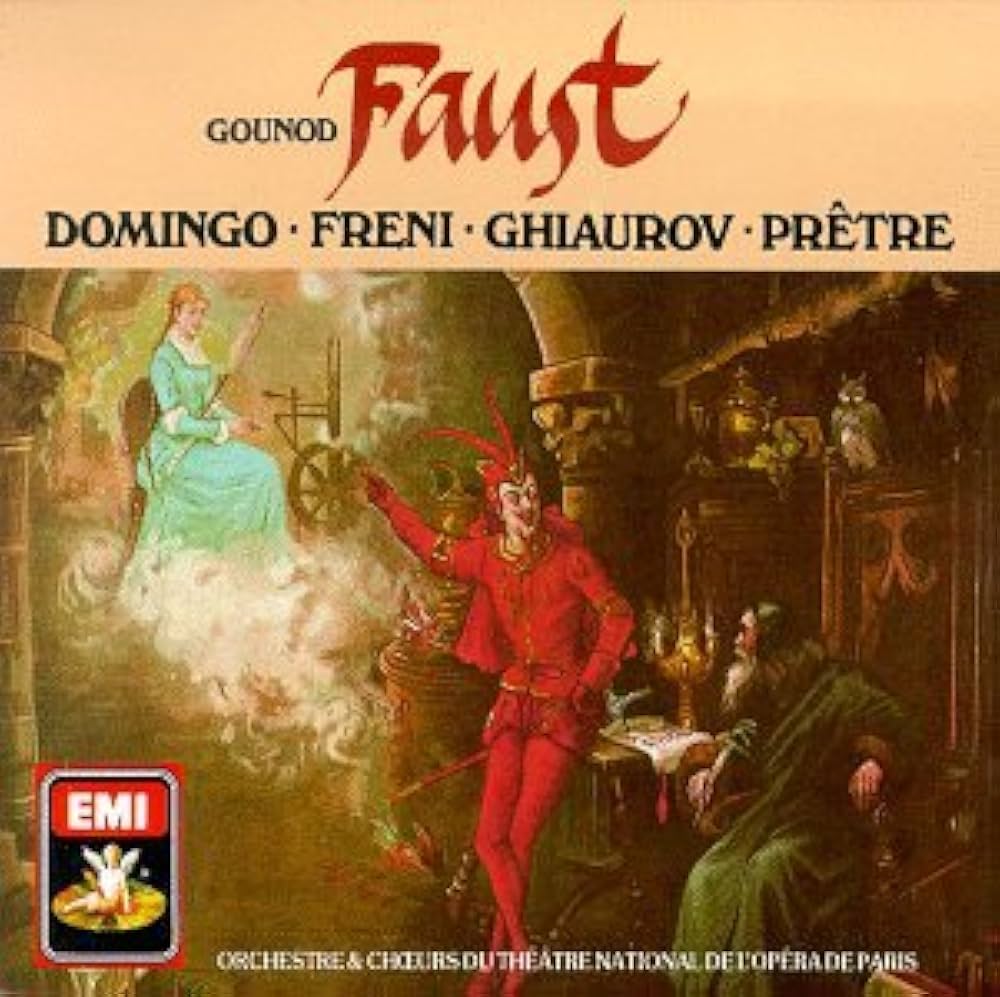
Domingo is not really the first you think of when discussing Faust, but fortunately for the aficionado, a good studio recording of him exists. Fortunately, because in this case you can safely say it is one of the best recordings of the work (once EMI ).
The Paris Opera orchestra is conducted by Georges Pretre, one of the best conductors for the French repertoire. The cast is finger-licking good: Mirella Freni is a fragile and sensual Marguerite and Nicolai Ghiaurov a very impressive Méphistophéles. .
In the small role of Valentin, we hear none other than Thomas Allen. I have never heard ‘Avant de quitter ces lieux’ sung more beautifully before (or since).
How many operas can claim to have shot the world order hell by sparking a revolution and thereby creating an entirely new country?
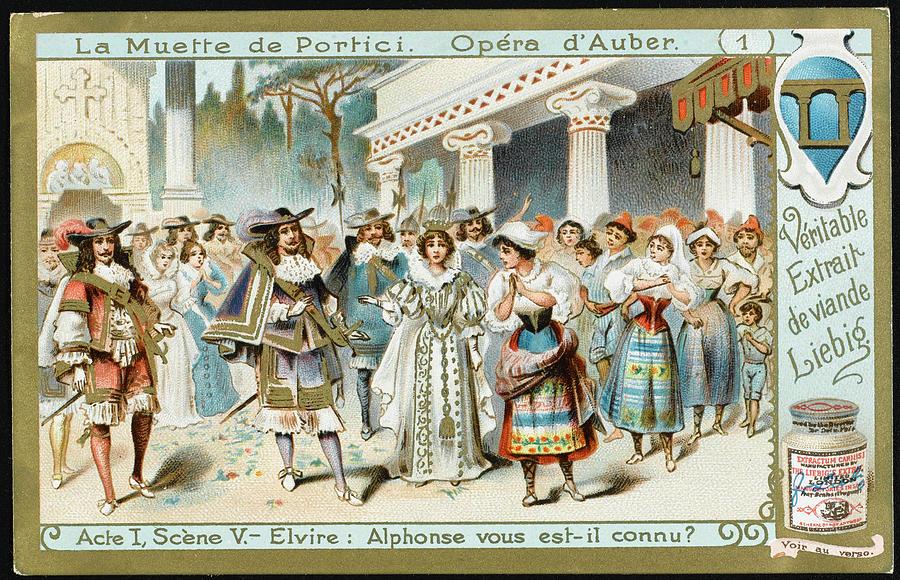
The honour falls to La Muette de Portici, an opera almost forgotten today by an almost equally forgotten French composer Daniel-François-Esprit Auber (1782 – 1971).
The situation ignited during a performance at Brussels’ La Monnaie in 1830, a performance in honour of the birthday of King William I. The moment suprème came during an aria, in which one of the protagonists sang the text: “Holy patriotism, give us back our courage and pride. My life I owe to my country, it will owe its freedom to me.” The audience left the hall, took to the streets and voilà: the Kingdom of Belgium was born.
That La Muette is different from all other operas also has to do with the protagonist. The latter may be present but has no note to sing – poor fisherman’s girl Fenella is mute.
Anna Pavlova as Finella
She is seduced by the young Neapolitan count Alphonse, who then exchanges her for a better match: a Spanish princess Elvire. Fenella is imprisoned, escapes and – using only sign language – manages to attract Elvire’s attention and pity, turning her brother Masaniello into the destroying angel.
This also becomes the signal to spark an uprising against the hated rulers; after which everything that can go wrong does. Masaniello is poisoned, the revolt fails and Fenella finds self-death in the lava flow from Vesuvius. I can’t make it more logical for you, but that doesn’t matter, because the opera itself is more than delightful and provides you with more than two hours of pure listening pleasure.
La Muette is considered the first true ‘grand opéra’. That may also be why it was so rarely staged, given our long-standing condescending view of the phenomenon of ‘grand opéra’.
But the tide is turning. A few years ago, La Monnaie dared to include the opera in its repertoire. Unfortunately, their courage did not go so far as to include performances in Brussels.
Peter de Caluwe, the director of La Monnaie, said with that, “That was done deliberately. Staging the opera in Brussels now would not only be an artistic act, but also a political statement; it would be interpreted as a plea for Belgian unity at a politically precarious moment.”
In 2011, a German opera house, the progressive Anhaltisches Theater in Dessau, where the young Dutch conductor Antony Hermus, then Generalmusikdirektor, also staged the opera. The performances were recorded live by CPO. It was about time!
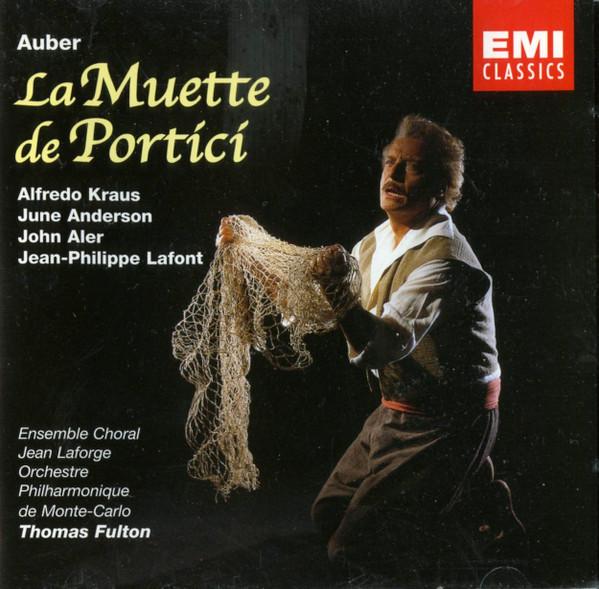
I knew of only one recording of the opera, with Alfredo Kraus, June Anderson, John Aler and Jean-Philipe Lafont conducted by Thomas Fulton (EMI not available anymore)). No one can match Alfredo Kraus’ elegant phrasing, but I still prefer Diego Torres’ more heroic sound. As Masaniello, he manages to convince much better. With him, you can practically hear the hormones coursing through his veins.
In his madness scene (yes, why not? Men are allowed to go mad too!), he sounds a lot like John Osborn.His high notes are not only spectacular but he also sings them at the top of his voice. Occasionally he sounds a little tired, but that doesn’t matter, especially in the context of the whole thing.
In “Mieux vaut mourir que rester misérable!”, from which the incendiary text thus comes, he is joined by Wiard Withold as Pietro. I also find him more interesting than Jean-Philipe Lafont on the Fulton (EMI) recording. It has now been recorded by CPO. It was about time
The young Dutch singer is at his best in the fifth act. His barcarolle “Voyez du haut de ces rivages” is particularly impressive. His lyrical baritone, meanwhile, has darkened a little without compromising on suppleness and lyricism, which goes without a hitch.
Angelina Ruzzafante is a wonderful Elvire. Her voice is light, supple and agile, her pitch beautiful and pure, and her vocal acting is perfect.Sometimes she reminds me of Cristina Deutekom, but without her oh-so-typical “staccato” (no offence!). It is about time the we get to hear the Dutch soprano on our stages too!
Oscar de la Torre (Alphonse) starts out weak – his tenor sounds a bit pinched – but in the fourth act he more than recovers. He is still young and – from the looks of it – inexperienced, but he will get there!
The chorus is formidable and I find Hermus’ tempi definitely better than Fulton’s.
Renata Scotto, ‘la mia Divina Assoluta’, was born on 24 February 1934 in Savona. She made her opera debut at the age of eighteen as Violetta (La Traviata). Her ‘official’ debut was the next day in Milan. Shortly afterwards, she sang Madama Butterfly in Savona.
Because there was no chance to hear her in the Netherlands, I travelled with a few friends, they were also great fans, to Paris, where she gave a recital. It was sold out and I really only remember the huge queue in front of her dressing room: people wanted her autograph, they came with flowers, chocolates, gifts…. I had never seen anything like that in the Netherlands.
But the day finally came and she sang in Amsterdam! On 19 October 1996 she performed in the Netherlands for the first time since 1963. During the Amsterdam Saturday Matinee she sang before the interval Chausson’s Poème de l’amour et la mer and after the interval Poulenc’s La voix humaine. She made a real performance out of it: there was a table with a telephone on it, and with the telephone cord she strangled herself at the end. Those who were there will never forget it.
This recording comes from Barcelona 1996:
During her long career, Scotto performed in operas written by 18 composers and her repertoire included some forty-five roles. And then there are the studio recordings. I cannot possibly discuss everything, so I will restrict myself to a few recordings. The order is random.
LA WALLY
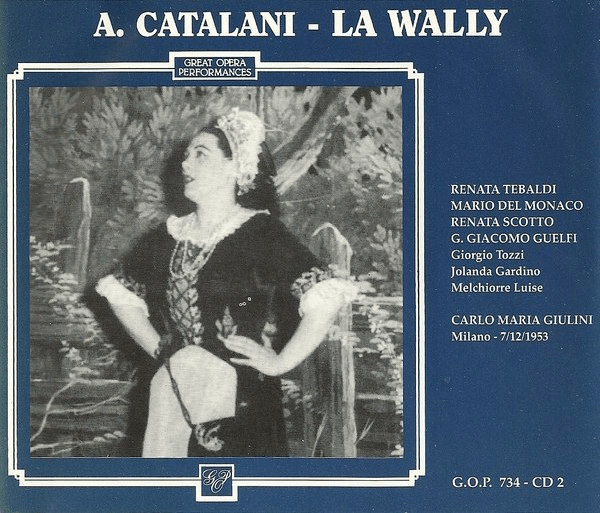
In 1953 she auditioned at La Scala for the role of Walter in Catalani’s La Wally with Renata Tebaldi and Mario del Monaco, amongst others. Giulini was to conduct. It is told that afterwards Victor de Sabata, one of the jury members, said: “Forget about the rest.”
La Wally premiered on December 7, 1953, and Scotto happily accepted fifteen curtain calls. Tebaldi and del Monaco got seven each.
LA SONNAMBULA
In Edinburgh, Milan’s La Scala staged Luchino Visconti’s production of La sonnambula, with Maria Callas as Amina. The production had been so successful that La Scala had decided to add another performance. But Callas was tired, and besides, she wanted to go to the party that Elsa Maxwell was giving for her in Venice. So she told the Scala people that she would definitely not be singing this. Nevertheless, La Scala announced the extra performance with Callas. And Callas refused. With only two days’ notice, Scotto took over the role of Amina and replaced Callas on 3 September 1957. The performance was a great success, and the 23-year-old Scotto became an international opera star overnight.
This recording with Alfredo Kraus is from 1961:
RIGOLETTO
My all-time favourite is a Ricordi recording from 1960 (now Sony 74321 68779 2), with Ettore Bastianini in the lead. Renata Scotto sings a girlishly naive Gilda, who is transformed into a mature woman through her love for the wrong man. She understands better than anyone that the whole business of revenge can lead nowhere and she sacrifices herself to stop all the bloodshed and hatred.
Bastianini and Scotto in the finale:
LA TRAVIATA
Renata Scotto has (or should I say had?) something that few other singers possessed: a perfect technique that enabled her to sprinkle her coloraturas like it was nothing at all. Her high notes sounded a bit steely but they were undeniably flawless. She possessed the gift of acting with her voice (and not only with her voice!), and because of her perfect articulation you could not only literally follow what she was singing, but also really understand it.
Her perhaps most beautiful (there are several recordings) Violetta she recorded in 1963 (DG 4350562), under the very exciting direction of Antonino Votto. Alfredo is sung by the sweet-voiced Gianni Raimondi, and Ettore Bastianini is a warm, indeed fatherly, Giorgio Germont.
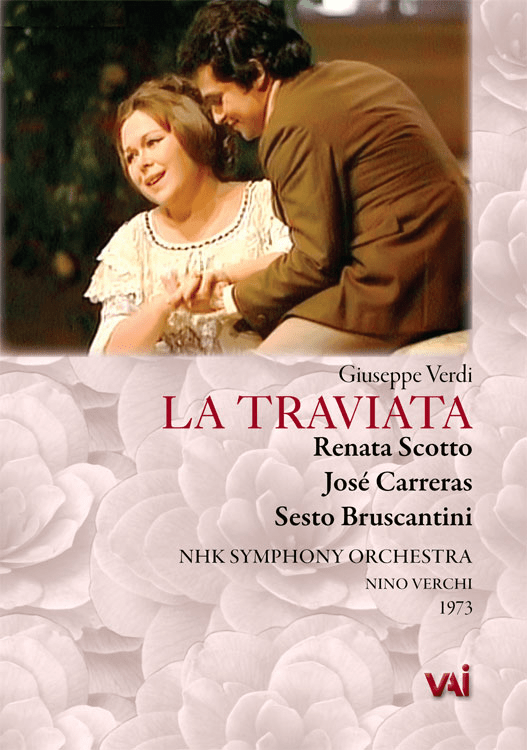
And don’t think that in the old days, when everything was done by the book, the performances were static and boring! In 1973, La Scala was on tour in Japan, and there, in Tokyo, a legendary performance of La Traviata was recorded (VAI 4434).
The leading roles were played by the then still ‘curvy’ Scotto and 27-year-old (!) José Carreras. DVD does not mention the name of the director, perhaps there was none, and the singers (and the conductor) did it all themselves? Anyway, the result is really beautiful, moving and to the point. I am not going to say any more about it, because this recording is an absolute must for every opera lover.
Finale of the opera:
L’ELISIR D’AMORE
To the younger generation I would especially recommend the DVD with Renata Scotto, Carlo Bergonzi and Giuseppe Taddei (Hardy Classic Video HCD 4014). It is not only the beautiful voices of the past that impress (Scotto, Bergonzi, Taddei – who can still sing like them?), the eye is also given a lot to enjoy.
Do not think that they just enter the stage, sing an aria facing the audience and then take a bow. It is theatre pur sang and a better acting singer than Scotto has yet to be born.
Renata Scotto sings ‘Prendi, per me sei libero’:
TURANDOT
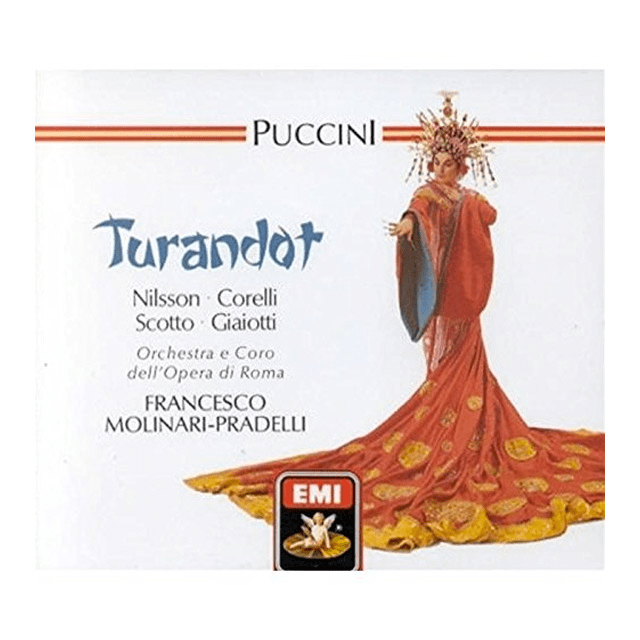
I can be very brief about this: there is no better Liu. Renata Scotto is a very fragile and moving Liu, which is in stark contrast to Corelli’s macho and seductive Calaf and Birgit Nilsson’s chilling Turandot.
MADAMA BUTTERFLY
For me an absolute ‘numero uno’ is the 1966 recording by EMI (now Warner 0190295735913) under Sir John Barbirolli. One might imagine a more lyrical or alternatively a more dramatic Cio Cio San; one with less metal in her voice or maybe one with a more childlike voice. But no other singer was able to grasp the complex nature of the girl so well and to characterise her change from a naive child into an adult woman, broken by immense grief, so impressively
LUCIA DI LAMMERMOOR
Renata Scotto never recorded the role in the studio. However, there are several pirate recordings of her in circulation, with Luciano Pavaratti, Alfredo Kraus, Carlo Bergonzi and Gianni Raimondi as Edgardo.
Of these four, the recording with Raimondi is dearest to me, not least because of the very energetic and dramatically balanced direction by Claudio Abbado. It was recorded at La Scala in December 1967 and it once appeared on Nuova Era (013.6320/21). Unfortunately, that recording is very difficult to obtain, but those who search….
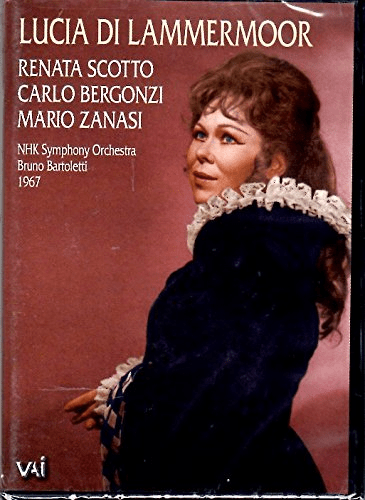
Scotto’s interpretation of the tormented heroine is available on DVD (VAI 4418). The production was recorded in Tokyo in 1967. It circulated for years on pirate video, but since the sound and picture quality was particularly poor, the commercial release has made many opera lovers very happy. The sound is a little sharp, making Scotto’s high notes sound even more metallic than usual, but who cares?
Her interpretation is both vocally and scenically of an unprecedented high level. With a childishly surprised expression (my brother does this to me?) on her face, she agrees, albeit not without grumbling, to the forced marriage with Arturo (an Angelo Marchiandi who is hideous in every way).
Below, Scotto sings ‘Il dolce suono’. Try to follow her example!
LA BOHÈME
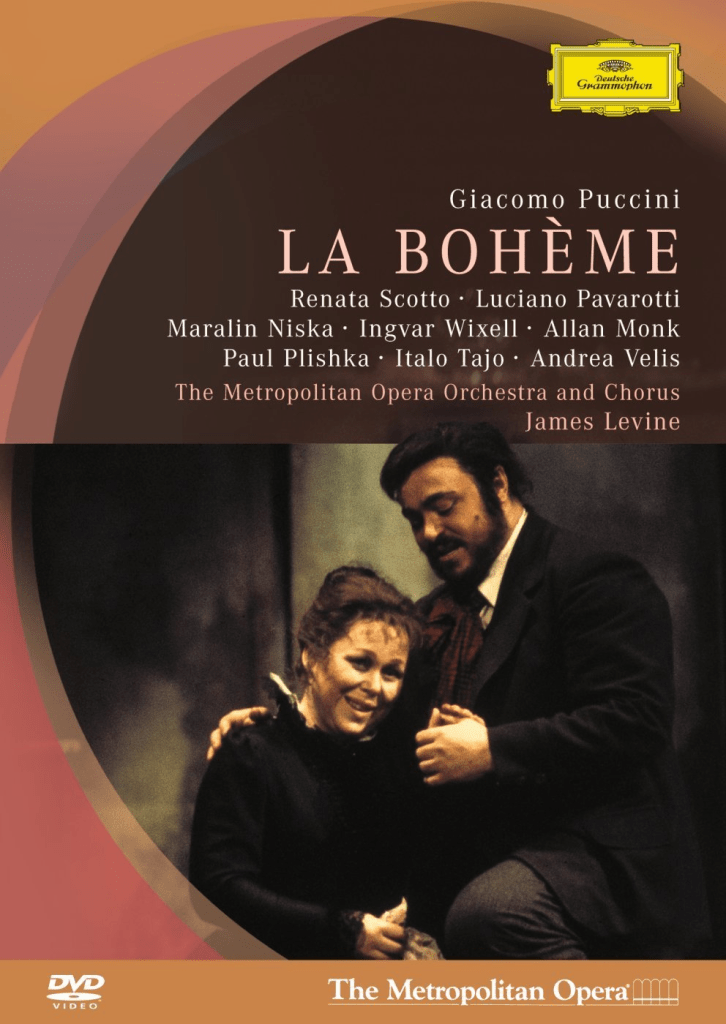
History was made with La Bohème from the Met in 1977 (DG 0734025): it was the very first direct transmission from the New York opera house on TV. The production was in the hands of Pier Luigi Pizzi, who at that time was not yet obsessed with excessive ballets and the colour red.
Although I was never a big fan of Pavarotti, I cannot deny that he produces a fresh sound here and that his high notes stand like a house. Acting was never his cup of tea, but here he does his best.
It becomes really exciting when Mimì enters: in 1977, Renata Scotto was at her unprecedented peak. She spins the most beautiful pianissimi and her legato and mezza voce are so beautiful they make you want to cry. The rest of the cast is no more than adequate, but the young James Levine conducts as if his life depended on it!
Scotto sings ‘Si mi chiamano Mimì’:
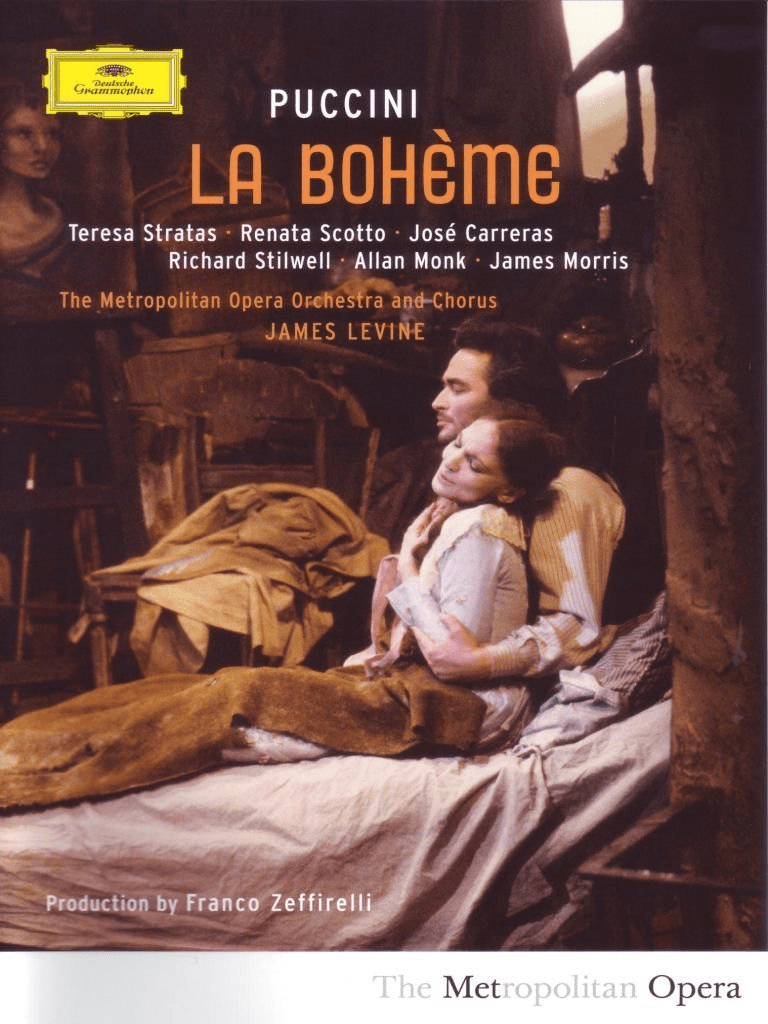
Musetta was not really a role with which we associate Scotto. Neither did she herself, but she accepted the challenge with both hands. In the Zefirelli Met production of 1982, she sang a Musetta to die for. Alongside the very moving José Carreras and Teresa Stratas, she was the undisputed star of this recording (DG 073 4539 9).
Scotto as Musetta:
LUISA MILLER
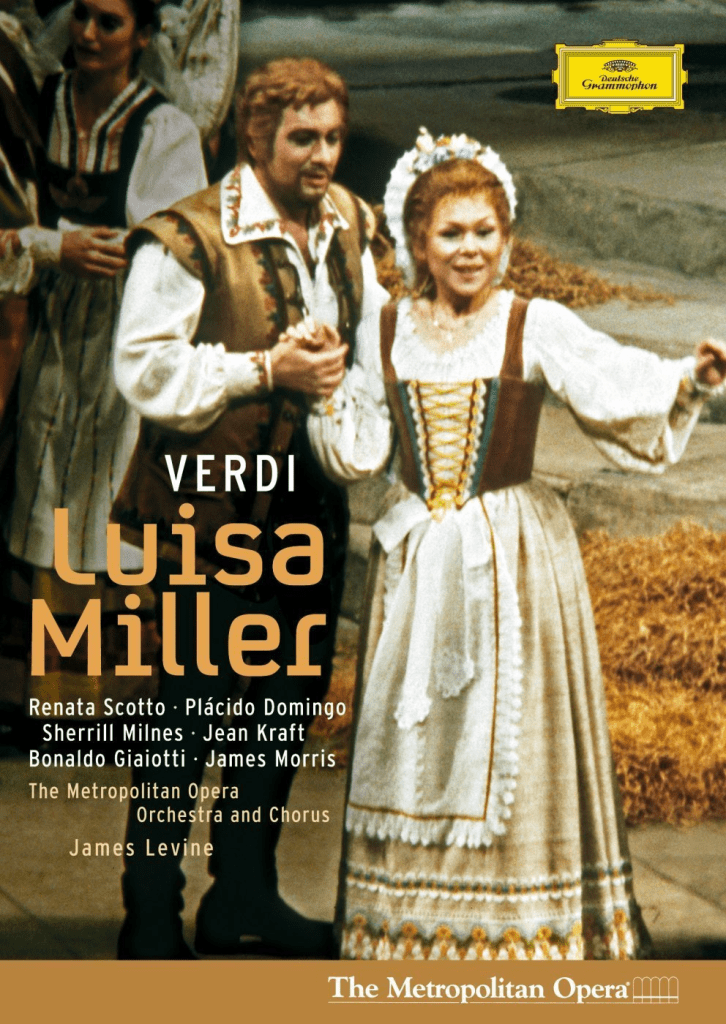
In 1979, Renata Scotto sang her first Luisa at the Metropolitan Opera and she did so with her usual devotion. But before she could start her first big aria, a ‘joker’ caused a scandal by shouting ‘brava Maria Callas’ at the top of his lungs.
Sherrill Milnes, here in the guise of Luisa’s father, took the emotional Scotto in his arms and so saved her concentration. And the performance. And the day.
All this was broadcast live on TV and thus it ended up on the pirate videos in circulation. I had been cherishing mine for years, and now the performance has been released on DVD by Deutsche Grammophon, with the necessary cuts, including that famous incident. A pity, but after all it is not about the incidents but about the opera and the performance. And there is absolutely nothing wrong with that.
In the video below, the main actors (Scotto, Domingo, Milnes and Levine) discuss Verdi’s opera and the 1979 production:
ANDREA CHENIÉR
My favourite CD recording was recorded by RCA (GD 82046) in 1976. The cast is delightful: Renata Scotto sings Maddalena, Plácido Domingo Cheniér, Sherrill Milnes is Gérard, and in the minor roles we hear Jean Kraft, Maria Ewing, Michel Sénéchal and Gwendolyn Killebrew, among others. James Levine, who conducts the National Philharmonic Orchestra, understands exactly what the opera is about. It is so beautiful that it will make you cry.
Scotto sings ‘La Mamma morta’:
MANON LESCAUUT
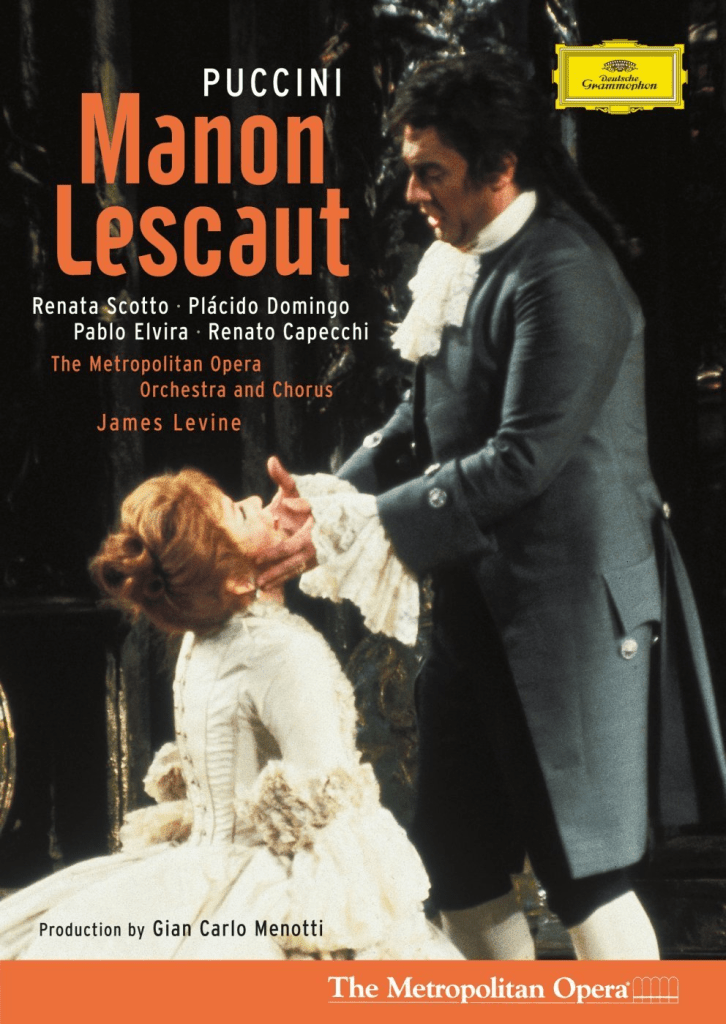
Here I can be very brief: buy the Menotti production with Renata Scotto and Plácido Domingo from the Metropolitan Opera (1980) and you are set for life. There is no other production that even comes close to it and I don’t expect that to happen any time soon. Scotto sings and acts Manon as no other has done before and together with Domingo she provides us with an evening of old-fashioned weeping. Menotti’s very realistic, true to life and oh so exciting production simply could not be any better. (DG 0734241)
IL TRITTICO
In November 1981, Scotto sang all three heroines at the Metropolitan Opera in New York, with Levine conducting. Once a pirate released it in its entirety and it was briefly on YouTune. Too briefly, unfortunately. It is possible, however, to find fragments of all three.
Il Tabarro
Suor Angelica:
Gianni Schicchi:
On CD, the recording under Maazel from 1977 is my first choice. Certainly because of Scotto’s Angelica, nobody comes close to that. Add to that Marylin Horne as her evil aunt and the young Cotrubas as the quick-witted sister Genovieffa. In Il Tabarro, too, it is Scotto who demands all the attention as Giorgetta, helped along by a very macho Domingo and Ingvar Wixell in one of his best roles.
LA GIOCONDA
But don’t forget La Gioconda from San Francisco 1979! For her interpretation of the role, Scotto received an Emmy award. It also meant a violent quarrel with Luciano Pavarotti, whom she did not even mention by name in her autobiography “More than a diva”. He became “A certain tenor”.
FRANCESCA DA RIMINI
And no one should miss Francesca da Rimini by Zandonai from the MET:










 Basia con fuoco