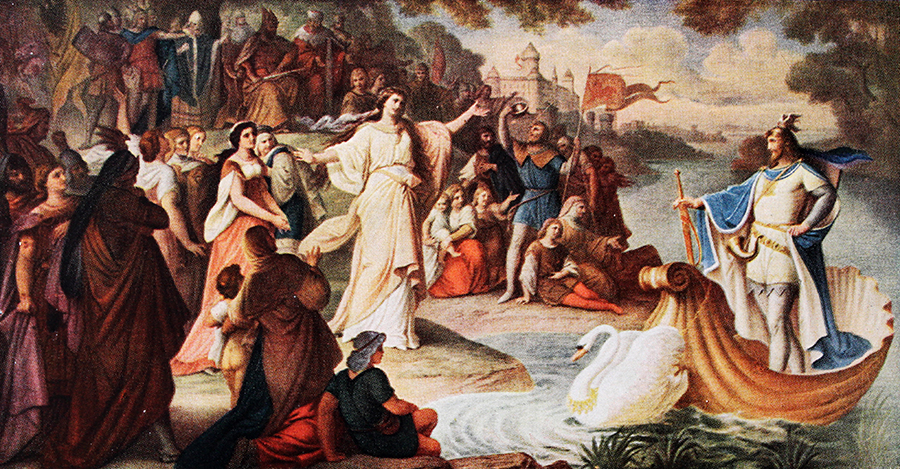
Lohengrin arrives in Antwerp, painting from the Lohengrin mural cycle, by August von Heckel , Neuschwanstein Castle
For me (definitely not a Wagnerian!), Richard Wagner’s Lohengrin ranks as high as his Tannhäuser : I can never get too much of it. No wonder my Lohengrin shelf is well-stocked. A selection of recommendations and turn-offs.
CD’S
GEORG SOLTI
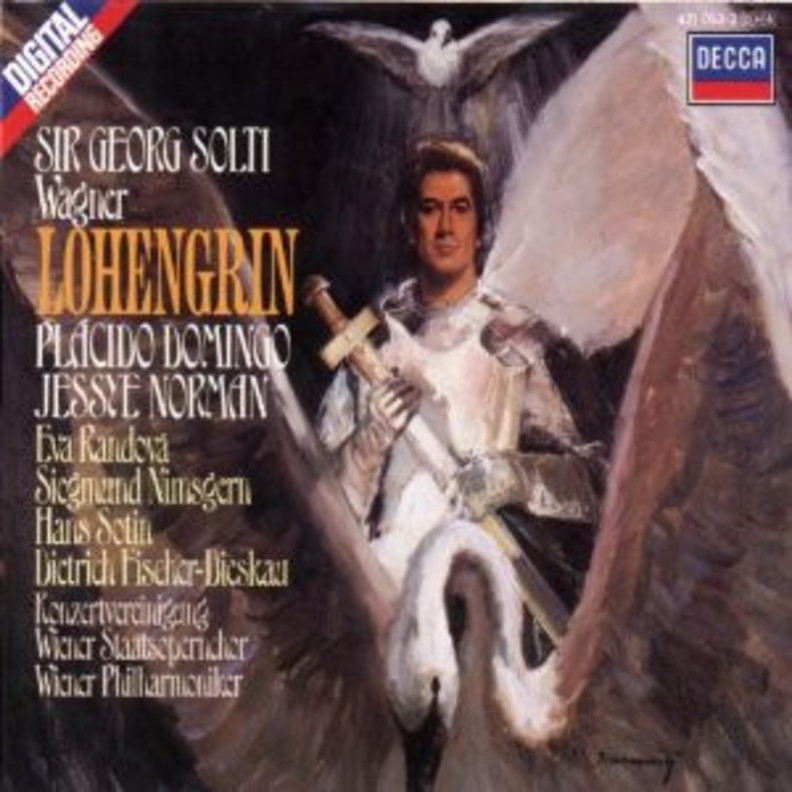
My favourite CD recording is the one conducted by Georg Solti (Decca 4210532), mainly because of the conductor. It starts already with the overture: very mysterious yet with both feet on the ground. Very sensitive, but also emphatically real without any sectarianism; no Hare Krishna here, but no Halleluja either.
Despite all the swans, Lohengrins do not usually fall out of the sky. Before officially recording the role Domingo had been preparing for it for almost twenty years. His Lohengrin is loving and warmblooded.
Jessye Norman was the perfect Elsa in those days; young and innocent with a voice that completely blows you away. Fischer-Dieskau’s Heerrufer is a matter of taste, but Siegmund Nimsgern and Eva Randová are a perfectly vicious pair!

Domingo’s baptism of fire in the role of Lohengrin was in Hamburg in 1968. He was then 27 (!) years old. It was not only his first Wagner, it was also the very first time he sang an opera in German, a language he did not yet master.
Fragments of the performance have been preserved (e.g. Melodram MEL 26510). His voice sounds like a bell, with a lot of bronze and a golden shine. The high notes are high and sung in full. Where can you still experience a Lohengrin like this? So beautiful that it makes you want to cry.
His Elsa was Arlene Saunders, at that time a much-loved prima donna in Hamburg, today she is totally forgotten. How unjust! Saunders was not only an amazingly good singer, she was also a beautiful woman and an exemplary actress.
MAREK JANOWSKI
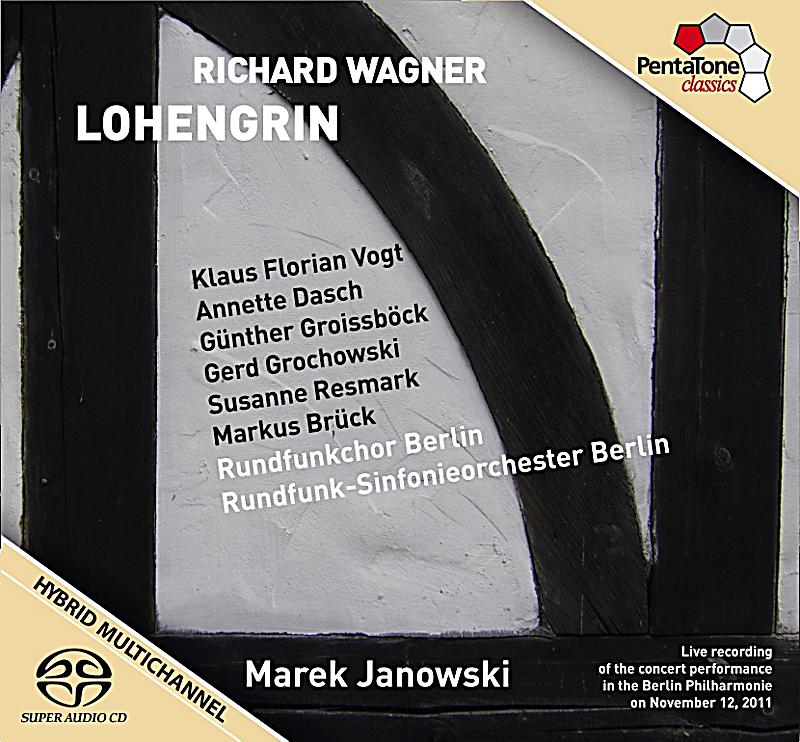
Marek Janowski is considered one of the best Wagner conductors of our time, but his Lohengrin, recorded live in Berlin in November 2011 (PentaToneClassics PTC 5186403) is a little disapppointing to me.
Janowski conducts very carefully, too carefully for me, making the overture most like an overly- stretched mush. Fortunately, he soon recovers and in the second act he makes the menace palpable. In the Wedding March, he makes the notes flow nicely into each other and he succeeds very well with his choice of tempi, all the while neatly restraining the orchestra. Yet I cannot escape the impression that he loses himself into the details.
I am not a fan of Annette Dasch, I find her voice a bit ‘ordinary’, but perhaps it does suit the character of Elsa? Susanne Resmark is a decent Ortrud, with a big voice and a nice dark timbre. But her ample vibrato is sometimes annoying.
The rest of the singers are certainly superb, but there is one problem: they do not blend. Klaus Florian Vogt’s sound is very ‘white’, his timbre quite sweet and his approach very lyrical. Beautiful, yes, but frankly I’ve had it by now with the same thing over and over again: he doesn’t develop. Moreover, he cannot compete with the deep low sound of Günther Groisböck (Heinrich) and the truly phenomenal volume of Gerd Grochowski (Telramund). In the ensembles, he simply shrinks away to nothing.
Below Günther Groisböck sings the ‘Gebet des König Heinrich’
BERTRAND DE BILLY

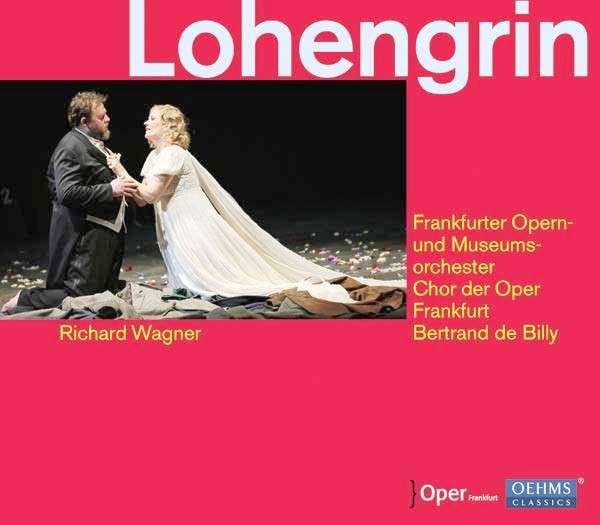
One of the newer Lohengrins, at least on CD, was conducted by Bertrand de Billy and recorded live at the Frankfurter Opern in March 2013 (OEHMS classics OC946).
Judging by pictures in the textbook, we are to be happy that the production was not released on DVD but on CD!
Camilla Nylund is a wonderful Elsa, for me perhaps the best Elsa of recent years. Michaela Schuster, meanwhile, has made Ortrud into one of her showpieces, although there is something in her interpretation that displeases me a little. For Falk Struckman (King Heinrich) I am willing to commit murder, so I will forgive him for his voice becoming a bit unstable.
The German-Canadian tenor Michael König (Lohengrin) is new to me. His voice and interpretation really make me quiet, so beautiful and so moving! Just because of him and Nylund, I am going to cherish this recording!
ERICH LEINSDORF
Back in time for a moment.
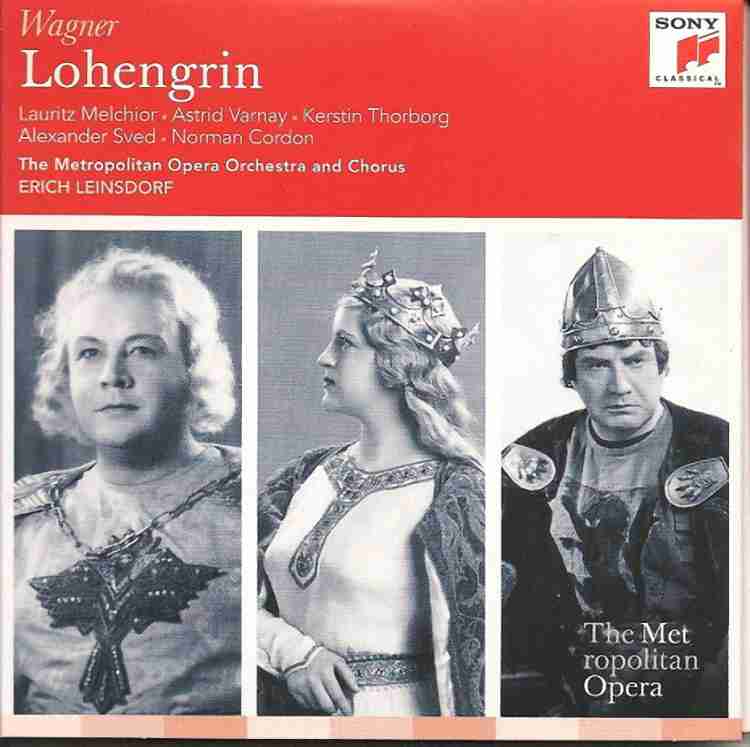
In 1943, Erich Leinsdorf conducted a wonderful Lohengrin at the Metropolitan Opera in New York (Sony 88765 42717 2). The overture is to die for, just like a fairytale. I can’t get enough of it.
Lauritz Melchior is of course the Lohengrin of the era and Astrid Varnay sounds surprisingly lyrical. It’s a pity that she pronounces the consonants so very emphatically, something I don’t like. Alexander Sved is a very authoritative Telramund and Kerstin Thorborg a good Ortrud.
FRITZ STIEDRY

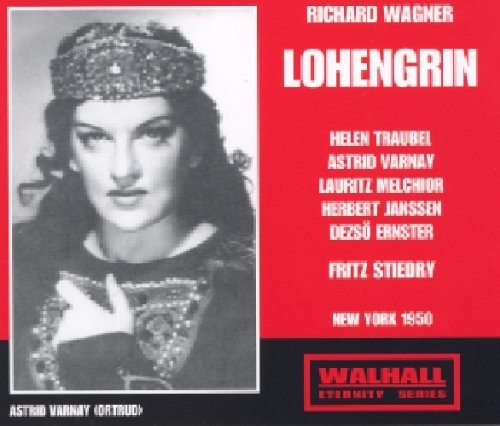
Opposite Leinsdorf’s recording is a 1950 recording under Fritz Stiedry (Walhall WLCD 0146). His approach is very down-to-earth, straightforward, which is also amplified by the poor sound quality. But it is undeniably beautiful and very surprising.
The singers also: Helen Traubel is a delightful Elsa and Astrid Varnay has been promoted from Elsa to a very impressive Ortrud after those seven years. And then Herbert Janssen’s Telramund: what a voice and what an impressive interpretation.
DVDS
AUGUST EVERDING

Even on DVD there is no shortage of good, not so good or even ridiculous performances (long live the director!). I start with an undoubtedly fine performance from the Metropolitan Opera, recorded in 1986 (DG 0734176) .
August Everding’s production is very traditional, with ditto costumes and sets. It is very beautiful, but for me there is something missing, as if the soul has been taken out of the performance.
But then there is Leonie Rysanek (Ortrud) and you have to keep looking at her with fascination. Just watch her glance at Elsa’s accusation. Delightful!
James Levine conducts with verve and gives all the shine to the score, truly magnificent. Watching his face while he conducts is also fascinating; it shows complete commitment to the music.
Below, Leonie Rysanek as Ortrud:
GÖTZ FRIEDERICH
It was August Everding who first recognised Götz Friedrich’s enormous qualities. It was also he who ensured that Friedrich was appointed chief producer in Hamburg after his escape from the GDR.
Contrary to what is written about him, Friedrich never saw himself as a representative of ‘Regietheater’. On the contrary, his productions are very faithful to the libretto and the music. Do not expect strange concepts from him.
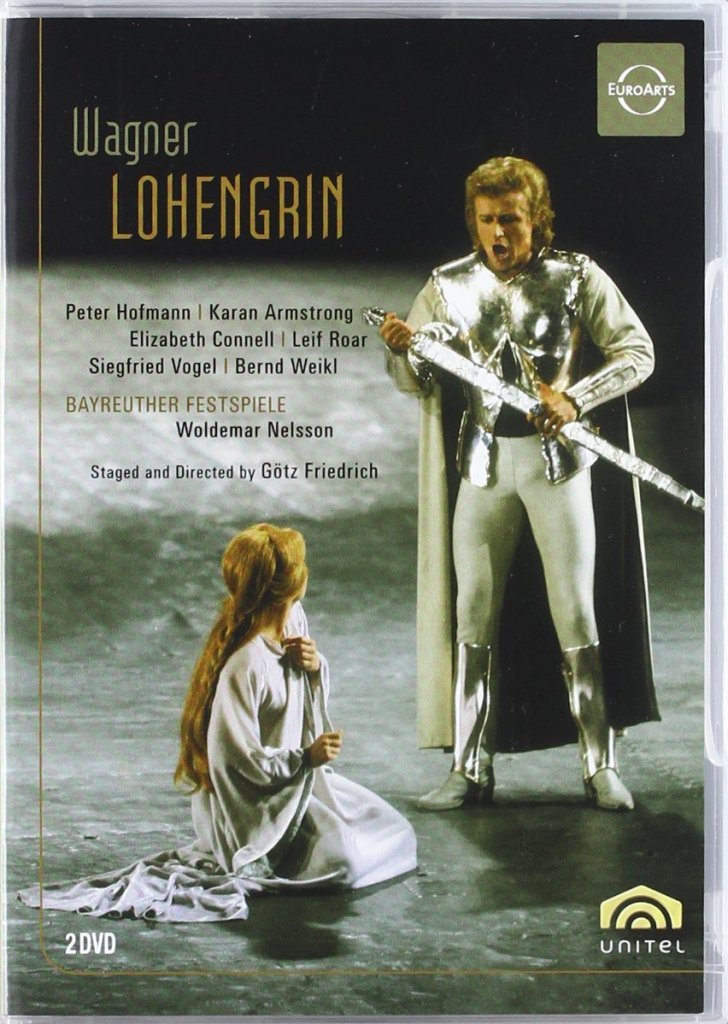
The Lohengrin he made in Bayreuth in 1982 (Euroarts 2072028) is, for me, among the opera’s finest productions. It moves between harsh reality and the utopian dream world of an adolescent girl.
Karan Armstrong is a beautiful woman and a great actress, but her tremolo is very annoying at times. Peter Hofmann is in every way a dream Lohengrin: with his handsome looks, clad in white and silver, he seems to have literally stepped out of a girl’s reveries. Elisabeth Connell is an impressive Ortrud and Bernd Weikl a terrific Heerrufer.
Below is a short excerpt from the production:
NIKOLAUS LEHNHOFF
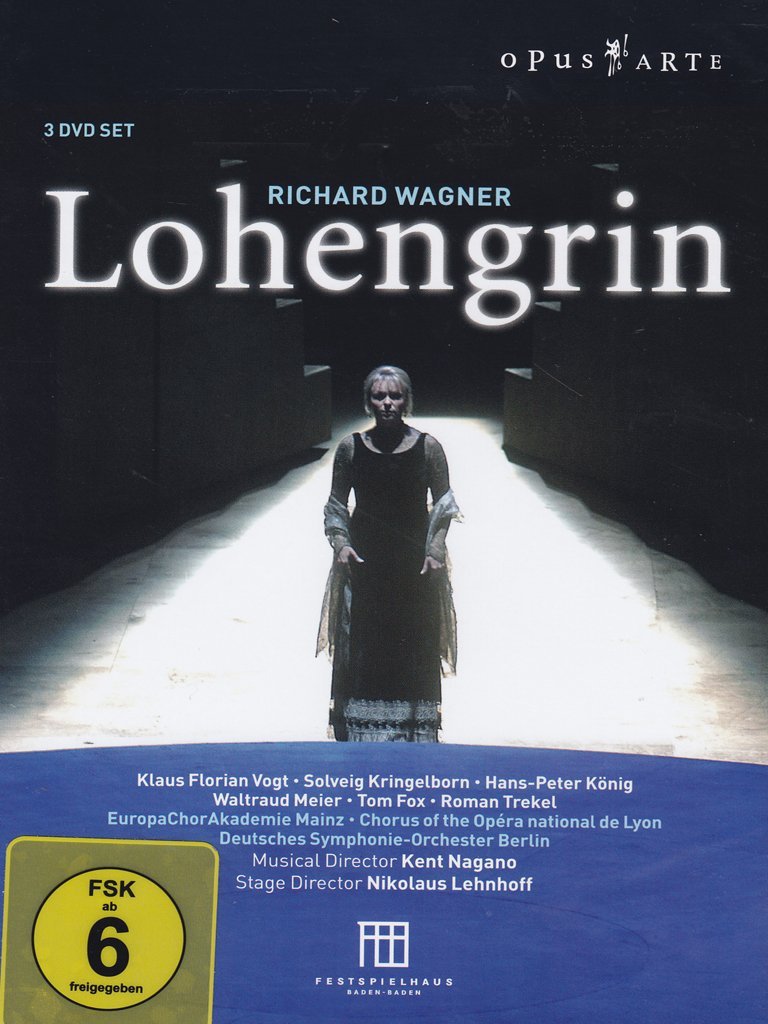
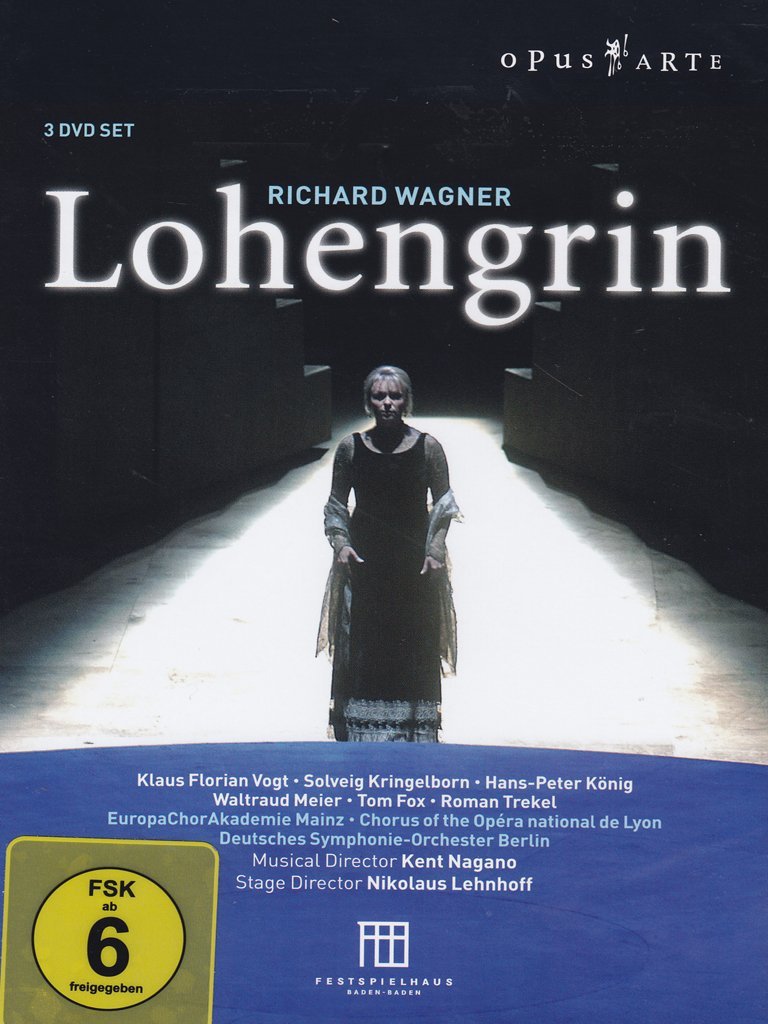
That Nikolaus Lehnhoff was very familiar with Friedrich’s production is obvious. Like Friedrich, he omits the swan. Lohengrin (Klaus Florian Vogt in one of his best roles) is preceded by a ray of light, giving him the allure of a 1950s pop star. Talk about girlish dreams!
Light and soft, like the first rays of the rising sun, this is how the first bars of the overture sound. In the middle of the stage, shrouded in shades of dark blue and black, Elsa ( a very poignant Solveig Kringelborn) comes up, her hands on a chair. This chair will remain the centre of her universe, and her only foothold, from now until the end of the opera. The feeling of loneliness takes hold of you, and you realise that things will never work out, all the knights and swans notwithstanding.
The most striking thing about this brilliant Baden-Baden production is its matchless lyricism. The singers seem to have walked straight out of Bellini operas and even Ortrud, in the interpretation of the phenomenal Waltraud Meier, is like a Lady Macbeth with human traits. After Götz Friedrich, this is for me the best Lohengrin on DVD (Opus Arte OA 0964D)
Below is a scene between Elsa and Ortrud:
RICHARD JONES

Does the libretto speak of a regime? Dictatorship? Persecution and/or lack of democracy? Yes? Hup, then we simply move the action to the 1930s. So banal, and so clearly a lack of inspiration! I blame Richard Jones especially for the latter. His Lohengrin, in its banality, is not only weird, but also predictable and uninspired. At least for me.
Right at the start the beautiful overture, sublimely and sensitively played by the Bayerischer Staatsorchester under Kent Nagano, is totally destroyed by the picture. We see a girl with dark braids, dressed in green dungarees, sitting at a drawing table, drawing a house.
Lohengrin (Jonas Kaufmann) is a hippy dressed in jeans. He emerges, with under his arm, a big, white plastic swan, which is also mechanically controlled: it pecks around and into its feathers. I find it tacky.
The Munich production, July 2009 (Decca 0743387), marked Kaufmann’s debut in the role of Lohengrin. Did he succeed? Yes and no. His voice is naturally powerful and lyrical at the same time and with a big volume. He does not have to force anything and his highs and lows are beautifully balanced. Yet I miss something in his performance, that little ‘etwas’… Maybe it’s because it’s his debut, but on me he makes a not too happy impression.
Anja Harteros is a heartbreaking Elsa. She plays the role very impressively and manages to combine girlishness with a budding femininity.
Michaela Schuster did not know how to be portray Ortrud at the time, but Wolfgang Koch (Telramund) makes up for a lot. Such a beautiful voice! Deep, grand, supple, lithe, majestic and authoritative. He also manages to impress particularly as an actor. Evgeny Nikitin is a convincing Heerrufer.
Below is the trailer of the production:
HANS NEUNFELS
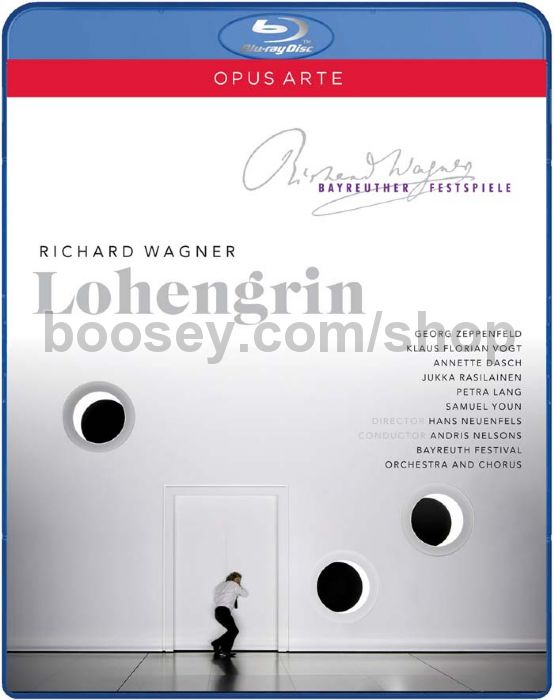
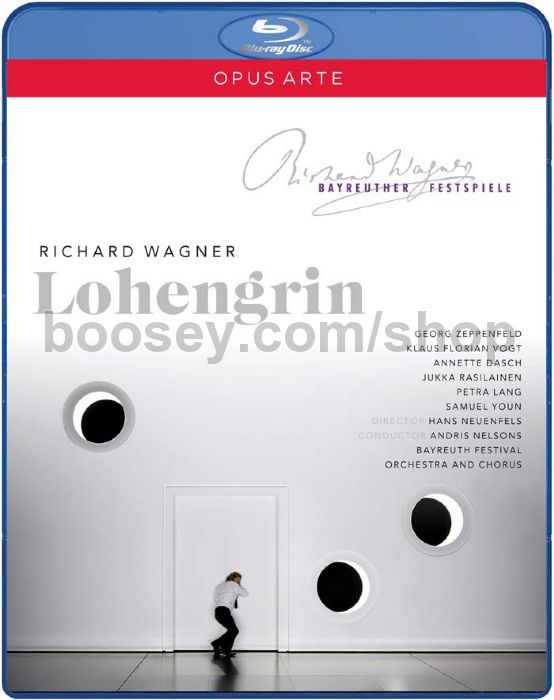
Recorded in Bayreuth in 2011, Hans Neuenfels’ production (Opus Arte OA 1071 D) is a bit obscure. Because, what are rats doing in Lohengrin? Now… here’s the thing: the Brabanders have been turned into rats by failed experiments and Lohengrin comes to help them, like someone from the animal liberation front. Something like that. Sort of.
No, I didn’t think it up and I wouldn’t have been able to understand it if I hadn’t read the reviews. But apparently the enthusiastic (yes, the production was enthusiastically received!) fellow reviewers are either clairvoyant, or they had a special sit-down with the director.
Even the overture is teeming with (animated) rats in pink, white and grey. And that’s just the beginning. And to also give away the ending: Elsa’s little brother is a just-born fat baby with the umbilical cord still on….
Annette Dasch looks beautiful and innocent and acts well and Klaus Florian Vogt sings beautifully and lyrically. Once and never again.
Below is an excerpt:







 Basia con fuoco