
©Ian Ehm /News
Otto Schenk, one of the greatest opera directors died 9 January 2025 at the age of 94. This is brief summary of few of his many productions, arranged alphabetically
ANDREA CHÉNIER

For me, Andrea Chénier is one of the best and most beautiful operas ever. I think the music is nothing less than divine and the story is timeless. It remains current, perhaps now more than ever. The tyrant must be cast off his throne and the people must take control. Surely, we all agree on that?
If only it were that simple! If only it were that simple! Anyone who grew up in a post-revolutionary totalitarian regime knows how much horror it brings. One terror is replaced by another. This, at least for me, is the main theme in Giordano’s biggest hit. I don’t think the real lead role is the actual poet, André Chénier It is the French Revolution, which, as Gérard (once Maddalena’s houseboy and now one of the revolutionary leaders) bitterly observes, devours its own children.
I myself think the role of the poet/revolutionary fits Placido Domingo like a glove. Passion for love and enormous involvement in everything that happens in the world were – and still are – his trademarks.
In 1981 the opera in Vienna was recorded for TV. That recording has since been released on DVD. Gabriela Beňačková, one of the most underrated singers in history, sings a Maddalena of flesh and blood. Horrifyingly beautiful and moving.
Piero Cappuccilli is a Gérard among thousands and the small roles are also filled by great singers: Madelon is sung by none other than Fedora Barbieri. Otto’s Schenk’s production is a feast for the eyes (DG 073 4070 7).
ARABELLA
Film 1977:
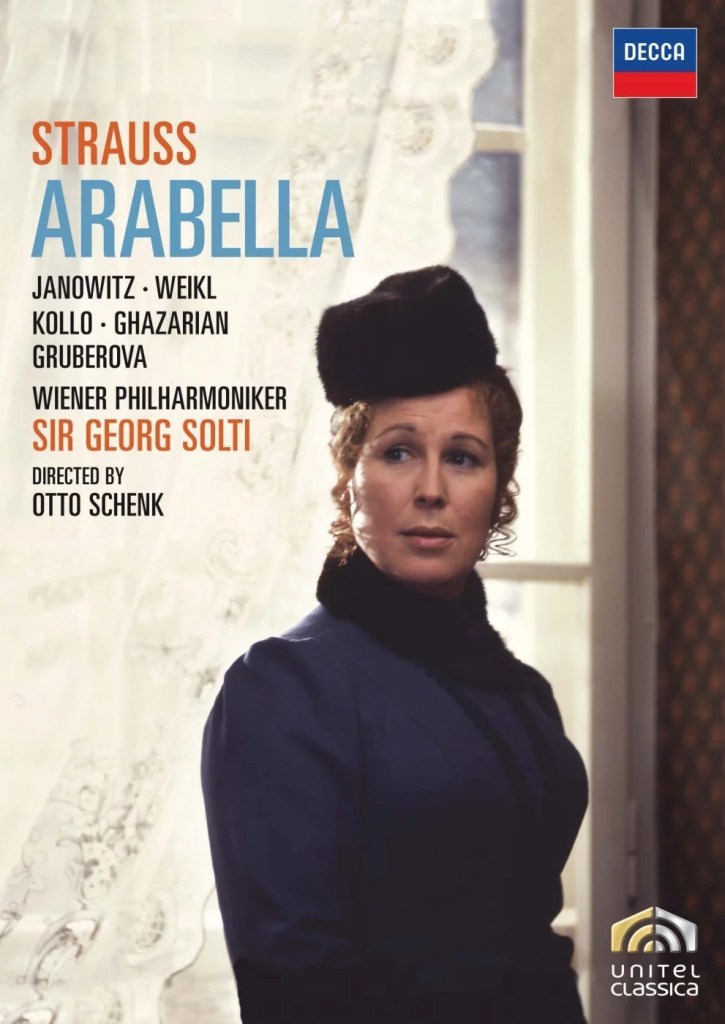
If you have never seen the opera, you would do well to start with Otto Schenk’s 1977 film (DG0743255). Larger than life, with lifelike sets. Of course, no ordinary live performance can compete with that.
Gundula Janowitz is a delightful Arabella. Perhaps not the best actress in the world, but her high notes are so very beautiful. Sona Ghazarian is a good Zdenka, but what really makes the recording, alongside the very erotic playing of the Wiener Philharmoniker (Solti!), more than worthwhile, is Bernd Weikl’s Mandryka. Any woman would certainly want to be kissed awake by him.
The minor roles are also fantastically cast: René Kollo is a Matteo out of thousands and I know of no better Fiakermilli than the young Gruberova. Add to this the very young (30!) Kurt Rydl as Lamoral and Margarita Lilova (Adelaide). It is definitely very good.
Below Gundula Janowitz and Bernd Weikl in the last act:
Metropolitan 1995:
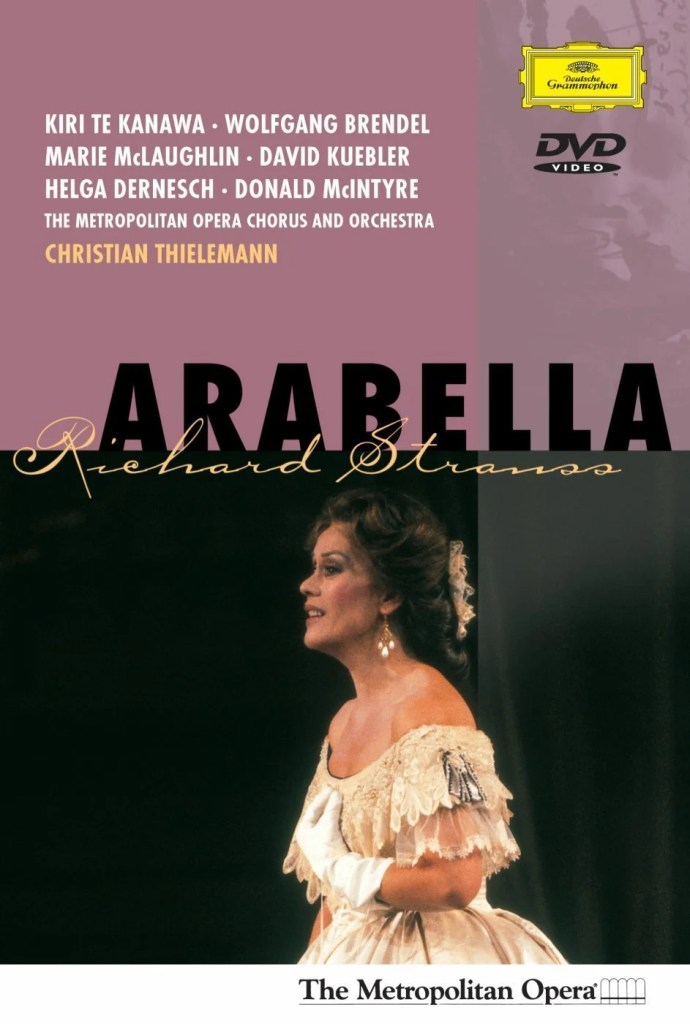
Kiri te Kanawa is an exemplary Arabella; there are few singers who can match her in this role. Strauss has always been a bit like her personal composer and optically, of course, she is a dream Arabella.
Her sister Zdenka (Marie McLaughlin) is also wonderful, something that cannot be said of Wolfgang Brendel (Mandryka). He doesn’t succeed in making my female heart beat any faster. Thielemann conducts well, but he lacks the sensuality of Solti. (DG 0730059).
Below is a scene with Kiri te Kanawa and Marie McLaughlin:
BALLO IN MASCHERA

The Royal Opera House production released by Opus Arte (OA 1236D) dates from early 1975. The sound is a little dull, but you will forget that as soon as you hear the beautiful voices of the singers.
Katia Ricciarelli is one of the most moving Amelias I know. The sound that she produces is perhaps not really ‘Verdian’, and perhaps her voice is a little too light, (she has sadly destroyed her voice by singing this type of role), but the pianissimi that she spins deserve a prize for sheer beauty, and her fragility is palpable.
The kindly anxious, loving, but also playful tenor of the young Placido Domingo fits the role of Gustavo like a glove. Piero Cappuccilli is an excellent Renato and Reri Grist an Oscar such as you do not often hear them anymore. Her performance alone is worth buying the DVD.
Claudio Abbado (how young he was then!) conducts lightly and keeps the tempi sparkling, resulting in an effervescent orchestral sound.
The direction by Otto Schenk is effective. Conventional and yet surprising. And like no other, he exposes the comic aspects of the opera.
Trailer of the production:
DIE FLEDERMAUS

For me, the performance recorded at the Wiener Staatsoper on New Year’s Eve 1980 is by far one of the best, if not THE best. The production was then one year old and it was directed by Otto Schenk, a famous Viennese actor, who himself had played the role of Frosch 29 times. In a rich and detailed setting, an intrigue full of lies unfolds, which is at once exciting, comic and sad.
The cast simply could not be better: Bernd Weikl portrays the dissolute and primal Eisenstein with the necessary wink and humour, Lucia Popp is delightful as the bored housewife Rosalinde, and Brigitte Fassbaender irresistible as Orlovsky. But the very best is the young Edita Gruberova (Adele): she coquettes, makes us laugh at her mock accent, and moves us with her naivety. And all this with perfectly sung colouratura, brava!
Theodor Guschlbauer shows already in the overture that it is going to be an evening of masterfully performed beautiful melodies. Delightful.
DIE MEISTERSINGER VON NÜRNBERG
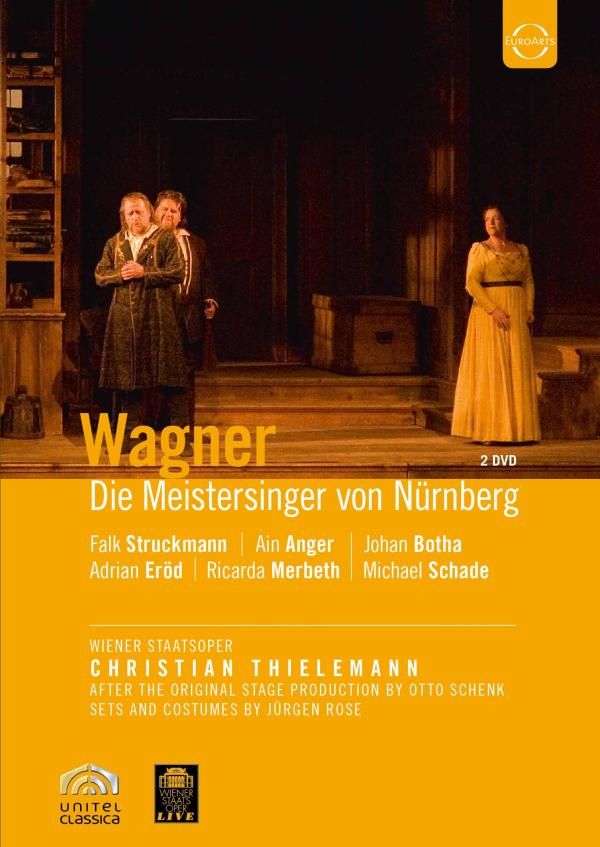
If you want a really beautiful Die Meistersinger on DVD, I can recommend Otto Schenk’s production. The wonderful performance was remade and recorded in Vienna in 2008. (Euroarts 0880242724885). HUGE! You really hardly ever get an experience like this; everything is in its context: the sets, the costumes, the story….
You may not believe it, but even Johan Botha (Walther) does some acting in this production! For that alone, the DVD is a must-see…But there is more. How about Falk Struckmann as Sachs (OK, the man can do no wrong with me)? And the deliciously vile Adrian Eröd (Beckmesser)? And if you know that the conductor’s name is Christian Thielemann … well!
Trailer:
LULU
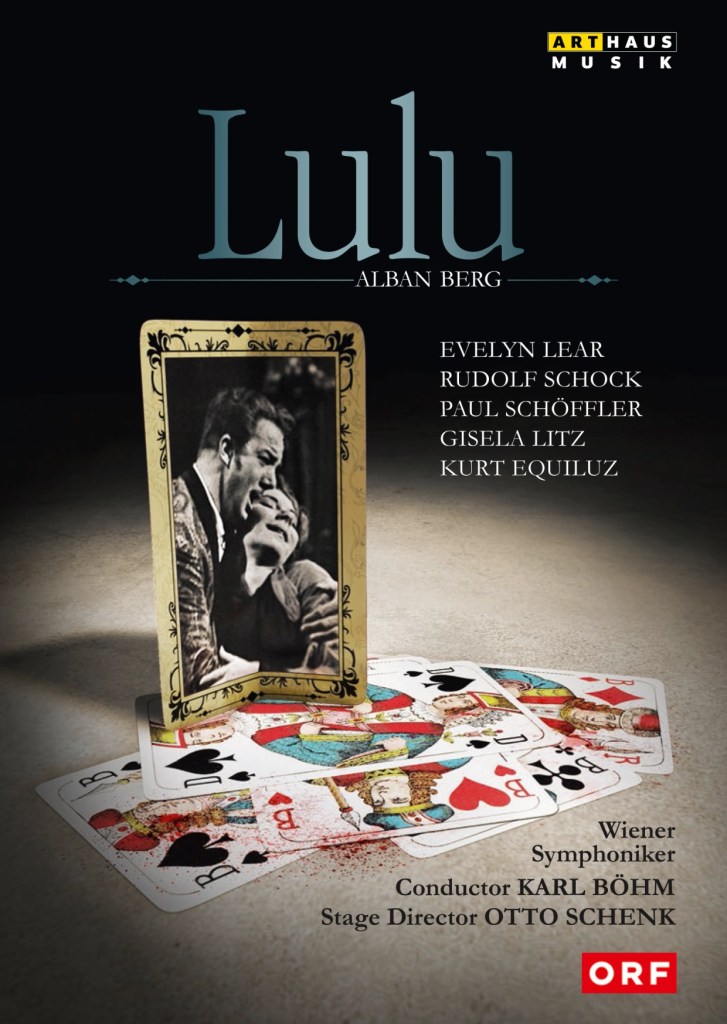
With her movie-star looks and angelic voice, Evelyn Lear has been referred to in the press as ‘Elisabeth Taylor meets Elisabeth Schwarzkof’. Personally, I find the American soprano, very popular in the 1960s to 1980s, much more interesting than her German colleague. Lear was one of the greatest and best advocates of modern music.
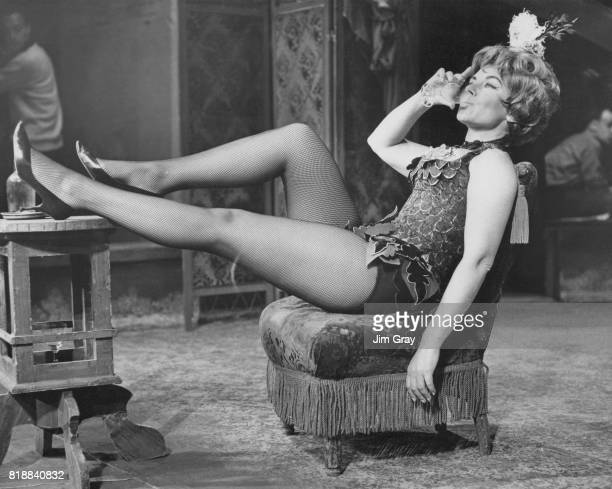
On 9 June 1962, she sang the role of Lulu in the first Austrian production of the work, at the newly reopened Theater an der Wien. I can imagine that the posh premiere audience may have been a bit surprised to see a prima donna dressed only in a tight-fitting corset and fishnet stockings, but if so, nobody showed it. It was directed by the then very young Otto Schenk, who followed the libretto closely.

That Paul Schöffler (Dr Schön ) reminded me of Professor Unrath from Der blaue Engel is, of course, no coincidence. Nor is his resemblance to Freud.
The last scene, beginning with Geschwitz’s plea followed by images of Jack the Ripper, could just as well have been taken from one of the best Hitchcock films. Especially since Gisela Lintz, who sings the role of the Countess, looks a lot like one of the director’s beloved actresses.
Watching Karl Böhm conducting is also extremely exciting. I have never seen him gesticulating so violently. An absolute must (Arthaus Musik 101 687).
TANNHAUSER
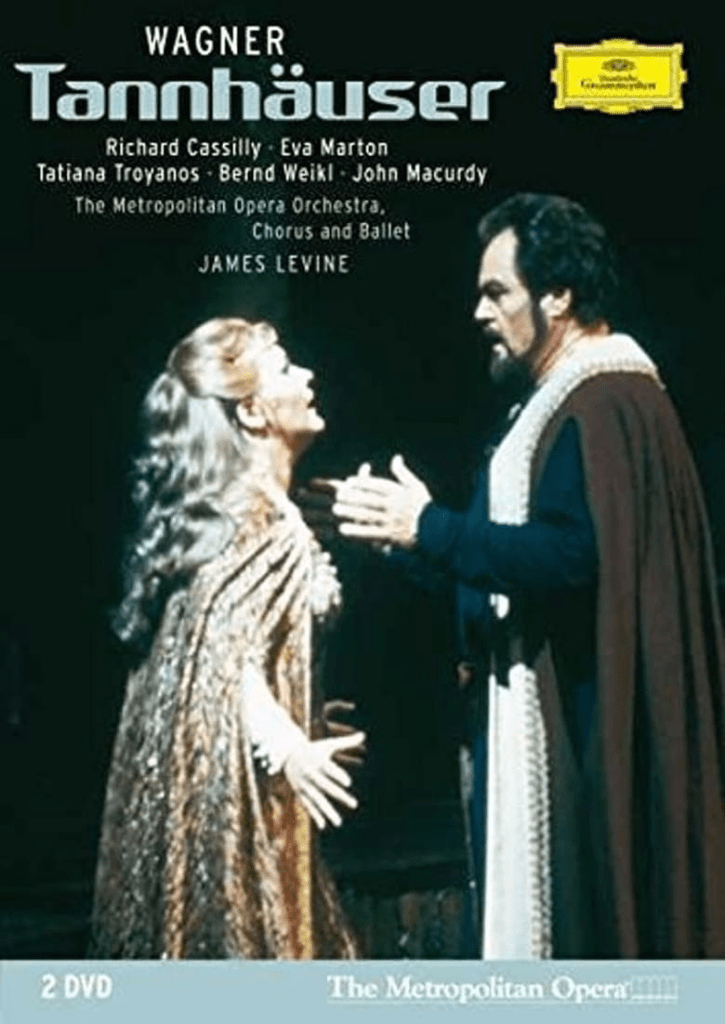
Otto Schenk’s insanely beautiful 1982 production, recorded at the Metropolitan Opera in New York (DG 0734171) dates from 1977. If you like very realistic, lavish sets and ditto costumes (I do) you can have a lot of fun with this. Just about the entire Venus grotto from Schloss Neuschwanstein was recreated for the opening scene, and the ballet presents us with a truly orgasmic Bacchanal. The orchestra, conducted by James Levine, plays mostly lyrical and light, there is nothing to criticise at all.
Eva Marton is a fine Elisabeth, Tatiana Troyanos a wonderfully sensual and seductive Venus.
Bernd Weikl, one of my favourite baritones sings an irresistible Wolfram, although he messes up his great aria by trying to give his (in principle) lyrical voice too much volume, making his voice unsteady.
And although the Landgrave (John Macurdy) is really terrible, I would not have had a problem with that recording, provided … yes … provided the tenor had not been so awful. The textbook mentions “the very highest standard”, well, I’m not so sure about that. Richard Cassilly is a physically very unattractive Tannhäuser with a pinched voice and a total lack of lyricism, giving the impression of having wandered
into the wrong opera.
Goodbye Otti! We will never forget you!
 Basia con fuoco
Allemaal opnamen uit een tijd dat Otto Schenk met fantastische zangers een mooie productie mocht maken. Hij was van voor de tijd van graatmagere zangeresjes in een onderjurkje die met beperkte zangkwaliteit het regietheater aan een ondeskundige publiek opdringen
LikeGeliked door 1 persoon