
It has been said that ‘The Woman Without a Shadow’ is a kind of remake of The Magic Flute. There is something in that, because in this, very moralistic, fairy tale, too, the main characters are subjected to the most terrible ordeals, which, if endured well, will make them better persons. You can also detect a ˜Pelleas-like” symbolism, and Das Rheingold and Siegfried are nowhere far away either. But, simply put, this opera is mainly a kind of glorification of married life enriched with many children
˜FROSCH”, as the opera is called in the corridors, is considered Strauss’ most difficult opera to cast – one of the reasons why it is almost always cut. I think this is a pity, all the more so since the ˜melodrama” (the Empress’ outburst when she realises that the Emperor is already almost completely turned into stone), among other things, is also cut, and I think that (along with the beginning of the third act) it is one of the opera’s most exciting and dramatic moments.
DVD’S
GEORG SOLTI, 1992

In 1992, Solti conducted a totally complete performance of the work in Salzburg. Götz Friedrich’s direction was considered particularly strong at the time, but I do not find it entirely satisfactory. The mise-en-scène is undoubtedly excellent, but he falls short in the direction of the characters, leaving the singers a bit awkwardly bouncing around on the stage..
The beautifully designed stage setting is lovely with very minimalist but realistic scenery, but the costumes are a bit bizarre at times. There is a lot of use of strobe lighting, which combined with violent musical passages can come across as rather too much.
Cheryl Studer is a dream of an Empress. Her voice, with its very recognisable timbre and beautiful pitch, is soaring, transparent almost, innocent and erotic at the same time. Thomas Moser is an attractive Emperor, perhaps a touch too light for this role, which occasionally causes him breathlessness and forced notes, but his singing is fine.
Robert Hale (Barak) was already far past his prime here, at less than 50 years old. A pity, because his portrayal is very charismatic. Eva Marton hurts the ears, but is so committed that you forgive her. Her aria of despair at the beginning of the third act is touching and gives you goosebumps.
The palm of honour, however, goes to Marjana Lipovšek, who portrays a truly phenomenal Amme. What this woman has at her disposal in terms of colour nuances and how she handles her (very warm) mezzo borders on the impossible. On top of that, she is also a gifted actress; I could not take my eyes off her. (Decca 0714259
WOLFGANG SAWALLISCH, 1992

Six months later, FROSCH was presented in Japan. It was the very first time the opera was performed there, so expectations were high. The production was in the hands of an all-Japanese team led by Ennosuke Ichikawa, a famous director and stage actor of the Kabuki theatre.
What he and his colleagues have achieved is simply mesmerising. FROSCH translates wonderfully to the rules of Kabuki, it gets even more convincing – it gains credibility and tension because of these rules. Lipovšek is even meaner here, even more evil than with Solti. Her movements are now smaller and more subdued which, curiously, makes them more expressive, and she can do even more with her voice.
Peter Seiffert is an excellent Emperor, his voice is rich, elegant, warm, sensitive and pliable, and all his high notes sound like a bell. Unfortunately, the Empress is not of the same level. Luana DeVol intones very broadly, her soprano sounds shrill and is totally bereft of lyricism (why didn’t they include Studer?), but she is a very convincing actress.
Alan Titus and Janis Martin may be a touch less intense than Hale and Marton with Solti, but their voices sound much more pleasant. They can also act, and how! Moreover, Martin looks very attractive, which is not unimportant for the role. I find the orchestra led by Sawallisch even more beautiful than Solti’s, more fairy-like, more transparent too, and more sultry… A truly phenomenal production. (Arthaus Musik 107245)
CD’S
KARL BÖHM 1955
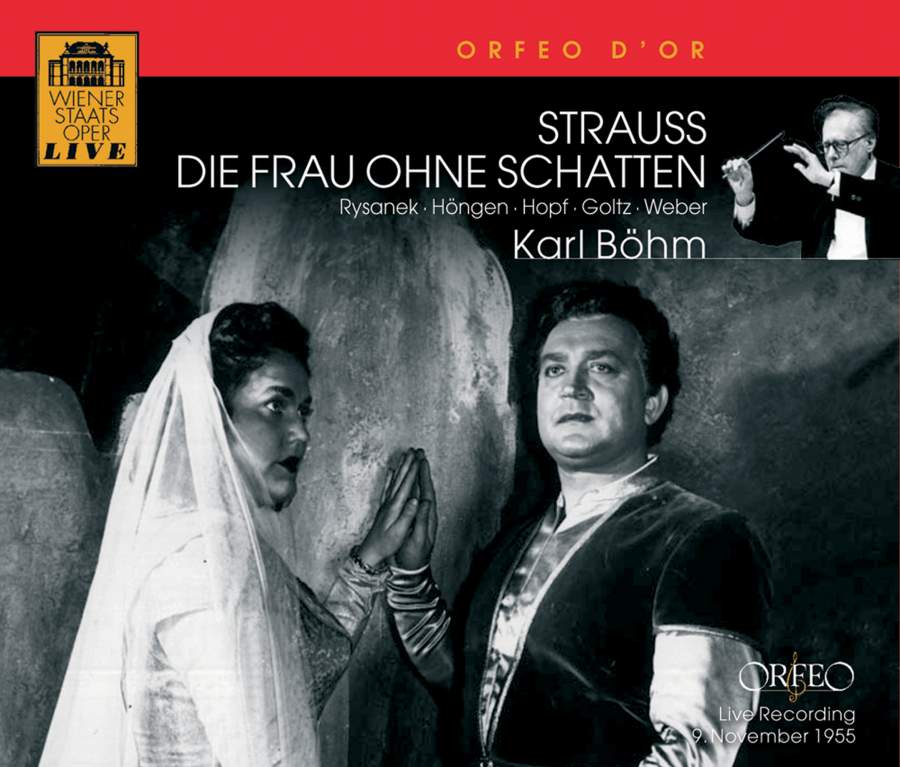
The very first recording of the opera dates from 1955. It was recorded live in Vienna, and has been amazingly polished by the Orfeo team.
Leonie Rysanek is the very best Empress I have ever heard. She dares to take risks, taking her beautiful, lyrical soprano to the limits of the impossible. With this role, she set a standard that is not easy to match.
Hans Hopf (Emperor) has a kind of ˜heroic” way of singing that I don’t really like, but I imagine he is considered as ideally cast by many fans. It is a matter of taste, I would say.
Elisabeth Höngen is a vile Amme, and Christel Glotz an impressive, if not always cleanly intoned Färberin Böhm conducts very lovingly (Orfeo D’Or 668053)
HERBERT VON KARAJAN, 1964

In 1964, on the occasion of Strauss’ 100th birthday, von Karajan conducted a very inspired FROSCH at the Wiener Staatsoper. Christa Ludwig’s scoring of the Färberin is not exactly idiomatic, but her high notes and her reading of the role are very impressive to say the least.
In terms of vocal beauty, Walter Berry (then also in real life her husband) is probably the finest Barak, unfortunately is Jess Thomas (Emperor) a bit disappointing. Leonie Rysanek repeats her magnificent reading of the Empress, even more intense, and even more fused with the role.
The luxurious scoring of the minor roles by Fritz Wunderlich (the Jüngeling ) and Lucia Popp (a.o. Falke), makes the recording even more appealing. Von Karajan conducts as we have come to expect from him – narcissistic but oh so impressive and with a great sense of nuance. (DG 4576782)
GEORG SOLTI 1987-1990

You cannot avoid Solti’s studio recording (it took him three years, between 1987-1990), if only because he recorded every note as it had been written by Strauss.
The scoring of the Emperor by Plácido Domingo was considered an attack on the work by many ˜purists” at the time. Unjustly so. His voice is in every way ideal for the role, and with his musicality, the colours in his voice and his more than ordinary vocal acting skills, he portrays a very humane and vulnerable Emperor.
Julia Varady is, as far as I am concerned, along with Studer, the best Empress after Rysanek, what a voice, and what a performance! Hildegard Behrens is a torn Färberin , her complete identification with the role is limitless. (Decca 4362432)
Frau ohne Schatten in Rotterdam: een werkelijk fabuleuze matinee
Die Frau ohne Schatten van Strauss: één van de meest gespeelde opera’s in Nederland?


 Basia con fuoco