Franz Schubert (1797-1828) staat vooral bekend om zijn liederen en symfonieën. Hij heeft echter ook de nodige werken voor het theater geschreven, veelal Singspiele en een klein aantal opera’s. Geen van allen brachten ze de componist het succes waar hij zo hoopte, vooral om een reputatie te vestigen als operacomponist.
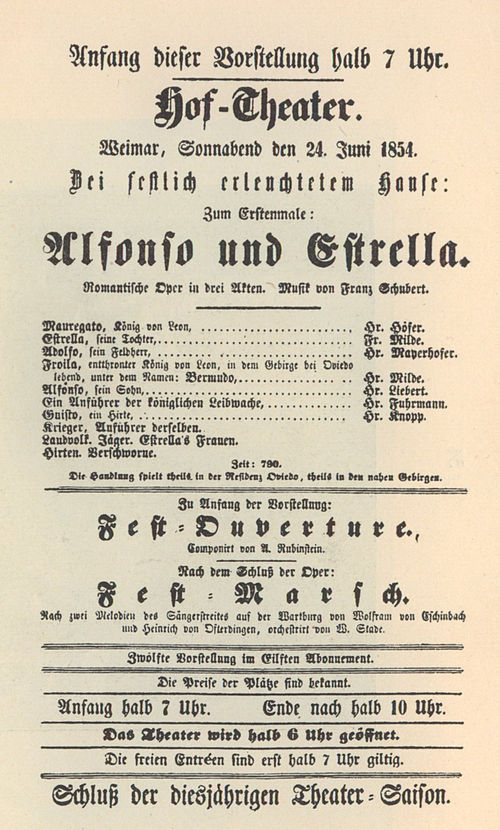
Playbill Weimar 1854, conductor Liszt
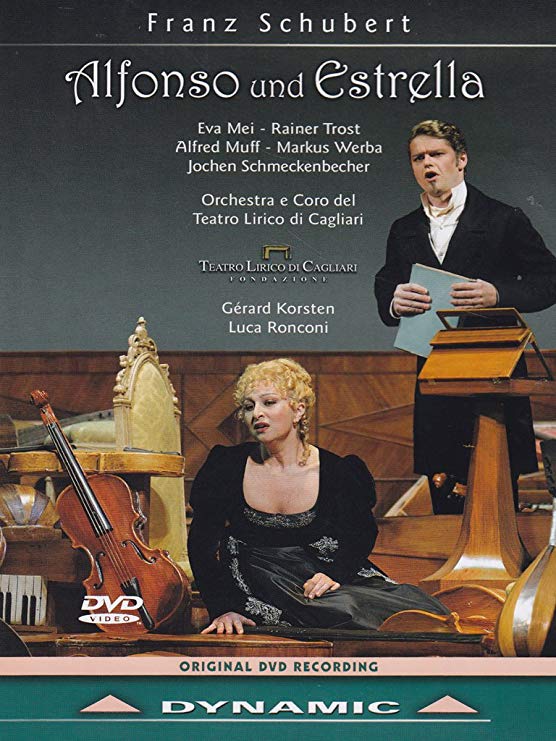
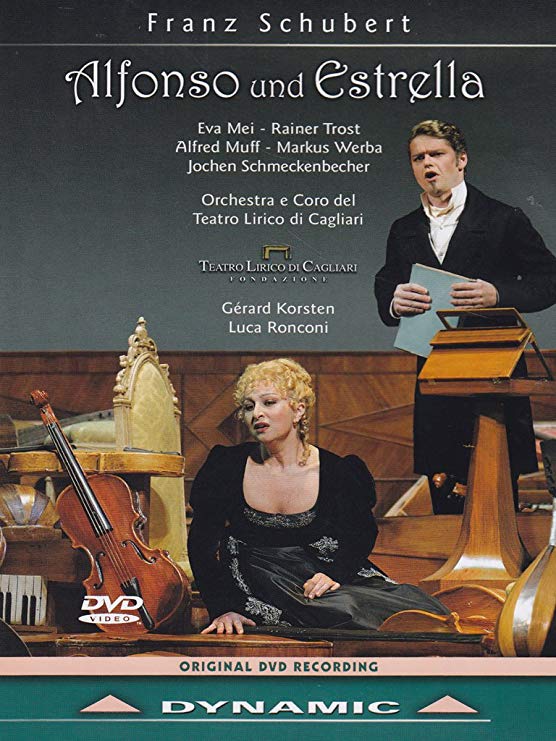
Het Teatro Lirico Cagliari kwam in 2004 met een uitvoering van zijn meest geslaagde werk: Alfonso und Estrella uit 1822. Een opname is door Dynamic op dvd uitgebracht. Het werk volgde zeer kort na Webers Der Freischütz maar werd genegeerd. De première vond pas in 1854 plaats in Weimar door toedoen van Liszt.
Het libretto van Franz von Schober gaat uit van een simpel verhaal. Koning Froila van Léon leeft al vele jaren in ballingschap in een vallei die door bergen van zijn vroegere rijk wordt afgeschermd. De usurpator Mauregato heeft het te druk met onder de duim krijgen van de Moren om zich te bekommeren om die zonderling daar achter de bergen.
Na weer een succesvolle campagne begaat Mauregato de klassieke vergissing zijn legeraanvoerder een wens te laten doen die op voorhand zal worden ingewilligd. Generaal Adolfo vraagt om de hand van zijn dochter Estrella die hem echter absoluut niet accepteert. Uit wraak komt Adolfo in opstand: als hij zelf koning is krijgt hij Estrella er gratis bij. Dat meisje is al eens verdwaald na een jachtpartij en toevallig is ze Alonso tegen het lijf gelopen, de zoon van Froila. Liefde op het eerste gezicht. Vanwege Estrella komt Alfonso de troepen van Mauregato te hulp als die dreigen te verliezen van Adolfo. Hij neemt deze veldheer persoonlijk gevangen als die Estrella bedreigt om zijn zin te krijgen. Mauregato denkt zich verslagen en geeft het op: hij laat zijn gestolen rijk weer aan Froila en zo krijgt het verhaaltje een happy end.
Bij het horen van de ouverture moest ik direct aan Schuberts symfonische muziek denken. Bepaalde wat opgewonden klimmende passages herinnerden me onwillekeurig aan Fidelio. De koormuziek is erg fraai maar doet weinig meer dan de handeling ophouden. Dat geldt ook voor veel van de aria’s. Ze klinken eerder als opgerekte liederen waar Schubert natuurlijk zijn faam aan te danken heeft dan als onderdelen van een theaterstuk.
Teatro Lirico Cagliari heeft wel een behoorlijke gok genomen met deze productie. Ik kan me niet voorstellen dat er in andere theaters veel publiek op af zou komen maar daar op Sardinië houdt men kennelijk wel van een rariteit zo nu en dan. En Dynamic is er altijd bij om dat vast te leggen.
Het speelvlak is heel opvallend. Het bestaat uit decorstukken die de vorm hebben van muziekinstrumenten, voornamelijk celli en bassen. Maar hier en daar zien we ook een trede of een plint in de vorm van een toetsenbord. Verder staan er muziekstandaards waarop een solist zogenaamd kijkt tijdens het zingen. Als de camera inzoomt blijkt er gewoon een prentenboek op te staan. Het toneel verandert niet per scène of akte, alles speelt zich daar af.
Variaties in de handeling worden uitgebeeld door op het achtertoneel marionetten op een lopende band langs te sturen. Ze zijn op normale grootte en gekleed als de personen die ze uitbeelden. Omdat ze worden bediend door in het donker gehulde toneelknechten kan men zich afvragen of het niet eenvoudiger was geweest daar normale levende figuranten voor in te zetten. Regisseur Luva Ronconi en Margherita Palli die verantwoordelijk was voor de algehele aankleding zullen daar wel hun redenen voor hebben gehad.
Wat de voorstelling muzikaal de moeite waard maakt is vooral de topcast die men bijeen heeft gebracht. Eva Mei excelleert als de koningsdochter Estrella, de enige grote rol voor een vrouw. Tenor Rainer Trost vertolkt de rol van de koningszoon Alfonso die nu eindelijk die benauwde vallei eens uit wil. Bariton Markus Werba als Froila heeft dat verboden om tenminste nog een plekje voor zichzelf te hebben. Leven en laten leven is zijn motto t.a.v. Mauregato.
Het duet van Alfonso en Froila zet de toon waar het Schuberts benadering van theatermuziek betreft. Het klinkt prachtig allemaal maar de handeling komt er geen millimeter mee vooruit. Mauregato komt voor rekening van bariton Jochen Schmechenbecher. Generaal Adolfo wordt ten tonele gevoerd door de bas Alfred Muff.
Koor en orkest van Teatro Lirico Cagliari staan onder leiding van Gérard Korsten.
P.s. (BJ) in 1978 is de opera onder Suitner opgenomen met een all star cast: Edith Mathis, Hermann Prey, Dietrich Fischer-Dieskau, Peter Schreie en Theo Adams:
P.s. 2: en vergeet Fierrabras niet, mijns inziens (BJ) een meesterwerk
In the late nineteenth century, Ermanno Wolf-Ferrari fell under the spell of church music composer Don Lorenzo Perosi, with whom he also became friends. It was also under Perosi’s influence that Wolf-Ferrari composed his cantata Talitha Kumi and the choral work La passione.
The latter, which was based on ancient Italian folk poetry, Wolf-Ferrari also dedicated to his friend. The beautiful youthful work ‘Otto cori’ also betrays the composer’s great love for Renaissance music.
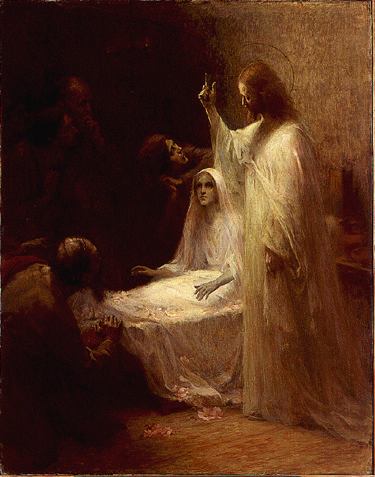
Talitha Kumi!” means “Get up!” in Aramaic. It is a quote from the Gospel of Mark which tells the story of Talitha, the daughter of Jairus. She is dying and in his despair – and hope for a miracle – Jair goes to seek help from Jesus. When Jesus reaches the house of Jairus, the girl is already dead, yet he manages to raise her from the dead.
Resurrection of the daughter of Jairus, by Victor-Oscar Guétin, 1902.
It is the evangelist who carries the story of the work: tenor Rainer Trost sings his text very impressively and manages to keep the listener glued to his every word. Jairus and Jesus have relatively little to do, but both roles are excellently performed here by baritone Joan Martín-Royo. The choir and orchestra have no more than a contemplative role. Call it a ‘colour-wash’ background.
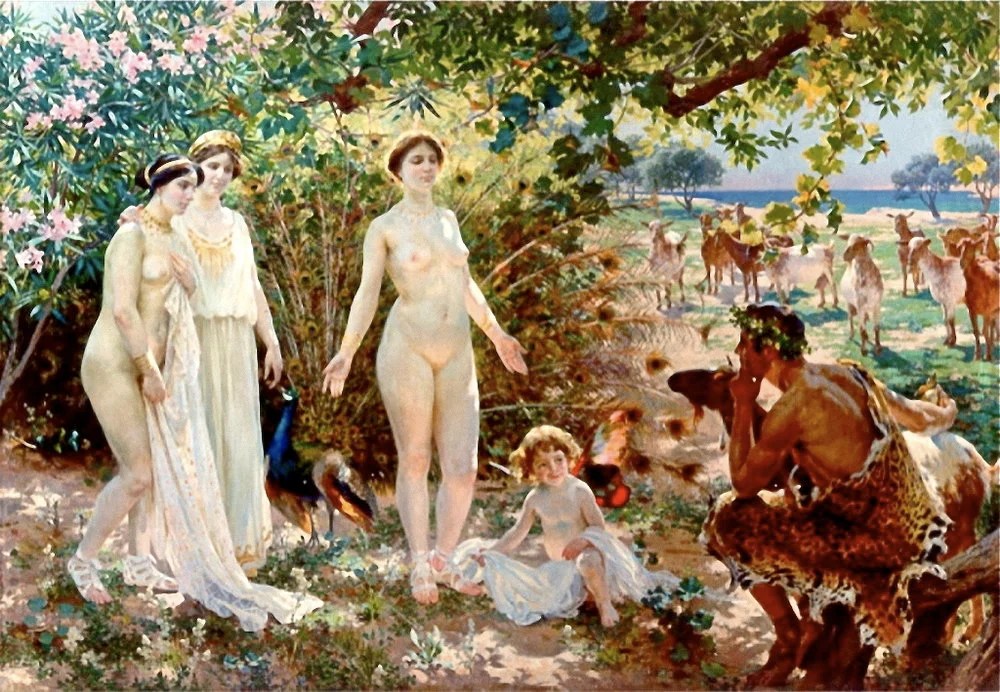
Gods! Did they ever mean well with us poor humans? We were provoked and incited by them only to be tormented and punished, with no defence at all. After all: did we really have free will? The divine decree was law and we could not escape the fate predestined for us. All this can be read in the thick book called ‘Mythology’, from which the greatest (stage) writers, poets, painters and composers have liberally drawn.
El Juicio de Paris by Enrique Simonet, c. 1904.
Take the Trojan War, for instance. It all started with an apple and a ‘Miss Goddess – contest’ and hundreds of thousands of human beings suffered as a result. The jury was bribed with the promise of love from the most beautiful woman in the world, but this promise failed to add that she was already married and her husband might claim her. If not voluntary then forced.
The war lasted no less than ten years and by the end, just about all the heroes were dead or cursed by the gods who, after all, had caused the whole situation. And don’t think, you can catch your breath now, because after the war we had to deal with the real post-Trojan War traumas (I’m not making it up!) and the gods were also still arguing amongst themselves.
Idomeneo, king of Crete, returns to his country, but things don’t go smoothly. He ends up in a huge sea storm and promises Neptune to sacrifice to him the first creature he encounters on his return. But this happens to be his own son, Idamante! Oops!
Loopholes are sought, but gods are obviously smarter. And then we have a triangle relationship: Elletra (yes, Agememnon’s daughter) has fled to Crete and fallen in love with Idamante. But so has Ilia, the captured daughter of King Priam of Troy. Anyway – if you do not know the full story, just read it. We will now deal with the various performances of the opera.
Personally, I have never found Idomeneo to be Mozart’s strongest opera and I was never really impressed. But now, after repeated listening and re-listening, I have had to revise my opinion. Because the music, it really is genius after all!
Anton Raaff, de eerste vertolker van de rol van Idomeneo
CDS
Sir Charles Mackerras
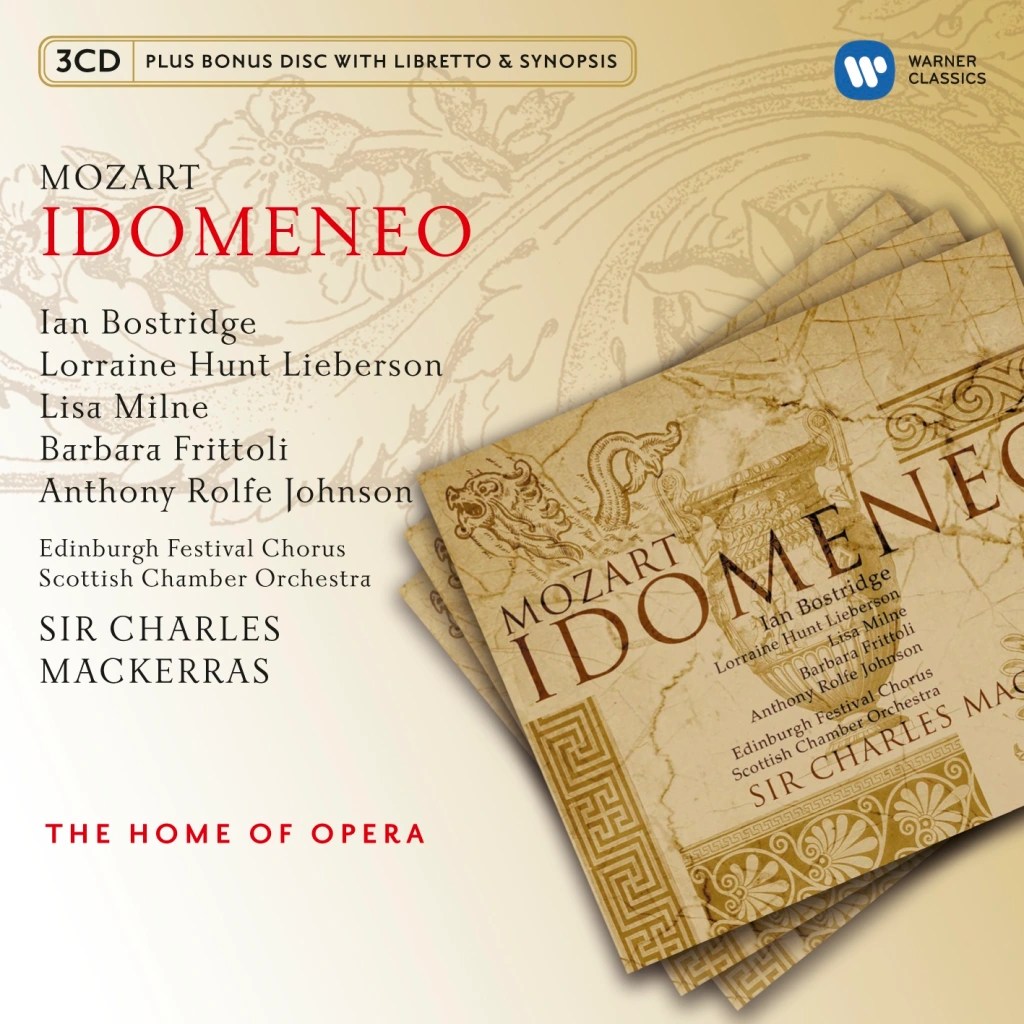
To get right to the point – I personally think the 2001 recording by Warner Classics (5099994823820) conducted by Sir Charles Mackerras is the very best. It does have one downside (about that later), but that could also be down to my personal taste.
To start with the smaller roles, Anthony Rolfe-Johnson (Arbace) has a voice of pure gold. It is a pleasure to listen to him and I can never get enough. One can only wonder: why Arbace and not Idomeneo himself? Yes, I know he recorded the role for Gardiner, but, so what?
Paul Charles Clarke is a fantastic Supreme Priest, chilling yet a real human at the same time. La Voce is very impressively sung by the then very young John Relya.
Barbara Frittoli is a wonderful Elettra. Hurt, and yearning for revenge, yet ultimately resigned to her fate. I would have liked to have heard a bit more drama, but her rendition fits in nicely with the conductor’s vision.
Lisa Milne’s rendition of Ilia is perhaps the finest I have ever heard. Lovely she is, but also loving and very determined. Her soprano is ‘liquid’ – think, warm honey, but with a peppery touch. To that, the warm, tormented mezzo of the lamented Lorraine Hunt Lieberson fits like a glove. Together, they sound as if they were indeed always a unit.
And now for my minus: Ian Bostridge’s Idomeneo. Not yet as vain, narcissistic and mannered, which so marred his recordings and performances in recent years, but he sounds so incredibly ordinary! Not a tormented king, but the next-door neighbour. He singing is clean, but his coloratures are sparse – and this for someone coming from the Baroque tradition!
The score is pretty much complete, not even the ballet at the end is missing. It is usually omitted, and as far as I am concerned absolutely rightly so. It is nothing but an anticlimax and, after listening to it once, I never listened to it again. There is a brief booklet with the track list, but the box also includes a bonus CD with synopsis and the complete libretto.
James Levine
In 1996, Deutsche Grammophon (4477372) recorded the opera conducted by maestro James Levine with just about the Metropolitan Opera’s biggest stars of the time. No idea if it is idiomatic, but I find it HUGE!
Levine’s muscular conducting brings out hidden treasures and in no other performance can you hear how progressive the music really is! The tempi are obviously brisk, but nowhere rushed and most of the voices are overwhelming.
The role of Arbace is curiously taken by a baritone. Well, Thomas Hampson’s timbre is indeed more like that of a tenor and he is more beautiful in the highs than in the lows, but Mozart explicitly asked for a (light!) tenor. But it is not disturbing, quite the contrary. Especially since Hampson manages to fill in the role of the king’s confidant so perfectly.
Frank Loppardo is no match for Clarke with Mackerras, but he holds his own in the small but very heavy part of the Chief Priest.
Bryn Terfel is a very strong La Voce, his sound will automatically make you shiver with fear.
Carol Vaness (Elettra) sounds surprisingly lyrical. Fortunately, she picks up nicely at ‘Oh smania! O furie!”, exactly as we have come to expect from her. Delicious! Yes, she is an Elettra after my own heart!
Heidi Grant Murphy (Ilia) is a bit out of place in the big voice fest. Her pouty timbre reminds me a lot of Kathleen Battle, not really my ‘cup of tea’.
Cecilia Bartoli is a very virtuoso Idamante, very convincing too, though she sounds a bit too feminine at times.
Finally, Plácido Domingo’s Idomeneo is exactly what we expect from him: with his beautiful, warm tenor, his regal recitation and his commitment, he makes Idomeneo a very emotional and mostly very humane king.
DVDS
Pier Luigi Pizzi
From Teatro San Carlo in Naples comes Pier Luigi Pizzi’s production, recorded in 2004 (Dynamic 33463). The direction is typical Pizzi – if you’ve seen one, you’ve seen them all. Very realistic, but with a twist and lots of male (semi-)nudity. Lots of ballet too and the colours are mainly black and white with a touch of red. Only Elettra brings in an extra colour. Her purple outfit must – I assume – represent her fury. The setting has a strong cardboard feel to it and there is a lot of lying on the floor, singing.
To be honest, by now I have had enough of it, of nudity and nappies, over the years I have seen more than enough of them. But one thing I have to give Pizzi credit for: his productions are always exciting and his character direction very competent. It also has a very Greek feel to it.
Jörg Schneider (Arbace) is on the very light side. His voice is definitely beautiful, but I miss the expression. The Chief Priest (Dario Magnabosco) doesn’t really come across, a pity, and about La Voce I’ll keep quiet: he is barely audible. Perhaps he should have been amplified?
Iano Tamar is an outstanding Elettra. She impresses not only with her appearance and acting, but also with her singing. That’s how I like to hear it.
I had more trouble with Angeles Blancas Gulin’s Ilia. Beautiful woman, good actress, but so incredibly Callas-focused. And I found her singing really annoying at times, since it is often not on pitch.
Sonia Ganassi is perhaps the best Idamante ever. Not only is her singing most beautiful, her coloratures are perfect and her timbre warm. For her alone, the DVD is more than worth it.
Kurt Streit was once among my favourite tenors. He is also very much in his prime here. Listen to his undoubtedly impressive ‘Fuor der mar’, even if it doesn’t sound entirely pure:
Dieter Dorn
Anyway, compared to Dieter Dorn’s production, shot in Munich in June 2008 (Medici Arts 2072448), Pizzi can pass for the best director in the world. Dorn starts with slaps, blood and violence. What is this all about? Surely the war ended long ago? But maybe we’re looking back? Or are these Idomeneo’s nightmares?
And where and when is it all taking place: it could be Crete, but we could also have ended up in Africa. Could also be Munich in June 2008. The characters look most like a mixture of hippies and Hells Angels in African costumes, but maybe those are really Martians? Oh well. Why not. Sigh.
The choreography is disturbing, in itself there is nothing against that. The storm is nicely depicted – unfortunately the images don’t make sense. And why are, during Elettra’s first aria, the extras covered in blood? Furthermore, there is a continuous running through the hall – those poor people sitting upstairs and/or to the side. Bet they couldn’t see anything at all.
Rainer Trost is a pretty much perfect Arbace in terms of voice, but if you want to enjoy his singing, you have to close your eyes and keep it that way. What on earth the director came up with for him… !
Juliane Banse is a beautiful Ilia. Her voice is small and limited, but very beautiful in timbre. Moreover, she is a more than convincing actress.
Annette Dasch (Elettra) is a young attractive singer, who shot up like a comet and has made a huge career within a short time. Don’t ask me why. I find her just plain ordinary. Oh yes, she is good, sure, but that good? In the recording, she sounds distant and not even completely pure.
For Idamante, they surprisingly chose a tenor. Nothing against it, especially if the tenor in question is called Pavol Breslik and possesses a wonderfully lyrical timbre. But you should prepare your ears for a different sound.
John Mark Ainsley is Idomeneo. I could not take my eyes off him. Such an actor! And what a voice! You will surely instantly forget the ridiculous direction. For his performance alone, I wouldn’t want to miss the DVD – you must see and hear it at least once.
Below trailer of the production:
As a bonus, I have for you Sena Jurinac as Ilia in ‘Zeffiretti lusinghieri’. This is the very essence of beauty.
Opera concertante … Daar is veel voor te zeggen. Doordat er geen regisseur aan te pas komt, word je niet afgeleid door rare beelden en is er geen discrepantie tussen wat je hoort en ziet. Je kunt je eigen fantasie gebruiken en je zo beter op de muziek en de zang concentreren. Amsterdam heeft een jarenlange traditie van de ZaterdaMatinee, waar geen één echte operaliefhebber aan voorbij aan kon (en kan) gaan. Niet alleen is het programma zeer gevarieerd en spannend, ook de zangers en dirigenten zijn doorgaans van het hoogste niveau.
DIE MEISTERSINGER VON NÜRNBERG
7 februari 2009 was één van die middagen die nu al als legendarisch gelden, en dat niet vanwege de ongewone begintijd (11 uur ‘s morgens) en de lange duur (tot 17 uur in de namiddag). Jaap van Zweden tilde Die Meistersingertot een werkelijkongekend hoog niveau. En dan te bedenken dat het pas zijn tweede Wagner was, na de sensationele Lohengrin een jaar eerder. Niet minder imposant was de bezetting: daar stonden ze, allemaal de meistersingers op een rij, of eigenlijk een paar rijen, want anders zouden ze niet passen op de toch niet kleine bühne van het Concertgebouw. Allereerst was er de Nederlandse bas Robert Holl (Hans Sachs), die de rol al jaren achtereen tijdens de Bayreuther Festspiele heeft gezongen en er helemaal mee was vergroeid. Met zijn soepel gevoerde sonore bas riep hij allerlei gevoelens op – maar het meest die van een diepe bewondering. Wat een vertolking!
Ook Eike Willem Schulte (Beckmesser) kroop helemaal in zijn rol van een oude intrigant, waar best veel om te lachen viel. Burkhard Fritz was zeer geloofwaardig in zijn prachtig gezongen ‘Prijssong’ en Rainer Trost een mooie David.
Het is ondoenlijk om iedereen te vermelden, allemaal waren ze goed en vormden een volkomen eenheid met elkaar, de dirigent en het orkest. In tegenstelling tot de mannen liet de Nederlandse sopraan Barbara Haveman een gemengde indruk op mij achter. Het was de eerste keer dat ik haar live hoorde en ze viel me een beetje tegen. Ik had een groter (en ronder) geluid verwacht, maar misschien lag het aan de rol?
Om de sfeer te vergroten werd de foyer ingericht als een heuse bierstube: men kon plaats nemen achter lange, houten tafels en zich tegoed doen aan zuurkool met worst.
De uitvoering werd gelukkig op cd uitgebracht, op QuattroLive (2009014s). De opname is via de vakhandel en de webwinkel van het Koninklijk Concertgebouworkest te koop, maar voor zuurkool met worst en het biertje moet u zelf zorgen.
What a surprise! I have to admit: I love, love, love it! A romantic fairy tale about an old king, who is thrown off the throne by his rival, and about his son who falls in love with the daughter of his father’s rival.
After some complications (there is also a real bad guy) everything goes well: Alfonso and Estrella get married and the old king gets his throne back, which he then promptly hands over in favour of the young couple. And there is also a moral: a really big man forgives his enemies.
The music is very beautiful. No, it’s not a masterpiece, but still … it’s unmistakably Schubert. There are a few incredibly beautiful ballads: a song by Froila about the cloud girl, for example. Or a touching ‘Wo ist sie’ by Mauregato, who thinks he has lost his daughter.
Eva Mei, Rainer Trost, Alfred Muff, Markus Werba and Jochen Schmeckenbacher play and sing exceptionally well, and I also think the staging (directed by Luca Ronconi) is a great success. In a setting of string instruments only, the opera is played out two-dimensionally: on stage and on the platform behind it, where puppets play the scenes.
In the first act the singers are dressed in evening dress (suggesting a song recital?), in the second and third act they wear period costumes from the region (Spain in the eighteenth century).
The opera was recorded in 2004 in Cagliari, an opera house that is not afraid of unknown repertoire.
Eind negentiende eeuw raakte Ermanno Wolf-Ferrari in de ban van de kerkmuziekcomponist Don Lorenzo Perosi, met wie hij ook bevriend werd. Het was ook onder Perosi’s invloed dat Wolf-Ferrari zijn cantate Talitha Kumi en het koorwerk La passione componeerde. Dat laatste, dat gebaseerd was op de oude Italiaanse volkspoëzie heeft Wolf-Ferrari ook aan zijn vriend opgedragen. Ook het prachtige jeugdwerk ‘Otto cori’ verraadt de grote liefde van componist voor de muziek uit de Renaissance.
‘Talitha Kumi!’ betekent ‘Talitha: sta op!’ in het Aramees. Het is een citaat uit het Evangelie van Marcus waarin het verhaal van Talitha, de dochter van Jaïrus wordt verteld. Talitha is stervende en in zijn wanhoop – en de hoop op een wonder – gaat Jaïrus de hulp zoeken van Jezus. Wanneer Jezus het huis van Jaïrus bereikt is het meisje al dood, maar toch het lukt het hem om haar uit de dood op te wekken.
Het is de evangelist die het verhaal van het werk draagt: de tenor Rainer Trost zingt zijn tekst zeer indrukwekkend en weet de luisteraar aan zijn lippen te kluisteren.
Jaïrus en Jezus hebben relatief weinig te doen, maar beide rollen worden hier door de bariton Joan Martín-Royo uitstekend vertolkt.
Het koor en het orkest hebben een niet meer dan een contemplatieve rol. Noem het een met penseel getekende achtergrond.
ERMANNO WOLF-FERRARI
Talitha Kumi! (Die Tochter des Jairus) op.3
La Passione, Op.21 (Tuscan folk poem)
Otto cori, Op.2 for a capella choir
Rainer Trost (tenor), Joan Martín-Royo (bariton), Coro El León de Oro olv Marco Antonio Garcia de Paz
Oviedo Filharmonia olv Friedrich Haider
Naxos 8573716






 Basia con fuoco