
“Tutto nel mondo è burla… tutti gabbati!” Or in other words, “Everything in the world is a joke… we are all deceived.” It’s a bit of a tile saying, but old Verdi and his librettist Boito knew very well what they were doing.
In Falstaff, they show a world where everyone cheats everyone else. But that’s the way it is; we just have to accept it. So let’s laugh about it… This is how one of the best operas ever ends: with a smile and a big wink.
HERBERT VON KARAJAN
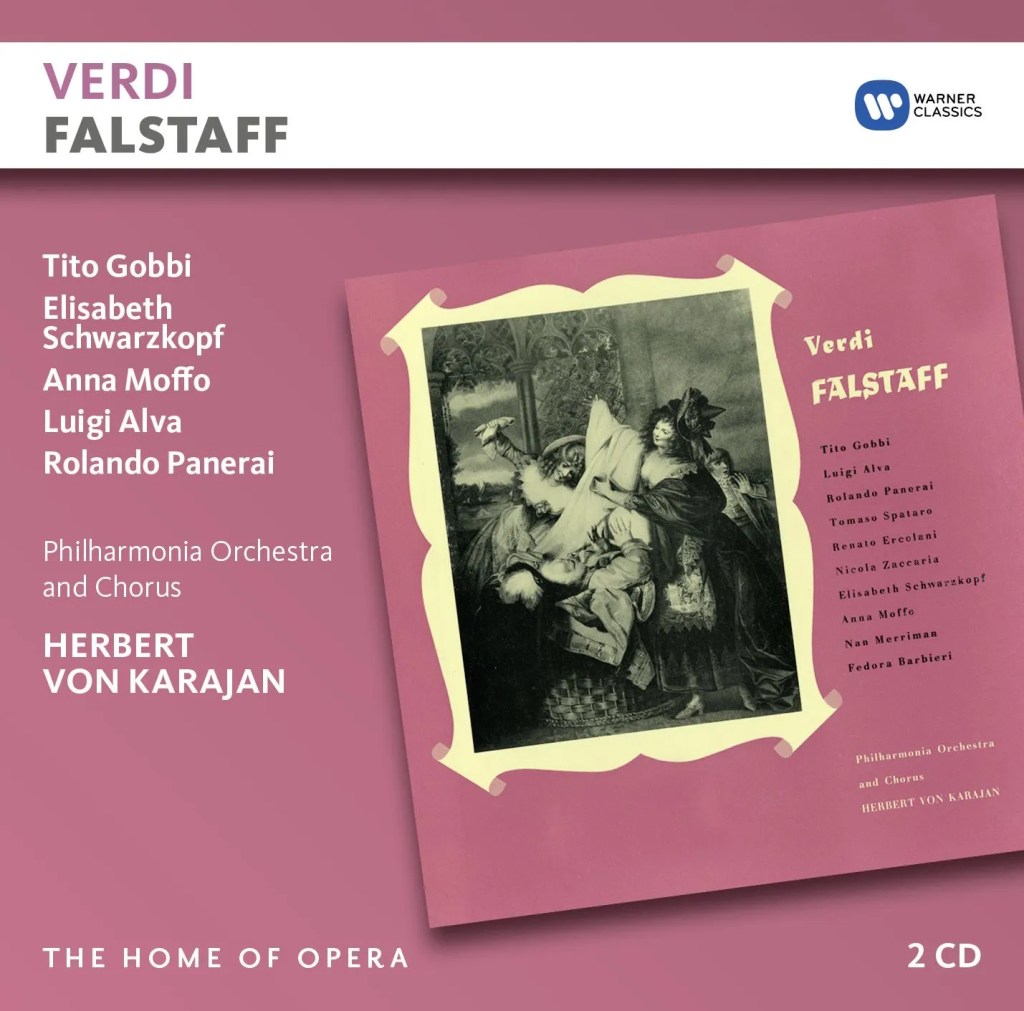
Recordings of Falstaff are legion on CD as well as DVD. One you absolutely can’t do without is the interpretation from Herbert von Karajan from 1956 (Warner 0190295935092). Under the supervision (direction?) of Walter Legge, the recording immediately became legendary and so it has remained.
Karajan had access not only the absolute best singers, but also a fantastic studio and recording director, the likes of which are no longer found. Titto Gobbi was born to sing Falstaff and a more beautiful Fenton than Luigi Alva simply doesn’t exist. I find the mannerisms of Elisabeth Schwarzkopf not always to my liking, but she is a convincing Alice, while Ford is sung by Rolando Panerai, who completely fits the bill. And then also Fedora Barbieri as Quickly… delicious.
COLIN DAVIS

Colin Davis’ 1991 recording for RCA (now Sony 8869745801-2) came pretty close, but does not quite match Karajan. This is partly down to the Bayerischen Rundfunks orchestra, but also to the recording quality.
Davis’ vocal ensemble is particularly strong, certainly by today’s standards, but apart from Marylin Horne, who can easily match Barbieri, the cast is still a rung lower. Rolando Panerai, with Karajan a Ford out of thousands, does less well as the ‘cosy fat man’, especially when compared to Gobbi.
Fantastic, on the other hand, are the supporting roles: with Piero de Palma (Dr Cajus), Davis brought in one of the best comprimari ever. In the small role of Pistola, we hear none other than Francesco Ellero d’Artegna.
JAMES LEVINE
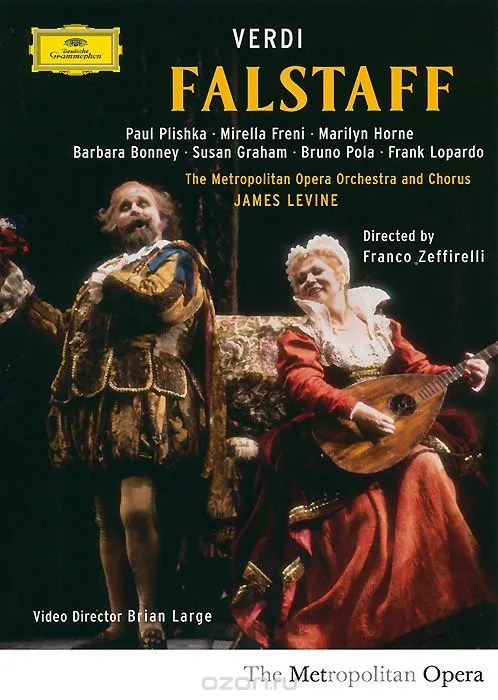
Frank Lopardo, Marylin Horne and Piero de Palma feature not only with Colin Davis, but also in the Zeffirelli production recorded in 1992 at the Metropolitan Opera in New York (DG 0734532). A dazzling performance!
Young Levine steers the music in all directions; it is as if there were not one, but four conductors in front of the orchestra. So much energy makes you gasp.
Paul Plishka is a delightful Falstaff and the rest of the cast just makes you crow for joy: Mirella Freni is Alice, as Meg we hear the very young Susan Graham and Marylin Horne is a Quickly in thousands. Add to that the truly delightful singing young lovers (Barbara Bonney and Frank Lopardo) and don’t forget the two comprimari: the inimitable Di Palma (Dr Cajus) is joined here by another great, Anthony Laciurra (Bardolfo). And whatever you think of Zefirelli: watching his productions is always a treat!
Below finale of the opera:
TULIO SERAFIN

One look at the cast is enough to make an opera lover’s mouth water. The cast is almost identical to von Karajan’s, but now, with added visuals, it is simply not to be dismissed.
Falstaff was Giuseppe Taddei’s star role, with which he achieved the greatest successes all over the world. His powerful, dark baritone, enormous empathy, extraordinary acting talent and great sense of humour made him a fantastic Falstaff, still inimitable and now legendary.
In the 1956 RAI production (VAI 4333), he was surrounded by the very best colleagues in the Italian opera profession. Rosanna Carteri was a beautiful, hot-blooded Alice, Scipio Colombo a virile Ford and Fedora Barbieri an impressive Mrs Quickly. Anna Moffo and Luigi Alva provided the most beautiful lyrical moments, and all this was conducted by none other than Tulio Serafin.
Anna Moffo sings ‘Sul fil d’un soffio etesio’
BERNARD HAITINK
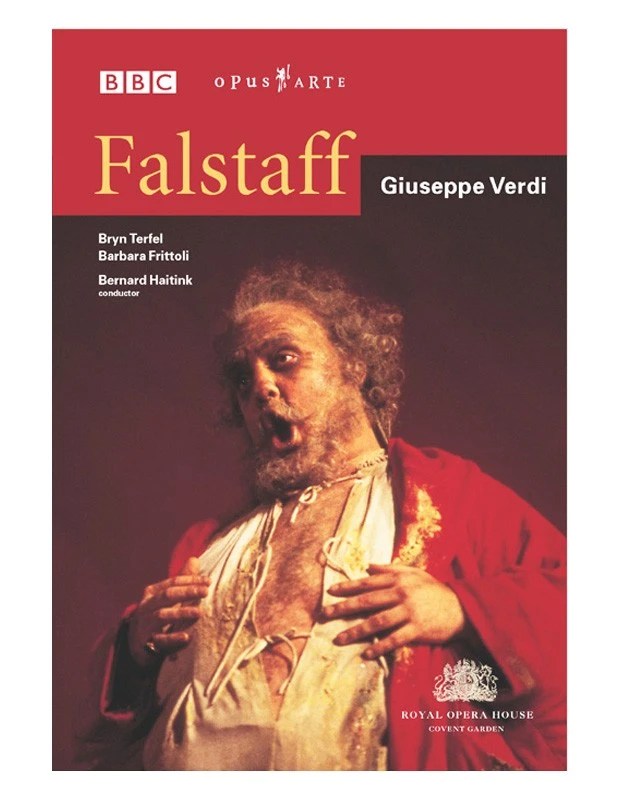
Graham Vick’s production (Opus Arte OA 0812 D) ushered in the revamped Covent Garden in 1999, and neither money nor effort was spared to make it as enjoyable as possible. The costumes are truly dazzling, the scenery witty, and though the whole thing looks a bit like the theatre of laughter (e.g. Falstaff “wears” a yellow-green striped codpiece under his belly), you forget the whole world around you.
Barbara Frittoli shines in the role of Alice Ford and the rest of the cast is also unquestionably good. The lead role is sung by the then 34-year-old (!) Bryn Terfel, who really does everything to convince us that he can portray the perfect Falstaff. Did he succeed? Yes and no. Terfel is (and even then was) undoubtedly one of the best singers and actors of our time. His facial expressions, his movements, everything is perfected to the extreme. And with the help of the grime and costume department, he manages quite well to look like a fat old, goat. But his youthful hubris and eye gaze betray his age and that is a pity
Haitink may not be my first choice, for me he conducts a little too stately, but it all sounds really great.
VLADIMIR JUROWSKI

Old nobility versus nouveau riche, that’s also partly what Falstaff is about. Even before the first bars of ‘Falstaff’ (Opus Arte OA 1021 D), recorded in Glyndebourne in 2009, have sounded, you already know which direction the director is going to take you. A gigantic tapestry hangs, with the necessary cross-stitches yet to be embroidered on it.
Richard Jones places the action in the 1940s, right after the war. There are still soldiers walking around (Fenton is an American GI), scouts and annoying housewives. The Fords and their neighbours are the nouveau riche. Their houses are neat and giant vegetables grow in their gardens – neatly lined up.
Falstaff is fantastically sung by Christopher Purves. He not only impresses with his voice, his whole performance is beyond amazing. Marie-Nicole Lemieux (Mistress Quickly) is also a delight. In her guise as a plump scout leader, she gets plenty of laughs.
The rest of the cast is variable. Adriana Kučerova is a lovely Nannetta and Bülent Bezdüz a sweet Fenton, but Tassis Christoyannis is not macho enough for Ford. If you like English humour (think series like ‘ Dad’s Army’ or ‘Keeping up Appearences’), this Falstaff is definitely for you.
Below Christopher Purves and Marie-Nicole Lemieux:ntastic.sio’
And as a bonus ‘Quando ero paggio’ sung by seven different baritones:
 Basia con fuoco
Colin Davis’ recording: Brian (?) de Palma (Dr. Cajus), I’m sure that has te be Piero de Palma!
LikeLike
yes, you are right
Corrected
LikeLike