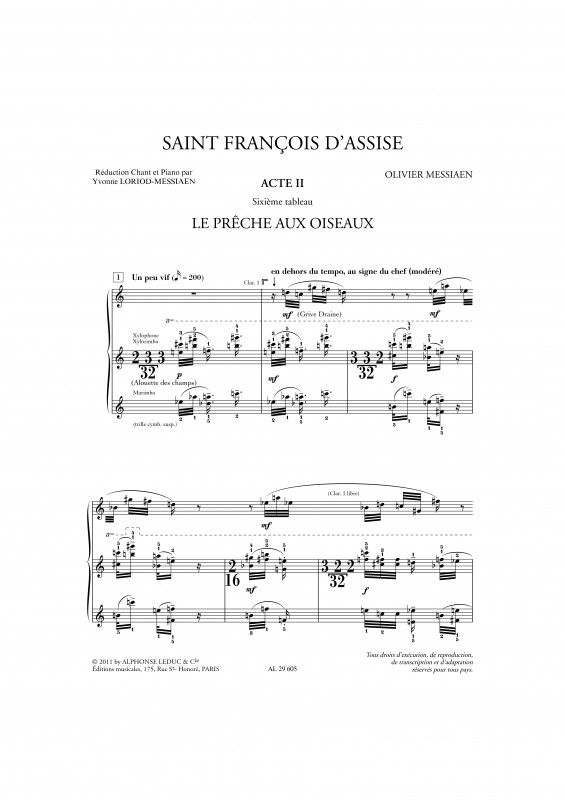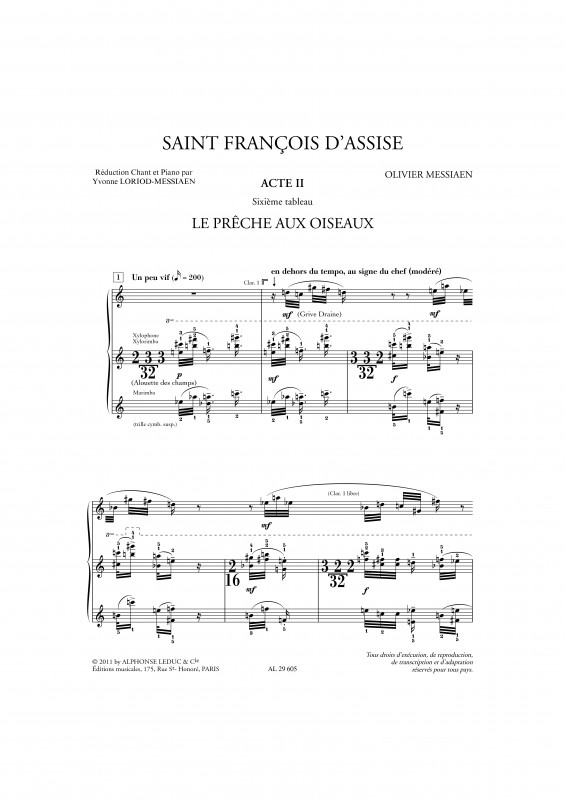
Saint_François_d’Assis

Saint François d’Assise by Olivier Messiaen in three audio recordings

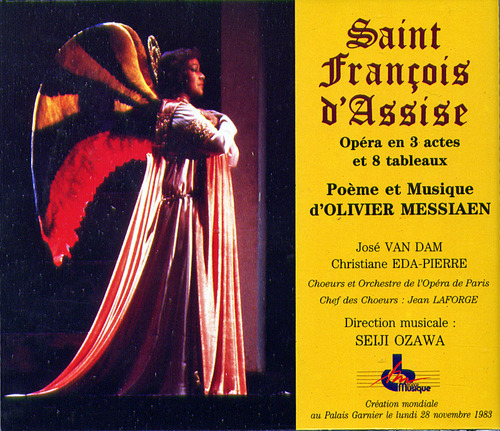
Olivier Messiaen was a deeply religious man, and most of his works are inspired by the Christian faith. For his only opera, about Saint François, he also wrote the libretto, which he regarded as his personal act of faith and a kind of testament, and which was at least as important to him as the music itself. He worked on it for seven years, and it premiered in Paris in 1983.
Seiji Ozawa
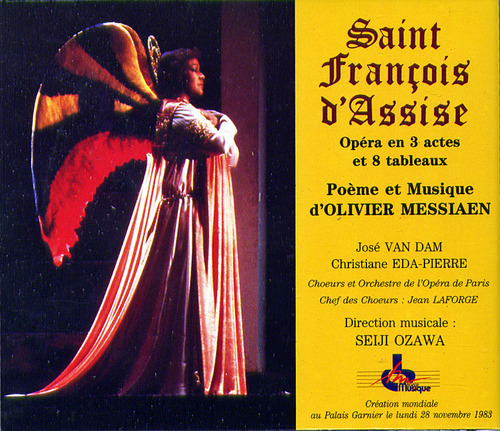


The performance, with José van Dam in the lead role and conducted by Seiji Ozawa, was once released on CD on the Cybélia label, but unfortunately the recording is very difficult to find nowadays. YouTube offers some solace; you may at least listen to some of it there
(with images!).

Below is an excerpt:


Lothar Zagrosek
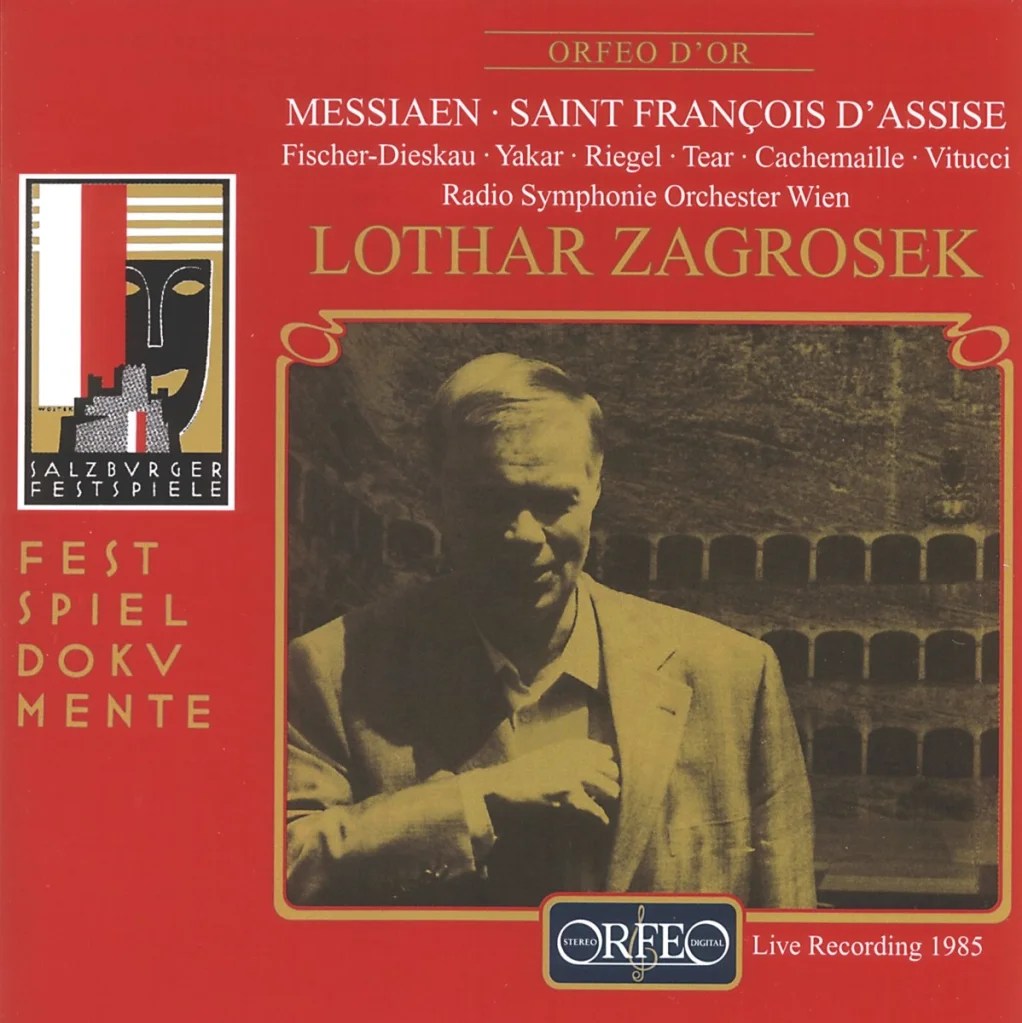

Two years later, in 1985, the opera (albeit very much abridged) was performed in Salzburg, conducted by Lothar Zagrosek and starring Dietrich Fischer-Dieskau as François, Rachel Yakar as the Angel and Kenneth Riegel as the Leper. It was broadcast live on ORF and subsequently released on Orfeo (C485 982).

Kent Nagano
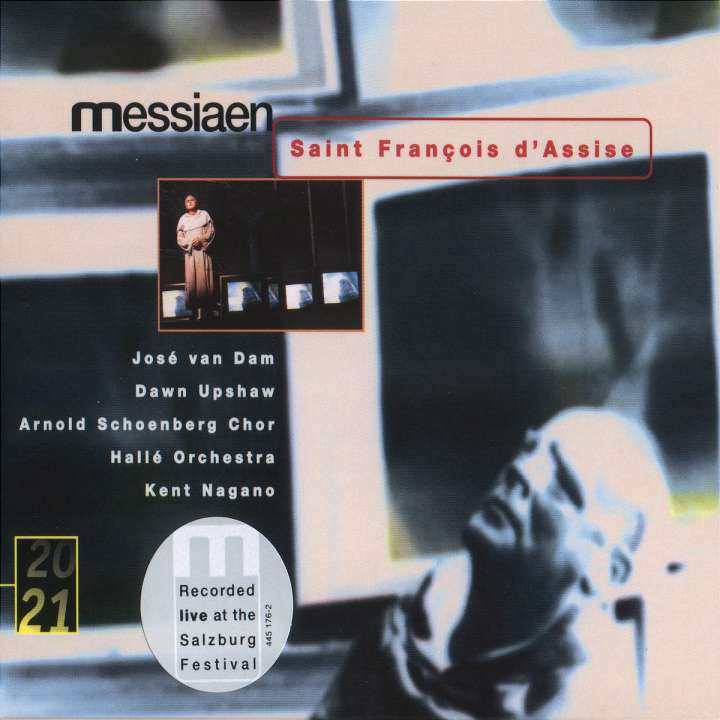


In 1998, the opera returned to Salzburg, this time in its entirety. Kent Nagano (who, when he was still Ozawa’s assistant, had rehearsed the opera under Messiaen himself) conducted, and the lead role was played by José van Dam, who had, by then, grown very much into the role. He was
supported by Dawn Upshaw (the Angel) and Chris Merritt (the Leper).

The opera was recorded live during the performances and released on four CDs a year later, giving us the only complete recording of this beautiful work on CD. (DG 4451762).


This recording is also available on YouTube:


The Salzburg performance is rock solid. Chris Merritt does not have the most beautiful voice in the world, but he doesn’t need to. He is supposed to come across as vulnerable and plaintive, and he succeeds admirably. Kenneth Riegel on Orfeo is perhaps slightly more impressive, but you don’t buy an opera for one scene only, although I do like to have that recording as well.

Dawn Upshaw is a radiant, silvery Angel, and more esoteric than Rachel Yakar on Orfeo and her singing is out of this world beautiful. Fiescher-Dieskau, on Orfeo, had really already been retired in 1985, but he agreed to study the role of François (well, just about half of it!). The result is not bad, but to me he sounds not very idiomatic and he does nowhere come near van Dam.

The music is very pleasant to the ear and radiates a certain serenity, which cannot be attributed solely to the influence of Gergorian Chants. At times, it is reminiscent of Debussy’s Peleas and Melisande, with Poulenc also coming to mind.
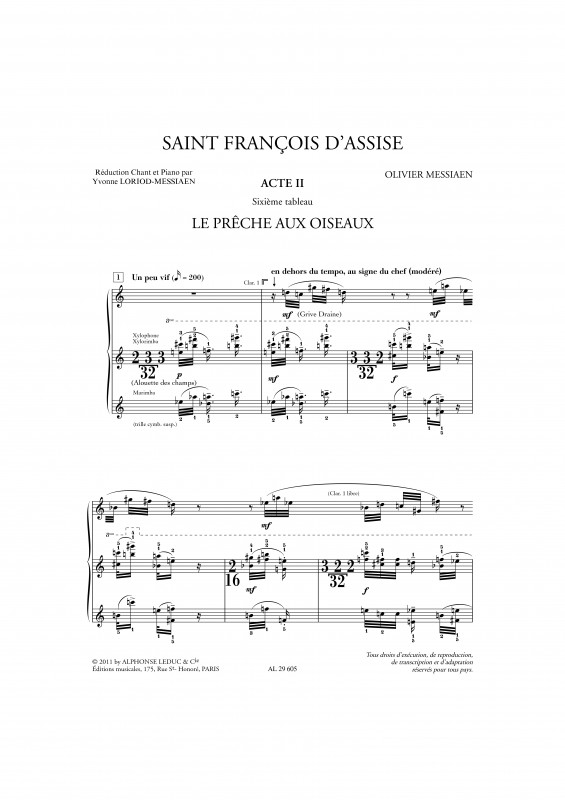


And Messiaen would not be Messiaen without the frequent use of the ondes Martenot (played on both recordings by his sister-in-law, Jeanne Loriod) and without the chirping of birds.

Saint Francois d’Assis is an opera that lends itself beautifully to listening on CD. It is a true masterpiece, yet you can easily have it playing in the background. You read the synopsis, glance at the dialogues from time to time (which can also be read in advance, as there isn’t that much going on) and then you know what’s happening.. You can easily fold your laundry while listening to it. Or sit staring into space. It has that calming effect.

DNO Amsterdam
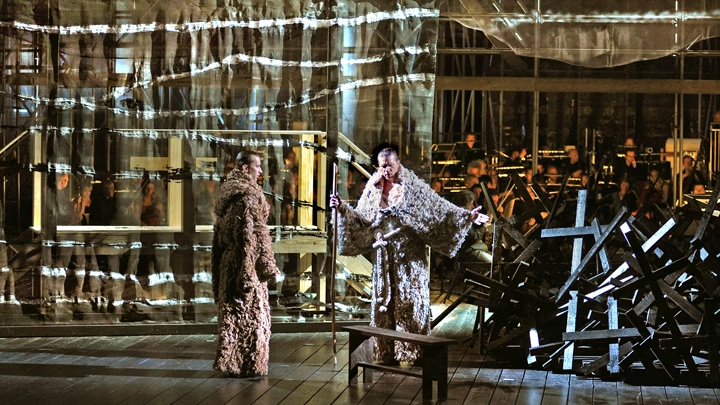
In 2008 the opera was (produced (by Pierre Audi) during Holland Festival in Amsterdam with Camilla Tilling (LÁnge), Rodney Gilfry (Saint François), Hubert Delamboye (Le Lépreux), Henk Neven (Frère Léon), Tom Randle (Frère Massée), Donald Kaasch (Frère Élie), Armand Arapian (Frère Bernard), Jan Willem Baljet (Frère Sylvestre), André Morsch (Frère Rufin)

https://www.medici.tv/en/operas/saint-francois-d-assise-olivier-messiaen-pierre-audi-de-nederlandse-opera


‘Saint François d’Assise’ by Olivier Messiaen in three audio recordings

SEIJI OZAWA

Olivier Messiaen was a very religious man and most of his works revolve around the Christian faith. For his only opera, about St Francis, he also wrote the libretto, which he considered his personal declaration of faith and a kind of testament. This was at least as important to him as the music itself. He worked on it for seven years; the premiere took place in 1983, in Paris.

The performance, with José van Dam in the lead role and conducted by Seiji Ozawa was released on CD, on the Cybélia label, unfortunately the recording is very hard to find these days. YouTube offers solace

LOTHAR ZAGROSEK


Two years later, in 1985, the opera was presented (albeit greatly shortened) in Salzburg, conducted by Lothar Zagrosek and featuring Dietrich Fischer-Dieskau as Francis, Rachel Yakar as the Angel and Kenneth Riegel as the Leper. It was broadcast live on ORF, and then released on Orfeo (C485 982).

KENT NAGANO


In 1998, ‘Francis’ returned to Salzburg, this time complete. Kent Nagano (when he was still Ozawa’s assistant he had once rehearsed the opera under Messiaen himself) conducted, and the lead role was performed by the now very grown-up José van Dam, seconded by Dawn Upshaw (the Angel) and Chris Merritt (the Leper).
The opera was recorded live during the performances and released on four CDs a year later, so we now have the only complete performance of this wonderful work on CD. (DG 4451762).


This recording is also on You Tube:


The performance is a very solid one. Chris Merritt does not possess the most beautiful voice in the world, but he doesn’t have to. He is supposed to come across as vulnerable and plaintive, and he succeeds superbly. Kenneth Riegel on the Orfeo recording is perhaps slightly more impressive, but you’re not going to buy the opera for one scene, though I myself like to have that recording alongside it.

Dawn Upshaw is a radiant, mercurial Angel, more esoteric than Rachel Yakar on Orfeo, and otherworldly beautiful. Fiescher-Dieskau had already retired in 1985, but agreed to rehearse the role of Francis (well, half of it). The result is certainly not bad, but for me it is very lacking in idiom, and he does not even come close to matching van Dam’s performance.

The music is very pleasant to listen to and it exudes a certain serenity, which cannot be attributed to the influence of the Gregorian chants alone. Occasionally reminiscent of Debussy’s Peleas and Melisande, Poulenc also comes quite close.

And Messiaen would not be Messiaen without the frequent use of the ondes Martenot (played on both editions by his sister-in-law, Jeanne Loriod), and without the chirping of birds.


Saint Francois d’Assis is an opera that lends itself beautifully to listening to on CD. It is a true masterpiece, but when it plays in the background only you will still enjoy it. You can read the synopsis, occasionally watch the dialogues (which may also be read beforehand, nothing much is happening anyway) and then you know it all. You can fold the laundry and listen to it just fine. Or just sit an

‘Saint François d’Assise’ van Olivier Messiaen in drie audio-opnamen

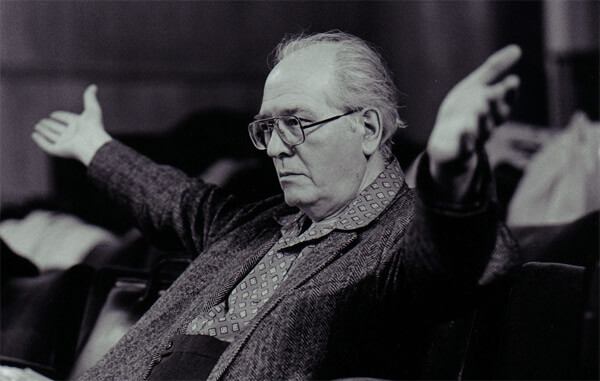
Messiaen

Olivier Messiaen


SEIJI OZAWA


Messiaen Ozawa

Olivier Messiaen was een zeer religieuze man en de meeste van zijn werken staan in het teken van het christelijke geloof. Voor zijn enige opera, over de heilige Franciscus, heeft hij ook het libretto geschreven dat hij als zijn persoonlijke geloofsbelijdenis en een soort testament beschouwde en dat voor hem minstens net zo belangrijk was als de muziek. Daar heeft hij zeven jaar aan gewerkt, de première vond plaats in 1983, in Parijs.

De uitvoering, met José van Dam in de hoofdrol en gedirigeerd door Seiji Ozawa werd ooit op cd uitgebracht, op het merk Cybélia, helaas is de opname tegenwoordig zeer moeilijk te krijgen. You Tube biedt soelaas, daar kunt u het een en ander (met beeld!) beluisteren.

Hieronder een fragment:


LOTHAR ZAGROSEK

Messiaen Zagrosek

Twee jaar later, in 1985, werd de opera (zij het sterk ingekort) in Salzburg gepresenteerd, gedirigeerd door Lothar Zagrosek en met Dietrich Fischer-Dieskau als Franciscus, Rachel Yakar als de Engel en Kenneth Riegel als de melaatse. Het werd rechtstreeks op de ORF uitgezonden, en daarna op Orfeo (C485 982) uitgebracht.

In 1998 kwam ‘Franciscus’ in Salzburg terug, ditmaal compleet. Kent Nagano (hij heeft ooit, toen hij nog de assistent van Ozawa was, de opera onder Messiaen zelf ingestudeerd) dirigeerde en de hoofdrol werd vertolkt door de inmiddels zeer met de rol vergroeide José van Dam, gesecondeerd door Dawn Upshaw (de Engel) en Chris Merritt (de melaatse).

KENT NAGANO

Messiaen Dg Nagano

De opera werd tijdens de voorstellingen live opgenomen en een jaar later op vier cd’s uitgebracht, waardoor we thans over de enige complete uitvoering van dit prachtige werk op cd kunnen beschikken. (DG 4451762).

https://open.spotify.com/album/6Hgbfl51J2HYCOzMXO1W22?si=GBlnp6hhRpWMcOTWctY0EQ

De uitvoering staat als een huis. Chris Merritt beschikt niet over de mooiste stem ter wereld, maar dat hoeft ook niet. Hij hoort kwetsbaar en klagerig over te komen, en dat lukt hem voortreffelijk. Kenneth Riegel op Orfeo is wellicht iets indrukwekkender, maar je gaat de opera niet voor één scène aanschaffen, al vind ik het fijn om die opname ernaast te kunnen hebben.

Dawn Upshaw is een stralende, kwikzilverige Engel, esoterischer dan Rachel Yakar op Orfeo, en buitenaards mooi. Fiescher-Dieskau was in 1985 al met pensioen, maar stemde toe om de rol van Franciscus (nou ja, de helft ervan) in te studeren. Het resultaat is beslist niet slecht, maar voor mij zeer weinig idiomatisch, en hij komt niet eens in de schaduw van de prestatie van van Dam.

De muziek ligt zeer prettig in het gehoor en er straalt een zekere sereniteit van af, wat niet alleen aan de invloed van de gregoriaanse gezangen geweten kan worden. Af en toe doet zij aan Peleas en Melisande van Debussy denken, ook Poulenc komt om de hoek kijken.

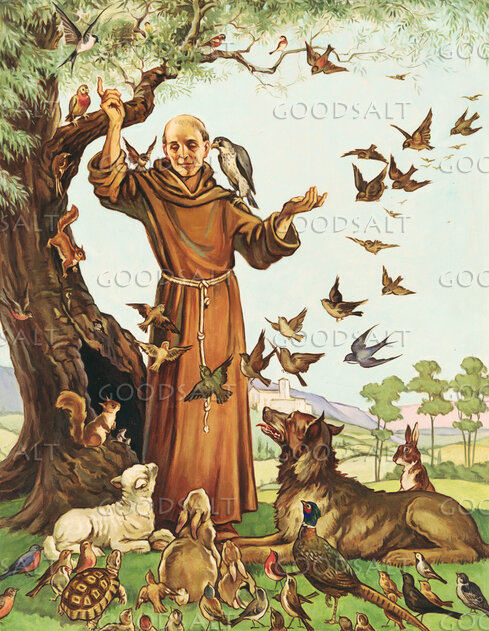
En Messiaen zou Messiaen niet zijn zonder veelvuldig gebruik van ondes Martenot (op beide uitgaven bespeeld door zijn schoonzus, Jeanne Loriod), en zonder het getjilp van vogels.

Messiaen vogels

Saint Francois d’Assis is een opera die zich prachtig leent voor het beluisteren op cd. Het is een echte meesterwerk, toch kan je hem prima op de achtergrond hebben. Je leest de synopsis, kijkt af en toe naar de dialogen (die kunnen ook vooraf gelezen worden, zoveel gebeurt er heus niet) en dan weet je het wel. Je kan er prima bij was opvouwen. Of voor zich zitten staren. Je wordt er rustig van.