Mstislav_Rostropovich

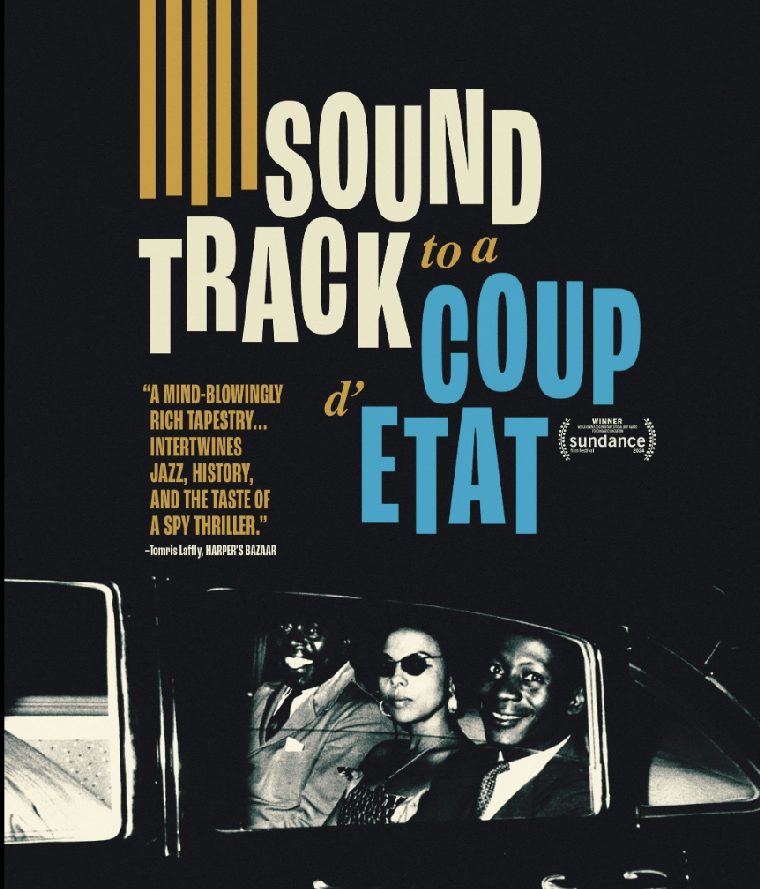
Soundtrack to a coup d’état, ‘syncopated thriller’ over de rol van jazz in de wereldgeschiedenis en de ondergang van Patrice Lumumba.

Tekst: Neil van der Linden
Je ziet een voormalig hoofd van de (Britse inlichtingendienst de) M15 verklaren dat de beste methode om je wil door te drijven is om partijen te vinden die je tegen elkaar kunt opzetten.

Je ziet Eisenhower glashard bij de Verenigde Naties verklaren dat de soevereiniteit van nieuwe landen heilig is en dat buitenlandse inmenging uit den boze is. Even later een hoofd van de CIA aan het woord komt die vertelt dat Eisenhower had gezegd dat Patrice Lumumba, de nieuw gekozen president van het net onafhankelijk geworden Congo, aan de krokodillen moest worden gevoerd.  En dat hij als lid van de delegatie die met Louis Armstrong meereisde een pistool mee kreeg waarmee je een onzichtbaar ijspijltje kon afschieten dat zonder dat het beoogde het slachtoffer het zelfs maar zou voelen een gif zou inspuiten dat een hartaanval kon veroorzaken.
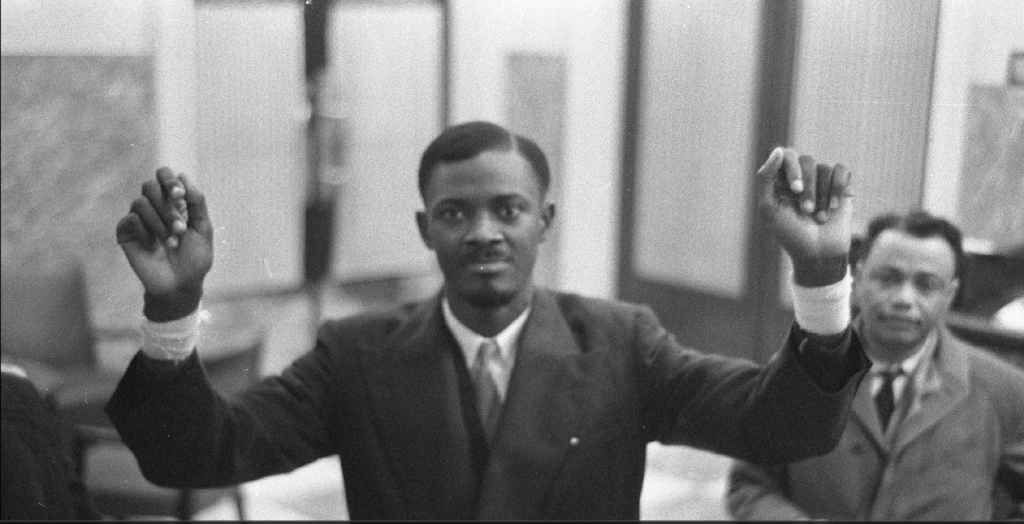
The murder of Congo’s first post-independence leader Patrice Lumumba took place as famed jazzman Louis Armstrong was touring the country. The two events were not a coincidence, as the acclaimed documentary, ‘Soundtrack to a Coup d’Etat’, reveals.

https://www.brusselstimes.com/1103100/how-jazz-played-out-over-congos-chaotic-coup

Je ziet even later Louis Armstrong verklaren dat hij daarna zijn Amerikaans burgerschap wil opgeven en naar Ghana wil verhuizen.

Louis Armstrong and the spy: how the CIA used him as a ‘trojan horse’ in Congo

https://www.theguardian.com/music/2021/sep/12/louis-armstrong-and-the-spy-how-the-cia-used-him-as-a-trojan-horse-in-congo

Je ziet Khruschev zich bij de VN als held van de nieuwe landen ontpoppen als hij verklaart dat buitenlandse inmenging taboe is. Je weet dat de Sovjets in 1956 een bloedig einde maakten aan de Hongaarse Opstand.
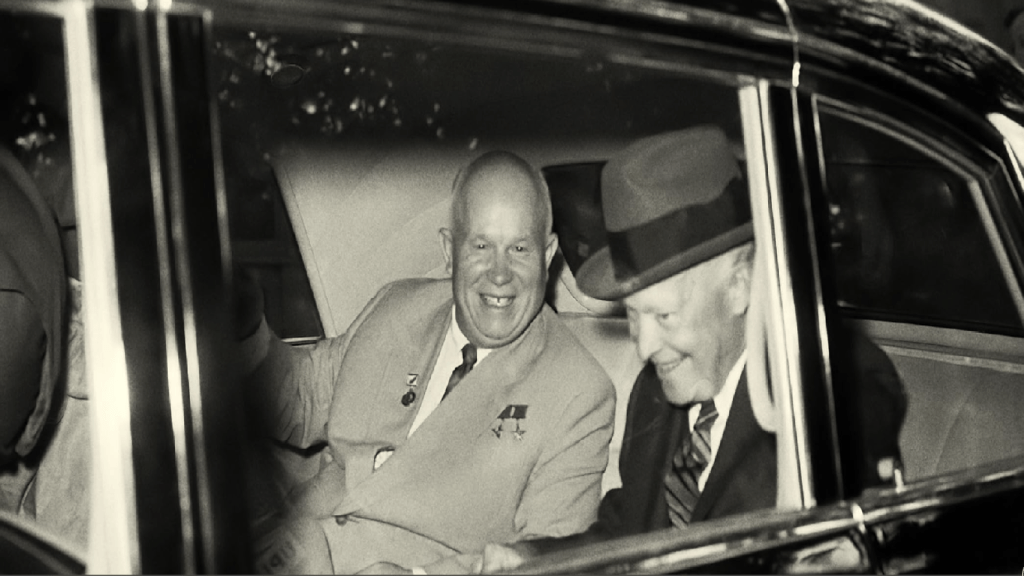
We zien de beroemde scenes waarin gedirigeerd door Khruschev de delegatie van de USSR (toen nog maar net toegelaten tot de VN; China was nog buitengesloten – ergens in de documentaire wordt gezegd dat de VN eigenlijk gewoon een instrument was van de VS) bij een aantal toespraken van Eisenhower en met name na het bericht over de dood van Lumumba met de vuisten op tafel trommelt. Of Khruschev nou werkelijk ook met een schoen op tafel had getrommeld is niet goed te zien.

Je ziet Rostropovich optreden bij de Verenigde Naties, waarna de toenmalige Secretaris General Dag Hammarskjöld verklaart dat muziek een taal is die ook kan uitdrukken wat niet onder woorden kan worden gebracht en die iedereen voelt. Cultural diplomacy vond over en weer op alle fronten plaats. Hoewel musici als Rostropovich zich later als dissident opwierpen, was het de VS een doorn in het oog dat de USSR zich meer en meer het monopolie op ‘hoogstaande’ klassieke als soft power toeëigende. 

Daarop besloten de VS juist de andere kant op te gaan en als tegenwapen de ‘volksere’ jazz te gebruiken. Daarin zouden misschien bijvoorbeeld de mensen uit Afrika zich meer herkennen. Wat in een ricochet-effect had toen de Amerikaanse jazz-musici zich meer en meer met de Afrikaanse dekolonisatiebewegingen gingen identificeren en bijvoorbeeld bij monde van Malcolm X Lumumba tot held verklaarden.

Jazz Diplomacy during the Cold War | The Jazz Ambassadors

https://www.pbslearningmedia.org/resource/jazz18-ss-ela-jazz/the-jazz-ambassadors-jazz-diplomacy-in-the-1950s/

Vervolgens horen we een interviewfragment met Khruschev waarin hij verklaarde dat jazz geen muziek is. (Dat kenden we ook al van de Nazis.) De documentairemaker mixt briljant het geluid van het getrommel op tafel door de Soviet-delegatie met de slagwerkgeroffel van Max Roach en voetgeraffel van Dizzy Gillespie. Even daarvoor zagen we hoe Dizzy Gillespie zich kandidaat had gesteld voor het presidentschap van de VS, eerst als grap, maar het werd vervolgens kreeg het een serieuzere kant.
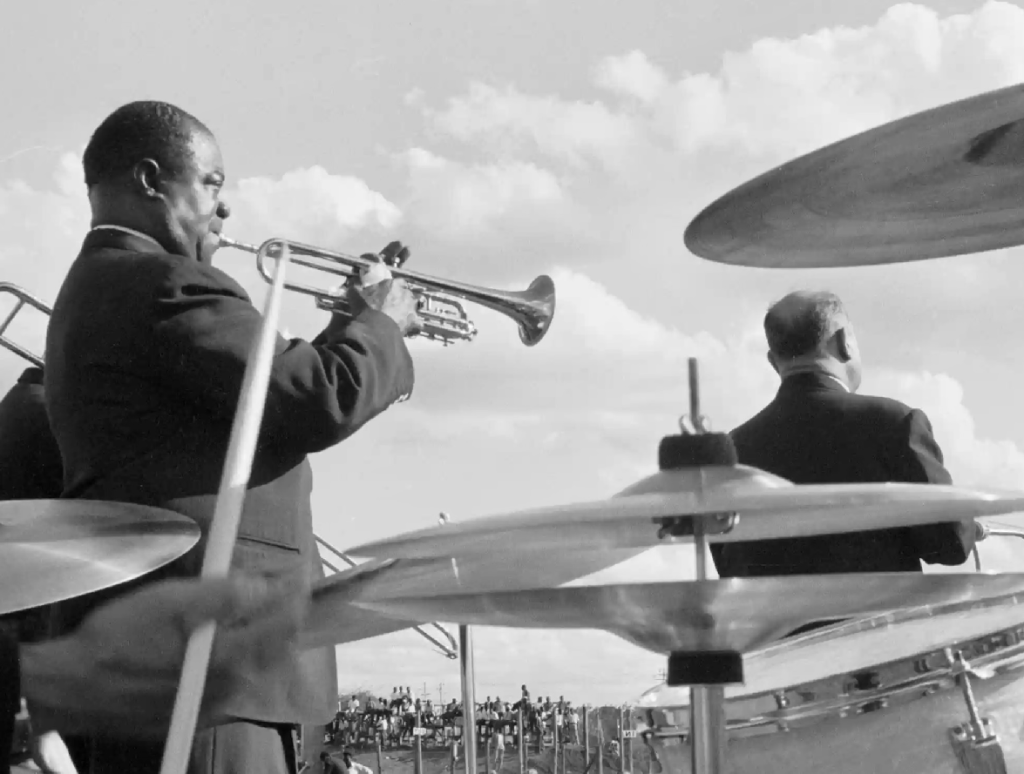
Louis Armstrong wordt warm onthaald in Ghana en treedt op voor 100000 mensen, naar wordt beweerd het grootste concertpubliek tot dan toe ooit. Ghana’s president Nkruma, één van de toonaangevende leiders in de Afrikaanse onafhankelijkheidsbeweging, krijgt tranen in de ogen als Armstrong een lied aan hem opdraagt, “Black and Blue”.

Jazz als een alternatief voor de high brow cultural diplomacy door de USSR.

Strains of Freedom Jazz Diplomacy and the Paradox of Civil Rights

Louis Armstrong, als vrolijk ogende en goedlachse persoon, die ‘niet al te moeilijke’ muziek maakt, was het “Trojaanse paard” van de Amerikaanse jazz-diplomatie, zoals onderzoekster Susan Williams het beschrijft, en we zien hem ook in Egypte. De New York Times wordt in de film geciteerd, die jazz het belangrijkste instrument in de Amerikaanse buitenlandse betrekkingen met een ‘blue’ mineur akkoord noemt.

Andere jazz musici waarvan we beelden zien zijn John Coltrane, Duke Ellington die fraai uitlegt dat hij geen jazz speelt maar op de piano droomt en die we in Iran en Syrië zien. Ornette Coleman en Art Blakey die allebei categorisch weigerden zich in te laten zetten voor de diplomatie, Nina Simone en wel verschillende keren, onder meer prachtig uit het raam van vliegtuig kijkend, op weg naar een Afrikaans land. Maar juist Simone had al vroeg in de gaten dat ze werd gebruikt en bedankte verder voor de eer.

Prachtig zijn ook de beelden van Abbey Lincoln, die van de Cubaanse VN delegatie toegangskaarten had gekregen voor de VN-vergadering na de moord op Lumumba en met zestig medestanders een luide protestactie voerde, voor ze met geweld de zaal werden uitgezet; Lincoln werd het werk daarna zo moeilijk mogelijk gemaakt. We zien haar met Max Roach in prachtig fragmenten uit ‘We Insist! Max Roach’ Freedom Now Suite’ waarin ze de schreeuw herhaalt die haar ook beroemd maakte in de vergaderzaal van de Verenigde Naties.

We Insist! Max Roach’ Freedom Now Suite’

Veel aandacht is er ook voor Dag Hammarskjöld. Als Lumumba als nog steeds wettelijk gekozen president van Congo, tijdens zijn door legerkolonel Mobutu op instigatie van de VS en met medewerking van de VN ingestelde huisarrest, Hammarskjöld vraagt om bij de VN te mogen komen spreken, zegt Hammarskjöld ja maar weigert intussen op last van de VS een vliegtuig te sturen. Bovendien wordt het inreisvisum voor Lumumba  door de VS geweigerd. Even later vindt de moord op Lumumba plaats.

Dag Hammarskjöld: “I shall remain in my post!” (1960), nadat zijn positie wankelde toen zijn bedenkelijke rol bij de moord op Lumumba duidelijk werd. Schrijnend is ook hoe een aantal landen daarop het aftreden van Hammarskjöld eist, maar hij zich er, met instemming van het Westen, ‘pre-Ruttiaans’ (zoals Rutte) uitkletst. Zie zijn toespraak in de Youtube link.

De rol van professionele huurmoordenaars komt ter sprake. Uit Zuid-Afrika, België en Duitsland bijvoorbeeld. Een Duitse huurmoordenaar verklaart hoe hij een goed leven had: mooi weer, af en toe schieten en een bankrekening thuis die dagelijks werd bijgevuld. Intussen is hij echt een beschaafde persoon, wil hij de interviewer laten weten, want tijdens rustperioden in de hoofdstad Leopoldville (het tegenwoordige Kinshasa) gaat hij ook naar de concerten met klassieke muziek die het plaatselijke Goethe Instituut organiseert.

De documentaire is een oogverblindend en bijna oorverdovend inferno van met elkaar verweven verhaallijnen. Voor wie de Congo-crisis indertijd via het wereldnieuws heeft meegemaakt is deze documentaire ook een soundtrack bij herinneringen aan namen die dagelijks door het nieuws gonsden.

Lumumba, Kasa Vubu, Tshombe, Mobutu, Katanga (de Congolese provincie in het zuidwesten waar – en daar ging het allemaal om – de uraniummijnen lagen waarvan het atoomprogramma van het Westen afhankelijk was. De bommen op Nagasaki en Hiroshima waren met uranium uit Katanga vervaardigd. In Katanga liggen ook belangrijke koper-, diamant- en cobalt-mijnen. De laatsten spelen nu net zo’n verderfelijke rol als toen vanwege de wereldvraag naar grondstoffen voor de batterijen voor onze Tesla’s en iPhones.

De uraniumtoevoer was tot de Congolese onafhankelijkheid in handen van het Belgische staatsbedrijf Union Minière, maar twee dagen voor onafhankelijkheid werd de Union Minière (nog zo’n naam uit het wereldnieuws-geluidsdecor van toen) geprivatiseerd en werden de Belgische staat en de Belgische koning aandeelhouders. Zo bleef het bedrijf uit handen van de Congolese staat. Bovendien steunden België en VS de afscheiding van Katanga en kwam daar een marionet aan de macht, Tshombe.

Het geheel wordt nog duizelingwekkender als je je realiseert dat de gebeurtenissen tussen de onafhankelijkheid van Congo en de moord op Lumumba zich in een periode van nauwelijks zes maanden hebben afgespeeld. Na dit bloedige half jaar was de toevoer van uranium uit de mijnen van Katanga weer veiliggesteld.

Dit alles dus in een spectaculaire montage, ‘a syncopated thriller’ zegt de trailer. In de esthetiek van televisie uit de jaren vijftig gemengd met het design van de klassieke Blue Note LP-hoezen. Schrijnend zijn dan de fragmenten van Congolese zangers zoals Franco die tijdens het huisarrest van en na de moord op Lumumba vragen om zijn terugkeer.

Soundtrack to a Coup d’Etat – Official Trailer

Balla Et Ses Balladins – Lumumba

Lumumba – Salum Abdala & Kiko Kids

Mariam Makeba Lumumba

En dit is toch hartverscheurend, inclusief een pleidooi voor een grondig onderzoek

Lumumba, Héros National – Franco & L’O.K. Jazz 1967
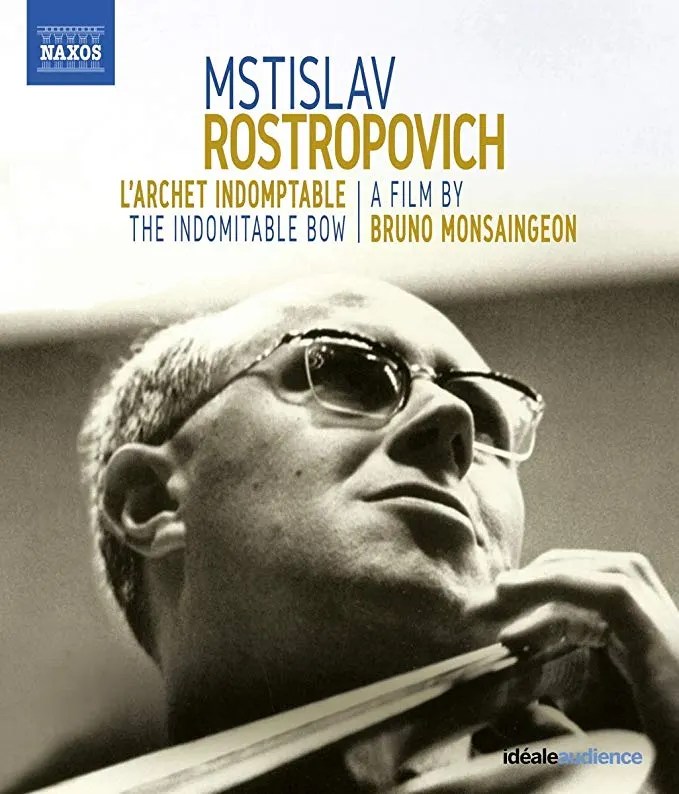
Mstislav Rostropovich’s indomitable bow

The year 2000 (and the new century) had just begun when French documentary maker Bruno Monsaignon was invited by Mistislav Rostropovich to his home: the famous cellist wanted to hand him all the material of films and recordings he possessed… containers full. And although much was missing in terms of dates and information, it was immediately clear to Monsaignon what a valuable treasure he had in his hands. After several vodkas later, Monsaignon dared to ask the great maestro’s permission to make a film about his life. IIt has become a fascinating document full of historical footage and music excerpts:

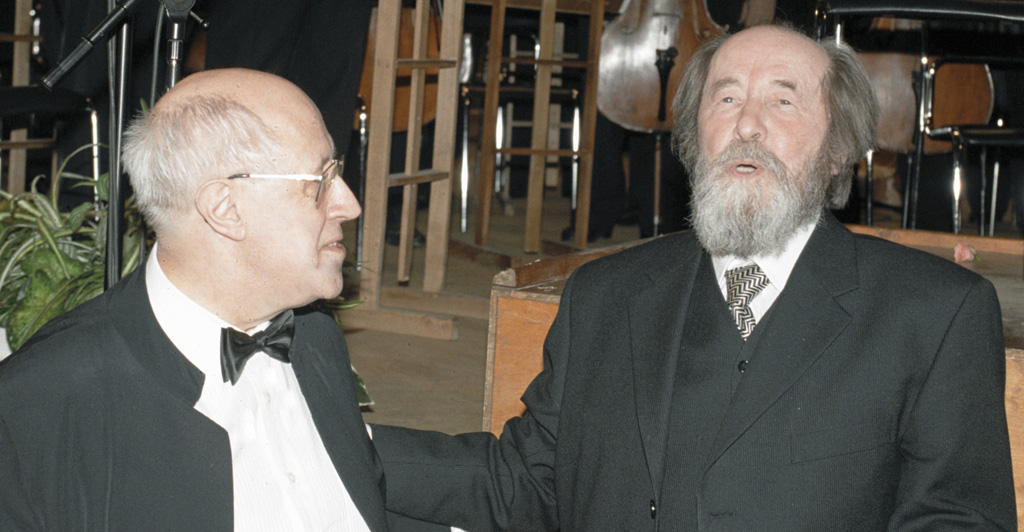
6624 17.12.1998 Писатель, лауреат Нобелевской премии Александр Солженицын (справа) и виолончелист Мстислав Ростропович (слева) на концерте в честь 80-летия писателя. Юрий Абрамочкин/РИА Новости

Rostropovich was not only one of the greatest cellists of his time who inspired untold numbers of composers to write works for him, he was also an excellent pianist and conductor as well as a political activist and champion of human rights. In 1972, he was exiled and stripped of his nationality for defending his friend, the writer Alexandr Solzhenitsyn. After the fall of communism, he was rehabilitated and welcomed as a hero in the ‘new’ Russia.

The film begins with a party at the Barbican Centre in London. On the stage, the greatest of the great gather. There they are, all in a row: Kremer, Argerich, Vengerov, Jansons, Kissin, Penderecki, Ozawa…. In fact, who isn’t? Not even Margaret Thatcher is missing! The ‘birthday boy’ cuts the cake (in the shape of a cello), after which he gestures that it is now time to start drinking. It must have been Costly!

There is also a bonus. Two, actually. After Tchaikovsky’s Rococo Variations from 1986, we get a unique visual recording of Beethoven’s ‘Archduke Trio’ recorded in 1977, featuring Wilhelm Kempff and Yehudi Menuhin alongside Rostropovich; followed by the ‘Sarabande’ from Bach’s second cello solo suite recorded in 1969… Wow.

Bonus two treats us to table talk with the children of Rostropovich and Solzhenitsyn. How much more valuable do you want it to be?

Isn’t it time to talk about Lady Macbeth of Mtsensk?

Lady Macbeth of Mtsensk illustration by B.M. Kustodiyev

It was supposed to be a four-part opera, an operatic tetralogy dedicated to the position of women in Russia in different eras.

A Soviet Russian Ring des Nibelungen, of which part one, `Lady Macbeth of Mtsensk’ would be a kind of Rheingold. But alas, it was not to be. Though initially no one could have suspected any impending doom.

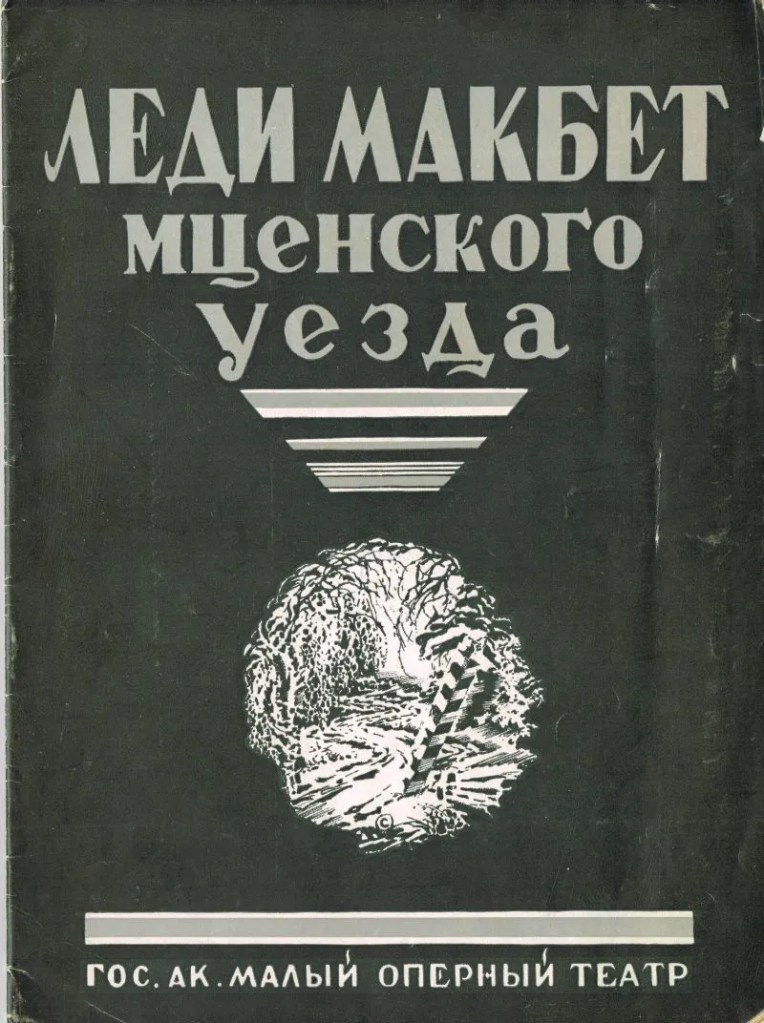
Premiere poster 1934 QED Art and press from the USSR and Central Europe


The premiere on 22 January 1934 at the Maly Theatre in Leningrad was a tremendous success, and for two years the opera was performed several times a week both in Leningrad and Moscow. The opera was also very succesful abroad: after Cleveland the New York City Opera followed , and then Stockholm, Prague and Zurich.

Until Stalin attended a performance in January 1936 and left early. The next day, an article appeared in Pravda under the headline ‘Chaos instead of music’.

It was signed by a certain Zaslavsky, but according to Shostakovich, it was written by Stalin himself. The opera was immediately dropped from the programmes and the composer was labelled an ‘enemy of the people’.


After Stalin’s death, Shostakovich revised his opera, and under a new title, Katerina Ismailova, it was first performed in Moscow in 1963. Prague and Zurich.

Shostakovich loved his heroine. To Solomon Volkov, he confessed: “Although Yekaterina Lvovna is a murderess, she is not yet lost as a human being. Her conscience torments her, she keeps thinking about the people she killed. I have sympathy for her. […] I wanted to show a woman who morally stands much higher than all the people around her. Because around Yekaterina there are only villains. She lives like in a prison and this is how she has been suffering for five years.”

“Her life is sad and uninteresting. But then comes love, a great passion. And it turns out that this passion is worth a crime to her. After all, it doesn’t matter, since otherwise life makes has no meaning to her.” (From Testimony. Memoirs of Dimitri Shostakovich.)

The opera, about the tragic fate of Katerina, who after marrying a rich merchant ends up in a kind of prison, from which she believes she can escape through her passionate love for Sergei and then ends her life in an icy river in Siberia, is a mix of tragedy and satire, seriousness and humour, lyrical melodies and – yes, indeed – chaos.

With a dizzying pace, the atmosphere changes from touching melancholy (Katja’s lament ‘Zherebyonok k kob’lke toropotsa’) to sexually charged (seduction scene), to end in actually pornographic sounds – Shostakovich has succeeded in describing ‘the deed’ through music in detail.


The premiere on 22 January 1934 at the Maly Theatre in Leningrad was a tremendous success, and for two years the opera was performed several times a week both in Leningrad and Moscow. The opera was also very succesful abroad: after Cleveland the New York City Opera followed , and then Stockholm, Prague and Zurich.

Until Stalin attended a performance in January 1936 and left early. The next day, an article appeared in Pravda under the headline ‘Chaos instead of music’.

It was signed by a certain Zaslavsky, but according to Shostakovich, it was written by Stalin himself. The opera was immediately dropped from the programmes and the composer was labelled an ‘enemy of the people’.
After Stalin’s death, Shostakovich revised his opera, and under a new title, Katerina Ismailova, it was first performed in Moscow in 1963. Prague and Zurich.

Shostakovich loved his heroine. To Solomon Volkov, he confessed: “Although Yekaterina Lvovna is a murderess, she is not yet lost as a human being. Her conscience torments her, she keeps thinking about the people she killed. I have sympathy for her. […] I wanted to show a woman who morally stands much higher than all the people around her. Because around Yekaterina there are only villains. She lives like in a prison and this is how she has been suffering for five years.”

“Her life is sad and uninteresting. But then comes love, a great passion. And it turns out that this passion is worth a crime to her. After all, it doesn’t matter, since otherwise life makes has no meaning to her.” (From Testimony. Memoirs of Dimitri Shostakovich.)

The opera, about the tragic fate of Katerina, who after marrying a rich merchant ends up in a kind of prison, from which she believes she can escape through her passionate love for Sergei and then ends her life in an icy river in Siberia, is a mix of tragedy and satire, seriousness and humour, lyrical melodies and – yes, indeed – chaos.

With a dizzying pace, the atmosphere changes from touching melancholy (Katja’s lament ‘Zherebyonok k kob’lke toropotsa’) to sexually charged (seduction scene), to end in actually pornographic sounds – Shostakovich has succeeded in describing ‘the deed’ through music in detail.


GALINA VISHNEVSKAYA, 1978


Shortly after the composer’s death, his friend, the cellist and conductor Mstislav Rostropovich, found the original score of Lady Macbeth. In 1978, the opera was recorded in full for the first time (Warner 0825646483204). Rostropovich conducted and the leading roles were performed by the best singers from the Russian tradition.
Galina Vishnevskaya is a phenomenal Katerina. In her interpretation, you can hear her character’s full range of emotions and character developments. She is bored, in love and passionate, and her despair at the end is the very deepest.

Nicolai Gedda portrays a very attractive and masculine Sergei, and Dimiter Petkov and Werner Krenn are matched as father and son Ismailov. Robert Tear is (as always, by the way) extremely convincing in his character role as the shabby labourer and only Birgit Finnila (Sonyetka) sounds a little too old-fashioned for me.

Rostropovich conducts with an eye for all the details and emphasises the contrasts. All in all: a better CD recording is unthinkable. Not that you have a choice: the only real competitor on CD, a DG recording (4375112) with Maria Ewing and Sergei Larin conducted by Myung Whun Chung, has now been dropped.


NADINE SECUNDE, Barcelona, 2002


EMI (5997309) once released a production from Barcelona (May 2002) on DVD, which may be called convincing to say the very least. It was directed by a former actor from Norway, Stein Winge, who made a very moving, mainly personal drama of it.

The setting suits the opera’s period of origin. The stage is dominated by a giant bed, which is prominently displayed even during the first bars of the music. Above it, a window with clouds, too high to see through, and too high to escape from. Good find.

Katerina’s arioso:


The staging is quite realistic without being vulgar. The lovemaking scene is particularly beautifully portrayed. Katerina ties the endless sheets to the legs of the bed, creating a kind of sea. She and Sergei disappear under it, and the commentary is left to the music (and our own imaginations), which is very evocative.

Nadine Secunde is a fine Katerina, very believable and extremely convincing both vocally and scenically. Christoper Ventris seems born for the role of Sergei: extremely attractive and very macho, he lives up to his reputation that no woman can resist him.

The rest of the cast is also phenomenal. Most impressive to me is the veteran Yevgeny Nesterenko in the small role of the old forced labourer.

And yet I still have a side note: the end of the opera. I won’t give it away to you, but it’s different from the libretto (for the umpteenth time already). Where does the new fashion of changing an opera’s ending come from anyway?


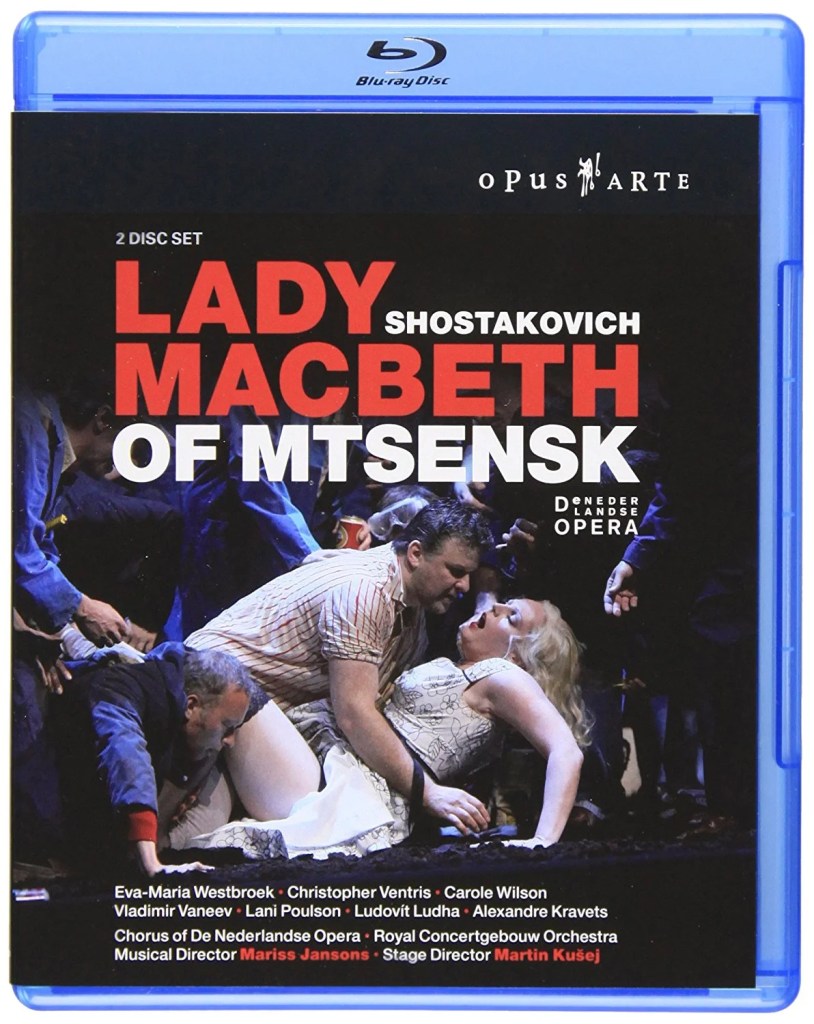
EVA-MARIA WESTBROEK, Amsterdam, 2006


In October 2006, Eva-Maria Westbroek made her widely acclaimed debut at London’s Royal Opera House as Katerina Izmailova. It was even spoken of as ‘one of the most important debuts at Covent Garden ever’

.
But we, the Dutch opera lovers, already knew it, because at the Holland Festival in June 2006, Westbroek made her debut at the Netherlands Opera in the same role, in a performance that received nothing but overenthusiastic reactions.


The production also saw Martin Kušej, a not uncontroversial Austrian opera director, make his debut in our country. In his concept, sexuality and power are closely linked and the opera is a terrible abyss, which can only be described with words like orgasm and manslaughter.

Katerina lives in a glass cage with a hundred pairs of shoes, guarded by dogs and surrounded by mud. Her longing for love and security is never satisfied, because what Sergei has in store for her is pure sex, devoid of any affection.


The musical mix of tragedy and satire, seriousness and humour, lyrical melodies and hard porn was perfectly portrayed scenically by KuÅ¡ej, which was only enhanced by the phenomenally playing Concertgebouw Orchestra conducted by Mariss Jansons. As a bonus, you get an extremely interesting ‘the making of’ documentary (Opus Arte OA 0965).


GLORIA LANE, Rome, 1976


To my knowledge, only one recording exists of Katerina Ismailova’s 1963 adaptation of Lady Macbeth, on the budget label Opera D’Oro (OPD 1388). It is an RAI recording of a broadcast on 29 May 1976 in Rome.

The differences from the original are noticeable right from the first bars: it is milder, without the biting irony, with more melancholy and sadness. The biggest differences are in the intermezzi. The first, for instance, has been replaced by completely different music. Even in the big seduction scene, the bulk of the music has been killed off and almost all the high notes have disappeared from Katerina’s music.

The performance, conducted by Yuri Ahronovich, is most certainly adequate, although I have trouble with William Cochran’s Sergei. It may be just me, but I experience his tenor as pinched rather than sexy. In the lead role, another one of those forgotten greats of yesteryear: Gloria Lane. Her Katerina is very dramatic and full of passion.he making of’ documentary (Opus Arte OA 0965).

Finally, the very interesting documentary Shostakovich against Stalin by Larry Weinstein was once released on Philips (Philips 0743117) with very much historical footage and even more music. The docu can also be found in its entirety on You Tube


De ontembare strijkstok van Mstislav Rostropovich

Rostropovich film


Het jaar 2000 (en de nieuwe eeuw) was net begonnen toen de Franse documentairemaker Bruno Monsaignon uitgenodigd werd door Mistislav Rostropovitsj om bij hem thuis te komen: de beroemde cellist wilde hem al het materiaal aan films en opnamen dat hij bezat, containers vol, overhandigen. En al ontbrak er veel aan data’s en informatie, het was Monsaignon onmiddellijk duidelijk wat een waardevolle schat hij in zijn handen kreeg. Na ettelijke wodka’s later durfde Monsaignon het aan om de grote maestro toestemming te vragen om een film over zijn leven te maken.


File:RIAN archive 6624 Alexander Solzhenitsyn and Mstislav Rostropovich.jpg  - Wikimedia Commons

Het is een fascinerend document vol historische beelden en muziekfragmenten geworden: Rostropovitsj was niet alleen één van allergrootste cellisten van de zijn tijd die onnoembare aantal componisten inspireerde om werken voor hem te schrijven, hij was ook een uitstekende pianist en dirigent. Én politiek activist én voorvechter van mensenrechten. In 1972 werd hij verbannen en van zijn nationaliteit gestript omdat hij zijn vriend, de schrijver Aleksander Sozjenitsyn verdedigde. Na de val van het communisme werd hij gerehabiliteerd en als held welkom geheten in het ‘nieuwe’ Rusland.


De film begint met een feest in de Barbican Centre in Londen. Op de bühne verzamelen zich de grootsten van de grootsten en daar staan ze, allemaal op een rij: Kremer, Argerich, Vengerov, Jansons, Kissin, Penderecki, Ozawa.. Wie eigenlijk niet? Zelfs Margareth Thatcher ontbreekt niet! Het ‘feestvarken’ snijdt de taart (in de vorm van een cello) aan, waarna hij gebaart dat het nu tijd is om aan de drank te gaan. Kostelijk.

Er is ook een bonus. Of twee eigenlijk. Na de Rococo Variaties van Tsjaikovski uit 1986 krijgen we een unieke beeldopname van de in 1977 geregistreerde ‘Archduke – trio’ van Beethoven, met naast Rostropovitsj Wilhelm Kempff en Yehudi Menuhin; gevolgd door de in 1969 opgenomen ‘Sarabande’ uit Bachs tweede cellosolosuite. Wow.


Bonus twee trakteert ons op tafelgesprekken met de kinderen Rostropovitsj en Solzjenitsyn. Hoe waardevoller wilt u het nog hebben?

MSTISLAV ROSTROPOVICH: L’ARCHET INDOMPTABLE
A film by Bruno Monsaignon
Naxos 2.110583