
Lady Macbeth of Mtsensk illustration by B.M. Kustodiyev
It was supposed to be a four-part opera, an operatic tetralogy dedicated to the position of women in Russia in different eras.
A Soviet Russian Ring des Nibelungen, of which part one, `Lady Macbeth of Mtsensk’ would be a kind of Rheingold. But alas, it was not to be. Though initially no one could have suspected any impending doom.
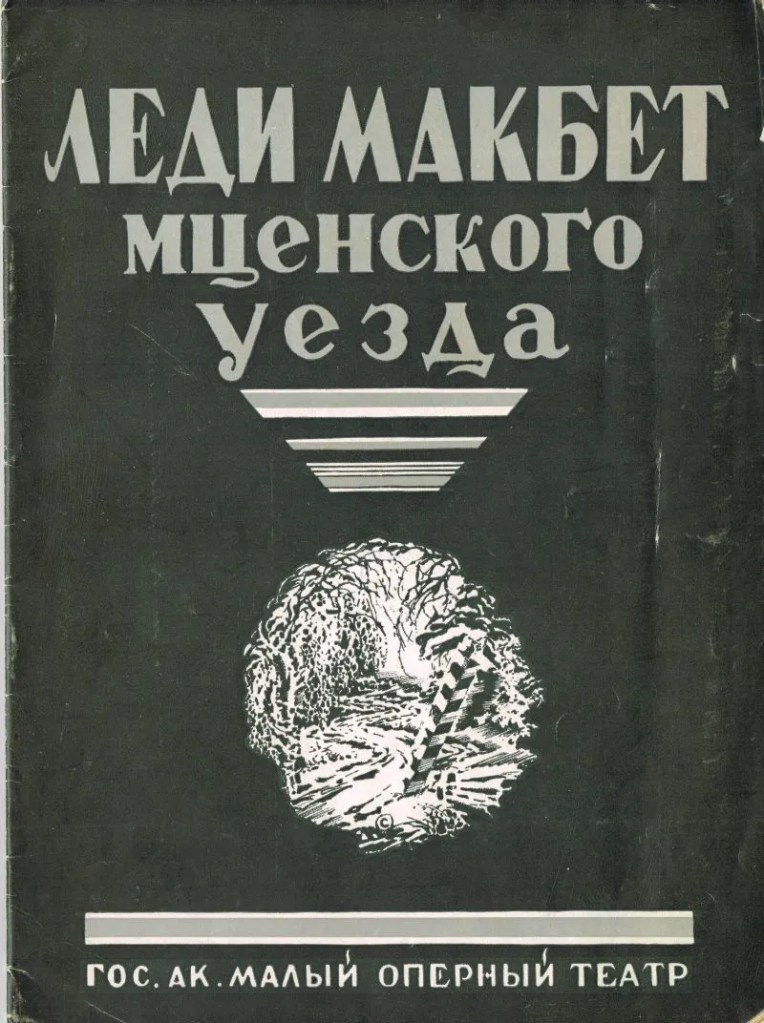
Premiere poster 1934 QED Art and press from the USSR and Central Europe
The premiere on 22 January 1934 at the Maly Theatre in Leningrad was a tremendous success, and for two years the opera was performed several times a week both in Leningrad and Moscow. The opera was also very succesful abroad: after Cleveland the New York City Opera followed , and then Stockholm, Prague and Zurich.
Until Stalin attended a performance in January 1936 and left early. The next day, an article appeared in Pravda under the headline ‘Chaos instead of music’.
It was signed by a certain Zaslavsky, but according to Shostakovich, it was written by Stalin himself. The opera was immediately dropped from the programmes and the composer was labelled an ‘enemy of the people’.

After Stalin’s death, Shostakovich revised his opera, and under a new title, Katerina Ismailova, it was first performed in Moscow in 1963. Prague and Zurich.
Shostakovich loved his heroine. To Solomon Volkov, he confessed: “Although Yekaterina Lvovna is a murderess, she is not yet lost as a human being. Her conscience torments her, she keeps thinking about the people she killed. I have sympathy for her. […] I wanted to show a woman who morally stands much higher than all the people around her. Because around Yekaterina there are only villains. She lives like in a prison and this is how she has been suffering for five years.”
“Her life is sad and uninteresting. But then comes love, a great passion. And it turns out that this passion is worth a crime to her. After all, it doesn’t matter, since otherwise life makes has no meaning to her.” (From Testimony. Memoirs of Dimitri Shostakovich.)
The opera, about the tragic fate of Katerina, who after marrying a rich merchant ends up in a kind of prison, from which she believes she can escape through her passionate love for Sergei and then ends her life in an icy river in Siberia, is a mix of tragedy and satire, seriousness and humour, lyrical melodies and – yes, indeed – chaos.
With a dizzying pace, the atmosphere changes from touching melancholy (Katja’s lament ‘Zherebyonok k kob’lke toropotsa’) to sexually charged (seduction scene), to end in actually pornographic sounds – Shostakovich has succeeded in describing ‘the deed’ through music in detail.
The premiere on 22 January 1934 at the Maly Theatre in Leningrad was a tremendous success, and for two years the opera was performed several times a week both in Leningrad and Moscow. The opera was also very succesful abroad: after Cleveland the New York City Opera followed , and then Stockholm, Prague and Zurich.
Until Stalin attended a performance in January 1936 and left early. The next day, an article appeared in Pravda under the headline ‘Chaos instead of music’.
It was signed by a certain Zaslavsky, but according to Shostakovich, it was written by Stalin himself. The opera was immediately dropped from the programmes and the composer was labelled an ‘enemy of the people’.
After Stalin’s death, Shostakovich revised his opera, and under a new title, Katerina Ismailova, it was first performed in Moscow in 1963. Prague and Zurich.
Shostakovich loved his heroine. To Solomon Volkov, he confessed: “Although Yekaterina Lvovna is a murderess, she is not yet lost as a human being. Her conscience torments her, she keeps thinking about the people she killed. I have sympathy for her. […] I wanted to show a woman who morally stands much higher than all the people around her. Because around Yekaterina there are only villains. She lives like in a prison and this is how she has been suffering for five years.”
“Her life is sad and uninteresting. But then comes love, a great passion. And it turns out that this passion is worth a crime to her. After all, it doesn’t matter, since otherwise life makes has no meaning to her.” (From Testimony. Memoirs of Dimitri Shostakovich.)
The opera, about the tragic fate of Katerina, who after marrying a rich merchant ends up in a kind of prison, from which she believes she can escape through her passionate love for Sergei and then ends her life in an icy river in Siberia, is a mix of tragedy and satire, seriousness and humour, lyrical melodies and – yes, indeed – chaos.
With a dizzying pace, the atmosphere changes from touching melancholy (Katja’s lament ‘Zherebyonok k kob’lke toropotsa’) to sexually charged (seduction scene), to end in actually pornographic sounds – Shostakovich has succeeded in describing ‘the deed’ through music in detail.
GALINA VISHNEVSKAYA, 1978

Shortly after the composer’s death, his friend, the cellist and conductor Mstislav Rostropovich, found the original score of Lady Macbeth. In 1978, the opera was recorded in full for the first time (Warner 0825646483204). Rostropovich conducted and the leading roles were performed by the best singers from the Russian tradition.
Galina Vishnevskaya is a phenomenal Katerina. In her interpretation, you can hear her character’s full range of emotions and character developments. She is bored, in love and passionate, and her despair at the end is the very deepest.
Nicolai Gedda portrays a very attractive and masculine Sergei, and Dimiter Petkov and Werner Krenn are matched as father and son Ismailov. Robert Tear is (as always, by the way) extremely convincing in his character role as the shabby labourer and only Birgit Finnila (Sonyetka) sounds a little too old-fashioned for me.
Rostropovich conducts with an eye for all the details and emphasises the contrasts. All in all: a better CD recording is unthinkable. Not that you have a choice: the only real competitor on CD, a DG recording (4375112) with Maria Ewing and Sergei Larin conducted by Myung Whun Chung, has now been dropped.
NADINE SECUNDE, Barcelona, 2002

EMI (5997309) once released a production from Barcelona (May 2002) on DVD, which may be called convincing to say the very least. It was directed by a former actor from Norway, Stein Winge, who made a very moving, mainly personal drama of it.
The setting suits the opera’s period of origin. The stage is dominated by a giant bed, which is prominently displayed even during the first bars of the music. Above it, a window with clouds, too high to see through, and too high to escape from. Good find.
Katerina’s arioso:
The staging is quite realistic without being vulgar. The lovemaking scene is particularly beautifully portrayed. Katerina ties the endless sheets to the legs of the bed, creating a kind of sea. She and Sergei disappear under it, and the commentary is left to the music (and our own imaginations), which is very evocative.
Nadine Secunde is a fine Katerina, very believable and extremely convincing both vocally and scenically. Christoper Ventris seems born for the role of Sergei: extremely attractive and very macho, he lives up to his reputation that no woman can resist him.
The rest of the cast is also phenomenal. Most impressive to me is the veteran Yevgeny Nesterenko in the small role of the old forced labourer.
And yet I still have a side note: the end of the opera. I won’t give it away to you, but it’s different from the libretto (for the umpteenth time already). Where does the new fashion of changing an opera’s ending come from anyway?
EVA-MARIA WESTBROEK, Amsterdam, 2006
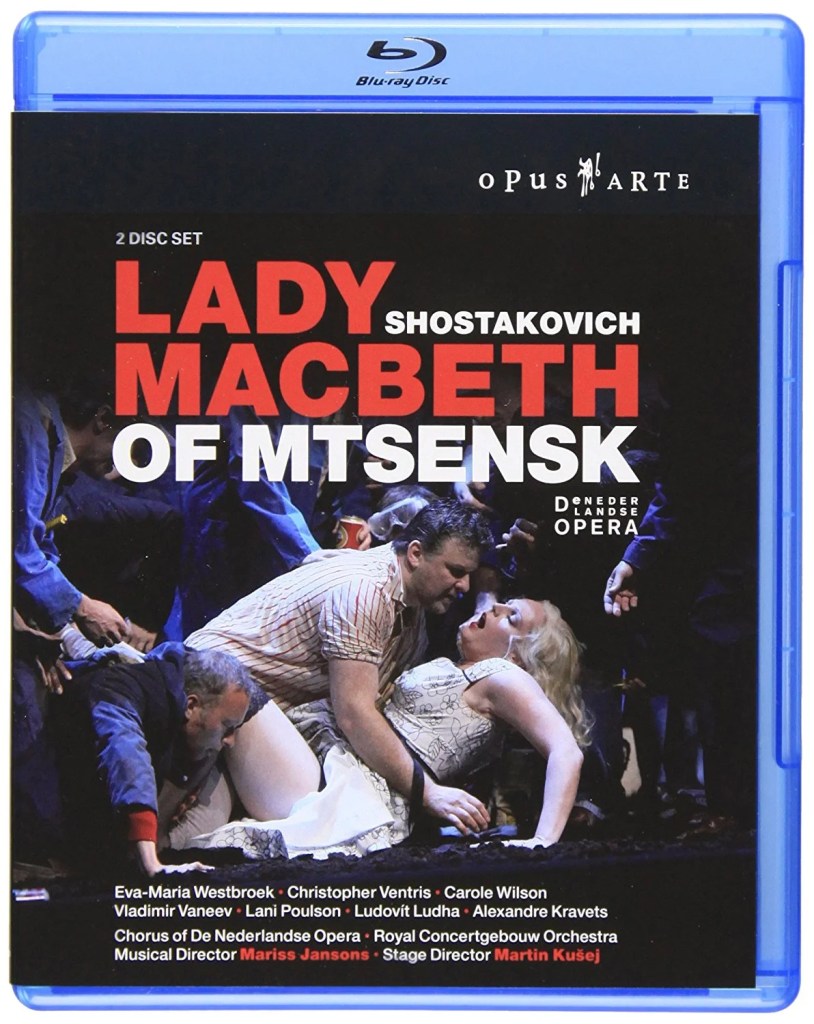
In October 2006, Eva-Maria Westbroek made her widely acclaimed debut at London’s Royal Opera House as Katerina Izmailova. It was even spoken of as ‘one of the most important debuts at Covent Garden ever’

.
But we, the Dutch opera lovers, already knew it, because at the Holland Festival in June 2006, Westbroek made her debut at the Netherlands Opera in the same role, in a performance that received nothing but overenthusiastic reactions.
The production also saw Martin Kušej, a not uncontroversial Austrian opera director, make his debut in our country. In his concept, sexuality and power are closely linked and the opera is a terrible abyss, which can only be described with words like orgasm and manslaughter.
Katerina lives in a glass cage with a hundred pairs of shoes, guarded by dogs and surrounded by mud. Her longing for love and security is never satisfied, because what Sergei has in store for her is pure sex, devoid of any affection.
The musical mix of tragedy and satire, seriousness and humour, lyrical melodies and hard porn was perfectly portrayed scenically by KuÅ¡ej, which was only enhanced by the phenomenally playing Concertgebouw Orchestra conducted by Mariss Jansons. As a bonus, you get an extremely interesting ‘the making of’ documentary (Opus Arte OA 0965).
GLORIA LANE, Rome, 1976

To my knowledge, only one recording exists of Katerina Ismailova’s 1963 adaptation of Lady Macbeth, on the budget label Opera D’Oro (OPD 1388). It is an RAI recording of a broadcast on 29 May 1976 in Rome.
The differences from the original are noticeable right from the first bars: it is milder, without the biting irony, with more melancholy and sadness. The biggest differences are in the intermezzi. The first, for instance, has been replaced by completely different music. Even in the big seduction scene, the bulk of the music has been killed off and almost all the high notes have disappeared from Katerina’s music.
The performance, conducted by Yuri Ahronovich, is most certainly adequate, although I have trouble with William Cochran’s Sergei. It may be just me, but I experience his tenor as pinched rather than sexy. In the lead role, another one of those forgotten greats of yesteryear: Gloria Lane. Her Katerina is very dramatic and full of passion.he making of’ documentary (Opus Arte OA 0965).
Finally, the very interesting documentary Shostakovich against Stalin by Larry Weinstein was once released on Philips (Philips 0743117) with very much historical footage and even more music. The docu can also be found in its entirety on You Tube
 Basia con fuoco