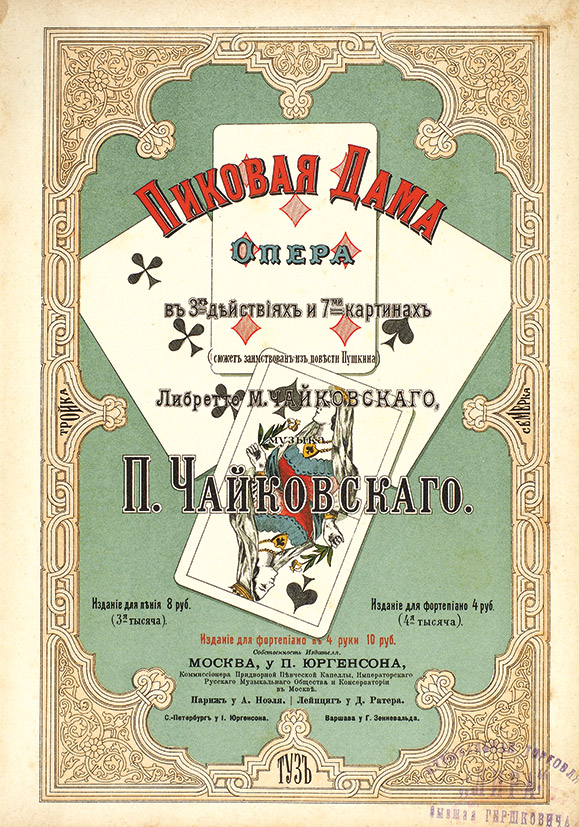
The Queen of Spades has always had something unsettling for me. I did not trust her. After all, she lacked the sweetness of Hearts, the wisdom of Diamonds and the sadness of Clubs. I experienced her as threatening
In Tchaikovsky’s opera, she symbolises the once blood-loving countess who, as legend has it, lost her entire fortune in a card game in her youth and regained it with the help of black magic.
The opera may be named after the countess’s ˜card alter ego”, but the real leading role belongs to Herman. A rather strange young man with obsessive eyes, of whom we know little to nothing. Fortunately, I would say, because this only adds to the suspense and mystery.
In Pushkin’s novel, on which the Tchaikovsky brothers based their opera, Herman is a German who at the end does not commit suicide but goes insane and is admitted to a mental institution.
Lisa (in the book not a granddaughter but companion of the countess) survives her misspent affair and marries a rich man.
Do you need to know it all before going to the opera?
No, you do not! Hence also why I always sincerely hope that the directors who take Pique Dame in hand ignore the novel and stick to what the opera is about: a musical dissection of obsessions.
It is about an addiction carried to the utmost absurdum; to gambling, to love, to money, to power, to everything really. And about an all-pervading madness to which Lisa too falls prey, making her behave as if she were possessed by the devil. This is what the score also says.
GEGAM GRIGORIAN
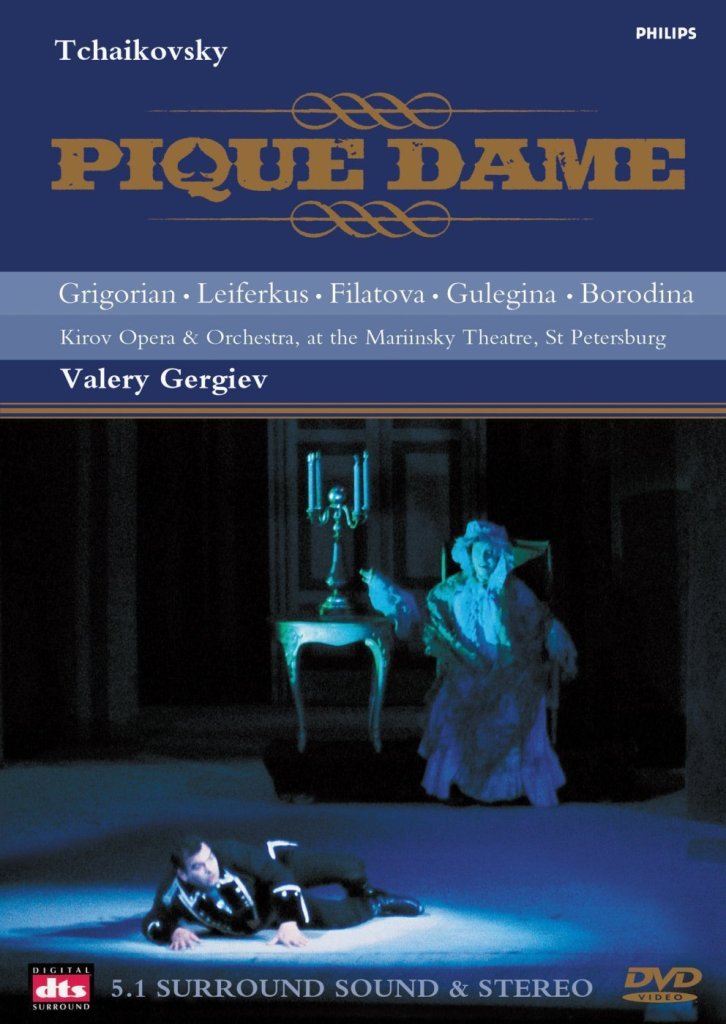
This 1992 Mariinsky production is a feast for the lover of traditional staging, where there is no room for updating and searching for hidden intentions. All the sets are super realistic, extensive attention has been paid to all the details and the costumes too seem to have been pulled out from under the dust.
That the whole thing nevertheless does not come across as very corny is due not so much to the director (Yuri Temirkanov, the renowned conductor and former artistic director of the Kirov), but to the truly superior team of singers.
Armenian tenor Gegam Grigorian, who died in March 2016, makes Herman a little brother to Otello, a true achievement.
Maria Gulegina, despite minor intonation problems, is a brilliant Lisa: tearful and heartbreaking.
Sergei Leiferkus puts on a solid Tomsky and Ludmila Filatova impresses as the old countess. Only Alexander Gergalov’s understated Yeletsky is not up to par, but he is soon forgiven, after all he has only the one aria to ruin.
Gergiev conducts animatedly, though he is not the subtlest. (Philips 070434-9)
VLADIMIR GALOUZINE
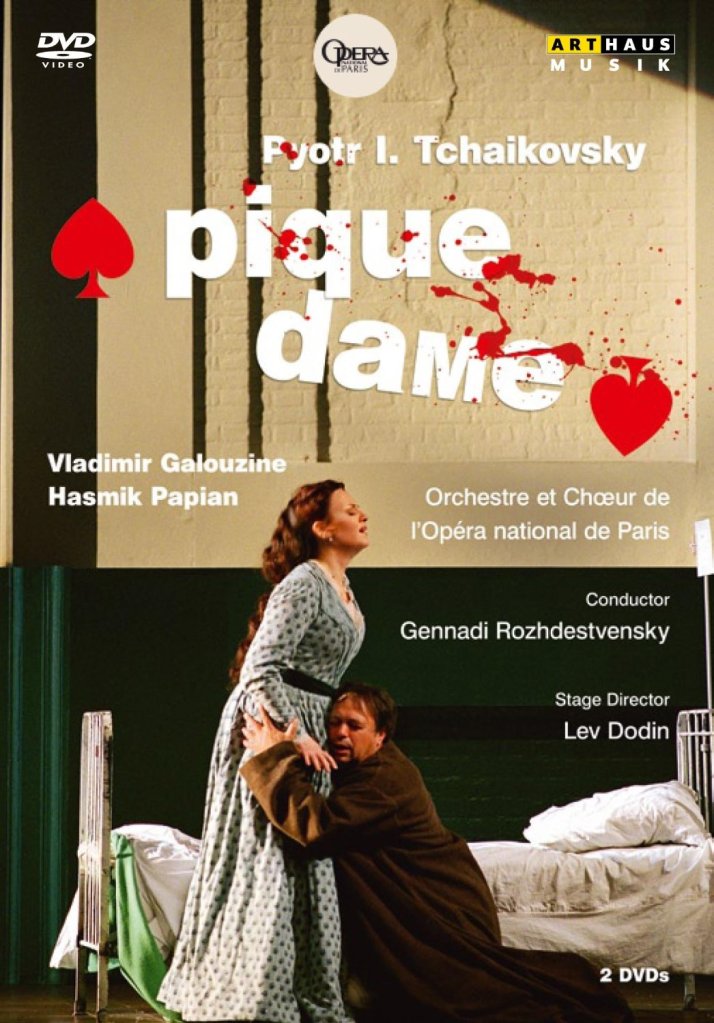
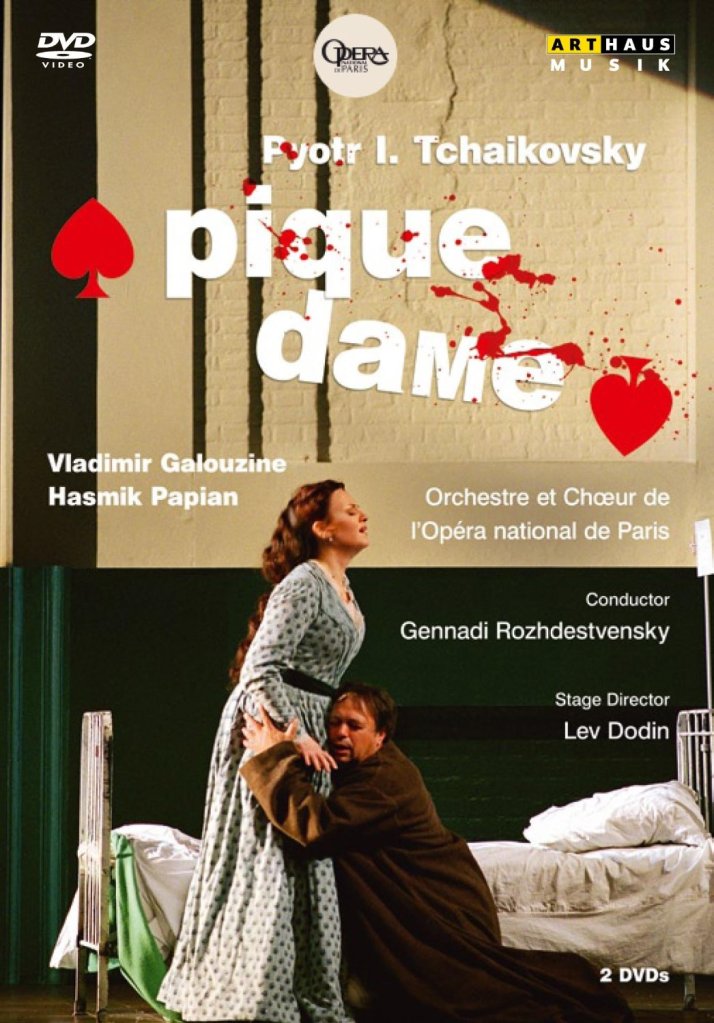
We experienced Lev Dodin’s recorded in Paris production of 2005 a few years earlier in Amsterdam: DNO staged it back in 1998.
Lev Dodin is a renowned playwright and a great Pushkin enthusiast, which is why he wanted to return to the original story (here we go again!), which he felt was thoroughly botched by the Tchaikovsky brothers.
He came up with a formula that was ˜logical” in itself, in which the whole story exists only in the memories of the mentally ill Herman. I think I could probably live with it if Dodin had not subordinated the music to his concept and had not cut into the score: he deleted some 20 minutes of Tchaikovsky’s music and added a spoken text. I consider this a real crime.
The music that remains, however, is spot on. Rozhdestvensky has the score in his fingertips and there is also a lot of excellent singing, mainly by Vladimir Galouzine as Herman. He seems utterly fused with the role and commands admiration for his brilliant performance, both vocally and theatrically.
Hasmik Papian is a moving Lisa and as Polina we hear the young Christianne Stotijn (Arthouse Music 107317)
MISHA DIDYK.
This made me really go quiet
This because of the unimaginably beautiful traditional production directed by Gilbert Deflo, which faithfully follows both the libretto and the score in every detail, while also being challenging and unusually exciting (Barcelona 2010).
The conductor (Michael Boder) handles the music with velvet gloves, steering it in the right direction and creating an atmosphere where pastoral scenes, sweet songs and folk dances alternate with horror, fear and death.
I fall silent too when hearing the singers, who give everything that even the most discerning person can desire. Micha Didyk ís Herman. He looks like Herman, he acts like Herman and he sings the role as only the real Herman can: passionate, obsessed and driven to madness. Truly: I don’t think there is any singer these days who can match him in the role. Peerless.
Nor can I imagine a better countess than Ewa Podleś : impressive. Superb also are the two baritones Lado Atanelli (Tomsky) and Ludovic Tézier (Yeletsky) and the warm Russian mezzo Elena Zaremba (Polina). Add the veteran but certainly not forgotten Stefania Toczyska in the small role of the governess…. Top.
I dó have a little bit of trouble with Emily Magee: she looks and sounds a little too old for the role. When I think of Lisa, I think of Natasha (War and Peace) or Tatyana (Yevgeny Onjegin): an excited young girl and not a mature woman.
Nevertheless: an absolute must-see. (Opus Arte OA BD 7085)
an excerpt:
With the images of the production in your mind, you can sit back and listen to the recording under Mariss Jansons. In a manner of speaking, then, because even with Jansons the tension is cutting edge.
Larissa Diadkova is an outstanding countess, very moving in her great aria ‘Je crains de lui parler la nuit’. Tatiana Suryan is a firm yet fragile Lisa and in the duet with Polina (beautiful Oksana Volkova) their two voices melt into a harmonic unity, worthy of sisters. Even without vision, Mischa Didyk is the best Herman around.
The recording, recorded live in Munich in October 2014, sounds more than excellent (BR Klassik 900129)
VLADIMIR ATLANTOV
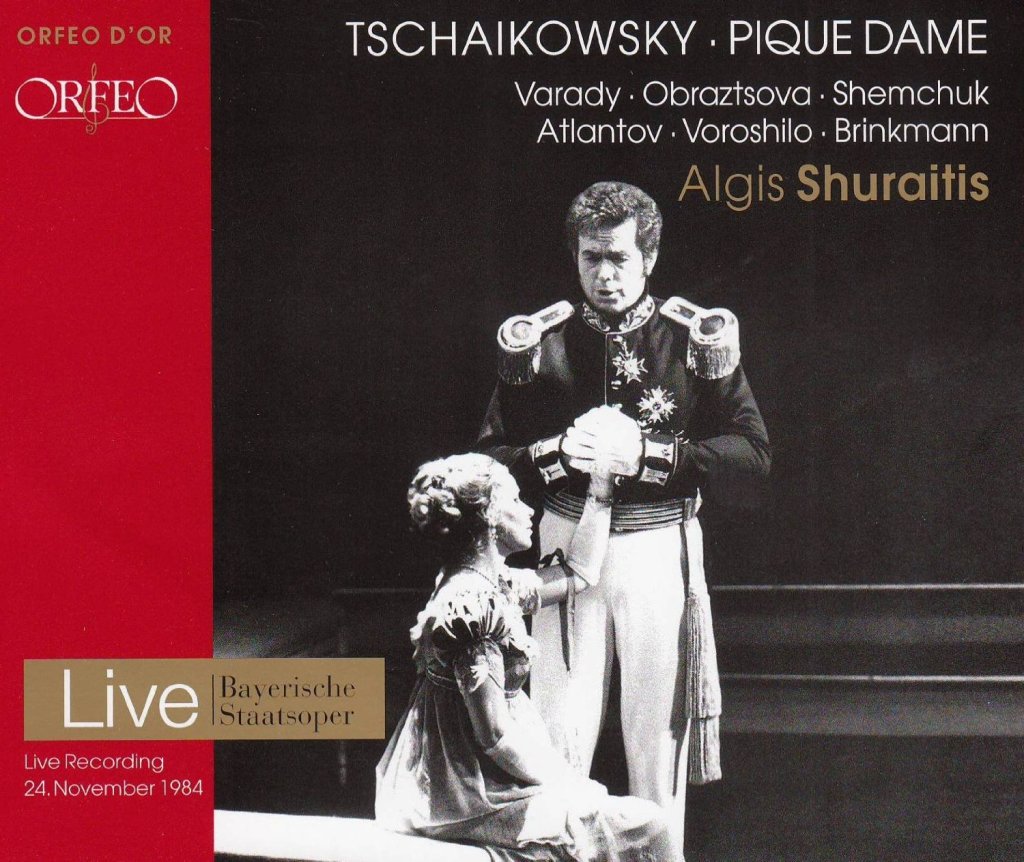
Julia Varady and Vladimir Atlantov were once a ˜match made in heaven”. In Munich in November 1984, they sang just about the most ideal Lisa and Herman in history, although I also have my reservations about Atlantov.
Atlantov has a cannon of a voice, which makes everything seem so unimaginably easy with him. Very beautiful, but his Herman sounds a bit too heroic and under-tormented for me.
Varady is a perfect Lisa in every way: vulnerable, insecure and in love. Lisa’s aria ‘Otkúda eti slyózy’ and the subsequent duet with Herman ‘Ostanovítes’ is breathtaking and of a touching beauty. Elena Obraztsova is a very impressive countess.
Algis Shuraitis conducts with little subtlety, but his reading is extremely exciting with a very cinematic ending (Orfeo D’Or C8111121).
Atlantov in ‘What is our life’
Recording from a performance at Mariinsky (not on DVD to my knowledge):
LEYLA GENCER
You really should have this recording, of course, because of the Turkish Diva. It is in Italian and the 1961 recording sounds pretty dull, but a collector takes it all for granted.
A totally unknown for me, Antonio Annaloro, does what he can and that, unfortunately, is very little. His uninspired Herman is a real crier and sounds like a Domenico Modugno in a mini format. Soon forgotten.
But Marianna Radev’s Countess is worthy of note. And ‘Da quando il core mi donasti’ aka ‘Ya vas lyoublyu’ by Sesto Bruscantini (Yeletski) is delightful and is rewarded with a very deserved ovation.
Nino Sonzogno revives a verist heaven, though not quite rightly so here (Gala GL 100.792)
 Basia con fuoco