
LA TRAVIATA

The November 2004 Venice production directed by Robert Carsen was made for the reopening of La Fenice which had totally burnt down eight years earlier. For this special occasion the first version of the opera, from 1853, was chosen. Good thinking, since the (then unsuccessful) premiere of what would become Verdi’s most beloved opera ever, had taken place precisely here. The main differences with the one-year later version, which is the one known to us, are in the duet between Violetta and father Germont, and the two final numbers of the third act.
Like no other opera, Traviata allowes itself to be updated. Incidentally, it was Verdi’s wish to stage it in contemporary costumes. Carsen’s direction is all about money, and the dollars really fall from the trees like leaves. He moves the time of action to the 1980s, the time of rising megastars, supermodels, gigaparties, as well as junkies, squatters and AIDS. As always with him, everything is implemented very logically and consistently
An absolute highlight is the opening scene of the last act, in which the now totally (also literally!) brought down Violetta watches a video of her past. A video that at some point stops and then goes on to only show ˜snow”. The scene grabs you by the throat and never lets go. The epitome of good modern directing.
Violetta is very movingly performed by the both vocally and scenically impressive Patricia Ciofi. As Alfredo, Italian-German tenor Roberto Sacca comes across very convincingly, and Dmitri Hvorostovsky is an outstanding Father Germont (Arthaus Musik107227 )
Last seven minutes of the production:
IL TROVATORE
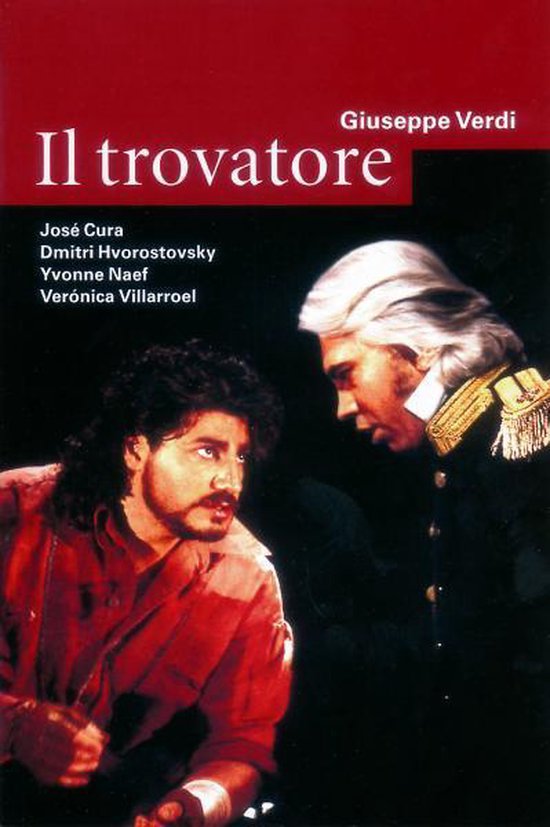
Some operas should be renamed. Verdi’s Il Trovatore should actually be called ˜Azucena” because, after all, she is the one who dominates every scene from the first moment she emerges.
It is Azucena who pulls the strings and only she can save or break all the characters. Through her thirst for revenge, she destroys everything and everyone, and no average baritone can match that. Although, average?
In his role debut as Luna, Dmitri Hvorostovsky more than surprised me in this Royal Opera House production. I still had my doubts about him in the early 1990s, but I take back everything I said about him in those days. Never did I think that there was still a baritone who could sing ˜In balen del suo sorriso” so emotionally moving. And indeed, at the ˜Sperda il sole d’un suo sguardo…” I even had to shed a tear, it was that beautiful.
EVGENI ONEGIN

I am (or should I say was?) a huge Robert Carsen-adept and I love (loved) almost everything he did. So too this Onegin , the production he made for the Metropolitan Opera in New York, which was recorded in February 2007 (Decca 0743298).
His staging is very realistic and closely follows the libretto. In the first act, the stage is strewn with autumn leaves, but everything else is basically bare and there is almost no scenery. A bed for the ˜letter scene”, some chairs in the second and third acts. At the duel, the stage is completely empty.
This is not distracting from what is happening. On the contrary. The costumes are really beautiful, but especially in the first act they remind me more of English Jane Austen film adaptations than of the Russian countryside. But that is alright, the eye wants something too, but Renée Fleming is too glamorous for a peasant girl, making her transformation into a proud princess less impressive.
Onegin (Dmitri Hvorostovsky) is primarily a dandy here, very concerned with his looks. Well, Dima is an extremely attractive singer in all aspects, but in his confrontation scene with Tatyana, he reminds us more of daddy Germont than Onegin.
Ramón Vargas was one of the best lyric tenors in 2007, but Lensky he was not. He really does his best, he also looks like a real poet, but this role needs a bit more “languish”.
Carsen’s character direction is truly unsurpassed and even Fleming seems to thaw out at times. Unfortunately, her Russian is totally unintelligible.
Fleming and Hvorostovsky in the opera’s final scene:
THE BELLS
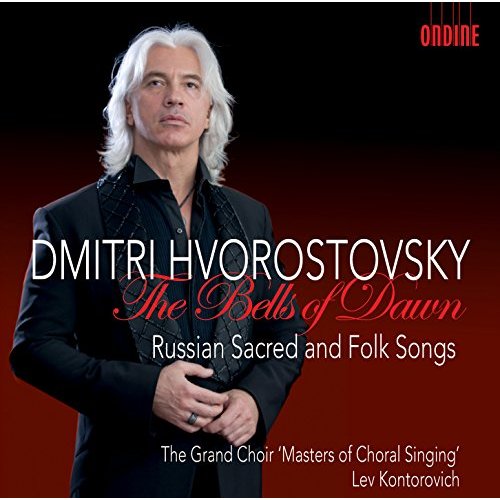
That this CD disappoints me somewhat is not because of the performance, because there is nothing to criticise about Dmitri Hvorostovsky’s voice, singing or interpretation. Those are simply perfect!
The beauty of the sound coming out of his throat is truly unimaginable. It is nothing less than the epitome of perfection.
What impresses me most about Hvorostovsky, besides his wonderful bronze sound, is his beautiful pianissimo. At times he sounds almost fragile, providing a fine contrast to the more heavily set passages.
You can hear this well in the solo ˜Prostchay, radost” (Farewell, My Joy). The moods alternate, but what remains is an all-encompassing feeling of total loneliness. After this, you can’t help but stop the music for a moment of silent reflection.
But the CD is not over yet. The feeling is still held for a while, but slowly the emotion ebbs away. The songs on the CD are hard to distinguish from each other, so it just gets boring and monotonous in the long run. At least for me; a ˜hardcore” lover of Russian spiritual songs and Slavic choirs may well enjoy this.
The Grand Choir ˜Masters of Choral Singing” is very much in the background and, under conductor Lev Kontorovich, is mostly subservient to the soloist.
Below is one of the CD’s finest tracks, ˜Vyhozhu odin ya na dorogu” by Elizaveta Shashina:
Dmitri Hvorostovsky in two live recitals
Dmitry Hvorostovsky zingt Sjostakovitsj en Liszt
 Basia con fuoco