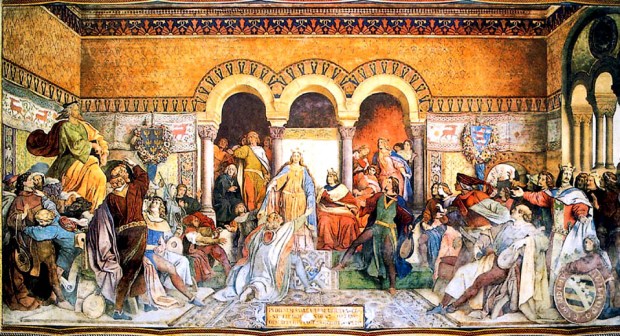
Moritz von Schwind: Der Sängerkrieg
As a young singer you could, so to speak, take part in a singing competition every week. Everywhere there are opportunities to sing yourself into the spotlights. Great news for the many talents that are around. But not everything is necessarily positive.
It is claimed that ‘the public’ is fond of competitions and I believe that. Already in antiquity people were able to keep their minds at rest with bread and games; and all kinds of competitions were organised, for poets and philosophers, but also for singers. The tradition lived on, and singing competitions also found their way into operas. Just think of Die Meistersinger or Tannhaüser. You were always rewarded for your singing skills. Once you were allowed to take the beautiful bride home, nowadays your price has become more tangible. A sum of money, a contract with an opera house and secret hopes of fame and a great career. No wonder, then, that there are so many competitions.
But: aren’t there too many now? Shouldn’t there be an age limit? Can you compare a singer who already sings at big houses with a starting colleague? Do competitions bring what the often very young participants have hoped for? Does it help them in their careers? You win and then? And how do you deal with your loss?
All these questions made me decide to take a closer look at the phenomenon of ‘singing competitions’ and to talk to some directly involved.
Maartje Rammeloo (soprano):

Een bijschrift invoeren
In 2008 Maartje Rammelo was one of the semi-finalists of the IVC, where she eventually won the Staetshuijs Fund Prize. At the Belvedere Competition in 2013 she reached the semi-finals. She also won an engagement in Essen. Rammeloo was a finalist at the Montserrat Caballé Competition in Zaragosa and at the Wilhelm Stennhammer Competition in Sweden.
“Taking part in competitions gives a double feeling. It inspires and is exciting, but results are either terribly predictable or completely bizarre.
You always participate with the aim to show the best of yourself and hope that this is sufficient to convince a jury of your quality: but how can you judge the skill and artistry of a musician in a competition? In an audition for a production, an artistic team has a concept and an idea about who should play a role. But in such a contest, several judges, each with their own taste, compare apples with pears: a Figaro with a Tosca, a Handel countertenor with a Wagner soprano.
Not to mention the intrigues and the hidden agendas of some judges, the chauvinism in regional competitions and the exoticism/commercialism of sometimes choosing singers who don’t necessarily give the best performance, but who are very interesting because of their origin or appearance.
So why participate? It gives you a chance to try out new repertoire and get feedback. It’s a chance to sing for the most important people in the profession, for whom you’ll never get an audition arranged in real life without a brilliant agent who guides you in.
I haven’t yet participated in a competition that didn’t either involve me in work or contacts, or gave me some useful feedback. And that is ultimately what we want: to work! Sing! To stand in front of an audience!
The prizes make it easier to practise your profession. From a financial point of view, because our profession doesn’t make us rich in the first few years, and also in terms of fame, which in turn can create more work. But just as well there are plenty of prize winners of whom we will never hear from again and singers who have never won a competition that now have a world career. At the end of the day it’s all about the long haul, not about the quick success…
What is always very difficult with competitions, is choosing your repertoire. First of all, few singers are 100% sure of their ‘fach’. Most of them doubt again and again what judges would like to hear them in.
Each competition has its own requirements. So many arias in total, so many of them from the list of compulsory works, of which your first round may only last for so many minutes and the jury detirmines the number of arias for the next round, and so on. Terribly difficult. Because you want to be heard as much as possible. Different languages, different styles, different techniques and topics.
There are also a number of competitions that offer more than just the competition element. I now also encourage my own students to look out for those. Contests like the IVC that use things like a youth jury, master classes, concerts and lectures to make it a real singing festival. And these are often the competitions that keep in touch with you in the years that follow. Who are committed to the further development of the singers. But unfortunately there are very few of them…
I have learned that if you sing what you feel comfortable with and what you are really good at, then at least one person will be happy after your performance. Namely you.
Maartje Rammeloo sings ‘I want magic!’ from The Streetcar named Desire by André Previn:
Piotr Barański (countertenor):

© Cornelia Helfricht
In 2012, Piotr Barański was a semi-finalist at the IVC in Den Bosch.
“For a long time I didn’t want to know anything about competitions, I didn’t think I was the type for them. You not only have to prepare yourself well, but also be sure of yourself and show the best of yourself to the jury, you have to perform while under stress. You have to be able to handle that very well and not everyone can.
And yet – competitions are very important. You get the chance to present yourself to a wider audience, to get to know new, important people – and in our profession we have to rely on connections and networks. And of course it’s very important that you can show yourself to conductors, agents, planners and casting directors who are looking for new talents.
Unfortunately, there are competitions where the eliminations and the first preliminaries take place behind closed doors and only the finals are open to the public. The chances of learning something from such competitions are then minimal.
The criteria of the jury are not always clear and the results can be very controversial. I know singers who, singing at the same level, win the highest prizes at one competition, while at the other they do not get any further than the preliminaries.
What is very important to me is the feedback. It is of the utmost importance for the further development of a singer to at least exchange a few words with the jury members, something that indeed happened at IVC and that has helped me enormously. A healthy, positive critique is indispensable and constructive.”
Piotr Barański (countertenor) and Hans Eijsackers (piano) in “Lullaby” from ‘Songs and Dances of Death’ by Modest Mussorgsky.
Reinild Mees (pianist):
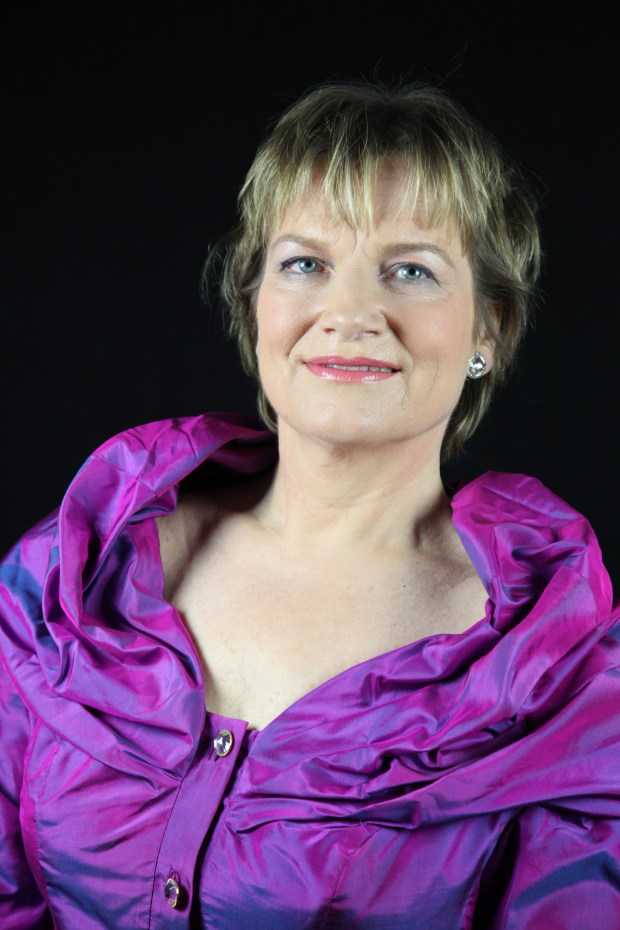
© Janica Draisma
“The results of singing competitions are already quite unpredictable – how a career goes after that is even more like gazing into a crystal ball! A performance (because that is what singing at a competition in fact is) is and remains a snapshot, even for those who listen and/or judge. There are so many factors involved: age, experience, musicality, voice, repertoire, language skills, etc. that it is sometimes difficult to determine which aspect is decisive.
The preparations for a competition, selecting and working on the repertoire with a singing teacher and a coach are invaluable. This requires great concentration and discipline – the pieces you have to learn will not be forgotten for the rest of your life – and in addition you have to make yourself strong to present yourself, you have to find the courage to do so, and you have to be able to cope with nervousness.
My experience is that a competition is always good for the development of a singer, even if in the worst case you are sent home. After all, the next day you have the choice: either you stop, or you decide to continue and develop yourself further in order to find new opportunities. Almost always you choose the second option and then it has been a good experience! Competitions are very valuable, even if you don’t win a prize…”
Reinild Mees accompanies Tania Kross in ‘Der Kaiser’ by Henriëtte Bosman±.
Reinild Mees and all Szymanowski songs, sang by (a.o.) Piotr Beczala and Iwona Sobotka.
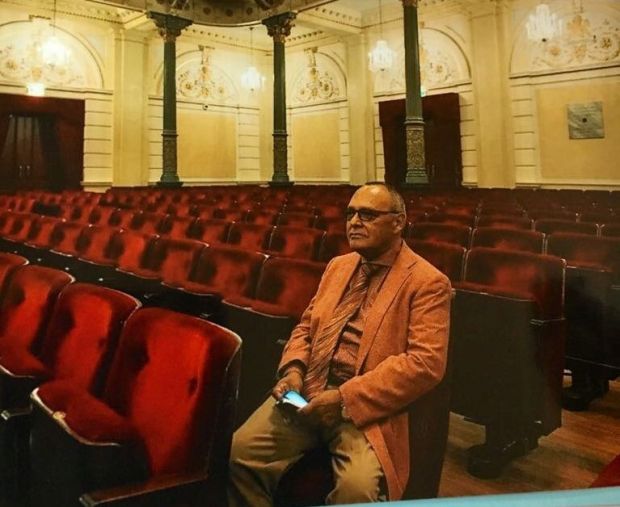
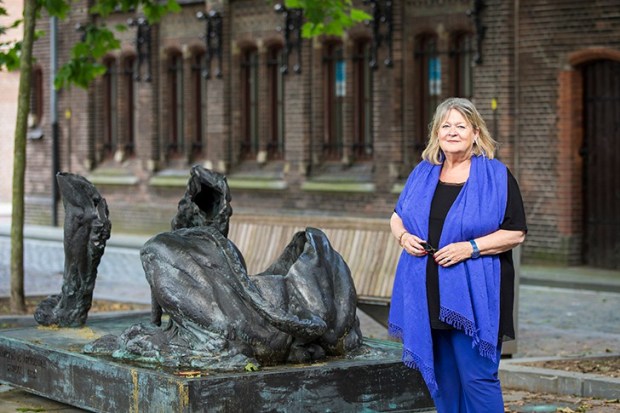
Mauricio Fernández (from 1983 to 2016 casting director NTR Saturday Matinee):
 Basia con fuoco
This essay is not only interesting but addresses pros and cons of competitions most exhaustively. It makes it an excellent read indeed.
LikeGeliked door 1 persoon
Thank you so much!
LikeLike
Great article – it can be a beginning of a very interesting discussion. The Lullaby is wonderful.
LikeGeliked door 1 persoon