
In the late nineteenth century, Ermanno Wolf-Ferrari fell under the spell of church music composer Don Lorenzo Perosi, with whom he also became friends. It was also under Perosi’s influence that Wolf-Ferrari composed his cantata Talitha Kumi and the choral work La passione.
The latter, which was based on ancient Italian folk poetry, Wolf-Ferrari also dedicated to his friend. The beautiful youthful work ‘Otto cori’ also betrays the composer’s great love for Renaissance music.

Talitha Kumi!” means “Get up!” in Aramaic. It is a quote from the Gospel of Mark which tells the story of Talitha, the daughter of Jairus. She is dying and in his despair – and hope for a miracle – Jair goes to seek help from Jesus. When Jesus reaches the house of Jairus, the girl is already dead, yet he manages to raise her from the dead.
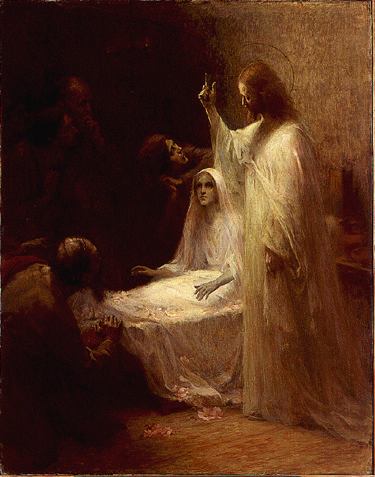
Resurrection of the daughter of Jairus, by Victor-Oscar Guétin, 1902.
It is the evangelist who carries the story of the work: tenor Rainer Trost sings his text very impressively and manages to keep the listener glued to his every word. Jairus and Jesus have relatively little to do, but both roles are excellently performed here by baritone Joan Martín-Royo. The choir and orchestra have no more than a contemplative role. Call it a ‘colour-wash’ background.
 Basia con fuoco