
Karl Weigl, ca. 1910; the photograph was featured in Die Musik (1910) to accompany Richard Specht’s essay “Die Jungwiener Tondichter.
Karl Ignaz Weigl was born in 1881 in Vienna into an assimilated Jewish family. In 1938, he fled to New York, where he died ten years later. He was important contributor to the ferment of musical styles in Vienna in the early twentieth century. His compositions, which are still rarely being performed, are very traditional, anchored in a ‘Viennese sound’.
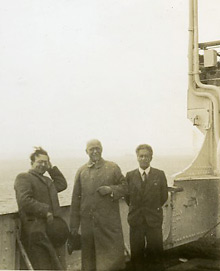
Karl Weigl on board the S.S. Statendam during the transatlantic crossing from Southampton to New York in October 1938.
That his symphonies are occasionally reminiscent of Mahler is not so surprising: Weigl worked closely with Mahler as his personal assistant at the Vienna Court Opera. But Brahms, too, is never far away.
In 1938 Arnold Schönberg wrote: ‘I have always regarded Dr. Weigl as one of the best composers of the old school; one of those who continued the glittering Viennese tradition’. No one could have put it better.rl Weigl on board the S.S. Statendam during the transatlantic crossing from Southampton to New York in October 1938.rl Weigl on board the S.S. Statendam during the transatlantic crossing from Southampton to New York in October 1938
Weigl studied with Zemlinsky, who held his pupil’s compositions in very high esteem. His works were performed by the most distinguished musicians, like Furtwängler and Georg Szell. It is truly unimaginable that he was so utterly forgotten: it was only after the year 2000 that record companies began to take some interest in his music. So huge kudos to Capriccio that, it seems, is in the process of creating a real Weigl (and more forgotten composers)-revival.
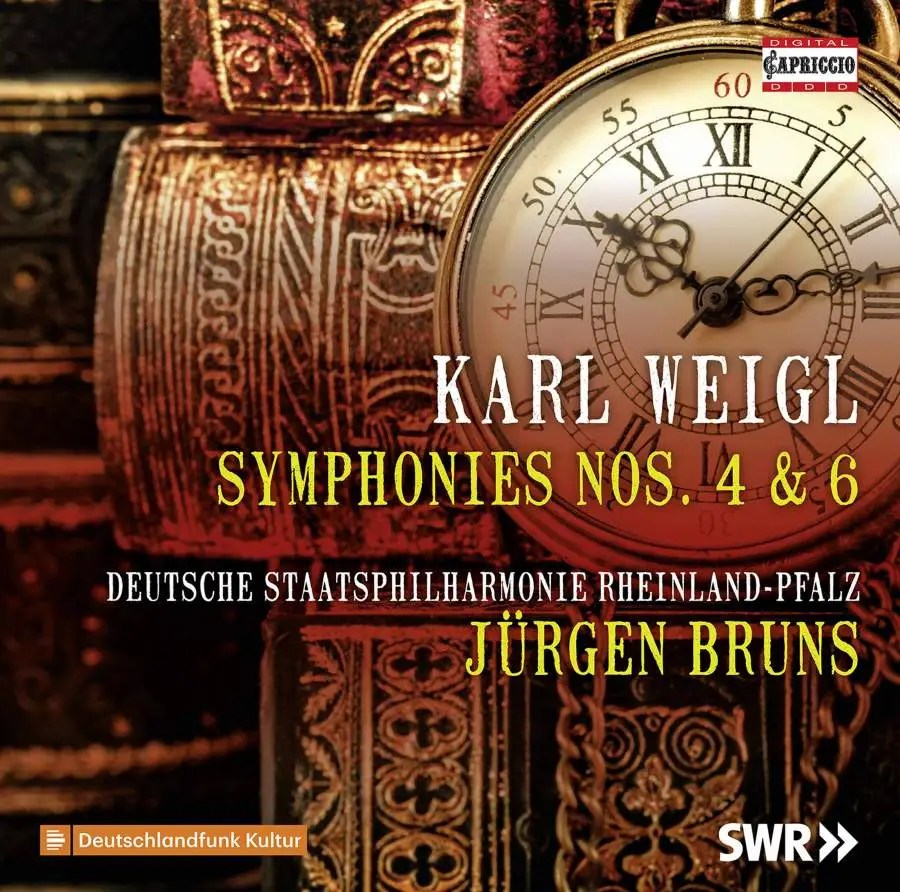
Weigl composed his fourth symphony in 1936. When I put the CD on, I first thought I was dealing with an unfamiliar version of Mahler 1; the resemblance is more than striking. But even the sixth symphony has its ‘Mahler moments’: think of the seventh! The performance by the Deutsche Staatsphilharmonie Rheinland-Pfalz conducted by Jürgen Bruns is outstanding

The ‘glittering Viennese tradition’ is Weigl’s main trademark. To put it irreverently, his music may be seen as sort of a gateway. A kind of corridor that runs from a classical Beethoven via a soul-stirring Schubert and an underground erotic Zemlinsky to finally end up in Weigl’s calm waters, and from there it finds its way to our hearts.
Weigl is not a composer I have heard much of (no, it’s not my fault) and apart from his, by the way, wonderful songs and a few of his chamber music compositions, I did not know him very well. So this CD is more than welcome, especially because the musicianship is so incredibly good.
I am most charmed by the violinist David Frühwirth. His tone is very sweet, as sweet as a Viennese Sachertarte. You can hear it best in the very Schubertian piano trio, but make no mistake! Just listen to the allegro molto, the third movement of the second violin sonata from1937 and you discover the complexity of the ‘Wiener-sound’.
And I feel free to use another quote, this time from Pablo Casals: “His music will not be lost, after the storm we will return to it, one day we will return to those who wrote real music.” It has taken a while and we are still far away, but a beginning has been made.

Detail of Karl Weigl diary entry, summer, 1937.
.

 Basia con fuoco