
GIUSEPPE VALDENGO
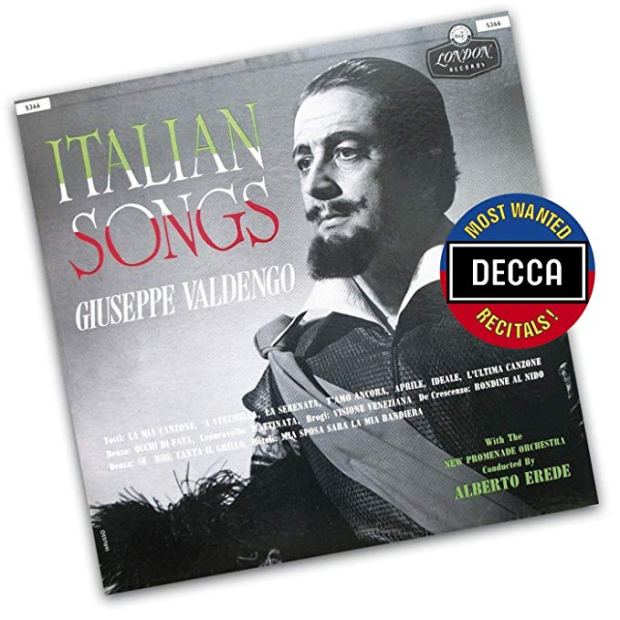
In May 2014 Giuseppe Valdengo would have turned 100 years old. A fact that has escaped everyone, because the baritone born in Turin is now almost completely forgotten. How sad! And then to think that he was one of the beloved singers of Arturo Toscanini! He can still be admired on live radio recordings of Aida, Otello and Falstaff, led by the great maestro.
Opera News wrote about Valdengo: “Although his timbre lacked the innate beauty of some of his baritone contemporaries, Valdengo’s performances were invariably satisfying – bold and assured in attack but scrupulously musical. How true!
Below is a tribute to the baritone, made on the occasion of his hundredth birthday:
I knew him from his performance in the film Great Caruso with Mario Lanza, but he really impressed me with his role of Alfio in the RAI filmed Cavalleria rusticana, with the inimitable Carla Gavazzi as Santuzza.
Alfio is missing on the 1949 CD recorded for London, but his Tonio from Pagliacci, a role with which he celebrated unprecedented triumphs, is included. Furthermore, two very moving arias from Rigoletto, plus the Italian sung Hamlet and Valentin (Faust), sound very touching.
Most of his recital, however, is taken up by Italian songs by Tosti, Brogi, Denza and Leoncavallo. Repertoire that fits him like a glove.
MADO ROBIN
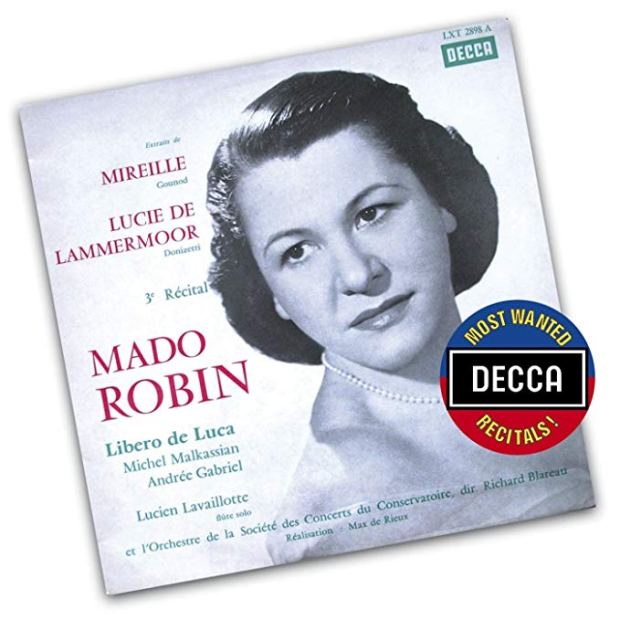
The French coloratura soprano could actually be considered the eighth world wonder Her voice was of the soubrette type with a very pleasant girlish timbre and her coloratura technique more than sublime, but there was more: her high notes were extremely high. With her voice she not only reached the F4, but even had the C4 within her reach without any problems, one of the highest notes ever sung by a human voice.
All her high notes in a row, with the description:
In the fifties she was a very celebrated radio and TV star in France, but her fame reached far beyond her national borders. She celebrated her greatest triumphs as Lakmé and Leïla (Pearl Fishers), but her Lucia and Olympia were also proverbial.
Gounod’s Mireille is not really a role we would expect from her, but it fits wonderfully well with her childishly naive timbre. I enjoyed these fragments the most, much more than her Lucia and Bellinis.
GERARD SOUZAY
The in all respects beautiful baritone Gérard Souzay has made the big mistake to sing on for far too long. His last Philips recordings are unlistenable and with his hair dyed pitch black he looked rather pathetic. A great pity, because if you listen to his earlier recordings, you can only fall in love with him and his voice.
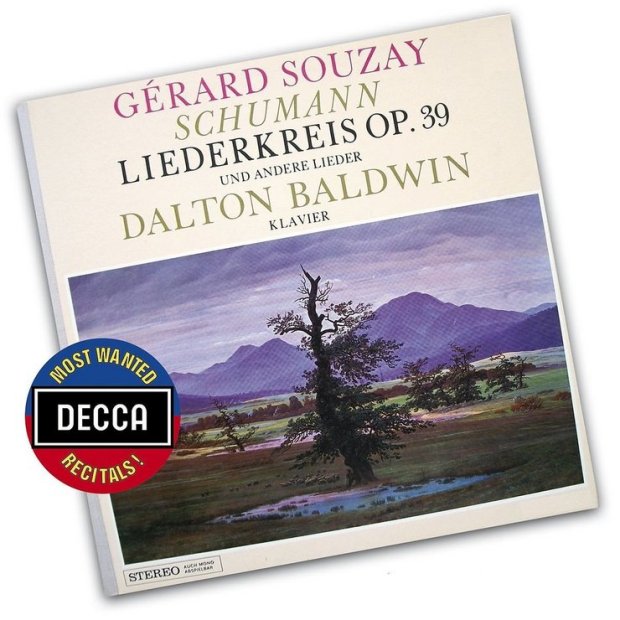
Souzay was without a doubt one of the greatest performers of French song and his Faurés and Ravels are a delight. But don’t underestimate his German lieder either! Listening to his recording of Schumann’s Liederkreis from 1965, one cannot escape the thought that this music should go like this, and not otherwise. Just listen to his ‘In der Fremde’; I want to bet you cannot escape the feeling of being displaced yourself.
Below Liederkreis:
His Dichterliebe is just as beautiful: with his light baritone and his sweet, sweet sound he makes you actually fall in love. The recording dates from 1953 and in addition to the cycle we get three separate Schumann songs, including an interpretation of ‘Nussbaum’, which moves me to tears.
In these recordings Souzay’s then regular accompanist Jacqueline Bonneau accompanies him. After 1954 she gave way to Dalton Baldwin (Bonneau did not like travelling). Souzay had a kind of musical marriage with Baldwin. Their collaboration guarantees ultimate beauty.
Below is Dichterliebe:
VIRGINIA ZEANI

Born in 1925, Zeani made her debut at age 23 as Violetta in Bologna, a role that would become her trademark. She had no less than 69 roles on her repertoire, many of which were premieres – she created the role of Blanche in 1957 in Dialogues des Carmélites by Poulenc. Her repertoire ranged from Haendel, Bellini, Donizetti, Massenet and Gounod to Wagner. And of course the necessary Verdis and Puccinis.
Her Puccini arias, recorded in 1958 under the direction of Giuseppe Patané, have – together with a recital by Graziella Sciutti – been released earlier by Decca; but her Donizettis, Bellinis and Verdis from 1956 (conductor: Gianandrea Gavazzeni) have their CD premiere.
INGVAR WIXELL

The Swede Ingvar Wixell was and remains a more than phenomenal Verdi baritone, and his Rigoletto ranks among the best creations of the role.
Below Ingvar Wixell sings ‘Cortigiani, vil razza dannata’ in Jean-Pierre Ponnelle’s 1982 Rigoletto film:
He had a sonorous sound most reminiscent of a firm oak, at first sight unshakable and yet sensitive to wind and rain. You can hear it best in ‘Tregua è cogi’ from Attila:
HILDE GUEDEN

 Basia con fuoco