
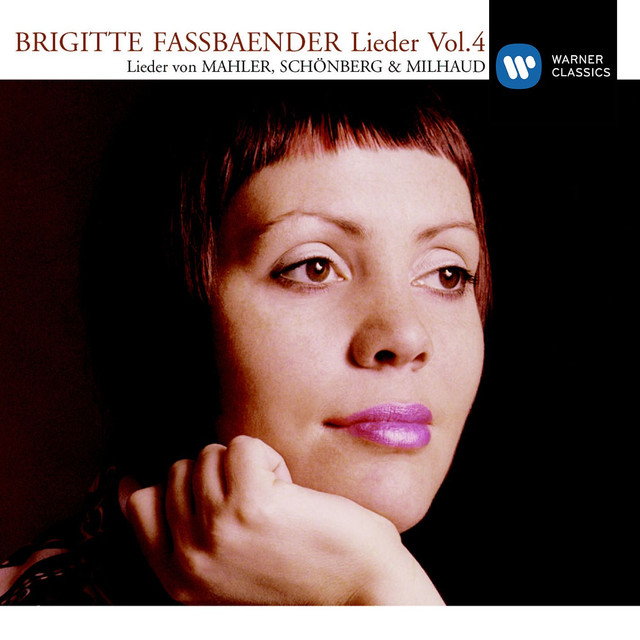
In the original EMI release (74767972), the texts were not included. A shortcoming, but they were not strictly necessary: Fassbaender articulates so well that every word is clear, without compromising the music.
Her Mahler is very sensitive, sung with compassion. Sometimes her emotions get the better of her (Lieder eines fahrenden Gesellen), but I don’t mind. Mahler can have it.
Arnold Schoenberg is very different. He composed his cycle ‘Das Buch der hangenden Garten’ in 1908, and though it is not devoid of emotions, it is strictly atonal. In an interview with Thomas Vogt, Fassbaender confesses that learning to sing the songs was not easy, yet she finds them written ‘liltingly’. And that is also how she performs them, liltingly, as if she were singing Schumann.
Milhaud’s songs are another thing altogether: if Mahler was the appetiser and Schoenberg the (heavy) main course, the “Chansons de la négresse” make for a lovely light dessert. Despite the far from cheerful texts, they are light-hearted and dancey, and they are very pleasant to listen to.
Gustav Mahler, Arnold Schoenberg, Darius Milhaud
Brigitte Fassbaender (mezzo-soprano)
Irwin Gage & Aribert Reimann (piano)
 Basia con fuoco