
Set design by Alfred Roller for ‘Der Traumgörge’. Vienna Court Opera 1907
“The fairy tales must become reality,” sings Görge, after his dream has been laughed at by the farmers and his fiancée Grete. And so it happens: Görge finds his dreamed princess in the form of Gertraud, cast out by the farmers, and his dream comes true.
Zemlinski has provided the story of Görge the dreamer and his search for the unattainable ideal with music of touching beauty. Sehnsucht, shimmering eroticism, symbolism …. You name it and you’ll find it. The work reminds me strongly of Szymanowski’s Król Roger, the same long, spun-out lines in the soprano aria, the same overwhelming choral parts, swelling orchestra. I love it.
Josef Protschka as Geörge:
Der Traumgörge (Leo Feld’s libretto after Richard von Volkmann-Leander’s fairytale ‘Vom unsichtbaren Königreich’ and Heine’s poem ‘Der arme Peter’) was meant by Zemlinsky as a tribute to his then beloved Alma. Due to circumstances, the opera was never performed during his lifetime; the first – considerably shortened – performance only took place in 1980.
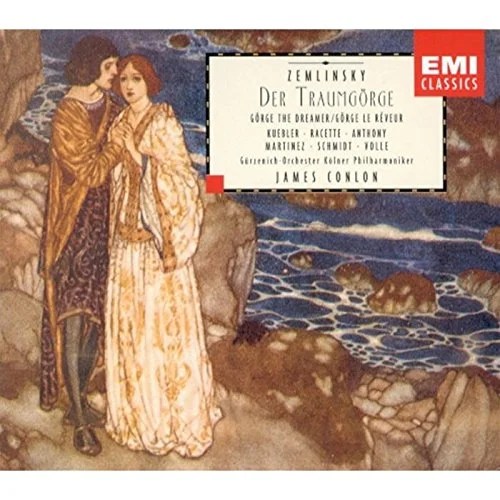
The first complete recording from 1999 proves that the music is not to blame. The Cologne orchestra conducted by James Conlon alone deserves an A-plus and the soloists are absolutely sublime.
David Kuebler plays a beautiful Görge with a radiant height. His voice mixes the right amount of metal with sottovoce, which is necessary for this role.
Patricia Racette, then still a great unknown, is unearthly beautiful as Gertraud (her velvet tones in ‘Oh! Ich wil zu dir in die Welt’ are of a Korgoldian beauty) and Andreas Schmidt has enough of a peasant to be a convincing Hans. The live recording sounds excellent.
Just imagine: The world premiere of Der Traumgörge took place in Nuremberg in 1980 – almost 80 years after it was written. Find out more in this documentary by Staatsoper Hannover:

 Basia con fuoco