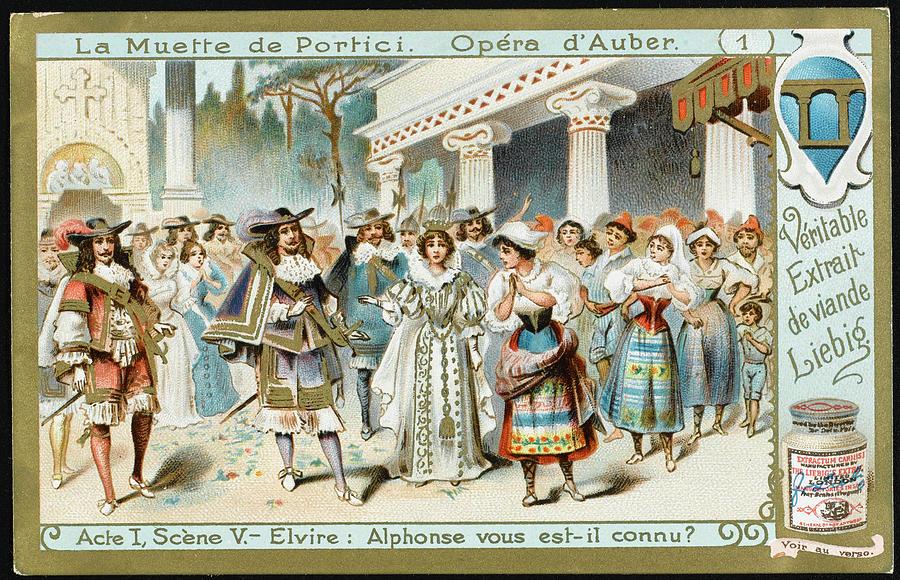
How many operas can claim to have shot the world order hell by sparking a revolution and thereby creating an entirely new country?
The honour falls to La Muette de Portici, an opera almost forgotten today by an almost equally forgotten French composer Daniel-François-Esprit Auber (1782 – 1971).
The situation ignited during a performance at Brussels’ La Monnaie in 1830, a performance in honour of the birthday of King William I. The moment suprème came during an aria, in which one of the protagonists sang the text: “Holy patriotism, give us back our courage and pride. My life I owe to my country, it will owe its freedom to me.” The audience left the hall, took to the streets and voilà: the Kingdom of Belgium was born.

That La Muette is different from all other operas also has to do with the protagonist. The latter may be present but has no note to sing – poor fisherman’s girl Fenella is mute.

Anna Pavlova as Finella
She is seduced by the young Neapolitan count Alphonse, who then exchanges her for a better match: a Spanish princess Elvire. Fenella is imprisoned, escapes and – using only sign language – manages to attract Elvire’s attention and pity, turning her brother Masaniello into the destroying angel.
This also becomes the signal to spark an uprising against the hated rulers; after which everything that can go wrong does. Masaniello is poisoned, the revolt fails and Fenella finds self-death in the lava flow from Vesuvius. I can’t make it more logical for you, but that doesn’t matter, because the opera itself is more than delightful and provides you with more than two hours of pure listening pleasure.
La Muette is considered the first true ‘grand opéra’. That may also be why it was so rarely staged, given our long-standing condescending view of the phenomenon of ‘grand opéra’.
But the tide is turning. A few years ago, La Monnaie dared to include the opera in its repertoire. Unfortunately, their courage did not go so far as to include performances in Brussels.
Peter de Caluwe, the director of La Monnaie, said with that, “That was done deliberately. Staging the opera in Brussels now would not only be an artistic act, but also a political statement; it would be interpreted as a plea for Belgian unity at a politically precarious moment.”

In 2011, a German opera house, the progressive Anhaltisches Theater in Dessau, where the young Dutch conductor Antony Hermus, then Generalmusikdirektor, also staged the opera. The performances were recorded live by CPO. It was about time!
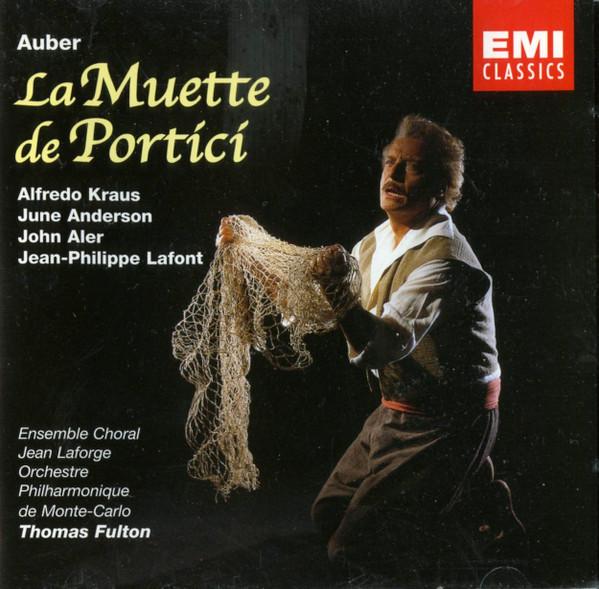
I knew of only one recording of the opera, with Alfredo Kraus, June Anderson, John Aler and Jean-Philipe Lafont conducted by Thomas Fulton (EMI not available anymore)). No one can match Alfredo Kraus’ elegant phrasing, but I still prefer Diego Torres’ more heroic sound. As Masaniello, he manages to convince much better. With him, you can practically hear the hormones coursing through his veins.
In his madness scene (yes, why not? Men are allowed to go mad too!), he sounds a lot like John Osborn.His high notes are not only spectacular but he also sings them at the top of his voice. Occasionally he sounds a little tired, but that doesn’t matter, especially in the context of the whole thing.
In “Mieux vaut mourir que rester misérable!”, from which the incendiary text thus comes, he is joined by Wiard Withold as Pietro. I also find him more interesting than Jean-Philipe Lafont on the Fulton (EMI) recording. It has now been recorded by CPO. It was about time
The young Dutch singer is at his best in the fifth act. His barcarolle “Voyez du haut de ces rivages” is particularly impressive. His lyrical baritone, meanwhile, has darkened a little without compromising on suppleness and lyricism, which goes without a hitch.
Angelina Ruzzafante is a wonderful Elvire. Her voice is light, supple and agile, her pitch beautiful and pure, and her vocal acting is perfect.Sometimes she reminds me of Cristina Deutekom, but without her oh-so-typical “staccato” (no offence!). It is about time the we get to hear the Dutch soprano on our stages too!
Oscar de la Torre (Alphonse) starts out weak – his tenor sounds a bit pinched – but in the fourth act he more than recovers. He is still young and – from the looks of it – inexperienced, but he will get there!
The chorus is formidable and I find Hermus’ tempi definitely better than Fulton’s.
 Basia con fuoco
Thsank you for this review. You’ve written: “It is about time the we get to hear the Dutch soprano (Angelina Ruzzafante) on our stages too!” That will never happen, because she has passed away at the age of only 57 about a year ago..
LikeGeliked door 1 persoon
I know dear Peter.
I know.
It’s a little in memoriam to her too
LikeLike
Quite a story behind this opera; Thank you, Basiu, for this very interesting write-up.
LikeGeliked door 1 persoon