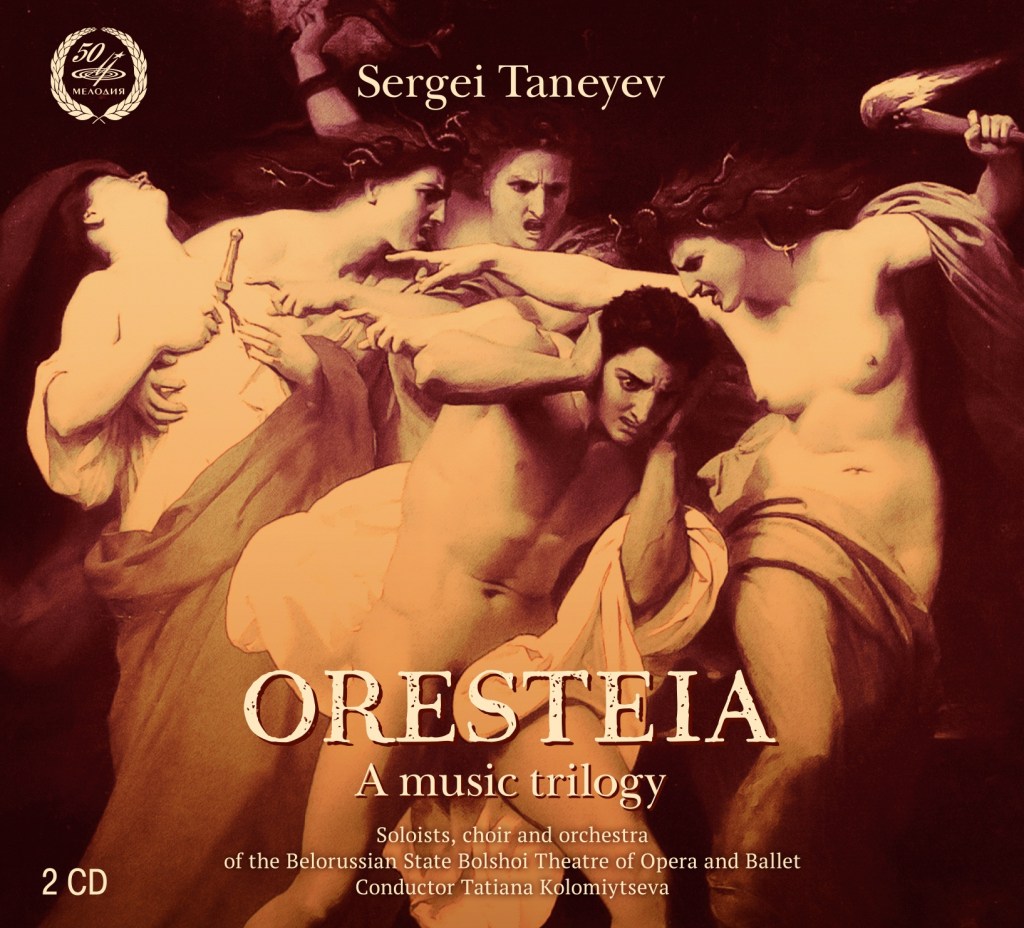
Oresteia

Oresteia by Taneyev: the complete trilogy of Aeschylos

Unlike, to name a few, Elektra by Richard Strauss or  Iphigenie en Tauris and Iphigenie en Aulis  by Gluck (Orest  by Trojahn I leave out for convenience), which focus on only one episode from Aeschylos’ drama, Taneyev has chosen the entire trilogy as the subject for his opera.

We start with Agamemnon’s return from the Trojan War and end with the court of law summoned by Athena, which has to consider Orestes’ guilt and penance.

.John Singer Sargent Orestes Pursued by the Furies>


But before that happens, Agamemnon is murdered by his wife and her lover Aigisthos. Both are in turn killed by Orestes, who, with the help of his sister Electra, takes revenge for his father’s murder. In the last part, Orestes (driven to madness by the Furies pursuing him) seeks the help of Athena, after which the court case followes.


Teneyev worked no less than 12 years on his opera. After all, he was not a fast writer and composing was a real struggle for him. The result is at once overwhelming and alienating.

‘Oresteia’ is a very atypical work for a Russian, especially at that time. Whether that was the reason for its total oblivion I don’t know, of course, but it may have been.
There, where his contemporaries and compatriots kept their eyes tightly fixed on the homeland and its history, he diverted to Greek tragedy, not losing sight of the classical form either. Taneyev himself therefore called his work not an opera, but a musical trilogy.

Still: although the theme and its elaboration is very un-Russian, the music undeniably is very Russian. Just take the great aria of Cassandra, composed in the best Russian tradition. Her arioso with the ensuing chorus is one of the opera’s absolute highlights. Unintentionally, I am then reminded of Khovanshchina by Mussorgsky and the music he composed for Marfa.

Cassandra’s aria, here sang by Svetlana Sozdateleva


This impression is of course also reinforced by the fact that the libretto is written in Russian. This highly melodic language has its own musical rules.

Lawrence Rapchak: The Most Beautiful Melody Ever Written?


I do not know any of the singers (mentioned only by their surnames in the cast), but the performance is, as far as I can judge – it is quite difficult without any comparative material – definitely good.
The biggest impression on me was made by N. Tkachenko (Cassandra). Her soprano sounds quite sharp at times, but that’s okay, especially since she sings with so much feeling and commitment. Her great ˜vision aria” is totally heart-breaking. Goosebumps.

I. Dubrovkin (Orest) possesses a beautiful, lyrical tenor. His height is a little pinched at times and he sometimes screams rather than he sings. But in the quieter moments he sounds really beautiful. Matter of dimming down the orchestra a bit more?

Electra (T. Shimko) sounds pretty hysterical. I get that (somewhat), but her high notes are not always pure and I find her voice on the thin side.

I. Galushkina, a real Russian mezzo with lots of chest tones, sings Clytamnestra. Very impressive. Yet: in her conversations with Aegisthus (fantastic baritone A. Bokov) she also shows her fragile side. Bokov’s sound is very masculine and heroic, which makes Clytaemnestra’s infatuation really plausible.

V.Chernobayev (Agamemnon) disappoints me a bit: his bass is quite impressive, but does not sound vry clean and occasionally lacks the low notes.

The music is at times very cinematic, but I suspect there is much more to it than the orchestra of the Belarusian Bolshoi Theatre led by Tatyana Kolomijtseva manages to get out.

The 1965 recording sounds rather dull and veiled, and I would give much to be able to hear the work in a new, modern recording. For now, there is no choice. There is no libretto, but the synopsis gets you there – more or less.

Oresteia van Taneyev: de complete trilogie van Aeschylos

2277_djpack

Anders dan ‘Elektra’ van Richard Strauss of ‘Iphigenie en Tauris’ van Gluck (‘Orest’ van Trojahn laat ik gemakshalve buiten beschouwing) die zich op maar één episode uit de drama van Aeschylos richten, heeft Taneyev de hele trilogie als onderwerp van zijn opera gekozen.

We vangen aan met de terugkomst van Agamemnon uit de oorlog en eindigen met de door Athena opgeroepen rechtbank, die zich over de schuld en boete van Orestes moet buigen. Maar vóór het zo ver is wordt Agamemnon door zijn vrouw en haar minnaar Aigisthos vermoord. Beiden worden op hun beurt gedood door Orestes, die met de hulp van zijn zus Electra wraak neemt op de moord van zijn vader.

In het laatste deel roept Orestes – tot waanzin gedreven door de hem achtervolgende furiën – de hulp in van Athena, waarna de rechtbank volgt.

Maar liefst twaalf jaar heeft Teneyev aan zijn opera gewerkt. Hij was eenmaal geen snelle  schrijver en het componeren betekende voor hem echt zwoegen. Het resultaat is tegelijkertijd overweldigend en bevreemdend.

Oresteia is een zeer atypisch werk voor een Rus, zeker uit die tijd. Of dat een reden was voor de totale vergetelheid weet ik natuurlijk niet, maar het zou zo maar kunnen.

Daar, waar zijn tijd- en landgenoten hun ogen strak op hun vaderland en zijn geschiedenis wijd open hielden, week hij uit naar de Griekse tragedie, waarbij hij ook de klassieke vorm niet uit het oog verloor. Taneyev zelf noemde zijn werk dan ook geen opera, maar een muzikale trilogie.

Toch: al is de thema en haar uitwerking zeer on-Russisch, de muziek is het ontegenzeggelijk wel. Neem alleen al de in de beste Russiche traditie gecomponeerde grote aria van Cassandra. Haar arioso met de daarop komende koor is één van de absolute hoogtepunten van de opera. Ongewild moet ik dan aan Khovansjtsjina van Moessorgsky denken en de muziek die hij voor Marfa heeft gecomponeerd.

De indruk wordt natuurlijk ook versterkt doordat het libretto in het Russisch is geschreven. Die, zeer melodische taal kent nu eenmaal zijn eigen muzikale regels.

Ik ken geen van de (in de rolverdeling alleen met hun achternaam vermeldde) zangers, maar de uitvoering is, voor zo ver ik het kan beoordelen – zonder enig vergelijkingsmateriaal is het best lastig – zonder meer goed.

De grootste indruk maakte op mij N. Tkachenko (Cassandra). Haar sopraan klinkt blij vlagen best scherp, maar dat mag wel, zeker omdat zij met zo ontzettend veel gevoel en betrokkenheid zingt. Haar grote “visioen aria” is ronduit verscheurend. Kippenvel.

I.Dubrovkin (Orest) beschikt over een mooie, lyrische tenor. Zijn hoogte is af en toe een beetje geknepen en soms overschreeuwt hij zich. Maar in de rustigere momenten klinkt hij echt mooi. Kwestie van het orkest een beetje dimmen?

Electra (T.Shimko) klinkt behoorlijk hysterisch. Ik snap dat (een beetje) wel, maar haar hoge noten zijn niet altijd zuiver en in vind haar stem aan de dunne kant.

I.Galushkina, een echte Russische mezzo met veel borsttonen, zingt Clytamnestra. Zeer indrukwekkend. Toch: in haar gesprekken met Aegisthus (fantastische bariton A. Bokov) laat zij zich ook van haar fragiele kant zien. Bokov’s geluid is zeer mannelijk en heroïsch, wat Clytaemnestra’s verliefdheid zeer aannemelijk maakt.

V.Chernobayev (Agamemnon) stelt mij een beetje teleur: zijn bas is best indrukwekkend, maar echt zuiver klinkt hij niet en af en toe ontbreekt het hem aan laagte.

De muziek is bij vlagen zeer filmisch, maar ik vermoed dat er veel meer in zit dan het orkest van het Belorussian Bolshoi Theatre onder leiding van Tatjana Kolomijtseva eruit weet te halen.

De opname uit 1965 klinkt behoorlijk dof en gesluierd en ik zou er veel voor over hebben om het werk in een nieuwe, moderne opname te kunnen beluisteren. Vooralsnog is er geen keuze. Er is geen libretto, maar met de synopsis kom je er – min of meer – wel uit.


Sergei Taneyev
Oresteia. A music Trilogy.
V.Chernobayev, L. Galushkina, A. Bokov, T. Shimko, I. Dubrovnik, N. Tkachenko e.a.
Koor en orkest van het Belorussian Bolshoi Theatre of Opera and Ballet onder leiding van Tatiana Kolomitseva
Melodia  MEL CD 10 02277