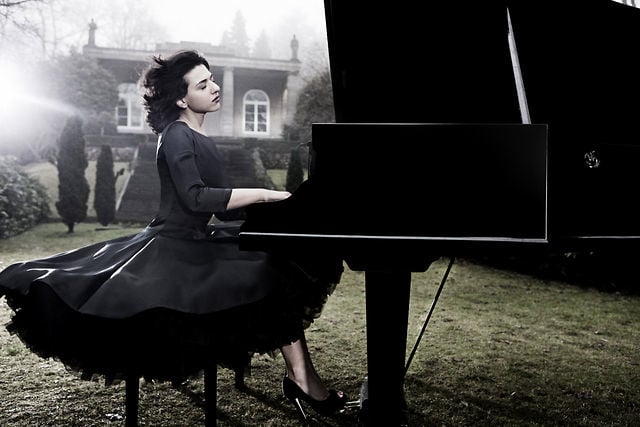
She has been called the world’s most glamorous pianist and that may well be true. In today’s music world, it is not only talent and ability that counts. Even winning a prestigious competition does not automatically lead to a contract with a record company: if you really want to make it, you also have to be able to present yourself as attractive as possible on a cover.
Khatia Buniatishvili is busy. Performances, recordings, book signings, interviews, festivals and even TV appearances with talks about fashion and her choice of clothes: like everything about her, her dresses are special too.
Getting an interview is easier said than done, but after a lot of scheduling and rescheduling, I finally manage to get her on the phone. She apologises for postponing the appointment and I immediately forgive her: Buniatishvili is extremely kind.
Batumi is mentioned as her place of birth. An exotic name I know from a song from my childhood in Poland. A song, sung by a very popular girl group at the time, which after all these years still haunts me.
Would Buniatishvili know it? I sing it to her and she laughs. No, it means nothing to her. The name of the composer, Ajwazian, is also completely unknown to her. Moreover, she may have been born in Batumi, but in fact she is not really from there.
“I was born there, but that was no more than a coincidence. We are originally from Tbilisi and my father happened to be in Batoumi for his work. When I was two months old we moved back to Tbilisi. So actually I am from Tbilisi”.
It is more than striking how many new young musical talents come from Georgia. Pianists, violinists, singers… One Georgian name after another appears in large neon letters above the biggest concert stages and halls around the world. Buniathisvili may be part of a musical family, but how about the others? How does she explain the enormous success of Georgian musicians and singers? Is it something to do with training? Or just the upbringing? Are children there being fed something that makes them more receptive to music? Is there a special diet that makes Georgian children more gifted than those from, say, the Netherlands?
“Hahahaha! No, of course not. It is our folk music. Well, mainly. We have a huge and rich tradition of music making, it’s in us, in our genes. Georgia is a small country inhabited by different peoples, so we have a huge diversity in folk music. There is a song for everything: for love, war, struggle and victory. And for death. Really for everything.”
“Music is natural to us, playing and singing is innate in our people. What’s more, our country has an exceptionally good music education, we are spoon-fed anything that has to do with music, as it were.”
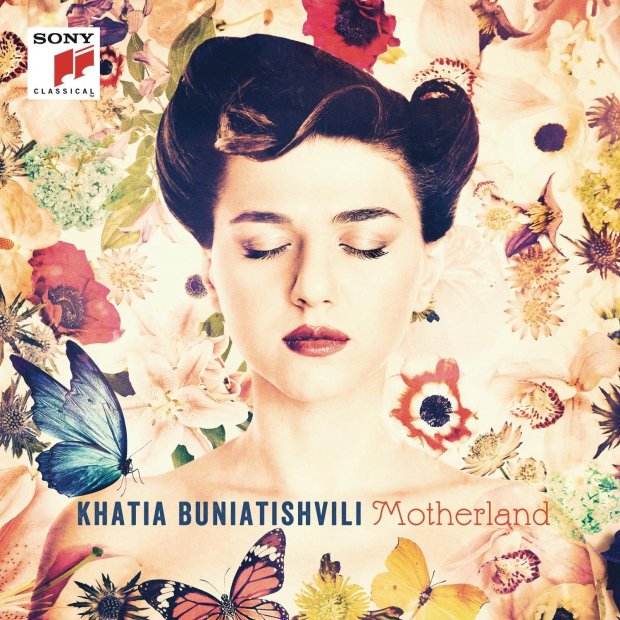
I tell her that I am particularly impressed with her penultimate album, Motherland. The pieces she plays there are less virtuoso than her usual repertoire. She also plays them very softly. And lovingly. The CD moves me very much.
But why is the album called Motherland? You would expect it to contain music by Georgian composers, but apart from When Almonds Blossomed by Giya Kanchelli and a folk song Vaguiorko ma, arranged by Buniatishvili herself, there is nothing Georgian to be discovered.
“I dedicated the CD to my mother. I wanted to combine all styles, from baroque to (more) modern, to folk. In this way I wanted to declare my love to her, to let her know how much I love her. So the title refers to my mother, not to my country. I am really glad that you like the CD so much, it means that I have succeeded in communicating my emotions…”
“On the CD I also play a piece, Dumka by Dvorak, with my sister Gvantsa. She is a great pianist and I regret that we cannot play together more often. But we are making lots of plans. And soon we are going to record something together. I’m looking forward to that.”
“Why did I choose the piano and not another instrument? I didn’t.
People say I should have become a violinist because of my perfect pitch, but it was the piano that was meant for me. I didn’t make the choice. At least, not consciously. I didn’t choose the piano: the piano chose me.”
Is there still such a thing as the renowned ‘Russian piano school’? For a moment there is silence and in the silence I can hear a question mark, so I repeat my question.
“No. I don’t think so. Everything has become international. Borders no longer exist or are blurred. Which gives you more opportunity to develop your own style, not bound by national borders. What is important for me is that I stay true to myself.”
“I am not a perfectionist, nor do I strive for that. Perfection takes the soul out of music. I am and will remain a flesh-and-blood human being, not some building material.”
“I also think it is important to enter into a kind of relationship with the composer. I find the thought that a composer made a certain piece especially for me very important and exciting, it also helps me. When I study a new piece – and by that I mean new to me – I try to avoid all other interpretations. I never listen to recordings then, because I want to make the score my own, all mine. I want to feel that I am the first.”
“My style can be described as a combination of extrovert and introvert. I love both equally and both are parts of me. Of me as a person and also of my way of making music. But it is, I think, also a female characteristic. Piano as a symbol of the loneliness that you can share with other people.”
Her interpretations are rather wild. Or, to put it kinder: energetic. Extraordinarily virtuoso too. Does she choose her repertoire from that category? How does she feel about the more subdued composers? Which does she prefer to play: solo recitals? Concerts? Chamber music?
“I like to play chamber music. Just like concerts and recitals, by the way.
Which of the three do I prefer? I couldn’t choose, but recitals are my favourite. With concerts you have to make a lot of compromises, it can’t be helped. The same with chamber music, because you also have to deal with your partner(s). But if it clicks, the result can be very satisfying.”
But what if you don’t agree with the conductor? I cite as an example the famous quarrel between Glenn Gould and Bernstein concerning the interpretation of Brahms’ piano concerto.
“I firmly believe that you can make compromises. That is what rehearsals are for, so that you can exchange ideas and if necessary meet each other halfway. But my thoughts, my ideas about a composition are sacred to me.”
Artists today are real globetrotters with many residences all over the world. Where does she feel at home?
“Everywhere actually. Georgia is very dear to me because that’s where my family lives, but Paris also feels like home, this is where I live.”
In February 2016, Sony released a solo album of hers, featuring works by Mussorgsky, Ravel and Stravinsky. And in May that same year, Buniatishvili performed at the Muziekgebouw aan ’t IJ.
Buniatishvili plays Mussorgsky at the Bimhuis in Amsterdam:
“I love Amsterdam. No, I don’t ride a bike. My parents never let me. I always had to be mindful of my hands, take care not to hurt them, so I didn’t learn. But I like to walk through the streets of the city for hours… it is so beautiful!
Zij wordt ’s werelds meest glamoureuze pianiste genoemd en dat zou best kunnen kloppen. In de muziekwereld van vandaag telt niet alleen je talent en je kunnen. Zelfs het winnen van een prestigieuze competitie leidt niet vanzelfsprekend tot een contract met een platenmaatschappij: wil je het echt maken dan moet je je ook op de cover goed kunnen presenteren.
Vandaar dat de ene pianist of violist (m/v) het ook – of soms zelfs voornamelijk – het van zijn looks moet hebben. Nu wil ik niet beweren dat het ook het geval is met Buniatishvili, want de zeer aantrekkelijke brunette heeft behoorlijk veel in haar mars! Haar optredens doen mij een beetje aan de jonge Martha Argerich denken: energiek, een tikje wild en altijd eigenzinnig. Technisch volmaakt, maar compromisloos. Met een duidelijke eigen stempel dat zij op alles drukt wat zij aanraakt.
foto: Esther Haase/Sony
Khatia Buniatishvili heeft het druk. Optredens, opnamen, signeersessies, interviews, festivals en zelfs TV-optredens, waarbij zij over mode en haar kledingkeuze wordt geïnterviewd: zoals alles aan haar, zijn ook haar jurken bijzonder.
Een interview afspreken is makkelijker gezegd dan gedaan, maar na veel geschuif met tijden lukt het uiteindelijk wel en word ik door haar opgebeld. Zij verontschuldigt zich voor het verzetten van de afspraak en ik vergeef het haar meteen: Buniatishvili is buitengewoon aardig.
Als haar geboorteplaats wordt Batoemi genoemd. Een exotische naam die ik ken uit een liedje uit mijn kindertijd in Polen. Een liedje, gezongen door een in die tijd zeer populaire meidengroep en die na al die jaren nog steeds als een oorwurm door mijn hoofd spookt.
Zou Buniatishvili het kennen? Ik zing het haar even voor en zij lacht. Nee, het zegt haar niets. Ook de naam van de componist, Ajwazian is voor haar volkomen onbekend. Bovendien: zij is dan in Batoemi geboren, maar eigenlijk komt zij er niet vandaan.
“Ik werd er geboren, maar het was niet meer dan toeval. Wij komen oorspronkelijk uit Tbilisi en mijn vader was in Batoemi voor zijn werk. Toen ik twee maanden oud was zijn we terug naar Tbilisi verhuisd. Dus eigenlijk kom ik uit Tbilisi”
Foto: BBC Music
Het is meer dan opvallend hoeveel jonge muzikale talenten nu uit Georgië komen. Pianisten, violisten, zangers… De ene na de andere Georgische naam verschijnt in grote neonletters boven de grootste concertpodia en zalen in de hele wereld. Buniathisvili komt dan wel uit een muzikale familie, maar de anderen? Hoe verklaart zij het enorme succes van Georgische musici en zangers? Heeft het iets met de opleiding te maken? Of gewoon met de opvoeding? Krijgen de kinderen daar iets in hun eten wat ze zo ontvankelijk voor de muziek maakt? Bestaat er een speciaal dieet die de kinderen uit Georgië begaafder maakt dan de kinderen uit bij voorbeeld Nederland?
“Hahahahaha! Nee, natuurlijk niet. Het ligt aan de volksmuziek. Voornamelijk, dan. We hebben een enorme en rijke traditie wat muziek maken betreft, het zit in ons, in onze genen. Georgië is een klein land bewoond door verschillende volkeren, waardoor we een enorme diversiteit in de volksmuziek kennen. Voor alles bestaat een lied: voor de liefde, de oorlog, strijd en overwinning. En voor de dood. Echt voor alles.”
“Muziek is voor ons vanzelfsprekend, we zijn nu eenmaal mensen van het spelen en zingen. Daar komt nog bij dat ons land een buitengewoon goede muziekeducatie kent, het wordt ons met de spreekwoordelijke paplepel gegeven”.
Ik vertel haar dat ik bijzonder onder de indruk ben van haar voorlaatste album, Motherland. De stukken die zij daar op speelt zij minder virtuoos dan doorgaans haar repertoire. Zij speelt ze ook heel erg zacht. En liefdevol. Mij ontroert de cd zeer.
Maar waarom heet de album zo? Je zou er muziek van Georgische componisten op verwachten, maar op When Almonds Blossomed van Giya Kanchelli en een door Buniatishvili zelf bewerkt volksliedje Vaguiorko ma na, valt er niets Georgisch in te ontdekken?
“De cd heb ik aan mijn moeder opgedragen. Ik wilde er alle stijlen combineren, van barok tot modern(er), tot volk. Zo wilde ik haar mijn liefde verklaren, haar laten weten hoeveel ik van haar houd. De titel slaat dus op mijn moeder, niet op mijn land. Ik ben oprecht blij dat je de cd zo mooi vindt, het betekent dat ik geslaagd ben in het overbrengen van mijn emoties..”
“Op de cd speel ik ook een stukje, Dumka van Dvorak samen met mijn zusje Gvantsa. Zij is een geweldige pianiste en ik betreur het dat we niet vaker samen kunnen spelen. Maar wij maken veel plannen. En binnenkort gaan we iets samen opnemen. Daar verheug ik mij op.”
“Waarom ik piano heb gekozen en geen ander instrument? Dat heb ik niet gedaan.
Mensen zeggen dat ik violist had moeten worden vanwege mijn perfecte “pitch”, maar het was eenmaal de piano die voor mij bestemd was. Ik heb de keus niet gemaakt. Althans: niet bewust. Ik heb piano niet gekozen: piano koos mij.”
Bestaat er nog zoiets als de vermaarde ‘Russische pianoschool’?
Even is het stil en in de stilte hoor ik een vraagteken, dus ik herhaal mijn vraag.
“Nee. Dat denk ik niet. Alles is internationaal geworden. Grenzen bestaan niet meer of zijn vervaagd. Waardoor je meer kans krijgt om je eigen stijl te ontwikkelen, niet gebonden aan ’s lands grenzen. Wat voor mij belangrijk is, is dat ik trouw aan mezelf blijf.”
“Ik ben geen perfectionist, daar streef ik ook niet naar. Perfectie haalt de ziel uit de muziek weg. Ik ben en blijf een mens van vlees en bloed, niet een of ander bouwmateriaal.”
“Ik denk ook dat het belangrijk is om een soort relatie met de componist aan te gaan. De gedachte dat hij een bepaald stuk echt speciaal voor mij heeft gemaakt vind ik heel belangrijk en opwindend, het helpt mij ook. Als ik een nieuwe stuk bestudeer – en daarmee bedoel ik nieuw voor mij – probeer ik alle andere interpretaties uit de weg te gaan. Ik luister dan nooit naar de opnamen, want ik wil mij de score helemaal eigen maken, helemaal van mij. Ik wil het gevoel hebben dat ik de eerste ben.”
“Mijn stijl kan je omschrijven als een combinatie van het extroverte en het introverte. Van beiden houd ik evenveel en beiden maken deel van mij uit. Van mij als mens en van mijn manier van muziek maken. Maar het is, denk ik, ook een vrouwelijke eigenschap. Piano als symbool van de eenzaamheid die je met andere mensen kan delen.”
Haar interpretaties zijn nogal wild. Of, mooier gezegd: energievol. Buitengewoon virtuoos ook. Zoekt zij haar repertoire daar ook op? Hoe denkt zij over de meer ingetogen componisten? Wat speelt zij het liefst: solorecitals? Concerten? Kamermuziek?
“Ik speel graag kamermuziek. Net als concerten en recitals, trouwens.
Welke van de drie doe ik het liefst? Ik zou niet kunnen kiezen, maar recitals zijn toch het meest van mij. Met concerten moet je veel compromissen sluiten, het kan ook niet anders. Ook met de kamermuziek, want je hebt ook met je partner(s) te maken. Maar als het klikt dan is het resultaat zeer bevredigend”
Maar wat als je het niet eens met de dirigent bent? Ik noem als voorbeeld de beroemde ruzie tussen Glenn Gould en Bernstein wat de interpretatie van het pianoconcert van Brahms betreft.
“Ik geloof er heilig in dat je compromissen kunt sluiten. Daar zijn ook de repetities voor, opdat je met elkaar van gedachten kunt wisselen en elkaar desnoods ergens halverwege tegemoet komt. Maar mijn gedachten, mijn ideeën over een compositie zijn voor mij heilig.”
Artiesten zijn tegenwoordig echte globetrotters met veel verblijfsplekken over de hele wereld. Waar voelt zij zich thuis?
“Overal eigenlijk. Georgië is mij zeer dierbaar want daar woont mijn familie, maar Parijs voelt net zo, hier woon ik.”
Onlangs heeft Sony een nieuwe soloalbum van haar uitgebracht, met werken van Moessorgski, Ravel en Stravinsky. En in mei treedt Buniatishvili op in het Muziekgebouw aan ’t IJ.
Buniatishvili speelt Mussorgsky in het Bimhuis in Amsterdam:
“Ik houd van Amsterdam. Nee, ik fiets niet. Dat mocht nooit van mijn ouders. Ik moest altijd op mijn handen letten, mocht ze niet bezeren, dus ik heb het niet geleerd. Maar ik kan urenlang door de straten van de stad wandelen… zij is zo mooi!”





 Basia con fuoco