Curious man, that Henze. Once flirting with communism and dreaming of a world revolution, he was also an aesthete and an erudite which – in part – made him decide to bid farewell to Germany and move to Italy in 1953.
His music has always been highly theatrical: he never liked the strict rules of serialism and felt a close connection with opera, which, unlike the hardliners of the avant-garde at the time, he had never labelled as obsolete. His discography therefore lists more than 20 musical theatre works, performed with great regularity.
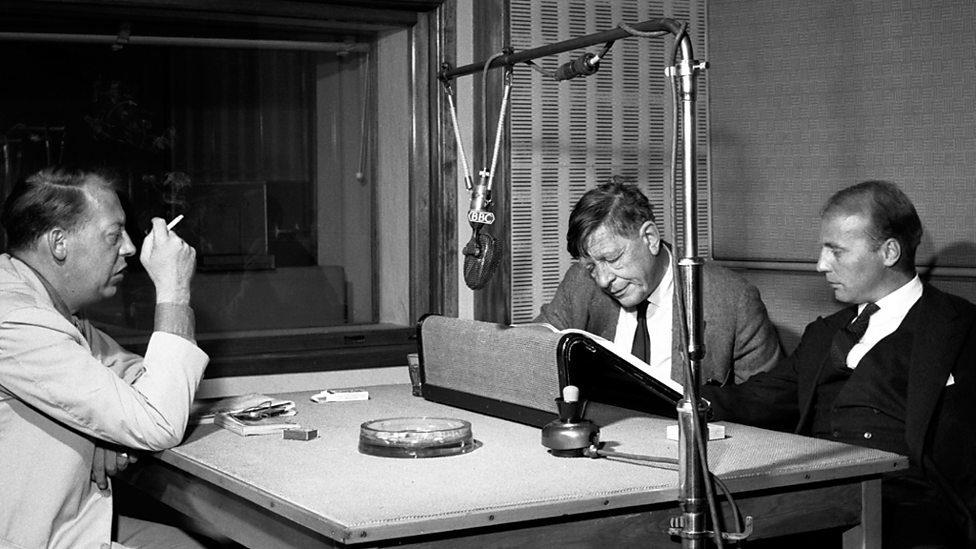
L-R: Chester Kallman, W. H. Auden and Hans Werner Henze
Die Bassariden is among Henze’s finest and most important compositions. The English Language libretto, after ‘The Bacchantes’ by Eurypides, was written by W.H.Auden (does anyone remember the ‘Funeral Blues’ from Four Weddings and a Funeral?) and Charles Kallman.
It became a massive, through-composed score, anchored in the Wagnerian tradition (it is whispered that the librettists insisted that Henze, before turning to composing, study the ‘Götterdammerung’) and constructed as a four-movement symphony with voices.
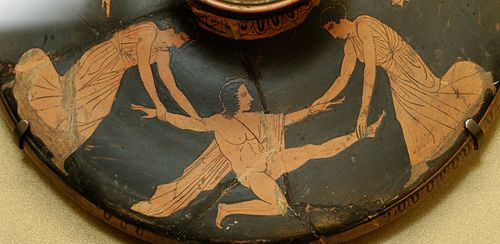
Pentheus being torn apart by Agave and Ino, Attic red-figure vase painting, c. 450-425 BC
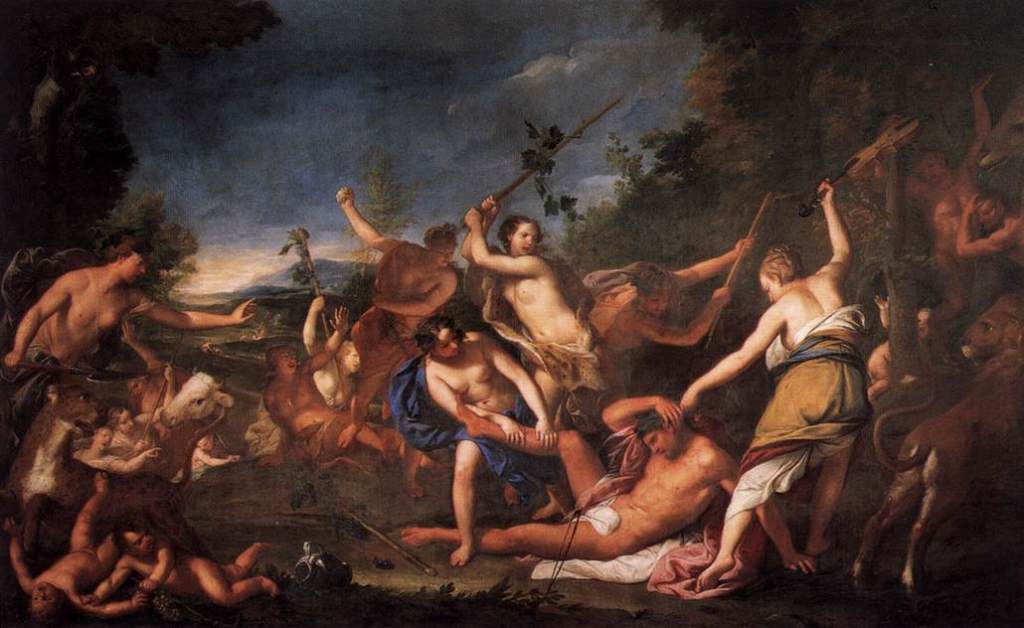
The story of King Pentheus, who, by wanting to banish all sensuality, comes into conflict with Dionysus and his adepts and is ultimately torn apart by his own mother, serves as a metaphor for the conflict between Eros and Ratio.
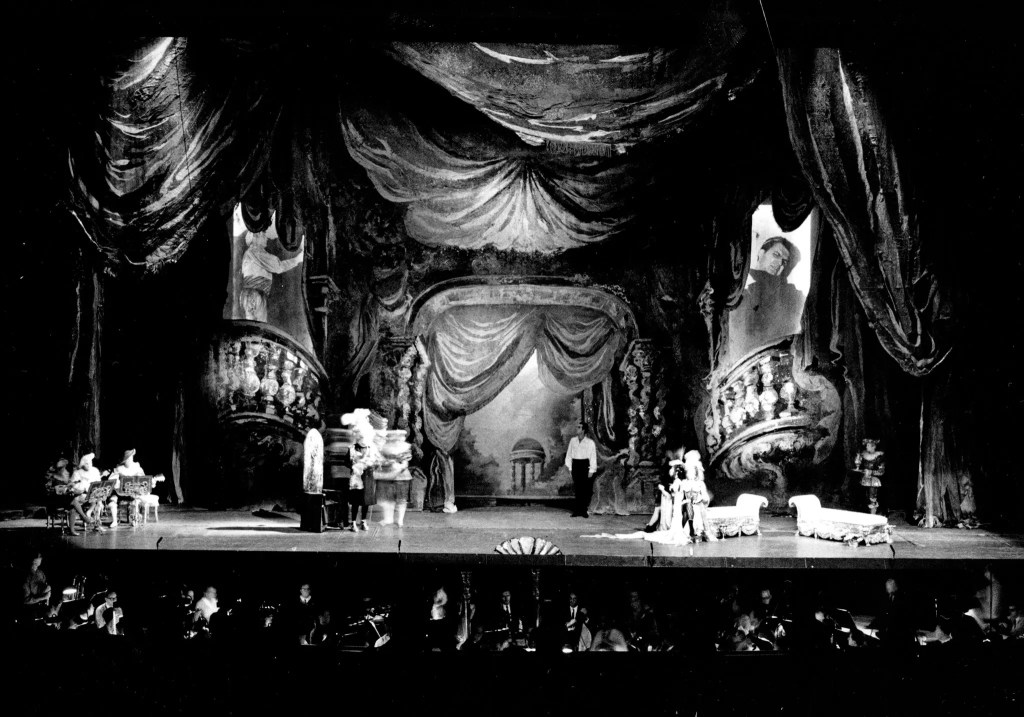
The opera premiered (in the German translation) at the Salzburg Festival in August 1966. It became a huge success, even prompting one of the reviewers to cry that Richard Strauss had finally got a successor. Henze laughingly and rightly dismissed this with a simple “where are the man’s ears?!”
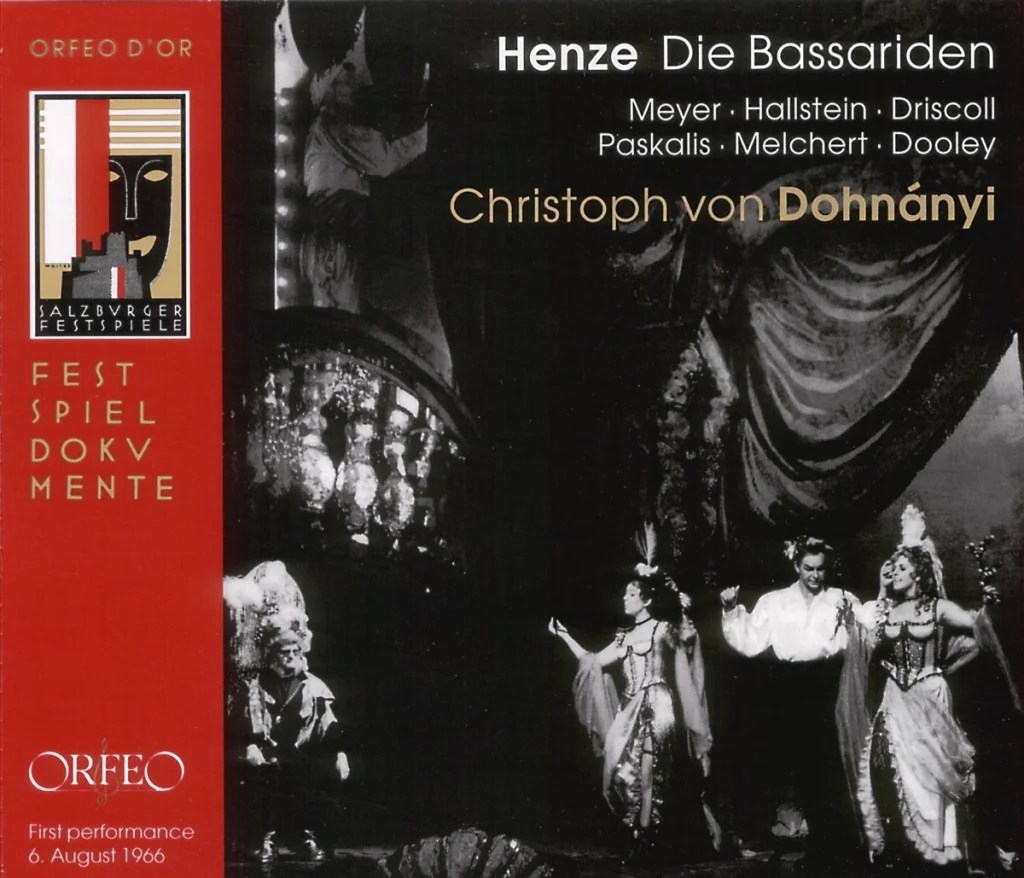
A few years ago, the live-recorded premiere performance (in German translation) was released by Orfeo (C 605 032 1). The highly emotional playing of the Wiener Philharmoniker, under the inspired direction of Christoph von Dohnányi, reaches unprecedented heights.
Kostas Paskalis is very credible in his role of Pentheus and Kerstin Meyer moves as Agave.It’s just a pity no libretto was included, after all, it’s not everyday fare.
[Editorial: A later performance of the English Language version was released on the Musica Mundi label, conducted by Gerd Albrecht, but this revised edition omits the interlude]
Das Urteil der Kalliope, interlude from Die Bassariden :
Curious man, that Henze. Once flirting with communism and dreaming of a world revolution, he was also an aesthete and an erudite which – in part – made him decide to bid farewell to Germany and move to Italy in 1953.
His music has always been highly theatrical: he never liked the strict rules of serialism and felt a close connection with opera, which, unlike the hardliners of the avant-garde at the time, he had never labelled as obsolete. His discography therefore lists more than 20 musical theatre works, performed with great regularity.
DIE BASSARIDEN
Die Bassariden is among Henze’s finest and most important compositions. The English Language libretto, after ‘The Bacchantes’ by Eurypides, was written by W.H.Auden (does anyone remember the ‘Funeral Blues’ from Four Weddings and a Funeral?) and Charles Kallman.
It became a massive, through-composed score, anchored in the Wagnerian tradition (it is whispered that the librettists insisted that Henze, before turning to composing, study the ‘Götterdammerung’) and constructed as a four-movement symphony with voices.
The story of King Pentheus, who, by wanting to banish all sensuality, comes into conflict with Dionysus and his adepts and is ultimately torn apart by his own mother, serves as a metaphor for the conflict between Eros and Ratio.
The opera premiered (in the German translation) at the Salzburg Festival in August 1966. It became a huge success, even prompting one of the reviewers to cry that Richard Strauss had finally got a successor. Henze laughingly and rightly dismissed this with a simple “where are the man’s ears?!”
A few years ago, the live-recorded premiere performance (in German translation) was released by Orfeo (C 605 032 1). The highly emotional playing of the Wiener Philharmoniker, under the inspired direction of Christoph von Dohnányi, reaches unprecedented heights.
Kostas Paskalis is very credible in his role of Pentheus and Kerstin Meyer moves as Agave.
It’s just a pity no libretto was included, after all, it’s not everyday fare.
[Editorial: A later performance of the English Language version was released on the Musica Mundi label, conducted by Gerd Albrecht, but this revised edition omits the interlude]
Das Urteil der Kalliope, interlude from Die Bassariden :
L’UPUPA
Almost forty years later, a new (and also the last, the then almost 80-year-old composer claimed) [Ed: He would produce two more after this, in spite of ill health] opera by Henze was performed in Salzburg: L’Upupa und der Triumph der Sohnesliebe. It was a commissioned work by the Salzburg Festival, and its premiere at the Kleines Festspielhaus in August 2003 was recorded live for DVD (EuroArts 2053929).
The libretto, a fairy tale based on Syrian-Persian tales, was written by Henze himself. The three sons of The Old Man go in search of L’Upupa (a hop), a bird lost by the man with the golden feathers. The two eldest drop out immediately and amuse themselves by drinking and playing cards. The youngest, Kasim (an excellent role by Mattias Goerne), assisted by a Papageno-like ‘Demon’ endures all kinds of adventures, including an attempt on his life by his brothers. But he finds the bird and, in passing, a lover in the guise of a Jewish Princess (Laura Aikin) and returns to his old father. Only to leave again immediately, this time to fulfil a promise made. An open-ended ending, then, that also makes for beautiful imagery and moving music.
The text is at times very comic, but also very poetic. Jürgen Rose’s sets and costumes are truly dazzling, and Dieter Dorn’s direction very intelligent. There is also more than excellent singing and acting, especially by the truly inimitable John Mark Ainsley as the Demon.
DER PRINZ VON HOMBURG
On Arthaus Musik (100164) you will find another superb opera by Henze: Der Prinz von Homburg. It was recorded at Bayerischer Staatsoper in Munich in 1994 and Nikolaus Lehnhoff’s direction is truly inimitable.
The story of a daydreaming prince, who fails to follow orders properly during the war and is sentenced to death but is exonerated as soon as he accepts his punishment, is based on a play by Heinrich von Kleist.
François Le Roux seems cut out for the lead role, but the rest of the cast: William Cochran, Helga Dernesch, and Marianne Häggander is also particularly strong.
MEMOIRS OF AN OUTSIDER
I also warmly recommend the documentary about Henze made by Barrie Gavin in 1994 (Arthaus Musik 100360). It features – apart from the composer himself and his Italian friend – Simon Rattle and Oliver Knussen, who candidly confesses that his own music would never have become anything without Henze’s influence. All this is interspersed with music excerpts and with beautiful archive footage. As an encore, you get a stunning performance of Henze’s absolute masterpiece, his Requiem.
Die Bassariden behoort tot Henze’s beste en belangrijkste composities. Het libretto, naar ‘De Bacchanten’ van Eurypides, werd geschreven door W.H.Auden (kan iemand zich nog de ‘Funeral Blues’ uit Four Weddings and a Funeral herinneren?) en Charles Kallman.
Het is een massieve, doorgecomponeerde partituur geworden, verankerd in de wagneriaanse traditie (er wordt gefluisterd dat de librettisten er op stonden, dat Henze, vóór hij zich op het componeren stortte, de ‘Götterdammerung’ ging bestuderen) en gebouwd als een vierdelige symfonie met stemmen.
Het verhaal over koning Pentheus, die door alle zinnelijkheid te willen verbannen in strijd raakt met Dionysus en zijn adepten en aan het eind door zijn eigen moeder wordt verscheurd dient als een metafoor voor het conflict tussen Eros en Ratio.
De opera is (in de Duitse vertaling) tijdens de Salzburger Festspiele in augustus 1966 in première gegaan. Het werd een enorm succes, wat één van de recensenten zelfs de kreet ontlokte dat Richard Strauss eindelijk een opvolger had gekregen. Hetgeen Henze lachend terecht van tafel veegde met een simpele “waar heeft de man zijn oren”?
De hele opera (audio):
Een jaar of vijftien geleden werd de live opgenomen premièrevoorstelling door Orfeo (C 605 032 1) uitgebracht. Het zeer emotioneel spelende Wiener Philharmoniker komt onder de bezielde leiding van Christoph von Dohnányi tot ongekende hoogtes.
Kostas Paskalis is zeer geloofwaardig in zijn rol van Pentheus en Kerstin Meyer ontroert als Agave.
Jammer alleen dat er geen libretto werd bijgeleverd, het is tenslotte geen alledaagse kost.
Das Urteil der Kalliope, intermezzo uit Die Bassariden :


 Basia con fuoco