Bridges

About Eisler, Brecht, exile and Hollywood


We live in very strange times. One composer after another emerges from oblivion and starts a (re)new(ed) march to victory. At least, if he (she) is lucky, because nothing is as short as the human memory and many of the ‘excavated’ composers are already covered in a thick layer of dust, after they have been performed and/or recorded only once (or maybe twice). For: “No day without Bach” and Beethoven’s piano concertos really do have to be recorded for the hundred millionth time.


Hanns Eisler has never _really_ been forgotten, which he owes in part to his friend and author of the texts for his songs and cantatas, Bertolt Brecht. In 1998, Decca’s ‘Entartete Musik’ series released its second CD of Eisler’s music: songs he composed during his exile in Hollywood.

Eisler was not alone in seeking refuge in the Mecca of film industry and trying his luck there, and he too has participated in a few films. His main occupation, however, was teaching, first in New York and Mexico and from 1942 at the University of Southern California.

Eisler and Brecht in Leipzig


In Hollywood, Eisler was united with Brecht and in May of that year he started working on the ‘Hollywood Songbook’. For most of the songs he composed between May ’42 and December ’43, he used poems that Brecht wrote during his stay in Scandinavia in the years 1938 – 1940 (the so-called ‘Steffinsche Sammlung’),

When Brecht temporarily stayed in New York, Eisler turned to other poets: Hölderlin, Pascal, Eichendorff, Goethe. There is an essential difference between the settings: the ‘Brecht Lieder’ are often bitter, aggressive, sometimes cabaretesque in nature; the others tend to be more melancholic, more melodious, more rooted in the tradition of the art of song.

Matthias Goerne, despite his young age (he was 31 at the time of the recording), was no longer an unknown quantity and already had a few recitals to his name. He has a wonderful timbre and sings with full understanding of the texts. Unfortunately, he is far too much like his illustrious predecessor (I will not name names) and that is a bit disturbing to me, although it may be a recommendation for someone else. Peanuts, actually, because as far as I know it’s the only recording of the complete ‘Hollywood Songbook’, so if you come across it: buy it!
He is accompanied by Eric Schneider in an exceptionally skilful way.


Hans Eisler
The Hollywood Songbook
Matthias Goerne (baritone)
Eric Schneider (piano)
Decca 460582-2

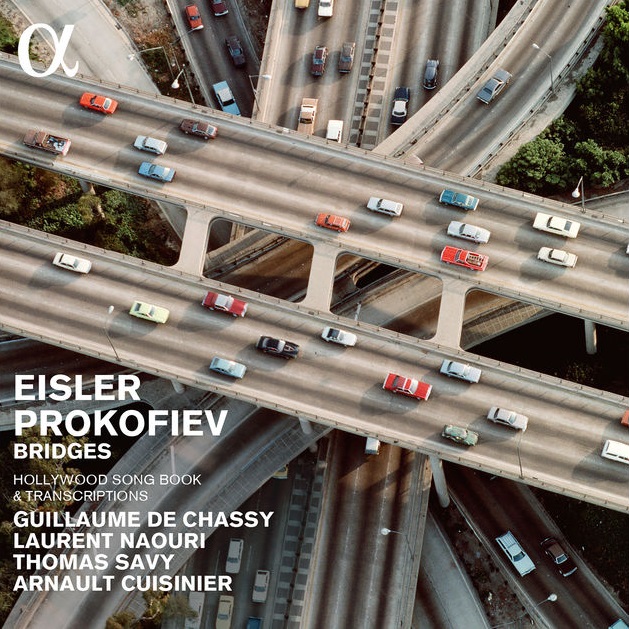

If you want to know what a jazzed-up ‘Hollywood Songbook’ sounds like, listen to Laurent Naouri. It’s quite fun to discover how very Weill-like Eisler sounds here. Listen to ‘Kalifornischer Herbst’, which could have come straight out of one of his ‘shows’.
It is a CD that is best listened to at night, with a glass of whisky.


Bridges
Hanns Eisler and Sergei Prokofiev
Hollywood Songbook (extracts) & Improvised Variations
Laurent Naouri (bass-baritone), Guillaume de Chassy (piano), Thomas Savy (clarinets) Arnault Cuisinier (double bass)
Alpha 210

Bridges: Laurent Naouri ‘verjazzt’ Eissler en Prokofjeff

bridges

Het is niet de eerste keer dat de vermaarde basbariton Laurent Naouri een uitstapje maakt buiten het geijkte klassieke repertoire. Net als zijn vrouw, de sopraan Natalie Dessay zingt ook hij het ‘lichtere genre’, veelal samen met jazzmusici. Iets, wat vaak uitmondt in jamsessions en improvisaties.

Ik ken maar één uitvoering van de (complete, dat wel) Hollywood Songbook van Hanns Eisler: met Matthias Görne en Eric Schneider in Decca’s onvolprezen Entartete Musik serie, helaas is de cd inmiddels vervallen.  Bovendien: er valt niets te vergelijken. Beide cd’s zijn grandioos in hun eigen soort.

Görne is eigenlijk een must, dus mocht u hem tegenkomen: meteen kopen. ‘Naouri and friends’ kunt u bewaren voor de nachtelijke uurtjes, met een glas whisky erbij.

Grappig eigenlijk hoe ontzettend Weill-achtig verjazzde Eisler klinkt, voornamelijk de ‘Kalifornischer Herbst’. Die zou zo uit één van Weill’s Amerikaanse shows kunnen komen.

Behalve Eisler hebben de musici ook Prokofjeff verjazzd. Pianist Guillaume De Chassy arrangeerde delen van diens piano- en vioolconcerten voor stem. Daarvoor gebruikte hij teksten van vier Russsiche dichters: Tsvetajeva, Poesjkin, Lermontov en Jesenin. Naouri zingt ze in een perfect Russisch, ieder woord is makkelijk te verstaan.

Maar het is niet alleen Naouri’s stem die de stemming bepaalt, de eigenlijke hoofdrollen zijn weggelegd voor het trio Guillaume de Chassy (piano), Thomas Savy (klarinetten) en Arnault Cuisinier (contrabas). Denk alleen niet dat je Prokofjeff nog ergens in herkent, mij is het in ieder geval niet gelukt.

Onbelangrijk, eigenlijk. Het draait tenslotte om de improvisaties en daar zijn de heren werkelijke meesters in.

Minpunt: het tekstboekje is helaas nogal slordig en een cd met tijdsduur van 45 minuten is gewoon een gotspe


En mocht u de smaak te pakken hebben, hieronder hoort u Laurent Naouri en de Chassy in ‘My Romance’:


Bridges
Hanns Eisler:
Hollywood Songbook (extracts) & Improvised Variations
Sergej Prokofjev:
Transcriptions
Laurent Naouri (basbariton), Guillaume de Chassy (piano), Thomas Savy (klarinetten) Arnault Cuisinier (contrabas)
Alpha 210