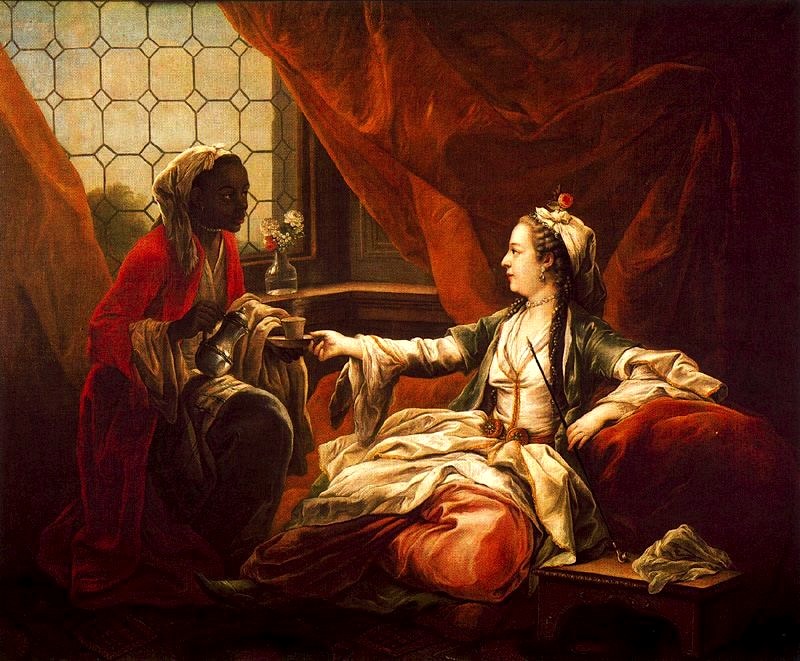
The Orient! What did we know about it in those far gone days? It was exotic, adventurous and exciting. All the men there were macho, super attractive and potent. And they smoked opium. All the women were beautiful, graceful, mysterious and seductive. It smelled of amber and wild jasmine….
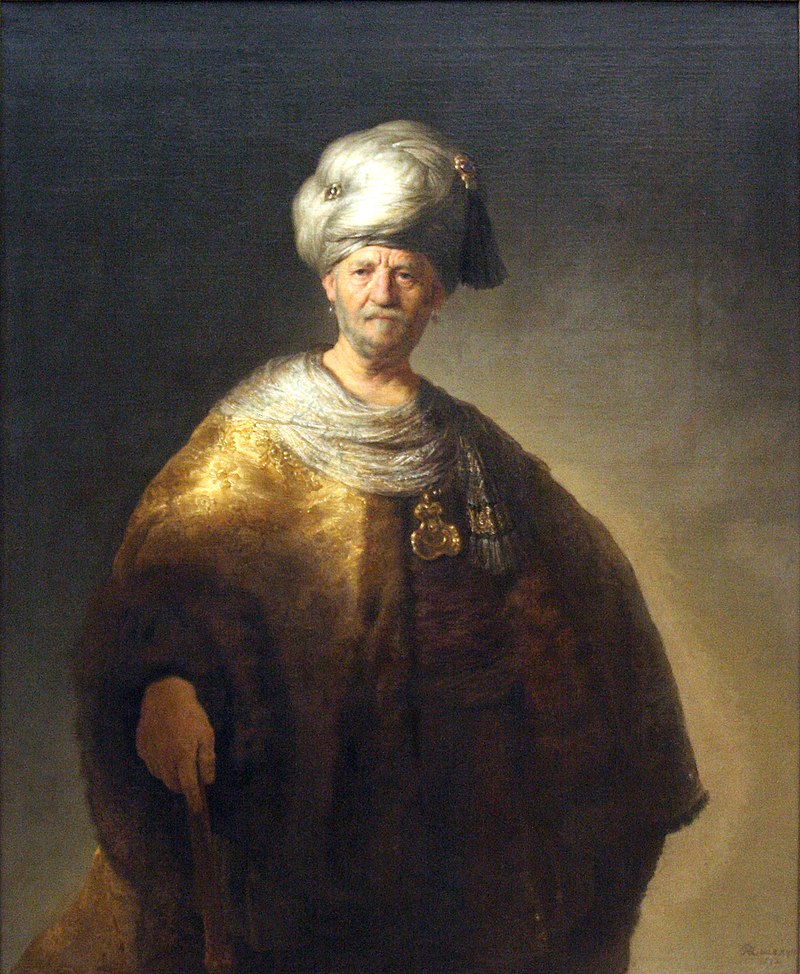
Man In Oriental Costume (“The Noble Slav”), oil on canvas, by Rembrandt, 1632. A significant example of European emulation of Ottoman dress for the purpose of portraying a dignified, elite appearance.
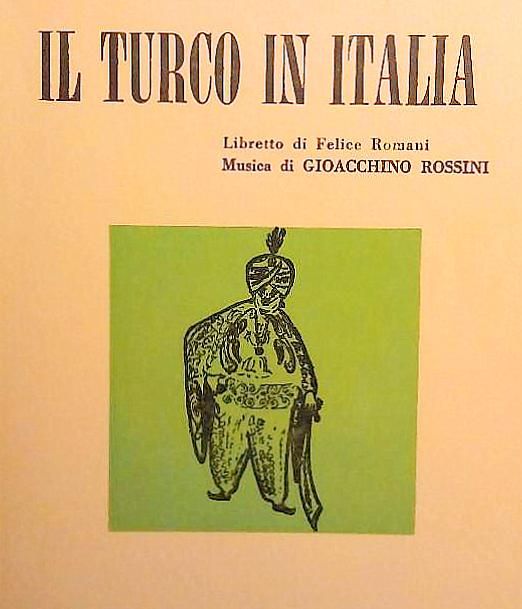
It was so incredibly far away and unknown – no wonder we were enchanted by it. No wonder, too, that our dreams sometimes ran wild. But the dreams turned out to be good for something, because they gave us the most beautiful works of art, including operas. Rossini’s Il Turco in Italia is one of them.
Believe it or not (believe it!), Turco is very similar to Mozart’s Cosi van tutte. Even the music is often reminiscent of it. The story: a Don Alfonso-like poet without inspiration, a kind of evil genius really, devises an intrigue in which he then manipulates all the characters as if they were puppets, so that everyone ends up with (almost) everyone else, but in the end everything does turn out well. Or not. In any case, our Prosdocimo tells a wonderful story.
I wonder what the ideal Fiorilla should sound like. On the recordings known by me, she is sung by all voice types: from a super light coloratura soprano to a dark coloratura mezzo with chest tones. Somehow, none of the ladies really appeal to me, not even Maria Callas, although she comes close to what I would like to hear in this role.
DVD’S
Zurich, 2002
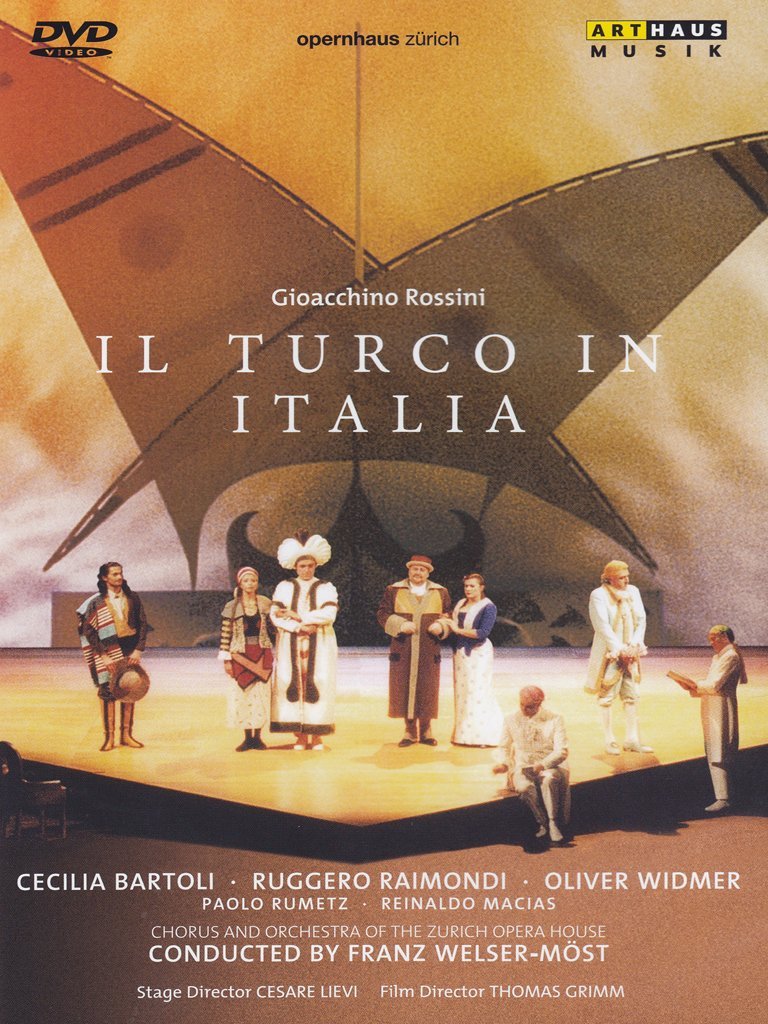
In 2002, Il Turco was staged in Zurich. The lead role was played by an old hand, Ruggiero Raimondi. His Selim is undoubtedly exciting and erotic, and he compensates for the wear and tear of his voice with overwhelming acting and tremendous charisma.
Oliver Widmer is in fine form as the cynical poet Prosdocimo, and Paolo Rumetz plays a delightfully dim-witted Geronio. The problem is Cecilia Bartoli. (Please don’t hit me, it’s just my opinion!) She is undoubtedly a virtuoso, but I find her mannerisms very irritating and her dark timbre completely unsuitable for the role.
The whole thing is cheerful, with bright colours and crazy costumes: the gypsies look like a combination of Volendam people and Peruvians (Arthaus Musik 100 369).
Pesaro 2007
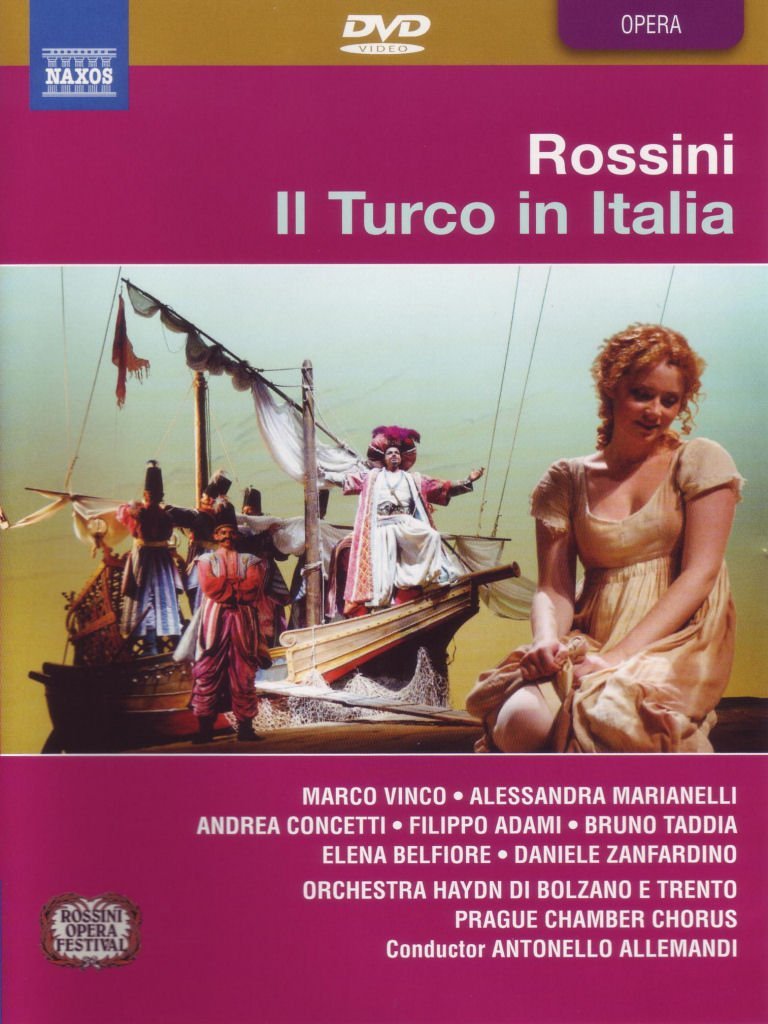
In Pesaro in 2007, a very naturalistic-looking Turco was recorded, with only young, unknown singers in the leading roles. The fact that they, with the possible exception of Marco Vinco (Selim), have remained unknown, does not say everything, but it does say a lot.
Nevertheless, there is much to enjoy. The characters are wonderfully recognisable, the colours are beautiful and the action follows the libretto closely. Definitely enjoyable! (Naxos 2.110259)
Genoa, 2009
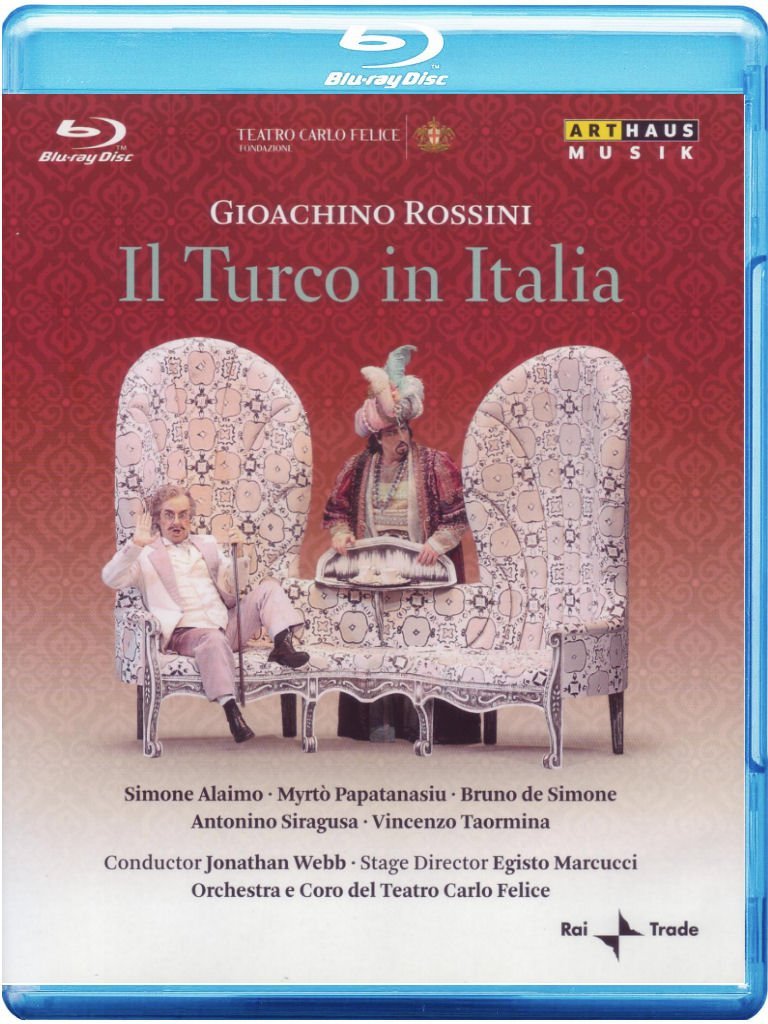
One of the newer recordings on DVD is from 2009 at the Teatro Carlo Felice in Genoa. Well, new… the production is more than 40 years old and was first seen in 1983.
That’s okay, because it’s still very entertaining, although I must admit that I sometimes feel a little dizzy from everything that’s happening on the stage: acrobats, fire-eaters, ballerinas, Arlecchinos and so on. Commedia dell’Arte at its best.
Myrtò Papatanasiu is a beautiful Fiorilla and Simone Alaimo a delightful Selim, although I think he is performing slightly below his usual high standard. Antonino Siragusa is also a tiny bit disappointing as Narciso (Arthaus Musik 101 39).
CD’s
Milan, 1954
.
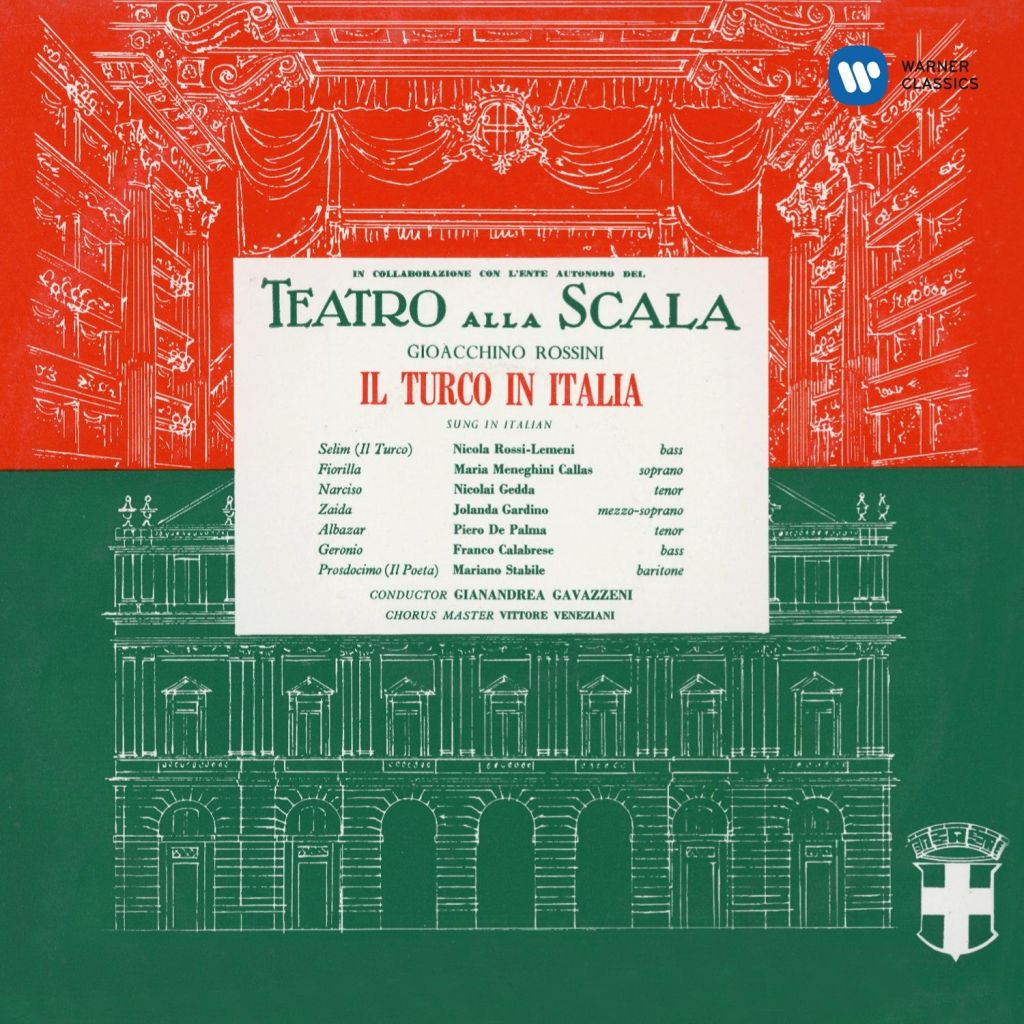
Maria Callas sang the role of Fiorilla in Rome in 1950 and four years later recorded it in the studio with La Scala in Milan. Gianandrea Gavazzeni conducted an “all-star cast” – most of the names make our mouths water today. But, apart from the fact that they were all truly fantastic, we have to ask ourselves whether it still sounds adequate to our ears.
Yes, Nicola Rossi-Lemeni would still be able to do it today, but the rest, including La Divina? With her, I often get the feeling that I am in the wrong opera and that I’m really listening to Anna Bolena. (Warner 0825646340880)
Milan, 1958
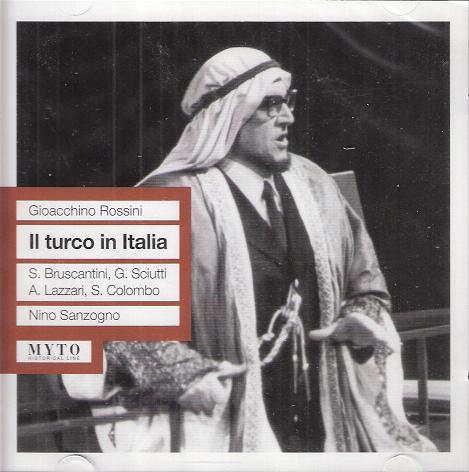
I absolutely cannot ignore Sesto Bruscantini who is a truly irresistible Selim. Scipio Colombo is delightful as the (in his interpretation) comic villain Prosdocino, and as Donna Fiorilla we hear one of the most delightful light sopranos of the time: Graziella Sciutti. A little soubrette-like, but so agile, and with such a wonderful timbre! The rest of the voices are good, but not exceptional, but Nino Sanzogno’s conducting – light and sparkling – does the opera justice. The live recording from 1958 (Milan) is rather dull. Nevertheless, it is a special document of a time that is now truly gone (Myto 00193).
Sesto Bruscantini and Graziella Sciutti in “Credete alle femmine”:
Tegenwoordig zouden we meteen een discussie hebben over culturele toeëigening. Sinds de publicatie van Edward Saïd “ORIENTALISM zijn we ons veel meer bewust geworden van onze vooringenomenheid ten aanzien van de Orient. In de tijd van Rossini en nog lang daarna kon met nog naar hartelust spelen met clichés en vooroordelen.
Het blijft een heerlijke opera waarin veel te genieten valt. Ik denk dat je Callas had moeten zien in die rol. De beroemde scenefoto’s spreken boekdelen.
 Basia con fuoco
No mia vita with Callas blijft geweldig om naar te luisteren!
LikeLike
Tegenwoordig zouden we meteen een discussie hebben over culturele toeëigening. Sinds de publicatie van Edward Saïd “ORIENTALISM zijn we ons veel meer bewust geworden van onze vooringenomenheid ten aanzien van de Orient. In de tijd van Rossini en nog lang daarna kon met nog naar hartelust spelen met clichés en vooroordelen.
Het blijft een heerlijke opera waarin veel te genieten valt. Ik denk dat je Callas had moeten zien in die rol. De beroemde scenefoto’s spreken boekdelen.
LikeGeliked door 1 persoon
tegenwoordig weten we beter. Of niet ….
Maar de opera is inderdaad heerlijk.
Callas heb ik helaas nooit live mogen maken…
LikeLike