Ryuichi_Sakomoto

Alpine tales and metal: Kindertotenlieder by Gisèle Vienne and KTL in the Holland Festival.

Text: Neil van der Linden
“Thank you for coming to this memorial concert for my friend, and I want to thank one of this favourite bands for agreeing to play here today. He was my friend since we were 2 years old, and I knew he would have…” (voice cut). These are the words of one of the characters on stage, Jonathan, commemorating the death of his friend. Whom he supposedly killed, we are about to learn.

On stage is a group of people in a snowy landscape, some of them are children. In one corner of the scene there is a coffin, with the lid open. Slow movements, slowly evolving electronic sounds. But after a while one of the people runs to two of the children in front and makes movements as if killing them. Kindertotenlieder is the title. Killing children and snow, I had to think of Brueghel’s The Massacre of the Innocents; I will come back to that later.
The children figures turn out to be stuffed puppets; I will come back to that later too.

A guitarist starts to play growling loud slowly progressing chords, style ‘black metal’. The audience has been given earplugs.
The actors keep on moving slowly to a virtual point on the left of stage where rays of light are shining from.
The killer gets killed by another character.
After a while the former rises again and grabs another character, takes off his clothes and stammers texts about raping him, and then kills him. Spoken text suggests that that was the person who was probably murdered by Jonathan.

The group keeps moving to the light, so slow some seem like puppets. After a while we notice that some did not move at all: they are puppets.
Another actor grabs some of the other figures, the puppets, and stacks them up together.

More snow is falling. Heaps and heaps of snow. Everybody still alive now has their winter coats fully buttoned up, except for the naked rape and murder victim, still lying on stage. It turns out that the young boy who was killed by his best friend has returned as a ghost during his funeral, and the story started from there.

Kindertotenlieder is a performance from 2007 by Gisèle Vienne, who along with Japanese composer and actor Ryuichi Sakamoto is associate artist of this year’s Holland Festival.

The two musicians on stage, Stephen O’Malley on guitar and Peter Rehberg on electronic equipment, work together under the name KTL (KinderTotenLieder!, I assume) since they participated for the first performances in 2007. In the storyline the murdered boy’s favourite music was KTL. Their style,, ‘Black metal’, is often associated with satanism and ‘doom’cults.

Another cult that plays a role in the performance is the German and Austrian Alpine rite of the Perchten. Gisèle Vienne is partly Austrian. At some point in the wintery landscape on stage two tall figures appear, dressed as ‘Perchten’. Perchta (English: Bertha) was a pagan goddess in the German and Austrian Alps. She lived on since the arrival of Christianity, entering village homes during the twelve days between Christmas and Epiphany, especially on the Twelfth Night. She knows whether children and young servants have behaved well and worked hard. If not, she would slit their bellies open, and stuff them with straw and pebbles. There you have it, child murder and stuffed puppets, two of the elements we see on stage.
For centuries after paganism disappeared boys would roam villages wearing animal masks, the midwinter Perchten feasts that still exist in the region, intended to chase out winter.

Maybe the title of the performance is derived from (Austrian composer) Gustav Mahler’s Kindertotenlieder, in which the composer reflects on the death of children; to which Mahler and the poet of the texts Friedrich Rückert were no strangers, Mahler having lost eight of his siblings and later a daughter and Rückert two children.

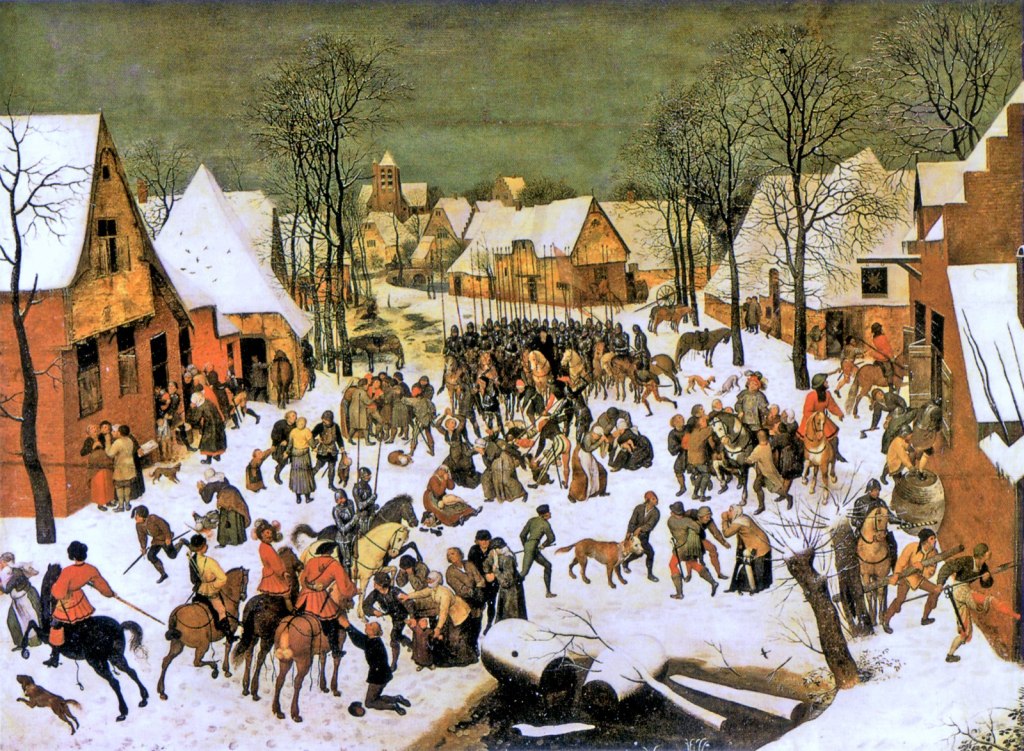
It occurred to me that the idea of child murder in combination with midwinter also can be associated with the ‘celebration’ of Mary and Joseph bringing the newborn Jesus to safety from the troops of King Herod;  as pictured by Brueghel the Elder in his Massacre of the Innocents. When King Herod had learned from The Three Wise Men from the East that stars had taught them that the future king of Jews was born in Bethlehem, he ordered all newborn males of Bethlehem to be killed. Mary and Joseph fled in time after being warned by an angel, and fled to Egypt.  (All other babies were killed; thank You, God.) Brueghel the Elder’s painting, set in a snow-covered landscape, was in fact an allegory on the cruelty on the Spanish occupation troops fighting the Netherlands’ independence movement. Here comes another Austrian link, as what was considered to be the original version of the painting is in the Kunsthistorisches Museum, Vienna. (It is now thought to be a copy by Pieter Brueghel the Younger. But as other authorised versions have been censored for its cruelty, this one shows the original cruel details of the mass-murder as conceived by Brueghel the Elder.

Vienne and Sakomoto are the festival’s associate artists. Partly due to COVID19 and unfortunately because Sakamoto is ill, a full collaboration between the two could not materialise It is possible to envisage why the two artists might have been attracted to each other’s work, with both’ interest in atmospheric music and immersive visual art.

Meanwhile, that the Holland Festival could happen at all including complex productions like Kindertotenlieder and Sakamoto’s opera Time is yet a miracle


Concept and choreography: Gisèle Vienne, dramaturgy and texts by Dennis Cooper, music by KTL: Stephen F. O’Malley and Peter Rehberg.

Zuiveringshal West, Westergas, June 19th 2021, as part of the Holland Festival

Photos by Antoine Masure and Mathilde Darel


Autobahn versus magnetic levitation.

Text: Neil van der Linden

I first got to know the music of Ryuichi Sakamoto (b.1952) through the Yellow Magic Orchestra, formed in 1978, a Japanese electronic artpop ensemble of which Sakamoto was a member, responding to Euro-synthesizer-pop acts like Germany’s Kraftwerk, Switzerland’s Yello, Jean Michel Jarre and Donna Summer’s disco music recordings with Giorgio Moroder. The Yellow Magic Orchestra or YMO as their name was often abbreviated gradually developed a style of their own, a mixture of jagged computer-generated riffs resembling computer game tunes and smooth, suave and sometimes cheesy melodies. As more and more of the electronic instruments were being made in Japan, first by imitating the American and European originals, then coming up with more advanced, reliable and userfriendly models, the members of the YMO more and more went their own way well.

Sakamoto’s solo career started to soar with his magnificent role as actor in the movie Merry Christmas, Mr Lawrence (1983), playing opposite David Bowie and Tom Conti, for which Sakamoto also composed the music.

Ryuichi Sakamoto © Kab Inc. | Photography by zakkubalan

Japanese culture was becoming fashionable just when the Western political leaders started to depict Japan as an economic threat to the West. In Merry Christmas Mr Lawrence Sakamoto personified a different Japan. He was likeable, good looking, easily embodying the semi-homoerotic infatuation between the characters played by him and by Bowie that is at the centre of the storyline. Musically this was even sealed in a vocal version of a piece in the soundtrack, ‘Forbidden Colours’, performed by Sakamoto with singer David Sylvian, frontman of the British glam-art-rock band Japan, who were toying with queer symbolism as well as hip Japanese and Chinese aestheticism in their image.

Sakamoto did more beautiful collaborations, with Sylvian and others, and he continued making soundtracks for movies like Bertolucci ‘s The Last Emperor and The Sheltering Sky and Alejandro González Iñárritu’s The Revenant.

PhotoByNata_ opromadze19-e1602257243821

Swiss-Georgian composer Alexandre Kordzaia a.k.a. Kordz (b.1994) studied in Basel and at the Royal Conservatoire in The Hague (with Yannis Kyriakides). In Georgia Kordzaia made a name with dance music and collaborations with the Georgian Philharmonic Orchestra. Here he worked with Asko|Schönberg, the Nieuw Ensemble and the Residentie Orkest in The Hague. Recently he wrote an adaptation of for Dutch dance ensemble Club Guy & Roni.

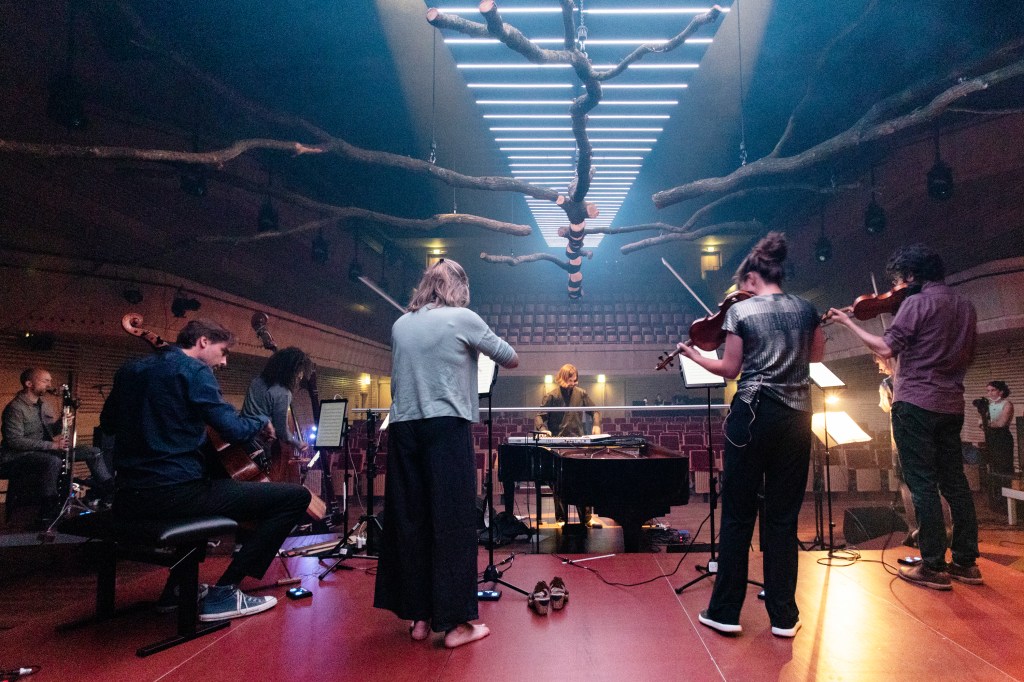
Kordz x Sakamoto is a collage of material mostly originating from Sakamoto’s early years, including the theme song from Merry Christmas, Mr Lawrence. We hear modern electronics, plus vintage electronic instruments, plus the acoustic instrumentalist of the ensemble, with Kordzaia behind the piano. Most of the music flows like a smooth machine, but sometimes disruption occurs, like drum rolls that go against the metre, and a long virtuoso and in this context deliberately alien, ‘dirty’ clarinet solo, by David Kweksilber.

The result sounds like Sakamoto embedded in an idiom that ASKO|Schönberg is so much at home with, of for instance Louis Andriessen. “Merry Christmas, Mr Lawrence meets Andriessen’s De Staat.” Imagine the Royal Concertgebouw Orchestra playing Bert Kaempfert, including of course masterpieces like Strangers in the Night and Living it Up (alias Theme from Kapitein Zeppos), paying homage to the tone colouring of Bruckner and Debussy at the same time. Something I would not want to miss.

Kordzaia emphasised that some of the music of the Yellow Magic Orchestra in their early years has inspired the later pioneering American techno and hiphop musicians, by interweaving techno- and hiphop-beats at certain points and making the ensemble-members rap and cheer as if they are in a houseparty.

I listened to the radio broadcast of the performance the next evening and it became clear that the music, somewhat against my initial misgivings I must admit, stood the test of being consumed as music as such. While another strong point of the live performance, which I had not yet mentioned, was absent, namely the wonderful visual installation by the Dutch light artist Boris Acket.

From back to front the cut parts of a single tree are fixed to the ceiling, its branches arching over the musicians. Above the tree, a set of LED-light screens, a metre wide, thirty metre long, stretches along the middle of the ceiling of the hall. The LEDs initially show black and white light patterns, resembling the patterns of early computergames, or white on black stripes of a highway, but soon the images become coloured, resembling landscapes gliding by in high-speed, as is we were riding the Maglev, the Japanese magnetic levitation train, the fastest in the world, with the Milky Way above us.

This association with high-tech urban transport could stand for how Sakamoto might see his evolution from emulating one of his first main influences, the 1974 LP Autobahn by Kraftwerk, to becoming an artist on his own, with the German Autobahn, the German highway, with what drives on it, German cars, once the pinnacle of Western  technology, in a few decades gradually being replaced by technology often coming from the Far-East, much better suited for modern metropoles, like that of the clean and smooth Maglev. Tree-friendlier, even though for this event a tree had to be felled.

Could the tree stand for Sakamoto himself, the giant who recently was diagnosed with recurring cancer, the reason he could not be present at the festival?

The Autobahn is there itself as well.


The Asko|Schönberg ensemble performing adaptions of Ryuichi Sakomoto’s mysic by Alexandre Kordzaia, conducted by Kordzaia.
Muziekgebouw aan ‘t IJ, June 15th 2021.
Pictures of a rehearsal by Ada Nieuwendijk.